
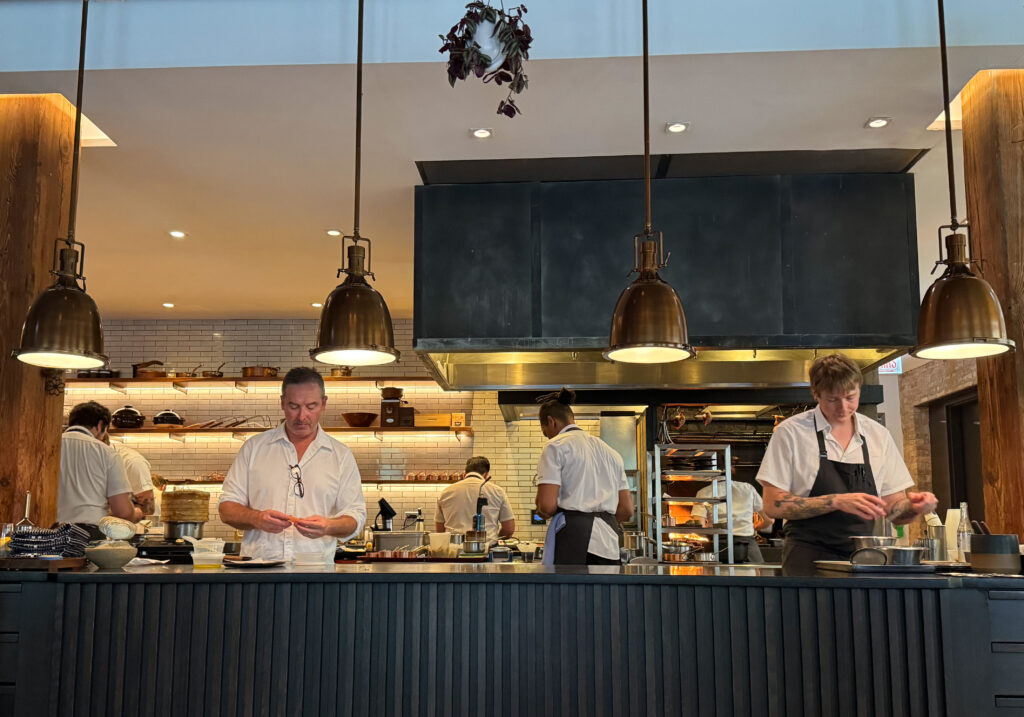
After regrettably cancelling a reservation here in June, I have been desperate to make my way back here: the restaurant that has inspired so much of my work and that, nearly 10 years later, remains capable of reinventing itself.
Chefs John and Karen Urie Shields—who met at Charlie Trotter’s and later shaped their distinctive cuisine in Chilhowie, Virginia—firmly anchored Smyth in a creative flux. From one to two to three Michelin stars, as mentors to (and collegial collaborators with) a whole generation of chefs, the couple has forever steered their concept toward the fringes of texture and flavor.
I do not fault any diner who misses the menus of the pre-pandemic era, whose pleasure (rendered via shima aji ribs, beef fat brioche donuts, and egg yolk licorice) felt so certain. What followed—fueled in part by the turn away from The Farm toward increasingly nationwide sourcing—was more challenging and amorphous: the study of nut oils, seaweeds, avocados, and all sorts of creamy, oozing sensations (applied to pristine produce, seafood, and meat mind you) that largely continues to this day.
However, philosophically, the choice was clear: either rehashing what was known to work (and could sustain a tidy, successful tasting menu for the foreseeable future) or following one’s deepest compulsions and curiosities wherever they lead. It’s tempting to cast the latter option as a descent into egoism—spurning all the enjoyment you can offer the broader public today for the sake of chasing what significantly fewer will understand.
Yet the Shieldses had already matured as craftspeople before Smyth even opened. Shifting the paradigm was not an abdication but a fuller surrender to the process that had gotten them there. Rather than reading the audience’s desires, they embraced nature’s bounty and mined their own. They developed a grammar of techniques and constructions that, even in the context of global gastronomy, lacked any obvious reference point. Doing so (and perpetually pushing their end product toward increasing extremes of refinement), they found a way to regularly conjure that most memorable, unexpected kind of pleasure in an industry rife with imitation.
To me, there’s a line connecting the cuisine of Smyth’s earliest years to that of today: the playfulness of certain constructions, the mastery of the hearth, a jarringly naturalistic manner of plating, and the unique intensity ingredients like sea urchin, crab, and lobster display in the chefs’ hands.
At the same time, you kind of have to squint to see it, and that’s what makes this particular moment so special: North America’s “number one” restaurant is completely untethered to any kind of orthodoxy or expectation. Smyth only climbed to this number one spot by being so unapologetically itself, and now the great dining public—no matter what they wish or hope the concept to be—will have to sit back and listen to what the kitchen has to say.
Those who decried the third Michelin star and surmised it would not be retained have to eat their humble pie and concede there might be something valuable about this cuisine that is not immediately apparent.
What will the team do when granted such a singular spotlight to display the fruits of a decade’s work?
Let us begin.
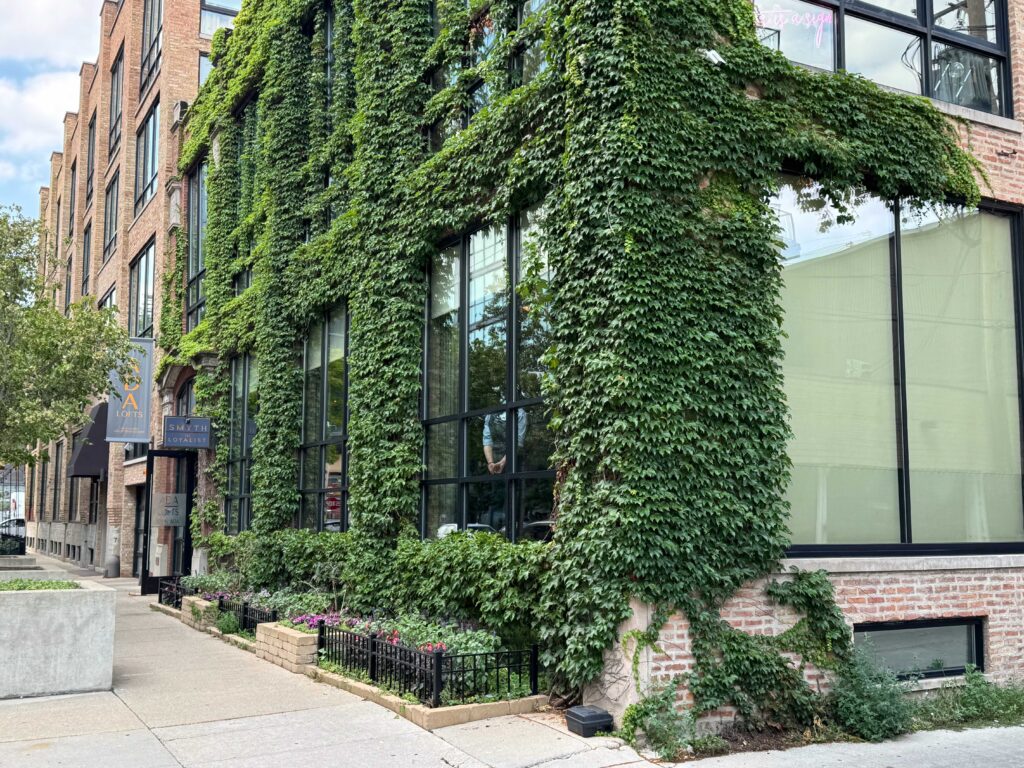
On the surface, dining at Smyth still feels very much the same as it has for the past ten years: involving a stroll up Ada Street (now a one-way), a glance at The Loyalist’s patio (now in the shadow of a condo tower), and one’s entrance through the door then up the stairs of an unassuming loft building whose façade has been increasingly surrendered to ivy,
The door to the dining room—marked with metal signage honoring that third Michelin star—frequently swings open to meet the restaurant’s guests. One stands, uncertainly, somewhere between the lounge and the pass as greetings are made and belongings are relieved. Then the party is led to table on the floor or along the banquette from which the nature of the space really takes hold: wood, brick, natural light, and nothing that screams for attention (or really suggests this highest level of luxury) save for the ratio of guests to staff and the clocklike precision with which the open kitchen operates.
Creature comforts are by no means neglected: cushions have been reupholstered, and a new set of armchairs (which debuted just a few months ago) provide greater support with a sleeker silhouette. Yet the focus here has always been the food rather than the flash and finery that frequently (and legitimately) make gastronomic experiences feel special.
According to the team, it was not so much Smyth’s gain of a third Michelin star as it was Alinea’s subsequent loss of their own that really changed the complexion of the crowd. “Less Rolex, more Richard Mille” was a pithy way of putting it—according with the fact that a certain demographic of diners, unwilling to settle for anything but “the best,” suddenly converged on one option instead of two.
Bibendum steered them toward the relative upstart with the challenging cuisine and none of the smoke and mirrors that easily charm consumers who (again, validly) find the wider sense of occasion more meaningful than a deep study of texture and flavor. Understandably, Smyth’s audience immediately became more difficult: paying Alinea money, with Alinea (or other global fine dining) expectations, for a performance that did not seem to be even trying to please them in the same way. Framed in this manner, a simple mismatch of stylistic preferences can leave a table feeling that Michelin, altogether, is running some type of scam.
The awarding of that “No. 1 in North America” title puts this same process into overdrive. For it’s one thing to be thought of as “the best” in a particular city and to stand among the finest worldwide but another to explicitly rank as the greatest restaurant on an entire continent (though Mexico is excluded).
Reservations (which, admittedly, had cooled slightly after a couple years holding that third star) suddenly quadrupled. Expectations have risen even higher and, with them, the difficulty posed by a new, eager audience with money to spend and no reason to necessarily care about the “how” or “why” of the Shieldses’ cuisine.
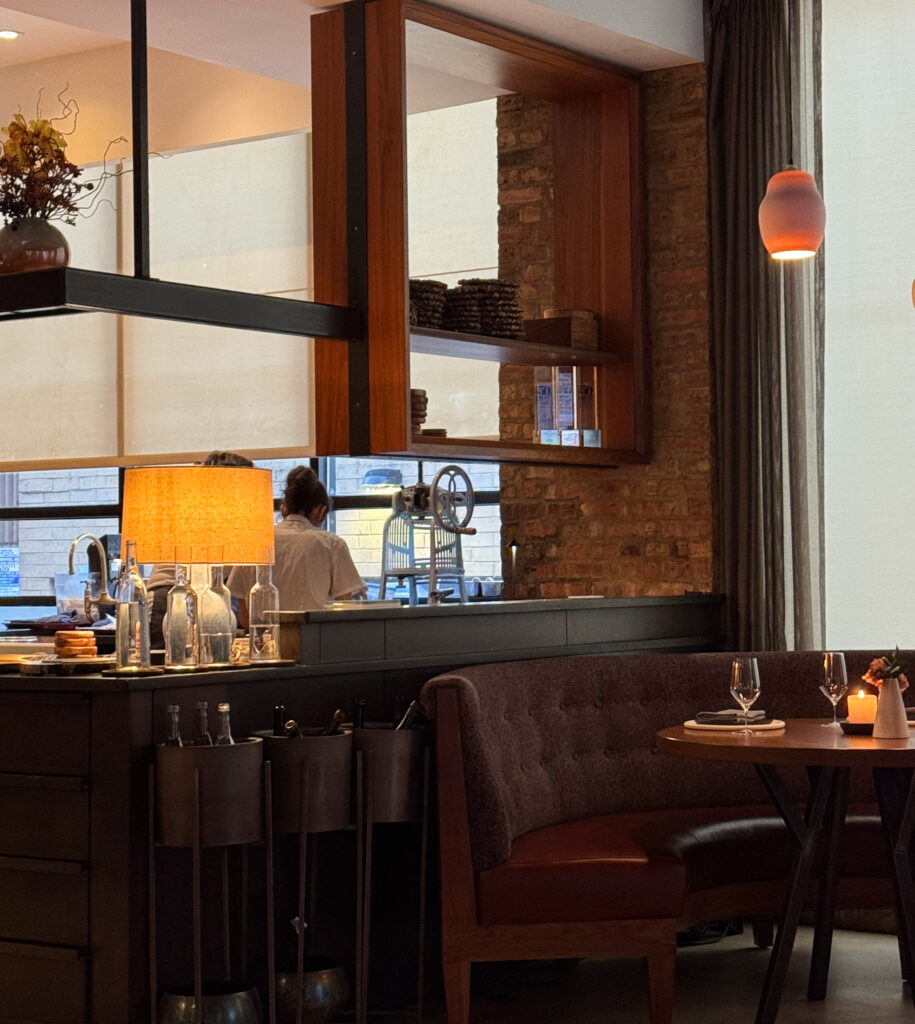
The restaurant’s operation is further complicated by a decision I mentioned back in May (and that directly preceded the 50 Best announcement). By removing a couple tables from the floor and staggering reservations across two clear turns, the team has pursued greater efficiency and the ability to serve more customers on any given night.
The timing, in a way, couldn’t have been better, but the restructuring of service has had a side effect. Barring cancellations, there’s absolutely no flexibility to accommodate changes (or squeeze people in) in the manner—fluid, easygoing, equipped to answer any request with a “yes”—that distinguished Smyth’s hospitality for so many years.
Admittedly, it’s a fair way to ensure that the restaurant, at this key moment, shares its vision with the widest population possible (even at a slight inconvenience to regulars or anyone making a special request). It also means that reservations—now being released on a rolling 90-day basis for the first time—are particularly coveted. Management has even considered putting the missing tables back and/or reimaging the lounge as a means of bowing to “consumerist pressure.”
Nonetheless, I am happy to report that the front of house team—led by general manager Cara Sandoval—continues to perform at a high level while safeguarding the essential spirit that has guided the concept through the past decade. Indeed, while the range of ingredients and techniques servers recite is enough to leave any table feeling flummoxed, any degree of efficiency being pursued remains balanced by a prevailing sensitivity, a willingness to linger, a desire for connection, and an overarching warmth that situates the food (however polarizing) as an expression of many souls working very hard to please while unwaveringly expressing themselves.
Shields, to his own credit, maintains the same schedule that has guided him through this most consequential era: being the first to arrive in the morning, directing his efforts toward the preparation of the menu’s foundational ingredients, setting aside time for further experimentation, guiding the kitchen through about the midpoint of service (frequently debuting a new recipe along the way), then going home and getting ready to do it all over again.
Certainly, showing face matters—particularly when a proportion of the audience might struggle to appreciate your work. But process (that is, the perpetuation of what actually brought Smyth to this mountaintop) remains king. Acting as a mere mascot for a menu that is ultimately static and cynical does nobody any good.
To hear the team tell it, Shields has never been more confident in his vision or willing to follow his inclinations wherever they may lead. If that sounds reckless (in the face of so many first-timers who, no doubt, would love to taste the “greatest hits”), it’s also incredibly brave and immensely rewarding for anyone who has gone along for the ride since 2016.
That said, if there’s one reliable weapon Smyth continues to wield in its satisfaction of globetrotting, cosmopolitan taste, it has to be Louis Fabbrini’s wine program.
I cannot really speak to the nature to the nature of the entry-level “Smyth Pairing” ($245)—which, considering the price of the core tasting menu ($420), might be the turnkey option many parties choose to complete their experience. The selection, from what I can see, leans natural and limited production without descending into outright weirdness.
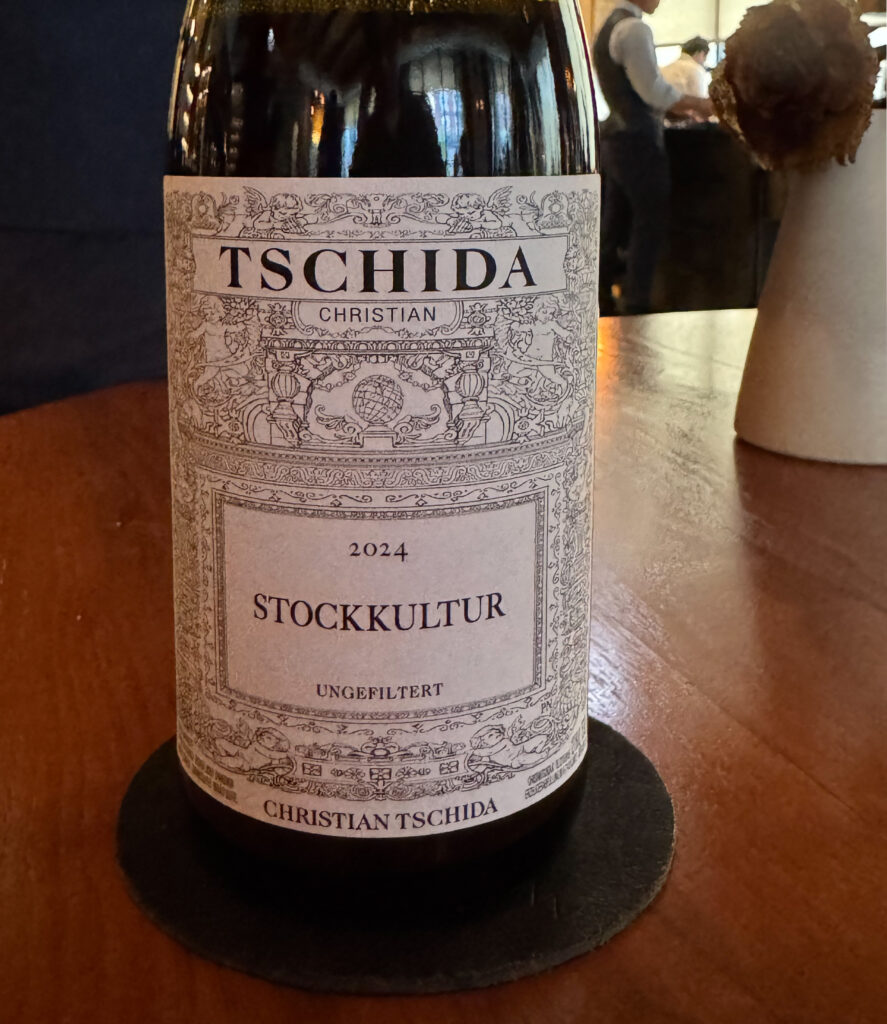
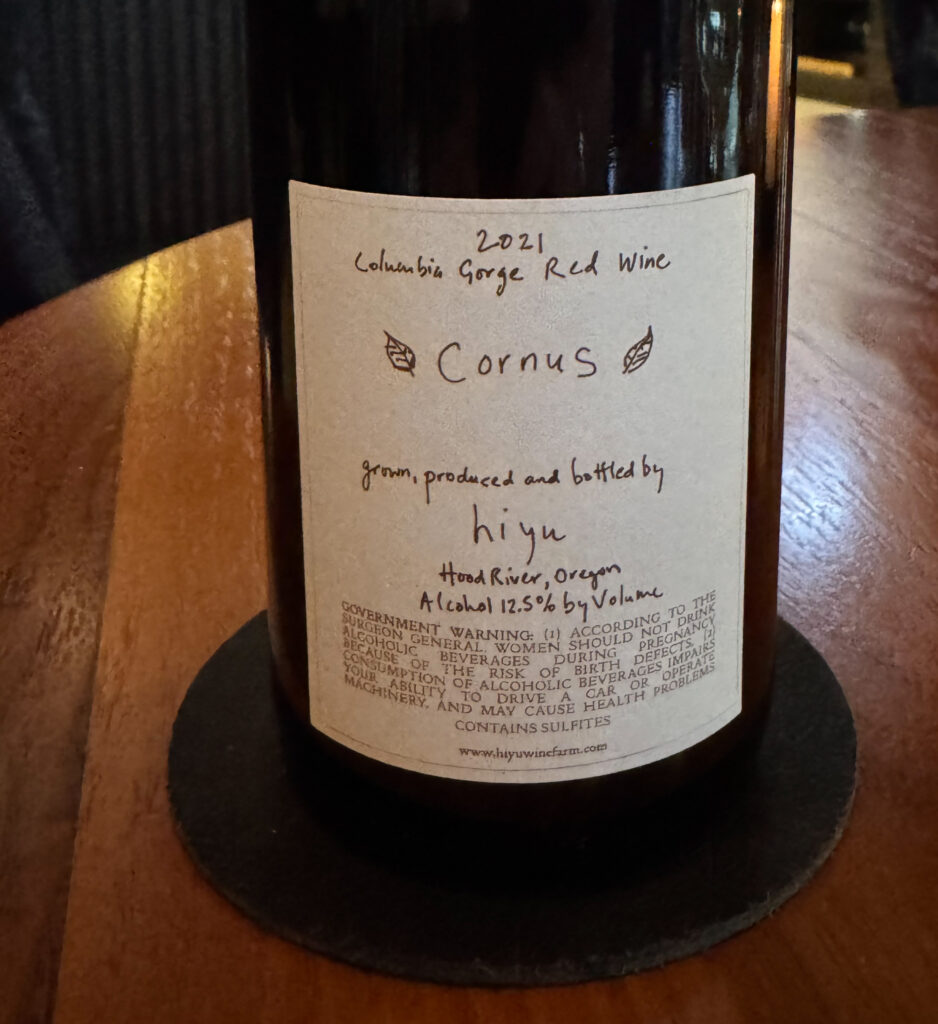
Rather, mirroring the cuisine, some chosen producers (like Antica Terra and Schätzel) subvert expectations of what certain ingredients (i.e., grapes like Chardonnay or Riesling) are capable of. Others (like Christian Tschida and Hiyu) push conventional palates beyond any easy point of reference. But the greater purpose is to encourage a sense of discovery: one that rejects the tired tropes that afflict food and wine alike in favor of a singular encounter with the chef and sommelier’s ever-changing dialogue. I won’t pretend everyone will like the chosen lineup, yet they also won’t find the constituents being poured anywhere else in the city.
Those seeking greater control will undoubtedly ask for the bottle list, where they will find wines from Marguet, Peter Lauer, Nanclares, Chandon de Briailles, and Enderle & Moll offered by the glass and a wide array of both esteemed estates (like Allemand, Bernard-Bonin, Cédric Bouchard, Ulysse Collin, Conterno, Dagueneau, Dujac, Keller, Comtes Lafon, Lafleur, Prévost, Rinaldi, Romanée-Conti, Rouget, Roulot, Soldera, and d’Yquem) and cult favorites (like L’Anglore, Cantalapiedra, Chavost, Comando G, Les Jardins de la Martinière, Labet, Maison Maenad, Pedres Blanques, Roagna, Robinot, Saalwächter, Savart, Stella di Campalto, Suenen, Takahiko, Valette, and Wasenhaus) throughout.
I won’t dwell too much on pricing, but it’s worth mentioning that the coveted domaines from the first category are only marked up around 75% on top of retail price (with some cuvées approaching 0% or even falling below retail). In turn, many of the producers from the second category are scarcely available at retail at all, yet they are offered for small premiums (e.g., 25% or 50%) on top of fair retail pricing that undercut the speculation one might find on the secondary market.
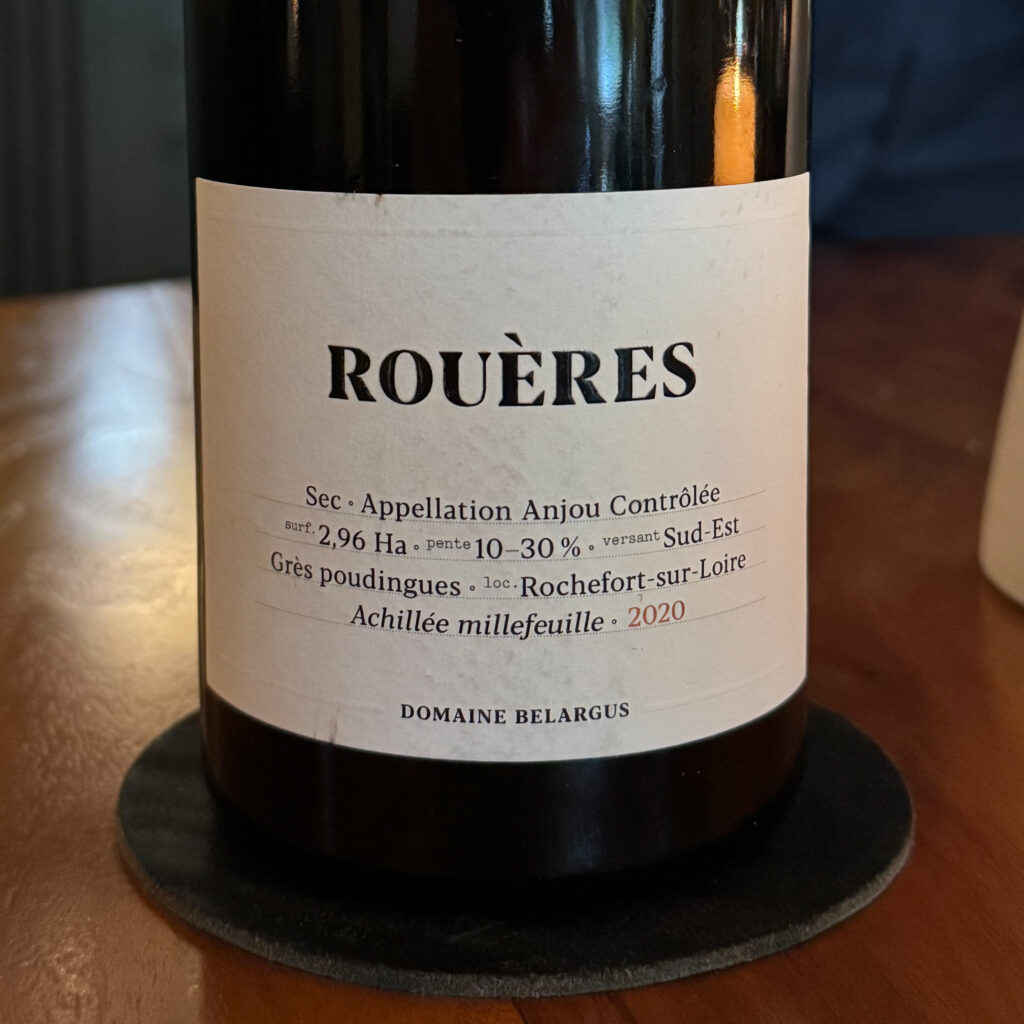
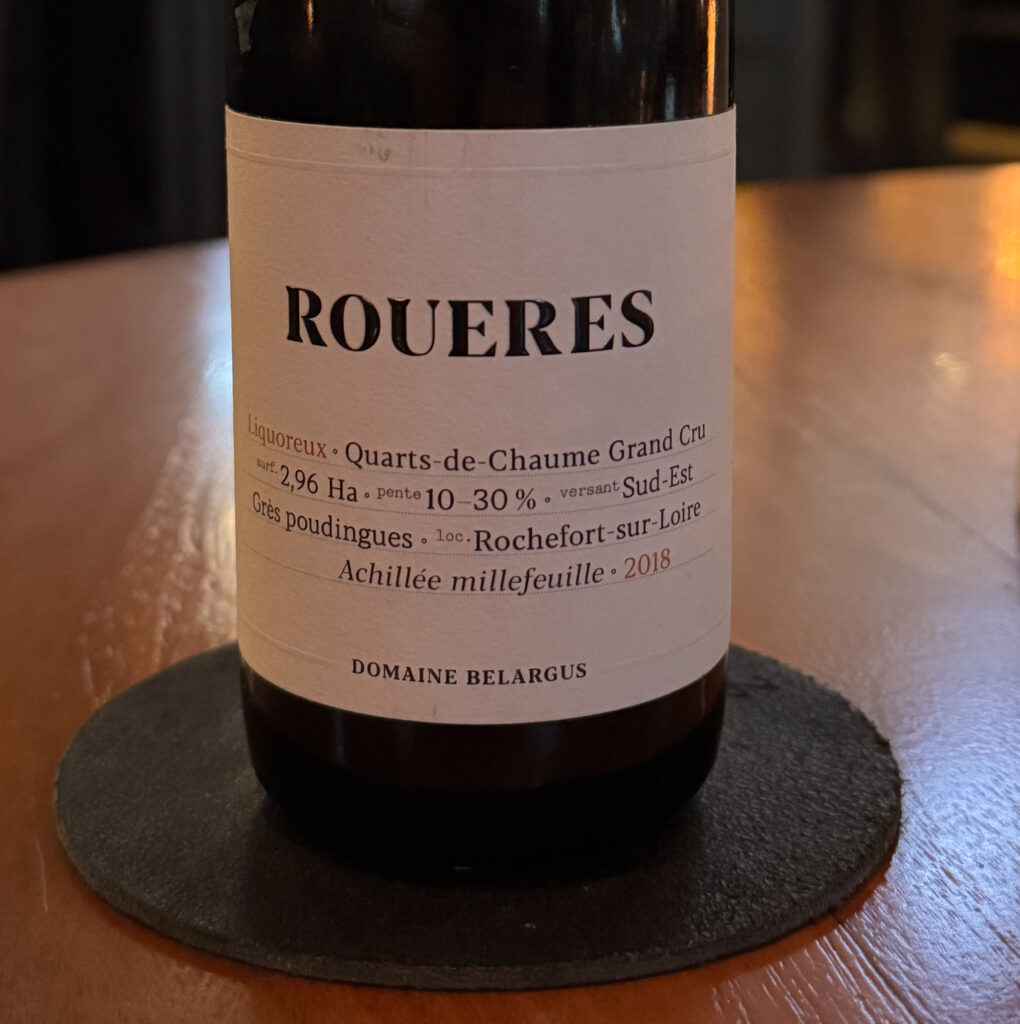
Of course, there are outliers that skew higher—and that are, I think, a consequence of greed being shown by people further up the pipeline. Yet, overall, Fabbrini’s inclination is to be both consistent and friendly in how he sells these wines. Doing so, he makes choosing something from Smyth’s cellar feel like a proper celebration.
For most concepts, I’d end things here: no set flight is ever going to rival a bottle or two that an individual diner picks out for themself. However, the “Reserve Pairing” ($475) has always formed the highest expression of Fabbrini’s talent, and it’s the sort of rarefied offering that those seeking the best experience at the country’s best restaurant might increasingly spring for. Yet, rather than presenting an opportunity to squeeze once-in-a-lifetime diners for a little more lucre, this pairing always punches way above its weight. I might go so far as to say that it forms the only way to really get a full sense of Smyth’s identity.
This evening’s selection is as follows:
2020 Domaine Belargus Anjou “Rouères” [$125 at local retail]
2018 Domaine de Bichery Champagne “Périscope” [$137 at international retail]
2023 Scholium Project Mt. Veeder Chardonnay “Sous Voile” [$65 direct to consumer]
2018 Pierre-Yves Colin-Morey Corton-Charlemagne [$650 at national retail]
NV Llewelyn “Second Grace” [$36 at national retail]
2024 Christian Tschida “Stockkultur” Pinot Noir [$114.99 at national retail]
2021 Hiyu Wine Farm “Cornus” [$149 global average price]
2001 Domaine Leroy Nuits-Saint-Georges “Les Vignerondes” [$3,034 at international retail]
2016 La Sorga “Allé Canto” [$115 global average price]
2018 Domaine Belargus Quarts de Chaume Grand Cru “Les Rouères” [$79.44 for 375mL at national retail]
Now, if someone doesn’t know the philosophy that guides the “Reserve Pairing,” I can see them getting nervous when faced with an obscure Chenin Blanc, a limited-production (i.e., 180 bottles) Champagne aged underwater, and a Napa Chardonnay that drinks like oxidative Jura. But—never mind the fact that these cuvées actually go quite well with the opening seafood—the secret to Fabbrini’s work is how he uses unique, characterful, yet altogether cheaper bottles to make room for a couple bonafide heavy hitters.
Suddenly, alongside a dish of lobster and caviar, one finds a pour of PYCM’s immensely concentrated (and surprisingly tense for a 2018) Corton-Charlemagne. The lineup then veers back toward an intriguing Gewürztraminer/Nebbiolo rosé (alongside trout) and dual expressions of Pinot Noir (Austrian with abalone, Columbia Gorge with lamb sweetbread). Nonetheless, the sequence—what the sommelier calls a study of the Burgundian grape—would not be complete without a benchmark example: an aged Domaine Leroy any oenophile would dream of tasting (and that even the most privileged, cynical snobs would find to be a surprising headliner for a mere $475 pairing).
From there, things get a little weird again (with a solera of late-harvest Alicante Bouschet served alongside a chanterelle and currant dessert). Then the meal ends sweetly with a rich, botrytized version of the same Chenin Blanc that accompanied the start of the menu.
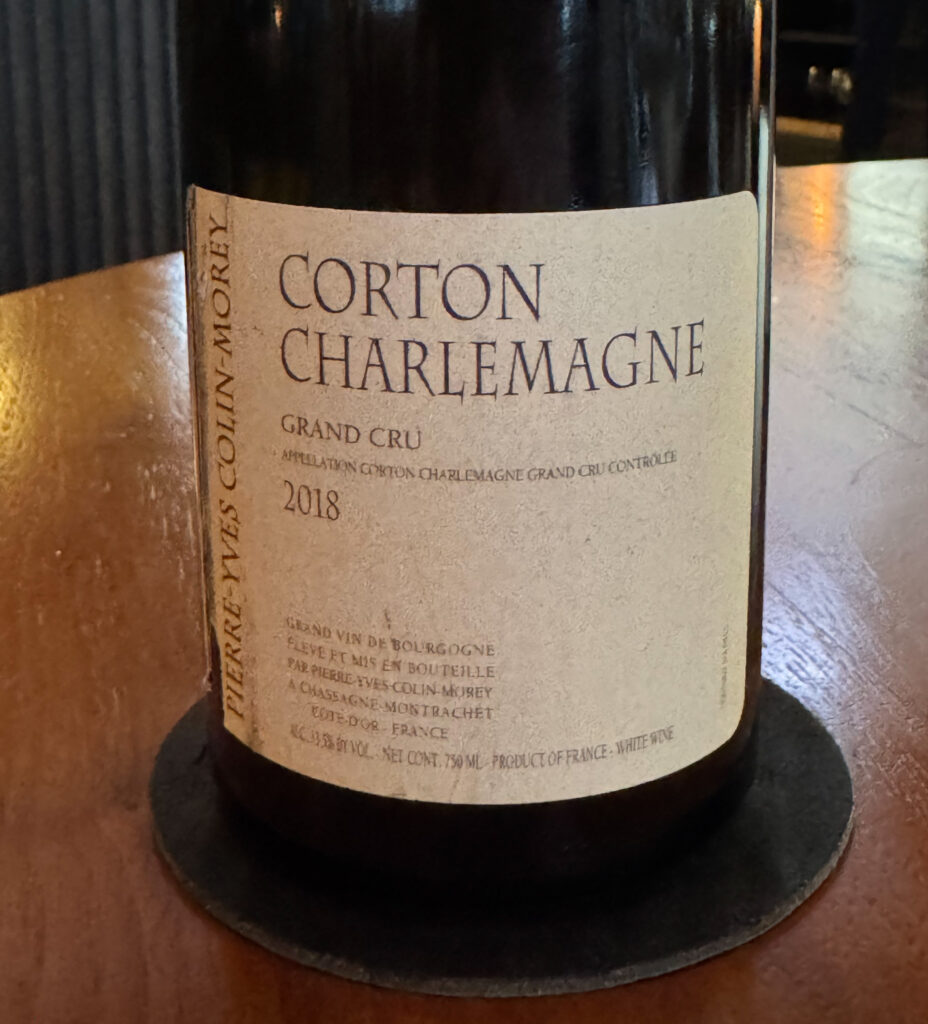
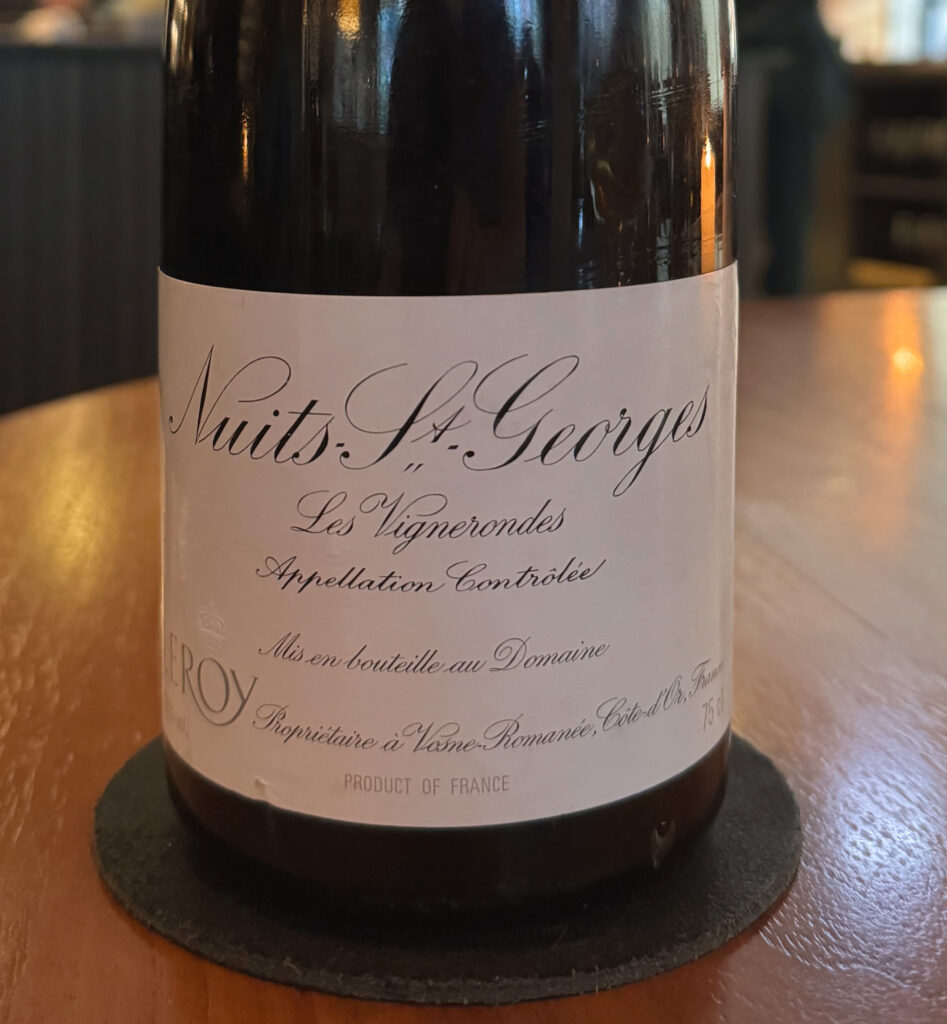
This flight, by balancing sequences, callbacks, and outright oddities with absolutely superlative offerings from classic regions, mimics Shields’s own culinary style: which may explore fringes of texture and flavor across several courses before—with seeming effortlessness—dropping a preparation of meat or shellfish (or maybe even a donut) that ranks among the most memorable, immediately pleasing items a guest has ever eaten.
By locking Smyth’s most limited and valuable bottles behind the “Reserve Pairing” pricing—and ensuring the highlights cost exponentially more than anything you could get off of the list for a similar figure—Fabbrini clears room to experiment with a palette of esoteric grapes and winemaking techniques that is entirely his own. With the restaurant’s support (and through his own close collaboration with the chef), the sommelier continues to shape a program that effectively doubles the sense of discovery that characterizes the tasting.
Ultimately, it’s not a journey driven by ego or the kind of mind—so endemic in this profession—that feels the need to push the public in accordance with iconoclastic taste. Drinking here, as with eating here, demands a degree of untethering from convention and expectation. However, if you play along and weather the occasional challenge to your preferences, you’ll be handsomely rewarded: not just with something that does, indeed, tickle your fancy but with that rare chance at scaling an emotional peak you didn’t even know exists.
With the drink order now settled, the “Chef’s Menu” ($550) begins.
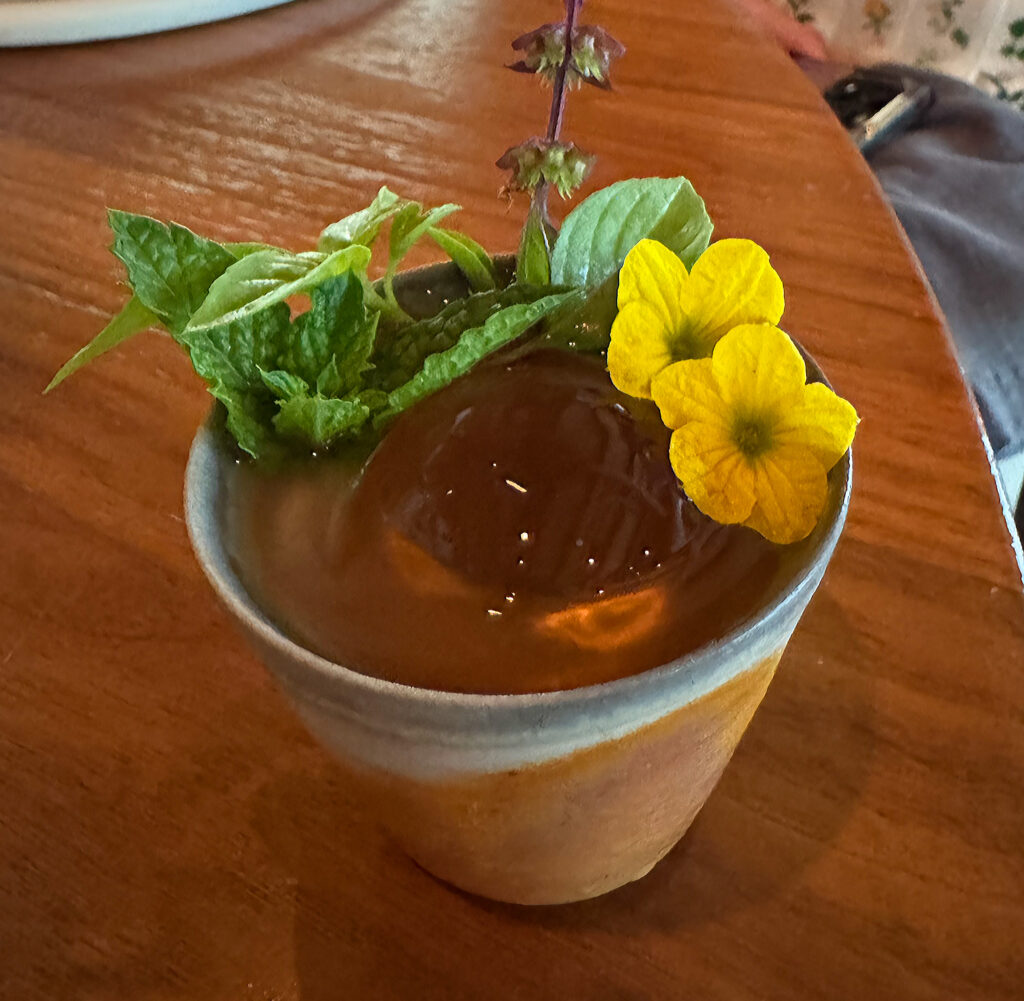
Tonight, it does so on a somewhat familiar note: with a pour of “Cucumber Kombucha” that represents Smyth’s latest work with this longstanding, fizzy form. The current iteration—flavored with white tea and opal basil then refermented with a cucumber oleo saccharum—comes attractively adorned with herbs, flowers, and a clear sphere of ice.
On the palate, the kombucha strikes a crisp, clean, and refreshing note that only displays the mildest bit of sweetness on the finish. For the present season, I think it’s pleasing effect: one that remains rather approachable while still surpassing (in terms of depth and cohesiveness) the various teas and juices being served at the start of other tasting menus in town.
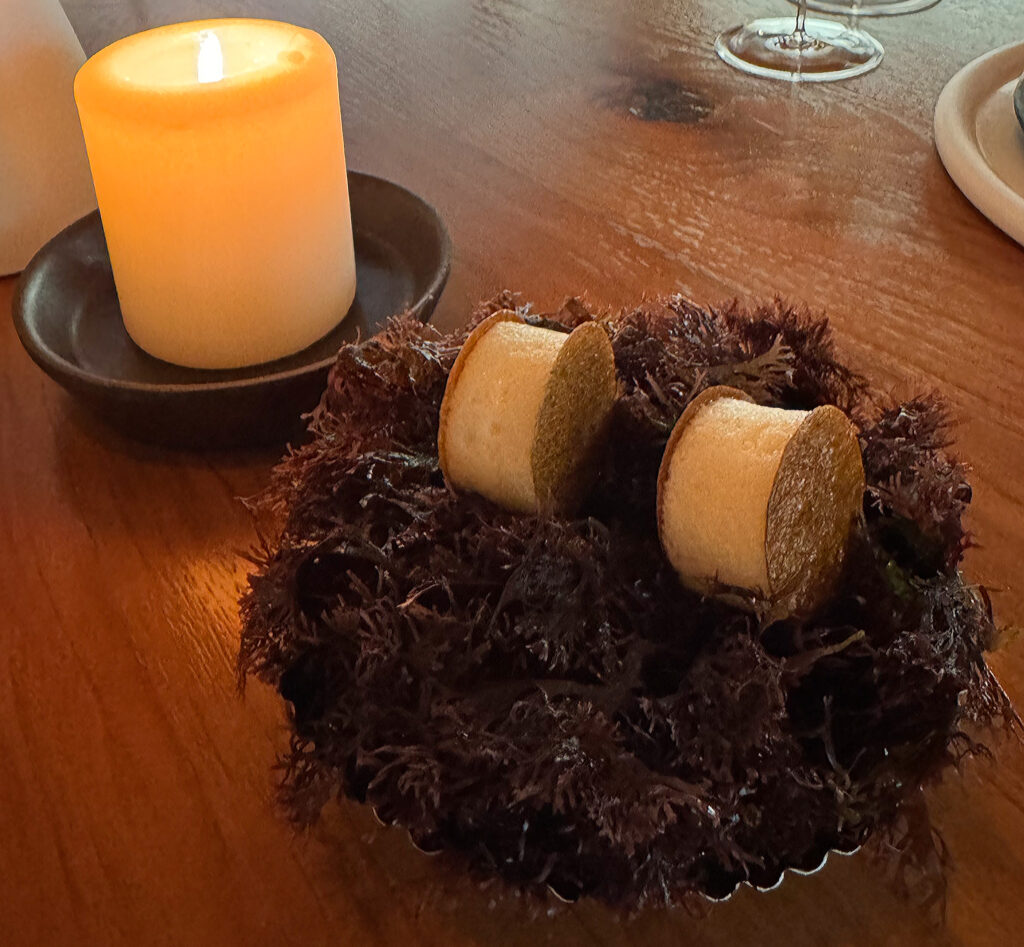
Joining my drink, the “Sungold & Dulse Sandwich” is entirely new to me. Structurally, the “bread” component—perfectly circular chips made from the titular seaweed—reminds me of all those brittle tarts the kitchen has habitually served during this early stage of the meal. And yet, their gossamer crispness is used to frame a soft, springy sponge of Froggy Meadow Farm tomatoes (rather than the layers of cream and fudge and kelp that traditionally feature).
For anyone who has found those emblematic textures to be grating, the present sensation (so compact and seamless) will offer a breath of fresh air. Personally, I find the package quite charming too, for the Sungold sponge retains an ample degree of tanginess on entry only to reveal a delectable interplay of umami and sweetness through the finish. Overall, this almost feels like something that would be served at Alinea—save for the fact that the core expression of flavor aims so squarely at enjoyment rather than hollow intrigue.
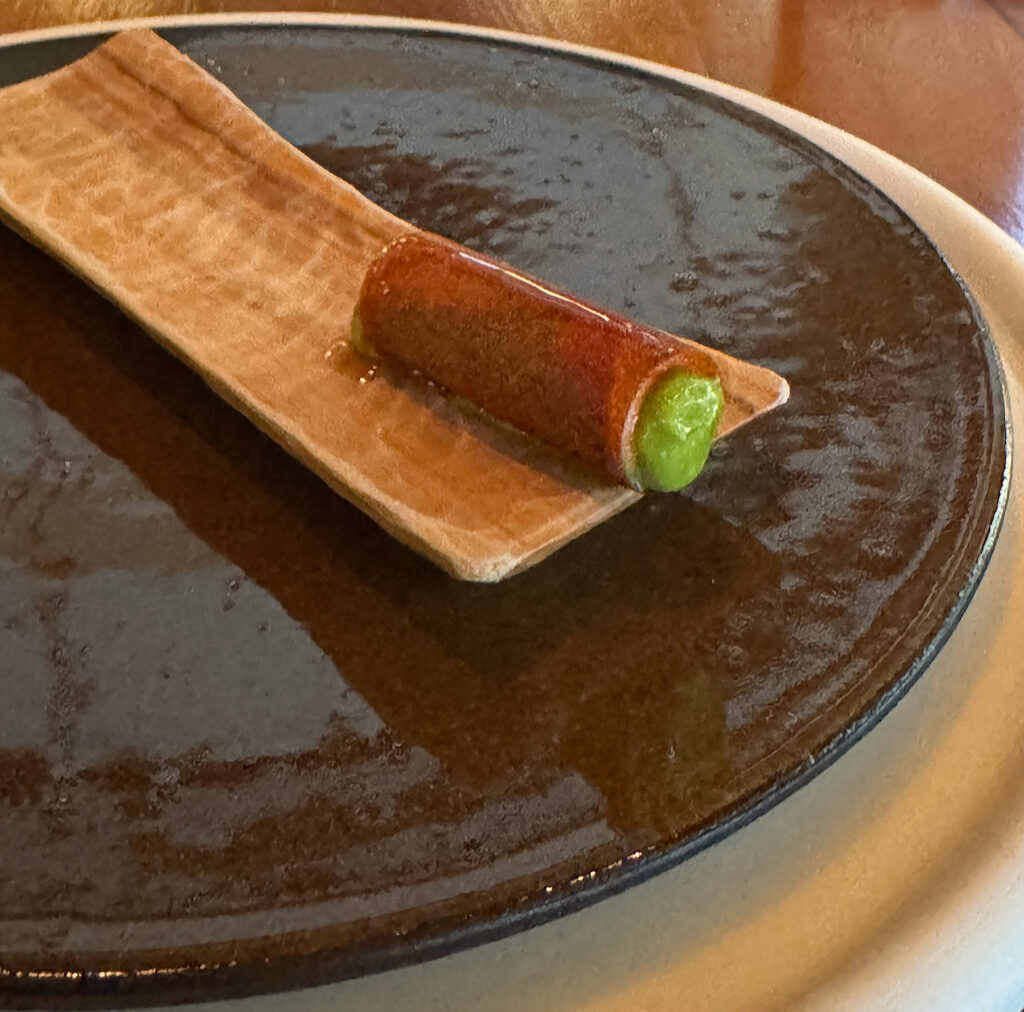
Arriving next, a “Sea Urchin Cannoli” looks to transform this longstanding, playful recipe (an enoki version appeared as recently as May) into a particularly decadent opening bite. By my measure, the present, streamlined construction actually makes for a friendlier introduction to Smyth’s distinct style too.
Here, a slender potato shell (being notably more narrow than usual) is filled with the headlining uni and capped with a dab of parsley stem cream. A drizzle of habanada oil is then used to lacquer the exterior of the cannolo, forging a mouthfeel that is triply smooth and silky yet offset by a delicate crunch. That said, the flavor proves most memorable: with the tropical tones of the pepper and sharp grassiness of the parsley perfectly accentuating the sea urchin’s own profound oceanic depth. The ingredient’s clarity—revealing a maddening touch of sweetness on the finish—is truly amazing, and it testifies to how masterfully Shields engineers luxury tropes like this whenever he chooses to do so.
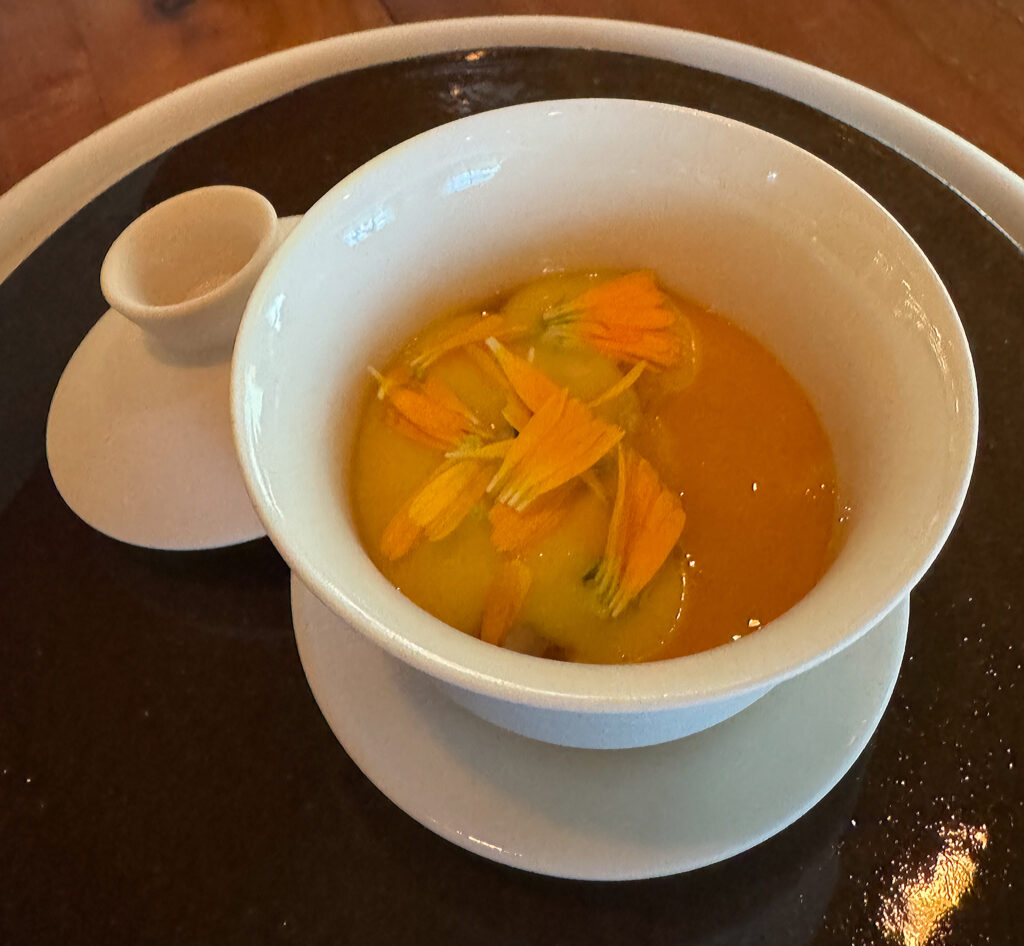
Listed alongside the uni on the menu (though served just a few minutes later) is a “Dungeness Crab ‘Tamago’” that builds upon one of the runaway hits from my meal in May. Back then (the very day of the recipe’s debut), this dish appeared near the midpoint of the meal as a transition toward richer sequence of trout. Tonight, it stands among the openers: being fashioned more like a composed “chawanmushi” than the freeform plate it formerly comprised.
The core idea—combining rich egg, fresh shellfish, strong underlying umami, and a complicating burst of florality—remains the same, yet it is now elaborated using a soft scramble (instead of an “omelet skin”), a barley koji (instead of an amazake), some calendula petals (instead of tulip), and dashi. On the palate, the contents of the bowl feel attractively soft and gooey. It’s hard to sense those threads of crab are even lurking below. But the resulting flavor—combining a refined, persistent egginess with notes of citric tang and sweetness—is beautifully cohesive. I only wish it displayed the same underlying savory power that made the previous iteration so memorable.
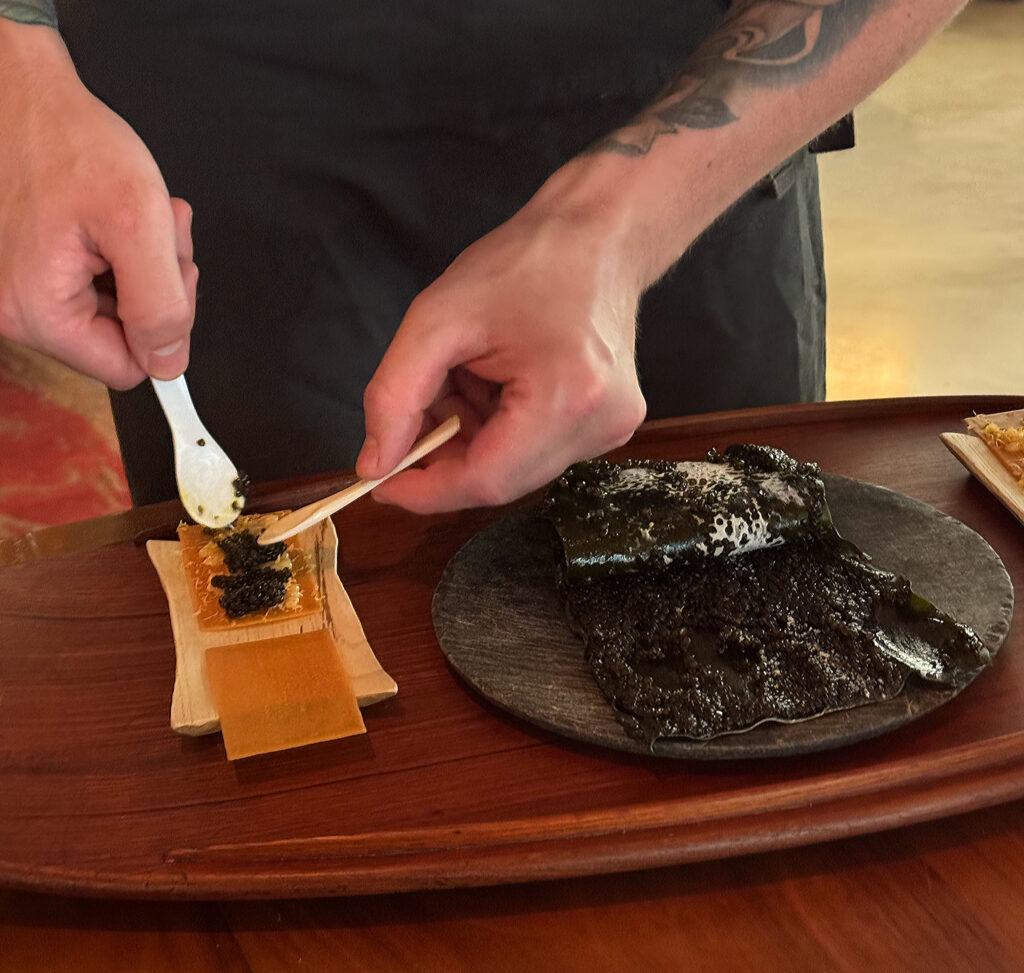
New to the menu, the “Sweet Corn Kombujime” (a term that traditionally refers to the curing of fish between sheets of kelp) adapts the restaurant’s work with this slender sandwich form—last seen in March holding foie gras and black truffle—into something more of a tableside flourish.
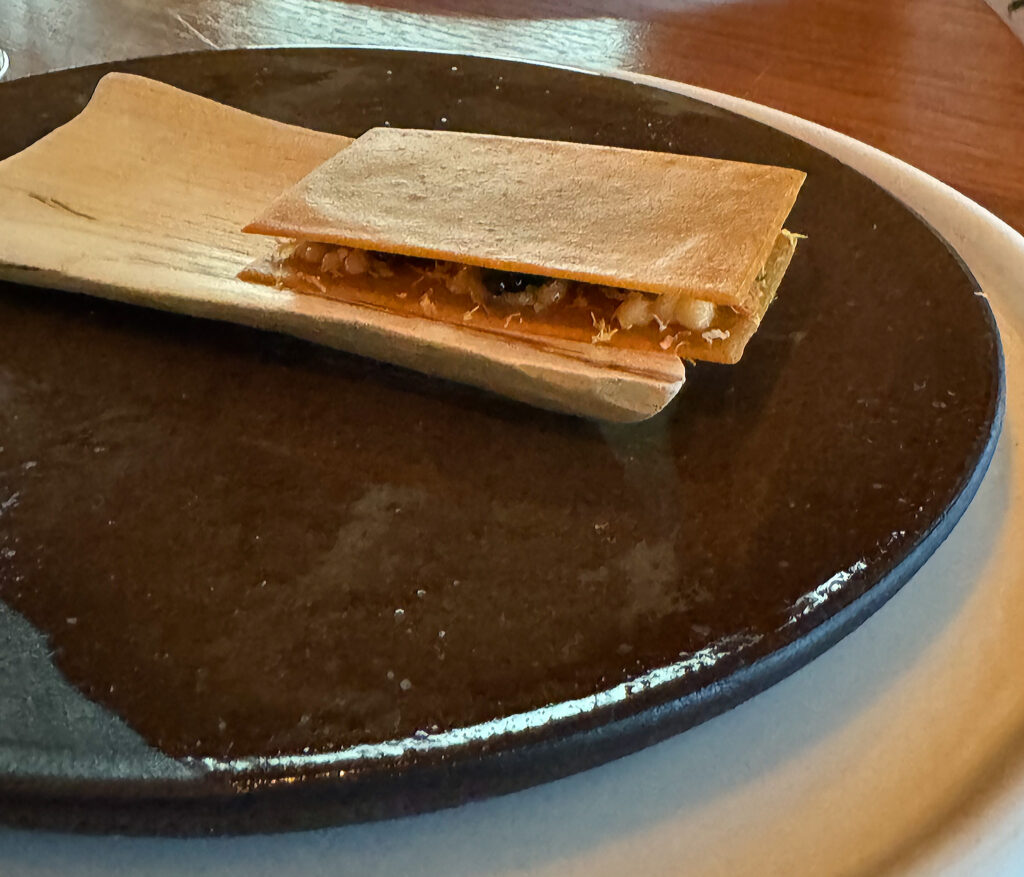
On this occasion, the wafers are made from fermented Jimmy Red corn. One side comes dressed with both butter and a cream made from last season’s preserved sweet corn. Kaluga caviar (which Smyth continues to source from N25) forms the final filling: being generously scooped from its seaweed wrapper, blanketed across the surface, and carefully encased by the other wafer.
Texturally, the sandwich retains the extreme degree of delicacy (i.e., that fear of it breaking apart) for which the form is known, and this actually does a nice job of showcasing the fleeting, creamy structure of the roe. Nonetheless, it’s the resulting imprint of salt, brine, nuttiness, and a striking, almost tortilla-like quality through the finish that proves most distinctive. Indeed, the caviar almost functions more as a seasoning for the corn than a star in its own right. Enjoyed alongside a paired pour of Champagne, this bite is sublime.
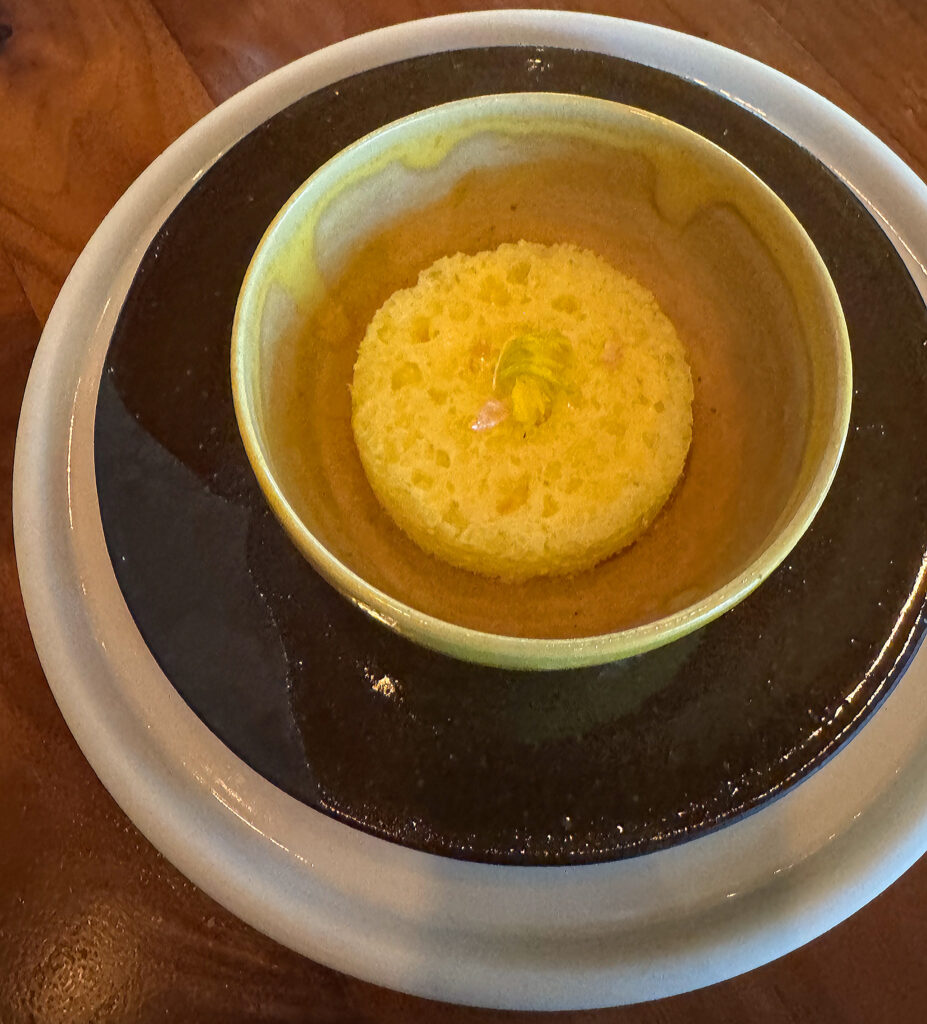
Perhaps acknowledging that the preceding item didn’t really touch on the sweeter side of corn we all know and love, the kitchen follows it with a “Corn Parfait.” This construction (which showcased Maine uni in May and March) typically centers on a cloudlike form whose ephemeral nature is countered by decadent dressings. Given the directness of the sea urchin cannoli, I actually like seeing corn—whose profile is more familiar and riper for deconstruction—step into this role.
Here, the corn cloud is simply served atop an egg yolk (sourced from a flock of Spence Farm hens that is fed barley koji) set within a corn custard. On the palate, the juxtaposition of the meltier top layer with the richer, creamier consistency on the bottom is expectedly pleasing. Yet, breaking with the kombujime, the resulting flavor rests entirely on a concentrated note of sweetness: so freshly, supremely corny and offset (i.e., further accentuated) by hints of salt and sharpness. Really, as with the sea urchin, it’s startling what kind of purity Shields can achieve when he makes that his mission. Overall, this makes for one of the evening’s very best dishes—and almost, in a sense, a callback to (and fulfilment of) what the tamago was trying to achieve.
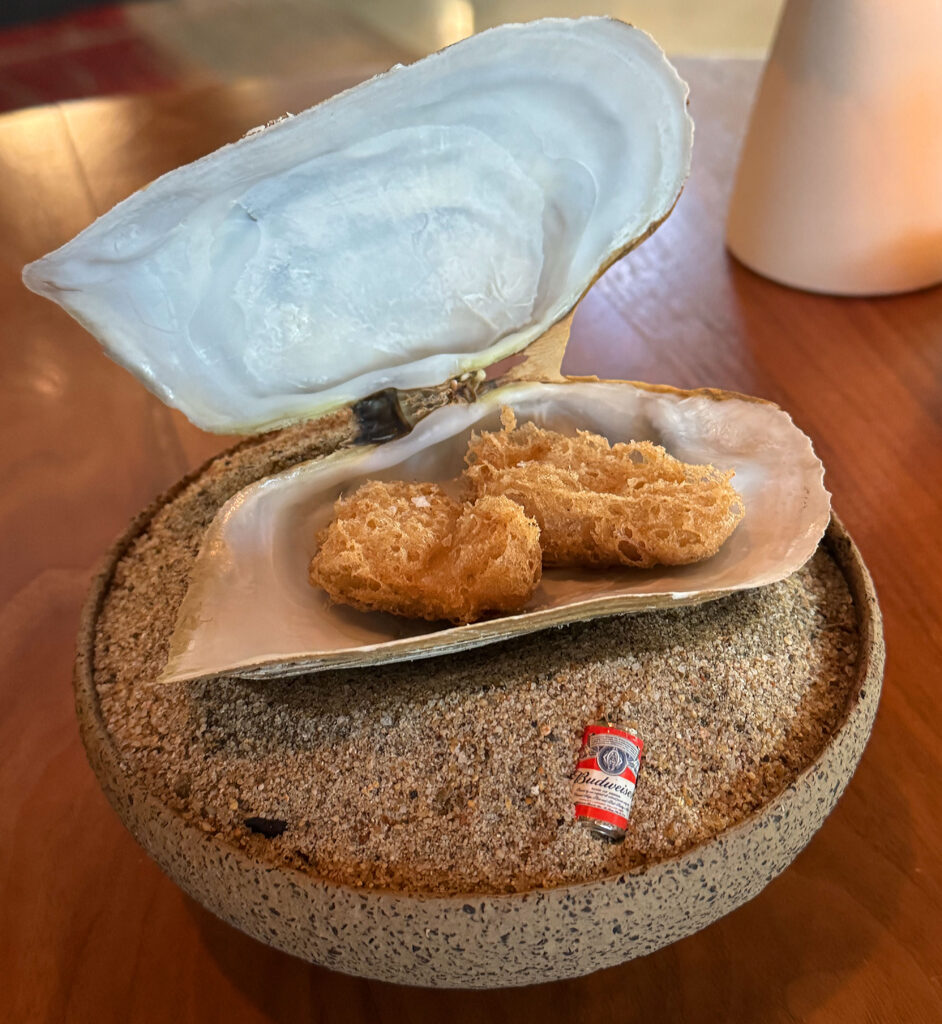
The menu’s next, entirely new two-part sequence moves away from seasonal produce and back to shellfish: namely, that most coveted (and perhaps strangest) of bivalves. The “Geoduck Belly” kicks things off, comprising a tempura-fried section sourced from the middle from the shell (that is distinct from the slivers of the neck utilized in most preparations).
This simple—yet charming—presentation demands nothing more than an accompanying squeeze of lemon. That citrus helps to draw out the mollusk’s mild, latent sweetness. Nonetheless the star here is the texture: finely crisp, surprisingly soft, then moist and cohesive in a manner that almost reminds me of sweetbreads. While I do think this recipe could be taken to another level with the inclusion of a bolder sauce, I cannot deny that its relative simplicity is utterly thrilling. The belly ranks as one of the highlights of the night, and I really hope it doesn’t leave the menu any time soon.
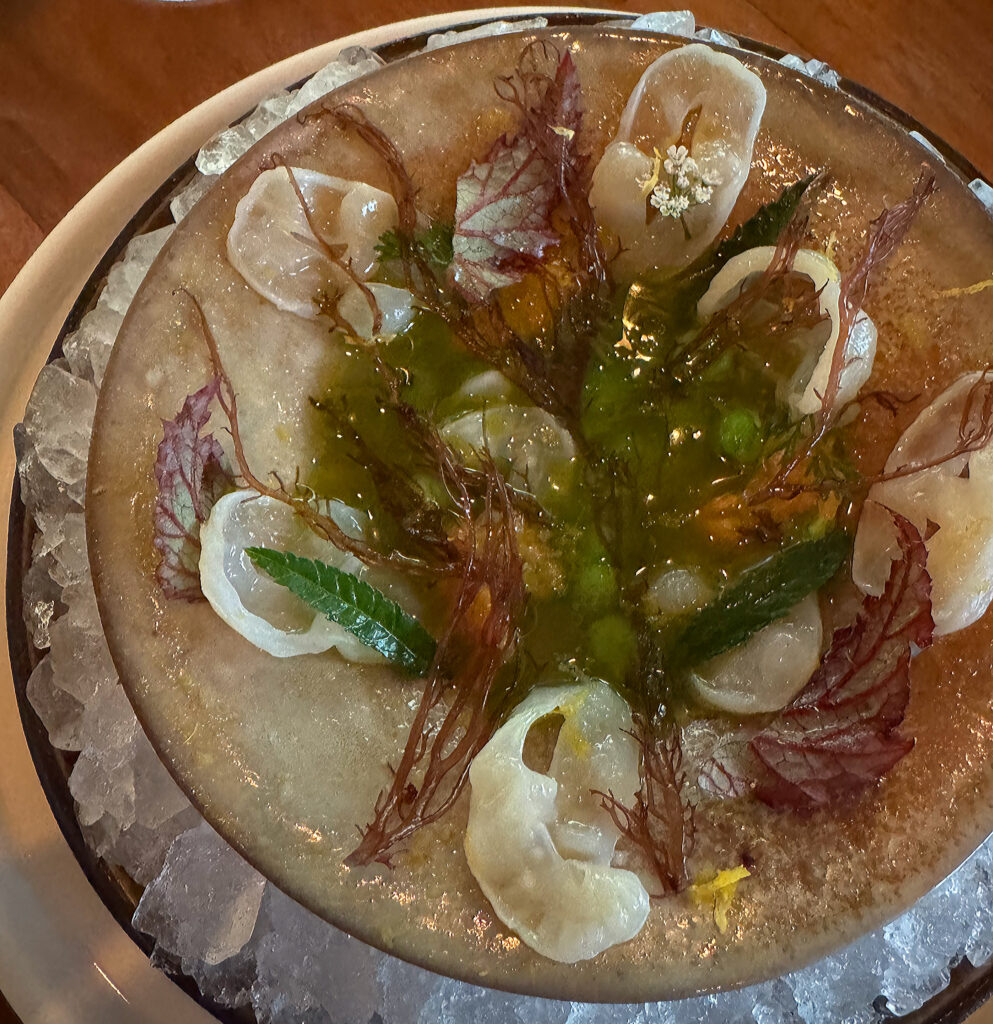
The “Geoduck Aguachile,” by comparison, follows in a longer line of dishes (featuring tomato or trout or oyster) that have centered on this bright and spicy form. The present construction comes loaded with dragon fruit, snap pea, maple-leaf hibiscus, and dulse all dressed in a jalapeño-derived chili water.
The bivalve, in this case, is rendered as thin slices of sashimi taken from the neck: offering a subtle sense of chew (avoiding any jarring crunch) that turns soft and tender with further mastication. The accompanying flavor, in turn, spans tang, sweetness, heat, and a pronounced greenness that I consider to be a Smyth hallmark. Still, I think the recipe could use a touch of salt to really sing, and I am almost left feeling that its profile (more complex but less decadent) might actually make more sense before the tempura belly.
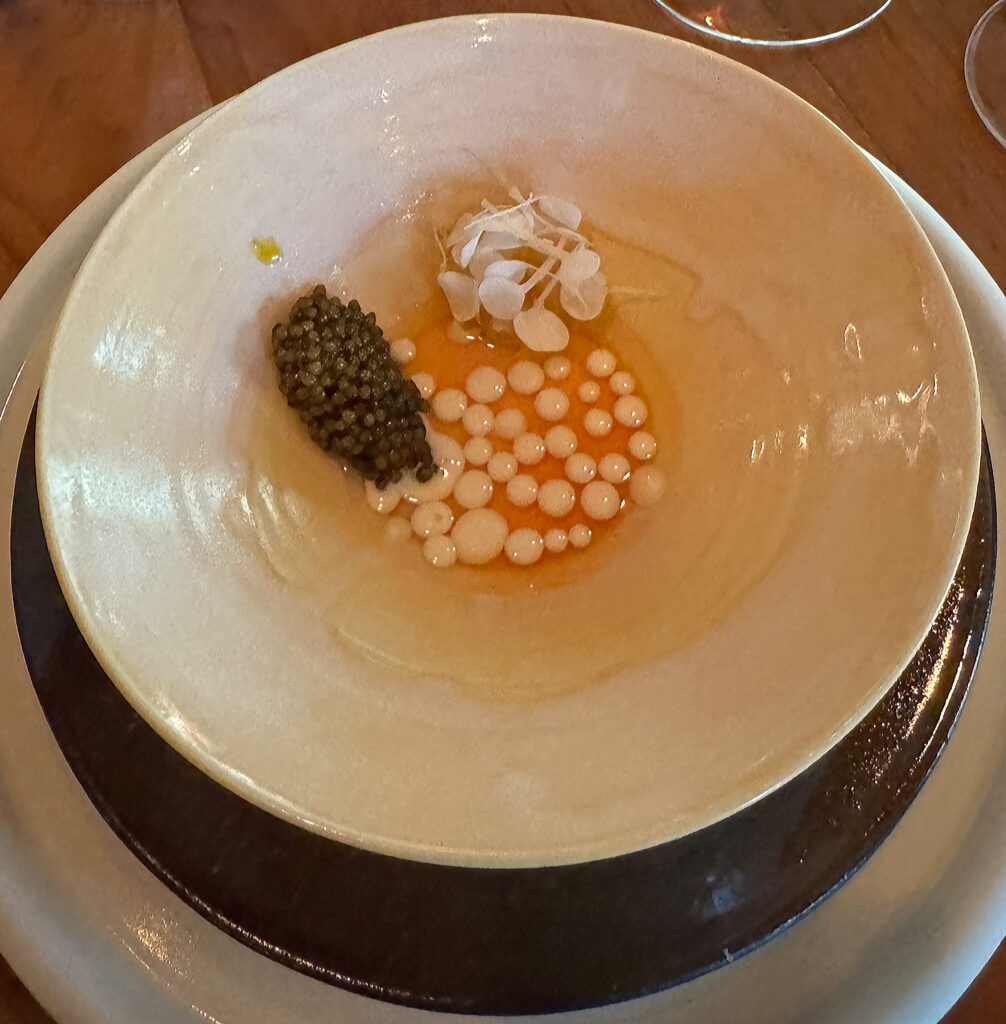
The arrival of the “Maine Lobster & Caviar” feels especially decadent after enjoying so much of the same roe as part of that kombujime dish. It also marks the restoration of an older signature recipe that was excised in favor a green walnut/horseradish cream composition that (in May and March) did not always leave me feeling satisfied.
The essence of this idea never really left the menu—it was simply scaled back and tucked into a ramekin or sea urchin shell during the first half of the year. Here, however, guests are invited to fully savor the meat of the lobster’s claw with alternating scoops of N25 Kaluga and a layered dressing of pink radish gelée, Marcona almond milk, and hazelnut oil. Compared to the rush of the wafer sandwich, it’s quite a thrill to assemble each individual bite and revel in each creamily coated orb of caviar. The balance of flavor, too, is expertly judged: with milder notes of tang and fresh vegetable yielding to a deeply nutty, milky sweet sensation through the finish. In short, this remains a signature for good reason.
The next two-part sequence celebrates the spring-raised, sustainably sourced rainbow trout (from Virginia’s Smoke in Chimneys hatchery) that has formed one of the chef’s obsessions this year.
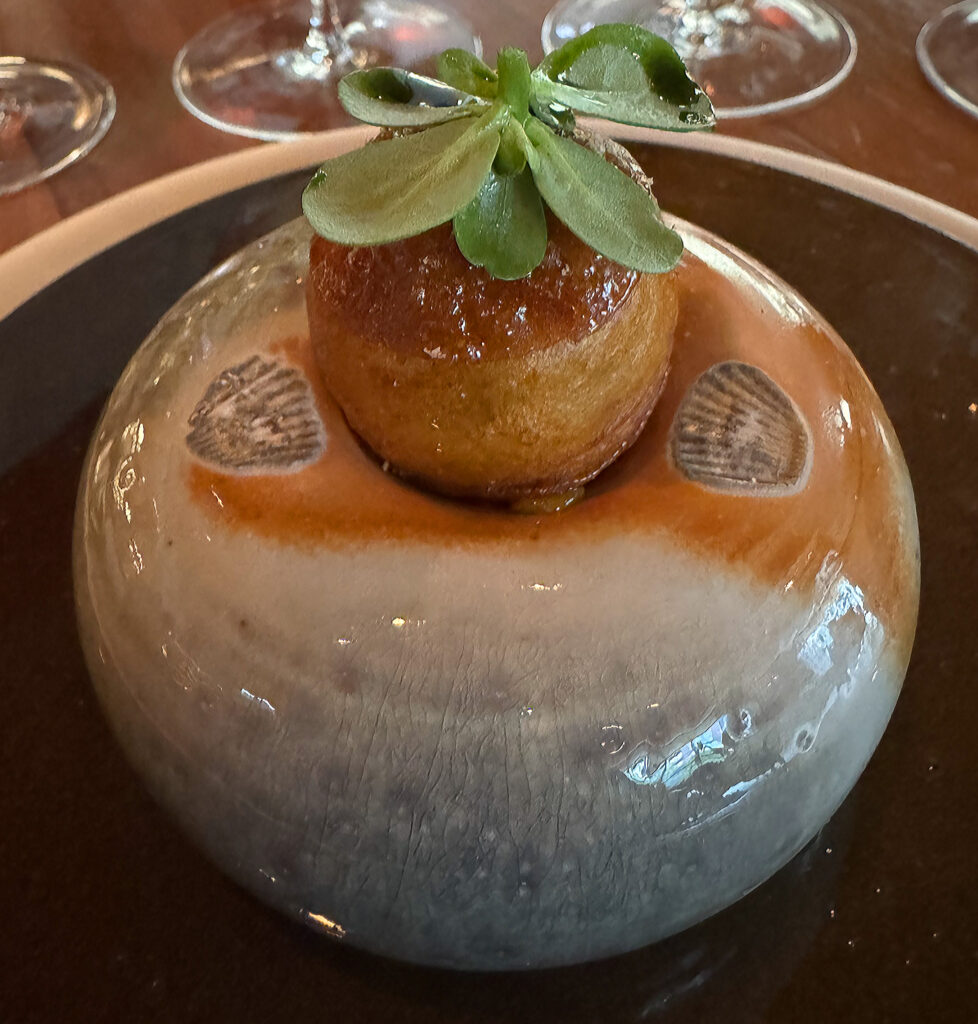
First, there’s the familiar “Smoked Trout Donut”—stuffed with a portion of the fish’s belly, some mustard greens, and a yeasted pastry cream (serving to replace the Pleasant Ridge Reserve that previously featured).
An apple butter tuile and some purslane complete the presentation, which marries brittle, leafy, and gooey, mouth-coating textures in a manner that breaks from prior iterations. The mildly tangy, lastingly sweet flavor that follows aligns more with my expectations, yet I’m not sure that the sharper, leafier notes make for one of my favorite renditions.
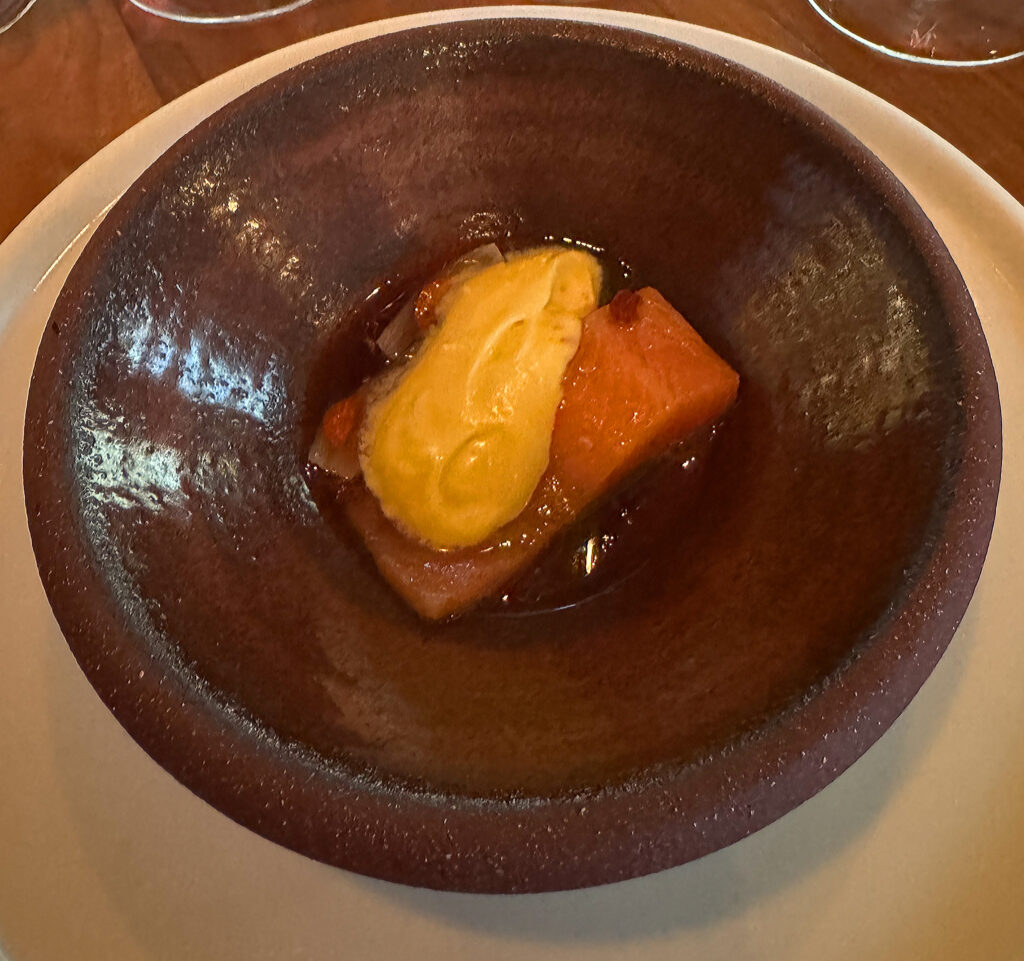
Second, the “Rainbow Trout & Blueberry Ponzu” represents a clear evolution from the foam-covered, green guava-inflected preparations that appeared during my past two meals. The fish used here (rendered as a neat fillet) has been aged for 15 days, confited in brown butter, and, other than the titular sauce, comes dressed with caramelized onion and a dollop of saffron cream.
On the palate, it’s impossible to fault the degree of butteriness (contrasted by crisp segments of allium) the trout has achieved. However, the recipe’s flavor profile is lean and tangy and a little bitter—even irony—rather than delivering the degree of richness and satisfaction one might expect. Certainly, there’s something intriguing about the assembled notes (including just tinge of heat from some shishito in the ponzu), but I’m not sure I really comprehend what this dish is going for. Maybe a stronger sense of umami would help these dissonant qualities gel?
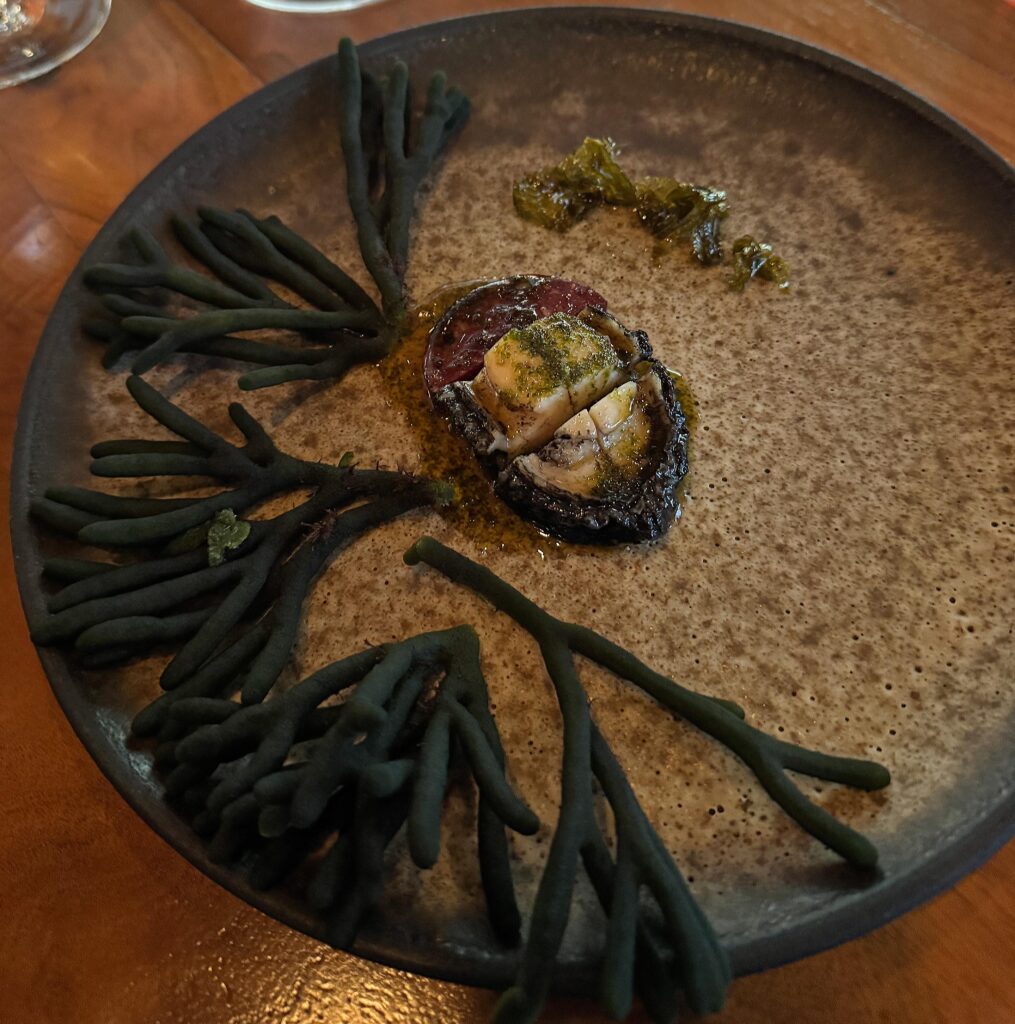
With the arrival of the next course, the menu gets back on track. In fact, the “Abalone & Boudin Noir” represents a new take on a coveted mollusk that really impressed me when it made its debut in May.
Here, thick chunks of the starring shellfish come braised in veal stock and laced with candied sea lettuce. The titular blood sausage is placed just off to the side: providing a sense of plumpness that mirrors the extraordinary tenderness (albeit framed by a pleasing, carnal chew) the kitchen has coaxed from the abalone. While the resulting flavor is more powerfully tangy and sweet than anticipated, these notes do not dominate. Rather, there’s enough brine and blood and umami at hand to ensure the dish effectively bridges the gap from seafood to meat. Overall, Smyth’s work with abalone might just form the restaurant’s most rewarding pursuit of 2026.
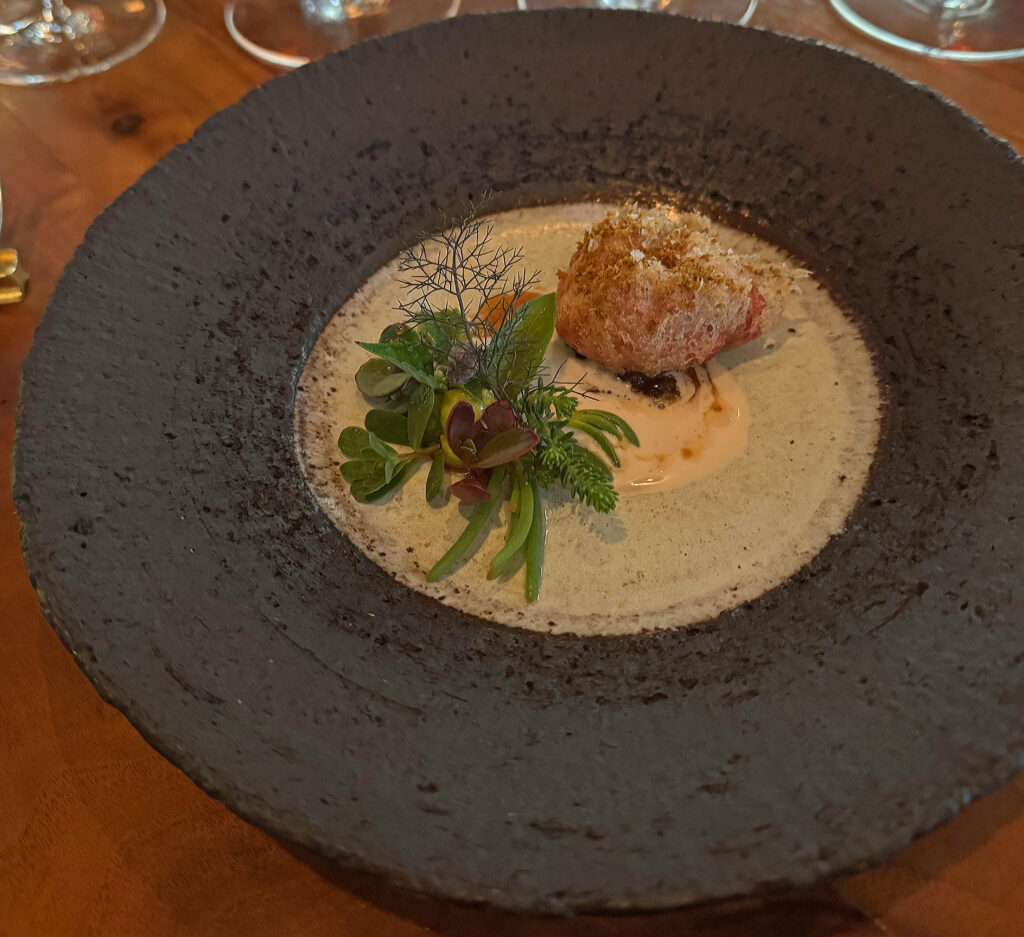
The “Lamb Sweetbread & Poblano Pepper” also offers a new take on an ingredient that debuted (or, more precisely, returned to the menu after a long absence) in May. On that occasion, the offal was paired with rather interesting—though captivating—flavors of mushroom, jelly fungus, and dried caviar.
However, presently, the sweetbread is poached in court bouillon and fried in a manner that is reminiscent of the geoduck belly (i.e., after being coated in a blue barley tempura batter). A succulent salad (set atop a cream made from the titular pepper) and some virgin peanut milk complete the presentation, which—texturally—centers on the juxtaposition of the craggy-gooey offal, the crunchy-leafy greens, and the slick sauces. Flavor, in turn, is built upon a base of savory, nutty, and earthy intensity that I find quite appealing. However, a freshly sweet quality (both from the milk and the succulents) helps to provide definition, and it ensures that this fried treat ends up feeling rather clean. In sum, this forms another highlight.
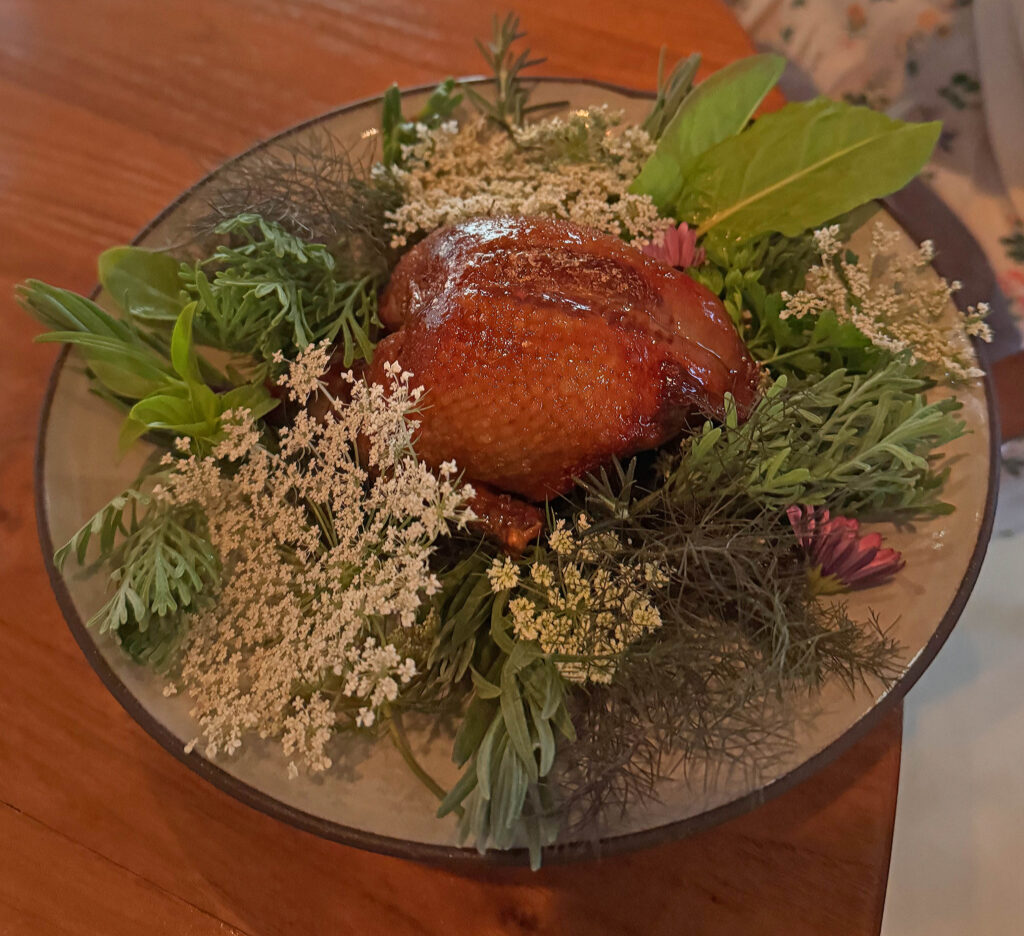
At this stage in the meal, one of the cooks presents the Devil’s Gulch Ranch squab—pan-seared, finished in the hearth, garlanded with herbs and flowers—that will headline the final savory course. Nonetheless, while the bird is being carved, guests are given one other serving of meat to mull over.
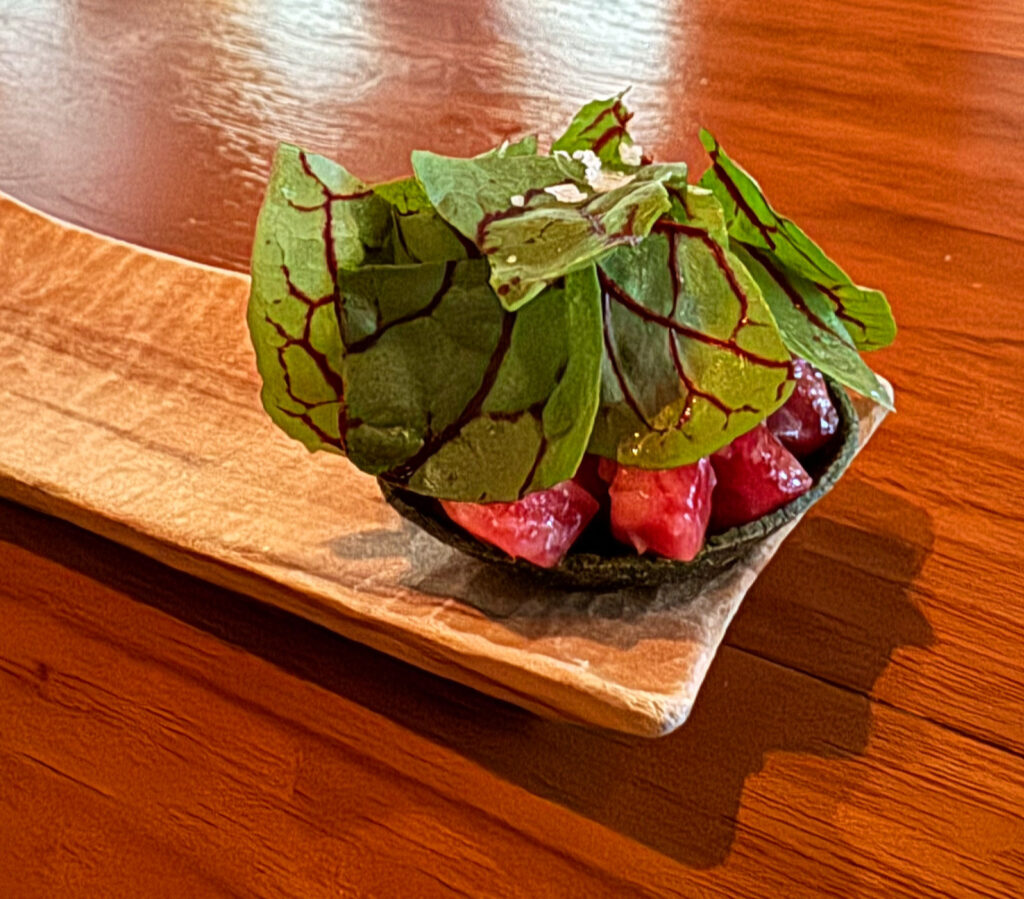
The “Lone Mountain Wagyu Beef Tartare” celebrates the same steak (sourced from full-blood Japanese cattle in New Mexico) Smyth has offered on its menu for many years. Yet, packaged in a sea lettuce tart, these fine cubes of flesh (which have been gently warmed in aromatic fat) strike with a unique force.
Indeed, the accompanying blend of lovage, red sorrel, ramp vinaigrette, and wasabi blanket the succulent tartare with sharp, grassy, and sweet (both allium and anise) tones that play off the tartare’s considerable beefiness while ensuring its richness is steered toward a more uplifting finish. Overall, this makes for a bite of unquestionable finesse that also helps to break up the larger plates that characterize this section of the menu.
The main course, once it returns to the table, comprises three distinct parts:
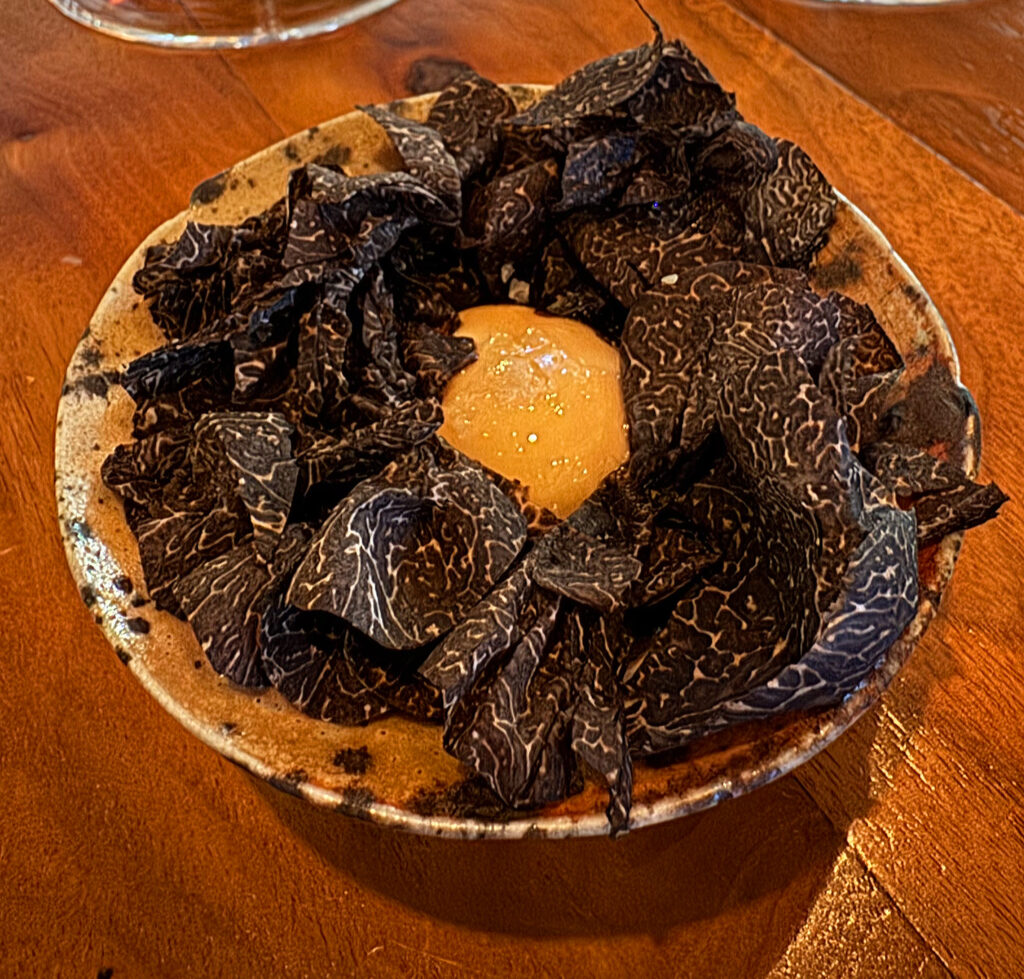
There’s the “Black Walnut Cured Quail Egg”—something of a signature bite whose blend of gelatinousness and sweetness (the latter drawn from elements like a caramelized onion consommé) is something I typically struggle with. The present iteration adds a touch of elephant garlic to the mix.
However, the generous shavings of Australian black truffle are what really dominate: blanketing one’s palate with their fleeting firmness, imparting a huge concentration of earth and musk, yet cushioning the egg in such a way that its plumpness, richness, and woodsy depth still sing. For my palate, this ranks as one of the more acceptable examples of the form. Still, I’m not sure this recipe (no matter where I place it in the sequence) has ever struck me as being truly delicious.
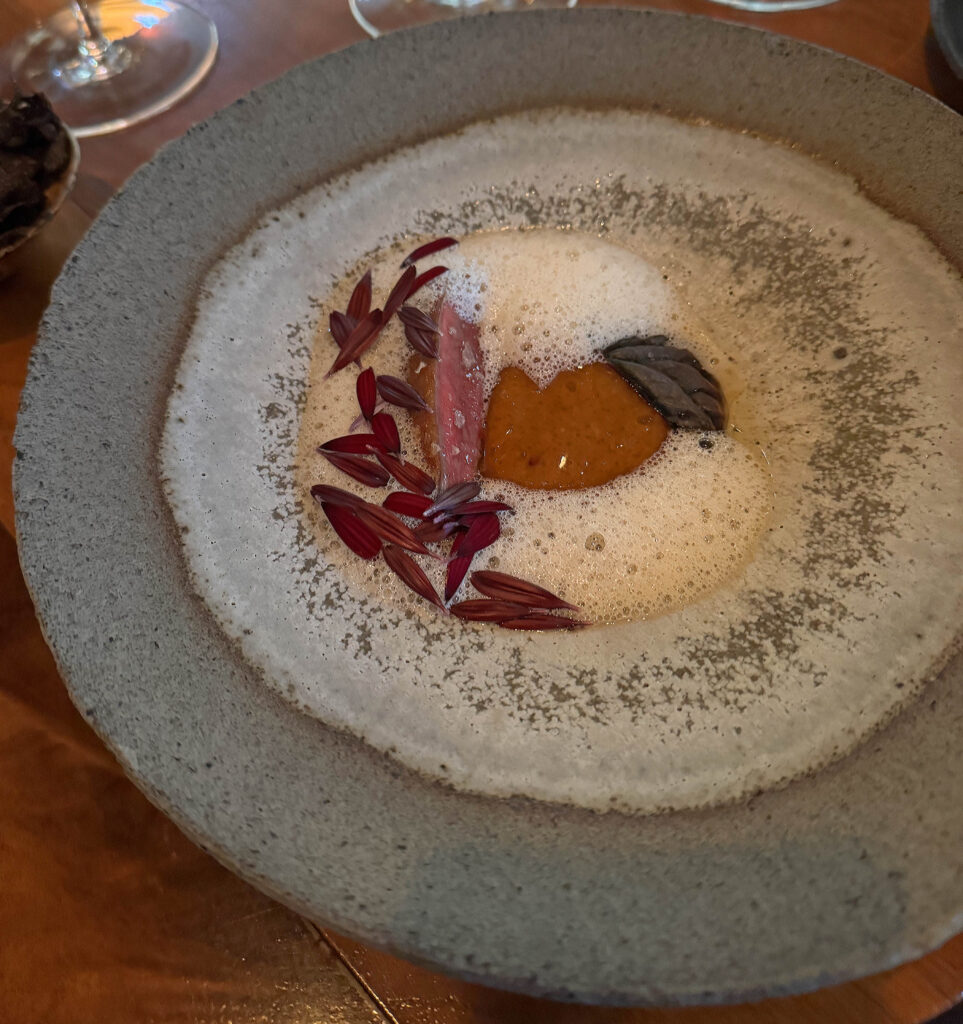
The “Devil’s Gulch Squab” itself is served with the same sprouted grain porridge and pepperleaf that I encountered in May (components that also shaped an earlier preparation devoted to Vermont quail). Nonetheless, the addition of a wine gelée, a chanterelle nage, and some daisy petals ensure that the present iteration is distinctive.
Texturally, the bird itself possesses a wisp of crispy skin, a pleasing hint of chew, and a pronounced juiciness that is highly appealing. Its natural flavor, too, is strikingly savory yet clean and refined. I recall that the kitchen has stuffed this breast with boudin noir in the past, so it’s really remarkable to see just how delicious the meat is on its own. But the supporting sweetness (from the gelée), subtle tang (from the flowers), and layered earthiness (from the grains and mushroom) further amplify the squab’s latent umami. This all makes for an entrée of considerable satisfaction that—paired with the Domaine Leroy—stands among Smyth’s best work during this later stage of the meal.
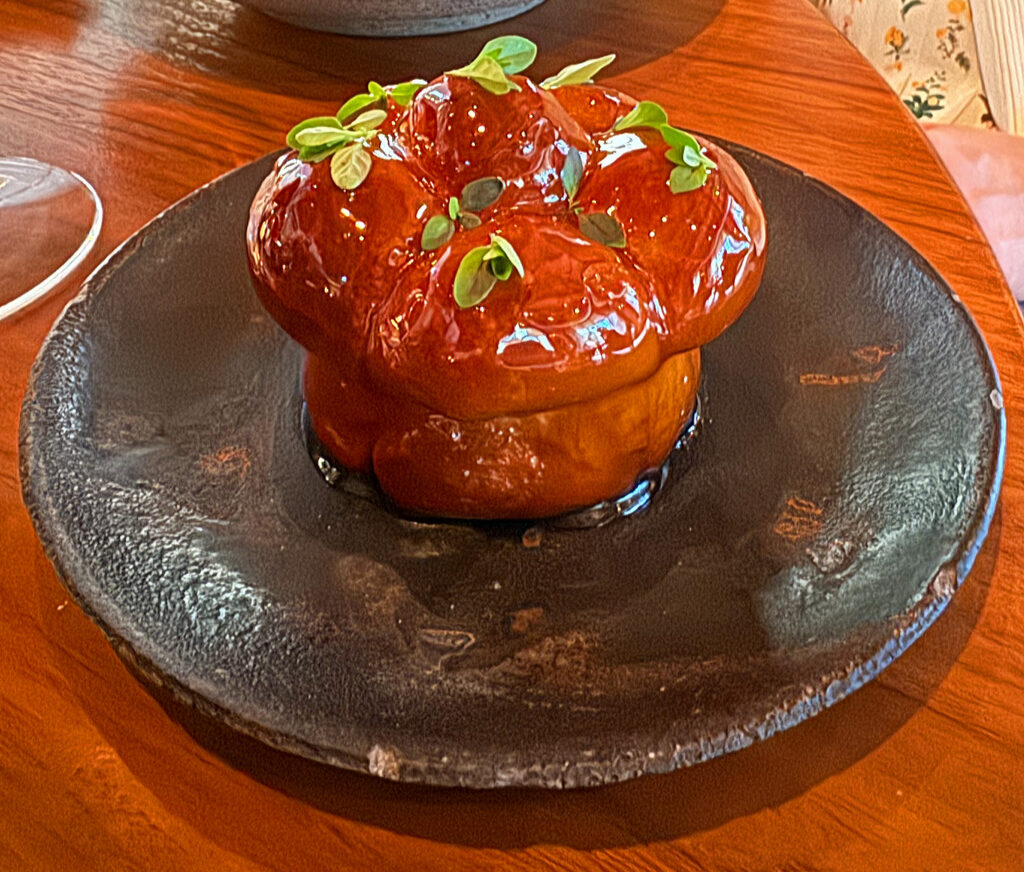
Finally, we have the “Malted Milk Bread”—the long-term successor to those beef fat brioche donuts I keep harkening back to. Personally, I find that this particular recipe (with its pecan-toffee glaze) sometimes veers too much toward sweetness in comparison to its predominantly savory predecessor. That said, it’s hard to argue with this particular example: which feels beautifully fluffy and caramelized and well matched against the savory tones of the main plate.
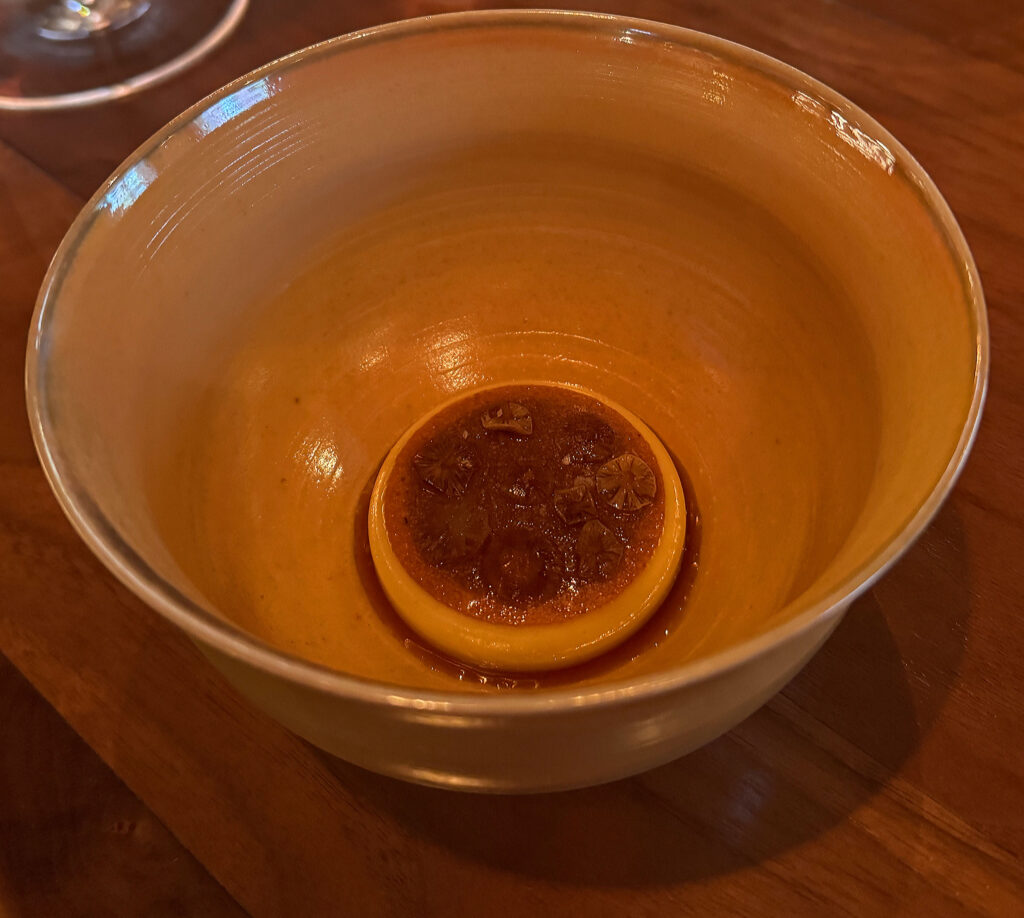
The turn toward dessert—and the work of pastry chef Jenna Pegg—hardly ever takes the form of a clean break: some palate cleanser, out of left field, that resets one’s tongue for an entirely new journey. Historically, the kitchen likes to structure its sweets (at least the first one served) as an extension of what diners encountered on the savory side. Tonight, the “Chanterelle & Currant” plays off of the nage that was found alongside the squab.
Here, a central disc of custard (made from the titular mushroom) arrives dressed in a sauce made from the currant in combination with other fruit like tart cherry and black raspberry. A tuile—set with preserved enoki caps—crowns the dish, offering a crisp and chewy counterpoint to the rich, creamy starring element. Given the density of the custard, the resulting flavor is only mildly tangy, a little funky, and barely sweet. However, on the finish, a transfixing note of chocolate takes hold: imparting a sense of decadence while, simultaneously, connecting the recipe to some of the earthy and truffly notes that accompanied the entrée. In sum, this makes for a surprise hit.
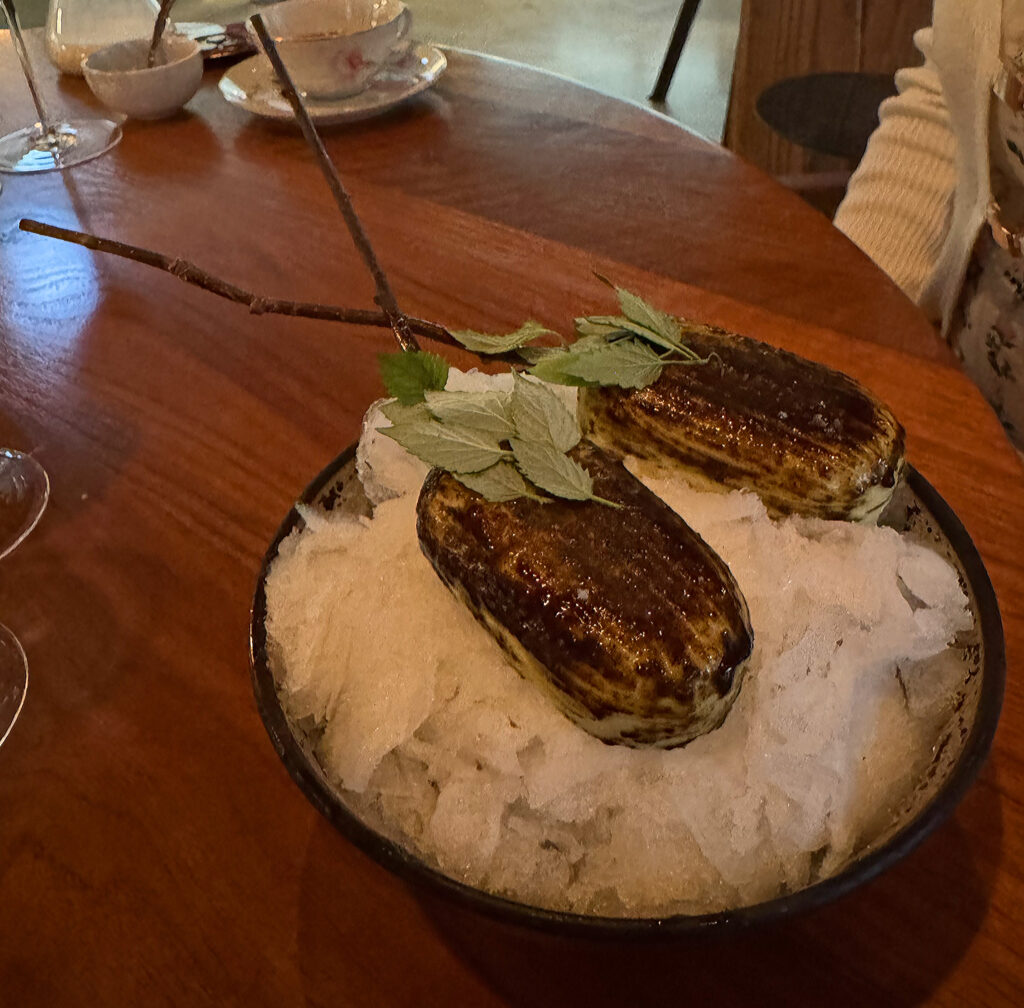
Arriving next, the “Fennel Ice Cream Bar” represents an evolution of the recipe (centered instead on birch) that I encountered in January and March. On this occasion, the white chocolate shell hides—at the center the titular frozen base—a core of black raspberry jam. A glaze made from anise hyssop and some leaves of hoja santa (another term for the pepperleaf that was served alongside the squab) crown the exterior.
On the palate, the juxtaposition of crisp, creamy, melty, and gooey textures is skillfully composed. But it’s the bar’s flavor—exceedingly fresh, with concentrated black licorice note, and a key jolt of bitterness from the fruit—the proves definitive. For my palate, the combination works (especially on the finish). At the same time, this particular profile is clearly polarizing, and I wonder if the chosen sensation (not unlike a palate cleanser) really offers enough outright decadence to anchor dessert.
Somewhat suddenly—I usually find the menu features one more dish—we reach a closing trio of petit fours that largely match those I was served in May:
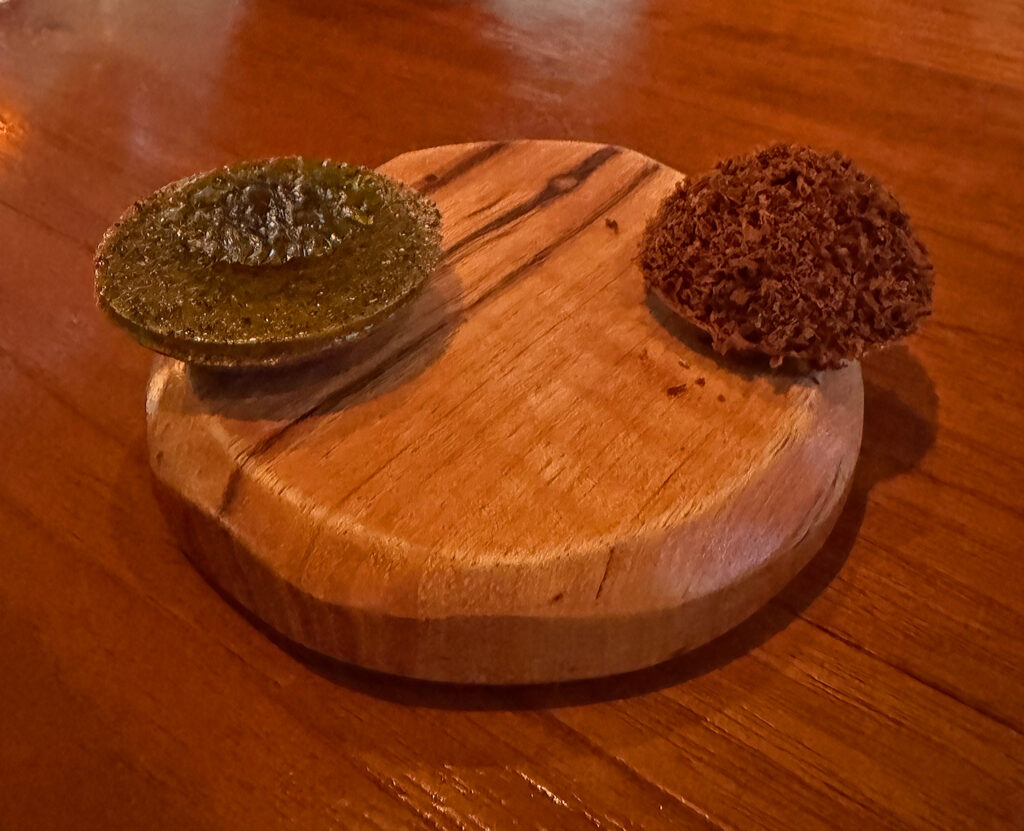
First, there’s the “Preserved Pistachio Tart”—a profound expression of nuttiness whose accompanying notes of tang (from finger lime) and earth (from matcha) for a long, delectably sweet finish. This remains a highlight.
Second, there’s the “Sprouted Grains & Koji Chocolate”—a dark, earthy, and surprisingly decadent expression of cocoa that, while easy to like, again lacks a little decadence for my taste.
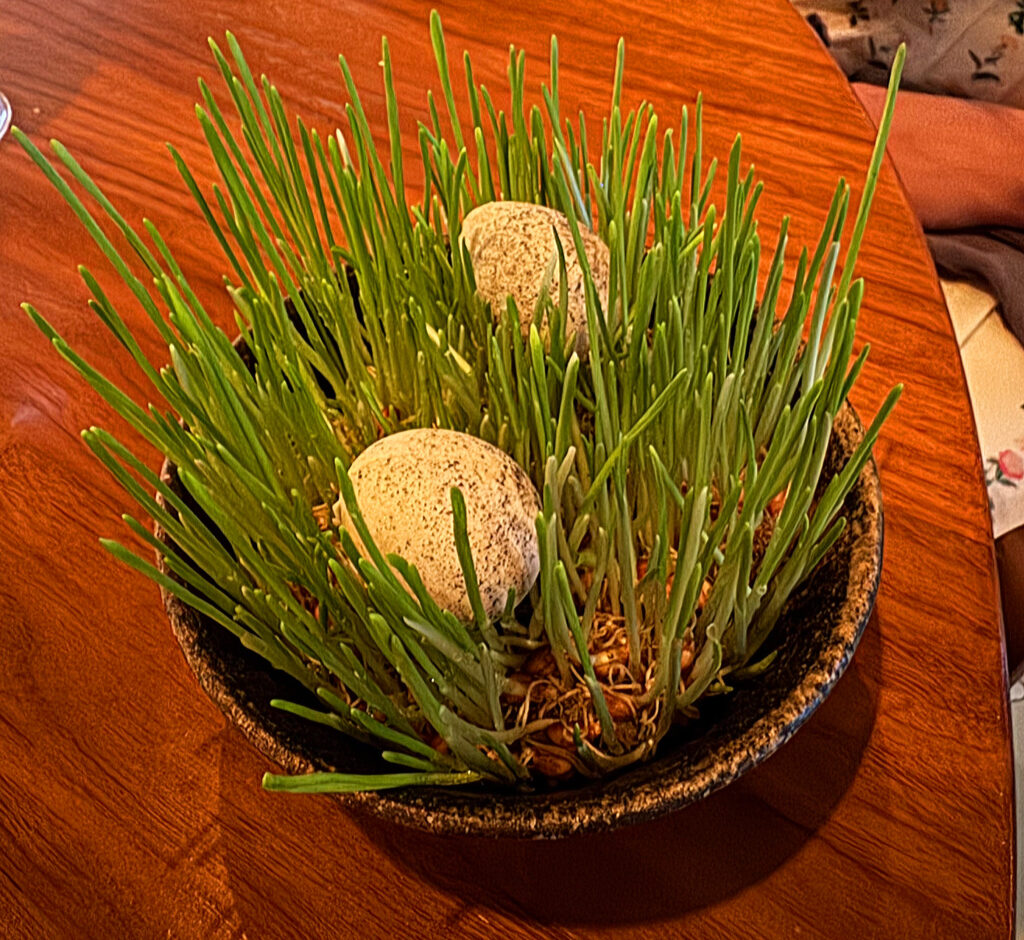
Finally, we have the “Cadbury™ Quail Egg”—a visual thrill that, frequently, has proven much too tangy for my palate. This time around, I appreciate the brittleness of the candy shell and the balance (not at all puckering!) struck by the combination of white chocolate and citrus curd.
With that, the meal reaches its conclusion: some 22 distinct items spread across 17 different courses and served in just a little less than three hours. It’s the kind of pinpoint pacing (especially for an extended menu that’s only typically offered during the second turn) that proves the team can handle the new, more efficient seating scheme without any lapse in the quality of the experience. It’s also makes for the kind of engaging flow that ensures even the most experimental offerings are cushioned by counterpoints of easy enjoyment.
What any individual party feels when they finally see the check is hard to predict. However, to the restaurant’s credit, any confusion about a “service charge” (and how it relates to one’s potential gratuity) has long been quelled. It’s hard to imagine the team navigating such a demanding period with those occasional misunderstandings (uncharitably broadcast online) hanging around its head.
For they continue to work the floor with total earnestness: sacrificing a few precious seconds between reservations to warmly see us out the door.
In ranking the evening’s dishes:
I would place the “Corn Parfait” and “Geoduck Belly” in the highest category: superlative recipes that stand among the best things I will be served in any restaurant this year.
The “Sungold & Dulse Sandwich,” “Sea Urchin Cannoli,” “Dungeness Crab ‘Tamago’,” “Sweet Corn Kombujime,” “Maine Lobster & Caviar,” “Abalone & Boudin Noir,” “Lamb Sweetbread & Poblano Pepper,” “Lone Mountain Wagyu Beef Tartare,” “Devil’s Gulch Squab,” “Malted Milk Bread,” “Chanterelle & Currant,” and “Preserved Pistachio Tart” all land in the next stratum: great items that achieved a truly memorable degree of pleasure. I would love to encounter any of these again.
Next come the “Cucumber Kombucha,” “Geoduck Aguachile,” “Smoked Trout Donut,” “Black Walnut Cured Quail Egg,” “Fennel Ice Cream Bar,” “Sprouted Grains & Koji Chocolate,” and “Cadbury™ Quail Egg”— good—even very good—preparations I would always be happy to sample again (but that just failed to elicit an extra degree of emotion).
Finally, there’s the “Rainbow Trout & Blueberry Ponzu”—a merely good (maybe just average) item that fell a bit short when it came to flavor.
Overall, this makes for a hit-rate of 95% with some 64% of dishes meeting the “would love to have again” standard and only 9% reaching that “best of the year” level of quality. These figures largely accord with those I reported in May (i.e., 91%, 55%, 18%) and March (i.e., 95%, 70%, 20%), with the only real difference being that fewer recipes tonight landed in the highest bracket.
Given Smyth’s prestige (not to mention price point) it’s fair to expect that degree of excellence: a meaningful proportion of offerings that deliver life-changing deliciousness. There are certainly a few dishes (e.g., the cannoli, the lobster, the beef tartare, even the chanterelle custard) I thought about elevating one category further. And there are other creations (like the tamago, squab, milk bread, and pistachio tart) that could easily make a bigger impression on any diner who is only encountering them for the very first time.
But—at a time when the nation’s (and maybe even the world’s) eyes are on the restaurant, during a period of perpetual packed houses filled with the most demanding of guests—Smyth is performing quite well: remaining true to so many of its totems (i.e., the seaweed, nut oil, nut milk, exotic fruit, blood sausage, and quail egg) while translating them in a way that feels particularly friendly.
Indeed, any menu that comprises caviar (twice), crab, lobster, uni, abalone, geoduck, wagyu, chanterelle, and black truffle almost seems to be throwing anything and everything luxurious at the wall to see what sticks (foie gras, too, could have so easily also been included). It almost looks to be playing to consumers’ most cynical desire to get their money’s worth. Yet there was nothing rote about how these ingredients were treated, and, frequently, it was elements like tomato, corn, egg, offal, and all those longstanding obsessions I named above that actually defined the meal.
The biggest critique I can really make has to do with dessert: the sequence, at present, feels a little short, and it hinges on an anise-driven dish that some diners are bound to hate. Admittedly, the legendary egg yolk licorice centered on some of the same flavor profile. However, I think it achieved a level of decadence that totally transcended one’s love or aversion for the category. Structurally, an ice cream bar just doesn’t seem capable of delivering that effect. To be clear, I adored the “Chanterelle & Currant.” But there must be a recipe that can indulge the kitchen’s creativity while striking a more mainstream note of fruit, caramel, or chocolate that really forms one of the menu’s peaks in its own right.
Ultimately, this is a rather minor bit of dissent (and, I am starting to realize, a criticism I am starting to aim at several different tasting menus).
The biggest compliment I can pay Smyth is that, in the heat of this moment, the concept remains so unapologetically true to the singular style of hospitality, wine service, and cuisine that has gotten it here.
To be honest, I did feel some excitement earlier in the year about what a new head chef (and the possible paradigm shift they would spur) could entail. Yet, whatever happened with their search, the team had to react when named number one.
Rather than undergoing total transformation, they pursued a familiar process of incremental growth: excising old standbys (like the avocado), reimagining favorite techniques (like the cannoli, the wafers, the parfait), adopting new ingredients (notably the abalone and geoduck), and treating nature’s bounty in new ways (the Sungold sponge, the kombujime, the tempura frying).
As much as I feel like I’ve seen it all here, Smyth always has another train of thought to follow, some sharper refinement to share, some further extreme to pursue. The restaurant’s work—to this day—ranks among its most challenging, rewarding, and exciting ever.
And, while some await a time when certain obsessions fade, the kitchen is presently striking a beautiful balance: one that honors the foundations of their award-winning work while inching toward the robust textures and ample flavors that, maybe, signal what’s next.