
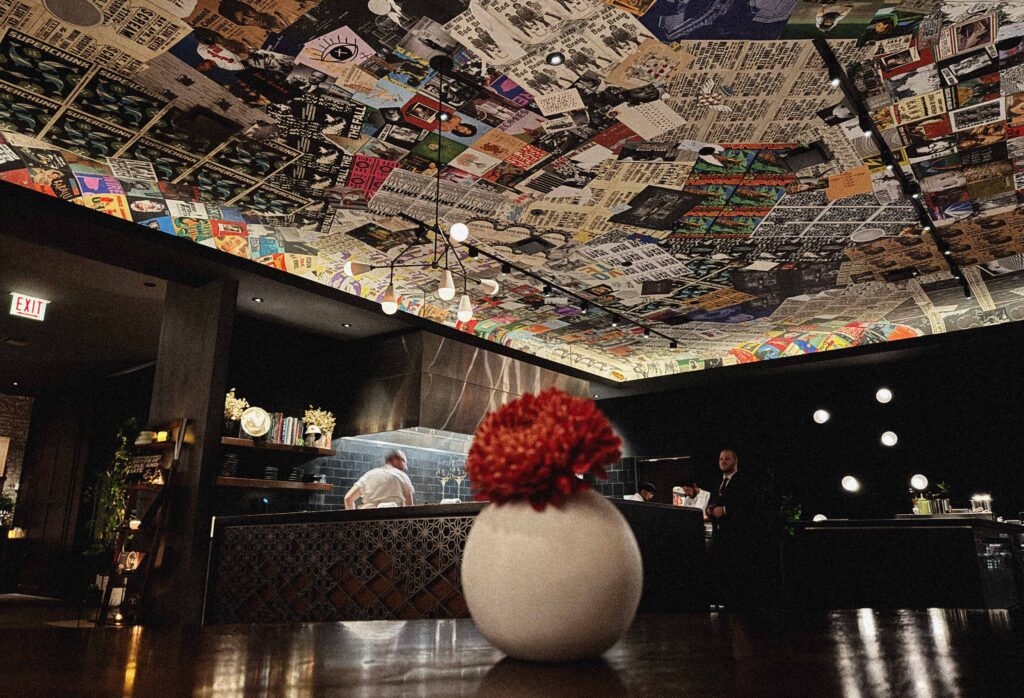
After yet another two-month intermission, we are back at Oriole and ready to uncover how this most beloved of restaurants—balancing ambiance, decadence, technique, and approachability in a way that many feel distinguishes it as Chicago’s best—embraces the fall bounty.
It’s been a season, thus far, that has seen restaurants like Cellar Door Provisions, Feld, and Smyth produce some of their greatest work: each kitchen attuned to their respective culinary style, capacity for experimentation, and overall value proposition while dovetailing in the use of certain produce (e.g., figs, grapes, chanterelles, all kinds of squash) that help lend this time of year its character.
Oriole truly does occupy a unique sweet spot that is neither the most nor least expensive (though prices, admittedly, are rising in December). It is not betrothed to a philosophy (i.e., “relationship to table” or a broader locavorism) that limits its work in one way or another. It’s not pigeonholed into a particular genre or burdened by the expectations that come with being formally declared “#1.” And, when I think back at how many years the rye capellini and soufflé steadily pleased guests, there’s clearly no compulsion to throw great ideas out and start all over for the umpteenth time.
To be clear, 2026 has told a story of how chefs Noah Sandoval, Colin McHugh, and Evelyn Aloupas have looked to evolve the house style, establish a new thematic resonance across the menu, and shape a new generation of signature recipes that preserve the core of the concept’s identity: a guarantor of aesthetic and gustatory pleasure in a city where the audience’s needs frequently feel ignored for the sake of some larger, esoteric vision.
Even Sandoval’s approach to pacing and portion sizing—something that has really stuck with me since seeing him explicitly articulate it—is a model of restraint: diners should be able to enjoy a memorable meal at a measured cadence without feeling (by constraints of time or fullness) like the possibilities of their night out have been entirely sapped.
Here, each new season, new menu, and new dish provides a window into how the team’s collaboration is growing—a glimpse at the path Oriole might take during the next decade of its lifetime.
And, at a time when Smyth (never a competitor, but an inevitable point of comparison) is facing the imminent arrival of its own new head chef, this feels like a key moment in each restaurant’s story: one set of influences maturing as another takes root and the push-pull of experience and reinvention rages on at the very top.
Indeed, while new openings tend to command much of the city’s attention, the most consequential creative transformations are occurring at establishments whose pedigrees and reputations almost fool you into thinking they’re static.
For anyone intent on taking a top-down approach to evaluating the dining scene, no other properties are nearly as essential.
Let us begin.
Given that I neglected to talk about Oriole’s wine back in August (surely a godsend for some readers), it seems right to take a closer look at the state of the program tonight.
In fact, if we really want to think about comparing experiences at the two- or three-Michelin-star level, it’s impossible to ignore what it means to savor a pour of something extraordinary alongside food that also, at its best, transcends anything the audience typically eats.
Honestly, it would probably make more sense to compare the restaurant’s “Reserve” ($420) pairing to Smyth’s own “Reserve” ($475): the former, from what I’ve seen, being a flight of steady indulgence while the latter, veering toward unabashedly natural styles, reliably spans both agony and ecstasy.
Moving into 2027 (and concurrent with respective increases in menu pricing), Oriole’s “Reserve” pairing will rise to $540 and Smyth’s will reach $570. Given the negligible difference in cost, that may finally be the time to put the two selections head-to-head (again, not so much for the sake of competition as it would be to assess how chosen producers and perceived value affect one’s wider perception of the meal).
For now, the bottle list continues to form the part of the program that excites me most here, offering a window into how general manager/wine director Emily Rosenfeld handles sourcing, determines markups, and, perhaps, will shape one of the most ambitious beverage offerings this city has ever seen.
Here are the items that catch my eye:
- 2021 Benoit Ente Bourgogne Aligoté “Antichone” [$95 on the list, $80 at national retail]
- 2024 Stefano Occhetti Langhe Nebbiolo [$96 on the list, $41 at national retail]
- 2024 Bass Phillip “Estate” Pinot Noir [$161 on the list, $80 at international retail]
- 2022 Domaine du Collier Saumur “La Ripaille” [$169 on the list, $115 at national retail]
- 2024 Walter Scott “X-Novo Vineyard” Chardonnay [$199 on the list, $105 at local retail]
- 2009 Domaine Michèle & Patrice Rion Nuits-Saint-Georges Premier Cru “Clos des Argillières” [$200 on the list, $107 at international retail]
- 2020 Chartogne-Taillet Champagne “Les Couarres” [$217 on the list, $140 at national retail]
- 2020 Jean-François Ganevat “Cuvée Florine” Chardonnay [$257 on the list, $146 at national retail]
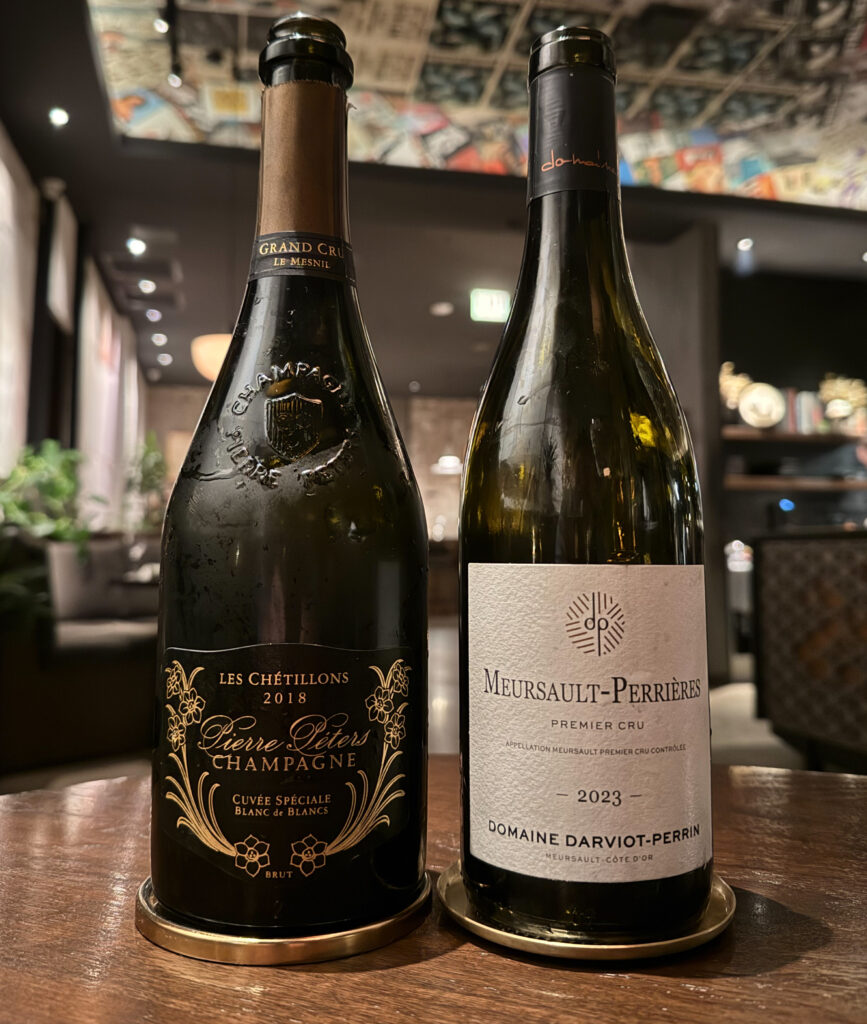
- 2018 Pierre Péters Champagne “Les Chétillons” [$258 on the list, $245 at local retail]
- 2018 Roagna Barbaresco “Albesani” [$264 on the list, $159 at national retail]
- 2018 Suenen Champagne “Les Robarts” [$311 on the list, $335 at local retail]
- 2023 Domaine des Comtes Lafon Meursault [$369 on the list, $199 at local retail]
- 2001 Michel Gros Vosne-Romanée Premier Cru “Clos des Réas” [$383 on the list, $194 at international retail]
- 2023 Domaine Darviot-Perrin Meursault Premier Cru “Les Perrières” [$467 on the list, $221 at international retail]
- 1993 Bruno Giacosa Barolo “Falletto di Serralunga d’Alba” [$469 on the list, $450 at national retail]
More than usual, this array reflects my personal taste: Champagne, several expressions of Chardonnay, a smidge of Pinot Noir, and a touch of Nebbiolo (alongside single, culty representations of Aligoté and Cabernet Franc). There are a couple examples of Sangiovese I could have also included, but they’ve been offered for a long enough time that I don’t want to keep repeating the same choices.
If I’m being honest, I really find those categories of sparkling and white wine to be the most exciting at this particular moment: the estates on display are exemplary, and a few of them (i.e., the Ente, Pierre Péters, and Suenen) are practically being sold at retail price.
It took me a little more time to find red wines that offer intrigue, approachability, and a sense of value. However, at the lower end, I appreciate the elegance of the Occhetti and the relative rarity (at least in this market) of the Bass Phillip. Even better, those looking to spend more will find mature examples of Burgundy and Barolo being sold at no special premium.
Broadly, the markups for this sample range from 7% below retail price to 141% above it. Nonetheless, the mean of 65% and median of 76% confirm just how modestly the restaurant looks to profit on its inventory.
Ultimately, so long as Oriole preserves this philosophy, it only takes a handful of savvy choices to leave me feeling very happy. On this occasion, I opt for the “Les Chétillons” (due to its sharp pricing) and the Darviot-Perrin (due to the status of the vineyard and the cuvées limited availability at a global level). Yet I could have just as easily chosen from three or four other potential bottles, mixing and matching while the friendly corkage policy ($50, limit of two) fills in the gaps.
Ordering wine here still feels like a celebration, which is about the highest compliment I can give.
Upon taking my seat in Oriole’s lounge, I am treated to the menu’s familiar opening progression: a nonalcoholic creation from the bar (in this case, a frothy peach-melon-ginger blend I find quite appealing), a chance to order any other cocktail I desire (i.e., an expertly-made espresso martini), the first glass of my chosen Champagne (already chilled to perfection), and—most importantly—a series of bites meant to engage both palate and mind before reaching one’s table.
Tonight, the kitchen presents the same series of “bouquets” I encountered in August. And, while these constructions abandon the kind of luxurious seafood diners have historically been treated to in this setting, they serve to introduce the kind of fresh produce and elegant saucework that will shape many of the chefs’ other, more notable preparations later in the evening. At core, they also allow the team to reference the farms they work with, connecting the restaurant’s cuisine (even loosely) to some sense of the local terroir.
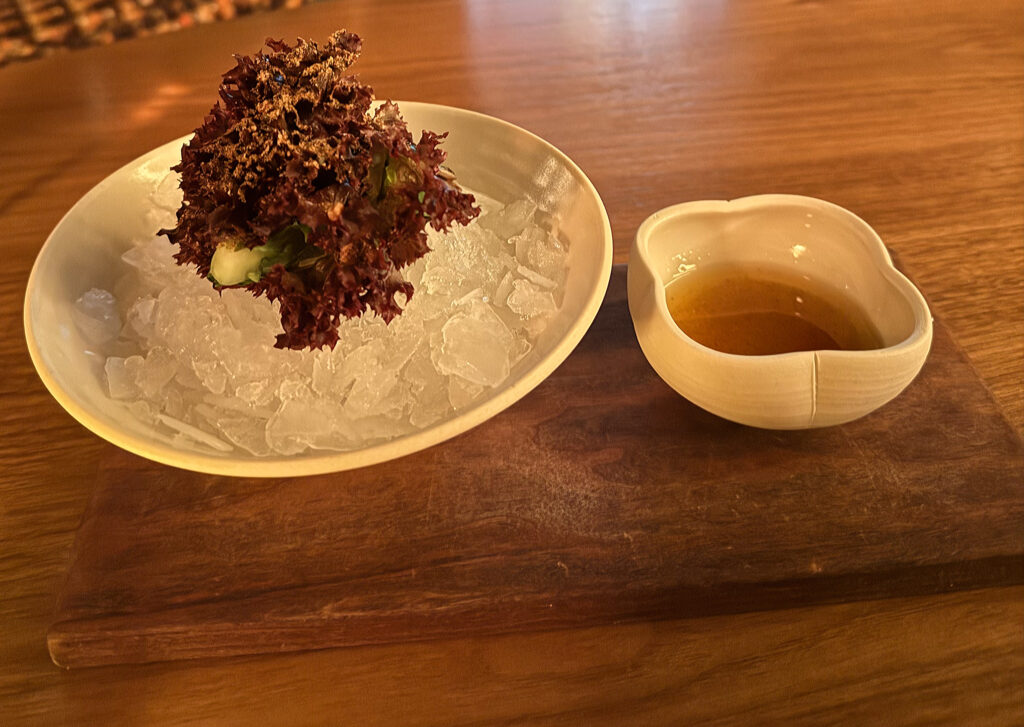
To begin, there’s the “Lolla Rosa,” which comprises the lettuce of the same name along with some cucumber, Thai basil, shiso, mint, and a topping of genmai furikake. The resulting bundle (smartly tied together with a chive) is paired with a nước chấm made from fermented tomato, black garlic, and lime.
This sauce lends the greens—so crunchy and cleansing on entry—a huge concentration of citric tang, rounded sweetness, and satisfying umami. Yet the effect, imbued with toasty, nutty depth on the finish, is in no way overwrought. Quite the opposite: this simple dish remains memorably delicious in a manner that is almost hard to believe.
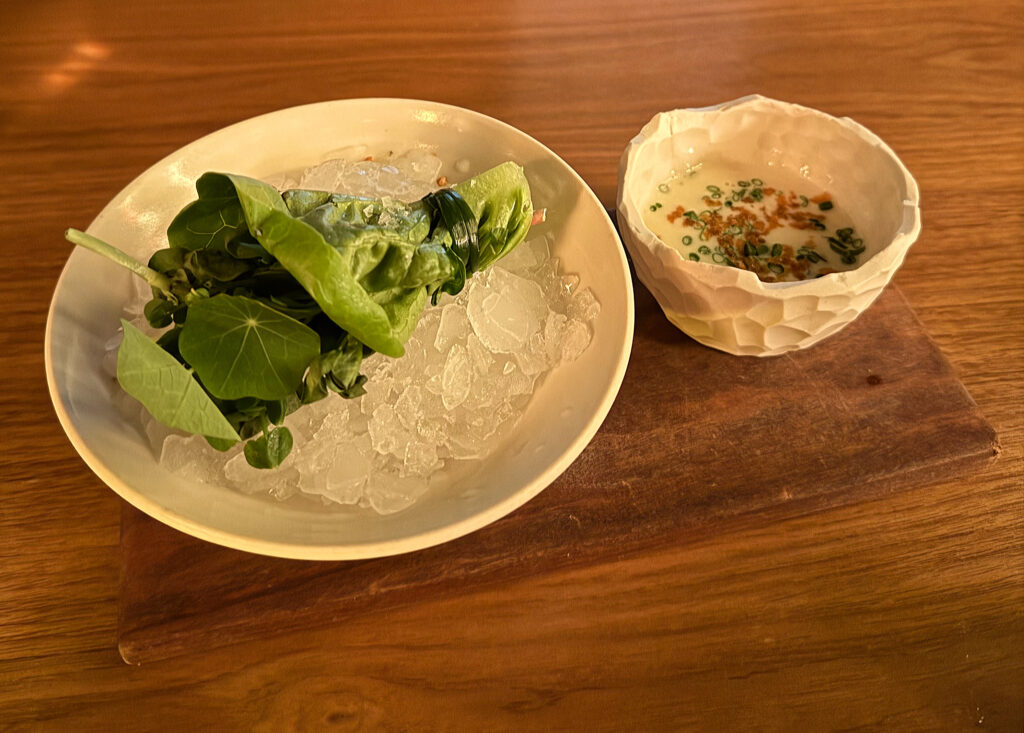
The “Little Gem Lettuce” comes next, combining the titular leaf with nasturtium, oxalis, sorrel, and fava shoots. On this occasion, a brandade made from sablefish (then topped with chive and bottarga) substitutes for the version previously made using turbot.
On the palate, the Little Gem and its companions produce a sensation that feels crisp and freshy almost to the point of being squeaky. The greens possess plenty of lemony backing—and a very mild note of sweetness—that should marry seamlessly with the rich, fish-derived sauce. However, I find that the brandade lacks the same savory powder as the preceding condiment, and, thus, this particular bite falls short of the standard set by the rest of the sequence.
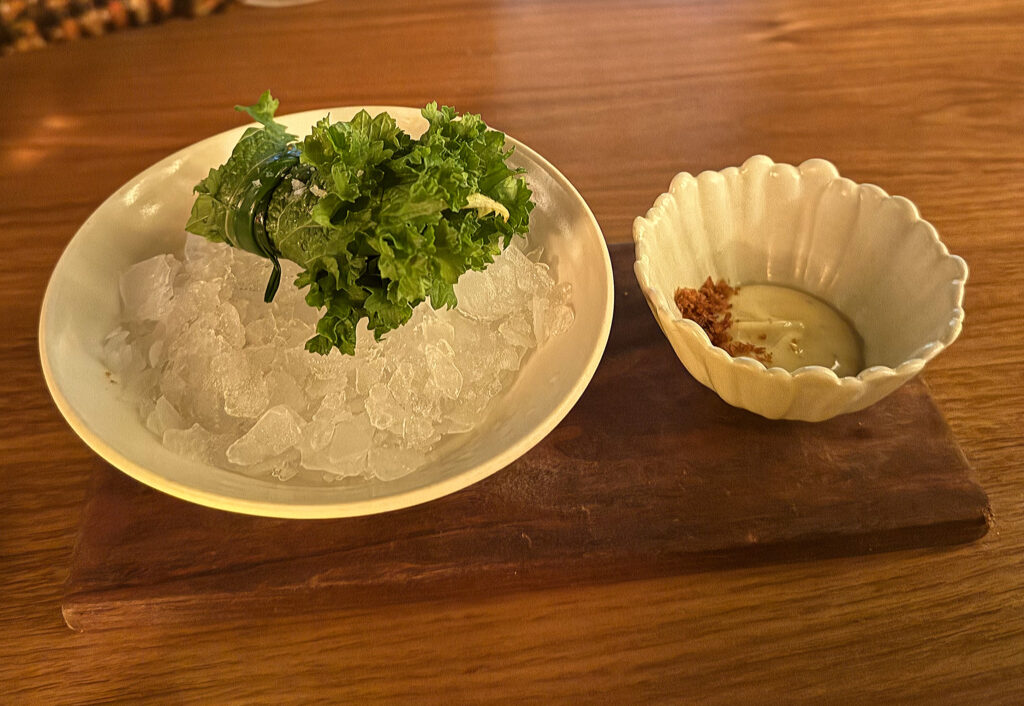
Finally, we have the “Mustard Greens,” a construction that also incorporates endive and breakfast radish. Here, the accompanying sauce is made from lamb (i.e., a lamb fat aioli with bits of crispy lamb belly set atop it) instead of the earlier wagyu. Nonetheless, an application of Kampot pepper oil and green peppercorn remains consistent.
Texturally, the mustard greens display much of the same crunch as the other bouquets without descending into squeakiness. Instead, the leaves are distinguished by a sharp, peppery quality that is softened by the creaminess of the aioli. Yet, instead of fading away, flavor builds as the salty bits of belly strike the tongue: unlocking the full weight and satisfaction of the lamb fat while, simultaneously, revealing a tinge of sweetness too. Yes, by my measure, this member of the trio has undergone the most improvement. Alongside the Lolla Rosa, it now ranks as one of the highlights of the night.
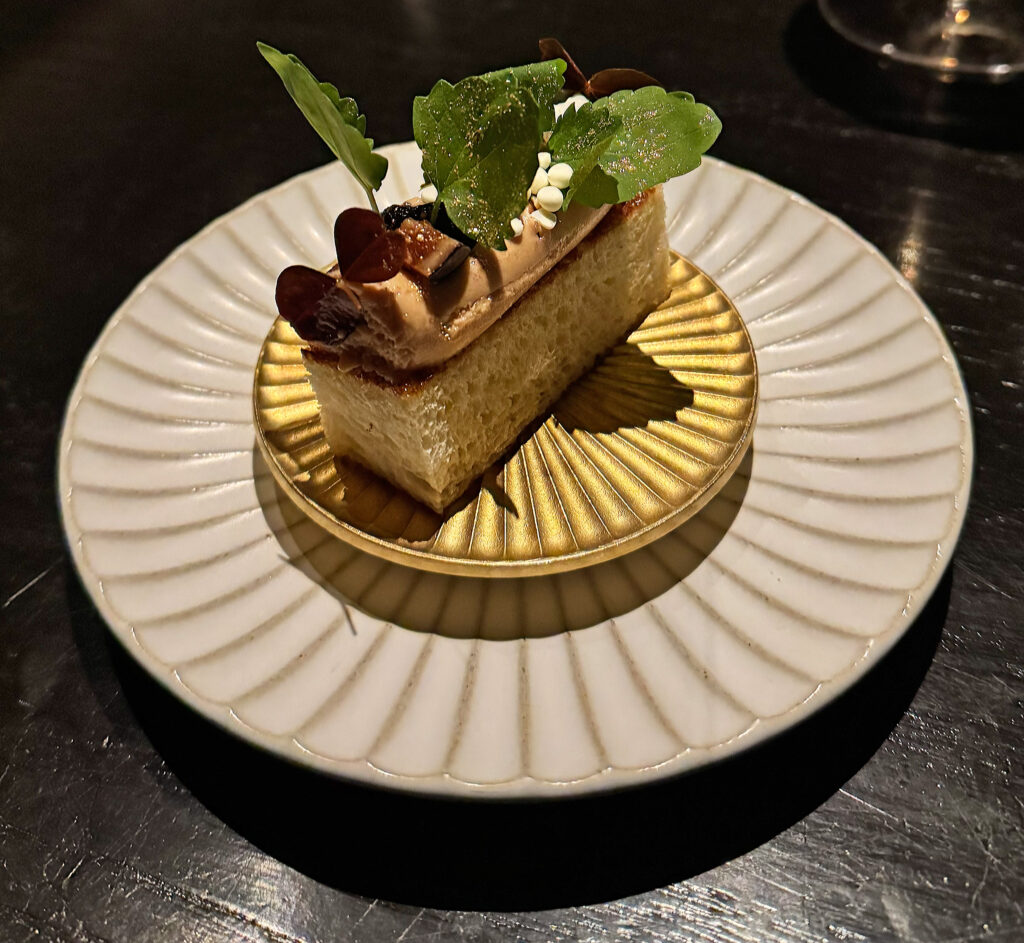
Now, if we’re going to talk about highlights, it’s impossible to neglect the “Hudson Valley Foie Gras.” Indeed, it’s a recipe—the recipe—that survives as Sandoval’s most longstanding signature (discounting the occasional revival of the rye capellini) despite all the broader creative work being done by McHugh and Aloupas. Even I must concede that, on any given night, there are few better mouthfuls of food to be found in Chicago.
The present version of the dish sees blueberry (which featured in August) make way for Mission fig. Otherwise, supporting elements like pink peppercorn, anise hyssop, crème fraîche Dippin’ Dots continue to bring the base layer of brioche (cooked in yeasted butter) and duck liver parfait to life. The result, as always, balances supreme degrees of creamy richness and sticky sweetness with nutty, tangy, and licorice-tinged undertones that drive the core contrast to an extreme of pleasure. This time around, I quite admire the honeyed, caramelized character of the fig—and how a new pairing of strawberry sake ensures some of the usual brighter fruit flavor remains in the mix. Overall, the foie gras strikes me as a confident, classic example of the beloved form.
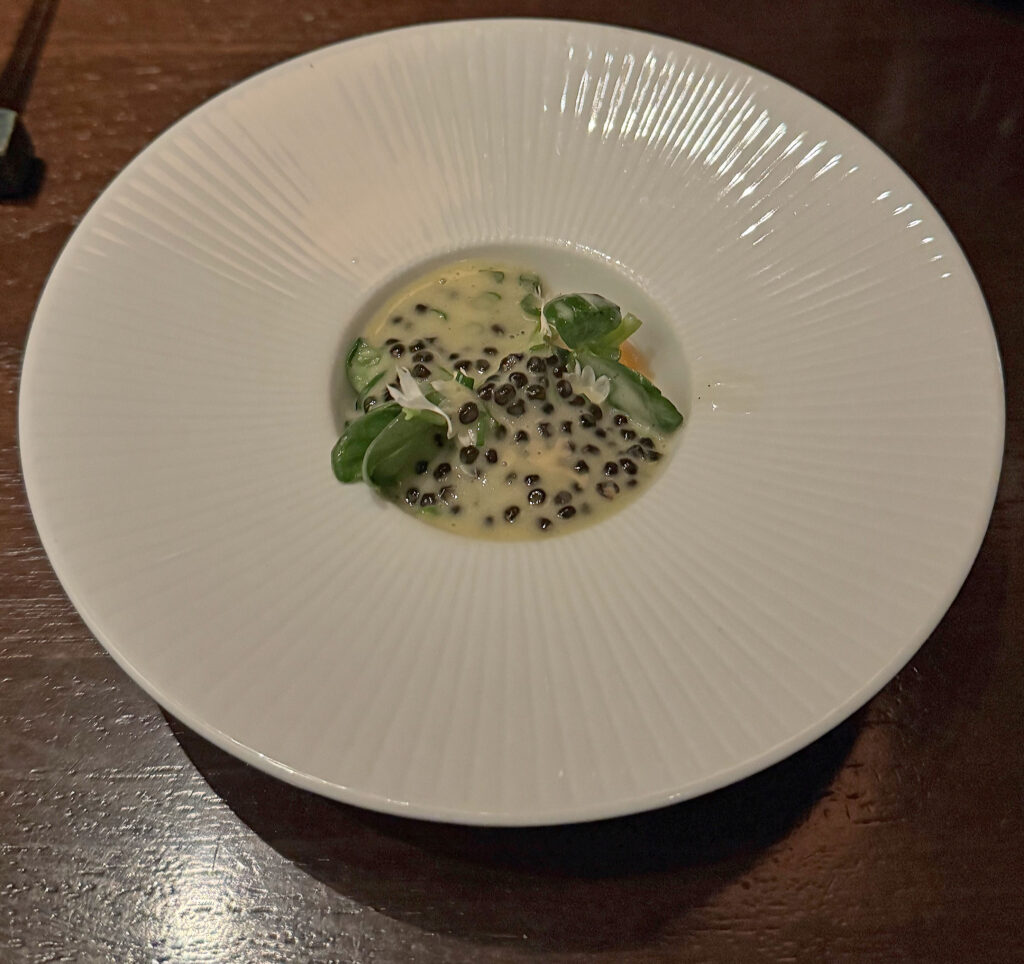
Upon settling in at the table, I am met by the “Golden Kaluga Caviar,” a course that formed one of the greatest successes of my previous meal. Thankfully, the chefs have been careful not to unduly alter such a good thing. Rather, while leaves of spinach have been exchanged for fava shoots, the essential juxtaposition of roe, Norwegian king crab, and blackcurrant wood-smoked beurre monté remains.
In fact, while the spinach worked quite well before, the fleeting crunch and nuttiness provided by the new choice of greens drives the preparation to an even higher peak: delineating the luscious layers of shellfish and butter before melding with the roe and doubling its own nutty (and sweet, and briny) depth. Truly, while I appreciate how many kitchens now look to reinvent the wheel when serving caviar, there’s something to be said by how direct and layered and almost idealized the Kaluga’s flavor is here. The chefs demonstrate such a clear vision of what this prized ingredient should taste like, and they’ve crafted a plate that faithfully upholds Oriole’s long history of singular indulgence.
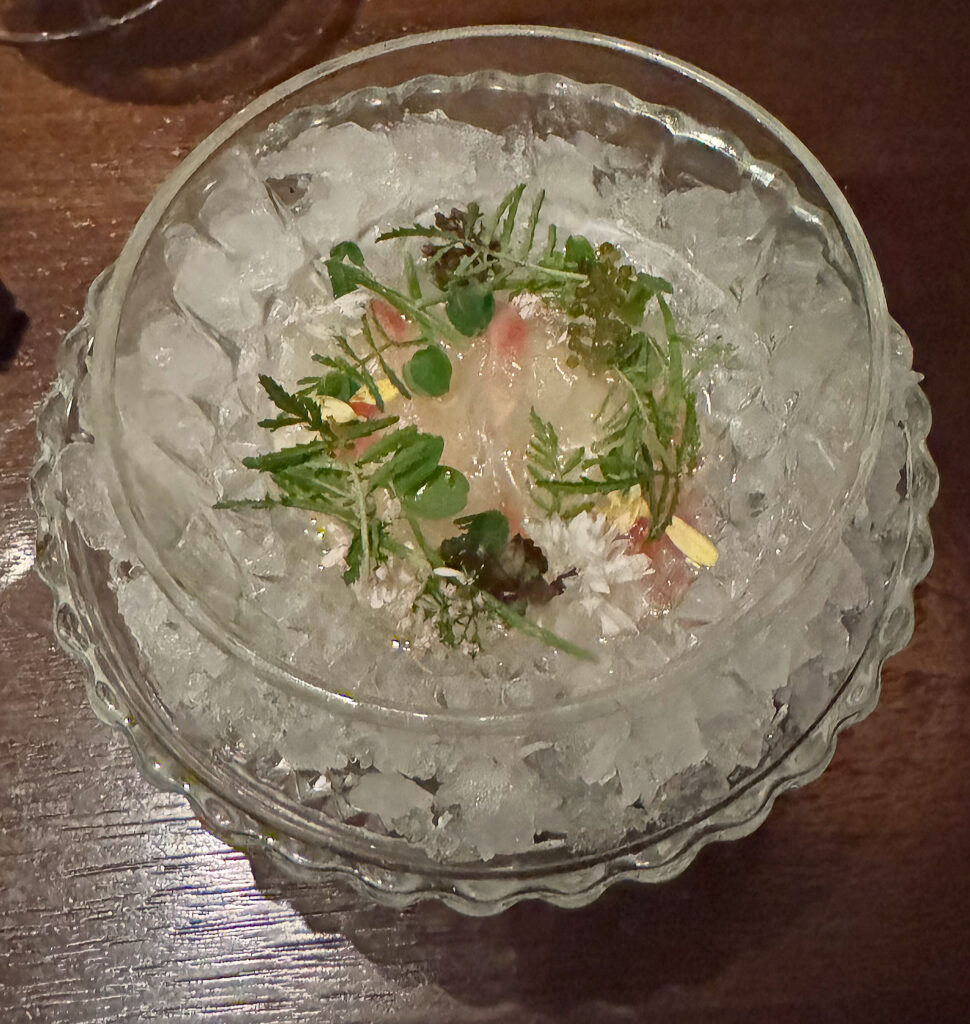
Arriving next, the “Madai” represents something entirely new tonight: a composition made from brined slices of sea bream in a dressing made from Honeycrisp apple and coconut. Some finger lime, sea grapes, and tangerine lace then form a garland that completes the effect.
On the palate, the madai displays an attractive, creamy mouthfeel that plays well against the crisper garnishes. The fish’s flavor, in turn, is mildly sweet and tangy. However, I find that the supporting notes fall short of the punchy fruitiness or umami that would really make this dish memorable. In some sense, I can understand that the chosen expression (i.e., delicate, understated) is meant to break form the richness of the preceding caviar. But this ultimately strikes me as a promising, somewhat undistinguished idea with room for more development.
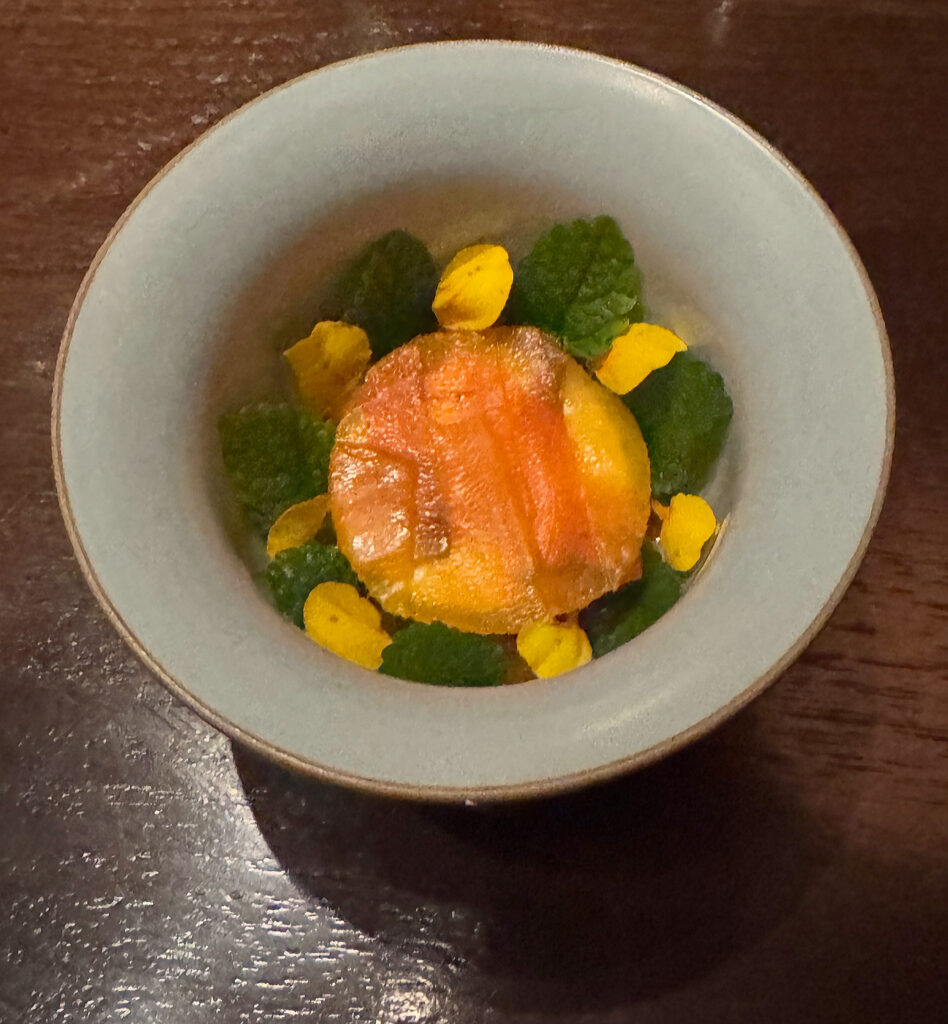
The “Badger Flame Beets” forms another new preparation, and it arrives feeling more fully formed than the fish. Certainly, this particular root vegetable (a variety that has seen much of its stereotypical earthiness bred out) has been a fixture of fine dining restaurants for many years, yet I admire the level of intricacy the team has sought with this treatment.
The beets themselves are cured then transformed into both shingles and a marmalade. An ice cream (infused with the same blackcurrant wood used to smoke the earlier beurre monté) lies at the center of the bowl while applications of honey, ginger, lemon balm, marigold, and chamomile offer breadth and depth.
At first glance, I’m tempted to think that all these herbs and flowers and woodsy elements are going to drive the resulting flavor expression into polarizing territory. Nevertheless, the textures I find below are so elegantly jammy, creamy, and melty (not to mention more than capable of absorbing any crisp, leafy topping). Further, while the level of sweetness here is rather pronounced, it remains long and soothing (rather than cloying) thanks to the assembled tapestry of spicy, citric, and floral notes. Yes, one is left feeling mightily impressed at just how cleanly fruity the Badger Flame really is—which, in my opinion, makes for an unabashedly successful showcase of the starring ingredient.
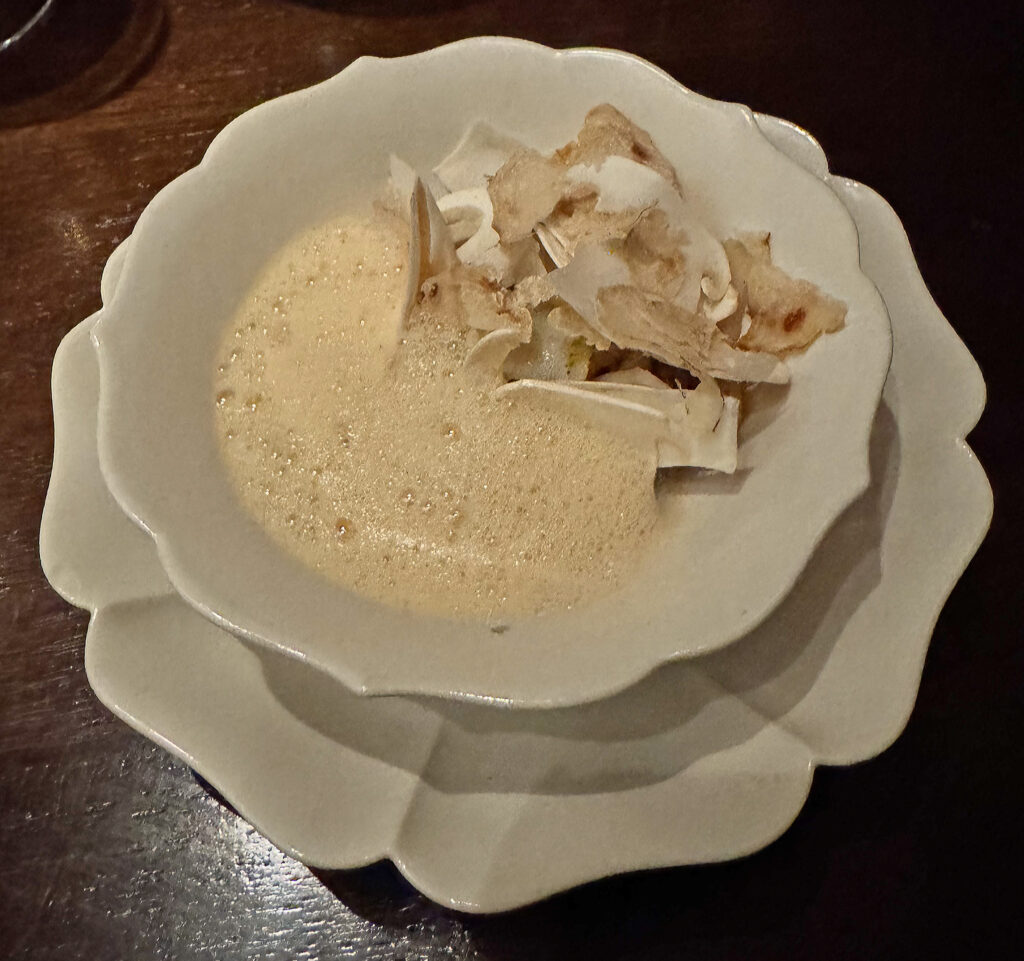
“Abalone” has starred in some of the very best courses I’ve been served at both Smyth and Feld these past couple months, so I’m quite eager to taste what Oriole can do with it. Upon hearing that the kitchen has braised the coveted mollusk for seven hours, I grow in excitement. Meanwhile, an array supporting elements—like Koshihikari rice, matsutake, Urfa biber (a Turkish chili pepper), black truffle, white truffle, and a fermented whey nage—seem to guarantee all the decadence I am usually after.
On the palate, the abalone balances its telltale weight and meatiness with a remarkable tenderness too. The subtle crispness of the mushroom topping and more encompassing creaminess of the rice (akin to risotto) help to further enhance the shellfish’s pronounced, satisfying character. Flavor follows suit with an impressive concentration of umami at its core. However, veins of smoky earth, pine, tangy dairy, and dried fruit add to the fun: alleviating some the starring ingredient’s richness while simultaneously broadening its range of expression. If I were to make a critique, it’s that the truffles somewhat get lost in the shuffle. That said, this remains a hugely pleasurable composition that I would love to encounter again.
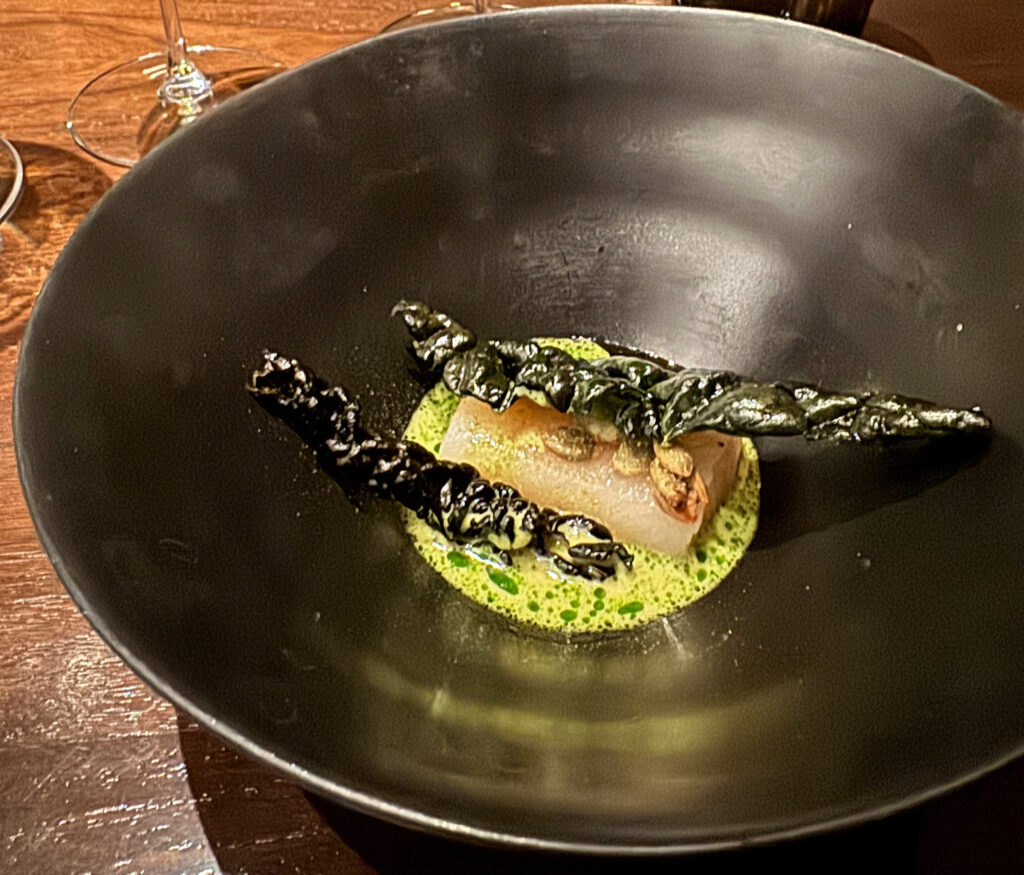
“Sablefish,” as the next dish is titled, carries with it some lofty expectations: I can only think of a series of creamy, butter preparations served immediately following the restaurant’s renovation (and that still rank among the best cooked fish recipes I have ever tasted). On some level, I respect the fact that the kitchen is not really looking to capture the same exact magic. Instead, they pair a glistening portion of the butter-poached fillet with carrot purée, white miso, pumpkin seed, fried kale, and a sauce made from vadouvan (i.e., French curry spices).
Texturally, the sablefish strikes me as soft but not altogether yielding, so I enjoy the delineating crunch provided by the leaves and seeds. Flavor, in turn, displays a tinge of deep ocean murkiness that is skillfully subsumed by the vegetal sweetness and powerful nuttiness that define the dressing. I actually like the persistent (though background) warmth provided by the spices too. Nonetheless, I think the consistency of the fish needs to be more outright buttery—and the influence of the white miso much more pronounced—if this construction is going to live up to the team’s other work in this category. As it stands, I don’t find the convincing decadence I am looking for.
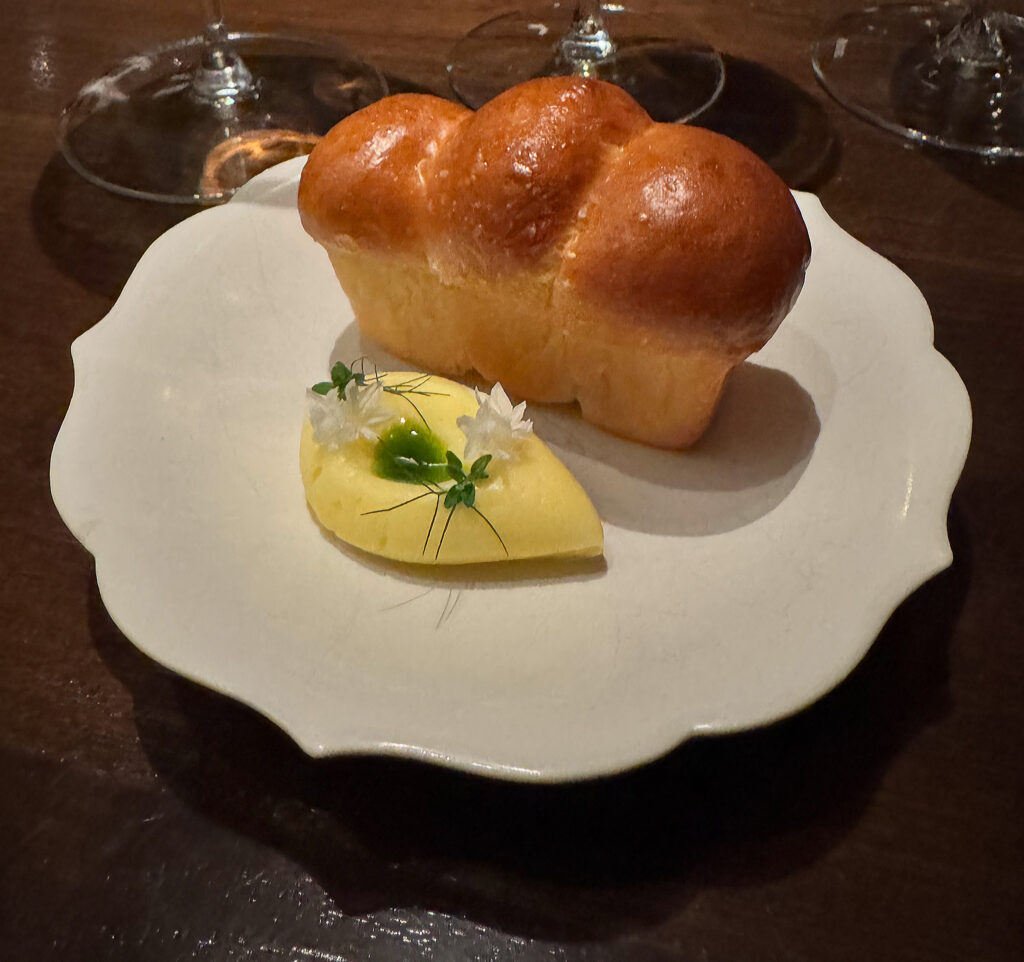
Thankfully, the “Milk Bread” served alongside the sablefish does more to satisfy my nostalgia: delivering prototypical fluffiness with a jolt of tangy sweetness drawn from the curry leaf oil-infused koji butter.
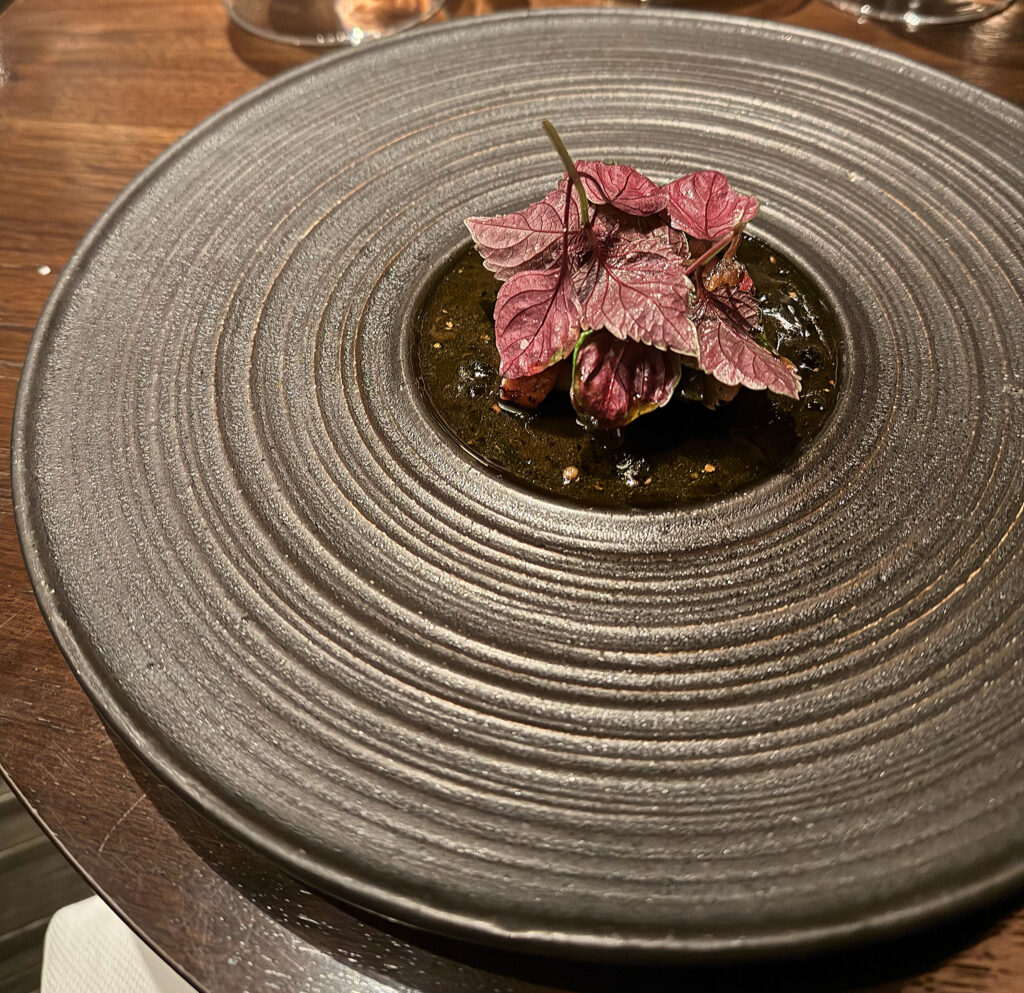
Arriving next, the “Veal Sweetbreads” (like the abalone) allows the chefs to stake their claim on an ingredient—my absolute favorite—that several of their peers have utilized to great effect in 2026. By soaking the offal in milk, braising it, and then grilling it, the team shows they mean business. Pairing the meat with a smoked onion soubise, some Shogun maitake, a nitsume (or eel sauce), a touch of blackberry vinegar, and ample red shiso suggests they possess something of a bold vision for the ingredient as well.
Now, I hate to see something I adore twisted and tortured for the sake of mere novelty. Yet, against my teeth, each piece of sweetbread is a picture of lusciousness—even creaminess—framed by only the most fleeting structure. Certainly, the segments of mushroom and the tangle of leaves help to bolster a sense of substance. But it’s the saucework that really defines the plate: bursting with the most persistent umami I’ve tasted all meal while elegantly melding its savory power with notes of sweet allium, anise, and rich, tangy fruit. Yes, for my palate, the level of satisfaction here is supreme. I can only admire how effortlessly and creatively the kitchen has tapped into the extreme qualities (both texture and flavor) that make this offal special.
The final savory course of the evening comes in four parts, each of which largely preserves what I encountered back in August.
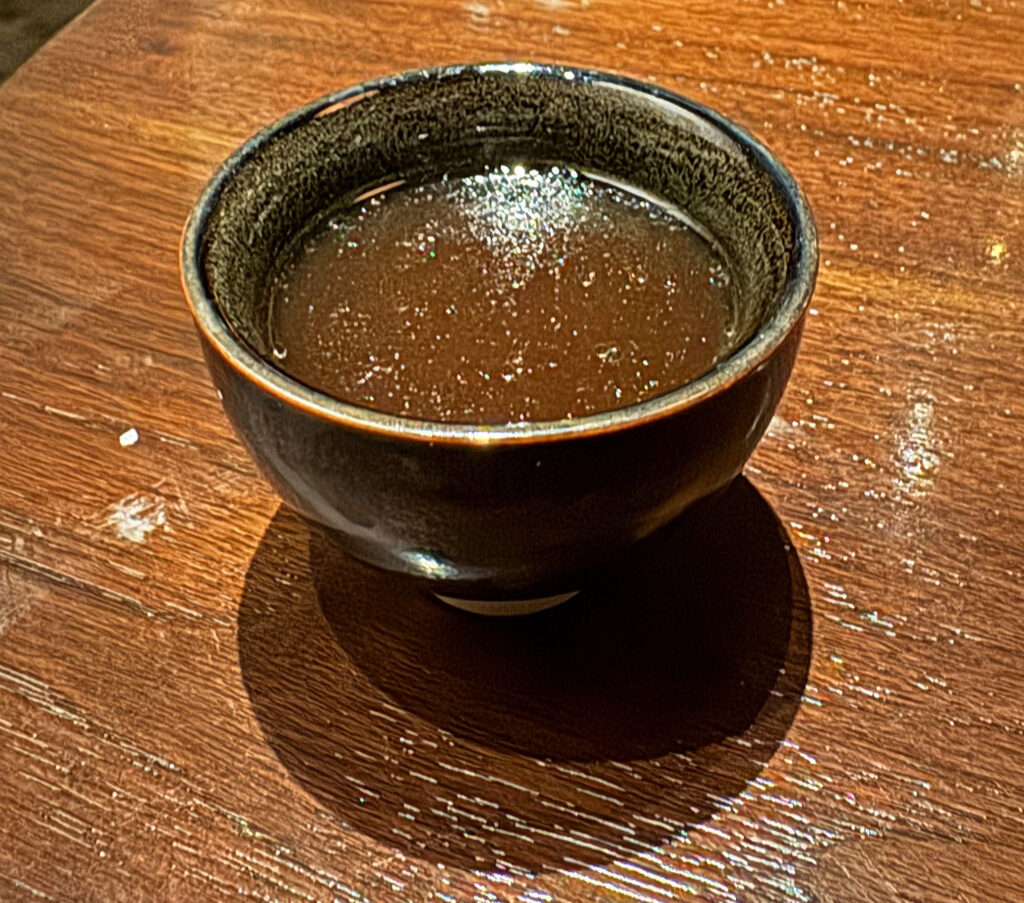
First, there’s the “Lamb Broth,” which—now being inspired by pho—slightly diverges from the tea served last time. With each sip, I find the juxtaposition of aromatic depth (from ginger, star anise, and cardamom oil) and richness (from lamb fat oil) to be attractively struck. There’s also plenty of salt (perhaps just a touch too much), and that ensures the broth doesn’t shrink opposite the actual meat.
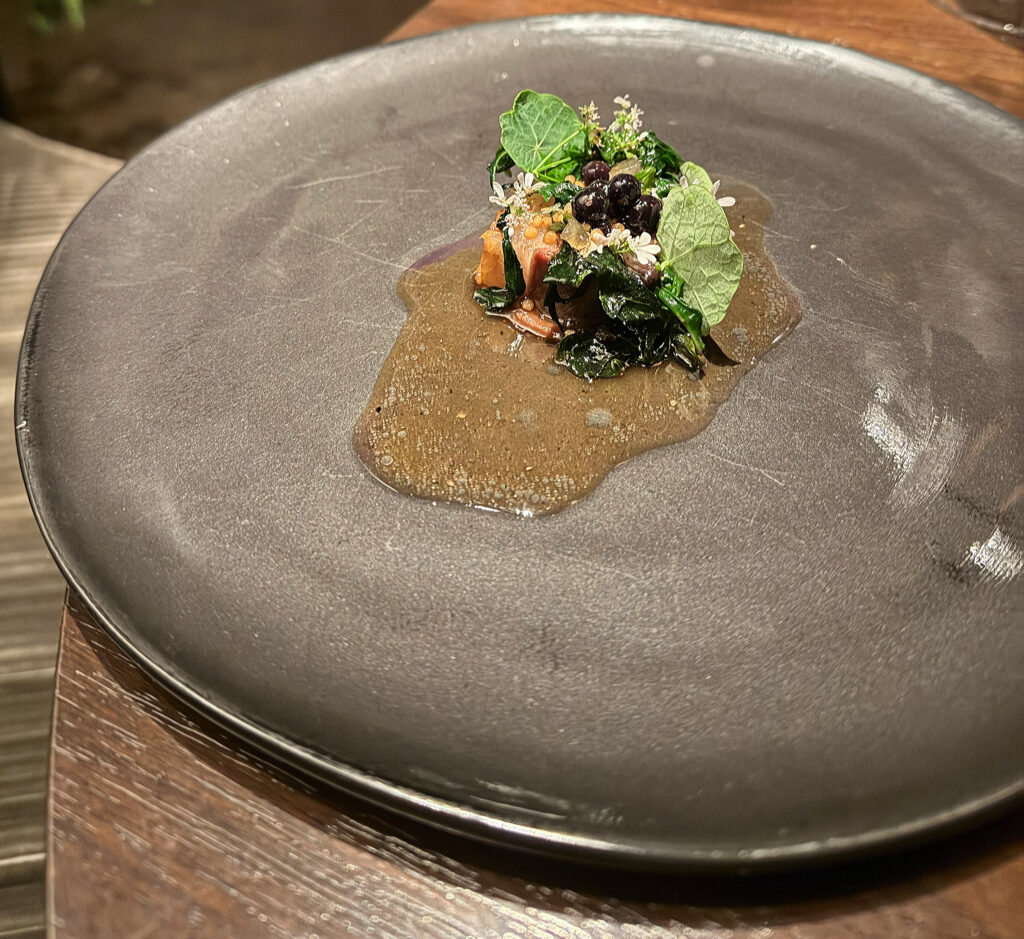
The main event remains the “Lamb Loin,” a cut that comes cooked in rendered fat then elaborately topped with nasturtium, spigarello, huckleberries, mustard seed, and coriander. A black garlic mustard is meant to provide a vein of savory power, and I find that it works well with the tender, juicy flesh. All those greens, flowers, and seeds—despite looking like a veritable salad—are also smoothly cushioned by the encompassing meat.
My only gripe is that the loin’s flavor profile is ultimately dominated more by sharpness and citric tang than any of the umami I mentioned (or even a baseline of decadence). It’s fair to say that the sweetbread already delivered such a sensation in spades, yet I think a plate like this needs to be totally convincing if it is to anchor the menu.
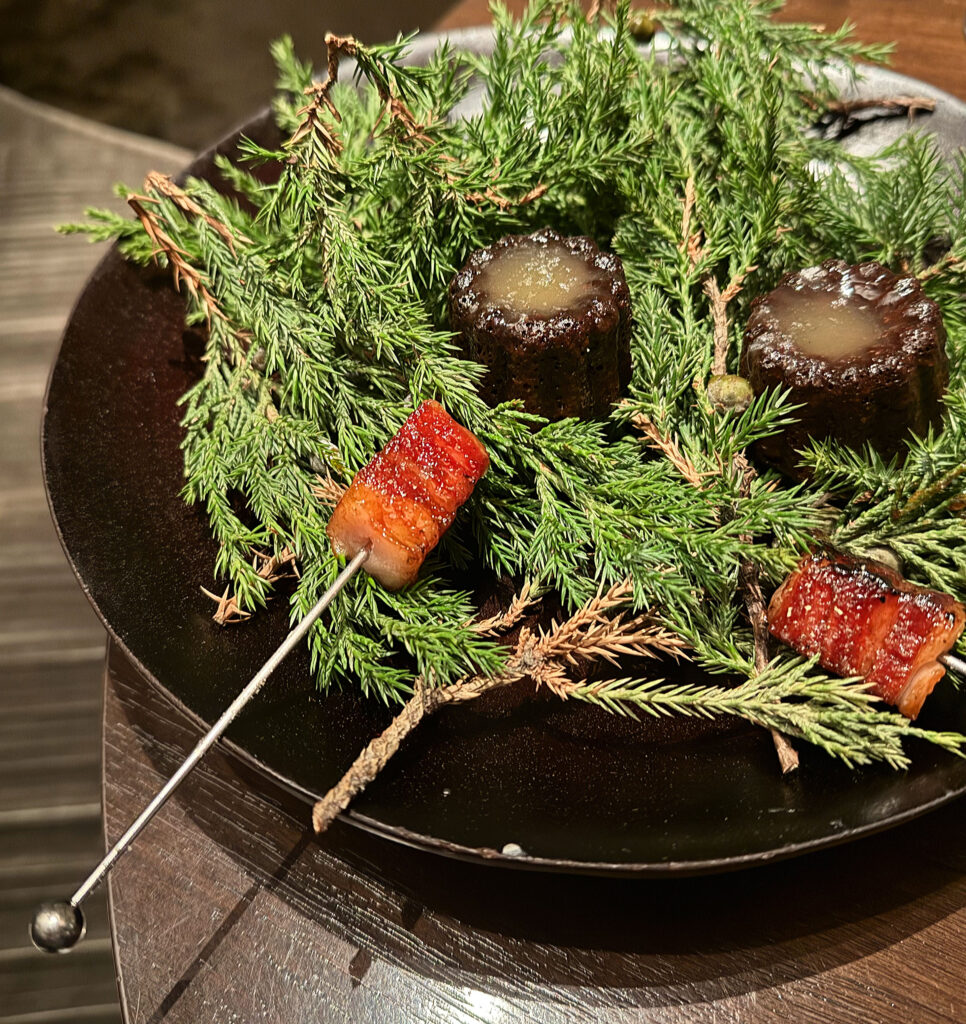
On a separate platter, one finds the “Lamb Pressé,” a skewered bite produced via a process of confiting (two days), pressing (one day), and grilling. Finished with a Jimmy Nardello pepper glaze, the dense package of meat delivers balances tremendous fat and sweetness with an elemental sense of satisfaction I found missing from the loin. Overall, I think this continues to rank as the very best mouthful of food Oriole offers.
Alongside the pressé, one also finds the “Lamb Butterscotch Canelé,” a pastry that has become one of the kitchen’s longstanding offerings within and without of this sequence. Flavored with Nikka “Yoichi” Whisky, the canelé feels a little too crisp on entry but proves custardy, sweet, and caramelized once one reaches the interior. Thus, while the texture could be slightly improved, this remains a welcome—and highly likable—item.
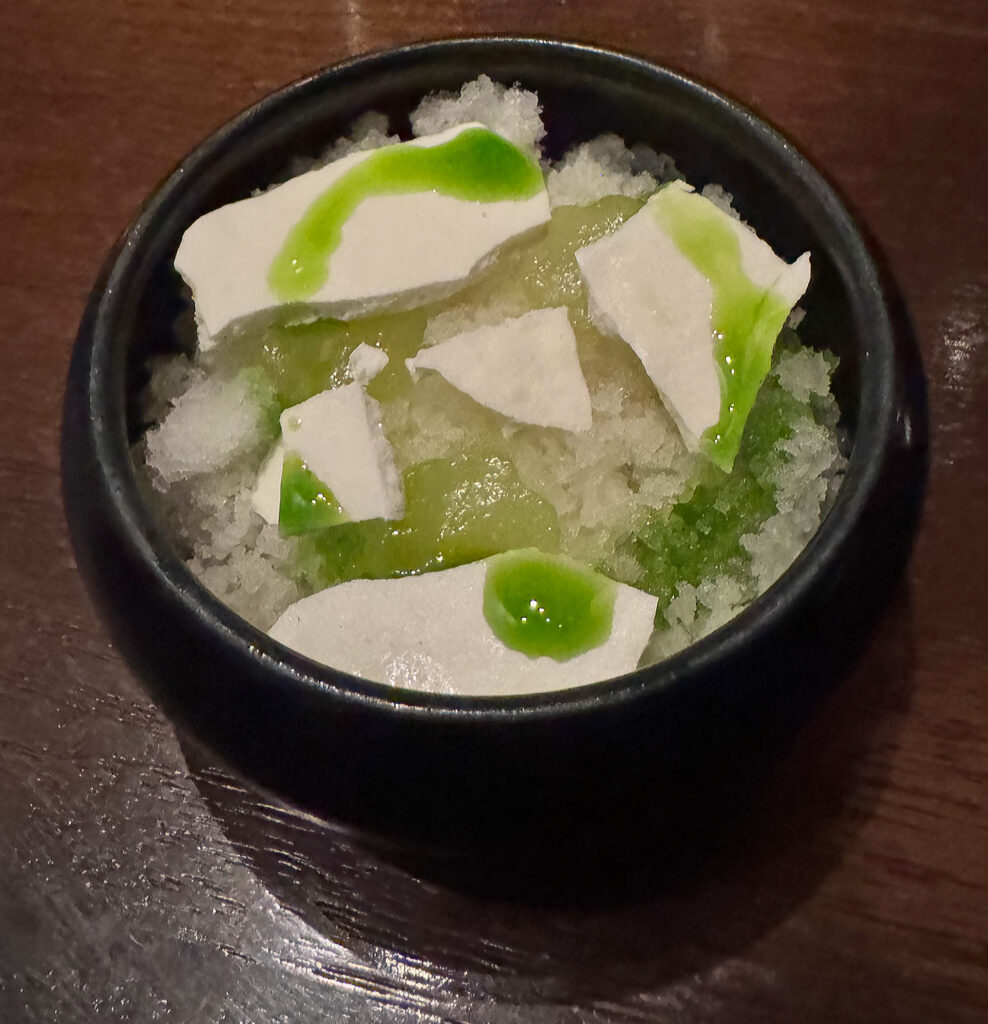
Upon reaching dessert, I am met by a preparation of “Honeydew Sherbet” that featured last time. Layered with, parmesan panna cotta, mint granita, crisp meringue, and fig leaf oil, this frozen treat contrasts cleansing ice, musky sweetness, and a rich, cheesy quality. I find the latter sensation to be the most appealing (and almost wish it was more dominant). However, if we view this recipe as a “palate cleanser,” one has to admire the level of nuance the chefs have pursued.
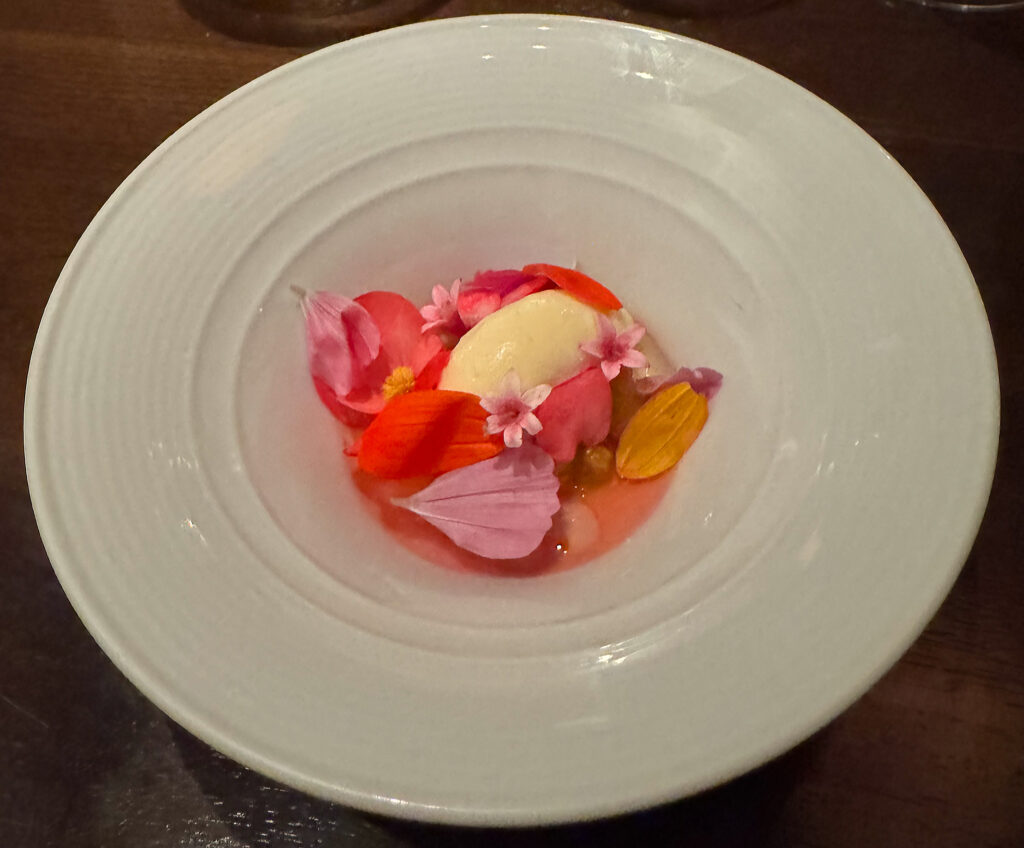
Opposite the sherbet, we have the “Sake Lees Ice Cream,” which almost strikes me as redundant given my preference for some kind of cake or chocolate (to say nothing of the old soufflé). Nonetheless, for whatever reason, this sundae of flowers (i.e., marigolds and cosmos), ground cherries, and a begonia-chamomile broth is superlative: striking with all kinds of fresh, fruity, and soothingly sweetened notes that draw out the tangy, cream cheese depth of the ice cream. I even find the texture of the petals—so often jarring—to be entirely acceptable. Taken together, this makes for a surprise hit.
Closing out the meal, I find a familiar trio of petit fours inspired by various teas:
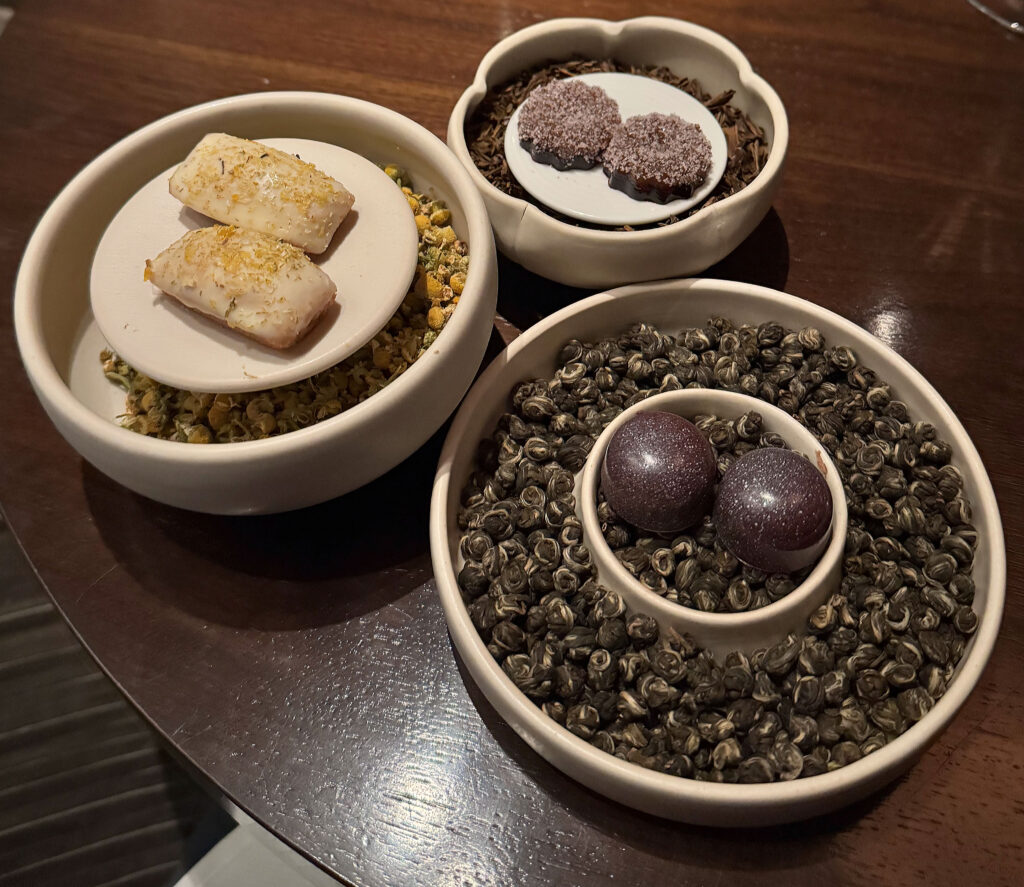
There’s the “Satsuma and Chamomile Madeleine” (my favorite), with its fresh notes of shortbread and white chocolate opposite a subtle, cleansing sweetness.
The “Berry and Hojicha Pâte de Fruit” (my second favorite), offering gummy, jammy dark fruit with a toasty, tart-sweet finish.
And, finally, the “Caramélia and Jasmine Bon Bon” (my least favorite), which speaks more firmly of brightness and grassiness than chocolate while, nonetheless, still smoothly integrating its caramel notes.
Roughly two-and-a-half hours later, my experience—comprising a total of 20 different recipes spread across 12 distinct courses—reaches its conclusion.
True to the chefs’ intentions (and with the help of an espresso), I retrace my steps through the kitchen, past the lounge, and beyond the elevator doors feeling satisfied but not sluggish.
It helps to know that I have a couple homemade cookies waiting for me in my bag: a new take-home treat, pioneered by Aloupas, that strikes me as an immediate and easy win for the restaurant. (Who, save for Kasama, even cares enough to give guests a worthwhile parting gift anymore?)
Even without snickerdoodles or chocolate chips to look forward to, I’ve found myself increasingly buying into the Oriole vision. Of course, a rise in price may change the internal calculus, yet there’s something to be said for a menu that stops short of staggering indulgence—that invites you to have those final bites and drinks somewhere else, to reenergize, to look back fondly at a dinner that left you wanting more, to dream about when you may visit again.
Despite bravely embracing a stylistic evolution, Oriole occupies this niche with singular confidence and flair: providing a reprieve from the city’s more frantic performances (however charming) and meandering expressions of creativity.
Yes, there’s still something dependable about coming here. There’s some feeling of a guarantee. Maybe not for the highest highs of the old signatures, but for a sense of occasion that is elegantly woven together (and hardly short on enjoyment either).
With all the kitchen aspires to do—all the team has already done to reshape the cuisine—I think the preservation of this feeling is a great accomplishment.
In ranking the evening’s dishes:
I would place the “Golden Kaluga Caviar,” “Veal Sweetbreads,” and “Lamb Pressé” in the highest category: superlative recipes that stand among the best things I will be served in any restaurant this year.
The “Lolla Rosa,” “Mustard Greens,” “Hudson Valley Foie Gras,” “Badger Flame Beets,” “Abalone,” “Milk Bread,” “Lamb Broth,” “Lamb Butterscotch Canelé,” “Sake Lees Ice Cream,” and “Satsuma and Chamomile Madeleine” all land in the next stratum: great items that achieved a truly memorable degree of pleasure. I would love to encounter any of these again.
Finally, there’s the “Little Gem Lettuce,” “Madai,” “Sablefish,” “Lamb Loin,” “Honeydew Sherbet,” “Berry and Hojicha Pâte de Fruit,” and “Caramélia and Jasmine Bon Bon”—good—even very good—preparations I would always be happy to sample again (but that, due to small flaws or chosen style, just failed to elicit an extra degree of emotion).
Overall, this makes for a hit-rate of 100%—far surpassing the 76% I reported in March and matching the same overwhelming degree of success I found in January, June, and August.
Further, while only 15% of offerings landed in that “best of the year” category (more or less matching the 16% from two months ago), a full 65% reached that “would love to have again” caliber (compared to 47% in January, 41% in March, 69% in June, and 58% in August).
By any measure, this was a tremendous meal: one that goes toe to toe with June’s visit for the title of the year’s best (at Oriole at least).
Nonetheless, digging into the details, I think we can uncover a few narrative threads:
For one, dishes like the “Lolla Rosa,” “Mustard Greens,” “Golden Kaluga Caviar,” “Lamb Pressé,” and “Canelé” continue to be quite successful, joining classics like the “Foie Gras” and “Milk Bread” to form a bulwark of consistent quality.
In turn, items like the “Little Gem Lettuce,” “Madai” (the latest in a series of crudo-like constructions), “Sablefish” (a reinvention of the turbot and other winning fish preparations), and “Lamb Loin” continue to slightly underperform. I might also include the petit fours in this category.
However, the “Lamb Broth” showed real improvement this time around. Not to mention, the “Badger Flame Beets,” “Abalone,” “Veal Sweetbreads,” and “Sake Lees Ice Cream” all made incredibly convincing debuts.
For this reason, I think it’s fair to excuse some of the growing pains that might be inflicting the “Madai” and “Sablefish.” These compositions might be trying to fit into established slots on the menu, yet the recipes are also substantially new and could easily improve over time.
This leaves the “Lamb Loin” as my only longstanding disappointment. It’s not an objectionable cut of meat by any means, yet, maybe, it tries to do too much and falls short of the satisfaction one expects from a headlining protein (and that the restaurant’s wagyu courses have so often fulfilled).
Admittedly, I’m the first to criticize wagyu as being overutilized in fine dining, so I certainly carry some appreciation for what the kitchen is trying to do with the lamb. Smyth, using quail, has pursued the same kind of novelty as of late, and the results haven’t exactly been inspiring either.
In the final analysis, with so many new dishes landing at the top of the heap, it’s hard not to be impressed by the chefs’ work. A creative process of this kind rarely yields an uninterrupted series of hits, yet it’s also important to note that not one bite of what was served tonight veered off the rails completely.
There are, undoubtedly, higher peaks of pleasure that the team can and should one day reach (peaks we only know are possible due to Oriole’s long history of excellence). But, as we approach the end of a year of visits, I feel lucky to have witnessed Sandoval, McHugh, and Aloupas’s collaboration firsthand.
There’s no question that the restaurant is developing a new voice. There’s also no question that it retains some core of the old patois. Untangling—and appreciating—these layered, emerging influences continues to form one of Chicago’s most rewarding gastronomic experiences.