
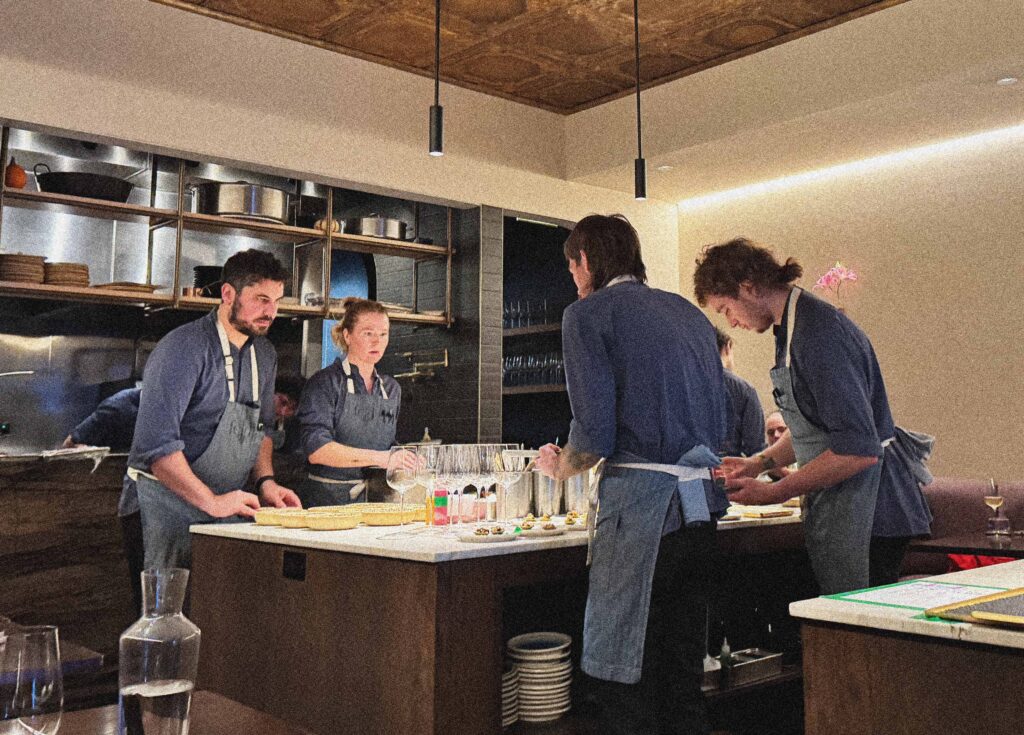
Another month, another visit to Feld—and just one visit this month (as fun as it was to track the restaurant’s transformation during the early and later stages of September).
We’re now firmly in fall, but there’s plenty of runway left to go: corn and tomato (except what was preserved) in the rearview mirror; apples and peaches and peppers all holding on; sweet potatoes, parsnips, sunchokes, squashes, and leeks now finally coming into the fold.
Chef Jake Potashnick concurs that “we’re really in autumn now,” highlighting the variety of Maine seafood and first dry-aged ducks that—alongside Feld’s totemic ham, cheese, and chocolate—will anchor the season’s bounty with comforting textures and flavors befitting a tasting menu of this price and prestige.
After all, “relationship to table” has never demanded that the restaurant spurn all of gastronomy’s trusty pleasures (once more, foie gras features as part of the meal this evening). Rather, it has simply provided a rationale through which the kitchen can jettison timeworn tropes like caviar, truffle, and wagyu in favor of the simple enjoyment herb-crusted lamb, a slice of masa bread, a cup of warm cider, some housemade mochi, or an ice cream made from fresh milk can provide.
Now, when you change the menu as frequently and collaboratively as this team does, not every new recipe will form an immediate hit. But what has come to the fore, over the course of 2026, is an ever-stronger house style spanning signature constructions (e.g., tarts, croustades, soups), favorite techniques (e.g., tempura, extended dry-aging), confident saucework, and a decisive approach to flavoring (ironic given some of the restaurant’s early controversy) that pulverizes any notion the restaurant is just serving raw produce on a plate.
Structurally, there’s still no other experience like this in Chicago, and, even if I was to look more broadly for a point of comparison, only destination restaurants (or perhaps something in the neo-kaiseki genre) really come to mind.
When I look out at the audience tonight—predominantly white and middle-aged yet, once again, peppered with a handful of older patrons who you’d expect to chafe against a concept like this—the seriousness of the Michelin star and the James Beard Award begin to resonate.
Feld, two years on, really is a bonafide destination in a city whose fine dining scene almost seems static. Just the same, Potashnick’s merry crew retains all the enthusiasm they had back at opening.
Of course, they’ve been forced to grow a little wiser. But there’s nothing serious about the way they enliven the intimate dining room: regaling each table with stories (or sometimes indulging in simple chit chat), hitting their marks with flair, and displaying an infectious esprit de corps one leaves feeling zealous to support.
Wherever a certain set of ingredients on a certain night may lead.
Let us begin.

When I take my seat at the table—on this occasion situated somewhere near the center of the room—I only want to know two things: what’s the restaurant’s latest seasonal drink, and how quickly can the team get it to me?
Over the past few visits, Feld’s “Freezer Door Cocktails” have formed consistent objects of attention. With one or two options available at any given time, these batched concoctions allow guests to savor something strong and composed without placing any undue burden on the chefs (who, at this very moment, must not only greet each party but also prepare for the meal’s most elaborate presentation of bites).
Clearly, this is a concept that revolves around pairings (conventional, non-alcoholic, and premium) while also taking pride in their bottle list. Corkage, you might remember, was discontinued due to a proportion of customers who abused the privilege—essentially, drinking all that they could as cheaply as possible then switching to water for the remainder of the evening.
So, these mixed drinks offer a fun, frivolous way to support the wider program (now the key to being allowed to bring your own wine) while celebrating the staff’s creativity and their attempts to translate the season via a different expression of craft.

The “Orchard-tini” ($20) I sample tonight might just rank among the best cocktails Feld has ever served. It is composed rather simply of quince gin, an apple eau de vie, and a touch of ginger. Yet, following a potent attack, it delivers ample, rounded fruit and a warming, spiced finish (lasting more than 30 seconds) that grows more enjoyable with each sip. Yes, the degree of cohesiveness here is truly impressive, and, enjoyed opposite an opening pour of mulled apple cider (more on that later), the drink’s effect is sublime.
Otherwise, when choosing what to enjoy alongside the menu itself, I again opt for Feld’s “Cellar Flight” ($325): an ever-evolving deep dive into what general manager/sommelier Nathan Ducker has to offer.
This time around, it comprises:
- 2014 Weingut Knoll “Ried Schütt Dürnsteiner” Riesling Smaragd [$80 at national retail]
- 2018 Michel Niellon Chassagne-Montrachet Les Chaumées Premier Cru “Clos de la Truffière” [$125 at national retail]
- 2012 Thomas Pinot Noir Dundee Hills [$130 average price]
- 2012 Il Poggione Brunello di Montalcino [$72 at national retail]
- 2001 D’Oliveiras Madeira Boal [$240 at national retail]
Now, guests are typically warned that this particular pairing is more about showcasing special bottles than actually matching the cuisine. However, at a structural level, the present flight actually accords rather well with the food: aged Riesling being served alongside the full breadth of “The Drop,” ripe white Burgundy with lighter expressions of seasonal produce, aged Oregon Pinot Noir (epitomizing elegance) with heartier vegetables and foie gras, then aged Brunello (wonderfully open in its own right) alongside the headlining aged duck.
The Madeira, interestingly enough, is the most expensive selection on offer by almost double. Nonetheless, given how superlative the restaurant’s desserts have been as of late, it’s actually refreshing to see them juxtaposed by a concentration of dried fruit, nuts, and caramel that drives recipes featuring ingredients like blackberry, butterscotch, maple sugar, buckwheat, chocolate, and smoked almond to even greater extremes of pleasure.


Overall, I’d label this as one of the more classically styled, textbook premium pairings that Ducker has put forth. But it’s one that savvily celebrates the virtues of mature wines, and, by doing so, provides a degree of a variety and value that a solitary $325 bottle (no matter how enticing the list is) cannot easily measure up to.
Indeed, split between two people (and enjoyed along with a cocktail, maybe a glass of Champagne, corkage, espresso, and after-dinner drinks) the “Cellar Flight” continues to add a meaningful layer of personality, performance, and gustatory depth to the experience.


Ultimately, given the overflowing passion with which the team operates, I think any of the pairings can provide much of the same effect. Yet, as I said before, it feels particularly enriching to indulge in an offering that helps push their curation to higher, more rewarding level.
In fact, it’s scary to envision the caliber of cellar Feld might build with a few more years of careful buying.
Now that the time has come to engage with the substance of the evening’s menu, I must actually take us back in time—before the ordering of any additional beverage—to the moment each party reaches the table.
After offering a warm greeting and confirming guests’ water preferences, one of the chefs will return toting ceramic cups filled with a housemade juice, tea, or broth meant to evoke the bounty of the season and crystalize the kitchen’s approach therein. This welcome drink is a small gesture—the kind that can also be found at Oriole or Smyth (in its own distinctive guises)—yet one that ensures Feld’s performance is immediately engaging and meditative long before the first morsels arrive.

Tonight, a “Lemon Balm Mulled Apple Cider” builds on the quality displayed by a verbena-inflected version served in late September. Finished with lemon oil and a touch of ginger stem, this hot pour delivers moderate sweetness, warming depth, and an electric tang/spiciness through the finish. Ultimately, I concede there’s nothing revolutionary about the combination. However, the balance here is impeccable, and the corresponding nostalgia makes for an easy win.
Some 15 or 20 minutes after the arrival of the cider (a frenetic period that sees the dining room fill, the pairings all poured, and the team marshalled with the utmost coordination), the time comes for “The Drop”—what the restaurant nicknames its signature opening flourish of innumerable, ever-changing bites.
Admittedly, it’s not all that hard to count to seven (the number of distinct elements Potashnick seems to be satisfied with after presenting as many as 11 back in January), but the effect is still engrossing: with plate after plate hitting, the accompanying spiel growing longer, and diners finally being left to “choose their own adventure” in how to attack the assembled tableau. At a structural and emotional level, no other concept in Chicago comes close to kicking off its meal in the same rousing style.
Of course, there’s also the small matter of how everything actually tastes:

To begin, a “Crostini & Confit” looks to revive a recipe that previously (in August and early September) featured lamb tartare. For my taste, it never quite came together, and the present iteration—featuring crispy sage, chive, and duck confit on a sage cracker—strikes me about the same. Indeed, while the fine threads of meat make for an impressively smooth sensation, the overall package is too drying and one-note to leave me wanting more.
Arriving alongside the crostini, a preparation of “Basil Tart & Bouchot Mussels” also expands on one of the restaurant’s longstanding forms, which has played host to ingredients like salmon belly, mackerel, and tomato in the recent past. Nonetheless, filled with crispy fronds of cauliflower and a plump piece of the titular mollusk, the crumbly, delicately sweetened shell displays a pronounced savory quality that surpasses any past example of the recipe I can think of. Indeed, this is nice.

Standing tall on its own dedicated pedestal, the “Yeast Pancake & Ribeye” sees another favorite vessel (last used to house yellowtail in July) driven toward a new, uniquely decadent extreme. Yes, by imbuing the base with apple and brown butter then glazing the beef (rendered as a carpaccio) with tare, the pancake spans a range wondrously melty, fluffy, and buttery-sweet sensations I’ve so often found missing from the dish. That said, I do think a stronger vein of underlying umami would take this construction to an even higher level.

The “Lobster Claw & Scotch Bonnet” that comes next comprises a rather sizable, enticing portion—the kind you’d expect to see somewhere closer to the heart of the menu. However, despite being dressed with sauces made from raspberry and the titular pepper, I find the meat of the crustacean—however pleasant—to be too dense and underseasoned to offer any of its expected pleasure. I won’t deny that I love the idea though. A touch of salt (or some more robust manner of dressing the lobster) could easily make this a star.

The “Sunchoke & Maple” strikes me as having a sort of playful “potato skins” element to its presentation, which sees the headlining tuber fried, hollowed out, filled with a sunchoke purée, then dressed with an apple cider-maple reduction and a dusting of mushroom-vinegar powder. Nonetheless, despite being pleasantly earthy-sweet, this construction is undone by the absolute hardness of the root vegetable’s crunch. Ultimately, the starring ingredient needs more refinement if this idea is going to be actualized.
Thankfully, the final plate of the sequence might be the most accomplished:

It contains the “Potato Tart & Benton’s Ham,” which comes layered with quail egg and cheese mousse. After breaking cleanly on the palate, the tart marries a rich, creamy mouthfeel with a pronounced, porky saltiness that carries through to the finish and helps to reveal an attractive undertone of caramelization.
There’s also the “Poblano & Peach”—a croustade filled with meat from the early lobster’s knuckle (and that rights the wrong of the claw’s blandness courtesy of ample supporting acidity, some jammy sweetness, and a complicating shot of smoky, rather mild heat). After the basil tart, this might be the best of the whole bunch.
Reaching the first of the kitchen’s actual, composed plates, my excitement is palpable. Not only am I ready to sink my teeth into something more robust and realized than “The Drop’s” format permits. Rather, I know from experience that Feld’s opening presentations of seafood counterintuitively (for a concept so closely associated with produce) rank among the team’s greatest work.

With the arrival of the “Atlantic Mackerel—Pickled Sungold,” my faith feels immediately justified. The dish centers on shining slivers of the fish (which has been salted but is otherwise served raw) in a vinaigrette made from last season’s tomato, “lots of ginger,” and a drizzle of dill oil.
Texturally, the mackerel displays an enticing firmness on entry that quickly turns tender and creamy with further mastication. The resulting flavor is markedly umami—a winning start—yet takes on growing shades of sweetness, grassiness, and uplifting spice with each subsequent mouthful. On the basis of its elegance and total cohesiveness, this recipe is worthy of any omakase in town. However, it’s the fish’s savory power (no doubt helped by the tomato) that pushes this preparation into the pantheon of Potashnick’s best.

The “Love Point Oyster—Apple” that comes next is not far off either (understandably so given its similarity to a Manila clam set that proved so convincing in late September). Here, the meat of the bivalve is extricated from its shell and layered in a bowl filled with apple cider, an apple gelée, some grated horseradish, a touch of basil oil, and a garnish of nasturtium flowers.
This yields a series of bites that feel rather gooey and amorphous upon reaching the tongue. However, the weight of the oyster and subtle crispness of the accompanying petals provide definition: framing a remarkable juxtaposition of sweetness, sharpness, cleansing cucumber, and juicy brine that penetrates deeper and more persistently than any half-shell presentation could ever hope for. Really, while the mackerel might win a few extra points for its delicacy, this plate manages to deconstruct the perfect dressed oyster and drive its corresponding satisfaction into the stratosphere.

Careful observers may have noticed that “The Drop” did not contain any kind of tempura (one of the kitchen’s most longstanding techniques) tonight. The appearance of the “Delicata Squash—Ginger” remedies that, and I think it makes a case for why the restaurant’s future fried delights may also deserve their own dedicated course.
Coated in a blue masa batter then topped with a thyme and ginger honey, the semicircular segments of squash possess a crisp, crumbly, and tender consistency that harmonizes brilliantly on the palate. Flavor, even more importantly, is marked by a generous application of salt that joins with the toasty notes of the tempura coating to establish a strong savory core. Against this baseline, the delicata’s own latent sweetness really sings: being driven by the infused honey toward a decidedly zesty, caramelized expression whose length and decadence are just sublime. In short, as far fried items go, this forms a new benchmark.

On the back of a few bonafide highlights, the “Candy Onion—Autumn Broth” (i.e., a lone piece of produce in a shallow bowl of liquid) could surely not hope to compete.
However, the charring of the onion yields petals that break apart cleanly and tenderly with just a little jostling. Further, the broth (made from katsuobushi and finished with chive oil) is beautifully balanced: drawing a soothing sweetness out from the starring allium while providing just enough salt to shape lip-smacking, umami-laden finish. Ultimately, I’ve sampled many versions of this essential form here over the years, yet this example has to rank near the top.

The “Slow Cooked Sweet Potato” that arrives next pursues much of the same simplicity: isolating and celebrating a lone piece of produce in the inimitable Feld style. Given the success of the earlier delicata, I’m excited to hear that the tuber has been “slow fried” for three hours then given a tempura coating (albeit without any masa).
“Lots of horseradish,” a miso-egg yolk sauce, and a handful of basil buds complete the presentation, which promises even more outward decadence than the squash delivered. However, while I admire the juxtaposition of crispness, richness, and freshly sweet backing, the potato itself proves dense and pasty through the middle. Somehow, the horseradish ends up entirely muted too. Ultimately, this recipe just doesn’t come together, but I think it could be easily fixed if the starring ingredient was rendered in smaller, more thoroughly cooked chunks.

A composition titled “Leeks Vinaigrette—Sunflower” displays much of the same promise: offering a play on the titular recipe that sees charred segments of the allium layered with garlic and thyme over a sunflower butter and sunflower seed-laced rice porridge.
Texturally, the transition from the topping of crisp leeks to the luscious center is beautifully managed. I also appreciate how smoothly the notes of bitterness, earthiness, and concentrated nuttiness come together. Nonetheless, the combination is desperately in need of delineation, for its overall expression almost feels one-note. Yes, a stronger application of salt would really do wonders here: unlocking a latent vein of sweetness and achieving the degree of satisfaction I know this dish is capable of.

After a couple slightly underwhelming courses, I know the “Au Bon Canard Foie Gras—Chestnut” can be relied on. Indeed, it formed one of the absolute highlights of my last meal (when it was paired with flavors of quince, blood peach, apple cider, and black lime).
The present iteration sees the liver—still served raw—paired with more decidedly savory components like masa cake and a butter, purée, and shavings all made from chestnut. That said, while the resulting expression of flavor is less boisterously sweet than before, its gradient of richly earthy and nutty tones is skillfully assembled. More importantly (and relative to the preceding porridge), there’s a persistent, mild sweetness at hand to ensure the foie gras’s ample fat is matched by a convincing sense of pleasure. Factor in the preparation’s creamy, melty consistency, and one is left with a take on the luxury ingredient that masterfully walks the line between creativity and enjoyment.

An accompanying slice of “Masa Milk Bread,” like the foie gras itself, isn’t quite as transcendent as what I tasted in late September. Its crumb is finer and firmer (like a sandwich loaf) than the fluffier example I encountered before. Yet it still does its job of soaking up the sauce on the main plate, echoing just a hint of the same sweetness found therein.

The “Long of Naples Squash Soup” that comes next can be thought of as a successor to the corn soup recipes that consistently featured during the summer. The telltale, in my opinion, is the scoop of ice cream (one flavored with bacon fat on this occasion) that sits at the center of the bowl and creates an alluring temperature contrast.
Otherwise, one finds a pecan praline and some rosemary oil incorporated into the liquid: shaping a soup of creaminess, crumbliness, and beautiful sweet-savory balance with a fruity, piney finish. If anything, the nuttier and smokier notes drawn from the ice cream are almost a tad overwrought. But the quality of the praline is remarkable, and, as a representation of winter squash, the course is quite easy to like.

A dish titled “Sue’s Lobster—Parsnip—Quince” looks to close out a sequence that started (during “The Drop”) with expressions of the crustacean’s claw and knuckle. Here, we now see the tail gently cooked and paired with three expressions of the titular root vegetable (a foam, a purée, and grilled pieces). Some quince gel and a caramelized onion jus serve to complete the presentation.
On the palate, the meat of the lobster strikes me as being loose and gooey rather than plump or buttery as one might expect. Nonetheless, the accompanying acidity (from the fruit) and elegant earthy sweetness (from the parsnip) meld nicely with the character of the shellfish while the onion, in turn, provides an all-important undercurrent of umami. Ultimately, this composition comes maddeningly close to ranking among the evening’s highlights. The tail just needs to achieve a slightly better mouthfeel for all the other good work being done to impress.

In familiar Feld fashion, the meal’s two principal entrées are separated by a small palate cleanser—a role played to perfection by the Sungold sorbet during the past few months. Tonight, I find a “Ginger Stalk Granita” in its place, and, admittedly, much of the constituent shaved ice is bland and watery. However, some of the spice and accompanying mint oil still shines through, and this tiny bowl just about does its job.

The present menu’s headliner is a “23-Day Dry Aged Duck” (whose confit already featured somewhat underwhelmingly during “The Drop”). But Potashnick, certainly, is enthused to be working with the birds again (now of the Moulard breed instead of the Muscovy used last year). And the carcass, which has been grilled then roasted then grilled again, also makes a delectable impression when presented tableside.

The resulting plate sees a sizable segment of the duck’s breast dressed with nothing more than some flaky salt and its own jus. An assortment of grilled produce (i.e., carrot, radish, bok choy, husk cherry, celery leaf, cranberry, and fig) is meant to provide much of the dish’s definition. Undoubtedly, it makes for a colorful medley, yet I only really find that the fig’s deeply caramelized sweetness makes much of an impression.
Thankfully, the meat itself (despite possessing a trace of sinew and thus being a little hard to cut) is totally satisfying. Texturally, the flesh offers an engaging chew, ample juiciness, and a melty—if not entirely crisp—cap of fat. Flavor, too, is marked by the liberal use of salt, which (even if it doesn’t do much to enliven the vegetables) amplifies the core umami of the aged duck and more refined, comforting character its jus. Ultimately, this recipe only represents a rather early effort from the kitchen (and no doubt I’d like to see the produce substituted for something more intentional). At the same time, it also affirms their increasing mastery of the starring ingredient, signaling that there should be plenty more enjoyment to come as the season progresses.

When we finally reach dessert, the “Verbena—Lavender” strikes an immediate note of nostalgia: calling a series of uncertain, inconsistent preparations from Feld’s early months to mind.
However, years later, this combination of blackberries, lavender butterscotch, lemon verbena sorbet, and black lime powder finally fulfills its potential: spanning notes of jammy dark fruit, tangy citrus, and rich, soothing sweetness while maintaining total harmony. Yes, the concentration here is immense—cleansingly so—but the resulting pleasure proves just why Potashnick was right to pursue and perfect this idea for so long.

The “Butternut—Buckwheat,” by comparison, forms an entirely new course tonight (albeit one that enters into a longer tradition of constructions featuring meringue).
Underneath the torched dome, the titular squash is puréed and diced and paired with maple sugar. A buckwheat emulsion then acts as the anchor, balancing the butternut’s exuberant, caramelized sweetness with roasted, nutty depth. The meringue—its consistency reminiscent of marshmallow fluff—deserves some special credit too, for its toasty notes and encompassing mouthfeel further serve to meld (and amplify) the principal ingredients. Overall, the pleasure offered here is profound, and I can only hope this highlight sticks around for a good while.

The latest iteration of the “Svenska Kakaobolaget” (one of Feld’s most longstanding signatures) sees the Swedish brand’s 74% Tanzanian blend transformed into the familiar mousse then seasoned with fermented blueberry and a topping of grated smoked almond.
Compared to the previous example (drawing on notes of sunflower and tomato), the chocolate now skews toward a darkly fruited, even tangier expression (well matched to the cacao’s jammy undertones) without entirely sacrificing a supporting, luxurious sense of nuttiness. Given that the mousse maintains its appealing airiness, I think this ranks as a rather successful (if not all-time great) variant that manages to keep the recipe feeling fresh.

The “Fior de Latte” (which has quickly become one of the restaurant’s signatures in its own right) appears in a fairly conventional form tonight: one in which the fresh-churned, unflavored milk base is shaped only by a drizzle of olive oil and a sprinkle of Maldon salt.
As always, the ice cream itself is remarkably smooth and imbued with a staggering depth of dairy sweetness. The olive oil, to its credit, provides a key dose of delineating sharpness and fruit. But it’s actually the salt—with flakes so big that they nearly get caught in your throat—that dampens some of my usual enjoyment. Yes, though I appreciate the seasoning’s effect on the milk’s flavor, its consistency needs to be more carefully managed.
Reaching the end of the meal, I find three familiar items waiting to see me off:

First, there’s the trusty “Fresh Fruit on Ice”—a playful presentation of blackberry, sweet lime, raspberry, apple, pear, and husk cherry (but one in which only the latter three come close to making any impression).

The “Apple Cider Financier,” with its notes of spiced fruit and brown butter, manages to outdo the raspberry version I enjoyed so much in late September. The texture here (balancing a subtle crisp shell with a moist interior) also deserves special praise.
Finally, the “Pleasant Ridge Shortbread” references the kitchen’s favorite cheese while transforming it into a drying, crumbly cookie. The textural appeal isn’t obvious, yet the flavor is winning: brimming with the kind of saltiness, nuttiness, and caramelization I love to savor at this late stage.
Two hours and fifteen minutes later, my dinner reaches its conclusion: a whirlwind of 27 distinct morsels served, on average, in five-minute increments.
Now, with the nature of “The Drop,” we know this calculation to not exactly be true. Yet, all the same, it testifies to how sharply this young team operates and to the rhythm the transforms the kitchens highs (and occasional lows) into a rollicking good time.
After-dinner drinks, guestbooks, s’mores, and relaxed conversation await: capping off dinner in the singular Feld style.
They’re not mere niceties so much as they rituals: ones whose charms seem to grow as each menu—and discrete moment in time—draws to a close.
In ranking the evening’s dishes:
I would place the “Atlantic Mackerel—Pickled Sungold,” “Delicata Squash—Ginger,” “Butternut—Buckwheat,” and “Svenska Kakaobolaget” in the highest category: superlative items that stand among the best things I will be served in any restaurant this year.
The “Lemon Balm Mulled Apple Cider,” “Basil Tart & Bouchot Mussels,” “Poblano & Peach,” “Love Point Oyster—Apple,” “Candy Onion—Autumn Broth,” “Au Bon Canard Foie Gras—Chestnut,” “23-Day Dry Aged Duck,” “Verbena—Lavender,” “Fior de Latte,” “Apple Cider Financier,” and “Pleasant Ridge Shortbread” all land in the following stratum: great recipes that achieved a truly memorable degree of pleasure. I would love to encounter any of these again.
Next come the “Yeast Pancake & Ribeye,” “Lobster Claw & Scotch Bonnet,” “Sunchoke & Maple,” “Potato Tart & Benton’s Ham,” “Slow Cooked Sweet Potato,” “Leeks Vinaigrette—Sunflower,” “Masa Milk Bread,” “Long of Naples Squash Soup,” “Sue’s Lobster—Parsnip—Quince,” “Ginger Stalk Granita,” and “Fresh Fruit on Ice”—good—even very good—preparations I would always be happy to sample again (but that just failed to elicit an extra degree of emotion).
Finally, there’s the “Crostini & Confit”—a merely good (or maybe just average) item that fell short when it came to flavor. Given that I’ve seen this idea executed more successfully in the past, I think it could easily be redeemed with a little more tweaking.
Overall, this makes for a hit-rate of 96% with some 56% of offerings reaching that “would love to have again” level of quality: figures that largely match the numbers I reported in late September (i.e., 100% and 69%), early September (i.e., 92% and 62%), August (i.e., 96% and 56%), July (i.e., 96% and 63%), June (i.e., 100% and 52%), May (i.e., 100% and 54%), and April (i.e., 96% and 54%).
If we consider the number of “best of the year” dishes (four, compared to four in late September, four in early September, four in August, three in July, six in June, five in May, and four in April), the results also remain more or less consistent.
Admittedly, it is probably fair to say that the present meal—served deeper into fall—ranks a step or two behind my previous one, which burst with creativity at the very start of the season (and might just represent Feld’s greatest menu to date).
In turn, I can only respect the fact that late September’s most successful creations (like the “Foie Gras” and the “Svenska Kakaobolaget”) underwent a significant amount of change and still stood among the evening’s highlights. Plenty of other hits (e.g., the “Manila Clam,” “Ikura,” “Wild King Salmon,” and “Toasted Oat”) were excised altogether—only to be replaced by a range of recipes (like the “Atlantic Mackerel,” “Love Point Oyster,” “Delicata Squash,” and “Butternut—Buckwheat”) that offered every bit of the same pleasure.
Sure, there was some regression to report: a slice of the “Masa Milk Bread” that was not quite as fluffy, a scoop of the “Fior de Latte” that was blemished by large flakes of salt. “The Drop,” despite two clear standouts, felt uniquely underwhelming on this occasion (and I can think of one or two bites that just barely escaped joining the “Crostini” in the bottom category). The “Fresh Fruit on Ice,” despite never offering much to write home about, felt nearly anonymous tonight.
But, at the end of the day, even some of the kitchen’s comparably weaker efforts—like the “Yeast Pancake,” “Sweet Potato,” “Leeks Vinaigrette,” “Squash Soup,” and “Sue’s Lobster”—were just a touch of refinement away from greatness.
Time has taught me that Potashnick and his team are more than capable of bridging that gap—that, as at several of the city’s other top spots, one must appreciate the kernel of a given idea and its process of becoming as much as the supreme satisfaction it may someday yield.
In the meantime, the Feld experience continues to feel engrossing as it confidently balances any errant experimentation with more than enough outright deliciousness in return.
Indeed, eating here is a journey rather than an exercise in hackneyed fine dining “perfection.” Eighteen visits later, it’s a journey I still feel privileged and piqued to embark on.