
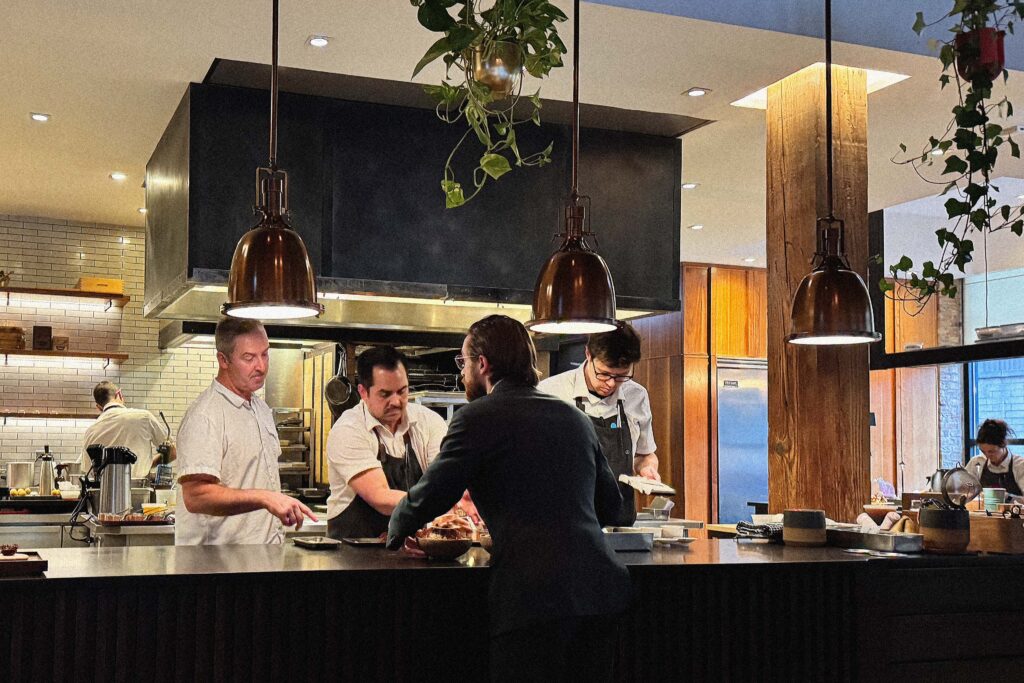
One month later, I am back at Smyth—and thoroughly ready to take my first taste of fall as imagined by chefs John and Karen Shields.
Subconsciously, this really is the season I gravitate toward when eating here: the time of year when I made my very first visits to the restaurant and that forms the eternal backdrop for any broader memory of the smells and tastes and memories that have made the place so special over the past decade.
Accounting for my forthcoming meals in November and December, fall is also the period I will be able to describe with the most certainty when looking back on 2026. Consistent engagement with the menu, I have found, always forms the key to appreciating some of the kitchen’s more challenging constructions: kernels of ideas and haphazard technical explorations that, one or two iterations later, suddenly deliver unforeseen ecstasy.
And, given the team’s continued obsession with various seaweeds, nut oils, seeds, grains, fudge butters, and offal, what better way to round out the resulting rough edges than to draw upon all the gourds and root vegetables and delectable shellfish that nature’s bounty offers at this very moment? In my experience, this deeper register of flavor cushions the house style quite well.
Otherwise, it may be worth reflecting on the fact that Smyth’s search for a new head chef—a global casting call that began in January—has now reached its conclusion. And, on the surface, it looks to me like the Shieldses made a perfect choice: hiring a young, international talent with a three-Michelin-star background but, more importantly, direct experience leading a Michelin-starred concept blending local ingredients with a worldly touch.
That sounds a bit trite, yet just look at these menus and note the resonance of certain products and sauces and cultural (i.e., Japanese) inflections. Plus, there’s something to be said about recruiting a chef from a “second city” like Manchester and bringing him to Chicago: breaking away from the oft-homogenizing influence of larger markets and building something that feels distinct and attuned to the local audience.
Yes, we may look at this meal (and perhaps the next couple that follow) as the last entries in a chapter that has seen Smyth scale the mountaintop of national ranking. The team has not done so without stoking a certain amount of polarization: the people, I frequently mention, who pine for the kind of cuisine served before the pandemic.
Nonetheless, a singular creative process—the persistent pursuit of newer, ever-greater pleasures (even at a cost to established excellence)—continues to rule here.
Thus, any understanding of the paradigm shift that is soon to come must be rooted in a full understanding of where the restaurant is and just how high it is aiming until the final moment of transition.
Let us begin.
Tracking the evolution of Smyth’s “Reserve Pairing” ($475) has become one of my favorite topics: not only because wine director Louis Fabbrini’s selections are every bit as dynamic as the food but due to the fact that this pricey add-on offers superlative value in a global context.
You will almost never find me paying for pairings at other restaurants when I know that the same sum (multiplied by the number of members in one’s party) can be used to secure styles and producers that directly satisfy the table’s preferences.
Here, that might mean a bottle of “La Closerie” ($475), Ulysse Collin “Les Maillons” ($475), Bruyère-Houillon “Les Tourillons” ($180), Maison Maenad “De l’Avant” ($180), Lafon “Clos de la Baronne” ($405), 2020 Schätzel “Pettenthal” GG ($545), 2010 Valentini Trebbiano ($495), 2023 Marc Soyard “Hermaïon” ($255), 2019 Bartolo Mascarello Barolo ($365), or 2016 Roagna “La Pira” ($425)—to name just a handful of options.
Smyth, certainly, can take pride in a wine list that offers great breadth and depth and the most minimal of markups (especially if we consider the kind of captive, special occasion audience many three-Michelin-star dining rooms choose to prey on). There’s no good reason for any oenophile to leave the particularities of their taste in the hands of a pairing that only really exists to provide a turnkey solution for those who seemingly lack the knowledge to decide on their own.
Plus, I’ve especially found that places touting pairings in the $500 or even $1,000 range often just regurgitate recent releases from famous brands whose status pleases the lowest common denominator and whose scale of production makes the sommelier’s job rather easy.
Yet, Fabbrini turns this logic on its head by routinely presenting weirder, cheaper, more characterful wines (aligned with the extreme textures and flavors of the Shieldses’ cuisine) alongside absolute legends: the pours even a privileged drinker dreams of sampling (and that strike a classic balance with dishes that center on meat).
Tonight, the lineup captures this juxtaposition perfectly:
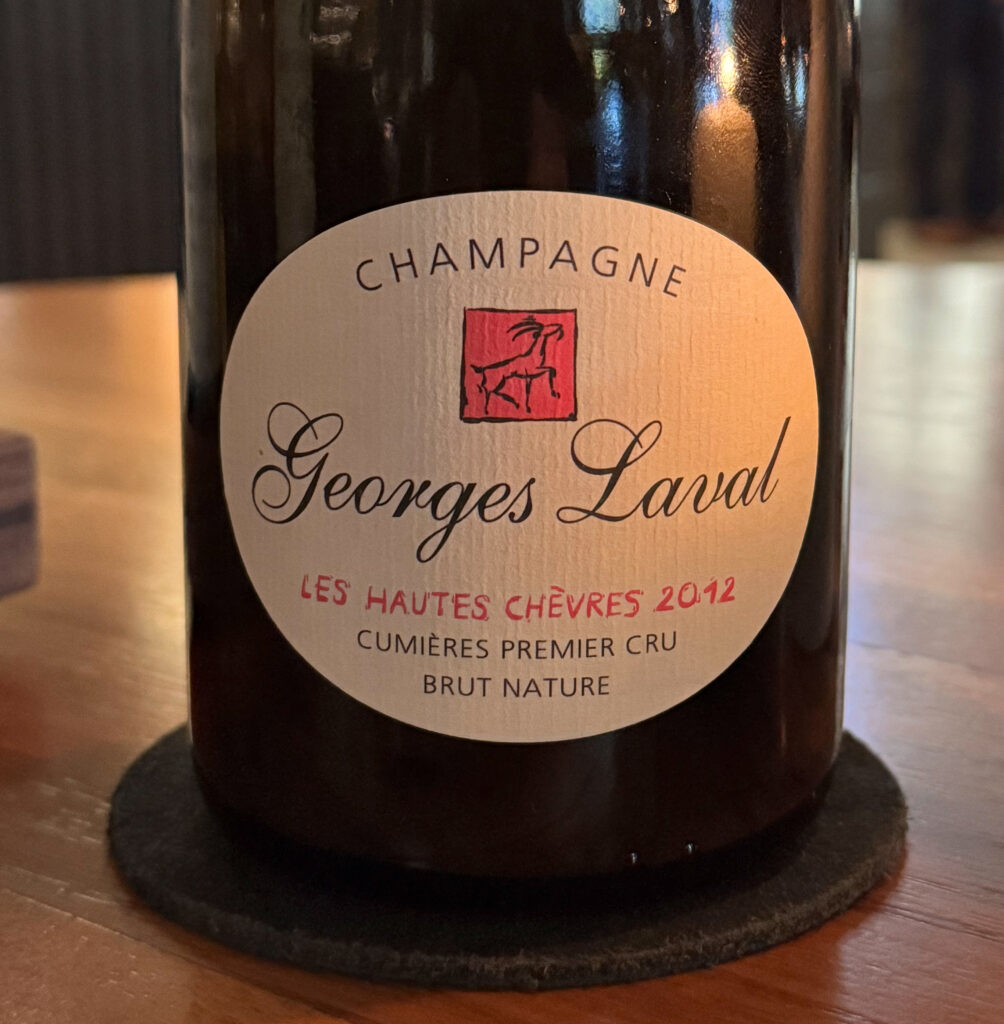
- 2012 Georges Laval Champagne Premier Cru “Les Hautes Chèvres” [$335 at international retail]
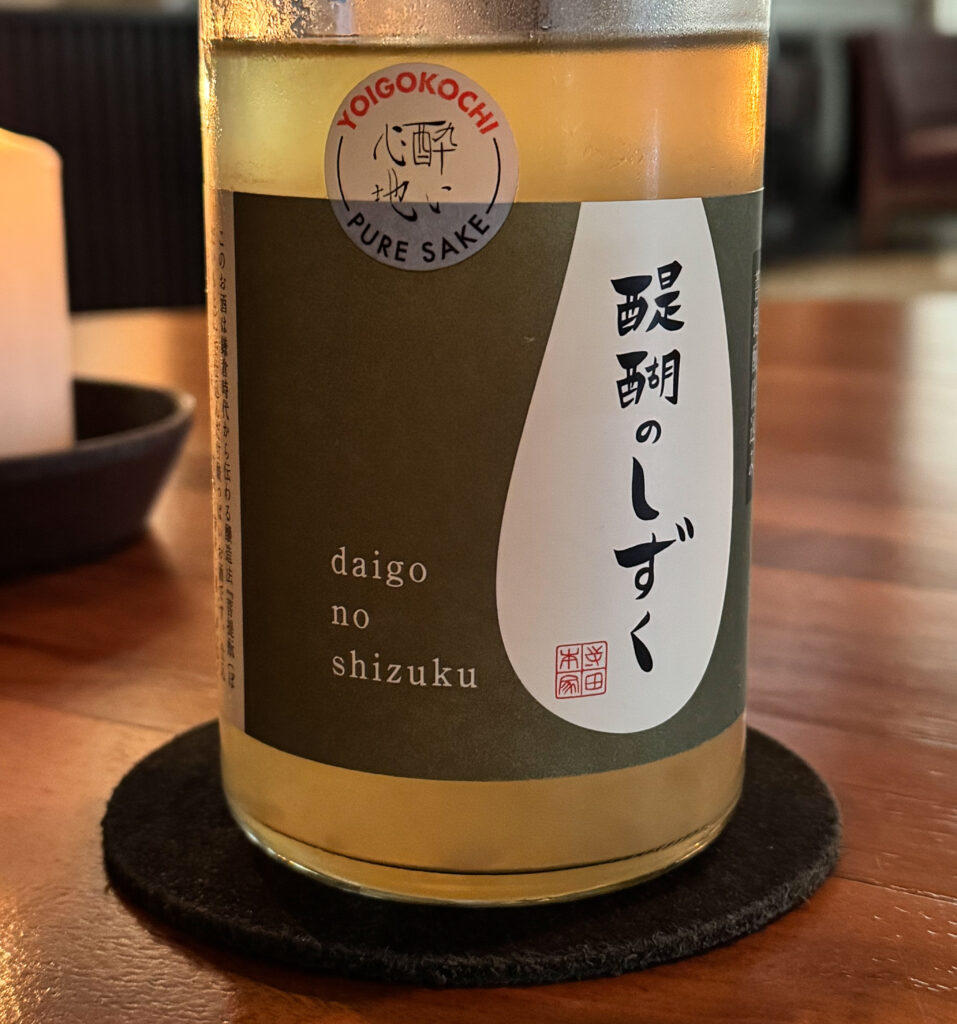
- NV Terada Honke “Daigo no Shizuku” Junmai Muroka Nama Genshu [$39 at national retail]
- 2022 La Grapperie Coteaux du Loir “Aphrodite” [$49 at national retail]
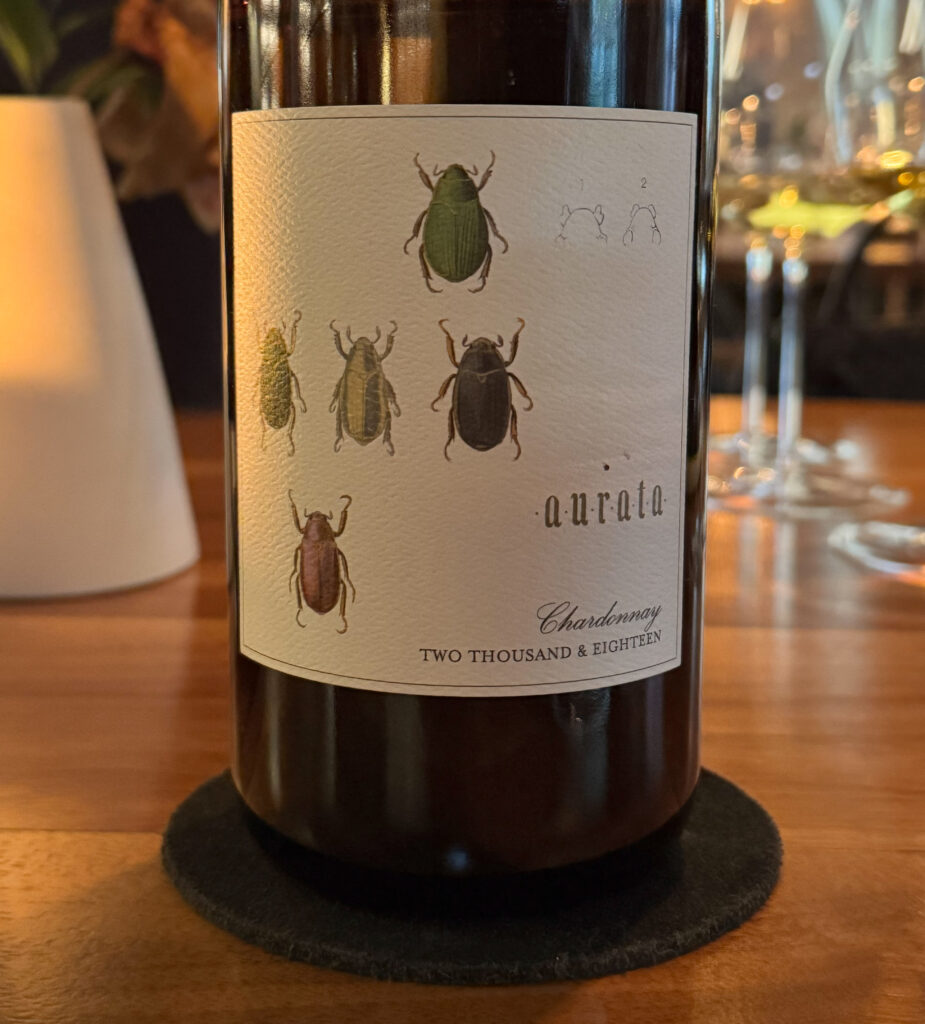
- 2018 Antica Terra “Aurata” Chardonnay [$320 at national retail]
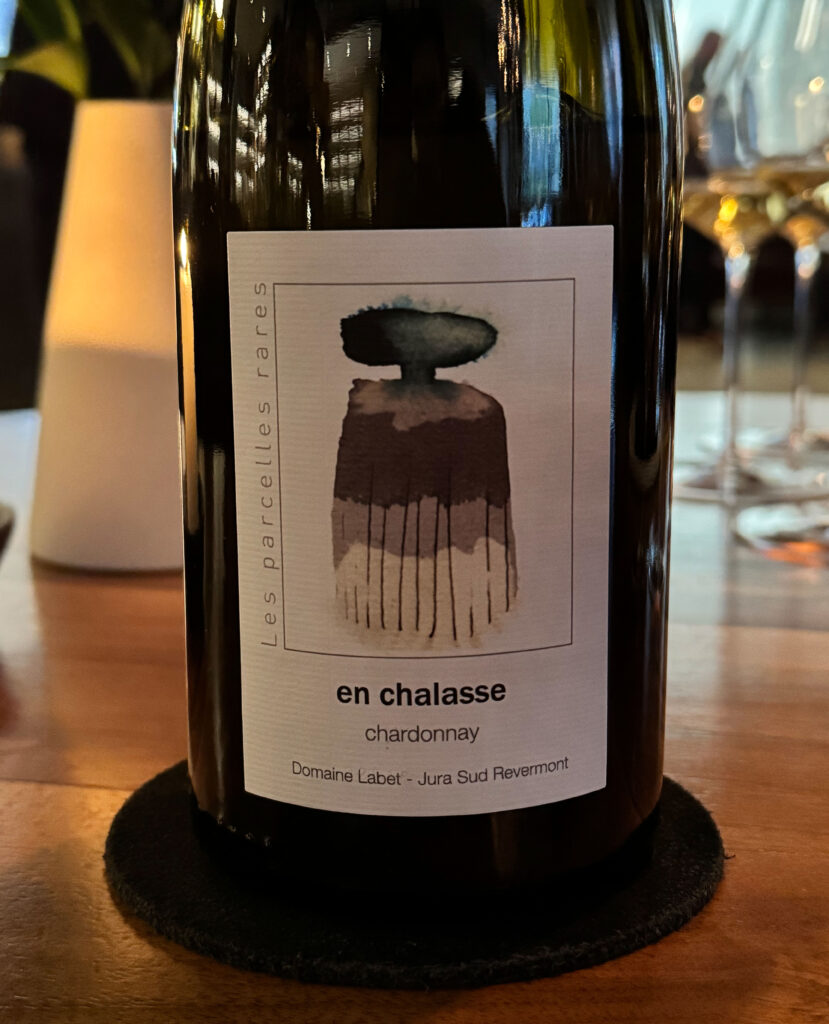
- 2018 Domaine Labet “En Chalasse” Chardonnay [$225 at national retail]
- 2025 Collecapretta “Il Rosato di Casa Mattioli” [$42 at national retail]
- 2023 Makatzak “Gandor” [$39 at international retail]
- 2022 Tzum (Hiyu Wine Farm) “Aedin” [$156 at national retail]
- 2005 Domaine Bizot Vosne-Romanée “Les Jachées” [$3,696 at international retail]
- 2018 Arnoux-Lachaux Latricières-Chambertin Grand Cru [$2,499 at national retail]
- 2017 Valentin Zusslin “Bollenberg” Gewürztraminer Vendanges Tardives [$56 at international retail]
- 1995 Domaine Jo Pithon Coteaux du Layon Saint-Aubin “Clos des Bois” [$51 at international retail]
Structurally, a pour of aged grower Champagne is a good way to start: engaging one’s palate alongside a few opening bites while soothing any fear guests are going to receive an undistinguished, oversaturated product like Krug “Grande Cuvée” (however delicious it can be).
Then, admittedly, things get a little strange with a cloudy, sweet-and-sour sake poured alongside a composition of tofu and caviar. However, the “Aphrodite” (a fresh Chenin Blanc displaying moderate sweetness) is easy to like, and one-two punch of 2018 Chardonnay (from Antica Terra and Labet) makes for an exciting exploration of the variety opposite shellfish.
With trout and squash, we see a rather approachable rosé of Barbera. With abalone and mushroom, things get a little stranger with a spicy, earthy red Getariako Txakolina. Then, alongside lamb sweetbreads, the pairing opts for a whole cluster Bordeaux blend from Hiyu (always a favorite of the restaurant) featuring a bit of Tannat, Fer, Abouriou, Négrette, and Saint-Macaire for good measure.
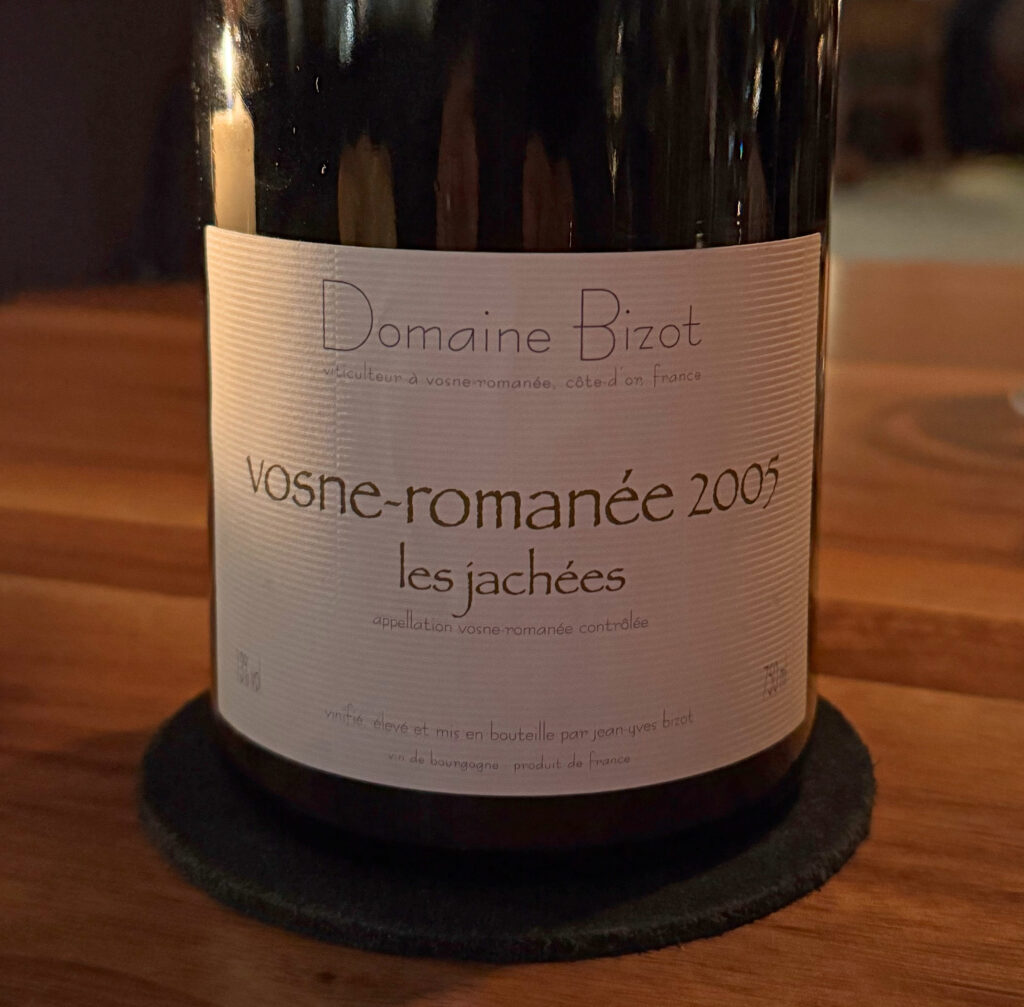
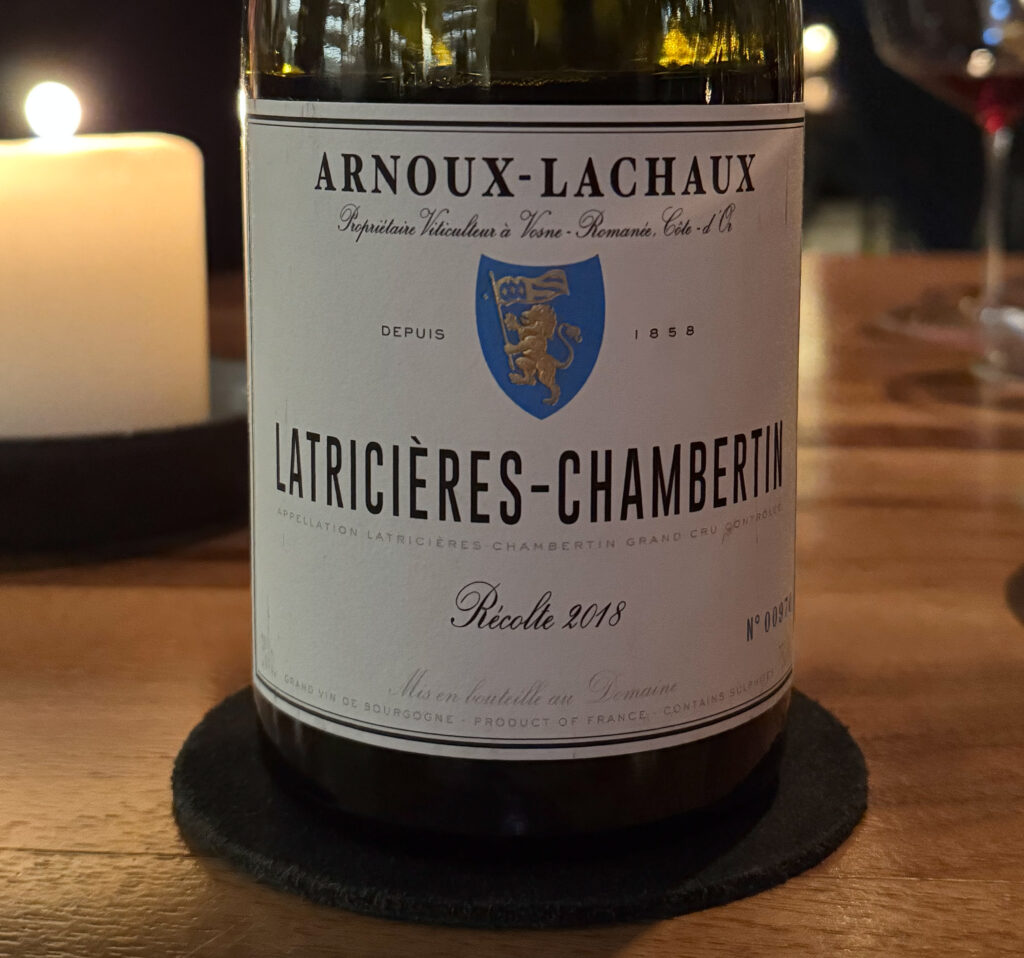
Just when things seem to veer off track, out comes an aged bottle of Bizot whose ripe, plush style elevates a stunning course of smoked wagyu ribeye, fresh/preserved truffle, and beet. The Arnoux-Lachaux offers a more robust, slightly darker expression of Pinot Noir that, nonetheless, matches a presentation of quail, fig, and miso fudge butter just as well. Simply put, trying these two producers—both at the vanguard of contemporary Burgundy—side by side is an event every bit as memorable as dining at Smyth itself.
And the dessert wines, while swinging back toward the obscure end of the spectrum, fit the bill quite nicely: a rounded, late-harvest Gewürztraminer being served with a dish showcasing Muscadine grapes and a coppery, honeyed Chenin Blanc somehow melding with one of the kitchen’s singular creations: a koji chocolate and caviar ice cream sandwich.
Ultimately, I’ve said it all before, but Fabbrini deserves special praise for continuing to craft pairings that match every bit of the intention and imagination shown by Smyth’s food. The system only functions in this one-of-a-kind manner due to the massive amount of effort put in—sourcing and mixing and matching single, exceptional bottles only to restart the process each week.
And, at the end of the day, the fruits of this effort yield a program that forms a proper destination—an absolute celebration of wine at a time when the industry’s future is a little uncertain—in its own right.
When the meal, at last, begins, it does so with a welcome drink: Smyth’s answer—typically an amazake—to the pours proffered at Oriole and Feld (that may, to varying degrees, mark the fruits, herbs, flowers, and fermentations characterizing this very moment of the season).
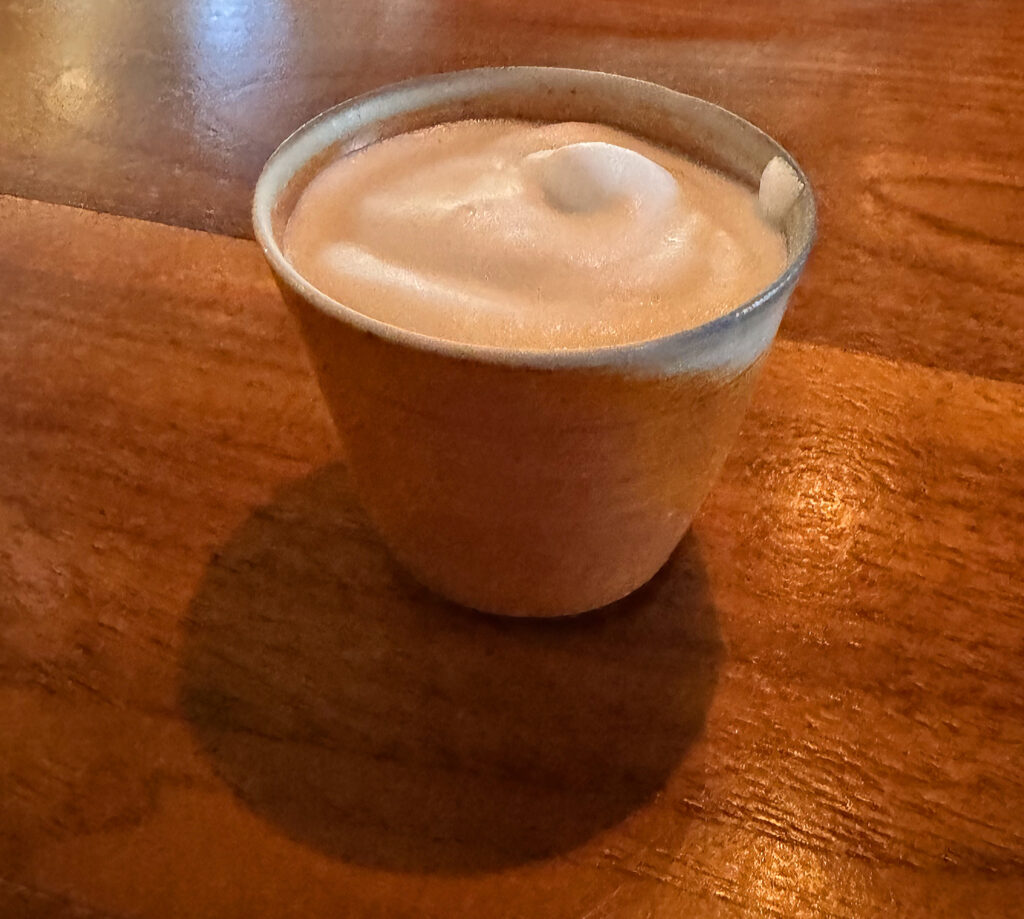
Tonight, the “Matsutake Tea” reflects an entirely new approach: one that comes accompanied by an elaborate tableside preparation involving the steaming of milk (itself made from pine nut garum and pine needle oil) which is then layered over each cup. The team is quick to joke about how Fabbrini is playing the role of “barista,” but the intimacy of the multistep process befits an experience of this price and reputation.
Plus, the tea itself is delicious: combining a base of roasted yeast broth with an array of savory, earthy, elegantly sweet, and slightly uplifting notes that feel cohesive and soothing (rather than overtly “mushroomy”). Overall, this makes for a memorable service gesture at the very start of the evening and one whose ultimate flavor is no afterthought either.
Arriving next, we find a sequence of three opening bites that meaningfully expands on the single morsel that was served back in September.
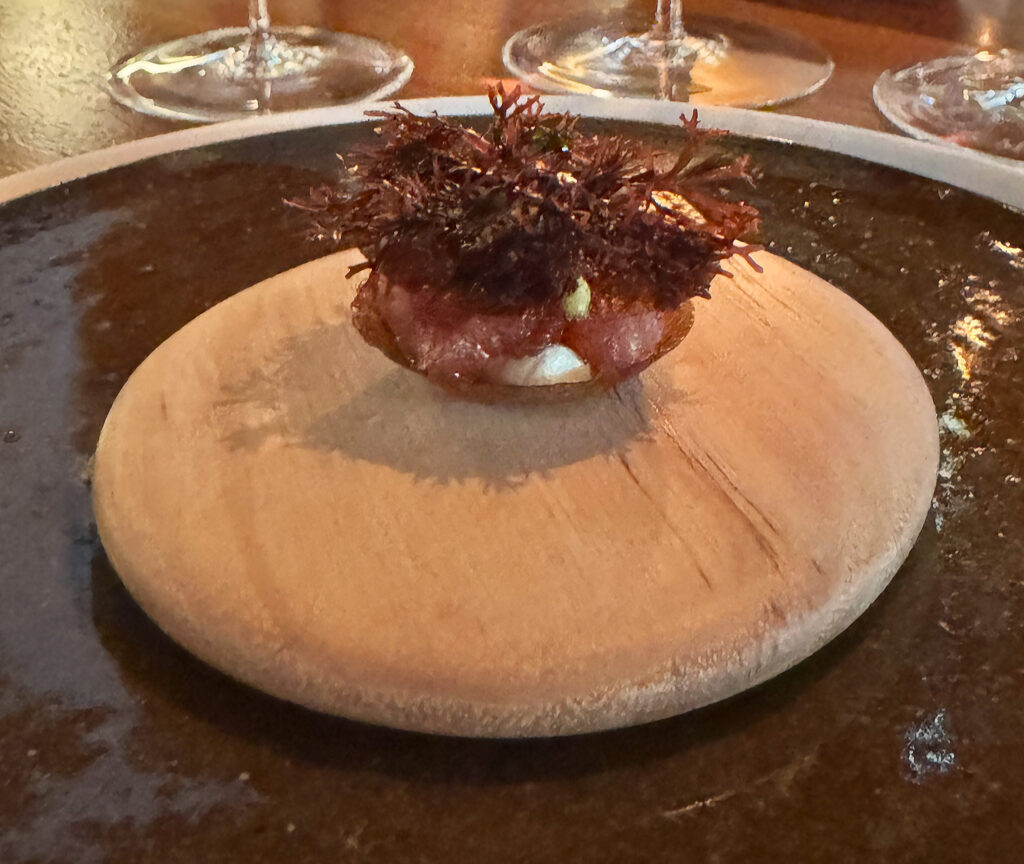
The first of these, titled “Bluefin Tuna Tartare,” looks and feels a lot like the “Truffle & Buttercream Tart” I encountered last time. Indeed, that latter element remains (the cream now being brightened by citrus), as does a healthy topping of dulse seaweed.
But the inclusion of those smoked toro chunks absolutely transforms the dish, as the belly’s gushing fat bonds the two brittle segments of shell together and imparts a sense of richness this construction rarely achieves. When it comes to flavor, an application of chive oil is also perfectly judged. Combining with the tangy backing of the buttercream, it draws both sweetness and umami out from the tuna, building a sense of overall satisfaction that makes for one of the most successful tarts in Smyth’s long history with the form.
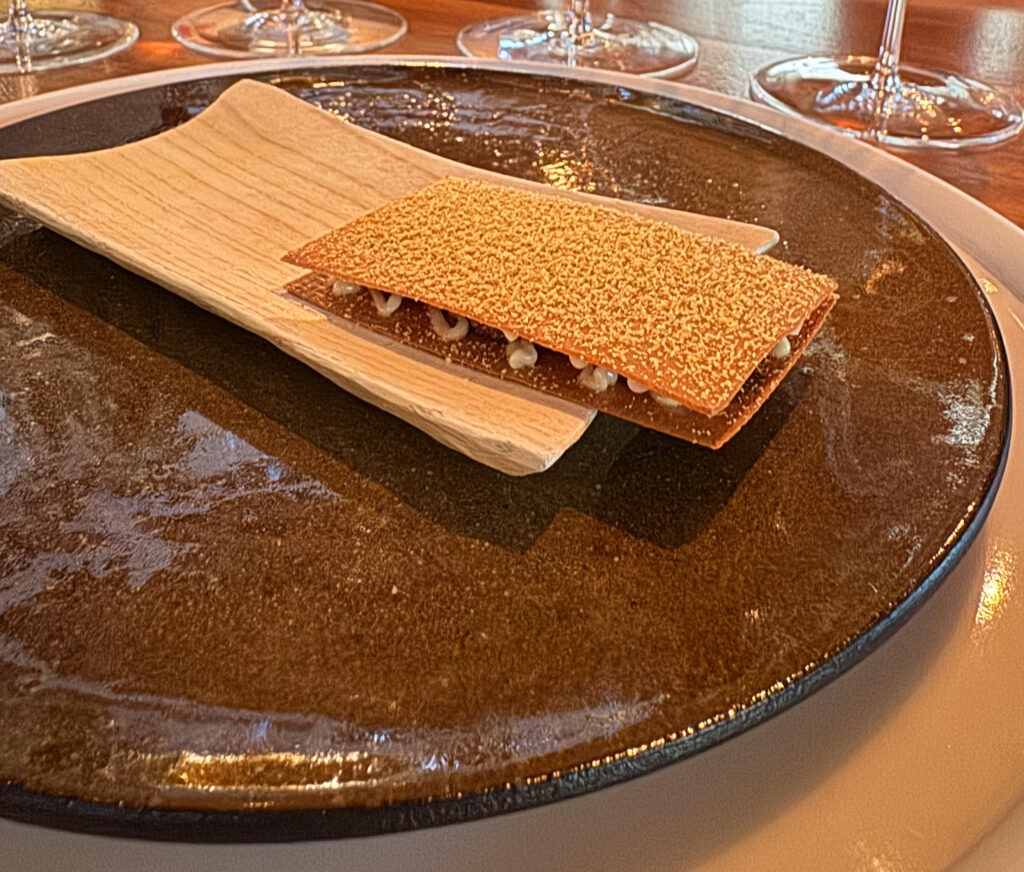
The “Quail Liver Pâté & Masa” represents an evolution of another longstanding construction (albeit one I haven’t seen since July). Here, what remains consistent is the use of corn, which is rendered as an inner drizzle of cream, the two central crackers, and a fermented powder dusted over their top.
However, while the resulting sandwich has been filled with ingredients like caviar, foie gras, and black truffle in the past, the present example pairs the titular offal (rendered as a fine spread) with nothing more than some hoja santa leaves. This combination preserves the crackers’ impossibly delicate structure (it’s always a wonder the vessel doesn’t break apart). Yet, in turn, the pâté delivers a unique concentration of meatiness and earth that melds effortlessly with the tangy, roasted notes of corn and attains a striking, anise-kissed sweetness on the finish. Yes, just as with the preceding item, it’s hard to remember any other occasion when this particular form aimed so squarely at decadence and delivered.
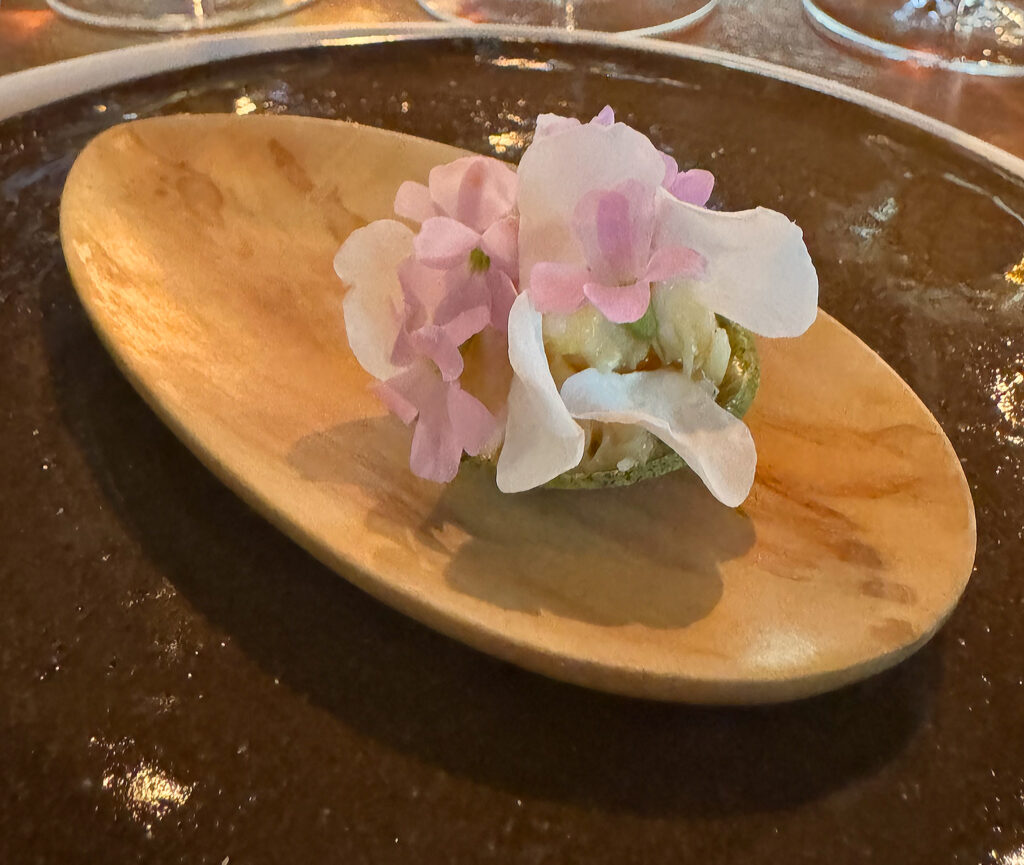
Closing out the sequence, we have the “Dungeness Crab & Sea Lettuce,” which more or less comprises another tart. Admittedly, the shell possesses a robust, crumbly texture that is totally distinct from its tuna compatriot. And, consequently, the vessel is used to transport a heartier filling made from sweet egg yolk cream, the titular shellfish, and some Lady of the Night petals.
On entry, the tart offers a series of crisp, moist, then crisp sensations that is generally appealing. Admittedly, the shell—interwoven with sea lettuce—is a touch drying, and the richness of the crab and egg yolk combination doesn’t immediately counter the effect. That said, while this bite lacks the utter explosiveness of its predecessors, its finish (more than 30 seconds of deep, crustaceous bliss) is remarkable. I especially appreciate how seamlessly the flowers integrate into the recipe’s overall flavor, providing a trace of sharp, fruity character that enhances one’s perception of the seafood.
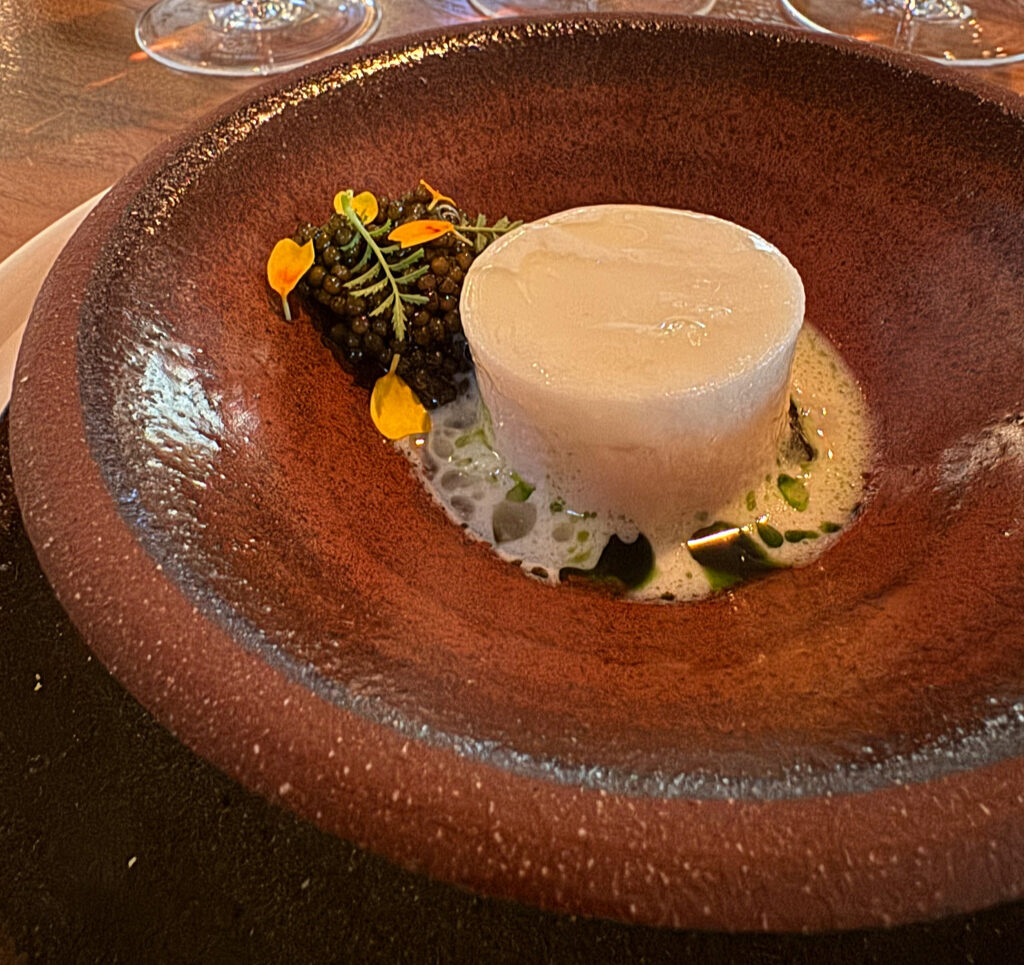
When the “Tofu & Caviar” debuted last month, the chef’s enthusiasm for the starring element was palpable. I speak not of the luxurious roe but, rather, of what the server terms a “sponge” made from Illinois soybeans. A sauce made from tomato and parsley serves as the plate’s principal flavoring agent while notes of citrus lace and sesame lend support.
Visually, the tofu is quite striking, and its tapered, cylindrical shape suggests the degree to which the kitchen has already refined its production. Texturally, the interplay of the creamy sponge and tongue-tickling caviar also remains totally sound. However, though the N25 Kaluga is pleasantly nutty and savory on its own, the pearls get obscured by the rest of the recipe. It’s a strange thing to say, for it’s hard to describe the surrounding flavors as anything other than subtly grassy, faintly acidic, and fleetingly bitter.
Yet, maybe due to the sauce-soaked soybeans’ own persistence, it’s hard for anything concentrated (let alone satisfying) to really take hold. As it stands, this is a dish of impressive delicacy whose balance simply needs to be adjusted. Given that the tofu represents such a new idea for the team, I do not doubt they will find better ways to harness it in time.
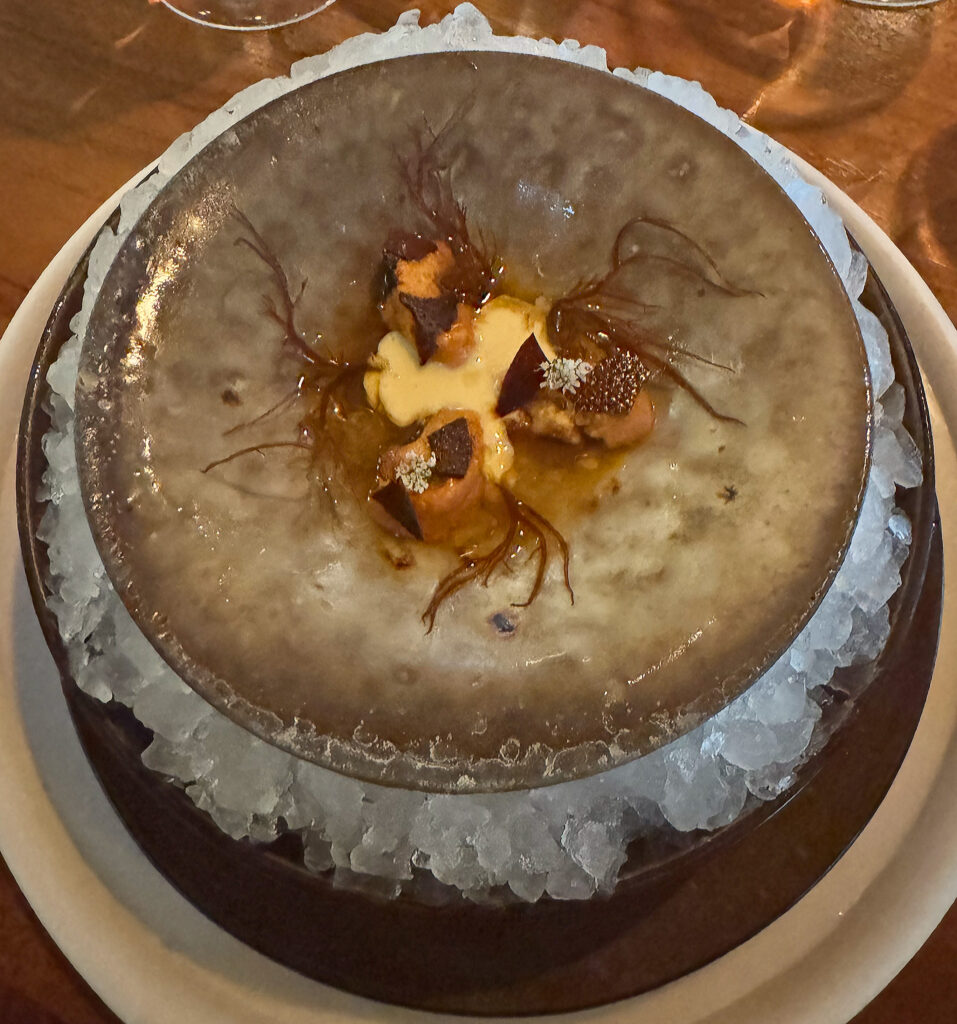
Arriving next, the “Maine Uni Aguachile” forms a clear evolution of a course that appeared in September (and that, though it also featured sea urchin, was titled in reference to its ground cherry element).
Aguachile, more broadly, has formed one of the restaurant’s obsessions for many years. Nonetheless, the resulting constructions are usually defined less by bracing heat and more by tropical fruit alongside a polarizing intensity of green, herbaceous character. After the tofu, I’m understandably apprehensive that this will be the case (and that the cherished uni, like the caviar, will be undone by its accompaniments).
I am pleasantly surprised to find that the plate’s central broth—the “chile water” itself—is made from red kuri squash. Even better, a pecan crème anglaise is drizzled on top. Throw in some kelp chips and a few fronds of seaweed, and one is left with a markedly sweet, nutty composition of sea urchin in which layers of crispness and creaminess yield to an exquisite oceanic depth on the finish. Yes, in a manner that totally inverts my initial fears, this preparation marries pleasure and complexity in a way that merits special praise.
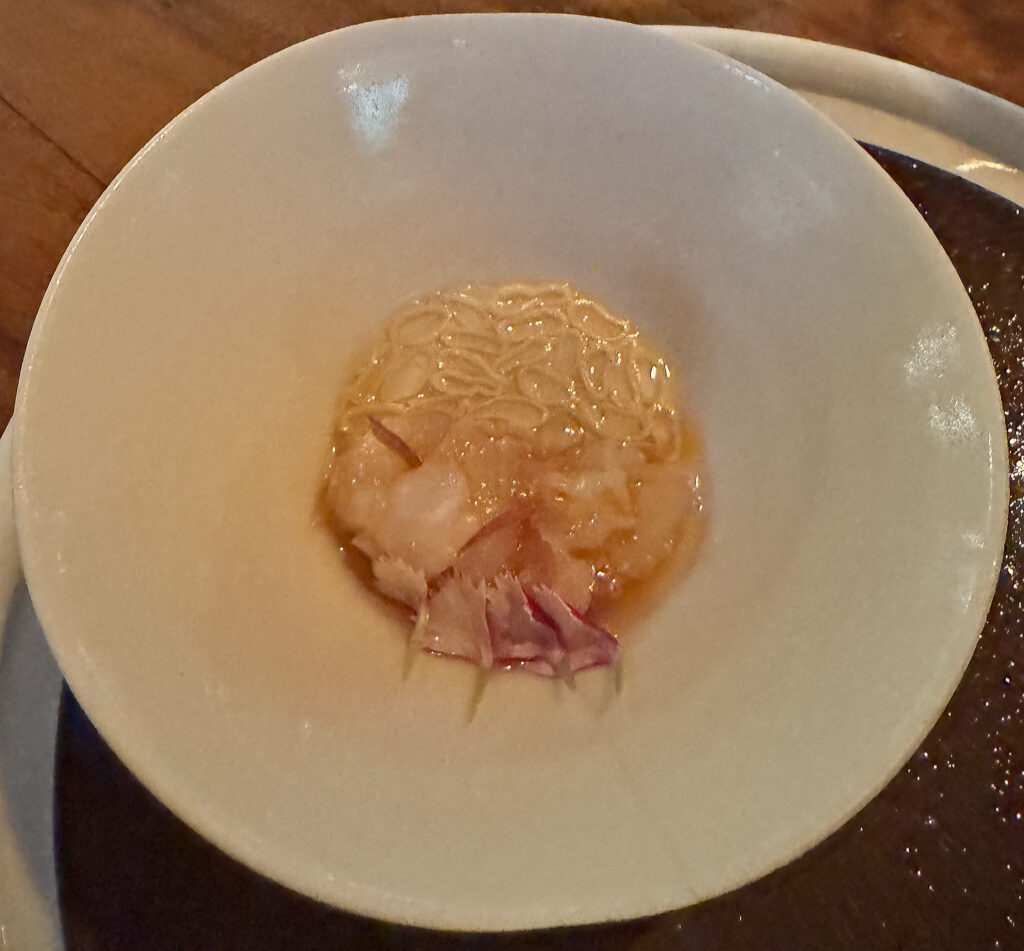
The “Maine Lobster & Cashew” stands as a rather direct repeat of what I sampled last time (and what undoubtedly formed a rather convincing debut).
Here, the crustacean—cooked only to the point that the meat can be removed from the shell—is paired with jackfruit, preserved green almond, and dianthus flower (the sole addition) atop a panna cotta of cashew and Japanese ginger. A wild rice amazake acts as the sauce, shaping a construction that balances a luscious consistency with bursts of subtle chew and a striking gradient of tropical-sweet, tangy, buttery, and nutty-savory flavors. The cooler serving temperature seems like an odd choice at first, but it really unlocks a level of nuance that a more conventionally warm, plump presentation wouldn’t attain. This remains a very good addition to the menu.
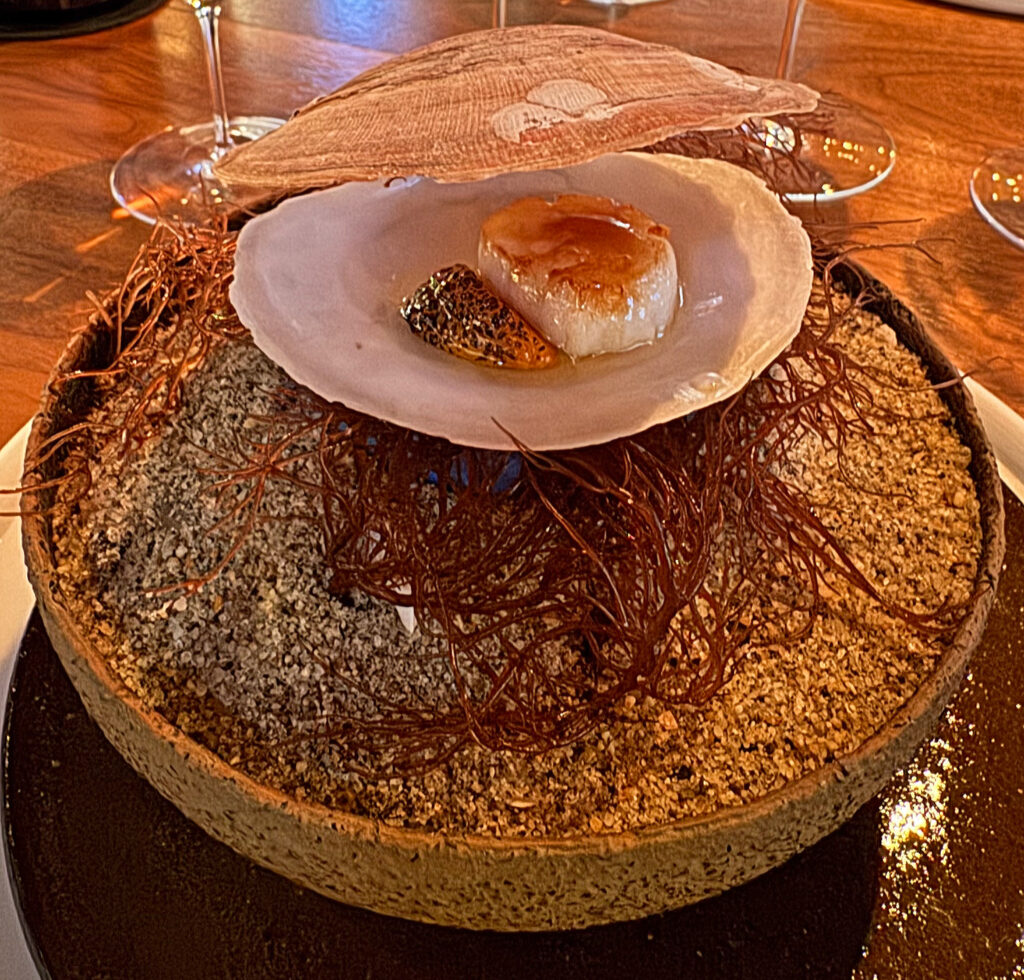
After a couple reruns, I am treated to something entirely new: a preparation of “Penobscot Bay Scallop & Niagara Grape” that demands guests pry open the mollusk’s shell to get a good look. Upon doing so, one finds a sizable, seared portion of the abductor muscle dressed in a sauce made from the titular fruit and a touch of tomato honey. Off to the side sits a lengthy lobe of uni (sea urchin being an ingredient the kitchen is never shy about utilizing twice), which has been torched and marked by dimples of charring.
Texturally, the scallop displays a textbook blend of crispness, butteriness, and latent sweetness (whose character is enlivened by the umami of the tomato and the punchier, muskier grape). However, the uni itself is marked more by funkiness, bitterness, and an aroma reminiscent of the beach. It’s hard to know where exactly these notes fit in, and I’m left feeling that its presence actually detracts from what is otherwise a thoroughly pleasant expression of shellfish.
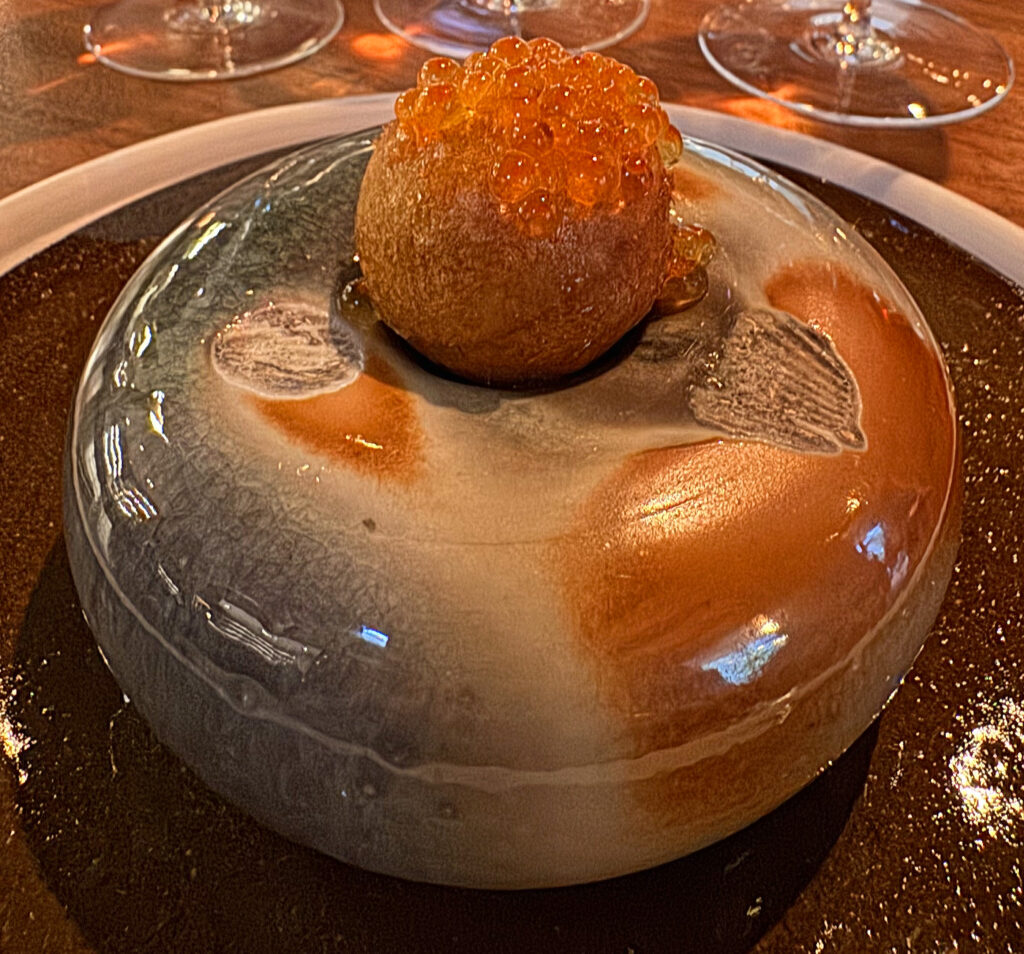
The “Smoked Trout Donut” that graces the table tonight feels like a refinement of the recipe I tasted in September. A filling made from the fish’s loin has been traded for the belly, which is smoked for five hours then blended with mustard greens and pastry cream. A bottarga made from the trout’s roe, some fresh roe, and a tomato-garlic glaze then complete the presentation.
On entry, the donut feels fleetingly crisp (complete with the orbs’ subtle pop) then immediately rich, creamy, and soothing. My impression is one of striking seamlessness; however, in turn, the resulting flavor is distinguished by little more than the barest sense of sweetness. Indeed, it feels like the bite cannot decide which direction to really go in, and, thus, one is left with the sense that all this perceived weight and decadence just quietly fades away. Maybe that’s the point (i.e., a certain kind of restraint and elegance), yet it makes for a play on one of Smyth’s classic forms that is merely good rather than transcendent.
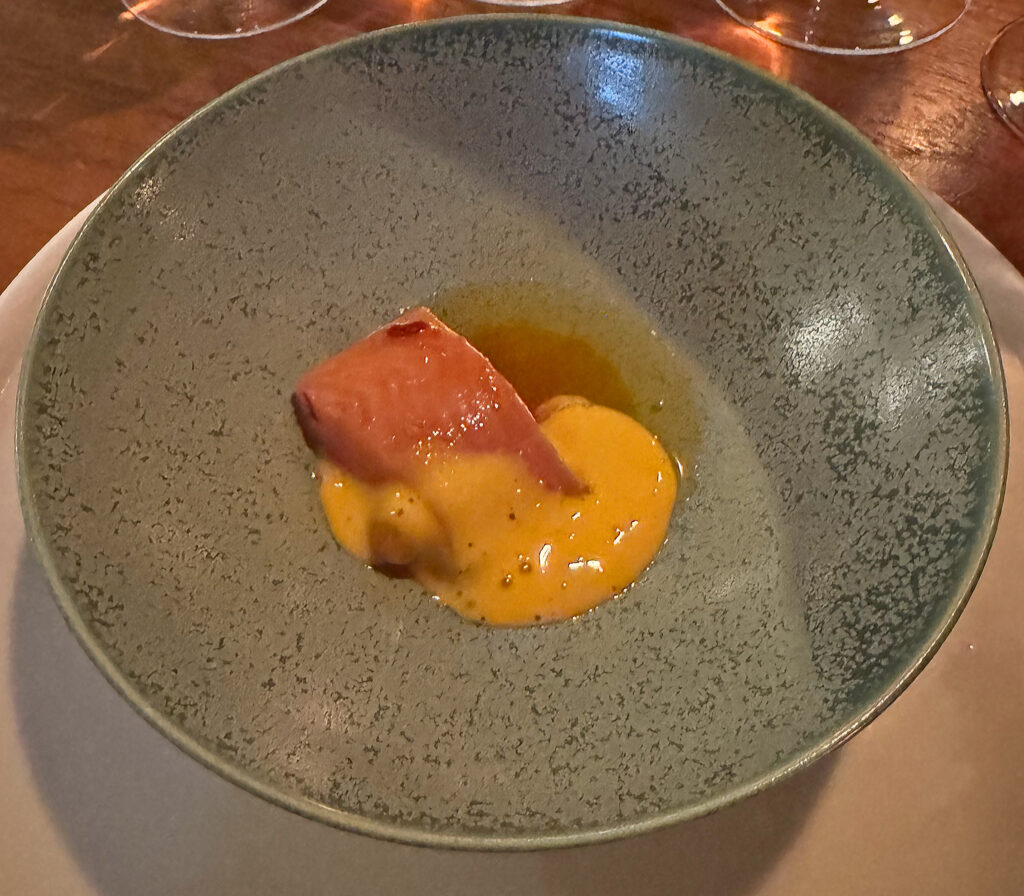
Thankfully, the “Rainbow Trout & Red Kuri Squash Ponzu” successfully builds on the softer notes of the preceding dish in a way that delivers all the satisfaction I am after. Tellingly, the previous iteration of this course—pairing a smoked fillet with summer apple—was actually served before the donut last time.
Now anchoring the sequence, a brown butter-poached piece of the trout comes dressed in the titular ponzu (made from the same gourd that featured so successfully in the aguachile) with supporting flavors drawn from a mussel-saffron sabayon, an onion glaze, and pumpkin seed. This yields a series of wonderfully smooth, frothy spoonfuls marked by an engaging brightness, a maddening sweet-savory intensity, and undertones of warm spice and nuttiness that stoke autumnal nostalgia. Overall, this has to rank among the finest fish preparations the restaurant has served all year, and it shows just what kind of straightforward pleasure the kitchen can pursue once summer gives way to fall.
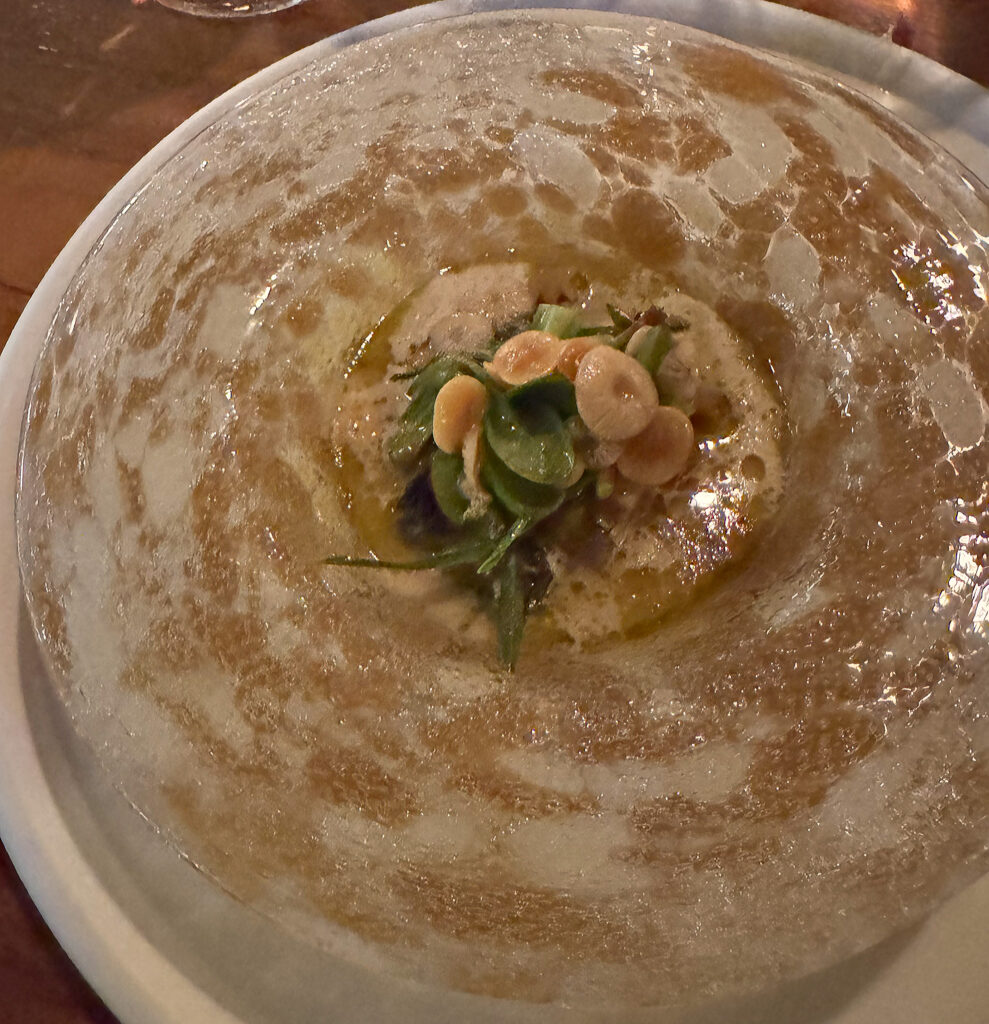
“Abalone & Maitake,” when it debuted last month, had the unfortunate distinction of being a complete miss: the kind of dish that not only fell beneath the standard set by other, better, recipes in the category but—somehow—was actually hard to eat.
On this occasion, the prized mollusk is once again paired with a sauce made from its liver (as well as some other trimmings) and the titular mushroom. Nonetheless, the supporting note of velvet horn (a kind of seaweed) has been traded for a veal cream, some leaves of puntarella, and a few caps of beech mushroom for good measure. Texturally, the resulting sensation is wonderfully creamy and tender and only punctuated by the occasional hint of crispness. Flavor, first and foremost, is entirely clean. Yet, more importantly, it attains a staggering concentration of umami with complicating veins of bitterness, nuttiness, sweetness, and earth that further delineate its power through the finish. Yes, the abalone has not only been totally redeemed tonight; rather, it now ranks among the very finest courses of 2026.
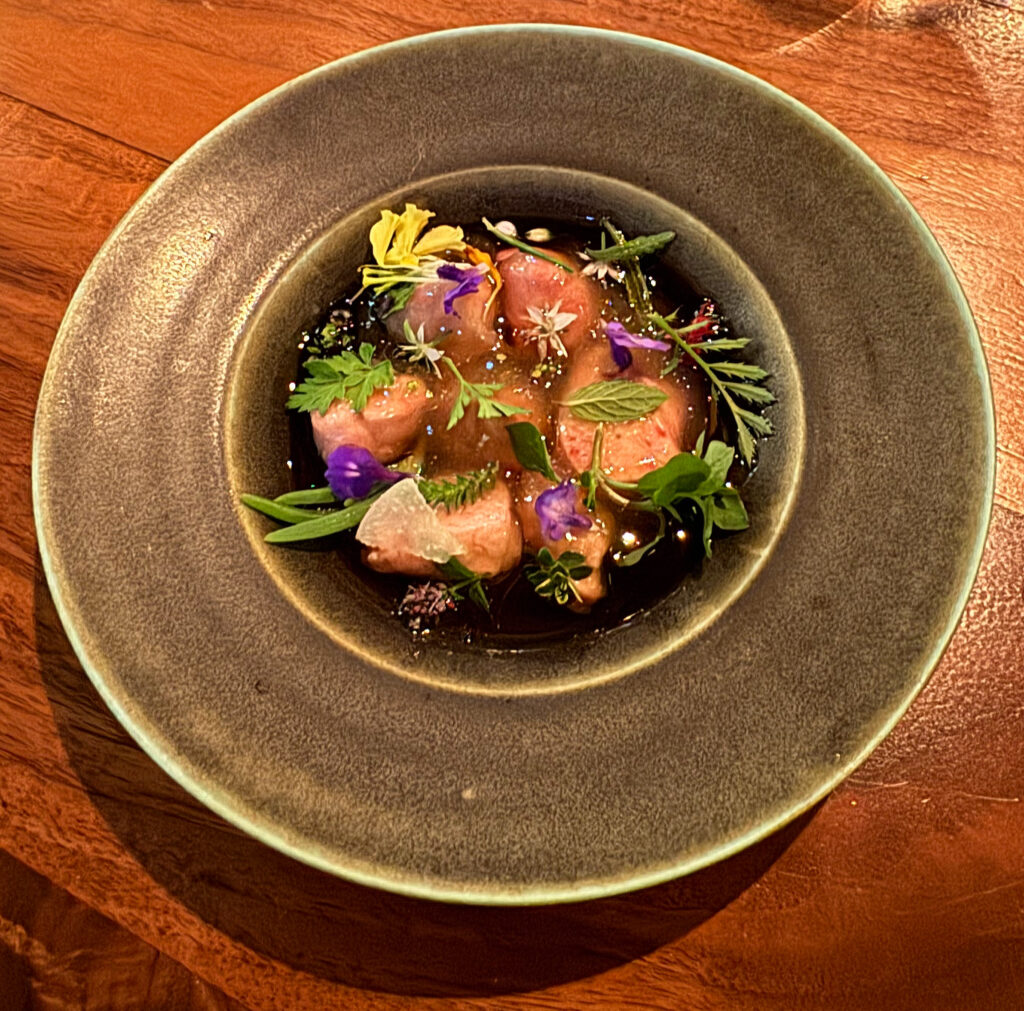
The “Elysian Fields Farm Sweetbread,” as it was presented in September, formed another underperformer: a case in which one of my favorite ingredients was reduced into little more than a canvas for a bunch of leaves and flowers that seemed to sap the offal of its essential pleasure.
Here, the construction more or less remains the same, with the chefs taking obvious pride in the array of rotating garden herbs (picked just “minutes ago”) that adorn the plate. However, while the previous iteration relied on an aromatic gravy to connect the disparate elements, the preparation is now characterized as more of a “yeasted autumnal stew.” Correspondingly, though each bite matches the tender, luscious sweetbread with a jolt of anise or mint, an overarching savory quality reigns. It ensures the thymus retains some sense of its bewitching meatiness, and that the herbs form an engaging, complicating garnish rather than dominating altogether. By my measure, this makes for a clear improvement.
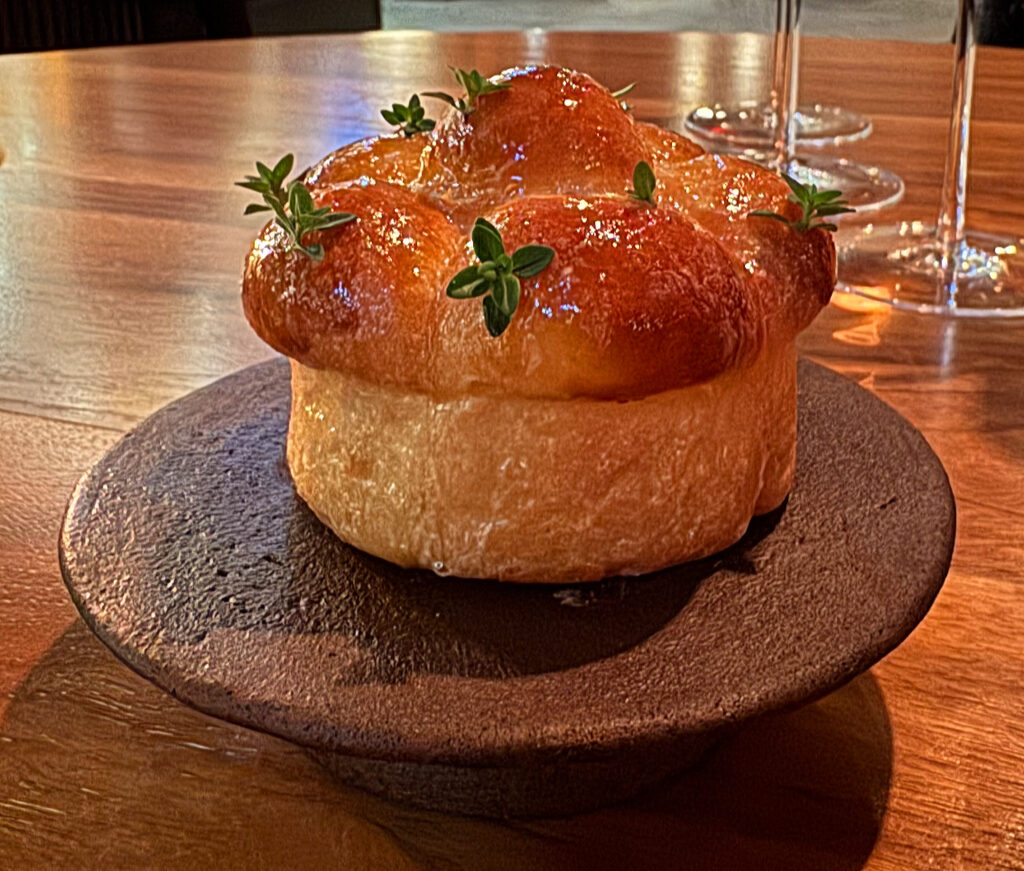
Accompanying the offal, Smyth’s “Malted Milk Bread” continues to pursue less of a sticky (sometimes sickly) sensation than it has for most of its existence. Flavored with black garlic, the loaf is impressively fluffy and only barely sweet. Ultimately, I like the feel of simple sustenance (with savory depth) this version provides, yet I also wonder when or if the restaurant will ever explore a different bread.
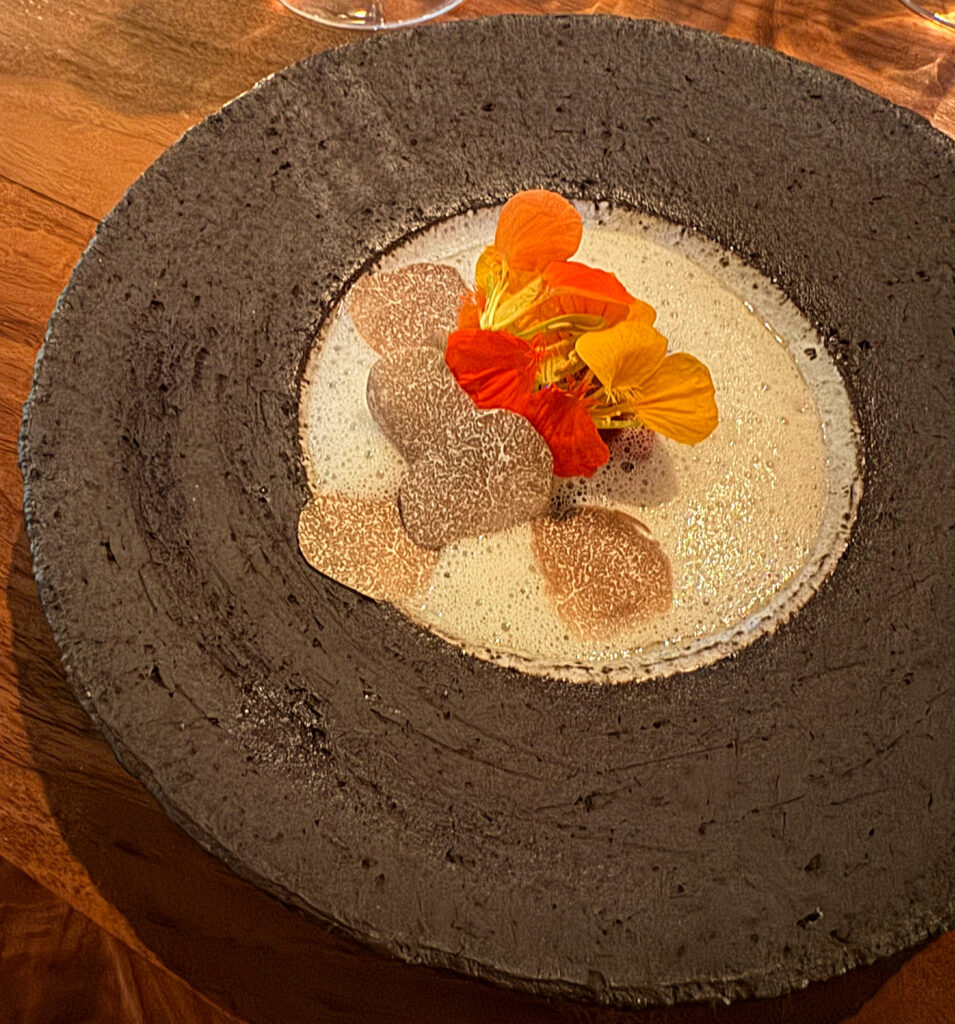
The “Lone Mountain Wagyu & Sour Cream” formed one of the absolute highlights of my previous menu, and I am happy to report that the team has found a way to further amplify its pleasure.
Structurally, the course continues to center on chunks of gently smoked ribeye in a sour cream nage. Yet pickled seaweed has now been substituted for beet while a duo of winter truffles (one application fresh, the other preserved in the kombujime style) serves to gild the lily. Some nasturtium flowers cap things off, providing a subtle touch of crispness to counter the gently chewy, almost toro-like bits of meat and root vegetable found below.
Compared to last time, the resulting flavor now balances the nage’s tang with a persistent imprint of sweetness and earth. That said, what I admire most is how the wagyu’s savory character shines: building and building in saltiness and satisfaction (no doubt helped by those preserved truffles) with each concurrent bite. Overall, the present showing only confirms what a brilliant idea the chefs have struck upon. I’m not sure they’ve ever utilized the coveted beef more effectively.
This evening, the meal’s headlining entrée arrives in two familiar parts:
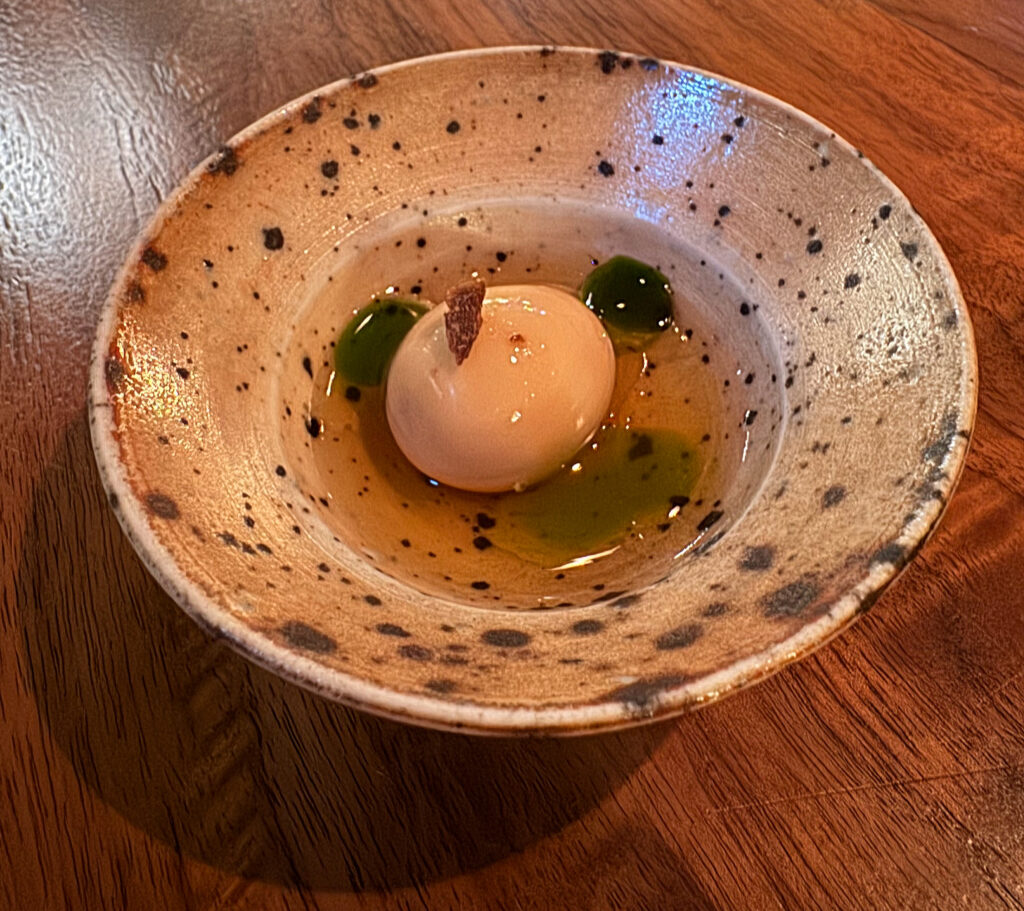
First, there’s the “Black Walnut Cured Quail Egg,” which has formed something of my nemesis over the years. Frankly, the intended effect can leave me feeling queasy. But, whether due to my own acclimation or some actual tweaking of the recipe, this gooey mouthful has recently become tolerable.
Tonight, the egg itself is solidly embedded in the surrounding gelatin like a 1950s nightmare. However, putting that aside, the plump texture and rich, miso-tinged flavor is likable. In fact, I find that these relatively streamlined examples actually work to reveal the deep, cooling kind of umami that inspired this bite in the first place.
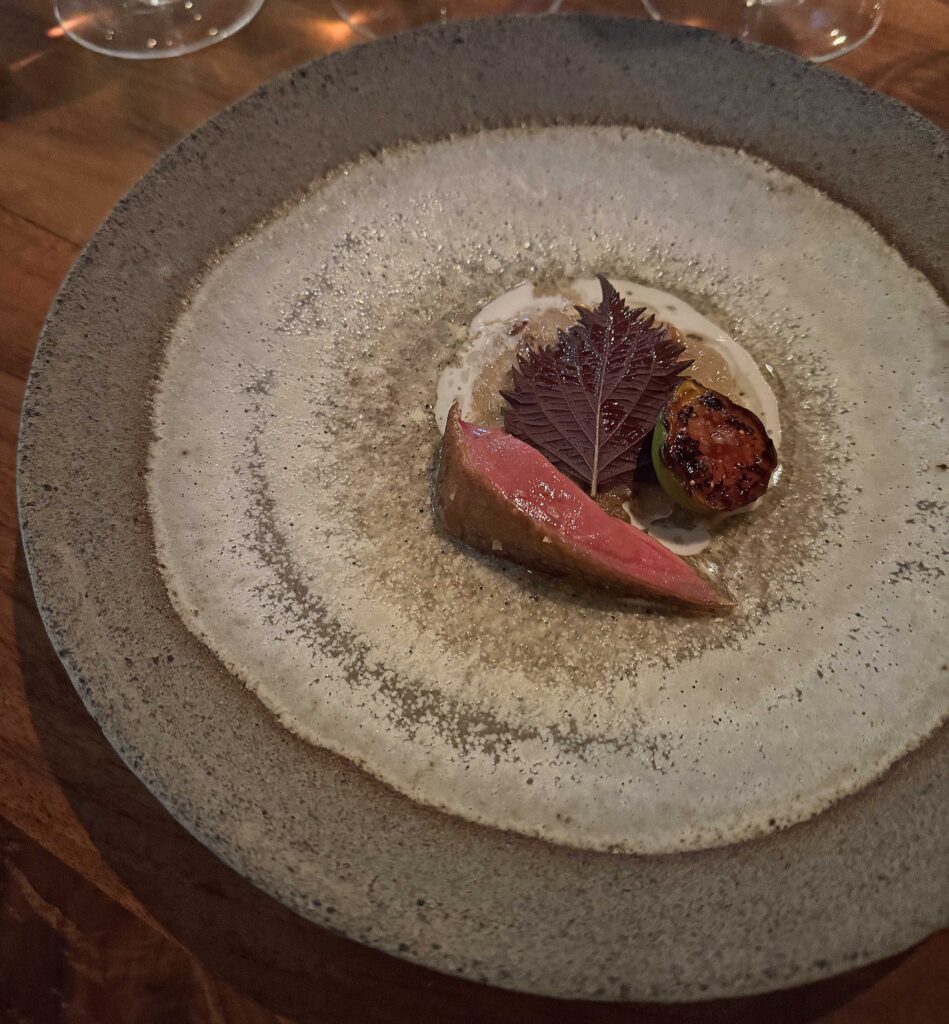
A preparation of “Devil’s Gulch Squab & Sprouted Grain Porridge” forms the main plate, and it looks and sounds a lot like what I sampled last time. Indeed, alongside the titular porridge, a drizzle of peanut milk and a lone shiso leaf remain. Yet, just to add a little intrigue, a brûléed piece of fig and miso fudge butter have been added to the mix.
On paper, this should make for an easy improvement: a clear boost of umami and jammy sweetness that drives the game bird into the stratosphere. Nonetheless, while the grain porridge displays an attractive earthy depth (reminiscent of masa), its texture is softly chewy and almost stale. Likewise, the quail itself feels sinewy, and the dish’s broader composition feels all loose and disjointed. Even the fig, for whatever reason, just strikes me as bland. Ultimately, it’s hard to know what happened here, but I know this course is capable of delivering far more than what it shows on this occasion.
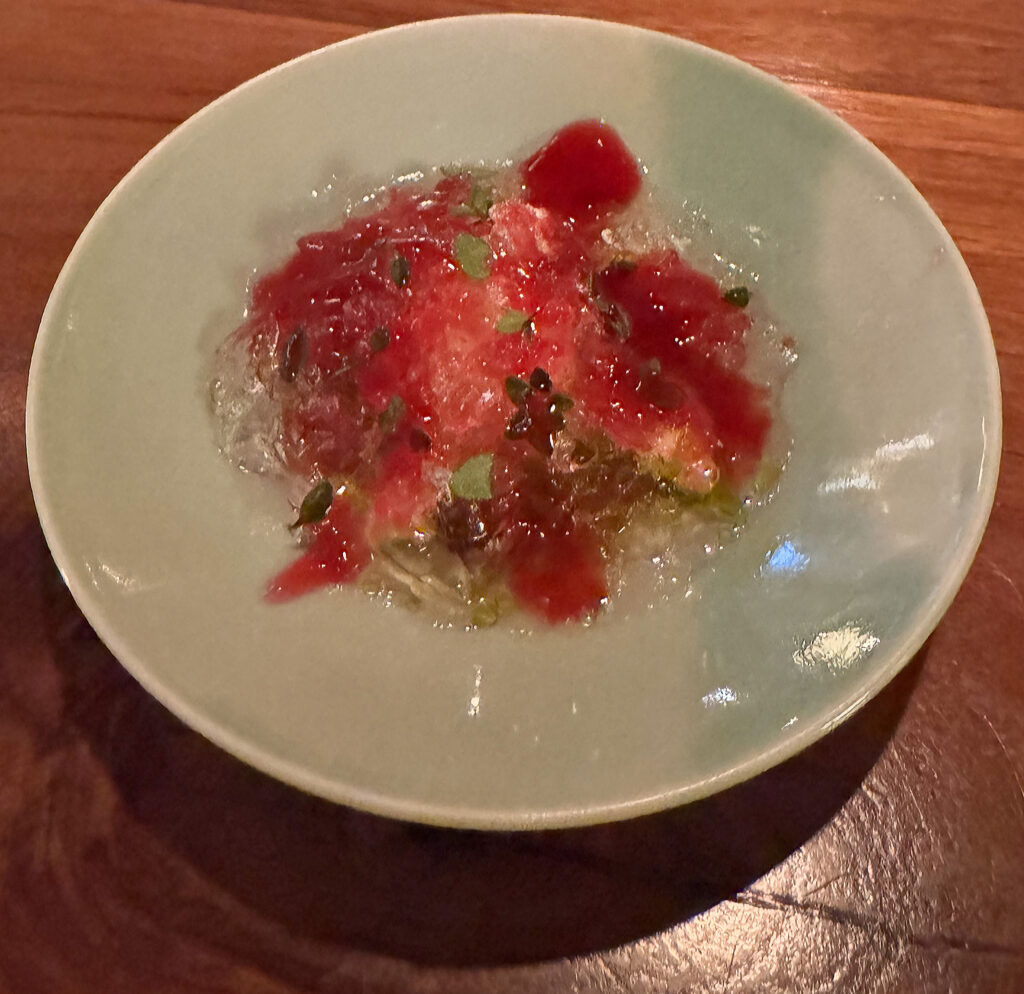
Turning toward dessert (and the work of pastry chef Jenna Pegg), we find a new palate cleanser titled “Muscadine Grape & Wine Jelly.” I actually hesitate to use that term—palate cleanser—because a similar preparation (centered on cantaloupe and lavender) actually formed one of the menu’s highlights in September.
The present construction—composed of a Niagara sorbet, salted slivers of Niagara, some muscadine seeds, a grape reduction, shaved ice, and the titular jelly (made using that Zusslin Gewürztraminer)—is not far off. When the crisp, chewy, and gelatinous layers mingle, a bracing tanginess takes hold. Yet, just a moment later, this acidity yields to ample, fruity sweetness (so intense that the plain ice forms an essential foil) whose purity is only complicated by a long, honeyed note on the finish. In short, this makes for a multifaceted celebration of grapes I would be happy to encounter again.
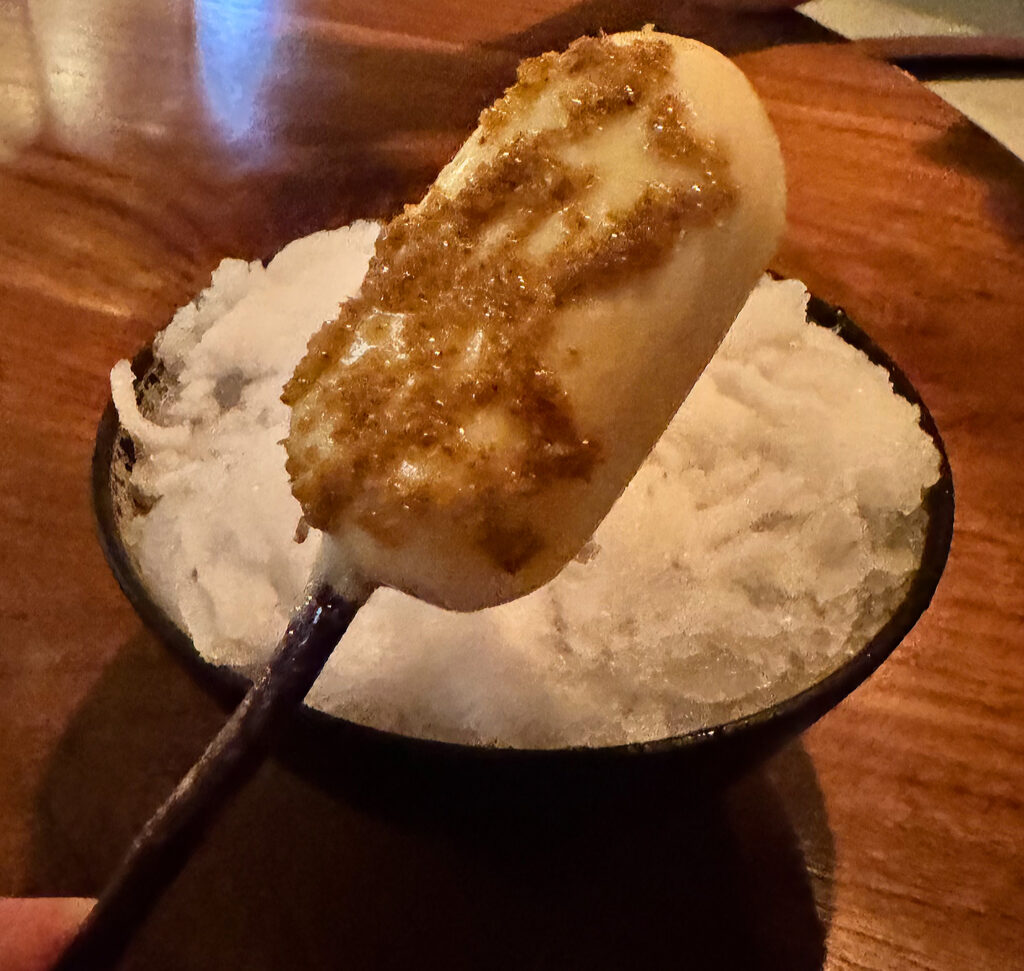
Arriving next, the “Birch Ice Cream Bar” has—across several variants—formed one of the year’s most longstanding bites (albeit one that briefly left the menu last month). The present version sees the white chocolate shell and caramel center remain while a topping of pine pollen honey adds new intrigue.
Texturally, the juxtaposition of crisp, cold, creamy, and sappy sensations continues to be skillfully executed. On entry, flavor tends in a fresh, sugar direction before revealing a caramelized (almost oxidative) note with seamless, root beer-inflected depth on the finish. For my palate, this tastes memorably decadent tonight.
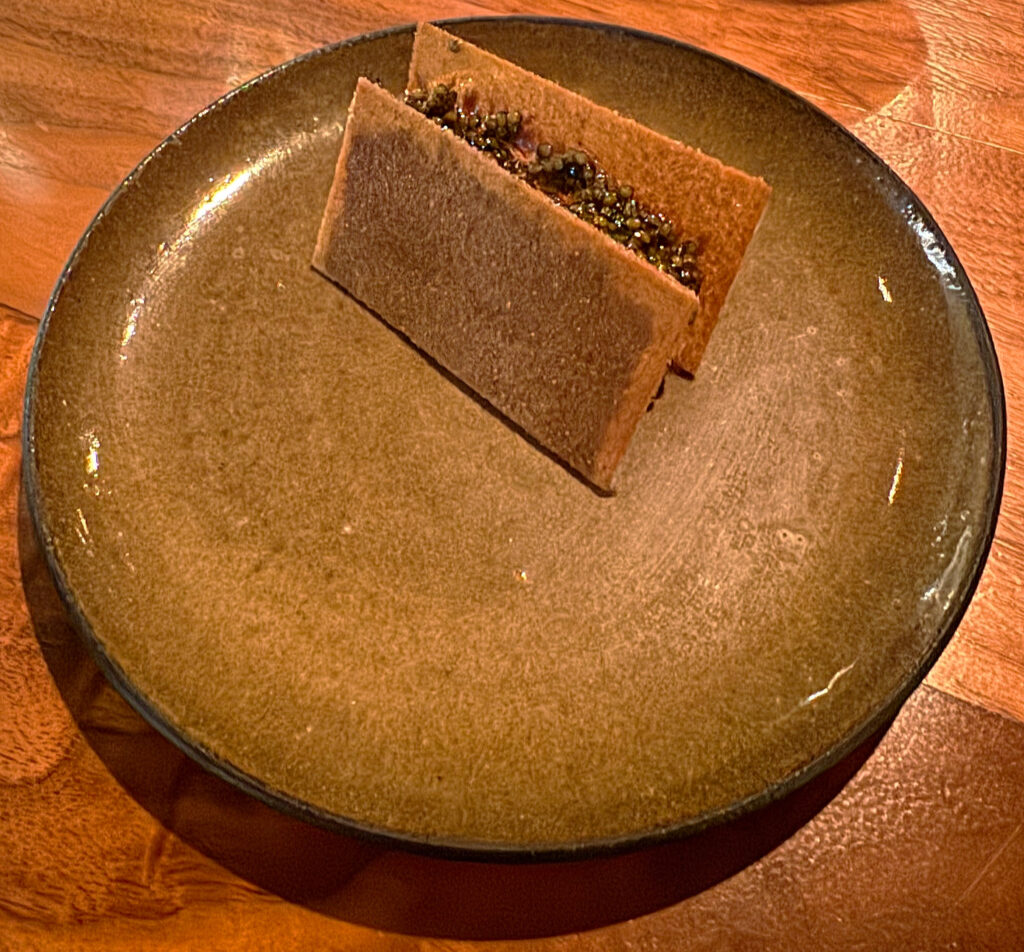
A “Koji Chocolate Ice Cream Sandwich” forms the last proper course of the evening, and it looks to retain its status as one of September’s “best of the year” bites. Here, the composition remains the same—two gossamer wafers framing the aerated ice cream, an application of hazelnut oil, and plenty of Kaluga caviar.
And, though the sandwich topples over shortly after its arrival, the effect remains the same: a crisp, melty sensation married to a Cocoa Puffs intensity of chocolate with a profoundly nutty, briny depth. Somehow, the combination feels so natural and so effortless in the enjoyment it yields, which (perhaps) signals Smyth has found a new signature for this late stage of the menu.
Closing out the meal, we find a familiar sequence of bites:
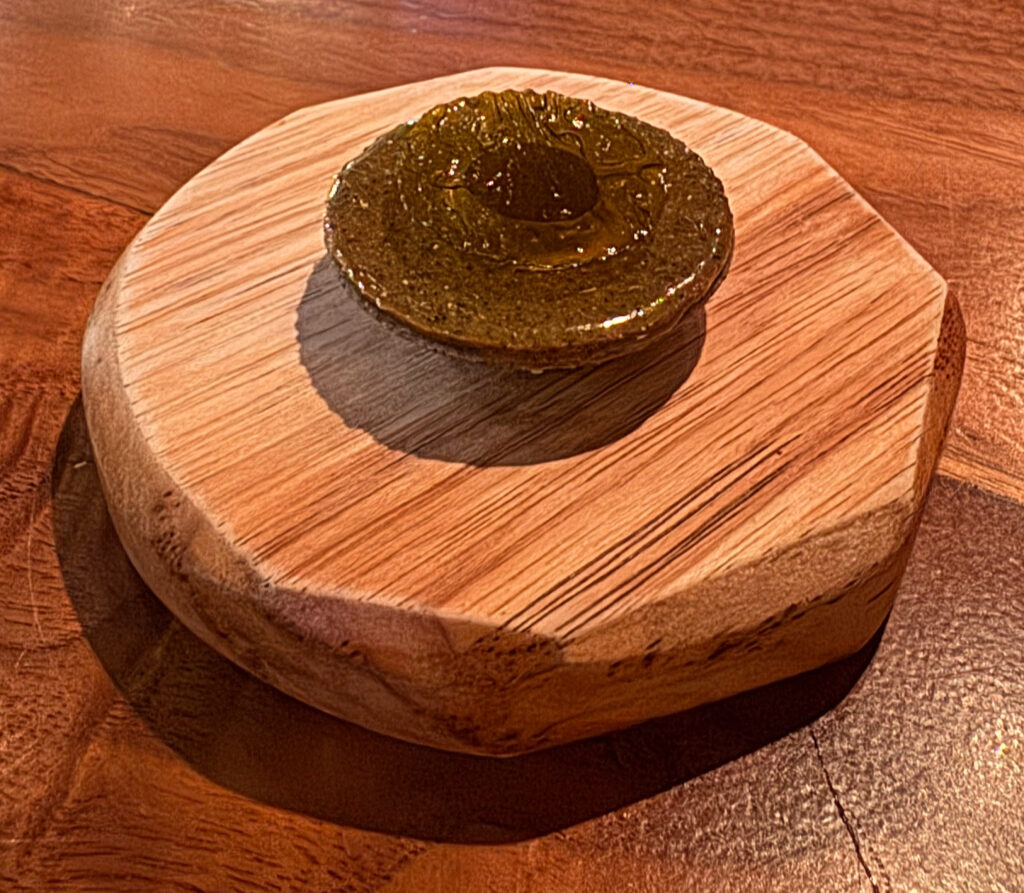
There’s the “Preserved Pistachio Tart,” with its superlative creaminess, nuttiness, and a hint of alleviating tang.
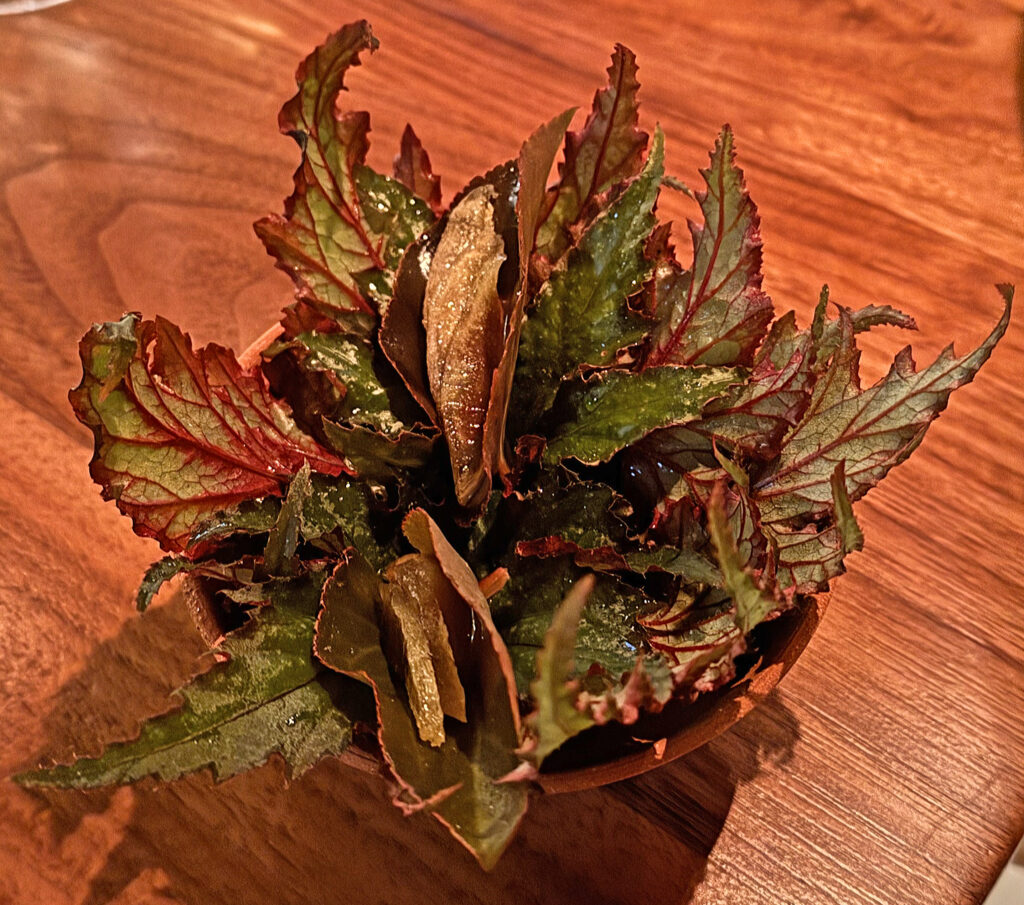
The “Begonia & Apple,” the newest of the bunch, whose combination of a crisp, leafy wrapper and juicy, deeply caramelized fruit remains surprisingly delicious.
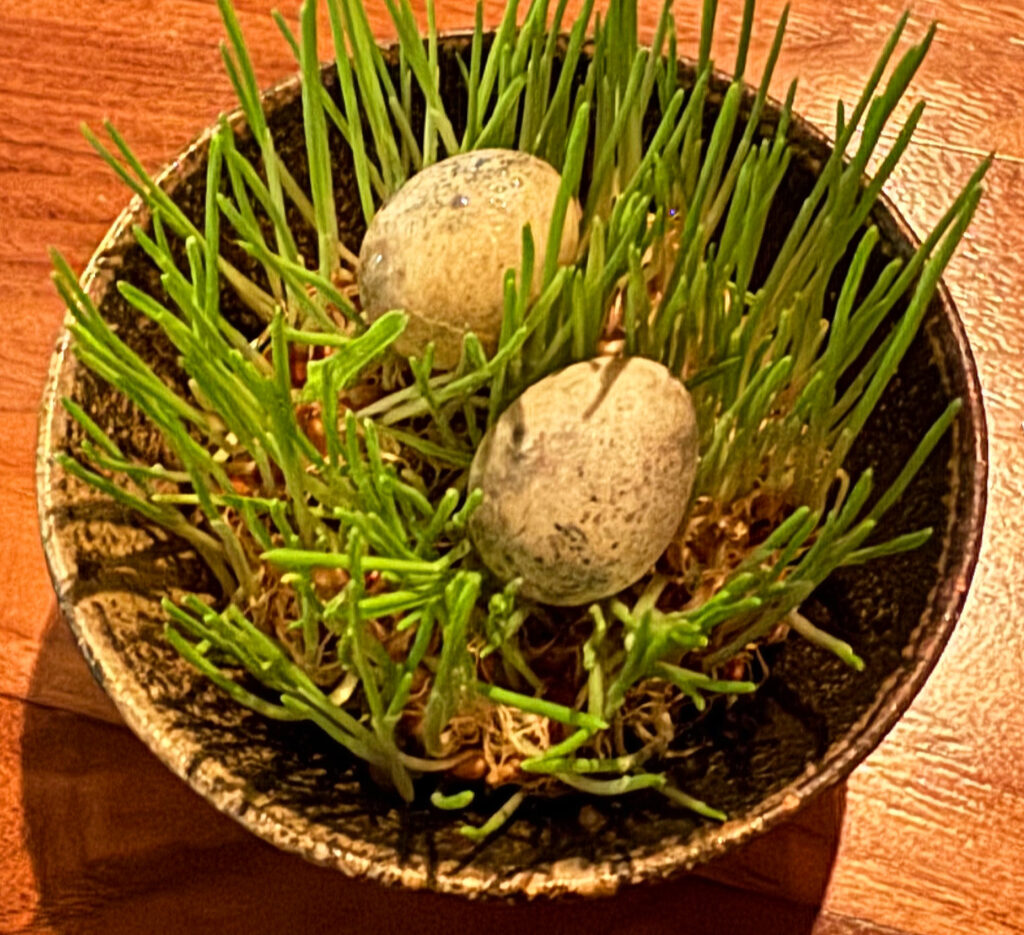
And, last of all, the “Cadbury™ Quail Egg.” This (like its savory counterpart) has often been challenging for me, but I continue to find the balance of citrus curd tang and supporting sweetness (tucked into a brittle candy shell) to be better managed.
With that, the evening reaches its conclusion: some 22 distinct items, split across 18 courses, served in just under three hours.
As always, this makes for confident and precise pacing at a place that has been entrusted (at least by the powers that be) to provide Chicago’s finest gastronomic experience.
At a technical level, no team hits their marks better or does more to spur conversation—soliciting sincere feedback, perhaps exploring a topic that is more frivolous—in those quiet moments between the arrival of each successive pour or plate.
The Shieldses’ cuisine, whatever sudden turn it takes, is cushioned by this sense of ease, humility, and overall rhythm. No doubt, it will ensure any new chef or thought process or potential paradigm shift is smoothly integrated into a wider sensibility that, as the seasons and faces change, always evokes Smyth.
In ranking the evening’s dishes:
I would place the “Bluefin Tuna Tartare,” “Quail Liver Pâté & Masa,” “Abalone & Maitake,” “Lone Mountain Wagyu & Sour Cream,” “Birch Ice Cream Bar,” and “Koji Chocolate Ice Cream Sandwich” in the highest category: superlative recipes that stand among the best things I will be served in any restaurant this year.
The “Matsutake Tea,” “Maine Uni Aguachile,” “Maine Lobster & Cashew,” “Rainbow Trout & Red Kuri Squash Ponzu,” “Elysian Fields Farm Sweetbread,” “Muscadine Grape & Wine Jelly,” “Preserved Pistachio Tart,” and “Begonia & Apple” all land in the next stratum: great items that achieved a truly memorable degree of pleasure. I would love to encounter any of these again.
Next come the “Dungeness Crab & Sea Lettuce,” “Tofu & Caviar,” “Penobscot Bay Scallop & Niagara Grape,” “Smoked Trout Donut,” “Malted Milk Bread,” “Black Walnut Cured Quail Egg,” and “Cadbury™ Quail Egg”—good—even very good—preparations I would always be happy to sample again (but that, due to small flaws or chosen style, just failed to elicit an extra degree of emotion).
Finally, there’s the “Devil’s Gulch Squab & Sprouted Grain Porridge”—a below-average item that fell short when it came to both texture and flavor.
Overall, this makes for a hit-rate of 95% with some 64% of dishes meeting the “would love to have again” standard and 27% reaching that “best of the year” level of quality. These figures largely accord with those I reported in September (i.e., 95%, 64%, 14%) July (i.e., 95%, 64%, 9%), May (i.e., 91%, 55%, 18%), and March (i.e., 95%, 70%, 20%), with the only real difference being that a total of six recipes landed in the highest bracket tonight.
Yes, when it comes to those “best of the best” dishes—the only kind that can really justify spending so much money at this three-Michelin-star level—it’s hard to think of a better performance from the restaurant in recent memory.
Certainly, I’ve encountered each of the chosen recipes in some form before (maybe even over the course of several years). Yet, a bit of toro or pâté or veal cream or preserved winter truffle is all it took to take a somewhat familiar idea and drive it into the stratosphere.
Admittedly, the “Koji Chocolate Ice Cream Sandwich” was more or less perfect upon its debut, but the “Abalone & Maitake” went from zero to hero (I considered putting it even one stratum higher than the rest) while the remainder sharpened in quality without ever losing their distinctive features (be that a seaweed tart shell, a corn wafer sandwich, a sour cream nage, or a birch caramel center). In this manner, the evening’s greatest successes tell the story of Smyth’s essential dynamism: they represent the fruits of a creative process that never stops.
The ”Devil’s Gulch Squab,” on the other hand, represents a case in which one of the kitchen’s longstanding preparations (appearing on the menu in September, July, and May) faltered across multiple dimensions. Indeed, the textures of the meat and the accompanying grain porridge—so successful in the past—were clumsy on this occasion. Meanwhile, the accompanying fig (a new element) was not only bland but contributed to a broadly loose, gooey consistency that was hard to stomach.
Yes, it’s hard to witness the core elements of a composition regress at the same moment it pursues a new thread of experimentation and then, altogether, collapse. It’s even worse when that same course forms the headlining entrée at such an acclaimed concept and comes paired with a showstopping $2,500 wine.
But ultimately, I can tolerate a dud when there’s so much other excellence on display. Months later, I am definitely ready for the squab to meaningfully change. Yet change—even when it comes to those dishes we don’t want to depart—is a fact of life here, and it’s enough to savor what I can of the night’s splendor while dreaming of what might come next.