
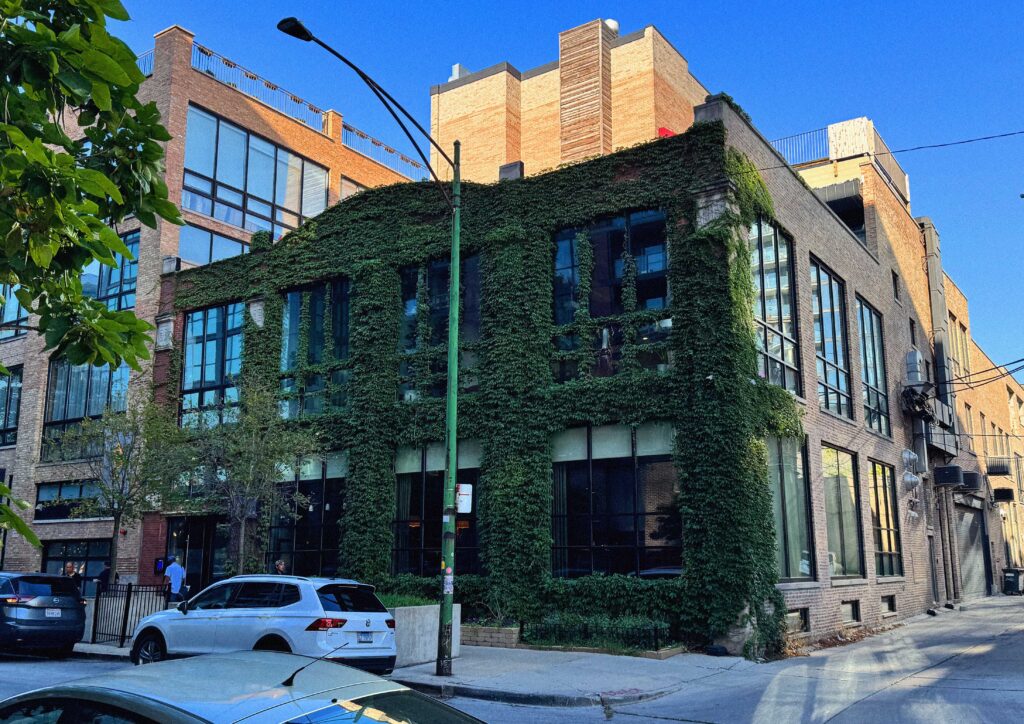
My last meal at Smyth was overwhelmingly successful while, perhaps, falling just a little short on the number of “best of the year” dishes that typically headline any given menu here.
Certainly, there were a couple of those preparations worth praising—alongside many more that were memorable and delicious—but the city and country’s greatest restaurant (to go by what the authorities say) will inevitably carry the greatest of expectations. And, though I retain the utmost appreciation for what the kitchen pursues and how inimitably they pursue it, I also deeply crave the kind of knockout pleasure that people traveling to Chicago and paying this kind of money feel entitled to.
Anyone lucky enough to taste the work of chefs John and Karen Urie Shields over a period of months or years knows that they’ve already created and disposed of several lifetimes worth of great recipes: strikes of lightning and more longstanding signatures that could be used to safeguard guest satisfaction in perpetuity.
The elaboration of unorthodox ideas and chasing of personal obsessions have instead led Smyth toward the unknown. They’ve shaped a singular culinary style and a creative process that seem to view pleasure (at least as a mainstream audience might conceive of it) as more of an accidental byproduct than an explicit goal.
This approach—forever probing, sometimes polarizing—has brought the Shieldses to the pinnacle of their profession: that rarest expression of craft, free from any trope or trend, that begs comparison to no other. It has earned the chefs the highest of honors and forged a unique value proposition in which diners must quiet their expectations and learn to appreciate textures and flavors anew without the help of any special effects.
As always, one spends the money and rolls the dice for the mere chance of enjoying that most special of thrills: an entirely novel kind of pleasure, inhibited by no past reference point, that reinvigorates one’s passion for this hobby altogether.
In the time since my July visit, Smyth formally celebrated its tenth anniversary. The collaboration dinner that marked the occasion (and was appropriately paired with wines of vintage 2016) is not worth dwelling on in too much detail—except to say that the restaurant’s cuisine felt all the more striking when served alongside that of two three-Michelin-star peers.
(Though, if I am to make one digression, it was actually the food served by Trevor Moran of Nashville’s Locust that delighted me most.)
Now, in September, we must turn the page and start to imagine what the next decade of Smyth might look like.
What is the team obsessed with today? Where might they be going? And what pleasure is there to be had along the way?
Let us begin.
Nowadays, whenever I find myself back in Smyth’s dining room, my excitement is twofold.
Of course, I do my best to observe what hangs over the hearth or comes across the pass with some hope of spying what might eventually be served. But the more satisfying reveal comes from the rows of bottles arranged on a counter closer to the front door: an array of labels (some hallowed, some altogether obscure) signaling, with little doubt, what will be poured.
My praise for the work of wine director Louis Fabbrini has formed a frequent—and likely tiresome—refrain when writing about this restaurant. I also realize it’s a little tone-deaf to advocate that guests spend another $475 (for the “Reserve Pairing”) on top of the $420 or $550 the tasting menu already costs (with prices set to rise across the board starting in November).
However, if you’re only going to dine at Smyth once (or, likewise, only choose to splurge on drinks sparingly), I cannot think of a better expression of harmony and value with which to enhance the meal. Indeed, I say this as someone who proudly snubs expensive pairings (be they at Alinea or two- and three-star concepts around the country) in favor of the bottle list.
It’s been my experience that, in exchange for providing diners with an easy, turnkey solution, sommeliers will happily present selections that do not even offer half the rarity or thoughtfulness or basic quality of what Fabbrini consistently puts forth.
The easiest way to make my case is by simply going over the evening’s lineup.
It comprises:
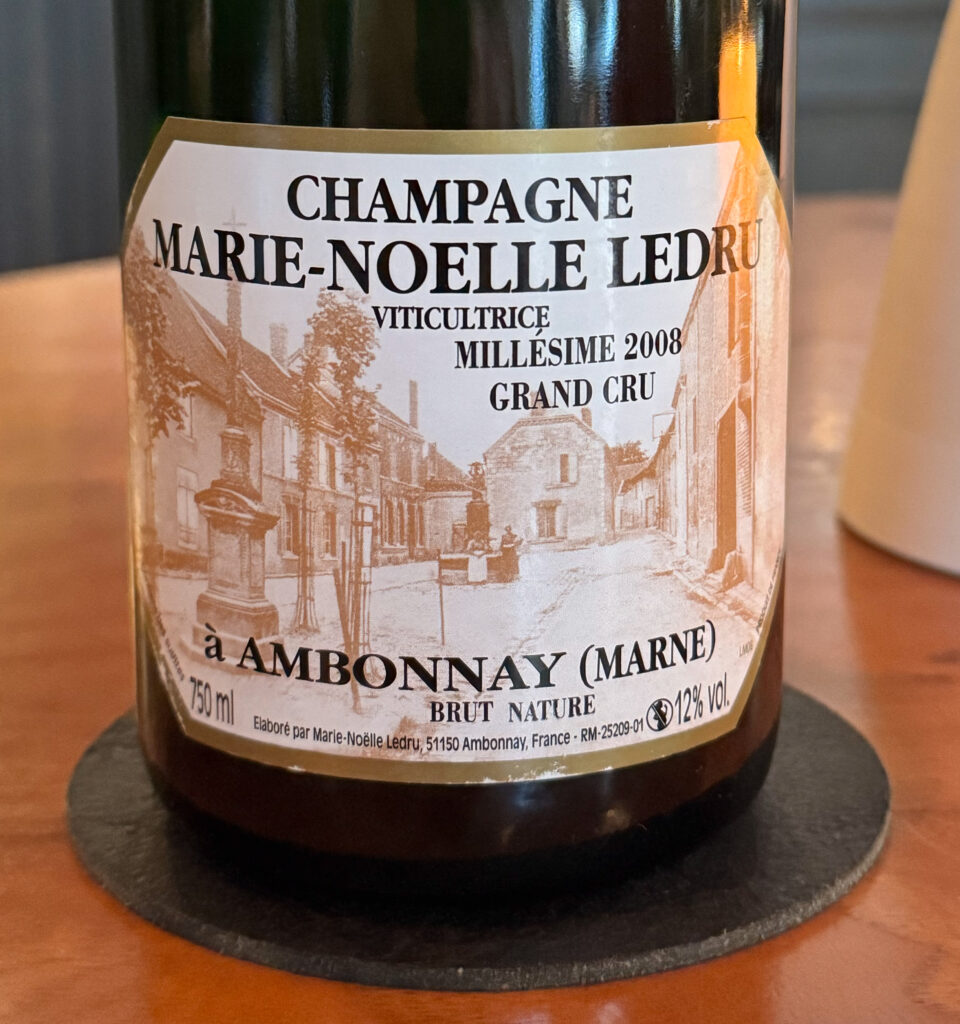
- 2008 Marie-Noëlle Ledru Champagne Grand Cru [$779 at national retail]
- NV Bonnet-Ponson Champagne “Cuvée Perpétuelle” [$55.99 at national retail]
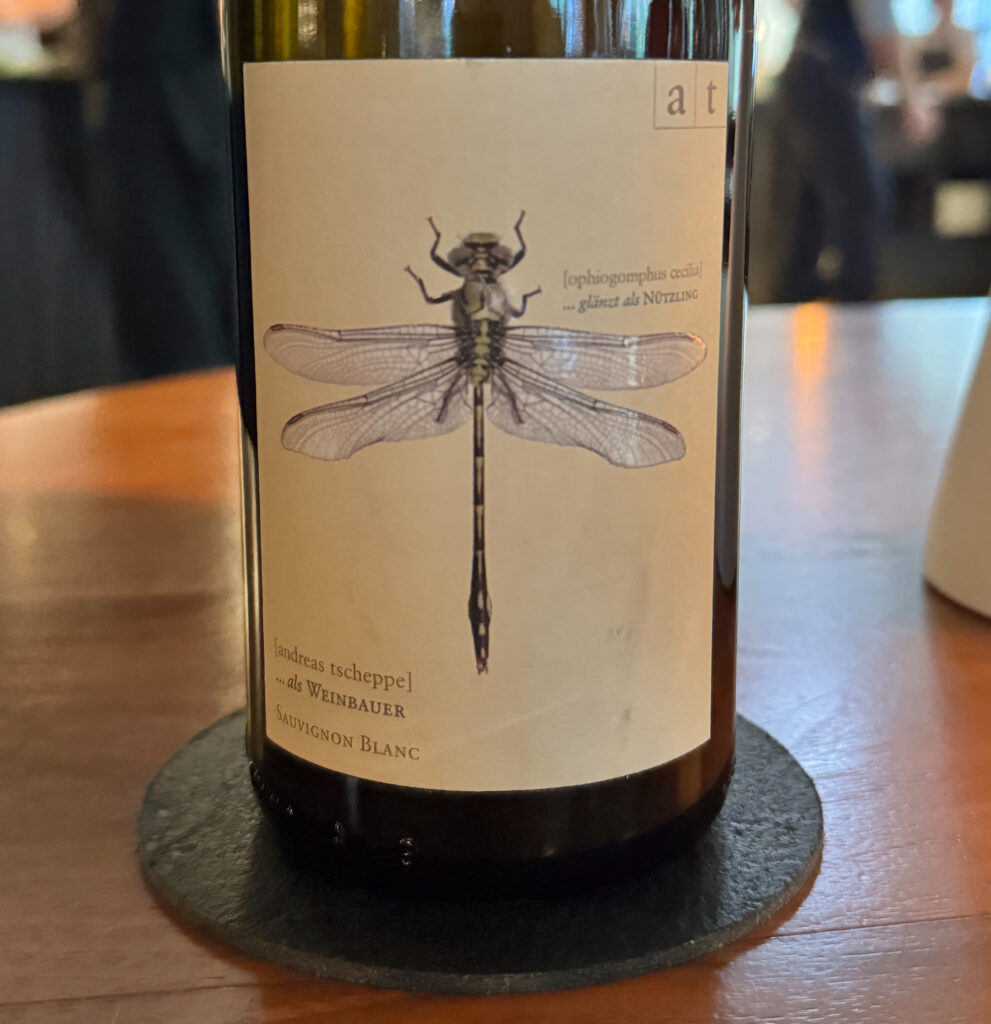
- 2024 Andreas Tscheppe “Green Dragonfly” [$105 at national retail]
- 2023 Karine Prélat Coteaux Champenois Blanc “3 Cepages” [$83 at national retail]
- 2024 Makatzak Wild Wines Getariako Txakolina “Sorkin” [$40.94 at international retail]
- 2022 Hiyu Wine Farm “Aura” [$116 at national retail]
- 2025 Dorsal “Hex” [could not be found at retail]
- 2022 Jean-Pierre Robinot “Nocturne” [$65 at national retail]
- 2016 Comando G “Rumbo al Norte” [$1,121 at national retail]
- 2007 Clos Rougeard Saumur-Champigny “Les Poyeux” [$495 at national retail]
- 2001 Domaine Leroy Corton-Renardes Grand Cru [$4,200 at local retail]
- 2003 Egon Müller Scharzhofberger Riesling Auslese [$500 at local retail]
- 2019 Pācina “La Sorpresa” [$62.99 for 2007 vintage at national retail]
Typically, the logic goes that for your $475 (or some comparable fee for a top-tier pairing) you will get to sample a wide range of cuvées that land in the $200 to $300 range. For anyone who prizes a sense of variety, the corresponding engagement of the staff, the chance at discovering something new, and/or the prospect of matching (let alone potentially augmenting) each course, this is really not a bad deal.
The value proposition only begins to fray when a consumer possesses robust preferences that would be better served by putting the same money (perhaps multiplied by the total number in the party) toward individual bottles. Plus, if we sympathize with the fact that sommeliers would like take advantage of bulk discounts whenever possible and establish a certain sense of stability for the pairings, it follows that the list would naturally become more of a repository for unique and interesting examples within a given category.
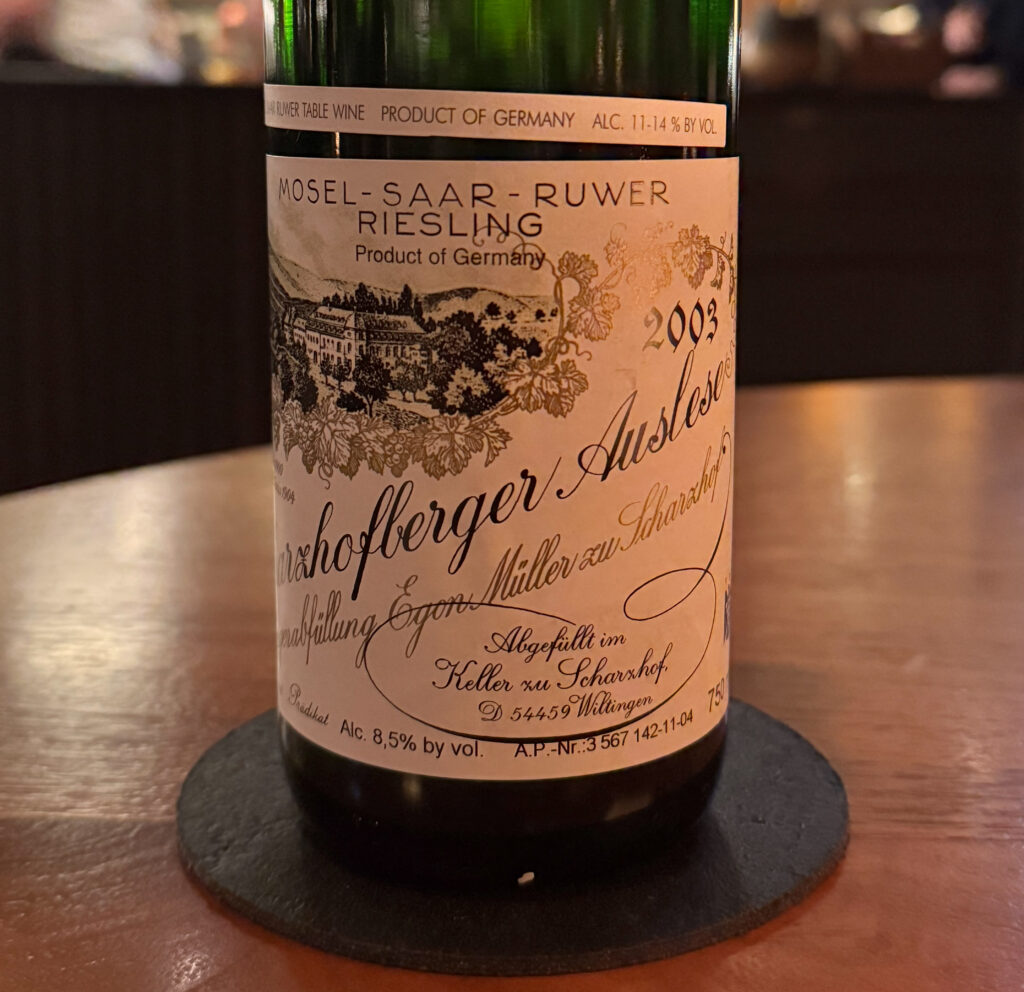
Fabbrini turns this logic on its head via a two-pronged approach.
First, there’s the foundation of what I would affectionately term weird stuff: the run of wines from the Bonnet-Ponson (a more naturally styled Champagne) through the Tscheppe (a cult Austrian Sauvignon Blanc), the Prélat (a still white blend from Champagne), the Txakolina (a notably sharp, spritzy rendition), the Hiyu (blended from equal parts Pinot Noir and Pinot Gris), the Dorsal (a macerated Chardonnay), and the Robinot (Pineau d’Aunis from a natural wine luminary).
These selections generally land under $100 (even $50) at retail, and they sound like a bit of a nightmare for any oenophile whose taste skews more classic. These cuvées subvert what one might expect from particular grapes and appellations, even going so far as to resist any reference point altogether. They’re characterful, yes, yet they avoid any polarizing flaws and look to match a kindred sense of adventure found on the plate (via all those amorphous textures and striking flavors of nuts, fruit, seaweed, and earth that have come to define Smyth’s distinct style).
It is this foundation—of food and wine going off into the unknown—that allows the pairing to pull off its second, more consequential trick: presenting a series of five superlative (if not absolutely legendary) producers whose work shapes some of the evening’s highest emotional peaks.
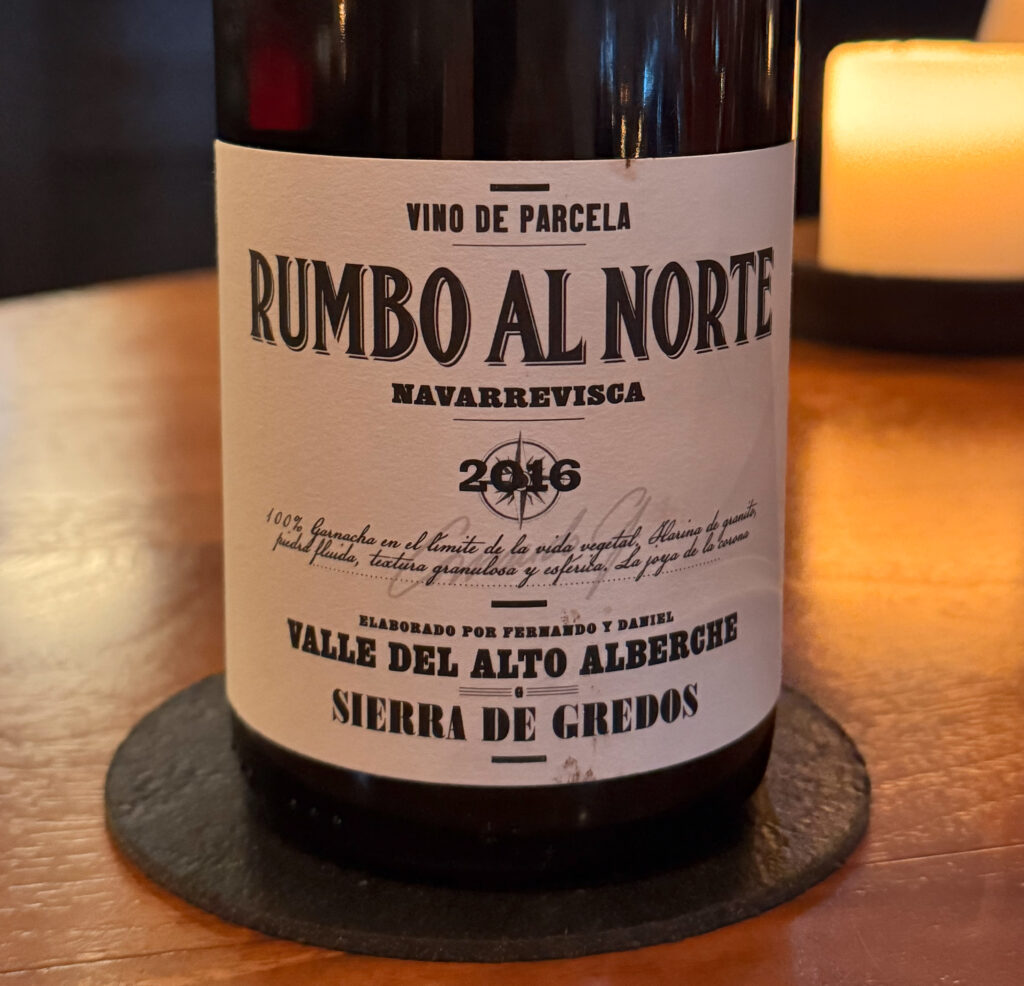
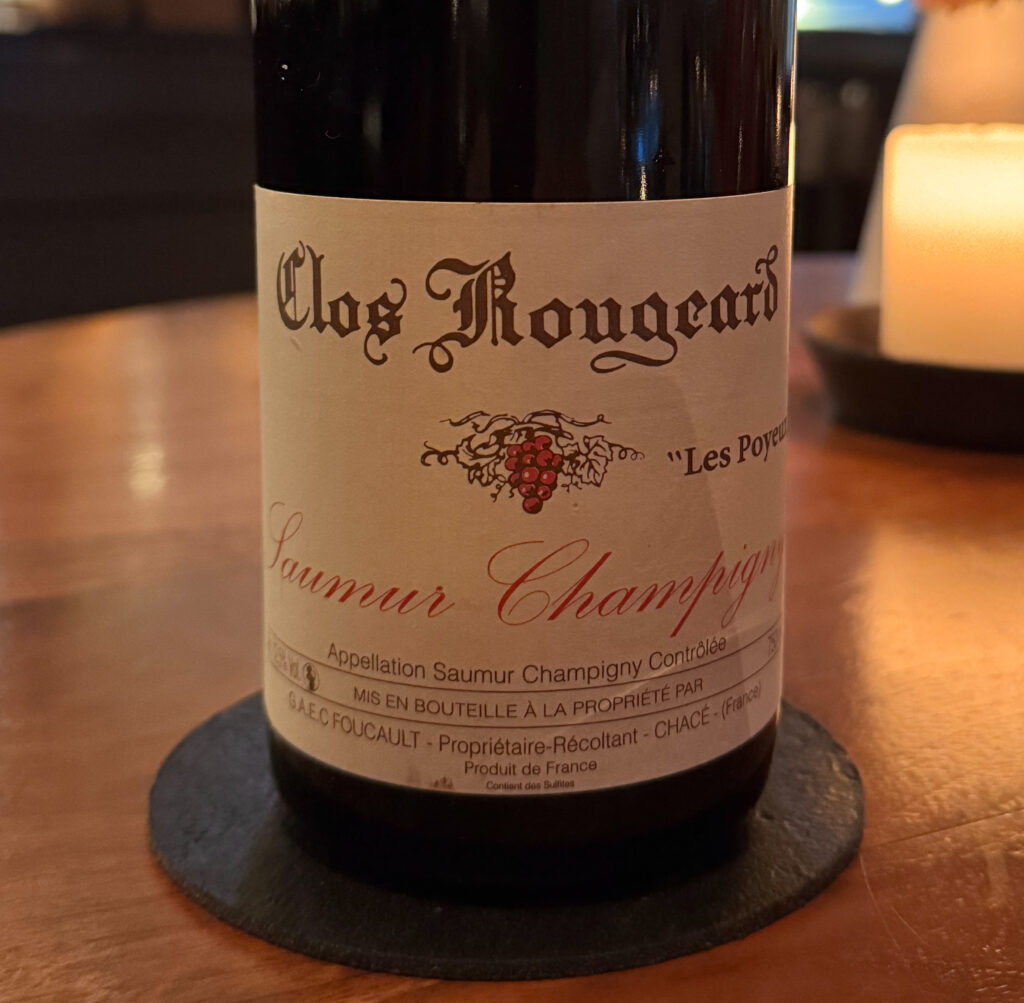
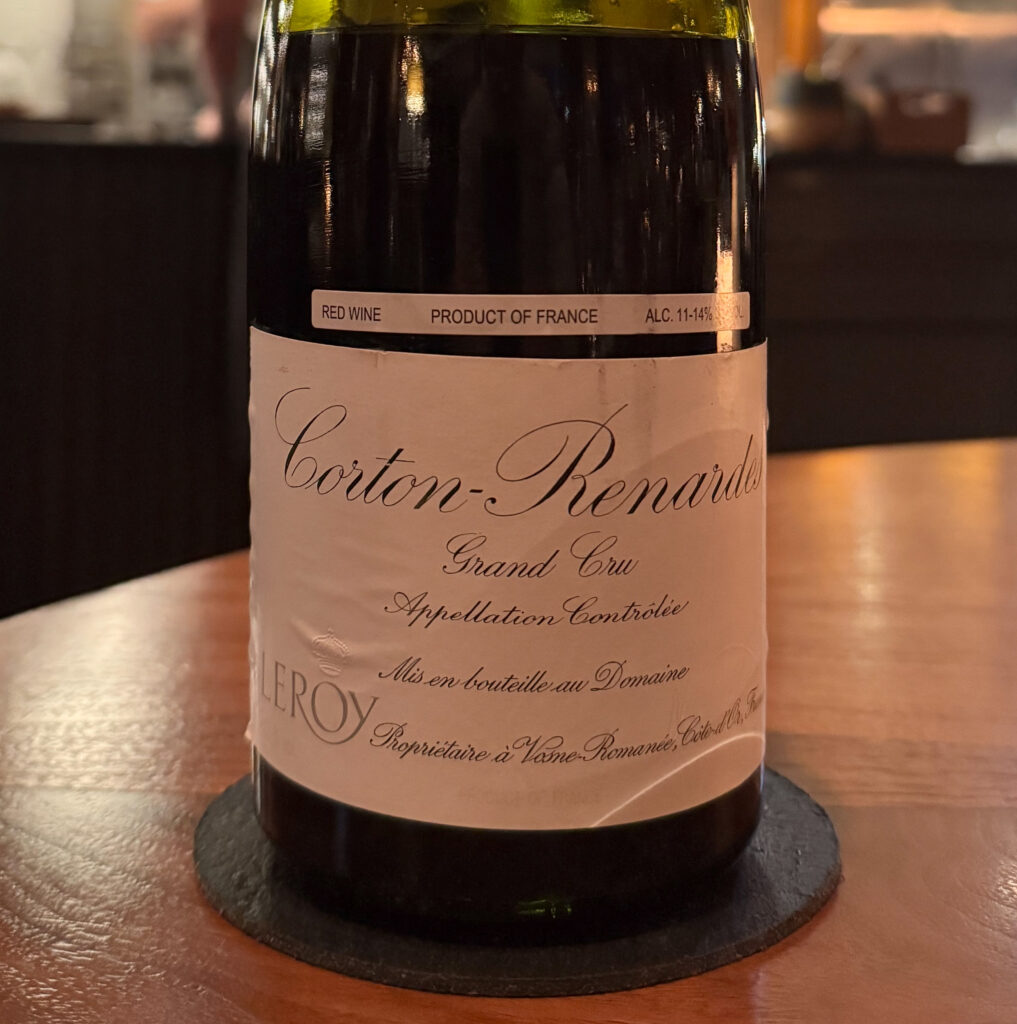
I speak of the 2008 Ledru (enjoyed alongside opening bites of truffle and caviar), the Comando G (an elegant Grenache paired with wagyu tartare), the 2007 Clos Rougeard (joining a preparation of lamb sweetbread), the Domaine Leroy (served with squab), and the aged Egon Müller (offered alongside a delicious cantaloupe dessert). The pricing of these bottles—ranging from $500 to $1,000 to above even $4,000—pulverizes any sense of an upper limit that the pairing’s mere $475 premium might suggest.
And, while it would be wrong to say these pours accompany courses (which include all of the menu’s headlining entrées) that are safer or more traditional in their constructions, there’s something to be said for celebrating the core juxtaposition of red wine and meat at a concept that otherwise pushes so many boundaries. (Just the same, Fabbrini has memorably paired top-tier white Burgundy and Jura with seafood on other occasions.)
Ultimately, I’ve expressed all of these thoughts before, but it’s hard not to marvel at the way in which the program continues to evolve. Yes, the collaboration between sommelier and chef here maintains a dynamism (to say nothing of depth) that goes well beyond what American diners would ever expect at this level.
And, each time I witness how substantively the pairing (including those expensive, singular offerings) changes each month, I am left in awe. It can only be the product of immense passion, imagination, and hard work: the kind I feel a solemn duty to showcase as a key—maybe even defining—aspect of Smyth’s identity.
When the meal, at last, begins, it does so with one of the kitchen’s familiar tipples: the kind of welcome drink (also frequently encountered at concepts like Feld and Oriole) that whets the appetite while hinting at flavors that might reappear at some later stage.
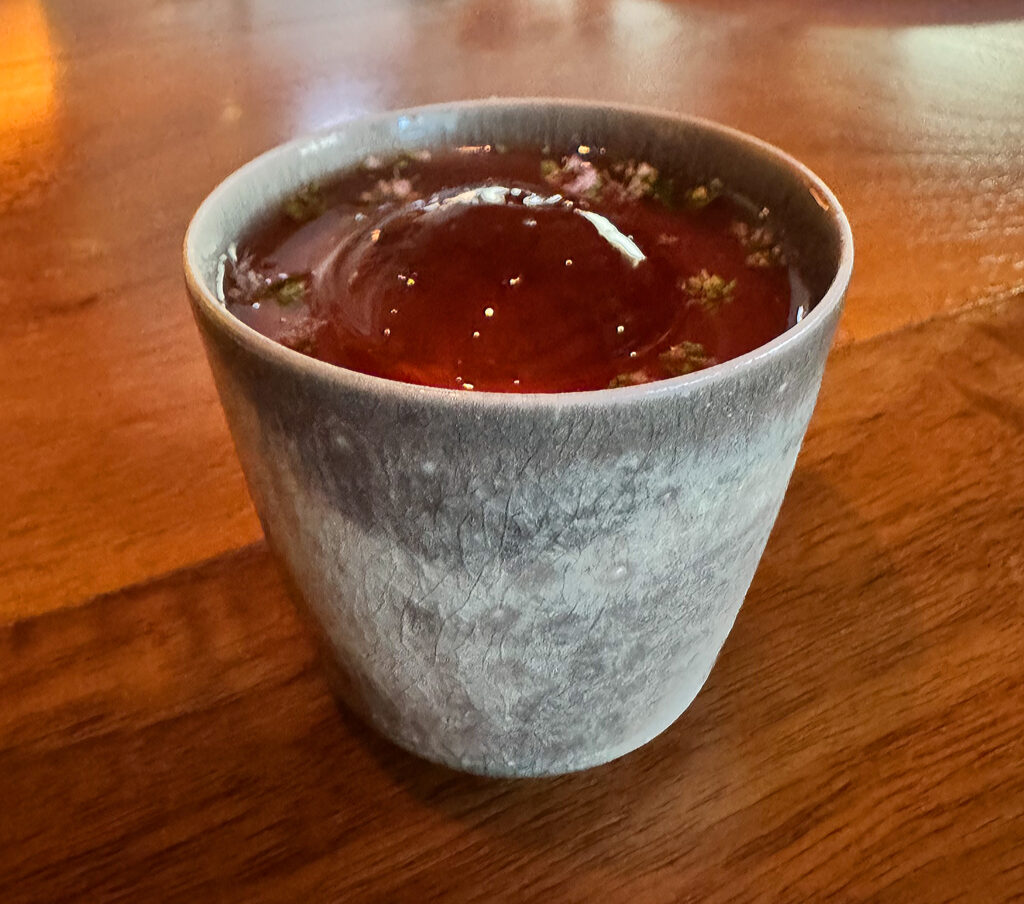
Tonight, the “Watermelon Kombucha” comes steeped with tea, sudachi, and basil then poured—tableside—over a sphere of ice. Its flavor is not as outright sweet as expected, centering instead on notes of subtle bitterness and citrus that frame a long, cleansingly fruity finish. Yes, refreshment (rather than indulgence) seems to be the intention, and I am left feeling this kombucha forms a perfectly pleasant start to an otherwise adventurous menu.
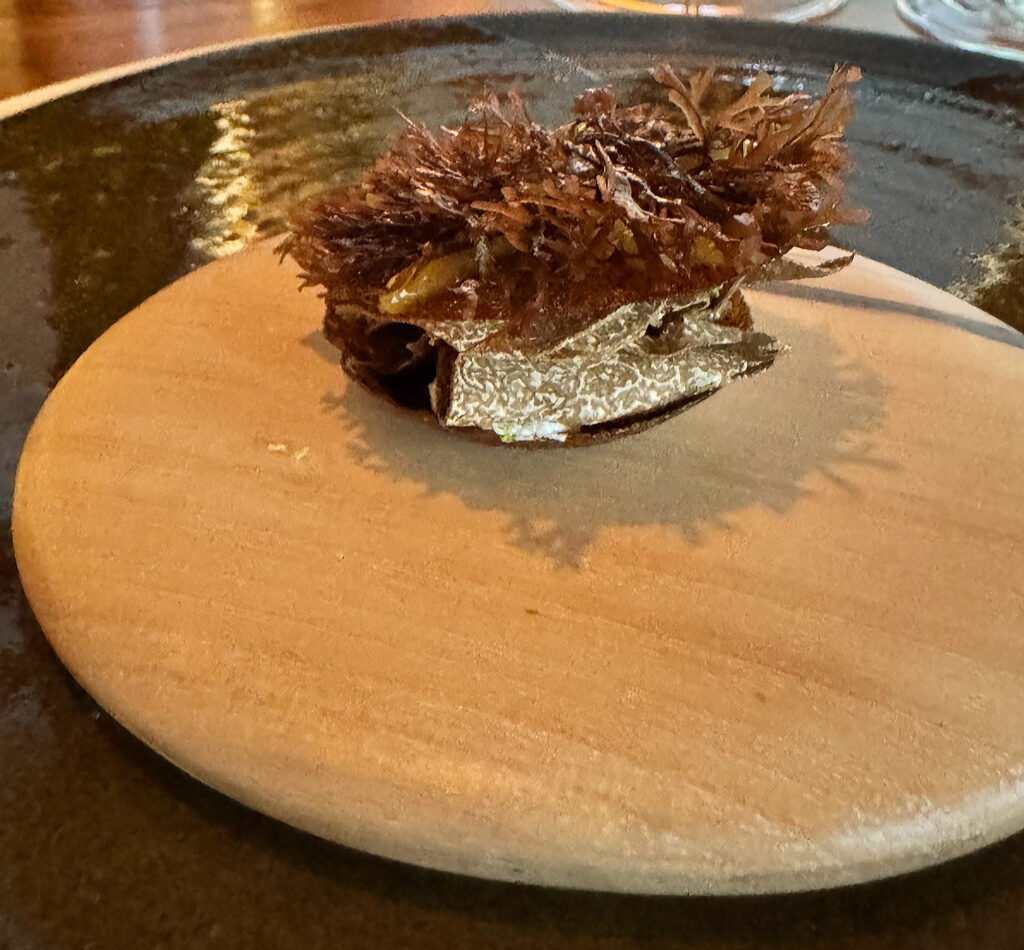
Almost on cue, the “Truffle & Buttercream Tart” arrives and epitomizes the kind of sensation that Smyth has been famous (or infamous) for during its highly-awarded, post-pandemic era. Indeed, while those titular elements do fill the bite’s brittle seaweed crust, it’s what comes stacked above—a Sungold tuile, some Sungold emulsion, pink lemon, and a garland of dulse—that proves decisive.
Texturally, the juxtaposition of crispness and creaminess here (which is effectively multiplied across two sandwiched levels) is executed with the utmost refinement. The tart goes down without any trace of stickiness or leafiness or chalky crumbliness that would detract from its essential delicacy. Instead, varied notes of tanginess strike in sequence, helping to delineate each other before revealing undertones of sweetness and umami with further mastication. Ultimately, I find the truffle hard to pick out, but this remains an impressively seamless construction that gently introduces the kitchen’s chosen style.
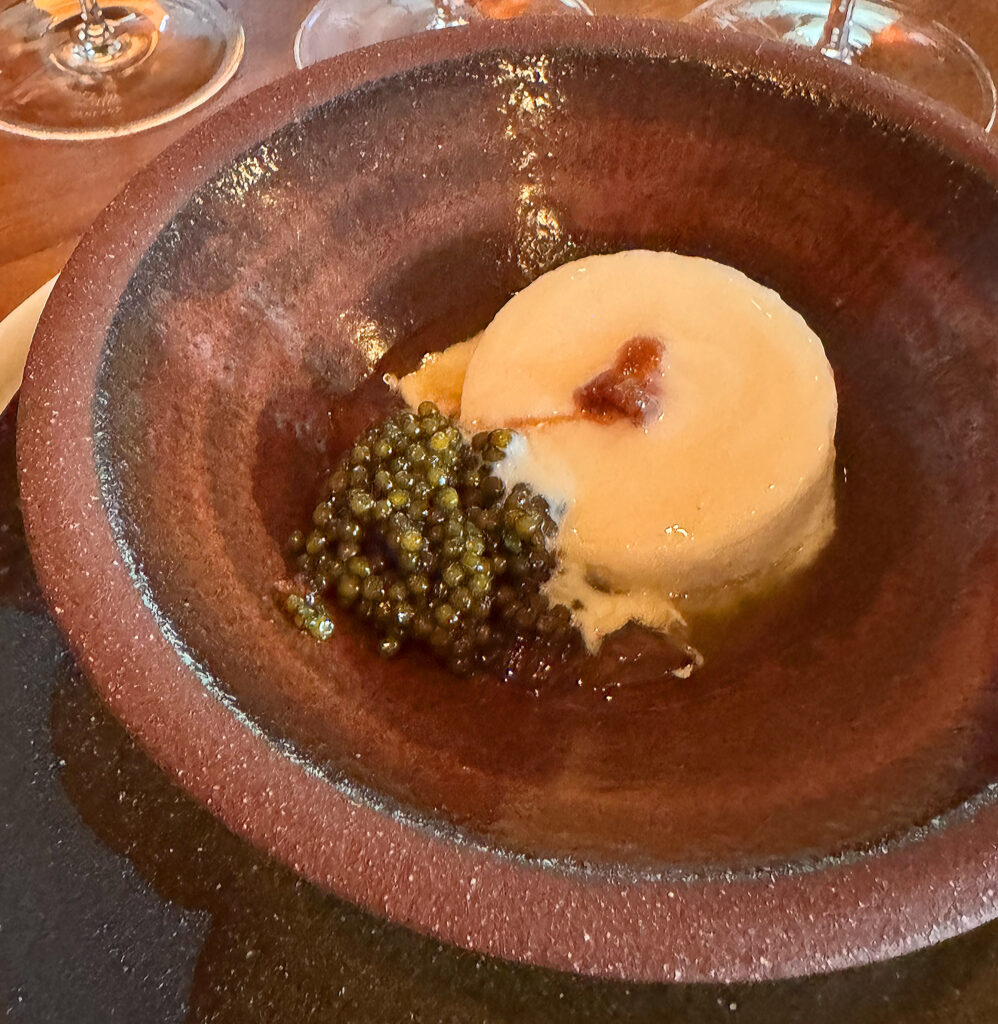
An entirely new item—the “Tofu & Kombujime Caviar”—pushes that same house style to an even higher peak, and I think the recipe is actually better for it. The dish is built upon a soy milk “cloud” whose slick, fleeting consistency calls a range of Smyth’s nut butters and creams and fudges to mind. A healthy serving of the headlining roe (Kaluga that has been cured between sheets of kelp) aims at providing an intuitive, contrasting pop and punch of flavor when enjoyed alongside the “tofu.”
Yet, while this intended effect may seem telegraphed, supporting notes of Sungold (again) and horseradish turn my expectations on their head. The latter ingredient, especially, strikes with a shocking concentration whose sharpness (and any potential for irritation) is skillfully subsumed by the soy milk. What’s left behind is a faintly milky sweet sensation and a certain quality of refreshment that plays well with the greener expression of the tomato. At about this point, the Kaluga comes in: countering these lighter, brighter tones with a boatload of nuttiness and briny, savory depth that, further accentuated by the autolytic Champagne being paired, tastes sublime.
As far as caviar presentations go, this course is absolutely singular. Nonetheless, rather than pursuing weirdness for its own sake, the chosen elements combine elegantly and intelligently in order to showcase everything diners love about the roe—only with a unique degree of power. Put another way, this is Shields at his best.
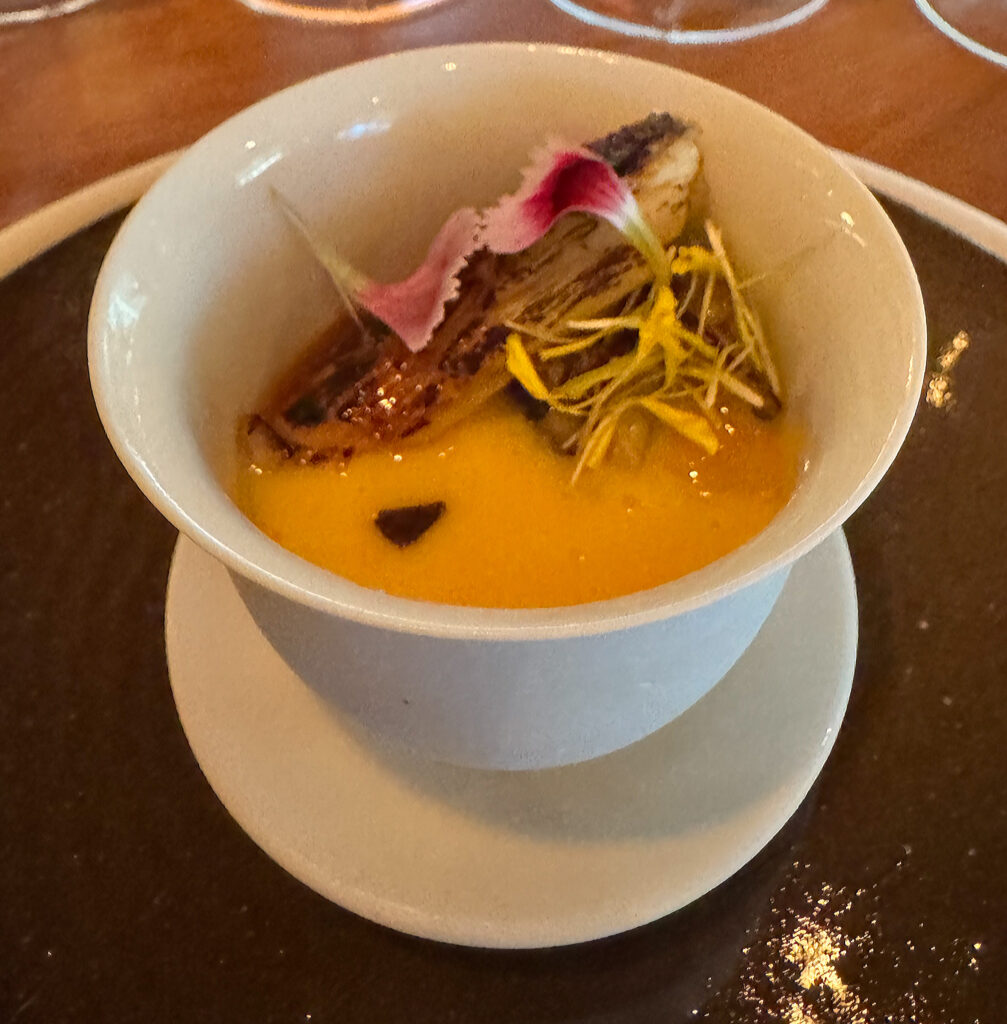
Arriving next, the “Dungeness Crab ‘Tamago’” represents the latest version of an idea I first encountered back in May, when it debuted as a kind of “freeform” construction featuring an “omelet skin,” a tulip petal, some shreds of the crustacean, and an accompanying amazake sauce. The present rendition looks and feels a lot more like a chawanmushi (something the spiel acknowledges), but, despite changing form, the recipe retains much of the same quality.
Here, the custardy base (interwoven with meat from the crab’s body) acts as a canvas for fig leaf oil, marigold, dianthus, and a sizable segment of the Dungeness’s leg (which has been beautifully brûléed). Texturally, the interplay of the soothing egg, crisp flowers, and tender shellfish is skillfully composed. However, it’s really the way the chawanmushi is seasoned that stands out.
Yes, while the custard itself is almost bland when one eats it off the bottom of the bowl, those haphazard applications of fig leaf, marigold, and dianthus actually imbue the dish with a range of warmly spiced and nutty notes. These work to reveal a delectably rich sweetness within tamago while, in turn, avoiding any sickly excess. Against this quality, the crab’s own latent sweetness—kissed with a key contrasting bitterness—really shines, shaping a course that balances surprising complexity with real enjoyment.
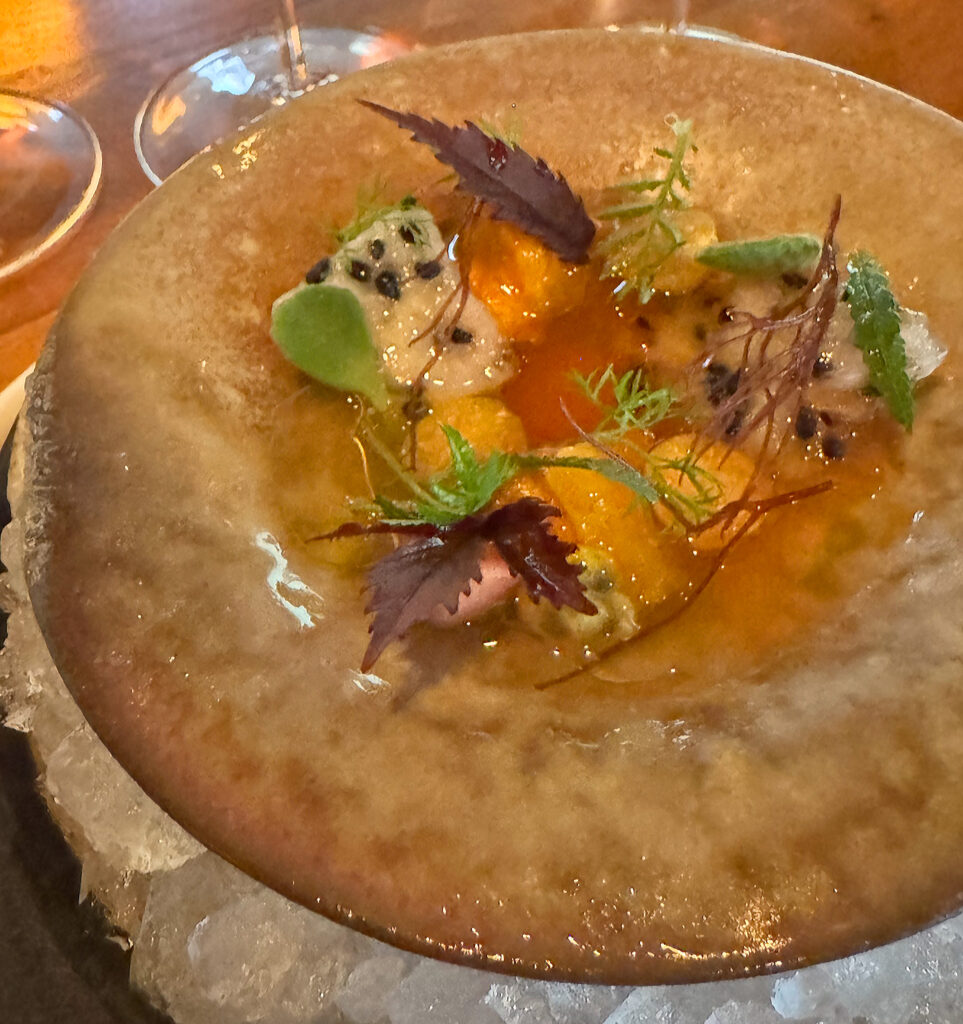
The “Ground Cherry Aguachile” also enters into a longer line of Smyth preparations (the most recent of which, from July, highlighted geoduck). On this occasion, it’s hard to imagine how the chefs hope to replace that luxurious shellfish with a humble nightshade (also known as the husk cherry or husk tomato and a fixture of my recent meals at Feld).
Yet, the aguachile is actually built from cantaloupe, peach, dragon fruit, citrus lace, and Hokkaido uni as well: spanning a whole range of leafy, juicy, and creamy textures before settling on a flavor that is tropically sweet, only a touch sharp, and marked by the sea urchin’s own unmistakable oceanic character. Overall, the balance struck here feels effortless, and the finish—displaying more of the tang and bitterness you’d expect on entry—helps to reinvigorate one’s palate on the back of that more decadent tamago. For what amounts to a bowl of fruit, this is actually quite impressive.
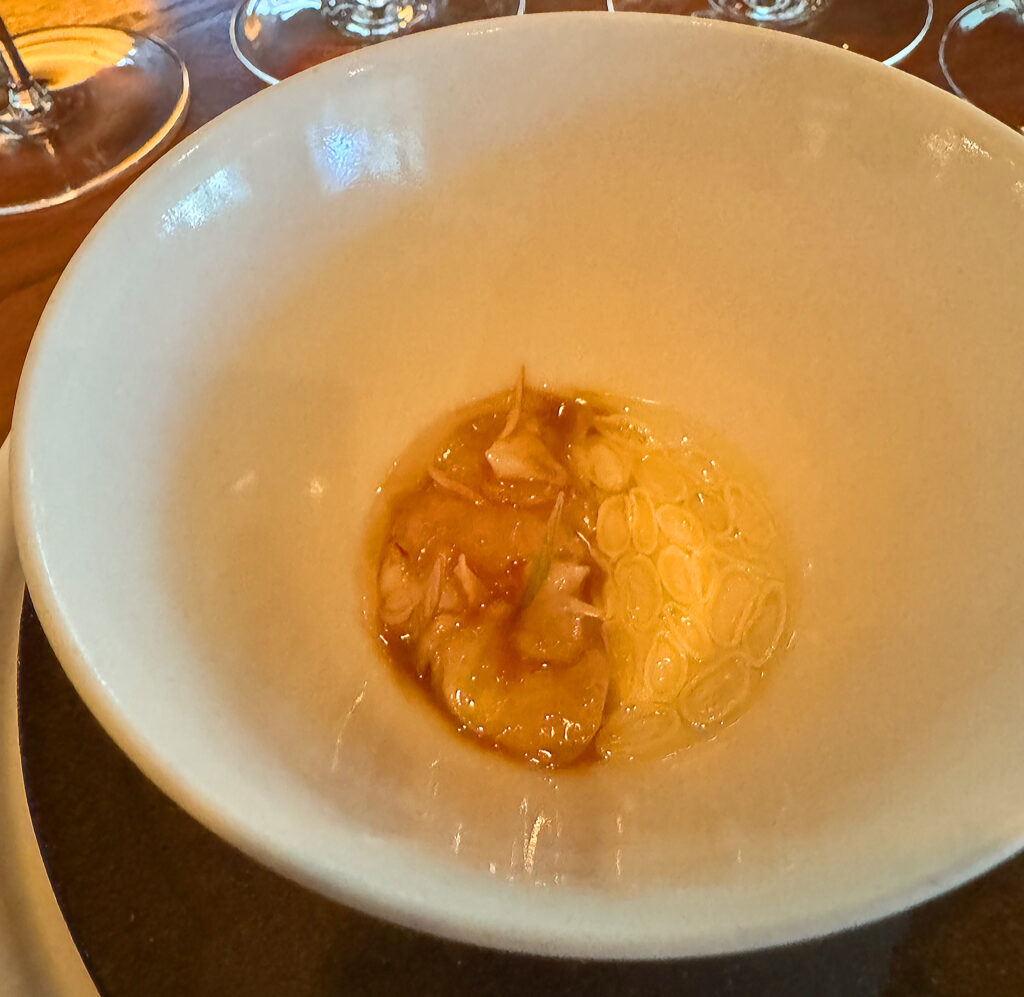
On paper, the “Maine Lobster & Cashew” sounds like yet another preparation that sees the starring crustacean shredded and dressed (often alongside caviar) with nut milk and oil in the familiar Smyth style. These are textures, admittedly, that can polarize some portion of the audience—especially when such creamy and custardy consistencies are deployed one after another without any kind of satiating reprieve. So, tonight, it’s nice to see the starring ingredients interpreted in a somewhat novel way.
Now, seeing the cashew processed into a panna cotta doesn’t sound like much of a real transformation. Nonetheless, the rendering of the lobster in more sizable, barely poached chunks (now joined by threads of jackfruit) lends the recipe an admirable degree of weight. Japanese ginger then forms the finishing touch, shaping a flavor that is tangy, doubly (both tropical and crustaceously) sweet, and supported by just enough of a savory, maddeningly nutty quality on the minute-long finish. Most importantly, the mouthfeel—however gooey and sticky—displays an element of cohesion that (at least relative to the aforementioned milks and oils) feels satisfying. Ultimately, this makes for one of the evening’s clear highlights.
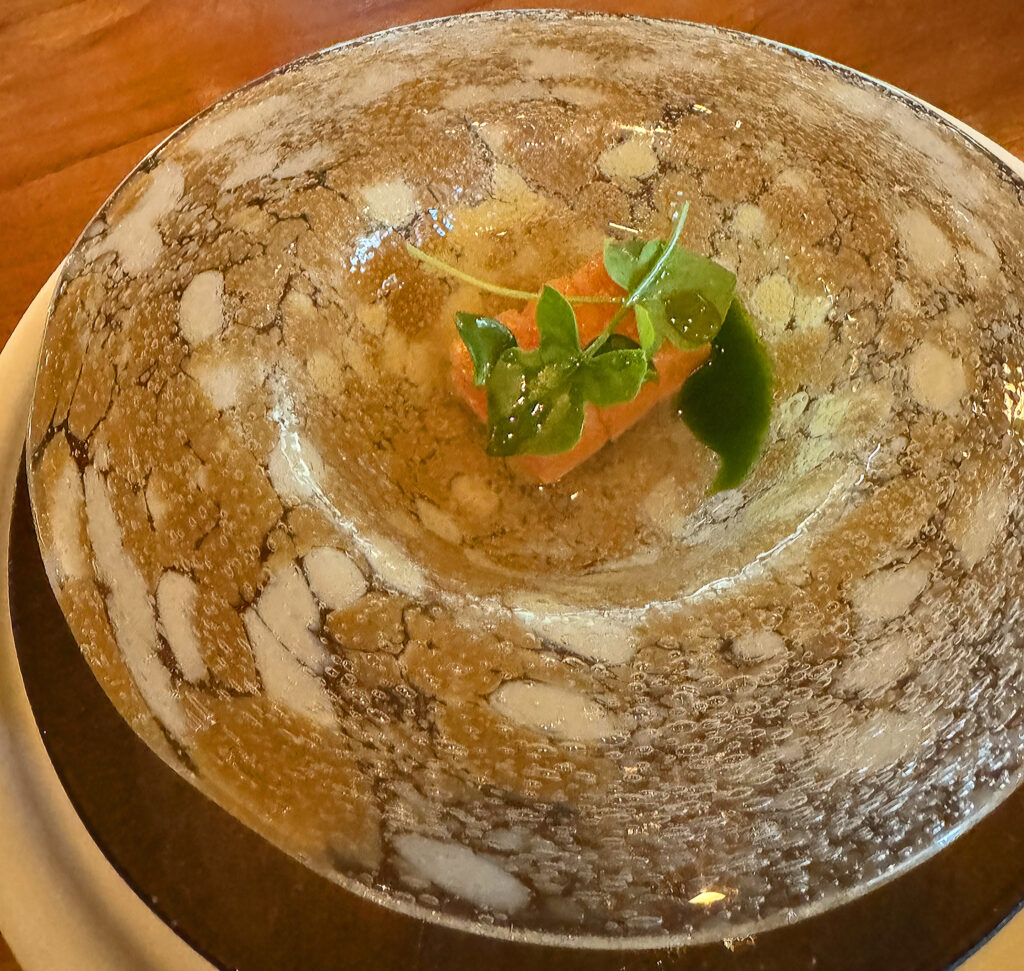
“Smoked Trout & Summer Apple” celebrates a fish (sourced from Virginia’s Smoke in Chimneys hatchery) that has been emblematic of the restaurant’s work over the past couple years. Indeed, the seafood has frequently featured in sequences spanning as many as three parts—the kind of extended exploration few other ingredients have ever been honored with at the concept. However, on this occasion, we only see the rainbow trout rendered in two ways.
Here, first, we have the belly: which has been gently warmed over the hearth for five hours then simply paired with juiced mustard greens, first-of-season apple, and sorrel. Yes, by this team’s standards, the effect being pursued with this plate is positively minimalist. But, all the same, the utter butteriness of the fish is hugely appealing, and I find the accompanying balance of sweetness, citrus, and peppery backing to be brilliantly struck. This dish could so easily veer into gooey, sickly territory, yet it manages to present the headlining ingredient with a soft touch while simultaneously revealing its full breadth of smoky, savory depth. Well done.
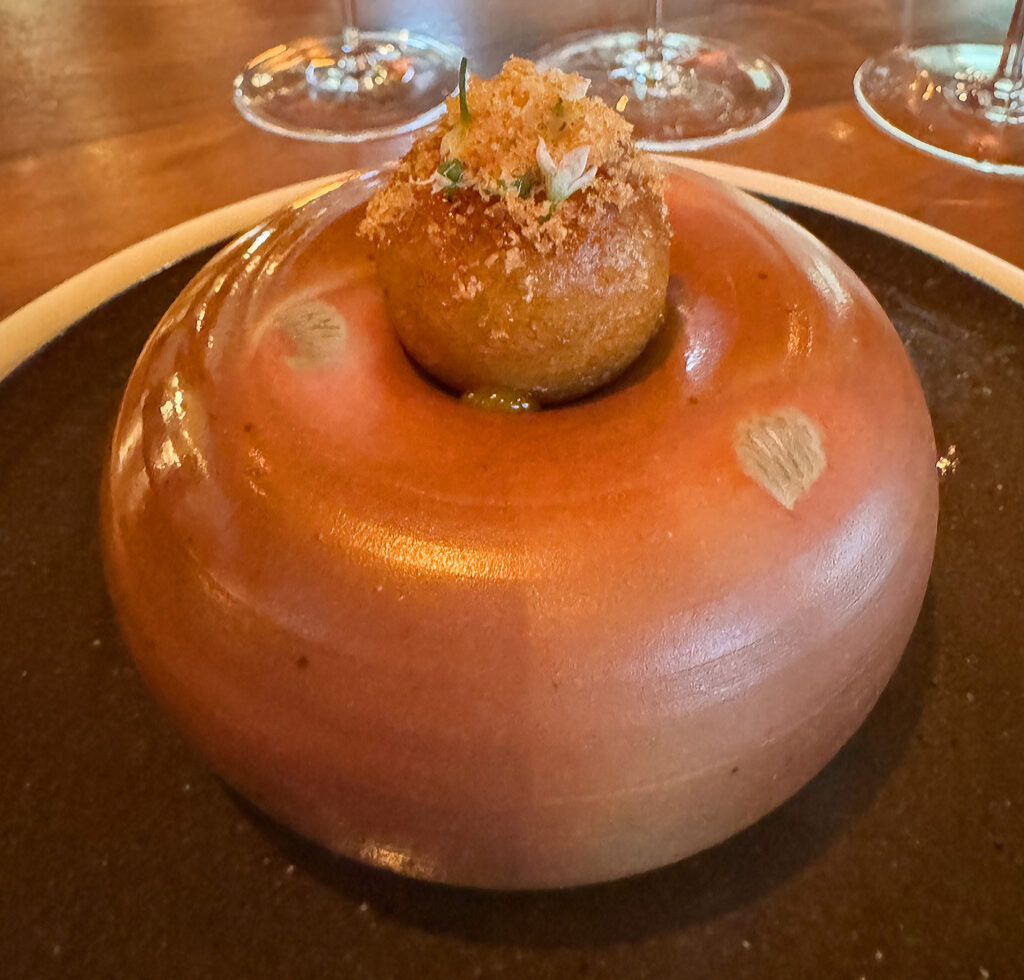
The second expression of the fish is titled “Trout Donut & Grilled Mustards,” and it represents the latest in a long, long line of savory pastries (that have increasingly been used to showcase this seafood).
This bite centers on a piece of the loin that has been smoked for seven hours and stuffed, alongside mustard greens and kale, into the center of the donut. Pickled elephant garlic, an elephant garlic-infused honey, and shavings of the trout’s dried roe complete the presentation, which—served warm—blends a seamlessly fluffy, melty mouthfeel with ample salt, a hint of sharpness, and a refined, barely sweet finish. Overall, this makes for a confident representation of a Smyth signature that (as has been the trend lately) still looks to tread new ground. I’ll always miss the outright decadence of the restaurant’s earliest, beef fat examples, but I also think this version is pretty approachable despite its exotic constituents.
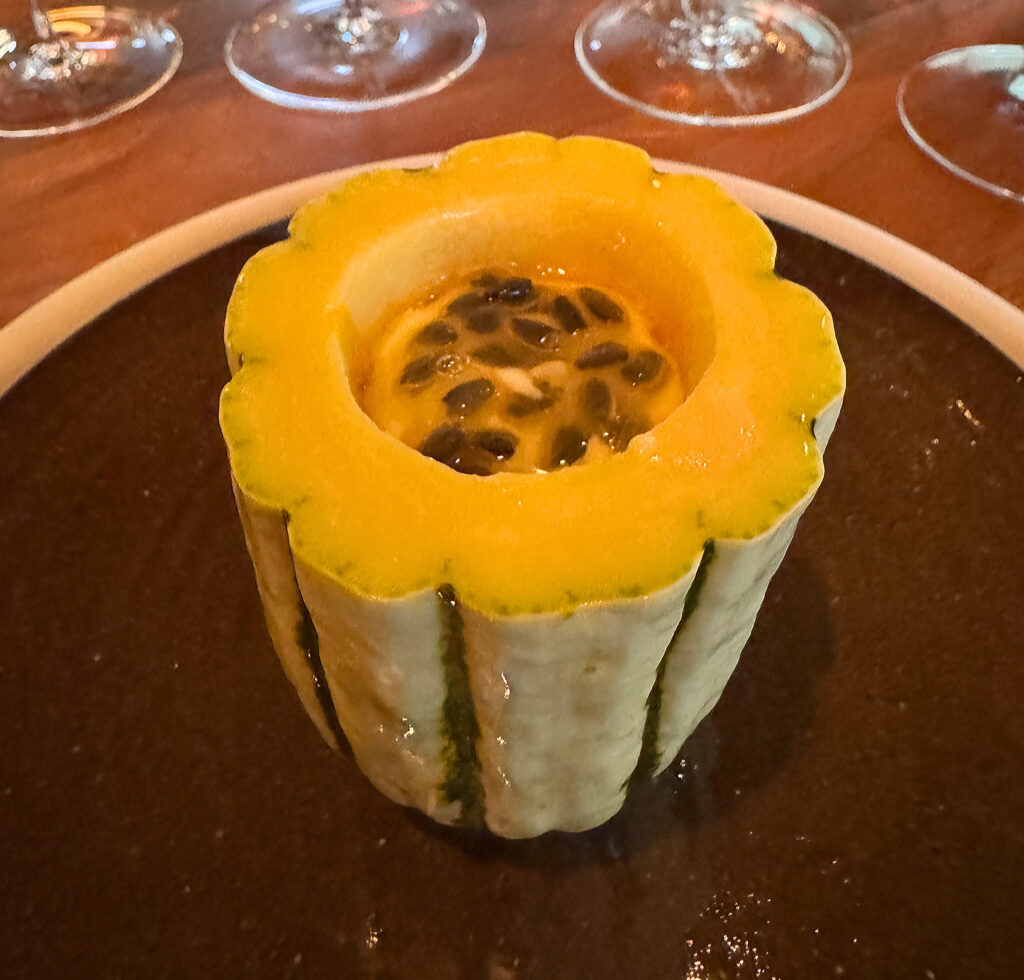
Tonight, the prize for the most charming composition undoubtedly goes to the “Early Fall Squash & Walnut,” a dish that is layered within an actual, cored delicata. There, one finds a purée made from the squash, some pieces of the titular nut, and the pulp and seeds of a granadilla (i.e., a member of the passion fruit family).
Served warm, the dish centers on the juxtaposition of the creamy, custardy base with the softly crunchy walnuts and seeds. (Enterprising eaters may also find that some of the delicata’s tender flesh can be scooped from the sides and thrown into the mix.) Nonetheless, it’s the resulting flavor—barely sweet, untouched by jarring acidity, yet strikingly rich and earthy with buttery, toasty undertones—that proves decisive. Somehow, even on the back of the trout, this vegetarian construction feels uniquely satisfying. It makes for one of the highlights of the meal and a wonderful harbinger of the season to come.
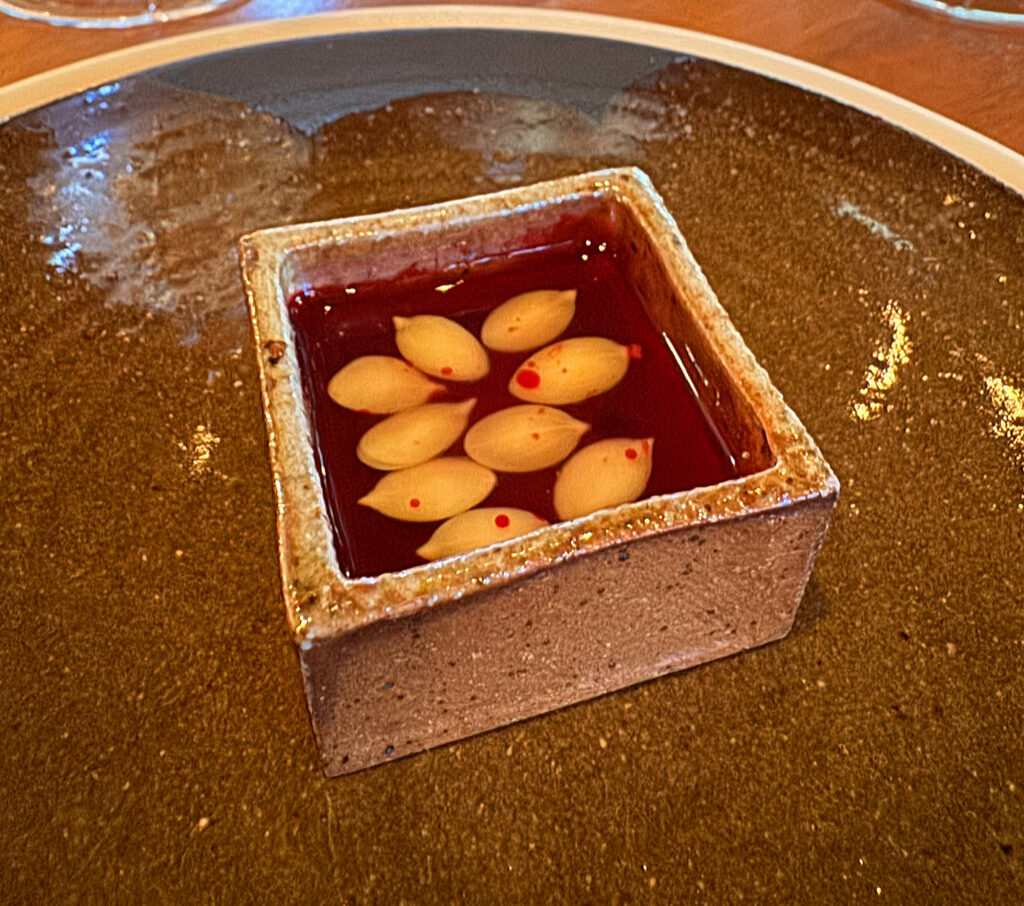
Arriving next, the “Maine Lobster & Kakai Squash Seeds” is a reimagination of a little ramekin presentation that, in various forms, has been a Smyth signature since before the third Michelin star.
The current iteration is fairly true to type: comprising a custard made from the crustacean (long the telltale element) topped with the titular poached seeds, some raspberry nectar, and an application of togarashi (i.e., seven-spice) oil. In a manner reminiscent of the preceding dish, this preparation’s textural expression is all about creamy versus subtle crunch. Thankfully, flavor diverges by way of fruity (though not too sweet) notes that, with warming and richly nutty undertones, unlock the lobster’s latent umami on the finish. Ultimately, I’d like a bit more savory intensity. However, this ranks as a cohesive and enjoyable rendition of a familiar form.
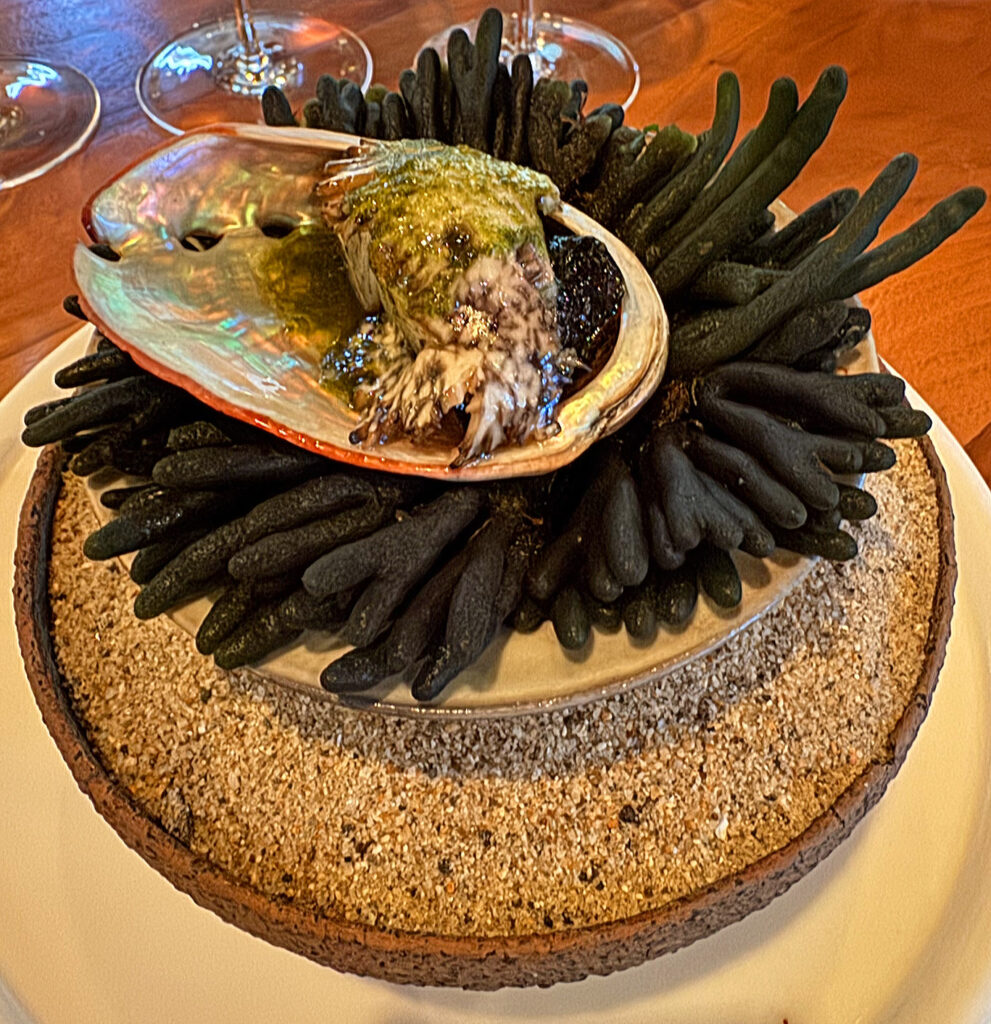
If there’s one course that misses the mark tonight, it has to be the “Abalone & Maitake.” I say this somewhat bitterly, for this most luxurious of mollusks featured as part of the very finest recipes I sampled in May and July.
On those occasions, the shellfish was paired with porcini and boudin noir respectively, so it’s hard to see how the kitchen could go wrong with another mushroom (let alone one cooked in liver). A liver sauce and some velvet horn (a type of seaweed) come from Smyth’s usual bag of tricks too. They promise the kind of resounding, achingly savory sensation I absolutely adore. However, this time around, the dish is marked by a murkiness and fishiness that (even at the level of aroma) obscures any of the enjoyment at hand. I can just about get through my portion (which does display a vaguely pleasing sweetness) yet cannot blame my dining companion for leaving theirs untouched.
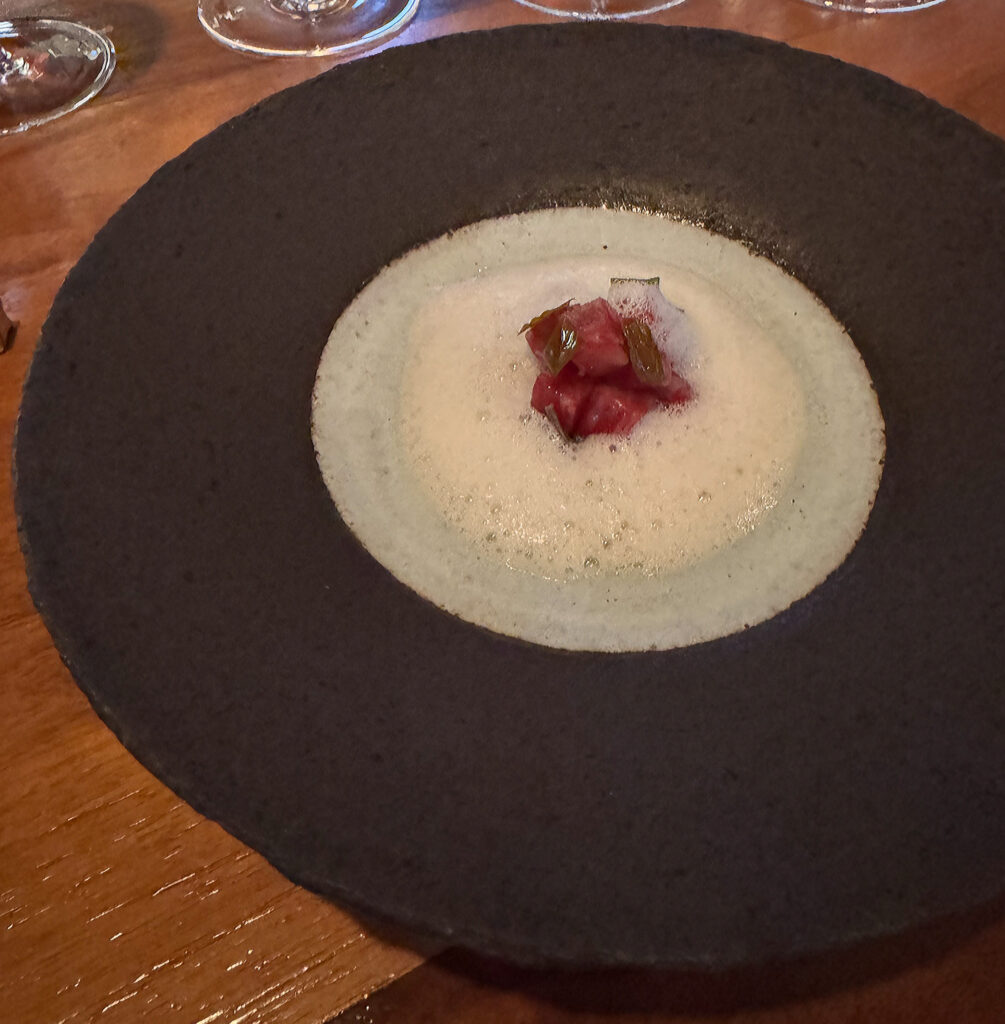
Thankfully, as we move toward the menu’s headlining proteins, the kitchen makes an immediate recovery. Their “Lone Mountain Wagyu Tartare & Sour Cream” breaks from past instances in which the coveted beef has formed one of the starring entrées. Instead, the meat is lightly roasted (at the bottom of the hearth), cut into chunks, and served alongside pickled seaweed in a sour cream nage.
Served with the tiniest of forks, the dish demands that diners savor the wagyu bite by bite. It’s a clever strategy, for the smaller pieces (in concert with the delicate manner of preparation) enforce an appreciation of the flesh’s fleeting structure and oozing fat. One really gets a sense of the beef’s essential character—oft obscured when presented as a whole steak—while supporting notes of sweetness and tangy, milky depth help to frame a lip-smacking, umami-laden finish. In short, this makes for an immediate hit, and I very much hope to see this plate again.
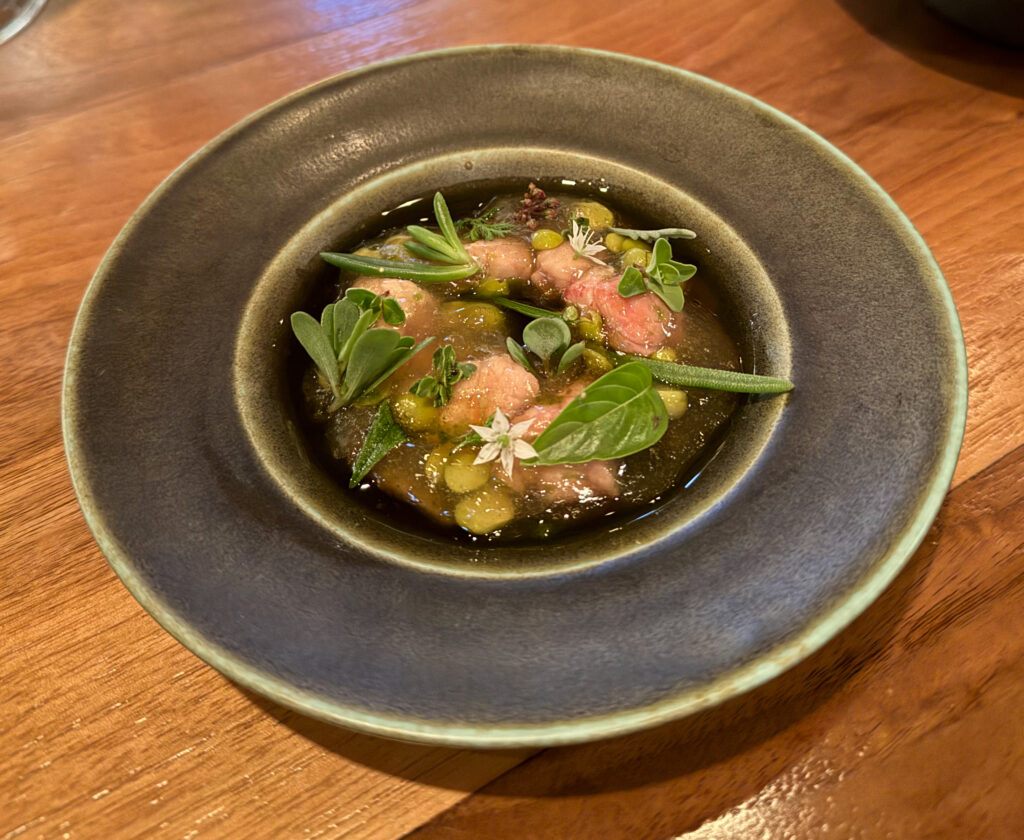
The “Elysian Fields Farm Sweetbread” looks to build on a series of recipes I encountered in May and July: ones that paired the offal with cloud mushroom and poblano respectively. Given that the latter example saw the meat tempura-fried (to great effect), I think the current iteration—which sees the lobe grilled and sliced—better resembles the former.
Texturally, this makes for a series of bites that are tender and luscious and more or less unadorned by any supporting structure. Yes, you get a sense of the sweetbread’s essential richness, then it’s up to an assortment of peas, pea shoots, and herbs from Smyth’s garden (also processed into an aromatic gravy) to provide the intrigue. Generally, I enjoy the dish’s warmth and the savory baseline it maintains despite such green, grassy, and freshly sweet supporting notes. However, I am left feeling that the offal—an ingredient I rank among my favorites—acts as more of a thickener and a passenger here instead of really strutting its stuff. That said, if we acknowledge that the herbs really form the defining ingredients, I think it’s easier to appreciate the balance being struck.
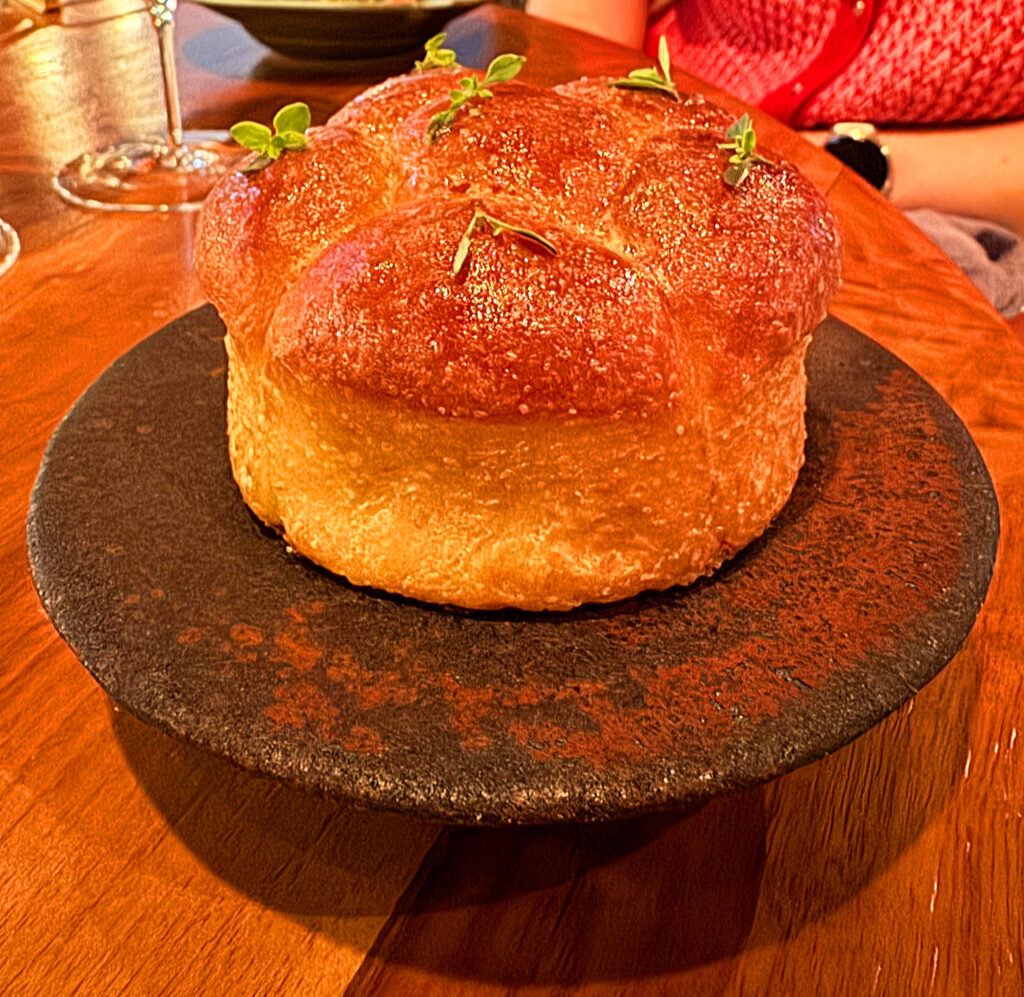
Certainly, the “Malted Milk Bread” served alongside the sweetbread helps to round things out. Indeed, being free of its usual glaze (and flavored instead with black garlic), this fluffy delight possesses enough sweetness to match the preceding dish’s brighter garnishes while also grounding their effect (and the offal’s unctuousness) with a sense of density. In short, this makes for a nice new example of a signature form.
The final savory course of the evening comes in three parts: two familiar (though reflecting the same kind of constant evolution that characterizes the kitchen’s work) and one almost entirely new (though, in turn, referencing bites that have appeared in years past).
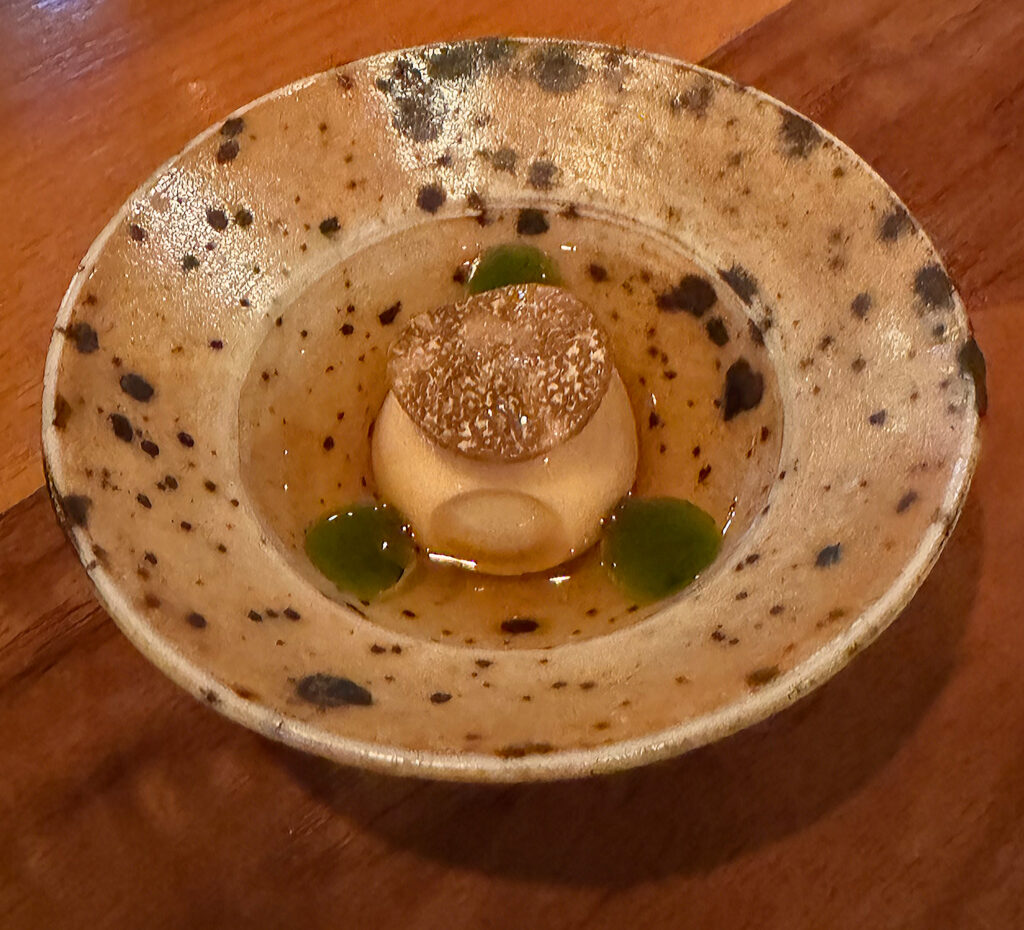
First, we have the “Black Walnut Cured Quail Egg,” which actually ranks as one of the restaurant’s most longstanding signatures of the present era. Nonetheless, even for my experience palate, it remains quite a polarizing mouthful—being so jellied and oozing and marked by notes of sweetness and earth that (opposite the richness) can leave me feeling queasy.
The present example sees the diminutive egg dressed with an onion emulsion, some lemongrass juice, and a solitary slice of truffle (as opposed to the positive avalanche that covered it in July). This results in an example that is pleasantly plump on entry then yields to a fairly straightlaced, allium-tinged flavor while avoiding any sickly-sweet excess. Yes, with the help of some citric lift, the recipe actually manages to be likable tonight (even if I’m not quite sure it will ever be an item I actually look forward to).
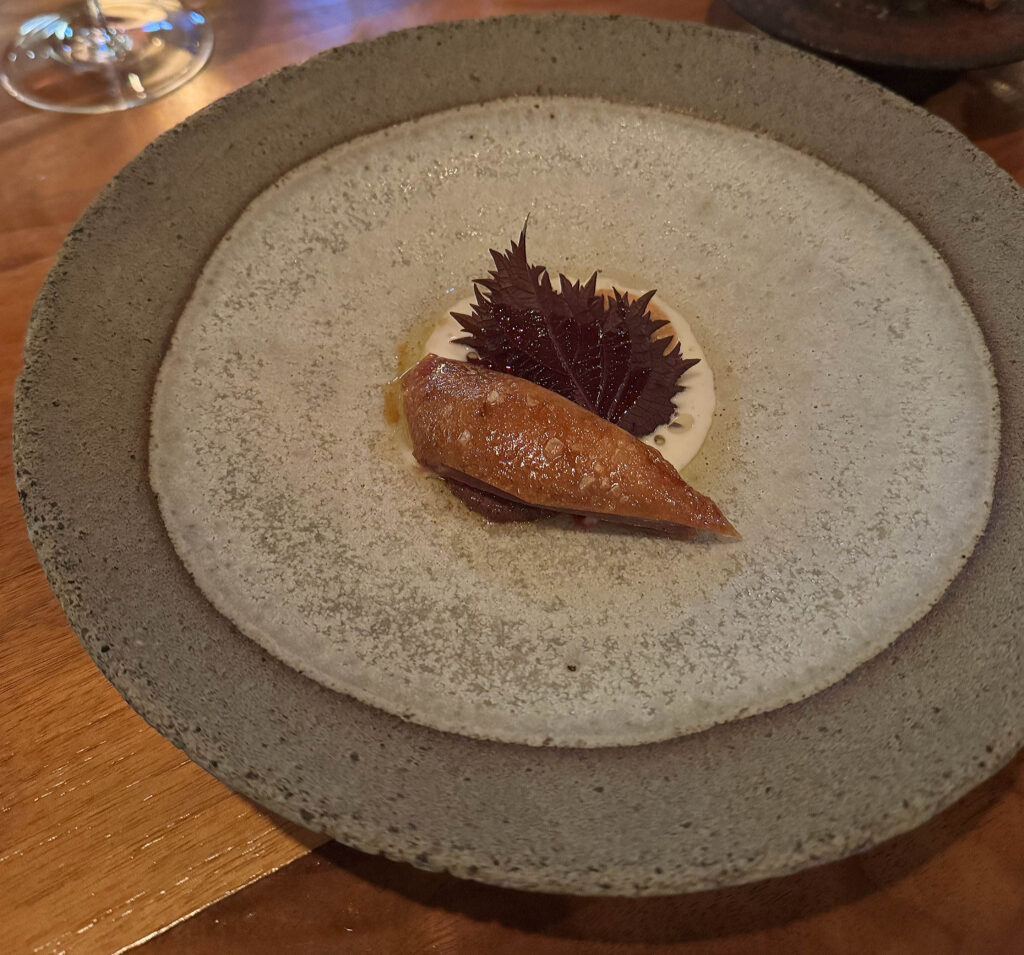
Second, we have the main plate: a preparation of “Devil’s Gulch Squab & Sprouted Grain Porridge” that builds on ideas I’ve encountered during my previous two visits. The latter element, really, is the common thread: forming a resoundingly earth and nutty foil for the meat.
However, on this occasion, I admire that the bird comes to the table without any coating of foam or other distraction from the essential crispness of its breast. Indeed, as with the preceding quail egg, this is actually a uniquely streamlined rendition of an ingredient that the team frequently pushes to an extreme of complexity.
Ultimately, only a drizzle of peanut milk, a dab of the squab’s liver, the aforementioned grain porridge, and a lone shiso leaf define the protein, which crackles and chews and strikes the palate with a pleasing feeling of sustenance. The supporting notes are surprisingly clean and soothing, being largely subsumed by the darker profile of the meat. Still, the use of offal ensures a certain degree of power persists, and I find that the breast offers an appropriately satisfying, savory quality on the finish. Overall, I do think a headlining dish such as this needs to be more memorable, but, all the same, I also welcome the shift toward a greater simplicity and purity in how the bird itself is presented.
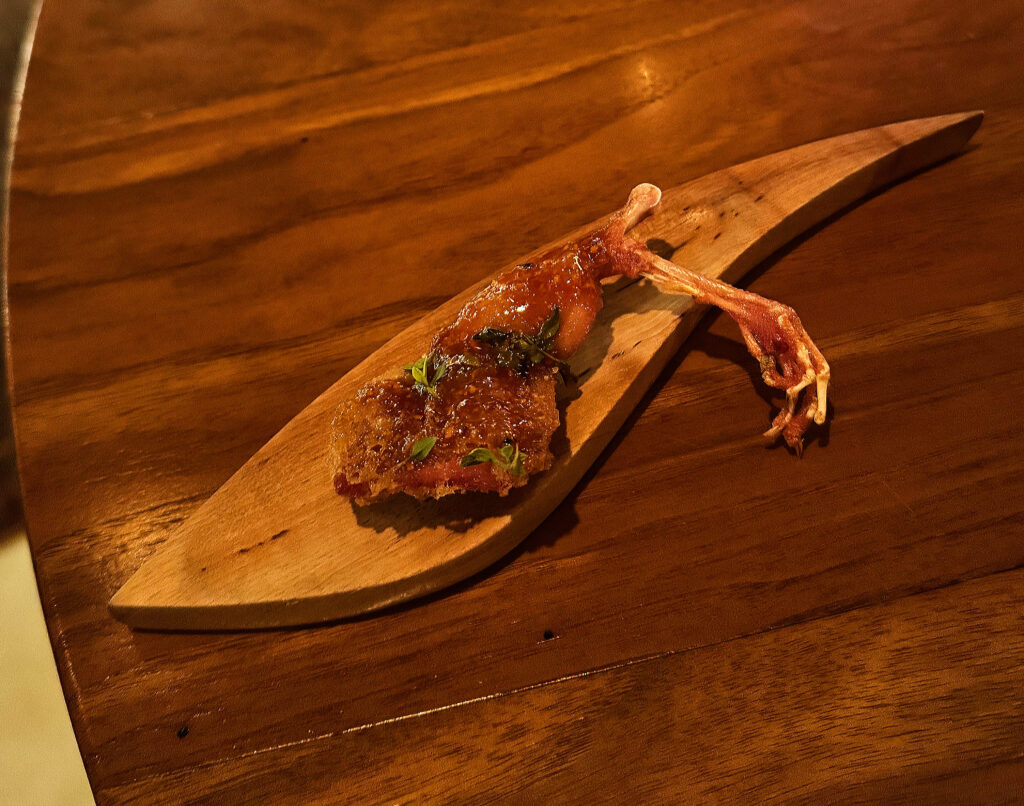
The third and final component arrives a few minutes after the previous two (yet while guests are still enjoying those last few bites). For this reason, it can almost be thought of as a cherry on top: a little bonus that’s meant to conjure feelings of decadence and delight that might not have quite landed with what’s already been served.
The “Fried Squab Leg” comes with the bones of the foot still attached but, more importantly, boasts both a flaky breading and an application of Nashville-style hot sauce. The resulting series of bites is crisp and juicy on entry before revealing a mild, lasting heat (backed by plenty of the same rich, savory depth) on the finish. In terms of both nostalgia and outright flavor, this recipe breaks entirely from the rest of the sequence. Doing so, it rescues this section of the meal with the kind of generosity that actually does stick in one’s memory when compared to all the careful, intellectual fare.
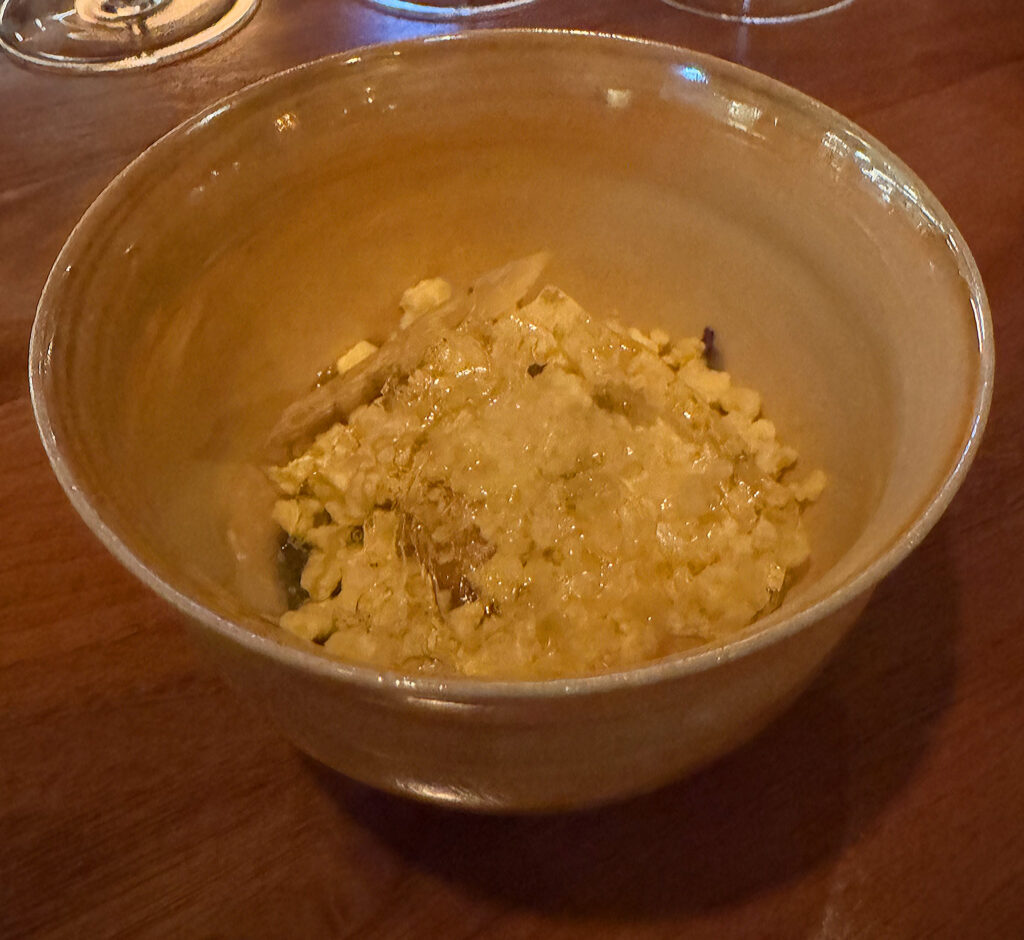
The turn toward dessert—and the work of pastry chef Jenna Pegg—is announced by the arrival of the “Cantaloupe & Lavender,” an entirely new creation made from pink lemon sorbet, a frozen (then crushed) foam of melon, some birch syrup, and a few crowning shards of ice.
This list reads a bit like a hodgepodge of Smyth’s favorite tropes (the birch and the ice especially). However, the preparation it yields balances crisp and chewy textures with the most profound musky sweetness. Sharp notes of citrus, mint, and that bewitching lavender help to further delineate (and thus enhance) the cantaloupe’s intensity. Yet, by my measure, this course transcends any label as a mere palate cleanser, ranking instead among the highlights of the night.
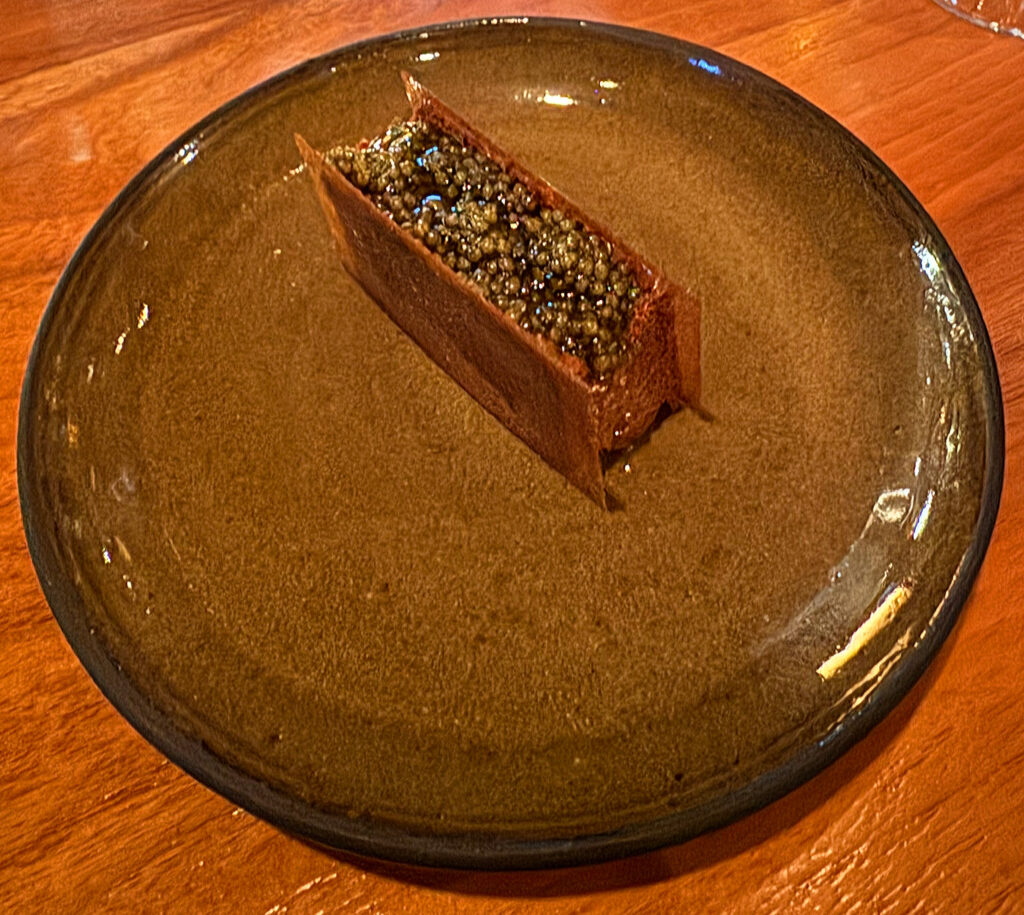
The “Koji Chocolate Ice Cream Sandwich,” another entirely new course, does one better. It marks that rare occasion when Pegg’s work rivals anything seen during the savory portion of the meal (though, if I am being honest, I can easily see Shields actually positioning this dish somewhere in the early stages of the menu).
Between two gossamer wafers, one finds the titular ice cream (rendered as one of those aerated “cloud” structures the kitchen so favors) drizzled with hazelnut oil and amply coated with Kaluga caviar. On the palate, each bite of the sandwich transforms from crisp to melty in the blink of an eye. But the subtle pop of the roe stays behind, charging the chocolate with hints of brine and unlocking a supremely nutty, caramelized flavor (joined by roasted, toasted undertones) with incredible persistence. Yes, this is one of those constructions that affirms just what Smyth is capable of when all of its ingenuity is directed solely toward the fulfilment of pleasure. I dream of tasting this again.
After two sizable (and overwhelmingly successful) desserts, the evening’s closing movement comes in three smaller parts:
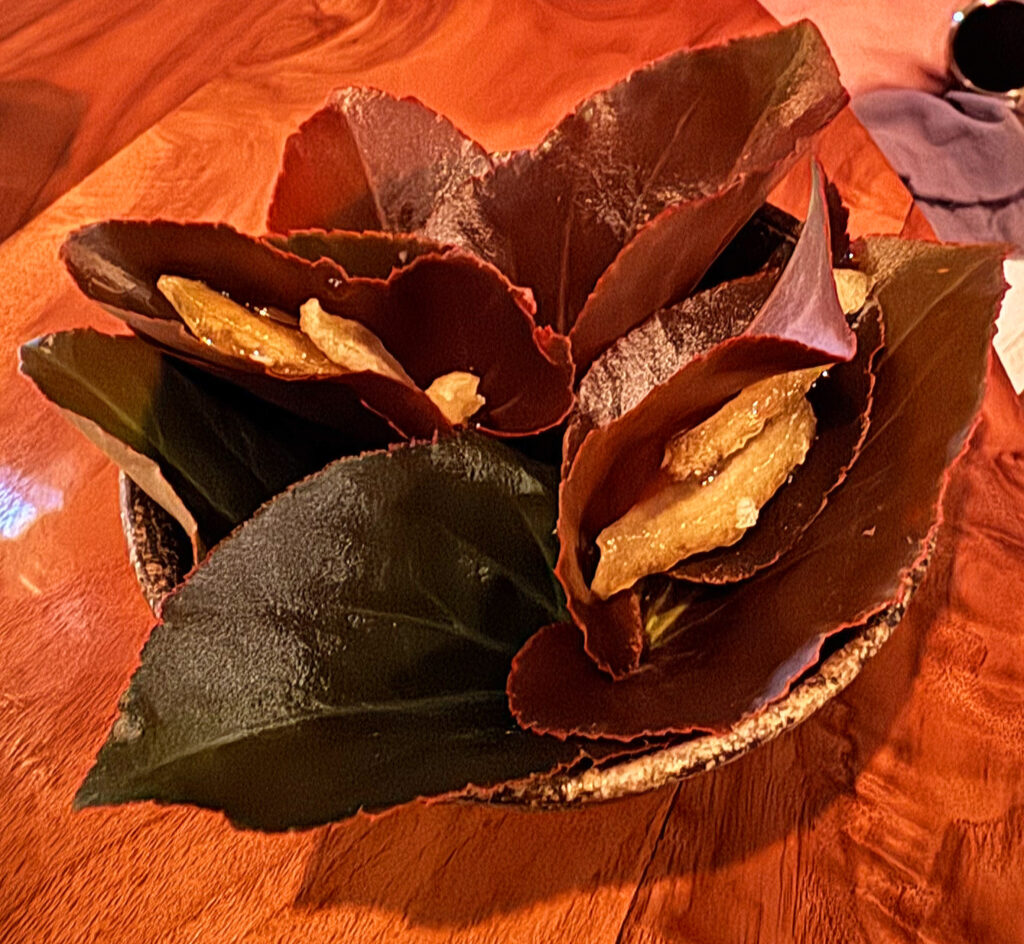
There’s the “Begonia & Apple,” a new item, that combines the chew and deep caramelization of the titular fruit (which has been candied then dehydrated) with the crispness and uplifting citrus of the flower wrapper itself. This makes for a delightfully creative presentation that, even better, displays impeccable balance. I cannot think of the last time the pastry team has performed so well.
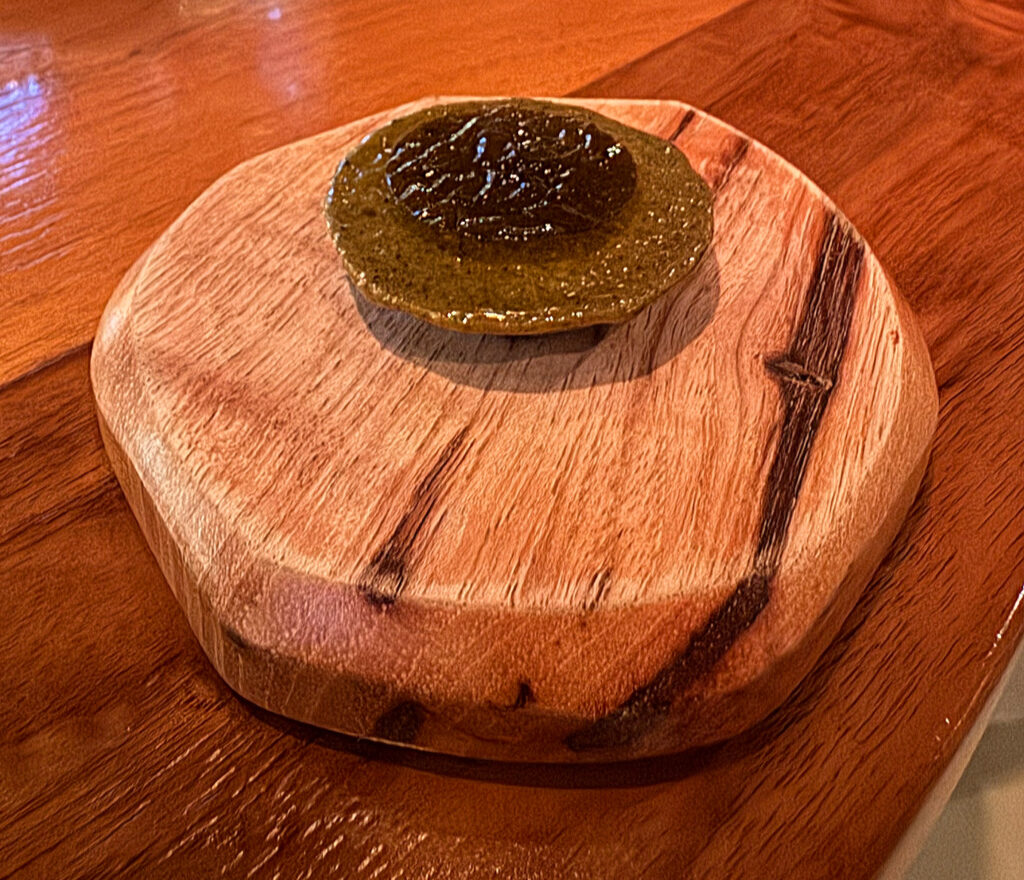
The “Preserved Pistachio Tart” is an old favorite, and it continues to deliver a delicately crisp—then creamy—sensation backed by a superlative nuttiness and just enough tang to distinguish itself from the koji chocolate. In fact, there’s an elegance and lightness to this expression that is rather appealing in its own way.
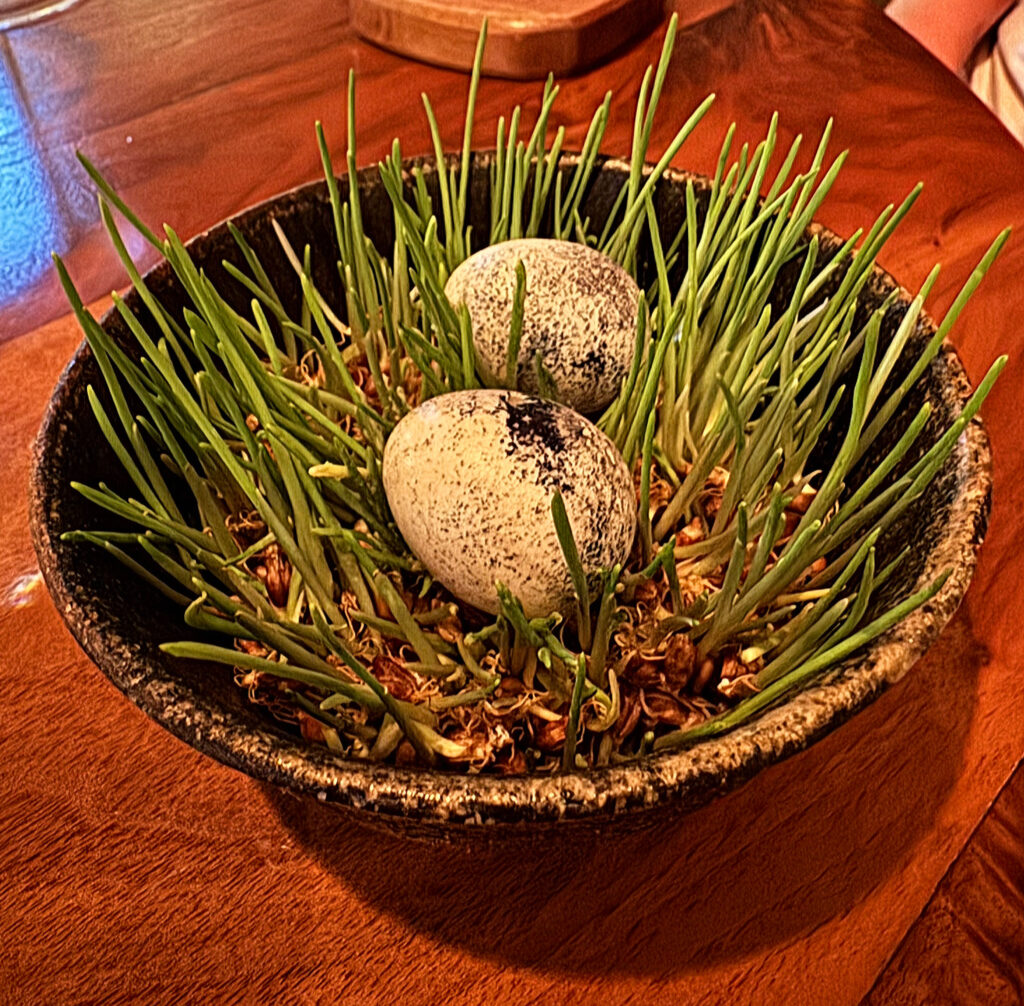
Finally, we have the “Cadbury™ Quail Egg,” which (like its cured counterpart) frequently leaves me feeling dissatisfied. However, on this occasion, the candied shell and citrus curd actually achieve a nice harmony: avoiding the kind of egg shell brittleness and jarring acidity that I often decry. Instead, I find a sugary, enlivening treat that lives up to its charming construction.
With that, the meal reaches its conclusion: spanning some 22 individual items, spread across 18 distinct courses, served over a period of just under three hours.
This is absolutely pinpoint pacing for a cuisine of such complexity—one, perhaps, that is helped by the fact that dishes are not needlessly beautified before heading out to table. Still, when one accounts for the wine pairings (which arrive with their own spiels and invite careful consideration in the moments between drops), the menu takes on a rollicking rhythm that never seems to cease until it’s actually time to go.
Such a pace ensures that the rougher edges of the kitchen’s experimentation don’t quite have a chance to fester. Rather, they make you pause, reassess, and renew your appreciation for the many hits to come. They foster the kind of intellectual engagement—a total subversion of fine dining’s timeworn expectations and the conventional markers of pleasure—that has defined Smyth in its post-pandemic era.
Yet, especially when faced with the run of desserts I found tonight, it’s hard to leave unsatisfied. The team may not be aiming at “experience” or “luxury” as the audience have come to know them, but they are faithfully stewarding one of the world’s most distinctive approaches to cookery and frequently hitting the bullseye of memorable, emotional food too.
In ranking the evening’s dishes:
I would place the “Maine Lobster & Cashew,” “Cantaloupe & Lavender,” and “Koji Chocolate Ice Cream Sandwich” in the highest category: superlative recipes that stand among the best things I will be served in any restaurant this year.
The “Tofu & Kombujime Caviar,” “Dungeness Crab ‘Tamago,’” “Ground Cherry Aguachile,” “Smoked Trout & Summer Apple,” “Early Fall Squash & Walnut,” “Maine Lobster & Kakai Squash Seeds,” “Lone Mountain Wagyu Tartare & Sour Cream,” “Fried Squab Leg,” “Begonia & Apple,” “Preserved Pistachio Tart,” and “Cadbury™ Quail Egg” all land in the next stratum: great items that achieved a truly memorable degree of pleasure. I would love to encounter any of these again.
Next come the “Watermelon Kombucha,” “Truffle & Buttercream Tart,” “Trout Donut & Grilled Mustards,” “Elysian Fields Farm Sweetbread,” “Malted Milk Bread,” “Black Walnut Cured Quail Egg,” and “Devil’s Gulch Squab & Sprouted Grain Porridge”—good—even very good—preparations I would always be happy to sample again (but that just failed to elicit an extra degree of emotion).
Finally, there’s the “Abalone & Maitake”—a below-average (frankly somewhat off-putting) item that fell short when it came to flavor.
Overall, this makes for a hit-rate of 95% with some 64% of dishes meeting the “would love to have again” standard and 14% reaching that “best of the year” level of quality. These figures largely accord with those I reported in July (i.e., 95%, 64%, 9%), May (i.e., 91%, 55%, 18%), and March (i.e., 95%, 70%, 20%), with the only real difference being that one additional recipe landed in the highest bracket tonight.
Structurally, this was a menu that really excelled when it came to dessert (as I have already mentioned) and the opening series of small plates (comprising the “Tofu,” “’Tamago,’” “Aguachile,” “Maine Lobster & Cashew,” “Smoked Trout,” “Early Fall Squash,” and “Maine Lobster & Kakai”). Given that the “Truffle & Buttercream Tart” and “Trout Donut” could’ve easily ranked one category higher, this represents one of the most engaging, enjoyable sequences I can recall in the restaurant’s history.
Nonetheless, save for the “Wagyu Tartare” and “Fried Squab Leg,” the headlining proteins (i.e., the “Abalone,” “Sweetbread,” and “Devil’s Gulch Squab”) represent a section really where the meal suffered. Indeed, this feels particularly vexing given that the abalone and sweetbread have featured so successfully during recent visits only to be inevitably tinkered with (and thus robbed of some power). The squab breast itself wasn’t bad by any means—I actually liked seeing the crispy skin presented so proudly this time—yet, as the starring entrée, it really demands accompaniments that absolutely smack of umami.
Ultimately, these are longstanding gripes that really get back to the essence of the Smyth philosophy: that even the most stereotypically satiating ingredients in the roster (be they shellfish, beef, offal, or game) are not spared from being transformed and translated through the house style. Yes, to do so—to serve that likable slab of A5 wagyu—would be to back down at just the moment when the kitchen’s obsessions have a chance to strike with the greatest force.
I trust there will be a time this year when the stars align and the entrées, while remaining true to the team’s convictions, truly bowl me over.
In the meantime, I cherish the sharpening quality I’ve perceived elsewhere during the menu. I hope the present evolution of small plates and desserts will form a stable foundation on which Smyth will make that final jump toward a “perfect meal.”
However, I’m also wise enough to know that the season will shift, the details will change, and only the skeleton of any given idea may remain come next month.
All you can really do when dining here is savor each high and low as a singular expression of a singular chef and a solitary chapter in a story that will forever be rewritten.