

As I approach the midpoint of 2026—and my present project, which looks to place Chicago’s greatest restaurants in perpetual conversation with each other—the emotional timbre of each individual concept has become strikingly clear.
To wit, there are places that feel like home (and maybe have for years) and those where paying a visit (no matter how much of a reference point the cuisine might be) begins to feel like a chore.
No doubt, this is an incredibly privileged thing to say about places the average consumer dreams of dining at just once. It seems to signal a degree of excess and downright gluttony that strip these places of their essential magic, flattening them into mere arenas for the ugliest, most literal kind of gustatory consumption.
But I contend that this is exactly the point when probing these eateries starts to get interesting: the time in which a restaurant reveals itself to have a bottomless pool of charm (often showcased by the chef themself) or, in turn, relies almost entirely on texture and flavor to win the day.
Charm, admittedly, cannot make up for bad food. Likewise, I think any devoted gastronome would readily put up with plodding hospitality if it meant tasting the finest cuisine of their life. We really don’t have to choose (for the truth always falls somewhere in between), yet it’s worth talking about these deeper feelings—this question of a concept’s soul—because they provide the foundation on which experimentation and risk-taking can be graciously understood.
In short, you either have to be near-perfect at this level of dining or clever enough to convince guests to roll with the occasional punches in fulfilment of a vision that transcends conventional pleasure—the kind of pleasure patrons could just as easily find at a high-end steakhouse if that’s all they’re really after.
Feld, by now, has me totally convinced. There might not be a place I get more excited about visiting these days. Some of that, surely, has to do with how much the team struggled at opening. The bar was on the ground, and chef Jake Potashnick forged a path to Michelin glory without ever abandoning his core ethos.
Today, he personifies redemption: the fruits of a process of ever-increasing refinement—a day-to-day dedication made obvious even two months in—that, to me, feels so much more honest and alluring than the promise of a static, signature sort of “perfection.”
At the same time, Potashnick, it seems, will never be deemed worthy by a certain demographic. I sympathize with their inclination to forever punish mistakes (as well as an accompanying petulance) that cannot be excused when charging hundreds of dollars. But there’s also a point—backed by James Beard, Bibendum, and an array of local and national critics—that Feld’s growth cannot be ignored.
Treating the restaurant as a lazy punchline or a scapegoat betrays a callous disinterest—say what you want about the “relationship to table” tagline—in where the city’s dining scene can and should be going: toward individualized sourcing and nimble, minimalist compositions (paired with intimate, engaging storytelling) that turn traditional notions of luxury on their head.
Chicago will never go toe-to-toe with cities like New York, San Francisco, and Los Angeles when it comes to serving caviar, truffle, wagyu, or a whole host of Japanese seafood. Sourcing these ingredients is ultimately an arms race, and we do not have a population that can sustain or reward the highest strata of quality.
Frankly, it grants us a golden opportunity to excel in ways that those totemic items rather perversely restrict. And it’s hard not to respect Potashnick (and maybe even feel somewhat defensive about the hatred he inspires) for helping to lead that charge.
If you want to call him a dilletante or a pretender, you have to ask why he and his team seem to be having more fun—and exude so much more passion—than any other kitchen in town.
Their energy, twelve meals in, not only remains infectious. It makes space for a culinary journey (occasionally provocative yet now so routinely delicious) whose twists and turns are hard to grow tired of.
Let us begin.
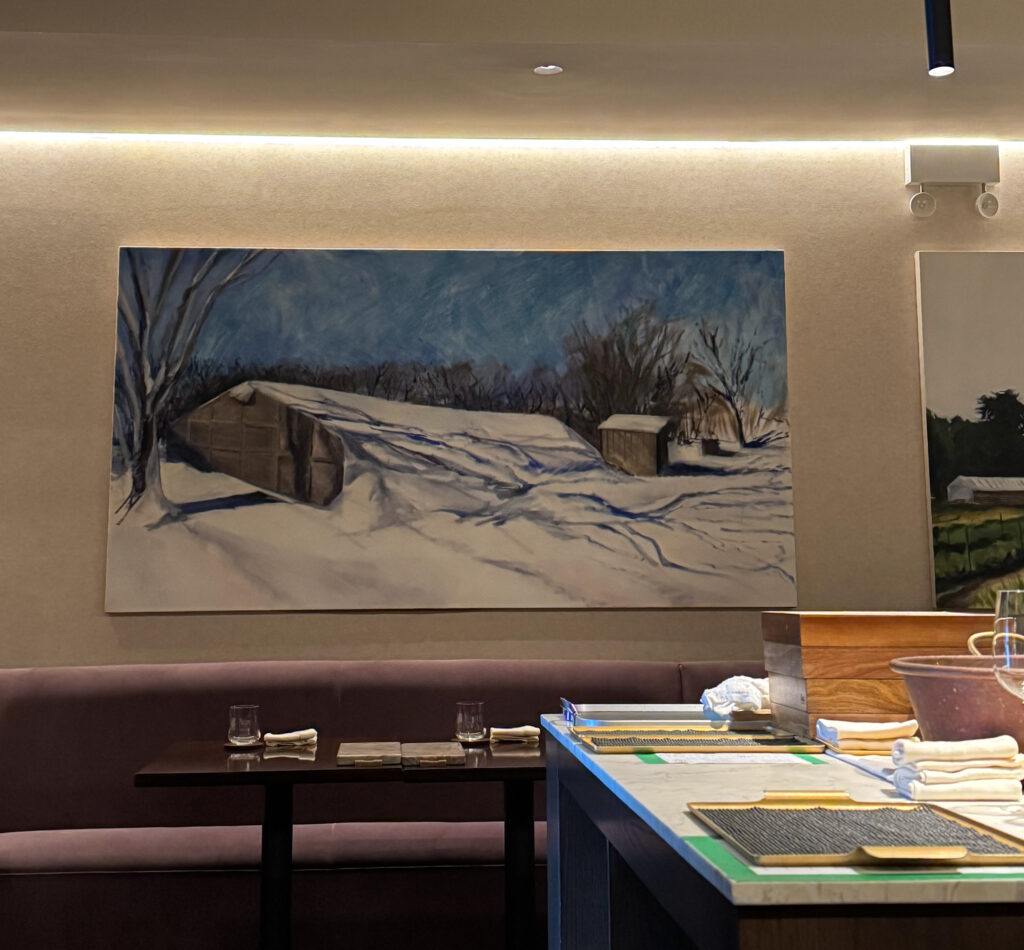
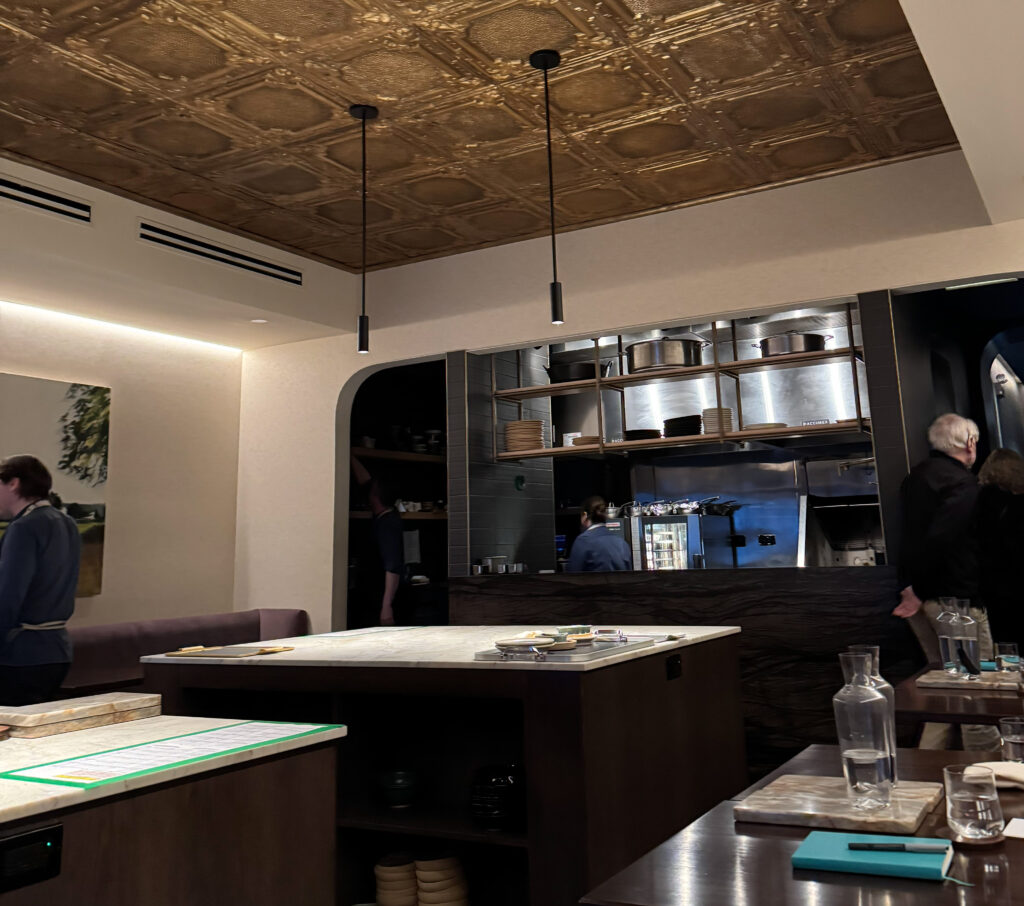
I’ve already talked plenty about what it’s like to enter Feld’s world: how it feels to approach the darkened façade, endure those few seconds of uncertainty, and then—suddenly—be swept into the warm embrace of a team whose overflowing earnestness will color the next two and a half hours of your night. So, I won’t bother with the whole song and dance.
Instead, the constituents of the audience do more to catch my eye tonight. I spy the usual yuppie couples of course, but it’s tables like the three middle-aged women to my left—who intelligently evaluate each course then get back to recounting recent world travel—and the family across the room (elderly parents with their adult daughter who engage in flowing conversation with the staff throughout the meal) that make the biggest impression.
There’s also an older man in the corner taking careful shots with his professional camera, as well as a party to my right celebrating their tenth visit (upon which Potashnick presents personalized chopsticks) and another, in the distance, marking their anniversary.
I don’t sense that many of these groups really interact with each other during the menu progression (which, on other occasions, certainly happens). However, when we are later led outside to enjoy our s’mores, conversation erupts effortlessly.
Indeed, the crowd—without the kind of communal table / “dinner party” contrivance that characterizes some concepts—is truly bound by a sense of shared experience. Feld’s novelty (even in a dining scene like Chicago, even for guests who get around to its top spots) is disarming, and a sort of joyous energy froths and bubbles once the whirlwind of the seasonal tasting yields to the simpler pleasures of brandy, chocolate, and marshmallow.
Even for a hardened gastronome like myself, it’s refreshing to get a taste of this pervasive spirit. The audience may not really be diverse by conventional measures, yet it reflects a strength of personality (leavened with a dash of quirkiness) fitting for a restaurant that, in its own right, has iconoclastically challenged gastronomic norms.
Otherwise, the only real decision I need to make this evening is what to drink.
I sampled the “Cellar Flight” ($325)—what Feld titles its reserve pairing (which, they admit, doesn’t necessarily match the food so much as it does show off exceptional bottles)—back in April, and I was left feeling that it forms an attractive turnkey solution.
If one were to spend the same sum (or maybe even $650 for a party of two) on the wine list, they could enjoy producers like Egly-Ouriet, Roulot, Dagueneau, Ganevat, Keller, Juge, or Stella di Campalto (without quite hitting names like Selosse, Raveneau, or Romanée-Conti that sit at the very top end of offerings).
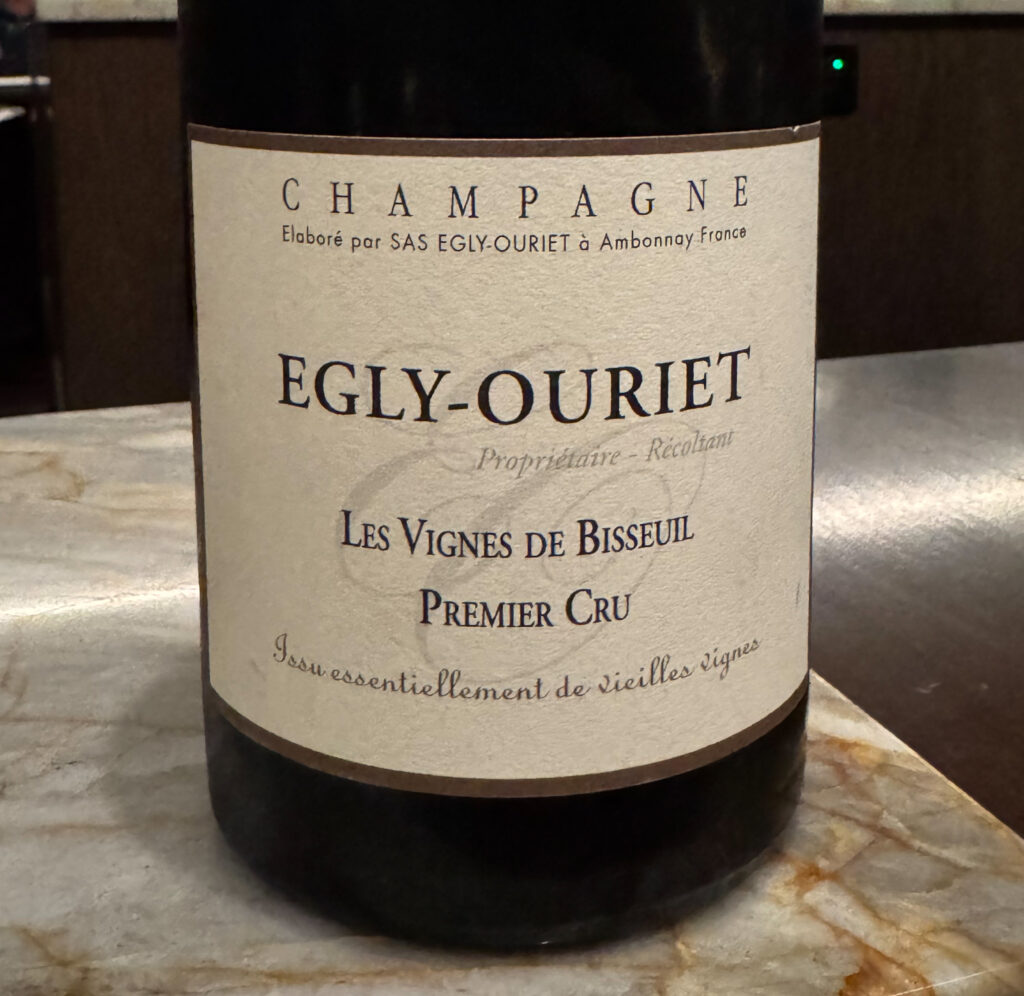
I think most oenophiles would jump at the chance to down a full 750mL from one of these estates rather than surrender to the vagaries of a set lineup—all the more because markups generally amount to less than 100% (sometimes as low as a mere 25%) on top of retail price. Factor in the $75 corkage (limit 1.5L total), and there seems to be no good reason to relinquish control.
Well, it is a bit of a shame not to hobnob with general manager/sommelier Nathan Ducker, whose passion for Feld, for the beverage program, and for these special bottles in particular is palpable. Consequently, his storytelling, tucked into the flow of a meal that is already so engaging, really adds an extra layer of enjoyment to the experience.
One can certainly secure some of this same attention at the low-ABV ($110) or standard ($130) levels of pairing, but it’s hard for me to resist sampling the peak expression of the sommelier’s work (while, no less, tracking how the premium selection changes over time).
Tonight’s “Cellar Flight” comprises:
- NV Egly-Ouriet Champagne Premier Cru “Les Vignes de Bisseuil” [$125 at local retail]
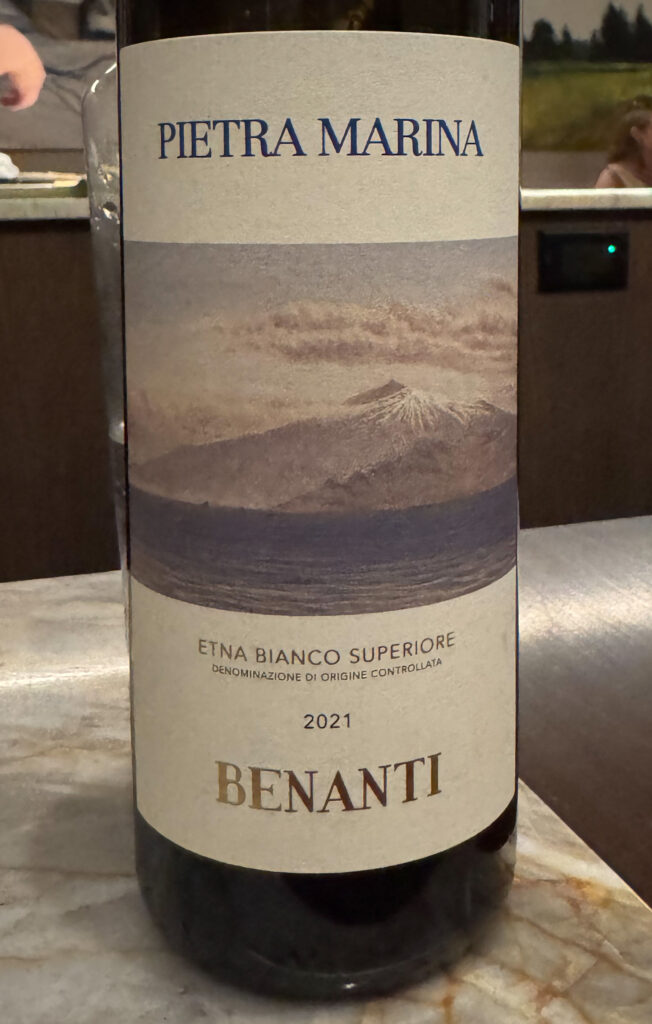
- 2021 Benanti Etna Bianco Superiore “Pietra Marina” [$189 at national retail]
- 2017 Thomas Pinot Noir Dundee Hills [$137 at national retail]
- 2024 Clos Cibonne “Cuvée Spéciale des Vignettes” [$65 at national retail]
- 2005 Massolino Barolo Riserva “Vigna Rionda” [$150 global average price]
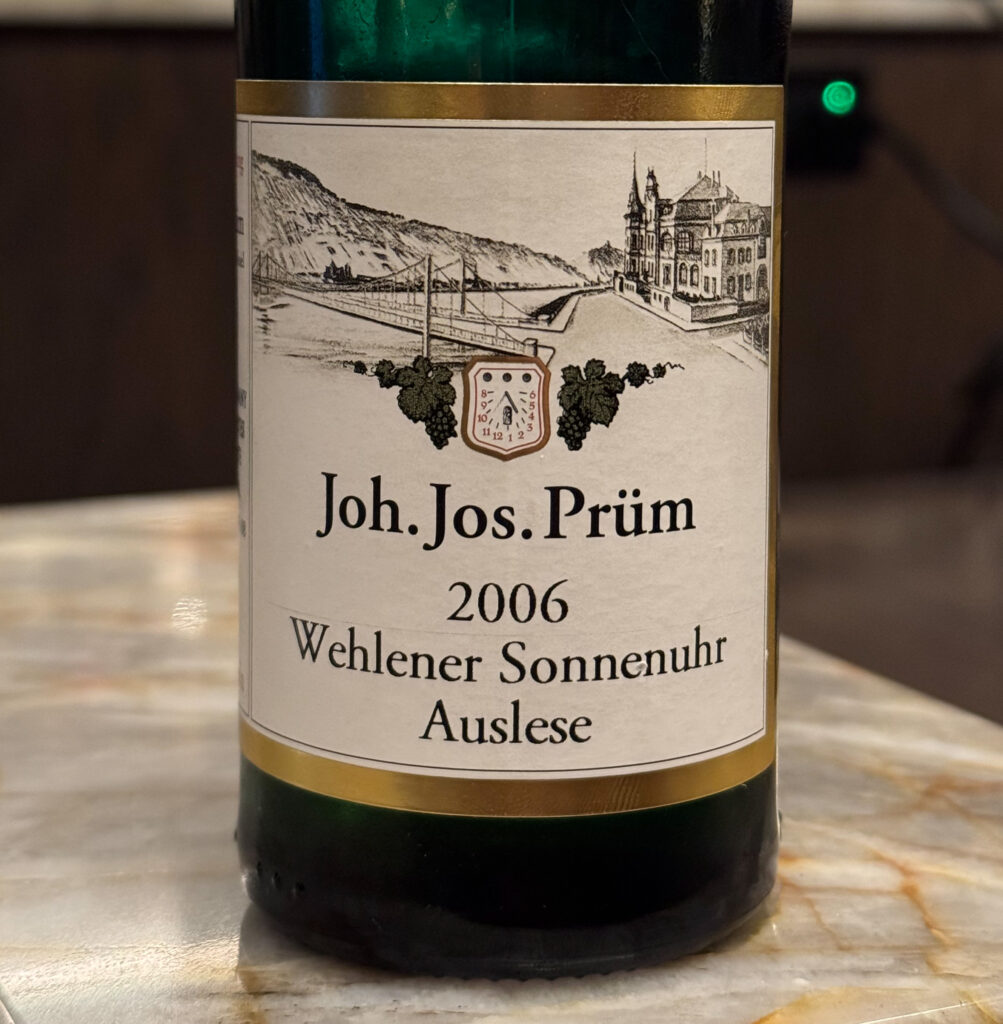
- 2006 J.J. Prüm Wehlener Sonnenuhr Riesling Auslese Goldkapsel [$130 at auction]
Compared to the lineup I encountered last month (where the average price per bottle was $134), the present assortment (with an average price per bottle of $133) offers almost the exact same degree of value. Further, while three of these offerings can be ordered from the list (where they cost $335 to $425), three can only be tasted as part of the pairing.
Though I quite enjoyed getting a taste of the allocated Bernard-Bonin “Initiales B.B.” in April, the shift toward offering Champagne, Provençal rosé, aged Barolo, and aged Riesling is a welcome one. The Willamette Pinot Noir—true to Ducker’s description—offers Burgundian finesse while the Etna Bianco (probably the most obscures of the selections) is wholly approachable and elegant in its own right.
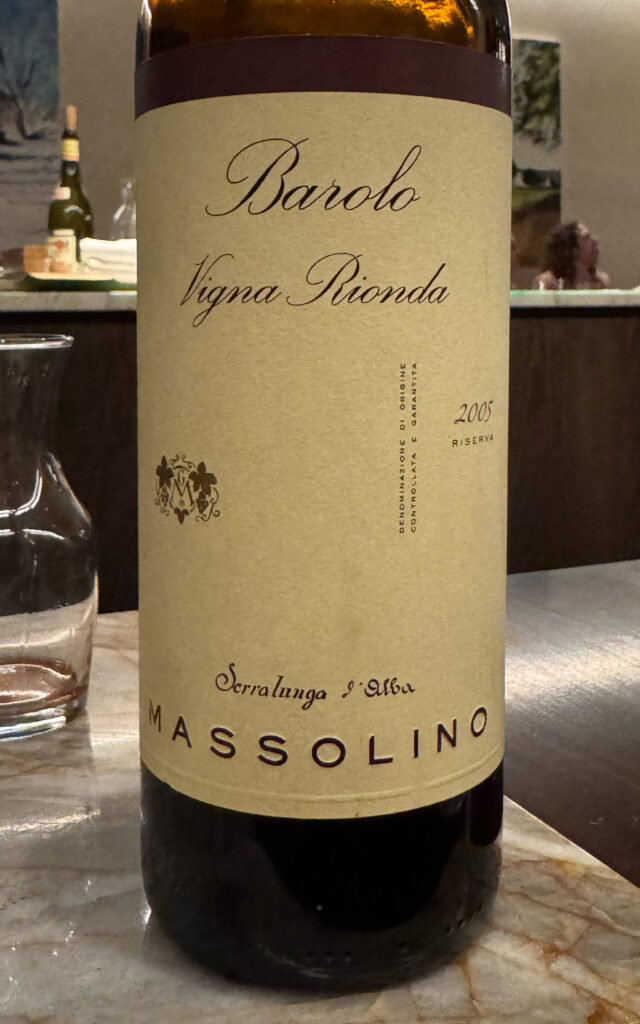
Ultimately, I savor the degree of variety and added insight—regarding producers the sommelier personally hunts for, as well as the harmony many of these wines (even if it’s not always the point) strike with the cuisine—the “Cellar Flight” provides.
It cannot compete, say, with the rare pours found on the premium pairings at Oriole or Smyth. But it feels every bit as personal and singular: an expression of nimble, dynamic curation that avoids too much cynical calculation or the corresponding tendency to stock up then stand still.
Opposite the two bottles I bring as corkage, a single “Cellar Flight” (split amongst two) feels appropriately priced and particularly enriching. This second time around, I think it forms the kind of add-on whose appeal might go beyond the splurging public and, incorporated as part of a larger plan, actually tickle the bonafide snobs too.
At last, the meal begins: occupying a point in the season that Potashnick says is characterized by green asparagus (which he picks up once a week from Michigan), white asparagus (which he always dreamed of sourcing locally), and strawberry (including the first of the green berries, which are only harvested once the crop hits its stride).
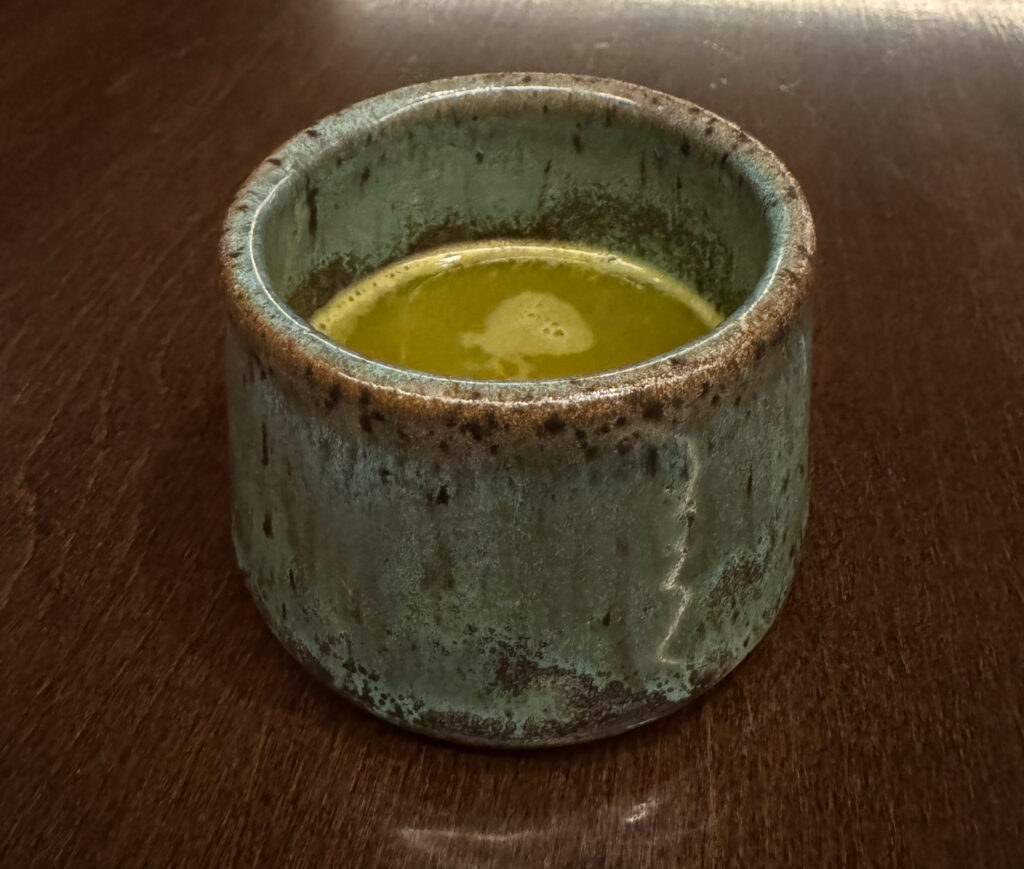
That said, the first item of the evening—a small cup of “Tangelo and Chamomile Tea”—features none of those emblematic ingredients. Instead, it arrives immediately after each party is seated, providing a cool, puckering, and just-sweet-enough sensation (drawn in part from a hint of peach pepper) that tingles the tongue and tantalizes guests for all that comes next.
It is the arrival of Feld’s emblematic opening progression (what the team call “The Drop”) that really kicks off the menu. The present iteration comprises 10 distinct bites—up from eight in April and nearly matching the 11 served in January—that can veer from utter simplicity to surprising complexity with a moment’s notice.
Structurally, this section of the menu allows the chef to present a wide array of elemental combinations (and pursue fleeting ideas) in a less committal manner than the courses that follow. Correspondingly, the quality of the offerings can range from intelligent—even transcendent—to largely inoffensive and forgettable. But overall effect is unlike anything found in Chicago fine dining, and the spread’s emotional and thematic resonance remains significant even after a dozen visits.
On this occasion, six of the 10 servings are served “crudité style” on top of ice. Though the team invites diners to approach the myriad items in whatever order they choose, I will start with this particular half dozen and then roughly move from raw to cooked.
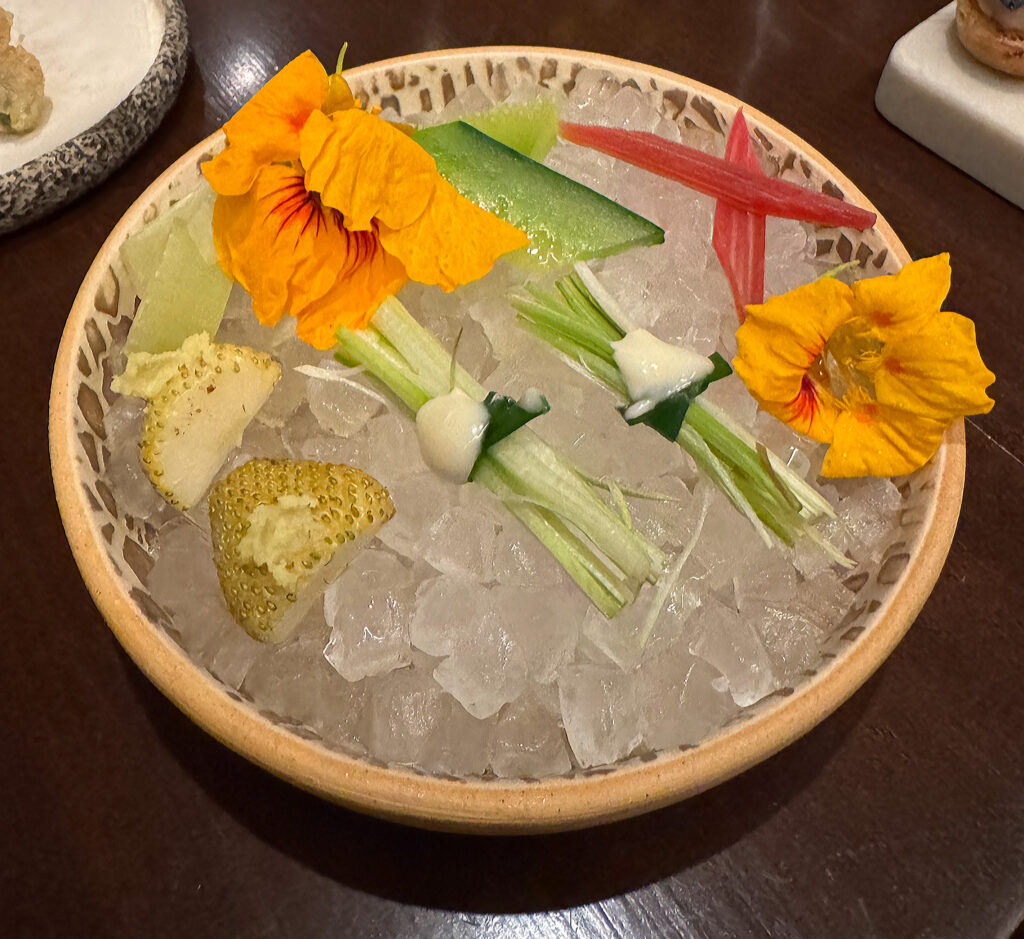
Of the “crudités,” I find:
A “Nasturtium Flower” that—brushed with honey—softens the petals’ sharper, somewhat bitter character with a rounded sweetness I actually find appealing. This bite also featured in April, so I must admit it’s not terribly unique or interesting. However, the flower’s visual appeal is hard to rival, and its flavor cannot be faulted either.
The “Elderflower Fennel” centers on a rather simple juxtaposition of the titular ingredients. A crisp curl of the latter vegetable is lightly dressed with a vinegar made from the former herb. On the palate, the fennel leads with a watery crunch, yet the accompanying tang and subtle notes of tropical fruit ensure the resulting sensation avoids feeling bland. Indeed, the finish—displaying such depth and intensity of anise—is so pronounced that I can only marvel at the combination.
A slice of “Picolino Cucumber” (a small, “snacking” variety of the fruit) follows along the same lines: offering a clean, crisp, watery crunch. I think it must be dressed with some oil or vinegar that I did not quite catch. Yet, while a plain piece of cucumber would typically represent the height of boredom, I must acknowledge that this particular example possesses enough supporting sweetness to be palatable—and maybe even enjoyable in a refreshing sort of way.
The “Umeshu Rhubarb” (infusing the titular stalk with Japanese plum liqueur) ranks among the best of the bunch, for it balances the vegetable’s signature crisp, sour character with a rich, effusive sweetness that steers the ingredient back toward decadence. As with the fennel, I think the combination here is elegantly and intelligently conceived.
The “Green Strawberry” serves to replace the pickled version of the fruit (topped with a Scotch Bonnet pepper emulsion) I encountered in April. This example matches the firmness and sharp, sour profile of the unripe crop with a dab of Oregon wasabi. I appreciate the thought, but the effect of the rhizome (which should marry sweetness, heat, and florality) is hard to pick out. Thus, the strawberry tastes more or less unadorned, and, though the fruit is palatable this form, its charm is limited.
An “Asparagus Bundle” (made from smaller stalks of the vegetable that have been pickled, tied together with chive, then dressed with a chive emulsion) closes out the “crudité” sequence. Texturally, the bite displays a remarkably clean, crisp consistency despite its layered nature. Nonetheless, the accompanying notes of allium—which I expect to be soothingly sweet—are actually rather subdued. Ultimately, this item stands alongside the cucumber as one of the bowl’s milder, almost cleansing expressions. Yet, to its credit, the bundle also forms a gentle introduction to an ingredient that will feature extensively throughout the night.
The remaining four pieces of “The Drop” are plated individually:
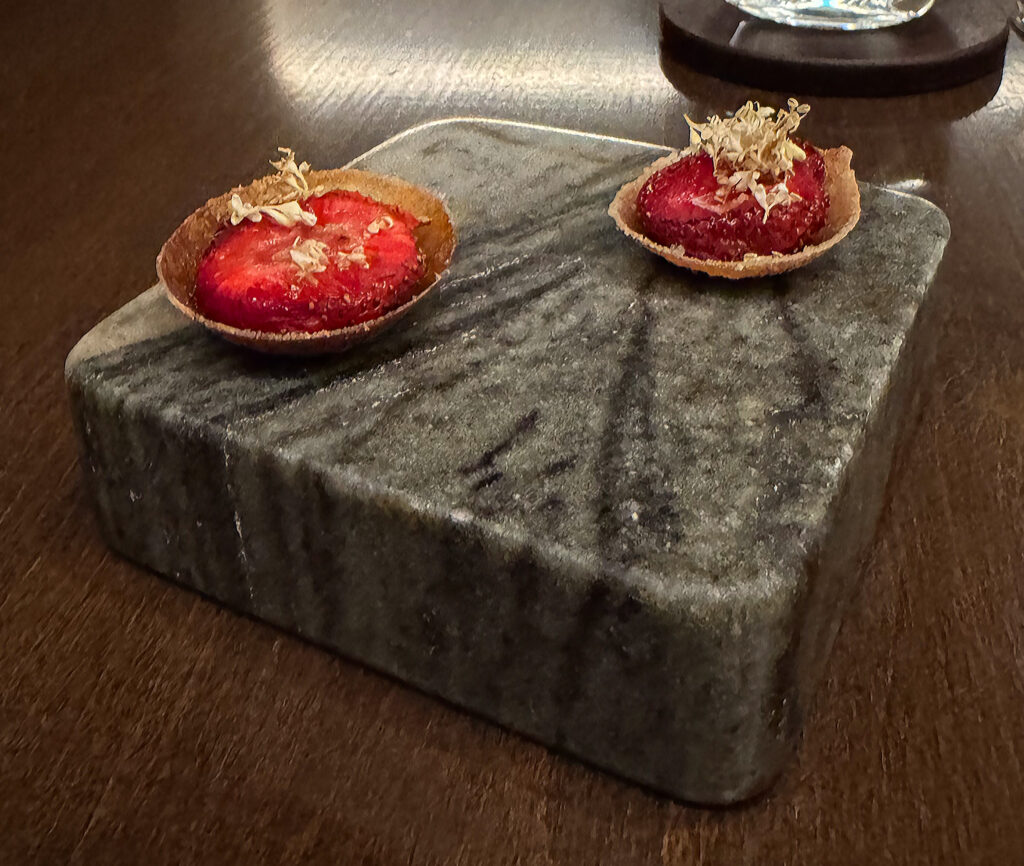
There’s the “Strawberry Tart,” made from a blend of fresh and dehydrated fruit tucked into a sweet potato shell and topped with elderflower. Compared to its green counterpart, this expression of the ingredient balances crispness with softness and tang with gushing sweetness. This makes for a faithful representation of strawberry that, perhaps, still doesn’t rise to the level of superlative. (Thankfully, the fruit has several other opportunities to shine on the menu.)
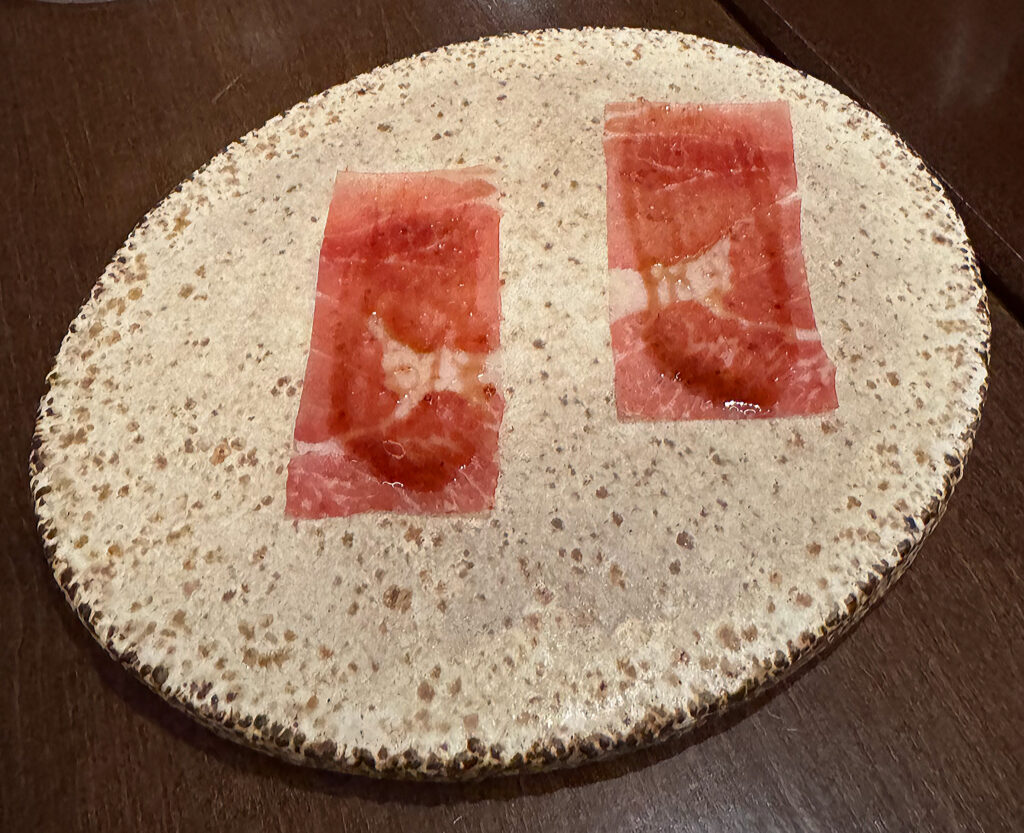
“Benton’s Ham” has formed one of Feld’s totemic offerings—the fruit of a cherished relationship—since opening. The ingredient (via its fat and incorporation into things like broths) has featured all over the place; however, I have sometimes felt that meat falls short when served in a more conventional, sliced format. Nonetheless, the rectangular segment of ham I find tonight could not be better: combining gossamer thinness and melty fat with the kind of sweet, smoky, deeply porky flavor that honors Benton’s reputation.
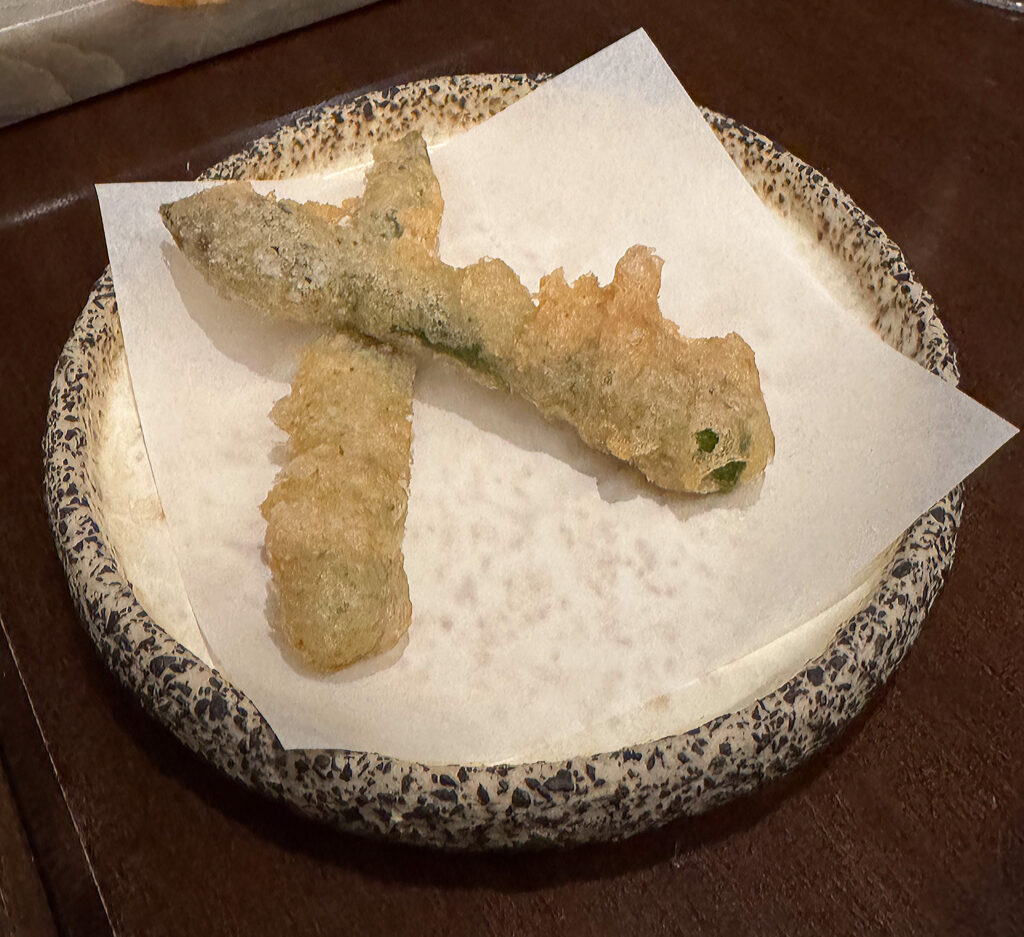
“Tempura Asparagus” stands as the latest in a long line of fried preparations that date back to my first meal here, and, faced with this example, I cannot deny that the kitchen has started to master this technique. The spear arrives with an attractive coating of batter that delivers a clean, flaky crispness to match the crunch of the vegetable within. A firm imprint of salt—along with a touch of blue corn masa—ensures the bite’s textural thrill is joined by more than enough nutty, savory depth. Overall, this makes for one of the highlights of the entire evening.
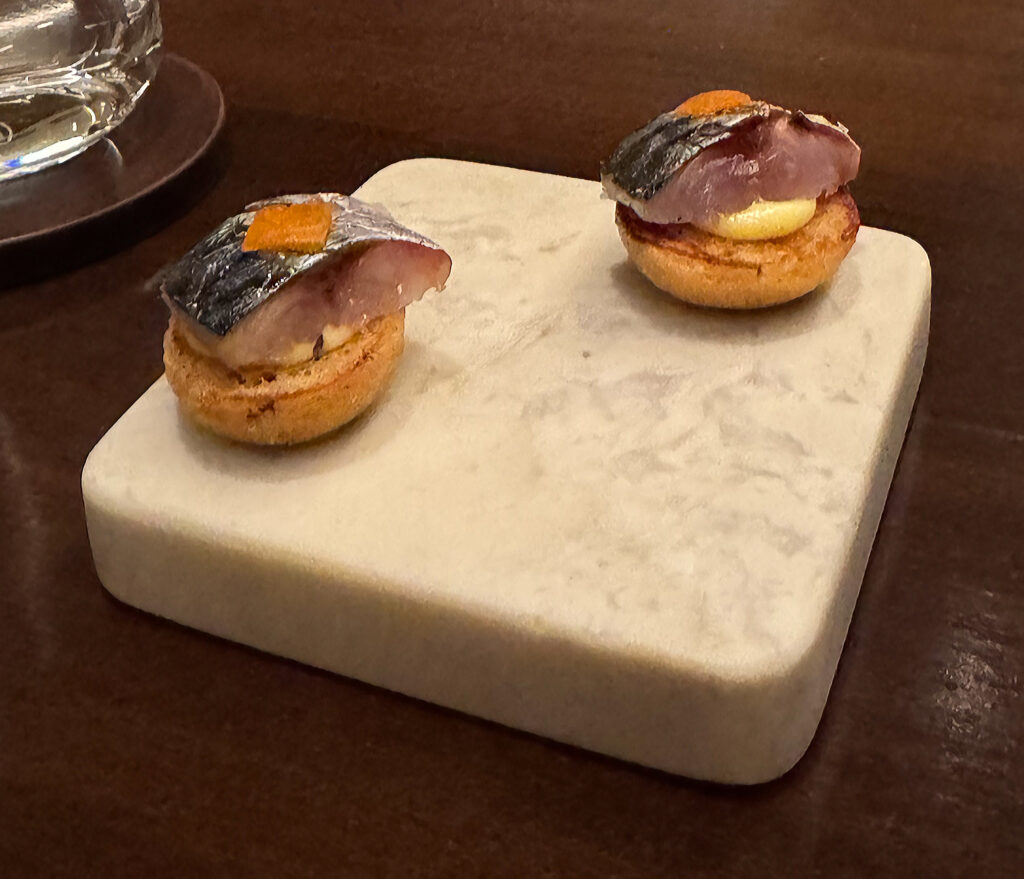
Finally, we have the “Mackerel Pancake,” which showcases the same fluffy, beef fat-fried base that held pieces of mussel back in April. On this occasion, the vessel has been reduced in size and notably refined. It elegantly cushions a beautifully plump, only mildly fishy cut of fish whose flavor grows in richness when it meets the meaty undertones of the pancake. I fail to note what the accompanying condiment is, yet this serving—in sum—lands among the stronger members of the progression.
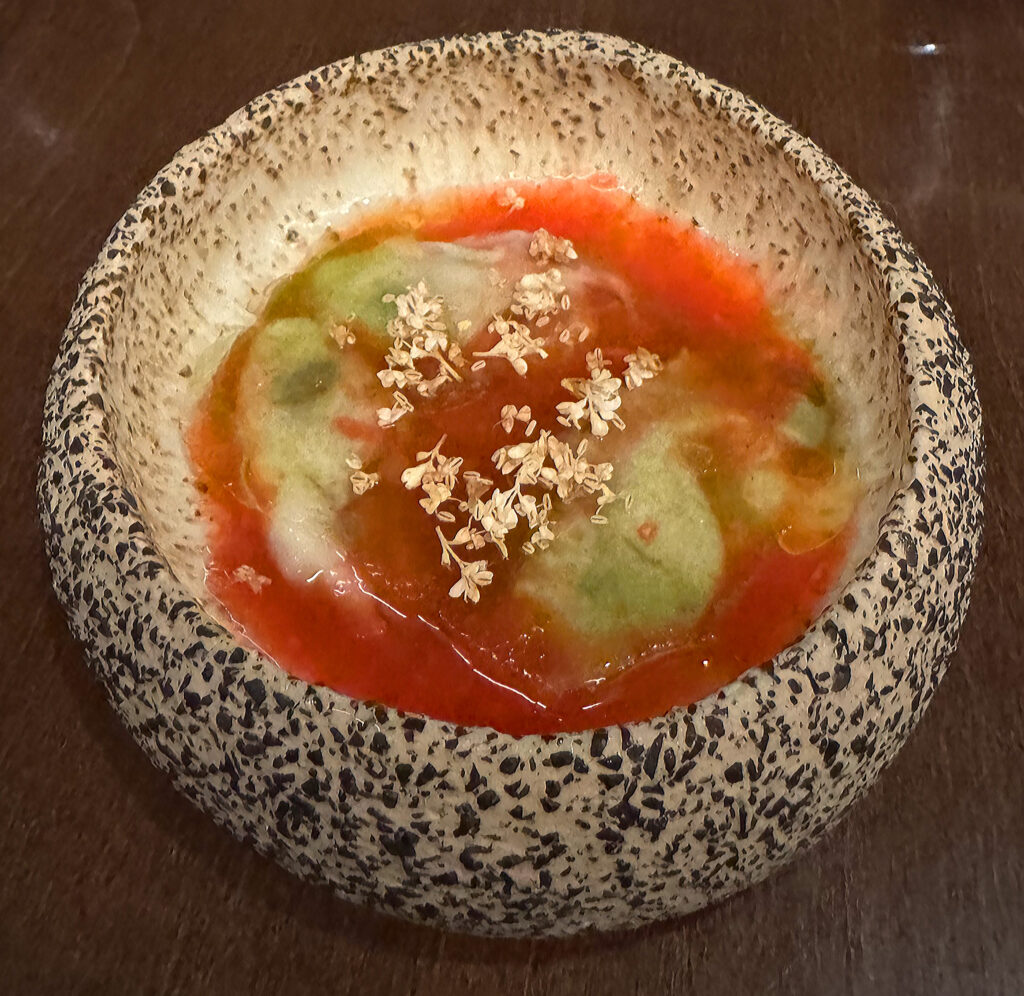
Now turning toward the menu’s proper, plated fare, I find a dish titled “Love Point Oyster—Elderflower” that immediately ranks among the finest recipes Feld has ever served. The composition, which centers on bright, moderately briny bivalves sourced from Maine swimming in a “mignonette of sorts,” sounds like nothing revolutionary. But the sauce (a combination of strawberry juice, last year’s elderflower vinegar, shallot, habanero oil, and fennel ice) proves sublime.
Being so thoroughly chilled, the raw oysters themselves hit the palate with a clean, bracing quality that belies their meaty weight. The tang of the fruit and vinegar then strike first, establishing a baseline of refreshment. However, the most exquisite heat (forceful to a degree I do not associate with the restaurant without going overboard) quickly takes hold, wiping any residual memory of “The Drop” with its utter intensity. As the fruitier side of the habanero comes to the fore, deeper notes of allium and anise are revealed. Nonetheless, it’s the sweetness of the fresh elderflower that brings course home, ensuring one’s final impression feels invigorating—even cleansing—in the way it traverses such a wide range of mouthwatering sensations. Simply put, I loved every bite and am eager to see the team put forward more work in this style.
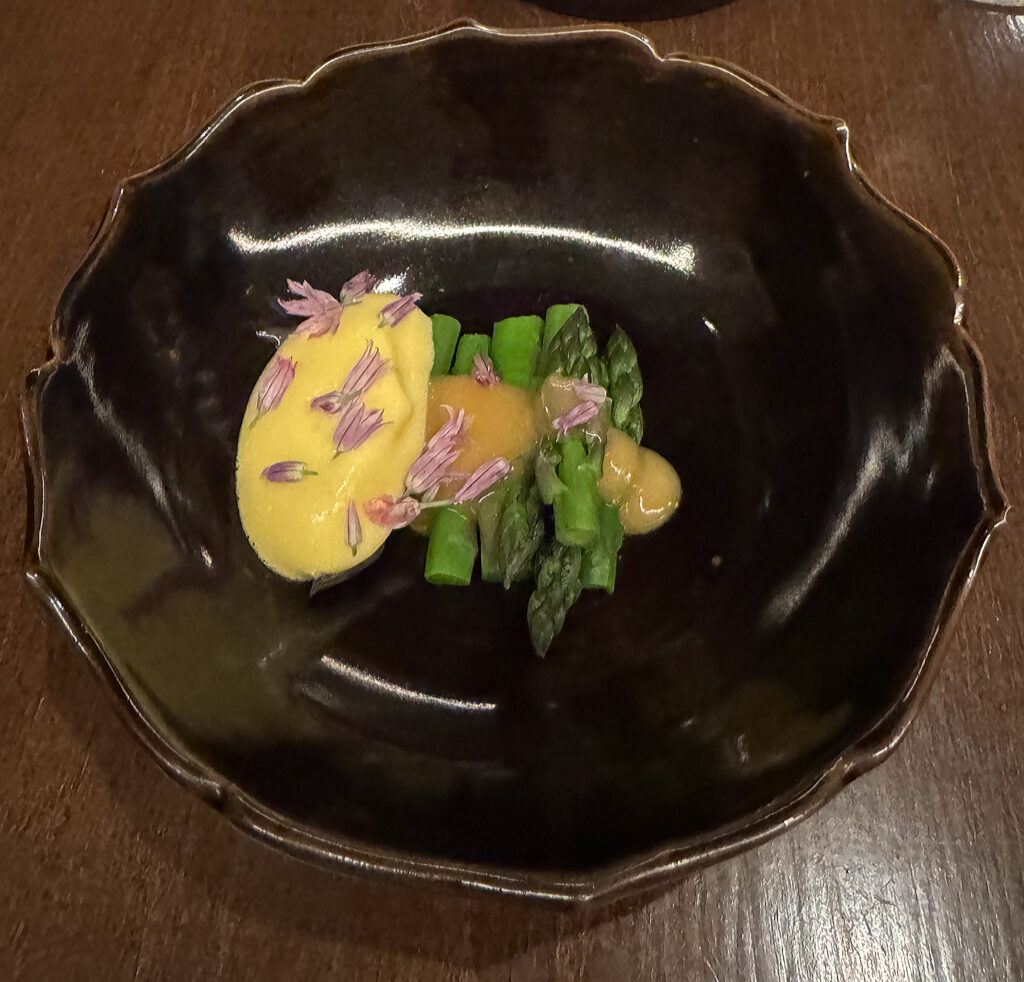
The “Chilled Asparagus—Tama Miso,” served not long after the fairly innocuous bundle, offers me another chance to appreciate one of the meal’s most persistent ingredients. Here, the smaller spears have been blanched and chilled then paired with an egg-based miso, a ginger kimizu (likened to a sabayon), and some chive blossoms.
Guests are instructed to drag each forkful of asparagus through the dual sauces, yielding bites that lead with an engaging crispness, tang, and mild sweetness before settling on a long, creamy sensation with notes of zest and grassiness that carry through the finish. For my taste (and given the expectations that the miso carries), I could use a little more umami. Nevertheless, the recipe offers a bold, satisfying representation of the starring ingredient that delivers everything I found lacking from the previous example.
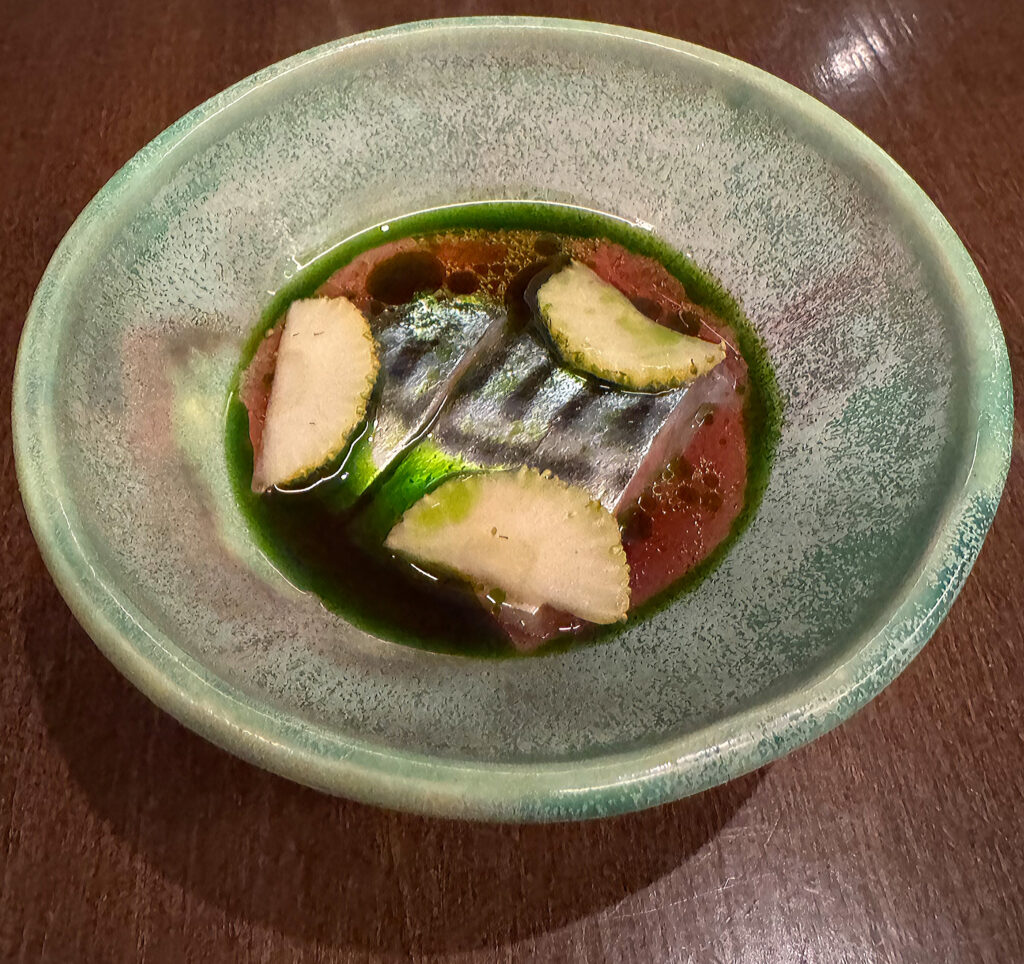
Arriving next, the “Mackerel Sashimi—Dulse” stands right alongside the earlier oyster as a perfect representation of what Potashnick is capable of when working with seafood. The starring fish (last seen atop the pancake) is sourced from San Diego and cured in salt before being dressed in an apple, rhubarb, and rose vinaigrette then joined by dulse (a kind of seaweed), dill (both emulsion and oil), and more of those first green strawberries of the year.
Given how reliably I search for umami in these dishes, some of those latter elements do not sound horribly appealing. Still, the mackerel itself displays a wonderful meatiness (framed by a clean, homogenous mouthfeel) with a robust savory quality echoed by the dulse. This makes the fish a perfect canvas for the palette of sour, sweet, and grassy tones that accompany it: notes of considerable strength in their own right that, opposite the sashimi, soften and broaden to achieve shocking cohesion. Yes, it’s so easy to imagine where this recipe could’ve gone wrong, but I am left admiring how it uses the mackerel’s concentration as an unexpected foundation for fresh produce.
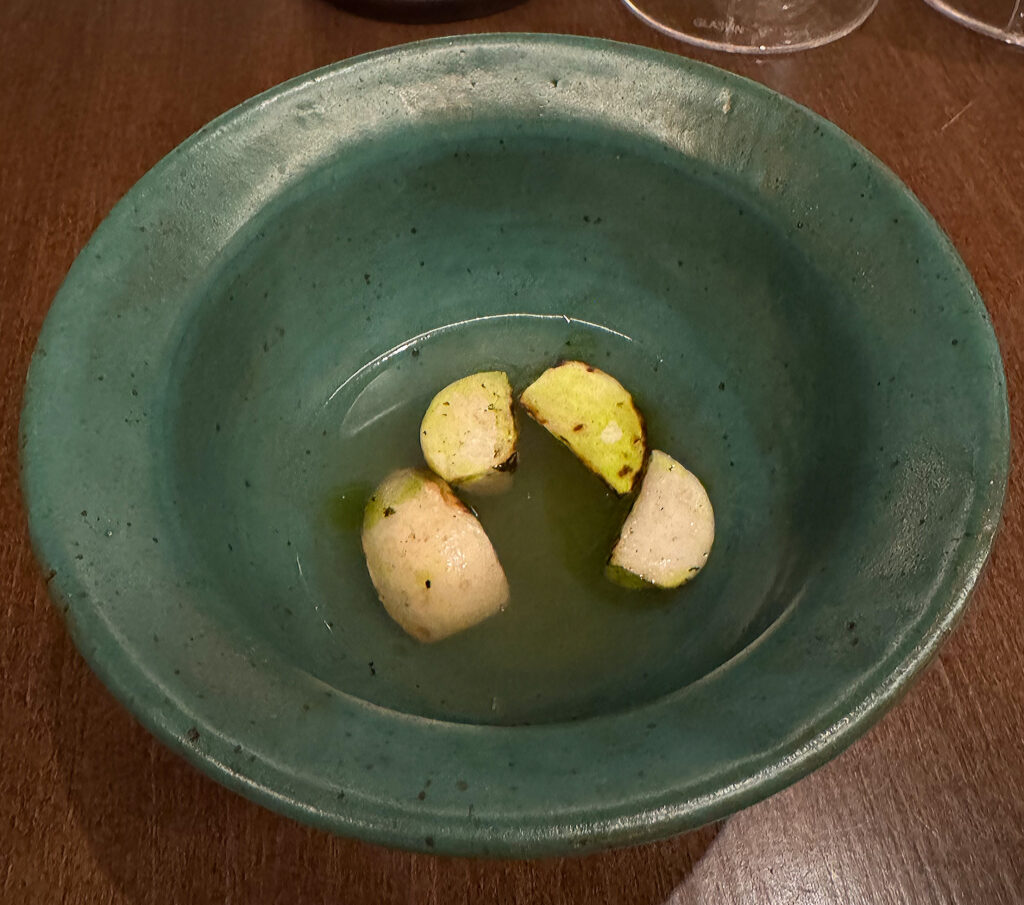
A dish titled “Hakurei Turnip—Benton’s Ham” might be the simplest of all constructions offered tonight (save for some—not all—of the items featured as part of “The Drop”). And there’s just something about serving a sparse, almost carelessly arranged bowl like this that cuts right to the heart of Feld’s identity. It begs the question, “how can this ever be considered fine dining?”
Yet the root vegetables have been carefully grilled over the coals so that they remain “a little al dente” at their center, and the meager broth they come dressed with is actually a dashi made from both the ham and the bacon of Potashnick’s beloved Benton’s. A little ramp oil adds intrigue, with alternating bites yielding crispness and char (from the turnips) then soothing, salty porkiness (from the accompanying liquid). The final sensation sees the starring ingredient’s subtle bitterness traded for a lasting sweetness in what is ultimately a precise and pleasing preparation.
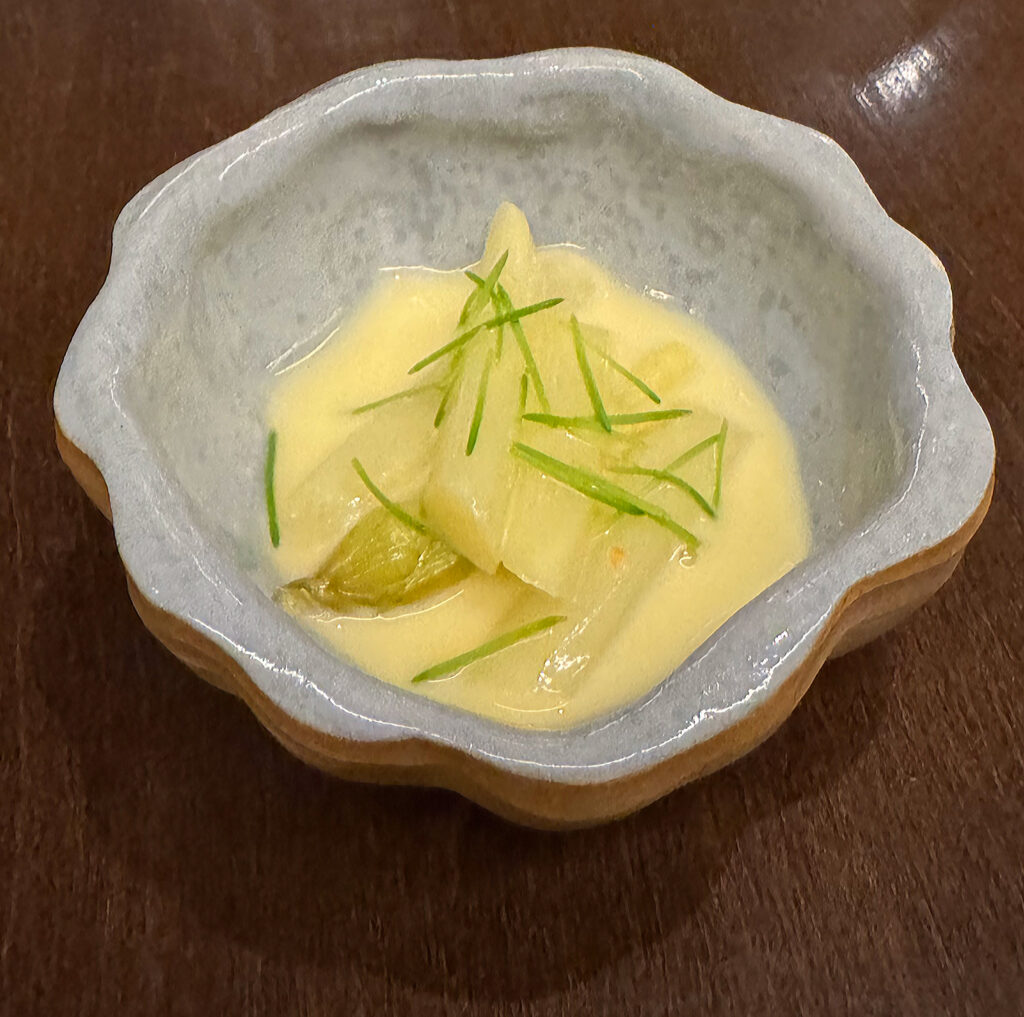
The “White Asparagus—Citrus” has the noteworthy distinction both mine and the chef’s prayers. The latter has long viewed sourcing this vegetable (coming from Flatwater Farms in Buchanan, Michigan) as his “white whale.” The former has long felt that Feld—and pretty much any tasting menu—would benefit from a bread course. These two compulsions converge in a recipe that centers on the asparagus (steamed with tangelo zest then dressed in beurre monté and a vin jaune-tangelo sauce) but comes accompanied by a generous slice of goat butter brioche (baked right before guest arrival).
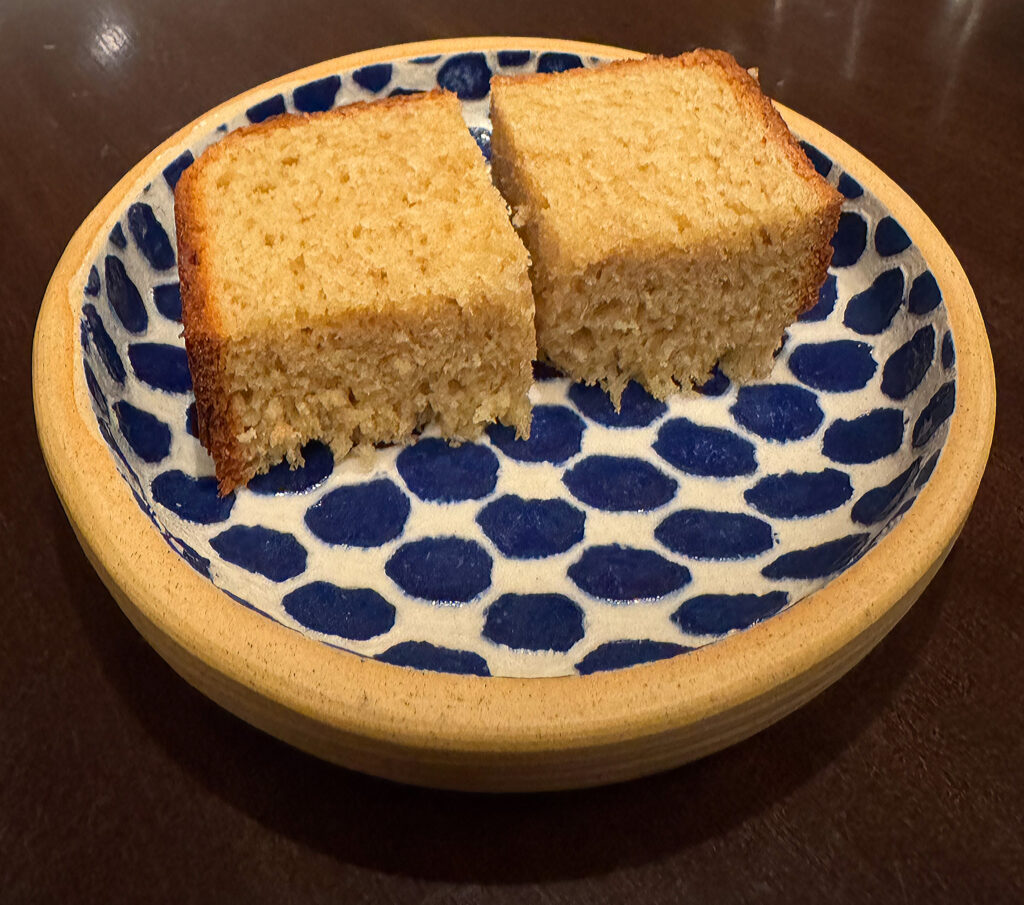
Texturally, the spears of this coveted vegetable display a refined crispness that feels especially luxurious with the thorough coating of butter. When it comes to flavor, the tang of the tangelo certainly takes the lead: obscuring the decadent sweet and nutty tones I expect to be showcased. Nonetheless, the brioche itself is beautifully rich and fluffy (with a faint crumbliness to the crust), revealing notes of tang and sweetness that harmonize perfectly with the remaining sauce. Overall, though I’d still like to see more savory power here, the dish is undoubtedly a success. It also makes me quite excited to see how the kitchen might work with this and other breads in the future.
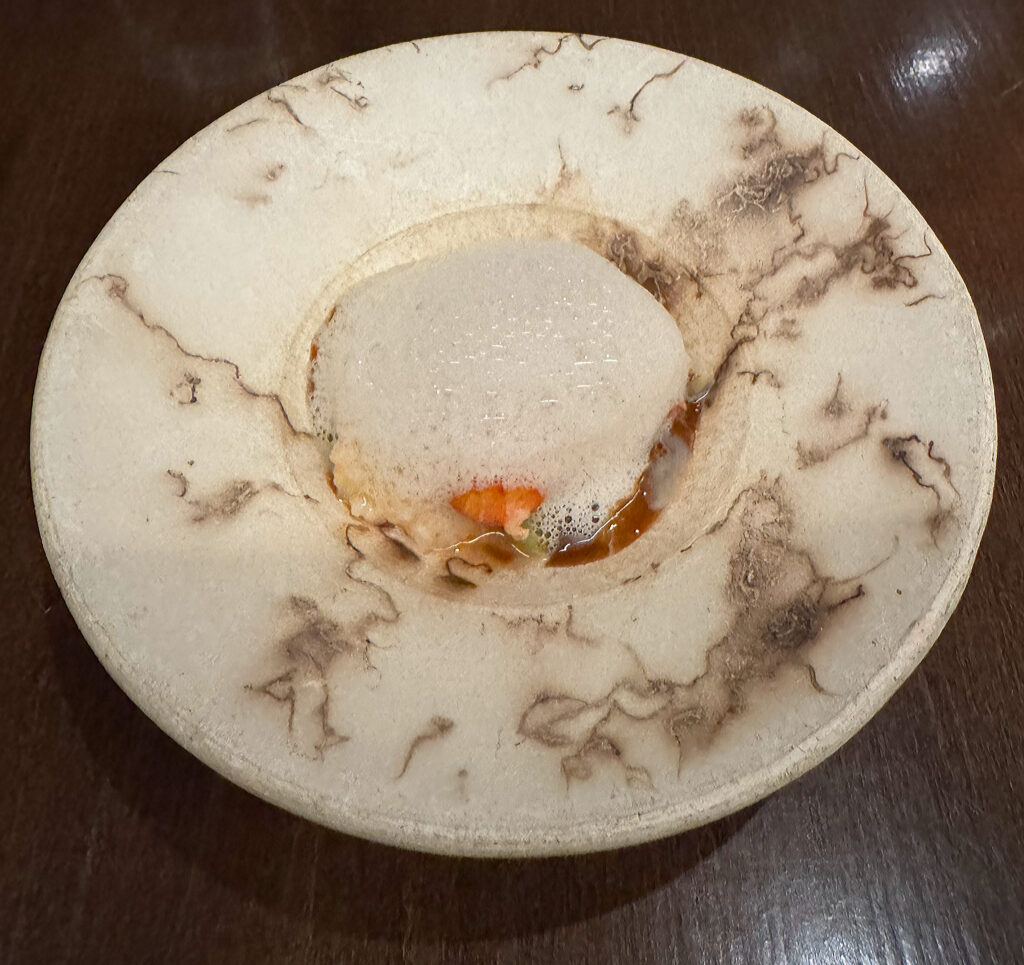
A course titled “Cahokia Rice—Crawfish” expands on the restaurant’s work with this high-protein cultivar being grown in Southern Illinois. For this dish, the grains are constantly stirred to form a porridge, which is flavored with crawfish butter and a mole made from last season’s dehydrated tomatoes and peppers. Wisconsin blue corn masa serves to further thicken the consistency while grilled spring onion, a lobster foam, and the crawfish themselves (sourced from Oregon) complete the presentation. The idea is really to create some kind of a gumbo, and the results are staggering.
On the palate, the interplay of the plump shellfish and creamy grains (offset by the occasional crisp allium) is immediately soothing. Flavor, too, combines a mild—yet lasting—heat with dual notes of sweetness (i.e., the fruiter tomato and the deeper, crustaceous expression) and a robust degree of umami. Yet the earthy and nutty qualities of the masa are what prove so sublime, rounding out the recipe in a manner that drives its decadence (epitomizing both balance and depth) to an absolute peak. In short, this is one of the best things Feld has ever served.
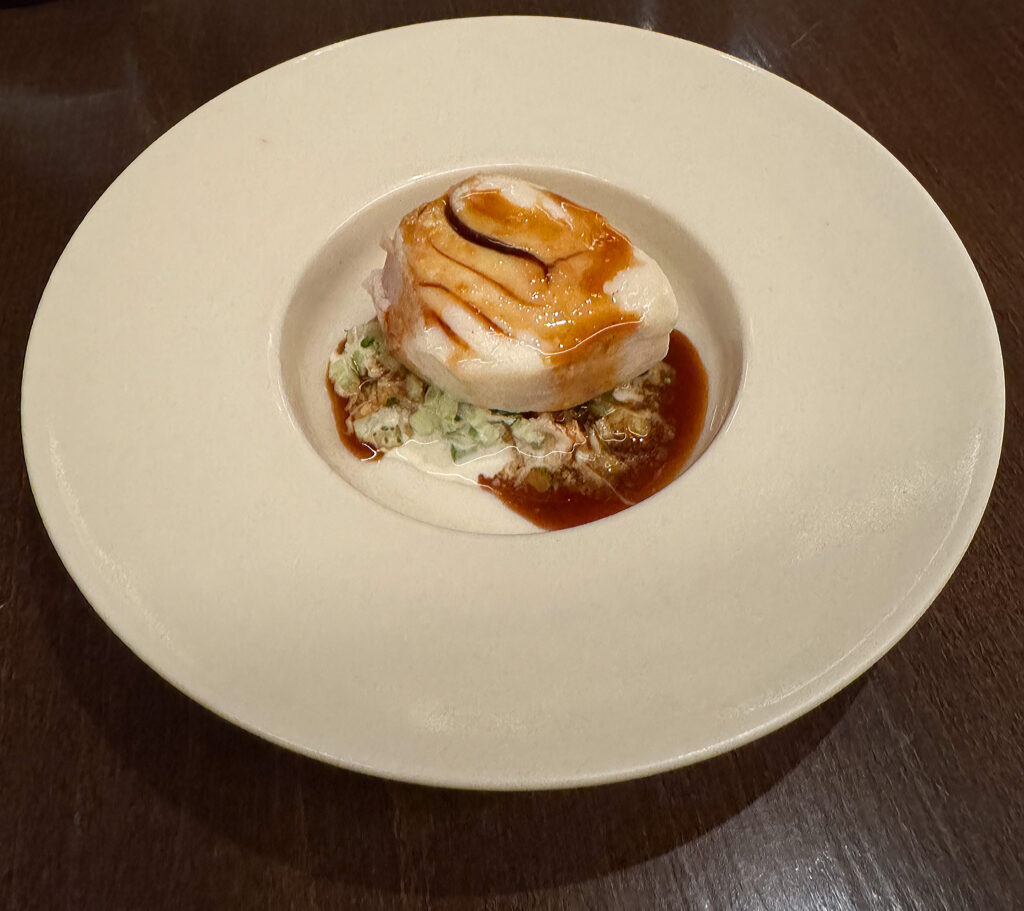
The “Sue’s Halibut—Strawberry” ushers in a series of three compositions that, closing out the savory portion of the meal, highlight comparably generous pieces of protein (and, in turn, test the rudiments of the team’s cooking technique). Here, the fish in question (one of only two caught per day during a one-month season) is smoked over the hearth and placed atop a mound made from bits of peekytoe crab, cucumber, celery, and pickled green strawberry all soaked in pil-pil and an onion jus.
Visually, the resulting fillet promises a sense of weight and succulence that is very much welcome after so many wet and creamy dishes. Admittedly, the halibut is just a touch overcooked. However, I find the flesh still forms a firm, meaty counterpoint to the finer threads of shellfish and crunching pieces of produce that lie below. Yes, texturally, the recipe is rather engaging, and I find that the crab and onion elements combine (along with a hint of tang from the fruit) to form an attractive sweetness that enhances the fish’s own mild flavor. Ultimately, I think this is just good enough to be considered successful.
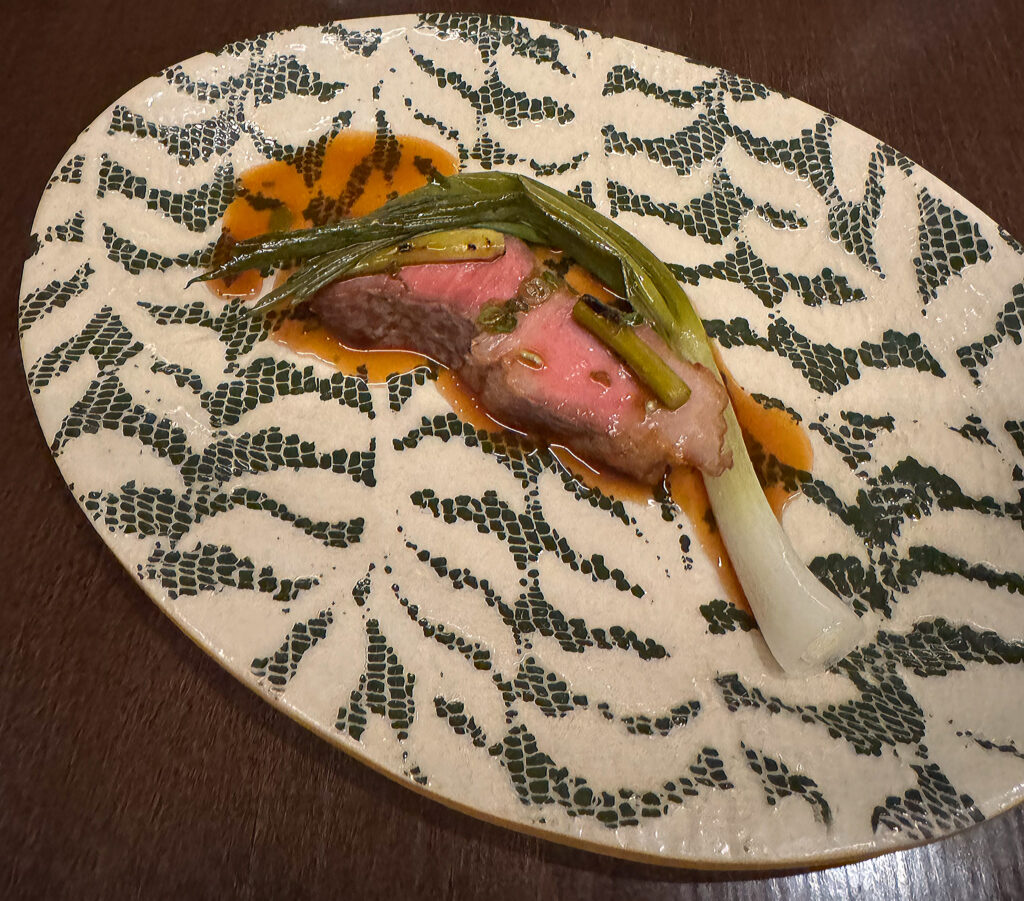
The “Pork Coppa—Garlic Scapes,” in contrast, leaves no room for debate. This cut of meat—taken from the shoulder of a pig sourced from Danville’s Krazy Kluckers Farms, grilled over coals, then sliced—beats any other chop or steak Feld has ever served. Texturally, the coppa blends a slight, satisfying chew with ample, oozing fat and a huge concentration of latent umami.
The manner of preparation could not be better, and the accompaniments—grilled and pickled garlic scapes, Indiana-grown Vidalia onions (confited in kombu), and garlic jus—are a testament to the chef’s restraint. Demonstrating a hint of contrasting crunch and some harmonizing sweetness, these alliums seek nothing more than to drive the pork’s savory intensity to an even higher extreme. Indeed, while so many of Feld’s recipes prize creativity above all else, this one aims straightforwardly at pleasure and hits the bullseye. The coppa stands as a striking testament to the team’s stylistic range and, moreover, their deeper understanding of guest satisfaction.
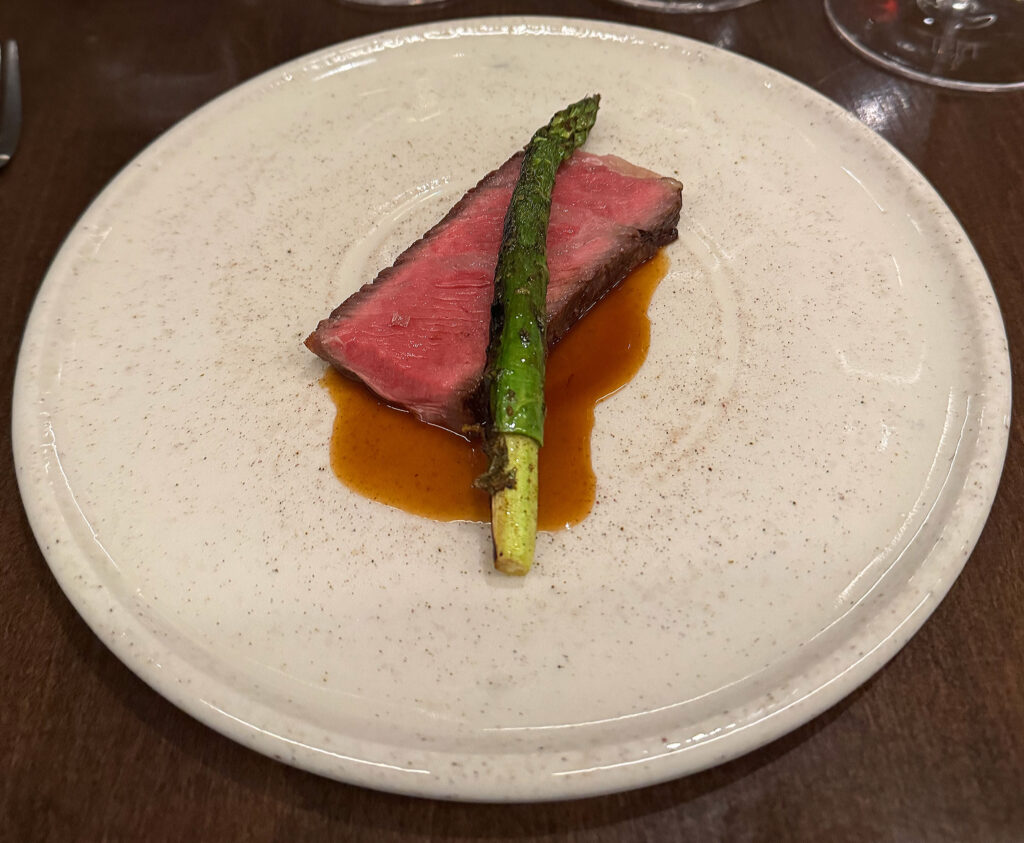
A serving of “53 Day Kilgus Ribeye” represents the latest offering in a long line of dry-aged steaks served here. Tonight, thanks to the pork, it faces stiff competition. Cooked entirely over the coals and paired with the largest of the asparagus sourced this week, the beef brilliantly combines a fleeting sense of chew with a pervasive sense of juiciness and plenty of umami (amplified by some flaky salt and an accompanying jus infused with black garlic and oregano).
On the back of its execution (including the hearty, tender spear of asparagus), the recipe is clearly a success. Echoing my praise of the coppa, I should also note that this ribeye gives carnivorous, red-wine-swilling guests exactly what they want to cap off the menu. Nonetheless, by Feld’s standard (and that of the preceding dish), it feels just a little too simple. Contextually, that could be a virtue for other patrons, and I guess I again admire a tendency not to always overcomplicate things.
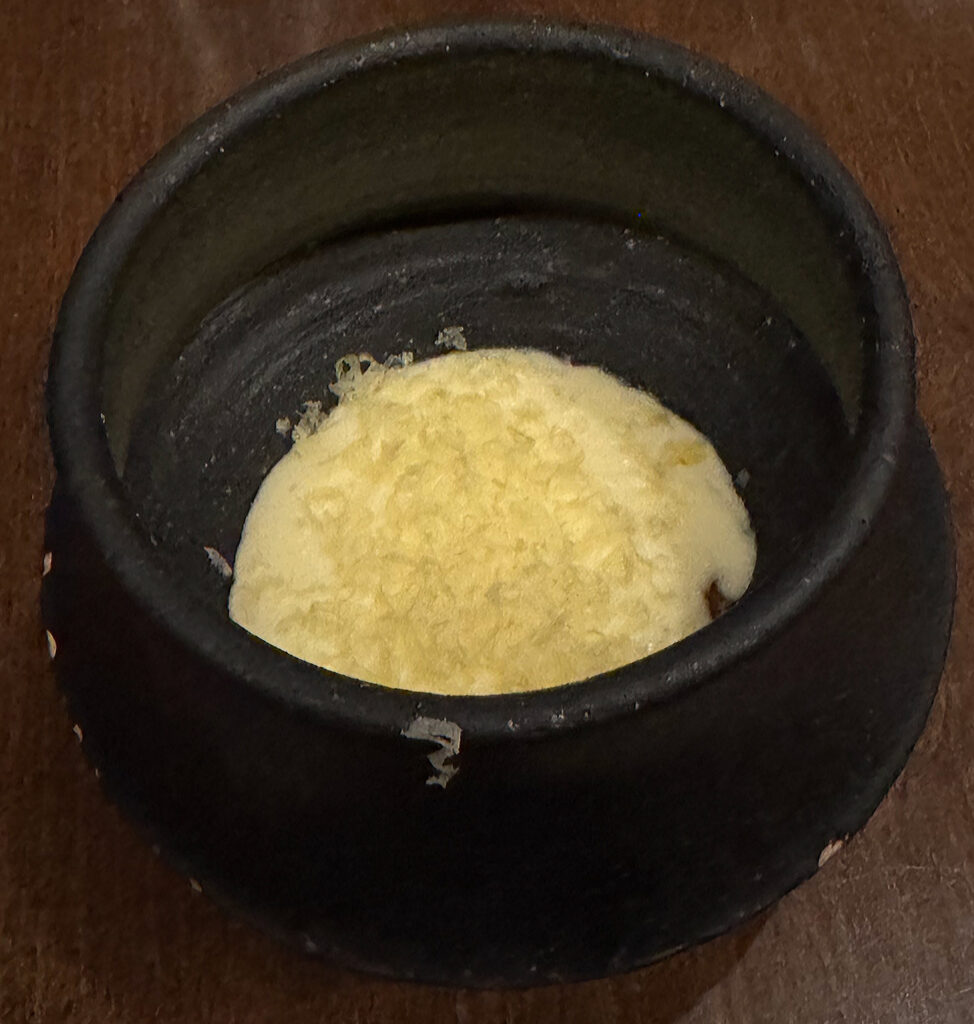
Over the course of my visits to Feld, desserts have increasingly come to rival the very best of the savory fare, and the “Masa Cake—Pleasant Ridge Reserve” is a good example of why. Technically, you could term this more of a cheese plate (utilizing a variety that Potashnick has prized since opening the restaurant).
Yet the combination of steamed masa cake, pecan praline, sweet potato reduction, and Pleasant Ridge (rendered both as shreds and as a mousse) is barely sweet in the best way. Framed by a fluffy, tamale-like base and plenty of rich creaminess, the cheese exhibits an earthy, nutty, and caramelized depth that is immensely satisfying. In fact, I think this may be the best use of the product in the concept’s history: one, in turn, that sets the stage for an even sweeter indulgence to come.
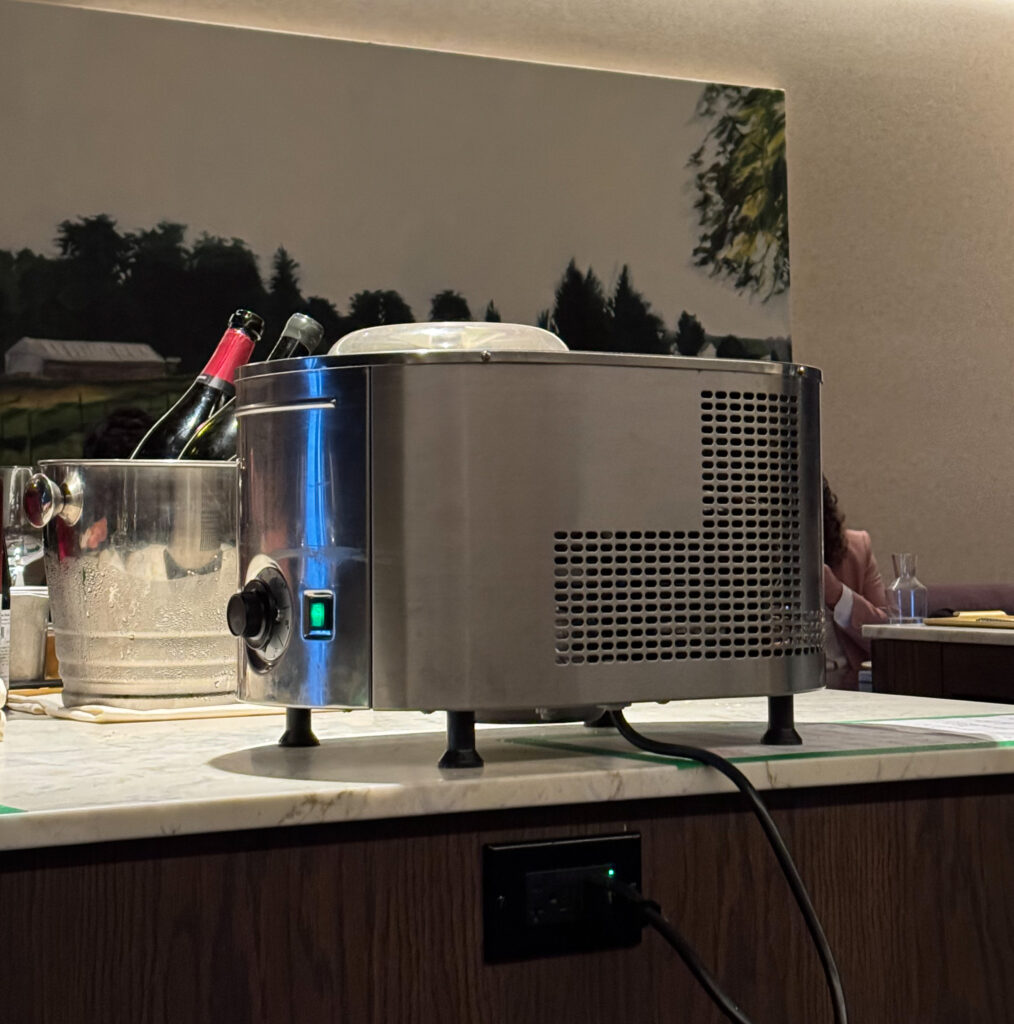
Shortly after the ribeye course is cleared, a metal contraption is staged on the counter in front of me, inviting all sorts of speculation as to what it might produce. Potashnick, not long after, shares that he’s long wanted to produce fresh-churned ice cream for dessert and, this week with this machine, he is able to do so for the first time.
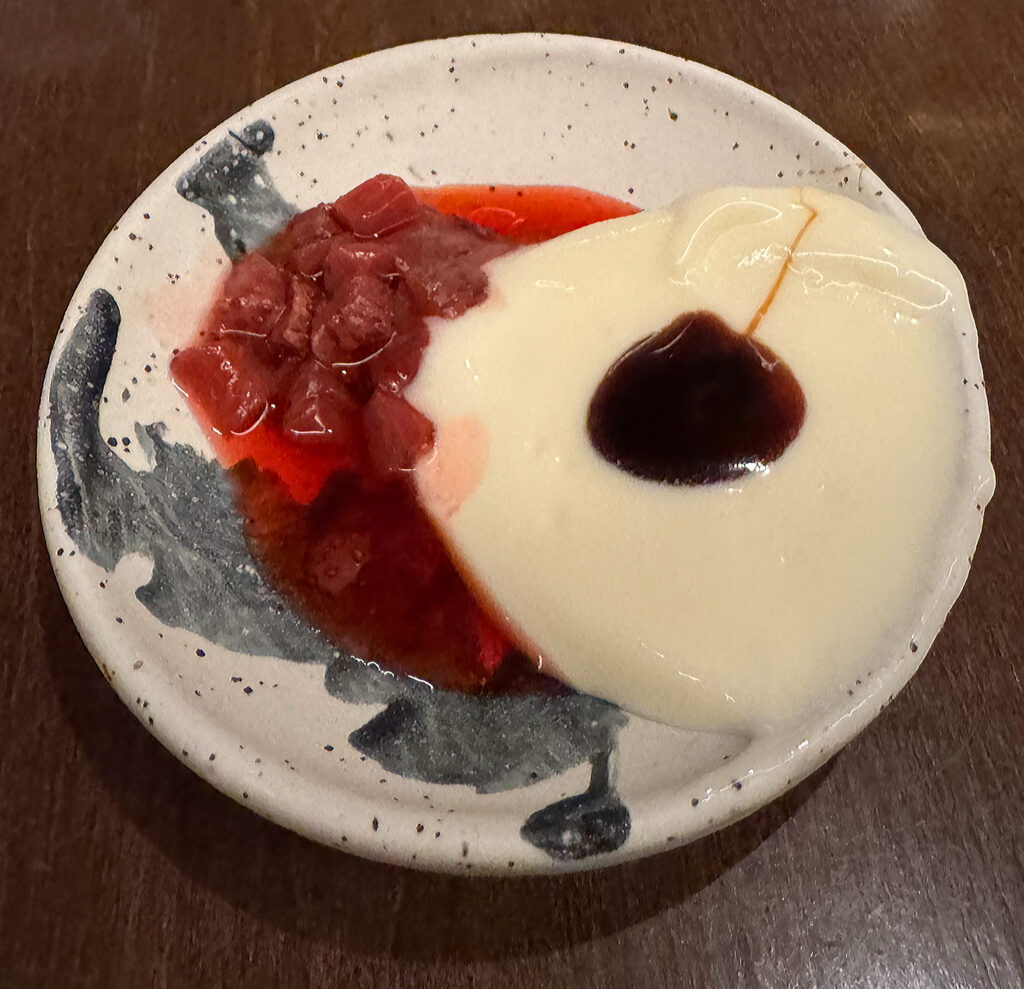
“Milk—Strawberry,” as the resulting dish is titled, combines a fior di latte-style ice cream (i.e., one without any added flavoring) made from Jersey milk with strawberries (cooked down without sugar) and a drizzle of rhubarb vinegar the chef has aged for three years (to this very day!) in a Bourbon barrel.
Texturally, the fresh-churned product displays a remarkable creaminess that surpasses even the best Pacojet creations I’ve encountered in Chicago. The accompanying clean, pure expression of milk does not want for sweetness either. However, the juxtaposition of the strawberries (with their faint structure and bright fruit tones) and the rhubarb vinegar (cohesively sweet-sour with some of the caramelized vanilla notes missing from the fior di latte) opposite the ice cream is superlative: revealing a profound depth of flavor in each of the recipe’s three core elements. While respecting seasonal produce of the moment and years past, Feld puts forth a nostalgic treat taken to its apotheosis.
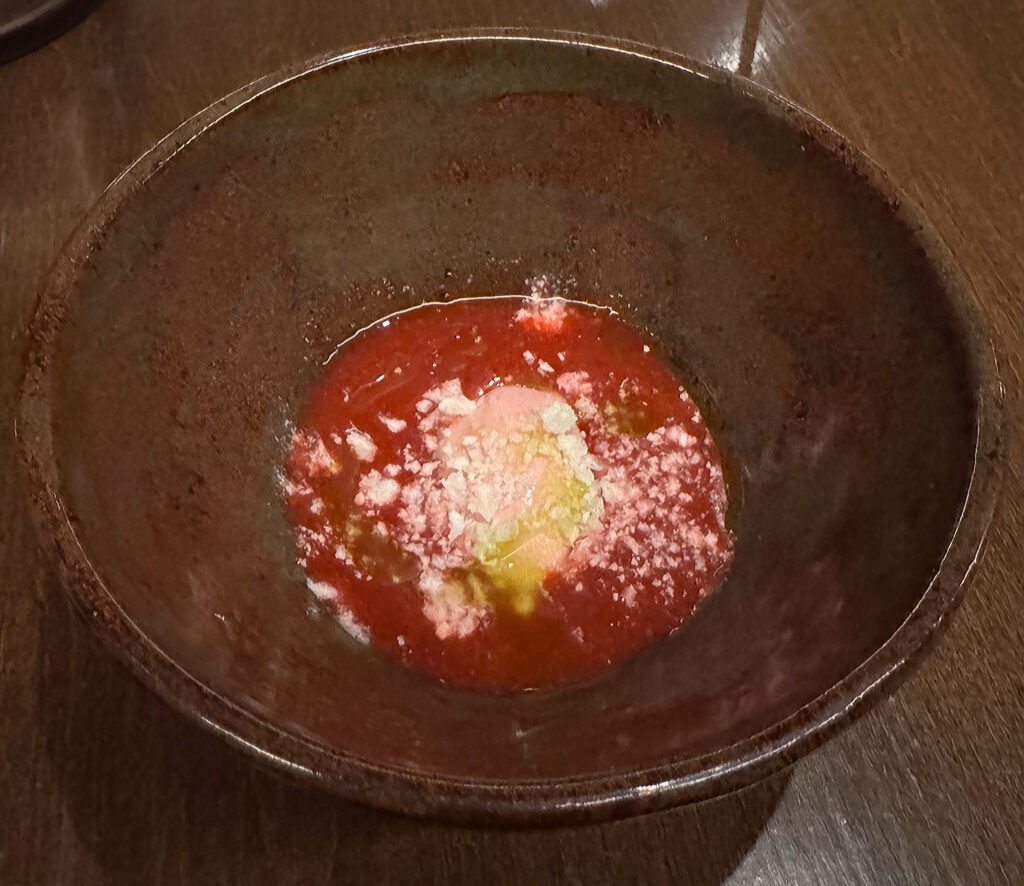
The “Strawberry Gazpacho—Chamomile” cannot possibly hope to compete with the preceding dessert, and I think it’s best to think of this item as forming more of a transition toward the final bites than a true anchor. It combines a rhubarb-buttermilk sherbet with flakes of buttermilk granita, a drizzle of wild chamomile oil, and thickened base of fresh strawberry juice.
Texturally, the interplay of the creamy gazpacho and meltier components is actually well conceived. Flavors are appropriately sweet and tangy and floral (with hints of tropical fruit and honey), but the sum effect is cleansing rather than truly satisfying. Given the strength of the other dishes, there’s nothing really wrong with that.
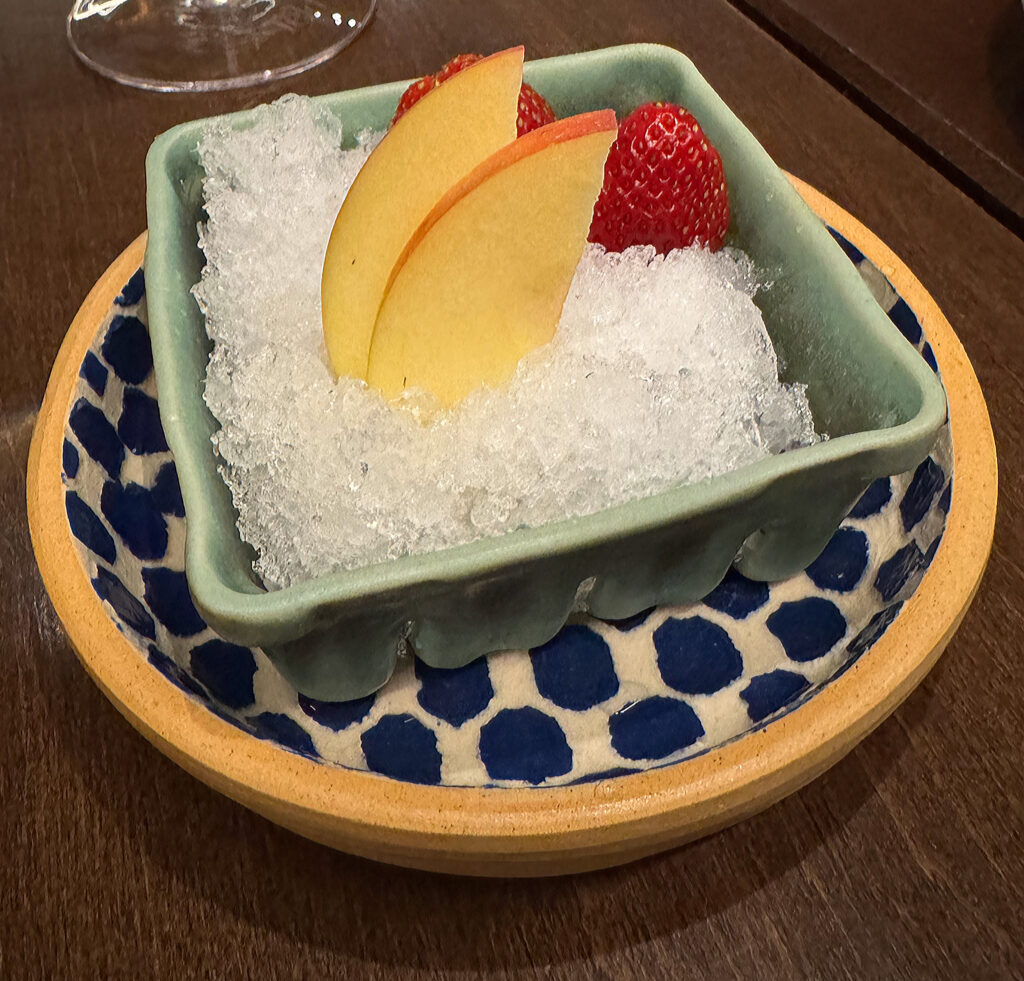
The closing progression of the evening is largely familiar, yet there are a couple twists:
The “Fresh Fruit on Ice” features likable (though not really inspiring) pieces of apple and strawberry. The presentation—in that familiar ceramic “carton”—is probably the most charming part.
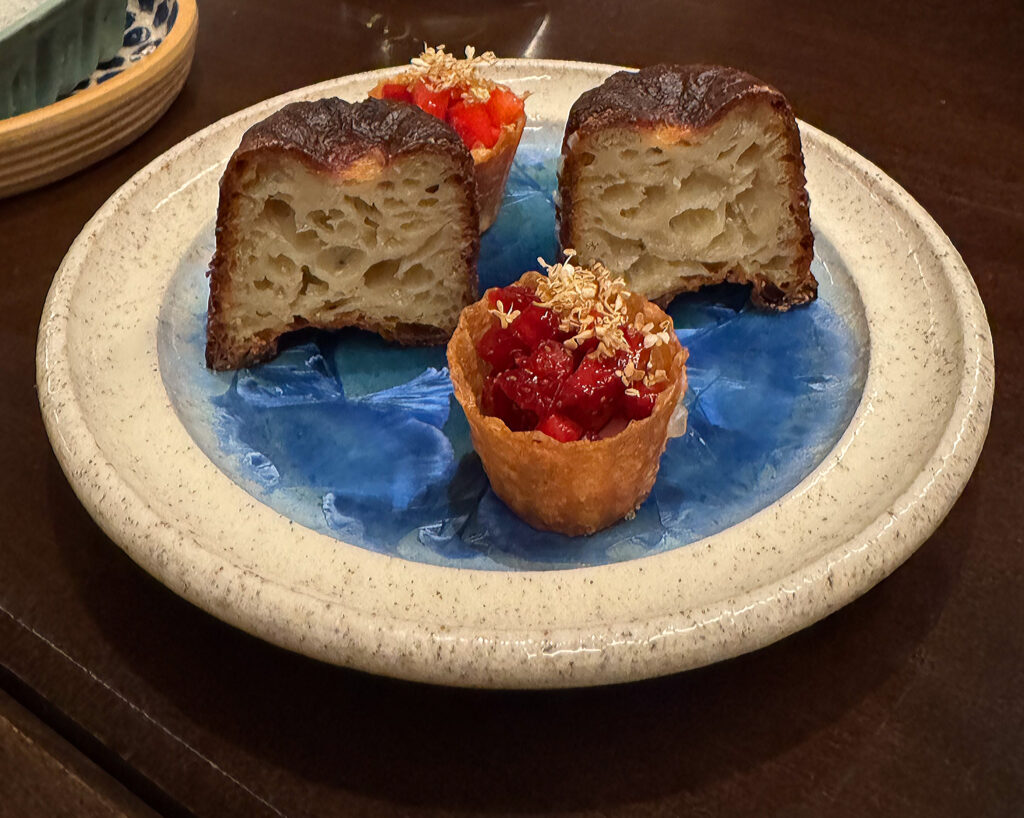
The “Rhubarb Tart,” by comparison, is crisp then richly tangy and sweet. I enjoy this, and it even surpasses the strawberry tart served as part of “The Drop.”
The “Masa and Spiceberry Canelé” is an experiment crafted solely for my party and the adjacent table that is celebrating their tenth visit. I love the team’s willingness to try something new on such a small scale, for, while the usual addition of Malört is playful, the accompanying flavor saps some of my pleasure. Here, notes of zest, earth, and warming spice deliver a much more focused, pleasurable expression of the caramelized, custardy pastry.
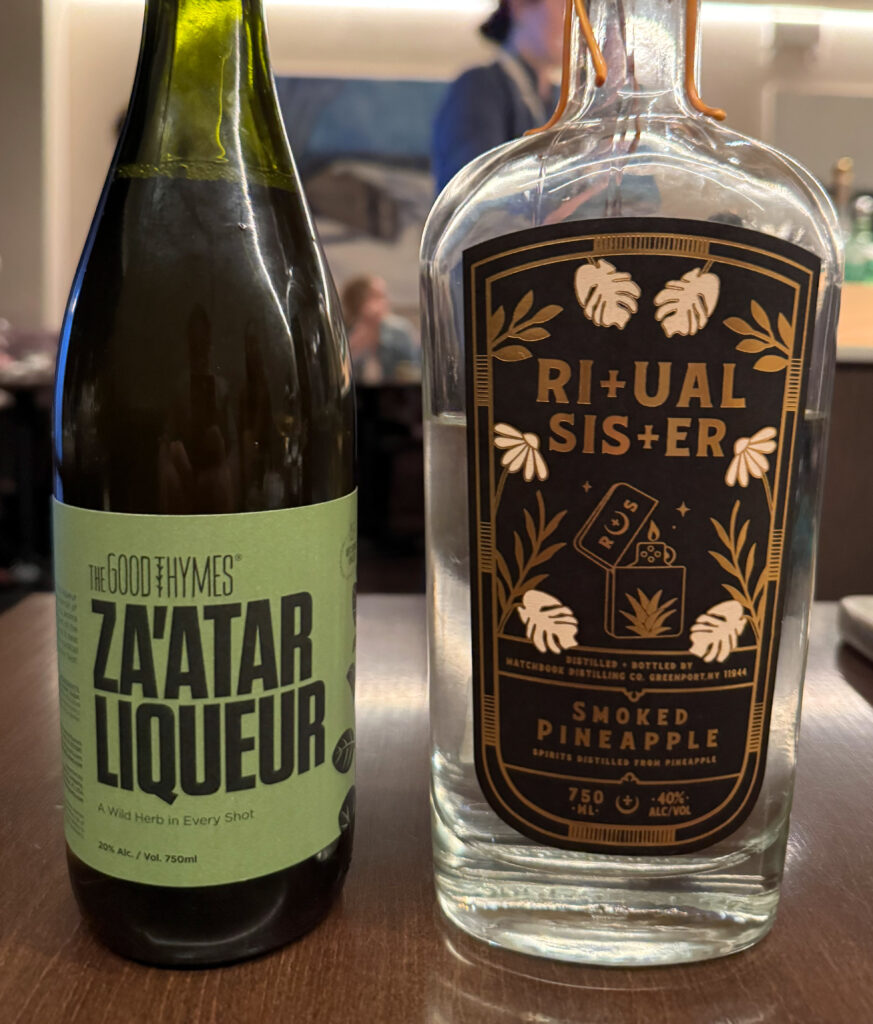
With the guestbook signed, the check paid, and a couple after-dinner drinks in hand (a za’atar liqueur and a smoked pineapple spirit, we are all invited outside for a parting s’more and some meandering conversation with the chef.
It’s kind of amazing how Potashnick is able to switch off and joke around after leading service (itself the culmination of a much longer day): some 26 offerings spread across 14 distinct courses in just a little under two hours.
Whatever way you calculate it (roughly five minutes per bite or nine minutes per presentation) the pacing is breakneck. Just the same, it always feels personal—woven with moments of interaction tailored only to you—rather than clinical.
And supporting the restaurant, still somehow the underdog, feels meaningful: like you’re helping this motley crew realize their dreams even as national honors continue to accumulate. Yes, Potashnick’s passion, nearly two years later, remains indefatigable—even infectious.
The team echo it with every word and movement, shaping an experience (however rarefied) that uplifts: connecting diners to time and nature and maybe even each other in a manner that challenges the more exoticized, isolating luxury we have come to know.
In ranking the evening’s dishes:
I would place “Love Point Oyster—Elderflower,” “Cahokia Rice—Crawfish,” “Pork Coppa—Garlic Scapes,” “Masa Cake—Pleasant Ridge Reserve,” and “Milk—Strawberry” in the highest category: superlative items that stand among the best things I will be served in any restaurant this year.
The “Tangelo and Chamomile Tea,” “Benton’s Ham,” “Tempura Asparagus,” “Chilled Asparagus—Tama Miso,” “Mackerel Sashimi—Dulse,” “Hakurei Turnip—Benton’s Ham,” “White Asparagus—Citrus,” “53 Day Kilgus Ribeye,” and “Masa and Spiceberry Canelé” land in the following stratum: great recipes that achieved a truly memorable degree of pleasure. I would love to encounter any of these again.
Finally, there’s the “Nasturtium Flowers,” “Elderflower Fennel,” “Picollino Cucumber,” “Umeshu Rhubarb,” “Green Strawberry,” “Asparagus Bundle,” “Strawberry Tart,” “Mackerel Pancake,” “Sue’s Halibut—Strawberry,” “Strawberry Gazpacho—Chamomile,” “Fresh Fruit on Ice,” and “Rhubarb Tart”—good—even very good—preparations I would always be happy to sample again (but that just failed to elicit an extra degree of emotion).
Overall, this makes for a hit-rate of 100% with some 54% of offerings reaching that “would love to have again” level of quality: figures that match those I reported in April (i.e., 96% and 54%) almost exactly.
Indeed, while I found that there was one bite last month—a “Mussel Pancake” presented as part of “The Drop”—that faltered a little on the basis of both texture and flavor, I cannot fault even one serving tonight for a lapse in technique. If anything, the weakest of the items (like the cucumber, green strawberry, and fruit on ice) suffered only from being a bit too simple. Meanwhile, a dish like the “Sue’s Halibut” would have easily ranked at least one category higher if not for being slightly overcooked. The “Strawberry Gazpacho” might have only struggled because it was placed after—and not before—two stunning other desserts.
Ultimately, I think one has to go easy on many of the constituents of “The Drop” because the overall progression is so successful and the ingredients (even if they arrive just short of being unadorned) are intended to make a kind of “raw” introduction here before appearing throughout the rest of the menu. This does not preclude any of the bites being clunky or borderline offensive (as could be true during the restaurant’s earliest chapter), but that was in no way the case tonight.
Thus, I am comfortable stating that this was an entirely successful meal (and undoubtedly the best I have ever had here) within the context of Feld’s ethos: one that looks to showcase a singular moment of the season—sometimes starkly, sometimes with quite a bit of repetition—through the lens of relationships, storytelling, preservation, inventive saucework, curing, smoking, and grilling over coals.
I provide the caveat because this concept, quite consciously, will never be like Oriole: a wonderland of luxury ingredients for a mainstream dining population that equates dollar spend with decadence. You have to respect Potashnick’s philosophy and process—and, really, the restrictions he has placed on his kitchen—in order to appreciate the more intellectual preparations on offer. And it is those subtler, stranger creations that ultimately empower his most generous, memorable preparations when they eventually come around.
Indeed, the experience is meant to be thought-provoking as much as it is pleasing, and I think Feld has found a niche (more approachable than Smyth, with higher production value than Cellar Door Provisions) through which it can effectively advocate for a whole different vision of fine dining.
This was always the concept’s promise, and I am happy to see it being fulfilled. I am even happier to see the team embrace fresh-baked bread and fresh-churned ice cream—pathways toward the kind of easy pleasure that (while still offering plenty of opportunity for creativity) may satisfy more skeptical guests for years to come.
That said, I am most amazed by the five dishes that achieved “best of the year” status this evening: a testament to the kitchen’s ever-increasing mastery and an affirmation that their work, today, already rivals that of the greatest restaurants in Chicago.