
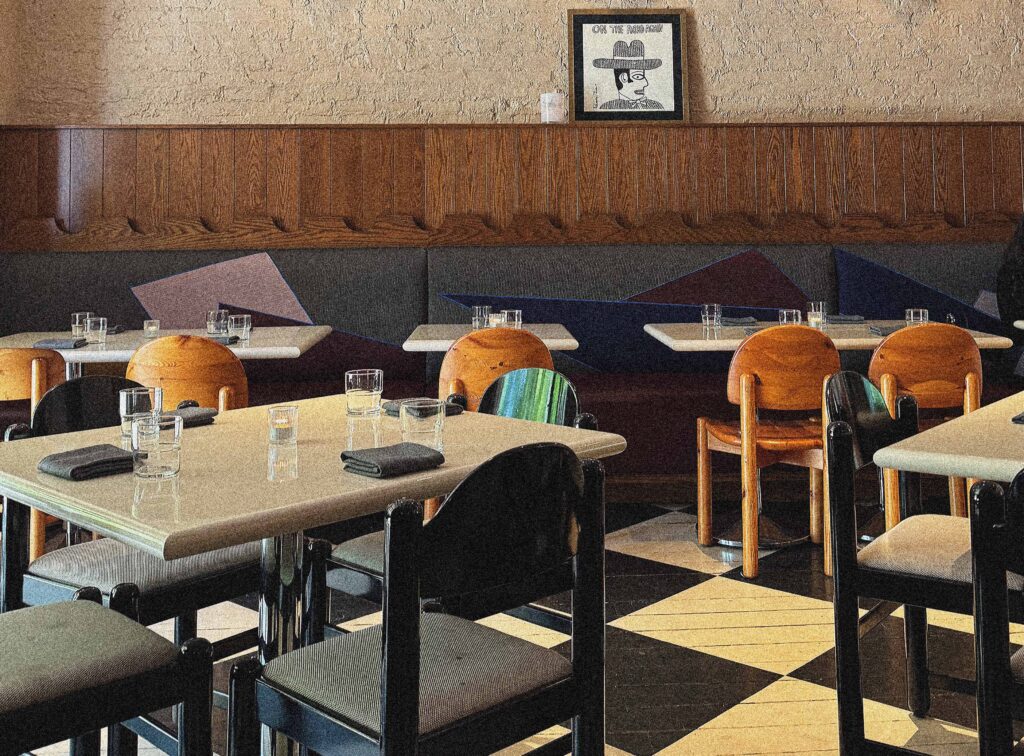
It’s been a good three months since I’ve eaten at Creepies, where I found a kitchen that had really started to hit its stride. By all means, the concept is not yet perfect—I highlighted the entrées and vegetable sides as areas that could still use some improvement. I’m also not quite sure I’d rank the restaurant among the very greatest in Chicago (i.e., the central focus of my writing this year) either.
But I’m captivated by Creepies nonetheless. For, relative to the reliable indulgence offered by Le Bouchon or Obélix, the place is weird, provocative, and Midwestern enough to make an impression even on those coming from comparably vibrant bistro and neo-bistro scenes.
Indeed, now approaching its one-year anniversary, the eatery’s popularity has remained enduring despite so many proud quirks (like the lack of a full bar, the steadfast dedication to natural wine, and the general belief that recipes should always embrace distinctiveness over easy, conventional pleasure).
Creepies remains relevant and engaging to me because it forms such a successful entry point into the kind of challenging, intellectual cookery I’ve been tracking at Elske (its sister establishment), Cellar Door Provisions, Feld, and even Smyth: concepts whose resonance might not be obvious but, if we trade specifics for spirit, feels certain.
Due to a confluence of factors (including location, relative value, branding, and interior design), Creepies might be the most approachable and fashionable member of the bunch. Yes, with chicken and fries as its lure, the restaurant acts as the tip of the spear for a larger movement toward the wider appreciation of thought-provoking—rather than strictly pleasing—gastronomy in Chicago. A kind that (while not novel) now strikingly embraces seasonality and simplicity: putting forth elemental, ever-changing combinations of texture and flavor without the performative, smoke-and-mirror crutches clutched by the previous generation of practitioners.
Putting this romanticizing aside, I should also admit that I’m drawn to Creepies because it still feels buzzy. It attracts an audience that, maybe, could do with having surprisingly subversive French fare and natty wine shoved down their throats. To be clear, I certainly enjoy tangling with the offerings in my own way, yet observing the effect they have on others feels like a unique opportunity to take the pulse of the city’s dining masses.
Otherwise, I’ve already covered this singular bistro extensively, so there’s little left to do but dive back in.
Let us begin.
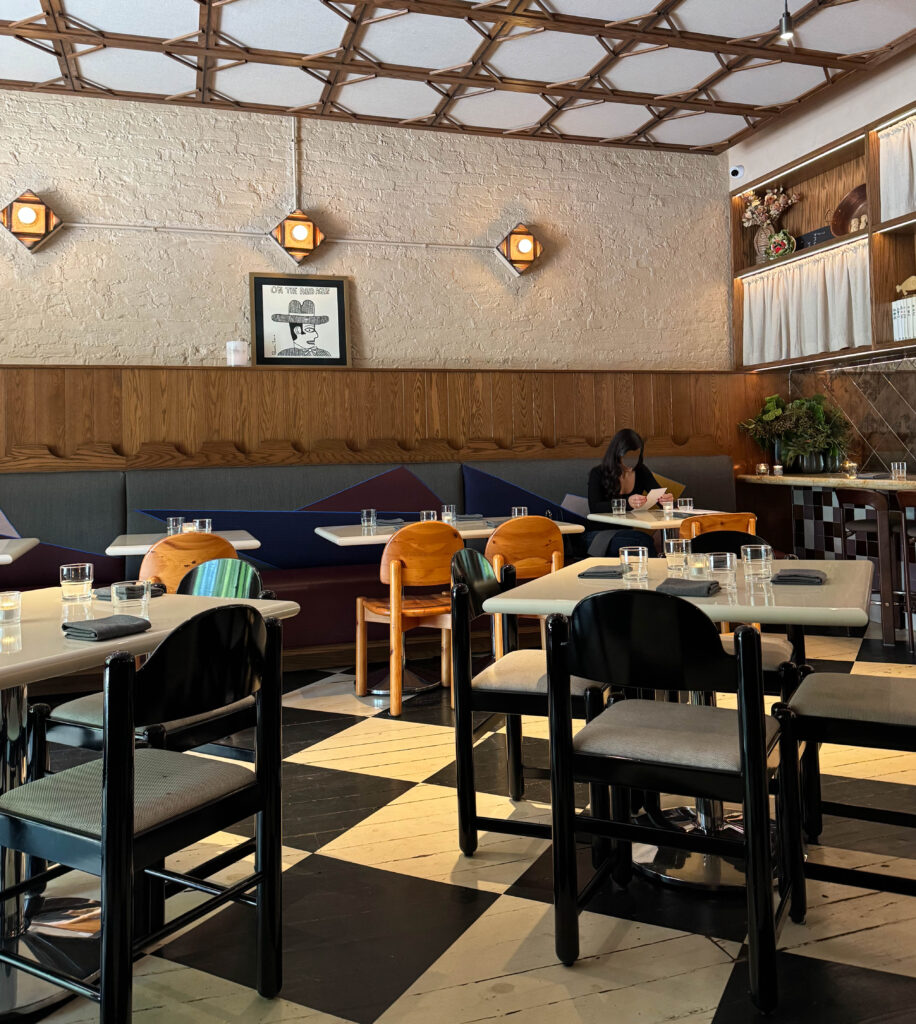
Tonight, I am granted a unique vantage point for my meal: one of only two full booths tucked along the wall opposite the host stand.
I’ve only ever found myself seated in this front room just once (during lunch), so I savor the opportunity to observe the full breadth of the Saturday night audience as they are led to their own places across the checkered floor.
Admittedly, though these booths are by no means secluded, their arrangement makes for a feeling of relative isolation. Indeed, compared to the freestanding tables, the shared banquettes, and those dread spots at the mirrored “bar,” one is largely shielded from the influence of the other guests.
This softens the sense of bonhomie that has proven so intoxicating on other evenings here, and it certainly dulls my ability to perceive how other diners grapple with the menu (save for those in the other booth to my rear). Nonetheless, with my party being snugly situated, it feels as though the servers are attuned solely to our needs—less bistro, more fine dining, in fulfilment of the pedigree the Elske team can so deservedly claim.
All told, I enjoy the fresh perspective on a place that has already become so familiar, and I especially prize the amount of surface area I have to play with: a blank canvas for the whirlwind of plates, bottles, and stems that should characterize any meal here.
When deciding what to drink, I always look to match a reliable, stalwart cocktail with degree of excitement and iconoclasm I’ve come to expect from the wine list.
That said, the departure of Monica Casillas-Rios has cut across the beverage programs at both Elske and Creepies, leaving bar manager Stephan Jurgovan to pursue the delicate task of preserving pieces of his predecessor’s superlative work while also meaningfully expanding on it.
Last month at Elske, I perceived that the “Martini” (on its day one of the best in the city) had subtly shifted toward greater herbaceousness, remaining wholly enjoyable while losing its maddening, pinpoint sense of balance. Of course, I must acknowledge that these small variations in flavoring really come down to personal preference.
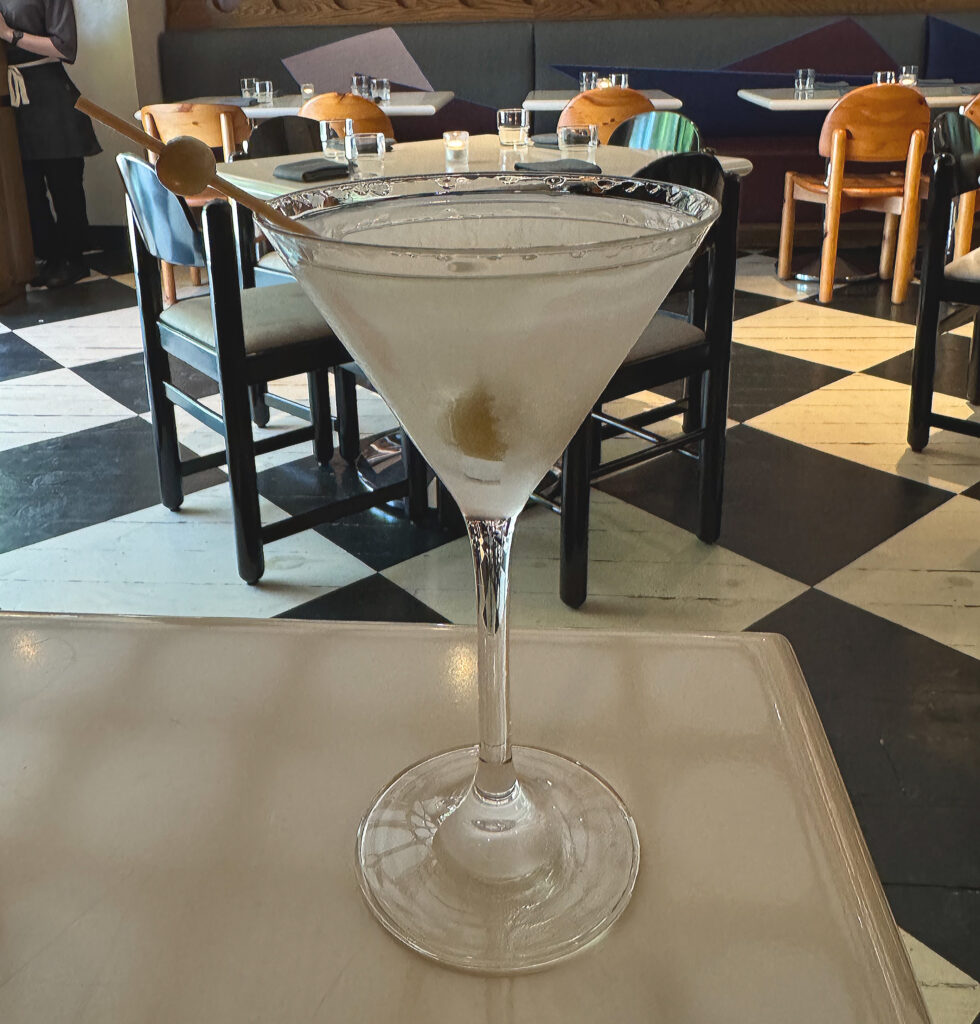
However, I feared that the Creepies “Dirty” ($16) might have suffered the same fate—and am happy to report that the drink (made from vodka, brine, and aromatized wine) delivers the same profound, bracing sensation I have come to love. For any fan of the form, this remains an absolute benchmark.
Martini aside, it was Jurgovan’s milk punch at Elske that really impressed me and offered some promise of what’s to come. A “Cassis Negroni” ($16)—made with gin, C. Cassis blackcurrant aperitif, and Cap Corse—has the same effect: expertly melding ample, rounded fruit with bitterness in a manner that leaves me wanting more.
Turning to the bottle list, I always find the dynamism of Emily Sher’s selection—whatever one thinks of its natural bent—to be incredibly engaging. Nearly one year in, Creepies now seems able to sustain a wider assortment of pricey producers that were long the province of Elske: premium options that, while still respecting the program’s philosophical underpinnings, are often better equipped to please traditionalists (who are free to pay corkage anyway!).
Some bottles of note include:
- 2022 La Vigne du Perron “Les Ermitures” [$100 on the list, $60 at national retail]
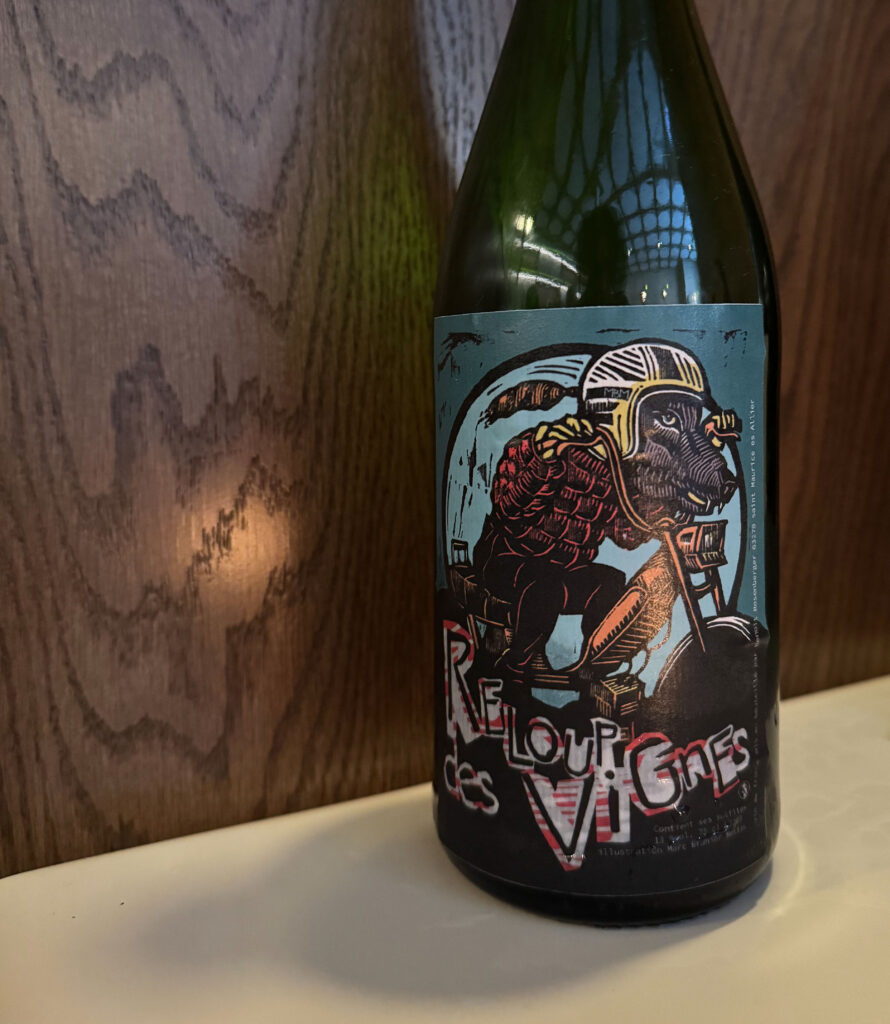
- 2022 Benoit Rosenberger “Reloup des Vignes” ($112 on the list, $94.56 at auction]
- NV Laherte Frères Champagne “Rosé de Meunier” [$133 on the list, $54.95 at local retail]
- 2023 Catherine Riss “T’as pas du Schiste?” Pinot Noir [$136 on the list, $69 at national retail]
- 2023 Domaine de l’Octavin “Potion Magique” [$150 on the list, $78 at national retail]
- 2021 Patrick Desplats “Helios” [$200 on the list, $109.99 at national retail]
- 2014 Château Meylet Saint-Émilion “Cuvée G” [$249 on the list, $127.99 at national retail]
- NV Ruppert-Leroy Champagne “Fosse-Grely” [$252 on the list, $115.99 at local retail]
- 2022 Patrick Desplats “Caroline” [$270 on the list, $142 at national retail]
Now, I’ll be the first to admit that a couple of these choices are still quite weird—with the “Potion Magique” and “Helios” both comprising field blends of grapes (which, in the case of the latter, are not even identified).
But it’s hard to resist pairing neo-bistro fare with an equally modern, vibrant take on Gamay (the “Ermitures” or “Reloup des Vignes”). Alsatian Pinot Noir, grown on blue schist, offers some of the same effect. Yet a pair of Champagnes (despite their lower dosage) are even easier to like and particularly celebratory. The Château Meylet, too, provides a bonafide expression of Bordelaise Merlot (from 70- to 80-year-old vines) in a distinctly approachable style.
The ”Caroline”—made from 100-year-old Chenin Blanc that has never been exposed to chemical agriculture (the vines being trained up fruit trees no less)—is probably reserved for the most fanatical of drinkers. Nonetheless, its rarity is unquestionable, and the resulting concentration of fruit and weighty texture (drawn in part from aging in qvevri) seem tailormade for a menu that, however weird it gets, never runs short on personality.
With markups rarely exceeding 100% on top of retail price—and, at times, landing close to zero (for coveted bottles like the Rosenberger)—I will always advocate for Creepies being the place where even the most skeptical patrons dip their toes into the world of natural wine.
For, ultimately, there’s nothing smug or cynical about how Sher assembles this list. In fact, it’s the product of tremendous passion (and of a sommelier who, while unbending in her convictions, truly tries to provide thoughtful alternatives for customers who prefer conventional wine).
Considering the quality of the aforementioned cocktails, the opportunity for corkage ($35), and a handful of other options (like a couple smart non-alcoholic choices and three beers), there’s no reason to rue Creepies’s proclivity for minimal intervention.
You can get around it if you need to, but you’d also be rejecting a key layer of experience: one in which taste is completely untethered from the expectations of the bistro genre and of the winemaking styles that have traditionally accompanied it.
I don’t fault anyone for refusing to roll the dice on a $50, $100, or $200 experiment. At the same time, it seems counterproductive to embrace the restaurant’s boundary-pushing cuisine only to immediately retreat into the arms of a classic, familiar wine that speaks an entirely different dialect.
I could see such a pairing working in certain cases (due to the adaptability of Champagne and more acid-driven whites), but I’m not sure Creepies is a place where you want to be chewing on tannins throughout the meal.
Turning to the menu, I will try to keep my evaluations of the restaurant’s standbys brief so that I can direct the majority of my attention to what is entirely new (or otherwise notably tweaked).
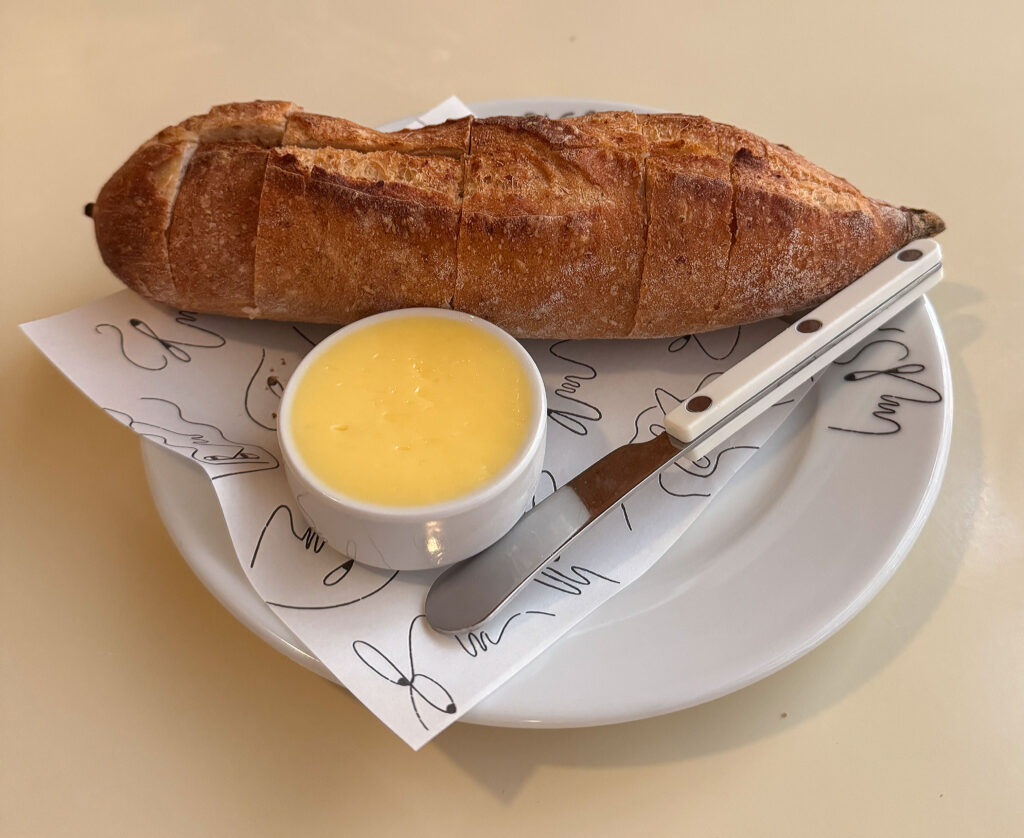
To that point, what more can I say about the “PQB Bread & Butter” ($8)? This demi-baguette displays pleasing traces of crispness and chew with a fluffy interior that is well matched to the accompanying creamy, salty spread. I notice that the loaf is cut into 12 segments tonight (instead of the usual eight), which might help to distribute those crunchiest sections that encompass the pointed tips—le quignon.
Otherwise, I’ll always remember how the kitchen struggled with their bread early on, so finding such a reliable example here (even if it is being brought in) is always a treat. Overall, the baguette forms both a trusty palate cleanser and a key vehicle for the countless sauces that characterize the rest of the fare.
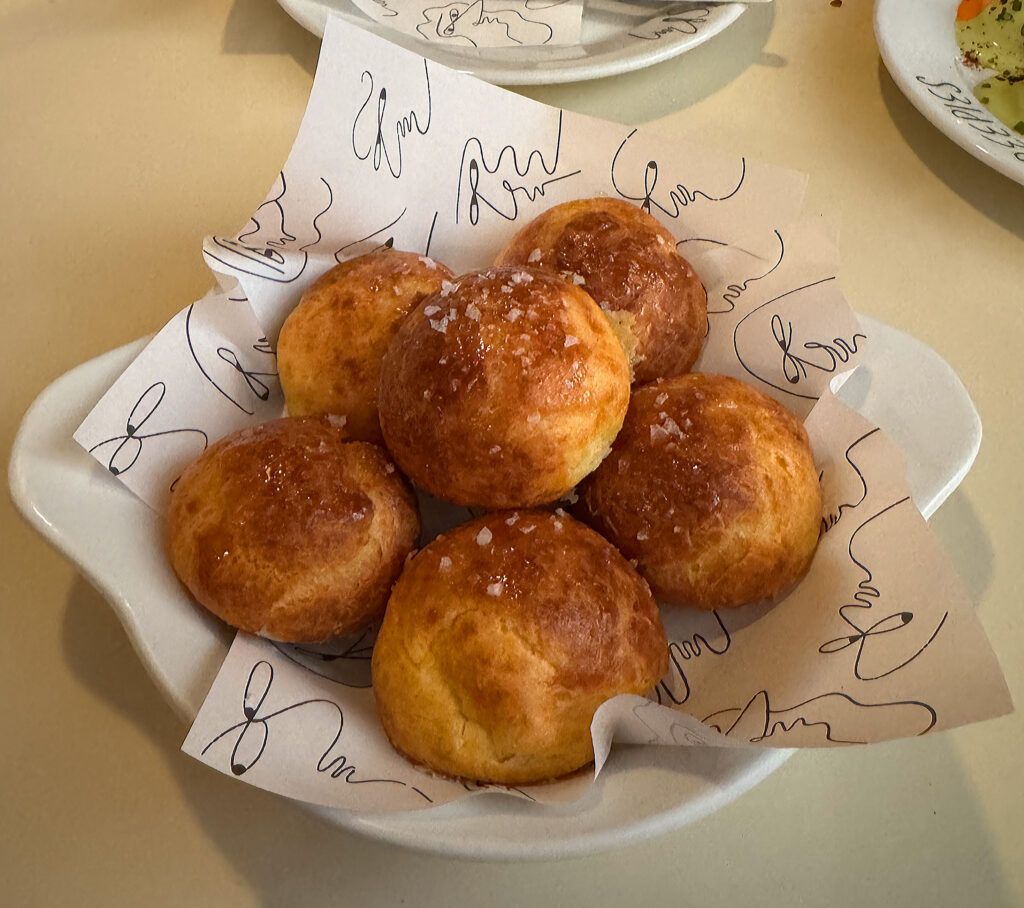
The “Warm Brie Gougères” ($16) form a Creepies signature, yet one that has actually undergone a surprising degree of alternation during the course of its existence. I recall early examples that were coated in shreds of melty, nutty cheese and those slightly later renditions that pushed sweet, honeyed decadence to the extreme. The present version seems to be the winner, and I think it represents a conscious decision to showcase restraint: turning away from mainstream, hedonistic appeal toward a refined, intellectual expression of the starring cheese.
Indeed, while the gougère perfectly balances a clean, crisp shell with a rich, gooey center, its flavor is far more understated. I find just enough salt and the smallest hint of sweetness, yet these notes really serve only to frame the supreme purity and length of the brie itself. Yes, the recipe is really only about concentrated dairy with that maddening touch of earth. The dish eschews the easy pleasure it used to so memorably provide (and that I must admit I sort of miss), becoming something more of a “cheese course” in essence. Still, in this role, the gougère retain significant appeal—all but demanding one enjoy them with a glass of wine.
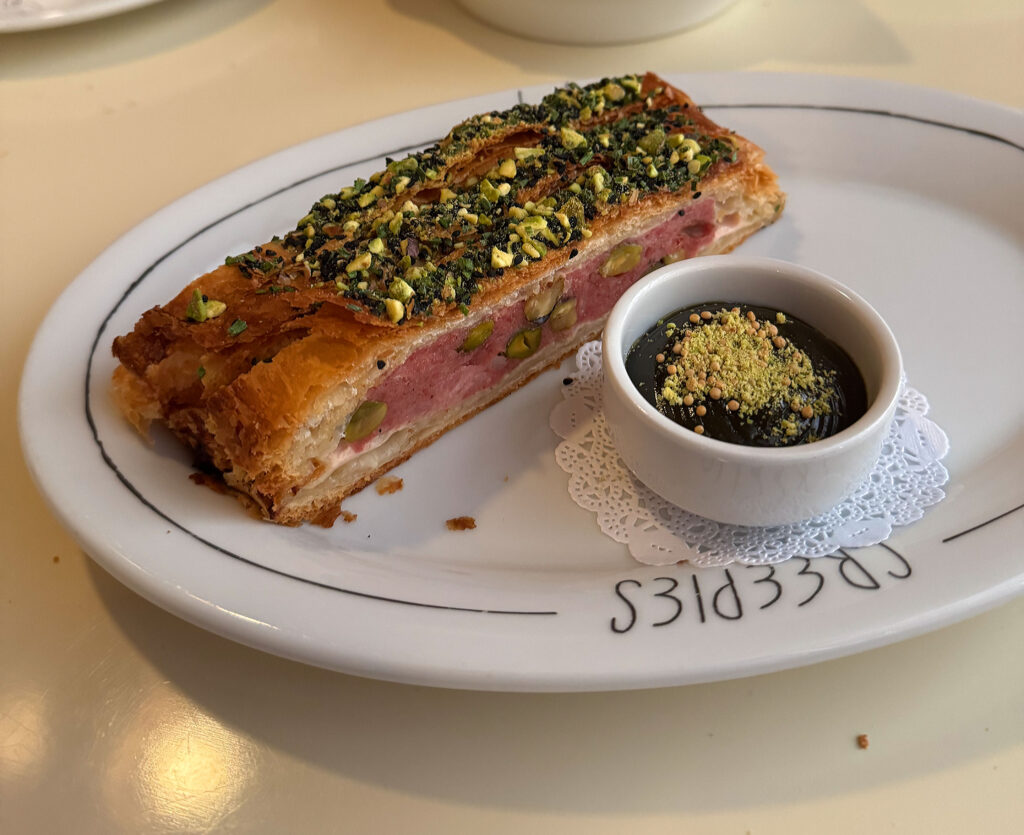
The “Saucisson” ($19)—another signature—has undergone a similar, winding path toward achieving some kind of consistency (while increasing in price by a couple dollars along the way). However, while the preceding preparation was characterized by a clear stylistic change, this blend of pork and pistachio in a puff pastry wrapper has really only cemented the kind of textural appeal it long promised.
To clarify: the saucisson was impressively crisp and flaky and juicy on opening night then struggled with a certain limpness for many months after that. Now being executed properly, the dish delivers deep satisfaction drawn from a double dose of sweetness (the pork and the accompanying pistachio mustard) with savory, nutty depth. For my taste, the level of tang in the condiment also cries out for the kind of natural wine Creepies serves.
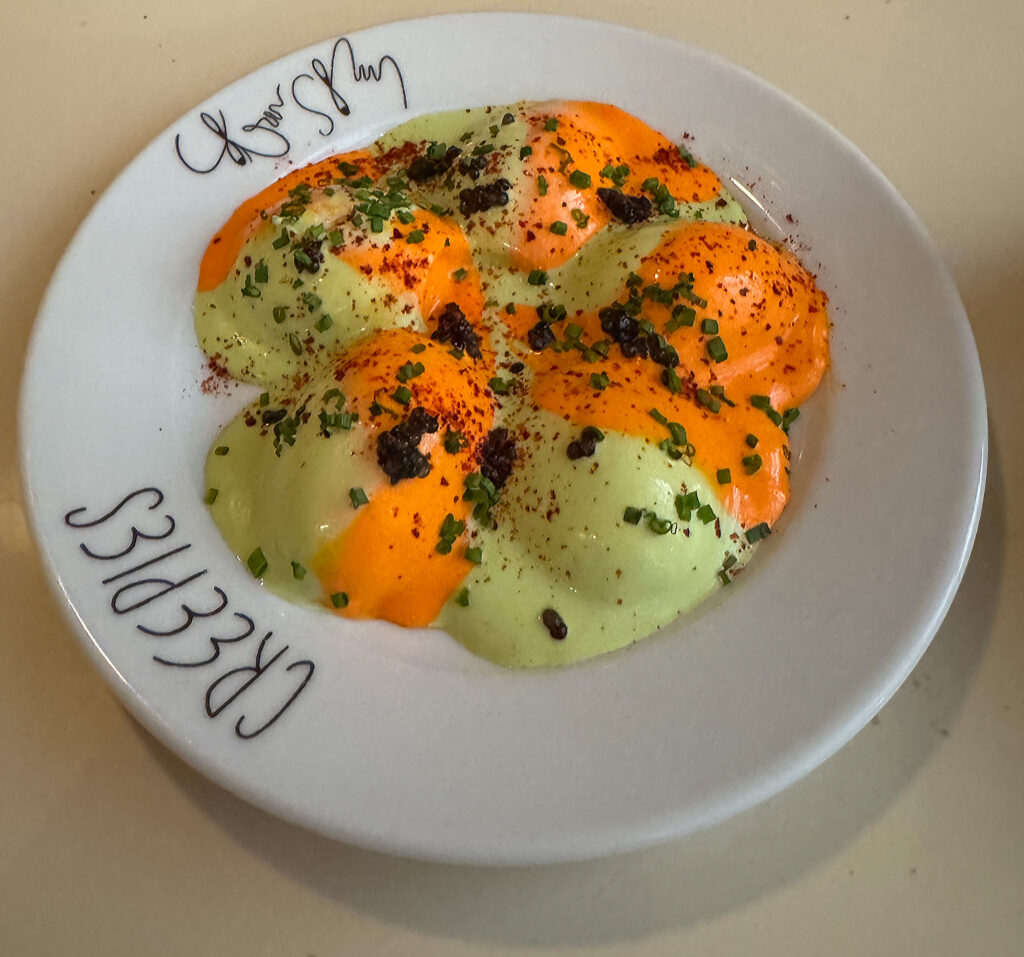
The “Oeuf Mayonnaise” ($16) stands as the newest member of the menu’s opening section, and, though trout roe was substituted for caviar a short time after its debut, the recipe has formed an almost immediate success. In fact, I think I enjoyed these eggs—plump, creamy, with a tie-dye swirl of subtle smoky heat and allium sweetness—more on each occasion. The application of salt here (its character echoed by the roe) is well judged, and, while I wouldn’t say the caviar absolutely sings, the price seems right for a playful feeling of indulgence. Don’t be afraid to drag your baguette across the bottom of the plate either.
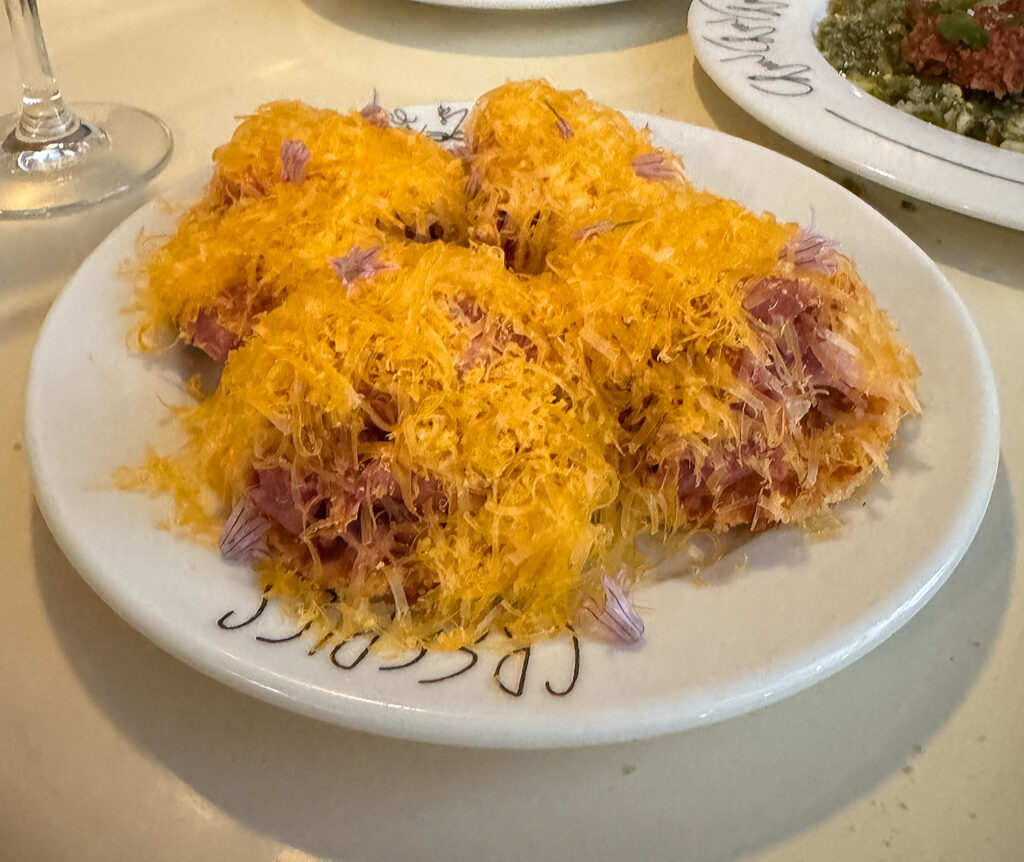
At last, the “Mimolette Gaufrettes” ($22) grants me the chance to tangle with something entirely new. By my measure, this item also has to rank among the boldest and most inventive to hit the Creepies menu. The plate centers on four thin, waffle-like wafers that are stacked high with beef tongue, punctuated with green garlic, then buried under shreds of the titular cheese (with the occasional chive blossom for good measure).
Texturally, I find the gaufrette (a term that can also refer to a style of potato) to be a little more weighty and crumbly than it is crisp. Given the resounding tenderness of the tongue, this juxtaposition actually works nicely. When it comes to flavor, the beef establishes a sense of underlying richness. Nonetheless, a surprising burst of horseradish (from a hidden layer of cream) comes through, melding nicely with the fresher, sweeter expression of garlic. The mimolette then brings everything home with a sharp, nutty quality whose savory power drives this misshapen morsel toward a real feeling of satisfaction. Yes, the recipe—creative construction and use of the tongue aside—is actually rather straightlaced in the pleasure it pursues. I’d like to see more of this from the kitchen.
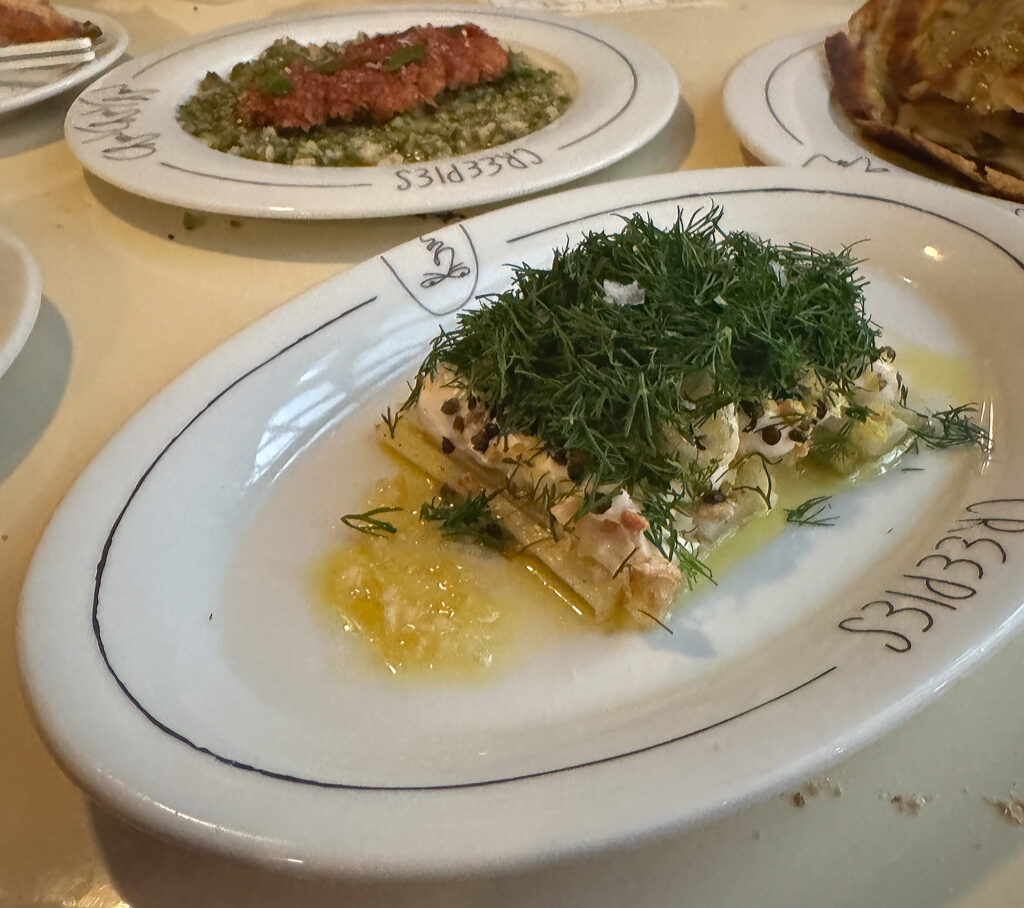
The “Leeks Vinaigrette” ($22) is also new tonight, and the recipe immediately calls Elske’s own version to mind. That said, Creepies’s rendition is entirely distinct: centering on strips of tender allium that are layered with a ribbon of creamy cheese, bits of almond, some capers, and an absolute thicket of fresh dill.
The resulting bites are crisp, crunchy, and mouthcoating on entry with ample, building tanginess. All that dill (which, admittedly, is not among my favorite herbs) threatens to overload one’s palate. Yet, on the other end of its grassy intensity, I find a lip-smacking depth of allium sweetness—charged by the accompanying nutty, briny (but still somehow refreshing) notes—that is surprisingly, memorably delicious. While this dish could have so easily gone wrong, it ranks among my favorites this visit.
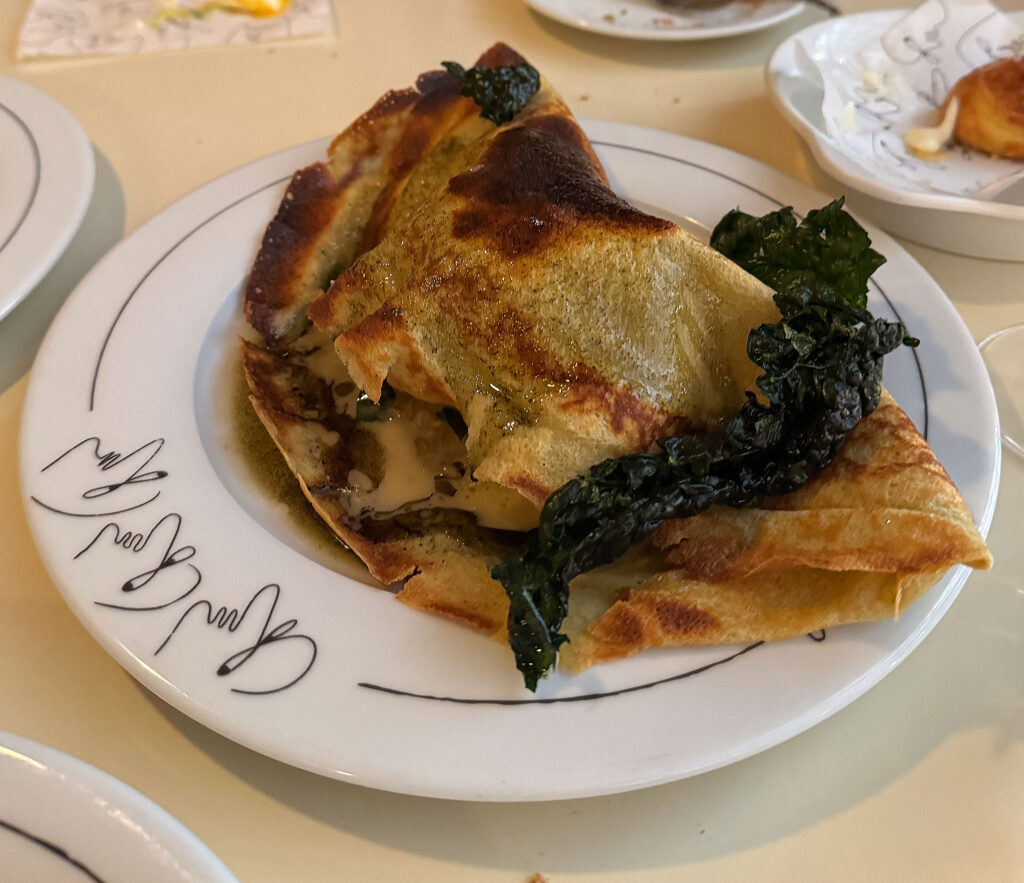
The “Freekeh Crepe” ($27) forms the latest iteration of one of the restaurant’s most enduring forms, yet one (going back to the days of the original corn version) that I have never felt has really fulfilled its potential.
On this occasion, a filling of artichoke, spring onion, and fromage blanc seem to promise a more approachable, mainstream flavor profile. However, it’s really the texture of the crêpe itself that impresses me: achieving a brittlely crisp, even somewhat puffed effect that far surpasses the kitchen’s earlier work with the batter. This delicate crunch (echoed by some fried curls of kale) reveals the tender, chunkier ingredients below. And the resulting sensation—straightforwardly earthy and nutty—is easy to like even if I still feel the elements do not quite meld at a textural level.
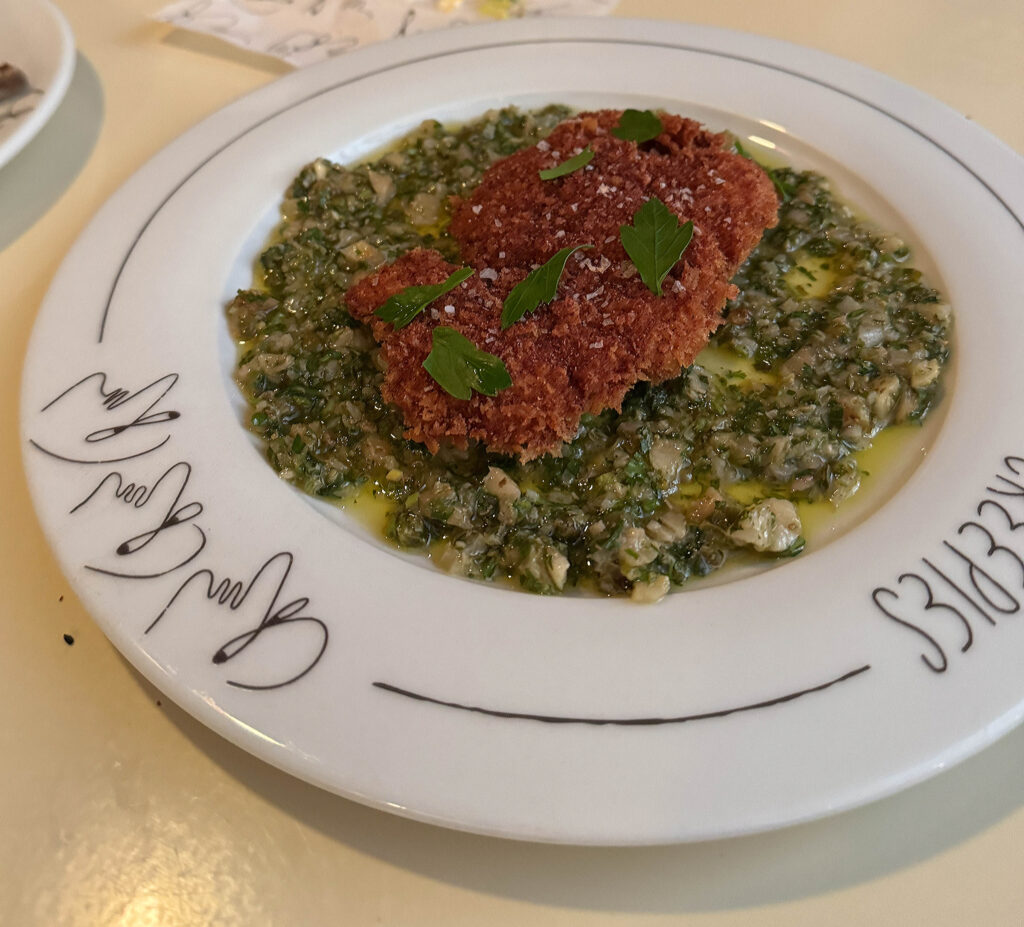
The “Sweetbread Schnitzel” ($28) is, for me, Creepies’s most convincing preparation. Alongside the fries, the martini, and the wine, it provides an assurance that I am going to have a good time here no matter how weird the rest of the menu might get.
At the same time, the dish almost represents a microcosm of the kitchen’s style. You have the central offal—perfectly crisp, astutely salted, with a luscious interior and a singular combination of richness and subtle sweetness on the finish—and the accompanying sauce: an intensely tangy and herbaceous ravigote (substituting the usual pomelo for green strawberry) whose only purpose seems to sap my pleasure. Admittedly, I understand the importance of countering (and thus reinvigorating) the sweetbread’s decadence. But the meat is executed so well that I think it’s a shame to obscure it to this degree. Really, I just want to get an order to go and tuck it between some bread.
Approaching the entrées, I am saddened to learn that one of the new offerings—a “Porcelet” with boudin blanc and sauce forestière—has sold out. Based on the description alone, I felt this recipe might have formed the shining star within the category. Nonetheless, there remain a couple other larger plates to sample (one old, one new) alongside a few sides (both familiar and novel).
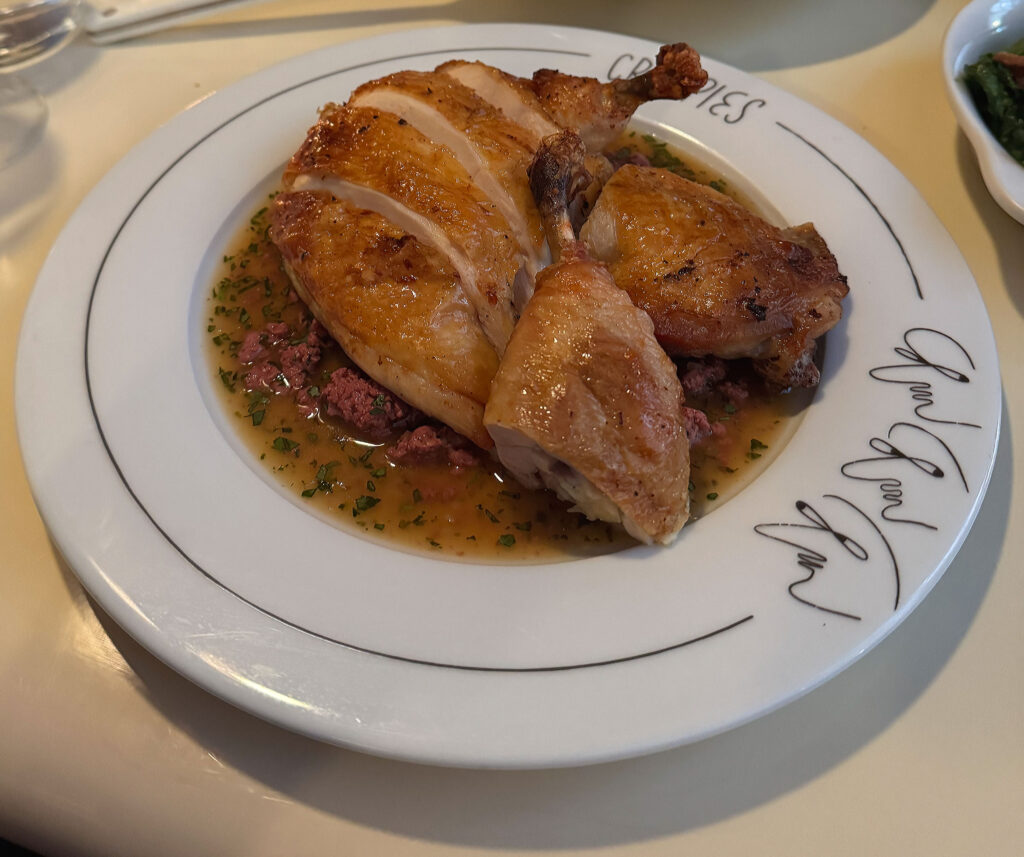
Following the order listed on the menu, the “Roasted Chicken” ($39) comes first. Having enjoyed a rather nice “Roasted Poussin” ($43) over at Elske last month, I find the prospect of pitting this signature dish against its neighbor to be quite enticing.
At a visual level, the difference between the former dish (a glistening half-bird befitting a bistro setting) and the latter (a neat portion of breast crowning an elaborate fine-dining landscape of sauces and accompaniments) is obvious. Yet I find a kindred crispness to each serving’s skin, and the chicken’s accompanying moist, succulent flesh keeps pace with the more naturally delicate poussin. Of course, a mere sauce of liver and wine cannot quite match the artistry of a Michelin-starred composition. However, it combines a sense of lift with some noteworthy savory depth, and I am left feeling that this Creepies classic is every bit worthy of the work going on next door.
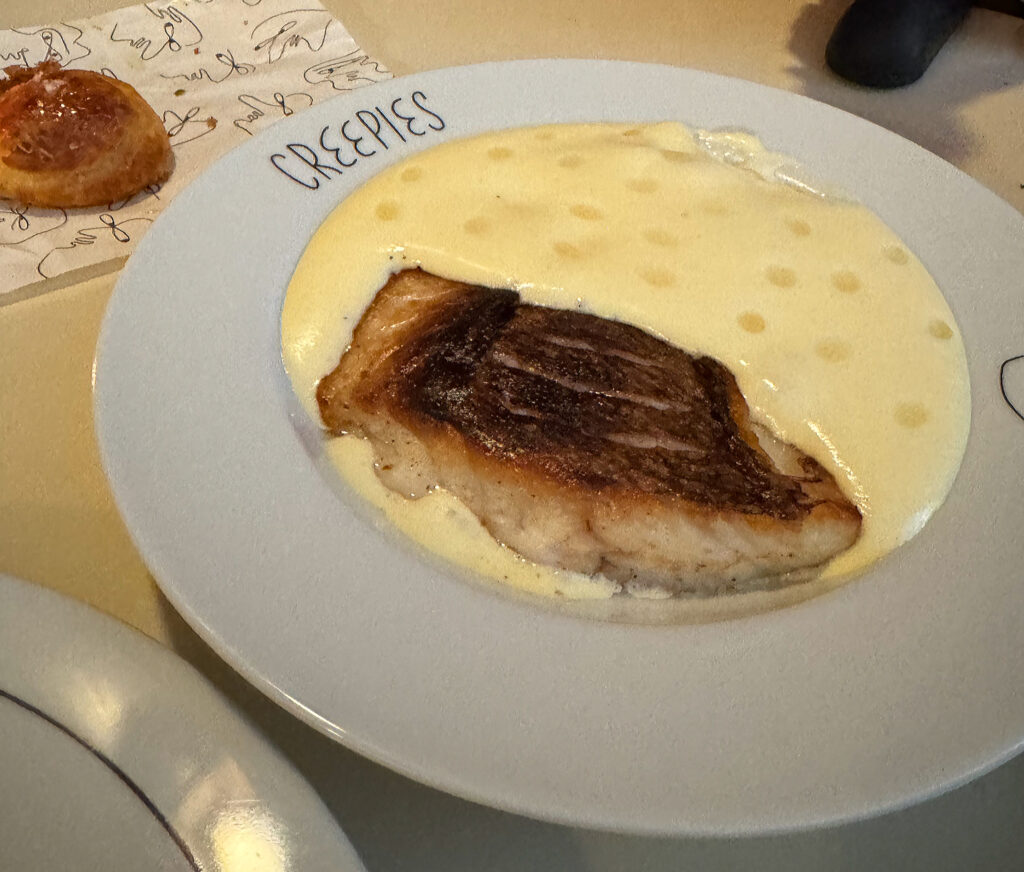
The “Snapper with White Asparagus” ($46) actually forms the most expensive item on the menu tonight, ominously entering into a line of preparations (i.e., the halibut and fjord trout) that have largely left me cold.
That said—perhaps by pursuing relative simplicity—this particular fish actually ranks among the finest entrées the restaurant has served. Yes, the fillet itself melds a fleeting crispness with moist, gentle flaking and a soothing, faintly sweet finish. The accompanying sauce is impressively airy, delivering tang, even greater sweetness, and an earthy, savory edge drawn from the use of kumquat and coffee. These notes serve to invigorate the milder character of the snapper while also smoothly incorporating the asparagus’s own bitter depth. Overall, this makes for a fish dish of creativity, total cohesion, and uncommon satisfaction. Well done.
Of the sides, I try:
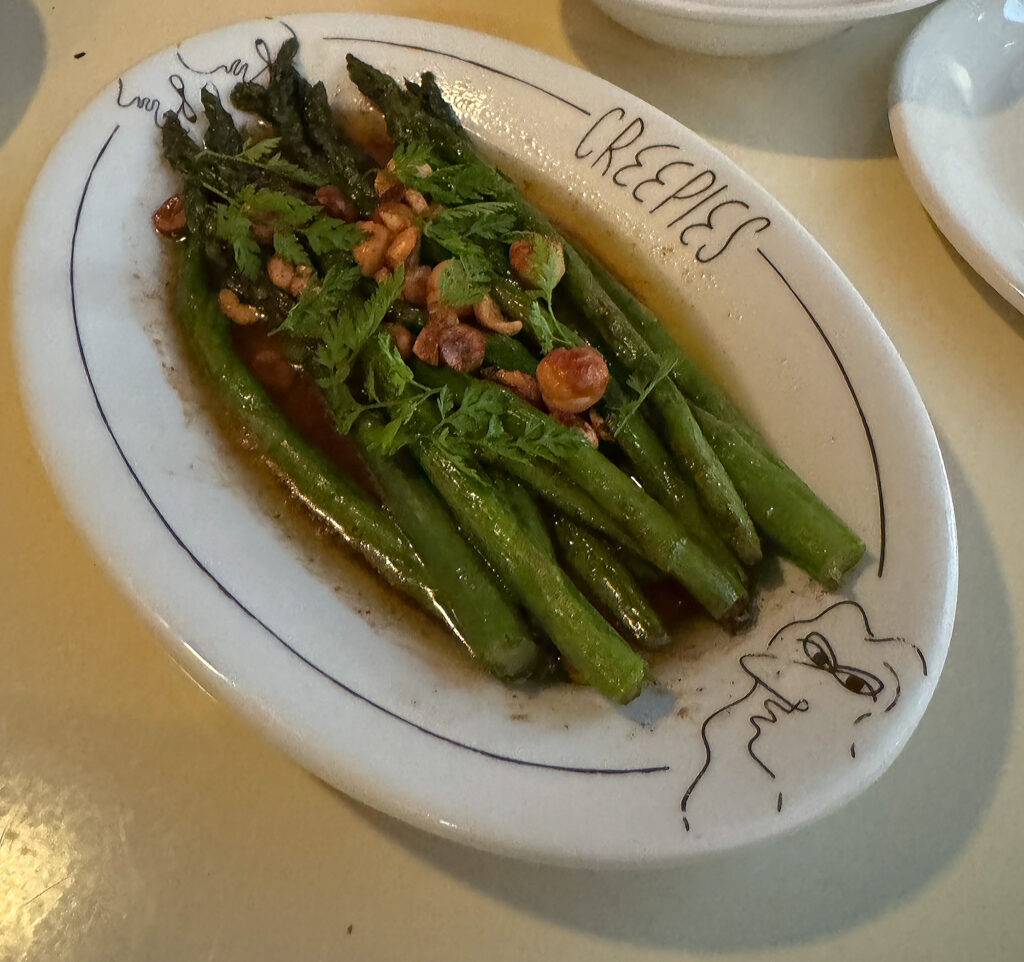
The “Asparagus” ($13), which wields its hazelnut and brown butter dressing to great savory effect but whose texture—a touch limp despite general crispness—leaves the dish feeling uninspired rather than truly elevated.
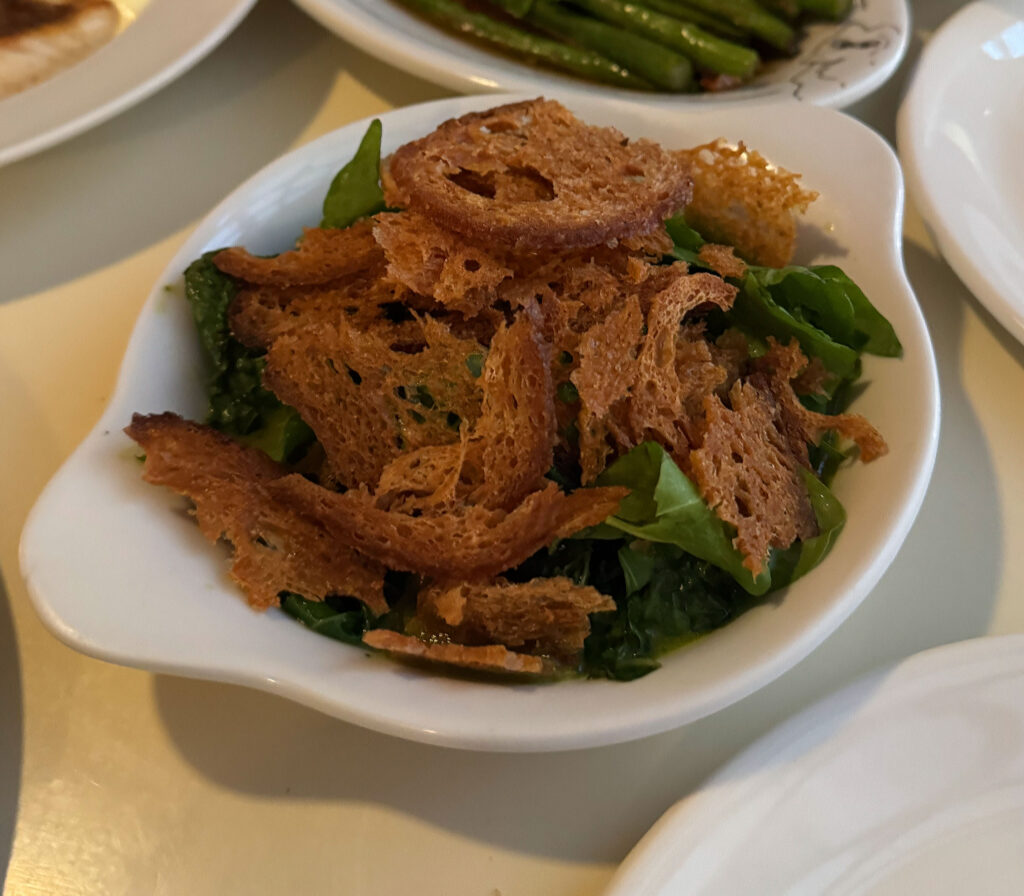
The “Braised Greens” ($15), whose hidden chunks of escargot and inescapable crispy sourdough croutons frame moist, crunching leaves: ones whose notes of earth and ample salt cement a surprisingly robust, satisfying recipe.
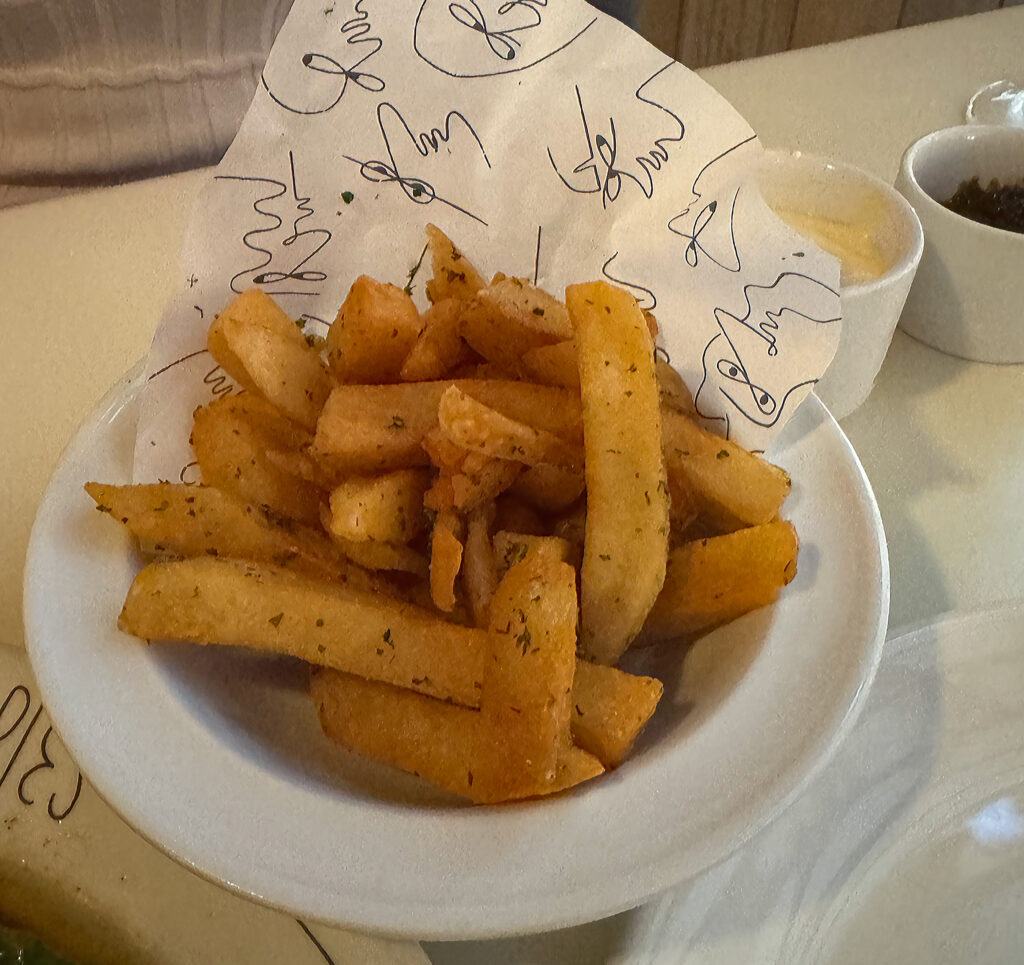
And, finally, the “French Fries” ($10), which—always impeccably seasoned—now seem to be a tad thinner and crisper and thus even more enticing.
Of the desserts, there’s:
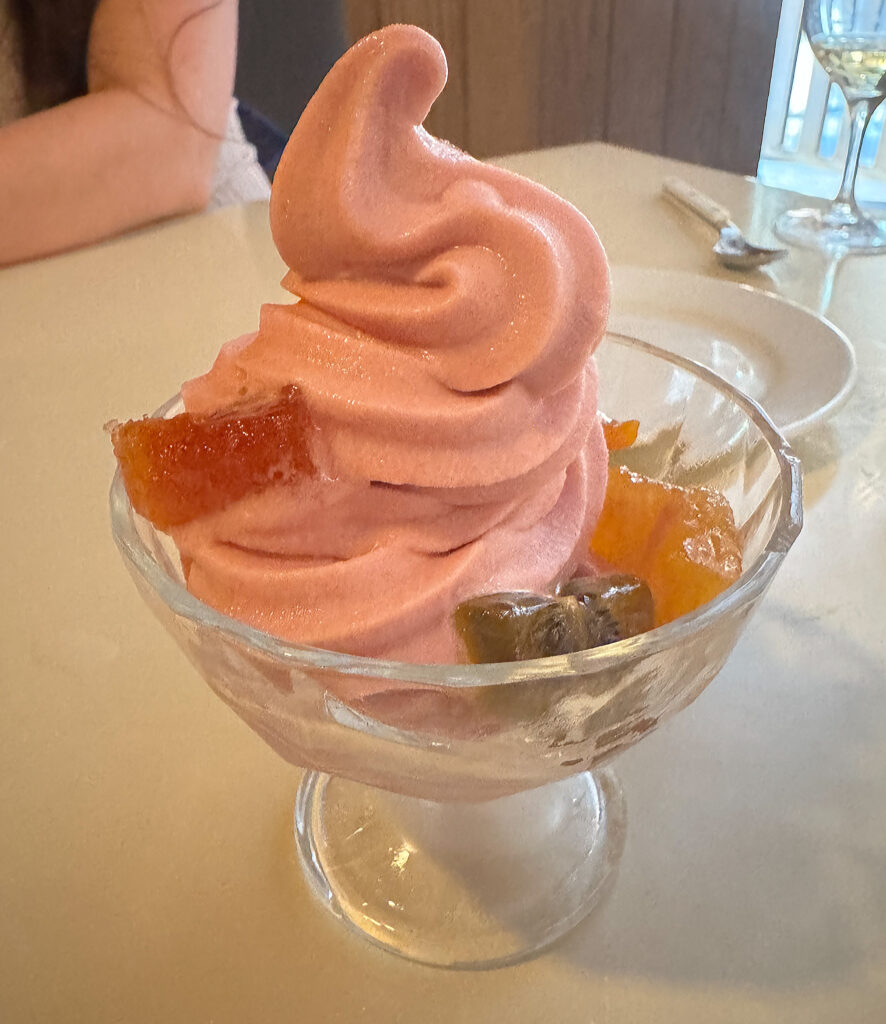
The “‘Tutti Frutti’ Soft Serve” ($12), a newer item that I sampled last time and more or less feel the same way about. Indeed, while the base of the frozen dessert is beautifully smooth and kaleidoscopically sweet, the accompanying candied fruit ranges from deep and juicy (like the pineapple) to jarringly bitter (like the kiwi and citrus segments). At this point, the effect must be intentional, but I’ll admit it’s lost on me.
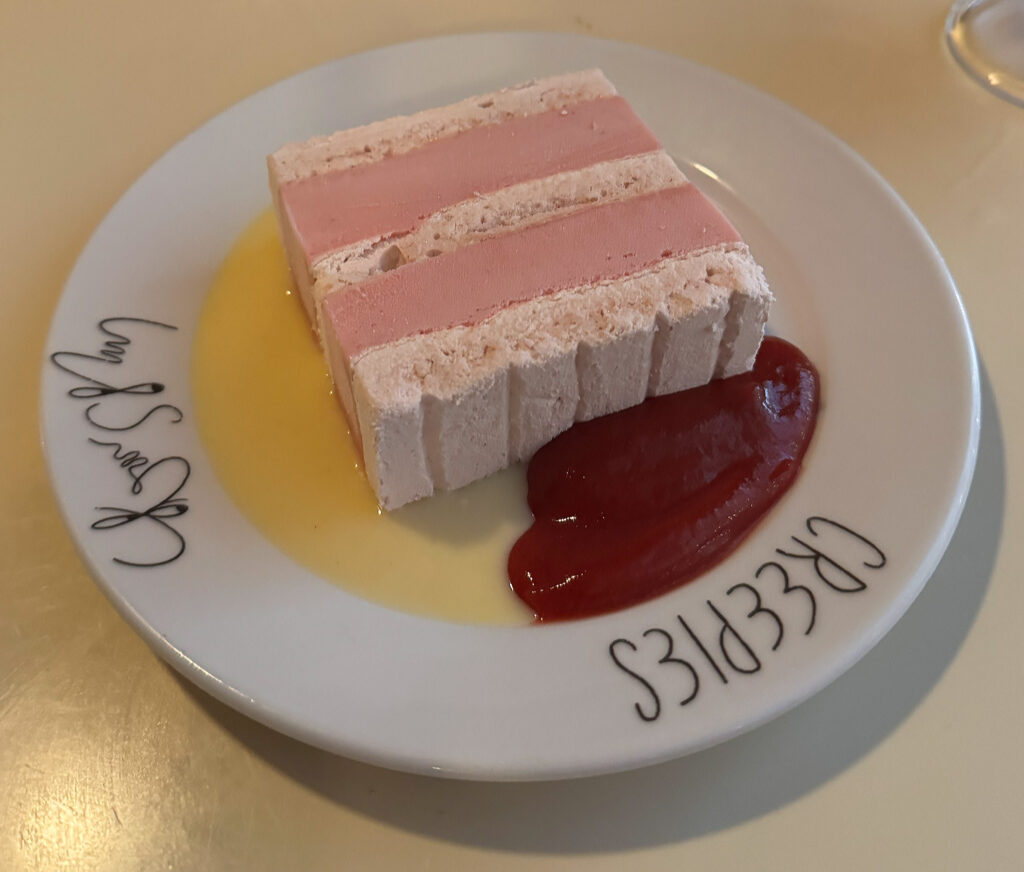
And, last of all, the “Strawberry Sherbet & Strawberry Meringue Cake” ($12): the latest version of this emblematic recipe, which skillfully marries crisp and creamy textures while rounding out its tangier notes (revealing a depth of fruity sweetness) via the richness of buttermilk. While this offering forms a reliable option, I do not fault my dining companion for asking, “where’s the cake?”
(For this same reason, I think I still favor the Creepies lunch menu on account of its straight-for-the-jugular “Chocolate Mousse Cake.”)
At this point, the meal reaches its conclusion: some 15 dishes (spread across four distinct courses) being served in a little less than 90 minutes. As far as the bistro genre goes, this is expert pacing, and it testifies to the caliber of coordination and timing that distinguishes a kitchen at the top of its game.
Stylistically, the cuisine might not entirely be there yet. But there’s something to be said about enjoying the highs and lows without ever growing bored—about a place where the natural flow of wine and conversation makes the hits feel bigger and the misses not worth lingering on.
Creepies has long provided the foundation for a fun night out, and the concept is now increasingly fulfilling its gastronomic potential too.
In ranking the evening’s dishes:
I would place the “Sweetbread Schnitzel” in the highest category: a superlative recipe that stands among the best things I will be served in any restaurant this year.
The “Oeuf Mayonnaise,” “Mimolette Gaufrettes,” “Leeks Vinaigrette,” “Roasted Chicken,” “Snapper with White Asparagus,” and “French Fries” land in the following stratum: great recipes that achieved a truly memorable degree of pleasure. I would love to encounter any of these again.
Next come the “PQB Bread & Butter,” “Warm Brie Gougères,” “Saucisson,” “Freekeh Crepe,” “Braised Greens,” and “Strawberry Sherbet & Strawberry Meringue Cake”—good—even very good—preparations I would always be happy to sample again (but that just failed to elicit an extra degree of emotion).
Finally, we have the “Asparagus” and “‘Tutti Frutti’ Soft Serve”—merely good (maybe just average) items that fell short when it came to texture or flavor. None of these bites faltered in more than one dimension, so there was still pleasure to be had (and, indeed, they could all easily be fixed with a little more tweaking).
Overall, this makes for a hit-rate of 87%—the highest I’ve ever recorded for the concept (compared to 82% in March, 86% for January’s lunch, and figures like 63% and 52% last year). Moreover, some 47% of offerings tonight reached that “would love to have again” level of quality, which represents another record (relative to the 41% I reported in March).
Tellingly, while signatures like the “Gougères,” “Saucisson,” “Freekeh Crepe,” and “Meringue Cake” have more or less settled at the level of being “good” (not great) over time, newer preparations like the “Schnitzel,” “Oeuf Mayonnaise,” “Gaufrettes,” “Leeks Vinaigrette,” and “Snapper” have quickly—even immediately in the case of the latter three—climbed in the rankings.
This signals that the team is totally capable of transcending the recipes that so powerfully defined Creepies at opening and, moreover, suggests that they possess the creative capacity to keep coming out with new hits on a weekly or monthly basis. Factor in the steadfast quality of signatures like the “Roasted Chicken” and “French Fries,” and one finds a menu in which boldness and experimentation are cleverly integrated into a rollicking, frequently comforting meal.
Ultimately, I still really would’ve liked to try the “Porcelet” on this occasion, for it would’ve granted the kitchen to go three for three with their entrées (a huge accomplishment in itself). I’m also still looking for a dessert—something that’s neither frozen nor largely custardy—that delivers the kind of convincing decadence I am after.
That said, what Creepies has achieved in under a year is admirable, and I still find myself drawn to this place long after the novelty (if not the wider hype) has worn off. At an emotional level, I cannot think of a better marker of enduring success.