
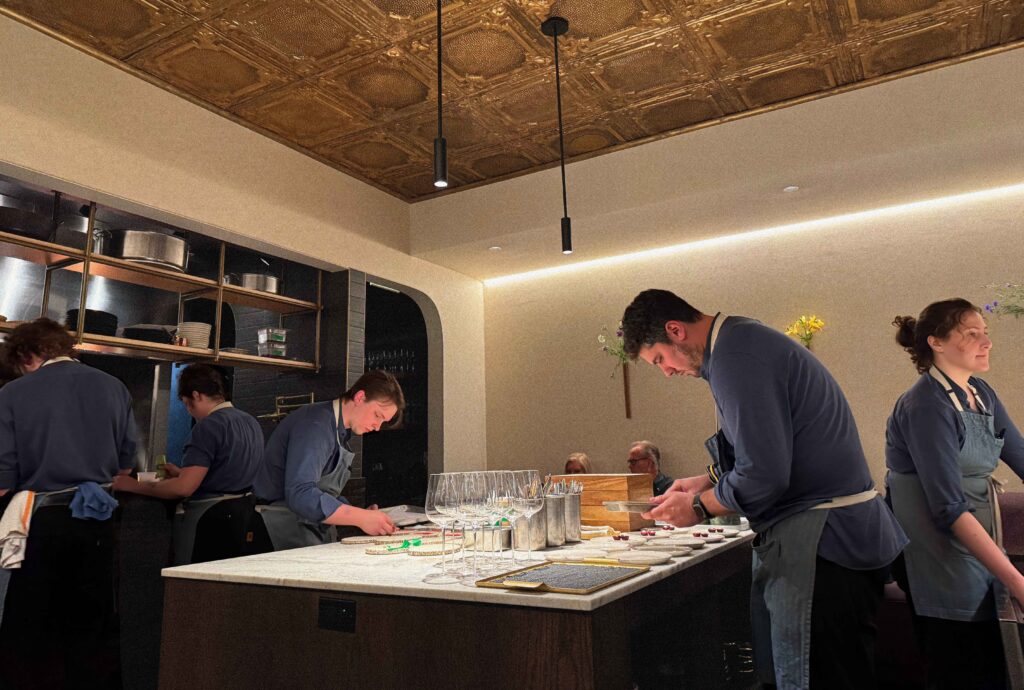
My twelfth meal at Feld left me feeling that the restaurant—for all its controversy and tribulation—has now comfortably taken a place alongside Chicago’s finest.
One can certainly question whether Jake Potashnick really is the best chef in the entire Great Lakes region, but it’s hard to think of a toque who has done more to interrogate the essential structure of local gastronomy over the past couple years. Indeed, the James Beard Foundation doesn’t just hand out lifetime achievement awards. The organization actually remains relevant—and true to its mission—by going to bat for people (however raw in their talent) pursuing paradigm shifts in the face of public scorn and ridicule.
Feld, once it weathered those first few months, has undoubtedly become a critical darling. Potashnick’s philosophy—crafting a tasting menu centered on purveyor relationships and storytelling rather than conventional markers of luxury—always felt tailormade for anyone who spends too much time dining out (and, thus, has grown tired of its common tropes).
But getting mainstream consumers on board, whether they were put off by early impressions or simply perceive the concept’s cooking (with its meager plates of fruit, vegetables, and cheese) as something like a bad caricature, is a trickier task. Maybe a critical mass of honors will move the needle (or, just as easily, stoke longstanding tensions between the pretentious, out-of-touch gastronomic elite and those everymen and everywomen who only want to eat well). Maybe it will take a second Michelin star for the import of what the Feld team is doing (whether or not you agree with how the head chef first went about it) to become undeniable.
After all, perpetual growth is the rule here—how could it not be after such a dramatic redemption? Still, Potashnick has admitted to me, in passing, that he is not sure how the kitchen will continue to surpass its previous work with each subsequent visit (acknowledging my usual praise).
Yet the question at this point is not so much one of improvement: Feld has reached a plateau of excellence in which even their weakest dishes remain wholly enjoyable and their strongest dishes rank among the most delicious in the city. Being so ingredient-driven (like Cellar Door Provisions, Kyōten, and Smyth), the restaurant cannot be expected to always deliver more and more pleasure.
Rather, we reach a point where we must recognize that our enjoyment hinges somewhat on personal proclivity (i.e., a preference for the textures and flavors that only certain produce, served at certain points in the year, can provide). The sharpening of the team’s technical prowess (when it comes to baking or preservation or tempura) surely plays a part. So does the development of a more longstanding Feld canon—nostalgic preparations through which repeat diners can track incremental growth over time.
However, having become so confident in the team’s ability, I am really starting approach each of the menus as a small chapter in a much larger story: one (with a baseline of quality now assured) that reveals as much about my own tastes as it does the talent of the chef. Put another way, I know the hits are bound to come, but I don’t know exactly how and why the bounty of one season or another will get me there.
Frankly, it’s exciting terrain—and the kind I cannot wait to survey on this thirteenth visit.
Let us begin.
When I think about how much room Feld still has to grow, I reflect on the mere number of seatings the team actually stages in a given week: one on Wednesday, one on Thursday, one on Friday, and two on Saturday. We’re practically talking Kyōten numbers of exclusivity—only with the benefit of a full a team (and a comparably cut-rate price) shaping each performance.
On the back of all the positive press, the restaurant is now filling its books three months in advance. Starting in September, it will now be hosting two seatings on Friday with some regularity (something of a throwback to all the excitement and hopefulness that surrounded the concept back at opening). Scaling down the hours of operation was a product of necessity. Ramping them back up—slowly, carefully—is a cause for celebration.
I’ve always favored Saturday’s earlier timeslot, which gets me out the door before 7:30 PM (if I leave immediately) or 8 PM (if I stay for s’mores and a chat). With the next round of customers not due to arrive until forty-five minutes after that, the staff always leaves themselves plenty of time to warmly see the previous diners off while simultaneously readying the space for a second show. Most importantly, I’m certain anyone who is inclined to converse and connect with Potashnick is granted ample opportunity to do so (imbuing the concept’s experimental cuisine with the kind of emotional underpinning that creates lifelong fans).
Tonight, I arrive for a rare (to me) 7 o’clock Friday seating, and, while I cannot claim I really notice any change in the tone and tenor of the team’s performance, perhaps my own expectations are different. This is one intimate dining room, being taken on one singular journey, with no defined limit, and no chance of ever occurring (in exactly the same manner) again.
I’m speaking, again, of a very subtle emotional gradation, yet one I think is meaningful once a consumer comes to realize how many one- or two- or even three-Michelin-star restaurants really operate as anonymous assembly lines once you get past their pomp. Eating at Feld feels more like a discrete, indelible encounter with the chefs’ shared dream, and I find walking through that door at the very prime moment of the evening only heightens that effect.
Before buckling up and enjoying the ride, I need simply decide what to drink.
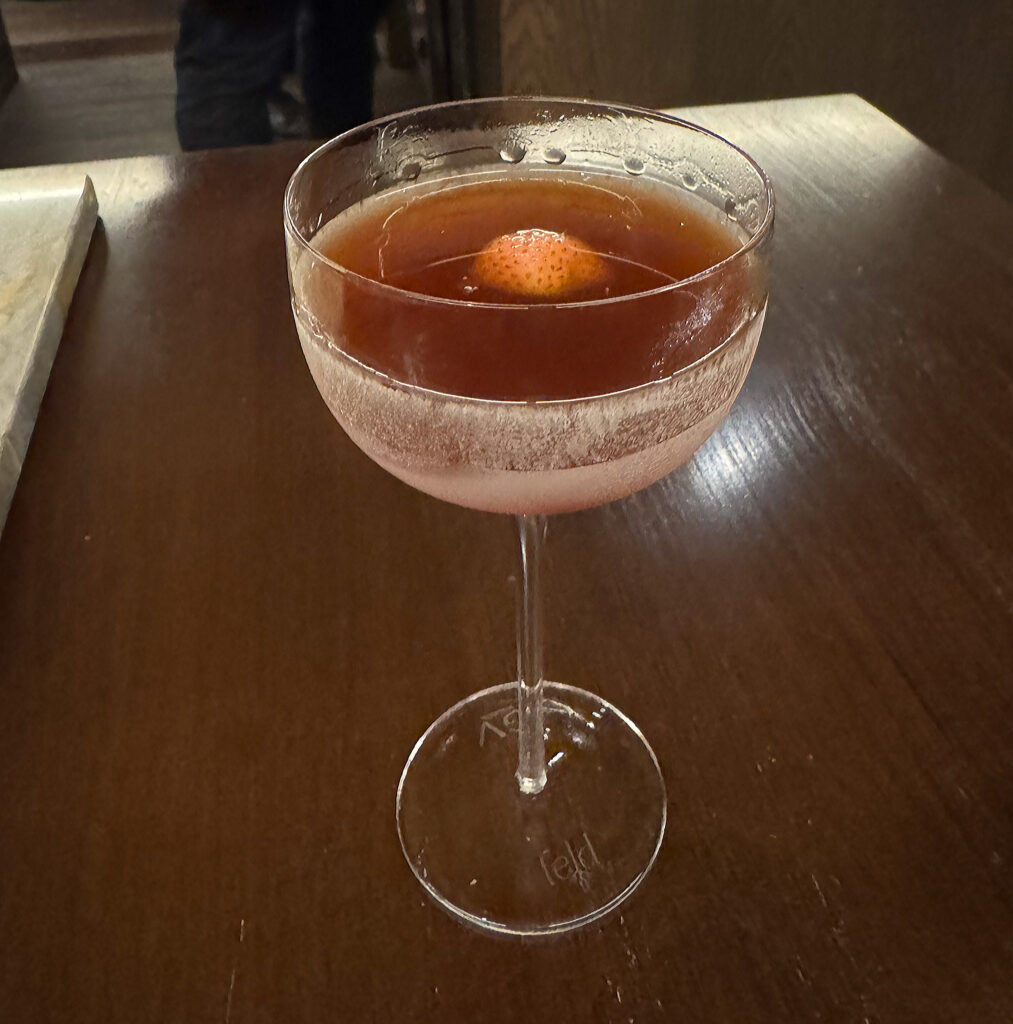
Having spied a “Freezer Door Cocktails” section on the wine list, I resolve to kickstart my evening with a potent libation. The martini seems like an obvious choice, but general manager/sommelier Nathan Ducker steers me toward a “Strawberry Manhattan” ($20) that has just been added to the menu.
Feld’s idea is to offer a different rotating cocktail with each season, and it’s hard to argue with the results. Indeed, this is not a recipe I’d ever be inclined to order (given its reputation for booziness). However, the blend of Ohishi Whisky, Scarlet Radice Amaro, strawberry-flavored umeshu (i.e., plum wine), and a piece of white strawberry (“treated like a cocktail cherry”) provides an elegant Japanese inflection. Helped by the cold serving temperature, the drink tastes rich and rounded while substituting the usual spirit-forward character for an engaging medley of fruit and botanicals ending on a note of mild, lasting sweetness. Overall, this Manhattan forms a nice, bracing way to start the meal. I would not hesitate to order it again.
Nonetheless, the “Cellar Flight” ($325)—in combination with a couple bottles brought as corkage ($75 each)—remains my preference here.
The present lineup is as follows:
- NV Egly-Ouriet Champagne Premier Cru “Les Vignes de Bisseuil” [$125 at local retail]
- 2015 Didier Dagueneau Pouilly-Fumé “Silex” [$199.99 at national retail]
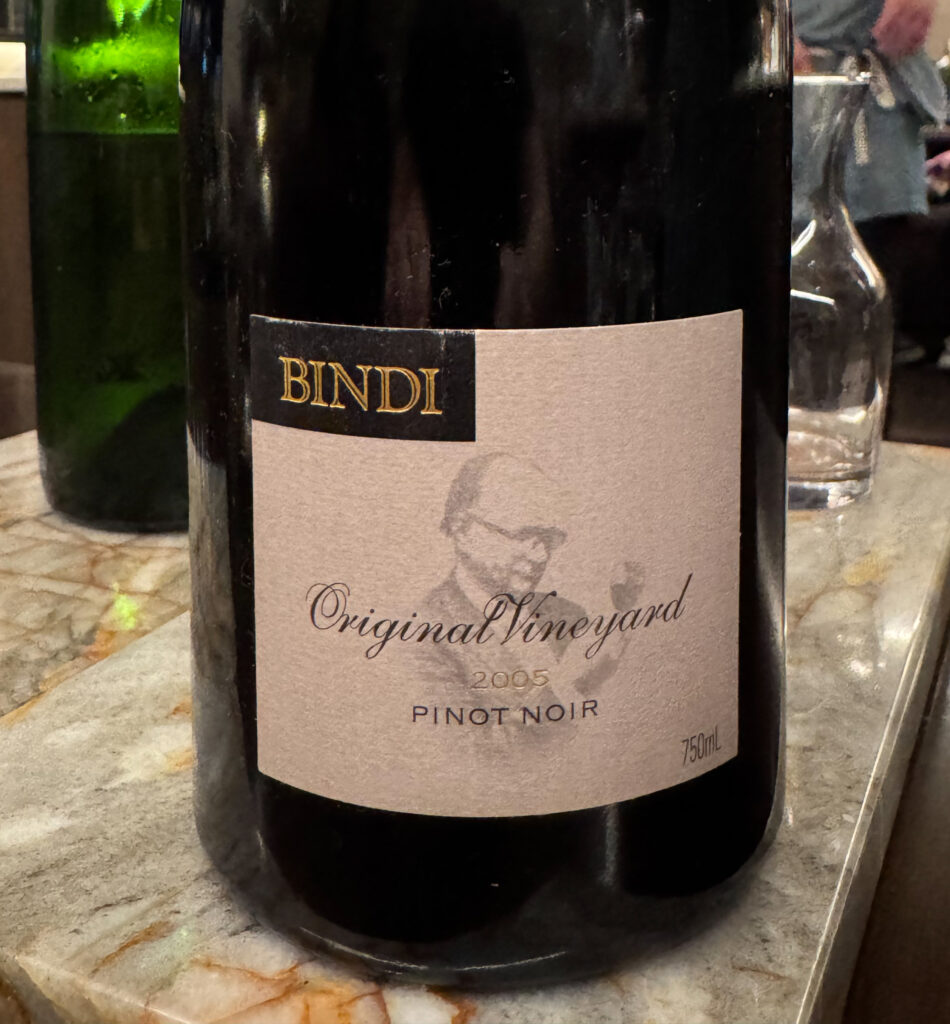
- 2005 Bindi “Original Vineyard” Pinot Noir [$99.99 at national retail]
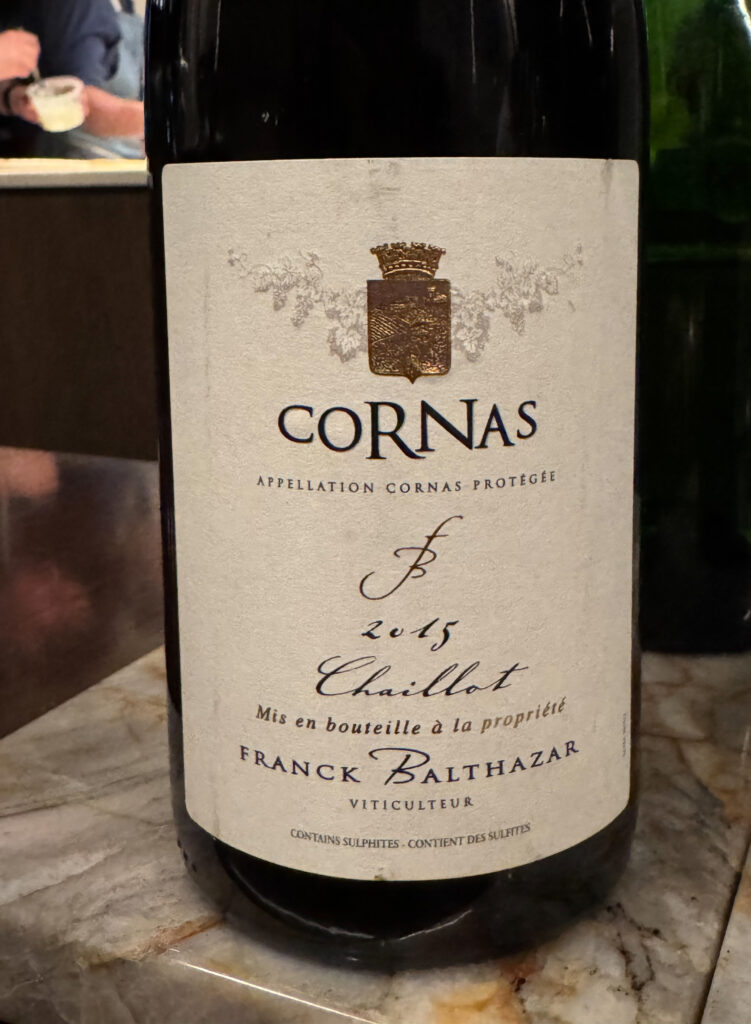
- 2015 Franck Balthazar Cornas “Chaillot” [$145 at national retail]
- 2002 Dönnhoff Oberhäuser Brücke Riesling Auslese Goldkapsel [$81 at national retail for 375 mL]
While Ducker is quick to admit that the Egly-Ouriet represents a repeat from May’s pairing—the kind (given the quality of the estate and the general tendency not to serve Champagne here) any oenophile would wholeheartedly welcome—I think the rest of the selection represents a real high point for this premium offering.
The core value proposition remains consistent: the opportunity to sample five different producers in the $100 to $200 range rather than spend that $325 on a solitary wine (like, say, a Ganevat Chardonnay) from the wider list. However, I appreciate that the chosen bottles—each, save for the sparkling, unavailable à la carte—are skewing older. I like that they boast increasing name recognition (not necessarily a marker of quality yet something mainstream consumers will no doubt prize).
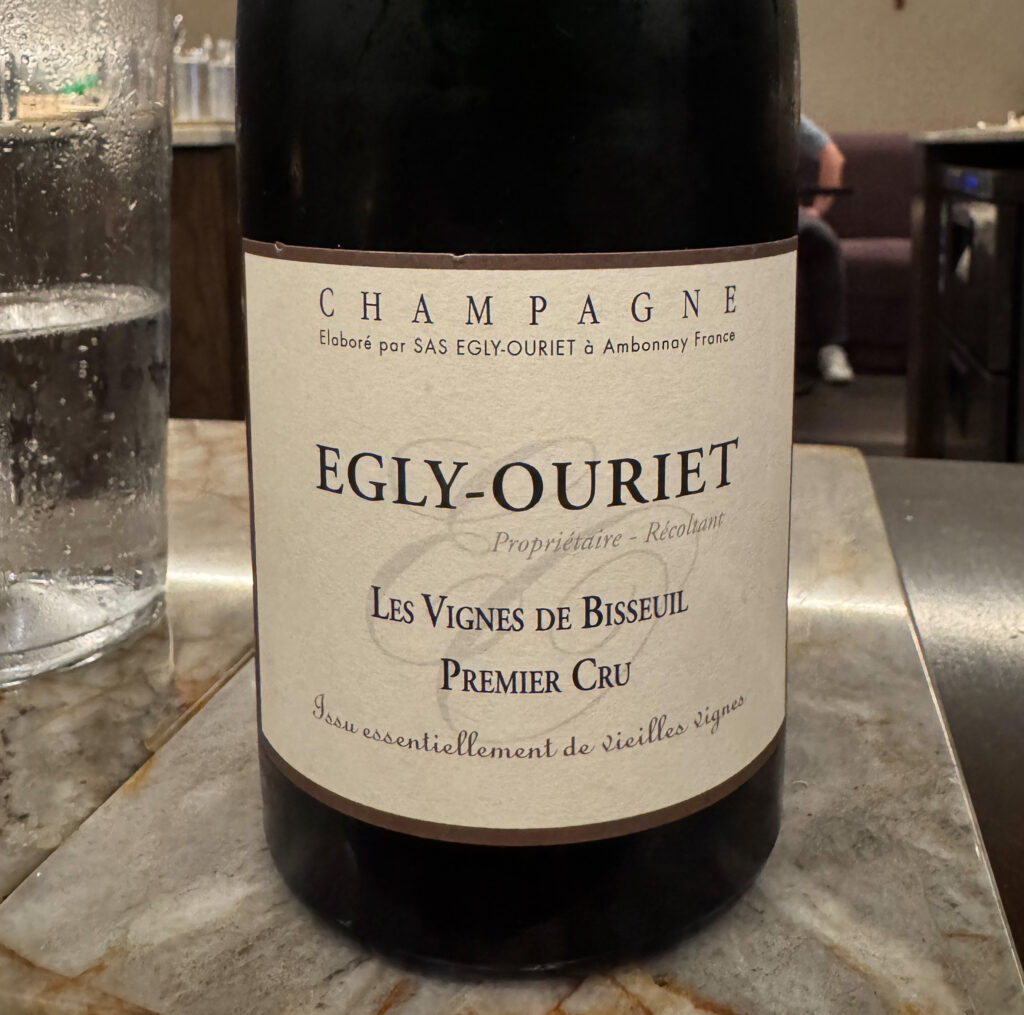
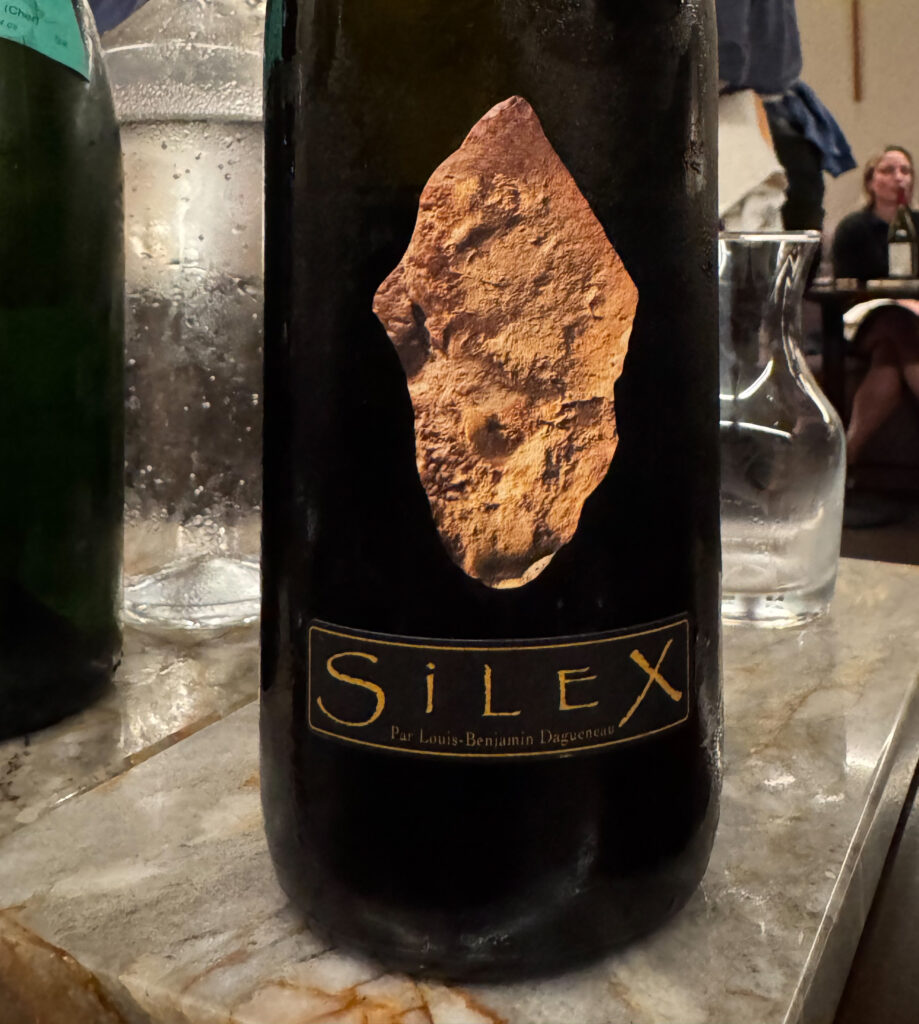
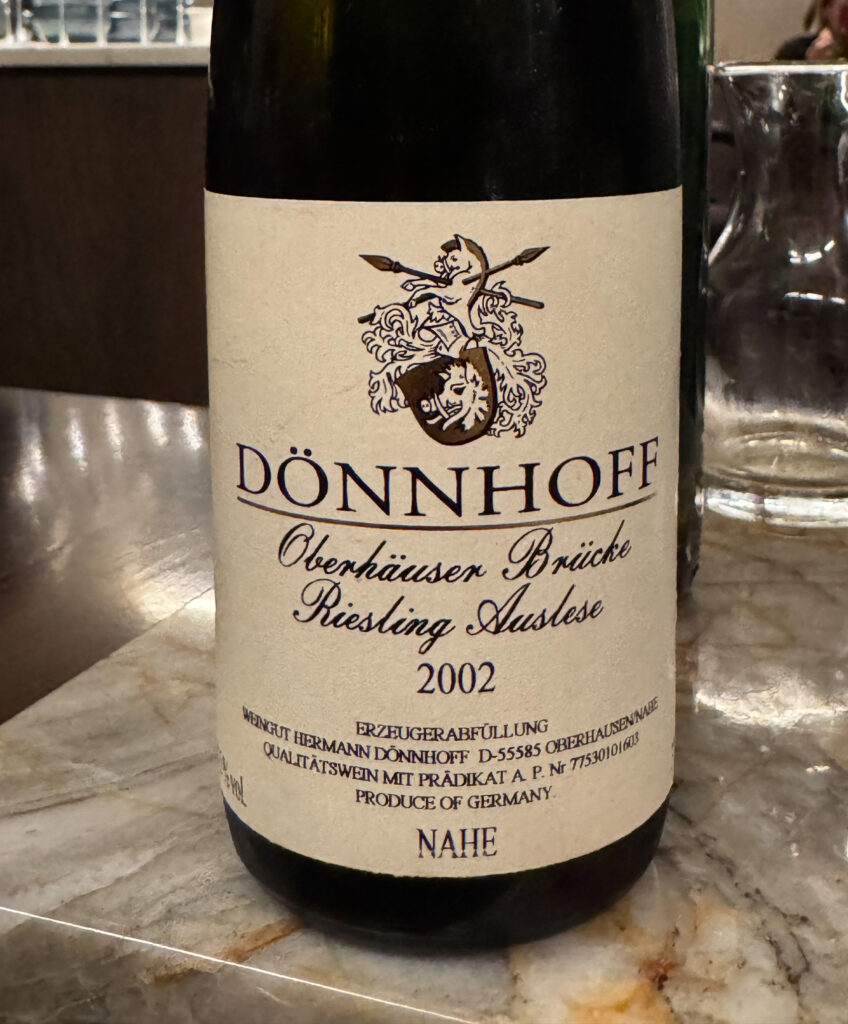
And I especially admire the kind of timeless pleasure the combinations pursue: Champagne with the opening bites (like the tempura), Sauvignon Blanc with five presentations of peas, aged Pinot Noir with heavier seafood, Syrah with coal-grilled pork, and botrytized Riesling with the fruity, caramelized notes of dessert. These are the moments of indulgence that drinkers—whatever their level of snobbery—seek out.
So, even though I’ve said the “Cellar Flight” works best as a turnkey solution for parties looking to splurge (given what $650 or, for groups of four, $1,300 can get you from the estimable bottle list), I’m increasingly drawn to its dynamism. Sharing one of these pairings as a party of two—while supplementing it in the manner I described above—feels like a sweet spot.
It empowers Ducker to share his passion with the table and lavish one’s evening with an additional layer of storytelling. Given how central the team and its personalities and personalities are to shaping the guest experience, it’s hard not to spring for some kind of flight (especially given the affordability of the base options) that secure this extra interaction.
Personally, I look more and more forward to uncovering this highest expression of the sommelier’s work with each visit. It’s hard to imagine enjoying a meal at Feld otherwise, which I think reflects just how well the beverage program (both in its peak and more approachable forms) complements the cuisine.
With everything and everyone in place, Feld’s latest tasting menu comes to life: celebrating a point in the season (Potashnick shares in a quick aside) in which asparagus has yielded to English pea and the last of May’s old, familiar seafood now sees itself joined by a couple new fish.
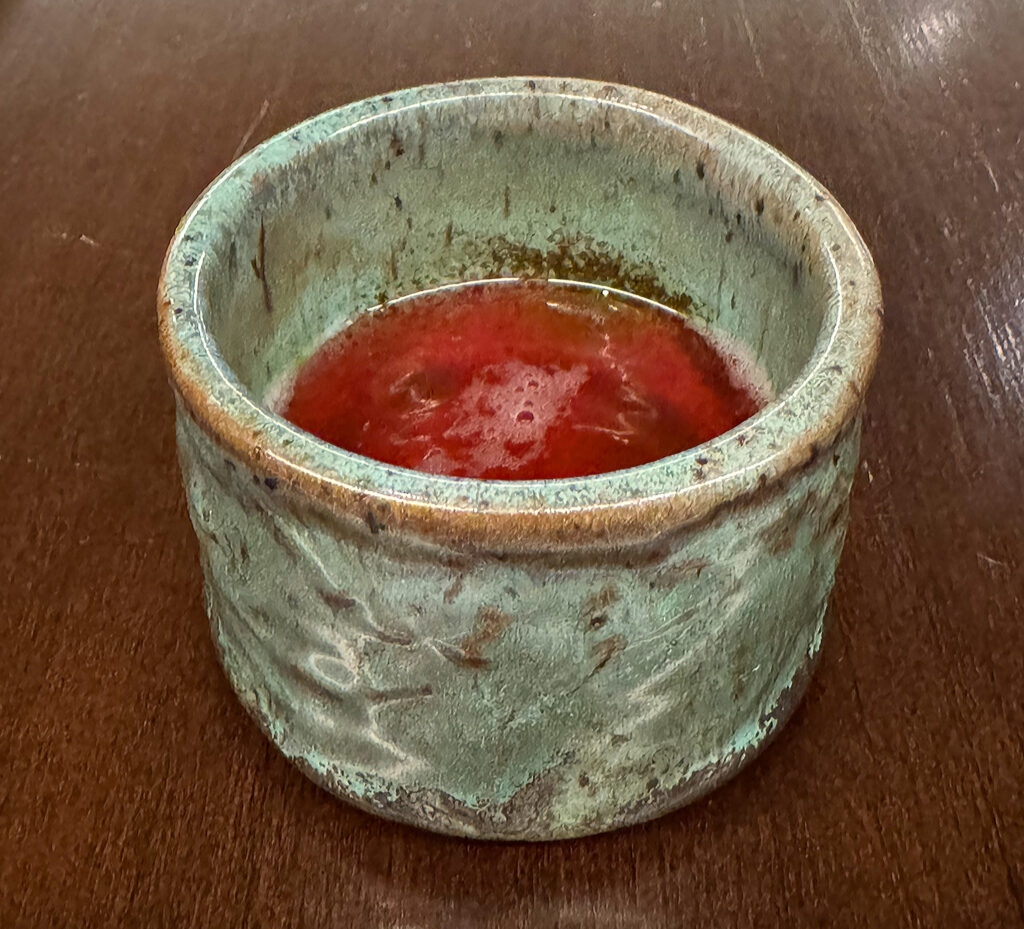
As always, the progression actually starts with pour of something that arrives the moment you sit down: in this case, a small cup of “Rhubarb and Chamomile Tea” whose puckering attack, sweet midpalate, and smooth, grassy finish acclimate both mind and tongue to all the complex flavors to come.
Given how much I celebrate the wider beverage program here, it’s easy to think of these brews as an afterthought. Nonetheless, they are consistently well made, thematically appropriate, and even generous in a sense. These drinks form an immediate expression of the team’s hospitality, and I think they would be doubly appreciated by any guest who (for whatever reason) planned only to drink water
It is “The Drop”—what the restaurant titles its opening salvo of bites—that really inducts diners into the concept’s creative process. These ever-changing seasonal items allow the highly collaborative kitchen to present its most fleeting, experimental ideas (the product of ingredients that may never appear in just the same way at just the same time again) with the least amount of risk.
Indeed, much of this signature presentation’s appeal lies in the fact that so many intricate servings arrive all at once: a total nine on this occasion (down from 10 in May and 11 in January but up from eight in April). Individual quality—for I cannot say these morsels usually rank among the very best offerings of the night—tends to be subsumed by a larger sense of discovery. Weirdness (or shall we say “intellectual appeal”) can coexist with straightforward deliciousness without throwing the entire sequence off.
However, this present iteration of “The Drop” might stand as one of Feld’s finest. Showmanship aside, there are actually a few recipes that rival the headlining plates found later in the meal, making for the sort of performance that transforms this spread from a pleasing novelty into a bonafide highlight.
I will present the components in the order listed on the written menu:
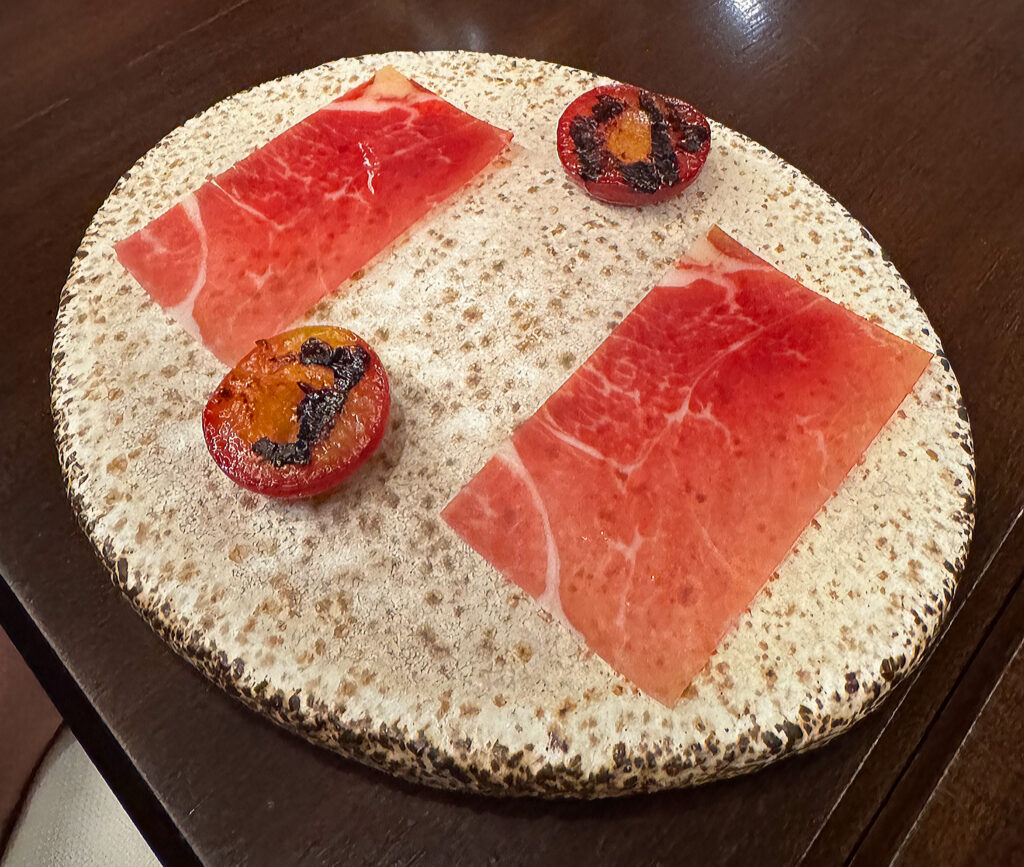
“Benton’s Ham” has formed one of the restaurant’s favorite motifs since opening, and it has been subject to all sorts of treatment (and mistreatment) during that time. Yet lately, the chefs have done a great job of honoring the ingredient’s fundamental appeal. Here, the cured and smoked pork is thinly sliced into a neat rectangle. A brush of coffee oil (referencing red-eye gravy) then adds roasted, subtly bitter depth to what is a beautifully fatty, salty, satisfyingly meaty expression of ham. Overall, it’s an intriguing combination—and one that yields memorable pleasure.
The “Grilled Plum” that accompanies the Benton’s is topped with nothing more than a pinch of basil salt. However, the resulting savory boost (displaying undertones of earth and pepper) plays nicely with the fruit, whose crisp and juicy consistency frames a powerfully sweet, jammy flavor with hints of smoke and softened tanginess on the finish. This bite is so elegantly conceived and a real delight opposite the richness of the pork.
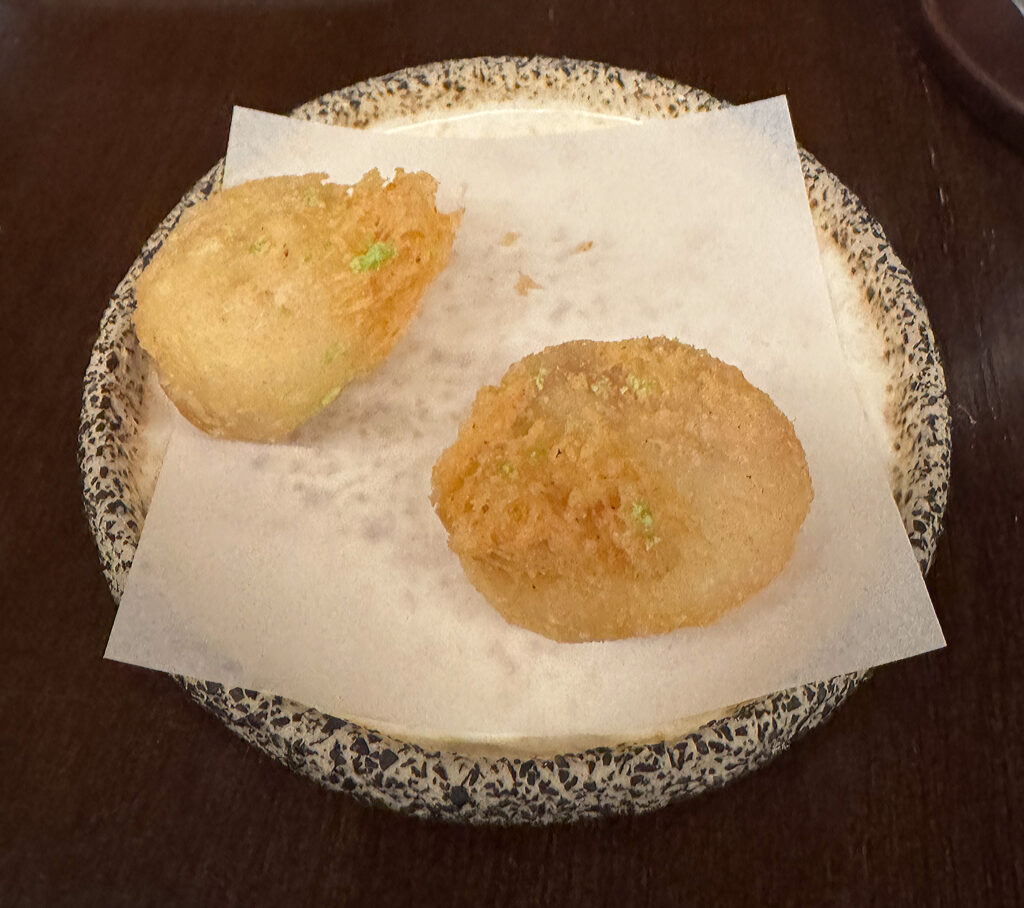
A bite of “Tempura Mochi” forms the latest test of the kitchen’s frying technique (which has gone from faltering to downright refined in the span of a couple years). The present recipe—in which a filling of bacon jam and strawberry is wrapped in the titular rice cake before it meets the oil—might represent the absolute peak of the chefs’ prowess. Texturally, the tempura skillfully blends the mochi’s signature chew with a clean, brittle crispness. Nonetheless, it’s the warm, oozing layers of sweet, smoky, and fatty decadence one finds inside that prove superlative. Yes, though the team wasn’t quite sure this item would actually make it on the menu tonight, it actually forms the high point of the entire sequence!
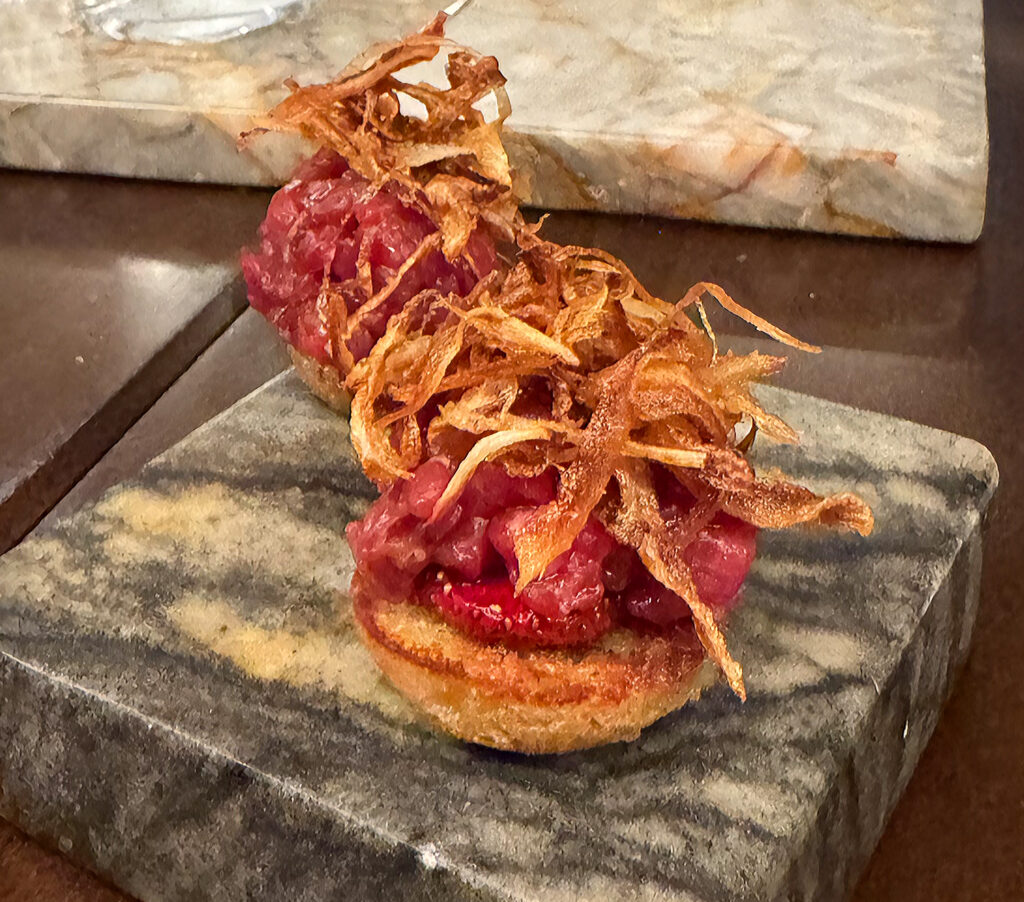
The ”Beef Tartare” also offers a new twist on a familiar form: the beef fat-fried pancakes that have acted as vessels for myriad ingredients (like mackerel and mussel) during meals past. The present combination—combining fine chunks of meat with a tangle of crispy onions—sounds rather straightlaced. However, a single slice of strawberry adds intrigue: with its mild acidity and sweetness helping to invigorate the beef without detracting from the nibble’s plush, crisp, and expectedly savory appeal. Ultimately, this makes for the most cohesive of these pancakes Feld has thus served.

A “Dill Tartlet” follows in the footsteps of all kinds of dainty, flaky shells. And, to be clear, the kitchen has always executed these vessels with an adequate degree of delicacy. It’s only the fillings that have occasionally faltered, yet the present combination—impossibly thin slices of green been set atop a cream made from the titular herb—impresses me. I like how the fine crunch of the vegetable plays against the more brittle crispness of the tart. Moreover, the resulting flavor (clean, tangy, with undertones of anise) distinguishes itself from all the meat and fruit and seafood on offer. Though I didn’t expect this preparation to make much of an impression, it actually ranks toward the top of the entire progression.

Visually, the “Salmon Belly Day Lily” is undoubtedly the most eye-catching component of “The Drop.” The center of this expansive, orangish flower is matched by the color of the accompanying tartare (which sits at its very center). On the palate, the sizable petals are actually easy to process: yielding to the rich, tender consistency of the fish and a degree of flavor (balancing a subtle oceanic quality with the brightness of kumquat) that is pleasantly persistent. I feel this item could have so easily gone wrong, yet it actually displays admirable finesse.
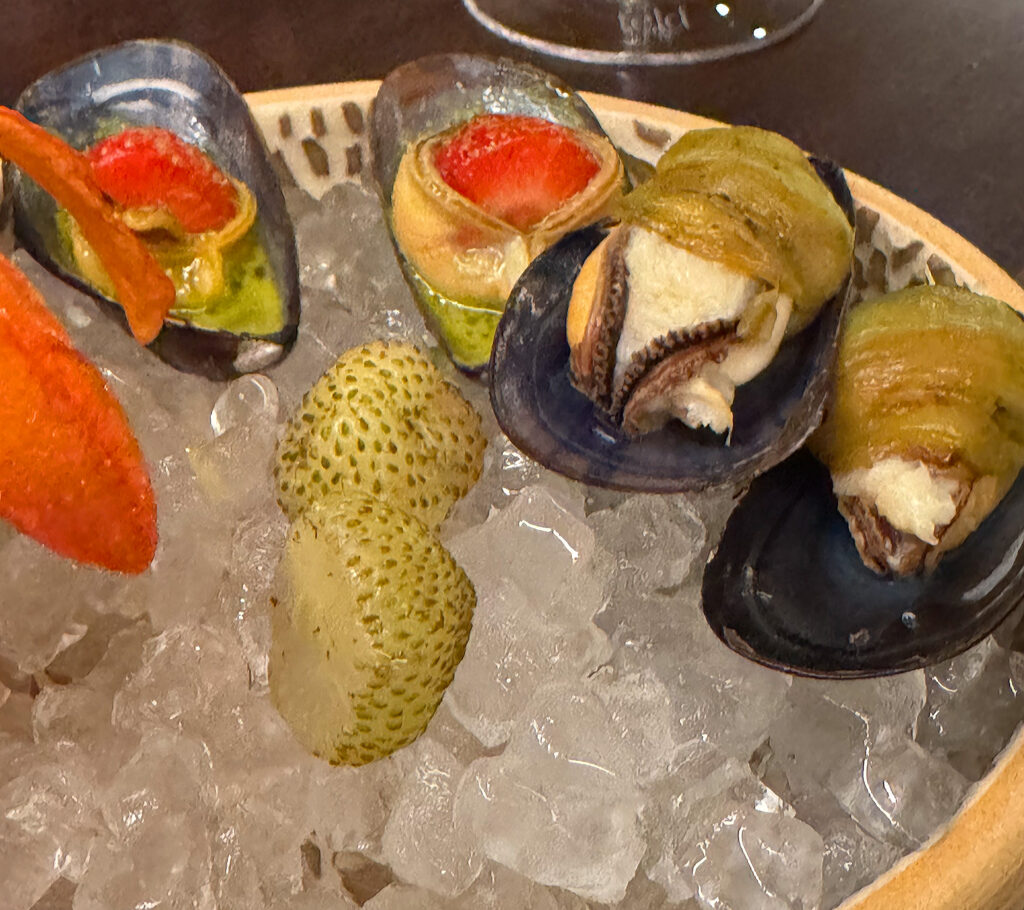
The “Green Strawberry” (partially obscured by the day lily) is served unadorned, and there’s not much to get excited about upon encountering its firmer, tarter profile. Still, I can appreciate the chefs using this opportunity to introduce patrons to the ingredient—in an entirely raw state—before utilizing the fruit elsewhere.
Served alongside the preceding bites, a set of “Stuffed Mussels” offers two competing expressions of the bivalve. The first—stuffed with crab and topped with banana pepper—explores a mildly sweet, briny profile with a very faint tangy/vegetal note. The second—stuffed with strawberry and dressed with a fennel escabeche—feels plumper and more exuberant in its acidity. While I do not find that either preparation of shellfish really blows me away, I do think the construction (that is, the way the mussel wraps around its filling) is clever.
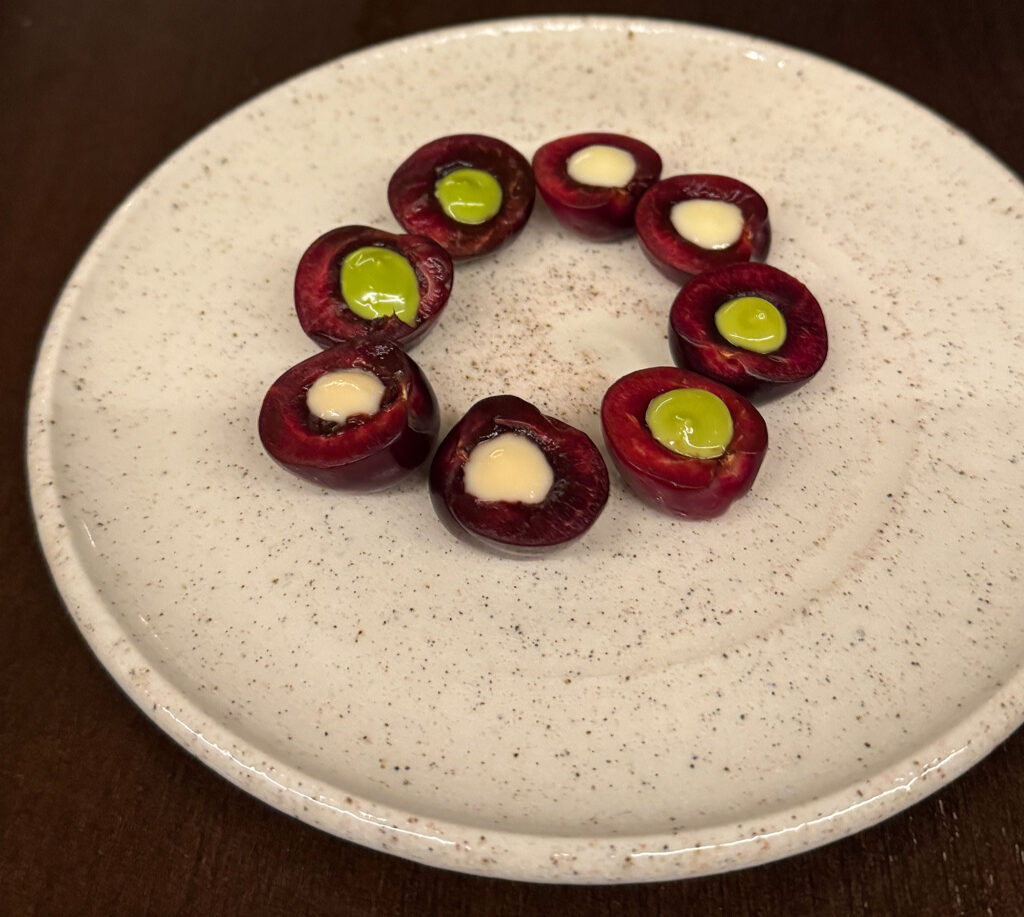
Finally, we have the “Cherry^4”—four halved segments of fruit each filled with a different, unnamed emulsion. In fact, the team makes a point of stressing that the accompanying flavors “don’t really matter.” With each mouthful, I appreciate the fresh, juicy sweetness of the cherry and the way its character veers toward bitter herbaceousness or what seems like yuzu tartness depending on the sauce. The identities of the various dressings are (somewhat intriguingly) never revealed. However, given that I enjoy this item last, I can appreciate the preparation as a sort of multi-faceted palate cleanser used to close out the progression.
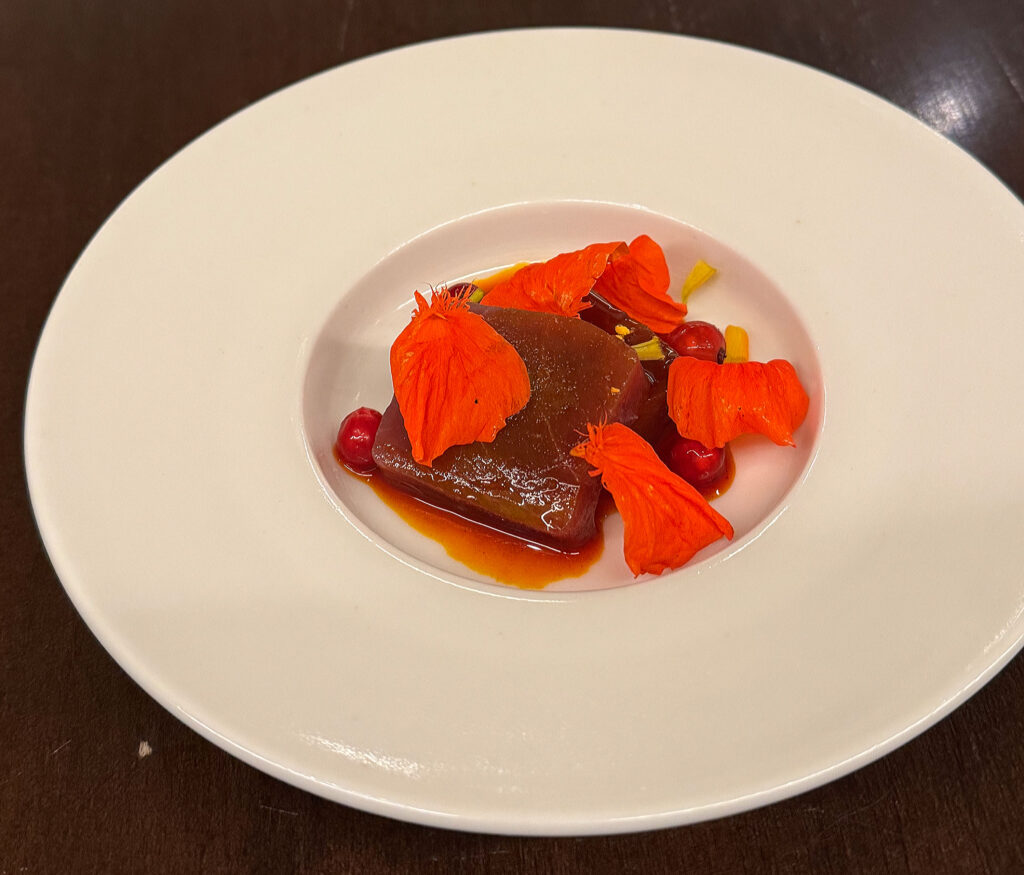
When the first proper plated course of the evening arrives, I can hardly contain my excitement. The “Bluefin Tuna—Tomato Vinegar” trades the comparably meager portions of “The Drop” for a substantial presentation of ruby-hued fish. Wild-caught from Maine, this particular specimen proved so intensely irony that Potashnick sought the counsel of Kyōten’s Otto Phan (who advised this character is not only appropriate but actually prized).
In order to play off of this concentration, the chef bolsters the titular tomato vinegar (made from last season’s heirloom varieties) with a sauce made from beetroot and a few redcurrants. Texturally, the tuna itself—rendered as large, glistening slabs—displays a soft, cleanly yielding consistency with just enough fleeting structure to provide deep satisfaction. When it comes to flavor, tanginess leads the way. Nonetheless, I admire how seamlessly the sweeter and earthier notes of the accompaniments meld with that irony quality: softening its sharpness while shifting the finish toward something more balanced and savory. While a touch of soy sauce or salt would make this preparation positively stratospheric, it still ranks among the very best offerings of the night (and one of the finest I can remember ever having here).
Given that Feld only has the opportunity to work with peas for two or three weeks each year, the kitchen—on this occasion—dedicates an entire “Second Drop” to this fleeting vegetable. In my opinion, it’s a brilliant move: doubling down on the sequencing that forms such a signature of the restaurant while imbuing this subsequent progression with a greater focus and rationale.
The five components are as follows:
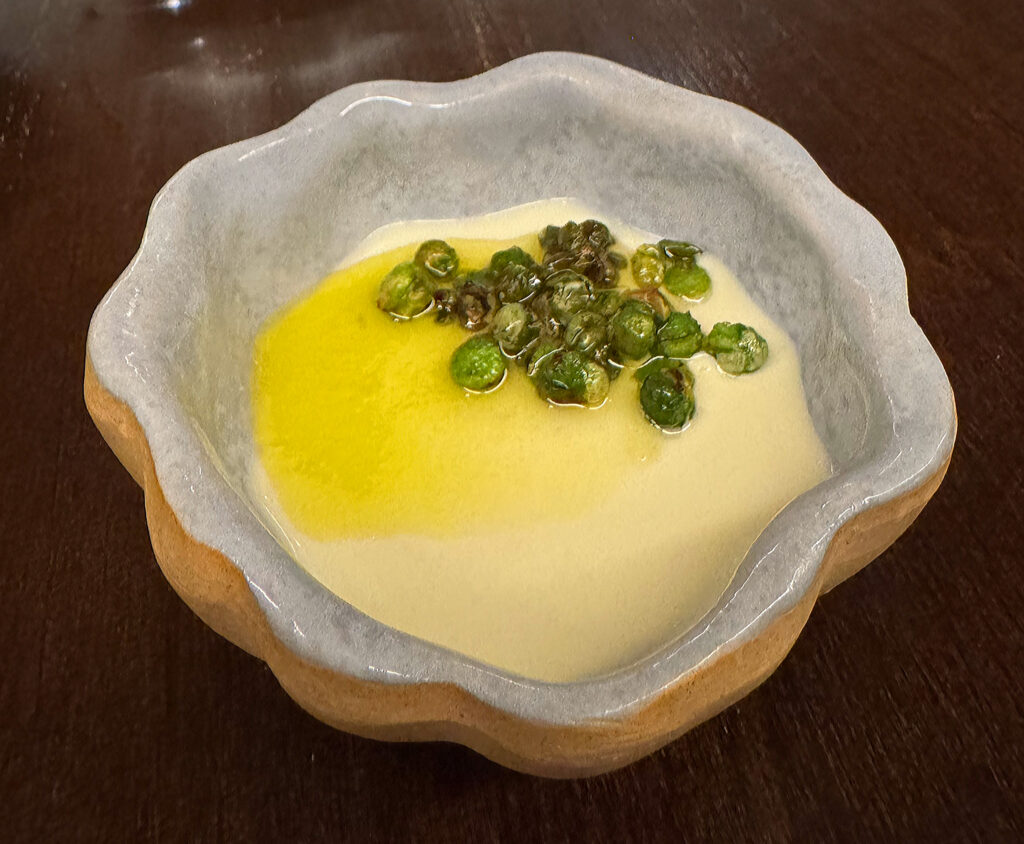
A “Pea Panna Cotta” pairs a sweet, creamy base with the citrus tones of lemon verbena, the sharpness of an olive oil drizzle, and the crisp, salty notes of fried peas. Overall, the combination is hard to fault. Despite missing that extra dimension of emotional appeal, it ranks among the stronger members of the flight.

The “Pea Soup,” in turn, is a runaway hit. The dish combines with an incredibly pure, resoundingly sweet base (made from the vegetable) with a warm Pleasant Ridge Reserve mousse whose creamy, salty, and caramelized concentration leaves me desperately scraping the bowl in search of just one more drop. Of all the ways the chefs have utilized this cheese in the past, this preparation—so resoundingly simple—proves the most memorable.
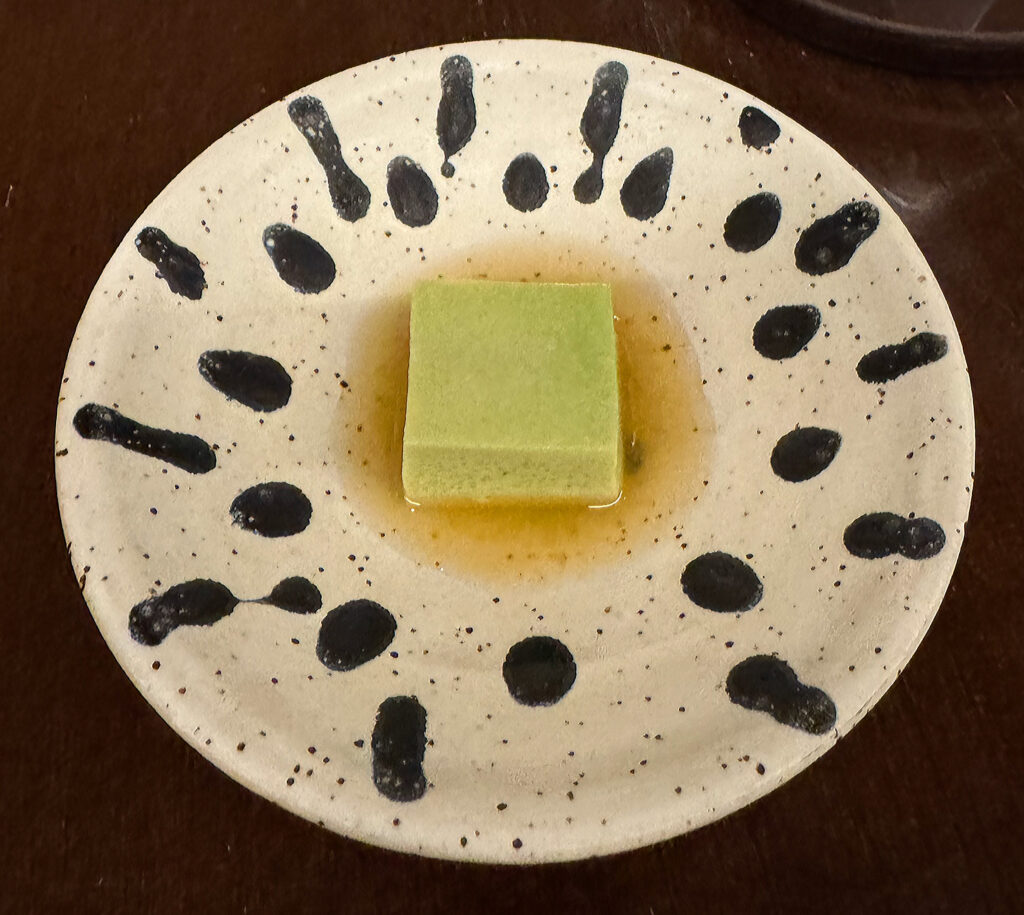
A serving of “Pea Tofu” takes the form of an attractive little square. I appreciate its cool, creamy consistency and the refreshing flavor profile (drawn from a white soy sauce ponzu and some fresh wasabi) it exhibits. For my taste—and this is a longstanding criticism—I’d like the influence of the wasabi to be even more pronounced (shaping an even more extreme juxtaposition). However, despite ranking at the bottom of the sequence, this recipe remains wholly enjoyable and worth appreciating for its softer touch.
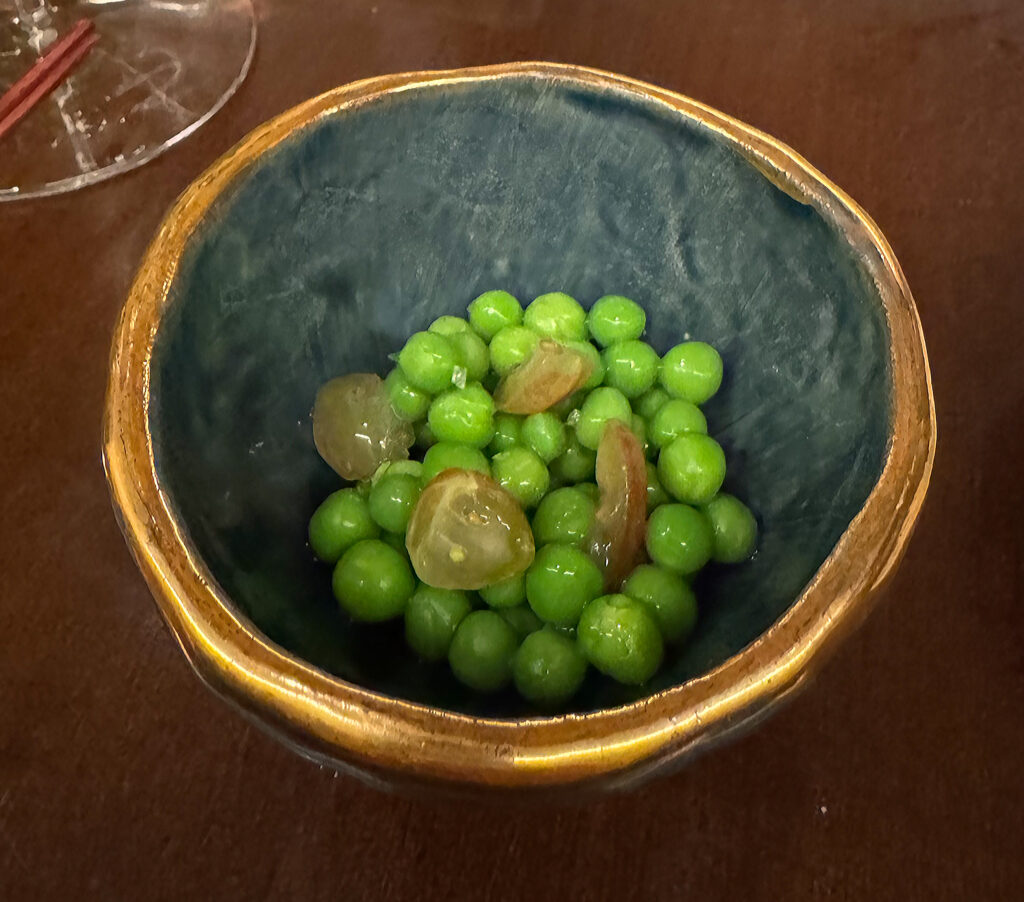
The ”Chilled Peas” (which are blanched, cooled, dressed with elderflower vinaigrette, then garnished with a few gooseberries) also lands on the lighter, more intellectual side. That said, the texture here—displaying the vegetable in all its subtly crisp glory—is sublime, and the accompanying notes of floral tang do well to emphasize the ingredient’s fresher, greener character while retaining some sense of enjoyable sweetness. Ultimately, I put this just ahead of the tofu.
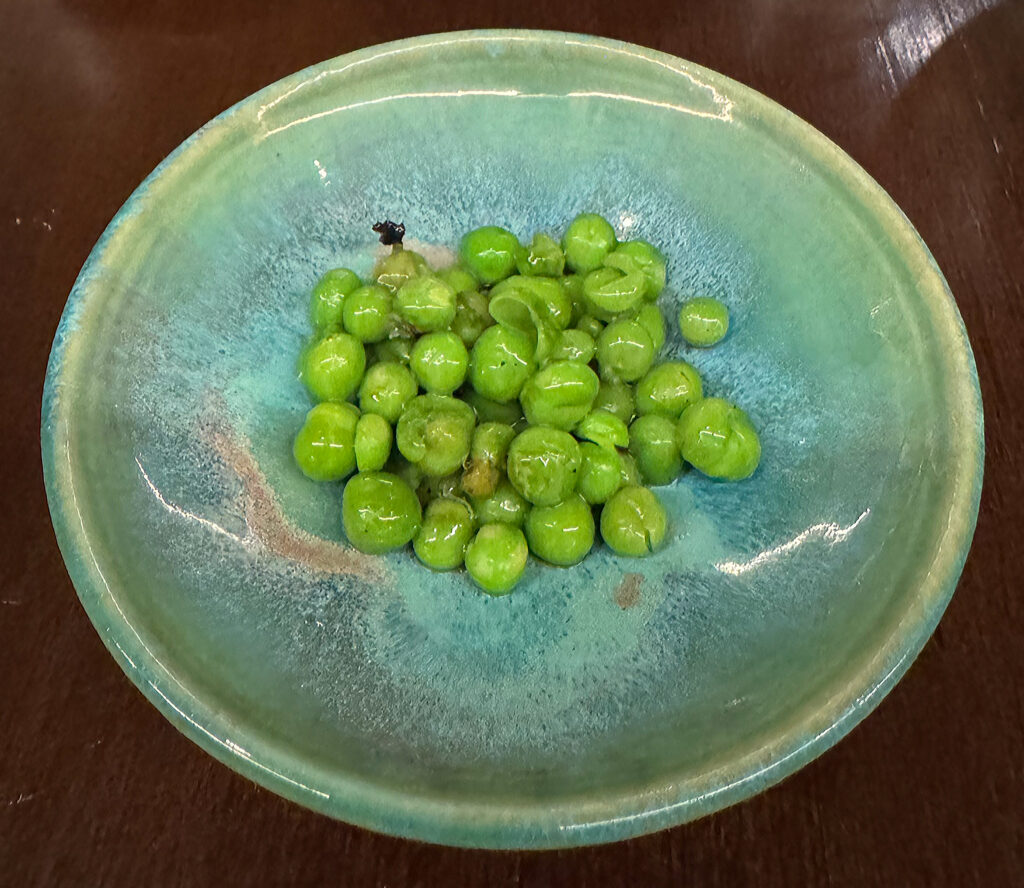
Finally, the “Grilled Peas”—paired with nothing more than goat’s butter and salt—form my second favorite member of the sequence. There’s nothing revolutionary here: just a feeling of plumpness, crispness, fleeting tang, sweet smoke, and ample salt that yields a fairly classic, adeptly balanced expression of the vegetable and all the eternal satisfaction it entails.
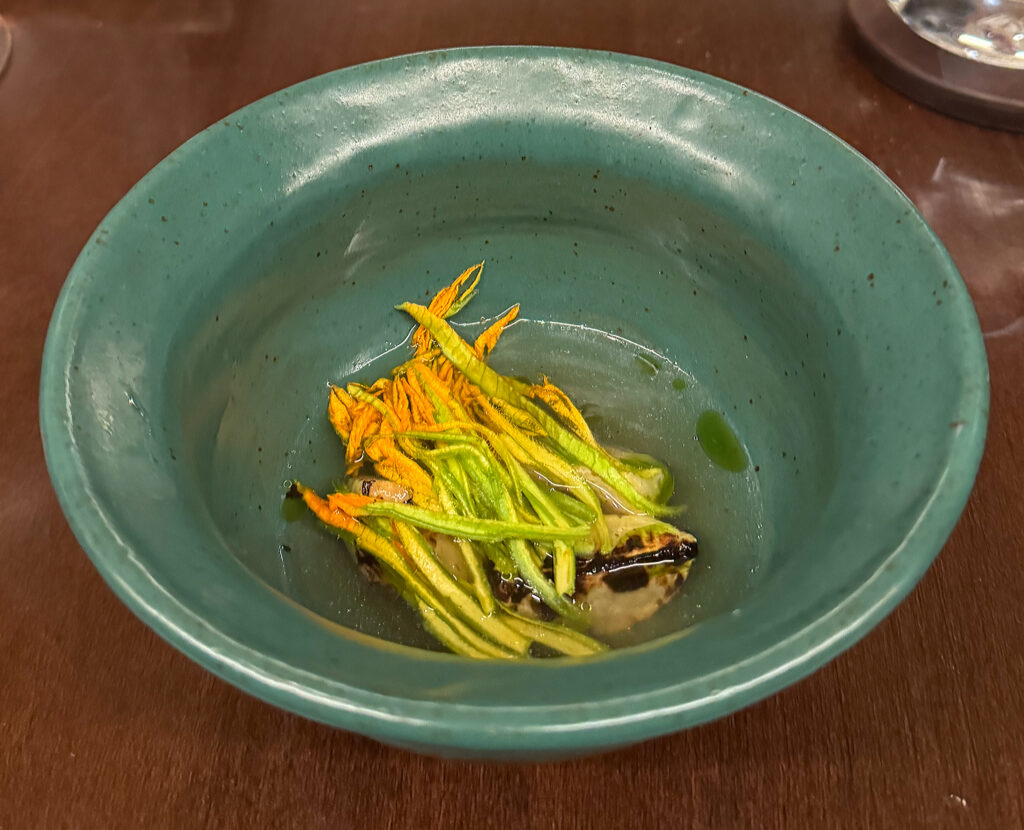
Returning to the flow of individual presentations, I am met by a preparation titled “Hakurei Turnip—Ham Dashi” that looks and sounds like a repeat of what I encountered back in May. Nonetheless, while the core juxtaposition of grilled root vegetable, porky broth (made from Benton’s of course), and ramp oil remains the same, ribbons of squash blossom add a pop of color and touch of structure that ensure the bowl feels a little less sparse.
Otherwise, the crunch of the turnips (intentionally left “a little al dente”) and their hint of bitter char play well with the salty, deeply savory dashi. On the finish, a vein of sweetness even comes to the fore. Ultimately, while I think this recipe more or less maintains the same level of quality (i.e., good but not memorable) it showed last time, I do appreciate the team’s effort to complement the original composition with a new, harmonizing seasonal ingredient.
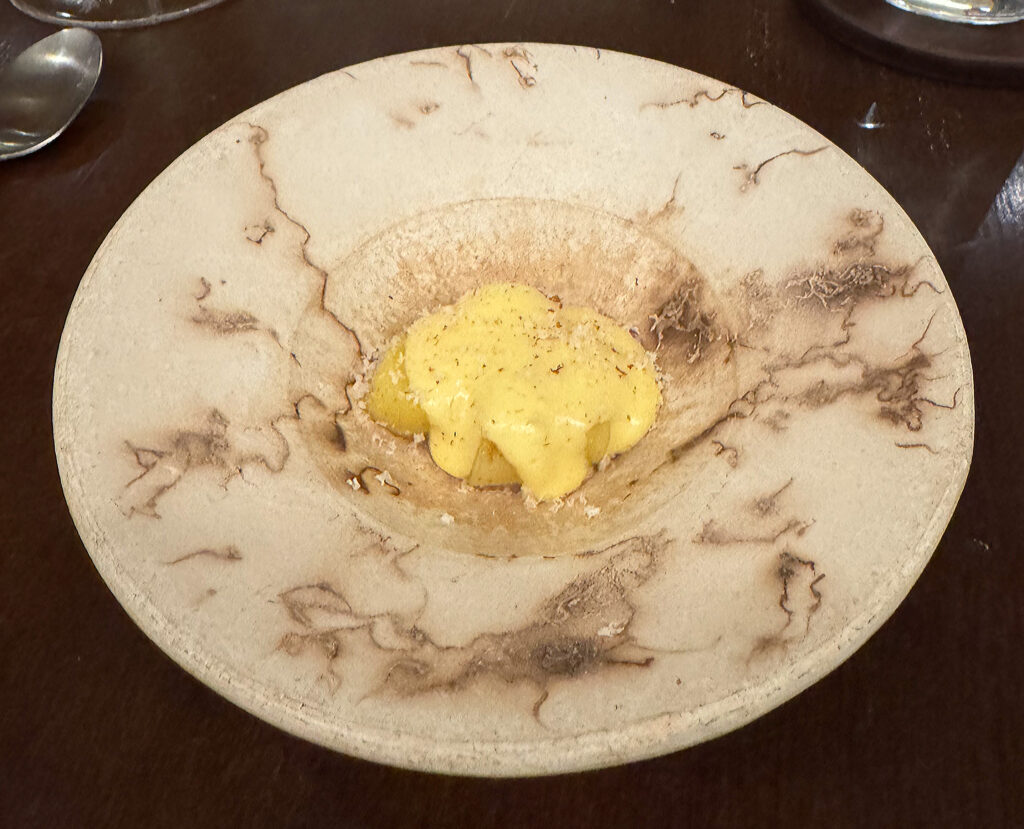
By comparison, the “Austrian Crescent Potato—Almond” is entirely: representing the kind of worshipful (and somewhat provocative) representation of produce that is so core to Feld’s identity. This particular tuber—sourced from Kankakee Valley Homestead—is a long, high-yielding kind of fingerling. The chefs steam them (using salt water), grill them (once again maintaining an “al dente” interior), and serve them sliced under a dressing of almond butter, grated almond, and ginger-infused hollandaise.
Texturally, the potatoes clearly subvert any expectation of crispiness or fluffiness. Instead, they are firmer, a little crunchy, and even a touch gummy. However, the creaminess of the accompanying sauce acts as an attractive buffer: helping to shape (along with the almond) a salty, buttery, and powerfully nutty flavor profile that better aligns with what I crave. The influence of the ginger, all told, is hard to pick out. But I think that’s to the recipe’s credit, for it does a good (if not utterly spellbinding) job of highlighting the character of the starring ingredient.
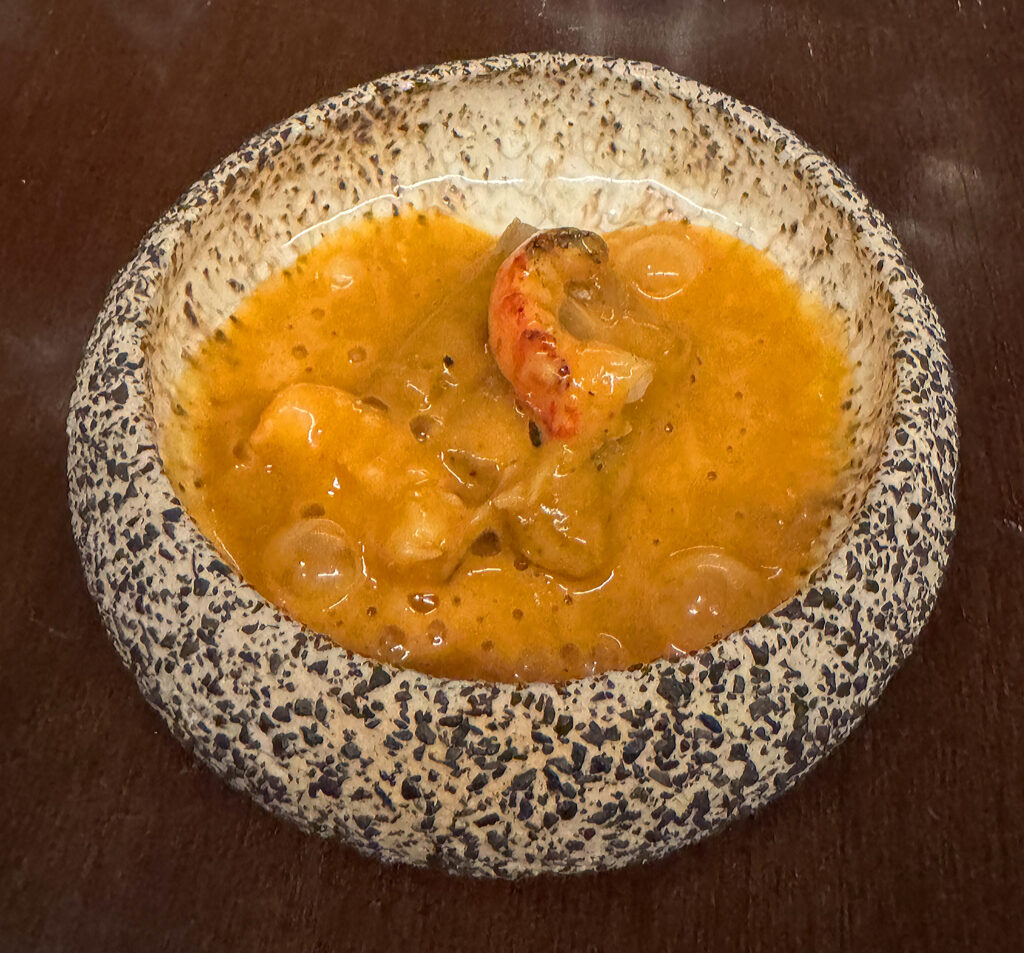
Arriving next, the “Oregon Signal Crawfish—Gnocchi” builds on the quality that this crustacean displayed last month, when it starred in one of the evening’s finest preparations. This time around, the shellfish is once more dressed in a mole amarillo made using last season’s Jimmy Nardello peppers (now also featuring apricot). As before, a crawfish butter further deepens the meat’s flavor. Yet it’s the introduction of a couple Parisian gnocchi (enriched with masa and serving to replace the previous rice porridge) that proves key.
These soft, ephemeral dumplings do a great job of cushioning—and thus enhancing—the plumpness of the seafood. They also soak up the accompanying sauce, ensuring that each bite traverses the full range of sweetness, earthiness, fruity tang, and mild, lasting heat that make this dish (charged with the pristine, faintly oceanic character of the crawfish itself) so fulfilling. Overall, I think the gnocchi and the rice porridge versions achieve the same quality: which is to say, they both rank among the highlights of their respective meals.
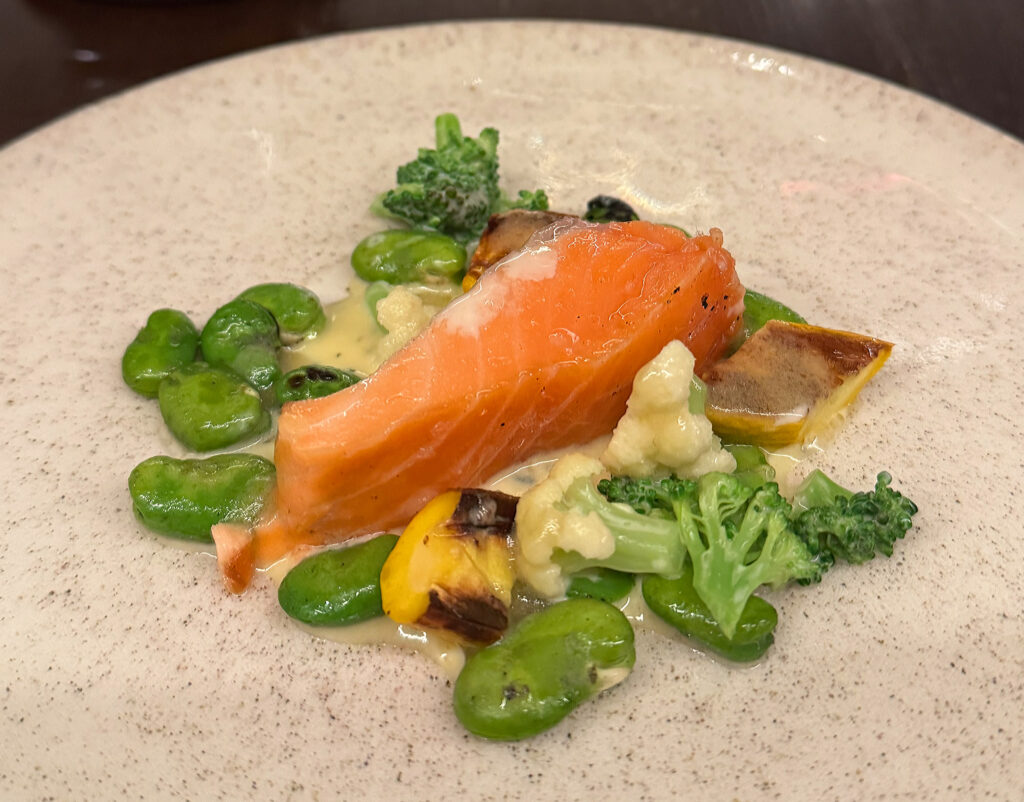
A preparation titled “Salmon—Vin Jaune” signals the tasting menu is quickly approaching its substantial, savory peak. Indeed, the starring fillet—sourced from tribes fishing the Columbia River, surrounded by a “mélange of seasonal vegetables” the team “needed to squeeze into the menu”—looks like a proper entrée from a slightly more conventional concept. Nonetheless, the techniques on display here are actually quite intricate.
The salmon itself is gently poached and paired with a vin jaune cream sauce whose soothing, nutty nature forms a brilliant match with the rich, melty, and otherwise mild flakes of fish. Upon this foundation, each of the accompanying vegetables provides further intrigue: the crunchy tang of steamed broccoli and cauliflower (tossed in a cured lemon emulsion), the smoky-buttery notes of grilled fava beans, and the crisp, caramelized, and porky-sweet tones of seared summer squash dressed with ham fat. With each pairing and subtle delineation, the blank canvas of the salmon grows ever more pleasing. But this takes nothing away from how enjoyable the pieces of produce are on their own—a testament to what Feld, even when throwing everything at the wall, does so well.
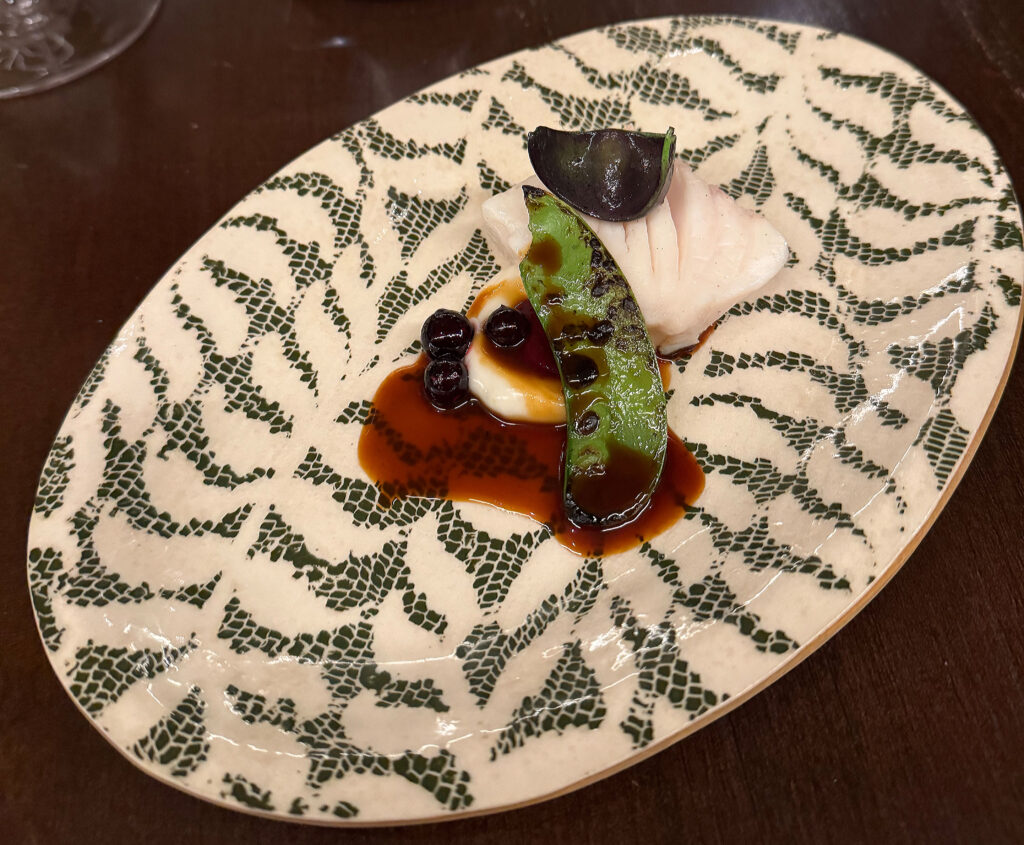
“Sue’s Halibut—Strawberry” is titled in a way that suggests the recipe is unchanged from May. Yet I should know better: the fish (dry-aged for a little over two weeks) is now poached instead of smoked. The fillet is once more paired with a caramelized onion jus and a pil-pil sauce made using the head. However, the crab, cucumber, and celery accompaniment has been substituted for a few blackcurrants, a separate blackcurrant sauce, and some grilled snow peas.
These latter ingredients shift the dish’s balance away from the fresher, greener character that it possessed before. Instead, the moist, flaky halibut (being perfectly cooked on this occasion) smacks of tangy, jammy fruit whose sweetness joins with that of the vegetables before fading into a more orthodox, savory finish. For my palate, the level of acidity proves a little too high (perhaps due to the inclusion of green strawberry in one of the sauces) and, thus, saps the fish of some satisfaction. Still, I admire how the kitchen has almost entirely—and boldly—reconstructed this course. It rises to the same level (i.e., good but not quite memorable) level as the last example.
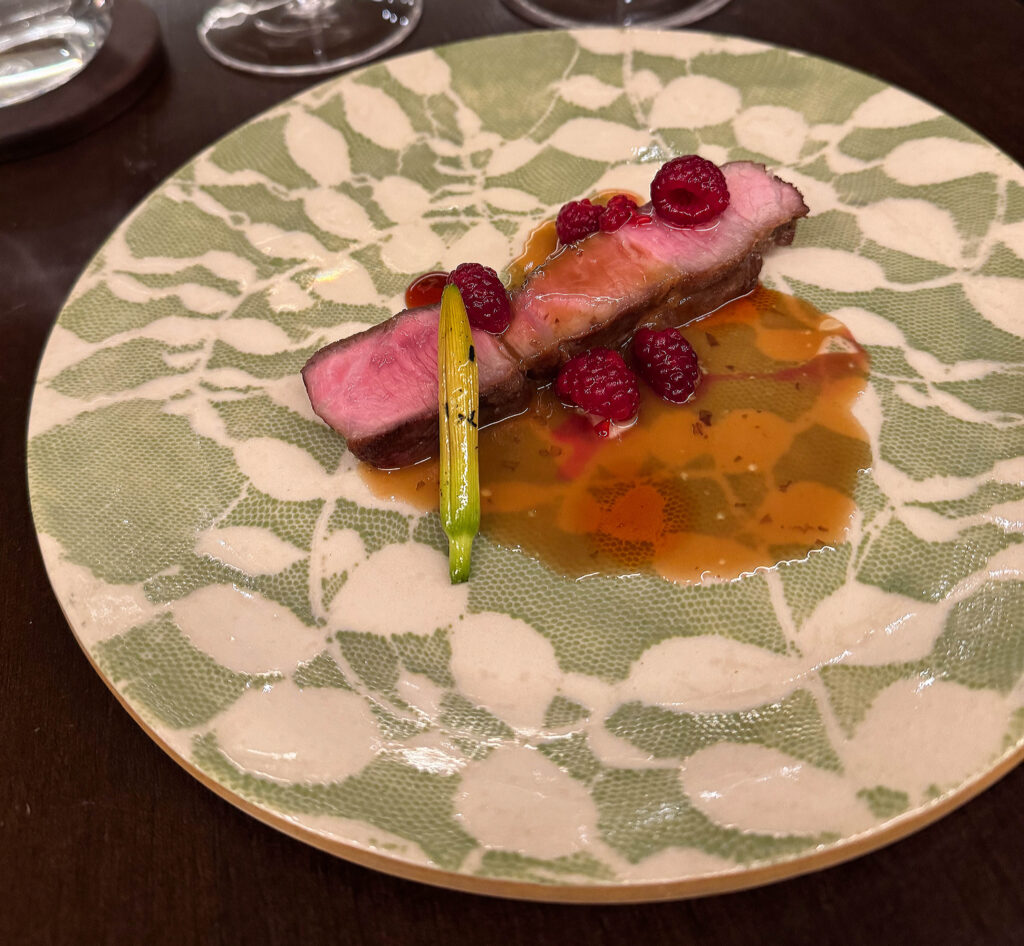
The “Pork Coppa—Rose” also revives a protein that featured (oh-so-deliciously) back in May: a cut of the pig’s shoulder sourced from Danville’s Krazy Kluckers Farms and cooked entirely over coals. This time around, garlic scapes and confited onions are substituted for a grilled day lilly, a handful of raspberries (warmed in rose oil), a burnt honey-lemon juice gastrique, and a drizzle of rose vinegar jus.
Undoubtedly, this version of the recipe pursues a more intellectual flavor profile than that heap of allium (so straightforwardly savory) did before. Yet I actually love how each jolt of berry tang—amplified by the gastrique, deepened by the roses—penetrates the fattiness of the pork in a manner that showcases the cut’s sweetness. If the coppa weren’t served a little too cold on this occasion, it would easily rival the previous rendition. Nonetheless, the meat retains its rich, juicy sense of chew and continues to form a perfectly enjoyable conclusion to the menu’s savory fare.
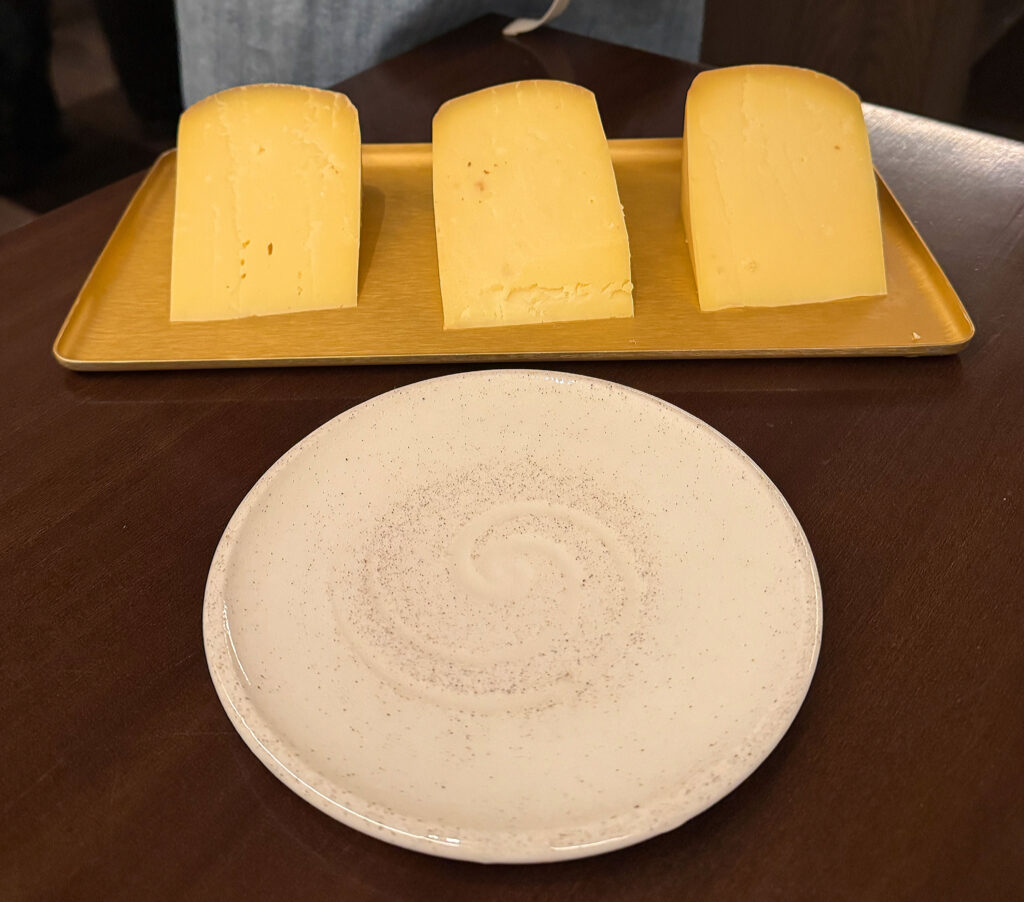
The transition toward dessert takes a nostalgic turn when three wedges of cheese appear. However, it might be worth clarifying that this most derided of Feld dishes has never been presented in this manner before.
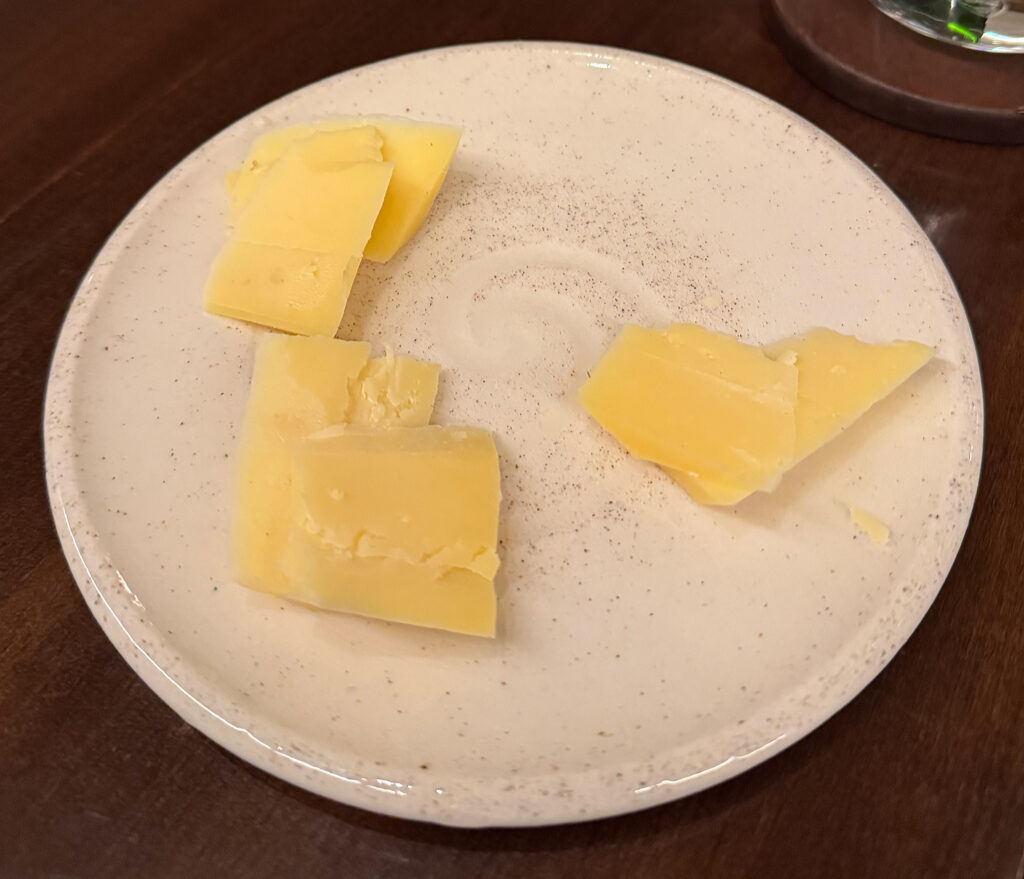
“Pleasant Ridge—August 11, 12, 13,” as the course is titled, grants patrons the chance to sample three successive days of Uplands Cheese Company’s signature offering: an aged, Alpine style whose expression constantly changes as cows work their way across different fields at different elevations and enjoy a broad cross-section of flora. In this way, the product is said to express the local terroir.
While the team has haphazardly strewn slices of cheese on guest plates in the past (inviting ridicule), seeing the chunks broken off tableside forms a marked improvement. Beyond that, the experience is solely about flavor (and that’s why the arrangement of the pieces has never really bothered me). To me, “11” tastes mildly caramelized and fairly mellow. It’s the one you’d want to put in a grilled cheese. “12” displays a more robust texture with a pronounced, persistent sharpness. But “13” integrates that sharpness into a more mild, grassy whole whose combination of richness and brightness is superior. Overall, I really prized getting to engage in this intellectual exercise again. Plus, even the weakest of the days is still quite tasty.
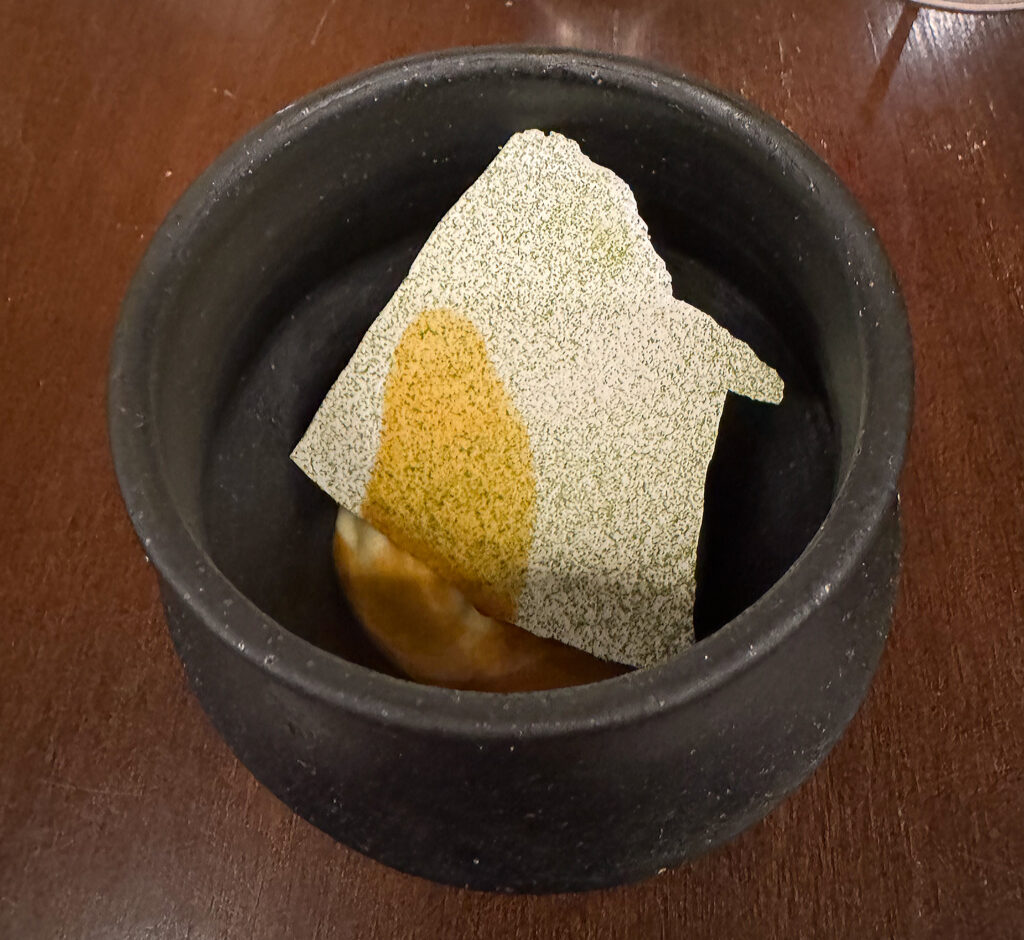
Given the nature of the preceding course, the “Masa Cake—Currant” trades the Pleasant Ridge mousse that so impressed me in May for toppings like bay leaf ice cream (using herbs sourced from the restaurant’s own garden), a grilled corn miso (made from last year’s crop), a brittle blackcurrant leaf meringue, and a blackcurrant leaf caramel sauce.
Otherwise, the recipe’s core appeal remains the same: centering on a steamed, fluffy base of cake (made with maple sugar and masa sourced from Elgin’s La Cosecha) and building on its toasty, nutty qualities via waves of tart, citric, salty, and woodsy intensity. That said, I really love how the corn miso supercharges the dish’s decadence. It ensures that this recipe, rather than simply pursuing contrast, introduces dessert with a bonafide sense of delight.

When, last time around, the “Strawberry Gazpacho—Chamomile” appeared on the back of a superlative fresh-churned ice cream, I really thought the preparation suffered. It was nowhere near as sweet or soothing as its predecessor—meaning that it felt less like an exclamation point and more like a halfhearted transition toward the closing bites.
Tonight (and I do not want to take credit), the order gets reversed. The bright, refreshing “tutti frutti” quality of the gazpacho (topped with a rhubarb-buttermilk sherbet and buttermilk granita) breaks from the masa cake’s earthy, mapley profile and readies the tongue for one final serving. This sequence makes more sense, and it allows me to better appreciate the bowl’s subtler, honeyed depth without begging comparison to what comes next.
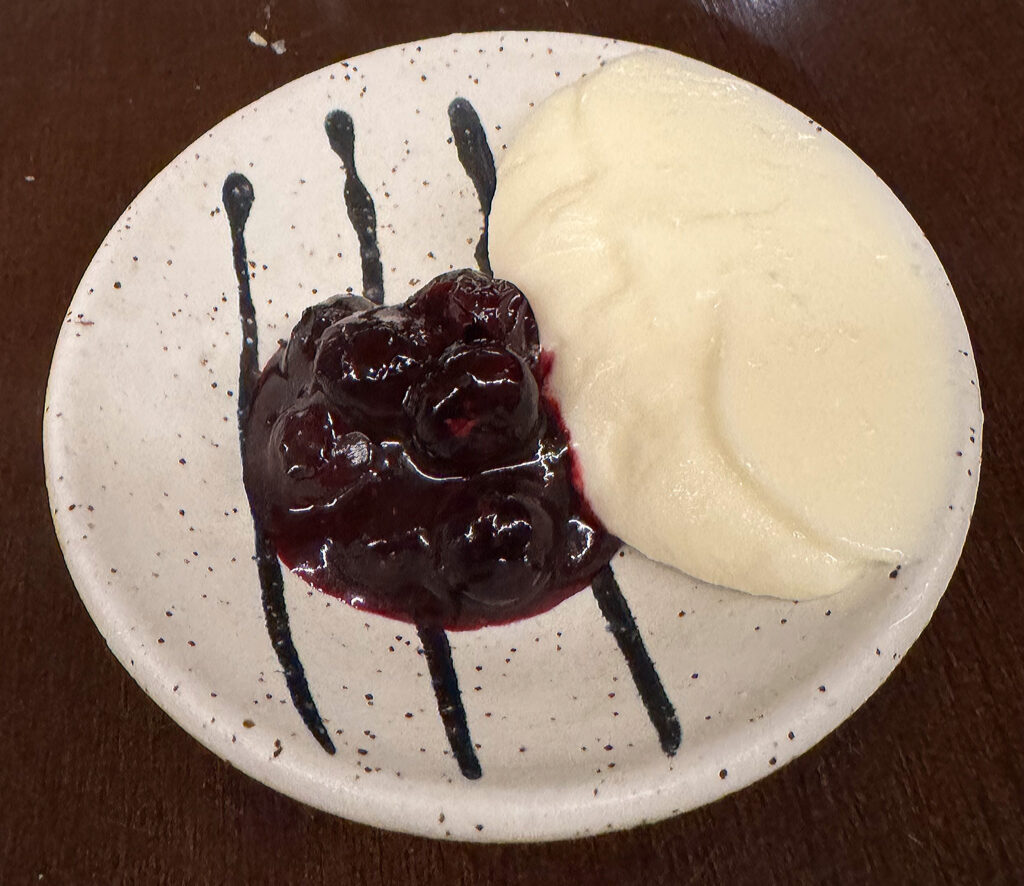
Anchoring dessert, the “Fior di Latte—Blueberries” represents Potashnick’s latest work with the fresh-churned, otherwise unflavored ice cream that debuted during my previous meal. On this occasion, grilled blueberries provide just enough smoke and tang and syrupy intensity to draw out the fresh, maddeningly restrained sweetness of the Jersey milk. It goes without saying that the consistency of the ice cream—so flawlessly smooth—remains unbeatable too. I can only hope that this dish (paired with a rotating selection of fresh or preserved fruit) forms a Feld signature for a long, long time.
Last of all, we have a rather familiar selection of closing bites:
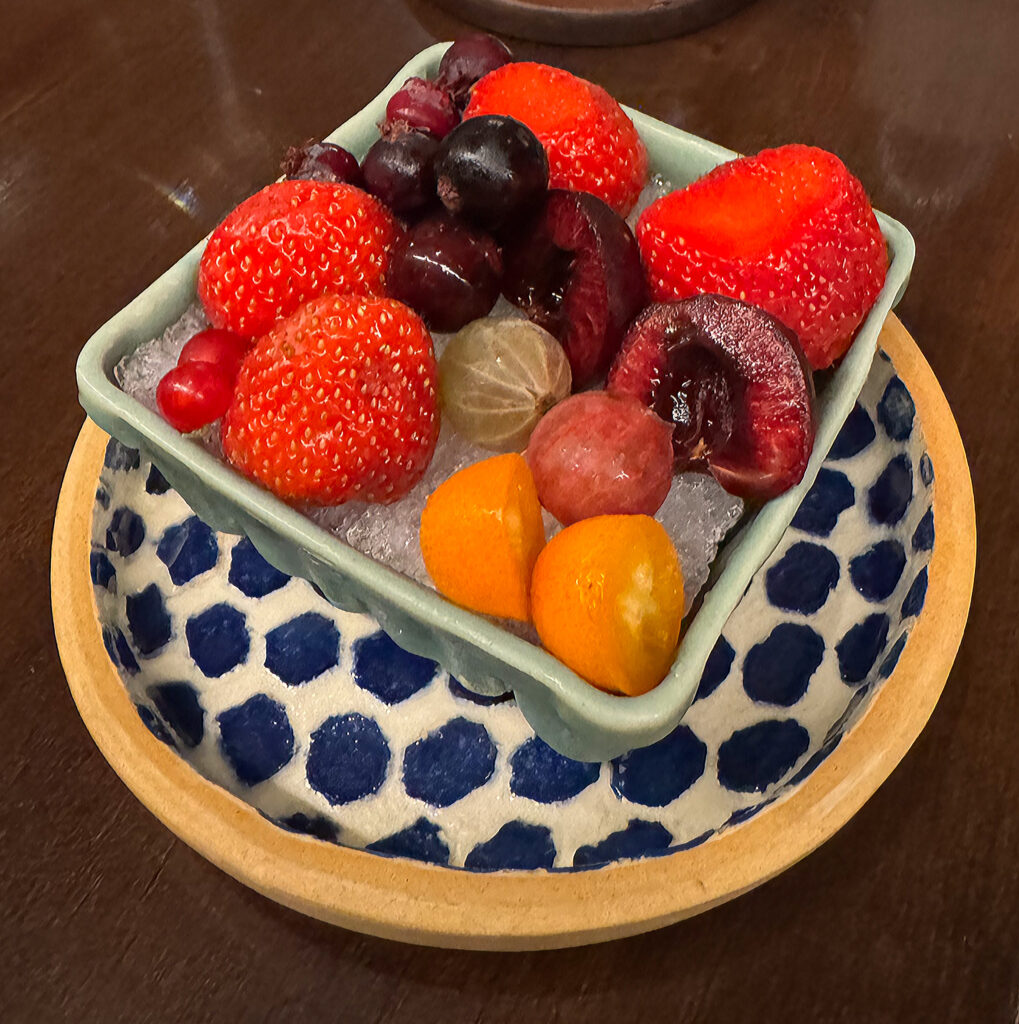
Presently, the “Fresh Fruit on Ice” spans kumquats, gooseberries, and currants of both the red and black sort. While I generally find the appeal of this raw produce to be somewhat limited, the Bing cherries are particularly nice, and a set of strawberries (one plain, the other spritzed with Samaroli rum) delivers the kind of intrigue I’ve long sought.

A “Rhubarb Tart”—delicately crisp and sweetened with notes of strawberry and elderflower—remains moderately pleasing (as it was in May) but, importantly, avoids feeling redundant next to the fresh fruit.
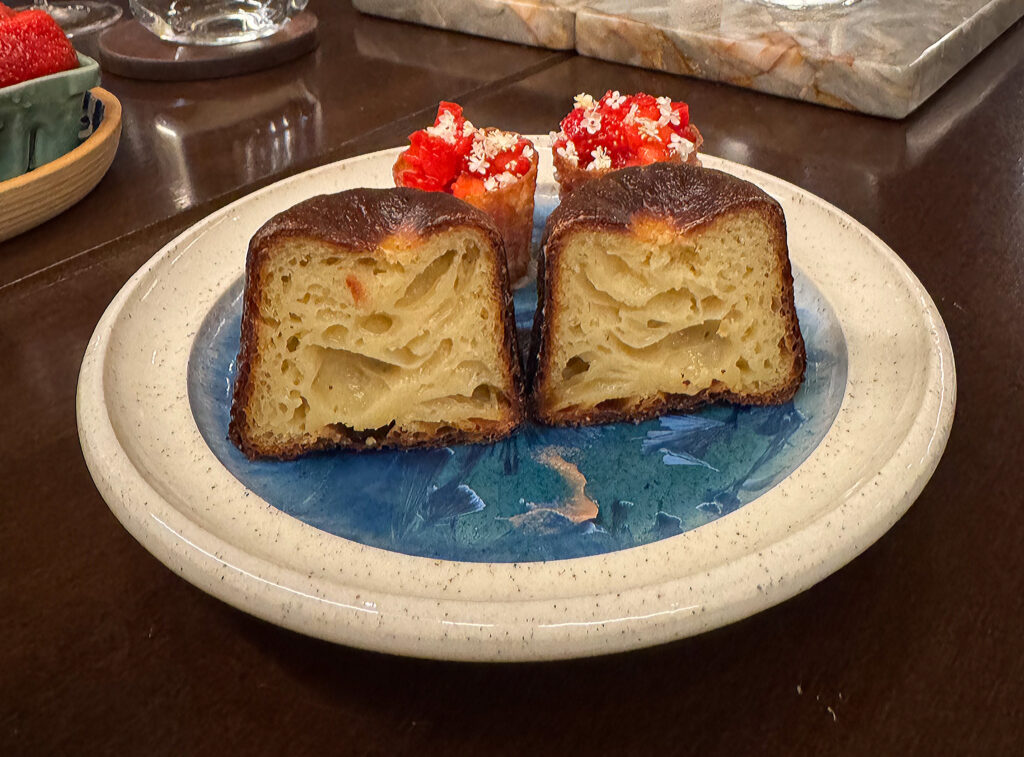
Finally, the “Spiceberry Canelé” (which formed a limited, experimental offering in May) has now permanently supplanted the Malört version of the recipe. Texturally, the pastry’s juxtaposition of crispness and gooiness is beautifully managed. Plus, the accompanying fruity, spiced, and nutty notes (the latter drawn from the use of masa) provide the kind of straightforward pleasure that, novelty aside, does a better job of rounding out the meal.
With the meal having reached its conclusion, the team transfers its vast array of after-dinner drinks to the center island. There always seems to be something new on offer, and, given that I am typically guided through the selection by a different chef each time, I always savor the chance to sip something I wouldn’t otherwise gravitate toward. These interactions stand among my favorite here.
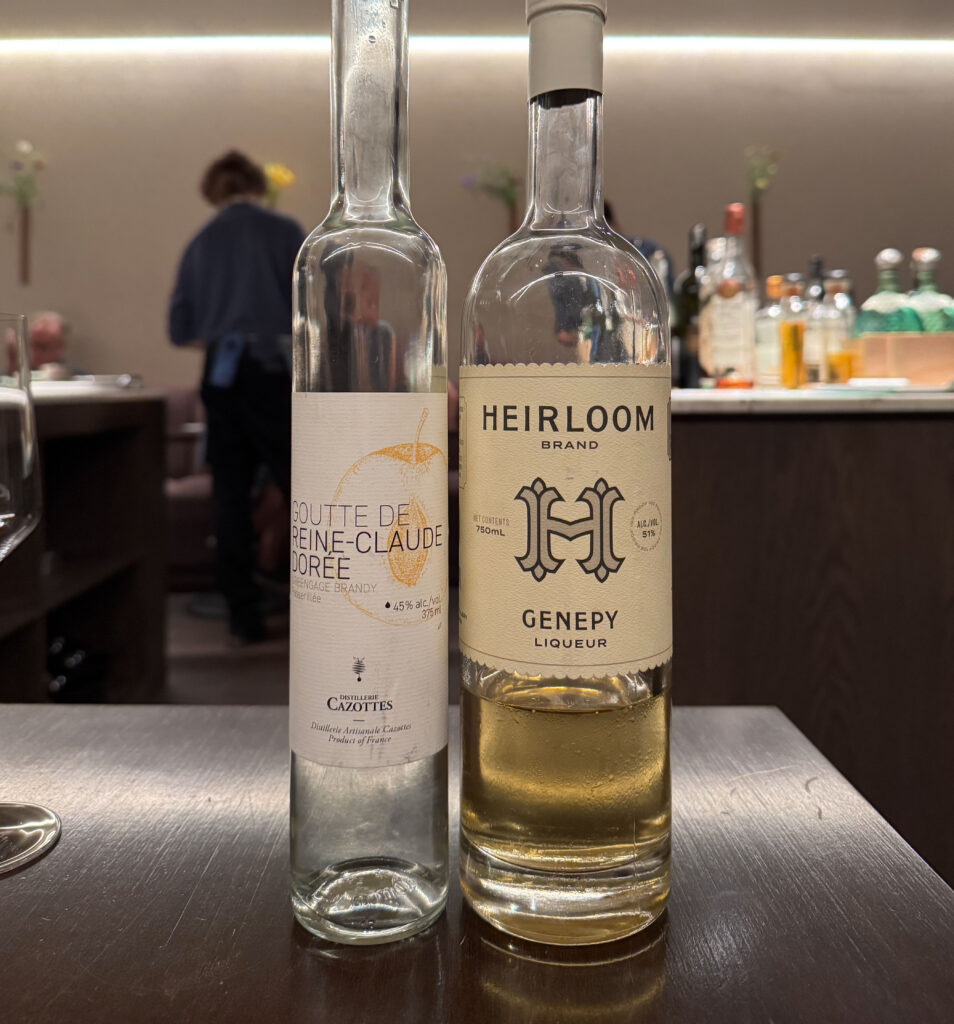
Shortly after the tipples have been dispensed, the check arrives alongside some printed menus and the guestbook (which offers its own thrill now that I have the chance to mark the same page across multiple visits).
S’mores—and just a fleeting moment of conversation—beckon. Frankly, I’m not sure a Feld experience would really feel complete without that final sugar rush: a celebration of ingredients (as I recall one online critique grumbled) that stand diametrically opposed to the “relationship to table” ethos.
But the chocolate and marshmallow, however ordinary, play a much more important role in cementing the relationship between diner and chef. Putting philosophy and the expectations of fine dining aside, they form a timeless ritual. The s’mores invite these suited figures (having just spent many hundreds of dollars) to drop their masks and revel in a moment of shared, childlike nostalgia.
The inevitable stickiness shapes meaningful emotional break: from the intellectual thrill of the dining room (with all its refinement) to the quiet, natural camaraderie formed when a group of people surround a fire and try to fashion a molten treat.
Potashnick and his team are adept at making the audience feel cared for and heard from the second they enter the space. But the final memory of the night feels less like an interaction between servers and served and more like the budding of friendship.
At the very least, it forms a kind of induction—if not into a family, then into a shared dream where the scaling of gastronomic heights can coexist with the simpler, primordial pleasures that actually bond us as eaters.
In ranking the evening’s dishes:
I would place “Tempura Mochi,” “Bluefin Tuna—Tomato Vinegar,” “Pea Soup,” “Oregon Signal Crawfish—Gnocchi,” “Masa Cake—Currant,” and “Fior di Latte—Blueberries” in the highest category: superlative items that stand among the best things I will be served in any restaurant this year.
The “Rhubarb and Chamomile Tea,” “Benton’s Ham,” “Grilled Plum,” “Beef Tartare,” “Dill Tartlet,” “Salmon Belly Day Lily,” “Salmon—Vin Jaune,” “Pork Coppa—Rose,” and “Spiceberry Canelé” land in the following stratum: great recipes that achieved a truly memorable degree of pleasure. I would love to encounter any of these again.
Finally, there’s the “Green Strawberry,” “Stuffed Mussels,” “Cherry^4,” “Pea Panna Cotta,” “Pea Tofu,” “Chilled Peas,” “Grilled Peas,” “Hakurei Turnip—Ham Dashi,” “Austrian Crescent Potato—Almond,” “Sue’s Halibut—Strawberry,” “Pleasant Ridge—August 11, 12, 13,” “Strawberry Gazpacho—Chamomile,” “Fresh Fruit on Ice,” and “Rhubarb Tart” —good—even very good—preparations I would always be happy to sample again (but that just failed to elicit an extra degree of emotion).
Overall, this makes for a hit-rate of 100% with some 52% of offerings reaching that “would love to have again” level of quality: figures that, once again, match the numbers from May (i.e., 100% and 54%) and April (i.e., 96% and 54%) almost exactly.
However, digging into the details a bit further, I find that the present menu yielded the greatest number of “best of the year” dishes (six, compared to five in May and four in April). In turn, it is also worth considering that, given the particularly strong performance of “The Drop” tonight, many of those “would have to have again” selections are rather small bites—meaning, consequently, that the kitchen’s larger plates might have slightly underperformed on this occasion.
My evaluation of the “Second Drop” (i.e., the pea sequence) further complicates matters given that one component ranked at the top and the other four landed at the bottom. Yet “the bottom,” in this case, is a perfectly respectable level of quality, so isn’t this kind of sequence—distinguished by one huge hit and a few other interesting (if not transcendent) components—still impressive?
Structurally, what matters most is that Feld could boast highlights in every section of the meal: the “Tempura Mochi” (among other strong bites) at the very start; the “Bluefin Tuna” and “Pea Soup” through the middle; the “Crawfish,” “Salmon,” and “Pork Coppa” anchoring the savory fare; and the “Masa Cake,” “Fior di Latte,” and “Canelé” holding down dessert.
With this amount of satisfaction assured, who can blame the team for taking bigger swings everywhere else? (Plus, by my measure, the “Pleasant Ridge,” “Strawberry Gazpacho,” and “Fresh Fruit on Ice” were all superior to any previous versions I’ve encountered. They could have easily ranked higher.)
In the final analysis, I can only repeat what I said at the start: Feld, now two years after opening, has reached a plateau of quality that places it alongside Chicago’s very finest concepts. I would no longer even really say that there are parts of the experience (e.g., “The Drop” or the entrées) that I would pick out for improvement.
Instead, I can only marvel at the creative process Potashnick and his team continue to pursue, with the utmost earnestness, and with seemingly infinite capacity for growth. Some menus—on some nights—are destined to be better than others, but it’s the thrill of seeing so many ever-changing ingredients and techniques come together that keeps me coming back.
The excellence these recipes frequently achieve always signals I have made the right decision.