
My last meal at Oriole (back in March) left me feeling that the restaurant was undergoing a bit of an identity crisis. Indeed, while all the foundations of success were there—an unrivaled setting, a sense of journey throughout the space, slick service, and a beverage program geared toward exceptional value—the cuisine was at a point of transition.
The signature “Foie Gras,” in combination with newer recipes like the “Kanpachi” and “Venison” and the majority of executive pastry chef Kyra Farkas’s work, led the kitchen to a strong performance in my “peak” metrics: some 24% of items achieved “best of the year” status while 41% reached that “would love to have again” level of quality.
Who can resist a tasting menu in which nearly a quarter of what is served ranks among the top bites they will eat for many, many months? Even a cynic like me would jump at those odds.
Yet, it was the overall hit-rate of 76% that gave cause for concern—especially given the fact that a couple of the evening’s most substantial courses (i.e., the “Sablefish” and the “Wagyu Ribeye”) stood among the weaker preparations.
Invigorated by a new chef de cuisine and executive sous chef, Oriole was clearly embracing evolution: deploying ingredients (both new and old) in accordance with a lighter, brighter, and perhaps more worldly style. I admired the effort, as I have long felt that a little more dynamism—fueling a sharper, indelible sense of identity—would help the concept reach that highest stratum.
However, pursuing such a process is fraught with peril: one bravely retires bonafide hits with the expectation they can be replaced, but reality is often trickier. One does not strike gold with every swing of the pick, and, if one changes too much too quickly, they might face a structural collapse.
March’s experience undermined what I consider to be the pillar of Oriole’s identity: a degree of reliable decadence and unquestionable luxury that distinguish it from (and, for many, elevate it above) those other places touting one or two or even three Michelin stars in Chicago.
When you start to introduce too much experimentation into the mix—too many ideas, no matter how promising, that are not yet fully formed—the cuisine begs comparison to all kinds of other menus that have made their name by more effectively taking risks week after week.
Oriole is supposed to be the city’s great guarantee, and the kitchen must balance any laudable inclination to grow with a clear sense of what must forever be guarded (lest the concept lose sight of what has made it so beloved).
Still, a solitary visit is nothing to base a verdict on.
In fact, I count the two new chefs among the city’s greatest talents, and I believe they will seize this most eminent of culinary stages to put forth something truly special. Thus, I’m eager to see where things stand a few months later.
Let us begin.
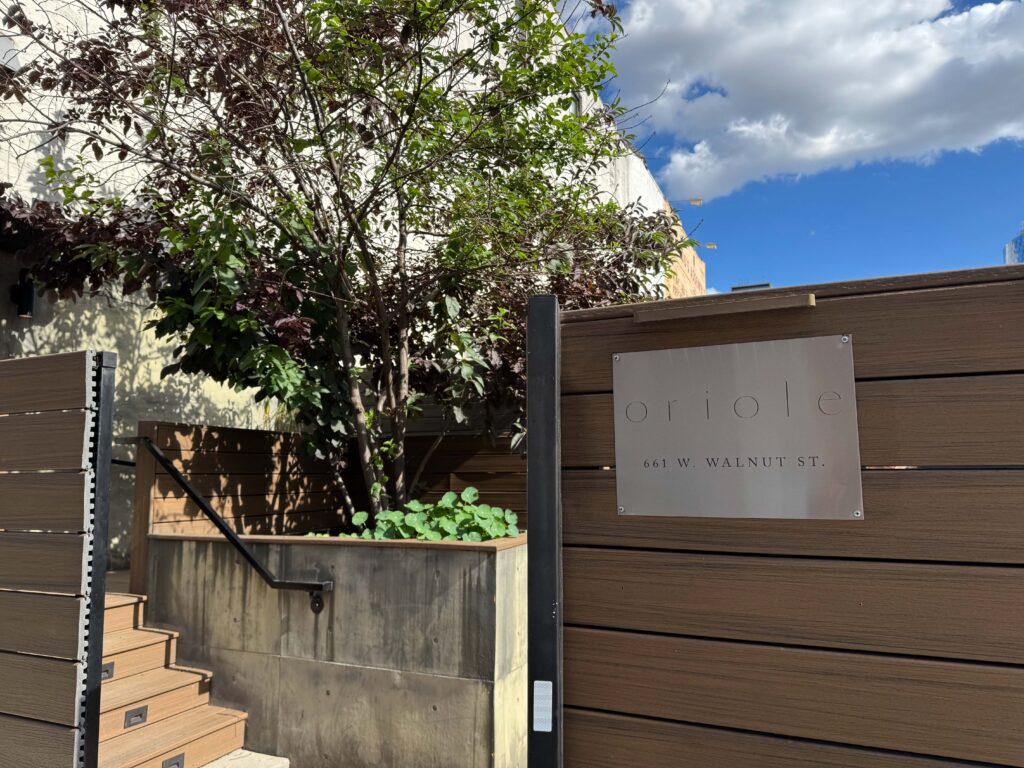
I’ve said this before, but it’s worth reiterating: the sense of discovery that characterizes post-renovation Oriole (and proves so central to one’s memory of the restaurant) has lost all its power for me.
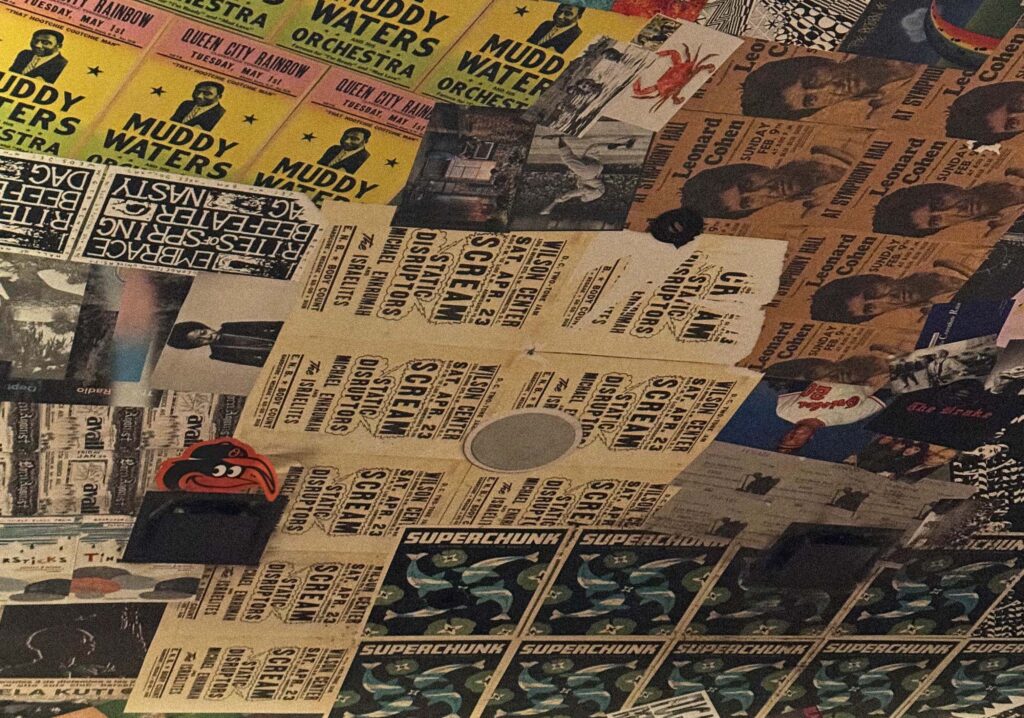
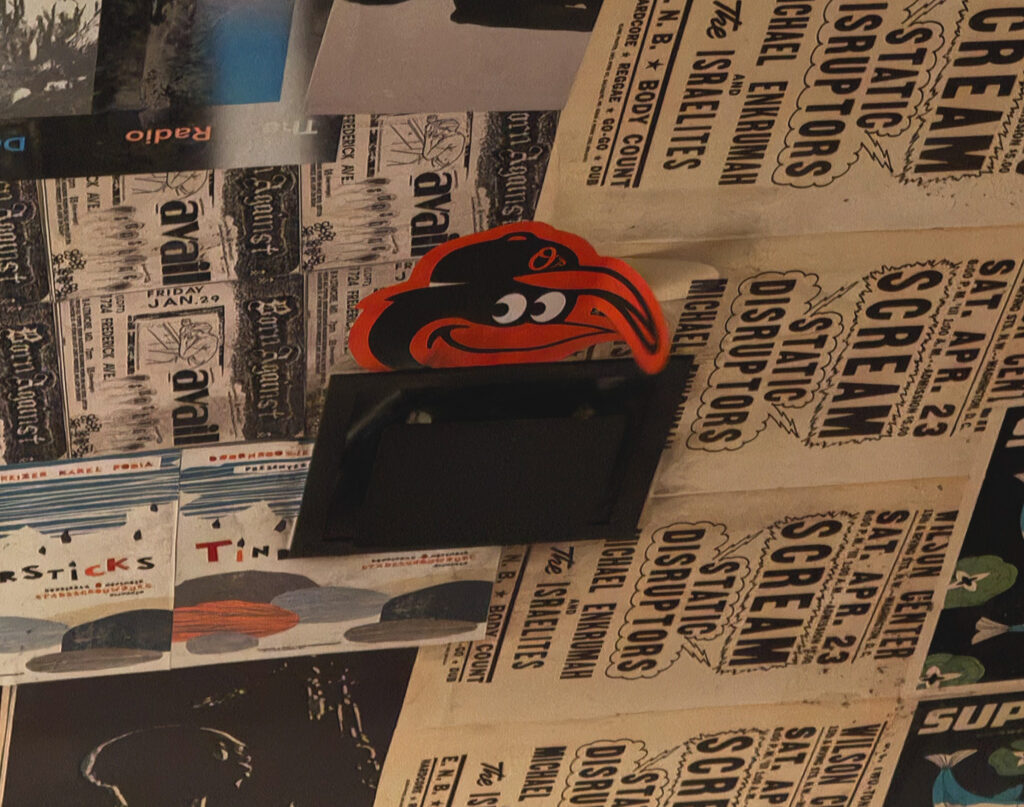
Indeed, I feel like I could make my way up the stairs, through the elevator, and to the couch, the counter, and the kitchen table with a blindfold on (though I’m not sure I could manage the food and drink served along the way). Plus, I’m much more likely to notice what has gone awry—like the flapping bill of the Oriole Bird’s hat, which has peeled off the ceiling due to an adjacent air vent—than marvel over some hidden detail I have thus far missed.
Yet tonight I host a first-timer, and they allow me to savor the journey with a fresh set of eyes. The experience, at core, does not hinge on grand gestures: smoke and mirrors set against the cold, imposing architecture of an Alinea or Ever. The elevator here is still just an elevator—a temporary holding area and a simple point of transport from one place to the next. There are no fireworks when, after a cup of tea, the door opens. The resulting corridor (at least until you reach the wine cellar) is a bit undistinguished too.
However, the sudden emergence of the lounge—and with it sights of the stately private dining room and expansive kitchen—imparts a sense of unlimited possibility. Those traveling all the way to the dining room (comparably secluded but sweeping in its own right) will see the effect doubled.
Oriole’s world stretches so much further than what can be discerned from the street. At the same time, the various spaces and faces meet you with a warm embrace. They brim with the kind of personality that (traversing a wide range of pop culture at a visual level, mirroring those passions conversationally) one hardly expects from “fine dining” at the multi-starred, $300 level. Before even touching the white tablecloth, you are feted with bites and tipples that can very well surpass anything you’ve encountered elsewhere in town (or even across the country).
The result is quietly subversive while not intending to provoke. Rather, the restaurant pleases a broad clientele by simultaneously deconstructing gastronomy’s hushed, solemn exclusivity and amplifying its greatest virtue: establishing a singular emotional connection that guides guests through a series of courses where pleasure and satisfaction only grow more profound with each successive dish.
When the time comes to leave the lounge, I know the first-timer is already totally convinced. My own history and predilections aside, there’s really no greater thrill than to bring someone to their personal mountaintop—to be reminded of (and maybe even reenchanted by) the moments that once brought you there yourself.
Oriole, to this day, wields that power effortlessly.
The only decision one needs to make on a night like tonight is what to drink.
Though the glimpses of the “Reserve” ($350) pairing I’ve gotten have been inspiring—particularly due its showcasing of aged Barolo, Bordeaux, Burgundy, or Cornas alongside the headlining proteins—I’m a creature of habit.
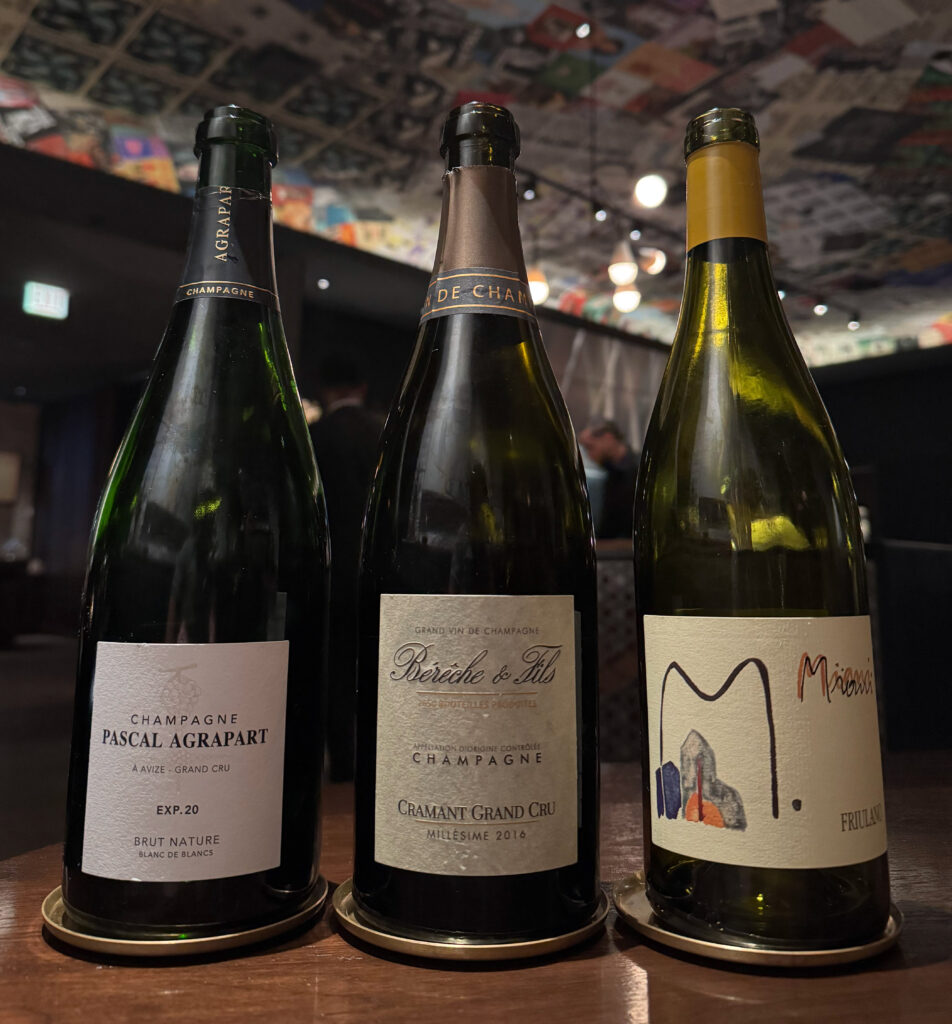
Ordering a couple bottles from the list, and bringing a couple as corkage ($50) remains hugely rewarding. Plus, I cannot remember the last time the selection looked quite this enticing.
These are some items that catch my eye:
- 2016 Miani Friulano [$86 on the list, $60 for 2015 vintage at national retail]
- 2017 Hofgut Falkenstein “Krettnacher Euchariusberg” Riesling Spätlese [$99 on the list, $47.99 for current vintage at local retail]
- 2010 Egon Müller “Wiltinger Braune Kupp” Riesling Spätlese [$111 on the list, $115 global average price]
- 2022 Fabio Gea “Back Grin” Grignolino [$123 on the list, $53.99 at national retail]
- 2014 Domaine Bachelet Gevrey-Chambertin Vieilles Vignes [$169 on the list, $135 at national retail]
- NV Pascal Agrapart Champagne “Exp. 20” Grand Cru [$201 on the list, $299.98 at national retail]
- 2020 Jean-François Ganevat “Cuvée Florine” Chardonnay [$257 on the list, $150 at national retail]
- 2018 Roagna Barbaresco “Albesani” [$264 on the list, $159 at national retail]
- 2019 Domaine de la Grange des Pères Rouge [$270 on the list, $199 at national retail]
- 2013 Benjamin Leroux Mazoyères-Chambertin Grand Cru [$360 on the list, $217 global average price]
- 2019 Domaine des Comtes Lafon Meursault “Clos de la Barre” [$364 on the list, $249.99 at national retail]
- 2020 Jean-Claude Ramonet Chassagne-Montrachet 1er Cru “Morgeot” [$378 on the list, $329 at national retail]
- NV Cédric Bouchard Champagne “VV/R23” [$399 on the list, $195 at national retail]
- 2020 Coche-Dury Bourgogne Chardonnay [$484 on the list, $383 at national retail]
- 2019 Stella di Campalto Brunello di Montalcino “Bacia” [$550 on the list, $420 at local retail]
- 2020 Domaine des Comtes Lafon Meursault-Goutte d’Or 1er Cru [$699 on the list, $399.99 at national retail]
- 2020 Soldera (Case Basse) Sangiovese [$775 on the list, $595 at local retail]
- 2013 Domaine Dujac Vosne-Romanée 1er Cru “Les Beaux Monts” [$987 on the list, $725 at national retail]
- 2021 Domaine Leflaive Puligny-Montrachet 1er Cru “Les Pucelles” [$990 on the list, $799 at national retail]
- 2006 Krug Champagne “Clos du Mesnil” [$1,999 on the list, $1,575 at national retail]
Here, one finds a roll call of the world’s finest producers—both eminent and culty—across Champagne, Burgundy, Italy, and Germany (with a touch of Jura and Languedoc for good measure). Trust me, there are options from California, Spain, and the aforementioned Bordeaux/Rhône regions for the taking as well.
But I think it’s fair to say that my chosen sample (save for the Fabio Gea, which I included simply to note the inclusion of a more “natural” name) comprises many of the most coveted and speculated upon bottles on the market. It is in the treatment of these offerings that Oriole has long excelled, and wine director Emily Rosenfeld’s pricing—even for selections touting a fair bit of age—keeps that tradition alive.
Markups range from as high as 128% on top of retail to price to as low as 33% less than retail pricing. Moreover, a mean of 46% and a median of 36% suggest that the program’s generally tendency is to keep that figure below 50%.
At many of the world’s finest restaurants, oenophiles simply have to accept that they are going to be squeezed if they wish to drink anything superlative alongside the cuisine. Oriole, to its immense credit, continues to delightfully turn this trope on its head: richly rewarding anyone who cares to browse the list by allowing them to secure celebratory bottles at the most minimal of premiums.
There’s really no better way to honor a great meal, and, while the range of producers does not quite get as geeky those I find at Smyth or Elske, Rosenfeld’s work still plays a huge part in assuring the most discerning of drinkers that they have come to the right place.
At an emotional level, this generous approach to curation always leaves me dreaming about what I may find next. Whether or not the tasting menu changes in the way (or to the degree) I desire, I know that ordering the right wine at the right price can reliably revitalize my experience—making me happy simply to go along for whatever ride the chefs decide upon.
Tonight’s meal begins in the familiar fashion: with a trio of seafood bites served in the comfort of the lounge. However, while the team has recently favored serving each of these items individually (with sharp, attentive pacing I must admit), they now arrive in unison. This makes for a sweeping sequence of considerable appeal—albeit one that comes with a prescribed order.
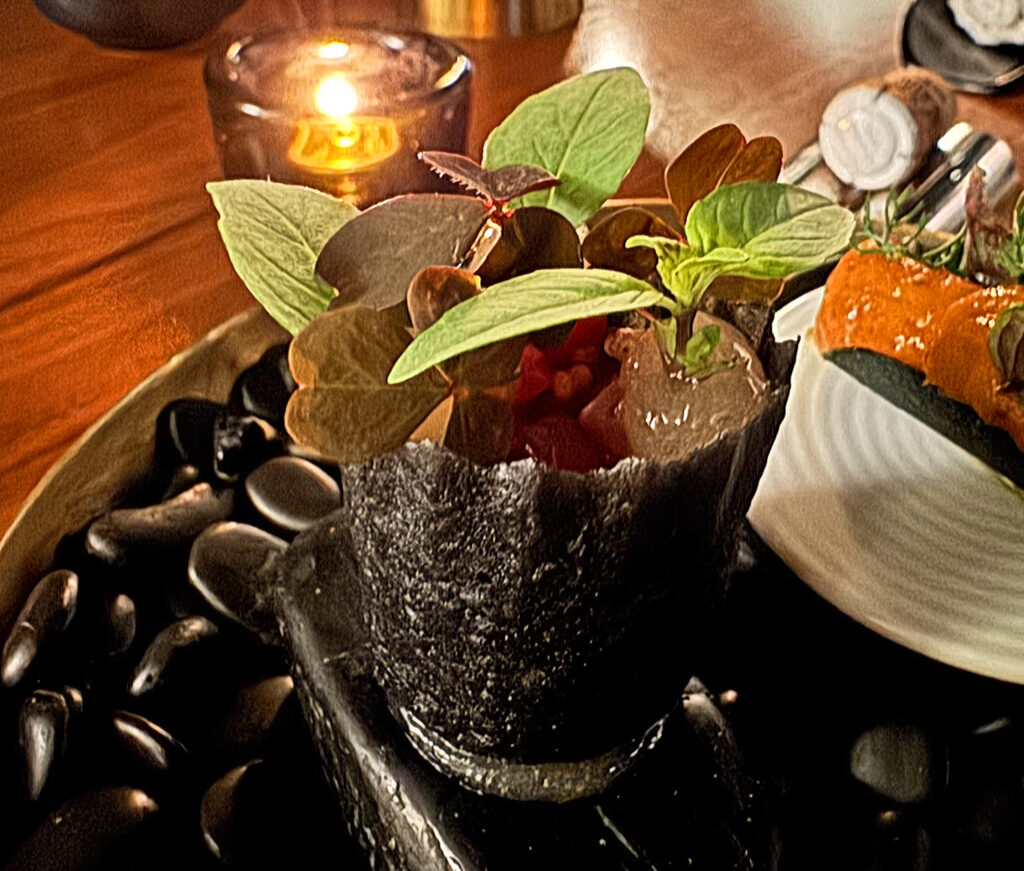
The ”Tuna Loin” sees the fish finely diced and tucked into a pie tee tart shell alongside some yuzu koshō and Thai basil. The resulting mouthful blends sensations of fleeting crispness, soothing flesh, and tangy intensity with just enough salt (and corresponding umami) to shape a long, satisfying finish.
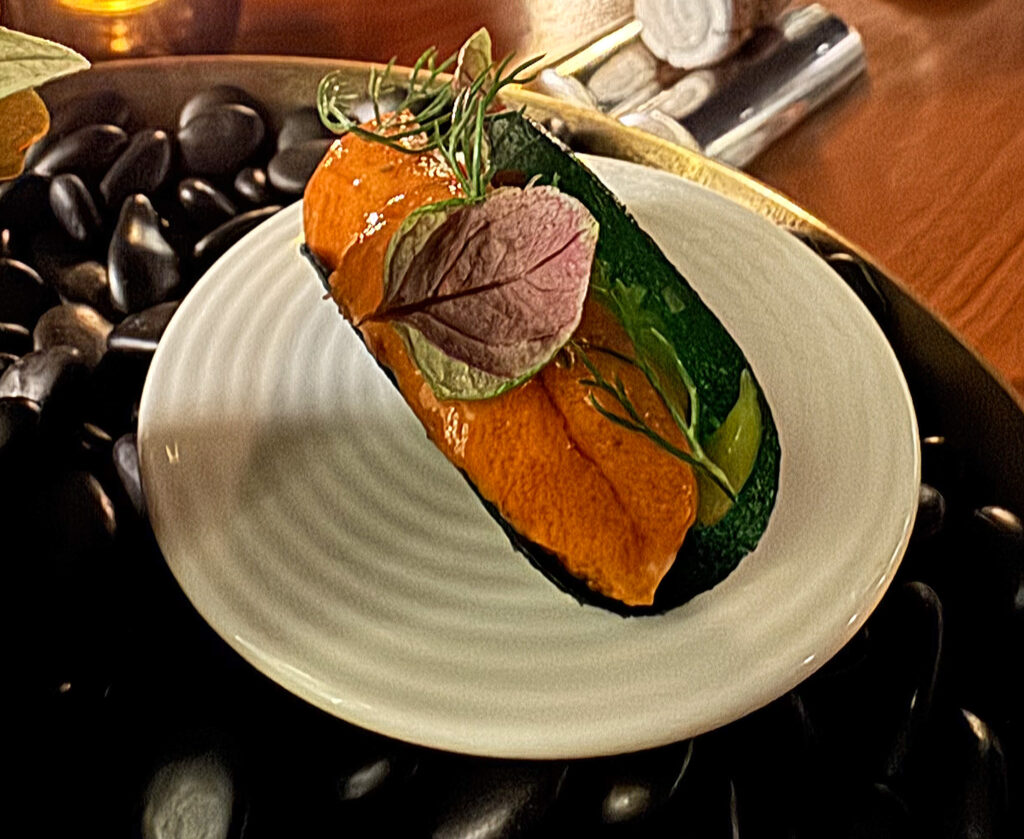
The “Uni” comprises two whole lobes of sea urchin situated on an oblong cracker with accompanying notes of fennel and green peppercorn. Texturally, the vessel is softer and more yielding than expected. Nonetheless, its frames the uni’s rich creaminess perfectly, and the accompanying flavor—subtly citric yet profoundly, persistently oceanic—showcases the starring ingredient with a startling degree of purity and concentration.
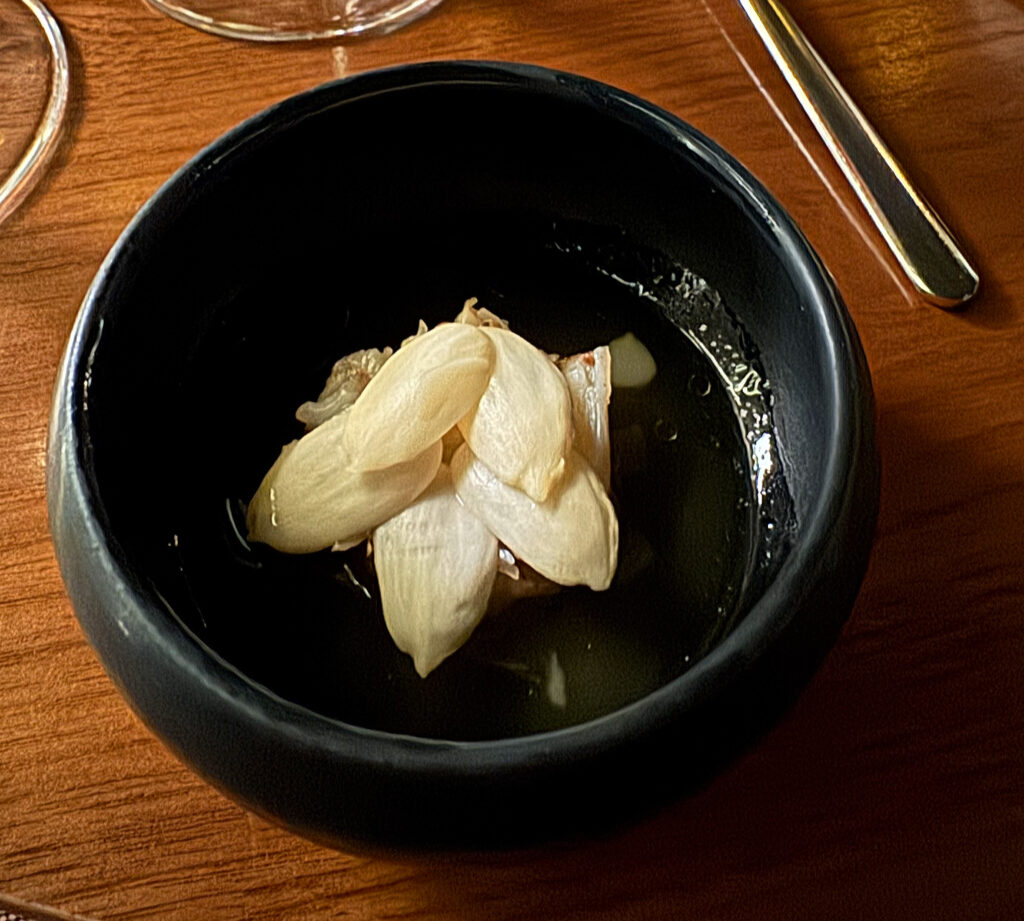
Finally, there’s the “Dungeness Crab”—an almost Smyth-like preparation that pairs fine threads of the crustacean’s meat with slivers of green almond and a sesame-sea buckthorn vinaigrette. Any resemblance aside (I speak more of a general stylistic resonance anyway), the chosen combination is deliciously executed with shades of sweetness, nuttiness, and moderate acidity shaping each delicate, pleasing spoonful.
Overall, it’s almost impossible to pick a favorite from the three offerings (though I might go for the tuna if you forced me). Meaning: this has to rank as one of Oriole’s finest opening sequences in recent memory—or maybe even ever.
An accompanying drink from bar director Maddie Balintona (a carbonated composition of huckleberry, shiso, lemongrass, and lemon cordial) also pairs beautifully with each of the offerings, echoing (and enhancing) the brighter tones found in each recipe while readying one’s palate for each successive bite.
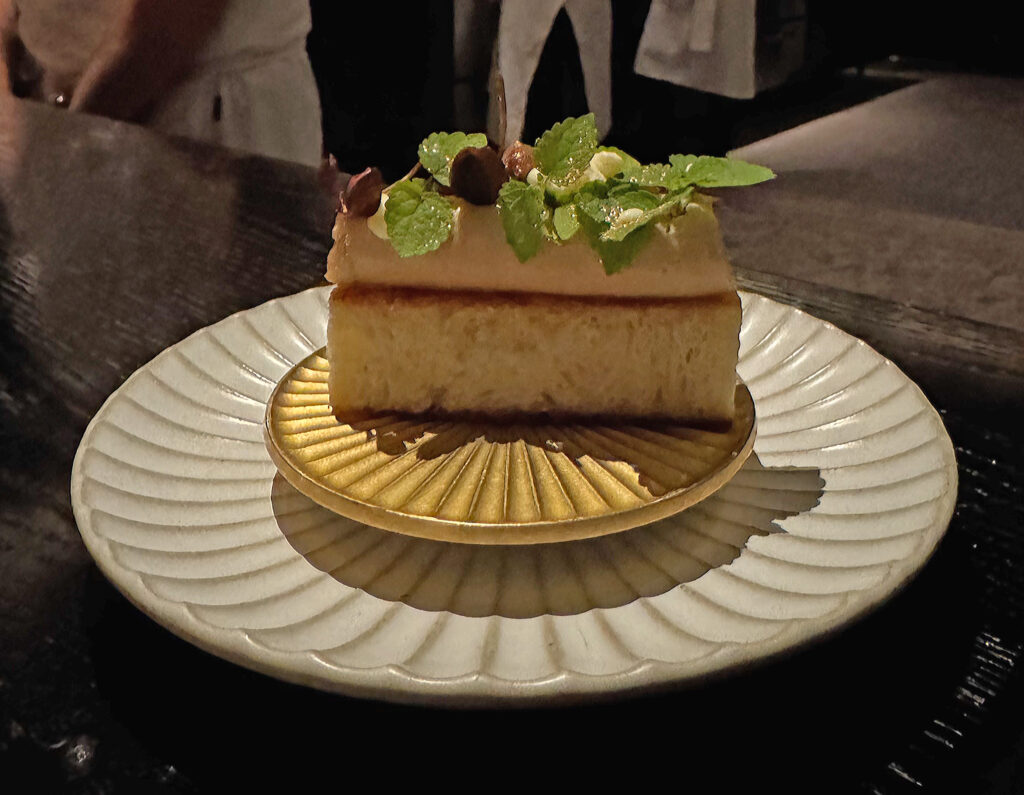
Following such a convincing start, I can only be excited for what awaits at the kitchen counter. The “Hudson Valley Foie Gras” has by now established itself as the restaurant’s most emblematic dish. For, while there are and were competing recipes, none have proven as resilient (or their decadence as ironclad). The present iteration adds seasonal flavors of green strawberry to the otherwise familiar construction: one that centers on a butter-cooked brioche base topped with a creamy liver parfait then garnished with pink peppercorn, anise hyssop, some crème fraîche Dippin’ Dots, and gold dust.
Whether due to the nature of the new fruit (the strawberries’ sourness serving to replace the caramelized sweetness of the figs that featured in March) or simply on account of some slight variation in execution, this example is superlative. Its marriage of crispness, creaminess, and maddening tangy-sweet intensity affirms exactly why Oriole forms the city’s greatest gastronomic “guarantee”—and why this singular morsel might actually be the best, most reliable bite served anywhere in Chicago on a given night.
To further enhance the experience, the foie gras is now paired with a new drink designed by Noah Sandoval himself: a blend of Lustau Vermut Rojo (soon to be replaced by the restaurant’s own vermouth) with clarified strawberry juice, rosé Champagne, and a spritz of Sumo mandarin that seamlessly lengthens and deepens one’s appreciation of the rich, fruit-intoned liver. Years on, I’m amazed at how the team manages to push this most signature of items to an even higher peak of pleasure.
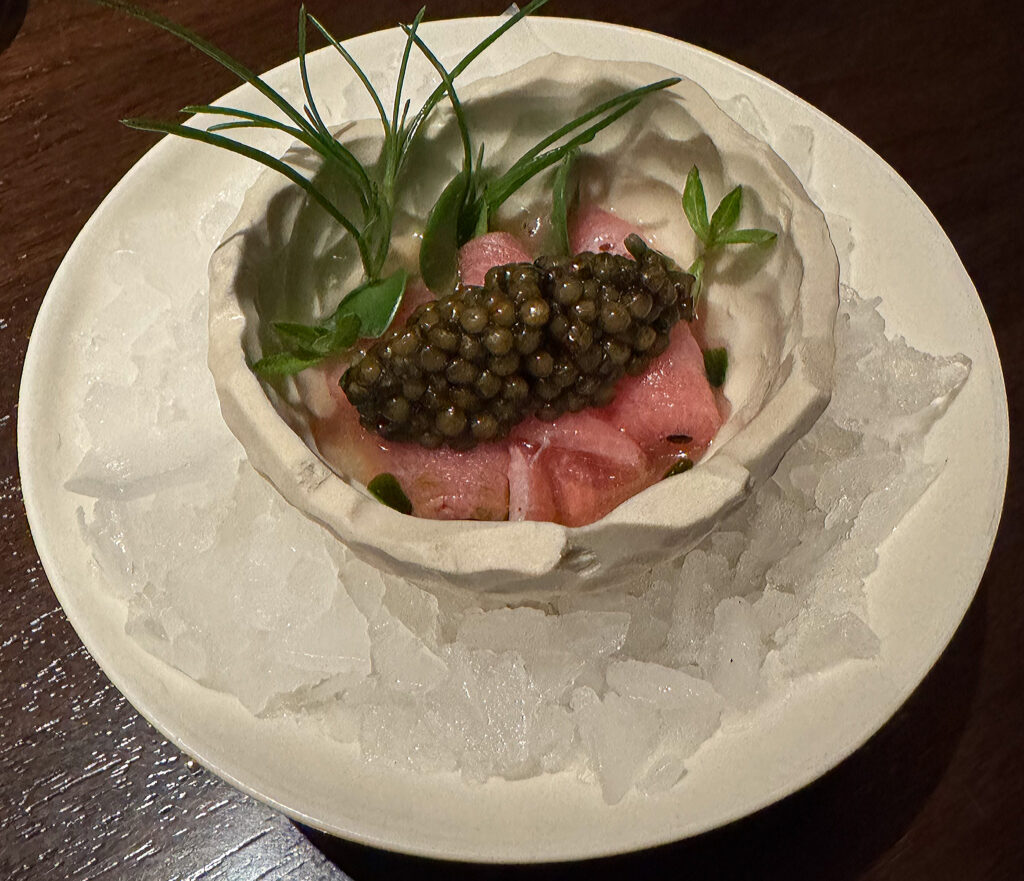
Making my way to the table, I am met by a series of courses that—like the opening servings of seafood—immediately testify to the creative efforts of the chefs. Indeed, the “Golden Kaluga Caviar” really feels like an extension of what was served in the lounge.
Admittedly, the starring roe has formed a staple of my last few meals here. However, the present composition (which pairs the ingredient with bluefin tuna, pickled Sungold tomatoes, tarragon, a kombu broth, and king trumpet mushrooms) might be the finest of them all. On the palate, the fish’s mouthcoating, melting character is far more pronounced than what I found in the earlier tart shell. Its fat does an elegant job of cushioning the caviar—whose briny, nutty flavor profile is hard to isolate but, otherwise, whose qualities harmonize well with the smoky, anisey, and lastingly tangy accompaniments that sit at the bottom of the bowl. Most importantly, the degree of umami in the dish (drawn from both the seaweed and the fungi) is perfectly judged. Thus, I truly savor this preparation even if it doesn’t rank among the menu’s highlights.
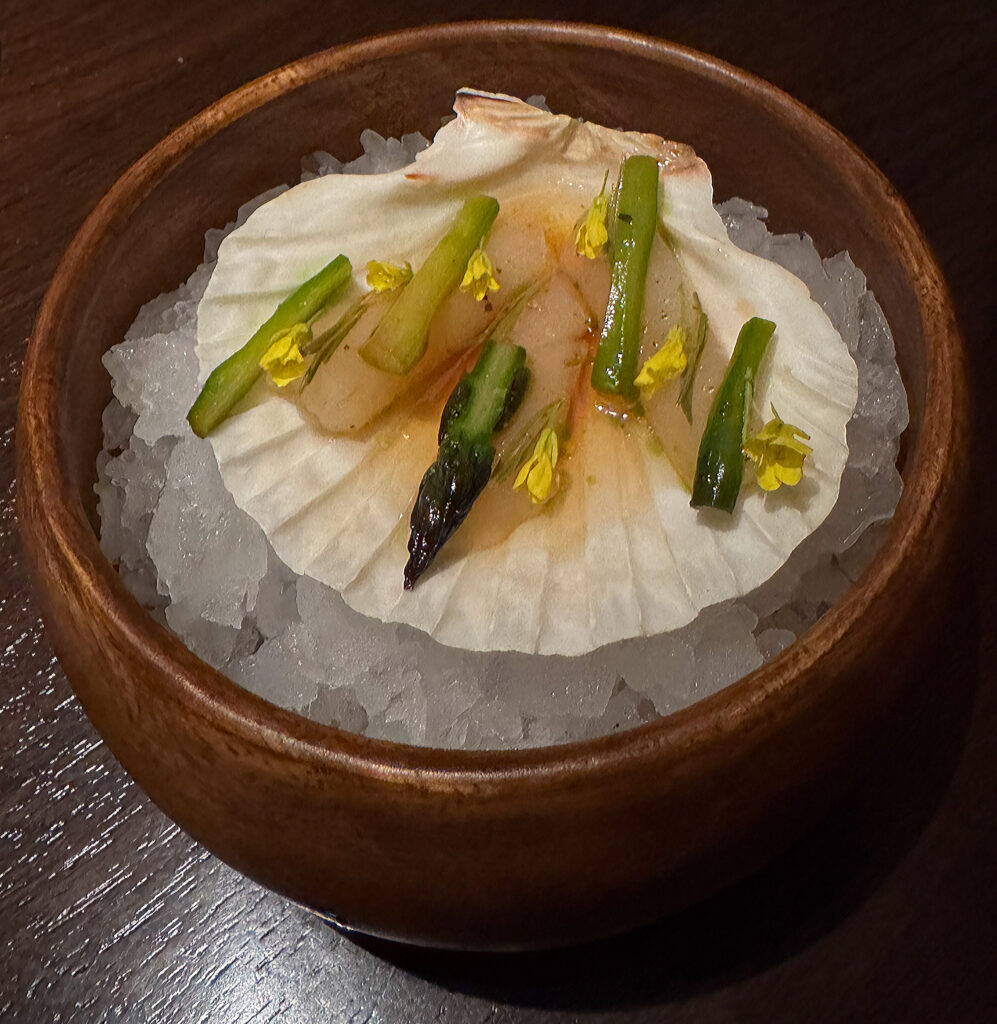
Arriving next, a serving of “Hokkaido Scallop” builds on the kitchen’s work with the mollusk’s Maine counterpart (served as part of the opening seafood sequence back in March) while also evolving a presentation of seasonal produce that previously featured at this point in the meal. Served in its own shell, the bivalve is sliced into three long slivers and matched with slender segments of green asparagus (replacing the white variety I encountered last time). A broth made from Virginia ham, a few sprigs of spruce, and a handful of horseradish flowers form the finishing touches.
Guests are armed with both chopsticks and a spoon to tackle this course, and I think the latter is essential. Yes, I make the mistake of plucking my first couple bites out of the vessel: marveling at the interplay of soft, ephemeral shellfish and wonderfully crisp spears. The ingredients impart a subtle sweetness that is highly alluring, yet it’s only with the introduction of the salty, savory broth (along with hints of citrus and sharpness from the garnishes) that the recipe takes flight. These powerful notes are ably subsumed by the meaty pieces of scallop, revealing an even greater concentration of sweetness that I find sublime.
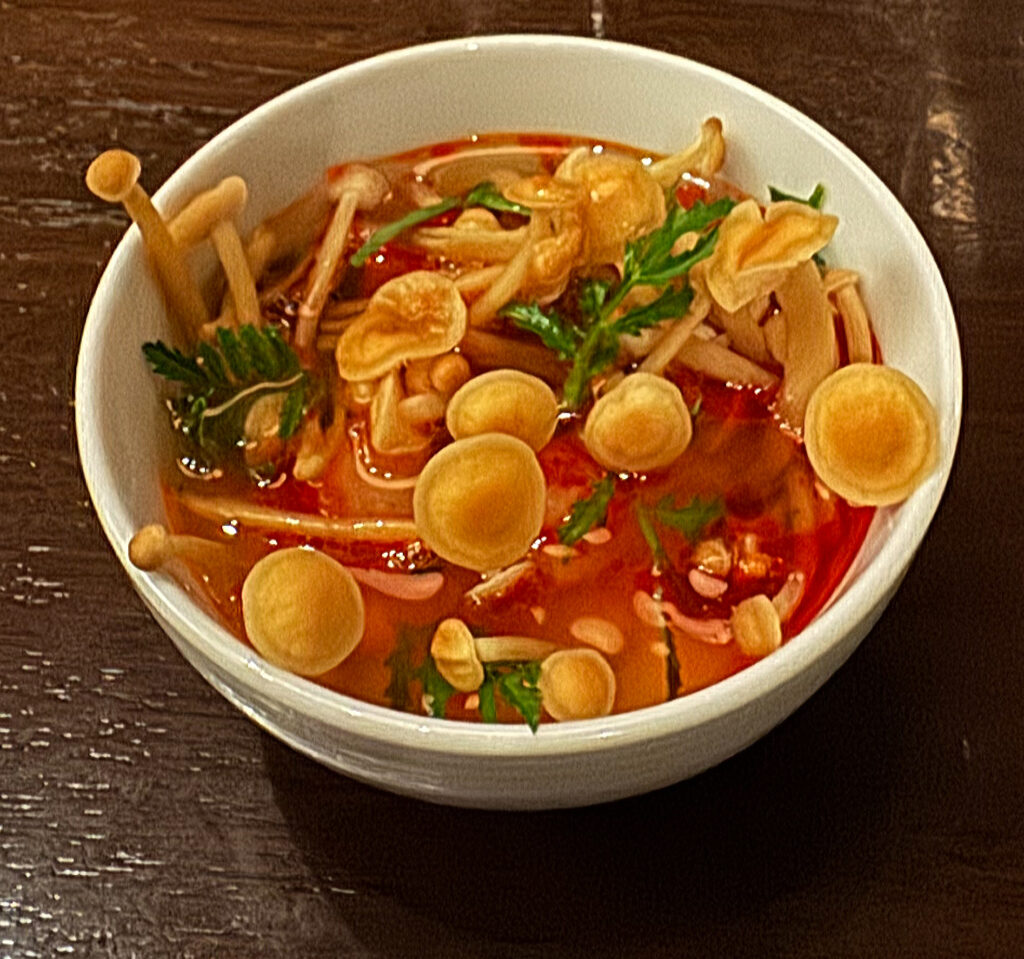
“Carabineros Prawn” is an ingredient I always associate with my experiences at Oriole “1.0,” yet the crustacean has also appeared—now and then—after the remodel. On this occasion, the citrus-cured shellfish actually sits at the heart of a chawanmushi: the latest in a series of savory custards (frequently featuring mushroom and/or foie gras) that rarely rank among my favorite items on the menu.
That said, the present rendition skillfully balances the plumpness of the prawn, the fine crunch of enoki mushrooms, and the rich, oozing quality of the eggy base. More importantly, the resulting flavor—bursting with savory intensity from a carabineros head broth, uplifted by citric tang and an earthy-sweet saffron depth—is wholly satisfying. Ultimately, chawanmushi will never be a form I get too excited about encountering here; however, this has to be the best example the team has served to date. It’s really hard for me to fault.
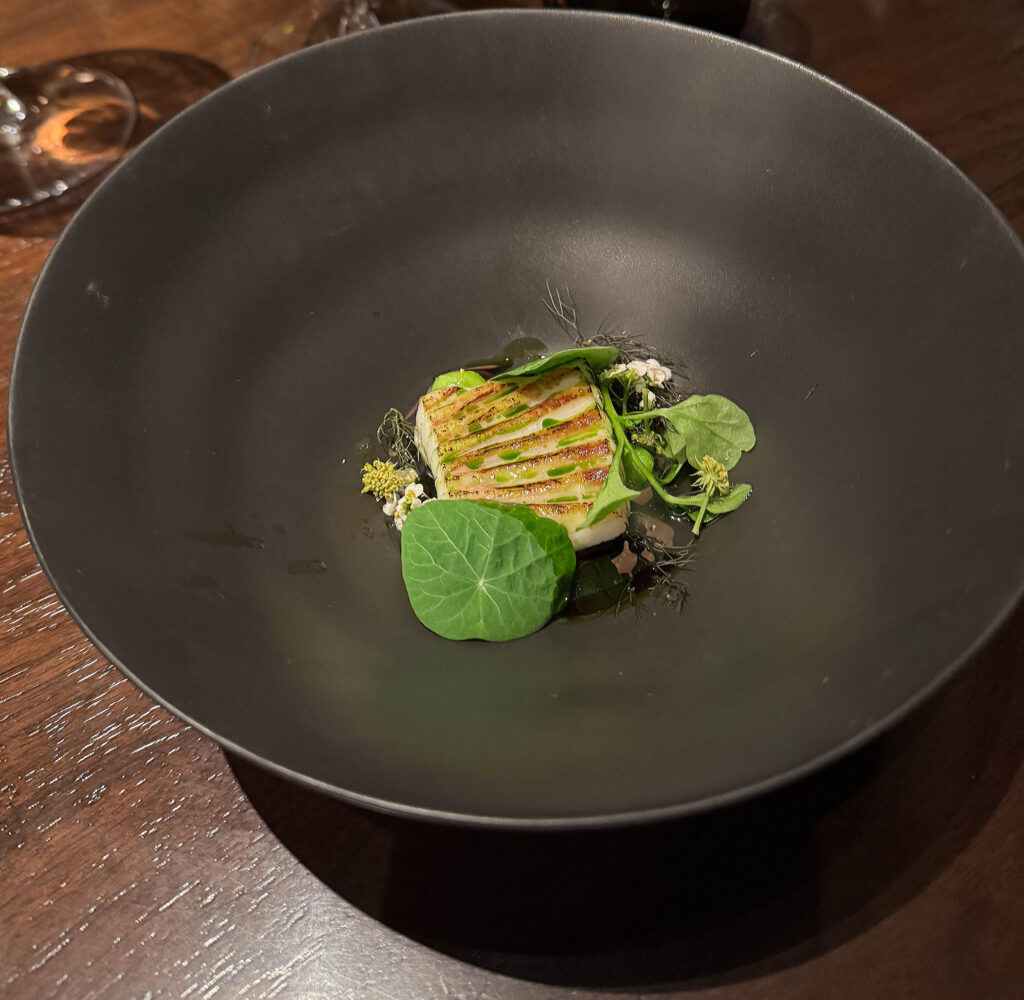
The ”Skate Wing” offers a chance at redemption after the underwhelming preparation of sablefish I tasted back in March. Indeed, with so much delectable raw seafood being served across the menu, these headlining cooked preparations can—in this kitchen’s hands—stand among the finest servings of the entire evening.
The recipe (entirely new to me tonight) centers on a piece of the fish’s titular pectoral fin, which arrives lightly crisped and glistening and surrounding by a thicket of herbs and flowers. Bronze fennel highlights the selection while dual oils (one made from the skate’s bones, another from lovage) and a couple fava beans complete the presentation.
At first glance, I fear I will be left searching (as I was last visit) for the kind of decadence I expect from Oriole’s work in this genre. However, the tender, meaty quality of the wing is instantly comforting, and its accompanying flavor—though clearly on greener, cleaner, brighter end of the spectrum—possesses just enough underlying umami to please. For my palate, this makes for an elegant and refined composition of fish that only falls short of being truly stunning. Still, others may like this dish and its chosen style (certainly befitting the time of year) even more.
Turning toward the first of two proper meat courses, I am immediately enchanted by the appearance of the “Squab.” In a way, it fulfills everything I have been looking for from the restaurant’s growth: a push toward elaborate, characterful sequences (each a synthesis of myriad ideas) that resist comparison to any other concept.
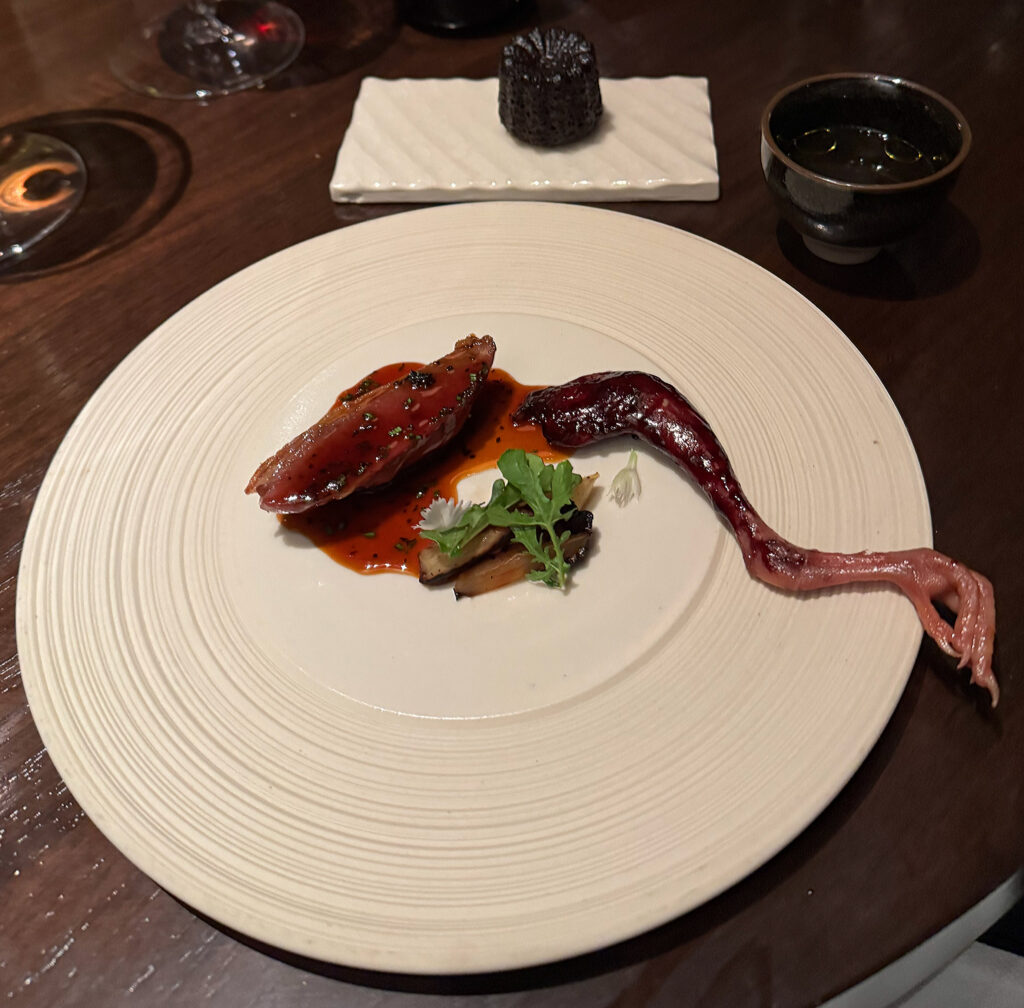
This particular preparation comprises five parts:
An intensely savory squab broth that, marked by subtle heat and sharpness, readies one’s palate.
A one-week-brined and grilled cut of the bird’s breast, which marries crispness, plumpness, and a pleasant chew before ending on the richly savory, earthy-sweet notes of a Thai long peppercorn-inflected jus.
A serving of the squab’s leg that has been confited for six hours and glazed in lingonberry: a remarkably tender, deeply savory bite displaying a bewitching “barbecue sauce” sweetness on the finish.
A dab of squab mousse tucked under a couple pieces of salsify—offering a clean concentration of umami with attractive earthy, nutty complexity.
And, finally, the “Canelé.” Served alongside venison, the pastry has formed a welcome flourish during my past couple meals (albeit one that feels closer to a bonafide dessert than a bread replacement). Nonetheless, the present version—flavored with rye and black cardamom—melds harmonizing earthiness with only the faintest sweetness. Thus, it works beautifully with the four expressions of squab and stands as the best example of the item I have yet tasted here.
Overall, while I do find the leg and the canelé to rank a step above the other components, I enjoy every item and particularly savor how they build on each other’s flavor without retreading the same ground. I would absolutely love to encounter this course again and, moreover, see the team pursue the same kind of sequence with other starring ingredients.
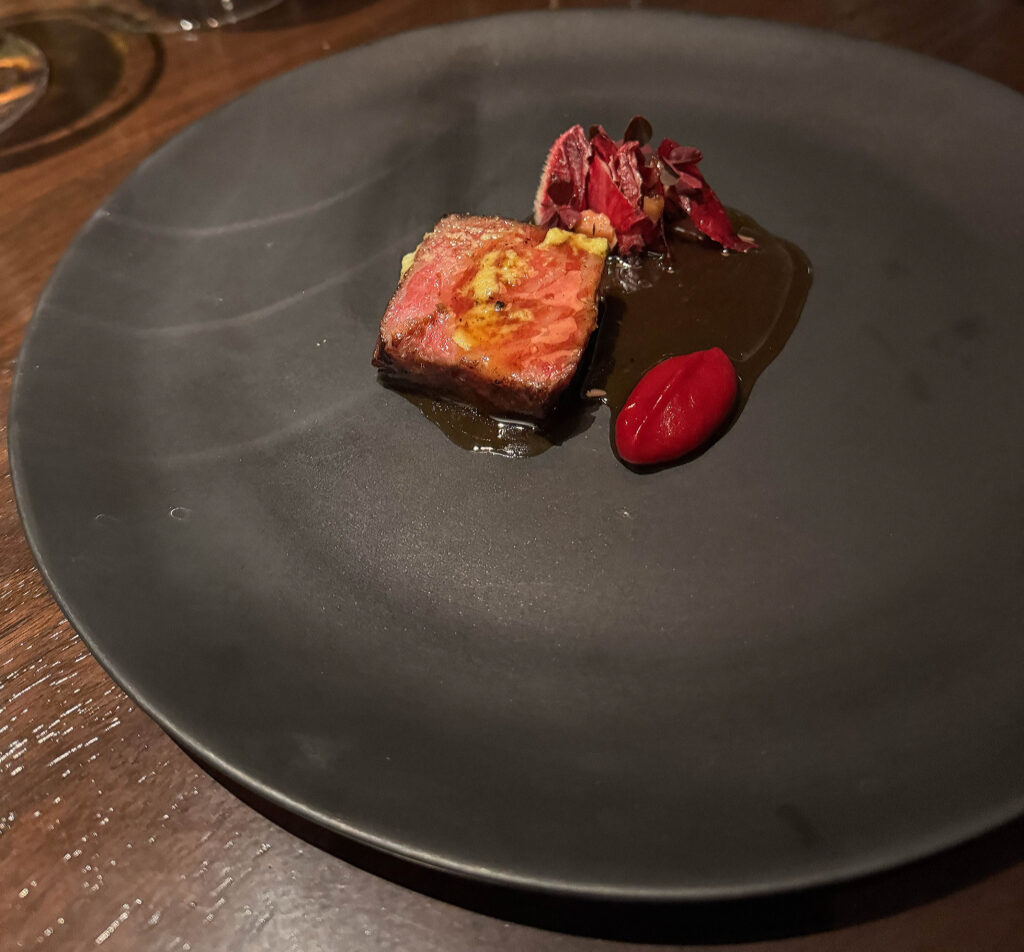
Anchoring the menu before the arrival of dessert, the “A5 Miyazaki Wagyu” forms a holdover from my meal in March. On that occasion, I felt the steak failed to live up to its previous iterations (or, by extension, rival the pleasure provided by a preceding dish of venison). With such a strong preparation of squab rivaling it this time around, the beef more or less falls victim to the same criticism.
Conceptually, the pairing of such a sizable slab of ribeye (glazed with mirin) with a dab of floral, comparably mild Shizuoka wasabi is totally sound—even admirably classic. The meat’s resulting texture (so soft and juicy yet perceivably rich) could not be better. Nonetheless, accompanying notes of rhubarb and red endive drive the flavor profile in a more intellectual, earthy-bitter direction. Black garlic helps to establish a baseline of umami, but I’m left feeling the wagyu, despite its textural supremacy, actually represents a drop-off in satisfaction when compared to a bite like the squab leg (or even the breast).
Surely, I can see how the rhubarb makes this recipe a wonderful match for red wine. Still, compared to the resounding pleasure of January’s mustard- and caramelized eggplant-inflected presentations, this take on the steak does not make the sort of impression such a hackneyed luxury ingredient demands.
Dessert, in the hands of executive pastry chef Kyra Farkas, has ranked among the best in Chicago as of late. Tonight, a couple of familiar recipes ensure that same standard is met.
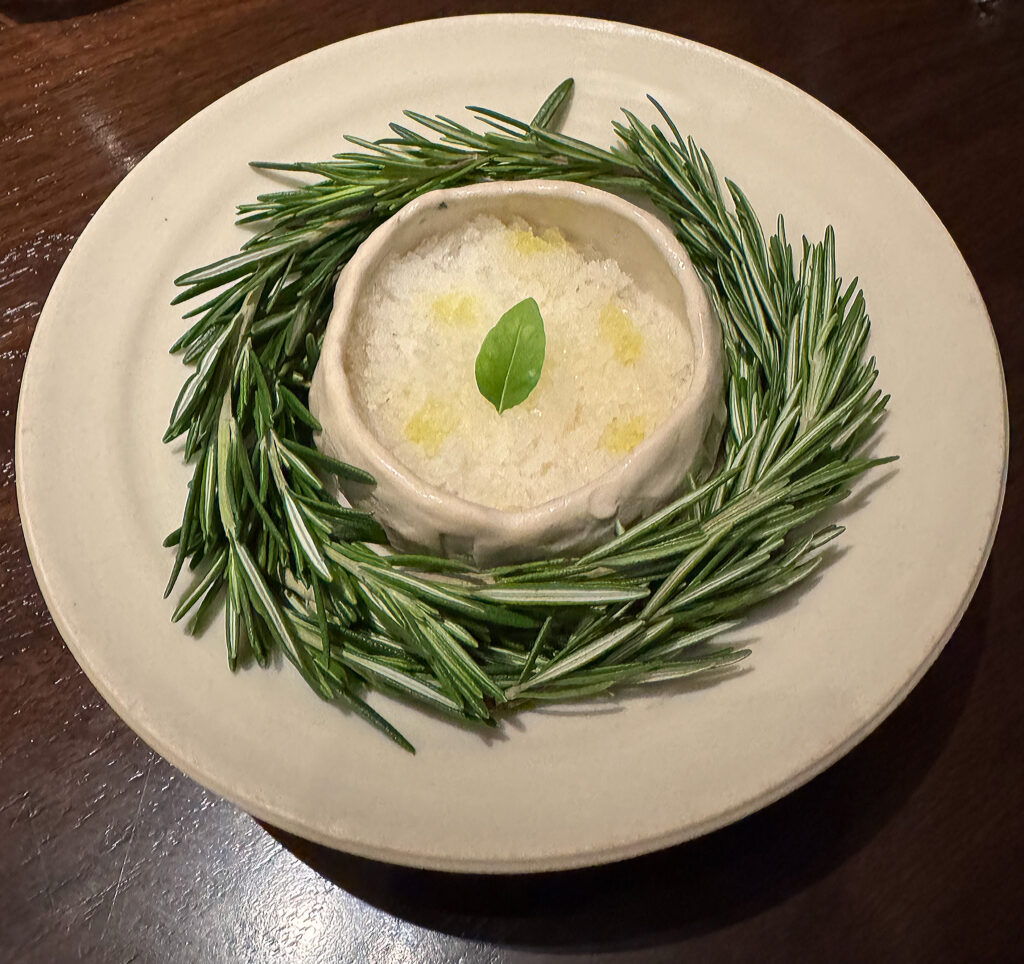
First, the “Rosemary Ice” (with its lemon pâtes de fruit, olive oil sorbet, rosemary granita, and rosemary-infused black olive oil) cools everything down: refreshing one’s palate with refined, cohesive textures and pronounced tangy-sweet flavors that, thanks to the supporting richness, achieve a surprising sense of satisfaction.
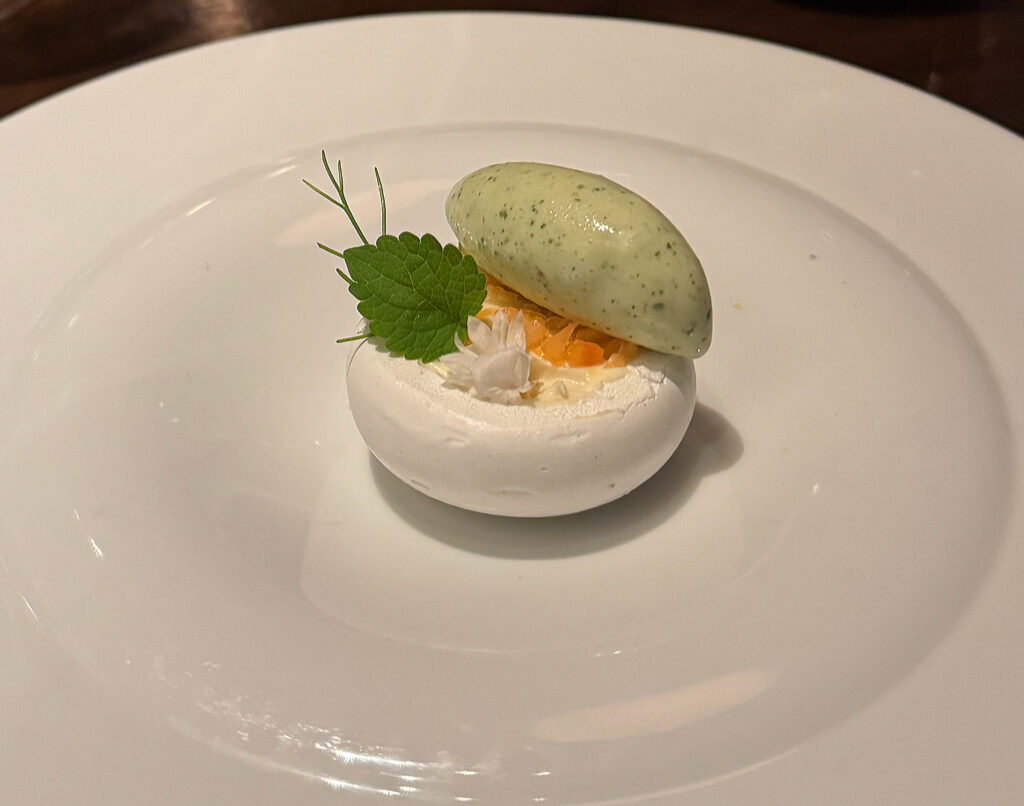
Second, the “Fennel Pavlova,” whose crisp and creamy blend of Cara Cara orange, tonka bean crémeux, and hoja santa ice cream takes the central note of anise and drives it toward notes of vanilla, roasted nuts, and root beer that feel staggeringly decadent despite the lack of any real accompanying structure or richness. This remains a triumph.
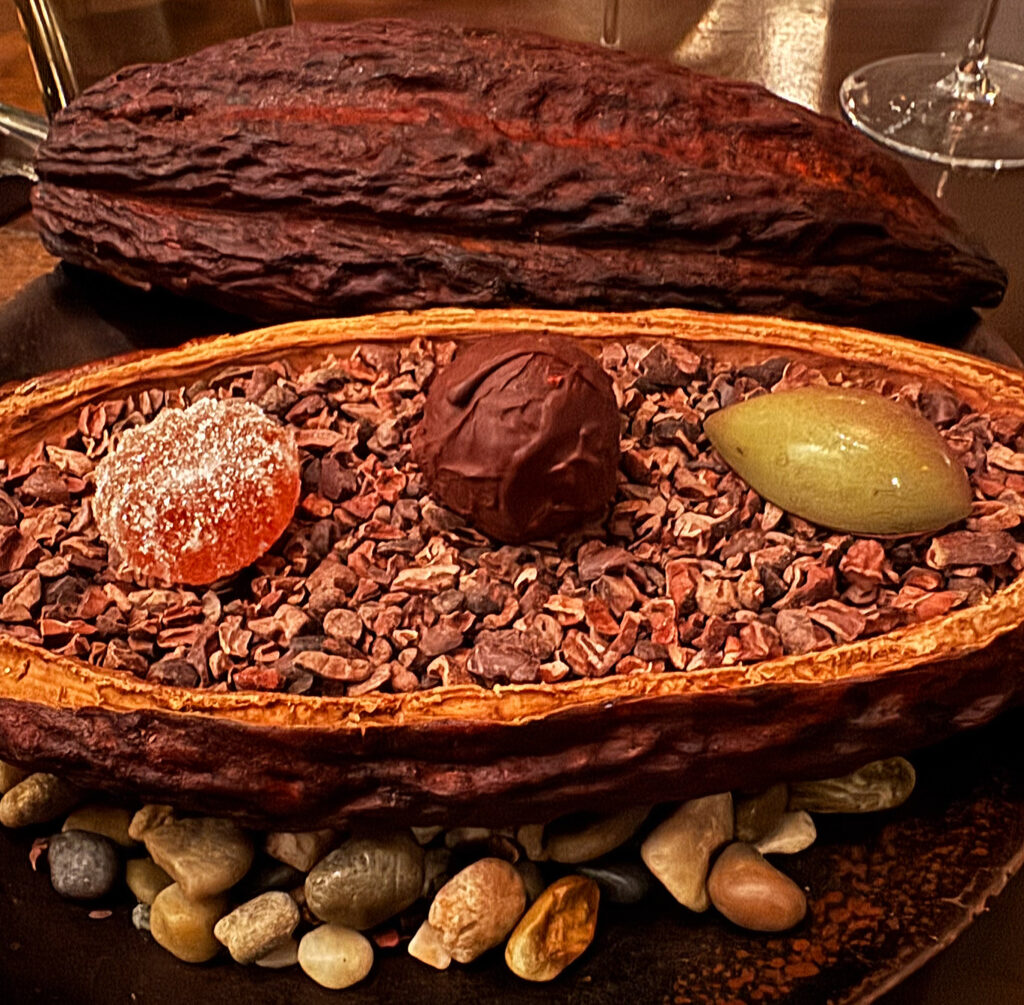
Finally, something new: a three-part sequence of cacao (sourced from Ecuador) served within an actual pod.
The “Cacao Pulp Pâte de Fruit,” made with passion fruit and citric acid, feels fresh and pleasantly chewy. It displays a concentrated, jammy flavor with an impressively persistent tropical depth.
The “Candied Cacao Nib Custard” is crisp then creamy then crunchy: embracing the earthier, more bitter notes one might expect while ensuring the bite retains enough powerful, sweetened cocoa character to be wholly enjoyable.
Lastly, the “Dark and Caramelized Milk Chocolate Bon Bon” possesses a brittle—then creamy—mouthfeel that frames a fairly straightforward expression of the fully processed beans. Still, the purity and easy pleasure here effectively build upon (and brilliantly conclude) that rawer expressions of the cacao.
Ultimately, I was somewhat tempted to write this sequence off as a clever way of packaging the same old mignardises used to conclude this (or just about any) tasting menu. Yet, beyond the thematic journey (from pulp to nib to bon bon) and the mirroring of the opening seafood flight, each bite is legitimately delicious. They meet—and even surpass—the quality of Oriole’s greatest petit fours, ensuring guests end the night with a fitting feeling of indulgence.
Two and a half hours later, the meal reaches its conclusion: admirable pacing for what amounts to 16 individual servings spread across 11 distinct courses.
Yes, rather than feeling rushed, the experience seems sharp and choreographed and leaves more than enough time to linger over coffee or leftover wine before proceeding to one’s next destination.
That is Sandoval’s intention—a tasting menu that highlights (without dominating) the evening, that titillates and inspires something more than a hazy collapse into bed. As much as might enjoy an extra course or two here, I’ve increasingly come to respect the restaurant’s philosophy.
On a night like tonight, the juxtaposition of pleasure and restraint is executed with pinpoint accuracy. Wine and food and conversation simply flow. Our first-timer is not bogged down by any compulsion to dissect the cuisine or decipher what the chef is trying to express.
We enjoy each plate with a healthy mixture of surprise and delight and then head out the door in a buoyant mood: reflecting on our enjoyment, eager to return, but content enough to let the memory go—for now—and revel in the warm weather.
In ranking the evening’s dishes:
I would place the “Hudson Valley Foie Gras” and “Fennel Pavlova” in the highest category: superlative recipes that stand among the best things I will be served in any restaurant this year.
The “Tuna Loin,” “Uni,” “Dungeness Crab,” “Hokkaido Scallop,” “Squab,” “Canelé,” “Rosemary Ice,” “Cacao Pulp Pâte de Fruit,” and “Candied Cacao Nib Custard” all land in the next stratum: great items that achieved a truly memorable degree of pleasure. I would love to encounter any of these again.
Finally, there’s the “Golden Kaluga Caviar,” “Carabineros Prawn,” “Skate Wing,” “A5 Miyazaki Wagyu,” and “Dark and Caramelized Milk Chocolate Bon Bon”— very good—even great—preparations I would always be happy to sample again (but that just failed to elicit an extra degree of emotion).
Overall, this makes for a hit-rate of 100%—far surpassing the 76% I reported in March and matching the same degree of success I found in January.
Even better: while only 13% of offerings landed in that “best of the year” category, a full 69% reached that “would love to have again” caliber—a new record for the concept (compared to 41% in March, 47% in January, and 60% in November of 2025).
Undoubtedly, these are massive scores, and they totally affirm Oriole’s reputation as Chicago’s great guarantor of gustatory pleasure.
Indeed, it’s tempting to say that the kitchen should just push a little harder and reach for that “best of the year” standard more frequently. But, in turn, does crafting such creative, transcendent dishes not demand a degree of fanaticism? Does it not threaten to shrink the audience for the restaurant’s work in order to please a smaller subset of customers (like myself) who judge every fine dining concept in relation to each other?
Oriole occupies such a special niche—opposite places touting greater honors and charging higher prices—because it so effectively captures the popular imagination: spanning all the artistry, warmth, exoticism, and decadence one dreams of encountering in gastronomy while ridding the format of any pretense and avoiding any constructions that may be too arcane.
It sounds so easy, yet the cuisine’s direct pursuit of pleasure (always the product of careful technique, never betrothed to iconoclastic belief) shines. The restaurant presents a vision of luxury that, in this city, frequently gets obscured by smoke and mirrors and gels and seaweed. It does so in a way that feels classic and elemental while, in every dimension, being revitalized.
The result is an experience that reliably satisfies newcomers and jet-setters and oenophiles alike. After all, do these distinct flavors of diner not frequently share the same table together (hoping to break bread and meaningfully connect despite differences in means or taste)?
In the final analysis, the work coming from chefs Sandoval, McHugh, and Aloupas right now has to rank among the finest I have tasted in Oriole’s history. Their cooking balances a clear desire and capacity for growth while, simultaneously, honoring the style that has brought Oriole such esteem.
By all means, this collaboration is only starting to hit its stride, and, consequently, I believe it can reach even higher peaks with time. For now, however, I think the team has plenty to celebrate. They have built a foothold upon which future success—a bigger, better representation of all that makes the restaurant unrivaled in Chicago—will flow.