
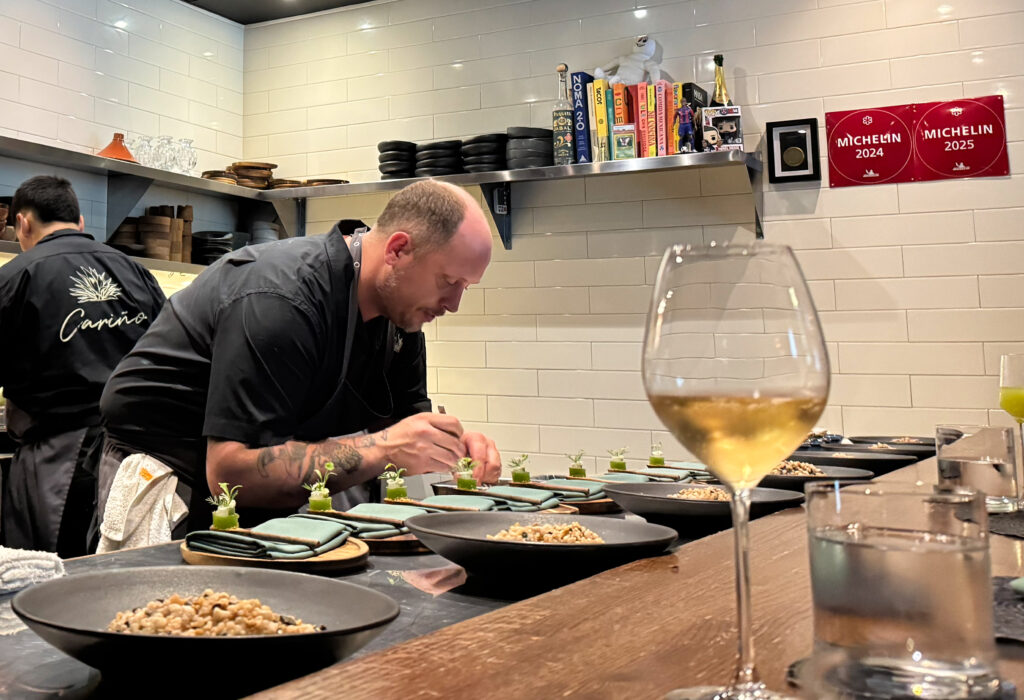
2024 was the year of Cariño, Valhalla “2.0,” and Feld: three fine dining concepts whose appeal—whether immediate or (in the latter case) only emerging after some serious soul searching—continues to surpass any restaurant that has opened since.
Indeed, putting Elske aside (whose strength really lies in the à la carte selection), one could make a case for any of these three tasting menus ranking as the very strongest at the one-Michelin-star (or should-have-one-Michelin-star) level. Given the premium charged by the city’s two- and three-star establishments (something like $100 more per person at a minimum), these places, by punching above their weight, stand among the most influential across our entire dining scene.
Feld’s chosen style (though not without its controversy) has obviously spoken to me the most: being centered on a vigorous, collaborative process of ingredient sourcing, experimentation, preservation, and intimate storytelling that challenges gastronomy’s timeworn tropes. What Jake Potashnick and his team are doing can charm even the most jaded serial diner, and I find being a regular here (serial diners perhaps being the real target demographic) to be endlessly rewarding.
Valhalla “2.0,” in its own way, subverts traditional fine dining by rejecting any sort of visual or spatial frills in favor of a sparse, minimalist counter and the most direct engagement with food and drink possible. Yes, if Feld is nascent and exploratory, Valhalla represents the culmination of several lifetimes’ experience: the mastery that Stephen Gillanders, Tatum Sinclair, and Jelena Prodan bring to their respective domains. The results—traversing a world of cultures, influences, and techniques—can be singularly explosive. However, things get more complicated when this headlining talent are needed elsewhere.
Ultimately, it’s Cariño, I think, that puts forth the strongest value proposition: touting nothing grandiose or academic but, rather, celebrating Latin American cuisine with a sense of refinement, irreverence, decadence, and nostalgia that largely hasn’t been seen in the market. Norman Fenton, in a manner that mirrors his menu, is immediately approachable and knowable yet contains a depth of passion just waiting to be uncovered. His chef’s counter feels like a natural antidote for anyone who finds the sushi omakase versions to be too stern and suffocating. At the same time, Fenton’s late-night taco omakase effectively halves the price of the regular tasting and broadens the concept’s appeal well beyond star chasers.
It’s telling that Cariño’s reservations are perpetually filled nearly three months in advance—with seats remaining more difficult to secure here than at Feld, which is still riding the wave of that Best Chef: Great Lakes win.
Ironically, who was the only other Chicago chef nominated in that category? Norman Fenton.
By any measure, my return to Cariño is long overdue. In fact, it would impossible to complete my current project—focused solely on the city’s greatest restaurants—without taking another look at Fenton’s work: both how it’s grown and how its core appeal (rooted in a couple emblematic dishes) survives.
Let us begin.
If there’s any Michelin-starred restaurant in Chicago that exemplifies Bibendum’s old tropes (i.e., “worth a detour,” “worth a special journey”), it has to be Cariño: the northernmost concept to currently tout such an honor, occupying a space that once claimed two of those stars about a decade ago.
Structurally, I don’t see anything holding Fenton back from one day reaching that same stratum. His work, while not quite staged as a dinner party, smacks of the same sense of “personality” that the Guide says they prize. Plus, with some light renovation work scheduled for January (improving the counter and upgrading the old range/oven that, ironically, survives from 42 Grams), the chef’s cuisine will only become more “refined,” “inspired,” and “expertly crafted” in time.
Plus, if Bibendum cares as much about making himself look good as I think he does, it’s hard to think of a fine dining establishment that more effectively subverts the exclusivity and insularity that define this hobby. I’ve already mentioned the relative value of the taco omakase, but there are also monthly “Tacos with Friends” events—culinary collaborations in support of local nonprofit Latinos Progresando—worth celebrating.
Fenton takes pride in the fact that his prices have only increased minimally (i.e., from $190 to $200 for the tasting menu, from $210 to $220 for the chef’s counter) since opening, as well as the fact that he’s cultivated a customer base composed of diners (as many as 25% coming from the surrounding area) who may visit several times a year or even once a month across the various experiences.
But it’s what he has planned for next door—a tortillería creating proprietary blends for other Chicago restaurants, selling retail products to those in the neighborhood, and serving “full-on meal[s]…for around 50 bucks…[per] person”—that is perhaps most consequential. Molino Los Hermanos (as the new concept will be called), reflects Fenton’s desire to expand Cariño’s presence on the block: building a foundation on which the chef’s team, the wider community, and even his own family (including two young sons) can further benefit from the Michelin-starred concept’s good fortune.
It’s the sort of approachable lynchpin that could transform a solitary tasting menu into a force for gastronomy across the entire North Side. The tortillería might not be Fenton’s only plan for the block either (he dreams of someday launching a cantina), but it’s a first step of expansion and enrichment that might, in fact, fuel the sort of “detours” and “journeys” I speak of.

In practice, Cariño’s corner of Uptown is easy to access (discounting a couple torn-up streets immediately behind the restaurant), and, compared to the winter months when I made my original trips here, the present season sees a constant flow of pedestrians up and down North Broadway.
The concept’s dark, curtained façade remains understated: downplaying the incongruity that separates a place charging hundreds of dollars from the casual eateries and quotidian shops that line the other side of the street. However, it would be wrong to say that Fenton, his team, and his guests escape attention altogether.
Tonight, during service, a woman plants her hands on the front door and peers inside while rebuffing any effort to move her along. As a few minutes pass, the look of concern on the faces of the staff grows obvious. Yet, with a sense of firmness and respect, they are able to defuse the situation without any kind of audible or interruptive exchange.
Cariño, in this capacity, clearly benefits from the leadership of Camille de Haro and Ray Medina: members of the opening team who have risen to the positions of general manager and beverage director respectively. Yes, even coming here more than two years after my last meal, I am met by a sense of effortless warmth and continuity that puts me right at ease.
Unquestionably (at least for anyone seated at the counter), Fenton forms the star of the performance: balancing his own stewardship of the cooks (some five in total, working on up to a half-dozen different dishes at a time), the direct application of countless techniques (going well beyond garnishing), the presentation of each course (with “maximalist” descriptions that are almost impossible to follow), and plenty of banter too.
But the front of house does an incredible job of keeping the show on the road: hitting all the traditional marks of service (placing utensils, providing refills, clearing plates in a timely manner) while paying special attention to the total coordination of each drop and to the pacing (in my particular case) of two consecutive bottles of wine. The restaurant’s bathroom even deserves special praise for being so immaculate and pleasant smelling.
Drink options center on a selection of cocktails and wines by the glass in a friendly $17 to $20 range. Pairings, likewise, comprise “Non-Alcoholic” ($65), “Standard” ($105), and “Reserve” ($175) selections.
As always, I look to the bottle list, which has noticeably grown in its range of offerings from Argentina, Chile, Mexico, and Uruguay. The Chardonnays ($130 to $260) and Pinot Noirs ($95 to $175) from Bodega Chacra always form an obvious choice for anyone seeking quasi-Burgundian elegance.
Nonetheless, on this occasion, I opt for a pair of sparkling wines: the Viña Aquitania “Sol de Sol” Brut Nature ($170 on the list, $45 global average price) from Chile’s Malleco Valley and the Domaine Nico Brut Rosé ($100 on the list, $47.99 at national retail) and from Mendoza. They form pleasant companions to the menu at what feels like a fair markup (the limited availability of the first bottle means it’s hard to pin down an accurate reference point).
Fenton, back in 2024, noted that he would allow corkage for a fee in the $25 to $35 range if someone brought their own wine in. I’ve never taken him up on that offer; however, even if the figure has climbed a bit higher (commensurate with Cariño’s success), I think it presents an attractive opportunity.
The concept is clearly not looking to leverage the beverage program to squeeze its patrons for a bit more money. Rather, the chosen cocktails, pairings, and featured producers are meant to provide thematic resonance at a variety of friendly entry points. This leaves a perfect window for oenophiles—even at a corkage fee as high as $50—to bring something truly exceptional and honor the cuisine in accordance with personal taste.
Turning, at last, toward the food, we begin with a bite that joined the menu back in 2024 but only did so after I had completed my visits to the restaurant. Thus, I think it’s right to consider this item one of Fenton’s signatures—just one I’ve not had the chance to sample yet.
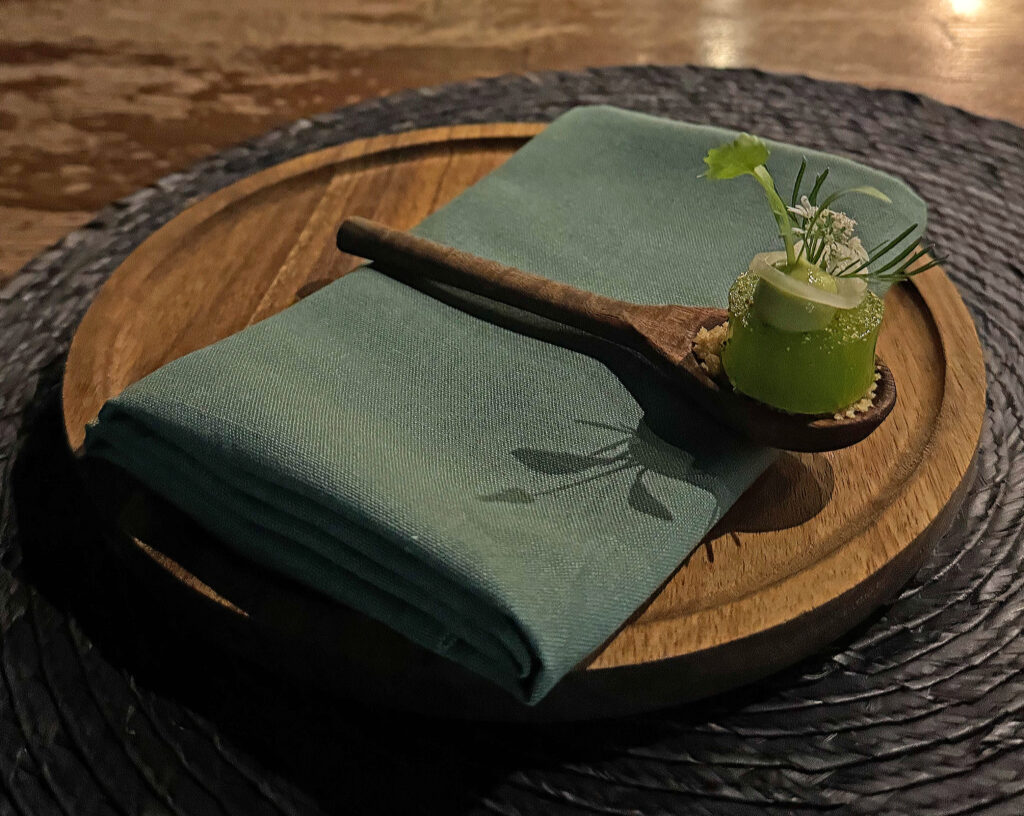
The “Chips and Salsa” speaks to the kind of elemental pleasure that transcends any (deserved) association with Mexican cuisine and can strike anyone, from any background, with a profound sense of deliciousness. For that reason, it forms the perfect introduction to the style of cooking Cariño will pursue throughout the meal: refined, perhaps de- or reconstructed, yet faithful to the textures and flavors and fundamental intensity one craves from its chosen forms.
This particular package comprises a salsa verde jelly set atop a tortilla crumb with some curls of pickled ramp and notes of licorice mixed in. The intended effect, so defined by something gelatinous, seems like it would be sacrilegious: a startling example of “molecular gastronomy” gone wrong. Yet the sensation—creamy, then powerfully crisp, with earthy depth and the most pristine, fruity-sweet tomato—is expertly constructed and undeniably nostalgic. Yes, this is the sort of amuse-bouche that actually matches and condenses the joy provided by its namesake. Given that the “Chicharrón” (that hulking, crunching, tower of pork and corn) has been excised tonight, I savor the chance to start the evening with some kind of snacky indulgence.
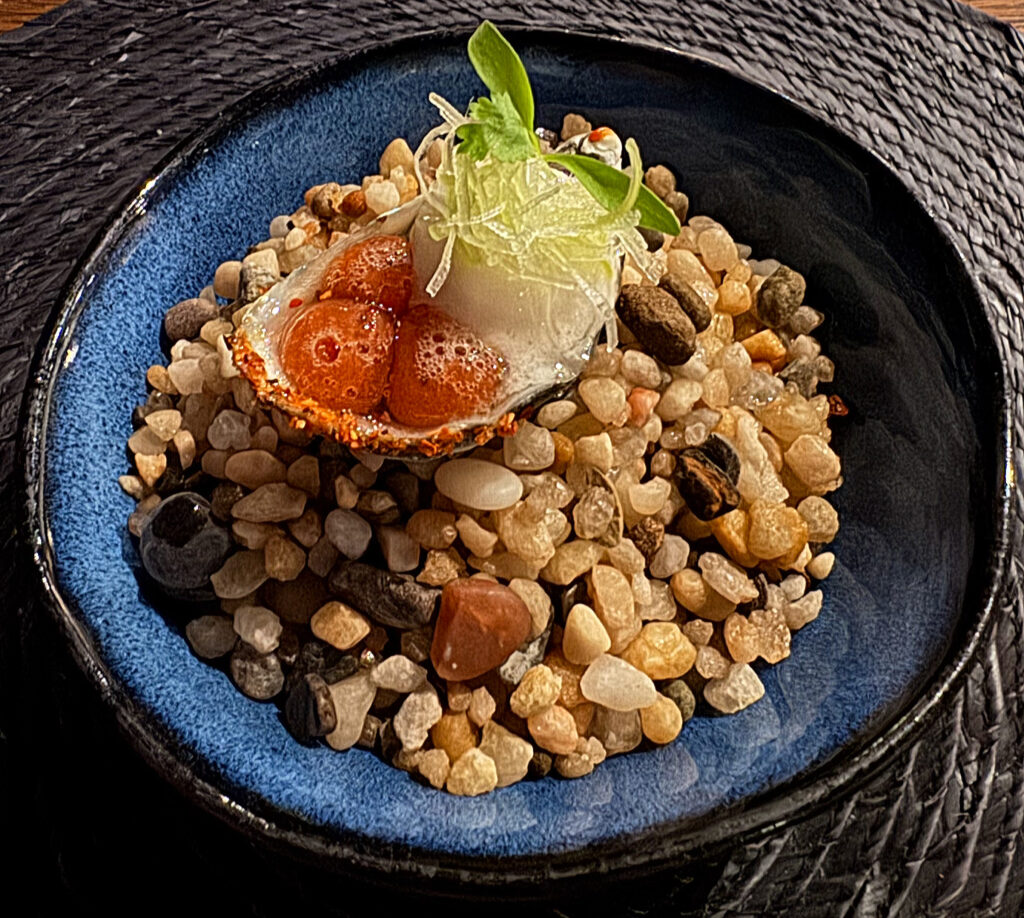
The ”Michelada” that arrives next is entirely familiar (and welcome). The bite’s namesake might not form the same universal reference point, but I bet a sizable proportion of the restaurant’s audience have slurped one down at one point or another. Plus, the drink forms a clever take-off point for the kind of dressed oyster so many chefs like to serve (while simultaneously struggling to find an angle that is unique or meaningful).
Here, a bivalve sourced from Baja is topped with a mound of beer foam, some shaved onion, and a trio of Clamato pearls before being crowned with the kind of chili-lime rim that frequently graces the titular cocktail. Texturally, the oyster offers a clean, creamy mouthfeel with a hint of tickly carbonation from the foam. Yet it’s the dish’s flavor—balancing tang and brine with moderate heat, persistent umami, and a surprisingly sweet finish—that proves exceptional. Indeed, while I slightly favor the “Chips and Salsa” for touching on a core food memory, the “Michelada” is beautifully bracing and readies one’s palate for all the courses to come. It’s hard to envision Fenton ever getting rid of these bites (and for good reason).
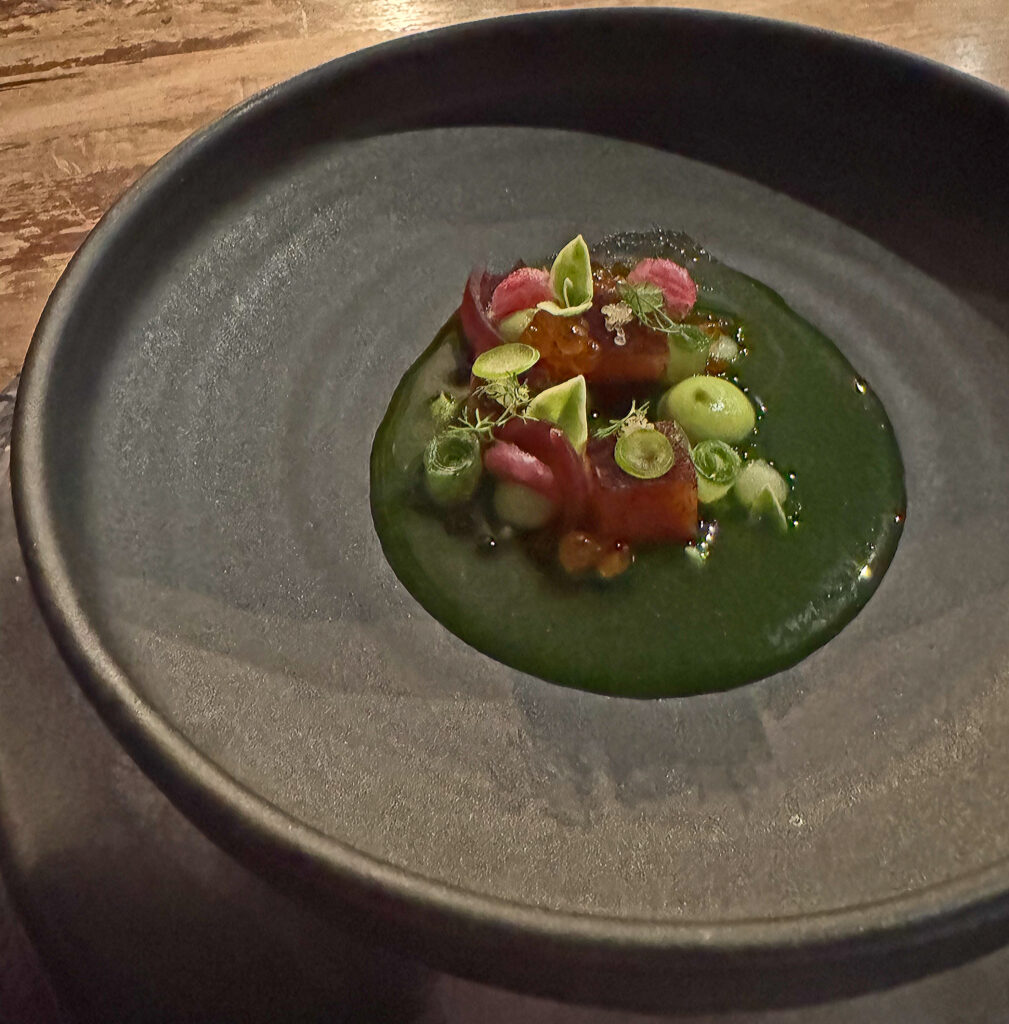
The “Aguachile” that comes after is also familiar, and I cannot help but raise an eyebrow. The chef has been serving some version of this recipe since as far back as 2021 (at Brass Heart), describing it as one that is “consistently evolving…[though] with the same thoughts and intention behind it.” During my early visits to Cariño, I thought the course fared well enough without ever really ranking as one of my favorites. For that reason, I’m surprised to see it still holding down a place on the menu.
The dish’s composition—combining chunks of cured Ōra King salmon with salmon roe, curls of cucumber, watermelon radish, pickled onion petals, parsley, finger lime, and a jalapeño chili water—largely remains the same. However, I do think the presentation (centered on such a tapestry of shapes and colors) looks cleaner and more assured. Most importantly, the aguachile now strikes me as undeniably delicious: spanning an engaging range of tender, gooey, and subtly crisp textures with supporting notes of brine, tang, and sweetness. Nonetheless, it’s the recipe’s juxtaposition of moderate, lasting heat and a certain cleansing, herbal quality that proves profound. These two sensations counter each other and further deepen, and I am left still savoring their effect minutes after the plate is cleared. Expectations aside, the “Aguachile” ranks as one of my favorite offerings of the night and a true testament to Fenton’s continued growth.
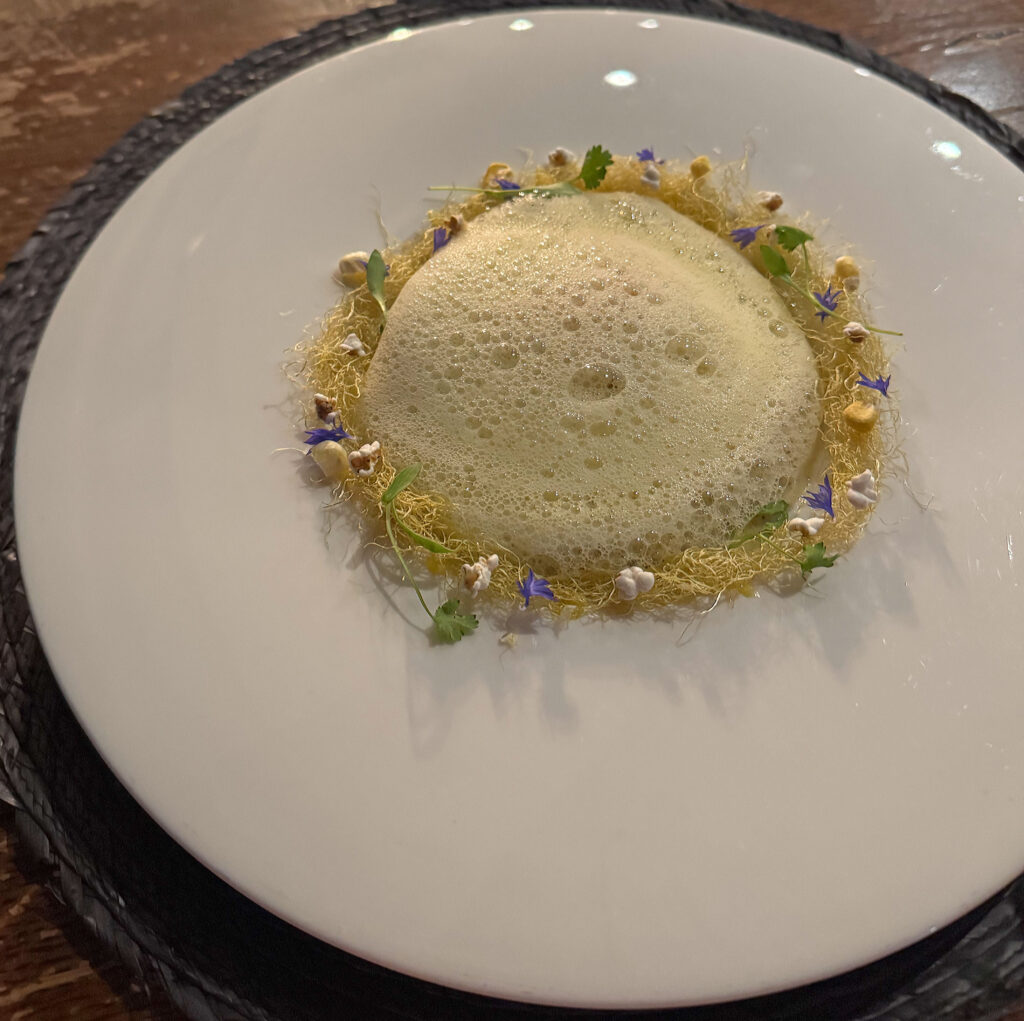
By comparison, the “Ravioli” is the one course I expect to see—given that it stands as the restaurant’s most emblematic signature and the kind of dish that is invariably named whenever diners speak of the very best in the city. Fenton, back in 2024, noted that he might eventually pull this beloved creation off the menu for the sake of growth, but the rest of the team has advocated to keep the recipe on forever. Appropriately, it has changed very little since my last encounter.
Here, the titular pasta comes stuffed with huitlacoche (i.e., the prized “corn smut” fungus nicknamed “Mexican truffle”) and dressed with countless other expressions of sweet corn (e.g., popped, pickled, frozen, the fried silk, a foam) and a bit of actual black truffle. On the palate, the ravioli are beautifully rendered: displaying a plump, soft, and fleetingly structured consistency with a creamy filling that attractively cushions all the plate’s crisper components. The resulting flavor centers on the most pristine, lingering note of freshly corny sweetness with just enough supporting earthiness, salt, and subtle acidity to provide what feels like a fathomless sense of definition.
That said, having eaten this pasta a few times now, I do think it’s effect—so thrilling to first-timers—is beginning to feel a little confected and boring. This takes nothing away from the recipe’s immense success. Rather (and I think of a bite like Oriole’s foie gras), a certain degree of modularity is necessary to keep classic dishes feeling fresh. Or, perhaps, Fenton already has some idea of how to replace the “Ravioli” altogether while preserving the same fundamental appeal. It’s a tall order but just the kind of challenge that should thrill a chef who so reliably conjures decadence.
The most notable change I encounter on the present menu—keeping the excision of the “Chicharrón” in mind—has to do with the elongation of Cariño’s taco (or should I say tortilla) sequence. Indeed, though my past meals have been characterized by a joint presentation of three distinct forms, the kitchen now serves four different recipes individually. Naturally, this enables a deeper appreciation of each idea while, in turn, allowing the chef to debut an entirely new item without being bounded by the original trio.
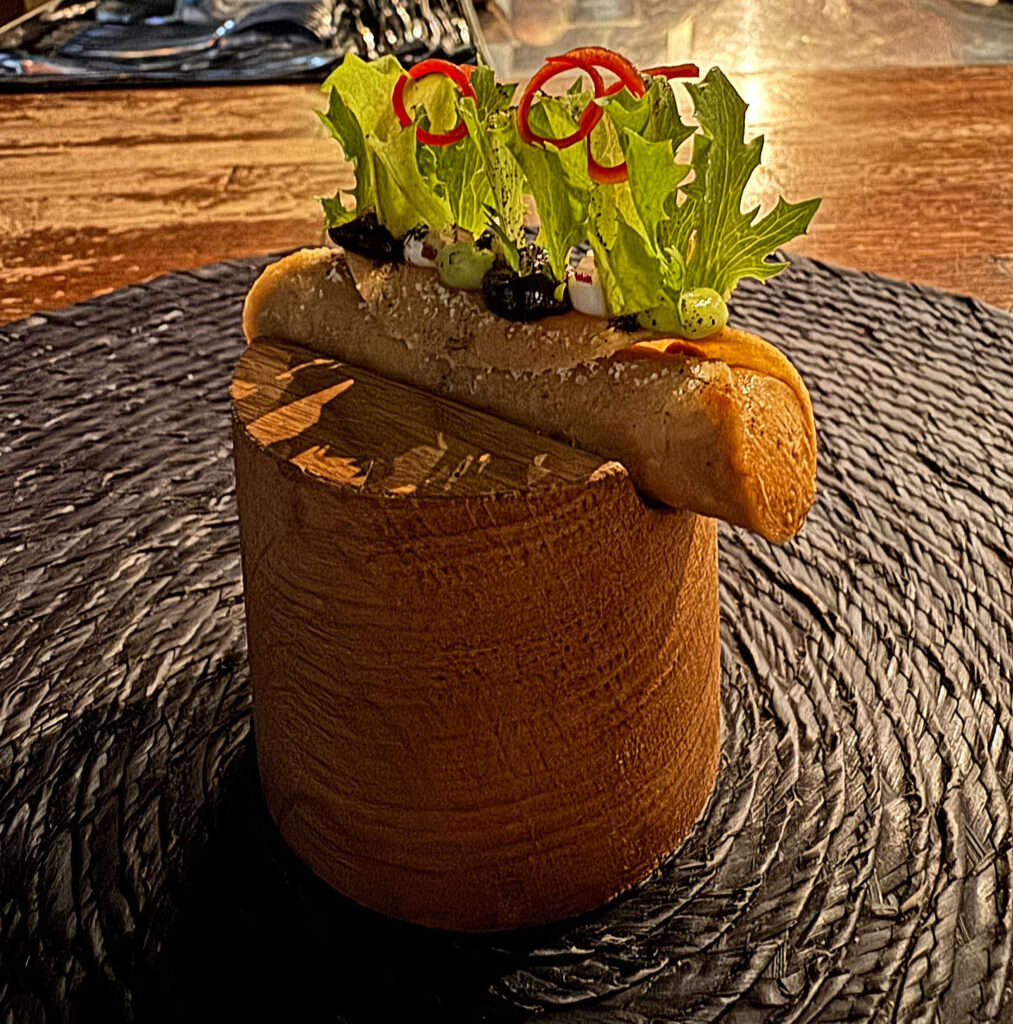
Of the four, the “Tacos Dorados” is the most familiar: comprising a tightly rolled tortilla filled with chicken liver mousse and allium mash then topped with a trio of sauces (i.e., avocado, adobo, queso fresco), leaves of petite lettuce, and curls of Fresno chili.
Texturally, the taco—so cleanly crunchy—does an admirable job of holding its shape as diners navigate the two or three bites. When it comes to flavor, the unabashedly meaty (almost borderline too irony) quality of the liver clearly dominates on both the attack and the finish. It could possibly prove too much for some guests, yet, even if I agree it could be better balanced by the accompaniments, I personally enjoy it. Further, while it might seem strange to start the sequence with a stronger note of offal, there’s enough power here to match and counter the intensity of the preceding corn.
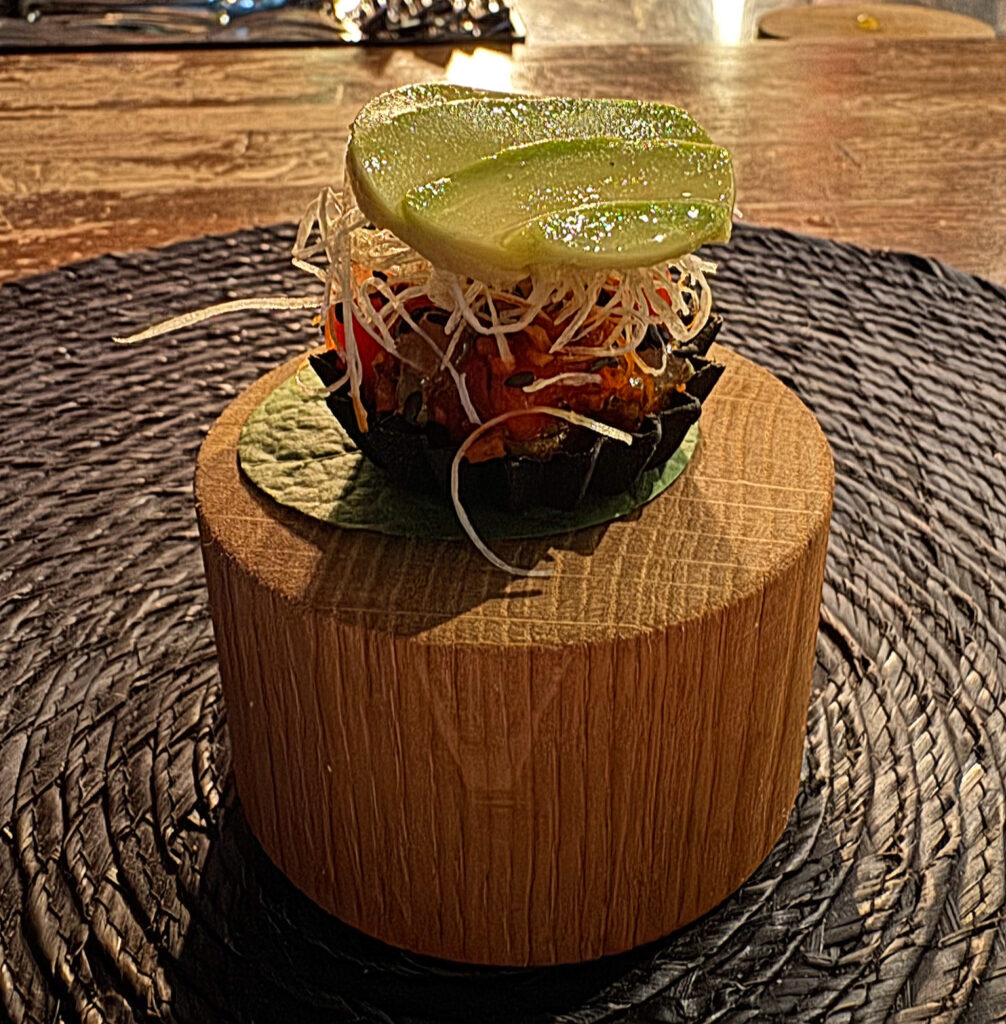
Arriving second, the “Bluefin Tuna” is new to me and, it seems, one of the newer servings on the menu more broadly. Here, the starring fish is rendered as a fine tartare that has been tucked into squid ink-bone marrow tartlet then topped with salsa macha, sudachi, crispy leeks, and avocado.
Diners are invited to wrap the whole package in an accompanying hoja santa leaf, which provides a third layer of crispness against which the tender, creamy fillings can shine. The resulting flavor—balancing pronounced, lingering citrus with mild heat, allium sweetness, and ample backing salt—is both totally cohesive and memorably pleasing. In sum, this makes for one of the highlights of the night.
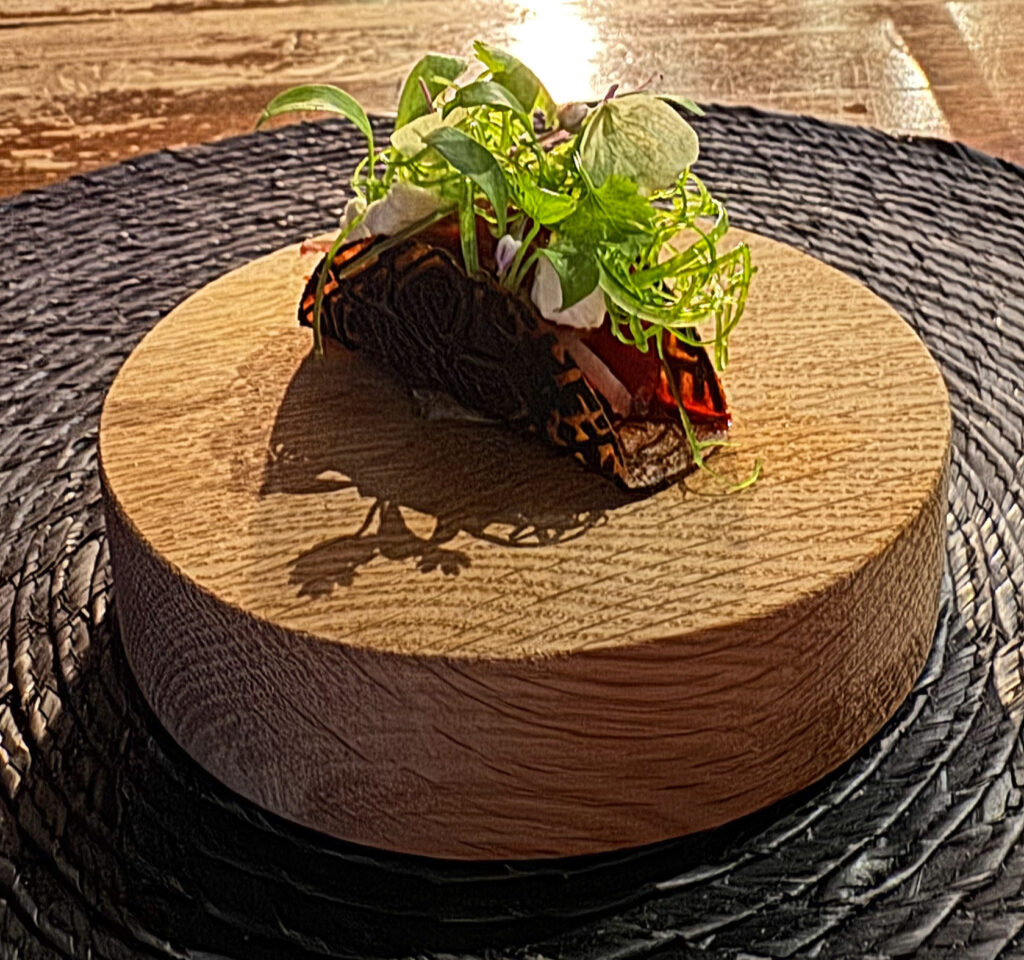
A third item, the “Onion Taco,” is both new to me and to the menu more generally. (I cannot find any record of it having been served prior to tonight.) This recipe actually replaces an earlier “Tostada” while, simultaneously, adapting its core ingredients: with the starring lamb tartare and pineapple now being joined by shallot and allium flower and tucked within a hard-shell vessel made from charred and caramelized onions.
Texturally, the taco’s base displays a very finely crumbly consistency that accords with its thin, impressively rigid shape. Its flavor blends a mild (or just above mild) degree of heat with a more moderate, lasting sweetness drawn from the seamless combination of onion and tropical fruit. However, I do find the lamb—both in terms of its weight on the palate and any corresponding richness—gets lost in the shuffle, and, thus, the combination tastes simpler and less convincing than it should. Overall, this might be the weakest bite of the evening. However, it’s clearly also the most untested, and there’s no question that it still provides pleasure.
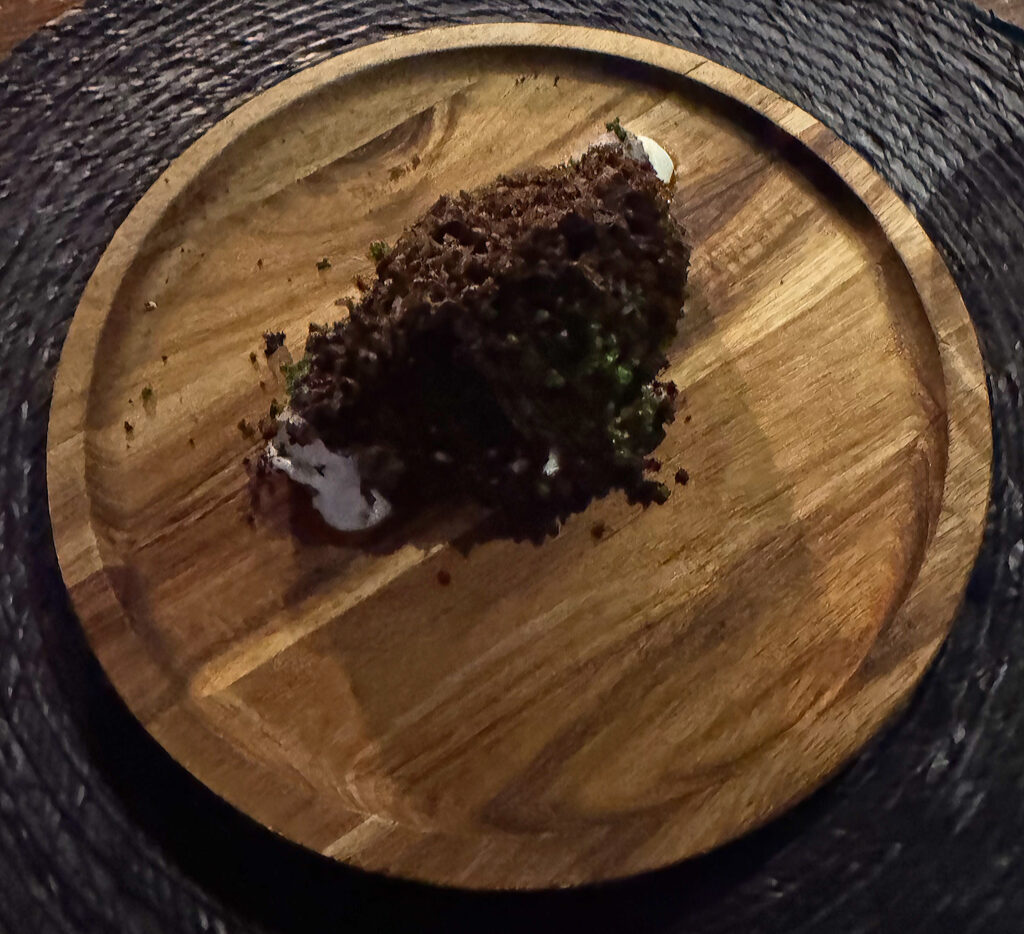
Closing out the sequence, we have the “Quesadilla.” This Cariño signature centers on a blue corn masa and pumpernickel-inspired rye base that is filled with hedgehog mushrooms and Oaxaca cheese before being topped with black garlic purée and more microplaned black truffle than I can ever remember seeing here.
Given the towering, oozing package that lies before me, I actually attack the dish with fork and knife. It takes a bit of effort to slice off a segment, and, indeed, the tortilla’s crispness is quite faint. Nonetheless, the resulting blend of mouthcoatingly creamy and fluffy, crumbly textures is easy to like, and the resulting flavor—long, milky, and tangy-sweet with transfixing notes of earth, nuts, and umami through the finish—is sublime. Yes, while the profile of this bite is darker and more intellectual than anything else Fenton offers, its power (even when the application of truffle is taken to such an extreme) is irresistible. In fact, I actually enjoy the dish much more now than I did back in 2024.
Turning toward the entrées, I find two familiar dishes that—retaining their headlining place on the menu—offer yet another, even stronger test of the recipes’ enduring appeal and the chef’s capacity to refine them.
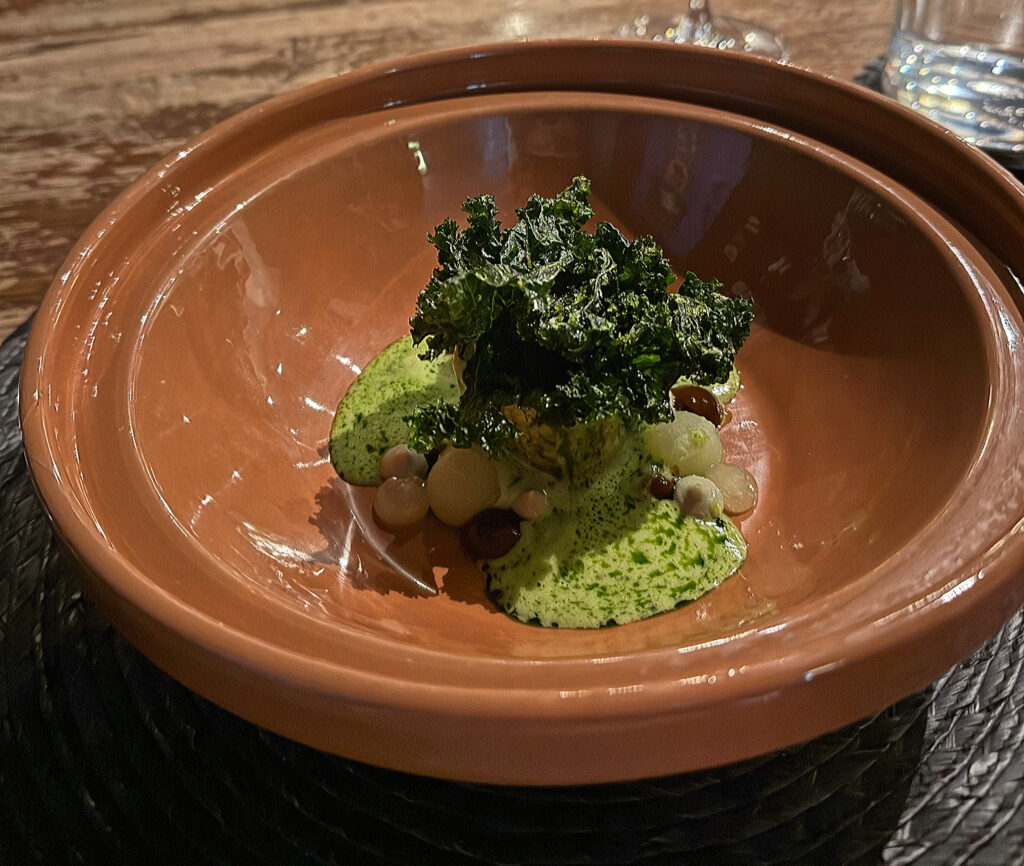
The “Black Cod”—formed into a roulade, grilled on a konro, hidden beneath a layer of crispy hoja santa, and joined by pickled chayote, mole amarillo, and a green pepita purée—actually dates as far back as 2019.
But the fish, to its credit, is beautifully rich and tender. Moreover, it’s otherwise mild flavor is ably matched to the medley of sour, smoky, and nutty notes that accompany it. A mild, lasting heat and exquisite anise-kissed sweetness characterize the finish: making for a course of classical styling and pinpoint precision whose faithfulness to Cariño’s vision is hard to fault. Ultimately, I’d probably get tired of eating this if I were visiting the restaurant every few months, yet I’m not sure several years of work are so easily replaced.
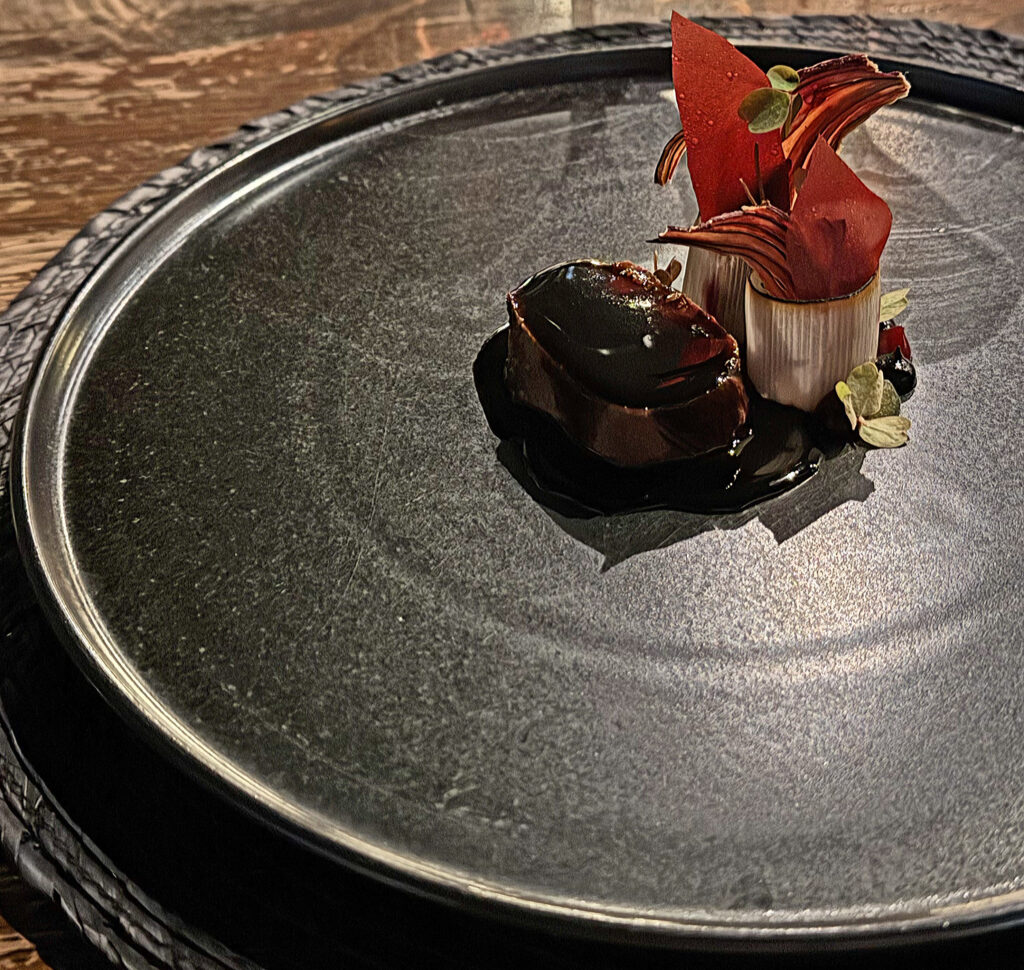
The ”Lamb”—a cut of the loin, cooked in smoked fat, then dressed with black garlic, beet, and sour orange—is faced with anchoring the savory side of the meal. In effect, it needs to deliver the kind of carnivorous satisfaction that has largely been missing from all the evening’s smaller bites.
Thankfully, the meat is more than up to the task: displaying a maddening blend of chew and juiciness that immediately puts me at ease. For my taste, the accompanying hibiscus chips (rising high from leek silos) offer more of a visual thrill than anything. However, the jolts of acidity and sweetness provided by the sauces are harmonious, and the lamb (backed by the black garlic’s concentrated umami) leaves me with the sense of deep pleasure I desire. That said, I do think some of the same fundamentals could be applied to a different cut or protein altogether. Or maybe it’s that “side” of hibiscus that could be replaced with something more interesting?
Dessert, funnily enough, might be the section of the tasting that has undergone the most growth since my last visits here. Though, based on what I am seeing, these recipes are all fairly longstanding in their own right.
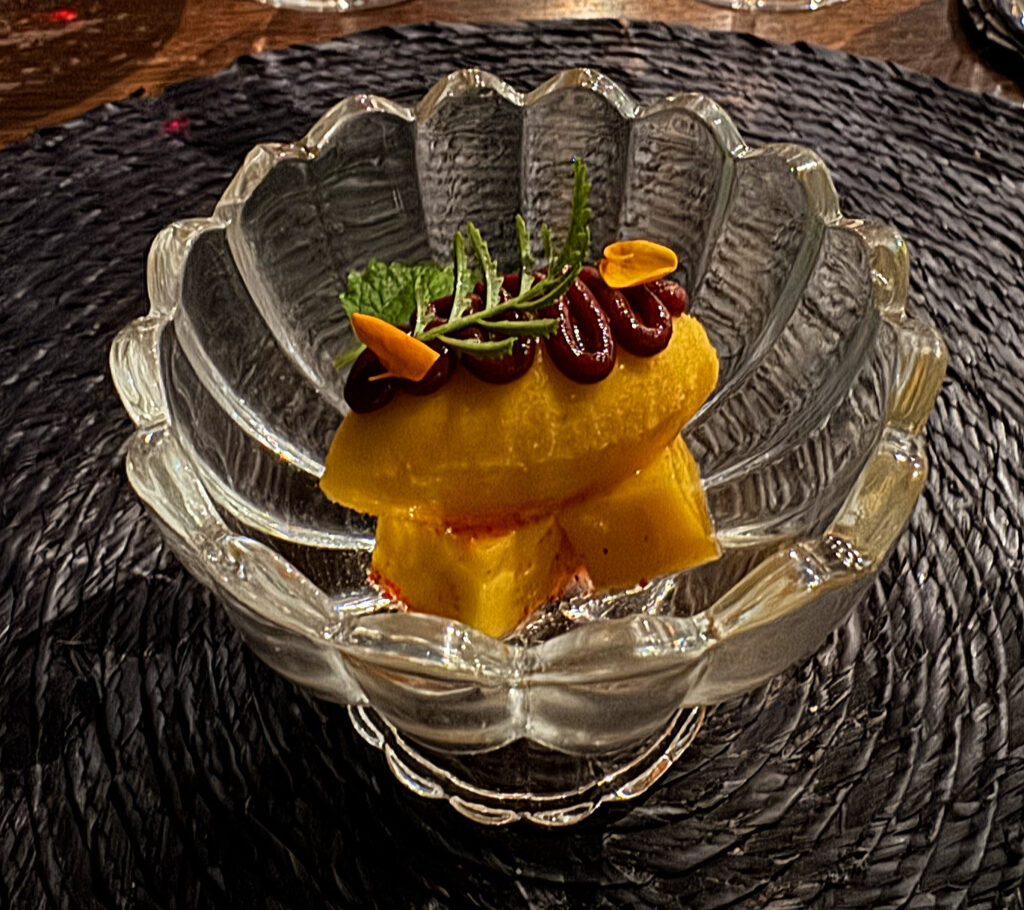
The “Chamoyada”—inspired by the drink of the same name—is not new to me. But it’s hard to see this bowl of mango chunks, mango sorbet, strawberry chamoy paste, freeze-dried yuzu, and lemon balm ever leaving the menu.
The recipe’s juicy, tangy, syrupy, and intensely sweet sensation (strikingly balanced by a touch of sharp chili) transcends any mere “palate cleanser.” Instead, it ranks as a highlight in its own right.
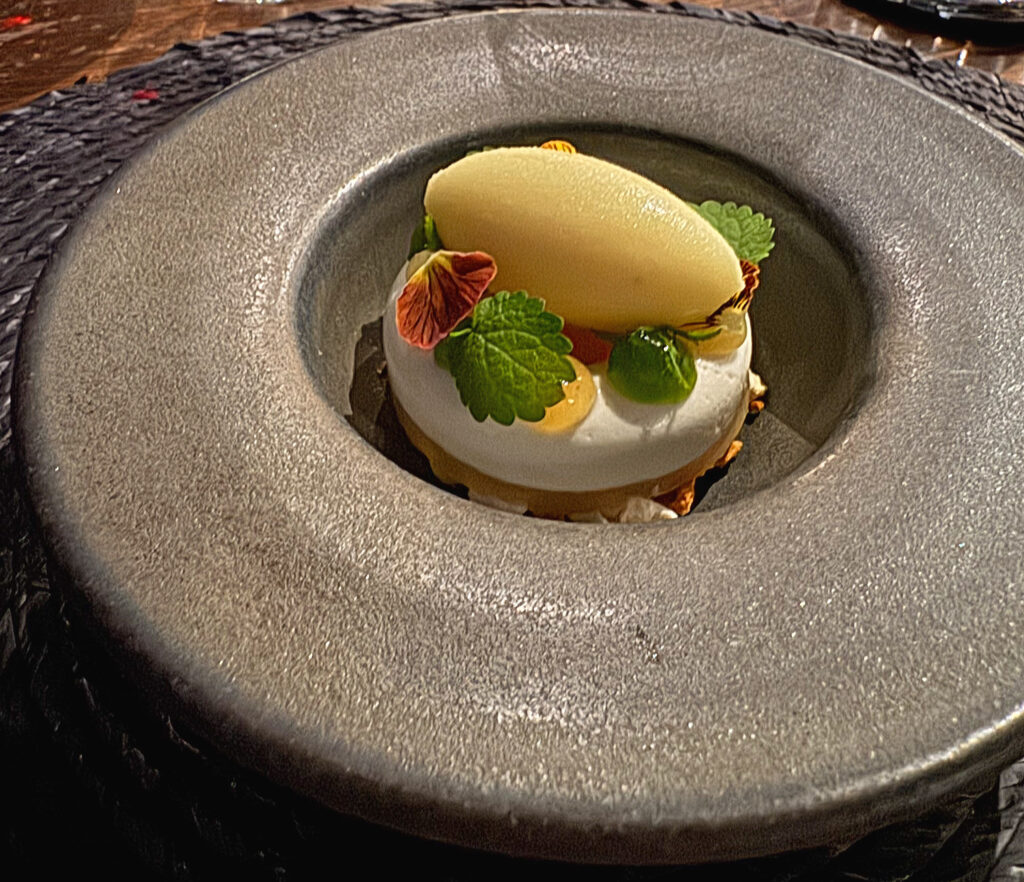
The “Pineapple”—stacked with coconut crunch, coconut-pineapple parfait, pineapple-lime sorbet, and gels made from anise hyssop, more pineapple, and tepache (made from the fruit’s fermented skins)—does one better. Cool, crisp, creamy, and soothing, this recipe layers tropical notes in the same way seen throughout Fenton’s savory work.
However, here, the tangy-sweet, caramelized, and licorice-laced flavors amount to a profound, superlatively tropical expression of decadence. For my palate, this ranks as one of the finest desserts in the entire city.
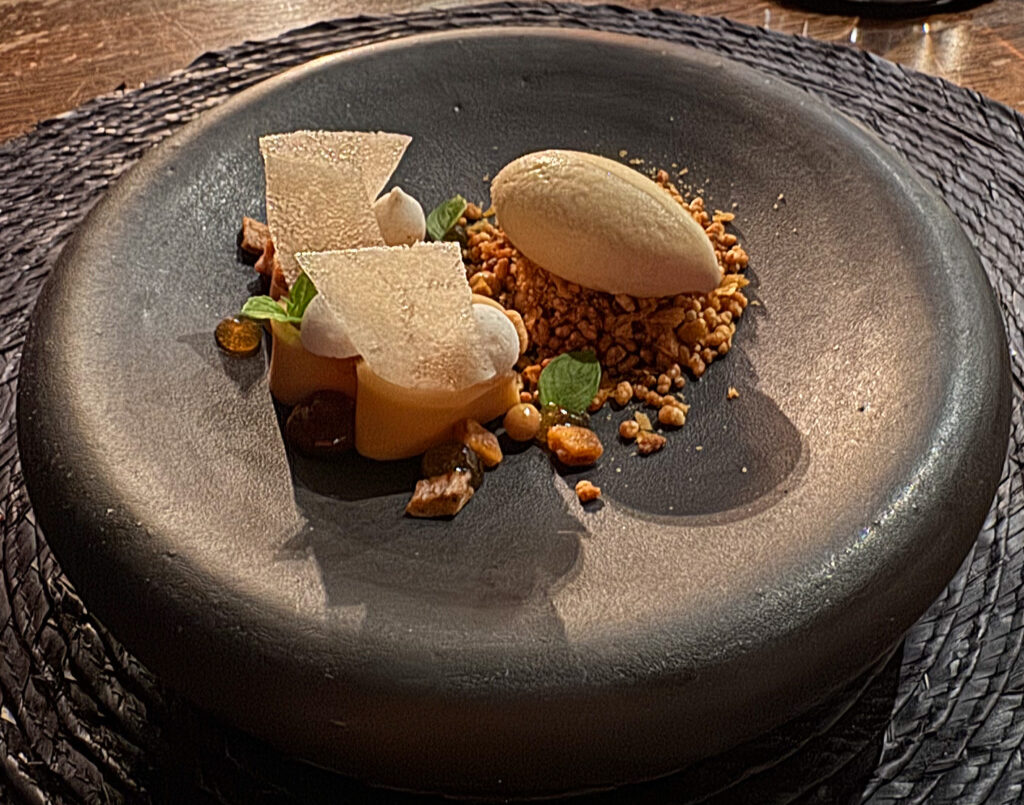
The ”Horchata Chai”—dressed with ribbons of Thai banana cream, a dulce de leche crumble, and rice chips—feels particularly generous on the back of such strong openers. With this dish, the kitchen explores an even richer, nuttier, more caramelized realm of sweetness one might desire to cap off the meal. However, uplifting notes of mint and warm spices ensure the recipe remains intriguing and intellectual rather than descending into saccharine excess.
I only wish the corresponding textures (smooth, gooey, and crisp) were balanced by something more cakey. For I can’t help but feel that all three of these desserts are frozen, creamy, and crunchy (but not dense or rich) at the end of the day.
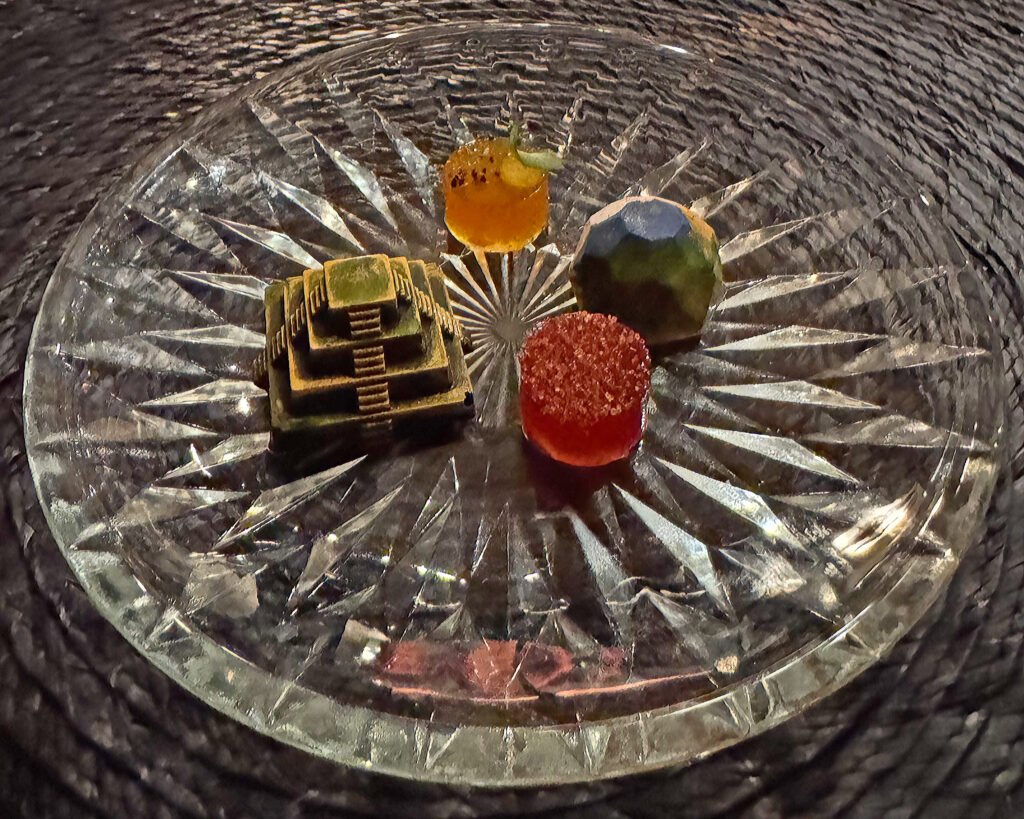
Tonight, a selection of “Mignardises” concludes the meal, forming just the kind of extra touch—the kind I didn’t see back in 2024—one expects from a concept that has now claimed (and retained) its Michelin star.
Fancifully formed, the confections comprise a soft, somewhat salty strawberry pâte de fruit; a tart, smoky jelly made from mandarin, mezcal, and toasted grasshopper; a 66% cocoa and guava bite (styled after an Aztec pyramid); and—my favorite—a 33% cocoa and corn creation accentuated by a touch of heat. Overall, the quartet is a clear success, and I am again left feeling that the restaurant is quite generous in its approach to dessert.
With that, the meal reaches its conclusion: some 14 different courses served in a matter of only two hours. Discounting the fact that many of these servings amount to no more than a bite—though, mind you, rather complex ones—this forms a blistering, engaging pace befitting an experience of such accolades.
Given that the “Taco Omakase” does not start for nearly another two hours (tasting menus are successively staged in the dining room at 6 PM, 7 PM, and 8:30 PM), there’s no rush to leave the counter. In fact, getting to chat with Fenton while he’s a modicum less busy forms a highlight in its own right.
Otherwise, the presentation of the check—with its 25% service charge “in place of a tip,” inclusive of “ALL gratuities and fees,” in fulfillment of “equitable pay and benefits” for the staff—is smoothly handled. It helps that the team (almost the entirety of which is visible within the restaurant’s intimate space) works so tirelessly for the fee.
Finally, with a turn of the lock (no doubt inspired by that earlier encounter), I leave Cariño’s world and make the long trek home.

In ranking the evening’s dishes:
I would place “Pineapple” in the highest category: a superlative item that stands among the best things I will be served in any restaurant this year.
The “Chips and Salsa,” “Aguachile,” “Ravioli,” “Bluefin Tuna,” “Quesadilla,” “Lamb,” and “Chamoyada” land in the following stratum: great recipes that achieved a truly memorable degree of pleasure. I would love to encounter any of these again.
Finally, there’s the “Michelada,” “Tacos Dorados,” “Onion Taco,” “Black Cod,” “Horchata Chai,” and “Mignardises”—good—even very good—preparations I would always be happy to sample again (but that just failed to elicit an extra degree of emotion).
Overall, this makes for a hit-rate of 100% with some 57% of offerings reaching that “would love to have again” level of quality yet only 7% climbing to that “best of the year” standard. Still, by any measure, this is a fantastic score: the mark of a mature restaurant, firing on all cylinders, pleasing guests with its longstanding signatures, and only now—just maybe—needing to start renewing in its menu so that returning customers find the same sense of discovery and pleasure that characterized their first visit.
Admittedly, the team likely has a much better sense of how many patrons on any given night haven’t been there before. Why should the kitchen cease putting its best foot forward—serving the dishes that have built its reputation—until the bookings begin to slow? Don’t the “Taco Omakase” and “Tacos and Friends” events better provide the kind of dynamism that a more privileged demographic of serial diners might be looking for?
Fenton, who I think it’s worth remembering fought so hard to help Brass Heart survive during its final act, feels the weight of his own success: not only the fatigue of giving “100% effort” over the past two years but the sense of responsibility he feels toward his family and the rest of the staff to make the most of their good fortune (through expansions like Molino Los Hermanos).
I think it’s right to ask what any chef really owes gastronomy—the constant pursuit of unknown and unattainable excellence—when faced with the chance to build something secure and generational and adept at pleasing the vast majority of people anyway. I don’t think there’s anything cynical about Fenton preserving the recipes (some the result of years of obsession) that have realized his dreams, for, if Cariño is open, his hands will be the ones weaving the magic. It’s not like he’s away on vacation somewhere and entrusting anyone else to play the hits.
Tonight, the “Chips and Salsa,” “Bluefin Tuna,” “Onion Taco,” “Pineapple,” and “Horchata Chai” were all new to me (if only due to years of absence), and they were all successful. A few ranked among the very best dishes of the night. The kitchen clearly retains its creative impulse; it need only embrace the process fully, debut things gradually, take risks without weakening the whole, and ensure they never reach the point where a few signature recipes suddenly feel obsolete.
Indeed, the “Onion Taco” was both the newest and the weakest recipe of the night (and, really, it was composed of ingredients—shell and fillings—that already feature across the various menus). The bite can and will be easily improved; however, more importantly, its inclusion changed the meal at a structural level and hinted at how much more Fenton can do with the format.
Ultimately, Cariño’s planned closure and minor remodel might be all the team really needs: a chance to shut down, recharge, arm itself with sharper tools, then start to push all over again. If they can put out new work that matches the standard set by the old stuff—and maybe lace it with a bit more of the storytelling and insight one prizes in a counter setting—I don’t see what’s stopping the restaurant from reaching an even higher level.