
My most recent meal at Elske (back in February of this year) ranked as one of the finest I’ve ever had at this nearly ten-year-old concept.
Indeed, while I have sometimes thought of the place as my dark horse candidate for “best restaurant in Chicago,” what makes the cuisine so renewing—so memorable—is that it is not afraid to provoke as much as it delights. There’s a tinge of something challenging in the team’s work: an assurance that their creative efforts do not rest on mere novelty but, instead, aim squarely at the unknown.
There are usually a couple recipes here that leave me scratching my head, yet they come wrapped in a flexible, hybrid menu format with a superlative beverage program, effortlessly warm hospitality, and a cozy setting backing it up. They are offset by at least a few evergreen dishes (e.g., the gouda, the endives, a rotation of pastas, the sunflower seed parfait) that I will never grow tired of eating—that, being downright iconic at this point, always safeguard one’s pleasure from the effects of errant experimentation.
Ultimately, is it better to be a little dangerous (and thus always compelling) or reliably satisfying (albeit a bit boring)? Is it better to be a peer of Smyth, Feld, and Cellar Door Provisions—concepts that can polarize but, just as well, serve up something absolutely transcendent—or of Oriole, Kyōten, and, say, your favorite steakhouse—where everyone knows the rules and faithful execution is all that really matters?
Honestly, all the restaurants named have sought to preserve certain signature recipes (if not for years, then at least for many months at a time). Likewise, even the most classic among them (i.e., Oriole) has embraced fresh perspectives and undergone a corresponding stylistic shift as of late.
Any attempt at rigid categorization will thus inevitably become a little blurred. Nonetheless, I think one comes to intuitively form a set of expectations regarding a given kitchen’s range, its preferred manner of seasoning, and any possible penchant for plunging diners’ palates into the unknown. Once one has had their fill of caviar, truffle, and wagyu from fine dining, there comes a time when intellectual (rather than hedonistic) appeal begins to take precedence. That said, the inclination is less about seeking out a “new restaurant” so much as it is supporting the work of those rare chefs who are equipped and motivated to advance the craft.
Elske, led by David and Anna Posey, has always landed in that category. However, with Sawyer Brooks’s promotion to chef de cuisine, I immediately sensed a subtle shift toward greater hedonism: a balancing current of salt and umami that served to round out the familiar house style and, for my particular palate, achieve something of a sweet spot. This proved particularly true when sampling the entrées, which long seemed to form a weak spot on the menu.
Of course, it’s hard to say anything decisively on the basis of one visit. So, I am eager to take another taste of the new chef’s work while, simultaneously, tracking the evolution of the bar program following its own change in leadership.
Let us begin.
The weekend of the National Restaurant Association Show is usually a boon for the city’s eateries: a direct injection of food-loving travelers right into our dining scene’s bloodstream.
However, though “innovation” is the byword for this exhibition (whose solutions often reflect the staggering scale of the industry and its operators), the crowd’s tastes skew traditional. They pack Chicago’s signature bars and steakhouses while, perhaps, occasionally gravitating toward the better-known practitioners of gastronomy. It’s not James Beard weekend after all—when visitors’ preferences invert from the approachable and mainstream to the bold and particular.
Elske isn’t exactly buzzing tonight, and I’m a little surprised when I’m able to move my reservation forward (from a Monday to a Sunday) on short notice without any trouble. Admittedly, at a glance, the concept can be a tougher sell even for those who recognize the weight of its Michelin star.
One’s eye is naturally drawn to scary words like “æbleskiver,” “øllebrød,” and “pølser” long before the bread, pasta, beef shoulder, and pork loin make their reassuring presence known. One might just as easily bristle at a cocktail selection that privileges broad categorizations and inventive combinations more than it does pithy descriptions or a representative array of spirits. Or, looking at the wine list, one might wonder why there’s only a couple obscure examples of Cabernet to be found.
I’m not trying to say this kind of audience is unrefined or incapable of appreciating the experience here. It only takes a leap: the kind I love to make but that the average consumer, on a trip and looking to splurge, would rather sidestep in favor of the easy hedonism our city does so well.
When I observe one couple (a pair of cowboy boots suggesting they might be from out of town) dourly eating their tasting menu this evening, I am reminded of the risks. Confusion, regret, and a certain coldness characterize what could and should have been delightful. Yet, later in the night, I observe a larger group of convention-goers—led through the à la carte fare by a repeat customer among them—having a wonderful time. Pleasure, it seems, is within reach for anybody carrying right expectations and a little willingness to take control.
When the dining room starts to fill a couple hours after my arrival, it hosts the usual demographic: well-dressed, middle-aged (though sometimes older) white and Asian initiates grouped with partners and friends. They comprise the clientele at just about every fine dining sanctum in Chicago. Certainly, a proportion of them may also be visiting for the NRA Show (beyond what I can tell from a glance).
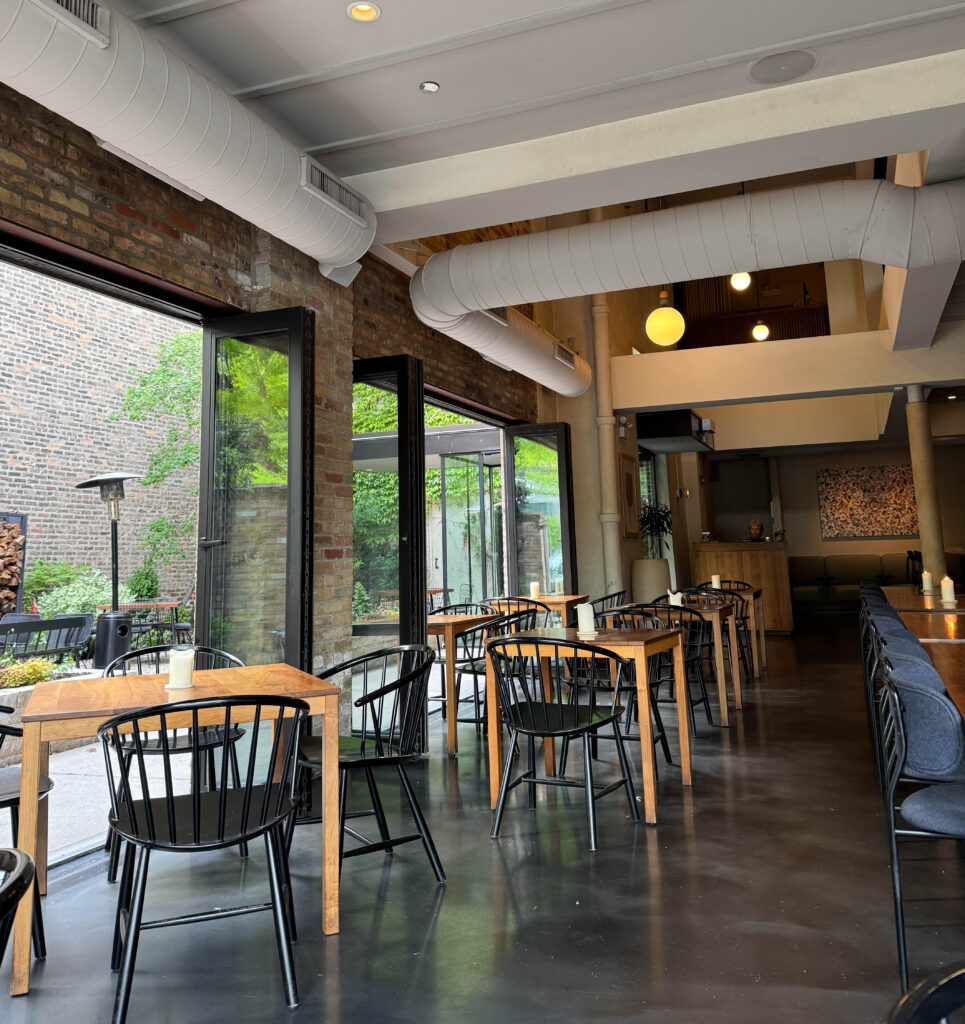
But they seem at ease, at home, and wholly appreciative of this late spring weather, which allows Elske to open the windows overlooking its patio. The intimate, tree-lined surroundings and crackling fire form an enchanting scene for anyone open to the restaurant’s quirks and charms.
Before digging into the present menu, I need only decide what to drink.
On the cocktail side, Stephan Jurgovan (whose wildcraft pairings impressed me during Warlord’s “Enemy” tasting menus last year) has stepped into the role of bar manager, replacing Monica Casillas-Rios.
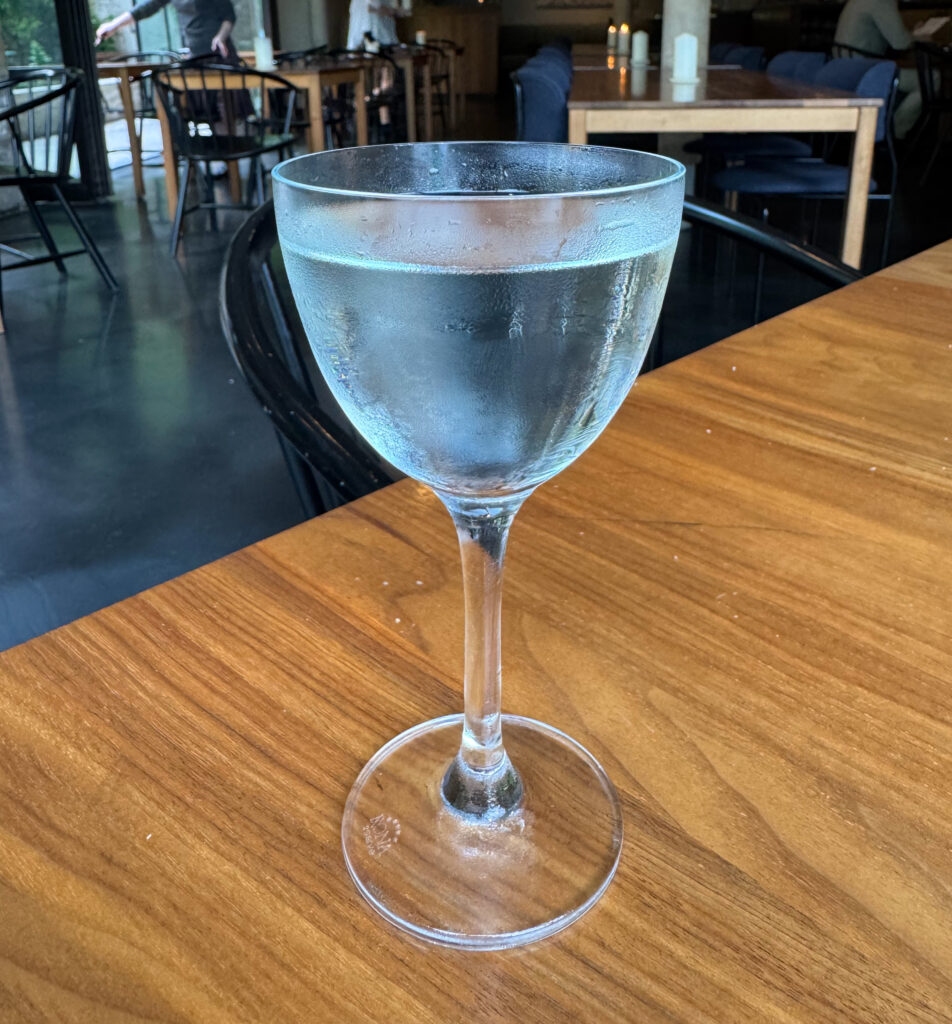
Thankfully, the “Martini” ($16)—made with vodka, dill-cucumber vermouth, and a gentian aperitif—remains on offer, displaying a bit more of a grassy, herbaceous character than I am accustomed to. I’d rather see this note softened by the crisp, bittersweet flavor that typically carries the recipe (as I’ve always felt it succeeds by so beautifully counterbalancing those somewhat polarizing, greener qualities). Still, this delectably creamy and bracing drink remains one of the best of its kind in the city.
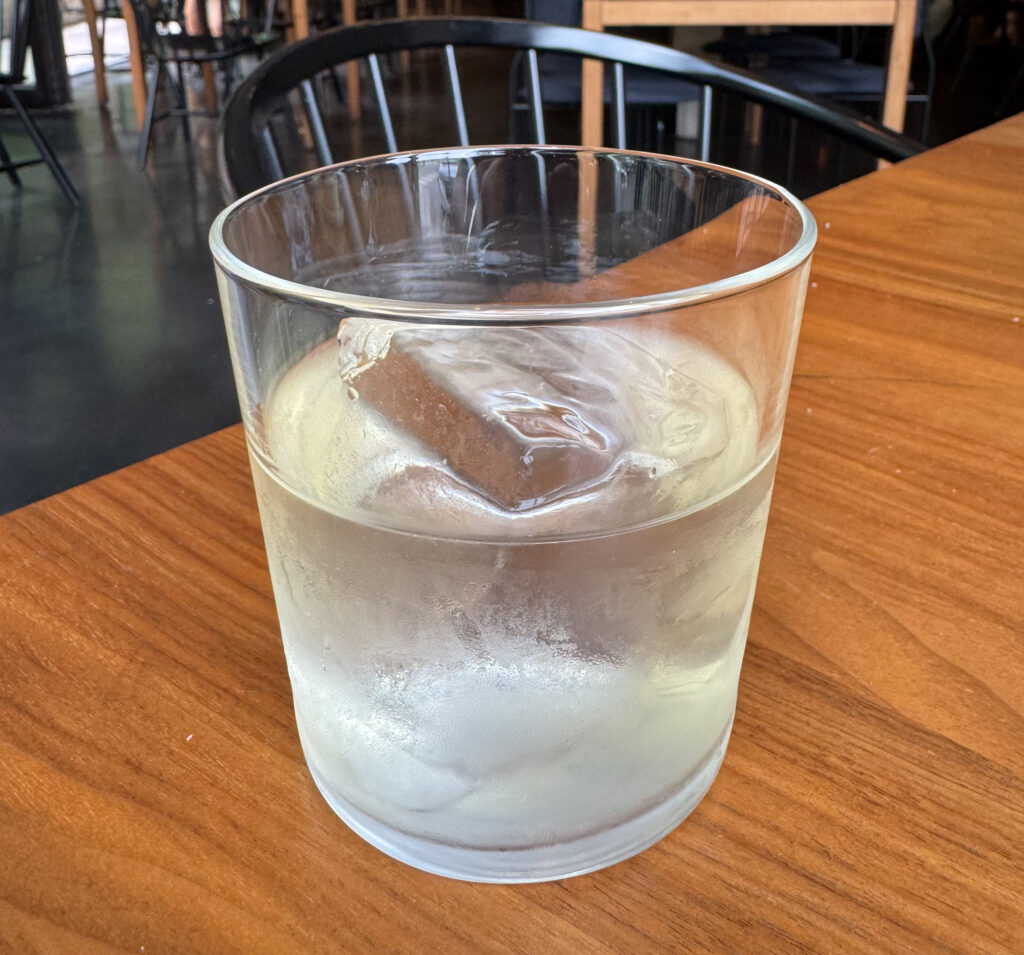
Of the new creations, a “Milk Punch” ($16)—made with fino sherry, green chartreuse, green apple, and coconut—tempts me. In fact, given the small change I perceive in the martini, this clarified tipple immediately takes the crown as my new favorite. Thoroughly chilled, the recipe blends a sense of weight and rounded sweetness with an electrifying oxidative tang: one that teases out the depth of fruit, earth, and spice that lurks in the background yet never detracts from a quaffable kind of enjoyment. Overall, I’d put this milk punch up against any in Chicago, and, if it’s a testament to Jurgovan’s work, I think the program is in great hands.
On the wine side, Emily Sher continues to do an excellent job balancing the approachability of Creepies’s list with Elske’s own desire to offer value while, simultaneously, showcasing some of the very finest producers.
Tonight, the following bottles catch my eye:
- 2023 Saalwächter Silvaner Alte Reben [$81 on the list, $43 at national retail]
- 2021 Massa Vecchia Rosato [$138 on the list, $76 at national retail]
- 2021 Massa Vecchia Sangiovese [$138 on the list, $70 at national retail]
- 2024 Maison Maenad “L’Être” Syrah ($150 on the list, $134.99 at national retail]
- 2020 Domaine de l’Octavin “Arces Macéré” [$150 on the list, $84.99 at national retail]
- 2023 Andreas Tscheppe “Salamander” Chardonnay [$180 on the list, $95 at national retail]
- 2022 Maison Maenad “Réveil Spectral” Savagnin [$200 on the list, $165 at national retail]
- 2021 Thomas Perseval Champagne “Art’Terre” [$240 on the list, $120 at national retail]
- NV (2019) Ulysse Collin Champagne “Les Maillons” [$420 on the list, $325 at national retail]
- NV (2019) Ulysse Collin “Les Pierrières” [$495 on the list, $379 at national retail]
The markups on these bottles range from as little as 11% to as much as 100% on top of retail price (with a mean of 63% and a median of 79%)—reflecting a longstanding policy that channels the restaurant’s largesse toward putting great wines in guests’ glasses for the most minimal of premiums. Moreover, most of these producers are rather rare in the local marketplace: representing leading lights in regions like Champagne, the Jura, the Rheinhessen, Styria, and Tuscany.
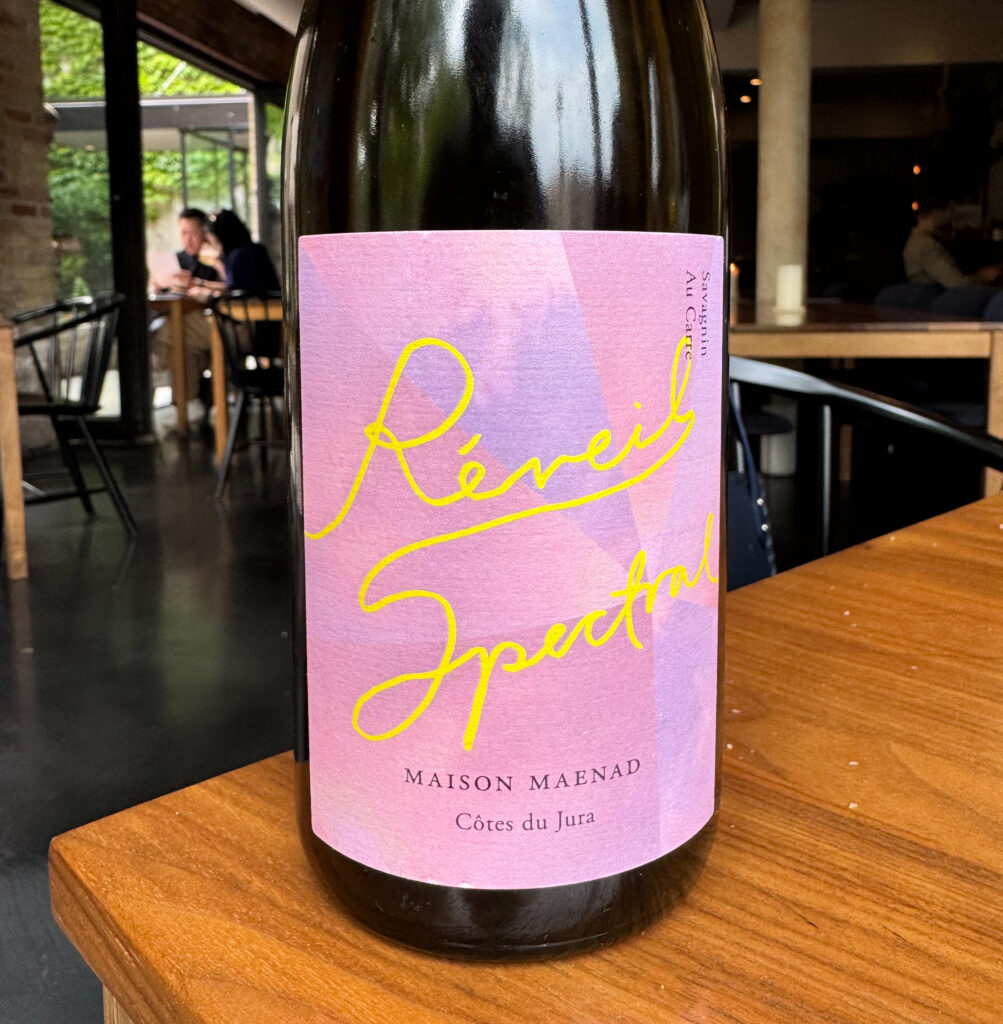
While I’d jump at the chance to order any of these selections if I spotted them on a list, the Maenad “Réveil Spectral” is particularly hard to come by. It also caters perfectly to my individual taste, combining tremendous, citrus-inflected acidity with undertones of saltiness and nuttiness that brilliantly match the chef’s cuisine.
What a treat it is to find items like this (all but unobtainable on the open market) being humbly offered at Elske. Indeed, both sides of the beverage program continue to offer a convincing reason to keep coming back, and they affirm the restaurant’s deeper philosophy—equal parts bold and welcoming—before one even tastes their first bite of food.
Though I typically build my meal almost exclusively from Elske’s à la carte section, I also cannot resist some of the bites I occasionally spy on the “Set Menu” ($140). The restaurant’s flexibility in this area—allowing guests to mix and match items whether they commit to the tasting or not—has long been one of its finest virtues. On any given night, the full range of the kitchen’s resources are at your disposable when shaping the perfect dinner.
Tonight, I pluck two dishes from the set menu before digging into a longer assortment of heartier fare:
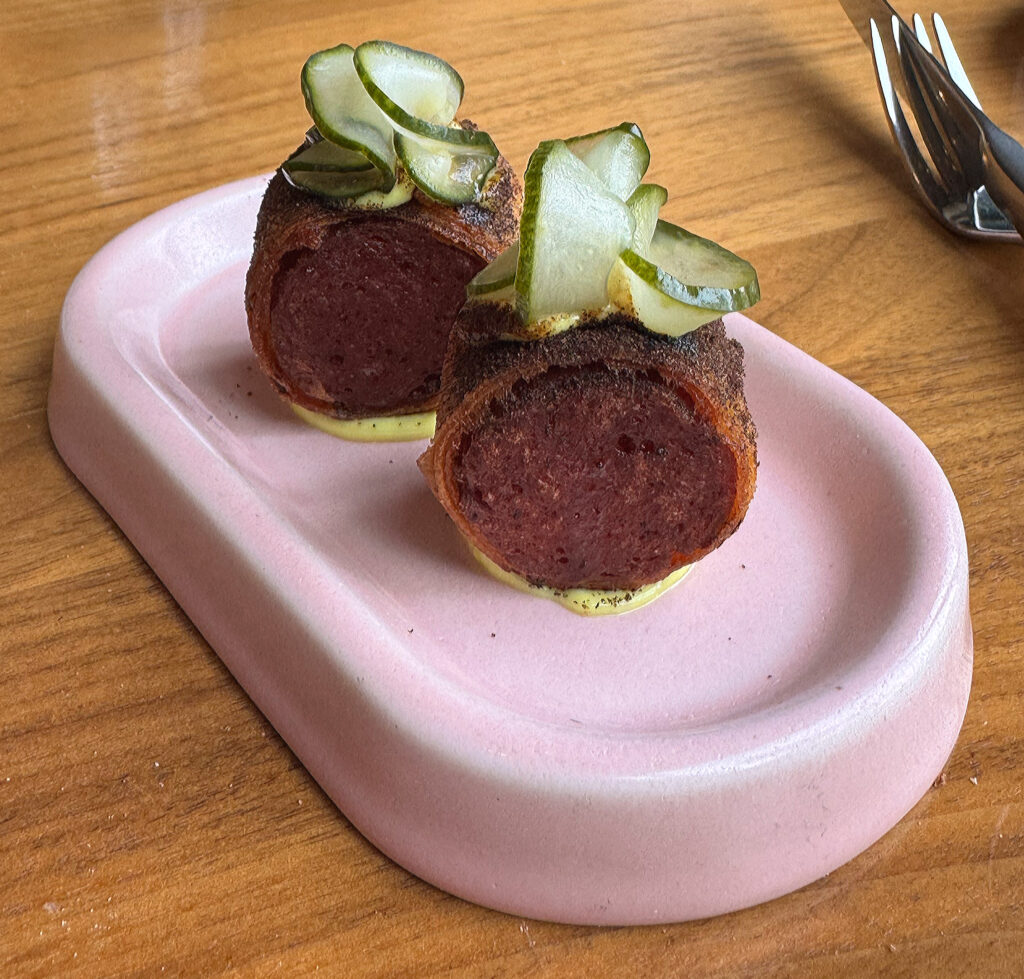
First, there’s the “Crispy Danish Pølser”—essentially a spiced slice of sausage wrapped in puff pastry (like a pig in a blanket) then dressed with remoulade and pickles. Honestly, had I known the bite takes this form, I would have angled to get a few of them. The crisp, juicy pocket of meat is immensely satisfying when it reaches one’s tongue. The condiments—crunchy and creamy—help to provide a familiar textural contrast, yet it is their richness and tang (serving to draw out the latent sweetness of the pølser) that prove superlative. For me, this immediately ranks as a “must-order” amuse-bouche.
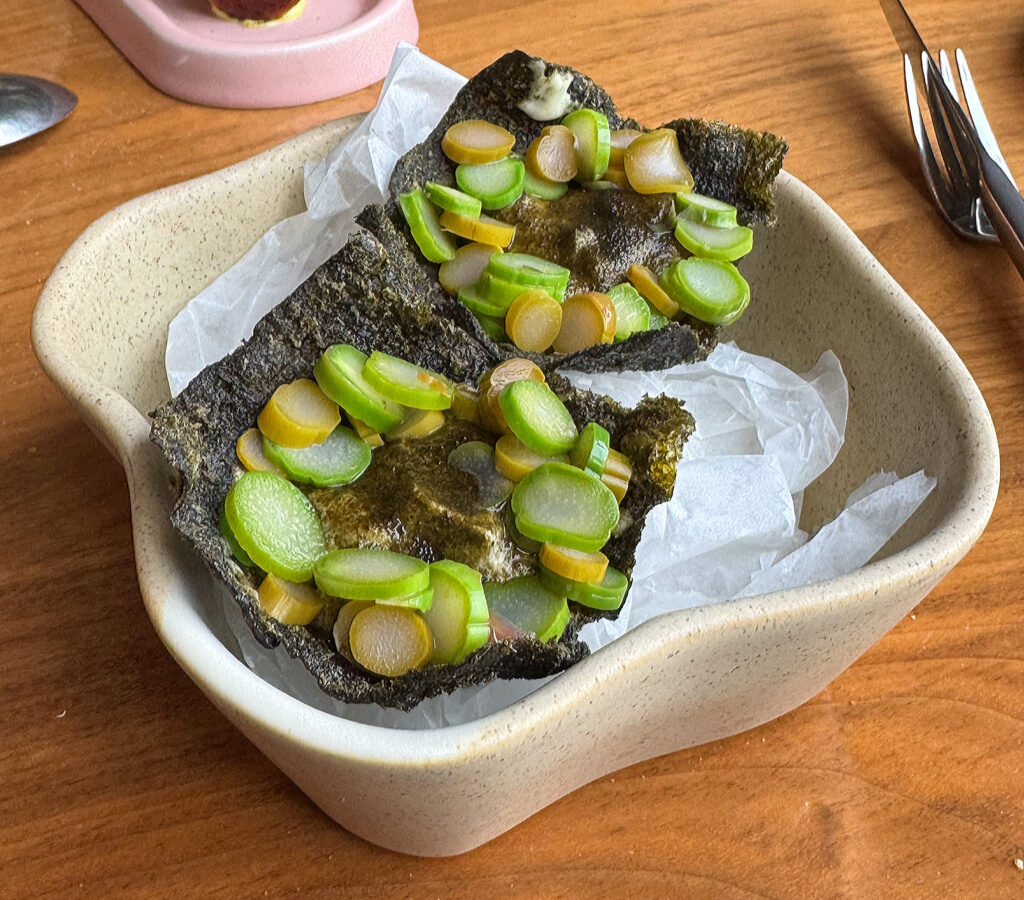
Arriving second, the “Grilled Oyster” feels much more prototypically “Elske,” for it indulges rather unapologetically in the brighter palette of flavors for which the kitchen is known. Even visually, any sense of the starring shellfish is totally obscured, for the bivalve is nestled at the center of a nori chip and entirely surrounded by slices of green asparagus. On the palate, these two latter elements provide softer and harder expressions of crunch (respectively) that elegantly cushion the plump oyster. Correspondingly, an array of green, herbaceous, and subtly sweet notes—rather than char, brine, or umami—works to define the bite’s character. However, these qualities harmonize seamlessly, and their resounding freshness does a good job of preparing guests for what else is to come.
At this point, the meal turns toward a few signature items (really, the traditional foundation of any experience here) that I have written about extensively across each of my visits. Given the unfailing consistency of these recipes, I will only offer brief impressions this time around.
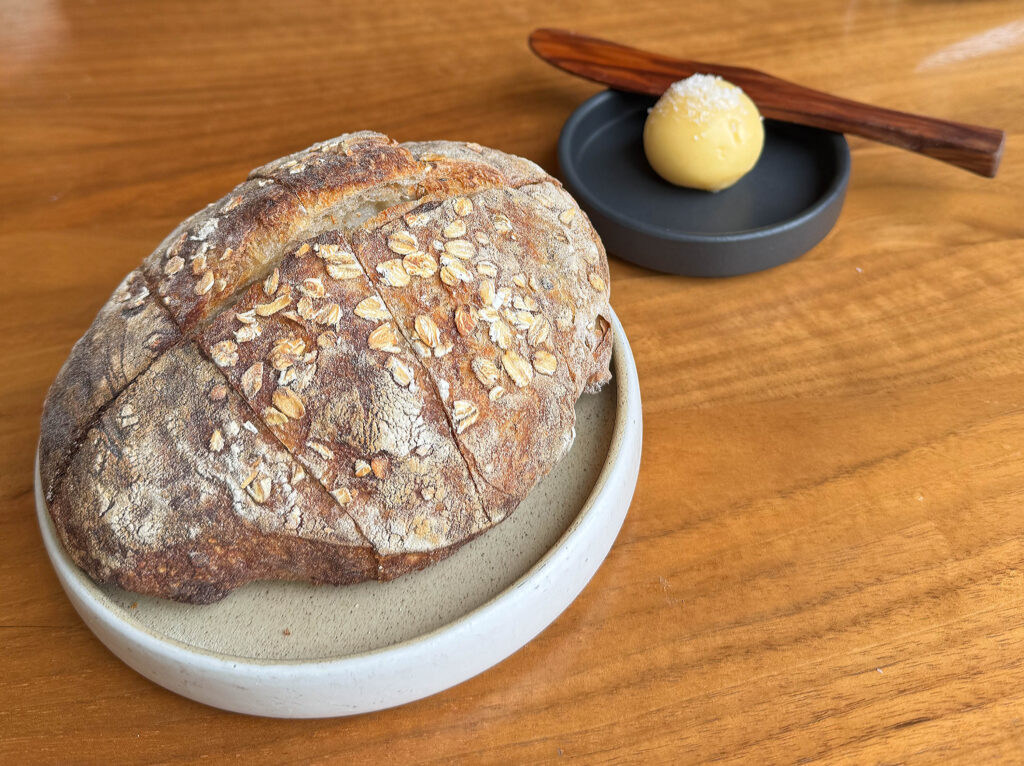
The “Publican Quality Oat Porridge Sourdough” ($12) continues to benefit from a generous sprinkling of salt atop its accompanying cultured koji butter. The combination of faintly crisp crust; warm, fluffy crumb, and rich, tempered dairy—all serving to frame a wonderfully earthy, tangy depth of flavor—remains a winning companion to any part of any meal here.
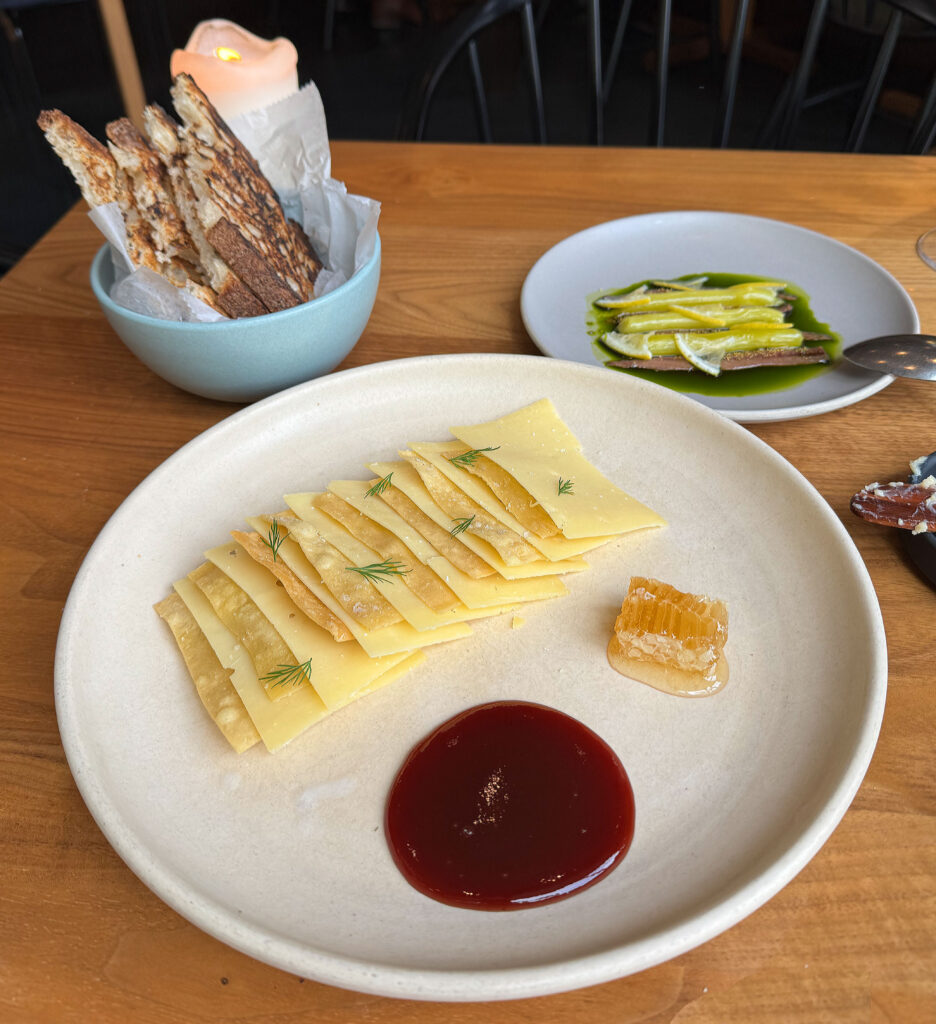
The “Wilde Weide Aged Gouda” ($20) and “Salt-Cured Anchovies” ($15) delve deeper into the realm of bread (in this case crackers and lightly charred toast) and toppings. The former combination of crumbly cheese, strawberry-sea buckthorn jam, and honey delivers decidedly nutty, tangy, caramelized, and florally sweet notes that, as always, are supremely decadent. The latter combination (drawing upon fennel pollen and a lemon gel for breadth) centers on more challenging flavors of bitterness, brine, and anise. Yet they harmonize effortlessly, conjuring an effect that is completely opposite of the effusive cheese plate while remaining totally complementary within the wider scope of the meal. These, too, are reliably hard to resist.
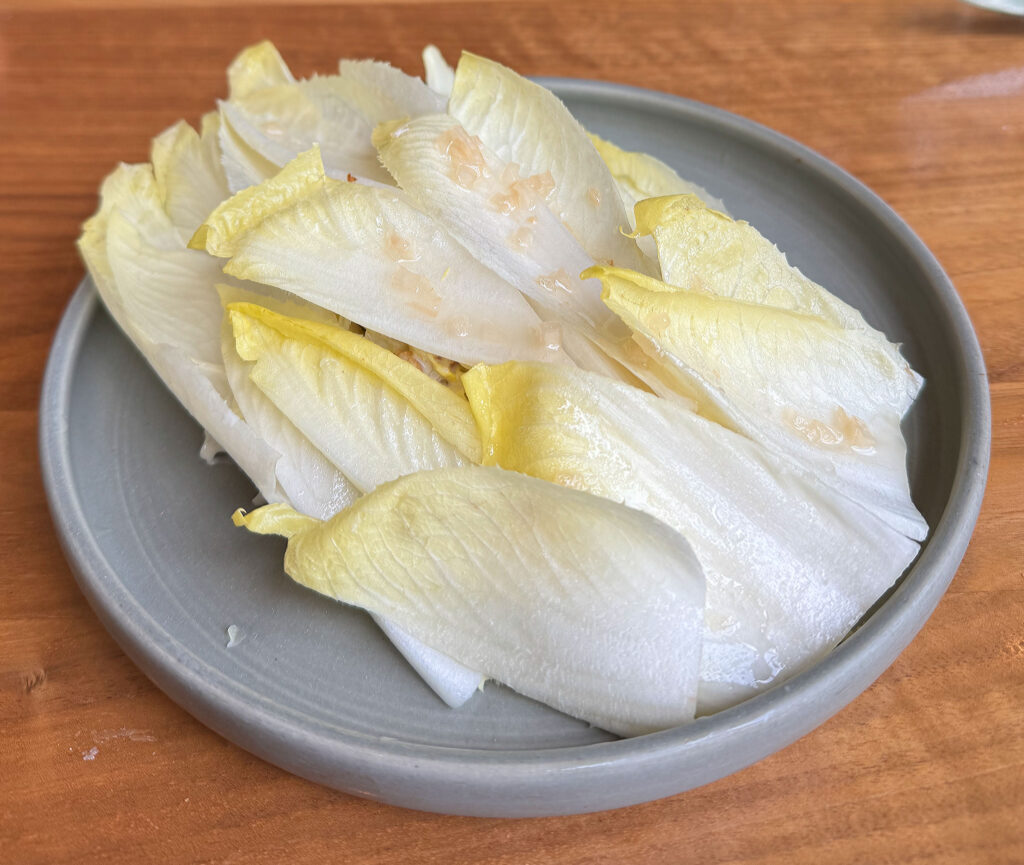
Finally, we have the “Belgian Endive” ($24)—a perennial contender for the best salad in the city. With all the good bits (i.e., the pickled raisins, walnuts, and dressed shreds of chicory) hidden under the larger leaves, I’ve taken to approaching this recipe in the same manner one might eat chips and dip. Undignified as that is, one can just as easily construct completes bites using fork and knife, yielding a dish whose bursting acidity—tinged with oxidation and caramelization—amply counters the endive’s own bitterness. The final sensation is not only endlessly engaging but, somehow, deeply satisfying too.
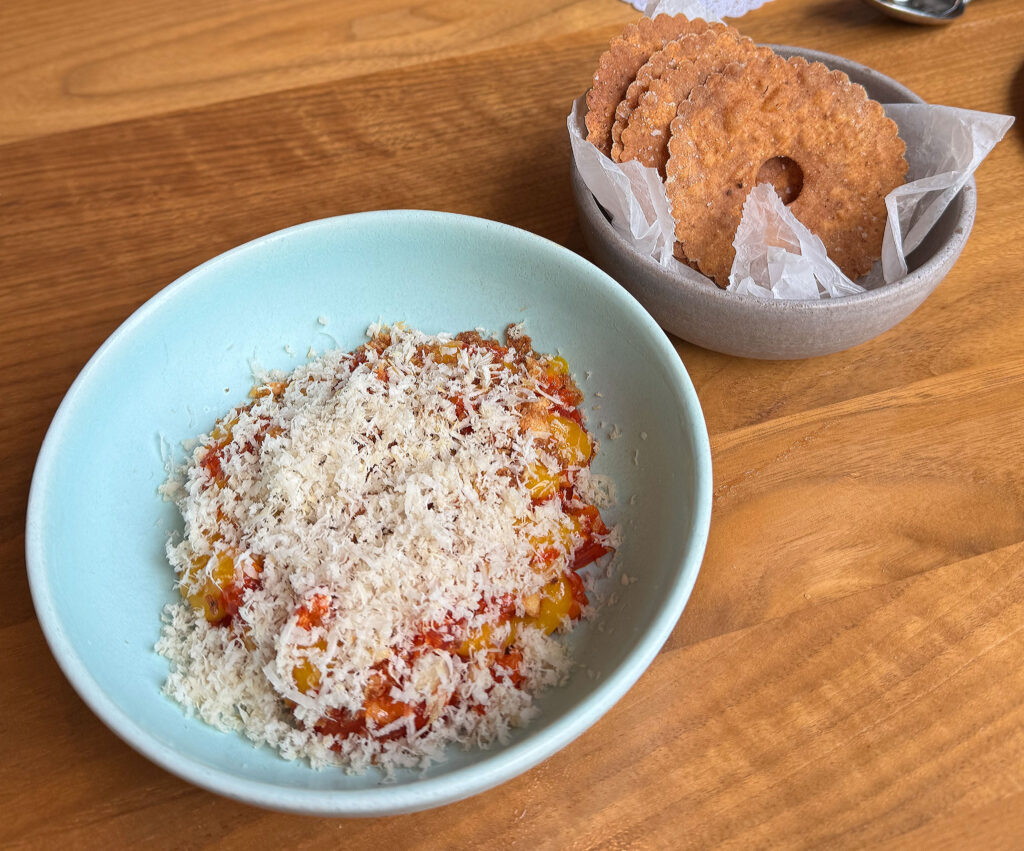
With the arrival of the “Tuna Tartare” ($28), I start to enter somewhat novel territory. Technically, I did try this preparation last time around (when it really impressed me). But, within this section of stalwart favorites, it is still rather new. I’m eager to give the recipe—which combines the titular fish with ‘nduja (the spreadable sausage), egg yolk, Calabrian chile, and grated horseradish—another try.
A side of knäckebröd (a Scandinavian rye cracker) forms the base of each bite, which feels crisp and crunchy on entry but settles on a rather luscious, mouth-coating consistency once the various ingredients melt. When it comes to flavor, a moderate degree of heat and jolt of tingly spice take the lead. The egg yolk—in concert with the tuna’s own meatiness—helps to soften the blow; however, they are matched by a strong dose of salt that, while key in building savory depth, nearly proves overwhelming (even for someone with a sky-high tolerance). It’s only with the introduction of the cracker’s toasty, earthy complexity that the recipe strikes the right balance. Personally, I love how this comes together, for it tastes almost twice as intense as anything else Elske serves. Still, I think the salt content risks turning some customers off, and it could probably be reduced without any real negative consequence.
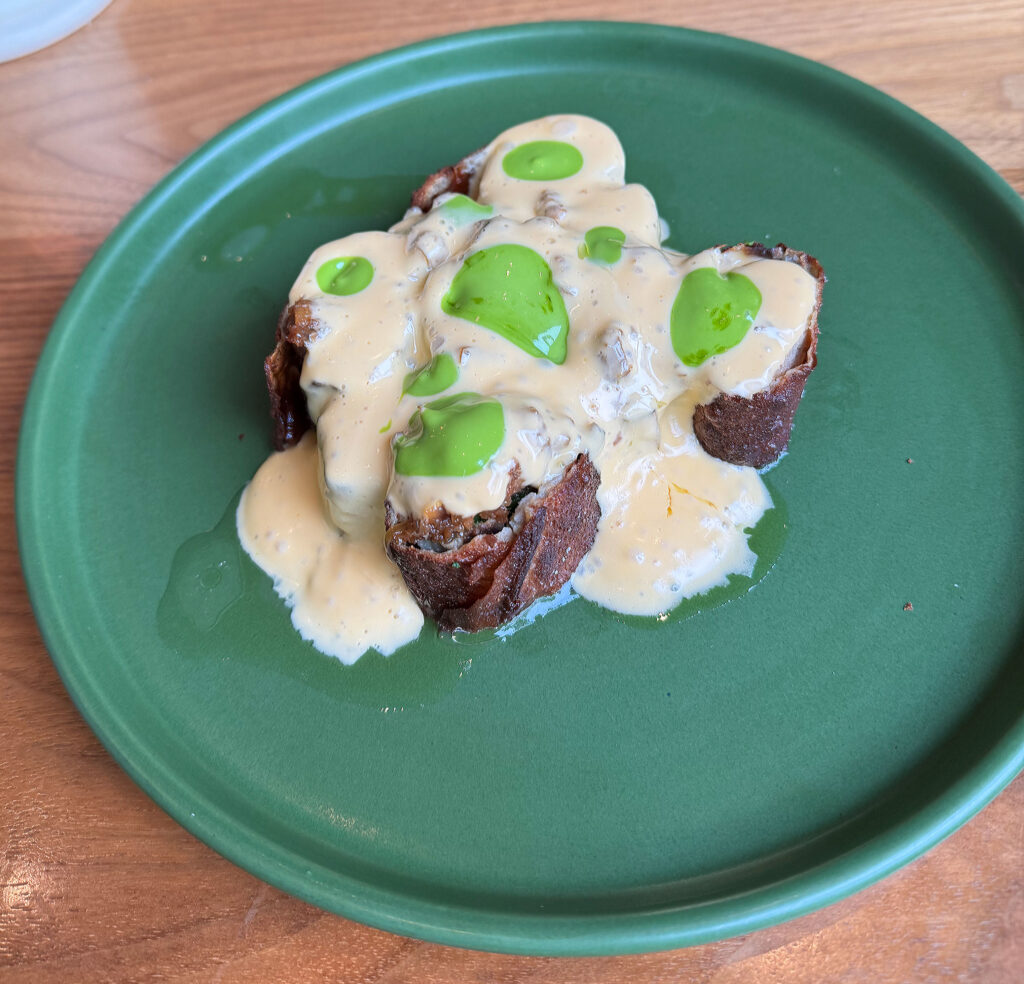
The “Buckwheat Crêpe” ($32) calls the team’s work at Creepies to mind, for, next door, the griddled batter has formed the centerpiece of myriad seasonal preparations. Here, the component features in something more of hodgepodge: being stuffed with shrimp and leeks then dressed with XO sauce and a frothy cheddar coating that is immediately reminiscent of Elske’s old signature “Leeks Vinaigrette” recipe. It’s a beautiful callback, and one, moreover, that meaningfully builds on the kitchen’s old work.
Texturally, the crêpe provides an added layer of crispness that plays off of the allium’s own subtly crunchy—yet still moist—consistency. The tender, yielding pieces of shrimp might be the best of the elements (serving to soften and congeal the recipe’s sharper edges). That creamy, cheesy sauce has something of the same effect, and, in combination with the XO, it delivers a nutty, savory undercurrent that helps to draw out the leeks’ sweetness. Ultimately, I do like the dish, but it strikes me more as strangely satisfying than convincingly decadent. Indeed, the assembled ingredients are so appealing that I just expect greater finesse and power from the chosen combination.
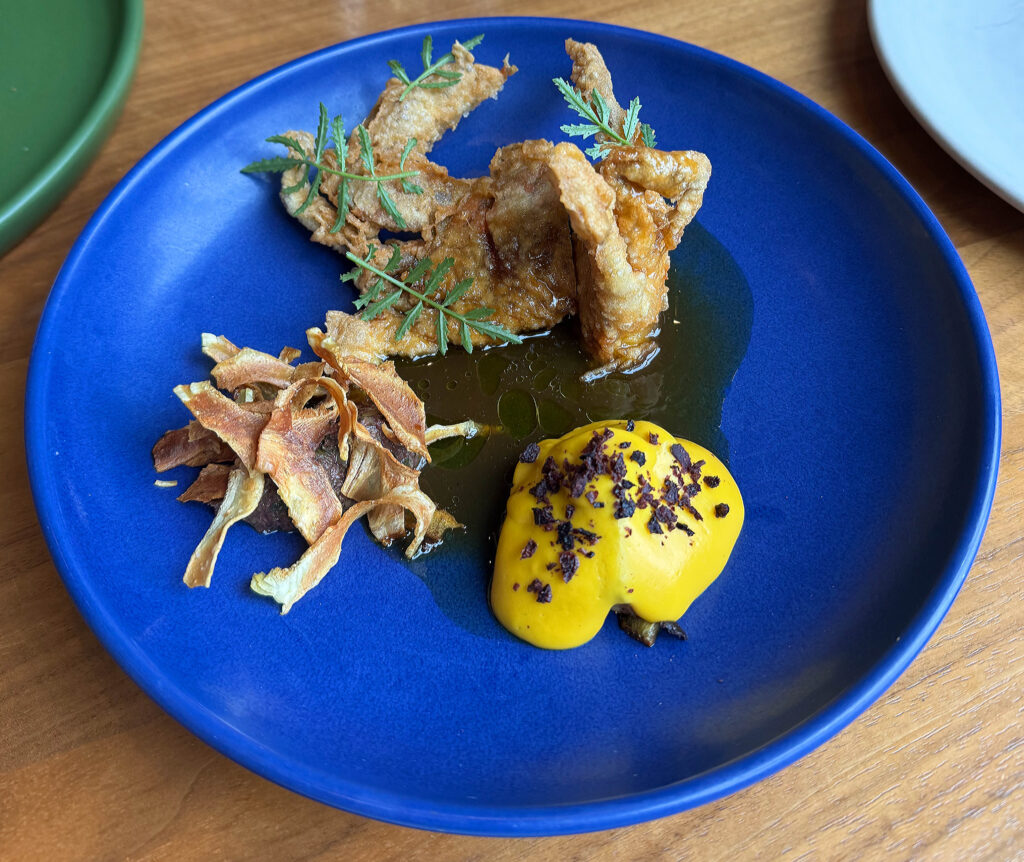
“Fried Soft Shell Crab” ($35) forms one of the restaurant’s most exciting seasonal offerings, and I’m not sure any other kitchen in town consistently prepares the crustacean with the same impeccable crispness. That proves to be the case tonight, so we really need only talk about the accompaniments: fried artichoke, a saffron soubise, and some black olive (both dried and as a tapenade). These elements echo the crunchy breading of the crab and enhance it by way of creamy weight. The nutty and warmly spiced notes play to the decadence of the shellfish; however, I find the earthiness of the olive to be too pronounced. It saps the crustacean of its desirable sweetness, pushing this recipe—so texturally proficient—into the realm of intrigue rather than pure enjoyment. Still, so many years later, I appreciate that the team is always looking to try something new.
This evening’s pasta course comprises three distinct parts (one old, two new) that reflect Elske’s inclination to balance sustenance with intellectual appeal. More and more concepts (often in the “contemporary American” genre) are looking to serve these sorts of recipes—extricating the form from its Italian origins and reorienting it via the Midwestern bounty—but I’m not sure any other team does so with the same degree of intricacy or thoughtfulness.
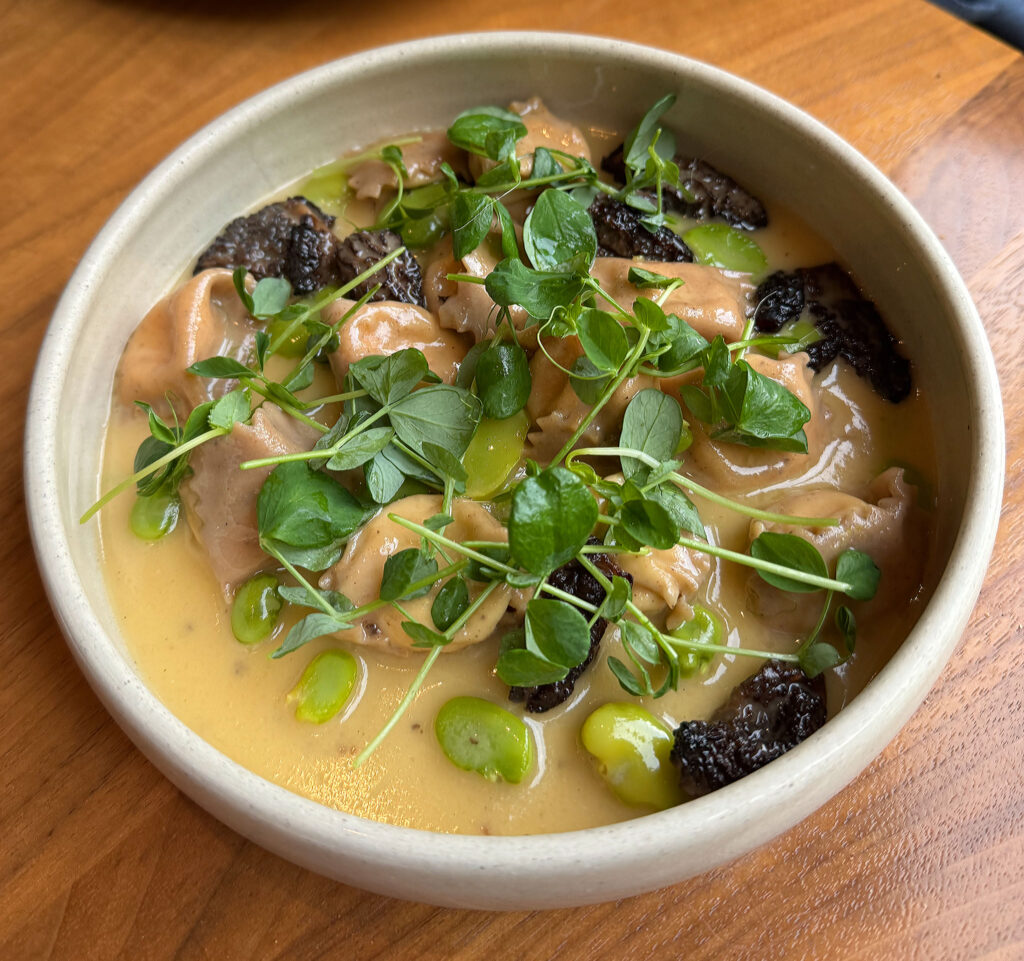
The “Black Bean Agnolotti” ($33) is the most familiar of the bunch, and, though the recipe’s exact composition can change depending on the moment of the season, I think it counts as one of the restaurant’s most longstanding signatures. Here, the pockets of pasta display a remarkable softness whose mouthfeel glides effortlessly from wrapper, to filling, to creamy fava beans, the faint crunch of pea shoots, and the subtle chew of fresh morels. The buttery sauce—spiked with sherry—enlivens the dish’s earthy base note and steers its expression toward a sweet, nutty sensation that remains, nearly a decade later, enthralling.
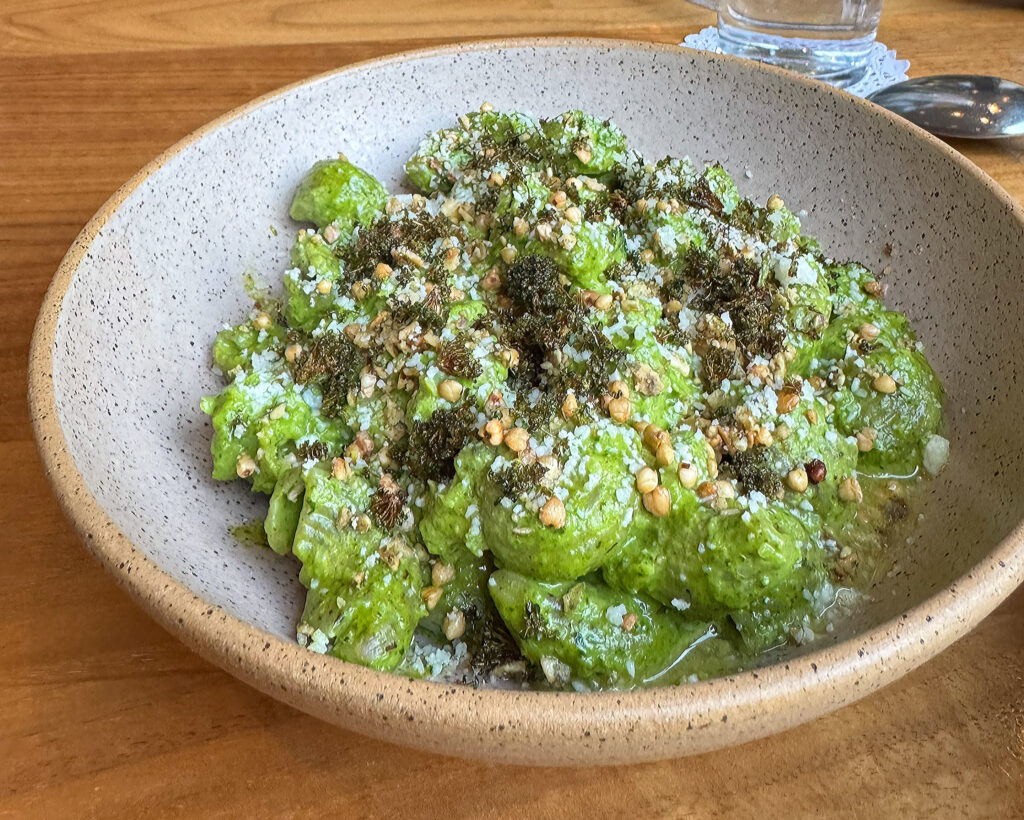
The “Buckwheat Lumache” ($28) pursues a kind of pesto effect with the help of broccoli, basil, pumpkin seed, nasturtium, and an ample amount of pecorino. These snail-shaped noodles deliver a pleasing sense of chew matched with a fine gradient of crispness that ensures each bite, from a textural perspective, is engaging. For my palate, the nutty and salty notes that should form the savory foundation of the recipe are a bit too obscured by the greener elements. More salt, in this case, could certainly help, but we’re talking about the kind of fine degrees of seasoning that are ultimately subjective. I actually like this dish even if I think it needs a little something to really pop.
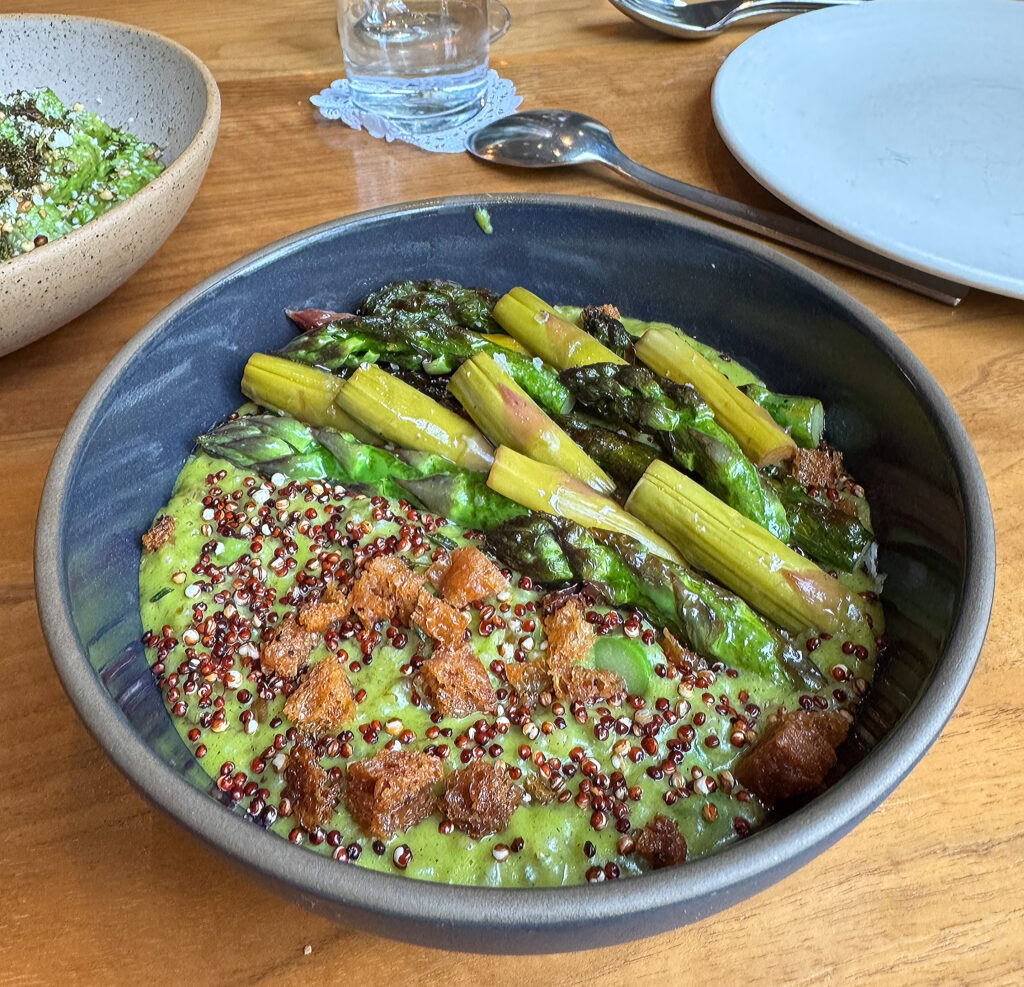
Lastly, the “Grain Porridge” ($34) might not technically qualify as a pasta, yet its soothing consistency establishes it as the best of the three preparations. Here, the fluffy-chewy blend of wheat berries and quinoa is punctuated by crunchy sourdough croutons and larger, crisper segments of asparagus. However, it’s the sauce—a creamy blend of Pleasant Ridge Reserve and spruce—that proves superlative: charging the nutty grains with a tangy, caramelized depth that leaves one desperate for another bite. Salt, too, is perfect judged: ensuring an adequate degree of umami supports the brighter, vegetal notes through the finish. Overall, this recipe ranks among the highlights of my past couple meals.
Of the two entrées I sample tonight, the “Roasted Poussin” ($43) begs comparison to what is served over at Creepies: namely, the “Roasted Chicken” ($39) that the neo-bistro considers one of its signatures. While the latter dish (best enjoyed with fries) centers on a sizable half-bird in a decadent wine/liver sauce, Elske’s take on the younger, more delicate meat emphasizes the kitchen’s technical virtuosity.
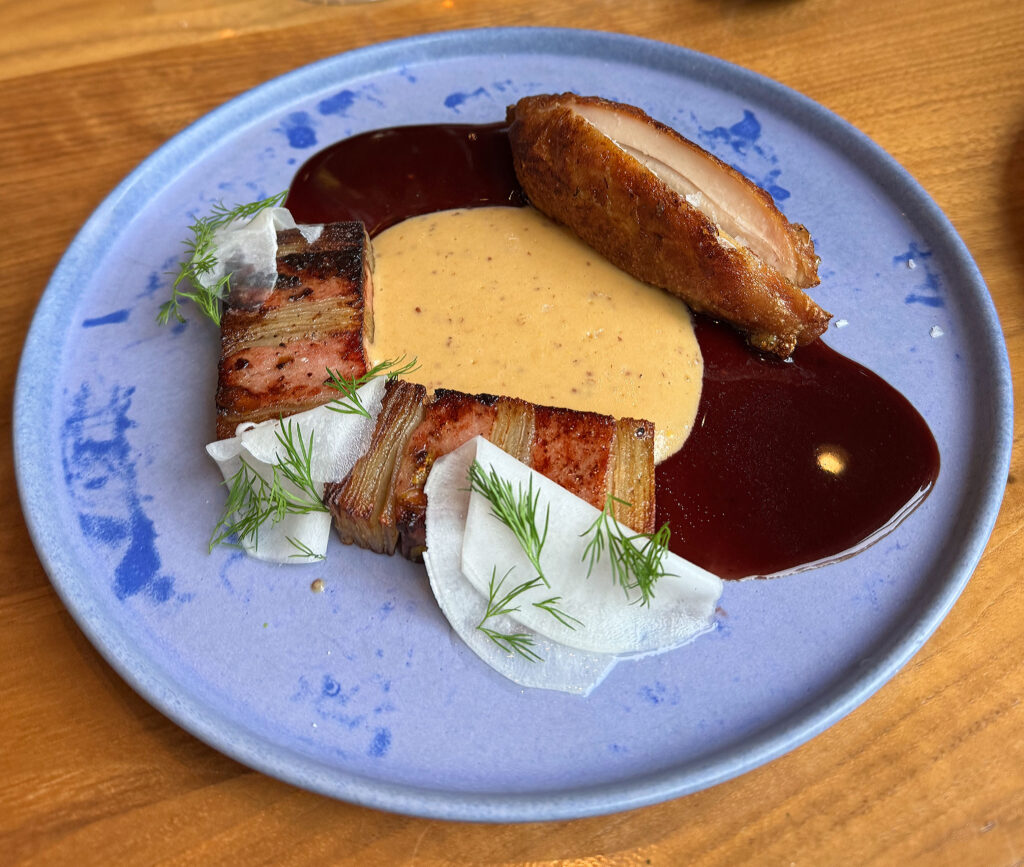
A pristine portion of the poussin’s breast—boasting a craggy, golden-brown crust—is sprinkled with flaky salt and dressed with flavors of toasted bread and salted raspberry. Off to the side, a pressé made from potato and pork sausage forms a robust accompaniment whose relative indulgence is countered by a couple refreshing shavings of turnip. On the palate, the chicken itself displays crisp, crackling exterior that frames a pleasing chew. Being beautifully seasoned in its own right, the meat takes on an attractive, nutty undertone from the bread sauce and only a faintly fruity, tangy note (which I find appropriately restrained) from the salted raspberry. The pressé, when I get to it, delivers buttery layers and charred edges backed by a plump porky sweetness that further amplifies the richness of the starring breast. Once all the elements combine, the effect is immensely satisfying.
Ultimately, it’s hard to pick a favorite between the two birds being offered by these neighboring concepts. Both recipes reflect the mood and price point of their respective domains, yet they are joined by a kindred textural refinement and a shared deliciousness that are worth celebrating. Nonetheless, there’s an added intricacy to the poussin that I’d like to spend more time exploring.
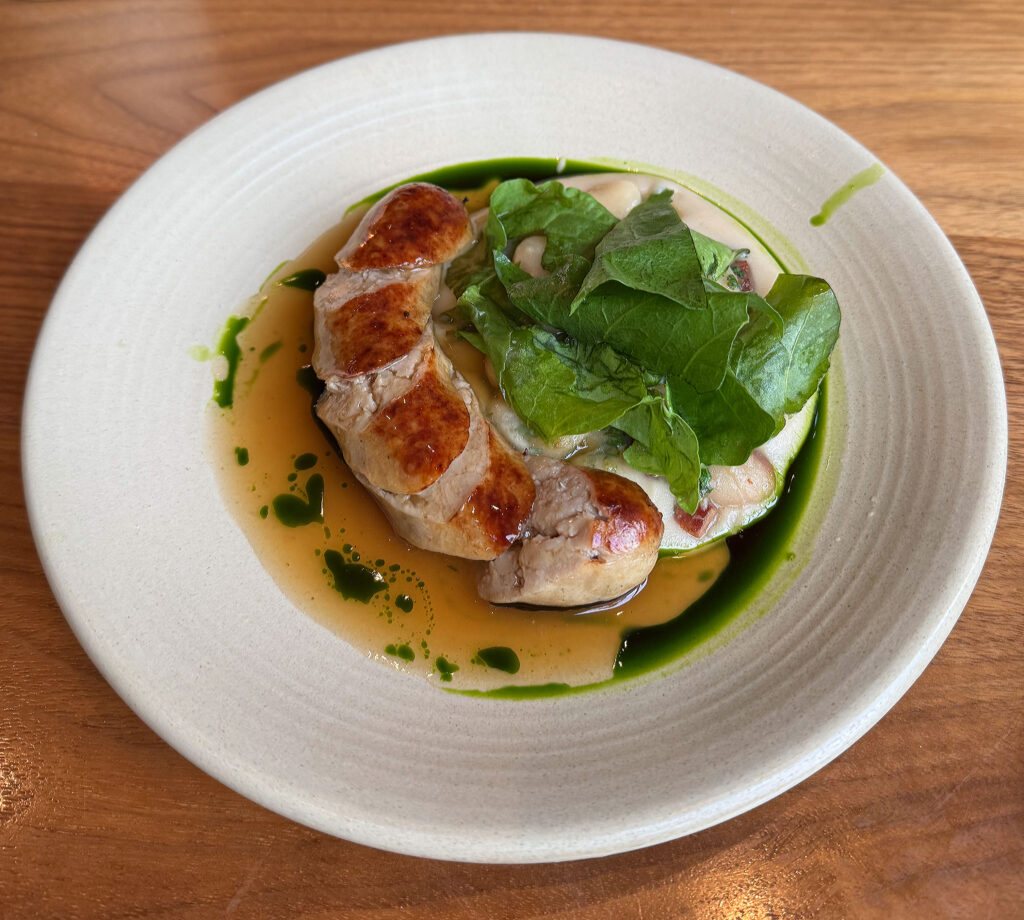
The “Frikkadeller Sausage” ($36), by comparison, is something you are only going to find at Elske: where the term signifies a kind of pan-fried meatball that is widely enjoyed in Denmark (as well as several other European countries). As the title of the dish suggests, the chosen blend—typically pork and beef—is fashioned into a link rather than being roughly shaped. This makes for a clear evolution of the restaurant’s past work with the form, yet one, in turn, that is paired more nostalgically with a side of white beans, bacon, and some leaves of sorrel.
On the palate, the sausage offers a suggestion of plumpness but proves too loose and almost mealy throughout the interior for my taste. There’s a subtle sweetness to the meat, which weighs in its favor. However, what really catches my attention are the white beans, whose creamy consistency and blend of nutty, smoky, and zesty flavors blow me away. Really, this mere accompaniment ranks among the finest items of the night. The kitchen needs only to bring the meatball itself (whatever form it takes) to the same level of quality.
Now turning toward the sweeter side of the menu, I’ve been so focused on the savory fare that I’ve ignored how Elske’s dessert (under pastry chef T.C. Lumbar) has also pursued a greater degree of decadence than I am used to seeing.
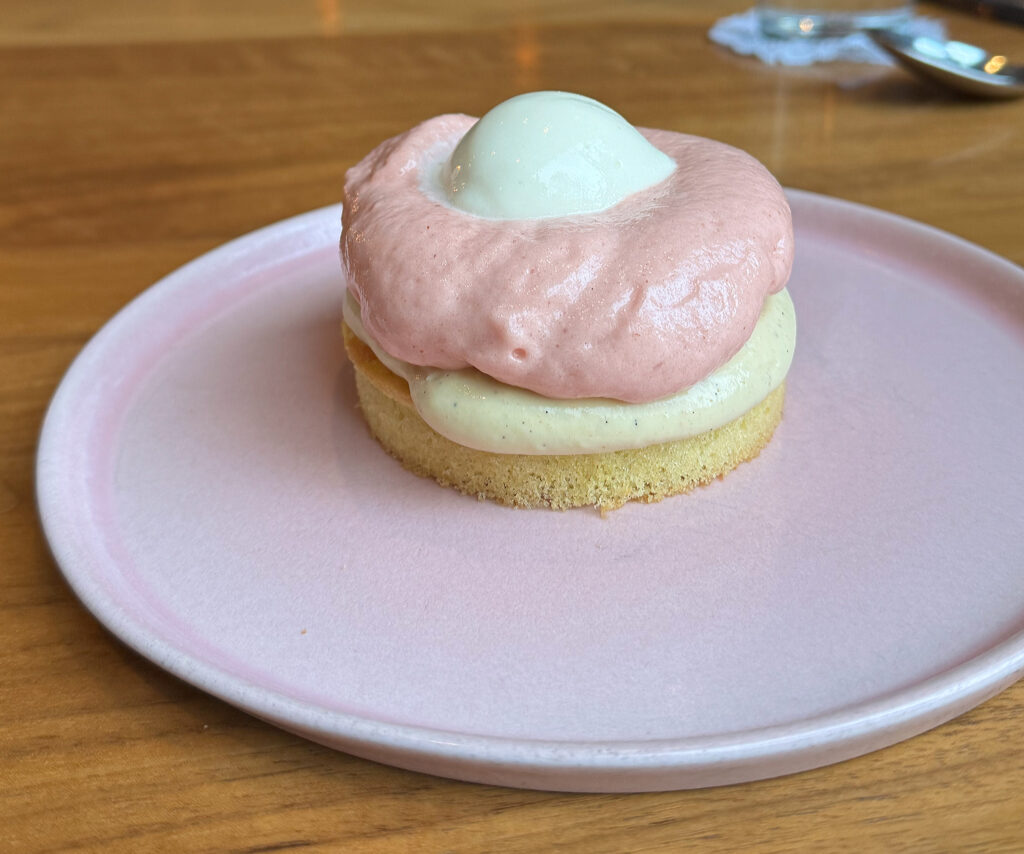
The “Brown Butter Cream Cake” ($16) represents one of the best examples I can think of: combining a soft, nutty base with layers of soothing vanilla, tangy rhubarb (including the odd chunk), and toasty hay ice cream. The recipe certainly showcases some of brightness and seasonality that has always characterized these closing creations, yet it remains restrained enough—emphasizing the caramelized character of the cake rather than the produce—to offer real satisfaction. Indeed, as much as I’ll always love the “Sunflower Seed Parfait,” this dish ranks among the finest I have encountered in this category in years.
Two hours later, dinner reaches its conclusion: an admirable pace for the two bites and 13 plates—split into six distinct courses—that made up my experience.
By the time I pay, the sun has not even set. The restaurant’s patio, so tempting in this weather, has only started to fill. The dining room, whether the guests have come from near or from far, is now approaching full flush.
I step outside, savoring the memory of another meal gone by. The scene—and corresponding emotion—feels familiar, even timeless. Yet my satisfaction creeps upward, and I wonder If Elske is now really reaching a newer, even higher peak.
In ranking the evening’s dishes:
I would place “Crispy Danish Pølser” in the highest category: a superlative recipe that stands among the best things I will be served in any restaurant this year.
The “Oat Porridge Sourdough,” “Wilde Weide Aged Gouda,” “Salt-Cured Anchovies,” “Belgian Endive,” “Tuna Tartare,” “Grain Porridge,” “Roasted Poussin,” and “Brown Butter Cream Cake” all land in the next stratum: great items that achieved a truly memorable degree of pleasure. I would love to encounter any of these again.
Next come the “Grilled Oyster,” “Buckwheat Crêpe,” “Fried Soft Shell Crab,” “Black Bean Agnolotti,” and “Buckwheat Lumache”—good—even very good—preparations I would always be happy to sample again (but that just failed to elicit an extra degree of emotion).
Finally, we have the “Frikkadeller Sausage”—a merely good (maybe just average) offering that fell short when it came to texture. Nonetheless, given how phenomenal the white bean, bacon, and sorrel component of the plate tasted, it’s not hard to see this skyrocketing in rank with a little more tweaking.
Overall, this makes for a hit-rate of 93% with some 60% of dishes reaching that “would love to have again” level of quality (but only 7% rising to that “best of the year” summit).
These figures represent a slight improvement on the numbers (92% and 42% respectively) I reported in February, and they do seem to affirm that Elske has established a new baseline of performance—compared to, say, my more irregular meal in May of 2025.
Admittedly, I’m leaving the majority of the set menu, a couple of savory à la carte items, and three whole desserts unevaluated when making this assessment. It also stands to reason that, when choosing to excise dishes for the sake of eating capacity, I generally sacrifice recipes that do not appeal to my own personal taste.
Nonetheless, as hesitant as I may be about ordering the “Braised Octopus” (with rhubarb), “Seared Halibut” (with black olive), or “Carrot-Elderflower Sorbet” (with shio koji), the “Grilled Flat Iron,” “Roasted Pork Loin,” and “Parsnip and Vanilla Custard” sound like sure things. This is to say nothing of signatures like the “Duck Liver Tart,” “Frozen Anise Jelly,” or “Sunflower Seed Parfait” that could’ve stacked the deck further in favor of the restaurant.
The truth is that any experience at Elske is going to start halfway toward excellence on the basis of the service, the cocktails, the wines, and a few stalwart preparations (i.e., the “Sourdough,” “Aged Gouda,” “Anchovies,” and “Belgian Endive”).
The biggest compliment I can pay the present team is that—via creations like the “Pølser,” “Tuna Tartare,” “Grain Porridge,” “Roasted Poussin,” and “Brown Butter Cream Cake”—they are putting out food that can stand alongside (or even rival) the concept’s finest ever work.
Simultaneously, even if not all the entrées are runaway hits, the kitchen has remedied the sort of stark drop-off (from the highs of the menu’s early and middle sections) that sometimes characterized these headlining plates. Under Brooks, they’re increasingly putting out servings of protein that are expertly cooked, creative, and—most importantly—deeply pleasing in a way that fittingly anchors one’s meal.
With this foundation established—a hit-rate that measures up to the finest of fine dining sanctums I have visited this year—Elske’s real mission is to push further toward achieving that “best of the year” level of quality.
Again, it’s hard to know how much reaching that highest stratum has to do with appealing to my own particular preferences. Yet, with the “Pølser,” it’s clear that the chef has what it takes, and, with so many other dishes knocking on the door of that honor, I wonder if this might be the year that Elske graduates from being the cool, quirky dark horse to become the perfect representative of Chicago’s culinary vanguard.