
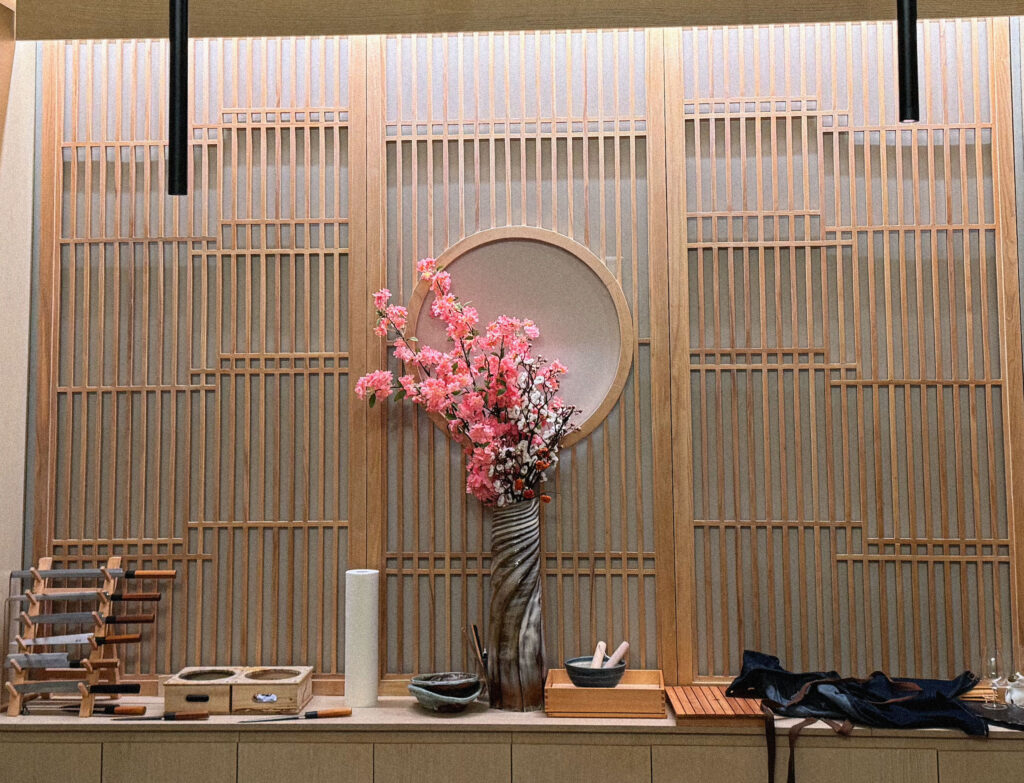
After a leave of absence (during which I sampled a couple other chefs’ omakases), Otto Phan is back behind his flagship’s counter.
Has fatherhood changed him? Mellowed him out? Softened the prickliness that—like the nigri’s forceful imprint of vinegar and wasabi—makes eating at Kyōten a singular experience for newcomers and sushi devotees alike?
Or do these life moments only grant us a chance to reorient and appreciate changes that have been simmering in the background this entire time?
In the nearly eight years since the concept opened in Chicago, its growth has been so perpetual, so incremental, that it’s hard to pick out watershed moments. Of course, there are obvious cues like the price hikes, the remodel, and the inevitable changes in staffing. But the heart of Phan’s work centers on granular change: a process driven by gradual refinement, ever-increasing mastery, and the burning obsession to embrace new ingredients and techniques even when the same old bites (like ankimo, tuna, uni, eel, and tamago) would more than suffice.
Despite the prohibitive cost of dining here (which, mind you, was not always the case), Phan has always understood how to cultivate and reward repeat patronage. Doing so does not simply entail bending to the rhythms of the season—a fundamental question of sourcing that inevitably shapes menus for every diner at every counter that is engaged in the same cuisine.
Rather, the chef challenges himself to serve items (the product of distinct aging or knifework or seasoning) that are at least somewhat novel to you. He pursues this work across each and every visit, in accordance with each customer’s individual preferences, guiding shared journeys of discovery and taste that, while foundational to this genre and the relationships it forms, cannot be replicated elsewhere.
Though I’ve long since stopped trying to cultivate “regular” status at other counters (at least in this city), I never found one in Chicago that was as well-equipped or motivated to hold my attention: to transcend the demands of branding or replicability and present sushi as the living, breathing, infinitely intricate and reflexive craft that it is. By my second visit to Kyōten (and barring the occasional new opening), I never looked back.
Yet, from this privileged position (so sensitive to the smaller changes that characterize week from week and month from month), it becomes easy to lose sight of the bigger picture: the leaps in quality that the yearly visitor perceives with comparable ease.
A two-month break doesn’t sound too extreme (though, arguably, it’s actually been three months since I’ve had sushi produced by Phan’s hands). Nonetheless, it offers a rare occasion to reset my palate and my expectations. It lets me experience Kyōten anew and weigh how the chef, now grappling with one of life’s great joys, is performing relative to his peers at the pinnacle of the dining scene.
If previous pauses are anything to go by, a bit of rest and relaxation helps Phan push himself to an even higher level.
Let us begin.
This evening marks the very first time I have ever eaten at Kyōten alone: a situation (given the workaday history of these counters and their corresponding intimacy) that feels altogether natural. After all, none of the customers are really looking at each other so much as they are facing forward, watching the chef and waiting for each successive morsel to appear.
The crowd tonight, Phan reveals, is composed entirely of repeat visitors and (since anyone inclined to dine here twice would surely keep coming) regulars. Thus, the mood in the restaurant is immediately familiar and conversational. The chef-owner—who has been back at work for a handful of days now—is entirely relaxed, and he goes about crafting the meal while reflecting on family life, recent travels, and any number of provocative questions that come his way.
Admittedly, I was really looking forward to being a fly on the wall while a group of first-timers went through the ups and downs of a typical Kyōten experience: confusion upon arrival, relief once reaching the dining room, another hint of skepticism (as the two-man team gets the show on the road), then waves of transcendent pleasure (as well as a bit more intrigue) as Phan goes through his arsenal of signature and seasonal bites.
But it’s also somewhat inspiring that a Chicago counter, so many years after the initial omakase boom, would host four groups of strangers who are willing to pay $490 per person for sushi with any degree of frequency. Surely, there are many more of these guests out in the dining population. The full house I find could really just be a matter of chance. Yet, sitting among people who know the score and have made a kind of home here forms a special thrill: a reminder of the enduring relationships one often senses when exploring this genre in Japan.
I say Japan (rather than Los Angeles or New York) because everyone is so respectful and polite despite their relative privilege—and the accompanying temptation to assert ownership over an evening that is supposed to represent the height of exclusivity.
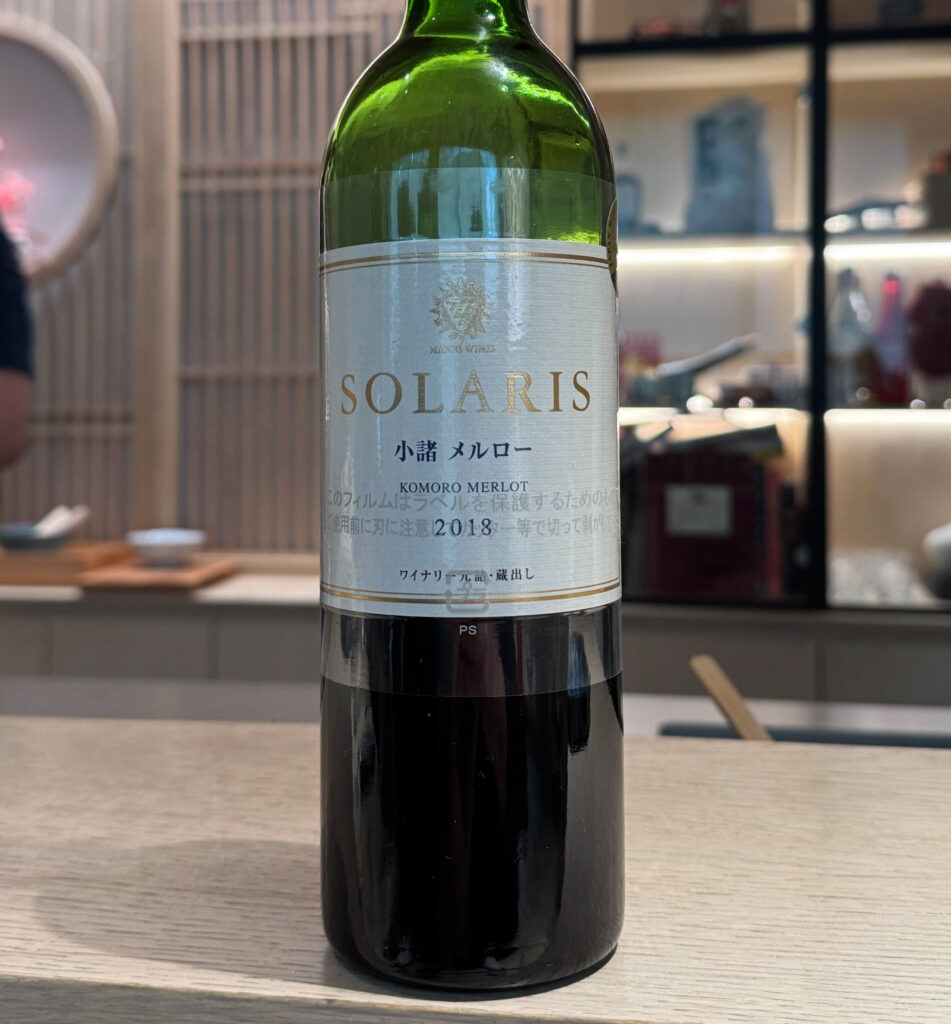
Phan, in turn, rewards us with a special closing piece (a nostalgic offering I maybe see just once or twice a year) and, alongside the tuna, some pours of a Japanese wine (the 2018 Manns “Solaris” Shinshu Komoro Merlot) he picked up while in the country.
Ultimately, chef and patrons combine to shape an occasion that skips right over the concept’s lingering (though threadbare) formality and centers instantly on the kind of interaction and irreverence that makes this place magical.
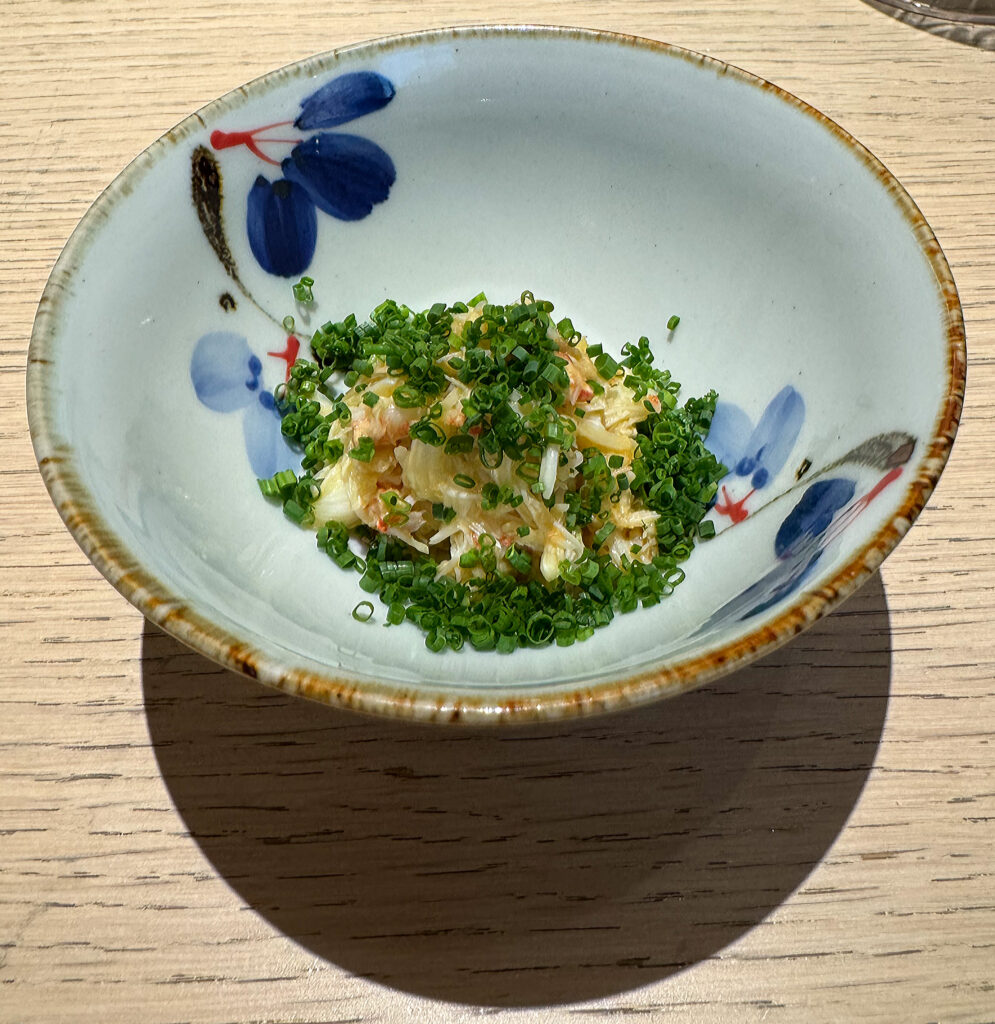
Tonight’s omakase kicks off with a serving of “Kegani” (or Hokkaido horsehair crab) I haven’t seen on the menu since November of last year. On that occasion, the ingredient formed an absolute highlight, rivaling the chef’s headlining servings of tuna. The present example is not far off in quality—with threads of the crustacean’s leg meat being combined with its innards and topped with an absolute avalanche of chives.
The resulting spoonfuls balance tender, buttery flesh with a crisp counterpunch of allium (whose subtle sharpness also serves to tease out the sweetness of the shellfish). For my taste, the dish only lacks a bit of persistence on the finish to truly rank among the best iterations. That said, it’s still delicious, and it makes for a great, broadly pleasing start.
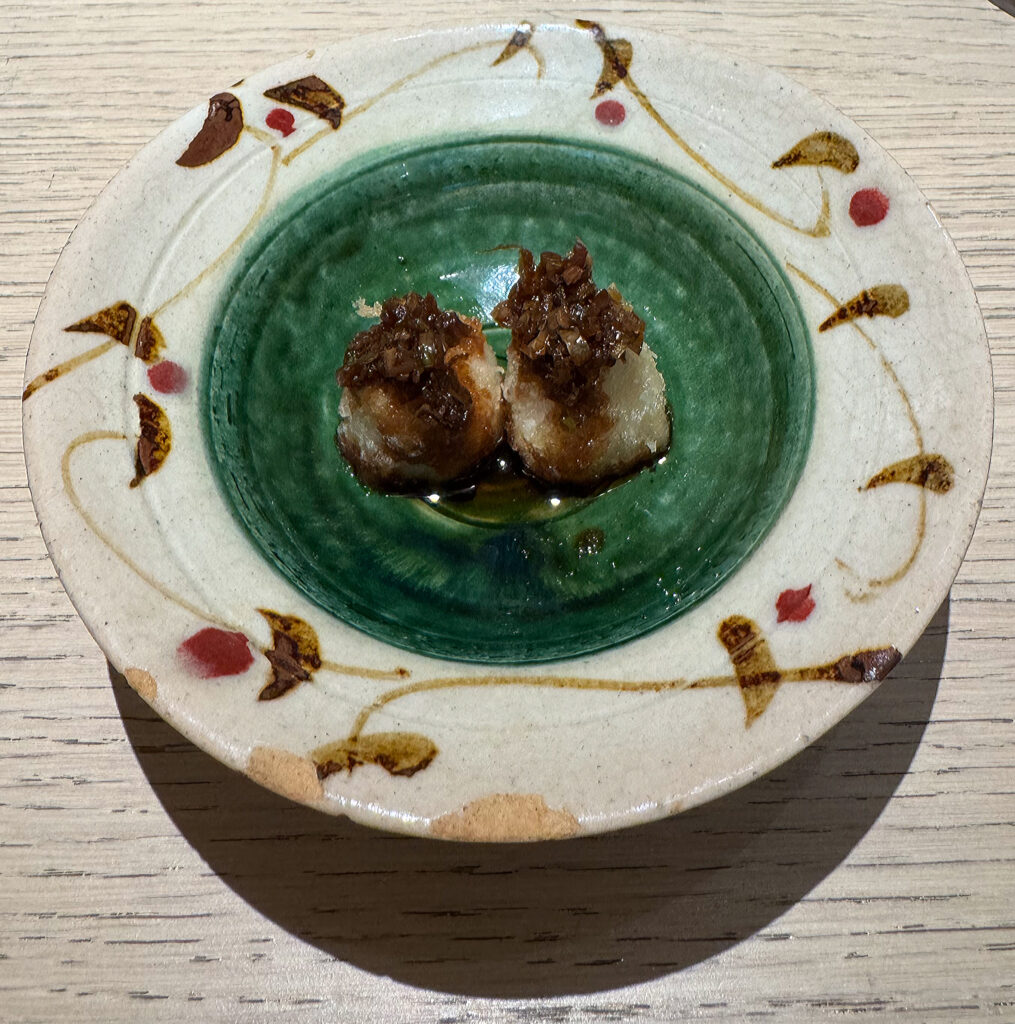
“Fugu Shirako” (i.e., the milt of that infamously poisonous pufferfish) represents the kind of arcane, challenging bite that can polarize newcomers who come here in search of more familiar, luxurious fish. However, this audience recognizes the ingredient’s prized status, and some even contend that Kyōten is the only restaurant where they will eat it. Phan, to his credit, knows just how to transform the sperm sac so that it’s both approachable and faithful to its essential, distinguishing character. Tempura-fried and topped with a green onion ponzu, the item makes its last appearance for the season.
When the milt is treated to this level of execution, it’s hard not to miss it. For, on the palate, a delicately crisp exterior frames a supremely rich, custardy mouthfeel whose textural effect is utterly singular. Enlivened by the tang of its accompanying sauce, the fugu shirako avoids any accompanying blandness that might make its creamy weight seem off-putting. Instead, it tastes entirely clean and even faintly sweet: introducing guests to one of the ocean’s treasures while remaining conscious of native stylistic preferences.
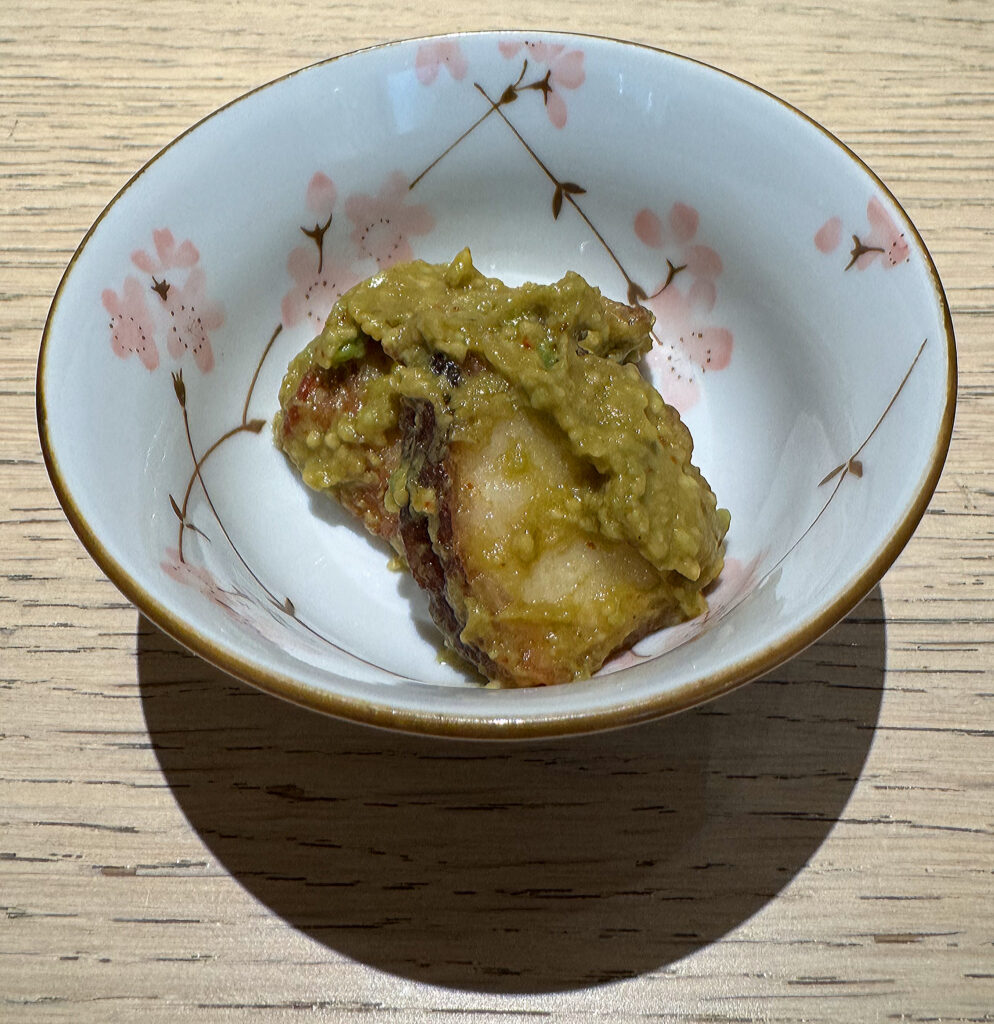
The “Octopus” forms one of Phan’s oldest signatures, and its evergreen quality attests as to why. The chef puts the cephalopod through an extensive regimen of massaging and boiling to assure its tenderness before frying it in the manner of a chicken karaage. The resulting portion is coated in avocado ponzu, which helps to amplify the starring ingredient’s own richness. In this case, I do miss a bit of the fleeting crispness that, when achieved, further enhances the octopus’s texture. That said, its sense of chew is deeply satisfying, and I also find an undertone of supporting sweetness that lasts—delectably—through the finish.
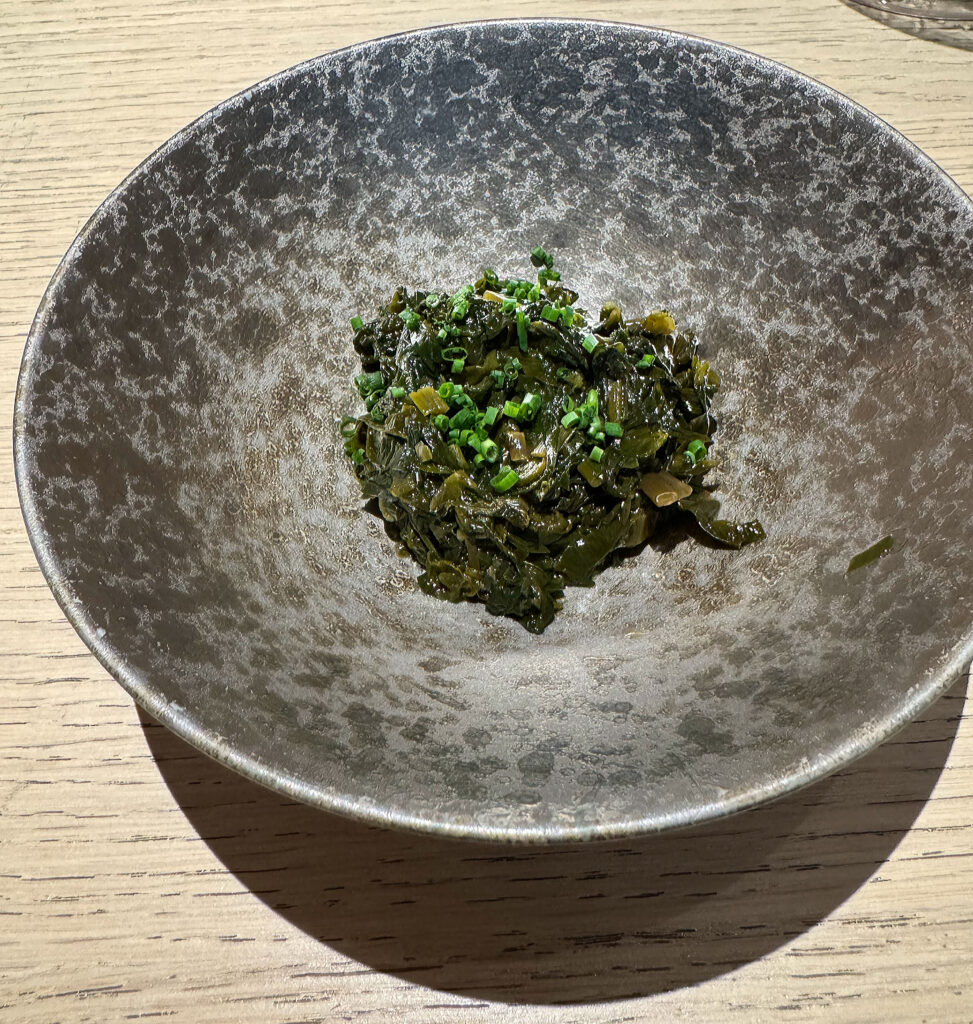
The “Ramps” enters into a long line of fresh produce preparations that demonstrate how the chef—even when separated from his coveted wild-caught seafood—knows how to pinpoint and accentuate the very best qualities of nature’s bounty. Indeed, seeing Phan embrace an ingredient that is so emblematic of the Midwest (and Chicago more specifically) has always anchored his work, however reliant on fish coming from afar, with a sense of local terroir.
Inspired by his own love of spinach, the chef centers his recipe on the leaves (rather than the stem) of the allium. Cooked in this manner—then topped with bits of chive and parmigiano—the ramps display a moist and delicately crunchy consistency that feels fuller and more soothing than the many occasions I seem them grilled whole or transformed into a mere garnish. The accompanying flavor—charged with salt, earth, and nuttiness but tending toward a beautifully sweet, garlicky finish—is just sublime too. While I’ve tasted a few good ramp dishes at Michelin- and multi-Michelin-starred concepts this season, I’m not sure any of those kitchens understand the ingredient’s hedonistic potential like Phan does. He manages to surpass them all while making it look effortless.
Kyōten’s three-part tuna sequence, which serves to usher in a longer progression of nigiri, forms the heart of any meal here. And, as much as I’ve come to love the restaurant’s less traditional offerings, it’s these headlining pieces (all taken from wild-caught fish sourced off the coast of Boston) that I really crave after any extended absence. Bite for bite, they consistently rank among the best items served in Chicago on any given night.
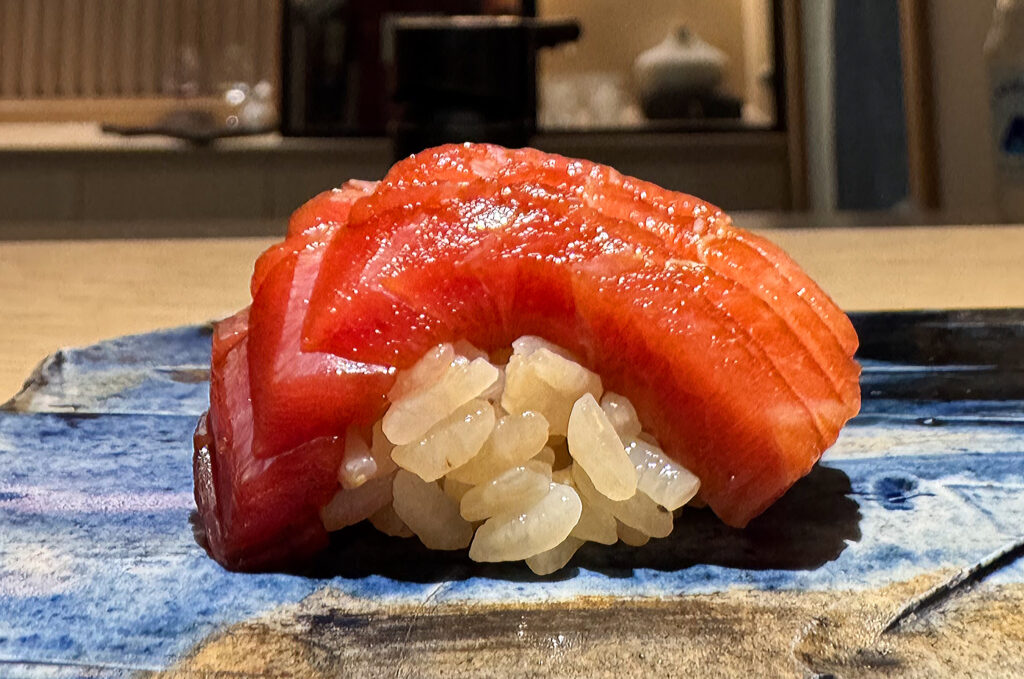
First, there’s the “Chū-Toro” (a medium-fatty cut of belly said to strike the perfect balance between the major sections). Prepared using a combination of lengthwise and widthwise scoring, the piece possesses fine veins of marbling throughout its flesh that coalesce into denser streaks in certain areas.
On the palate, this expression of tuna melts seamlessly—only for the torrent of mouth-coating fat to be electrified by a burst of wasabi (stopping just short of discomfort) and accompanying tang. A satisfying sense of umami, kissed with sweetness, carries through the finish, making for one of Phan’s prototypically excellent renditions of this coveted ingredient.
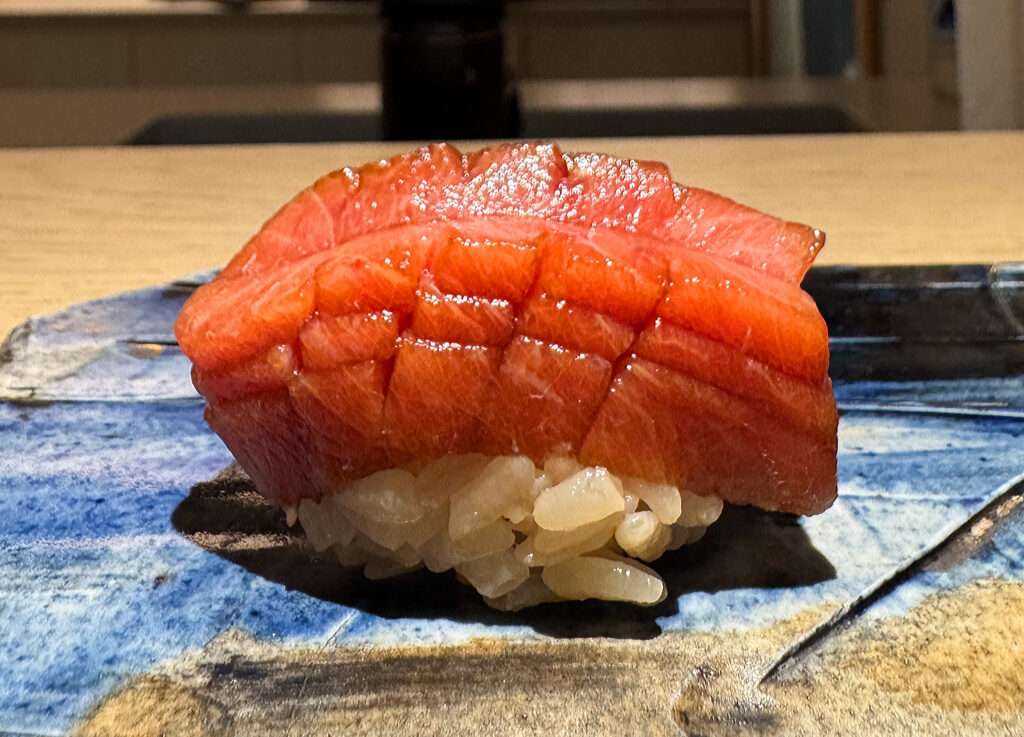
Next comes the “Ōtoro” (the fattiest segment of the same belly), which looks to push guests’ perception of richness one step further. The piece, with its pronounced web of marbling and crosshatched scoring, certainly looks the part.
However, I find the textural effect to be fairly comparable: it melts in more or less the same manner while, perhaps, feeling a bit wider and weightier on the tongue. Flavor, nonetheless, displays more of an imprint of soy sauce than it does the wasabi or vinegar that characterized the chū-toro. I probably prefer the latter, yet these bites are only separated by a hair. The expression here, more straightforwardly savory, also forms a wonderful pairing with that Japanese Merlot.
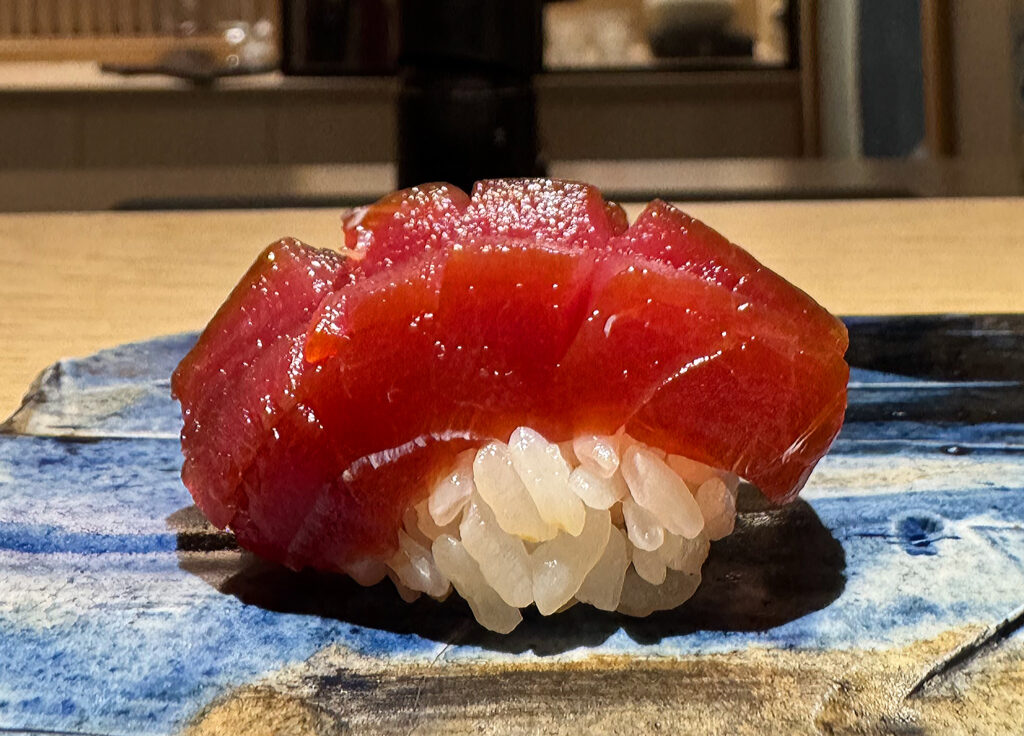
Finally, there’s the “Akami” (signifying the tuna’s leaner meat), which is cured in soy sauce (i.e., zuké) just a few hours before service each day. This humblest of the three pieces boasts an enticingly deep, glistening tone to its flesh and is only subject to a small degree of scoring.
Despite benefitting from less latent marbling, the akami offers a soft, almost jellied consistently that is hugely appealing. The soy sauce comes through mildly—somehow displaying less intensity than what I sensed with the ōtoro—yet the resulting impression feels adequately seasoned and rather elegant overall. Ultimately, this bite more or less keeps pace with its predecessors tonight: a collapsing of tuna’s stereotypical hierarchy that speaks to the chef’s skill and vision.
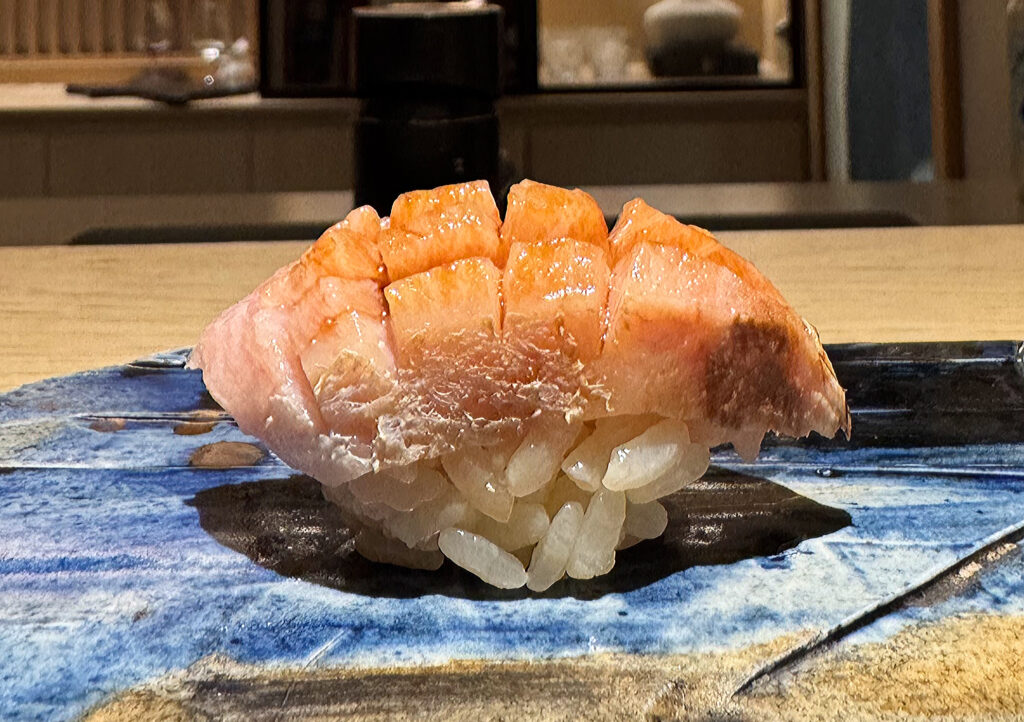
Turning toward the rest of the menu is always a tricky proposition—have we already reached the peak? But, by drawing on “Buri” (or wild mature yellowtail), Phan reliably proves that there is much more pleasure to come. He actually likens the present cut to the “ōtoro” of the fish, and its glistening fat (not to mention the kindred, crosshatched manner of scoring) attests to that.
On the palate, the buri displays an effortlessly melting quality that truly is reminiscent of those nicer pieces of tuna. Flavor, in turn, is marked both by soy sauce and a hint of vinegar tang: striking a balance (oh-so-satisfying when juxtaposing the umami) that, indeed, stands among the finest servings of meal.
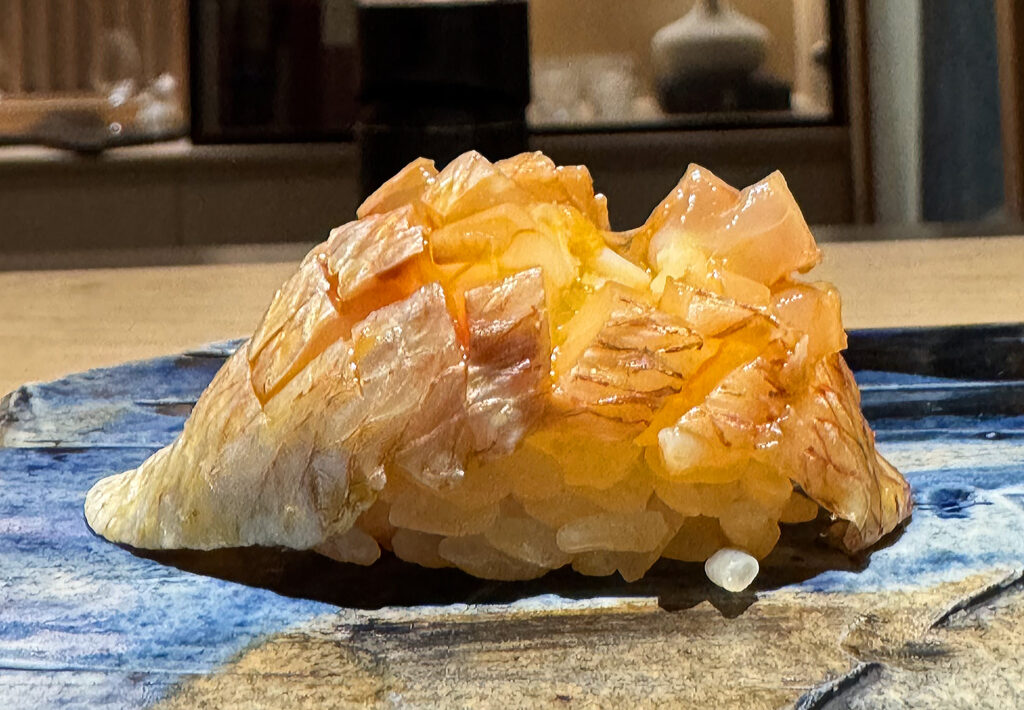
The “Kasugodai” (or young sea bream) represents one of those incredibly rare fish that Phan has never served. The chef says as much when introducing it—even though, ironically, I just sampled the ingredient as part of David Utterback’s omakase. On that occasion, I actually found the piece to be too saturated with flavor and, thus, a bit clunky in its expression.
The present version takes a rather freeform, wildly scored shape that is set atop Kyōten’s more lightly vinegared rice. Texturally, the kasugodai displays a fleetingly firm consistency that proves supple and pleasing with further mastication. The accompanying flavor is clean and cleansing, yet subtle note of sweetness and tang ensures the bite never feels bland. Overall, I quite like this fish as a means of transitioning from the menu’s fattier pieces.
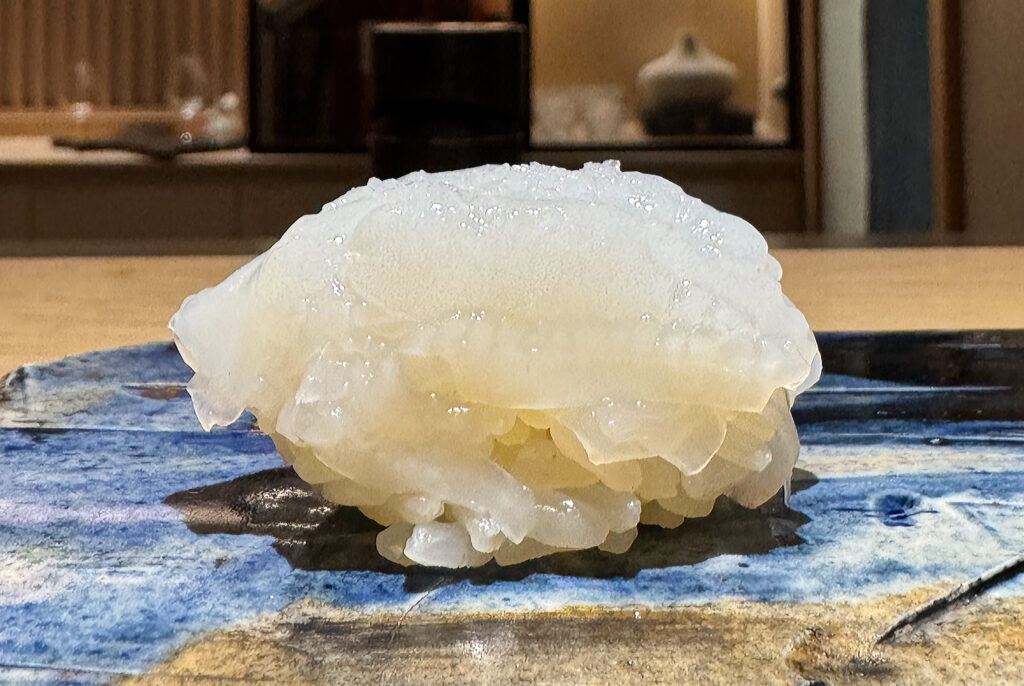
Phan’s “Aori Ika” (i.e., bigfin reef squid) follows along those same lines of brightness and refreshment. Moreover, it represents one of my very favorite ingredients in all of omakase, and the iteration I sampled back in February formed an obvious highlight. Here, little changes: the cephalopod is thoroughly tenderized and fashioned into a translucent mound that is seasoned with touches of lemon and salt.
At first, the squid feels slightly bouncy against my teeth, yet this sensation—suggesting a certain firmness and weight—yields to a transfixing tenderness. It’s exactly the kind of feeling I chase. Plus, the accompanying seasoning is well-judged too— not overwhelming the ika but, instead, working to reveal the most elegant sweetness of anything on offer tonight. In short, this piece leaves me quite satisfied.
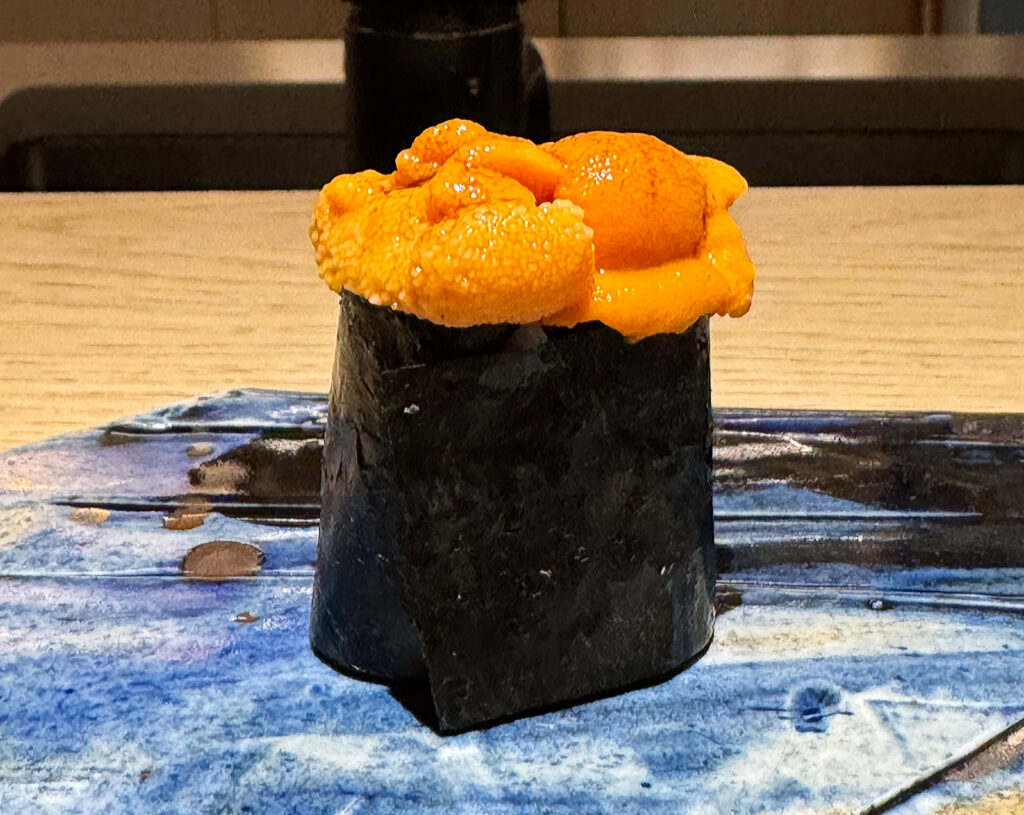
With so many highlights to celebrate this evening, it seems inevitable that there would be some lapses in quality too. Kyōten’s “Uni” is certainly capable of ranking among the meal’s best items, and the chef’s preference for the ensui (or preservative-free) variety of this Hokkaido-sourced product, which comes soaked in saltwater solution, is meant to counter the ingredient’s essential fickleness.
However, on this occasion, the sea urchin is served a little too cold: detracting from the interplay of the crisp seaweed and creamy lobes while also serving to mute the sweet, oceanic finish that crowns the bite. It’s not hard to imagine how great this piece would be at the proper temperature, which perhaps makes this miscue all the more vexing.
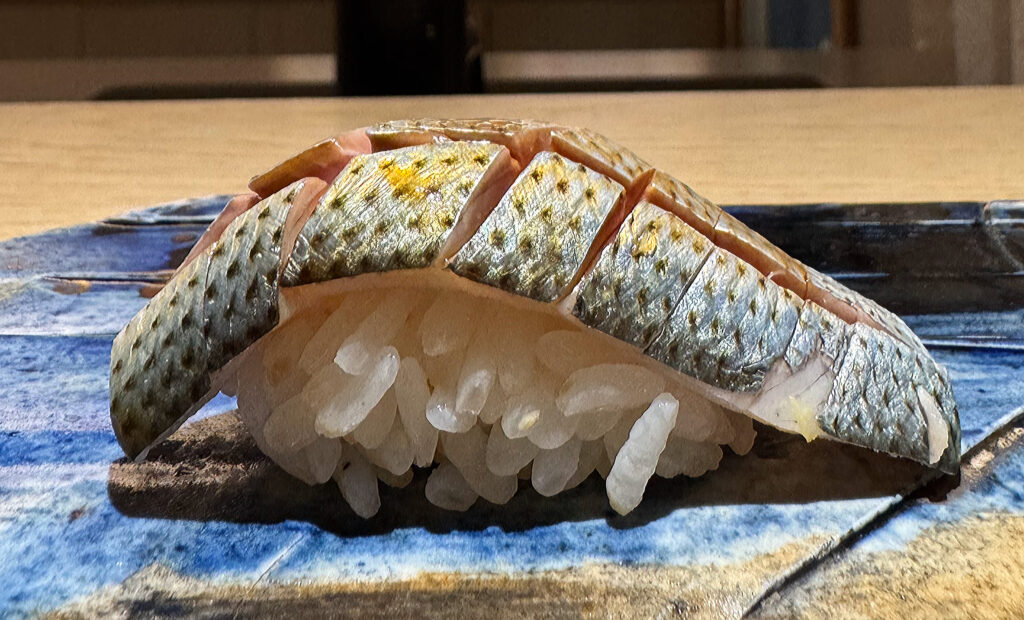
“Kohada” (i.e., gizzard shad) is a piece on which sushi chefs will always be especially judged—so involved is the process of deboning, washing, salting, and marinating the fish before it is served. Phan testifies to the ingredient’s hallowed status whenever he serves it, and, lucky for him, the results are usually impressive.
On the palate, the gizzard shad leads with a mild degree of firmness and accompanying sour flavor. Nevertheless, the flesh grows smoother and more cohesive with time, shifting toward a more balanced expression of tanginess that supports the kohada’s notable concentration of umami. For my taste, this is a pretty good example of the form: one that doesn’t quite reach the podium but, in turn, adds character and enjoyment to this midpoint of the progression.
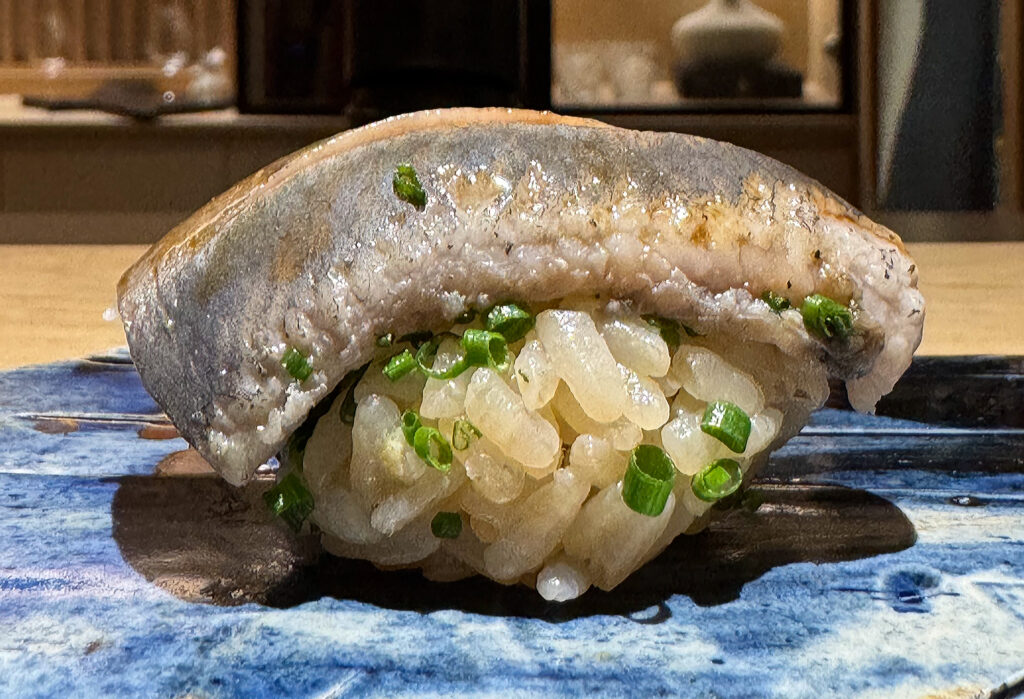
The “Iwashi” (or sardine) builds on the sense of intensity that characterized the gizzard shad. Placed atop a mound of rice that has been studded with chives, this diminutive fish marries an imposing degree of density with a supremely juicy, oily mouthfeel that keeps everything feeling balanced. Further, while the flavor is resoundingly briny, it stops short of any murky, polarizing fishiness. Instead, I get a sharp jolt of allium on the finish that helps to contrast (and further emphasize) the sardine’s significant savory depth. Indeed, if the fish was sliced a bit more thinly, I’d almost call this piece refined. Otherwise, though I appreciate the forcefulness on display, this bite lands closer to the middle of the pack.
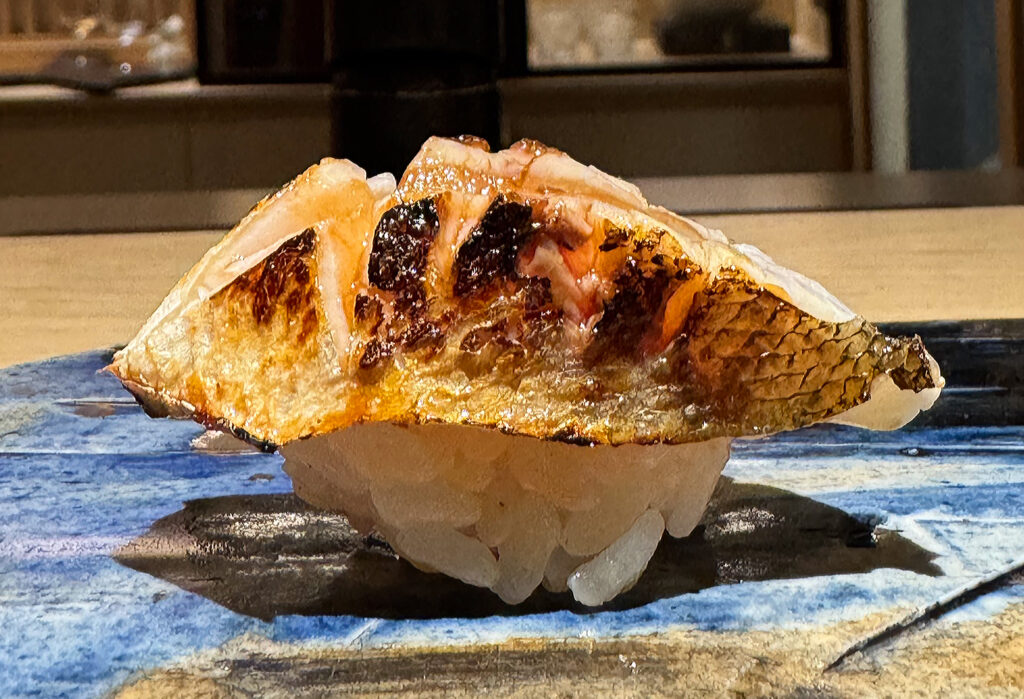
“Kamasu” (i.e., barracuda) stands as one of the newer additions to Phan’s arsenal. He smoked it on one occasion (back in 2022) and put forth a torched version back in March. Here, he again opts for the latter method: delivering a piece that is driven by crispness, flakiness, and char on entry but grows in softness, tang, and umami as one approaches the finish. I almost find the bitterness of the skin to be overwhelming (and it might be worth asking if the torch was applied a bit too long). The flavor is certainly persistent. However, it also adds an element of smoky depth that feels entirely different from any other fish served up until this point.
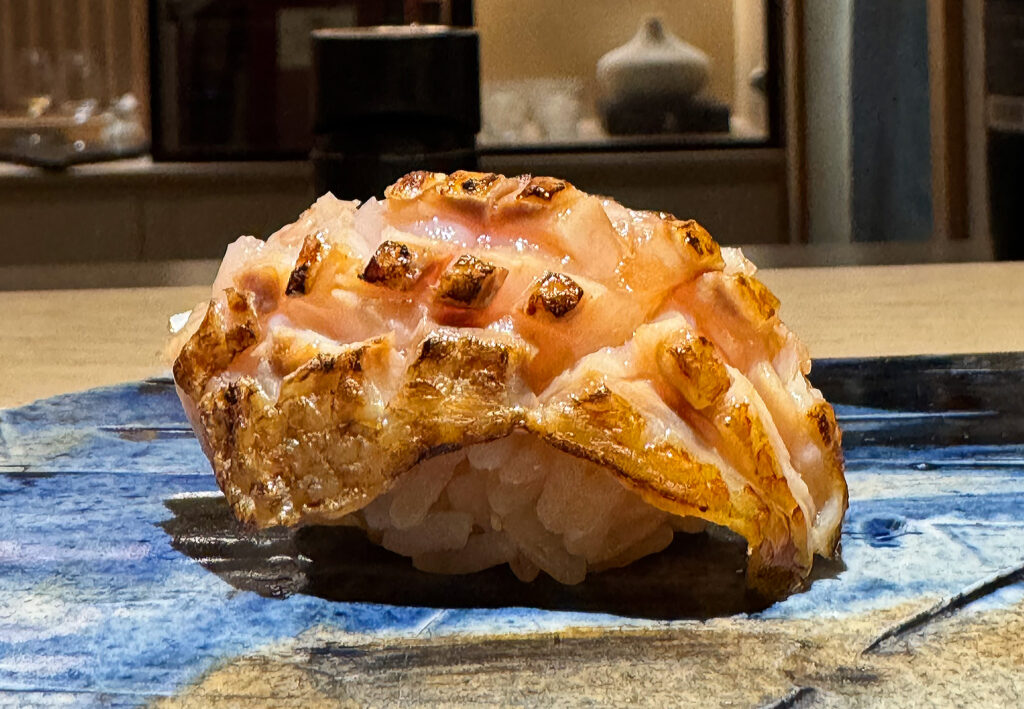
Phan considers the “Akamutsu” (or blackthroat sea perch) to be the most luxurious of all the fish he serves. Texturally, I understand what he means, yet the chef also seems to know that I frequently find the ingredient’s accompanying flavor to be lacking (a fact he pokes fun at tonight). As tempted as I am to ask for an application of sweet sauce or wasabi that might rebalance the piece for my taste, there’s actually an easier solution.
This time around, Phan serves me a cut taken from the fish’s body instead of one (more highly prized) closer to its head. Thus, as I appreciate the perch’s torched, gooey flesh, I actually find a persistent, supporting savory quality that steers its richness toward real satisfaction. And, for once, I can truly say that the akamutsu ranks among my favorite bites of the night.
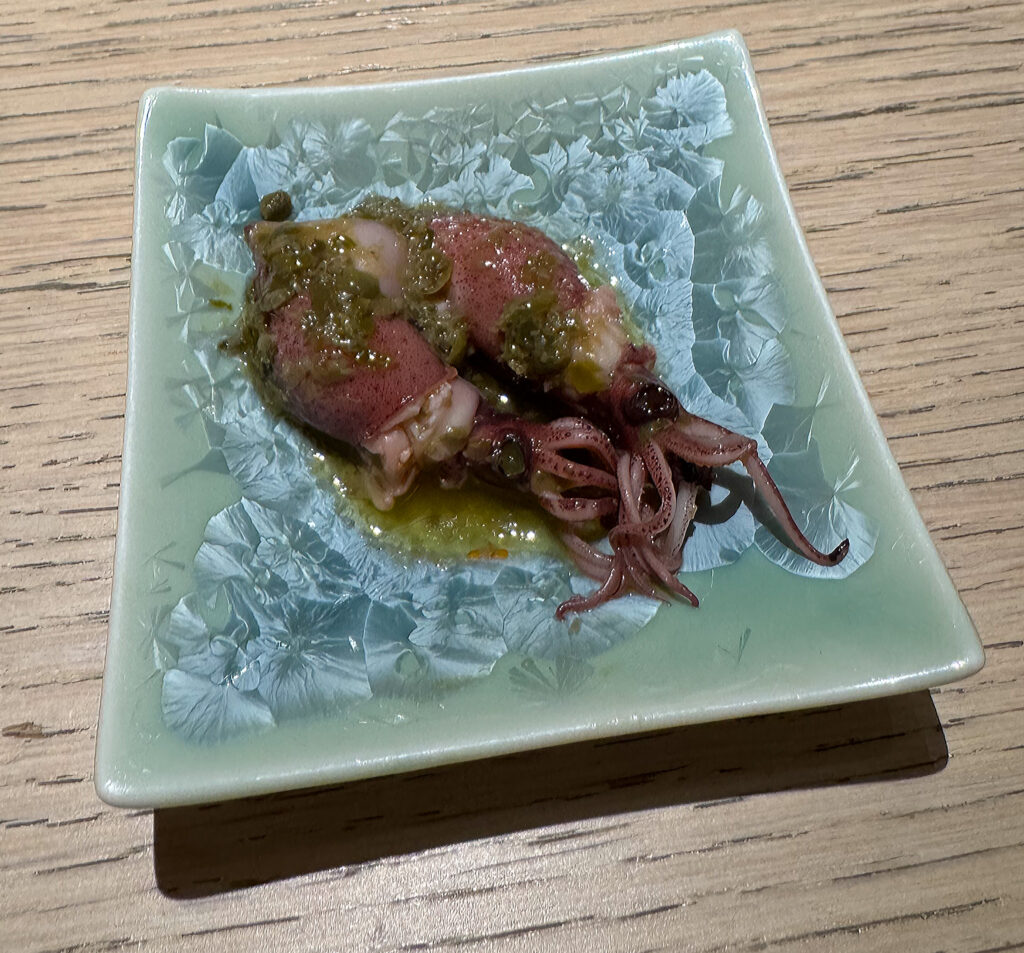
“Hotaru Ika” (also known as firefly squid) is, according to the chef, the “most seasonal thing” on the present menu—comparable even to “sakura blossoms.” Phan loves to pair the cephalopod with anchovies and capers to form a kind of “Caesar salad” effect, and he pursues that strategy here.
This results in a couple of bites that display a clean, plump, and creamy texture with an accompanying darkly savory flavor. Honestly, I’ve had versions of this recipe—too bitter and almost fishy in character—that left me cold, so I appreciate that the present example is fairly refined. That said, I’m not quite blown away by the combination and think it can be executed at a higher level.
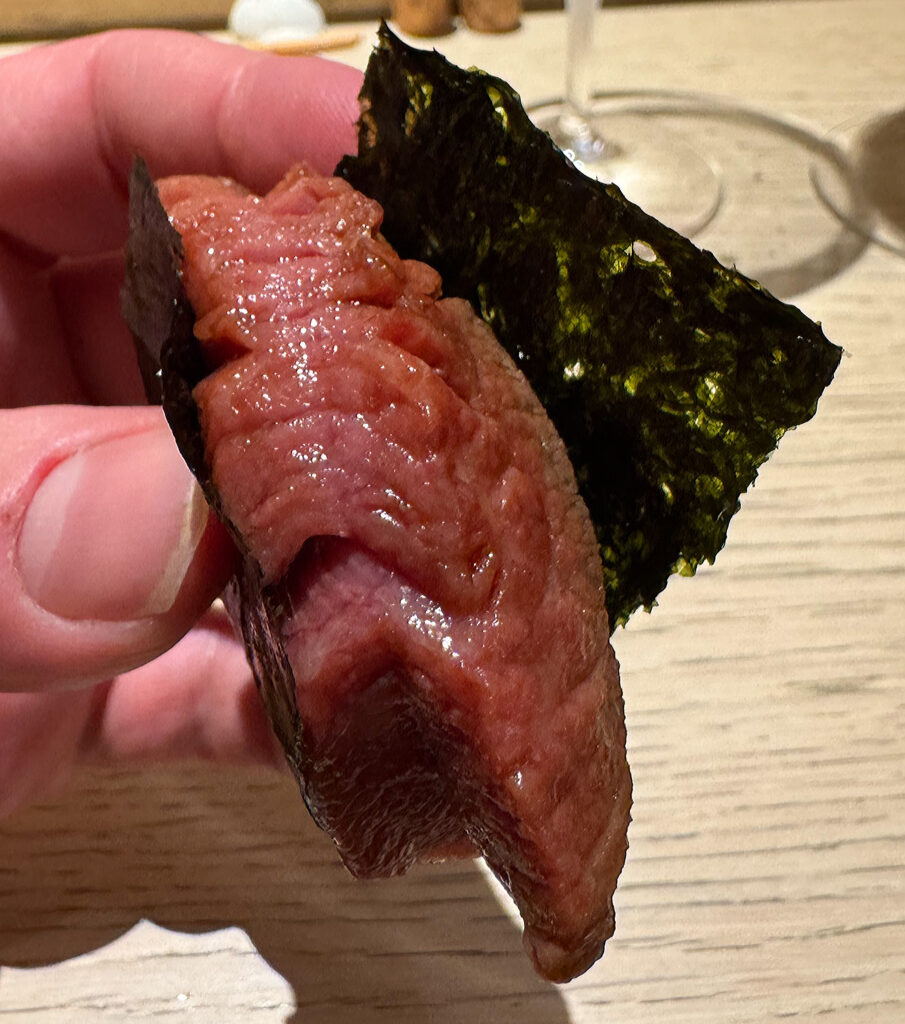
Expanding on his “salad” metaphor, Phan frames the following piece as an accompanying serving of “steak.” It’s actually “A5 Matsusaka Tenderloin,” sourced from one of the “three big regions” for beef, that has been seared and tucked (with horseradish and rice) inside a seaweed wrapper.
On the palate, the resulting bites marry crispness, chew, and juiciness in a manner that is highly attractive. However, while the sharpness of the horseradish forms a fitting complement, the wagyu itself is marked more by the flavor of char than any convincing savory power. For my taste, this needs a touch of salt or soy sauce to really shine, but I still appreciate how the tenderloin is packaged.
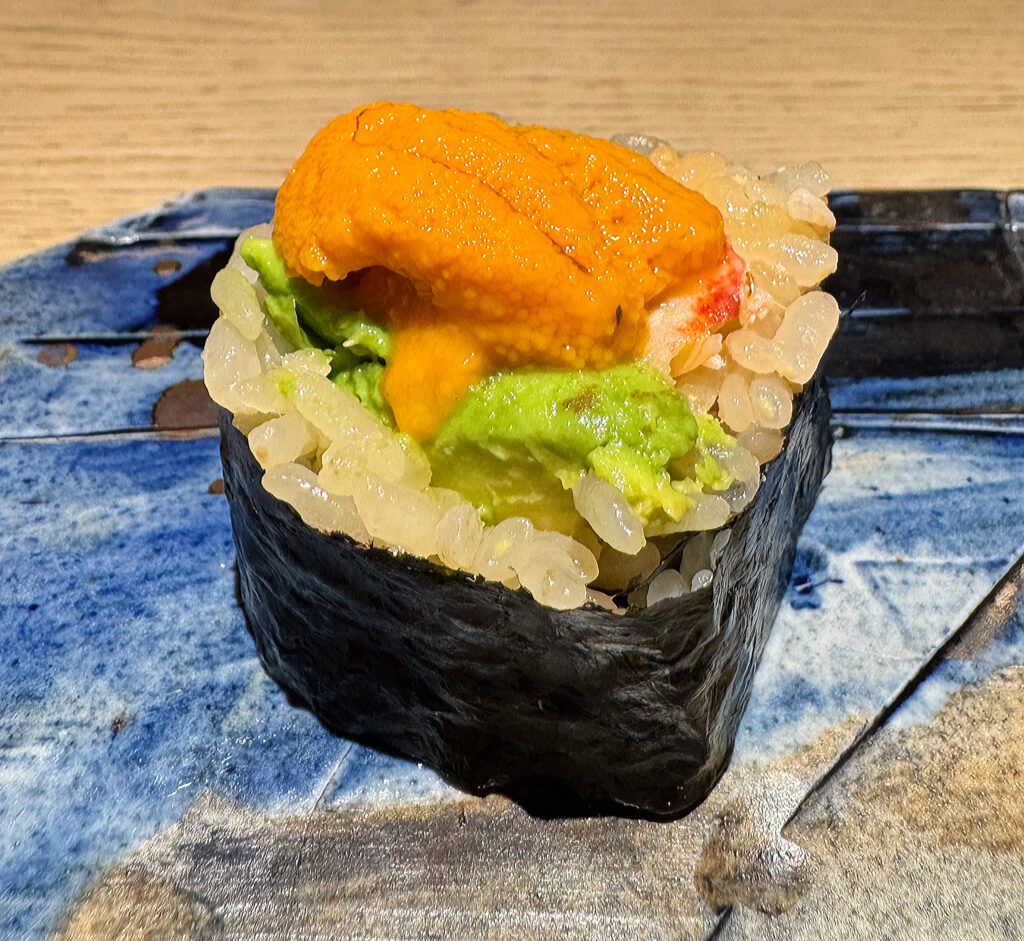
The final savory item of the night is being offered as a special treat to the assembled regulars, as it is both remarkably decadent and somewhat nostalgic for anyone who remembers Kyōten’s pre-pandemic era. The “California Roll” is rendered in a thicker, futomaki form that comes stuffed with European blue lobster and avocado then topped, for good measure, with a couple lobes of uni.
Texturally, the resulting piece displays a remarkable smoothness and creaminess despite its oversized stature. The roll’s flavor, in turn, is fairly oceanic and lacks the degree of sweetness I might expect. Still, it’s a beautifully cohesive bite imbued with all the playfulness Phan (perhaps moreso in his early days) is known for. I cannot resist smiling as I eat it.
Dessert arrives in two familiar parts (both of which are executed with pinpoint accuracy):
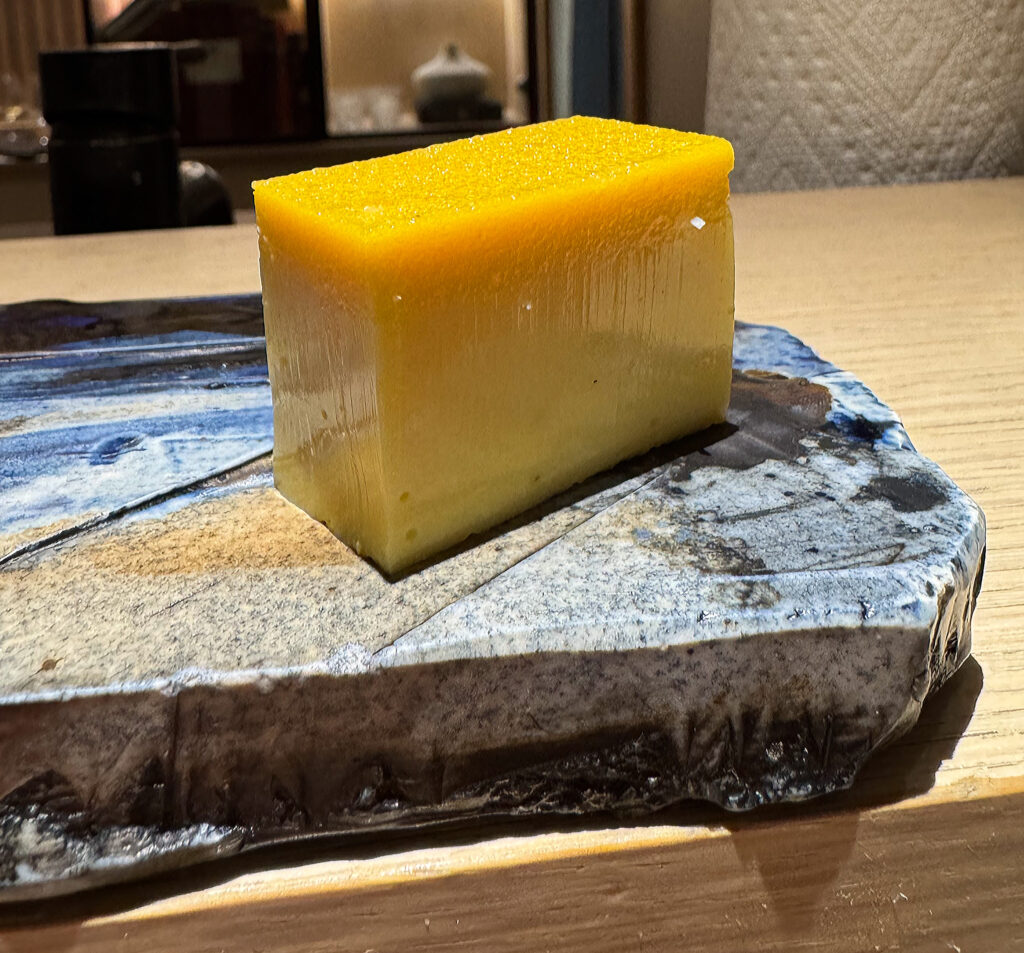
The chef’s “Tamago,” rendered in a custard style with the addition of corn and maple syrup, is served at the perfect temperature (the fluctuation of which has occasionally presented a problem). The eggy treat wiggles and melts and smacks you with a milky, caramelized sweetness that is impossible to resist. Phan, as usual, offers a second helping, and not one diner turns him down.
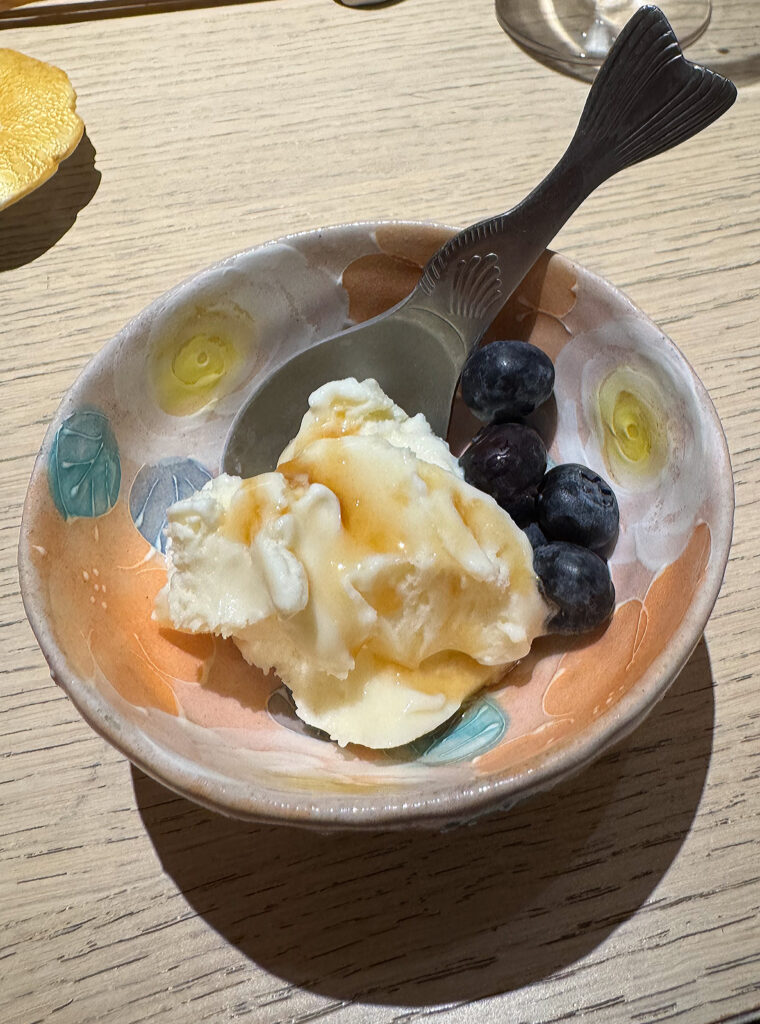
The “White Cheddar Ice Cream” is a comparably more recent addition that is well on the way to becoming a signature. On this occasion, the scoop—flavored with Prairie Breeze from Iowa’s Milton Creamery—is joined by the usual drizzle of maple syrup and, more uniquely, by a few blueberries. The addition of the plump, bursting fruit helps to play off of the rich, creamy quality of the ice cream. The berries also tilt the dessert’s flavor expression—subtly sharp and resoundingly caramelized—toward a fresher, tarter finish. I cannot see myself getting bored of this recipe anytime soon, yet it’s always nice to see the chef play around with different toppings.
Roughly two-and-a-half hours later, the meal reaches its conclusion: having maintained a slightly faster pace that I am used to but one (with an average wait of only nine minutes between each of the 20 bites) that also feels wholly appropriate given the solitary chef, number of customers, and total amount of food.
Plus, Phan’s efficiency grants him more time with guests who, each making a repeat visit to the restaurant, are here to catch up and share a glass of wine as much as they are to enjoy great sushi. Stoking this connection—by devoting more time to shared revelry than any other toque with an entire kitchen (or at least a second seating) to run would be capable—forms a large part of why regulars elect to come back.
They could spend the same amount of money at any number of multi-Michelin-star spots or steakhouses without ever getting more than a glimpse of the same raw, human quality that makes this genre (and Kyōten most particularly) special.
In ranking the evening’s dishes:
I would place the “Chū-Toro,” “Ōtoro,” “Akami,” and “Buri” in the highest category: superlative pieces that stand among the best things I will be served in any restaurant this year.
The “Kegani,” “Fugu Shirako,” “Octopus,” “Ramps,” “Kasugodai,” “Aori Ika,” “Akamutsu,” “Tamago,” and “White Cheddar Ice Cream” all land in the next stratum: great items that achieved a truly memorable degree of pleasure. I would love to encounter any of these again.
Next come the “Uni,” “Kohada,” “Iwashi,” “Kamasu,” “A5 Matsusaka Tenderloin,” and “California Roll”—good—even very good—preparations I would always be happy to sample again (but that just failed to elicit an extra degree of emotion).
Finally, we have the “Hotaru Ika”—a merely good (maybe just average) bite that fell short when it came to flavor. Still, I know the core idea underlying this recipe is sound, and it could easily be fixed with a little more tweaking.
Overall, this makes for a hit-rate of 95% with some 65% of offerings reaching that “would love to have again” level of quality and 20% being of that “best of the year” caliber.
Compared to my meal in February (that is, the last time Phan was behind the counter), the hit-rate here is slightly higher (up from 89%) while the latter two figures fell (down from 89% and 28% respectively).
This suggests that though the present menu was more consistent in its performance (largely avoiding any notable lows), it also failed to reach the same number and intensity of highs that it is sometimes capable of. Indeed, on any other occasion, I’d expect pieces like the “Uni,” “A5 Tenderloin,” and “California Roll” to move up to the second category while the “Kegani” and “Aori Ika” are definitely capable of rising to the first.
Nonetheless, all things considered, this was a superlative meal: one that assures me that Phan’s overarching mastery continues to move in the right direction even if a few smaller details can always be improved upon.
Certainly, there’s a rhythm that one needs to regain—even if technical skill is not forgotten—after a period of time away. With more travel on the horizon, this stopping and starting may form a unique challenge for the rest of this particular year.
However, the longest absence is already behind us. Kyōten’s quality remains ironclad. I cherish having its sushi, yet again, as a somewhat regular reference point (across all genres of cuisine). And I look forward to seeing the chef reach—and surpass—the ceiling his singular work so frequently approaches.