
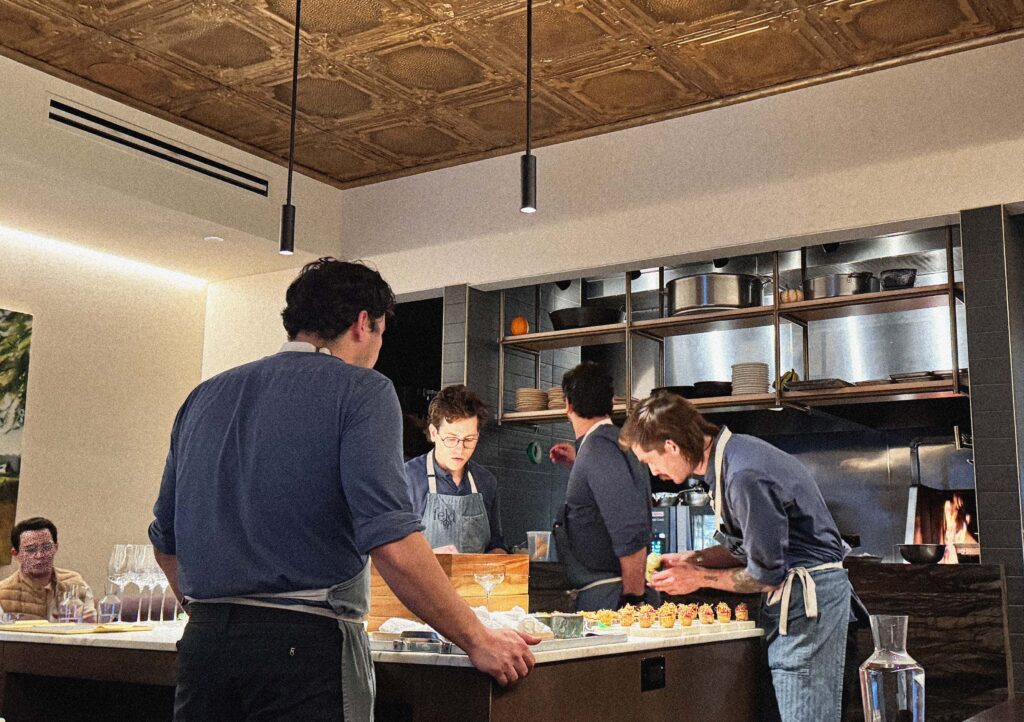
I really had no master plan in mind when scheduling Feld twice in September: no special inclination to test the menu’s capacity for transformation during the course of a few short weeks.
Indeed, my past couple meals have been characterized by a greater proportion of repeats and minor evolutions than I am used to seeing at such a dynamic restaurant. Chef Jake Potashnick, in turn, was pretty candid about what it meant to have corn, tomatoes, peppers, and melons stealing the spotlight (and somewhat hampering the kitchen’s creativity) for such a long stretch of the year.
Increased “manipulation” (not a word one ever likes to hear at a concept so concerned with sourcing and the very essence of the resulting ingredients) provided a pathway to keep the cooks thinking and experimenting with what had become a familiar bounty. In practice, this yielded an uptick in refinement—the kind you expect from tastings that change on a monthly (not weekly) basis—and the total fulfilment of a process of ideation whose fruits (as at Smyth or Cellar Door Provisions) often prove so fleeting.
Yes, I actually felt like my dinners in late July, mid-August, and early September represented one of the friendliest, most approachable, and most consistent chapters in Feld’s history. Mind you, these experiences were not perfect. But they hit the high highs that justify Potashnick’s philosophy and style while, simultaneously, never veering toward the kind of hapless constructions that plagued the establishment’s early days.
Factor in the burgeoning quality of the beverage program—as well as a practice of hospitality that only grows warmer and freer with time—and it’s easy to imagine why I might like to spend a little more time here.
Further, there’s something to be said for the fact that Feld is still little more than two years old and being evaluated relative to restaurants that have largely passed their 10th birthday. Certainly, Smyth and Oriole and Kyōten and CDP have not lost any of their own capacity to challenge themselves and change. Yet there’s something still fresh and unactualized about how Potashnick and his team operate that (despite their obvious success) remains rather charming.
As it happens, late September forms a key inflection point in the kitchen’s work, and comparing the present meal to that which I sampled earlier in the month might make for the most insightful visit of 2026.
To hear the staff tell it, the evening centers on a “lack of tomato” and a “lack of corn” (though they’re seen as preserves) in favor of the squash and seafood that comes with cooler weather.
For Potashnick, the menu is one of “big creative swings” that already ranks among those he’s most proud of. Given the level the chef has been operating at as of late, is there any more mouthwatering invitation to sit down, open one’s mind, and dig in?
Let us begin.
Tonight, I find myself at a table near the very middle of the dining room: a nexus from which the staff’s swirling movements and synchronized spiels really strike me—not in a hushed, balletic manner but rather with the boisterousness this young team always wears so well.
Otherwise, when it comes to ambiance or the general operation of the restaurant, I have little new to report. The hospitality, seventeen meals on, continues to reward loyal patronage as preferences are recorded, extra details are shared, and an overall ease of interaction instills a peak feeling of comfort.
As far as the rest of the audience goes, I must once more note my surprise at just how many 40-, 50-, and 60-somethings sit alongside me. And perhaps, yes, they have the money to risk on a concept whose value proposition is a little less conventional. Yet, in turn, their continued presence suggests that Feld’s appeal stretches well beyond those who found the chef on social media or are predisposed to support his philosophy (vis-à-vis luxury ingredients). In fact, it’s always been clear that Potashnick’s work is uniquely positioned to impress (or at least excite) guests who have already explored the full depth of Chicago’s dining scene.
With that said, it’s time for a drink.
Earlier this month, I sampled two of the menu’s “Freezer Door Cocktails,” generally preferring the rounder, sweet expression of the tomato margarita to the boozier seafood martini.
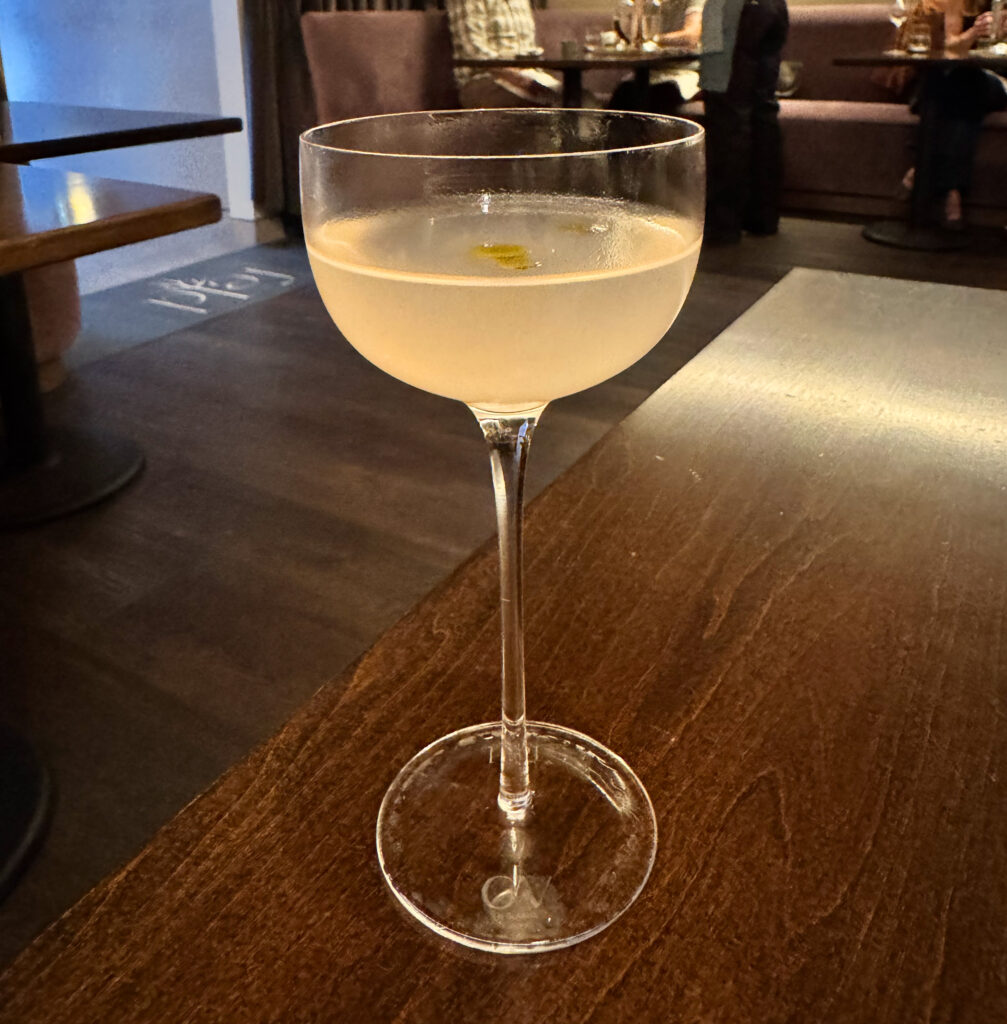
On this occasion, I find a “Melon Daiquiri” ($20) being offered as a new seasonal option. The drink blends rhum agricole, coriander, and shiso with the titular fruit (which, you might remember, was recently used in a series of herbaceous bites that were themselves inspired by cocktails).
Here, the transition from tanginess (on entry) to musky sweetness (on the midpalate) to a more spirit-forward, molasses-tinged finish is skillfully composed, and I particularly admire how the aromatic elements contribute lift and freshness rather than any errant pungency. Indeed, this daiquiri is beautifully cohesive and (as a lover of the form) wholly satisfying. Ultimately, it ranks as the best of Feld’s work in this category to date.
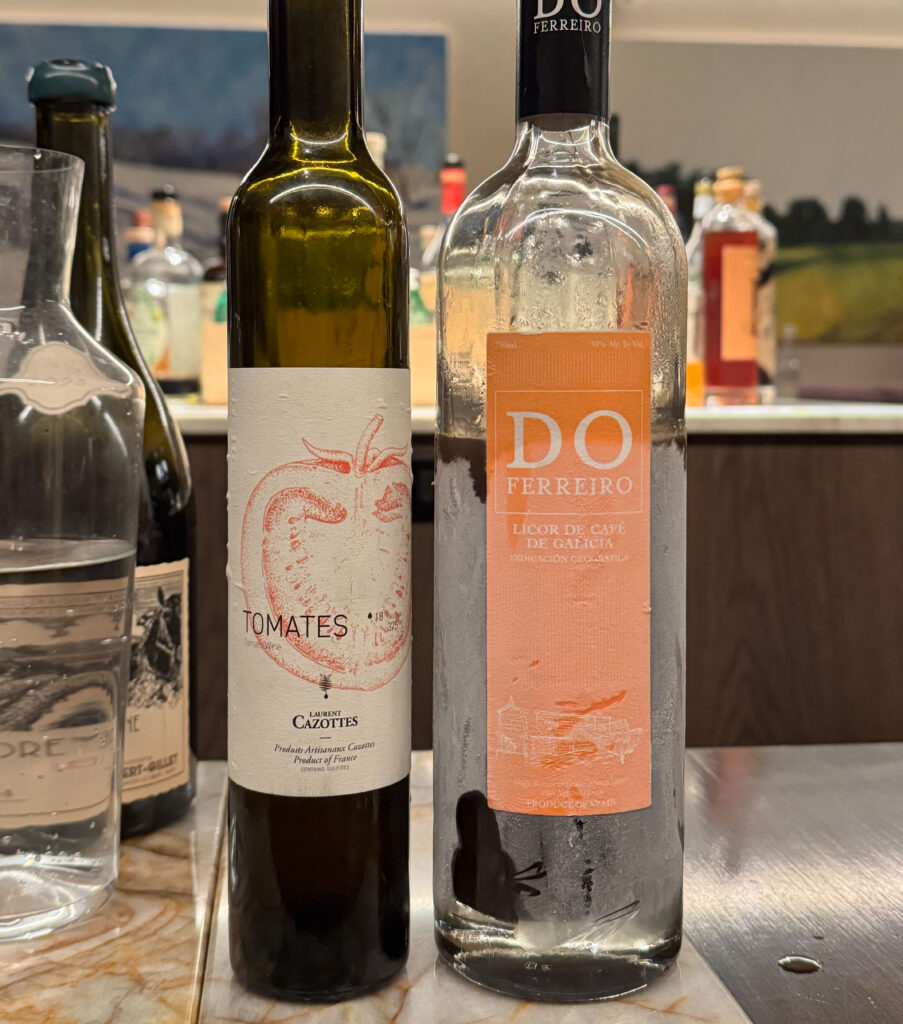
Beyond that, I am very happy to continue my exploration of general manager/sommelier Nathan Ducker’s selections for the “Cellar Flight” ($325): a “showcase of rare wines, older vintages, and luminary producers” that has proven to be one of the city’s most rewarding premium pairings.
Presently, it comprises:
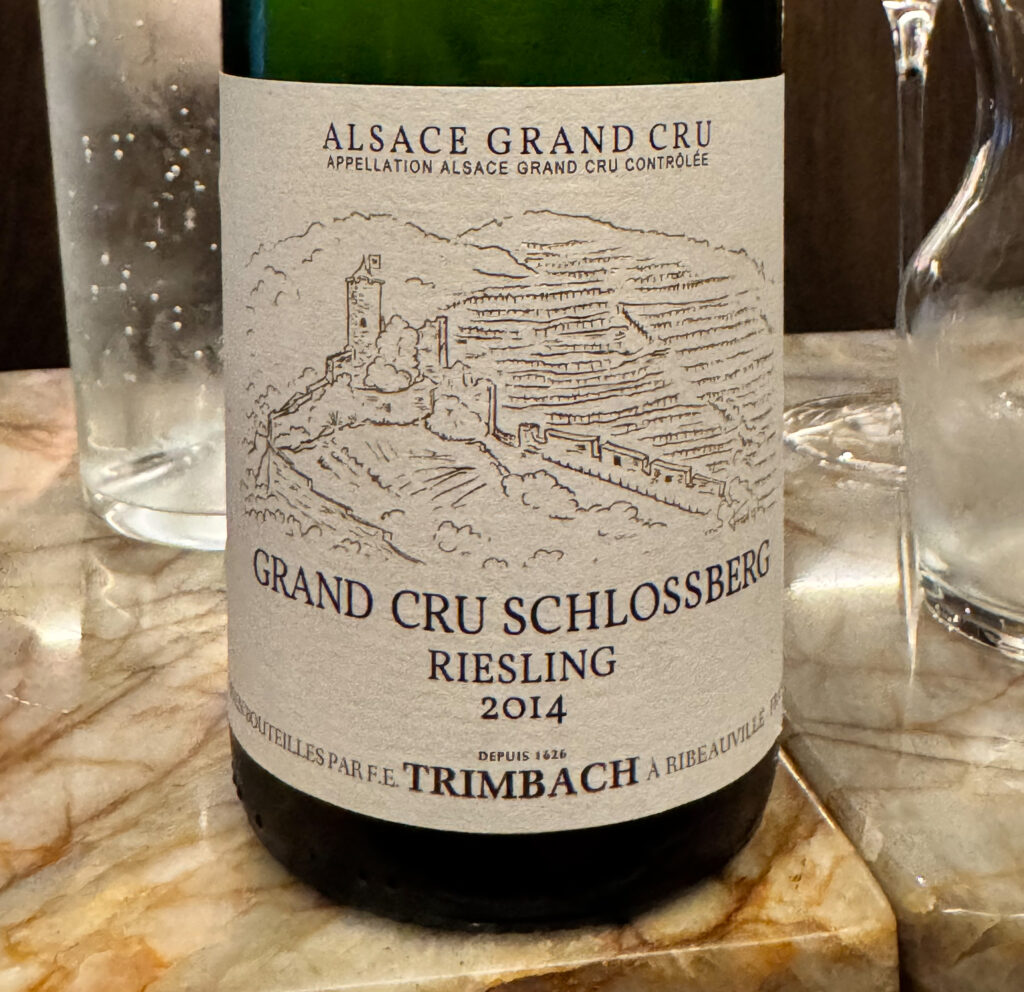
- 2014 Trimbach Riesling Schlossberg Grand Cru [$79 at local retail]
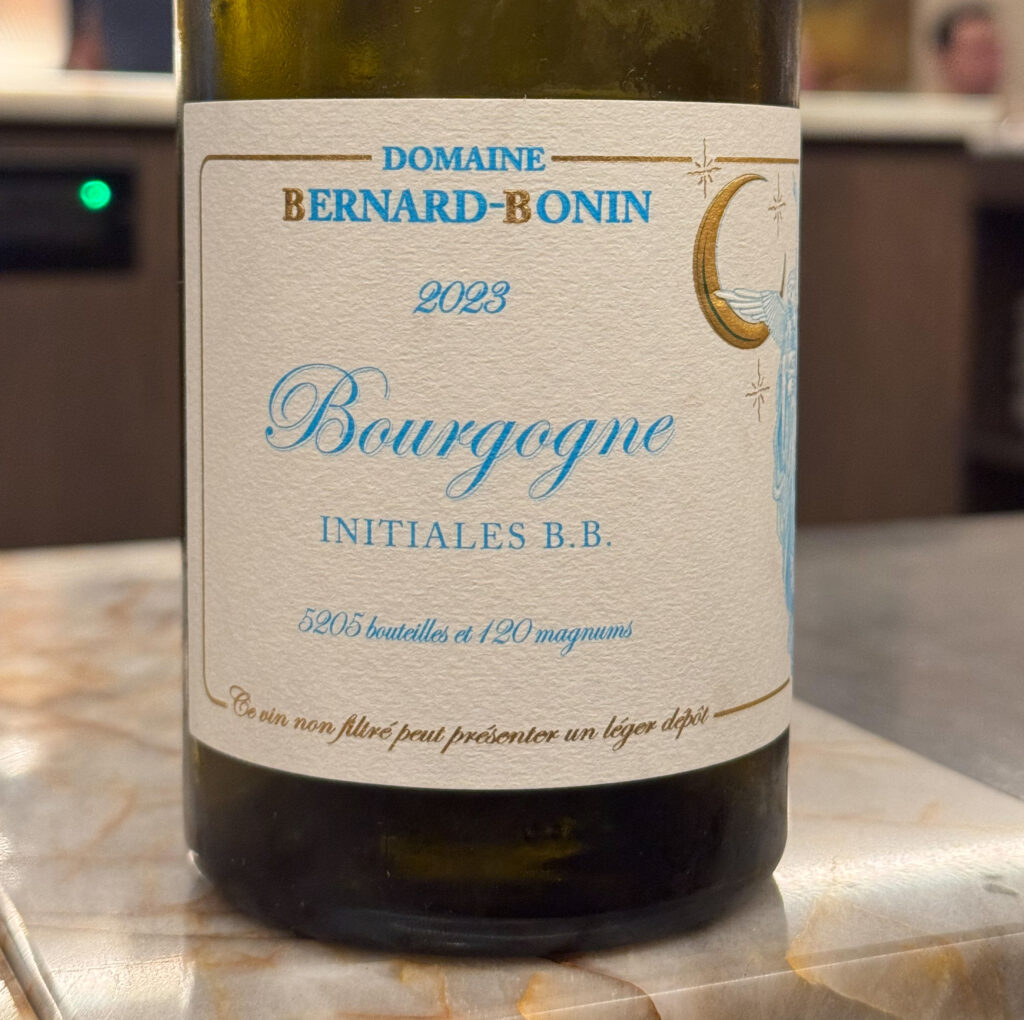
- 2023 Domaine Bernard-Bonin Bourgogne Blanc “Initiales B.B.” [$219.99 at national retail]
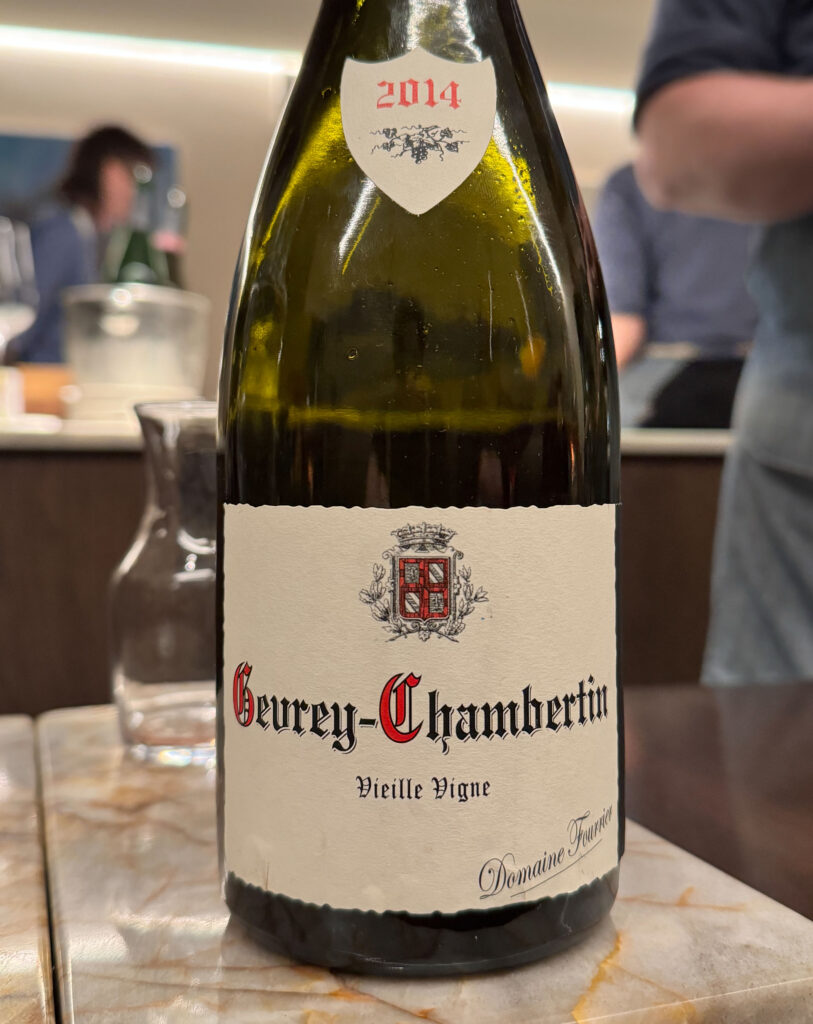
- 2014 Domaine Fourrier Gevrey-Chambertin Vieille Vigne [$140 at national retail]
- 1997 Paolo Scavino Barolo “Bric dël Fiasc” [$128 at national retail]
- NV Les Vignerons de Maury “Maury 1928 Solera” [$199 at local retail]
Now, while this lineup lacks a Champagne and the kind of heavy hitter (i.e., the 2006 Gangloff Côte-Rôtie) I saw last time, it is very smartly chosen. From the start (and alongside the varied sensations of “The Drop”), one gets to sample a wonderfully integrated Alsatian Riesling from a top site. Ducker then segues into a culty, reductive white Burgundy to cut through a series of salty, savory vegetable dishes before pouring a rather open, moderately aged red Burgundy (alongside weightier servings of fish) and a nearly thirty-year-old Barolo to enhance a headlining entrée of lamb, coffee, and raspberry.
The sommelier displays palpable excitement for his chosen dessert wine, and how often do you get to taste something that is—at least in part—close to 100 years old? In practice, it’s a likable little tipple with enough jammy fruit to match the fruitier desserts and a distinctively nutty, caramelized quality that goes with the toastier, more chocolatey fare too.
When judging pairings like this, I frequently look to what a similar sum could secure me off of the bottle list: a Suenen Champagne “C+C” ($295), a 2018 Ganevat “Les Chamois du Paradis” ($290), or a 2022 Pierre Girardin Vosne-Romanée ($315) perhaps.
However, I’ve really come to appreciate how singular and surprising the “Cellar Flight” is (given that the majority of items cannot be ordered off the menu otherwise). It’s also hard to put a price tag on the added degree of table engagement, storytelling, and pure geekery that indulging in this special offering entails.
Given that corkage is also now reserved solely for customers who adequately support the program, I continue to find both enjoyment and value in the “Cellar Flight.”
In the familiar Feld style, this evening’s menu kicks off with a small pour of something (e.g., a tea, a juice) that is presented at the very moment guests take their seats. Indeed, no matter how a given table chooses to engage with the beverage program, this offering ensures diners feel thoroughly welcomed—and their palates just a little titillated—before the show begins.
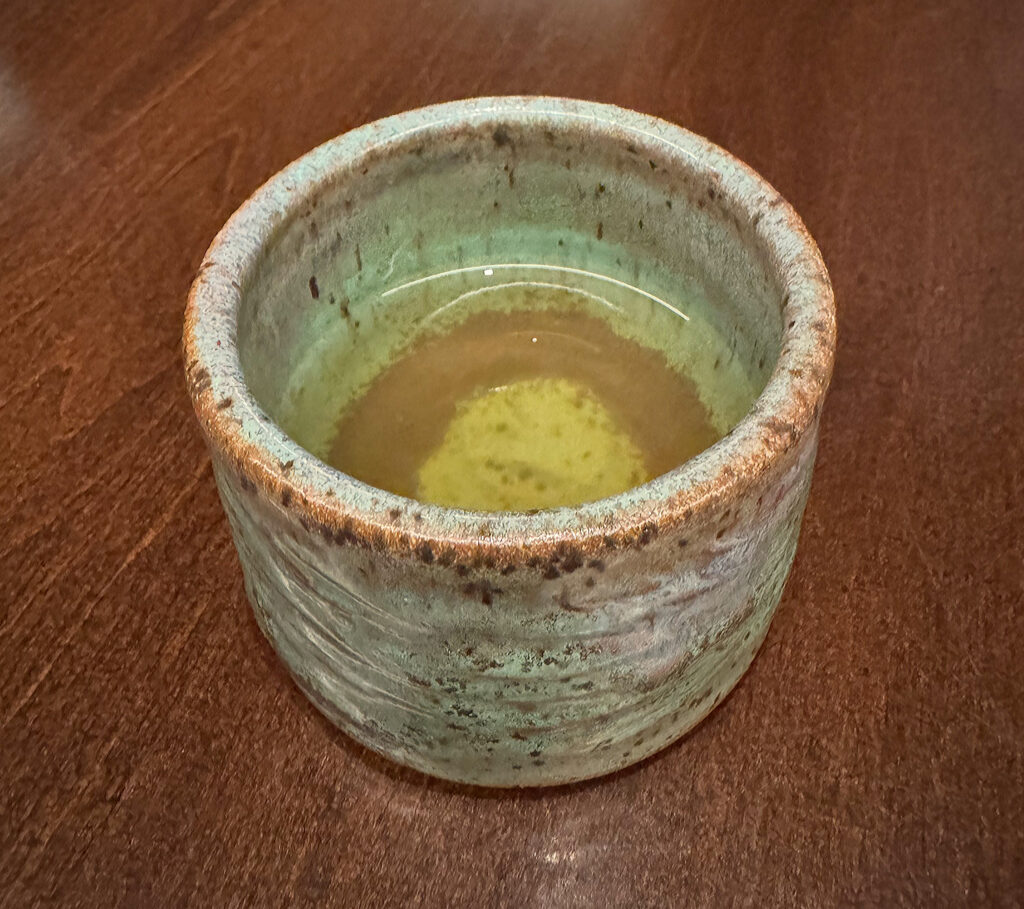
On this occasion, a “Verbena Mulled Apple Cider” comes tinged with lemon oil and ginger, delivering ample sweetness on entry before yielding to an enlivening citric quality through the persistent, mouthwatering finish. In short, this makes for a crowd-pleasing tipple with more than enough depth to rank among the restaurant’s best.
Of course, anyone who is familiar with Potashnick’s work knows that “The Drop” (what the team titles its opening salvo of small bites) really forms the meal’s definitive structural element: a section in which the kitchen’s creativity can run wild and, from visit to visit, convey the full degree of dynamism their approach to sourcing empowers.
Tonight, the sequence comprises just seven small items—a clear decrease from the nine I encountered earlier this month but still matching the number I found in August and July. As always, the hope is that fewer components (there were as many as 11 in January!) corresponds to greater refinement and enjoyment on average.
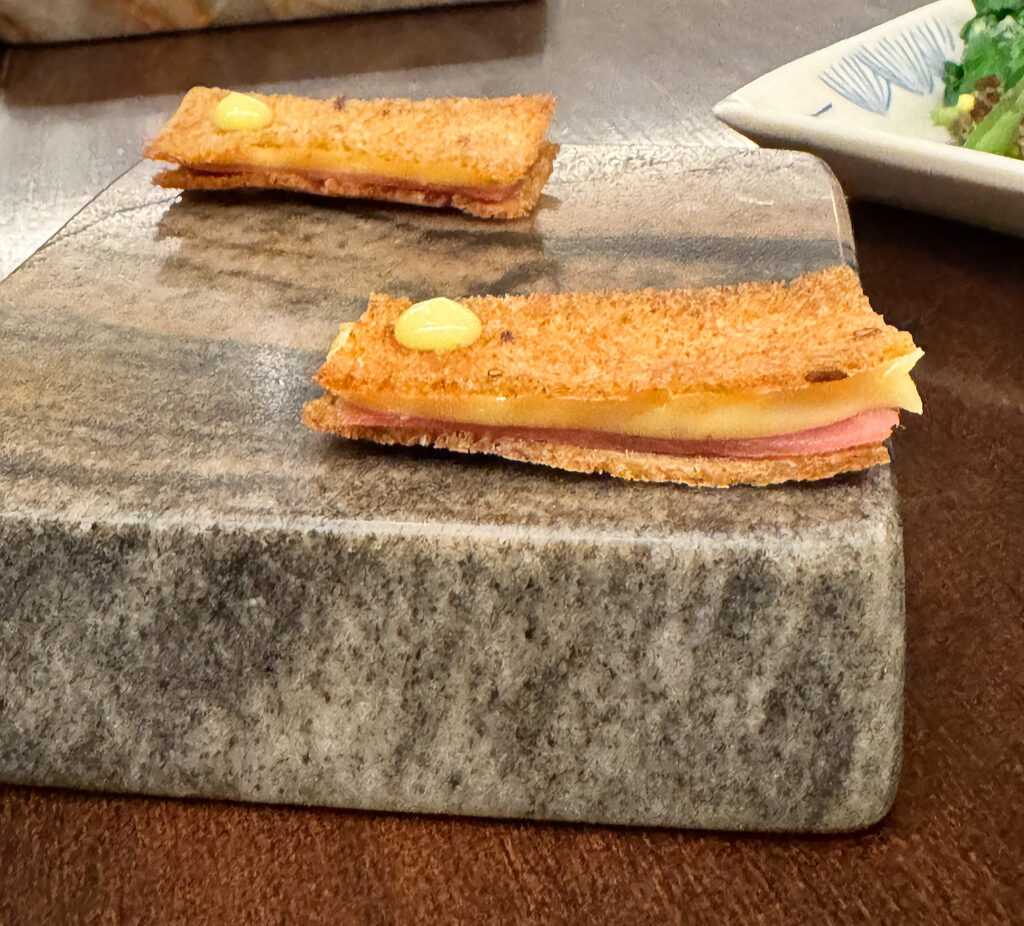
To start, we have the “Pleasant Ridge Toastie,” which offers a decidedly playful take on one of Feld’s totemic (and at times infamous) ingredients. Using sodium citrate, the chefs are able to melt the titular cheese into a gooey, homogenous layer that comes blanketed with Benton’s ham (another signature here) then sandwiched between two rye crackers.
Texturally, the resulting package is cleanly crisp and totally cohesive thanks to the way the rich, luscious cheese holds everything together. Further, while the flavor of the meat isn’t all that prominent, its salt proves essential: unlocking the Pleasant Ridge Reserve’s fruity, nutty depth while ensuring the character of the rye remains likably savory. Overall, this makes for a strong debut (though, admittedly, I think such a winning construction should offer even more decadence).
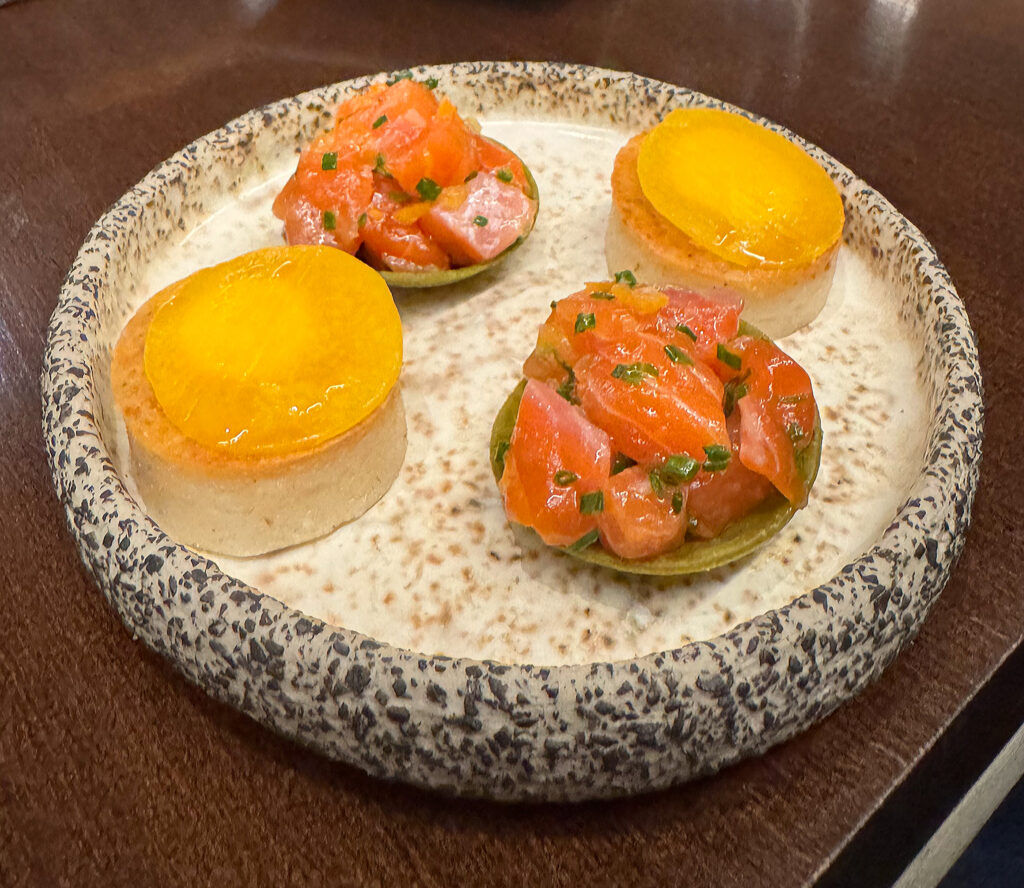
Arriving next, the “Salmon Belly Tart” follows in a longer line of preparations that have tucked meat, seafood, and fresh produce into these gossamer pastry shells. The present version centers on hearty chunks of the headlining fish that benefit from a Jimmy Nardello pepper glaze and a sprinkle of chive. A dab of yogurt also sits underneath, shaping a sensation that is pleasantly crisp, creamy, and melty yet offers little more than fleeting tanginess on the finish. Still, I do think the kitchen is become more assured in how they construct these tarts, so improving the seasoning should be relatively easy.
The ”Masa & Shallot” can be found on the same plate, where it ends up looking like a strange, doughy puck. However, I know what incredible work the restaurant has done with masa in the recent past, and this bite utilizes chicken fat in the very same way. A shallot emulsion and a slice of butternut squash complete the presentation, lending a faint imprint of sweetness that plays well with the corn’s roasted, earthy character. That said, the tamale itself arrives at a surprisingly cool temperature and proves rather dense in its consistency. The portion is not by any means hard to eat, but it lacks the finesse I found so appealing when sampling the team’s past efforts with this form.
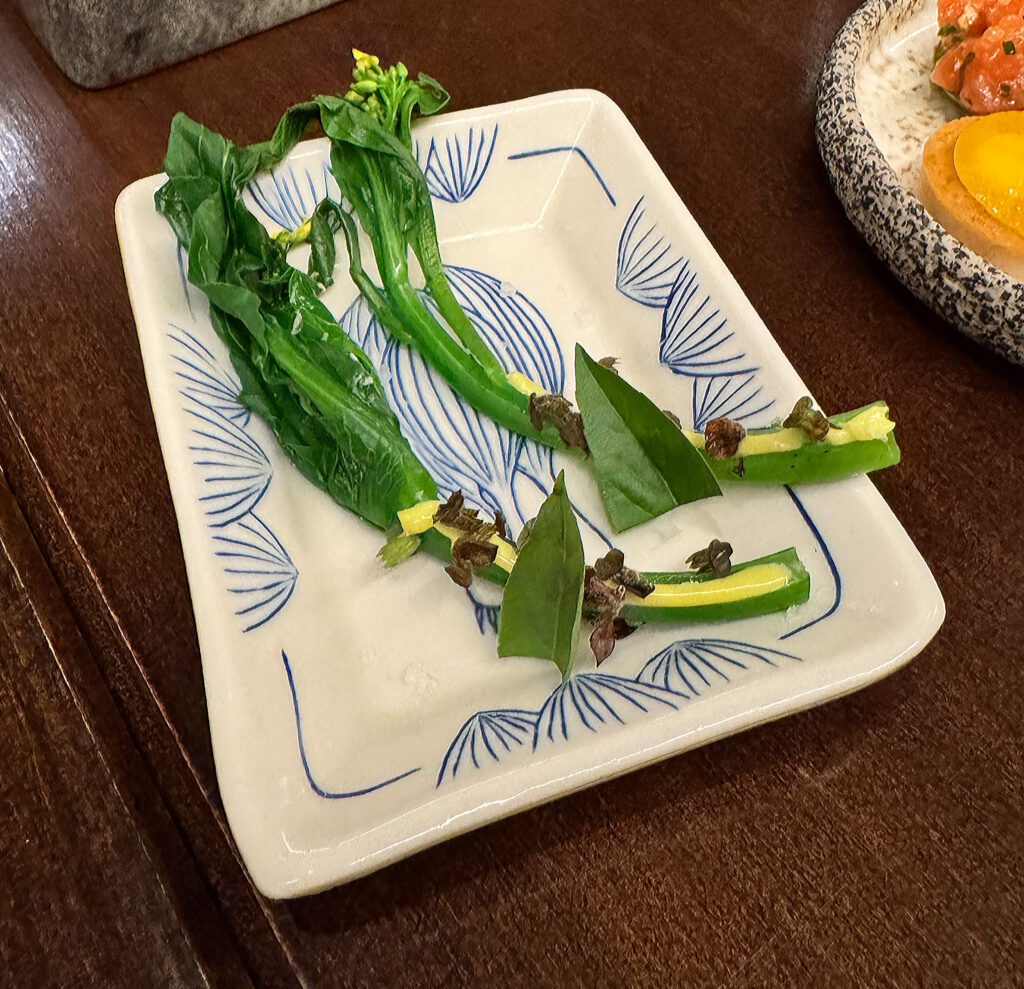
“Choy Sum,” as the next item is titled, refers to a particular kind of brassica also known by the name of Chinese flowering cabbage. Here, full sections of the stem and leaves arrive “barely steamed” and topped with three different iterations of basil.
This is the kind of green on green composition that almost feels like a caricature of what Feld is going for. Nonetheless, the vegetable strikes with a hearty, pleasing crunch and offers a range of sweet, bitter, and peppery notes that build toward a powerful, cleansing finish. Honestly, given the level of manipulation shown throughout the other parts of the sequence, there’s something beautiful about how this choy sum is served.
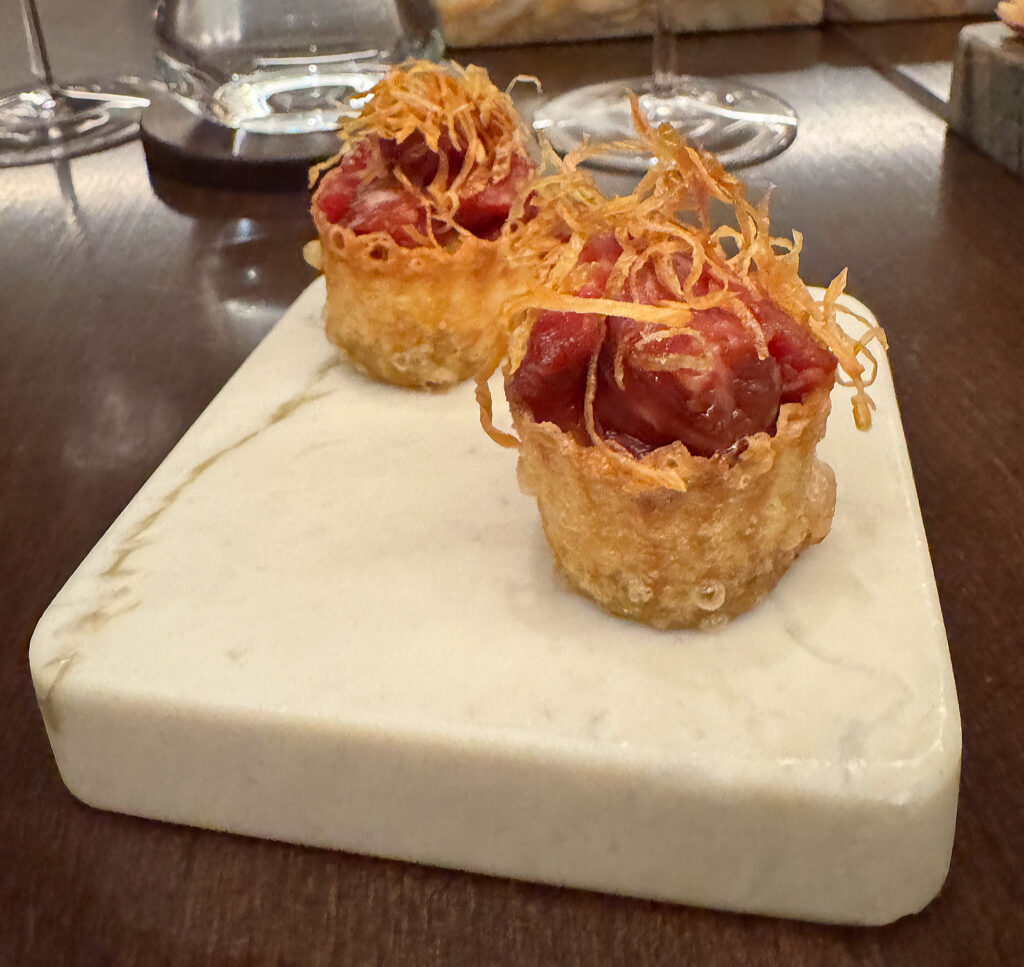
The “Leek Croustade” looks to expand upon the kind of pastry cup form I last saw stuffed with peach and shallot back in July. On this occasion, the titular allium is rendered both as an emulsion and as a tangle of crispy shreds layered over the top of the bite. However, it’s really the beef tartare and quail egg filling that defines the recipe: anchoring the dual layers of crispness with a rich, soothing base whose concentration of umami is entirely convincing. Yes, this has to be the best croustade Feld has served to date.
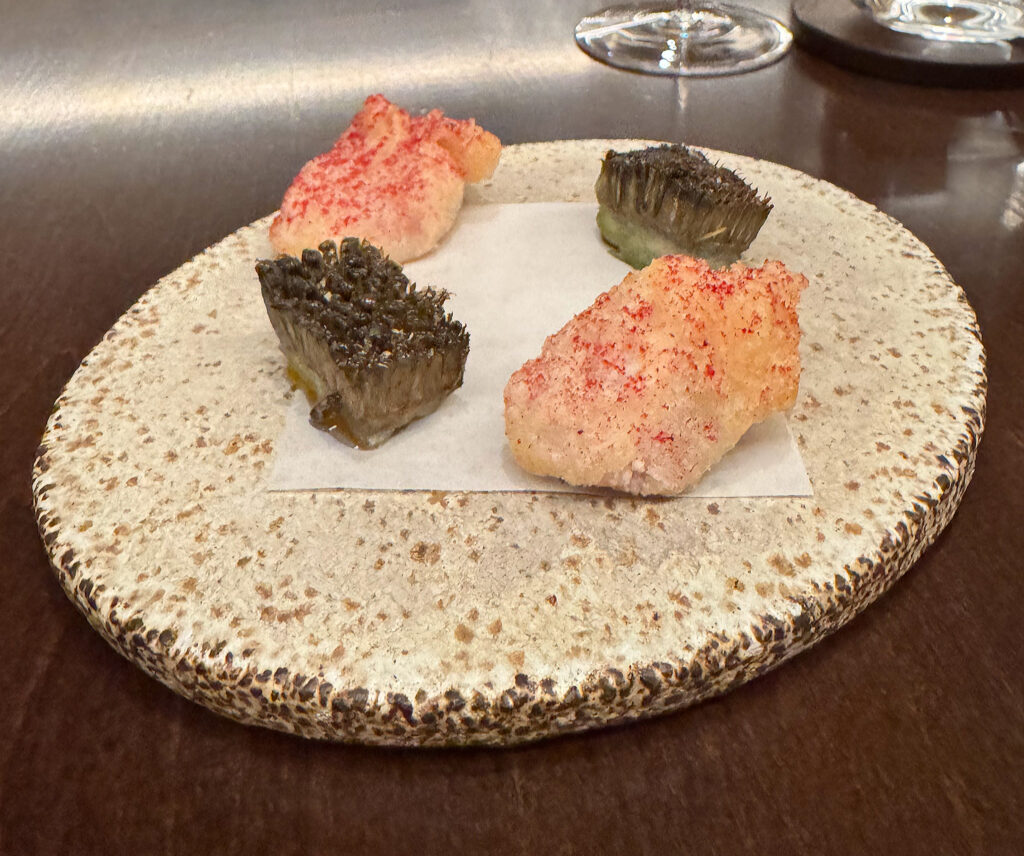
As it happens, the final plate of “The Drop” actually contains my favorite morsel. The “Ham and Raspberry Mochi” combines the same Benton’s product we saw earlier with a piece of the titular fruit, a layer of glutinous rice dough, and a tempura batter (that, after frying, comes dusted with a little raspberry powder for good measure).
I’ve seen Potashnick sharpen his tempura technique for years now, yet this might be the first instance in which he’s really ventured beyond convention (i.e., a piece of produce, a crispy shell, a dash of seasoning) and created something singular. Here, the layers of rendered pork, chewy mochi, and brittle crust are not only brilliantly composed. They also come accompanied with a pronounced saltiness and tanginess that frame an imprint of sweet, succulent meat on the finish. In short, this tempura stands as a triumph and a real testament to the kind of innovation the kitchen can now pursue in this category.
Closing out the sequence, I find the “Sunflower ‘on the Cob,’” which looks to honor how those who grow the crop are said (in communication with the chefs) to appreciate their own product. For this bite, a segment of the flower’s central disc is grilled on one side before being dressed with honey butter and cilantro salt. Guests are then instructed to eat the seeded layer while leaving behind the base in a manner meant to mimic corn. This yields an effect that is faintly crisp and nutty (if not exactly memorable). Ultimately, this makes for a charming idea that, in turn, does little to transcend a simple sense of novelty.
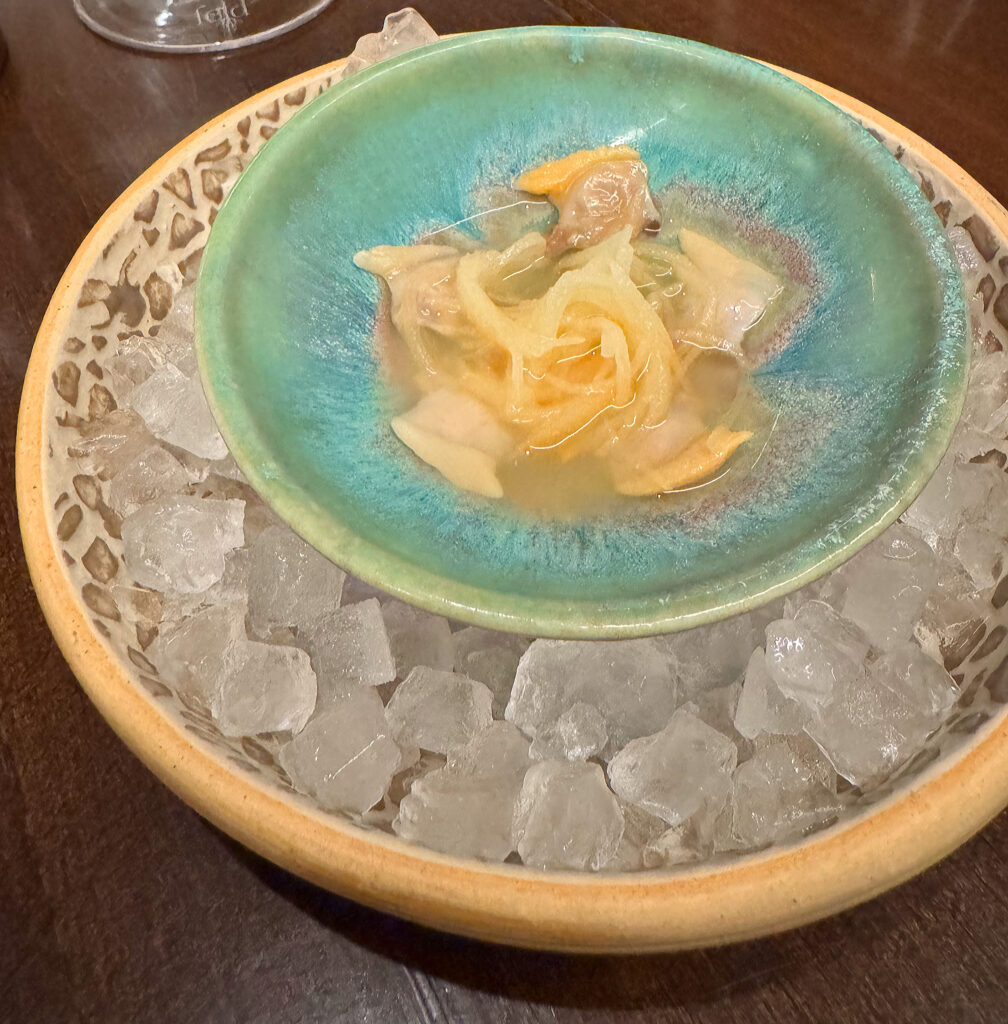
As kaleidoscopic as the textures and flavors of “The Drop” can be, I’m always eager to dig into something more substantial, and a new preparation titled “Manila Clam—Scotch Bonnet” more than fits the bill. This first fully composed plate of the evening combines the headlining bivalve (which is thinly sliced) with a tomato water made from the last of the season’s crop and an apple-horseradish juice. Thin curls of apple lend the dish an added sense of weight while the titular pepper is transformed into an emulsion that lurks below.
On the palate, the clams feel plump and pleasing with an extra dimension of juiciness drawn from the crunching fruit and accompanying juice/water. One could easily envision this recipe forming a super light, refreshing transition toward the heart of the meal. Yet, instead, I am immediately met by bursting brine and sharpness followed by a jolt of moderate heat. The tomatoes’ acid structure then comes to the fore—and is joined by a little bit of sweetness too—only for the Scotch Bonnet to reassert itself (with more of a rounded, tropical profile) on the finish. Overall, this is a rollercoaster ride of a course that leaves me absolutely invigorated. Potashnick rarely pursues this degree of boldness or concentration, but the effect is superlative.
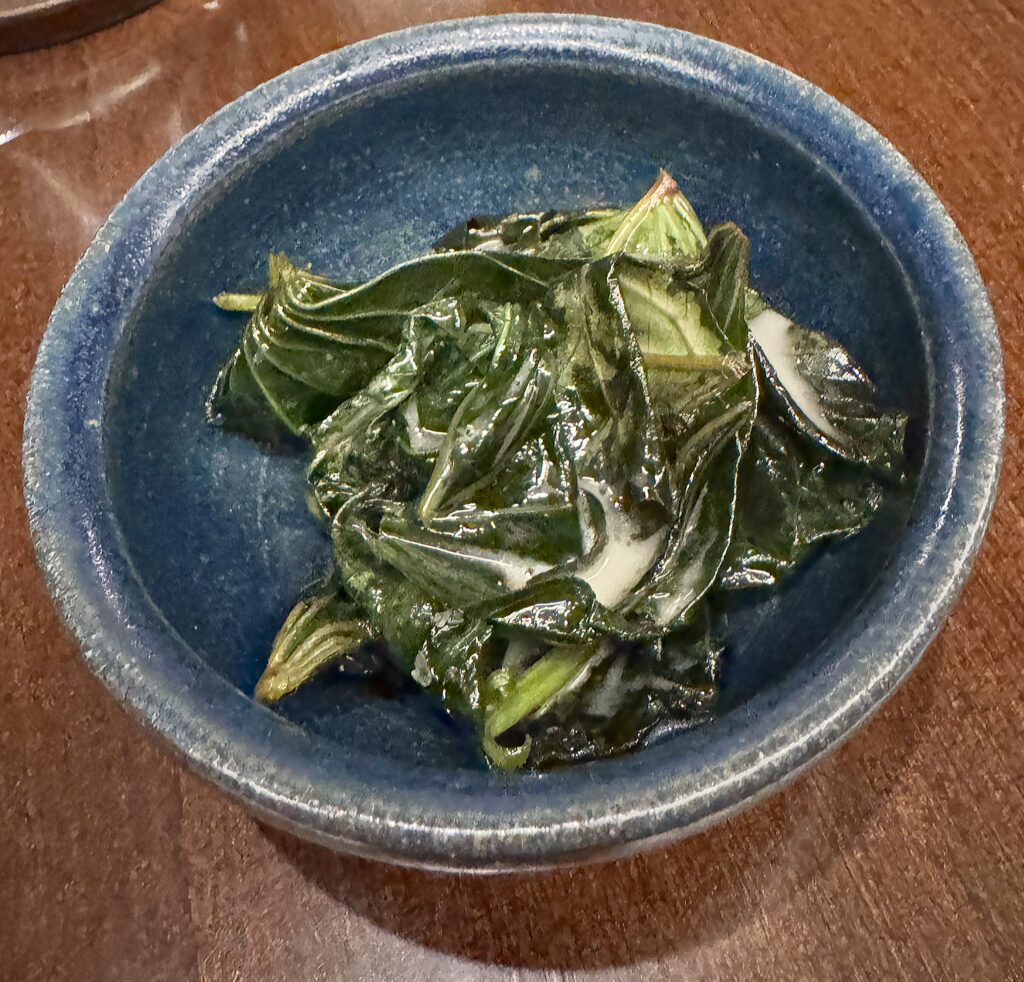
Arriving next, a bowl of “Sweet Potato Greens” (grilled and dressed with a goat butter beurre monté) brings me right back to the fall of Feld’s opening. In fact, other than some tweaking to the exact proportion of leaves versus dressing, it’s safe to label this as one of the restaurant’s canonical constructions.
Here, the greens are less soaked and wilted than I’ve seen in the past, which helps to preserve a robust crunch. Nonetheless, even though there’s seemingly less of the goat butter, its essential warmth and accompanying salty-tangy character strikes with plenty of force. Yes, this humble presentation delivers ample, earthy-sweet satisfaction as the two elements meld, and it reflects just how faithfully the concept continues to improve upon its oldest, simplest ideas.
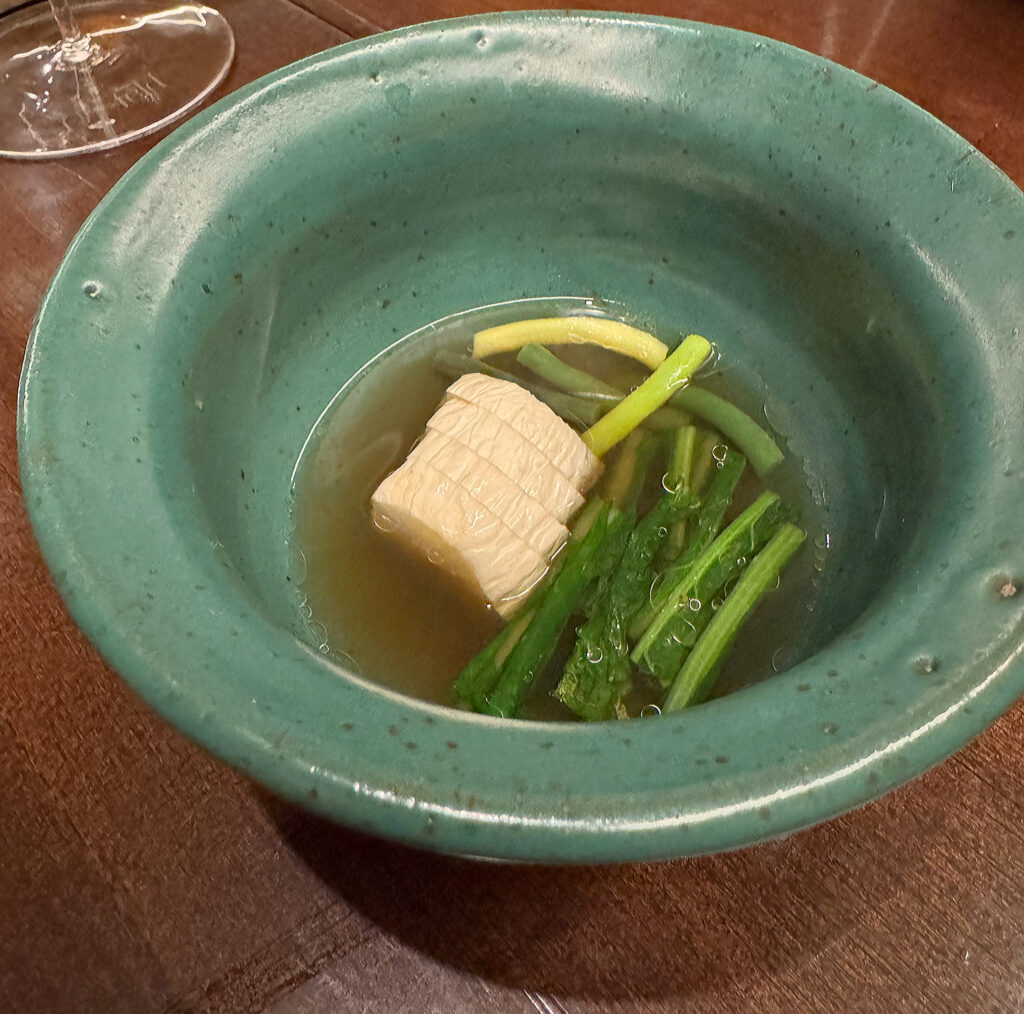
The “Hakurei Turnip—Mushroom Broth” stands as one of countless dishes that, over the month and years, has centered on seasonal produce in a kind of minimalist soup. July, for example, saw artichoke paired with a reduction of aged beef while May saw this same root vegetable paired with a liquid made from that trusty Benton’s ham.
Against these meaty counterparts, a mere mushroom broth should surely struggle. However, the base is actually made from chanterelles in combination with that smoky pork. Even better, some green beans have been added to the bowl: creating distinct layers of crunch alongside the roasted turnips that feel uniquely satiating and that, thanks to a generous application of salt, are matched by an equally profound expression of umami. For me, this represents the high point of this form at this restaurant to date.
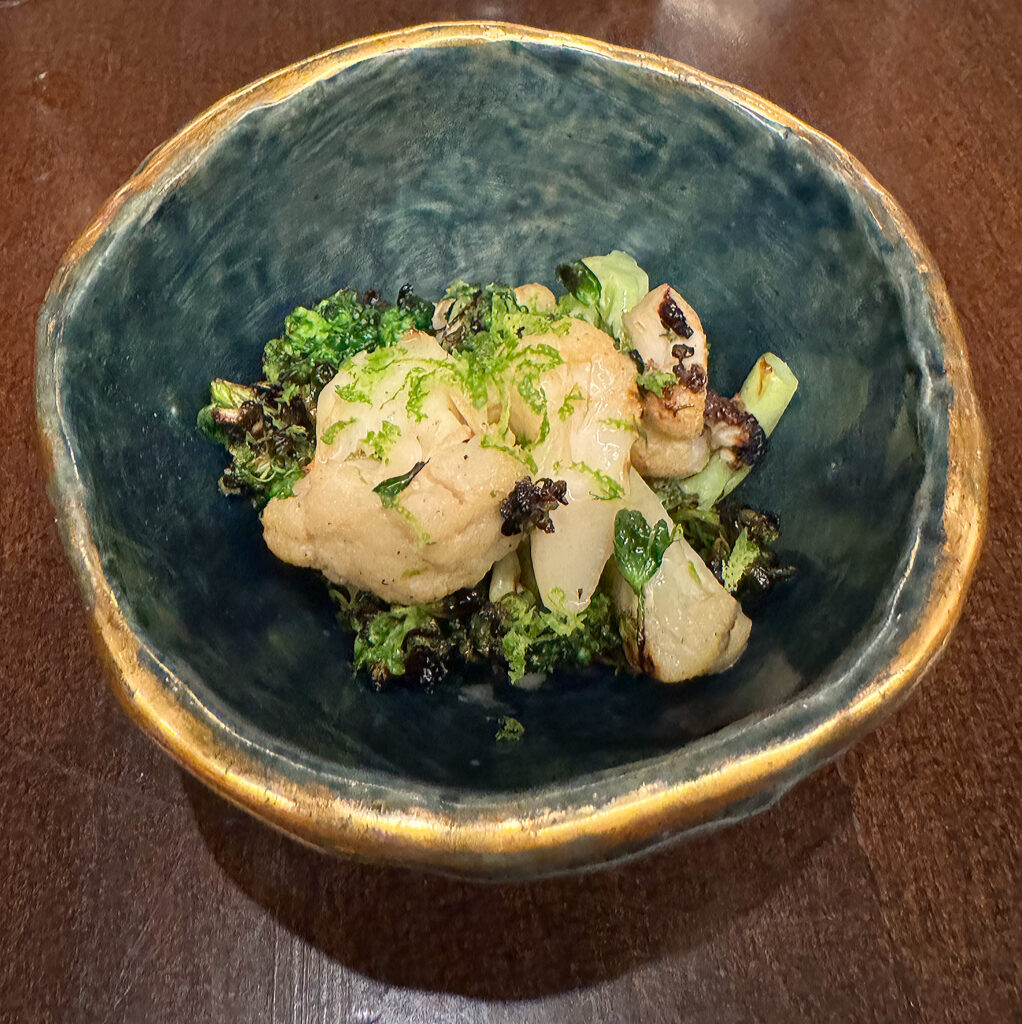
On paper, the “Autumn Brassicas—Roasted Garlic” should build on what has been a rousing series of successful opening courses. And, structurally, this medley of cauliflower, broccolini, and broccoli in a vinaigrette made from the titular allium is totally sound.
The resulting layers of crunch are even stronger and more satisfying than what I found in the preceding two preparations. At the same time, a generous grating of lime zest shifts the recipe’s flavor profile from unabashedly savory to something more proudly citric and cleansing. This, I think, is the point (and quite important in the wider context of the meal). However, this also means the plate proves a little less memorable than its counterparts.
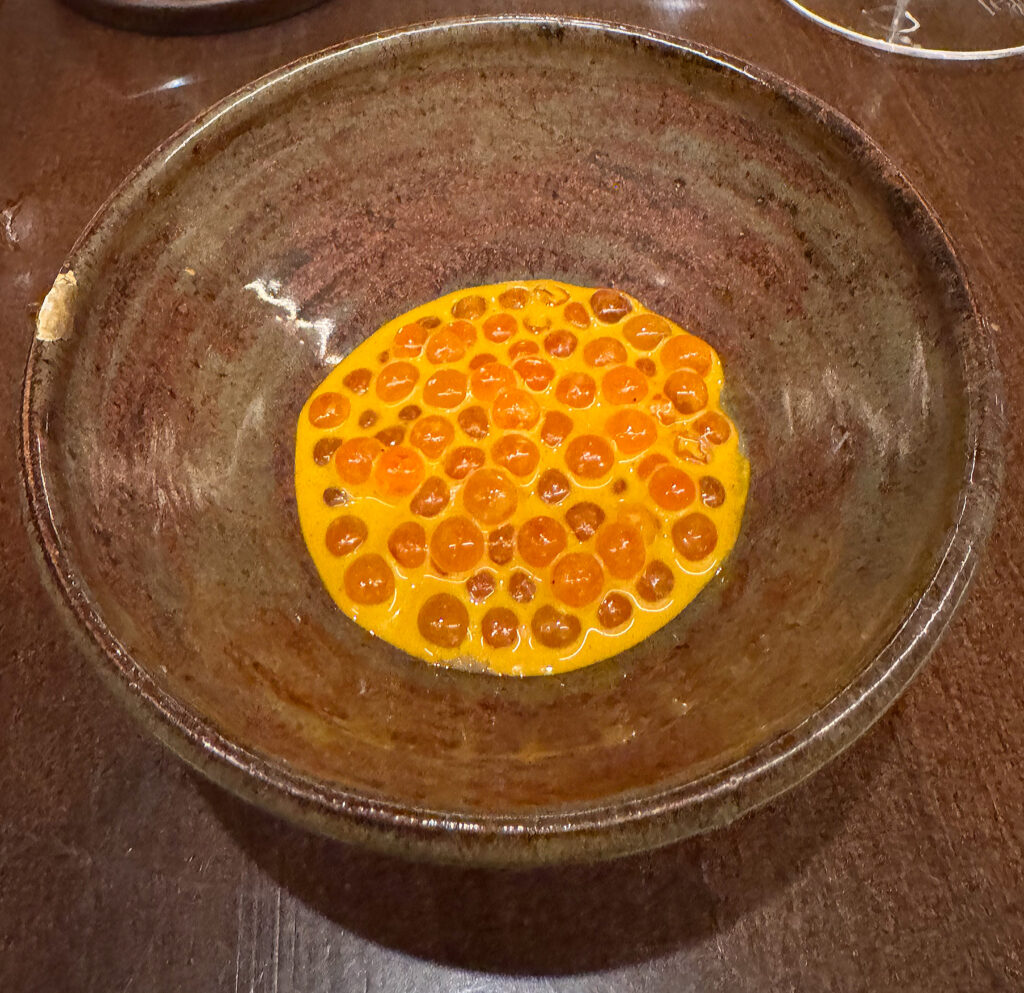
By comparison a dish titled “Feld’s Ikura—Red Kuri Squash” is immediately memorable, representing just the second time I have seen the concept handle the kind of salmon roe one finds at omakases (or, at least, on globe-trotting fine dining menus). Here, the use of the possessive case refers to the fact that the chefs have cured the entire sack themselves (using sake) before separating the eggs into individual orbs: a process that must be managed carefully in order to develop the delicate texture (i.e., a subtle “pop”) diners seek.
The ikura that ultimately arrives comes swimming in a striking, similarly-hued cream made of the titular squash in combination with some pasilla chile, miso, and pickled spruce. These varied ingredients ensure that the roe’s essential brininess is matched by notes of mild heat, moderate sweetness, alleviating citrus, and complicating earth that unlock a beautiful, persistent sense of umami. I only wish the eggs were a little less crunchy (akin to marbles) and a little more soft and seamless instead. Still, the approach to flavoring is brilliant, and I look forward to what the team can achieve as they pursue greater refinement.
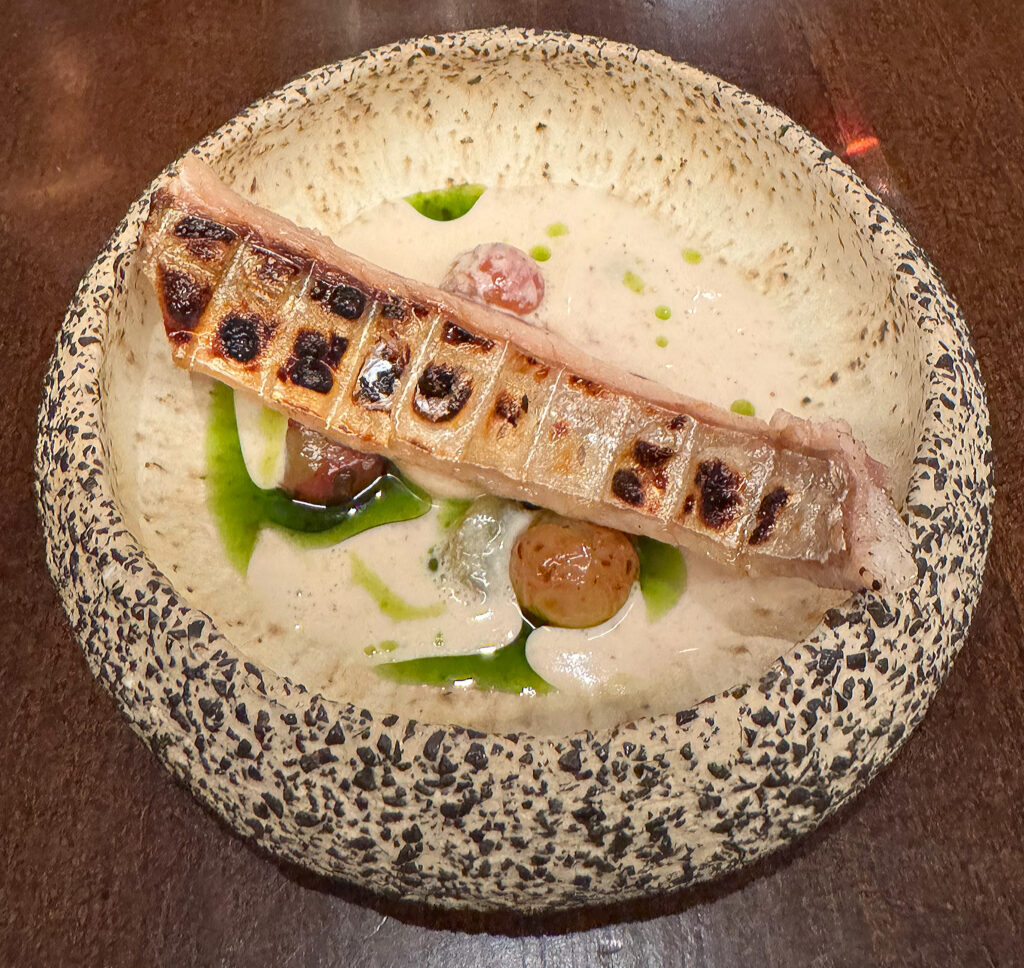
The “Hot & Cold Mackerel—Grapes” takes a fish that featured sparingly earlier in the month and makes it a star: fitting the fillet (which has only been grilled on one side) into a composition that bravely plays with temperature. In the bowl, one finds a frozen puck of ajo blanco (i.e., the white gazpacho Feld has frequently used to great effect), a duo of grilled and frozen grapes, a warm horseradish-almond sauce (broken with dill oil), and a cool lemon gel.
On the palate, the fundamental juxtaposition of the crisp, charred side of the fish with the moist, flaky undercarriage is sound. And it’s actually the cooler, creamier bottom layer that really interacts with the rest of the elements: softening the bursting bites of fruit as the hot and cold sauce components meld on its flesh and make their way to one’s tongue. There, the resulting flavor is charged with a sweet grassiness and rich nuttiness that adequately counter the bitter quality of the skin. However, it’s the persistence of the mackerel’s own savory character—which somehow shines through on the finish—that leaves me impressed. Ultimately, I think the execution of the temperature contrast feels a bit muddled, yet the underlying thought process is worth pursuing further.
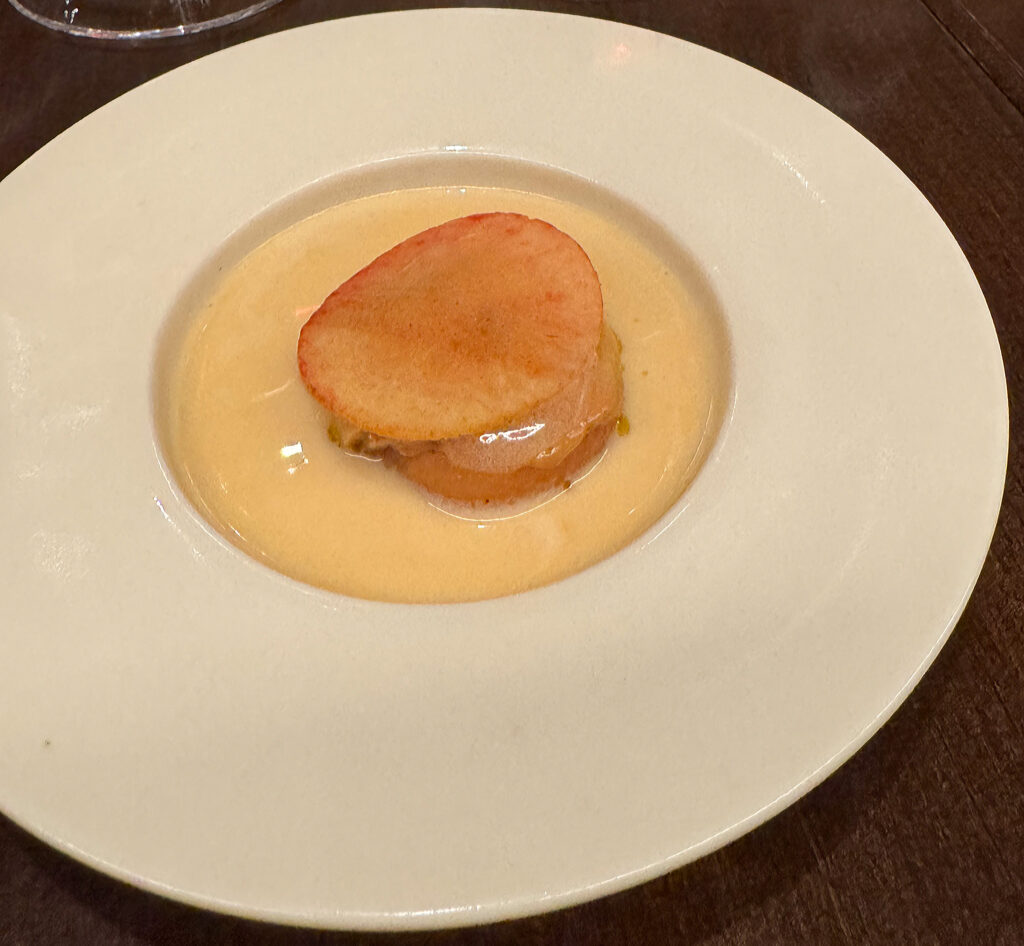
Arriving next, the “Au Bon Canard Foie Gras—Quince” centers on an ingredient that holds a special place in the Feld canon: Minnesota-based, small-production duck liver that permits Potashnick to diverge from his usual stance on trite luxury totems (like caviar, truffle, and wagyu).
Here, the foie gras itself is served raw—because that’s how it’s enjoyed on the farm—but comes joined by a slice of blood peach, a warm piece of quince (poached in apple cider vinegar and black lime), a sauce made from the thickened poaching liquid, and a dab of cider butter. This palette of supporting players does more than enough to allay any fear of cold, unrendered liver: yielding a supremely luscious disc of melty fat with a supreme, warmly spiced expression of sweetness backed by a perfect integration of acidity. Yes, the combination feels textbook, yet it strikes with a power (and almost a kind of nostalgia) I just don’t find from more conventional, seared lobes.
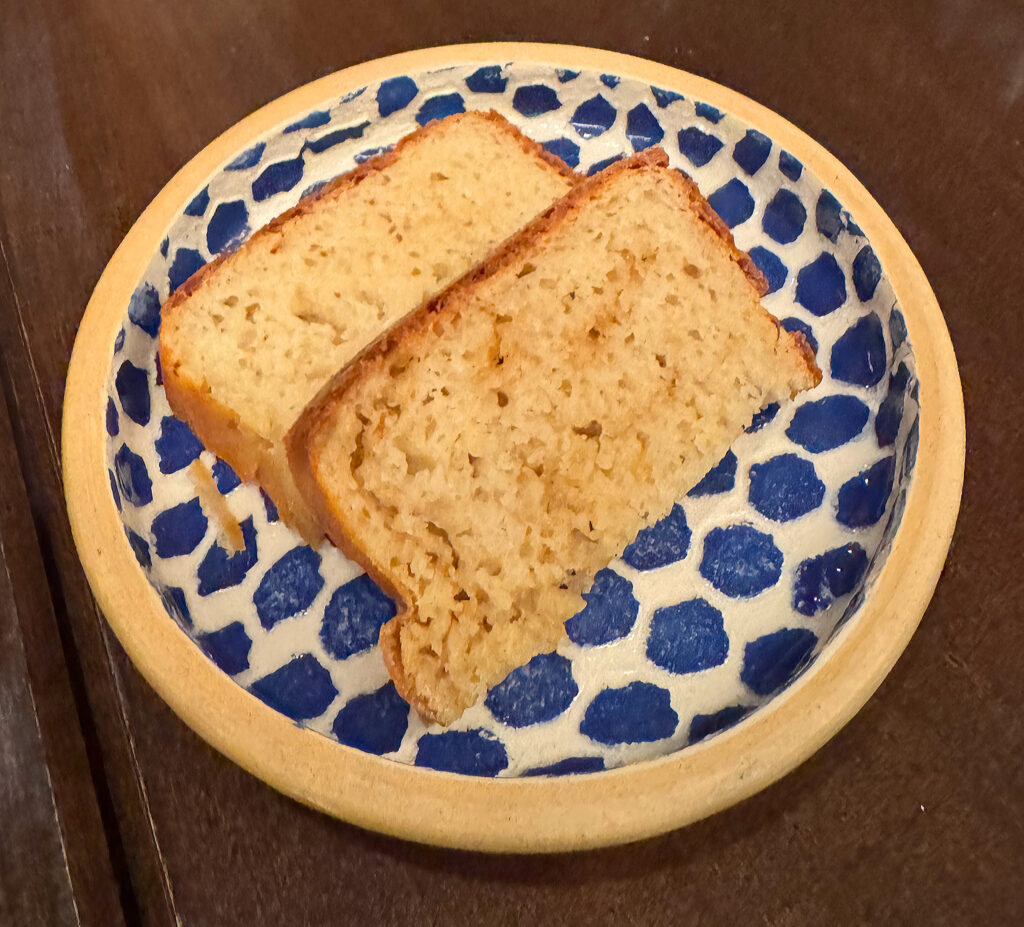
When one introduces the accompanying “Masa Milk Bread” (which represents the second or third time I can ever remember Feld offering any kind of savory baked offering) the foie gras’s pleasure becomes stratospheric.
Swirled with a black lime and maple sugar butter, the resulting slice is remarkably fluffy while possessing more than enough structure to hold a generous application of liver, fruit, and sauce. Doing so, the sweetness from the main plate takes on an earthy, caramelized depth that pushes my pleasure to an even higher extreme. Indeed, taken together, these two items represent some of the kitchen’s best-ever work.
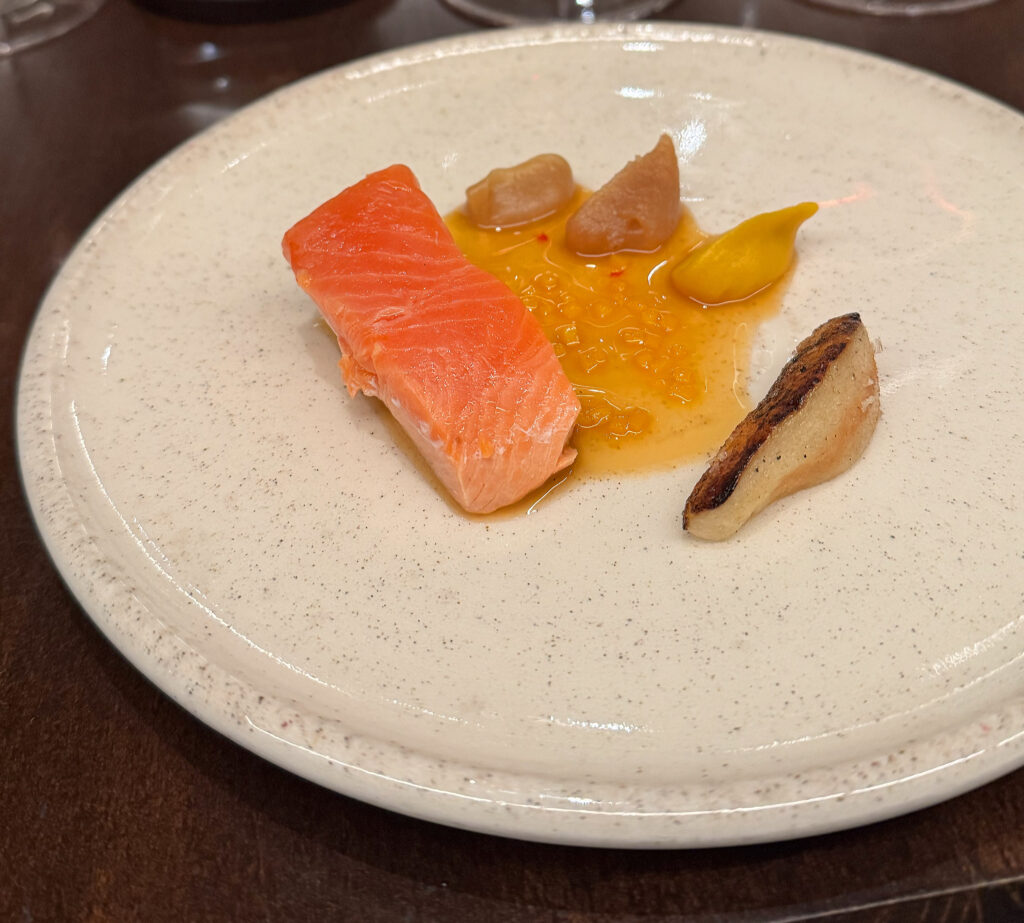
On the back of a mackerel preparation that was perhaps more intriguing than truly impressive, I feel a bit uneasy about encountering another cooked serving of fish. Nonetheless, much to my pleasant surprise, the “Wild King Salmon—Apple—Ginger” actually forms another one of the evening’s highlights.
For this dish, the fillet is served poached on one side (in a manner that still seems to echo its grilled compatriot). Otherwise, the composition rests less on temperature contrast and more on a range of complementary, mutually intensifying condiments that includes a smoked apple butter, an apple-peach pepper purée, a butternut squash-pear purée, and a ginger-pickled habanero jus. A piece of grilled pear completes the presentation, lending smoky-savory depth to a showcase of wonderfully buttery salmon alongside deep, resonant notes of sweetness, heat, and enlivening spice. Overall, this makes for a recipe that is rather clear in its intentions yet wholly memorably in its execution and decadence.
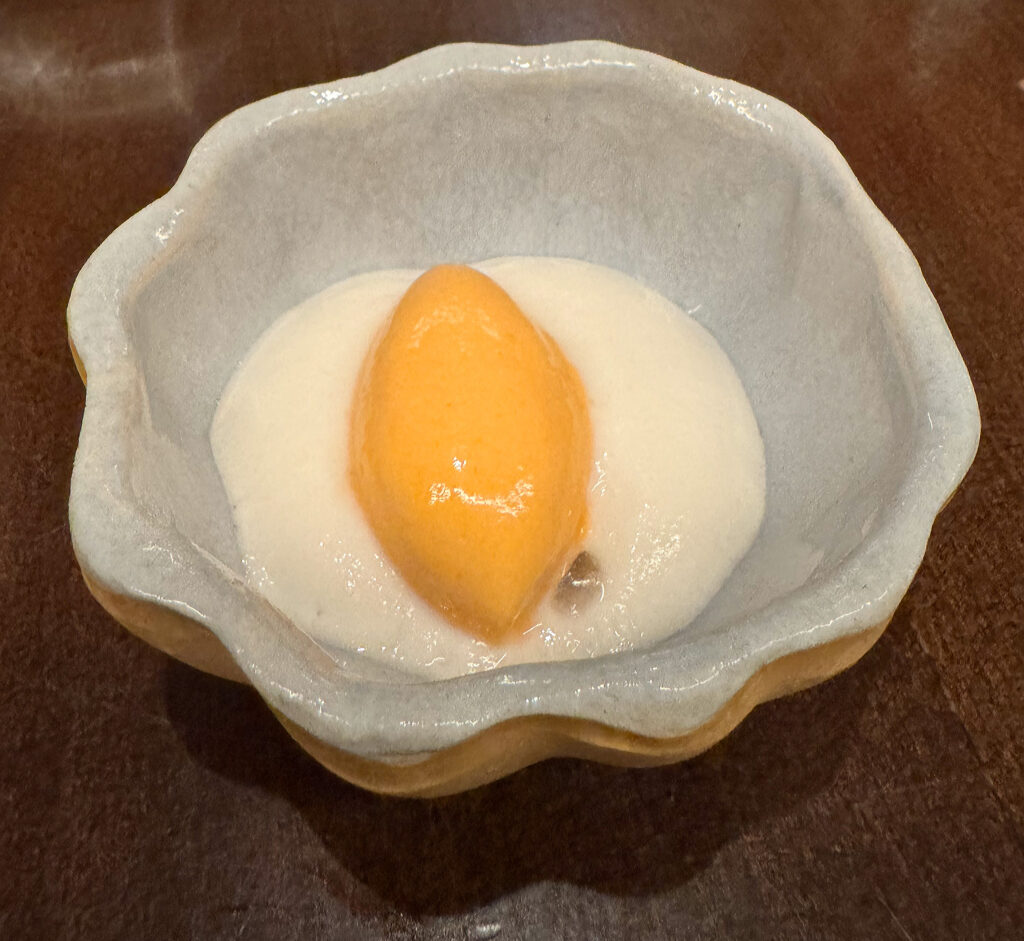
Tonight, the “Sungold Sorbet” represents the closest thing to a repeat (having appeared earlier this month, in August, and in July). Still, it’s a construction I like quite a bit—all the more as a creative transition between the meal’s headlining savory plates.
On this occasion, the flawlessly smooth sorbet comes surrounded by a foam made with Lustau Vermut Rosé (which, I should note, formed a longstanding pairing with Oriole’s foie gras bite). This new element charges the Sungold’s familiar sweetness and acidity with a spiced, almost syrupy-sweet intensity that feels totally cohesive. Indeed, the vermouth helps this venerable old course deliver a greater degree of enjoyment than it ever has in the past.
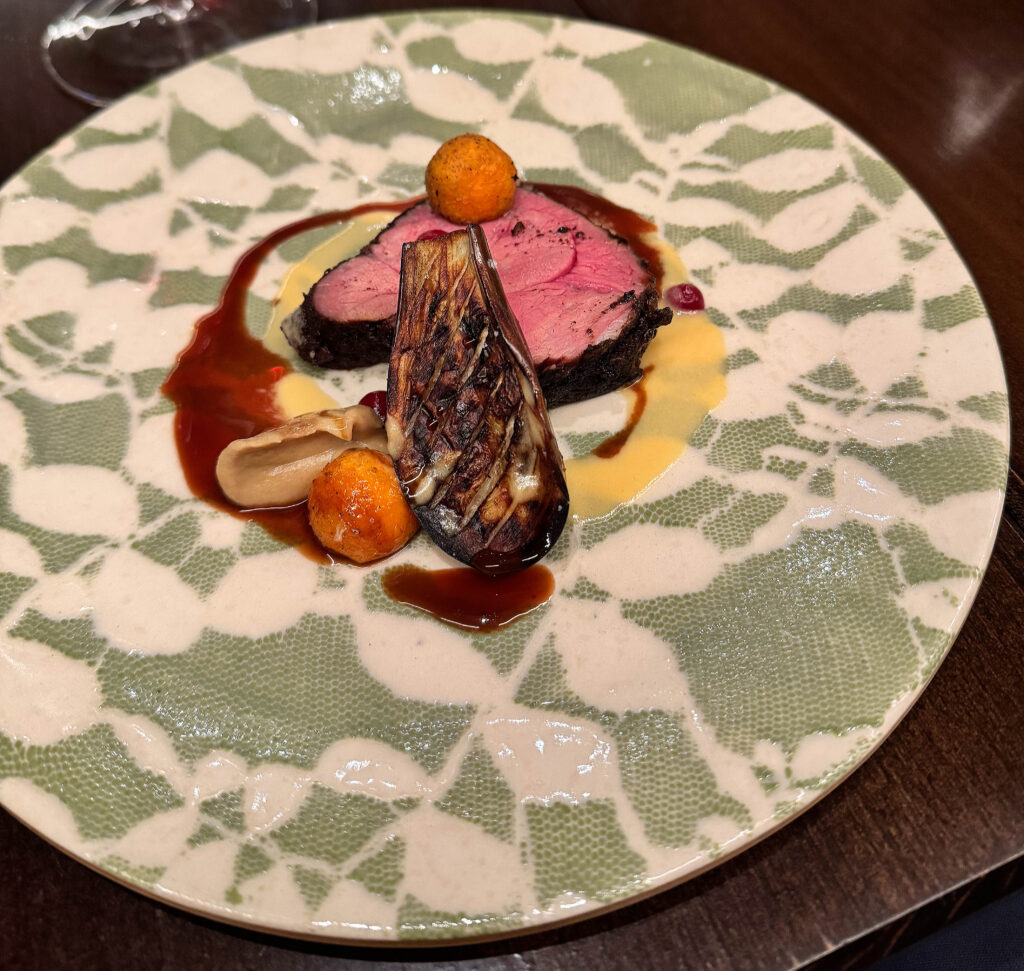
“Leg of Lamb—Coffee—Raspberry” forms the present meal’s starring entrée and looks to build upon the team’s work with this particular meat (sourced from Danville’s Krazy Kluckers Farms) over the past few months. Brined for two days, confited, coffee-rubbed, and grilled, the cut of leg comes dressed with a 74% cacao jus then joined by a piece of grilled fairytale eggplant, an eggplant purée, some raspberry purée, a couple balls of sweet potato, and a sweet potato cream.
Texturally, the lamb is impossible to fault: delivering a satisfying chew on entry with plenty of supporting juiciness. Its flavor, too, balances the sweetness of the fruit, the earthiness of the sweet potato/eggplant, and the bitterness of the chocolate/coffee to impart a cleanly savory note whose length and concentration are worthy of anchoring the menu. If I am to make a critique, it’s that the fairytale eggplant—though crisp—remains too soft through the middle to really cut. But, at the end of the day, this is a winning preparation of meat that ranks among the best recipes of its kind I’ve tasted at Feld.
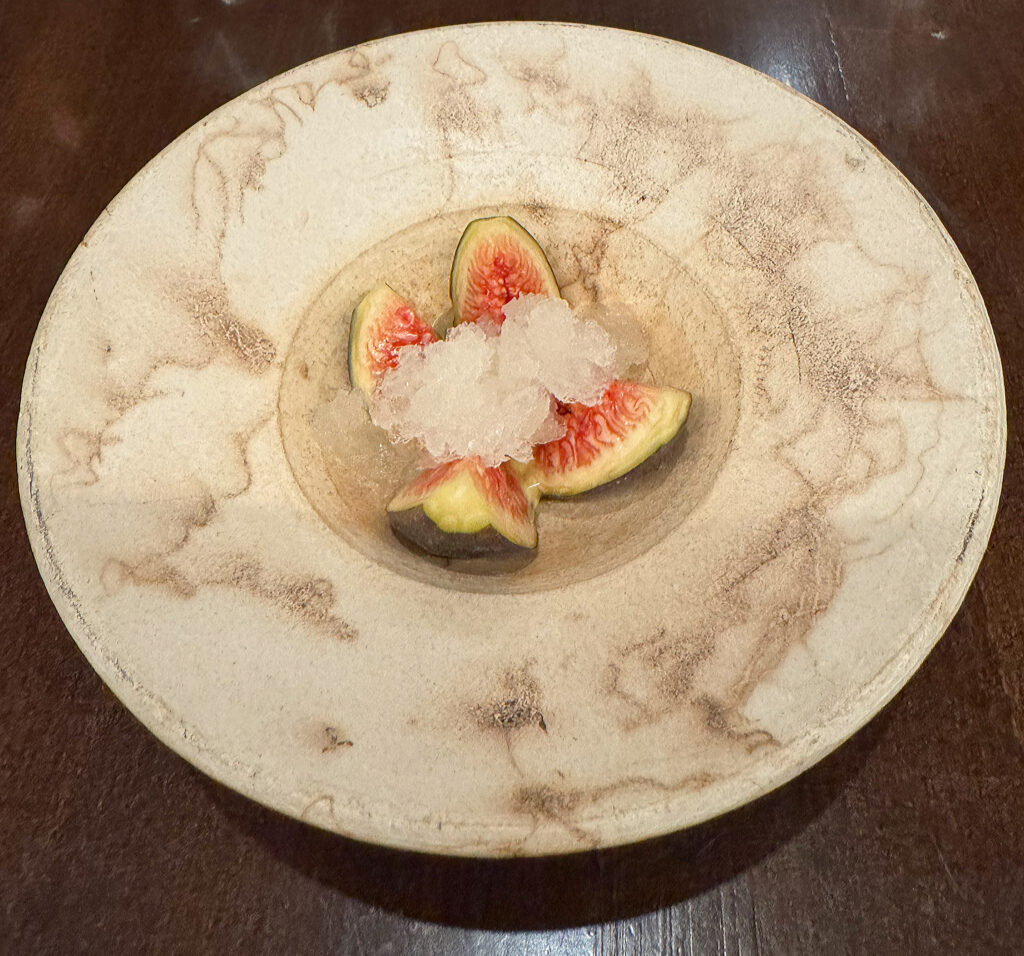
This evening, the transition toward dessert is managed by a rather elegant dish titled “Fig—Lavender—Lemon Verbena.” Layered with granita (made from the lemon verbena), oils (both fig leaf and lavender), and the titular fruit, the resulting bowl is plump, juicy, bracing, and tangy-sweet through the finish. By all means, this is built like a fairly conventional “palate cleanser,” but it also testifies to the chef’s pinpoint precision when working with seasonal produce.
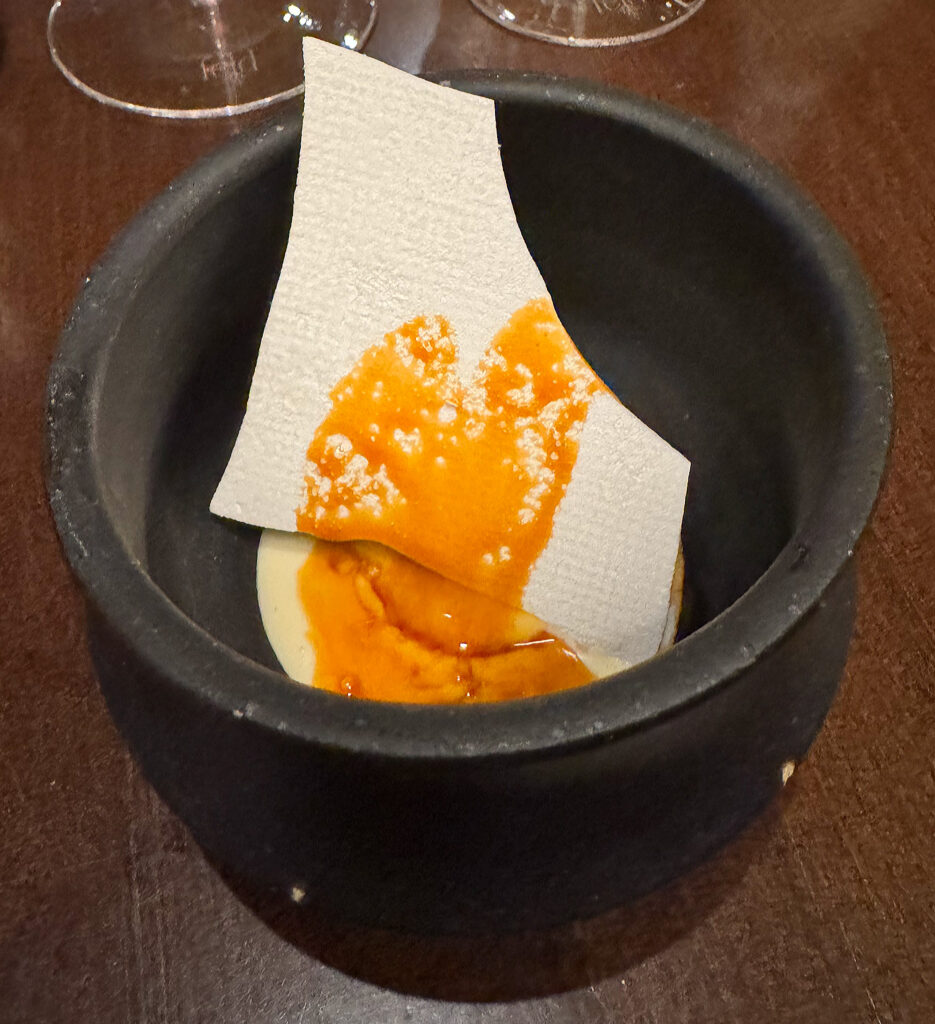
The “Toasted Oat—Beet—Smoked Cream” that comes next brings me back to those first few months of the restaurant’s life: when a kindred course, made from salted meringue and caramel, stood among few clear successes.
Here, reduced beetroot juice is used to make the caramel while a toasted oat ice cream and a smoked cultured cream lie in wait at the bottom. Texturally, the interplay of the crisp meringue, sticky sauce, and melty base is immediately attractive. Yet it’s the seamless integration of fruity-, earthy-, and tangy-sweet sensations that makes the biggest impression, jolting one’s tongue with its unabashed decadence without ever veering toward sickly excess. Yes, years later, this recipe continues to deliver ample pleasure.
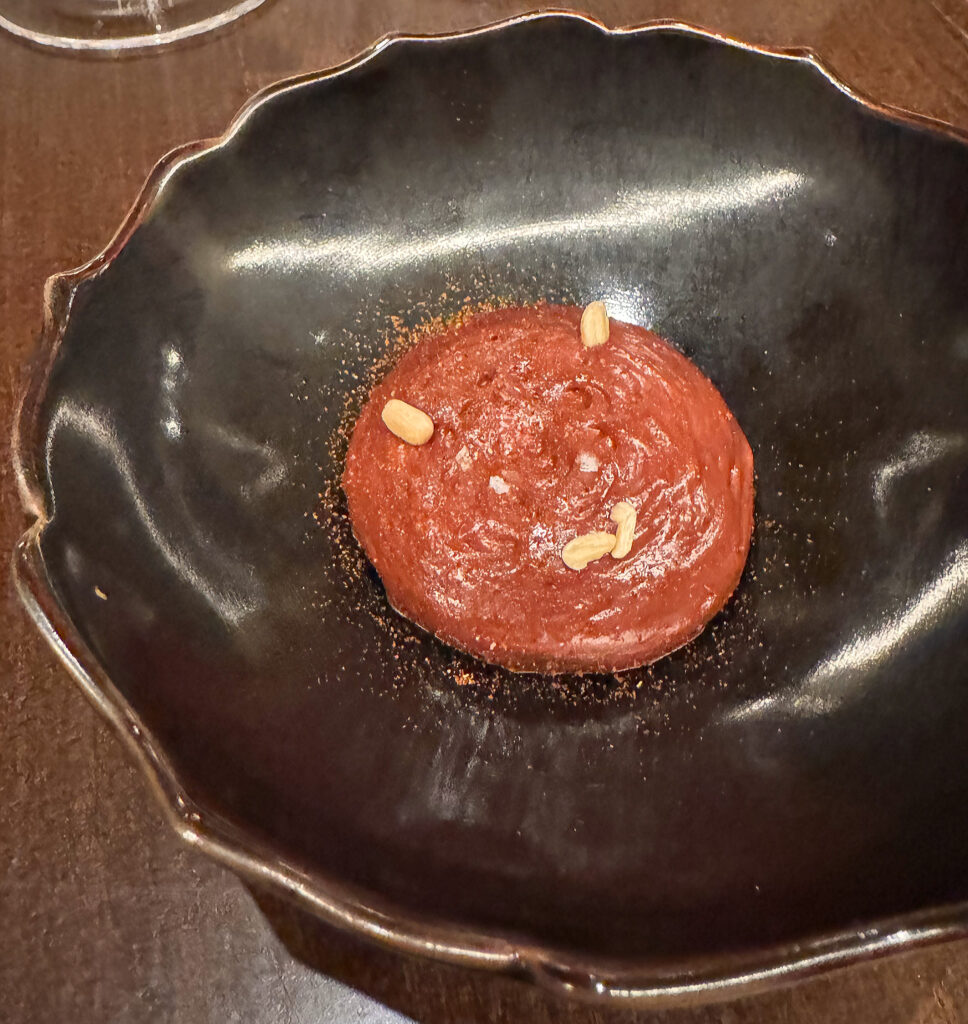
A preparation titled “Svenska Kakaobolaget—Sunflower” follows along the very same lines: representing a piece of the Feld canon (and Potashnick’s own personal history) whose resilience, even in the face of early ridicule, affirms just how far the team has come.
The core element—a mousse made from Svenska Kakao’s 74% Tanzanian blend—remains the same, yet a combination of sunflower butter, toasted sunflower seeds, and tomato powder now provide definition. The result does not only bookend the “on the cob” bite from “The Drop.” Rather, the corresponding notes of nuttiness and tangy fruit drive the expression of creamy chocolate to a place of easy enjoyment that belies its darker, bittersweet character. Once again, this represents an absolute high point for a bonafide part of the restaurant’s heritage.
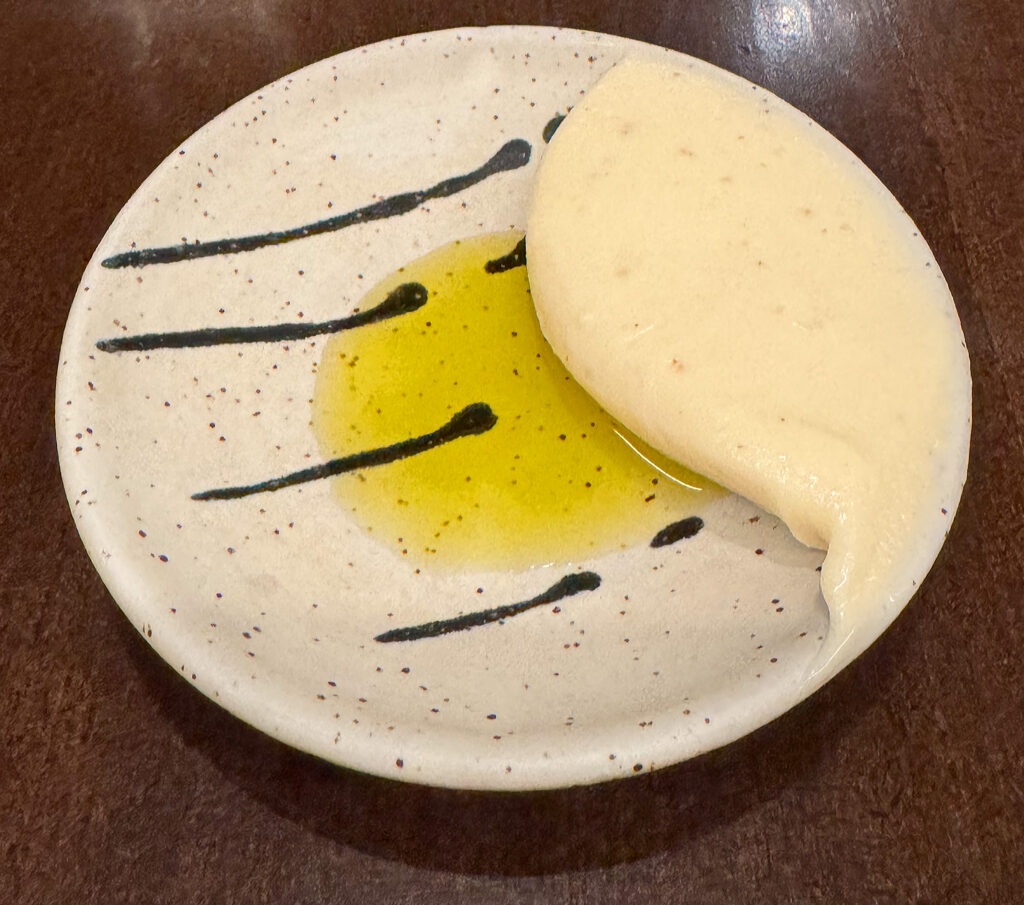
The final composed dish of the night centers on the fresh-churned ice cream that has, as of this year, become the concept’s latest signature. However, while the kitchen has recently used corn cob to great effect when flavoring the frozen treat, the present “Stone Fruit Kernel Gelato” draws upon peach and cherry pit to distinguish its pure dairy base.
The result—helped along by a drizzle of olive oil—is a beautiful depth of vanilla and marzipan tones marked by just a hint of fruity bitterness on the way down. As always, the utter smoothness of the gelato is almost second to none (a recent ice cream at Cellar Door Provisions might have slightly outclassed it). And, overall, I can only marvel at how well integrated and wholly satisfying this ever-evolving offering continues to be.
The menu’s closing sequence comprises three parts:
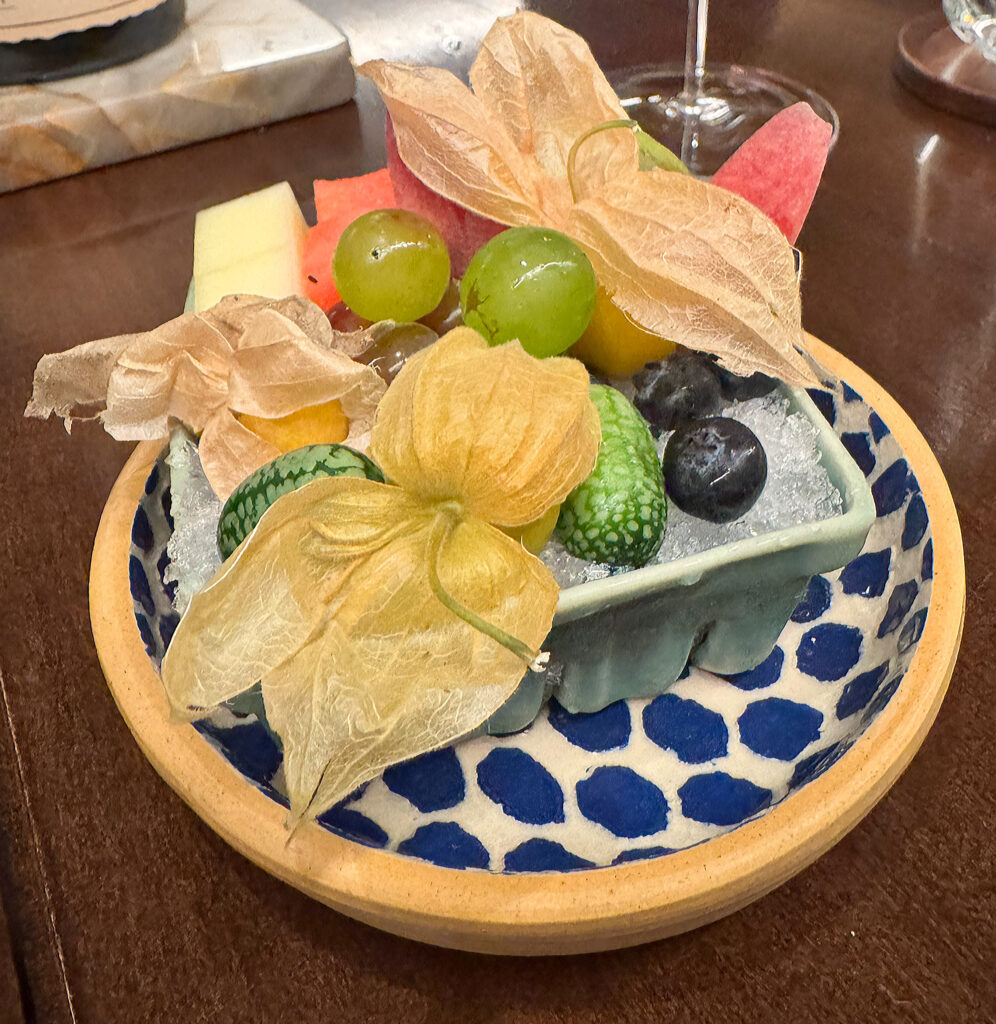
First, there’s the “Fresh Fruit on Ice,” which, on this occasion, comprises cucamelon, blueberry, green grapes, red grapes, watermelon, honeydew, peach, husk cherry, and fig. While the overflowing presentation (tucked in that charming ceramic “carton”) is as attractive as ever, I only find that the watermelon and husk cherry provide any real thrill.
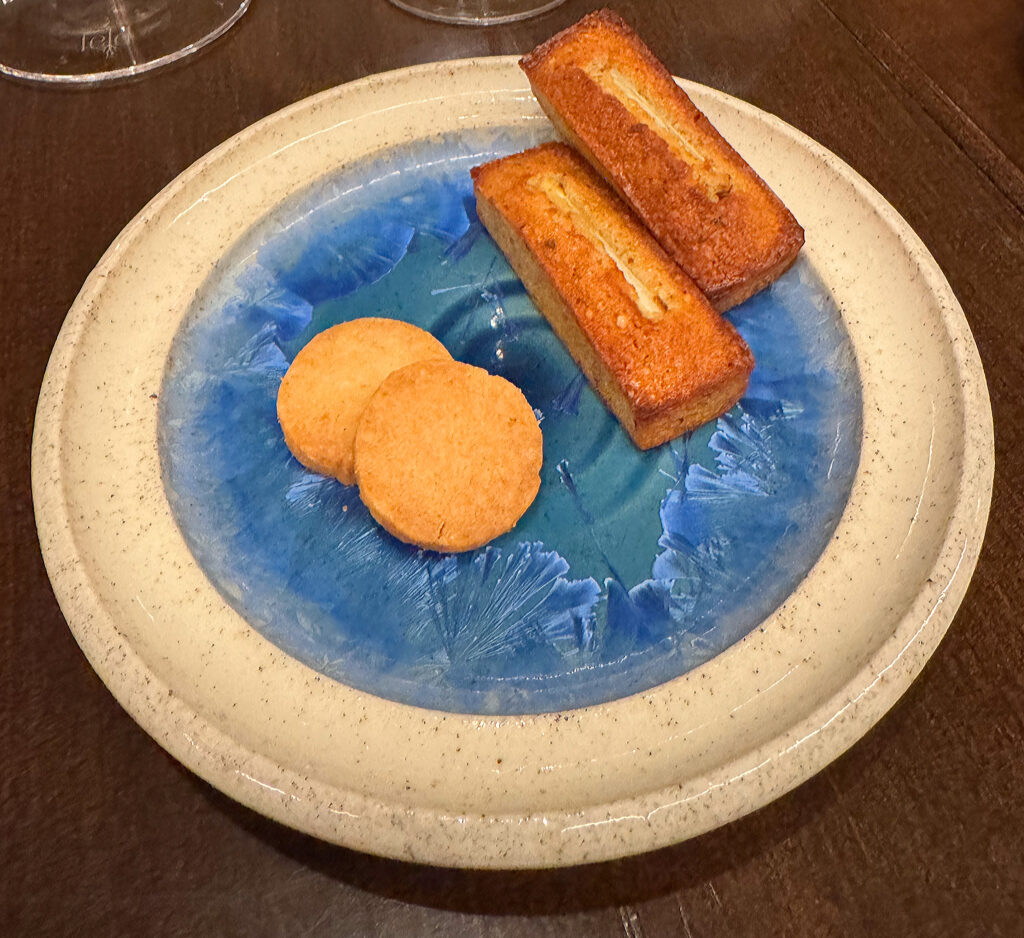
Thankfully, a “Sunflower & Pear Financier” (the latest replacement for Feld’s longstanding canelés) fares better: delivering crispness, fluffiness, and an engaging warmth with plenty of buttery sweetness on the finish.
The “Pleasant Ridge Shortbread” that joins it on the same plate displays the same level of quality—though it operates more in a crumbly, drying register whose more caramelized sweetness is quite pleasant too. Seen as a substitute for a proper “cheese course,” this cookie is a welcome addition.
With that, the after-dinner drinks are trotted out (as usual, I find a couple new pours to sample) and the guestbooks are presented for any diners who wants to leave the team a personal note. If anyone—looking in at Feld from the outside—doubts the degree to which its patrons enjoy their evening, they should take a moment to flip through the full pages of praise (frequently including illustrations) that people are inspired to scrawl.
Otherwise, once the bill is paid, it’s prime season for s’mores. Tonight, maybe due to the fact that I spend so long lingering over my wine, it seems like each and every table is crowded around the fire all at once.
Conversation, correspondingly, flows between customers who had only caught peeks of each other across the dining room. Potashnick, as always, plays the doting host: providing graham crackers, chocolate, and marshmallows as needed then rushing, alternatingly, to walk each departing group to the door.
It’s easy to forget what must have been a breakneck service for the chef—some 26 different plates split across 17 distinct courses in a matter of just two hours—but, in the relative calm of the back patio, a burning truth takes hold of me.
I cannot think of a better meal I’ve ever had here, and Potashnick is right to be proud of the kitchen’s creative effort as it welcomes fall for just the third time in what could be a years- and decades-long journey.
In ranking the evening’s dishes:
I would place the “Manila Clam—Scotch Bonnet,” “Au Bon Canard Foie Gras—Quince,” “Wild King Salmon—Apple—Ginger,” and “Svenska Kakaobolaget—Sunflower” in the highest category: superlative items that stand among the best things I will be served in any restaurant this year.
The “Verbena Mulled Apple Cider,” “Leek Croustade,” “Ham and Raspberry Mochi,” “Sweet Potato Greens,” “Hakurei Turnip—Mushroom Broth,” “Feld’s Ikura—Red Kuri Squash,” “Masa Milk Bread,” “Sungold Sorbet,” “Leg of Lamb—Coffee—Raspberry,” “Fig—Lavender—Lemon Verbena,” “Toasted Oat—Beet—Smoked Cream,” “Stone Fruit Kernel Gelato,” “Sunflower & Pear Financier,” and “Pleasant Ridge Shortbread” all land in the following stratum: great recipes that achieved a truly memorable degree of pleasure. I would love to encounter any of these again.
Finally, there’s the “Pleasant Ridge Toastie,” “Salmon Belly Tart,” “Masa & Shallot,” “Choy Sum,” “Sunflower ‘on the Cob,’” “Autumn Brassicas—Roasted Garlic,” “Hot & Cold Mackerel—Grapes,” and “Fresh Fruit on Ice”—good—even very good—preparations I would always be happy to sample again (but that just failed to elicit an extra degree of emotion).
Overall, this makes for a hit-rate of 100% with some 69% of offerings reaching that “would love to have again” level of quality: figures that largely match the numbers I reported in early September (i.e., 92% and 62%), August (i.e., 96% and 56%), July (i.e., 96% and 63%), June (i.e., 100% and 52%), May (i.e., 100% and 54%), and April (i.e., 96% and 54%).
If we consider the number of “best of the year” dishes (four, compared to four in early September, four in August, three in July, six in June, five in May, and four in April), the results also remain more or less consistent.
That said, fine dining at this level is all about incremental growth and the sharpening of innumerable details. We cannot ignore the fact that a 100% hit-rate ties the highest scores I’ve ever seen at Feld—and that finding 69% of dishes in those two highest stratums affirms the quality on display has never been greater.
Now, I would certainly like to see a couple more recipes reach that “best of the year” caliber (and I think most diners could withstand one or two errant creations if it meant tasting something truly superlative). Yet, given the way ideas tend to morph and improve at this concept, it’s not hard to envision some members of that second tier eventually taking the jump up to primetime.
Instead, what really strikes me about the present menu is its overall sense of balance. Indeed, other than a handful of bites from “The Drop” (whose scale and frivolity generally excuse any isolated disappointment) and the “Fresh Fruit on Ice” (almost more of a symbolic, thematic offering than anything meant to really be delicious), I only count two composed plates that fall a little short of all the rest. (Though, to be honest, there was nothing really wrong with the “Autumn Brassicas” or “Hot & Cold Mackerel” other than a lack of the same concentration or refinement found elsewhere.)
Yes, the run of consistent pleasure offered from the Manila clam, through the heavier preparations of produce, into the fish and foie gras (and bread!), matched by sorbet and lamb, then carrying all the way to the desserts and closing pastries is absolutely immense.
And, even if “relationship to table” has become more of an adaptable narrative device than a solemn promise, it continues to fuel a singular philosophy and shape a distinct meal structure whose fruits always have something interesting (and frequently delicious) to convey.
Based on what I’ve tasted throughout 2026, there’s no better time to come along for the ride.