
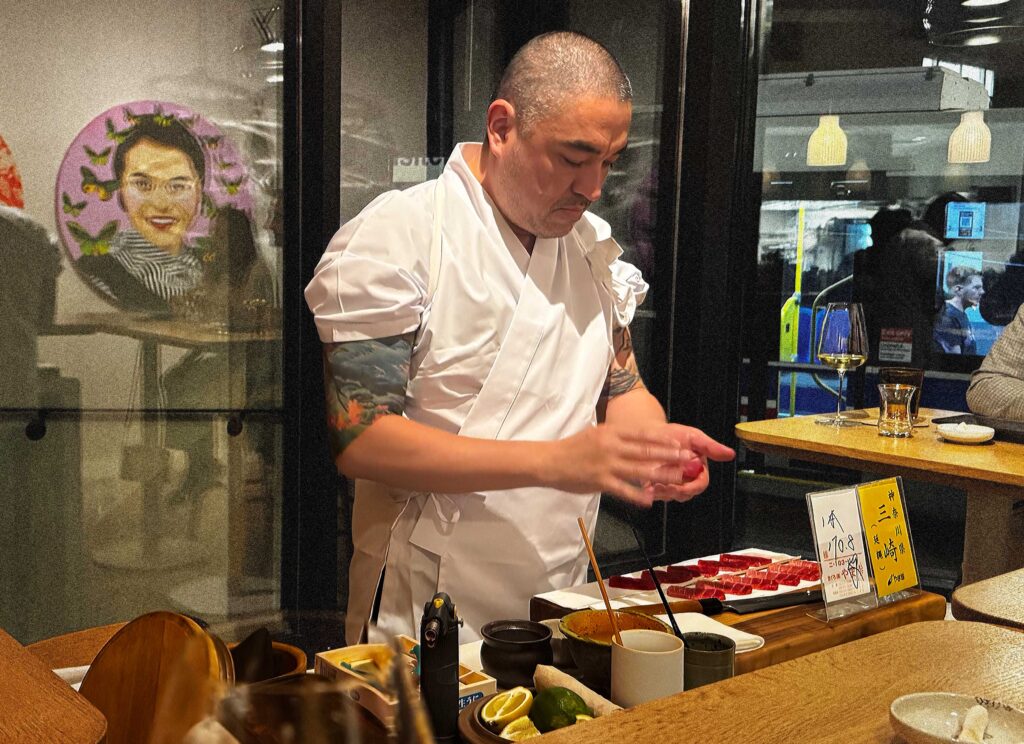
I typically do not write about pop-up events, for the utility of doing so (beyond merely preserving the memory of a meal gone by) is so limited.
Within the context of this site, why should anyone waste time reading about an experience that they cannot go out and duplicate in Chicago? Likewise, why go so far as to critique the work of any chef who, removed from the comfort of their home turf, has kindly come to share their craft with our city’s dining scene? In short, the whole process feels self-indulgent and even a little unappreciative.
Yet I’ve tasted David Utterback’s sushi before—during a pop-up at Kyōten in December of 2023. He returned there in March of the following year (though I did not attend). And the present set of meals at Esmé (in April of 2026) seems to confirm that the chef plans to ply his trade in Chicago with some regularity.
Plus, as far as omakase in this region goes, Utterback is a big deal: he’s been a serial nominee for the James Beard Foundation’s “Best Chef: Midwest,” and his concepts in Omaha (Yoshitomo and its private counter Ota) have received national recognition. Given this reputation and the relative difficulty (for those in Nebraska) of booking a reservation with the Georgia-born itamae, I jumped at the chance to enjoy an intimate, six-seat experience while Otto Phan remains on leave.
Ultimately, it is the resonance between Utterback’s sushi and Kyōten’s own that I find so intriguing and (for the purpose of writing this piece) worthwhile. For, in their common stylistic threads and the shared cult success they have achieved in less favorable markets, one begins to see the rudiments of a wider “Midwestern” approach to omakase take shape.
The two chefs share some obvious preferences: for aging their fish, utilizing the larger-grained Inochi no Ichi rice, seasoning the grains with a pronounced punch of dark vinegar, and (most tellingly) infusing their tamago with the unmistakable flavor of corn.
However, the places they differ are just as important: Utterback favors a wider range of toppings for his nigiri while also showcasing auction-grade trays of sea urchin and Japanese tuna from Toyosu wholesaler Yamayuki. Phan’s sushi is—quite simply—twice the size, and, for his headlining items, he regularly sources preservative-free uni (wet- or dry-packed in plastic) alongside wild-caught Boston tuna.
There are other points of difference worth considering (and that will be illuminated as I describe the present meal). Correspondingly, they reflect the divergent life experiences of Utterback—a self-taught former punk rocker who started his counter in 2011—and Phan—who graduated with a degree in chemical engineering then worked in New York (notably at Masa) before launching his original sushi trailer in 2014.
Nonetheless, more than anything, I think both men are connected by their formative (as well as ongoing) experiences eating at Japan’s finest counters. The chefs reflect a shared obsession with their chosen craft and a drive to push their technique to a level that honors what they have tasted from these masters. At the same time, Utterback and Phan are both brave enough to obey their own palates and reflect those of their audience: resolving not to replicate omakase as it is served anywhere else but forging something that, while equally thoughtful and technically proficient, is absolutely singular.
Utterback labels his style “hot dog sushi”—connotating a “rich,” “bold,” and “craveable” approach. Phan (though such a term would certainly play well in Chicago) avoids appending any kindred moniker to his work. Rather, it simply represents the fruits of an expertise and a process that have increasingly yielded a unique—wholly legitimate—kind of decadence.
Still, I cannot deny that the “hot dog” description (however irreverent) seems to fit Kyōten’s philosophy well. Perhaps that is why I am so motivated to put these peers’ omakases in conversation with each other.
Let us begin.
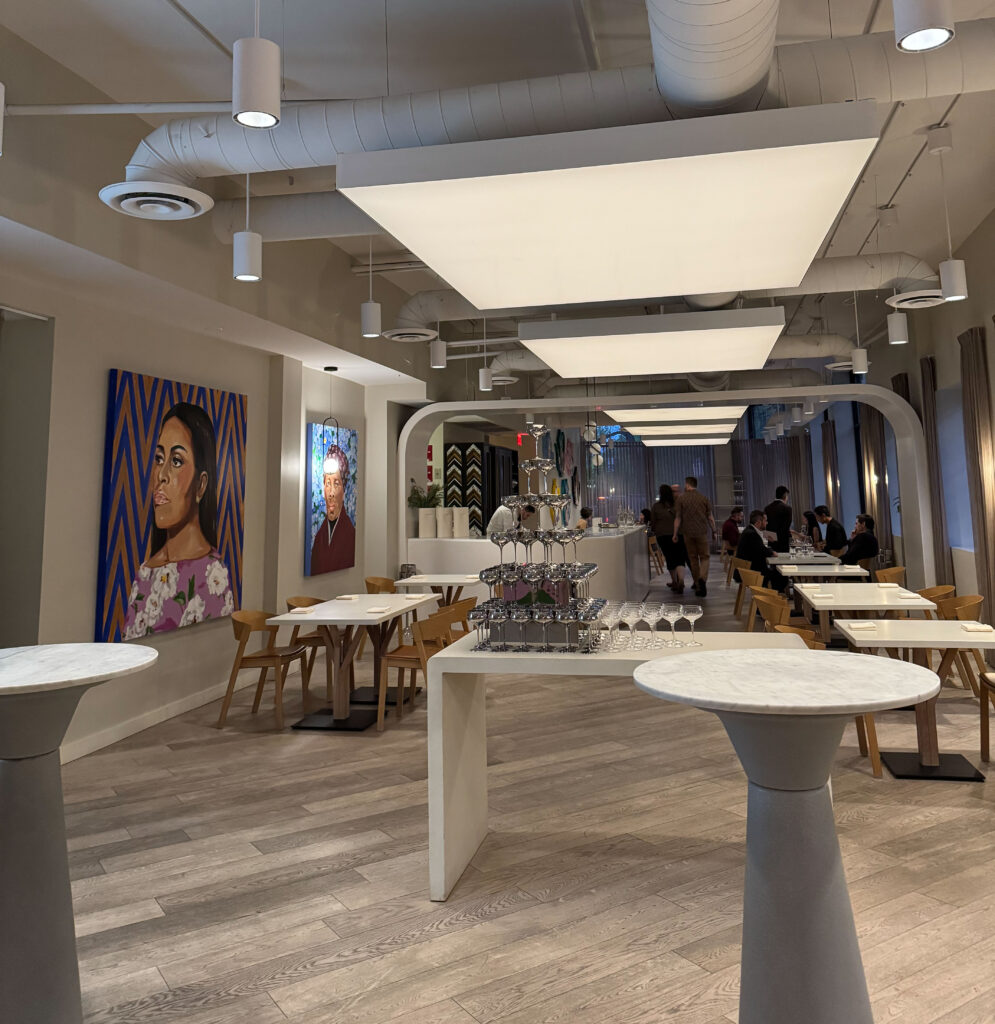
Despite eating at Esmé a handful of times—twice in the months after opening and twice, again, following the awarding of its Michelin star—I haven’t been here in nearly four years.
It feels a little weird returning to such a place for the sole purpose of tasting some other chef’s cuisine. But I’ve made peace with the niche that Esmé’s own work occupies: collaborative, visually inspired, theatric, a warmer evolution of what we’ve come to know from the city’s molecular gastronomy titans. I know enough to acknowledge it’s not for me and that my time would be better spent critiquing comparably opaque value propositions (or, better yet, simply analyzing approaches to cooking I do fundamentally like).
Nonetheless, it only takes a friendly face—Chris Gerber (former director of operations and partner at Smyth, now service director for Esmé’s wider hospitality group)—to put me at ease. And, after a moment of appreciation for the canvases lining the walls, we are led through the dining room and into the bar where Utterback’s ersatz counter sits.
All told, the area has been arranged attractively: with a set of six standing tables (one per diner) situated in a U shape surrounding the chef, whose own surface boasts all the requisite tools of the trade. With the help of one assistant (who joins him on these frequent pop-ups throughout the country) and the Esmé kitchen itself, Utterback stages his omakase in a manner that feels as fluid as any dedicated space. Further, his sense of centrality (and the resulting feeling of intimacy with each of the guests) would seem to rival what is possible in a traditional, elongated counter setting.
The only quirk worth noting is the set of windows that look out at the Clark & Webster bus stop. Throughout the evening, the resulting flow of pedestrian traffic (no doubt enjoying the temperate weather) is absolutely spellbound by the chef’s work. Or maybe I should say: they’re endlessly intrigued as to why someone is wielding a large blade and slinging fish with their hands in what (from the outside) purports to be a bar.
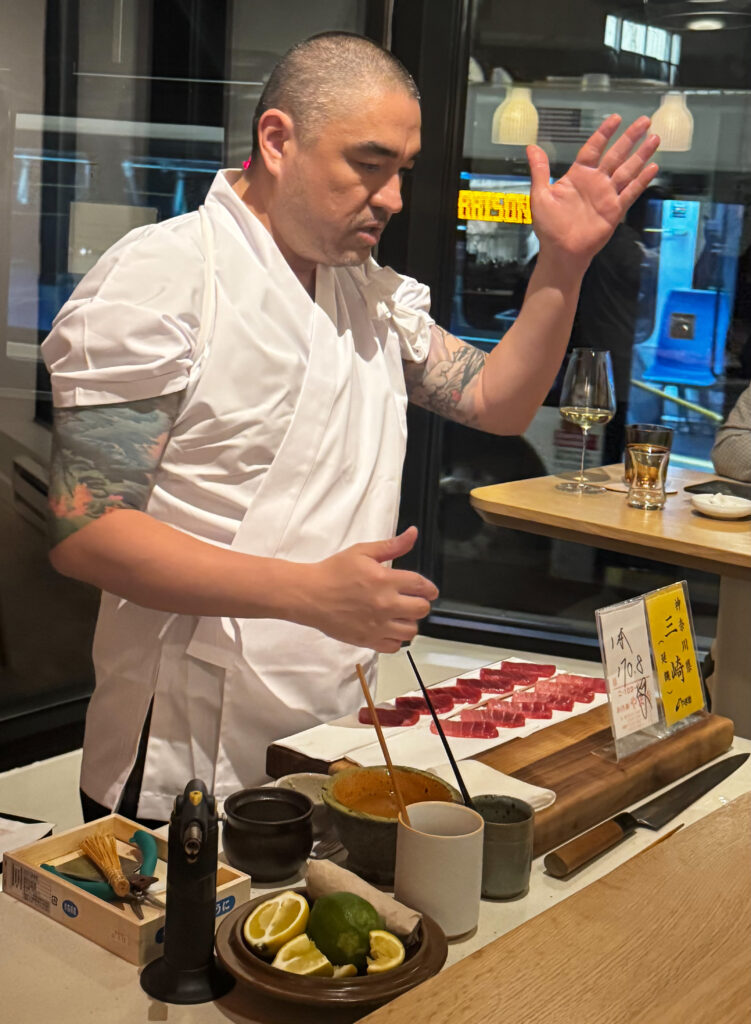
Yet, on the inside, all is well. Utterback strikes an easy, conversational tone with his assembled patrons: recounting his life story, describing the ingredients and philosophy that shape his sushi, jokingly providing instruction on how to best eat the nigiri, flexing his encyclopedic knowledge of famous Japanese chefs, and leaving plenty of room for the kind of fun, frivolous banter (on a wider array of topics) that totally subverts any caricature of the solemn, stoic craftsperson. As a consequence, a connection between each of the three parties also takes shape.
However, while Utterback is undoubtedly the star of the experience, the efforts of the Esmé team (acting far more as collaborators than mere hosts) cannot be discounted. I’ve already mentioned the help provided by the kitchen (which even extends to serving one of their own desserts at the conclusion of the menu). There’s also quality-of-life stuff like the refilling of water (dutifully executed) to note.
But it’s the “Contemporary Pairing” ($150), poured by beverage director Stevan Miller, that really impresses me.
It comprises:
- “Esmé Chuhai” (shochu, kiwi, wasabi, soda)
- NV Francis Boulard “Mailly-Champagne” Grand Cru
- Kawatsuru “Olive” Junmai Ginjo
- Yuho “Eternal Embers” Junmai
- 2023 Thierry et Pascale Matrot Meursault
- 2023 Clos Cibonne Côtes de Provence “Cuvée Tradition” Rosé
- “Mugi-Tini” (SG Shochu “Mugi,” pandan, vermouth, yuzu)
For my palate, this blend of thematic (though eminently drinkable) cocktails, classic wines (the Meursault costing as much as $110 at local retail), and characterful (though not too esoteric) sakes is beautifully composed. It makes for a drinking experience and that feels generous and endlessly engaging while still speaking to the kind of core juxtapositions (namely with the white Burgundy and rosé) that western lovers of omakase increasingly favor.
Given that the restaurant could have easily just directed customers to the by-the-glass or bottle list (where, indeed, there is a bit of overlap), the level of creativity shown here adds a meaningful layer of fun to the evening’s proceedings.
Overall, when one factors in all of the other elements I mentioned (i.e., the space, the caliber of hospitality, the direct interaction with the chef), the pop-up—at least structurally—feels worthy of its $285 price tag: equivalent to what Utterback charges in Omaha and surpassing all Chicago omakases save for Kyōten.
Of course, what matters most is how the sushi actually tastes.
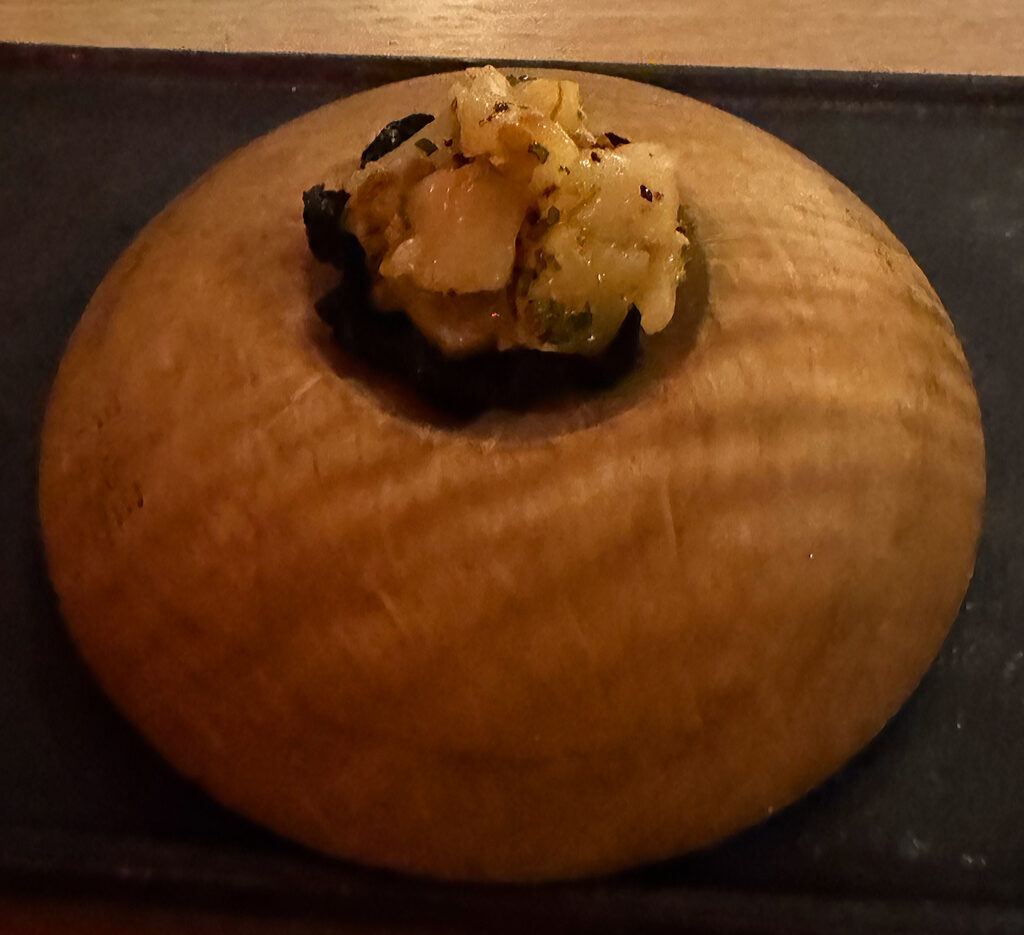
Utterback starts on a playful note: with a “Hotate XO” bite said to be inspired by a plated dish the chef previously served at Yoshitomo (his more casual concept). The recipe combines Hokkaido scallop, egg yolk, parmesan, and the titular dried seafood sauce in a manner that is meant to be reminiscent of carbonara (replacing the subtle chew of pasta with shellfish).
Tucked into a seaweed tart shell, the combination is crisp on entry then appropriately rich and gooey with further mastication. The resulting flavor smacks more of oceanic umami than it does the cheesy, nutty kind, but, overall, this a tasty mouthful and a playful way to introduce the omakase’s stylistic breadth.
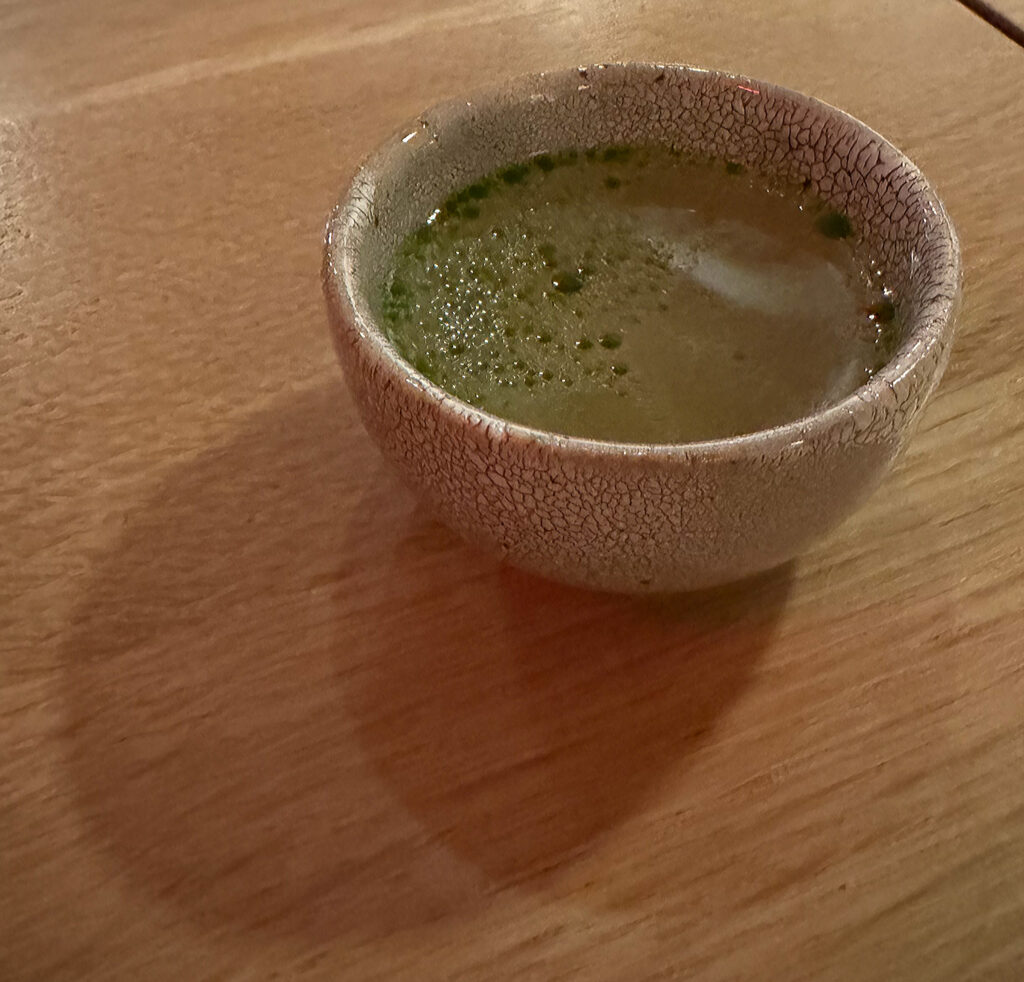
“Jiru,” which arrives next, widely refers to “soup” or “broth” in Japanese. Utterback’s is made from the totality of fish bones he cultivates, which (along with the flesh itself) may be aged anywhere from one week to one month. Flavored with chive oil and a touch of sake, the liquid displays a startling sweet, fishy concentration that, nonetheless, avoids ever feeling funky or murky. Instead, it’s depth of flavor does a wonderful job of readying one’s palate for the varied expressions of nigiri to come.
As the first pieces begin to take shape—all of them being made, one at a time, for each guest (a practice that remains lamentably rare in Chicago)—the chef reflects on the character of his chosen rice variety (i.e., Inochi no Ichi) and touts the blend of 20-year-old black vinegars he utilizes. In fact, the latter ingredients are so allocated—what Utterback likens to “cooking with Pappy Van Winkle”—that he has to beg his Japanese chef friends for help securing them. I should also mention that the provided ginger, crunching cubes possessing ample sharpness and sweetness, is nicely rendered too.
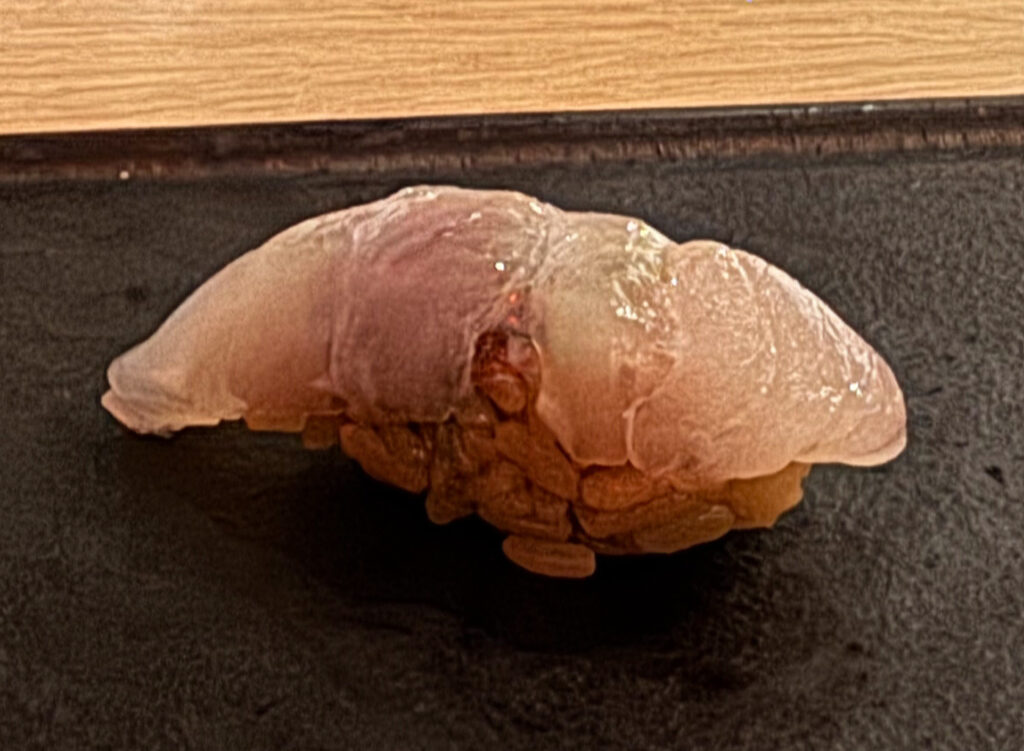
“Hirame” (or flounder), sourced from Fukuoka, leads the line: being treated to an elaborate curing process involving seaweed, pickled plum, shiso, white miso, and cherry blossom sake. This yields a bite that is a touch firm on entry. However, the fish proves soft and luscious with more time in the mouth, imparting a sharp note of vinegar with bitter undertones (and a boatload of supporting umami) that build toward a long, satisfying finish. What a great start.
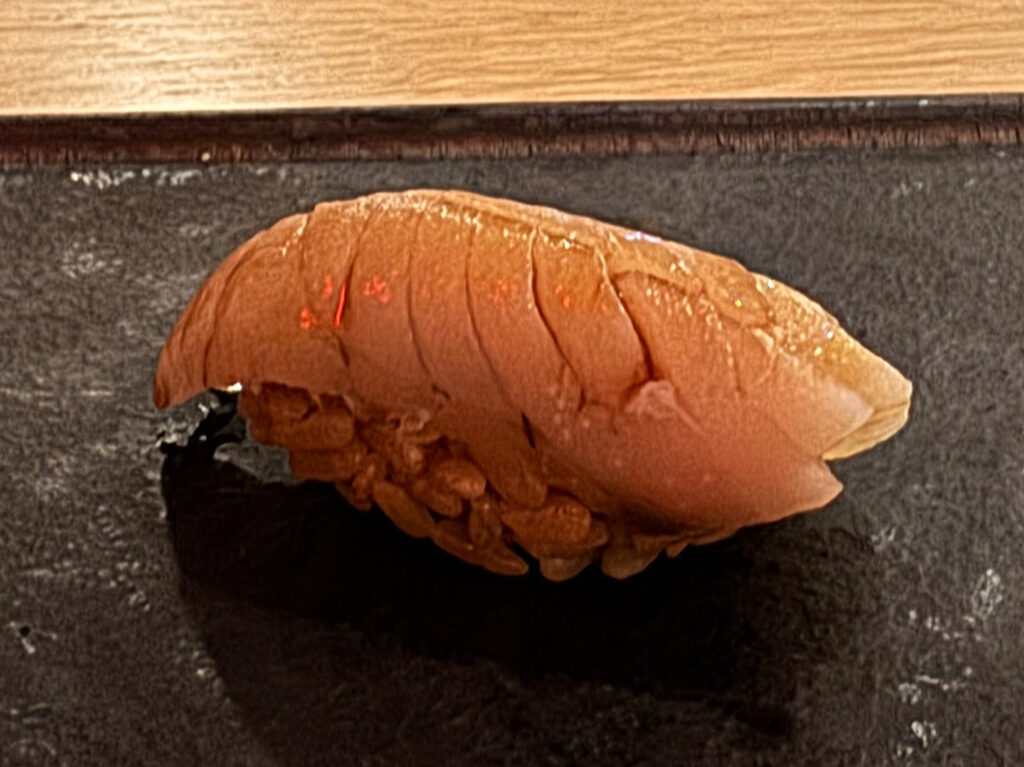
The ”Sawara” (or Spanish mackerel) arrives next, having also been sourced from Fukuoka but benefitting from a period of 10 days aging. Apart from some vertical scoring throughout the fresh, the fish’s expression remains straightlaced: centering on a rich, seamless texture backed by notes of soy sauce and vinegar that, while mild, are nonetheless persistent. Relative to the flounder, it does feel like there’s a drop in intensity here. But I’m not complaining—this piece is wholly enjoyable.
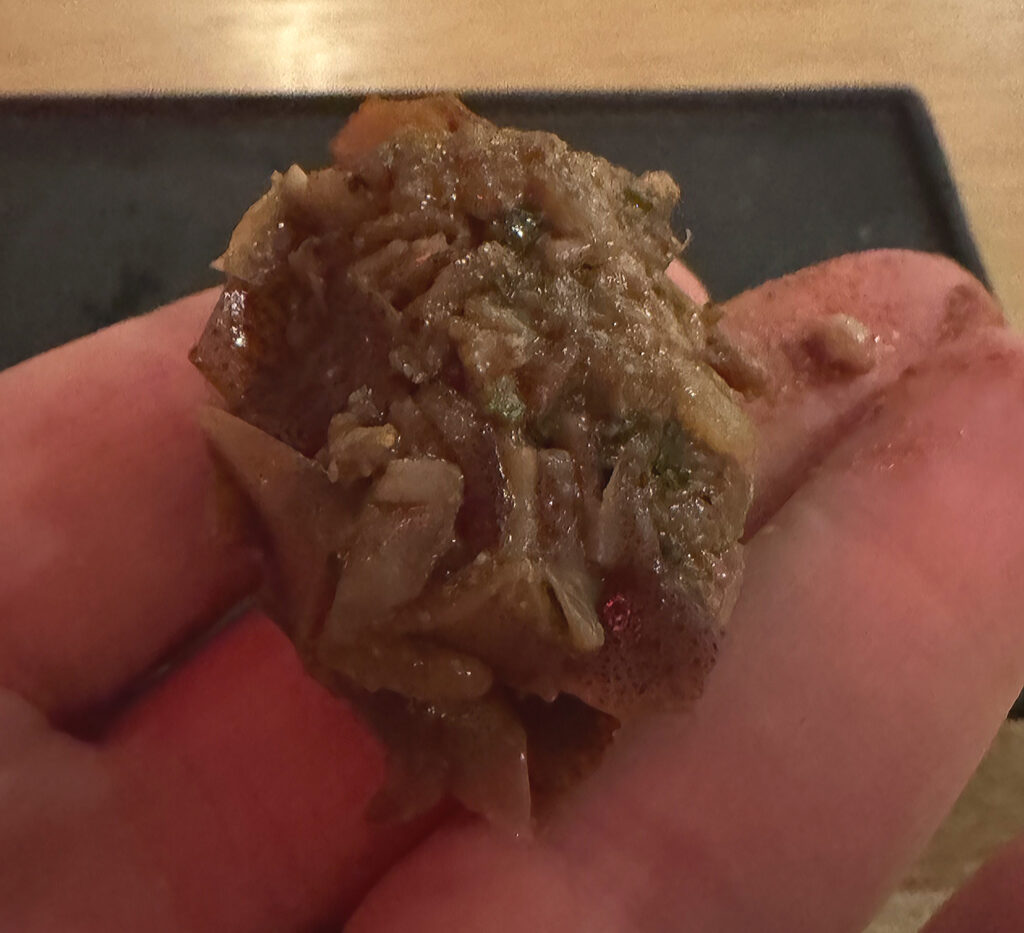
“Hotaru Ika” (also known as firefly squid) is, courtesy of a caper relish, transformed into something resembling a Caesar salad at Kyōten. Utterback goes in a different—yet equally irreverent—direction: fashioning the cephalopod into what he terms a “meatball.” The chef places this sphere of squid and rice and sticky sauce directly into diners’ hands, inviting them to take a bite that is moist, smooth, and laden with powerful, fishy umami. This preparation undoubtedly embraces the ingredient’s darker, almost livery side. Yet it avoids ever feeling dirty, making for an item of memorable decadence that surpasses any other treatment I can think of.
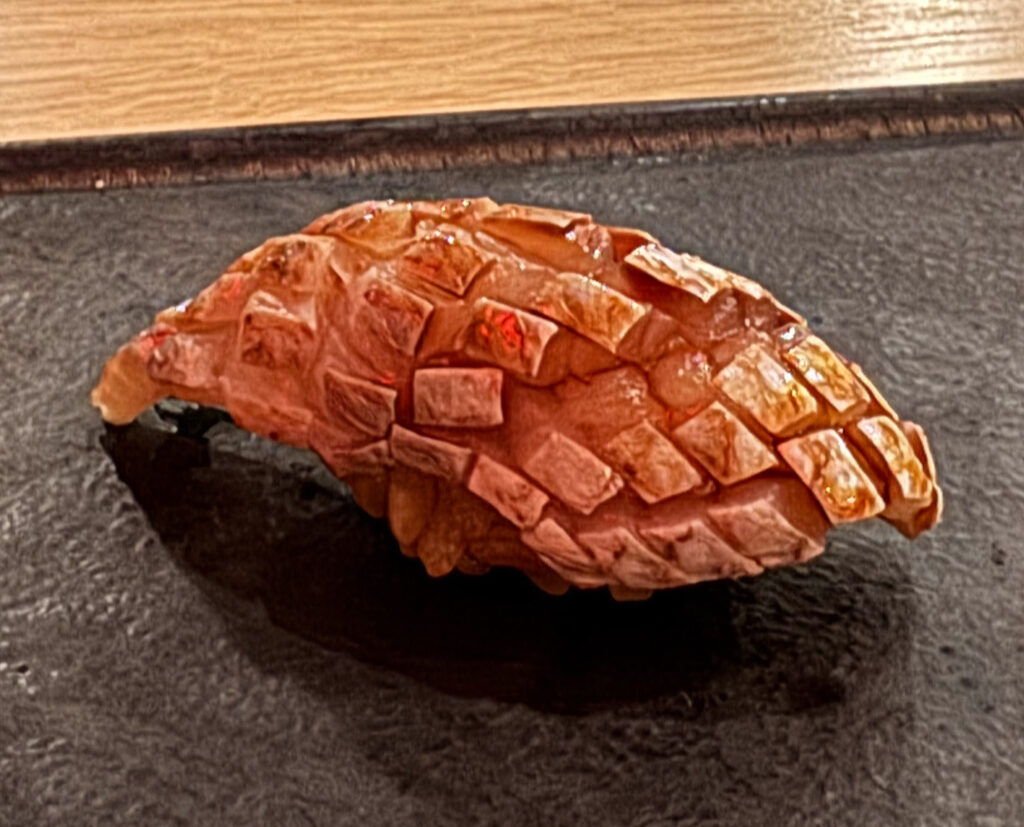
“Kasugodai,” referring to young sea bream, is a fish I’ve never encountered before (though I am certainly familiar with the older examples that go by the name madai). Here, the ingredient is salted and briefly soaked vinegar (the traditional method of preparation), yielding a skin-on piece characterized by eye-catching, ruffled scoring.
On the palate, the kasugodai displays an effusive, oily consistency that (following the firefly squid) is easy to appreciate. Correspondingly, the sea bream is charged with an immense degree of tang and a robust note of salt—flavors I certainly favor. However, on this occasion, the whole package just feels a bit oversaturated, and I am left searching for any trace of the sweetness or lasting umami that actually define the fish. That said, while the execution is a little clunky, there’s nothing unpleasant about this piece.
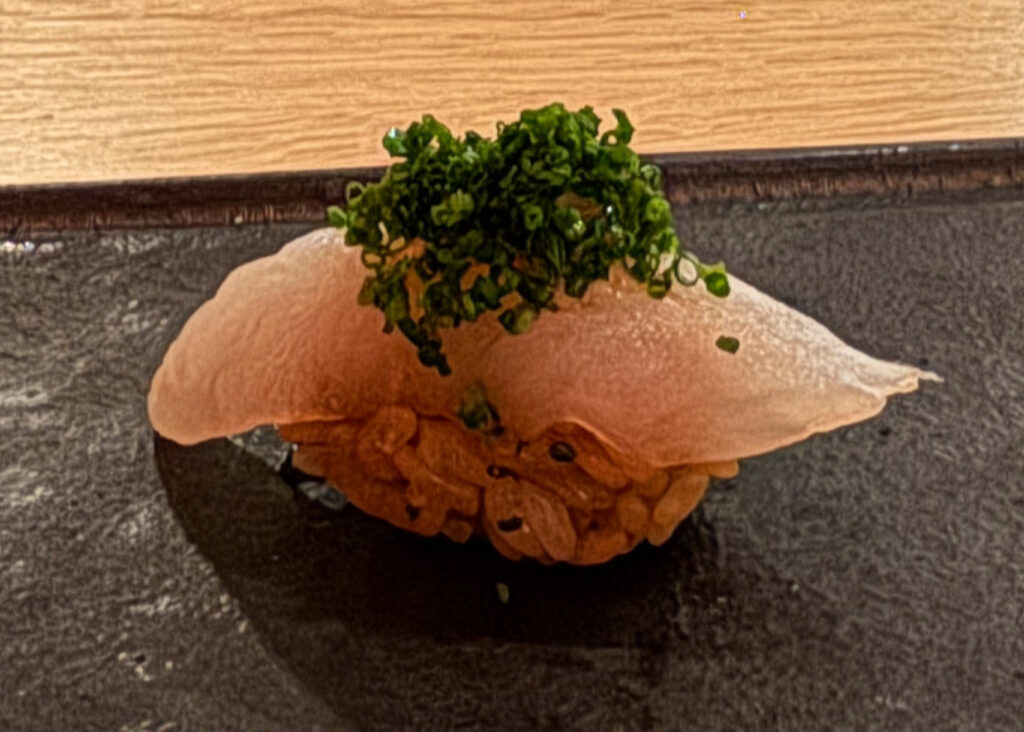
The pairing of “Kawahagi” (or filefish) with its liver is a bite I’ve come to appreciate in Japan but one that only appears sparingly (I count twice) at Kyōten. Utterback, in a move that is not uncommon, adds a heap of chives to the mix. This makes for a crisp counterpunch against the expectedly creamy offal, with both elements serving to enliven the fish’s otherwise firm, relatively undistinguished flesh. The resulting flavor is not perceptibly marked by vinegar, soy sauce, or wasabi. Rather, the sharpness of the allium teases out a depth of sweetness in the liver, making for a piece of perfect balance and unique satisfaction. Nicely done.
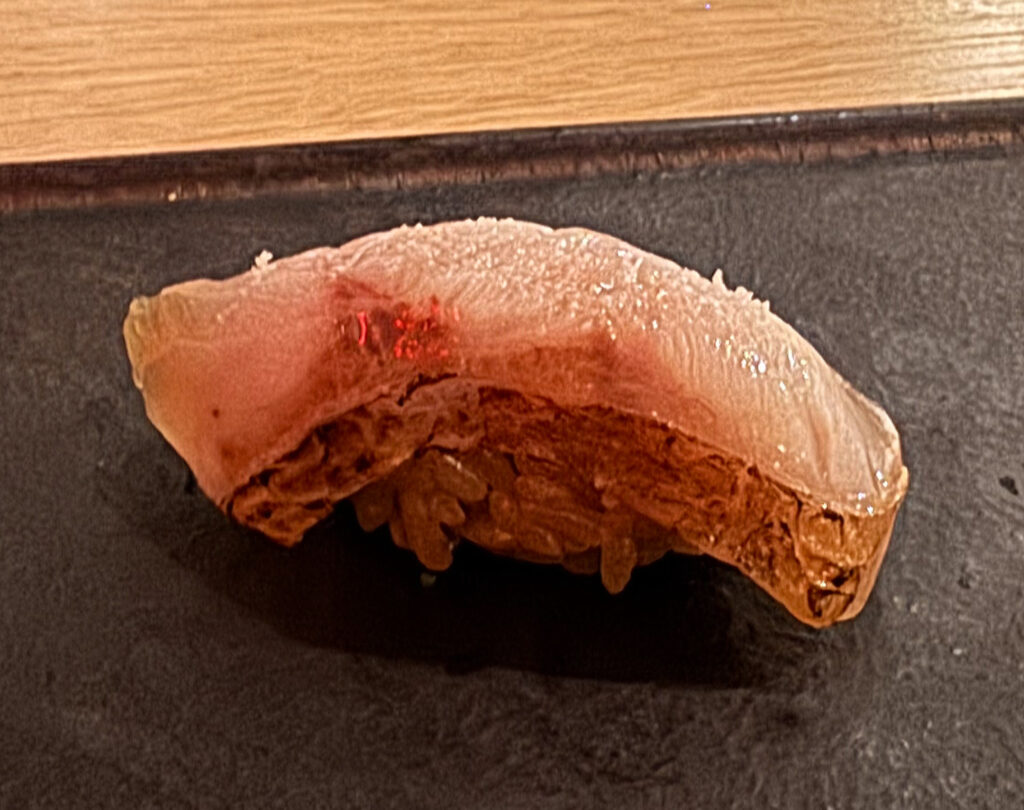
“Akamutsu,” the blackthroat seaperch Phan touts as the most luxurious of all his fish, appears tonight in a less overtly fatty form. Utterback sources his specimen from Nagasaki and ages it for seven days. No torch is used to warm or render the marbling. Instead, the piece displays a push-pull of firmness and richness that contrasts the past few (notably unctuous) bites. The accompanying flavor is distinguished by a fair bit of salt and some complicating fishiness—both of which display good persistence. Nonetheless, I’d like to taste more vinegar on the finish and am left feeling that the ingredient (though pleasant enough) is a little undistinguished in this guise.
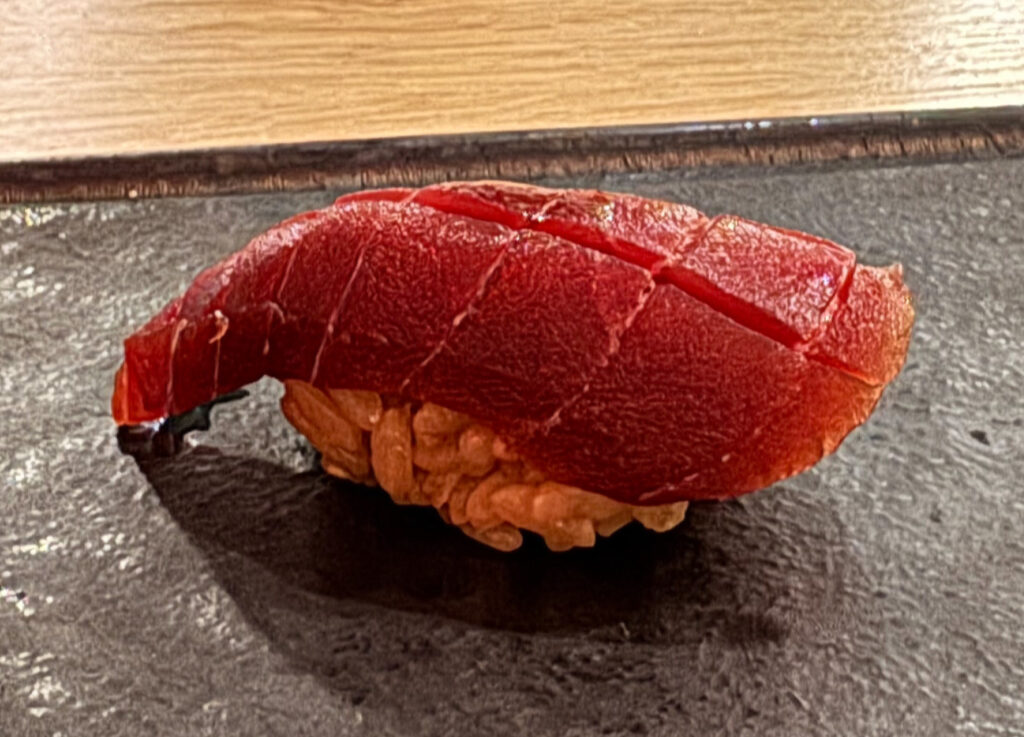
Turning toward the omakase’s star attraction, Utterback features a total of four pieces of tuna: the first of two coming from an Atlantic fish caught off the coast of North Carolina. The resulting “Akami” (or leaner meat) is taken from the core of the specimen and aged for 10 days. Scored horizontally and elegantly curving over the rice, the cut leads with an attractive sense of density that, nonetheless, proves soft and succulent with further chewing. Flavor—brimming with pronounced notes of soy sauce, vinegar, and wasabi—is absolutely superlative: delivering all the intensity I prize while ensuring this humbler portion of the fish achieves a profound sense of satisfaction.
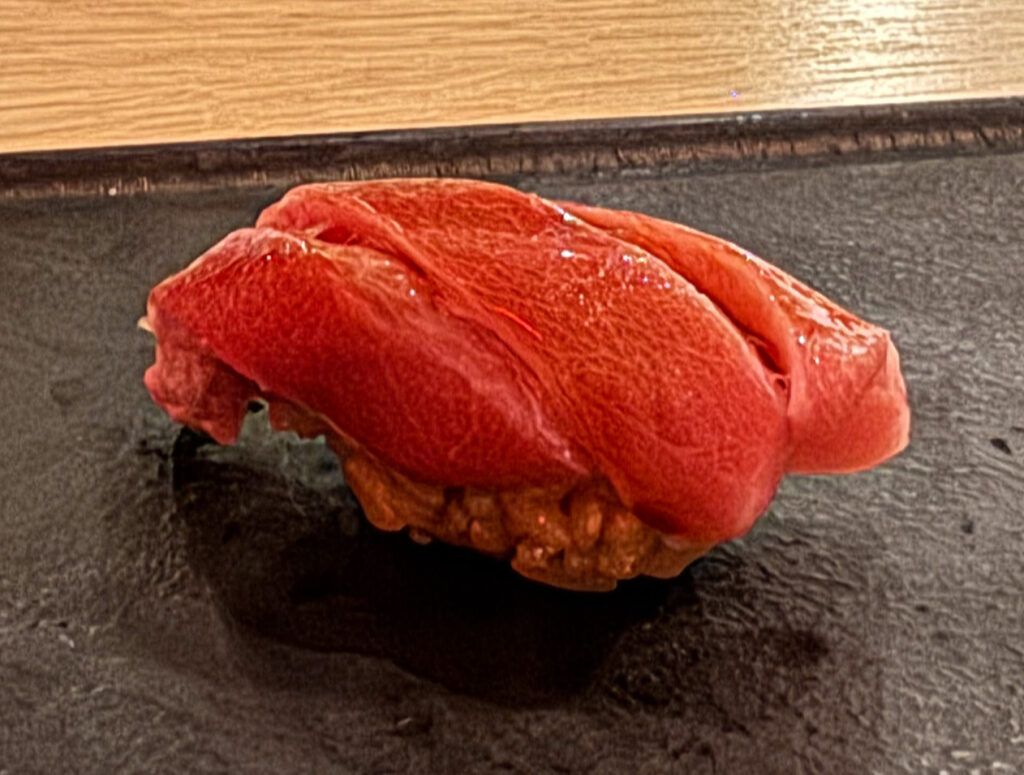
The “Chutoro” (a medium-fatty cut of belly coming from the same fish) is subject to the same period of aging, yet the resulting piece—scored into three discernible ribbons each woven with a fine lattice of marbling—is visually distinctive. It delivers a delectably soft, melty sensation upon reaching my palate; however, this comparable increase in richness is not matched by any perceivable uptick in the supporting flavor. Indeed, it seems the chef is content with taking a lighter touch here rather than countering the belly’s fat with even more of the same tang or pungency. I respect the decision (especially given what the preceding bite offered), but it feels like a missed opportunity to really knock this luxurious ingredient out of the park.
The next two expressions of tuna are meant to mirror the preceding cuts while being drawn, instead, from a Japanese specimen (caught near Kyoto) sourced through legendary Toyosu wholesaler Yamayuki. Utterback proudly displays the sheets of paper that testify to the fish’s origin, and, I must admit, it’s the kind of flourish that carries real novelty and currency within the Chicago market.
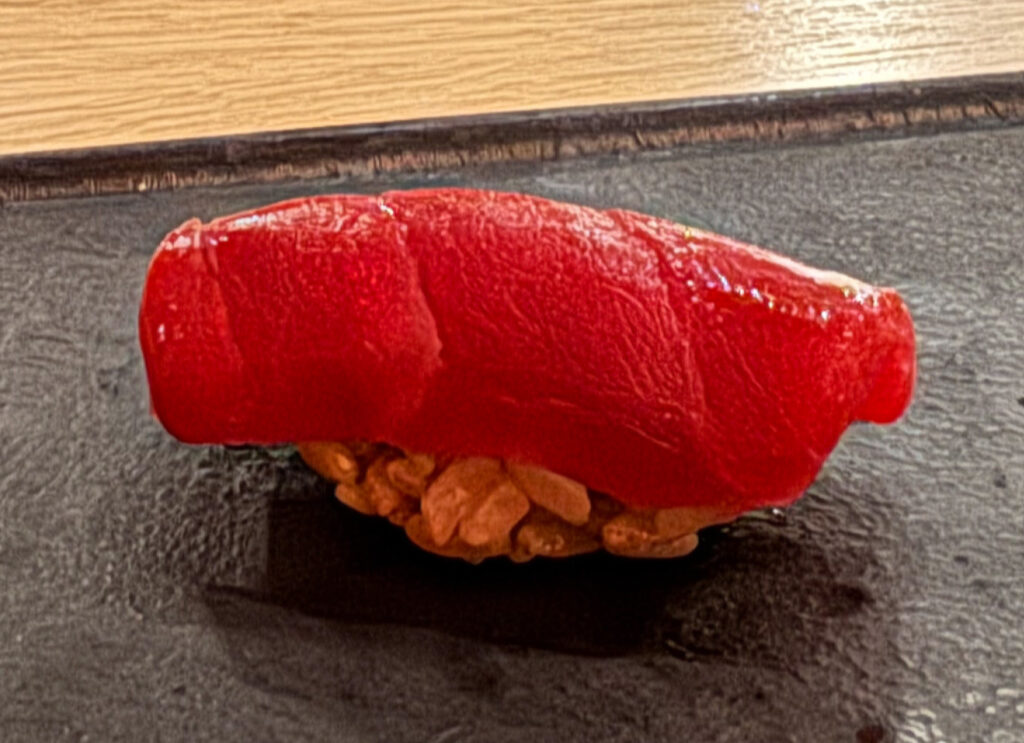
The “Akami” taken from this estimable tuna is distinguished, most of all, by the smooth, cushiony effect that takes hold after one breaches its initial firmness. Unquestionably, the texture here is more refined than its North Carolinian counterpart. Nonetheless, I again sense that the chef has chosen to pursue a lighter touch given the quality of the sourcing. For my palate, I again miss the intensity of vinegar and wasabi that made the other example so pleasing. Still, this is ultimately a matter of preference, and others may find the piece’s restraint to be a virtue.
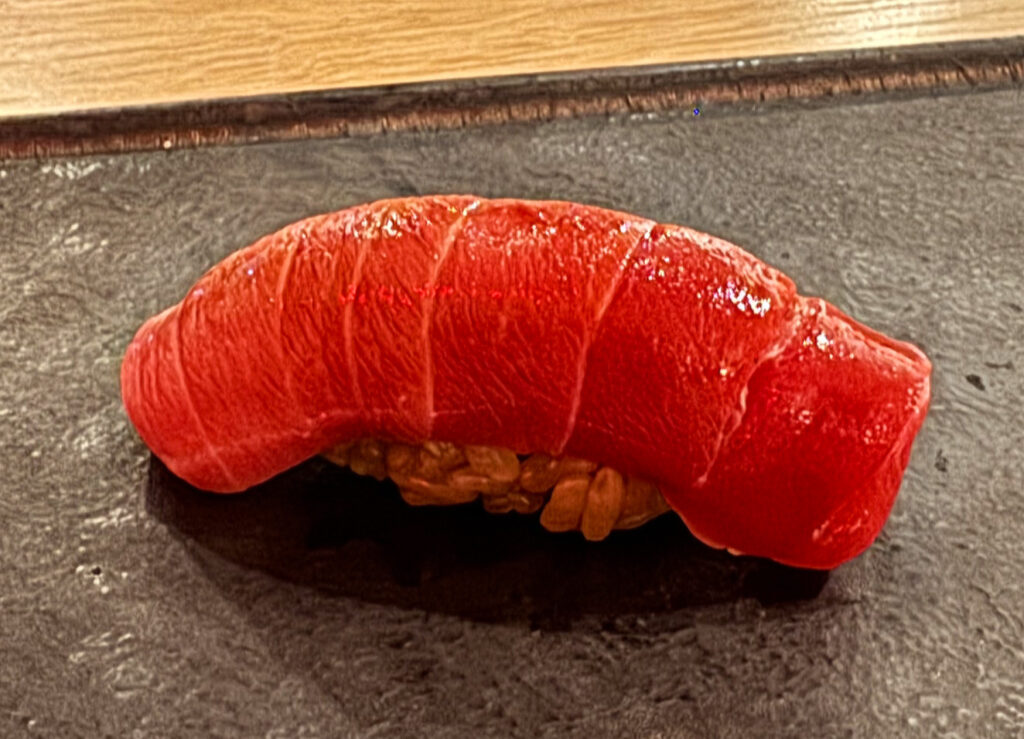
The ”Chutoro” of the Yamayuki tuna would, following the logic of the last two servings, seem destined to err in the same way. Yet, when this expansive bite (hanging so enticingly over its rice) reaches my mouth, I cannot resist the supreme butteriness and seamlessness with which it strikes. The expression of flavor here is again, undoubtedly, subdued. However (and this may have something to do with the flesh’s underlying richness), I feel that the chef has provided just enough supporting seasoning to push this cut of belly toward a long, lip-smacking, and fleetingly savory finish. The result not only testifies to his purveyor’s quality but, truly, ranks among the highlights of the night.
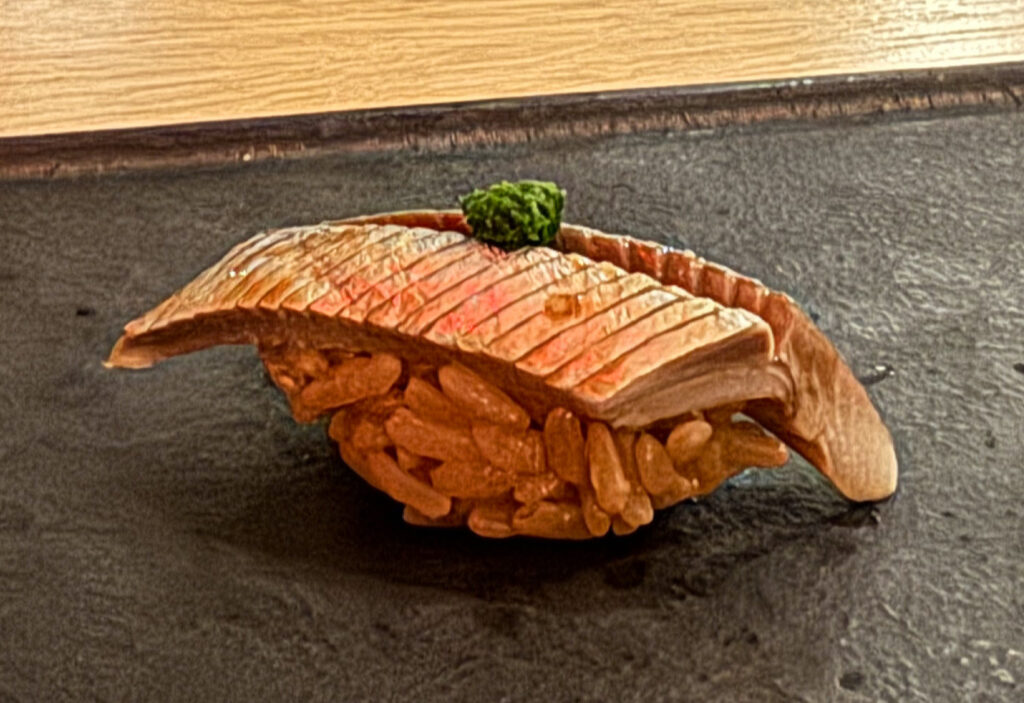
“Iwashi” (or sardine) has the unenviable job of following those four cuts of tuna. Nonetheless, Utterback distinguishes this decidedly unglamorous fish as being a good exemplar of his particular philosophy. While other chefs marinate the ingredient for no more than a couple minutes, he pursues a strong pickling (likened to boquerones) via one day in vinegar and another two in garlic-infused olive oil.
This yields a piece—among the menu’s most visually striking—that is plump on entry and decidedly moist throughout. Yes, this sardine gushes with notes of tang and brine. Yet, offset by a dab of allium, the fish’s expression avoids the sense of excess that tarnished the “Kasugodai.” Overall, it feels bold but rounded and largely approachable as a means of transitioning toward the meal’s closing bites.
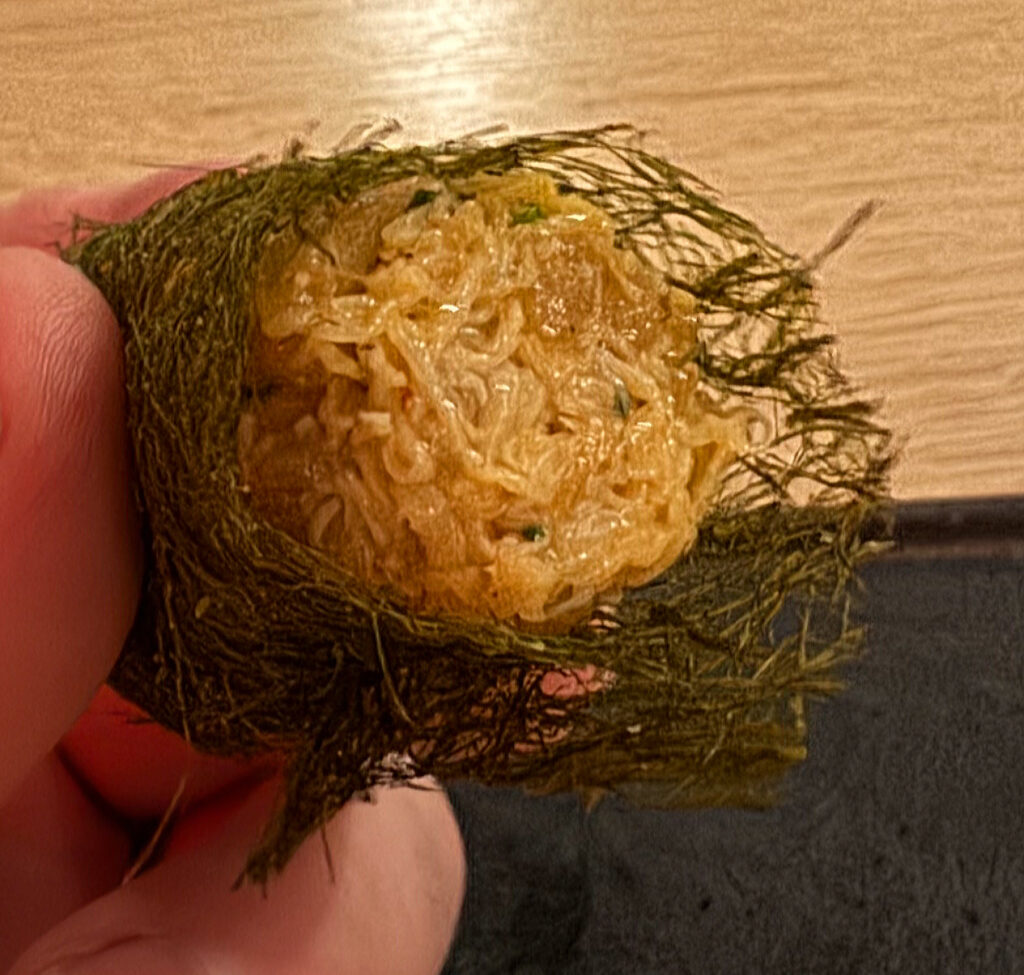
The “Kani Gamtae” stands as one of Utterback’s signatures: comprising fine threads of Dungeness crab (sourced from Washington) wrapped in a rare, wild-harvested (and also somewhat thready) Korean seaweed. The resulting package—relative to the crisp, glossy nori I am used to—possesses a pleasantly loose, rustic, “woven” feeling.
Rather than crunching, the gamtae displays a soft, slightly chewy consistency that melds well with the strands of crab. Its flavor—powerfully oceanic with surprising sweet and nutty undertones—matches the shellfish beautifully too, drawing out its own sweetness while simultaneously amplifying the bite’s umami. Though ranking among the boldest pieces on offer tonight, the degree of refinement here is phenomenal. I can totally see why it forms one of the chef’s standbys.
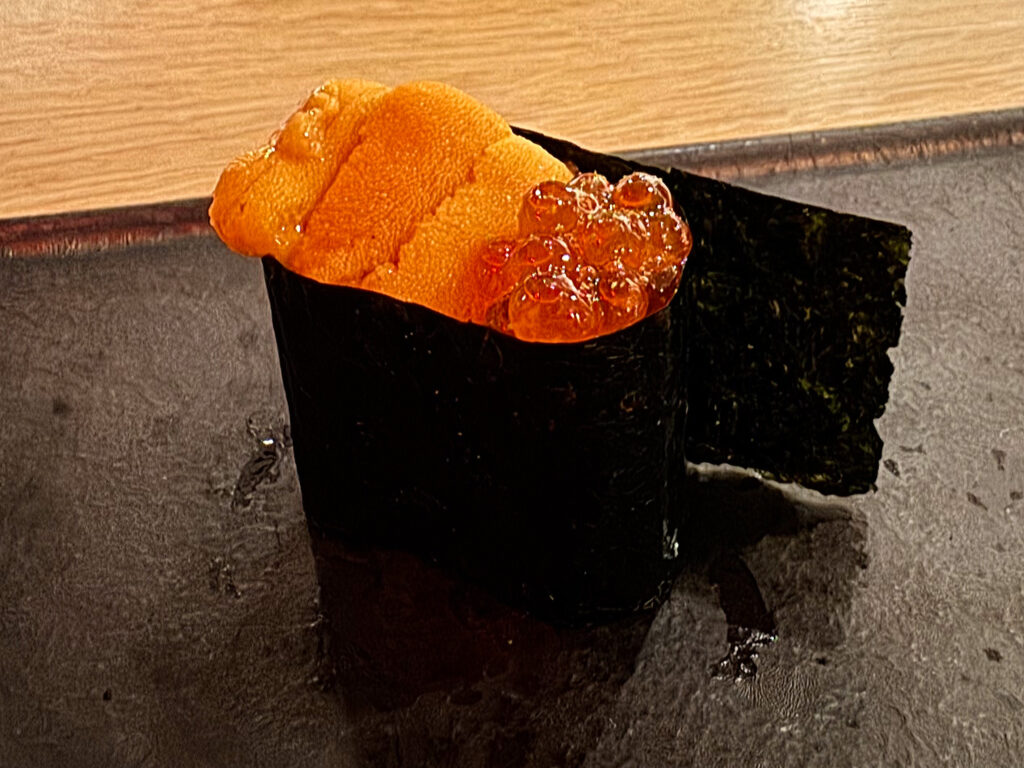
When the “Uni/Ikura” arrives (the former ingredient neatly arranged in a black tray bearing the markings of the wholesaler Yamaharu), I know I’m in for something special. Utterback touts this sea urchin (the bafun variety) as being auction-grade, and, by placing it alongside salmon roe, he hopes to unlock extra degrees of depth and pleasure.
Texturally, the combination leads with subtle crispness and the faintest pop before settling on a moist, creamy consistency that permeates the supporting rice. Flavor here displays a notable degree of brine (from the roe) and backing umami (from the seaweed). The uni (and any accompanying sweetness) is comparably harder to pick out. Yet its expression is entirely clean, and its pure, subdued expression remains perceivable through the finish. There’s no question as to the ingredient’s quality. I am just left wishing that I could enjoy it on its own.
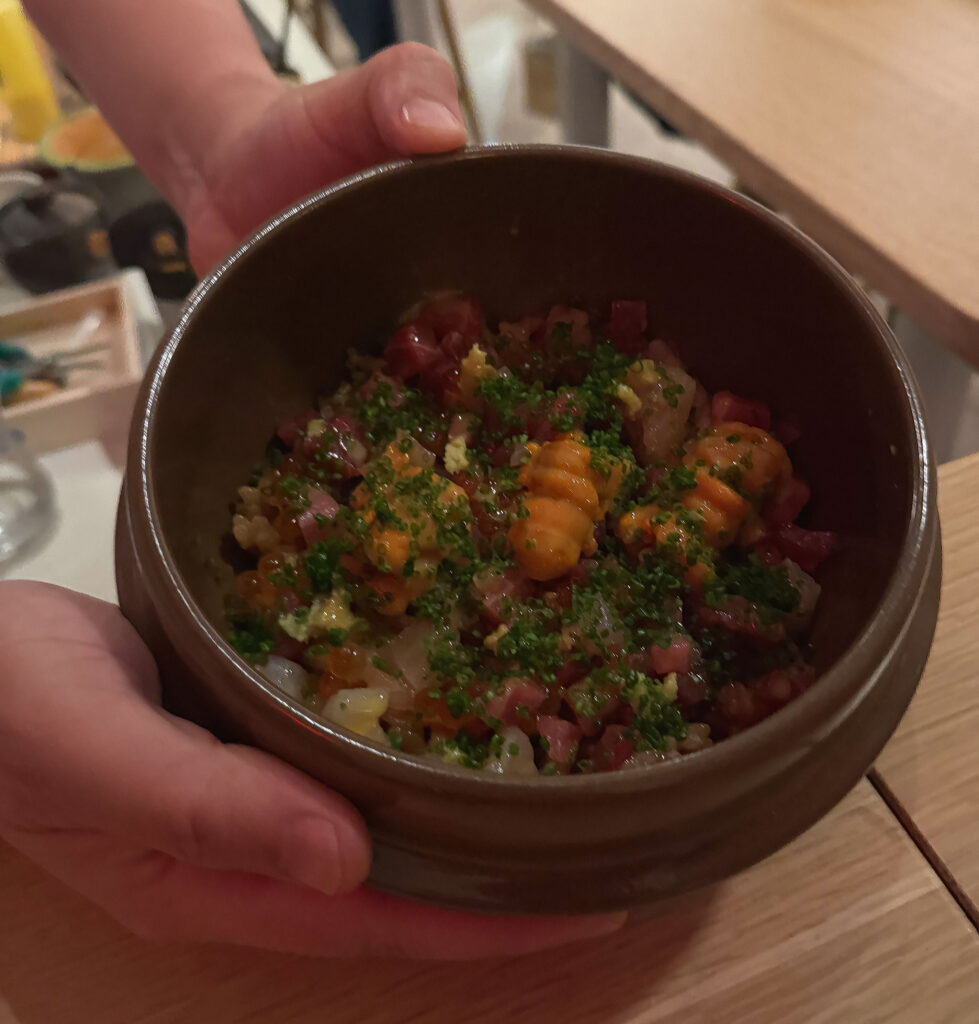
The “Temaki” (literally, “hand roll”) comprises a range of scraps that the chef formerly reserved for himself. This immediately reminds me of Kyōten’s approach, and I spy ingredients like sea urchin, ikura, several types of tuna, some unidentified white fish, and plenty of chives making up the mixture.
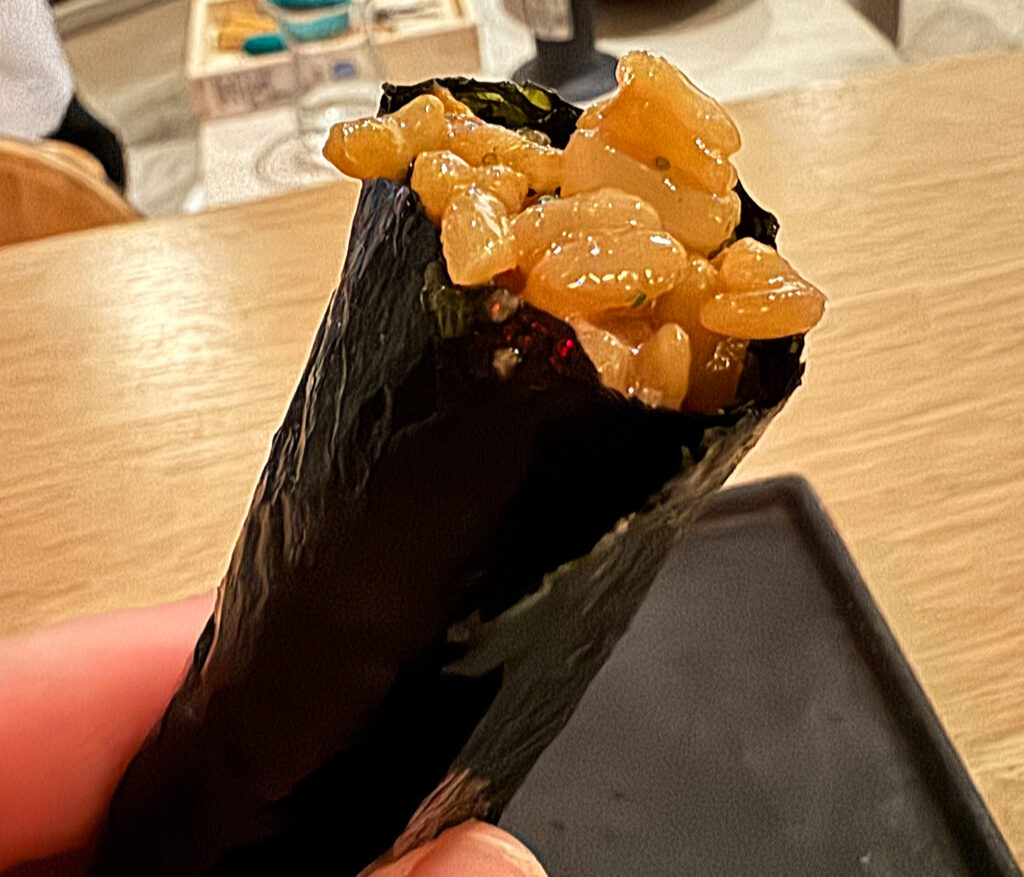
This results in a long, slender roll (again reminiscent of Phan’s work) whose seaweed wrapper does not quite possess the same clean, brittle crunch. That said, the filling proves juicy and entirely cohesive in a manner that does really impress me: delivering an engaging gradient of savory (sometimes briny) flavors balanced by sharp and satisfyingly sweet undertones. In short, this quite nice.
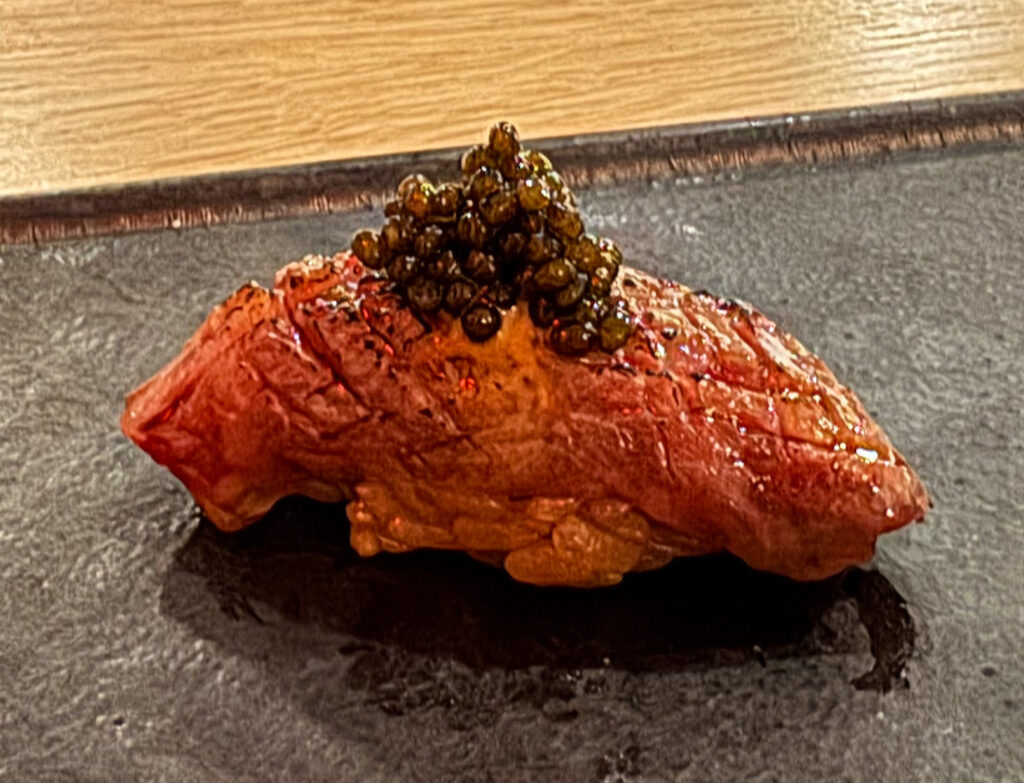
Though Kyōten (and several other Chicago omakases) will opt to serve wagyu from time to time, Utterback’s “Prairie Tuna” aims for a unique degree of extravagance. Admittedly, this is just the sort of piece coastal diners would point to as evidence that the Midwest fails to properly appreciate sushi. However, in turn, I cannot say the menu ever overdid it with toppings, so is it not okay to have a little fun with what proves to be the final savory bite?
The A5 Miyazaki wagyu comes scored and torched and topped with a one-two punch of uni butter and Kaluga caviar. I feel like I’ve seen this all before; however, the execution is pinpoint: being remarkably melty (like the tuna it’s compared to), framed by hints of rice and roe, yet most of all distinguished by warm, salty richness that convincingly anchors the meal. Call it sacrilegious, but the beef’s texture and seasoning and overall deliciousness cannot be faulted.
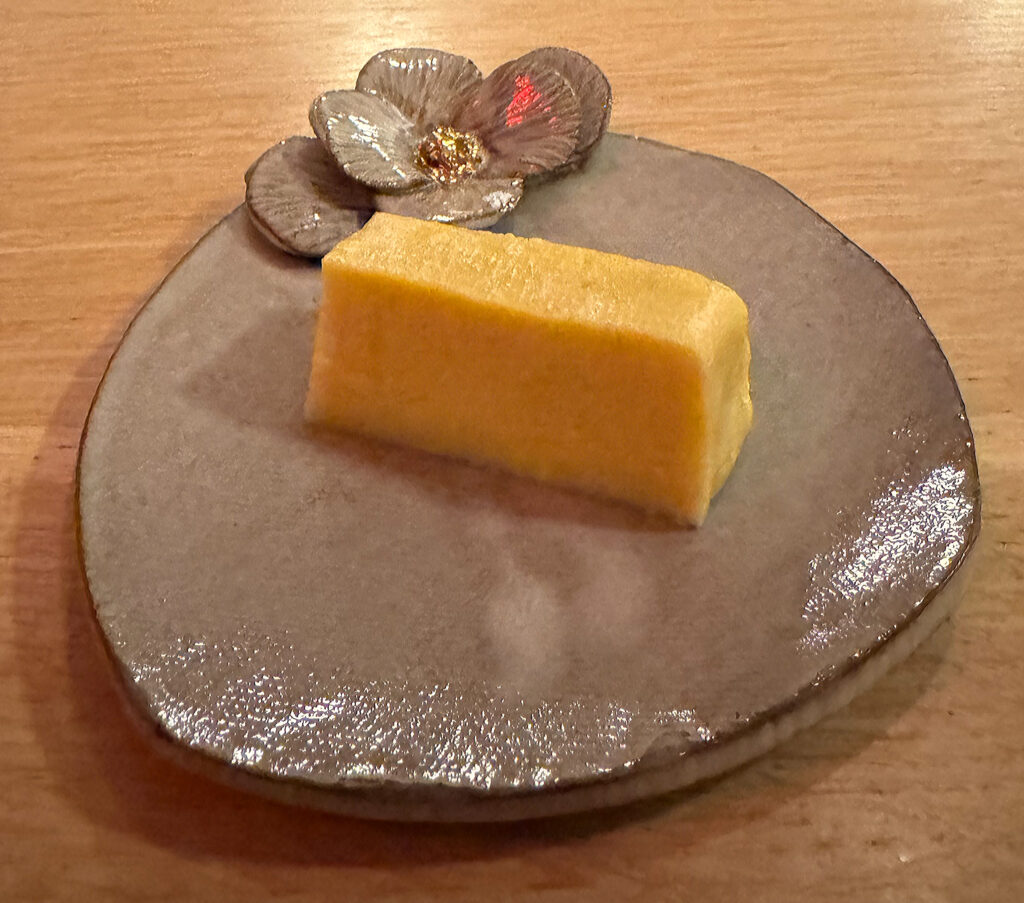
For dessert, Utterback serves his “Gyoku”—or “jewel” (a slang term for tamago). The chef’s play on the Japanese egg omelet, like Kyōten’s, makes use of corn. Nonetheless, his bite possesses an altogether creamier, meltier consistency (free of any gelatinousness or bounce) that I cannot say is unpleasant. Rather, this sappy mouthfeel lends the tamago a particular feeling of richness that matches its fresh, milky, and supremely concentrated sweetness. Ultimately, I cannot pick a winner between the two shining examples of this recipe. It’s best merely to appreciate the small differences that distinguish each chef’s work.
A little more than two hours later, the omakase reaches its conclusion: some 18 bites served in roughly seven-minute increments, making for the kind of pacing that tantalizes and increasingly pleases without ever seeming to drag on.
Though Esmé’s team starts to wind down its own service, there’s no pressure to leave. Utterback and his guests linger, share in a toast, and continue stoking the connection that the chef first ignited.
When it comes time to go, Utterback sees us off warmly at the door. It’s hard to know when I’ll ever taste his sushi again. But, given the wandering lifestyle the chef has committed to (as well as the rapport that has already formed), it also seems inevitable. What this omakase means for Midwestern gastronomy makes sure of it.
In ranking the evening’s dishes:
I would place the “[North Carolina] Akami,” “Prairie Tuna,” and “Gyoku” in the highest category: superlative items that stand among the best things I will be served in any restaurant this year.
The “Jiru,” “Hirame,” “Hotaru Ika,” “[Japanese] Chutoro,” “Kani Gamtae,” and “Temaki” land in the following stratum: great recipes that achieved a truly memorable degree of pleasure. I would love to encounter any of these again.
Next come the “Hotate XO,” ”Sawara,” “Kawahagi,” ”[North Carolina] Chutoro,” “[Japanese] Akami,” “Iwashi,” and “Uni/Ikura”—good—even very good—preparations I would always be happy to sample again (but that just failed to elicit an extra degree of emotion).
Finally, there’s the “Kasugodai” and “Akamutsu”—merely good items that fell a little short when it came to flavor. That said, the underlying textures here were sound, and these could easily be improved with a little more fine-tuning.
Overall, this makes for a hit-rate of 89% with a full 50% of offerings reaching that “would love to have again” level of quality. These numbers land right in the ballpark of how I rate and average Kyōten meal, and, while Phan’s headlining bites can peak a bit higher (hitting that “legendary” status on occasion), I must admit that even Utterback’s weakest pieces were wholly enjoyable. When one considers, again, that this was a pop-up (meaning the chef lacked any of the advantages of his home counter), the performance tonight was truly superlative.
Stylistically, the evening’s strongest servings combined textural finesse (courtesy of careful scoring and/or shaping of the starring ingredient) with bold seasoning (generally from the aged black vinegar but also, at times, from colorful toppings or curing) and the occasional twist (the “meatball” form, the Korean seaweed wrapper, the common use of corn). By showcasing top-tier ingredients from Japan (i.e., the Yamayuki tuna and auction-grade sea urchin), the meal also conjured a meaningful sense of luxury—however, I only think the “[Japanese] Chutoro” really lived up to its billing.
Kyōten, at nearly double the price, is distinguished by an opening sequence of small plates (often including tempura or grilled preparations) that may rank among the strongest or weakest dishes on a given night. However, I think Phan’s nigiri, relative to Utterback’s, melds bigger mounds of (the already larger-grained) rice with more sizable slices of fish: creating a structure in which generous applications of vinegar and wasabi are smoothly integrated.
Maybe, in the case of wasabi, Kyōten simply chooses to use more of it. But I feel like the supporting seasoning for Phan’s pieces is more consistently and elegantly rendered, whereas the present menu could veer from a similar, balanced expression toward salty, cured intensity or relative blandness (notably with a couple cuts of tuna) at times. This could certainly be intentional, and I don’t fault the decision to treat the most coveted fish with a comparably lighter touch. In turn, I think the steadfast quality of Kyōten’s Boston tuna, seasoned as it is, leaves me feeling that there’s no need to look to Japan for a supposedly superior product.
Looking at the two chefs’ menus, Phan’s reliable use of ankimo (monkfish liver), buri (wild, mature yellowtail), and anago (saltwater eel) forms a notable hallmark. His seaweed, too, displays a cleanness and crispness that I felt was missing tonight. Yet, these comparisons and critiques—based on a one-off meal away from Omaha—are hardly decisive. They amount to splitting hairs when, instead, I should be celebrating.
Indeed, with Phan away, I can say that Utterback served the best omakase in Chicago tonight. He did so not only on the basis of clearly cultivated technique (evidenced by the near-flawless textures displayed by the fish and rice). But, more importantly, the chef perpetuated a flavor-forward style—not sacrilegious, gimmicky, or overwrought—that interprets Japanese ingredients through a reflexive, Midwestern lens.
Other craftspeople, in other places, may choose to pursue the same style (which is really not as regionally bounded as detractors may like to think). Yet Phan and Utterback’s shared success, via their kindred (though still starkly individualized) voices, forms a kind of foothold.
It affirms that chefs can and should bend traditions—even the most hallowed ones—in accordance with the local terroir. By embracing the same conscientiousness (in pursuit of the same unattainable perfection) as the native masters, they may transcend the trap of mere reproduction and unlock new avenues of deliciousness that were never thought possible.