

It’s been more than three months since my last visit to Cellar Door Provisions, and that fact has increasingly eaten away at me. For, chefs Ethan Pikas and Alex Cochran have served some of the very best food I’ve eaten this year, and it feels reckless to miss out on so many other menus with all the seasonal treasures they hold.
CDP, in this golden age (more than twelve years on!), has already earned a reputation as one of Chicago’s greatest restaurants. The concept, though its culinary philosophy is bold enough to be polarizing in certain instances, does really not call for any additional praise. Even the wine program—so controversial in its own right (and, in my opinion, well worth defending)—does not really demand explication.
Anyone can visit CDP on even the shortest of notice and get a taste of the kitchen’s craft: spending as little as $50 on a salad, a burger, and a glass of something or as much as $500 for full tour of the bill of fare alongside a couple choice bottles. Yes, Pikas and Cochran have built a place that effortlessly scales to the expectations of their audience, whether they come expecting a neighborhood hang or a bonafide gastronomic experience.
And yet, I really don’t find there’s much utility in guiding readers on how to order at an à la carte concept (let alone one whose offerings rotate so frequently). When the barrier to entry is so low, you really need to speak to large movements of refinement and growth (observed over a long period of time) or see any insight reduced to just one of countless opinions spread across the web.
Surely, you can lean on credentials to try and bridge the gap. However, the question remains: can you really advocate that readers go to this casual spot in this part of the city over that casual spot in that part of the city?
In the past year (to say nothing of the weeks and months that actually distinguish how different chefs work with the same ingredients), have you eaten at the top five or ten competing establishments offering some kindred, if culturally-inflected vision of seasonal food?
Then, rather than merely ranking or rating the restaurants, are you equipped (via time or money or sheer expertise) to really untangle what one of these kitchens consistently does better than all the rest?
Taking a top-down approach (as I have throughout 2026) allows me to sidestep the constrictions of genre comparison and center my work on what I consider most important: placing the menus offered at Smyth, Oriole, Feld, and Kyōten (along with occasional appearances from Alinea, Cariño, and Elske) in conversation with each other.
In a given year, these dining experiences are rather dynamic. Yet the barriers to entry are rather high, and, correspondingly, the value propositions are somewhat opaque. Thus, there’s a natural utility to providing recent reference points and a perception of monthly growth for these meals even if some of the venues’ essential novelty has long faded away.
Ultimately, it may be enlightening to analyze how exactly these concepts performed relative to each other from January to December. But the real goal is always to provide the kind of exhaustive detail that helps consumers orient their individual tastes and direct their hard-earned dollars in a manner that secures the most pleasure—be it intellectual, emotional, purely gustatory, or some unique blend of the three.
Cellar Door Provisions is the dark horse in this equation. Implicitly, I’m contending that it measures up to the rest of the restaurants I named (landing somewhere between Smyth, Elske, and Feld stylistically while also diverging structurally).
In practice, the work of Pikas and Cochran really does meet—and even sometimes exceed—that standard. So, even if I sometimes favor the more rarefied spots on my shortlist, eating here is essential, for CDP entirely subverts the long-held belief that Chicago’s most technical, rewarding cuisines can only be enjoyed by paying up for tasting menus to begin with.
Let us begin.
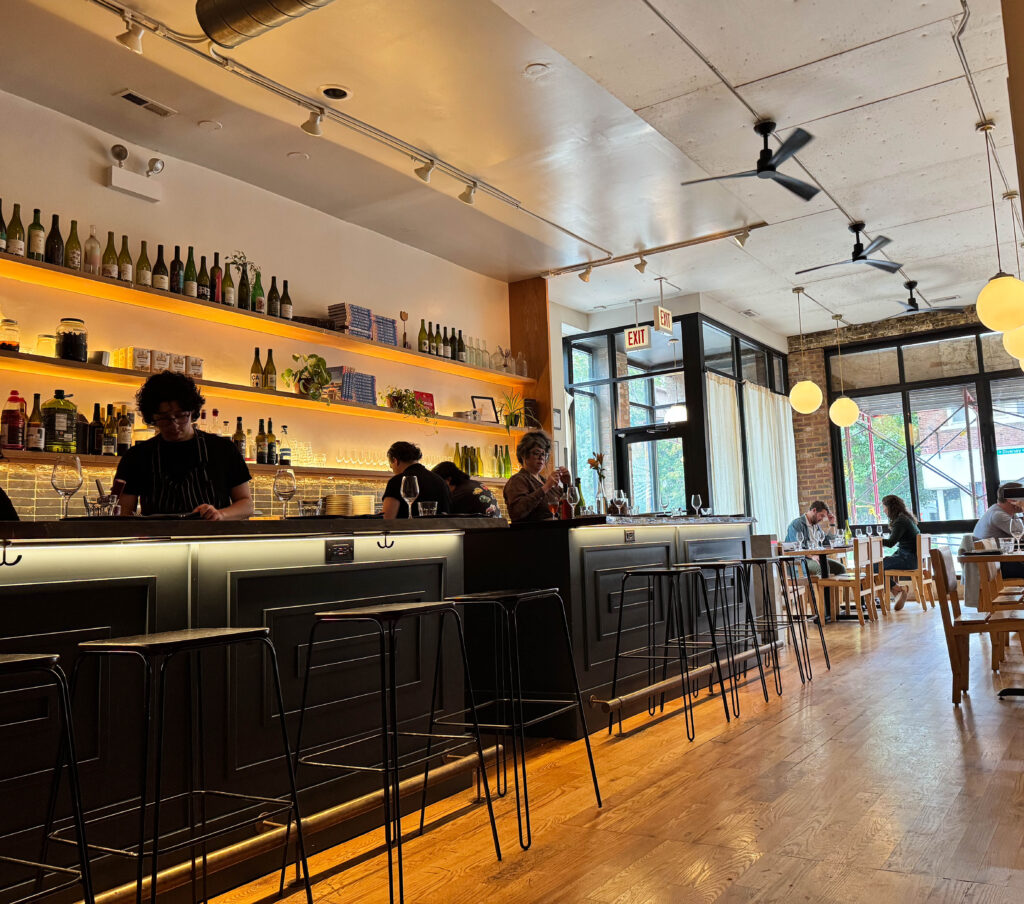
It’s Friday night, meaning that the week’s menu—which launched on Tuesday—has nearly reached its culmination. Of course, certain recipes (like the bread) are still subject to daily variation while other ingredients and ideas may persist throughout the month.
But it’s easiest to think of CDP’s cuisine as a series of five-day spurts: a movement from free experimentation (for the concept’s midweek devotees) toward the increasing refinement that safely awaits the weekend crowd.
Tonight, the dining room fills within an hour of opening, comprising all the 20- and 30- and 40-somethings one might expect to take the leap on a place that’s a little more of a cult favorite. Yet, I also spy a four-top of diners who must be in their 70s or 80s, and, while I cannot confirm that the table is drinking natural wine, their mere presence seems to confirm the far-reaching appeal of good, bold food without any needless frills.
(The bar, for what it’s worth, remains nearly empty during my time here—meaning that it likely remains a safe bet when the books look full.)
Given that this restaurant is so sharply defined by the dynamism of the kitchen, there’s usually not much else to report at a structural level. However, on this occasion, I must absolutely note Emily Sher’s return to Cellar Door Provisions on a permanent basis after a hugely successful run as wine director of Elske and Creepies.
Indeed, if we are to put any wider critique of low-intervention wine aside for the moment, Sher excelled in core duties of any buyer: offering stylistic breadth, drinkability, and an occasional touch of rarity at the most minimal markups the business model could bear. Outside of what I am lucky enough to drink at Smyth, it’s hard to think of another program that put as many exceptional bottles within reach in any given year.
While an array of glass pours shapes CDP’s approachability, Sher’s return should also help to shore up a bottle list that has—at times—gotten a bit lean. It’s hard to know when exactly her influence will fully be felt, but I think it’s always worth working through a selection that proves difficult for many patrons who otherwise admire what Pikas and Cochran offer.
These are the wines that catch my eye:
- 2023 Jean-Pierre Robinot “Fêtembulles” (Pineau d’Aunis/Chenin Blanc) [$70 on the list, $39 at national retail]
- 2018 Michel Guignier “Granite” (Gamay) [$80 on the list, $40 at national retail]
- 2022 Bruno Schueller “Pigé” Sylvaner [$85 on the list, $48 at national retail]
- 2024 Corentin Houillon “Veronnet” Blanc (Altesse/Jacquère) [$86 on the list, $45 at national retail]
- 2022 Domaine Sauveterre “Vin d’Montbled” (Chardonnay) [$88 on the list, $44 for 2021 vintage at national retail]
- 2020 Valentin Zusslin Crémant d’Alsace Rosé (Pinot Noir) [$90 on the list, $44.99 at national retail]
- 2018 Clos Fantine Faugères “Cuvée Courtiol” (Grenache/Mourvèdre) [$98 on the list, $48 at national retail]
- 2022 Rabasco “Damigiana” Rosato (Montepulciano) [$99 on the list, $49 at national retail]
- 2022 Domaine du Perron “Les Etapes” (Pinot Noir) [$107 on the list, $56 at national retail]
- 2023 Domaine de la Cotelette “Ch…” (Chardonnay) [$110 on the list, $58 at national retail]
- 2022 Collecapretta “Il Burbero” (Sangiovese/Merlot) [$111 on the list, $49.99 at national retail]
- 2020 Domaine Derain Bourgogne “Les Riaux” (Pinot Noir) [$115 on the list, $52 for 2023 vintage at national retail]
- 2023 Strohmeier “TLZ Weiss No.14” (Pinot Blanc/Chardonnay) [$120 on the list, $55 at national retail]
- 2022 Antoine Couly “Bigarree” (Gamay) [$128 on the list, $69.99 at national retail]
- 2017 Pācina Toscana (Sangiovese) [$128 on the list, $66.99 at local retail]
Now, I’ll concede that there’s not really an obvious place for lovers of Pinot Grigio, Sauvignon Blanc, Napa Cabernet, Bordeaux, Syrah, or Zinfandel to land, and it’s hard for any consumer to buy into the full expanse of the restaurant’s menu if they feel arbitrarily separated from what they’d most prefer to sip.
Admittedly, Cellar Door Provisions is the one place in the city—if not the country—where I really have to go out on a limb and submit to the idiosyncrasies of a sommelier’s vision (rather than, in the very worst cases, punt on an inoffensive bottle of Champagne). I’m actually more open to taking such a leap than most, and I’ve never thus far found myself venturing entirely into uncharted territory (even if that only means I’ve seen or heard a given producer’s name before).
Here, I immediately gravitate toward the Robinot (which I actually ordered back in June) and the Crémant Rosé: somewhat atypical expressions of sparkling wine that scratch the itch at a lower price than most esteemed appellations can offer.
For whites, the “Veronnet” (a blend of two native grapes found in the Savoie) offers the kind of freshness and aromatic depth one might desire from a Sancerre. There are also two expressions of Chardonnay on offer: the tropical, somewhat cidery Domaine Sauveterre and the buttery (but still bright, reductive) Domaine de la Cotelette. That said, the Strohmeier occupies a perfect sweet spot for my palate, offering a trace of texture (drawn from skin contact) while balancing it with the kind of acidic structure and salty edge that work so well throughout the menu.
For reds, a couple of Gamays (the soft, jammy “Granite” and sharp, Alpine “Bigarrée”) and Pinot Noirs (the precise Domaine du Perron and more full-bodied, whole-clustery Domaine Derain) play to the concept’s neo-bistro feeling. The Collecapretta and Pācina, in turn, provide more of the robust tannic structure many drinkers do seek (albeit with the kind of open-knit fruitiness that low-intervention practices can lend). There’s also a funky Grenache to be found, yes, but the Rabasco hits the mark for me. This rosé of Montepulciano offers an elegant, layered expression of an otherwise foreboding grape, and it’s more than capable of matching the chefs’ lighter fare too.
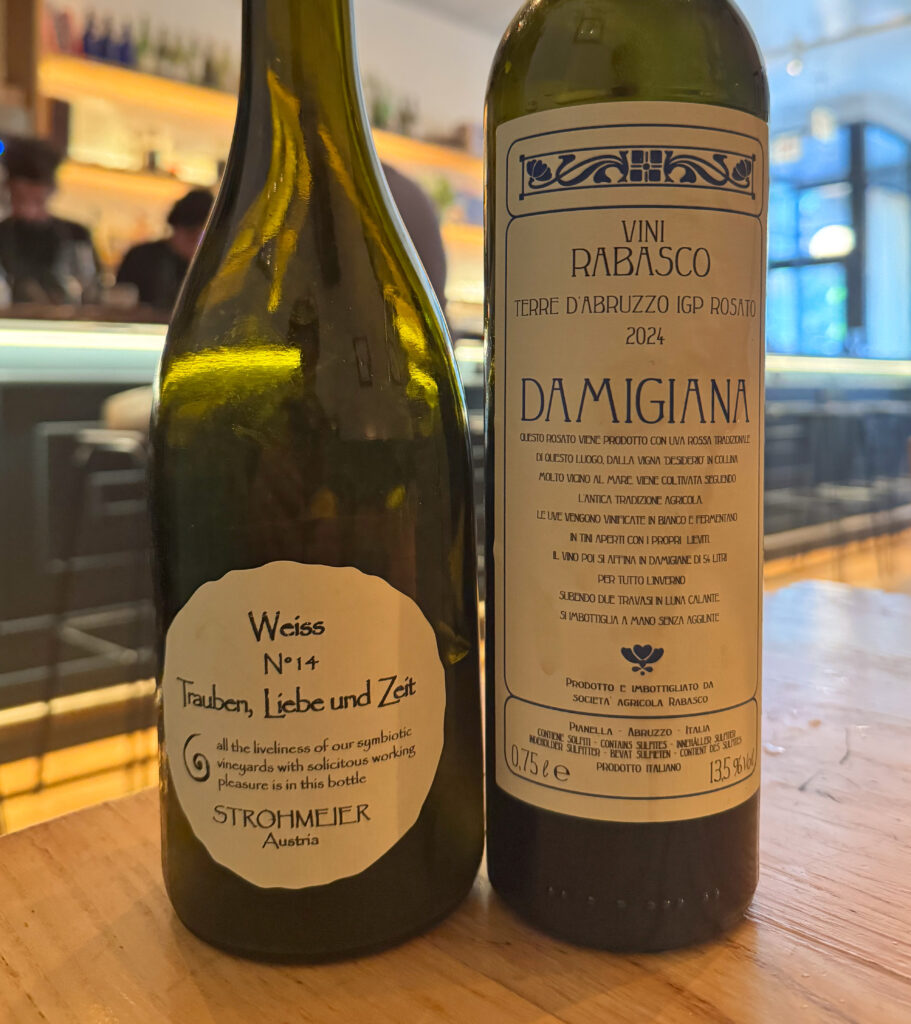
Ultimately, with most selections landing between $75 and $125, conditions are ripe to look beyond the rigid hierarchies that classic appellations rightly or wrongly enforce—and that beverage programs frequently echo by locking bottles of any quality beyond a $200 or $300 threshold.
In fact, with markups rarely exceeding a mere 100% on top of retail price across the board, it seems clear that CDP wants to encourage conversation (about), experimentation (within), and appreciation (for) natural wine in the friendliest way possible. The idea being that guests should set aside their expectations and learn to respect the overarching philosophy that connects what the featured vintners do with their grapes to what Pikas, Cochran, and the rest of the team do when sourcing and preparing their ingredients.
This idea—the trading of what’s conventional or even safely marketable for the extreme pursuit of a singular, personal style—lies at the heart of a new kind of gastronomy (and a broader conception of “luxury”) rooted in authenticity, however polarizing, over trite, lowest-common-denominator appeal.
Other than Smyth, it’s hard to think of another concept in Chicago that wields wine so boldly and obstinately to make a larger aesthetic point. And yet, to this day, I’ve never once been disappointed by what ends up in my glass.
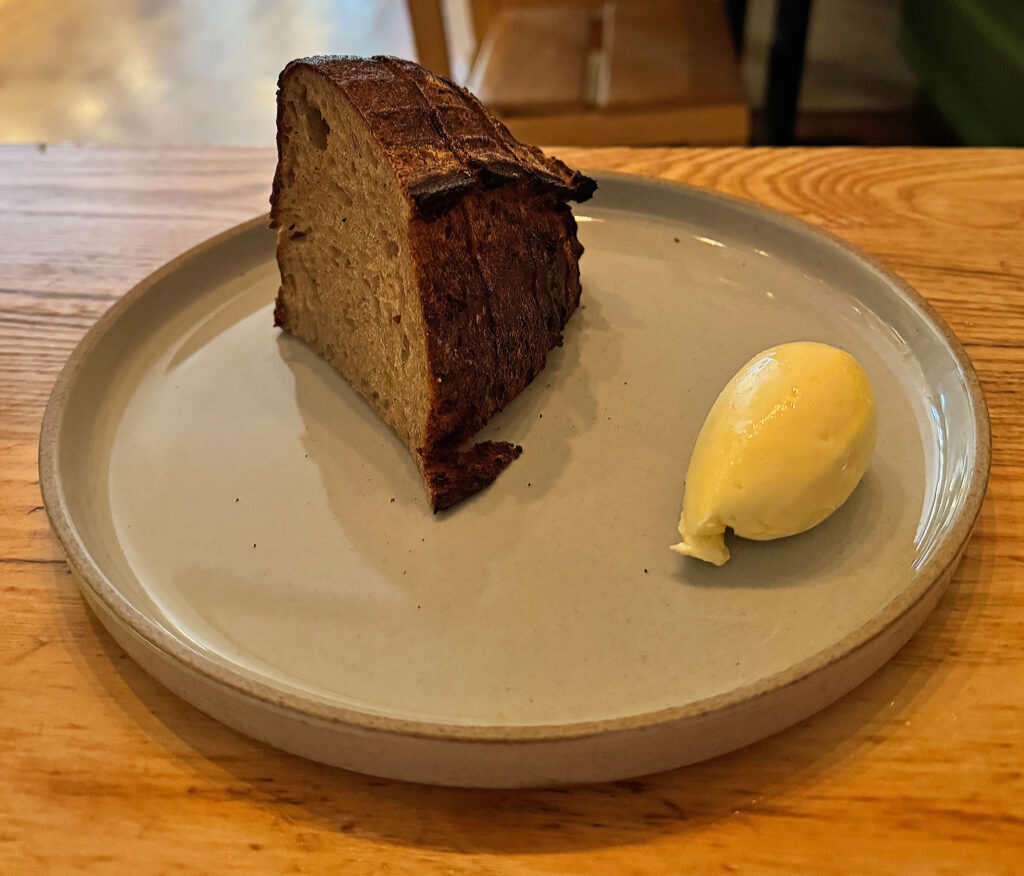
Tonight (as with any night at Cellar Door Provisions), the meal begins with bread—more particularly, a “Whole Wheat Masa Porridge Bread” ($10) whose exact style I have never encountered at the restaurant before.
Texturally, the loaf is characterized by a pleasing, moderate crunch throughout the crust and a slightly firmer crumb than I am used to. However, the bread’s interior is imbued with a wonderful blend of sweetness and toasty earth that turns lip-smackingly tangy with the application of an accompanying kefir-cultured butter. Truly, the flavor here is impeccably balanced and borderline profound. This makes for one of the finest examples of the form I have ever tasted from Pikas.
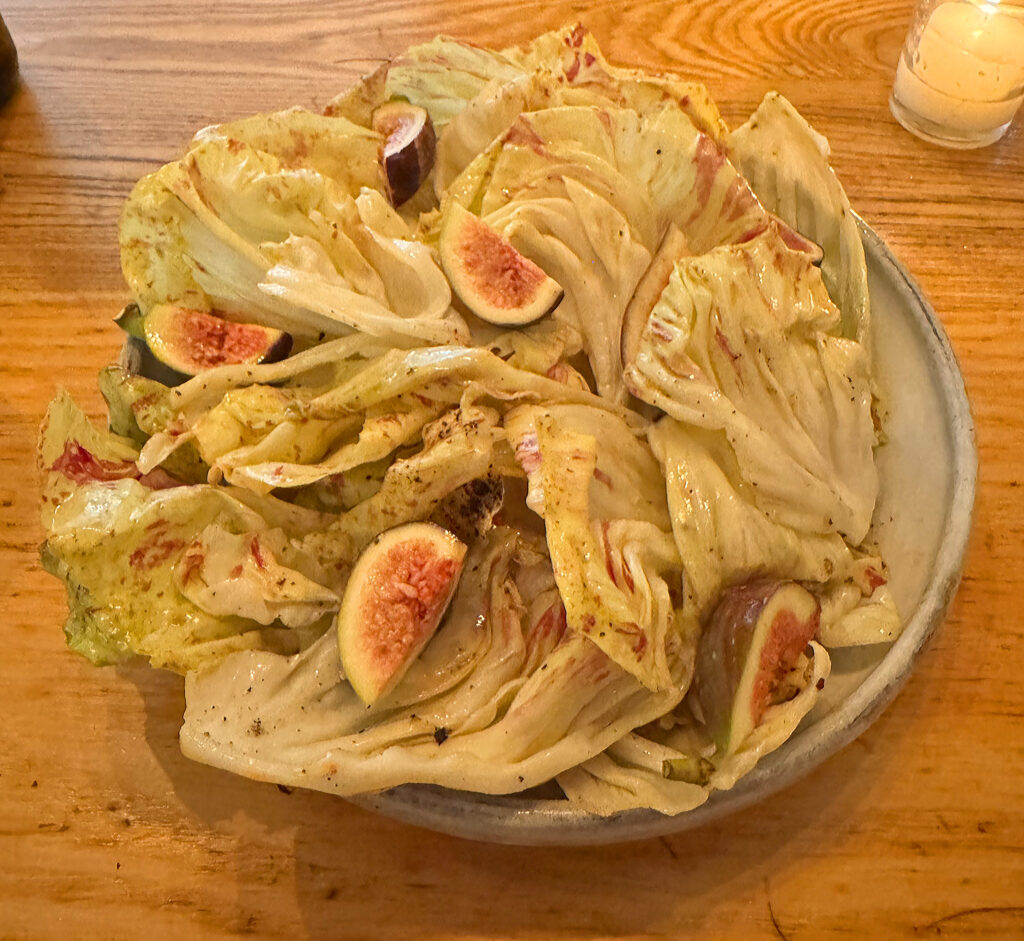
Arriving next, the “Salad of Bel Fiore Radicchio” ($18) follows in a long line of leafy compositions that have, alternatingly, ranked among the kitchen’s most inspired and challenging of preparations.
Visually, the present recipe certainly looks the part with its overflowing (always over the edge of the bowl) chicories and crowning segments of Black Mission fig. The recipe’s core juxtaposition—of crunching, bitter greens and rich, dark fruit—seems sound on paper, yet experience has taught me that the balance could certainly veer toward too much of that same bitterness. Thankfully, an accompanying caper berry vinaigrette and some chunks of gorgonzola dolce round out any rough edges, providing a range of sharp, briny, tangy-sweet, and nutty supporting notes that shape a salad of considerable depth (even decadence!). If I had to make one critique, it’s that a few slices of fig are blemished by inedible pieces of stem. Still, this represents a minor gripe relative to what is otherwise a hugely successful dish.
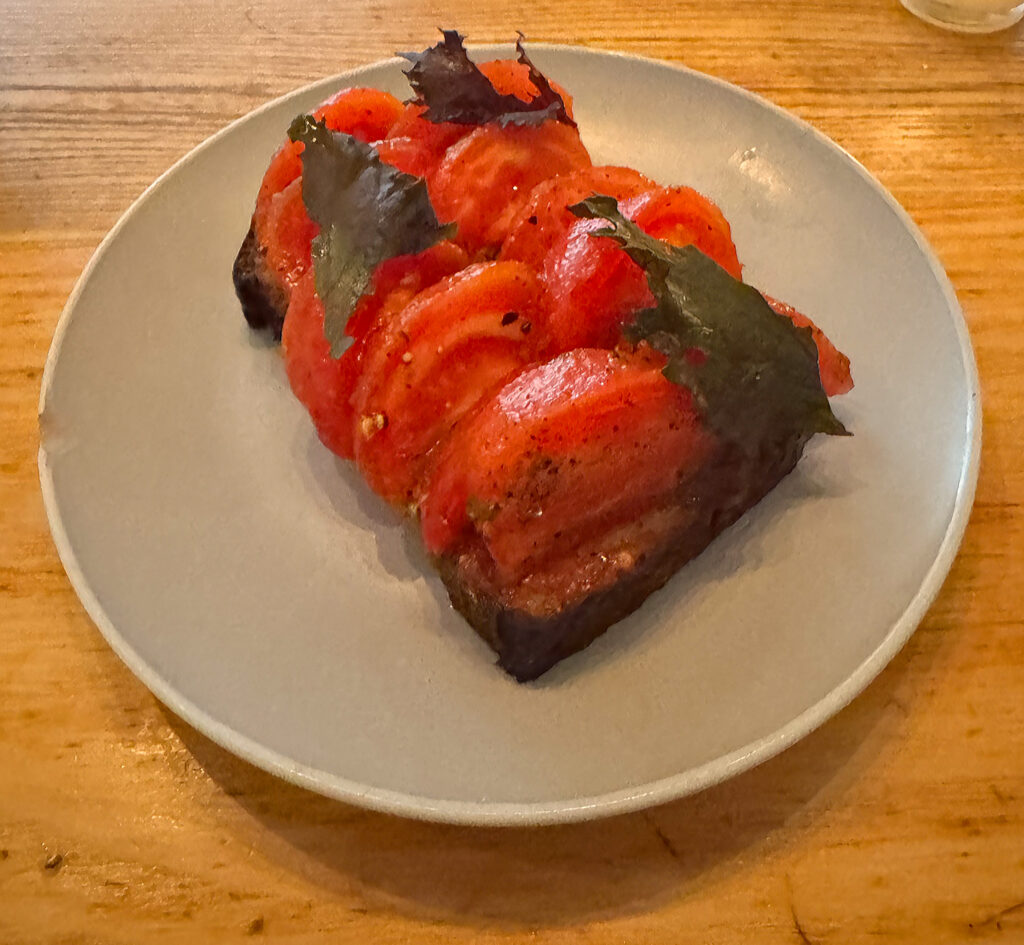
The “Pan con Tomate” ($18) constitutes an evolution of another longstanding CDP construction: one that sees fresh produce or interesting cuts of meat dressed and layered atop toasted pan de mie.
On this occasion, the finely-crumbed bread benefits from a coating of rendered beef fat before being piled with the titular tomatoes, which have been cured with saffron and finished with ample black pepper. Texturally, the toast is laden with so much juice that any trace of structure turns soft, soaked, and creamy. Correspondingly, the tomatoes are remarkably tender (and, surprisingly, rather subdued in their acidity). Instead, the ingredient displays a rich, somewhat savory expression that takes on a lasting, wheat- and honey-inflected sweetness through the drippy, messy finish. Yes, while this item a bit of a pain to eat, the flavor provided feels smartly composed and even (as far as produce goes) luxurious.
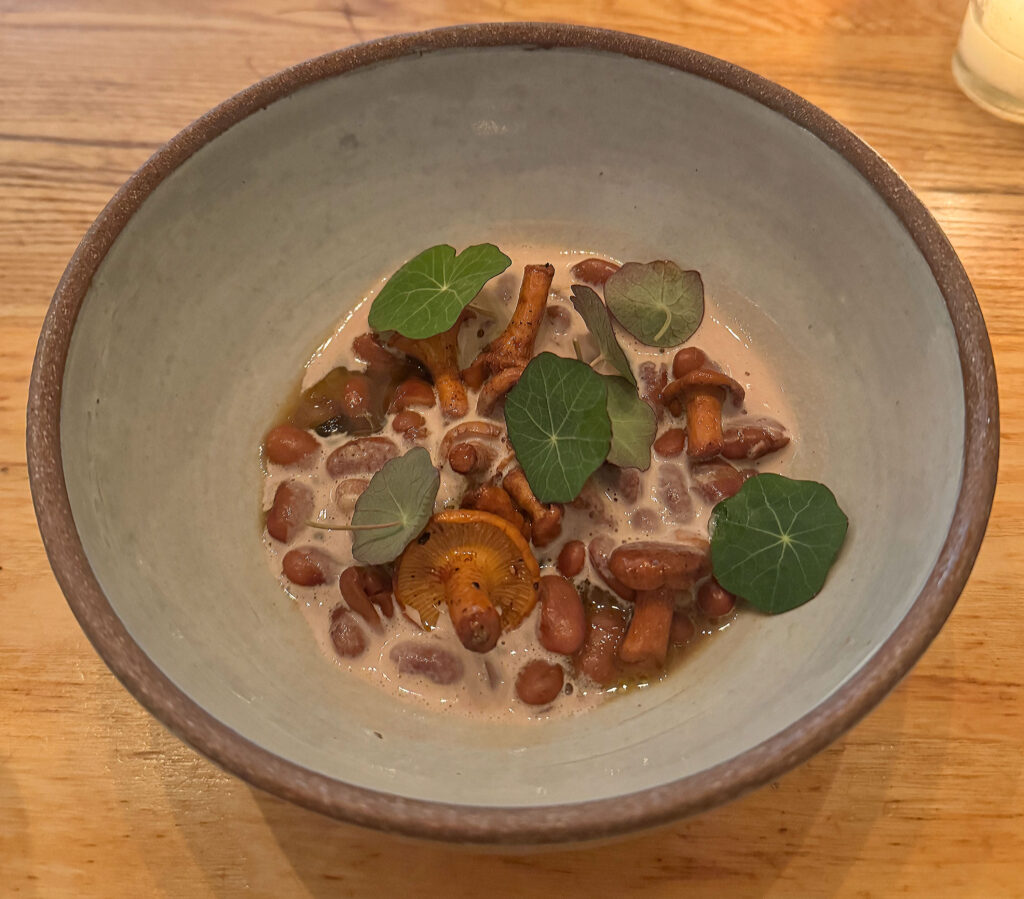
A composition of “Yellowfoot Chanterelles & Slow Cooked Borlotti Beans” ($20) sees the headlining fungus (a hardy winter counterpart to the famous golden variety) prepared in the worshipful manner that goes hand in hand with the restaurant’s sourcing.
Indeed, the resulting bowl comprises nothing more than the mushrooms, the beans, a walnut miso, a touch of sherry, and some nasturtium. On the palate, I savor the interplay between the subtle crunch of the chanterelles, the crispness of the occasional leaf, and the encompassing creaminess of the sauce. The beans, in turn, feel just a little grainy (rather than melding seamlessly into the mix). Still, the dish’s combination of earthiness, nuttiness, and ample supporting umami (all with a fresh, peppery edge) remains highly appealing. Thus, I enjoy working my way through the recipe even if it falls just a little short of the evening’s best offerings.
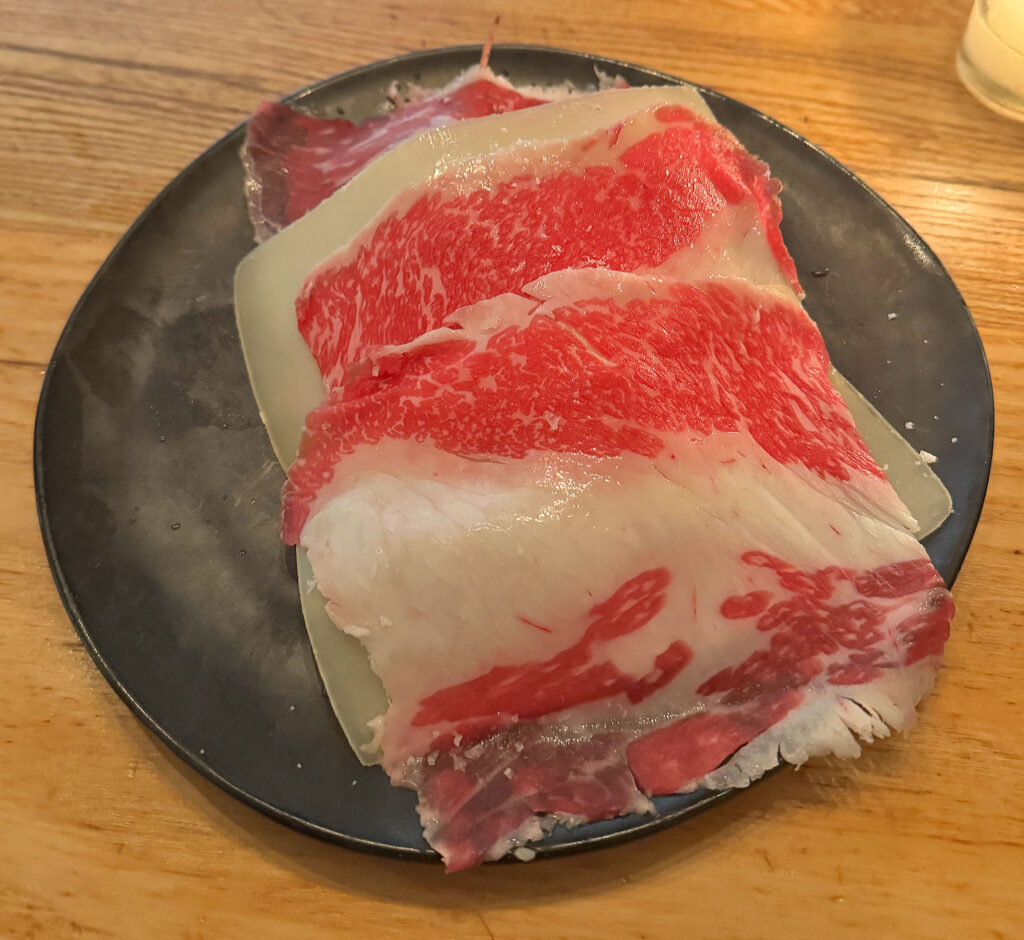
The “Slagel Farm Beef Carpaccio” ($22) comes out looking, appropriately, like a canvas of meat. Yet these sizable, fat-laden slices obscure layers of roasted Cherry Belle radish, red plum, sheep’s milk cheese, and candy onion vinaigrette that are hiding underneath.
Honestly, it can be a little difficult to cleanly slice through the carpaccio without effectively tearing it apart. But the beef itself is beautifully salty and melty—inviting the creamy, crunchy, and juicy counterpoints provided by the accompanying elements. Yes, opposite the meat’s own satisfying richness, one finds a sharp hit of cheese, some cleansing spice, and a faint note of sweetness. Nonetheless, I do think the recipe’s appeal is more textural than anything, and (with the dish being surrounded by so much produce) it’s nice to sink your teeth into a generous serving of flesh long before the entrées arrive.
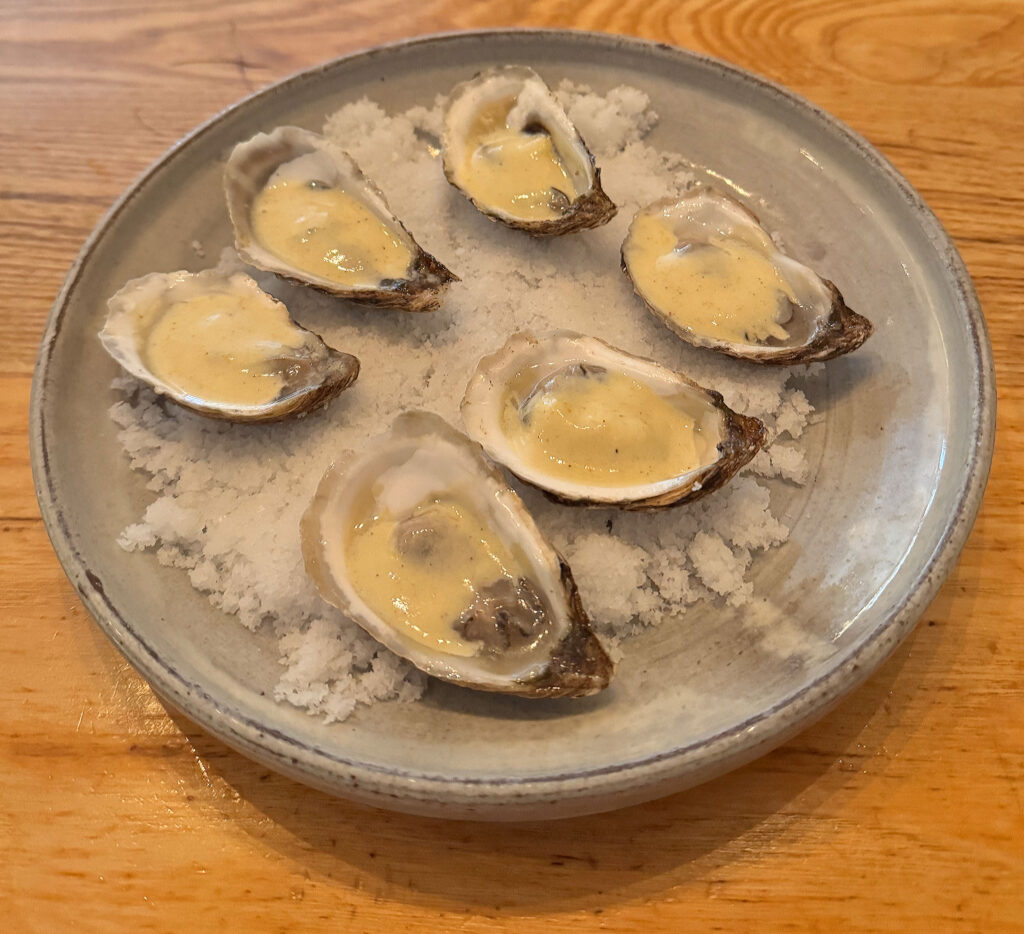
A plate of “Chebooktook Oysters” ($26) places Pikas and Cochran in direct competition with all the chefs serving any sort of raw, dressed bivalve throughout Chicago. Frankly, even when we’re talking about pricey tasting menus, I just don’t think there’s much you can do to impress guests in this sort of format. We all have a sense of what we’d like the shellfish to taste like, and that ideal is rarely aligned with any one kitchen’s creativity.
Still, on paper, a combination of roasted Lancelot leek, lamb fat, and white peppercorn sounds fairly appealing. On the palate, the oyster (a farmed New Brunswick variety known for its clean, balanced flavor profile) offers a remarkably smooth, cohesive slurp despite the moderate size (and perceived weight) of its actual meat. The rich, creamy sensation that follows comes charged with the most brilliant, caramelized kind of allium sweetness. This note then joins with the brine of the bivalve and the sharpness of the pepper to build a deeply satisfying, more conventionally savory finish. Overall, I can only eat my words and admit this is a masterful take on the traditional half-shell presentation that ranks among the highlights of the night.
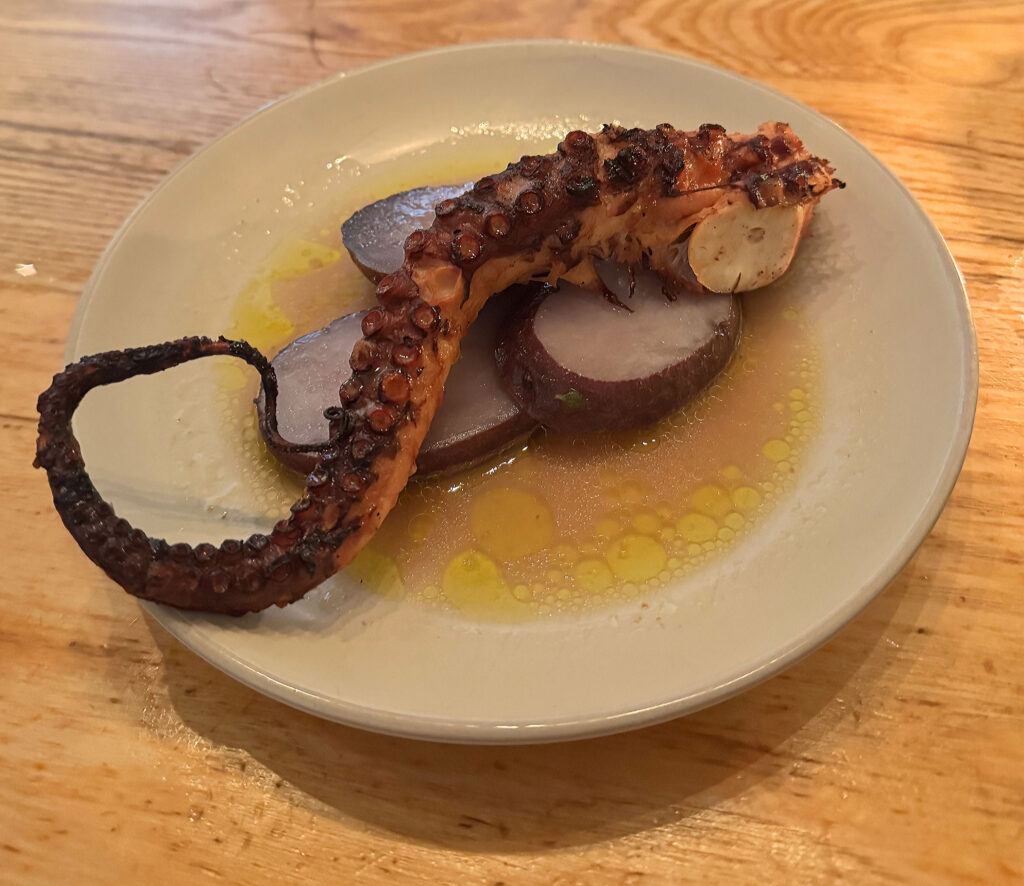
The ”Braised Octopus” ($28) centers on yet another ingredient that has long formed a staple at many of the city’s fashionable steakhouses and seafood grills. The cephalopod is part of a pretty pervasive repertoire, and a given chef either knows how to nail the texture or not—meaning that this course forms a good opportunity to test CDP’s technical prowess relative to a wider group of peers.
Lacquered with preserved lemon and burnt honey, the octopus (beyond being braised) displays the telltale charring signifying some time on the grill. This lends the very end of the arm a wonderful, curly crispness. However, it’s increasingly thick segments of the meat that impress me the most: each possessing the faintest trace of structure before yielding to a supremely buttery mouthfeel that ranks as the very quintessence of what can be achieved with this protein.
Against such a backdrop, the firmness of the accompanying confited potatoes (the Red Thumb variety) feels a little less appealing. Thankfully, the tubers prove creamier on the finish, lending undertones of earth and nuttiness to the mix. But ultimately, the octopus remains the star: building its own deliciously savory expression on the back of the salty citrus, some contrasting bitterness, and an elegant, anise-kissed sweetness derived from a sprinkle of fennel pollen. Yes, accounting for both texture and flavor, it’s hard to imagine the ingredient getting any better than this.
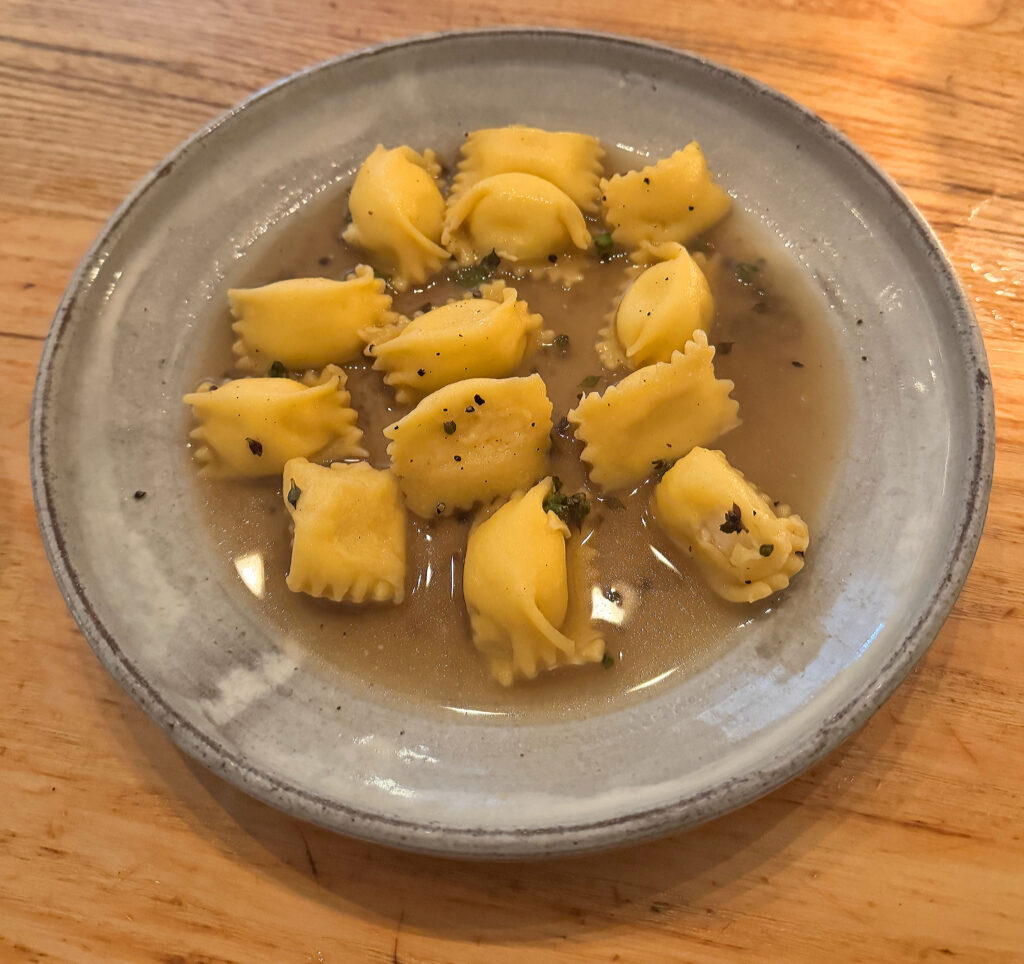
The team’s pasta dishes, while almost always technically accomplished, frequently strike me as a little too restrained. So, I’m rather eager to sample a “Three Sister’s Polenta and Fermented Corn Agnolotti” ($22) that sounds rather generously flavored.
Indeed, dressed with a jamón ibérico brodo and a touch of flowering basil, these crimped pockets of dough deliver incredible delicacy on the palate. The subtle chew of the pasta yields to the creamy filling—only for a bright, toasty sweetness to take hold, join with the powerfully hammy (though not overtly salty) broth, and unravel across a long, freshly herbal finish. Overall, I do still feel that the recipe only has just enough (rather than a true concentration of) flavor to succeed. Yet, by clearing that bar, the chefs have managed to compose a recipe that ranks among my all-time favorites within the genre here.
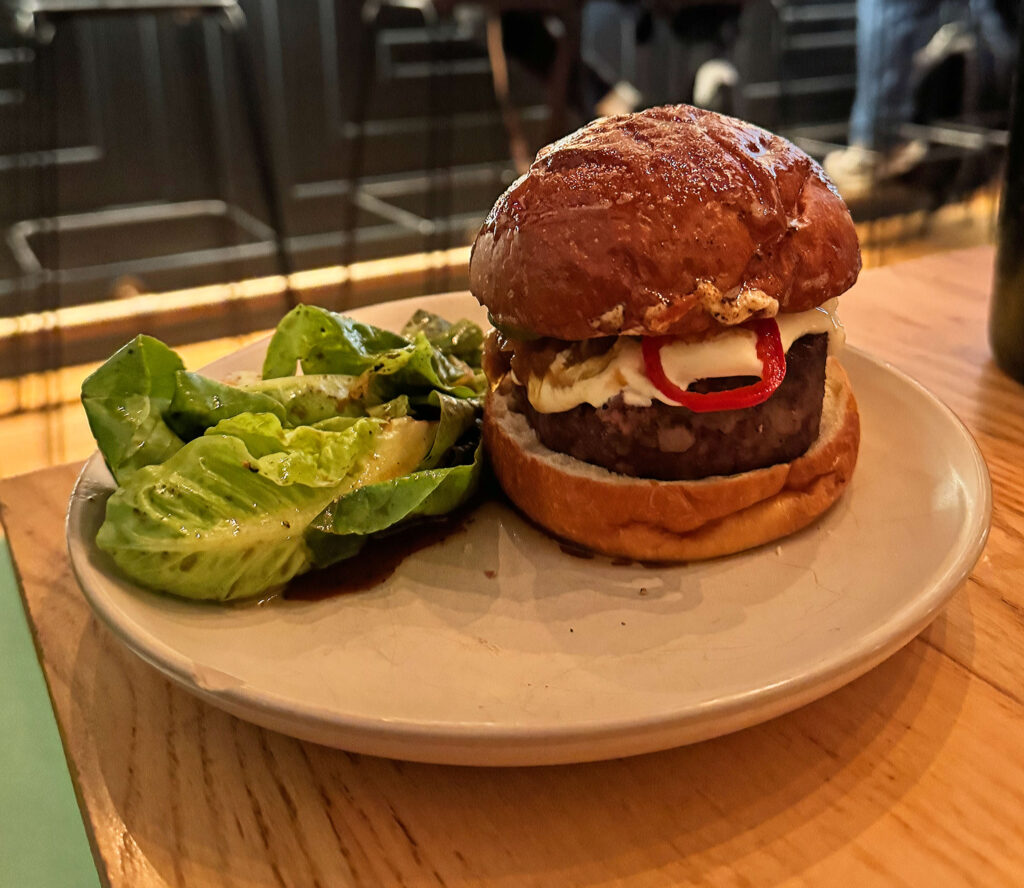
As we reach the menu’s entrées, I find it hard to resist the “Burger” ($20): a reliable, crowd-pleasing concession that one might skip (in the interest of trying more adventurous fare) but, for the sake of completion, allows me to get a full picture of the value proposition being offered tonight.
Dressed with an aioli, caramelized onion, some pickled Fresno chiles, and a side of Werp Farms lettuce (itself generously peppered and dressed with balsamic), this burger—as always—is defined by the heft and richness of the patty. Indeed, for all the sweet and tangy accompaniments, it’s remarkable how markedly the dish is defined by the savory, deeply satisfying flavor of the beef. On this occasion, I must note that the bun falls apart a bit more readily than I am used to. Nonetheless, this remains a benchmark example of the form whose finesse and purity have rightfully earned it a permanent place on the menu.
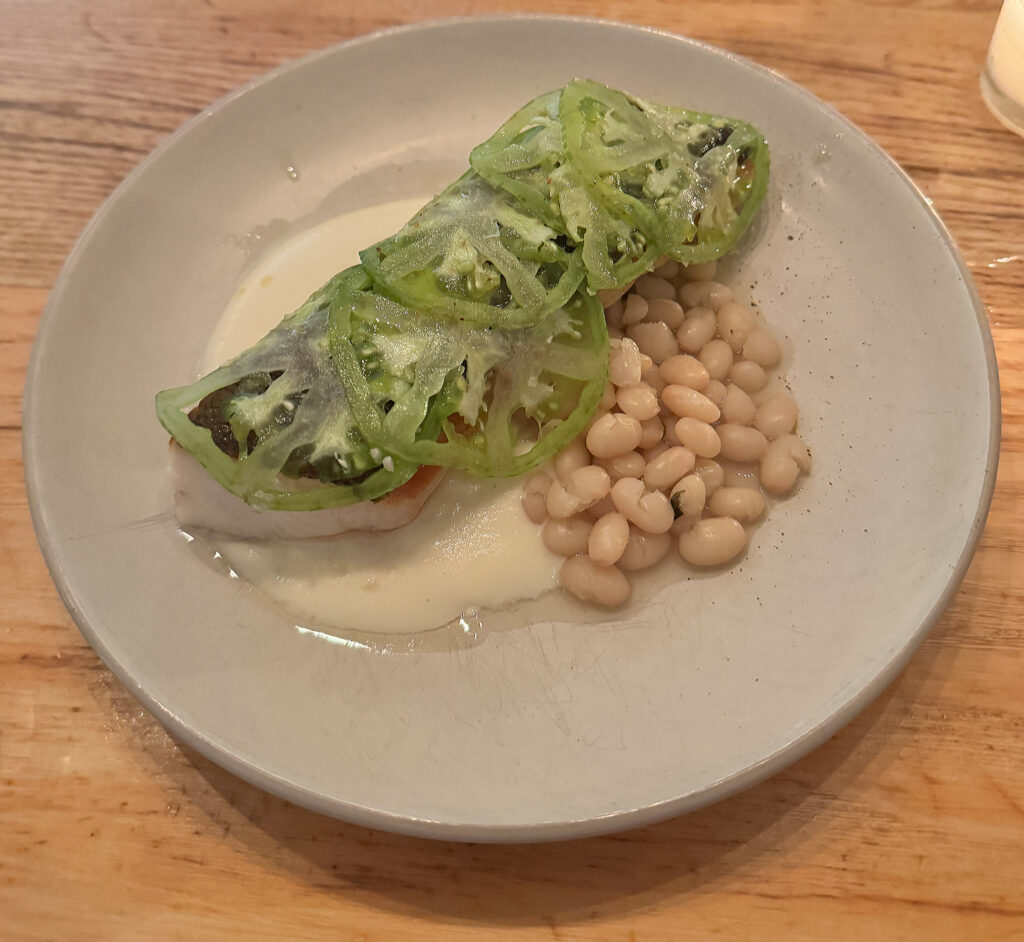
The ”Grilled Sablefish” ($44) strikes me as the more challenging of the two headlining plates—though that has more to do with personal preference and the inevitable comparison I must make to Oriole’s longstanding work with the titular ingredient.
Here, the fish comes seasoned with katsuobushi (i.e., bonito flakes), draped with slices of shaved Green Zebra tomato, and served alongside Alubia Blanca beans in a sauce soubise. Fearing a repeat of what I encountered with the earlier Borlottis, I start with the legumes, which are wonderfully smooth and creamy and savory. The sablefish, in turn, possesses a mildly crisp, liberally salted layer of skin that serves to frame a moist, tender interior. Even the tomatoes, cut as they are, meld smoothly with the other elements (while offering their own burst of juiciness).
Unfortunately, when it comes to flavor, I do sense some TCA (a chemical compound associated with cork taint that can also contaminate produce via its packaging). Yet, midway through the dish, the effect fades, and I start to appreciate the creamy, soothing, and satisfying sensation that characterizes the recipe through the finish. Ultimately, I think some proportion of the tomatoes (which should have been more perceivably citric and sweet) was to blame for the flaw I encountered. However, I still found some pleasure in the textures on offer and the baseline of umami that the preparation attained.
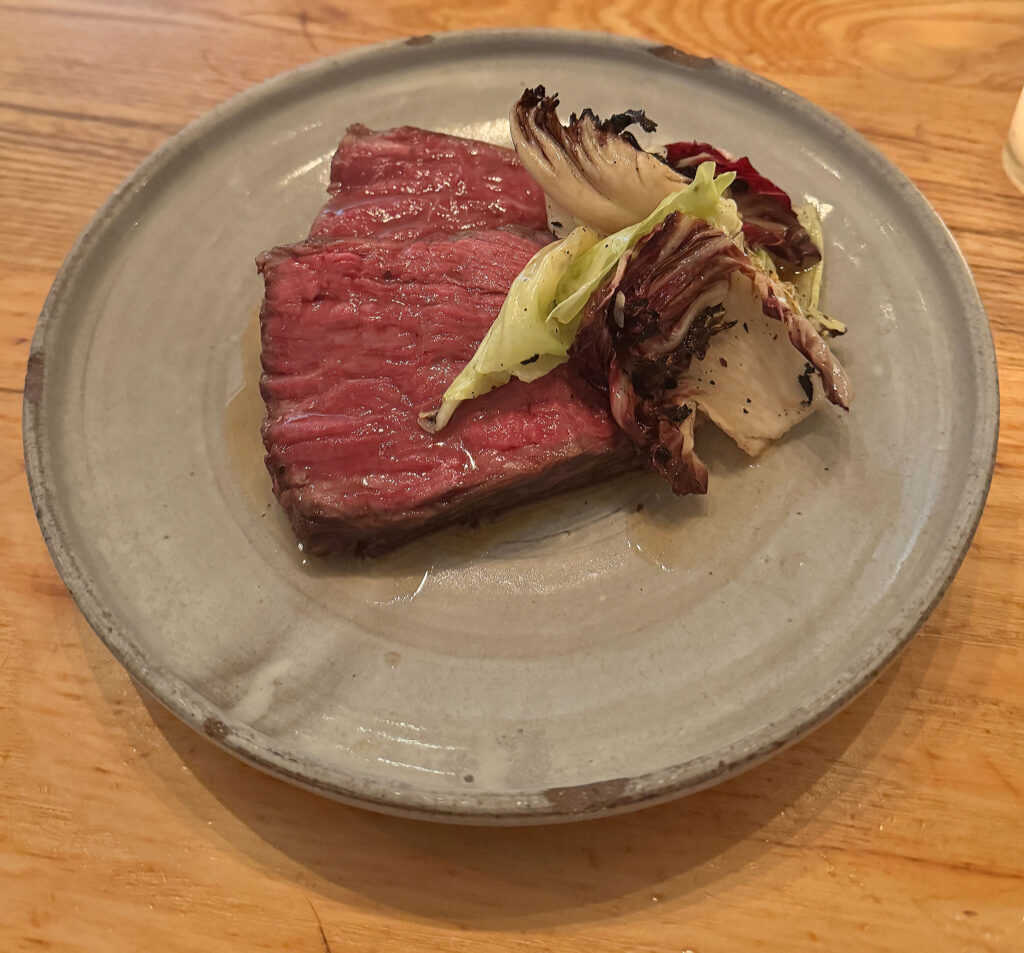
The final savory course on offer is titled “Bavette Steak Finished Over the Coals” ($42), and it represents the latest in a line of substantial meats that, I have found, do not always effectively translate the kitchen’s philosophy. Put another way: how do you balance the satiation diners expect from such an expensive serving of beef with the faithful pursuit of seasonal, creative cookery?
In textural terms, the cut more than fits the bill: displaying a kind of loose, juicy consistency that retains a hint of chew before spreading smoothly across one’s tongue. Against this backdrop, the accompanying leaves of Napa cabbage and radicchio offer bursts of crunch and an engaging bitterness. Yet it’s really the glaze made from candy cap mushroom (with its caramelized character) and a dressing of sage sanbaizu (an umami-laden vinegar) that really do the most to define the steak, ensuring each bite of the sizable portion remains invigorating on the midpalate and rounded (if only fleetingly sweet) on the finish. Overall, this is still not the kind of construction I come to CDP in search of, but it’s hard to fault the team’s work (or, otherwise, downplay just how well this item would pair with any heavier red wine).
Dessert, as usual, comprises three distinct offerings, each of which I try:
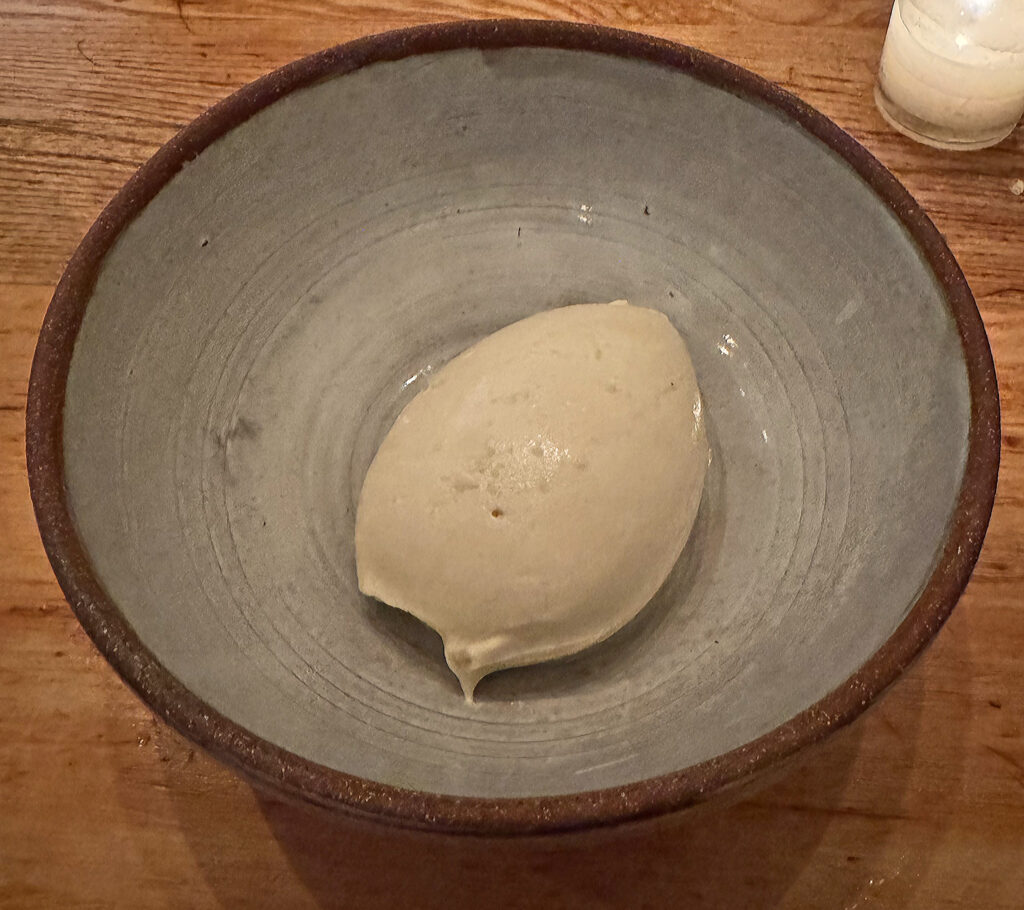
First, there’s the “Fiore di Latte Ice Cream” ($10)—a recipe I’ve seen championed by Feld this year that, effectively, celebrates the elemental quality of the dairy being used (rather than any distinctive flavoring).
Yes, made from milk, cream, and sugar (then topped with nothing more than a sprinkle of salt), the resulting scoop possesses a rich, seamless consistency that feels more like icing than any frozen treat. Flavor, in turn, is so purely and pleasantly sweet, yet the sensation is supported by a persistent freshness that makes each bite profound. Ultimately, this might just rank as the greatest ice cream in all of Chicago.
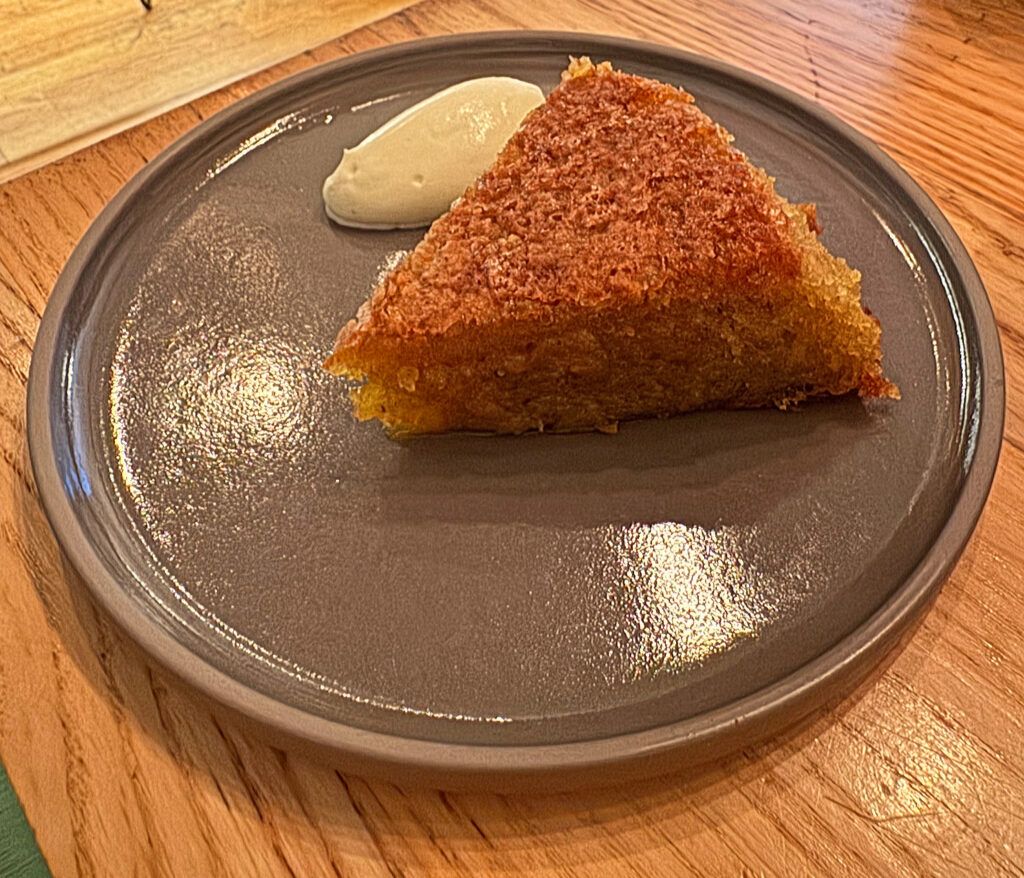
Next, we have the “Marzipan/Olive Oil Cake” ($12), which arrives warm out of the oven (a consequence of my early reservation time rather than any deliberate strategy I am told) with an accompanying dollop of unsweetened crème Chantilly.
Just visually, you know this is going to be good, and the recipe delivers: comprising a soft, loose crumb with a slightly custardy interior and a wonderful intensity of nutty sweetness throughout. Indeed, the flavor is so concentrated that the adjacent Chantilly is meant to soften (and thus delineate) the effect. But I think the preceding ice cream does a better job of pairing the cake, shaping a hot/cold and rich/fresh contrast that makes both dishes feel utterly stratospheric.
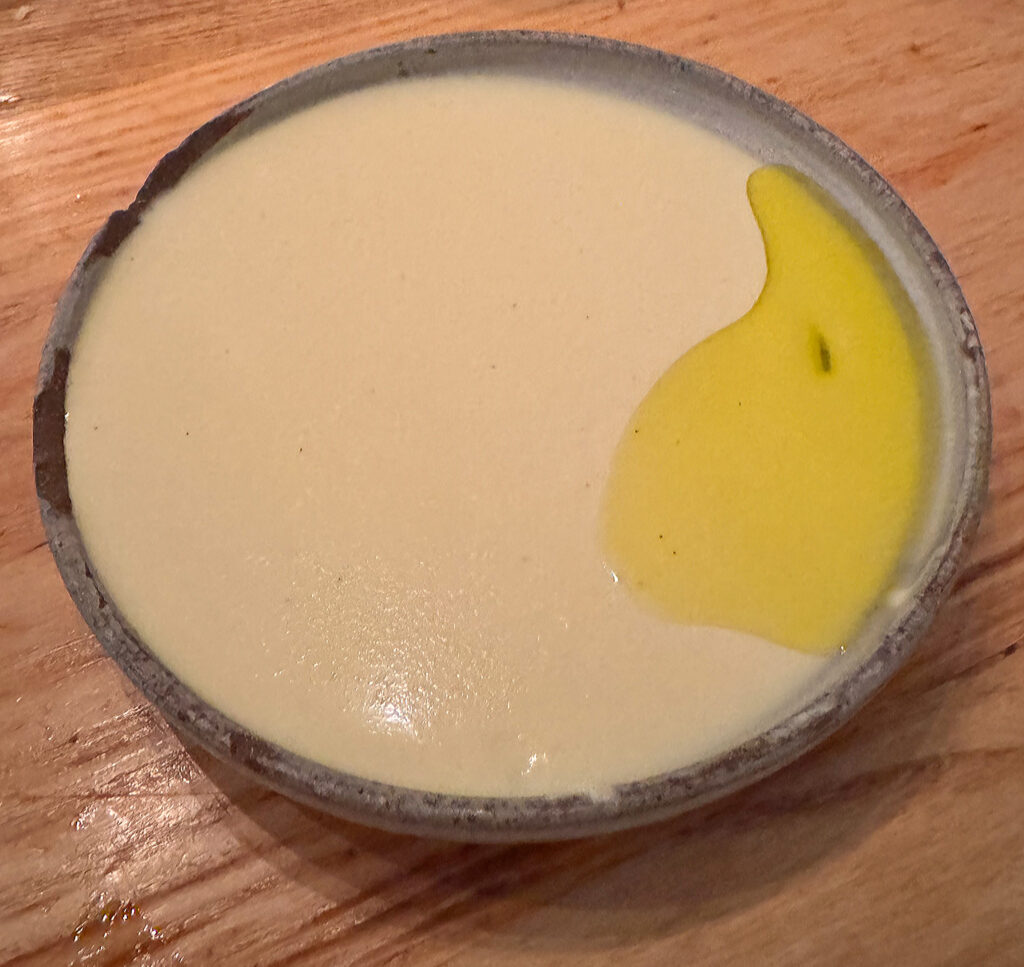
Finally, we have the “Panna Cotta & Hojiblanca Olive Oil” ($12), a stalwart recipe whose perfect creaminess, well-judged sweetness, vanilla depth, and jolt of fruity-bitter contrast are all on display here. That said, the other desserts are so superlative tonight that this item seems just a step behind by comparison. I’ll never regret ordering it though.
With that, the meal reaches its conclusion: spanning some 14 distinct dishes during a period of roughly 80 minutes. This is not the kind of pacing or portion sizing I expect many other parties of two could replicate (and parties of four or more, surely, would have to double up on the best of the plates).
However, true to the niche that Cellar Door Provisions occupies so well, it’s the kind of feast I really savor on the back of so many tasting menus: a showcase of sourcing, technique, and utter deliciousness that is unbound by suffocating structure, broad appeal, or the urge to concoct some sense of “experience.”
Instead, the highs come hot and fast with all the rhythm of an omakase yet little of the same delayed gratification. The rare lows (little more than kinks in their respective chains) are quickly forgotten. The chefs’ experimentation—even if it comes at the cost of ideas that deserved a longer life—can only be marveled at, for the pleasure it yields is so frequent and so substantial.
There’s a reason guests approach the kitchen and thank Pikas personally when it comes time to depart. He’s forged a restaurant that quietly and confidently overdelivers to such a degree that one really feels a solemn duty to acknowledge—and honor—it.
In ranking the evening’s dishes:
I would place the “Whole Wheat Masa Porridge Bread,” “Chebooktook Oysters,” “Braised Octopus,” “Fiore di Latte Ice Cream,” and “Marzipan/Olive Oil Cake” in the highest category: superlative items that stand among the best things I will be served in any restaurant this year.
The “Salad of Bel Fiore Radicchio,” “Pan con Tomate,” “Three Sister’s Polenta and Fermented Corn Agnolotti,” “Burger,” and “Panna Cotta & Hojiblanca Olive Oil” land in the following stratum: great recipes that achieved a truly memorable degree of pleasure. I would love to encounter any of these again.
Finally, there’s the “Yellowfoot Chanterelles & Slow Cooked Borlotti Beans,” “Slagel Farm Beef Carpaccio,” “Grilled Sablefish,” and “Bavette Steak Finished Over the Coals”—good—even very good—preparations I would always be happy to sample again (but that just failed to elicit an extra degree of emotion).
Overall, this makes for a hit-rate of 100% with some 71% of dishes reaching that “would love to have again” standard and a full 36% ranking among the best things I have eaten this year. These figures more or less match the numbers I reported in June (i.e., 93%, 71%, and 43% respectively); however, they also cement a clear improvement from those I presented in April (i.e., 93%, 50%, 14%) and January (i.e., 88%, 50%, 0%).
Any way you look at it, this is a monumental score that wholeheartedly affirms CDP’s status as a peer to (and a worthy alternative for) any of the city’s fine dining establishments. Of course, any diner subscribing to this argument needs to know what they are trading away in terms of ambiance, storytelling, and a sense of occasion. Lovers of wine must submit to chosen producers and styles that may be far outside of their comfort zone.
Yet, anyone committed to texture and flavor (to say nothing of some core sense of time and place) cannot possibly be disappointed by what they get in return. Plus, given that the concept is stacked with ex-Smyth, ex-Elske, and ex-Feld staff in its own right, what are we really missing when it comes to the passion and expertise that actually underlie a great gastronomic experience?
This is the question that the team implicitly and consistently poses with their singular, excellent work.