
Capping off a month of incredible dining (including a meal at Oriole that, for celebratory reasons, I chose not to transcribe), we have Kasama.
In six short years, the restaurant has become one of Chicago’s most emblematic. Yet the breadth and persistence of its popularity has almost made the concept passé: as in, “only clueless tourists and transplants wait in that winding line when you can preorder, when the pastries aren’t even that good, when the savory fare at Uncle Mike’s Place is way better.”
The tasting menu, which has climbed in price from $185 (back in 2022) to $325 today, doesn’t really weigh in conversations regarding the best of the city’s fine dining. One hears plenty about Valhalla ($198), Cariño ($200-$220), and Feld ($225) these days while Oriole ($325-$375) and Smyth ($425-$475) comfortably sit in the upper echelon. There’s nothing particularly polarizing about the way Kasama cooks—I think of Ever ($345) and Alinea ($375-$495)—yet it’s almost easy to forget that chefs Tim Flores and Genie Kwon also hold two Michelin stars.
For a certain kind of diner (I want to say it’s the same sort of person who chafed at Smyth’s third star), this honor was merely confirmation that Bibendum has lost the plot: that the once-friendly mascot now only wishes to attach himself to what’s fashionable and exclusive rather than rewarding places that are quietly putting in the work.
Basically, Kasama’s tasting menu is a one-and-done pilgrimage with a fairly static menu, few experiential thrills, and chefs who are frequently absent. Those Michelin stars (as the single star did) wrongly fuel the popularity of the daytime concept, whose longs lines and social media cachet wrap back around to promoting the fine dining side. The whole operation amounts to a kind of self-perpetuating hype machine that real Chicagoans steer far clear of.
Since first writing about Kasama’s tasting menu in 2022, I cannot say I’ve really been back—save for a spur-of-the-moment reservation in September of 2024. That said, I’ve consistently ordered from the bakery side of the business for years. Yes, in a city where so many of the best pastries really do demand you wait in line, there’s something to be said about walking out the door with a few dozen croissants and cakes and buns without even breaking a sweat. There’s something to be said about chefs who make their work eminently accessible and shareable so long as you are capable of doing just a little bit of planning.
In any case, Kasama’s tasting menu has clearly reached a point of maturity and increasing acclaim that—if I am really serious about evaluating Chicago’s greatest restaurants throughout 2026—demands another look.
Even if the critiques I referenced above are true, Flores and Kwon are still some of the city’s best culinary ambassadors. In fact (and not to spoil too much), I think I can accept the spirit of those critiques and still contend that Kasama is fulfilling everything that Michelin and a certain subset of experienced diners (including myself) actually want.
Let us begin.
It’s a warm summer evening, and there’s no remaining trace of the sea of bodies that assembles here—stretching down Augusta all the way toward Wolcott—even at midweek. It probably didn’t help that Lollapalooza kicked off today, further swelling Kasama’s line with a swarm of revelers who (whether coming from near or from far) wish to fuel themselves with a taste of the city’s best.
These throngs—generally comprising a younger population, of whom many are explicitly drawn to the concept’s “modern Filipino” flair—form the only sort of adornment the restaurant needs. The building may be black, rectangular, almost fortress-like, and totally foreboding, but it brims with energy. Finally making it through those swinging doors (or just skipping past the queue entirely) carries with it an air of wonder: what riches will await me inside?
However, when one is ponying up for the tasting menu, the train of thought might run a little differently. This is clearly not the kind of quasi art gallery or pseudo townhouse or imposing commercial space that frames Chicago’s other fine dining spots in this price bracket. Now, to be fair, Kasama’s entrance (marked by sleek metal signage) does not sink to the level of a place like Kyōten—where guests are led to question if the place is even open. Yet, at $325 a pop, there’s little promise of any experiential thrill or what anyone who wishes to see or be seen would consider luxury.
The plan, after all, was not really to stage a tasting menu in this venue. Rather, Flores and Kwon embraced such an offering as a way to better manage the pains of the pandemic: fewer tables, spending more, kept safe by the regimentation that is so endemic to the format.
Certainly, the chefs’ pedigrees made such a pivot easy. But I would contend that they happened to launch at a key moment in Michelin’s own history: one during which the guide has turned away from its more amorphous descriptions of quality (i.e., “worth a stop,” “worth a detour,” “worth a special journey”) toward a manner of evaluating restaurants that consciously downplays the role of décor and service in favor of “top-quality ingredients,” “distinct flavors,” menus where “the team’s personalities and talents shine through,” and cooking that “elevates the craft to an art form, with some dishes destined to become classics.”
Thus, when you step through the door here in search of that two-Michelin-star experience, it’s enough for Kasama to dim the lights, place a few candles, and go about enhancing their daytime service with flourishes like hand towels and a welcome tea.
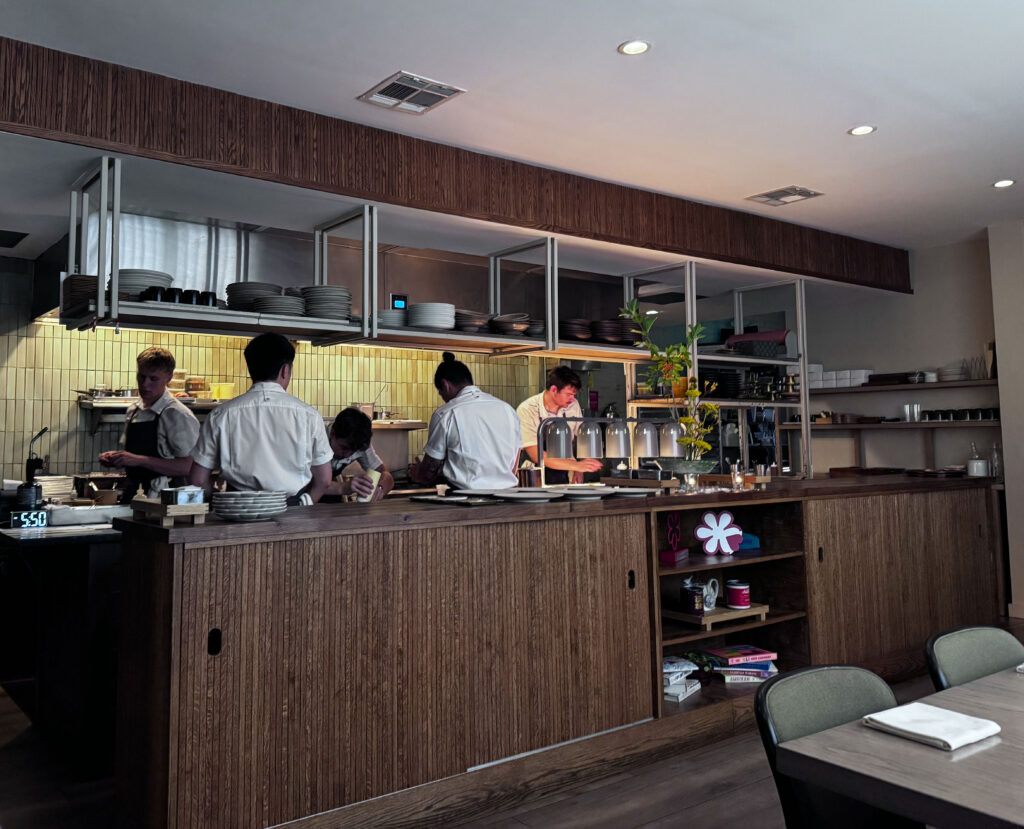
To be fair, the interior has undergone some minor renovation during the concept’s lifetime—I chiefly note the new counter (complete with lower compartments, shelves, and knick-knacks) that stands in front of the open kitchen.
Nonetheless, the expression of hospitality remains fundamentally the same: intimate, confident, disarmingly friendly, and shaped by the utmost mechanical precision when it comes to providing refills, replacing napkins, clearing plates, and conducting the pace of the meal.
(I’ve seen people complain online about their evening proceeding too quickly, and I can see how that might detract further from any desired sense of occasion. Still, there’s something to be said for a kitchen that can throw down hit after hit—compounding the diner’s pleasure—without a single dull moment.)
Admittedly, the team does not catch the fact that a member of my party is left-handed on this occasion, yet it’s not as though that ever really dampens an otherwise enjoyable dinner.
When deciding what to drink alongside their tasting menu, guests are presented with a wide variety of options befitting the caliber of dining: 11 wines by the glass (spanning Champagne, Riesling, Chardonnay, Barbera, and Malbec), three beers, one sake, and two pairings—with ($195) and without ($95) alcohol.
Eight cocktails—priced at $20 each—and a matching set of five spirit-free selections (from $8 to $13) probably form the most interesting category, for they allow the team to craft recipes that speak more to Kasama’s “modern Filipino” theme (or, at least, to tastes that transcend what can simply be bottled and sold).
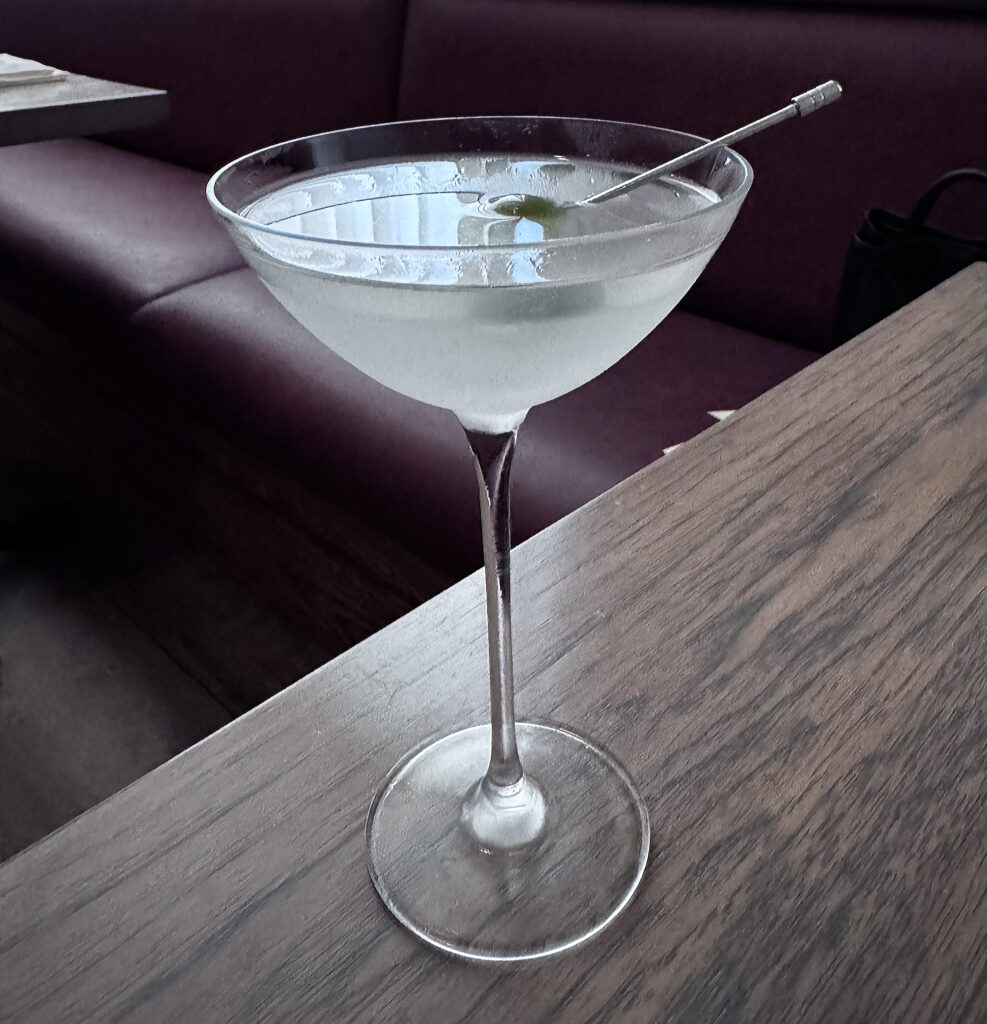
A “Dongchini” combines vodka, Castelvetrano olive, and flavors of the same white kimchi from which this tipple takes its name. Indeed, while those notes of tang and fermentation are present, they are skillfully woven into a clean, bracing rendition of a martini that—in both creativity and execution—is not far off of the kind I’d get at Elske (which I consider to be the gold standard in a fine dining setting).
The ”Lolita” (a clarified milk punch made with V.S.O.P. Cognac, rum, strawberry, and lychee) does even better: delivering all the roundness, sweetness, and transparency one expects from the form while perfectly integrating the weightier spirits in a way that ensures the fruity components never feel cloying.
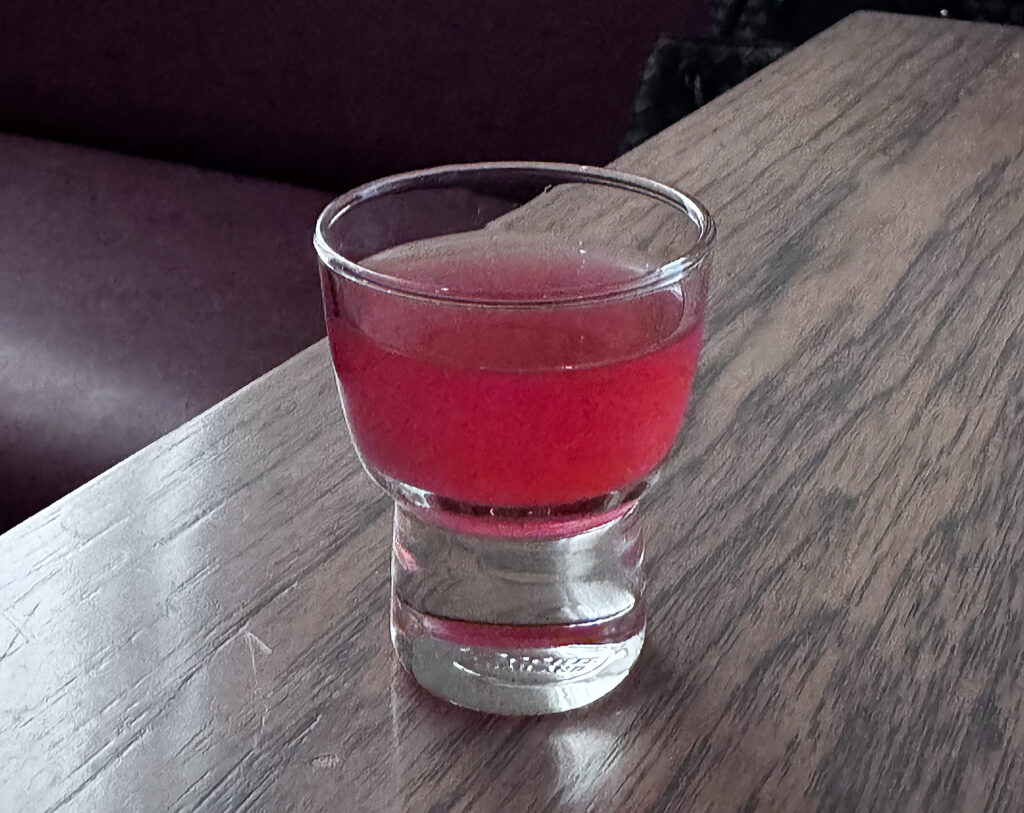
I should also mention the “Hibiscus Tea”—offered to each guest on arrival—whose jolt of calamansi (opposite the flower’s own ample tartness) is perfectly judged and invigorating. This welcome drink is not quite as elaborate as the amazakes one finds at Smyth, yet it performs well when compared to the offerings at Feld or Oriole.
Of course, I always pay a disproportionate amount of attention to the wine program, and I am happy to note that the bottle list has definitely fleshed out a bit since my meals here in 2022.
Still, aligning with a concept that is certainly gastronomic but not entirely concerned with being a destination for oenophiles, the selection remains concise—comprising fewer than 30 items, of which the following catch my eye:
2024 Massican Pinot Grigio [$63 on the list, $26.99 at local retail]
2025 Carlin Pinson Sancerre “Manoline” [$90 on the list, $38.99 at national retail]
2023 Guy Breton Fleurie [$93 on the list, $43 at national retail]
2023 Dönnhoff “Niederhäuser Hermannshöhle” Riesling Spätlese [$138 on the list, $64.96 at local retail]
2020 Donatella Cinelli Colombini Brunello di Montalcino [$176 on the list, $74.99 at local retail]
2023 Joseph Drouhin Gevrey-Chambertin [$213 on the list, $104.95 at local retail]
NV Krug Champagne “Grande Cuvée Edition 172ème” [$390 on the list, $255 at local retail]
2022 Génot-Boulanger Puligny-Montrachet 1er Cru “La Garenne” [$432 on the list, $210 at local retail]
NV Laurent-Perrier Champagne “Grand Siècle Iteration N°27” [$480 on the list, $295 at local retail]
2019 Grgich Hills Estate “Yountville – Old Vine” Cabernet Sauvignon [$600 on the list, $182 at national retail]
Stylistically, the list does a good job of catering to every palate and price point by stocking a range of popular grapes and styles sourced, largely, from their signature regions. Producers like Massican, Breton, Dönnhoff, and Drouhin offer a certain degree of name recognition and, correspondingly, guarantee a certain baseline of quality. However, it’s not hard to find a crisper or richer or sweeter white—as well as a more elegant or robust red—depending on the style one favors.
Champagne and Pinot Noir remain the categories with the most options (most of which I did not transcribe): ones inviting guests to spend $100, $200, $300, or beyond depending on how motivated they are to splurge. I can appreciate the logic, for these are approachable, adaptable, and ageworthy wines that will have little trouble matching the full breadth of Kasama’s cuisine. Otherwise, a nice bottle of white Burgundy and some pricey Cabernet Sauvignon (this is Chicago after all) ensure that no money is being left on the table.
Markups for this sample range from 53% to 230% on top of retail price, with a mean of 118% and a median of 114%. Discounting the Grgich Hills (which, I think, suffers from having declined in value since release), this is a perfectly fair premium to be charging and one—particularly—that ensures the Dönnhoff, the Burgundies, and the Champagnes (i.e., those options I would personally choose) offer a respectable degree of value.
Overall, as I said above, this is not the sort of bottle list that makes Kasama a destination in its own right (the singular appeal of “modern Filipino” fine dining vision and consequent difficulty booking a reservation make sure of it). However, it is way more thoughtful and generous than it needs to be: distinguishing the restaurant as a place that wants to meaningfully cater to guests’ divergent tastes rather than simply squeezing oenophiles for everything they can.
When one factors in the corkage fee ($50, two bottle maximum) and the quality of the aforementioned cocktails, it’s easy to drink quite well here even if the food remains the star.
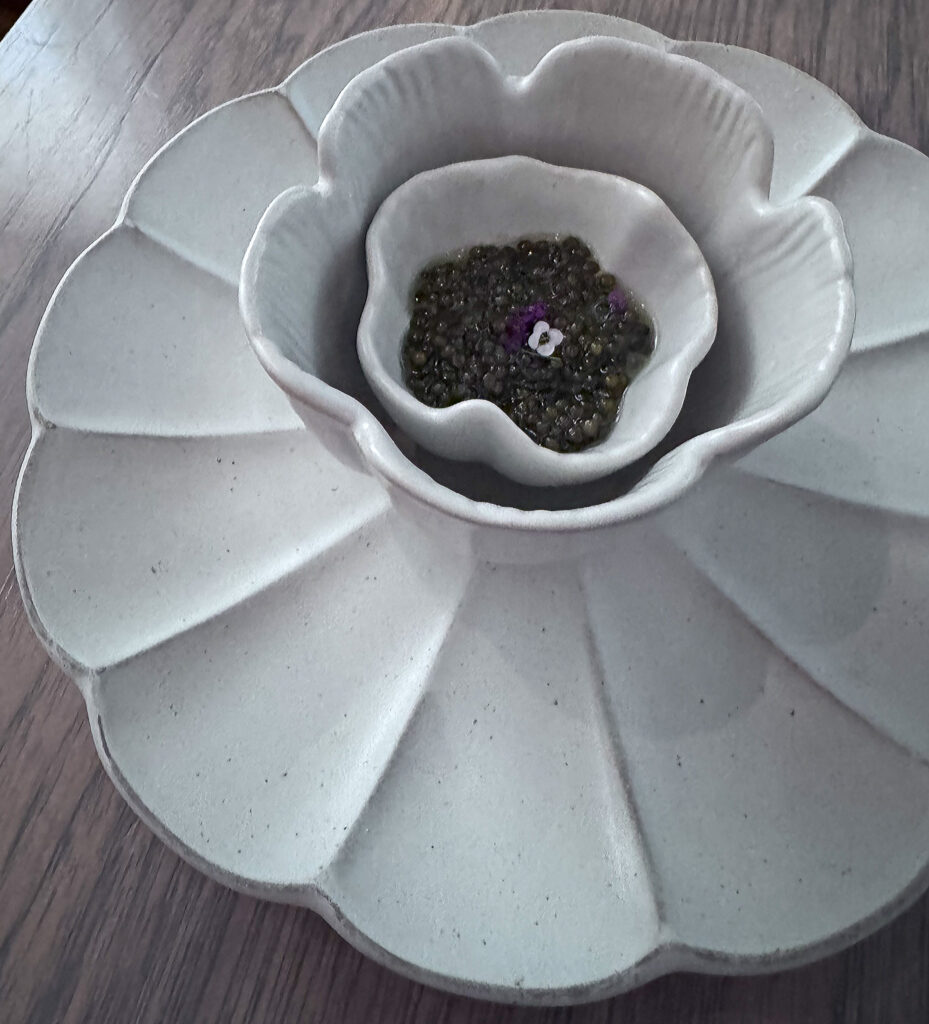
When the meal, at last, begins, it does so on a familiar note: the “Kinilaw” (a term broadly meaning “to eat raw”), whose name generally connotes a dish of seafood and vinegar that is likened to ceviche. As in 2022, the recipe—comprising a tartare of kampachi (substituting for the original hamachi), some coconut cream, and a calamansi vinegar—is headlined by a scoop of golden Kaluga caviar. However, while course used to be loosely assembled in a martini glass, the ingredients are now layered like a parfait and set within concentric bowls.
Mechanically, this decision ensures that diners enjoy a series of composed, homogenous bites with zero assembly acquired: ones that display a remarkable smoothness (from the marriage of fish, cream, and roe) with ample tang, brine, and a rounded tropical fruit quality through the finish. Personally, I do find that the shallow, uneven shape of the chosen bowl is a little clunky. I also cannot say I really sense the individual orbs of caviar on my tongue either. But, ultimately, these are nitpicks, and I think the recipe’s utter cohesiveness and deliciousness continue to make for a strong start.
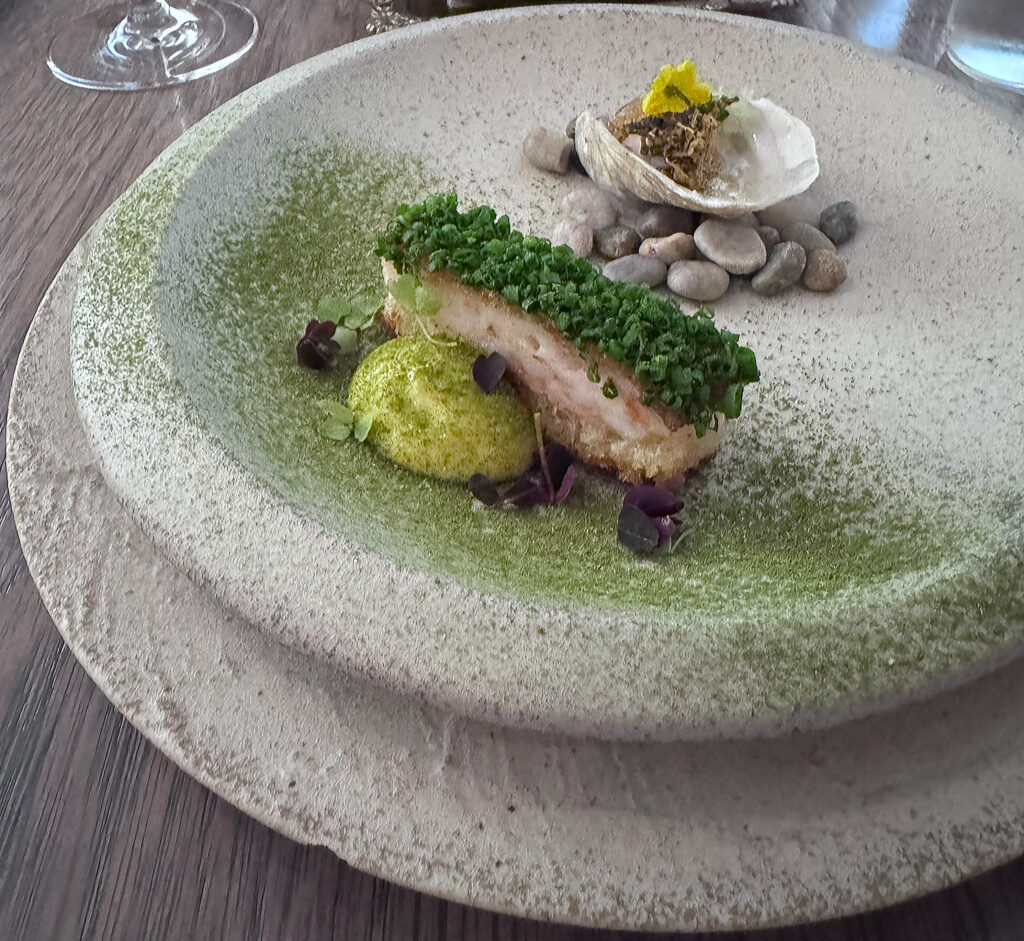
At this point, the menu diverges from what I’ve seen before—refreshingly so, it’s been years after all. Indeed, the “Pulutan” (a term denoting food that is “picked up” and eaten while drinking) absorbs the talaba (i.e., oyster) served in the past and pairs it with two new items.
There’s the shrimp toast: built upon a flaky rectangle of brioche with layers of the starring shellfish (its meat tightly packed into a matching strip) and thinly sliced chives. A béarnaise—dusted with salt and vinegar powder—forms the finishing touch, matching the bite’s crispness and plumpness with a rich, creamy, tongue-tingling quality that is truly decadent. Overall, this makes for one of the evening’s highlights.
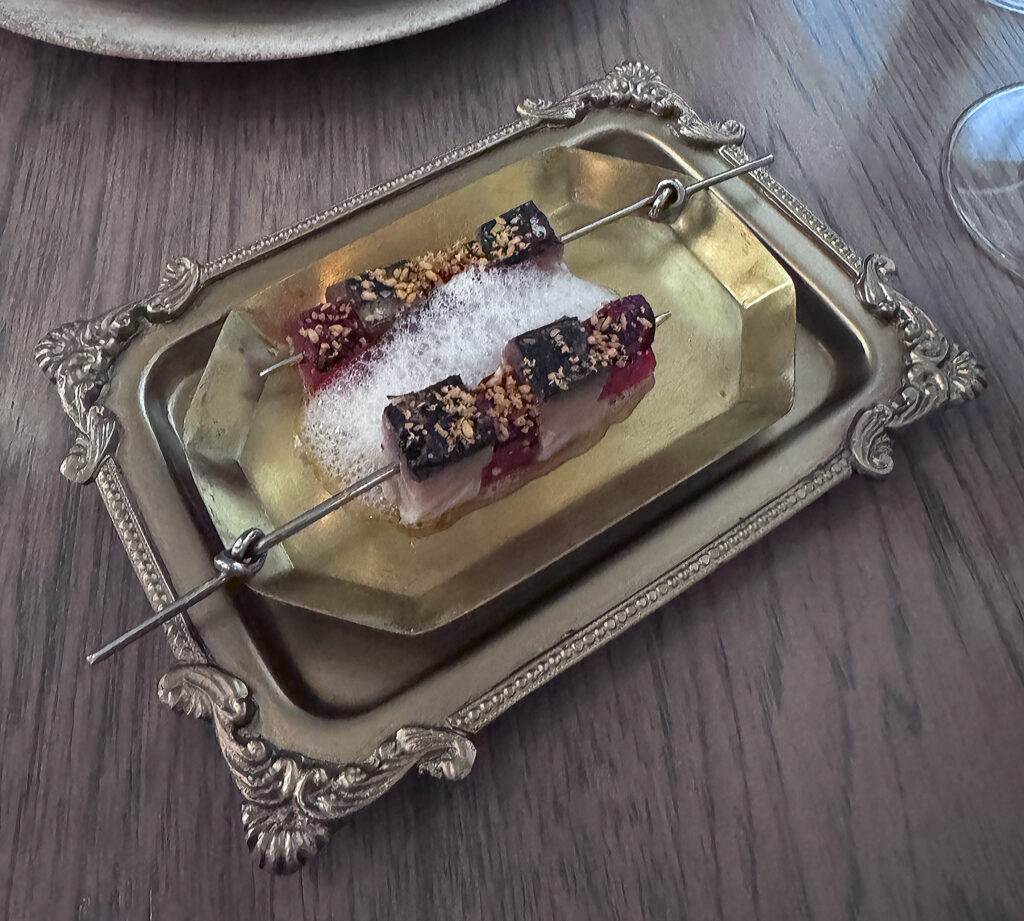
There’s also the mackerel: a skewer comprising chunks of the grilled fish separated by pieces of watermelon and sprinkled with sesame. Here, the juxtaposition of crisp skin, tender flesh, and juicy fruit is also well-judged, and I especially enjoy how the recipe’s opening bursts of salt and spice fade elegantly into a sweet, refreshing finish. As with the preceding caviar dish, the word “seamless” comes. This ranks as my second favorite of the sequence.
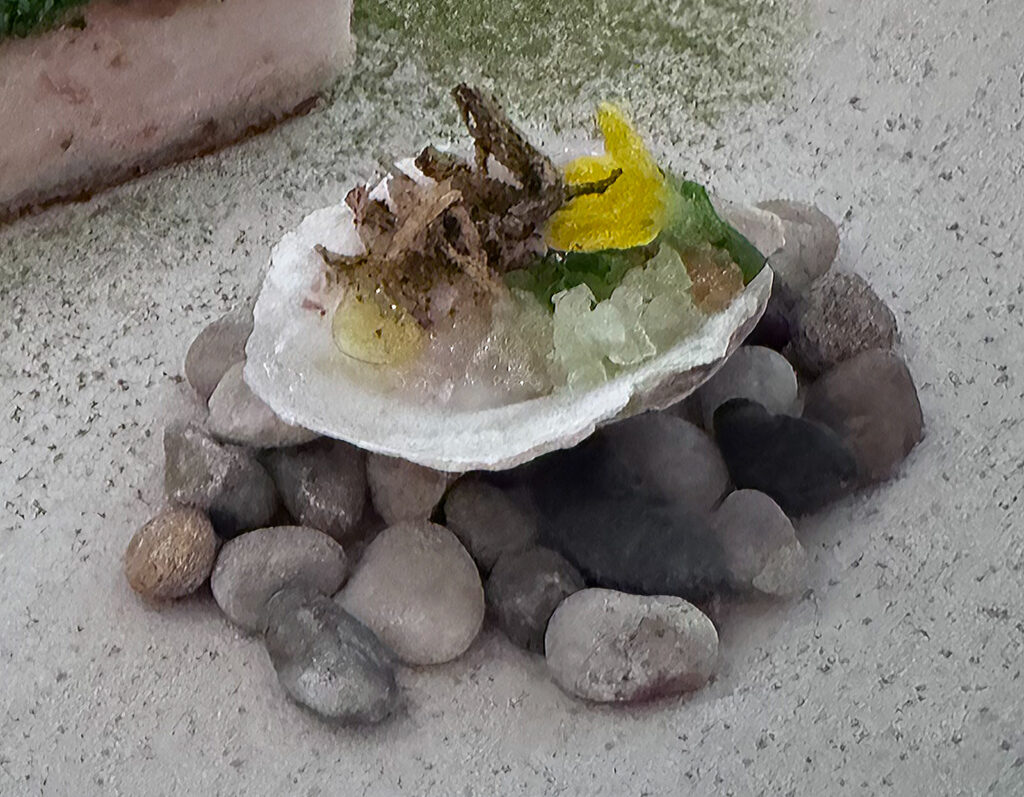
Finally, we have the oyster itself: a Kusshi dressed with an icy mignonette, notes of mezcal, and some crunchy bits I cannot identify. On the palate, the bivalve is remarkably clean—if mild—with an elegant, creamy mouthfeel. Its finish, in turn, is characterized by a faint imprint of cucumber and the smallest trace of salt. Compared to many of Kasama’s other servings tonight, the approach to seasoning seems a little restrained. Yet, while this oyster is particularly memorable, it’s also hard to fault.
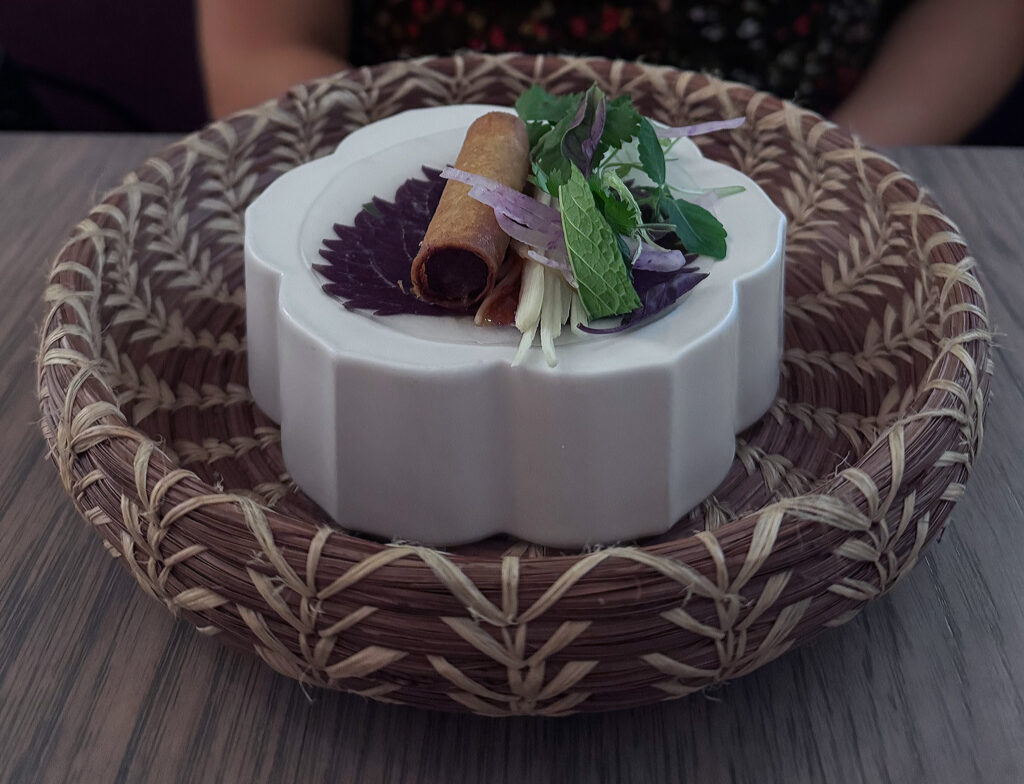
During my previous meals, the “Lumpia” (a pork-filled spring roll that is also offered, more casually, on the daytime menu) has been served alongside the oyster in a fully composed (i.e., wrapped) form. Nonetheless, the chefs now serve the fried delight as its own course: one that invites diners to wrap the crisp wrapper in a piece of rice paper lined with perilla leaf, radish segments, a drizzle of sweet chili sauce, and all manner of fresh herbs.
Doing so, I am met by a series of bites that marry chewiness, subtle leafy crunch, more pronounced watery crunch, and that perfectly brittle, shattering cylinder that lies at the center. This gradient of texture, for all its complexity, carries an air of delicacy. Moreover, the resulting flavor—delectably sweet, smacking of porky pleasure, with mild heat that turns cool and anisey on the finish—is sublime. Yes, the overall effect here remains thrilling, and the new process of packaging the spring roll yourself only adds to a sense of satisfaction.
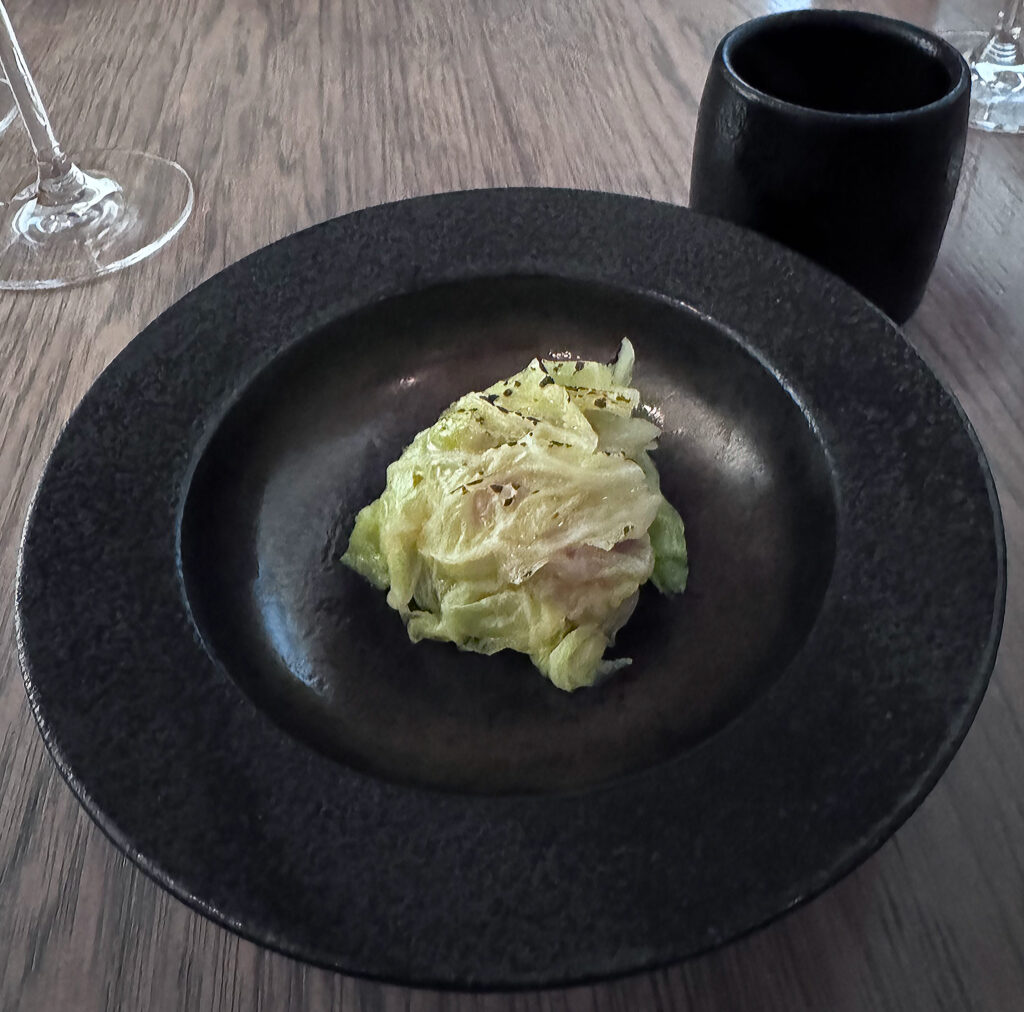
Arriving next, the “Nilaga” (denoting a traditional, “boiled” meat stew) remains largely unchanged from what I encountered back in 2022. If anything, the preparation—comprising slices of A5 wagyu atop a mound of bone marrow-infused short-grain rice all covered by wagyu fat-cooked cabbage—benefits from being served in a wider, shallower bowl (compared to the small, more slapdash vessel used before).
Otherwise, the essence of the recipe remains the same: with the layers of buttery, barely cooked meat and equally buttery vegetable being absolutely electrified by the beautifully salty, deeply beefy broth served as an accompaniment. Yes, while what’s in the bowl itself feels so restrained and precise (especially the rice, which only really provides a trace of structure), the dish transforms with each sip. A vague sense of richness suddenly veers toward deep satisfaction, delivering a sense of savory pleasure that—like the sort of stew from which this course takes its inspiration—can only be called timeless. Ultimately, I enjoy this item more on this occasion than I ever have before.
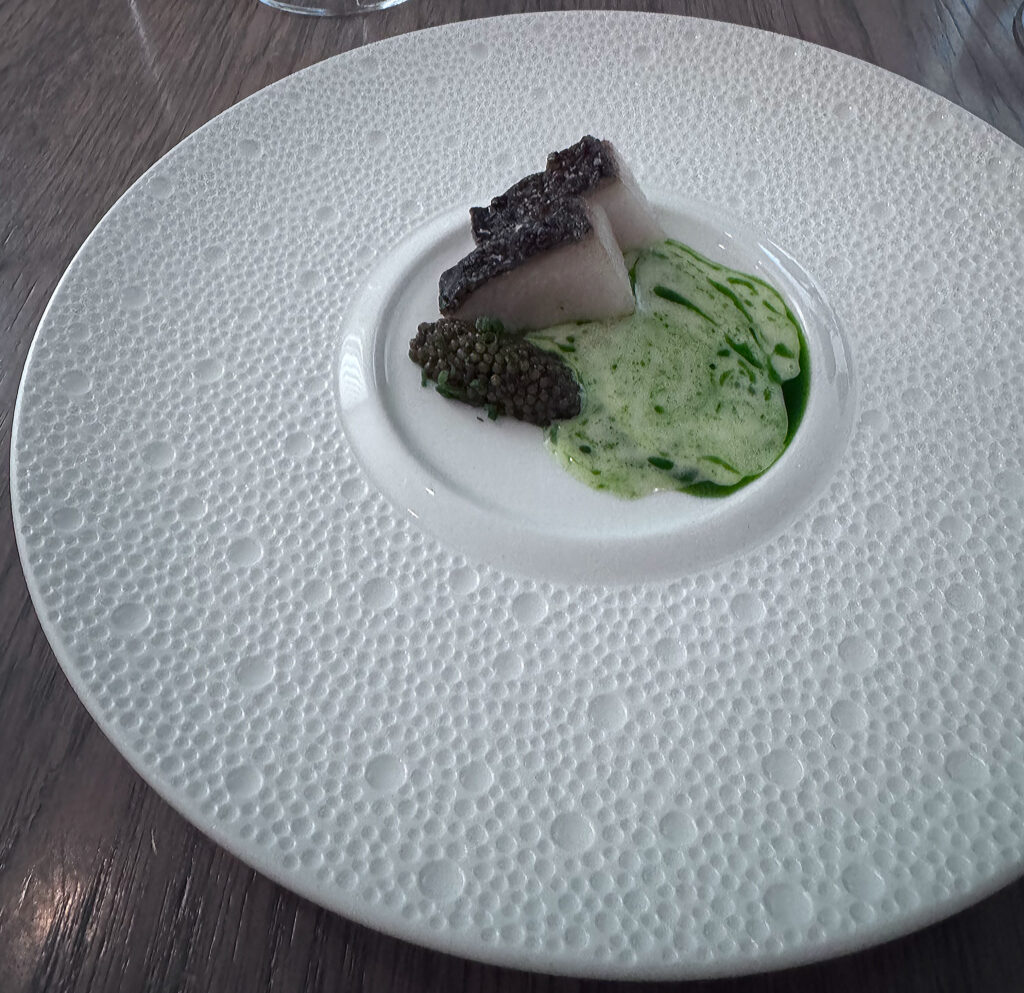
The ”Sinigang” (a “stewed dish” known for its sour flavor) has featured salmon and its smoked roe in the past. Tamarind—incorporated into a beurre blanc—forms a common thread with what I find tonight. But, if there’s any inkling that Kasama has raised its prices without demonstrating why on the plate, the substitution of sablefish (for the salmon) and more golden Kaluga (for the roe) make for an obvious upgrade.
A jalapeño-chive oil also forms a new finishing touch, and it’s a key one: adding hints of heat and sweet allium to a flavor profile that brilliantly balances an array of nutty, briny, and tangy tones that unfurl over a minutes-long finish. Of course, the fish itself—juxtaposing an incredibly crisp layer of skin with tender, flaky flesh (that is further enhanced by all the butter)—is skillfully prepared. Yet I’m really left wishing I had a spoon, for the preparation’s saucework is immaculate and represents a clear improvement on the recipe’s previous iteration. All in all, this ranks among the night’s greatest successes and one of the finest cooked fish I’ve tasted anywhere in Chicago.
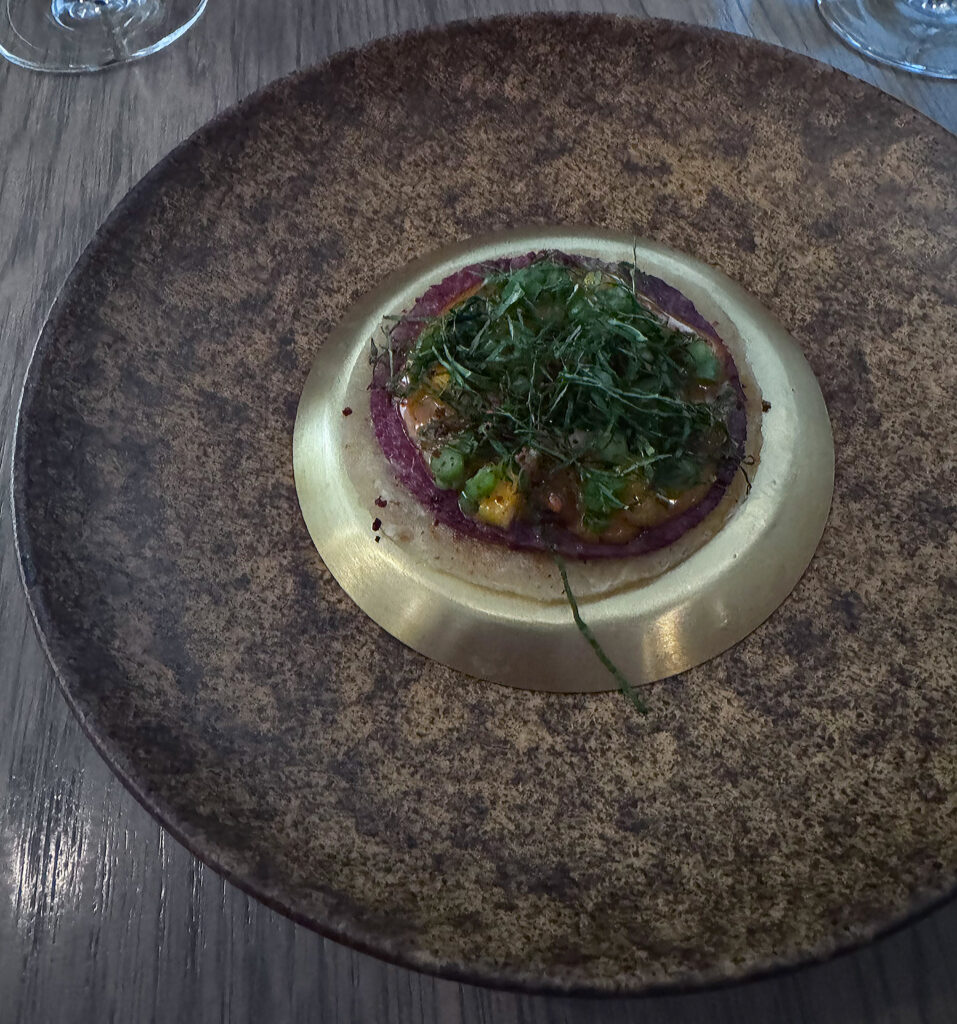
The ”Kare-Kare” (a traditional dish of stewed meat in a peanut-based “curry”) used to take the form of lamb belly, with a fermented shrimp XO, some eggplant purée, and an appropriately nutty sauce all served atop an accompanying laminated flatbread. As the penultimate savory course, such a presentation made sense. However, with two more to go, the chefs have totally reimagined the recipe as a single, refined package made from wagyu short rib, fermented shrimp paste, pickled green beans, and some dabs of peanut sauce served atop interlocking layers of perilla and a roti-like base.
Diners are instructed to eat the resulting serving as they would a tostada, yielding a series of composed bites that are crisp and flaky on entry but smoother, richer, and almost gooey (like a stew!) with further mastication. As with so many preparations this evening, the assembled textures—despite their complexity—achieve a striking degree of cohesiveness. More importantly, the resulting flavor delivers a concentration of sweet nuttiness and umami (enhanced by the pickles and an ever-present note of anise) that is absolutely lip-smacking. Indeed, given that I could easily eat several of these, the kare-kare’s transformation is undoubtedly a success.
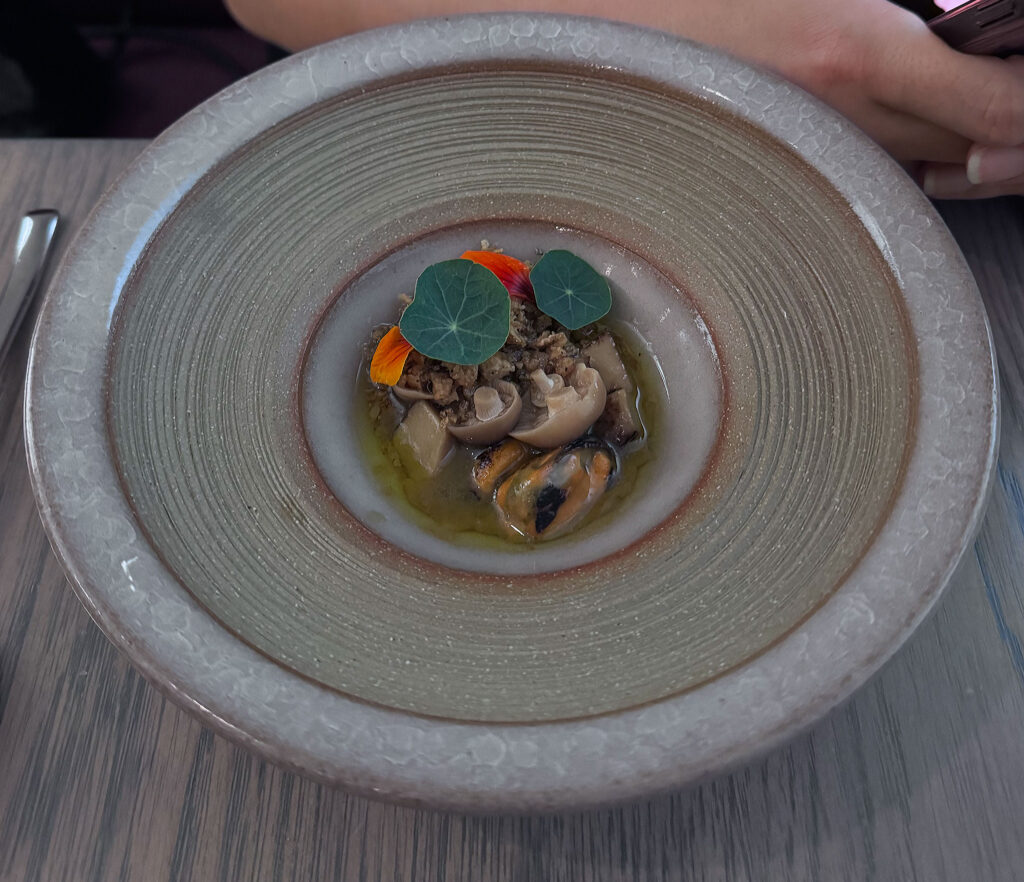
When I tasted Kasama’s “Adobo” back in 2022, it comprised a browned, slightly crispy segment of maitake mushroom served in the titular marinade with a foamy mussel emulsion. Early versions felt too restrained, yet the recipe eventually delivered the degree of umami I was looking for.
The present iteration of the dish features no foam in sight, centering instead on a medley of cooked mussels, king trumpet mushrooms, and beech mushrooms served in their braising liquid with toppings of black truffle, nasturtium, and chicken skin. Yes, the kitchen has seemingly turned away from its earlier efforts at deconstruction and now only seeks to refine the essence of the adobo form.
Texturally, the faint chew—but overall tenderness—displayed by the pieces of shellfish and fungus is highly pleasing. The crispy, crumbly, wonderfully salty skin is not used sparingly either. However, it’s umami that yet again defines this course, and I am happy to report that its concentration remains immense. Yes, the ingredients’ fullness on the palate is matched by real power, with notes of sweetness and earthy depth that guide this sense of overwhelming sustenance toward a minutes-long finish. Overall, the course easily ranks as one of the meal’s highlights.
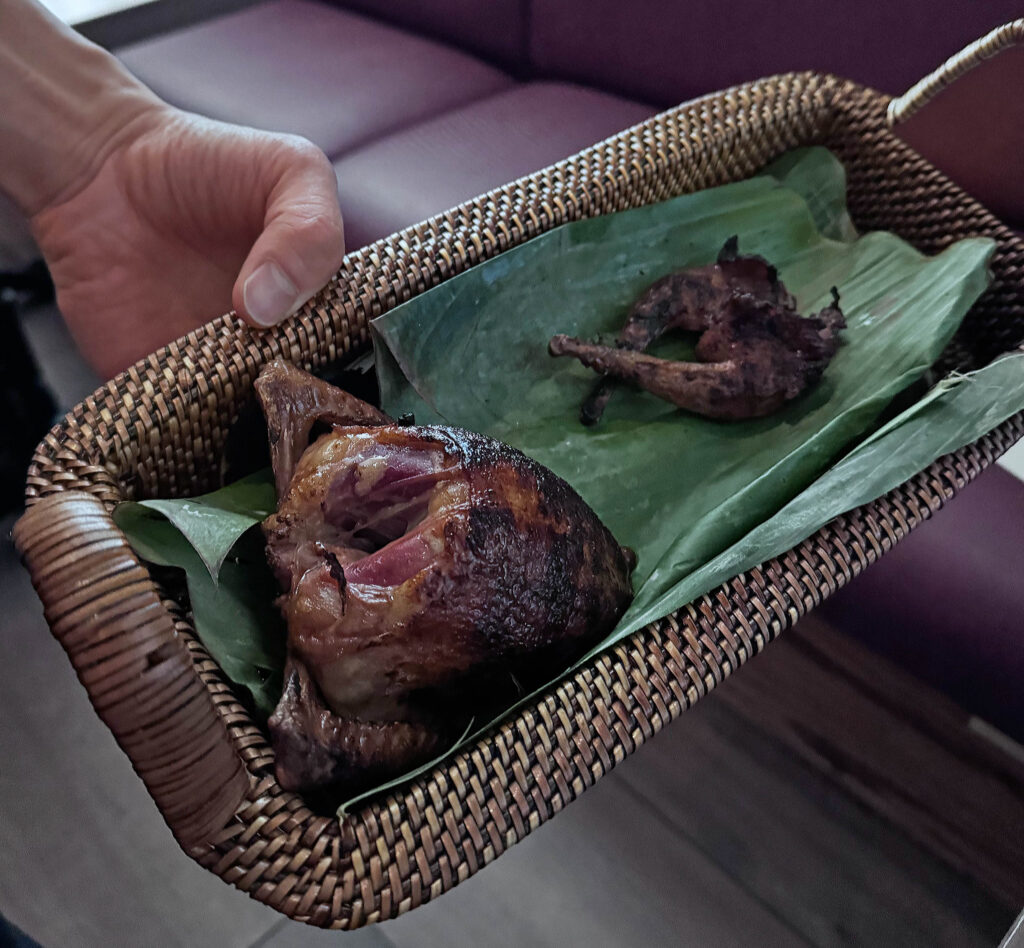
The final savory dish of the evening is titled “Inasal” (a term referring broadly to grilled meat and more particularly to a preparation of marinated chicken). Here, the chefs opt for squab, which is presented (before the arrival of the preceding course) in all its charred, coconut sap-glazed glory before being taken back to the kitchen to be carved. When guests see the bird again, it is neatly separated into segments of leg and breast that come paired with a piece of chestnut mushroom, a dab of foie gras, an organ meat dirty rice, and a red wine sauce made using the bones.
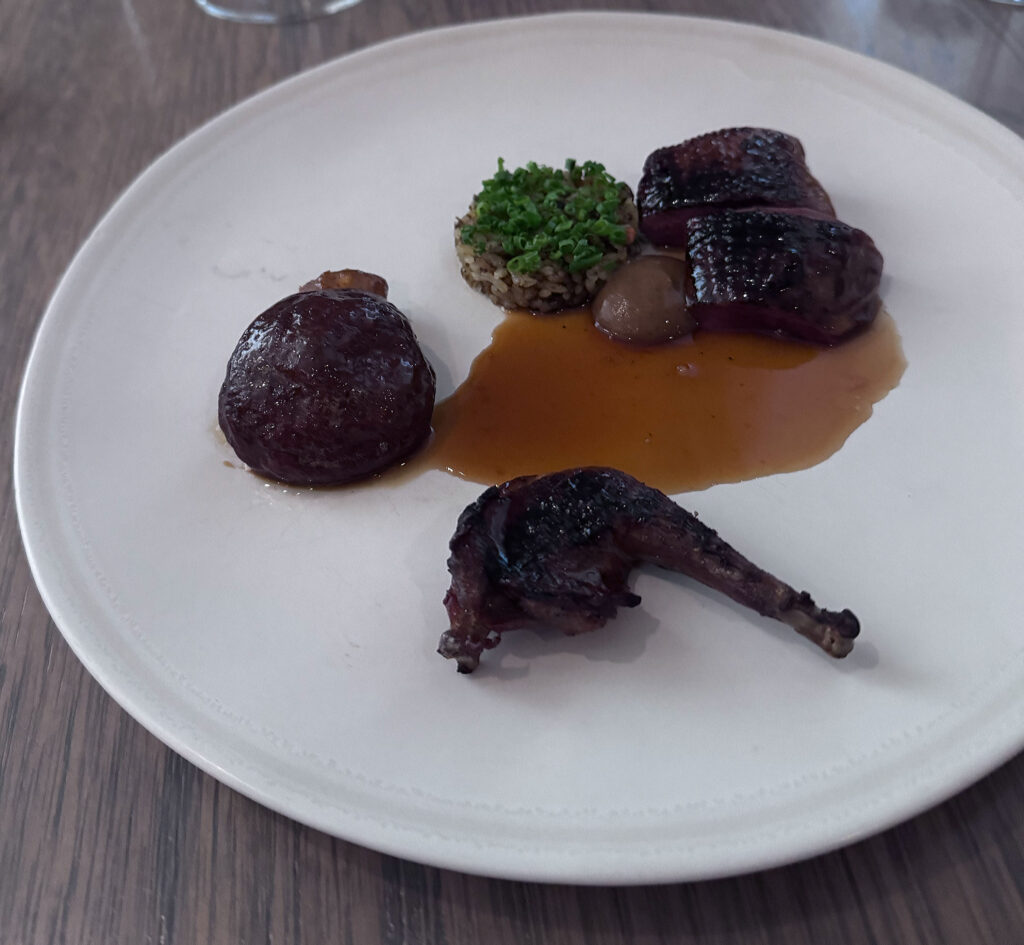
On some level, this is the kind of presentation one can imagine being served at any Michelin-starred restaurant—I think of the tidy portions of game I’ve been served at Smyth and Oriole this very year. And, in terms of flavor profile, I’m not sure the recipe reads as “modern Filipino” other than the beautiful, persistent sweetness (drawn from the coconut sap) that carries through the meat. That said, the cook on the squab—tender and juicy—is perfectly executed, and a confident application of salt ensures its latent richness comes to the fore. The chestnut mushroom (soft and sweet in its own right), duck liver, and accompanying saucework all add to the fun: that is, a degree of umami and depth that can keep pace with the adobo. The rice—being a bit dry and bland—is the only real disappointment.
Still, anything this course lacks in thematic fulfillment is more than made up for by its wider showcase of technique. The grilling and seasoning of the bird allow me to more precisely judge Kasama’s work relative to its peers, and, in this realm of game entrées, I think the restaurant performs quite well.
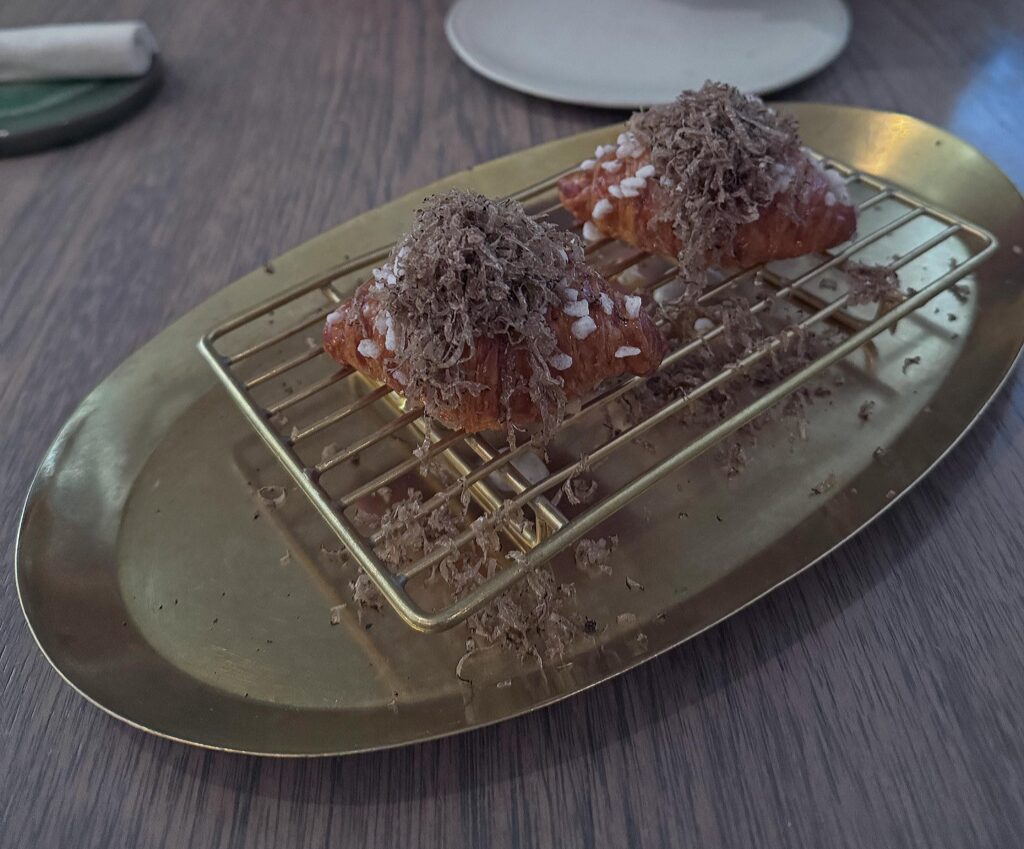
Turning now toward dessert, expectations necessarily run high given the enduring appeal of Kwon’s work on the bakery side. To begin, the “Truffle Croissant”—a miniature version of the daytime signature—remains on the tasting as a transitional offering (with its filling of Délice de Bourgogne and honey acting as a kind of cheese course).
Even as someone who has eaten their fair share of the full-sized pastry, it’s impossible to resist this diminutive form. The croissant is supremely crisp and totally cohesive, delivering a warm, gooey center (something one never encounters when purchasing these during the daytime) and just enough sweetness to unlock the bite’s musky, milky (and lasting) depth. In short, this totemic item remains a thrill.
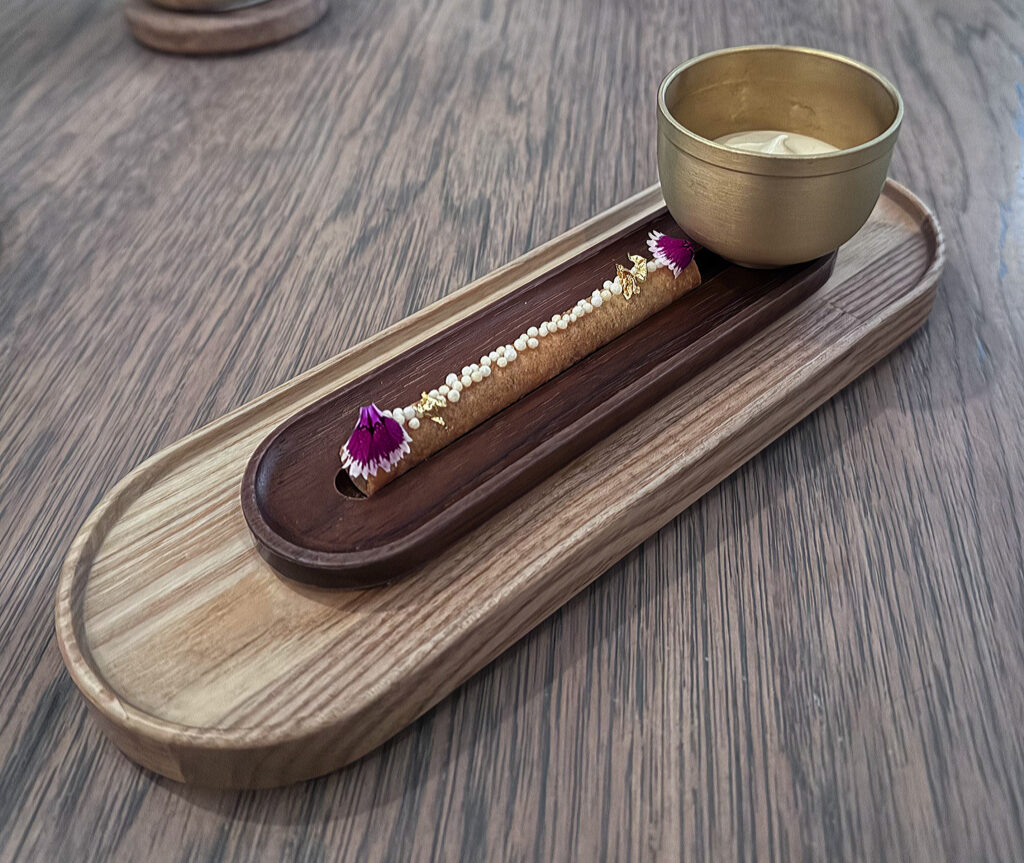
Arriving next, the “Turon” (referring to a kind of fried banana spring roll) represents a clever evolution of an idea that the chefs used to title “Banana-Cue.” Indeed, while its predecessor paired a caramelized piece of the fruit with a banana and brown sugar diplomat cream, the present dish allows diners to dip an impossibly thin, crisp straw (replicating the turón) into the custard.
The refinement of the presentation is obvious, yet the recipe’s tactile quality cannot be discounted either. Given how thick and deeply flavored and soothing the diplomat cream is, one really wishes to savor it. Nibbling down on the “spring roll,” reveling in each bite, hoping it won’t disappear for just a moment or two longer imbues that familiar custard with an added emotional dimension. Plus, on the back of the croissant, I just love how generous the chosen flavors are.
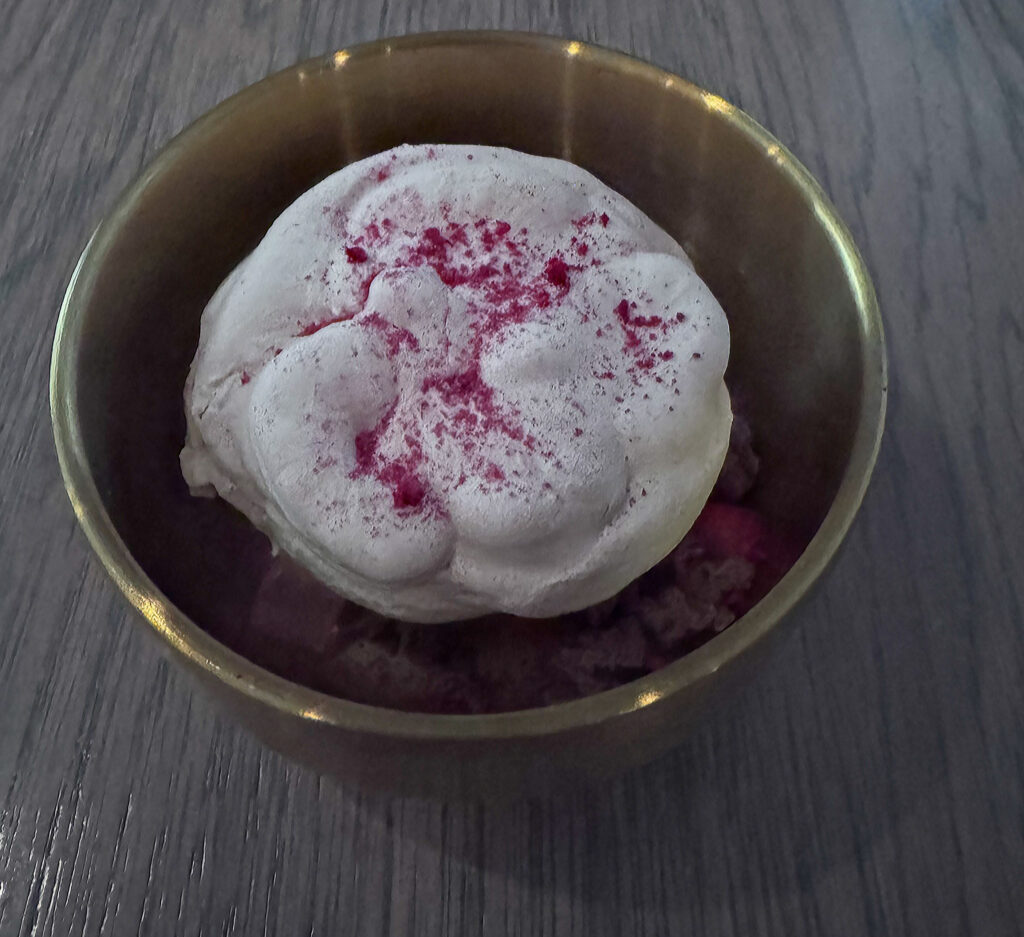
Almost on cue, the “Halo-Halo” arrives: offering the kind of palate-cleansing frozen dessert I would’ve expected earlier on this menu. Yet, even back in 2022, this dish acted as a closer—though it now trades Asian pair granita for one made from nitro-frozen chocolate.
Visually, the inclusion of an ube foam over the top makes this take on the recipe (which used to be presented as a bit of a hodgepodge) feel much more composed. Meanwhile, the retention of the leche flan at the center forms an important anchor: one that grounds the bowl’s kaleidoscopic textures (creamy, crisp, chewy, and jellied) with a rich, mouth-coating quality. Flavor, too, spans notes of tangy strawberry and the earthy, nutty yam. However, it settles on an unabashedly decadent expression of chocolate and caramel that only grows in force as one reaches the bottom. Ultimately, this makes for a clear, highly engaging success: what one diner at the table terms “like the Alinea ‘table dessert’—but good.”
Closing out the meal, we have a new presentation of “Mignardises.”
They comprise:
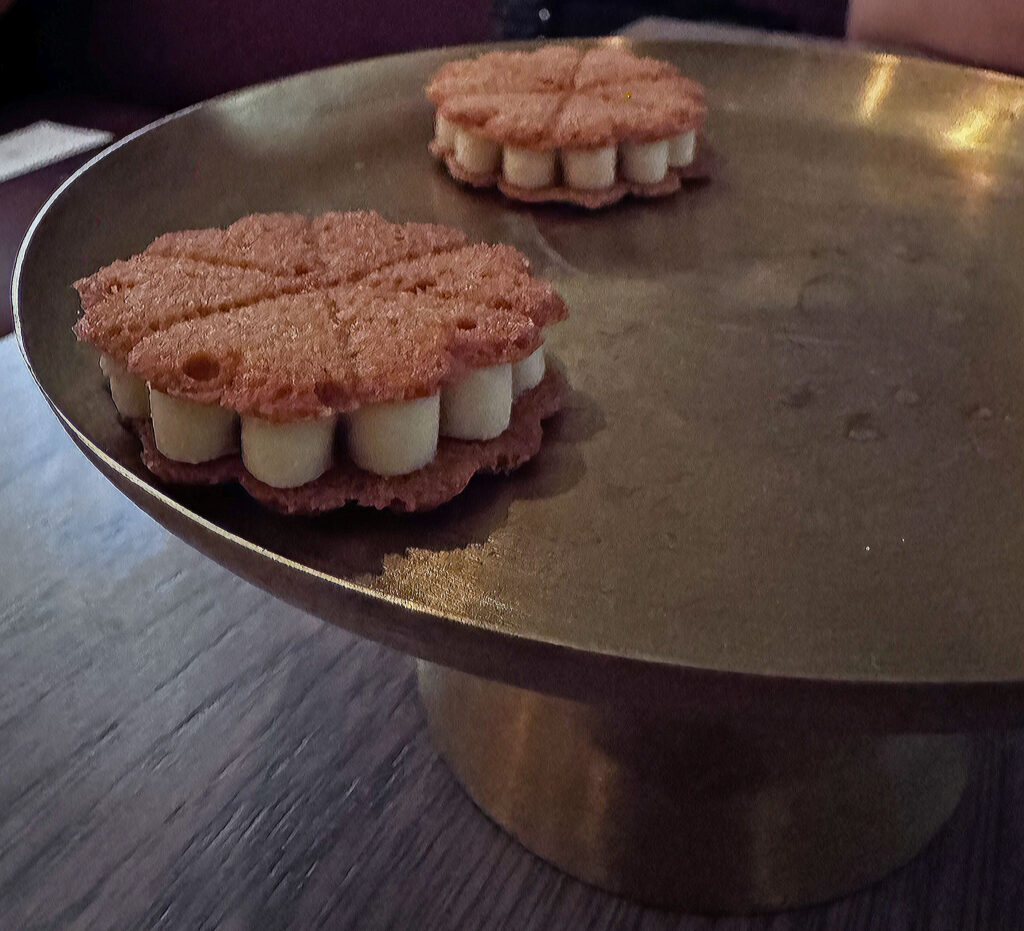
A guava and cheese ice cream sandwich whose crisp, crumbly outer layers house something more like a custard. Nonetheless, the gooey, tangy filling—tinged with tropical sweetness—is delicious.
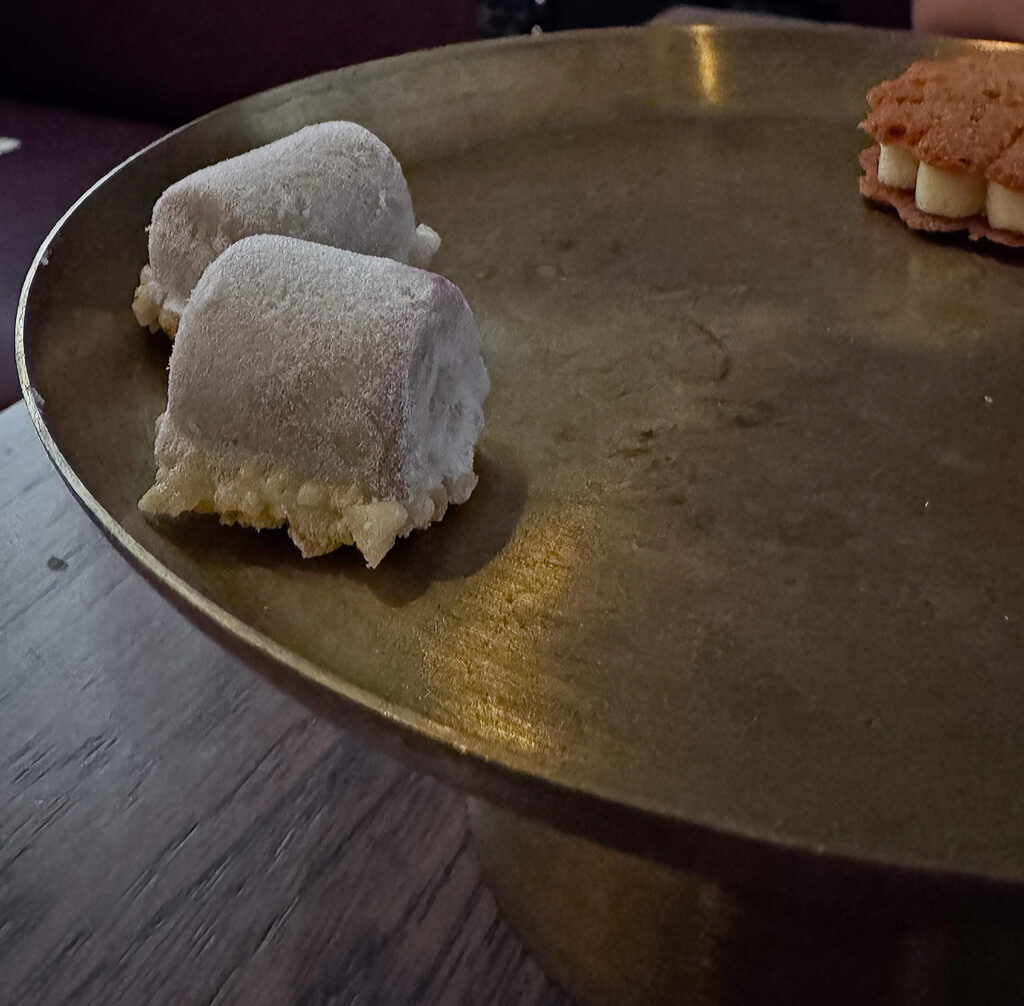
A cassis bonbon that is served with the instruction to let the bite melt on your tongue. Doing so, one finds a candied expression of dark fruit with a prickly “Pop Rocks” effect on the finish. This is also nice.
With that, the meal reaches its conclusion: some 12 different courses (11 if we discount those final two bites) served in just a little more than 100 minutes.
This is—as I said before—pinpoint pacing, and (while I am sympathetic to the fact that some guests may want to sit here longer given the difficulty of the reservation) it builds a sense of rhythm in which greater and greater pleasure seems to flow out of the kitchen without any demand that diners pause and feel the passage of time.
Does it make conversation—or conjuring that sense of occasion—more challenging? Maybe. But it also ensures the tasting menu (one that not defined by particularly large portions) feels like a feast.
Otherwise, with the check paid, the server provides printed menus and a couple boxes containing the best take-home item in all of Chicago fine dining: the “Ube and Huckleberry Basque Cake.”
I’m also kindly given the opportunity to book another reservation for the future, which seems like a nice way to reward customers who have shown an inclination to visit again yet might lack the motivation to fight for a table.
I decline: not because I wouldn’t or won’t come back but because the experience—largely familiar, strikingly refined, with a few new twists—feels so complete. The returns, if I were to repeat the meal too soon, could be diminishing. And maybe it’s enough to simply deliver consistent excellence to the legions of fans who are still dreaming of making their way here for the first time.
That is certainly an expression of the chefs’ Oriole lineage, and I think this privileging of reliable pleasure explains why Kasama (if, like Michelin, one accounts only for cuisine) has reached the same level.
In ranking the evening’s dishes:
I would place “Sinigang,” “Adobo,” and “Truffle Croissant” in the highest category: superlative items that stand among the best things I will be served in any restaurant this year.
The “Kinilaw,” “Lumpia,” “Nilaga,” “Kare-Kare,” “Inasal,” “Turon,” and “Halo-Halo” land in the following stratum: great recipes that achieved a truly memorable degree of pleasure. I would love to encounter any of these again.
Finally, there are the “Pulutan” and “Mignardises”—good—even very good—preparations I would always be happy to sample again (but that just failed to elicit an extra degree of emotion). Each of these sequences did feature at least one bite that could’ve ranked higher, yet, for the sake of being constructive, I think it’s fair to judge the courses in accordance with the weaker fare.
Overall, this makes for a hit-rate of 100% with some 83% of offerings reaching that “would love to have again” level of quality and 25% being of that “best of the year” caliber.
In short, this is an outstanding performance that places Kasama, plate for plate, among the best meals I have enjoyed anywhere in 2026.
Of course, the trade-offs are obvious: there’s little pomp and circumstance about eating here. For $325, one only finds the rudiments of a dining room, a meagre wine program, efficient (though still friendly) service, and a kitchen missing its headlining chefs. The last point—denying guests the chance to get a picture or a signed menu from Flores and Kwon—might be the most unforgivable for anyone, drawn to the “modern Filipino” theme, who really extended themselves to come and try the menu.
In turn, if we are to strip the evening of its emotional timbre, one can only be happy with the quality of the cocktails, the chance at bringing corkage, and the caliber of the cuisine—which traverses myriad textures, flavors, temperatures, and techniques with faultless seasoning and a clear preference for decadence (rather than needless novelty). Anyone who has encountered the kitchen’s ideas in any early form cannot deny the strides the chefs have made toward perfection. Years later, the presentation of the food is also sharper than it’s ever been.
In purely gastronomic terms, Kasama is a powerhouse, yet, experientially, the restaurant maybe struggles to fulfill the expectations of a popular audience that craves something more than great food for the price.
It’s easy to see why Cariño, Feld, and Valhalla (with their chef’s counters) win so much attention alongside Alinea and Ever (with their special effects) and Oriole (with its magic combination of indulgence and ambiance).
Smyth, thanks to the accolades it has earned, can get away with serving challenging, dynamic cuisine in a somewhat less impressive space. Kyōten justifies its price (and its quirks) thanks to the steadfast presence of the chef and his position within a very particular genre.
Kasama, discounting the considerable appeal drawn from its importance to Filipino foodways, is almost like Oriole “1.0.” It’s just a little place (arguably within even fewer frills) pumping out incredible fare with a handful of cherished signatures. And this is to totally discount the huge effort the team is also making during the day.
Maybe Cariño, with its own relatively unchanging menu and looming expansion into daytime service, is also the right point of comparison. My meal there earlier this month offered the same kind of faultless pleasure. However, Kasama (maybe owing to the premium it charges or the know-how that a couple more years in business brings) undoubtedly reached a higher gear: affirming that its most cherished recipes are capable of evolution and, through that process, may even become timeless.
Whatever the case, Chicago’s dining scene is not in a place where we need to qualify what Flores and Kwon have accomplished or urge them to run the restaurant in any other way. Indeed, in the face of such wild success, the chefs guarantee pleasure in a way that few of their peers are capable of. More importantly, they have cultivated a team that is capable of maintaining that standard in their absence—vexing, surely, for some but a huge testament to their mentorship and the systems they have put in place.
There may come a time when Kasama must evolve even more dramatically to satisfy the fame it has achieved. But, at this moment, the cuisine occupies a comfortable niche: one that transcends whatever window dressing a “modern Filipino” concept could entail in favor of cooking that is substantive and satisfying in a manner that honors the culture much more.