
I haven’t eaten at Alinea since January of last year: a seating at the kitchen table that (by my count) fell only one or two meals short of my 40th visit.
Maintaining my current rate (that is, dining here every one to one-and-a-half years), it’s hard to believe I’ll ever hit 50. And maybe that admission—framed by the fact that the restaurant just celebrated its 21st year—helps to indicate how big of a fan I used to be.
There was a time that walking Alinea’s old optical illusion hallway (as well as the later, post-renovation vestibule) left me all fluttery. A few hours later, I’d return outside feeling awestruck and deeply bonded with those whom I had enjoyed such a transcendent aesthetic experience with.
How could you not want to come again and share such a creative, visceral expression of culinary art with everyone you know? How could you not (even if the recipes, so mind-bending, already resisted any attempt at comprehension) dream of tasting what the kitchen might conjure next? I certainly did.
Alinea was formative for me, and I count myself lucky to be part of a generation that takes the kind of deconstruction and reconstruction and total immersion it pioneered for granted. How different was it to suddenly transition from Charlie Trotter’s or any of New York City’s gastronomic temples to Alinea, rather than only knowing it as the established icon of Chicago dining? How, having internalized Alinea’s vision, does one ever go back to those dusty three-Michelin-star dining rooms and appreciate conventions that now seem entirely outdated?
Yet, as I dined extensively in other major markets during the mid-to-late 2010s, I found that many of the country’s best restaurants had forged a different path. Across French, Japanese, Nordic, and American concepts (whether contemporary or classic), stuffiness came to recede. The same was true at Alinea, for fine dining—more broadly—had been democratized: not in terms of price, per se, but due to the demise of written and unwritten sociocultural barriers in concert with burgeoning consciousness driven by food media.
If you could pay (increasingly via faceless online booking platforms), you got a seat at the show. Alinea’s performance, to its credit, really didn’t and couldn’t meaningfully change beyond the confines of the menu one had actually signed up for. However, in more imposing dining rooms, I found that making an ally of the sommelier (by ordering a nice bottle of wine or a premium pairing) was a savvy path toward ensuring the team would put their best foot forward. Gamesmanship, as much as it should never be required at this level of luxury, reflects the realities of human motivation. Still, anyone could show their seriousness and create some reason to be remembered.
It’s through repeat visits that the older guard really began to distinguish itself. Their cuisine, though inventively presented, would never keep pace with Alinea’s level of imagination. But, somehow, the meals ironically actually felt freer. Without the pressures of “showtime” and hitting all their marks, the staff had the time and space to make each visit feel individualized and special. They could converse, connect, and direct the resources of the establishment in a way that surprised and delighted in a singular fashion. That could mean off-menu dishes (whether new experiments or old favorites), special pours, kitchen tours, or chats with the chef. It could mean marking milestones or cementing a “regular table.” Each meal brought something new only for you.
These restaurants lacked flash, but they were adept at rewarding loyalty. The relationship could deepen to whatever extent the guest wanted it to. Rather than perpetually chasing new openings, one only need find a stylistic match and affirm their devotion. One could be hosted like a titan of industry without anything close to the same largesse. Reflexively, the restaurant—while playing in the realm of legible textures, flavors, and ingredients—would actually attune itself to your distinct taste. Paradoxically, these relatively traditional expressions of gastronomy felt far better equipped to surpass expectations because they were not bound by the conceits of the larger “performance.”
Returning to Alinea with a greater sense of what a modern three-Michelin-star restaurant could be, I had trouble shaking my perception of where the guardrails were. You had to play by the team’s rules, and their time and resources were (to the seasoned observer) limited. If one had any familiarity with their chosen tricks, they could increasingly be seen coming from a mile away. Constant staff turnover (part of the business model) precluded the development of any connection that, even within the scope of these restrictions, could imbue visits with a meaningful emotional dimension.
First-time guests were naturally shielded from any of these shortcomings. In fact, Alinea’s ownership actually expressed pride at how meager its proportion of returning customers was. They had created a blockbuster that was wildly successful at impressing people during what would be a solitary, memorable encounter. Feedback—as it related to the food—never really needed to be grappled with. How many newcomers would not only be dissatisfied but actually dare to critique such a legendary chef? The pressure to confirm (even if it meant writing one’s experience off more as “art” than comestible) was immense.
The classic bites, centered on crowd-pleasing flavors, were a bulwark. Over time, their power faded, and, even when the kitchen tried offering what amounted to a steak course, the results were uninspiring. Somewhere in their ceaseless pursuit of provocation, the chefs lost total touch with deliciousness. “Performance,” indeed, formed a fatal crutch. They seemed completely siloed off from a larger movement toward unique ingredient sourcing and/or cultivation. Everything had to be transformed into something it was not rather than striking, honestly, with some superlative expression of its essence. Diners’ perception of seasoning could vary, yet the menu cared little about the satisfaction that only umami can provide. Everything tasted overwhelmingly sweet or tangy and ephemeral. Diminishing returns veered (apart from certain longstanding visual thrills) toward no returns at all.
Correspondingly, Alinea’s audience has evolved over the past 20 years. Diners are not coming to the restaurant with snooty French gastronomy as their only reference point. They’re exploring the worlds of Alchemist and Somni. They’re enjoying perfectly engineered bites of fish and rice straight from the hands of Japanese masters. They’re roaming the gardens of Blue Hill and Mirazur.
How is lowest-common-denominator, dehydrated detritus from an absentee chef—set within a tablescape or to a musical score—supposed to strike them? The team cannot compete in terms of raw spectacle anymore, and they’ve embalmed themselves within a format where offering any kind of singular, intimate experience (the heart of contemporary luxury) is an impossibility.
After ignoring alarm bells from local and national critics, Alinea faced the only consequence that could actually affect its bottom line (and, thus, prompt some sort of reckoning): Michelin’s demotion.
I thought it was just about the bravest thing Bibendum has ever done here: a testament to the fact that the Guide wants this dining scene to grow rather than fester (even if it means hurting a partner that has done so much to promote their brand over the years).
Still, this is nothing to gloat about: Alinea only exists due to the nightly efforts of innumerable souls. They don’t steer the ship—they’re just trying to carve out a place for themselves in this industry. And, as routinely disappointed as I have been by the restaurant’s work over the past decade, I will always be among the first to support any genuine effort to change.
Alinea, even at its lowest point, is still synonymous with Chicago gastronomy. Any serious attempt at reckoning with the best must look very closely at what it has to say.
Let us begin.
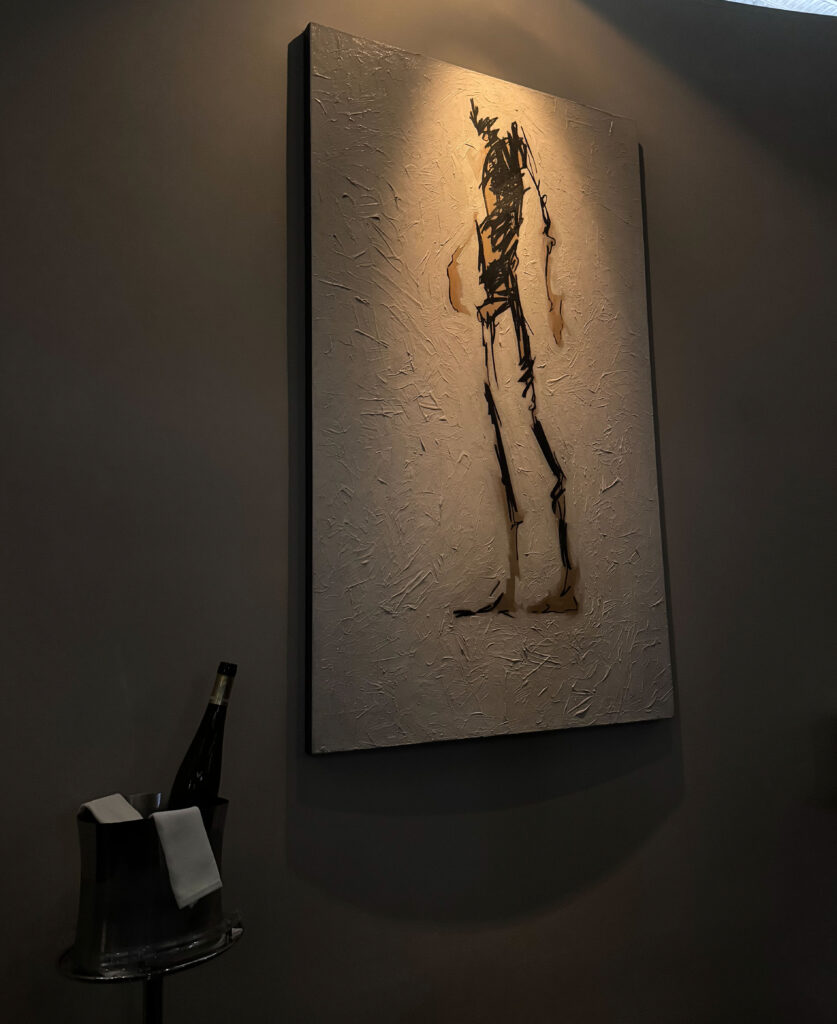
It is only a couple days after Alinea’s anniversary: the day when the “Gallery” experience ($495) was set to evolve “beyond what it has been, into something closer to what it always wanted to be”: a meal that “will unfold through distinct acts, each with its own emotional register and its own relationship among the guest, the space, the objects, and the sequence.”
I booked a 5 PM seating as soon as I read those words, which were (given the group’s penchant for splashy, if sudden, announcements) rather gently sprinkled at the end of a longer post made near the end of April. Yes, there was a sense of intrigue about what might be next. Yet, as May 4th approached, it didn’t exactly seem like diners were scrambling to secure the last remaining tickets (the month having first gone on sale in mid-March).
I could understand the hesitation to embrace the latest, greatest form of experimentation from a restaurant that had just stubbornly followed its processes to the point of public reprimand and embarrassment. Plus, who’s going to go and spend that kind of money on a Monday or Tuesday or Wednesday just to get a first look?
Well, the answer’s obvious, and, when the day came, I was pleased to find not a single bit of information that might spoil what I was about to find. Of course, I studied Alinea’s recent (i.e., pre-anniversary) menus as best as I could. I had also already been tracking the team’s work during its 20th anniversary pop-ups, which were said to have helped shape the mothership’s present evolution. In short, I wanted to distinguish what was truly novel from what remained or was possibly transplanted from the concept’s travels.
From the outside, 1723 N. Halsted certainly hasn’t changed: its black-and-brick façade betraying none of the secrets that await inside. The lobby looks the same too, and I am met by a warm, cheery greeting from hostesses who entirely subvert the staff’s typical, smarmy tableside manner.
Yes, I must admit that even my captain tonight does an admirable job of hosting us: combining diligence, graciousness, playfulness, and a sharp sense of anticipation to great effect. When dishes go unfinished, feedback is sought in a sensitive manner. In fact, there’s a general sense of curiosity about how we perceive the experience that feels humble and sincere. It stands in stark opposition to a more self-indulgent, fart-sniffing manner of interaction from staff that (before Bibendum’s demotion) seemed to think, on account of the restaurant’s status, they could do no wrong.
In my opinion, it’s Alinea’s culture—in combination with the demands of the performance and the consistent turnover at the immediate, guest-facing level—that has always been to blame (more than any individuals at least). I do not know enough to suggest that anything has changed internally over the years. I may, by chance or contrivance, simply be matched with staff who work harder at building a rapport. For what it’s worth, there are always a couple veterans on the floor, and I’d describe those encounters as thinly-veiled (mutual) disdain.
My captain, to their great credit, creates a feeling of comfort and ease that allows me to enjoy the show (whatever its flaws) without the dissonance that accompanies any team unaware of its own fallibility. This reflexive, emotional dimension to the service, when considered alongside the actual mechanical difficulty of staging the meal, made for some of the best hospitality I have encountered this year.
Otherwise, before digging into the actual substance of the meal, I will dwell a moment on the nature of the beverage program: namely, how “The Alinea Pairing” ($475) compares to Smyth’s “Reserve Pairing” ($475), which forms its only peer in Chicago.
Tonight’s lineup comprises:
- 2008 Krug Champagne [$499 at national retail]
- 2022 Remelluri Rioja Blanco [$124.99 at national retail]
- 2023 Weingut Ökonomierat Rebholz Riesling “Kastanienbusch” Großes Gewächs [$86.95 at national retail]
- 2022 Pierre Girardin Meursault Premier Cru “Les Perrières” [$349.99 at national retail]
- Hachidori Junmai Ginjo [$55 at national retail]
- 2018 Quinta de Muradella “Muradella” [$48 at national retail]
- 2007 Domaine Jean-Louis Chave Hermitage [$489 at national retail]
- 2011 Giacomo Conterno Barolo “Francia” [$275 at local retail]
- 2016 Château d’Yquem [$399 at national retail]
On paper, Alinea’s top-tier offering reflects much of the same strategy as Smyth’s: pouring a few more modest bottles (i.e., the Rioja, the Riesling, the sake, and the Mencía blend) in order to support superstars like the Krug, Chave, Conterno, and d’Yquem (not to mention a little white Burgundy).
The selection here skews classic—perhaps a sensible juxtaposition for a tasting menu that is already pushing diners outside their comfort zone—and a few examples boast a moderate amount of age. Moreover, pours are generous, and the team is quick to offer refills should one really gravitate to a glass (or simply gulp it down too quickly).
Smyth distinguishes itself through its embrace of (sometimes polarizing) natural wines and of other oddities that may cost as little as $30 at retail. The idea being that some of the weirder, seaweed- and nut-laden compositions can withstand sips that are equally provocative. Yes, rather than looking to anchor the cuisine via a familiar reference point, the restaurant encourages guests to fully embrace the unknown.
Yet, true to the Smyth ethos (i.e., “challenging but rewarding”), preparations of sea urchin, abalone, lamb, and game bird do come around: frequently aiming at the kind of unabashed pleasure other recipes may spurn. Pairings grow in tandem, spanning everything from Bouchard’s “RDJ n°04,” a 2017 “Entre Deux Bleus,” and a 2005 “Clos la Néore” to a 2008 Liger-Belair “Aux Reignots,” a 2001 Giacosa Riserva, and a 1989 “Réserve des Célestins.” Indeed, while Alinea serves a 2011 “Francia,” Smyth treats diners to the 1999 “Monfortino.”
Put another way: while Alinea pours two bottles that cost north of $300 and another two that approach $500 (at retail), Smyth has routinely served two—even three—producers that break the $1,000 mark and even approach $2,000. The emotional impact of encountering wines of this caliber (not just icons but bonafide legends) cannot be understated, and this fails to mention the three or four additional wines that, on any given night, play in that $300-$400 range.
The core difference here is really has to do with the degree of time and attention demanded. Smyth operates nimbly, balancing a foundation of larger quantity (though still perpetually rotating) selections with one-off, generally Coravined items that act as the cherries on top. The sommelier matches the dynamism of the menu by constantly drawing from this palette, preserving the same general styles and overall value proposition while trying to pinpoint subtler harmonies that may really make the cuisine shine. This never-ending process demands a huge degree of commitment (and, really, obsession) but yields pairings that smack of passion.
Alinea, by centering its gustatory experience on set pieces that tend to stick around for a while, can afford to stock up. The team prefers to do so—in case quantities—and seeks selections that can harmonize with the menu for a long period of time at a cost-effective price. The “cherries on top” are also produced at a similar volume and, perhaps, reflect (in the case of the Krug, Conterno, or d’Yquem) a moderate period of aging in the restaurant’s own cellar. Once a customer catches wind of these parameters, it’s easy to guess which estates (coming to the city in requisite amounts) are likely to appear. In turn, it’s easy to rule out an array of the most limited, coveted producers whose meager allocation sizes mean they’re not worth pouring. Of course, one must consider that Alinea is open seven days a week and Smyth only five. But, when I talk about “guardrails,” there’s never going to be anything singular or rare on offer here.
Ultimately, Alinea has always been a bit miserly about how it imbues these pairings—long forming something close to a “hard sell”—with value. The present example is competent, but it offers little more than a turnkey solution for consumers who would rather not brave the list (an occasional source of fairly-priced, allocated producers) or pay the $125 corkage (a newer concession that, with one bottle allowed per patron, strikes me as the best way to imbibe at the restaurant).
Because you can now bring your own wine, I cannot critique Alinea’s pairing too harshly for falling short of Smyth’s (which, truly, is among the best I have encountered globally). However, the beverage program really acts as a microcosm of the former concept’s problems: choosing the path of least resistance, in an effort the please the lowest common denominator, rather than chasing quality (however arcane, however much effort it takes) that is truly superlative.
Stepping into the Gallery, I am eager to catch sight of Alinea’s latest tablescape: the long, intricately adorned surfaces where parties collectively start their meal before being ushered into the kitchen and then led back out toward an entirely transformed dining room.
These set pieces—typically embracing seasonal or historical motifs—have long centered on a grand sense of scale and accompanying finery. Given that the restaurant is known for deconstruction, sitting at these tables (then watching the staff buzz around you as they deliver successive plates) has always struck me as decidedly classic. It calls a courtly vision of gastronomy to mind: one that the cuisine can naturally and powerfully subvert.
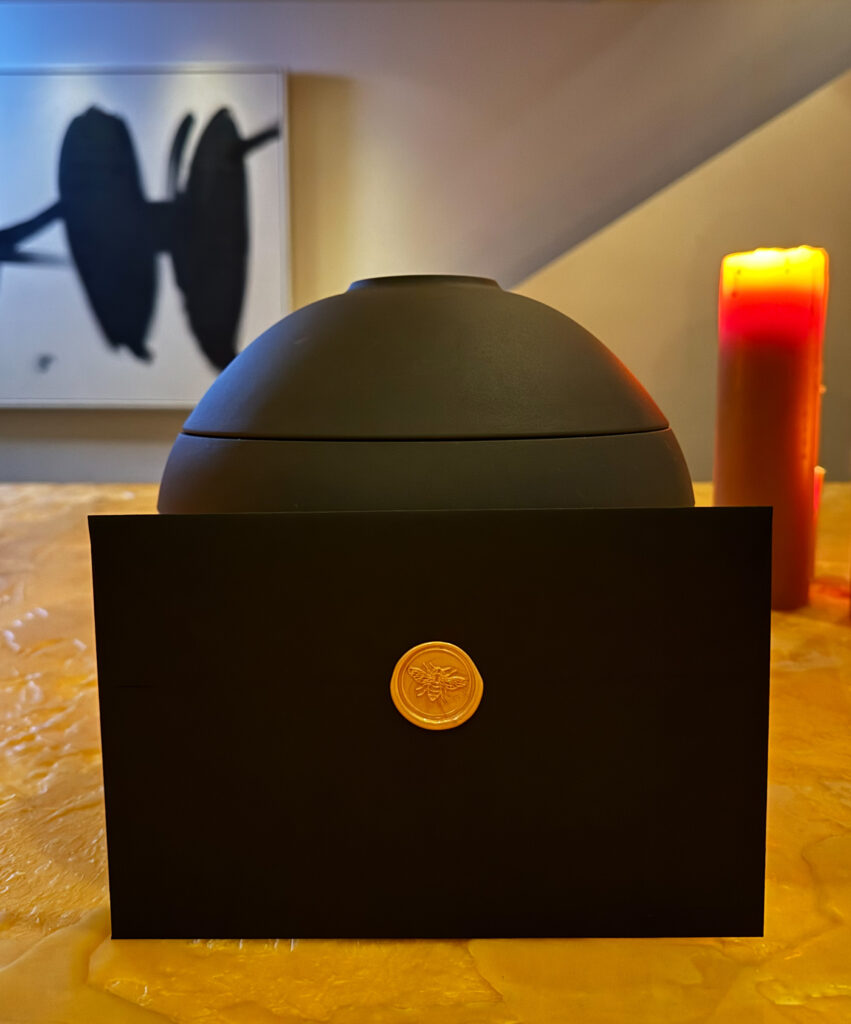
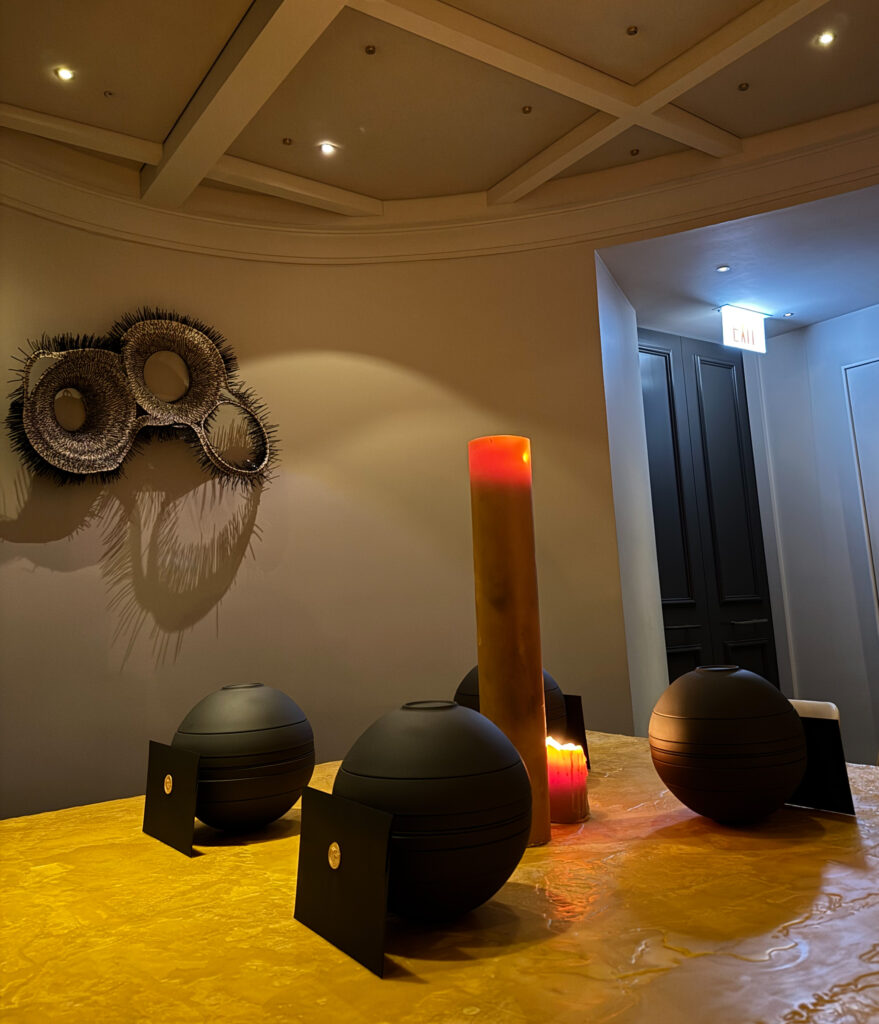
Tonight, I find the space curated with a degree of minimalism I have never encountered in this format—exacerbated by the fact that only 10 guests in total (relative to a capacity of 16) make up the seating. A beeswax-coated surface—irregularly rippled, faintly sticky to the touch (and to the bottom of one’s glass)—forms the heart of the design. Wax candles rise above it. Weighty, somewhat ominous black orbs sit upon it. A letter, sealed with a bee-emblazoned wax stamp, sits before each diner.
Nobody dares to break the seal until, 15 minutes later (once everyone has been seated), we are instructed to do so. In the meantime, it’s not hard to surmise that the orb, with its concentric grooves, nests multiple dishes. I would never have guessed there would be seven contained inside it: an opening sequence that—connecting the thematic dots—is referred to as the “Hive.” Following the presentation of each component, patrons also get a peek at what comes next (the identity of which they can learn by following along on the menu contained within the envelope).
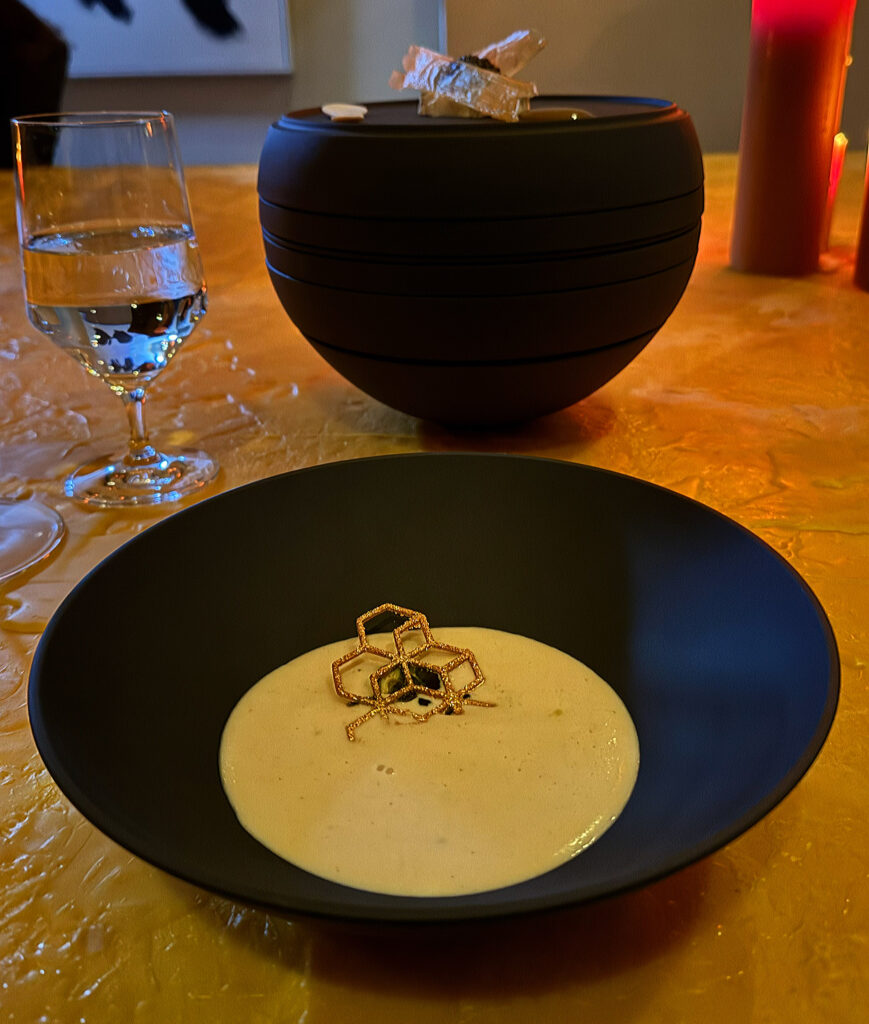
First, there’s the “Spring Onion Cream,” which combines the titular element with sweet-and-sour ramps, a charred ramp top butter, nuggets of golden honey, and a dash of amontillado. On the palate, the resulting effect is beautifully creamy and immediately soothing. Bits of crunch and bursts of oxidative tang provide definition. However, the core expression is one comforting, lip-smacking allium taken to a sweet extreme without ever proving sickly. This is a highlight—and not the kind of cooking I typically associate with Alinea.
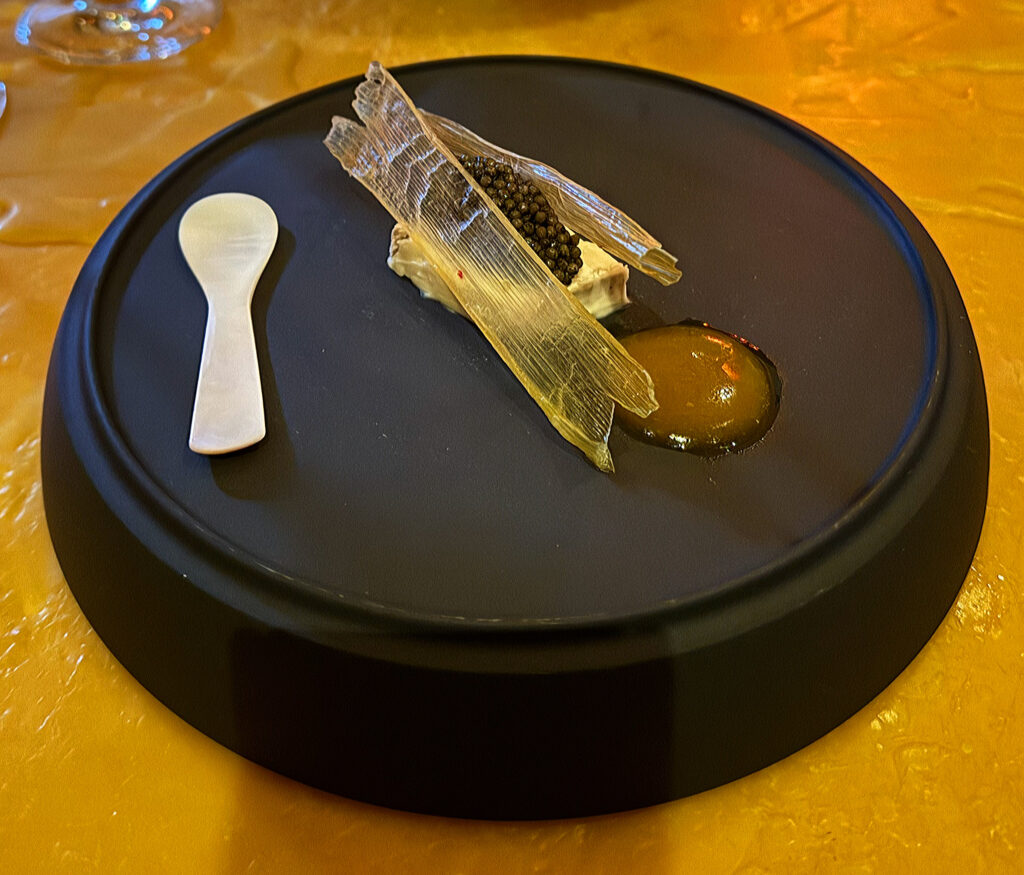
The ”Regiis Ova Osetra Caviar” takes a tempting form: pairing its roe with a slab of two-month-aged Délice de Bourgogne, a dab of French chamomile honey, and a couple “transparent” leeks. Again, I am met by a feeling of straightforward decadence that Alinea has almost seemed fatally allergic to at times. It’s hard to fault the combination of luscious cheese, sticky nectar, and subtle pop of caviar. Yet, while one of my leeks adds to the fun with its clean crispness, the other is jarringly limp and hard to process. Plus, fundamentally, the earthy undertones of the Délice de Bourgogne seem to obscure any desirable nuttiness from the Osetra. The interplay of cheese and honey is totally sound. I just find that this dish, while enjoyable enough, does not meaningfully improve on this rather basic combination.
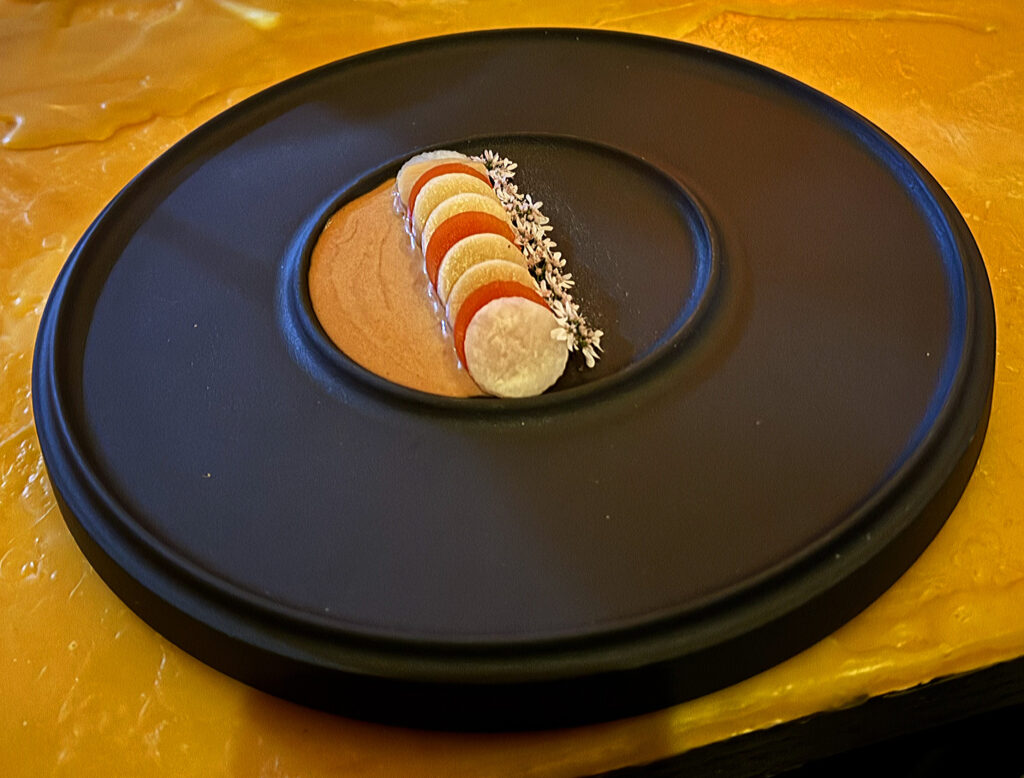
The “Preserved Trumpet Mushroom” boldly blends the fungus with jicama and honey-confited papaya (all rendered as coins). The stack comes dressed in a toasted coconut vinaigrette, whose sweetness and thickness form the best part of the recipe. Otherwise, the sliced components—alternatingly semi-crisp and limp—strike me as clunky. They’re generally quite bland too. I can almost envision how notes of earth, nuttiness, and tropical fruit were meant to come together here, but the result feels like a halfhearted vegan offering one would find at some casual concept.
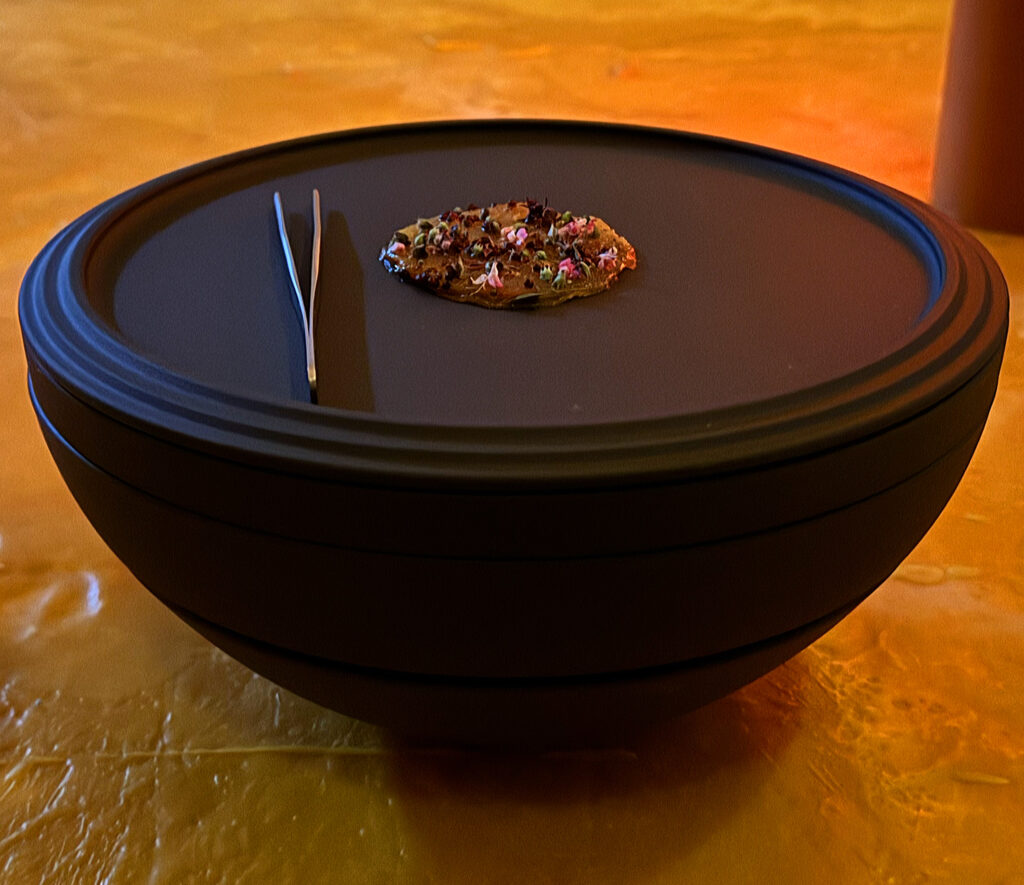
A serving of “Confit Abacaxi Pineapple” promises immediate redemption: after all, it not only features the finest fruit (in this case, a Brazilian variety known for its elevated acidity) but pairs it with jamón ibérico de bellota. An oxymel (or ancient honey-vinegar tonic) flavored with whole grain mustard and some opal basil buds complete the presentation, which guests—using tweezers—are instructed to fold twice before taking in a single bite. The first fold is easy, yet the second proves almost impossible. Others at the table give up; however, after applying brute force (which, in effect, perforates the center of the pineapple), I am able to do it. The resulting mouthful blends juicy tropical fruit with the subtle crunch of the basil buds and a hint of sharpness. Nonetheless, the coveted ham is hard to perceive, and, apart from being tricky to handle, this item is forgettable.
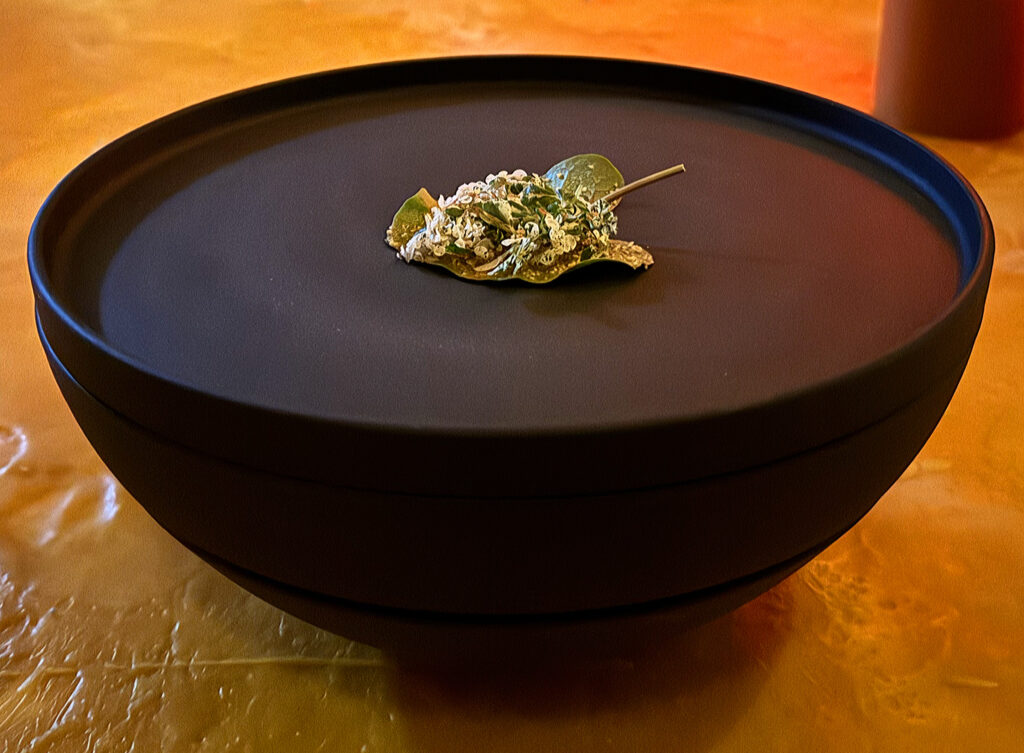
The “Alpine Sorrel Leaf and Frescura Blooms” forms the simplest part of the sequence. This one-two punch of herbs (the latter being positively obscure) is garnished with nothing more than a touch of honey and some propolis droplets (i.e., a resinous “bee glue”). The result is crunchy, then moist, and packed with powerfully fresh, woodsy flavor that tends toward an uplifting note of mint on the finish. If one thinks of this as more of a naturalistic palate cleanser than a proper course, the construction is actually quite refined.
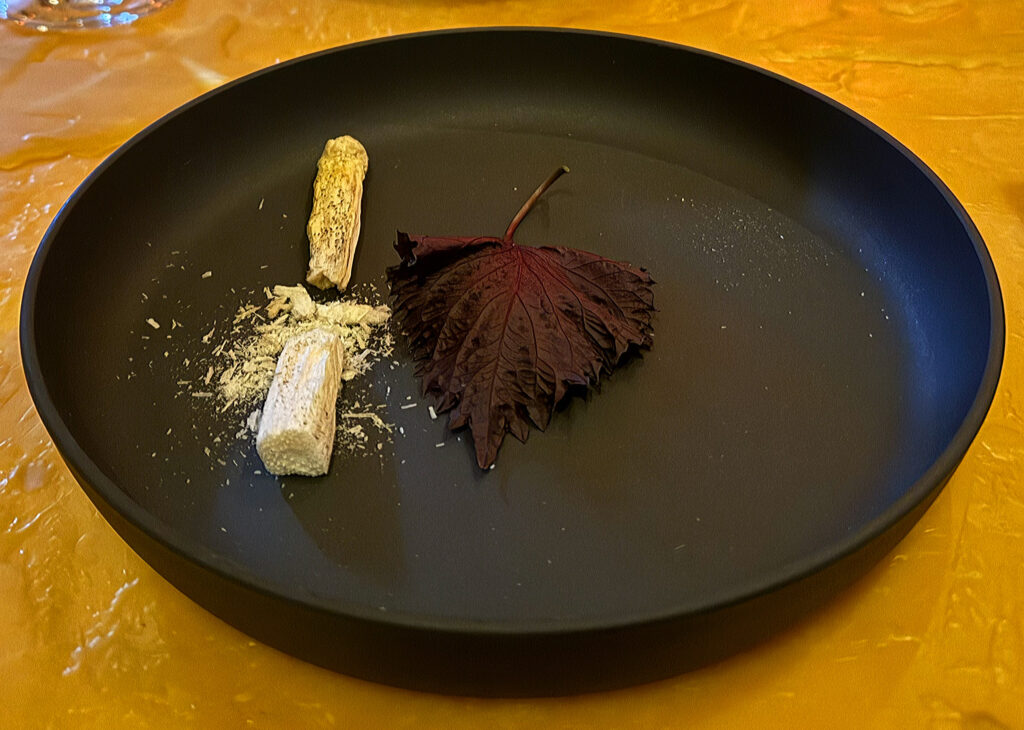
The ”Shattered Giant White European Asparagus” reflects a time-honored Alinea trope: the transformation of something plump and prized into an almost inverted structure. Nonetheless, if I am being honest, many chefs who look to honor these stalks in a more conventional manner cannot avoid rendering the ingredient with some abrasive stringiness. The kitchen here avoids that problem by imbuing the asparagus with a supreme, puffed kind of brittleness that only errs by sticking slightly to your teeth. Moreover, the “shattered” pieces are fun to dip—with accompaniments like a roasted straw cream, charred strawberry-Niçoise olive compote, and dab of caramelized honey (all hidden under a shiso leaf) offering nutty, earthy, and sweet undertones that help to reveal the starring vegetable’s full depth. Ultimately, while this dish feels stereotypically “Alinea,” it provides enough pleasure to positively represent the restaurant’s philosophy.
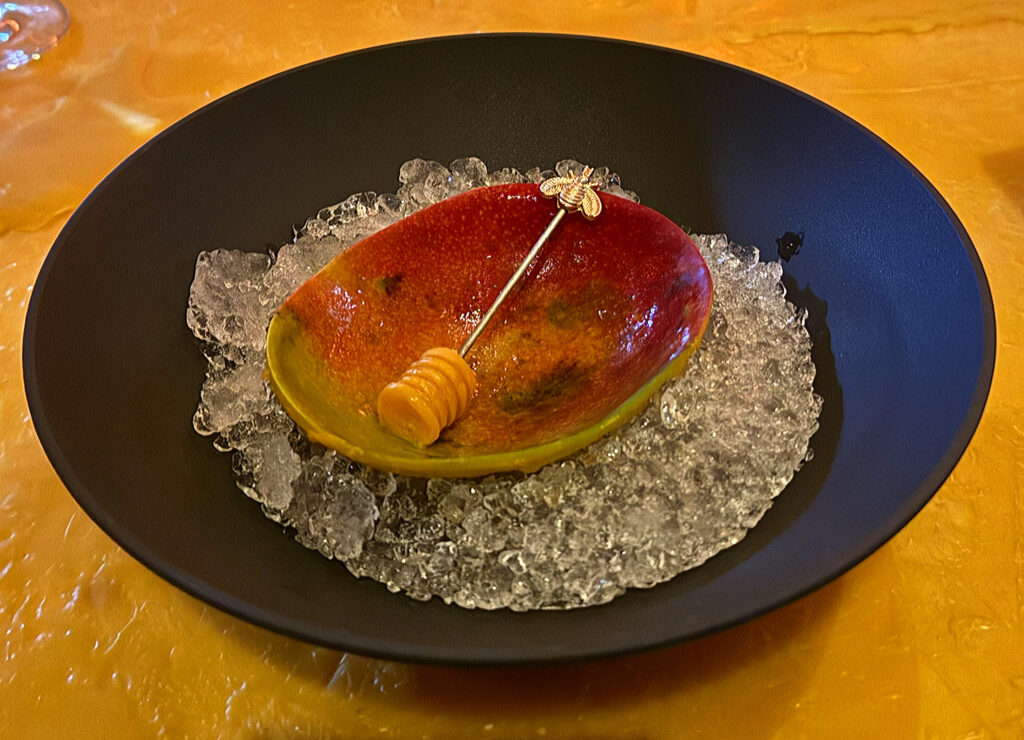
Closing out the “Hive” sequence is an item titled “Wax Mango.” This is another simple construction: one whose fruit—the Mexican Ataúlfo (or “honey”) variety—is layered and encased in beeswax so that the resulting skewer looks like a honey wand. This yields a bite of pleasing density and chewiness whose concentration of sweet, rich flavor provides a satisfying sense of finality. Indeed, the recipe ranks highly overall on account of its relative purity and power.
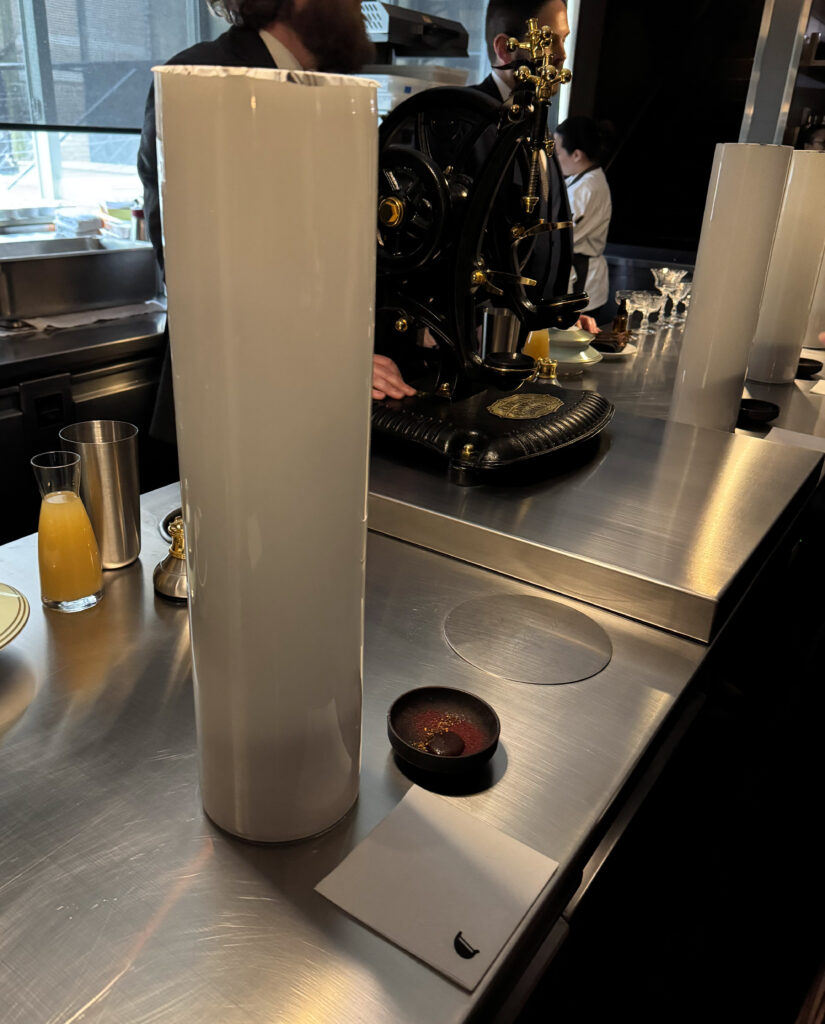
At this point, guests are led into the kitchen for the usual machine-shaken cocktail (in this case a sakura-accented Japanese whisky drink) and an accompanying snack.
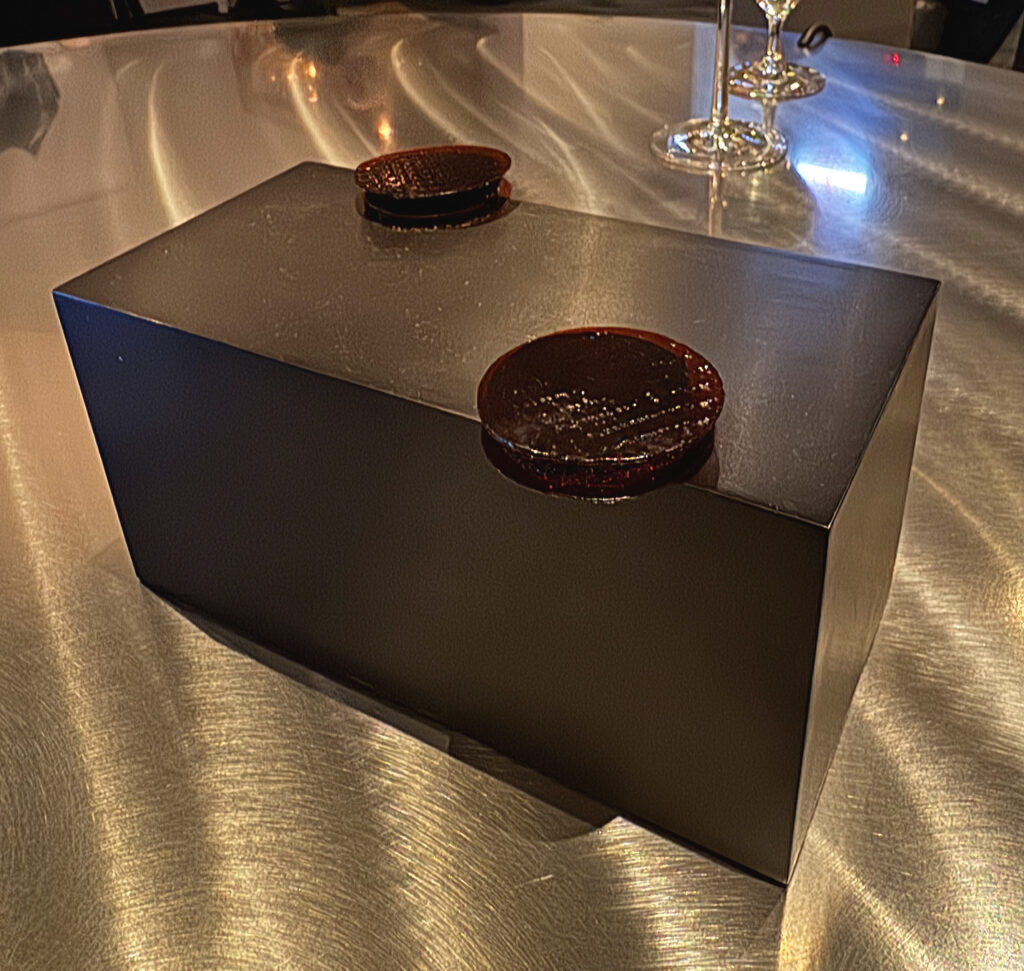
“Fear Factor” demands that guests punch through the top of a tall, opaque cylinder and reach down inside to retrieve their food. I can see why this process—plunging one’s hand into the unknown—is meant to feel precarious. Yet the team reveals the skewer of duck leg tsukune that awaits us, and I really do not feel anything else in the cylinder that would prompt a moment of pause.
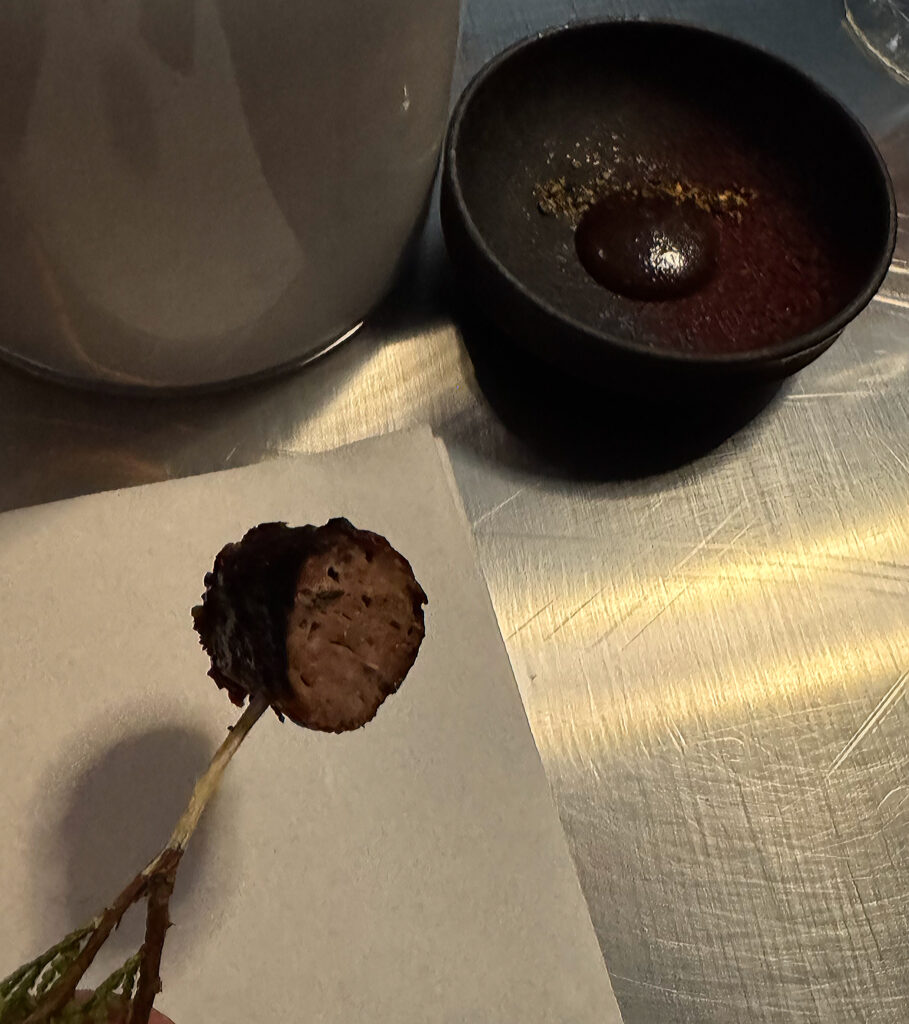
That said, the resulting meatball (coated in bits of duck bacon) feels plump and smooth and delectably meaty. An accompanying sauce, made from salted plum, adds to the pleasure with its intense, dark-fruited sweetness. In short, this represents another recipe—relatively straightforward in its deliciousness—that ranks among the evening’s highlights. I still don’t entirely understand the presentation, but I also appreciate the kitchen probably wouldn’t serve something so satisfying without a bit of set dressing to lean on.
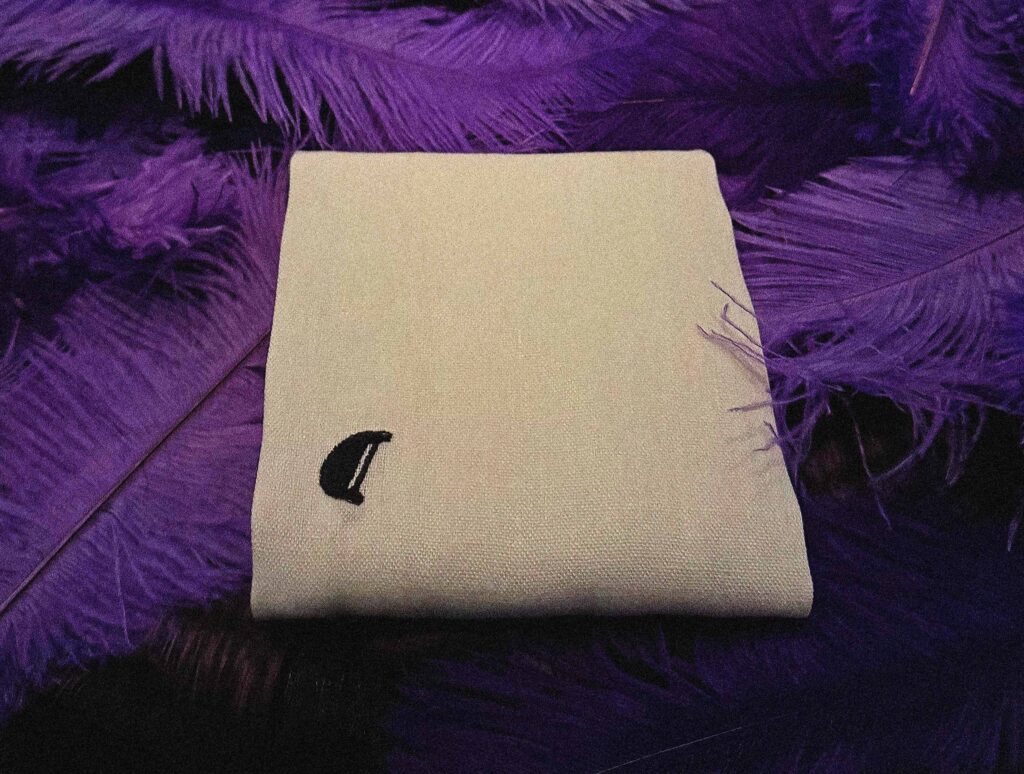
Structurally, the biggest surprise of the night arrives next: rather than being led back to the transformed “Gallery,” diners are directed up a staircase in one corner of the kitchen. They are then seated in one of the “Salon” rooms, where each table has been entirely covered in long purple feathers. Yes, these quills are so overflowing and irregularly piled that one struggles to even set their drink down. The resulting dishes, likewise, almost seem to float over the surface.
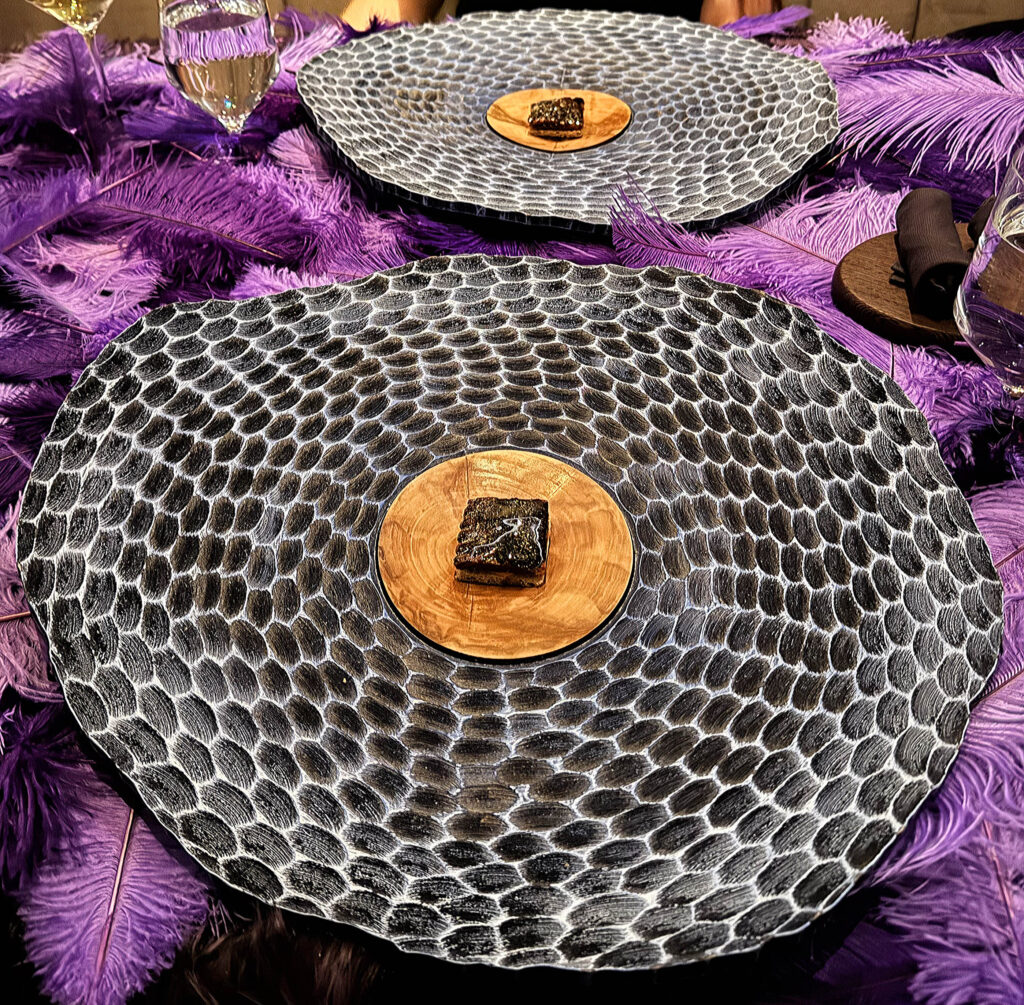
The “Skatewing à la Pharos Siamois” kicks off this upstairs sequence, comprising a glistening fillet of the titular fish that has been flavored with tamarind, fermented green peppercorn, and Thai basil then situated atop a coriander wafer. Texturally, the starring seafood displays a soft (though not particularly plump) consistency with a bit of a syrupy finish. The supporting wafer is mushy to the point that it cannot be cleanly broken through. The bite actually collapses as one works their way through it, and the overwhelmingly tangy sensation that hits the tongue is fairly undistinguished.
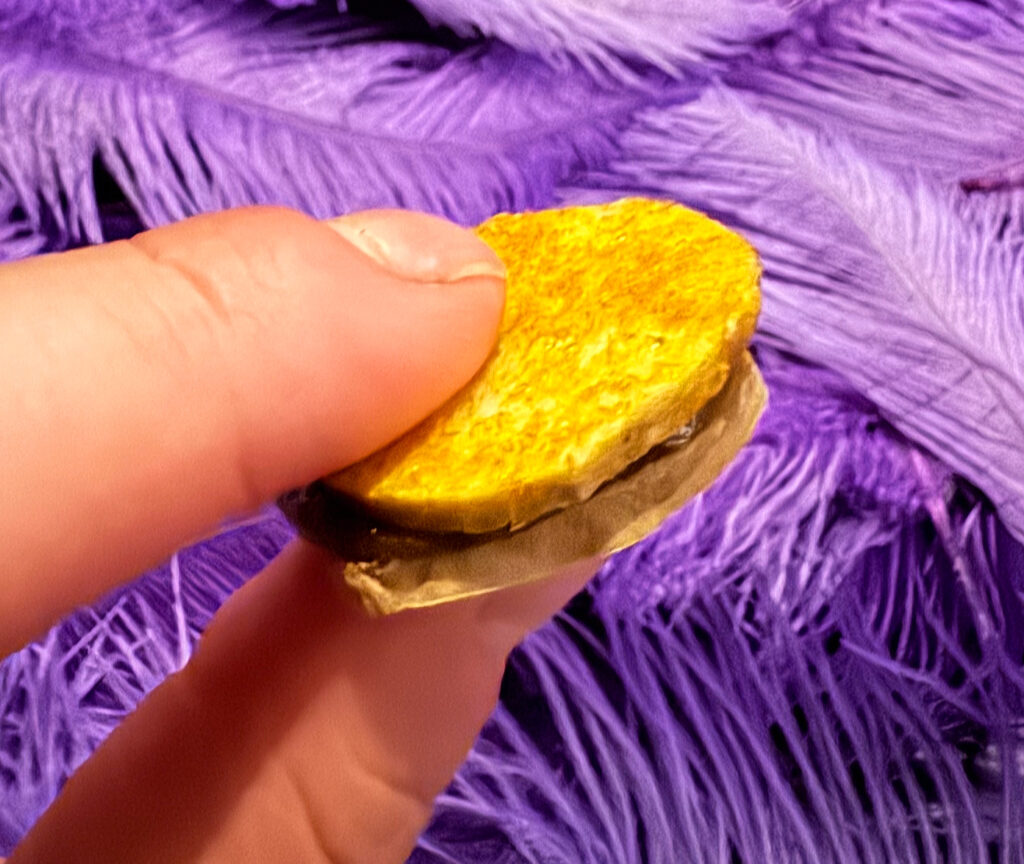
A “Sunflower Sandwich,” deposited on each diner’s palm, fares better. It is made from Jerusalem artichoke (i.e., sunchoke) wafers that are filled with a butter made from the flower’s roasted seeds and then layered with a few petals for good measure. On the palate, the sandwich delivers the kind of satisfying, framing crunch that was missing from the previous dish. Its flavor—packed with caramelized nuttiness—is reminiscent of an earthier peanut butter. The degree of concentration here is so high as to actually feel sappy and artificial. I guess, given how refined and single ingredient-driven this construction is, that forms something of a compliment.
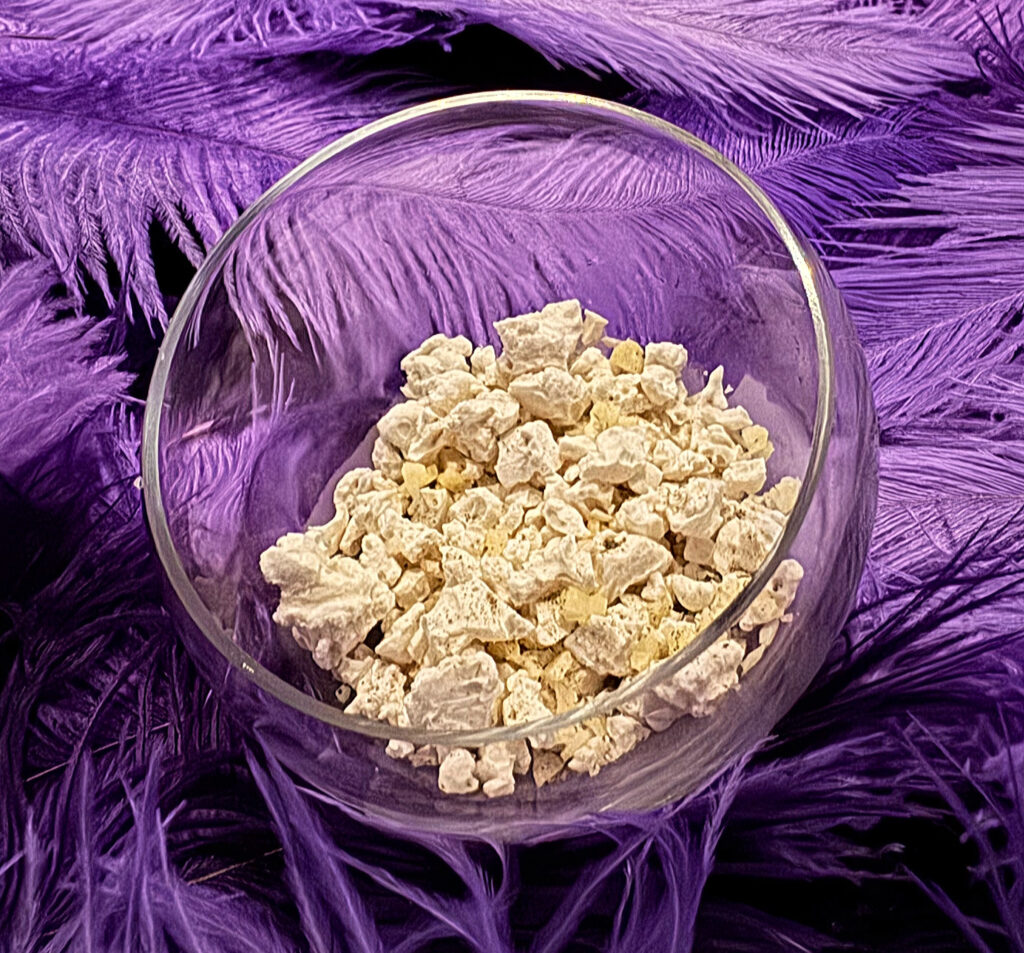
The “Cracked Maize Snow” promises to direct the previous bite’s brimming sweetness toward a delectably corny expression. Nonetheless, this bowl of nitro-frozen bits centers on a surprisingly restrained, savory representation of the starring ingredient. Indeed, juxtaposed by tongue-coating frozen butter chips and a sharp imprint of Tellicherry black pepper, the melty maize snow strikes with an earthy depth whose purity and persistence are profound. Paired with a pour of Meursault-Perrières, this recipe provides immense intellectual and hedonistic appeal.
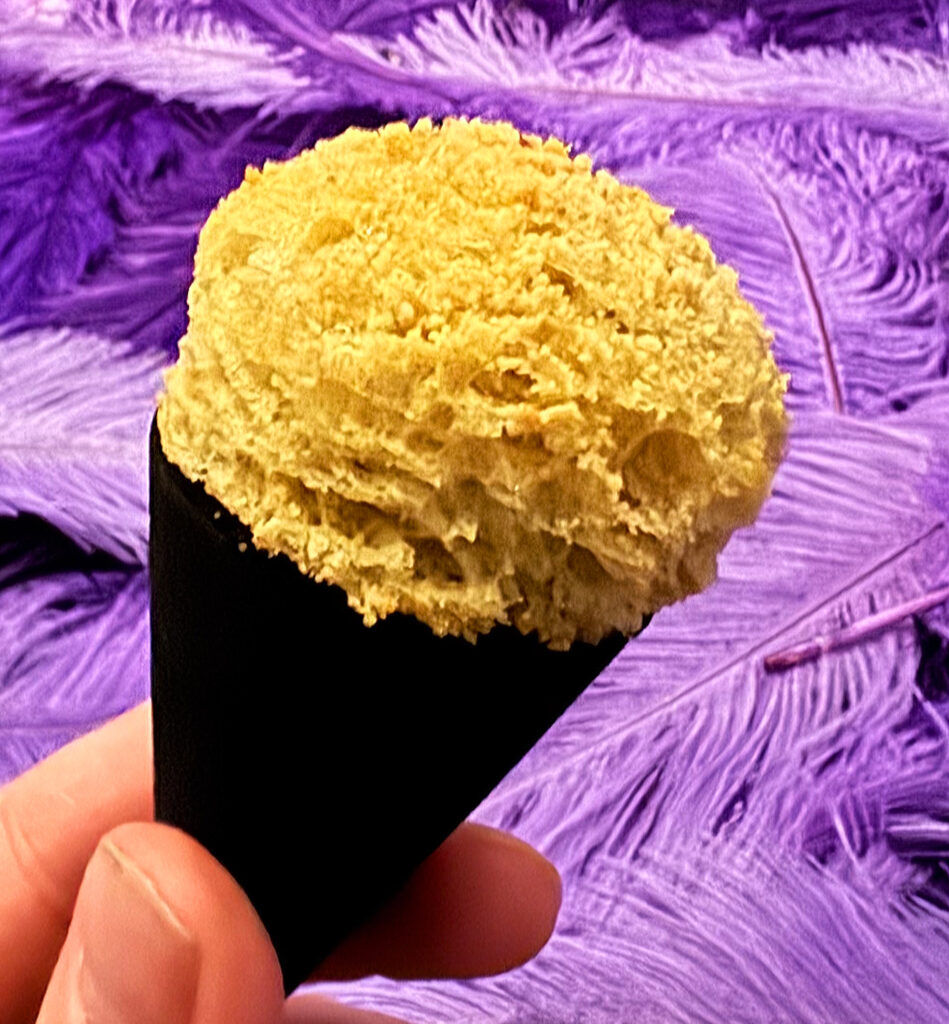
A ”Roasted Peanut Sponge” arrives looking much like an ice cream cone, but the captains are sure to advise guests to only go for the top. This soft, fluffy crumb is loaded with the warm, sweet, and powerfully nutty flavor of massaman curry. It’s shocking to encounter such an ephemeral form that can carry such savory depth and intensity. My mind—again—thinks “artificial.” But I know that’s not the case and instead ask, what is really gained by transforming such a rich, substantial dish into a fleeting fluffy of spice?

The “Seedless Concord Grape” closes out the upstairs sequence: offering a clear spherification of the headlining fruit (thus freeing it of those seeds) imbued with an oil made from house-milled and -toasted white sesame seeds. White the notes of the massaman curry still lingering on my palate, the Concord strikes with a supreme degree of fruitiness that conjures a sense of nostalgia. I speak not only of a peanut-butter-and-jelly effect (completing a thought that first arose a few servings prior), but of a grape—almost like grape soda—that transcends what the ingredient itself is capable of. Again, I reference something obviously artificial, but, in this case, the effect works for me.
At this moment, guests are led out of the repurposed “Salon” and down a central staircase that, completing the loop, leads right back to the “Gallery.” Tables there have been separated and set with traditional (i.e., free from wax or feathers) white tablecloths and illuminated by candlelight, which serve to welcome diners to the most substantial section of the menu.
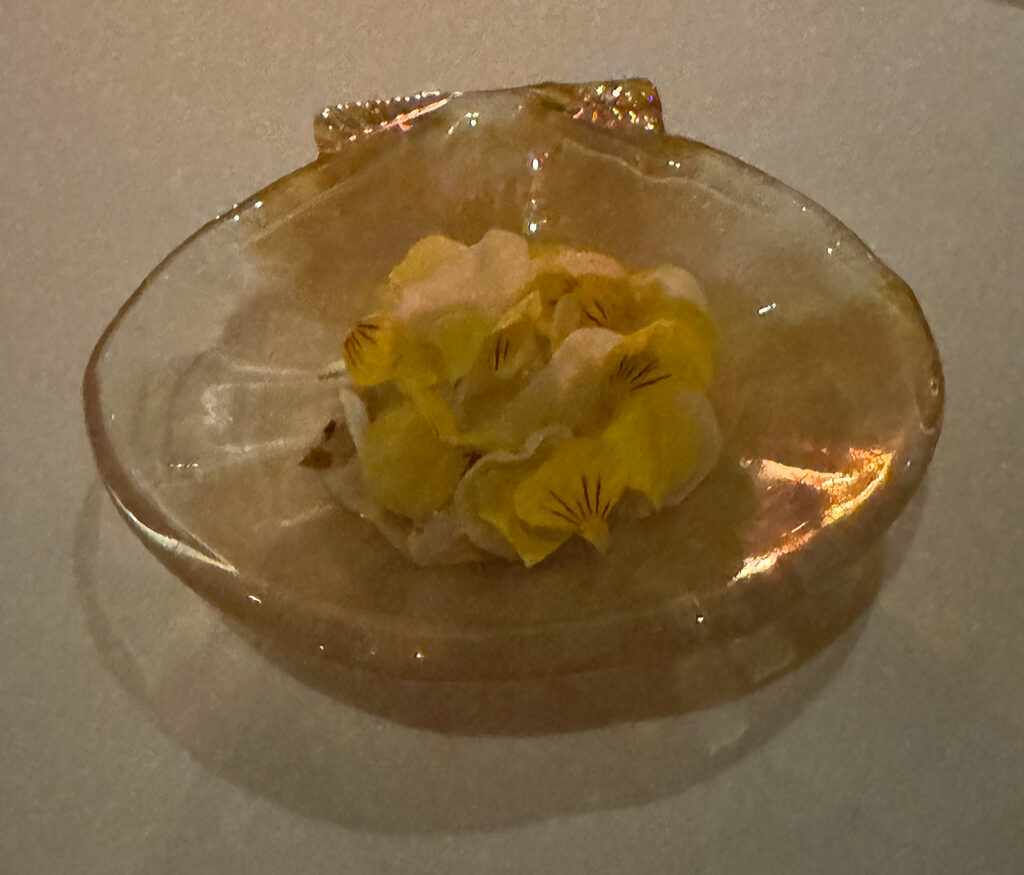
The “Hand Harvested Hokkaido Scallop” kicks things off, arriving within a vessel that is meant to mimic the mollusk’s own shell. Its flesh is rendered in small pieces that are married with shaved carrot, flower petals, passionfruit, and sauce made from mustard. That said, the dish’s texture is dominated by the crunch of the vegetable (rather than the soft, buttery consistency of the bivalve). There’s little tang or sweet or even pungency to speak of either. Ultimately, this recipe is confusing more than it is unpleasant—eating more like a halfhearted salad than anything suggesting seafood or fruit.
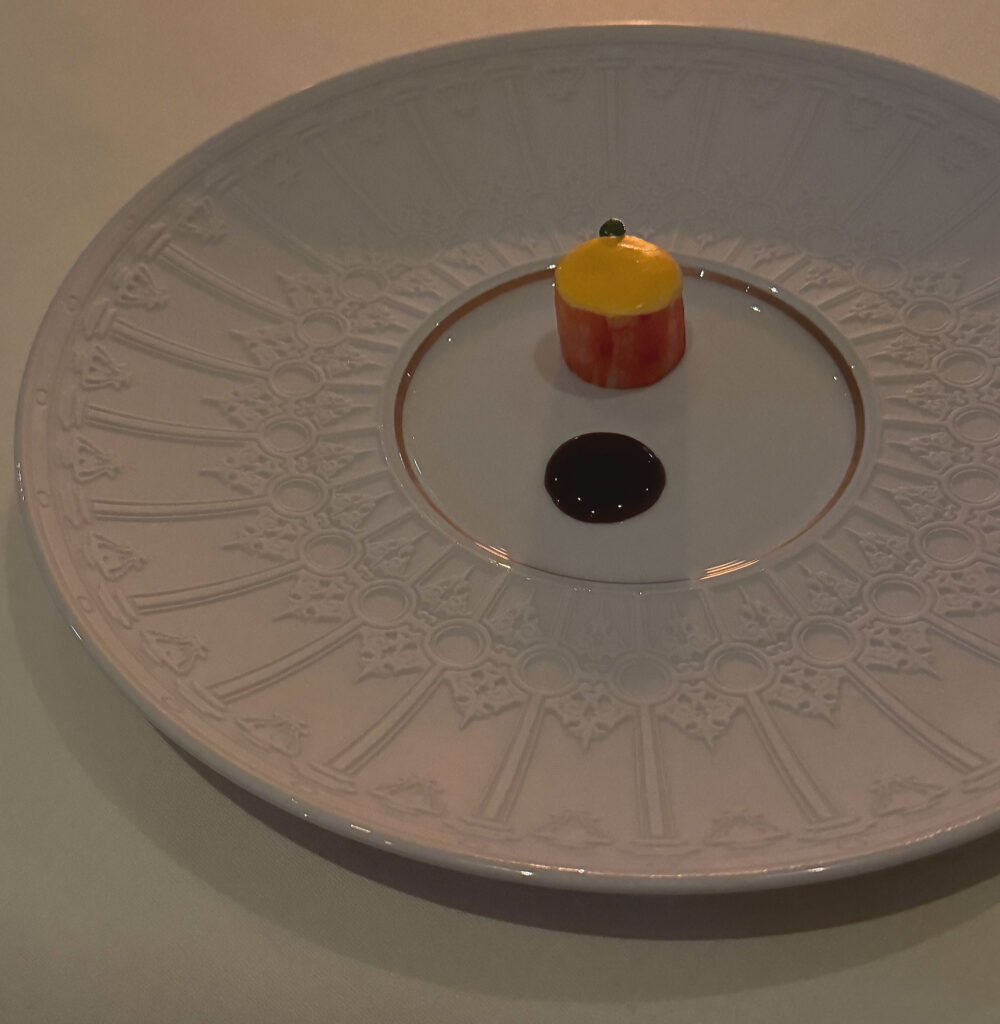
A preparation of “Barely Cooked Aleutian King Crab” ups the ante: it’s hard to think of any better shellfish than this. Dressing the crustacean with a veil of cheddar popcorn velvet, an accompanying dab of caramel (made from its shell), and a single kinome leaf, the kitchen aims at a degree of decadence I hardly associate with the restaurant. Guests are advised to take one bite of the crab on its own (the portion having been split in half) before dragging the second through the sauce.
On the palate, the meat feels uniquely rich and gelatinous but, for my dining partner, veers toward a sickening degree of gumminess. (I can only agree when tasting their serving.) When it comes to flavor, my first mouthful doesn’t quite read as cheddar popcorn but, nonetheless, displays pleasing notes of tang that tease out the seafood’s latent sweetness. On the second go-around, the crab shell caramel drives this perception of sweetness into the stratosphere. Really, it’s almost too much, but I find myself enjoying the surprising harmony and impressive concentration. Overall, this almost feels like a Smyth dish—just rendered with a bit more clunkiness and a lot less supporting umami.
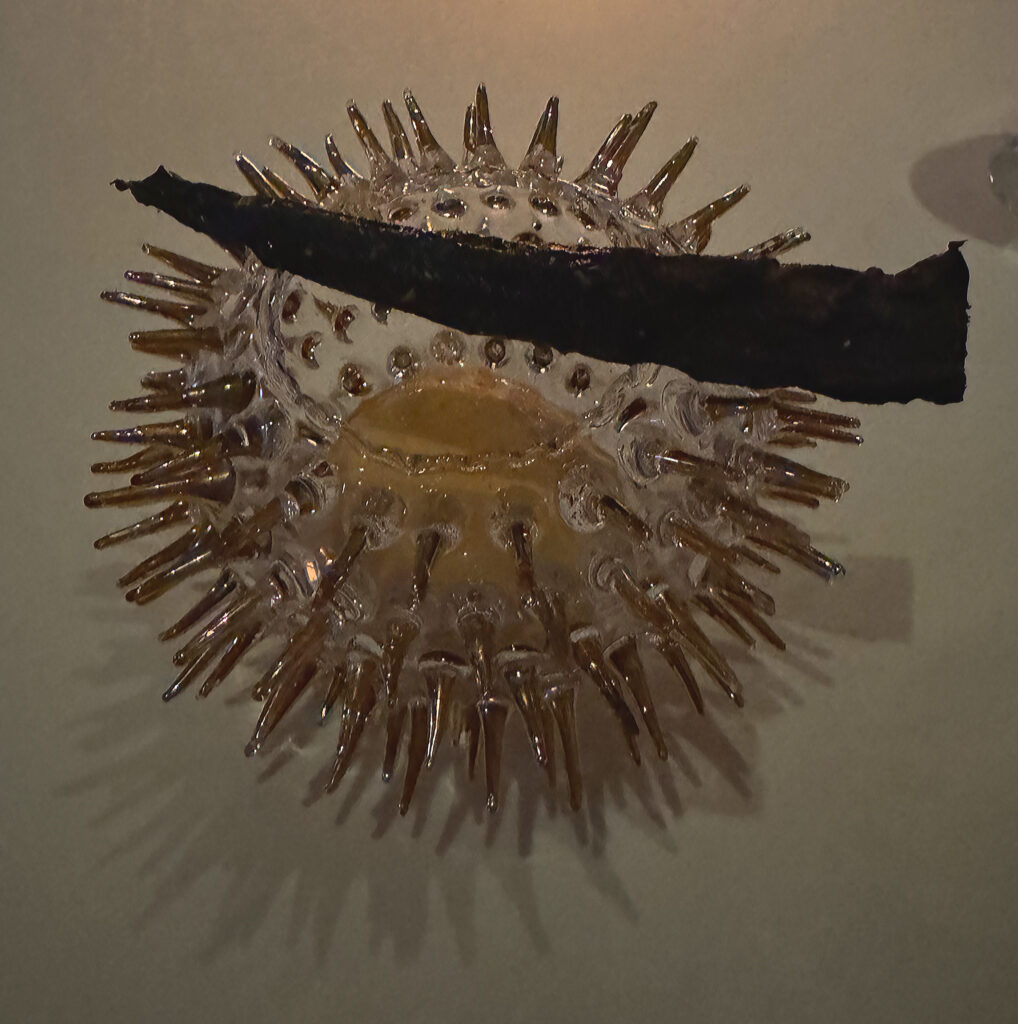
The “Grilled Hoja Santa Leaf Wrapped Baby Corn” is said to be debuting tonight. It can also be described as something more of a sea urchin course: one in which the uni (again situated in a vessel that replicates its shell) forms a frothy dip for the titular element. I quite enjoy baby corn, and its crisp crunch it well rendered here. However, the hoja santa leaf (which extends beyond the length of the vegetable) is a bit more problematic, for its limpness and stringiness counteract any pleasure. Nevertheless, the sea urchin dip—sweet, oceanic, with hints of tang (from lime) and smoke (from ancho chili)—forms an attractive complement. I am only left asking, again, what is really gained by transforming uni’s fundamental creaminess into an airy sauce?
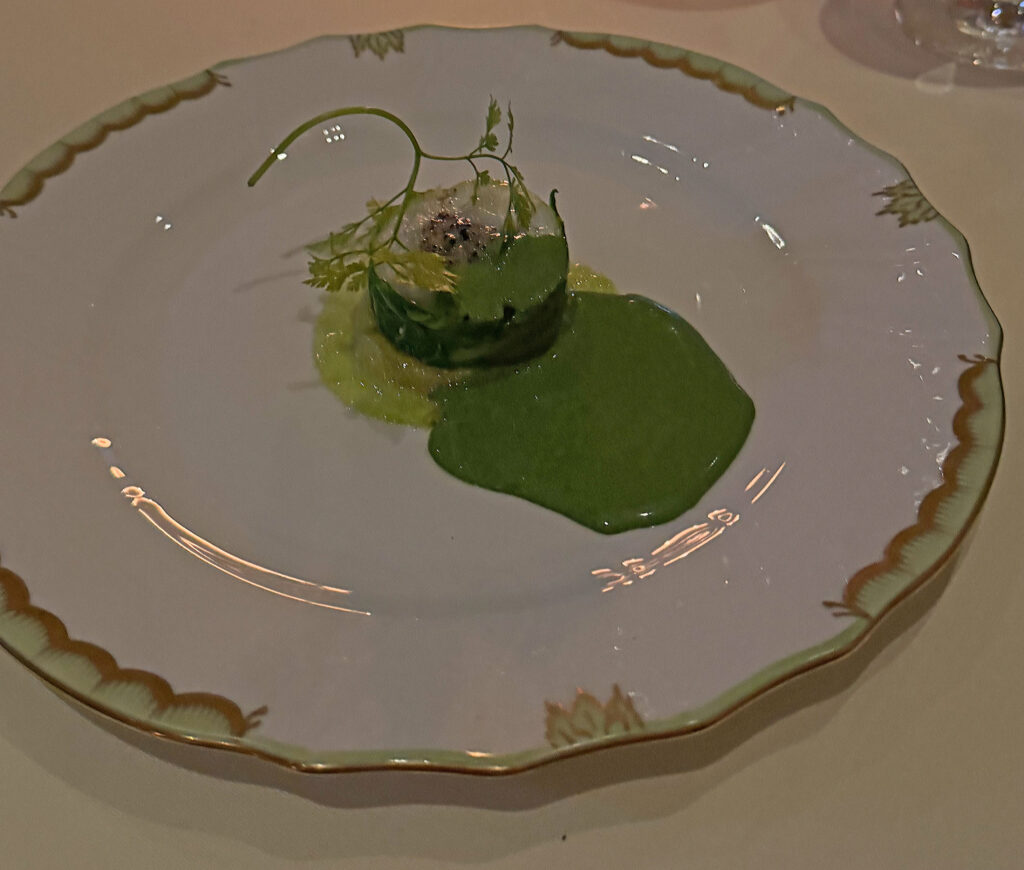
A “Steamed Spanish Turbot” completes what can, in retrospect, by titled a four-part seafood sequence. The fish arrives having been rolled and steamed in leaves of savoy cabbage then stuffed with a butter-braised sauerkraut made from the same ingredient. The vegetable also features (alongside juniper and carraway) in an accompanying sauce. However, it’s the Périgord truffle and banana mousseline surrounding the turbot that proves decisive: imbuing the recipe’s rich and creamy textures with a transfixing vein of sweetness (tinged with a haunting, savory musk) that drives the subtler notes of cabbage and spice to a place of deep satisfaction. Indeed, this preparation manages to feel subversive and classic in the same breath. It ranks as a highlight.
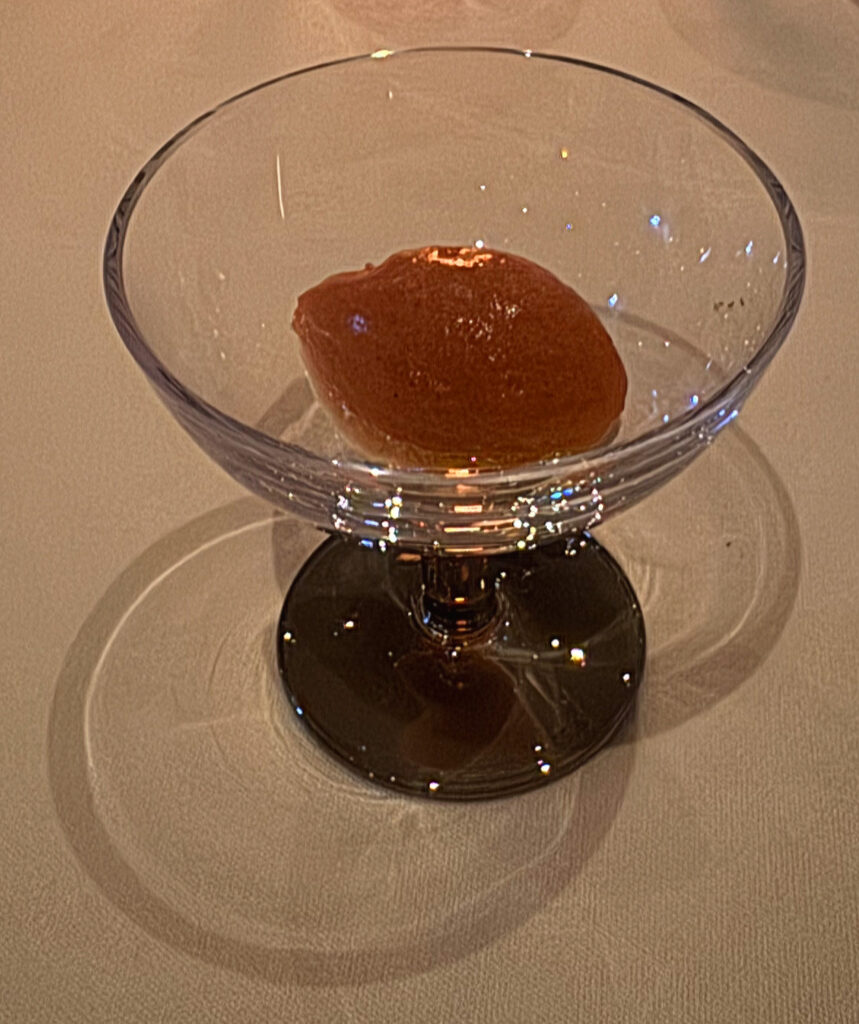
The “Carbonized Rio Red Grapefruit” is meant to form a cleansing segue toward the meal’s closing savory movement. Crowned with a cloche, it takes the form of a small scoop of sorbet dressed with extra-virgin avocado oil. The frozen fruit is meant to be enjoyed alongside sips of an accompanying Scotch bonnet soda, whose tropical and spicy depth (free of any jarring heat) counters the bitter, smoky notes of the charred grapefruit. This yields a pristine note of citrus fruit whose depth and length are simply immense. While not necessarily delicious, the sorbet and soda combination is both striking and practical.
At this late stage, the final “scene change” of the night occurs: tablecloths are removed to reveal the shiny metallic surface below. This fourth of four distinct surfaces will carry diners to the menu’s conclusion.
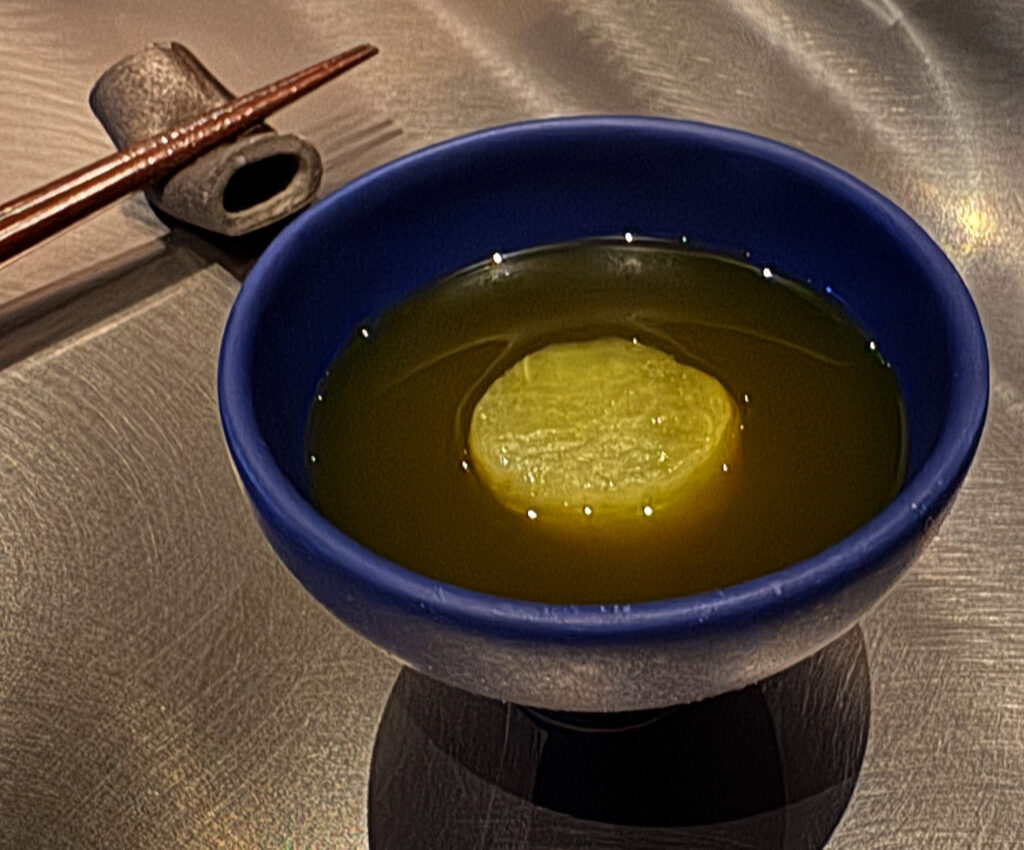
A “Softened Tōgan” (or Japanese winter melon) leads this culminating savory sequence off. The fruit comes soaked in a saffron- and vanilla-infused mussel tea, whose concentration of shellfish flavor dominates the dish. Yes, while the melon is pleasingly tender on the palate, its own character is largely neutral. I sense a bit of warmth from the saffron, yet there’s no wider sweetness to speak of. Instead, the recipe centers wholly on a briny, vaguely oceanic sensation, and I actually don’t mind it. As a means of gently readying one’s tongue for the meatier servings to come, the tea works well.
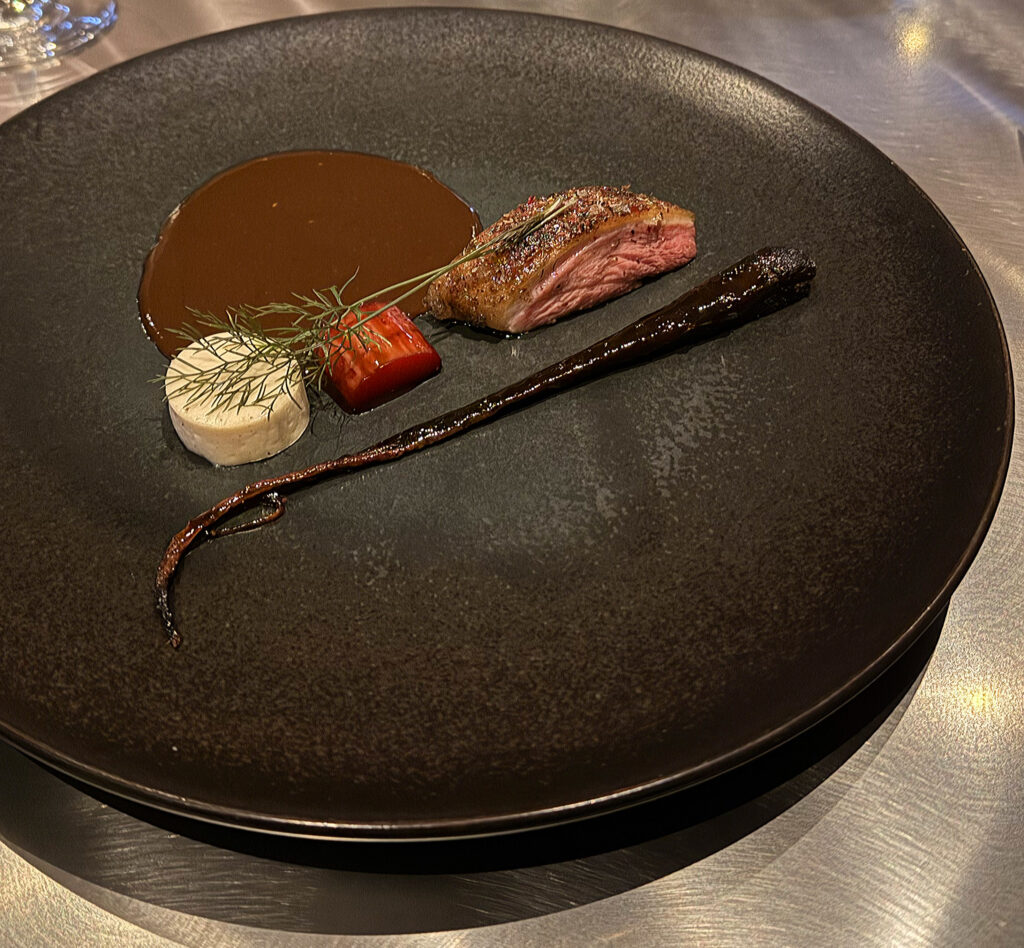
The first entrée on offer is the “14 Day Aged White Pekin Duck,” which comes dusted with Sichuan peppercorn and joined by a piece of petrified parsnip, a puck of parsnip-vanilla cream, a “twizzled” segment of rhubarb (not pictured), a poached serving of the same stalk, and a sauce rouennaise made from the bird’s carcass, liver, and some Cognac. On the palate, the cut of breast—crowned by a beautifully crispy layer of skin—is remarkably juicy, and it delivers a supreme degree of umami whose depth of earthy, nutty flavor is accentuated by the subtly numbing peppercorn.
Considered on its own (and alongside the sauce that echoes its essence), the duck is clearly the best item of the night. However, the accompaniments do nothing to improve on it. The “twizzled” rhubarb is expectedly chewy, yet the parsnip is less understandably so. The poached rhubarb feels redundant (and not all that easy to get through in its own right) while the parsnip-vanilla cream is thick and bland and off-putting. Ultimately, I’d put the cook on the duck up against any restaurant in the country (though not, say, Sézanne’s), but this admirable effort is undone by sides that seem to work against—rather than reinforcing—one’s pleasure.
A bite of “Bing Cherry Juice Braised Kombu” forms a bridge to the last entrée. Hearing that seaweed mentioned, my mind immediately goes to Smyth. Spying the slices of Périgord truffle tucked between the brittle chips only serves to heighten the effect. That said, the kombu’s texture is jarring due to its persistent “glass shard” sensation. The resulting notes of truffle are powerful and perfectly integrated with the cherry, but it’s hard to get over how this item feels against my teeth.
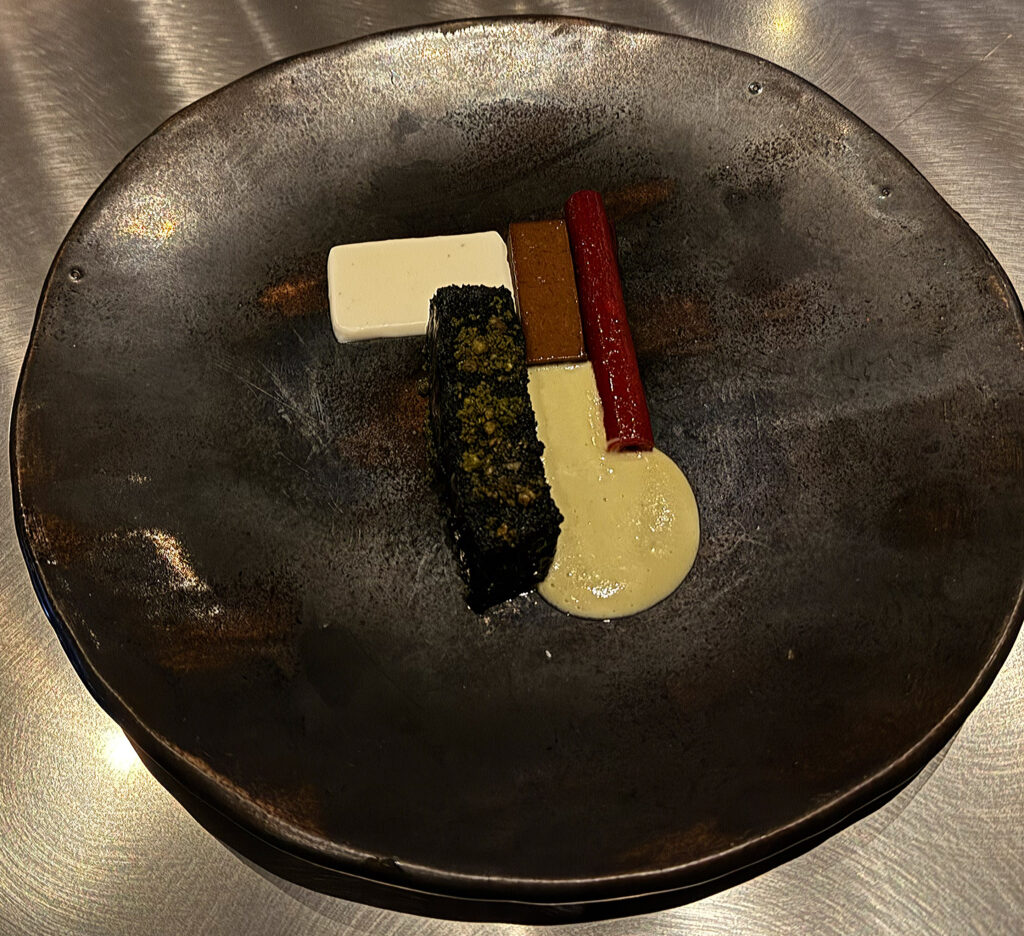
The final savory course on offer is titled “Ribeye of Japanese Wagyu Beef.” I always associate Alinea with A5 Miyazaki striploin, so I appreciate seeing a different cut—as well as the more robust A4 grade—of the coveted cow on display. The steak comes crusted in black garlic and Castelvetrano, which ensures its desired “steakhouse chew” is matched by a baseline of salt and umami. The resulting juiciness, too, meets my expectations for wagyu.
As with the duck, accompaniments here veer in a stranger direction. Yet a toasted bread purée, an artichoke emulsion, and supporting notes of parmigiano really only function to build upon the meat’s most desirable notes: matching beefiness with roasted, nutty depth. An “Italian udon noodle,” flavored with smoke paprika, is probably the weirdest of the bunch, but I actually find myself liking its warming expression as the tube’s bounciness fades. All in all, this makes for a rather conventionally pleasing preparation.
Of course, I’m discounting the fact that this dish also offers a certain visual thrill. However, shouldn’t the lines be sharper? And shouldn’t the overall effect be a little more convincing? Oriole’s wagyu consistently achieves greater textural breadth and deliciousness with relative ease.
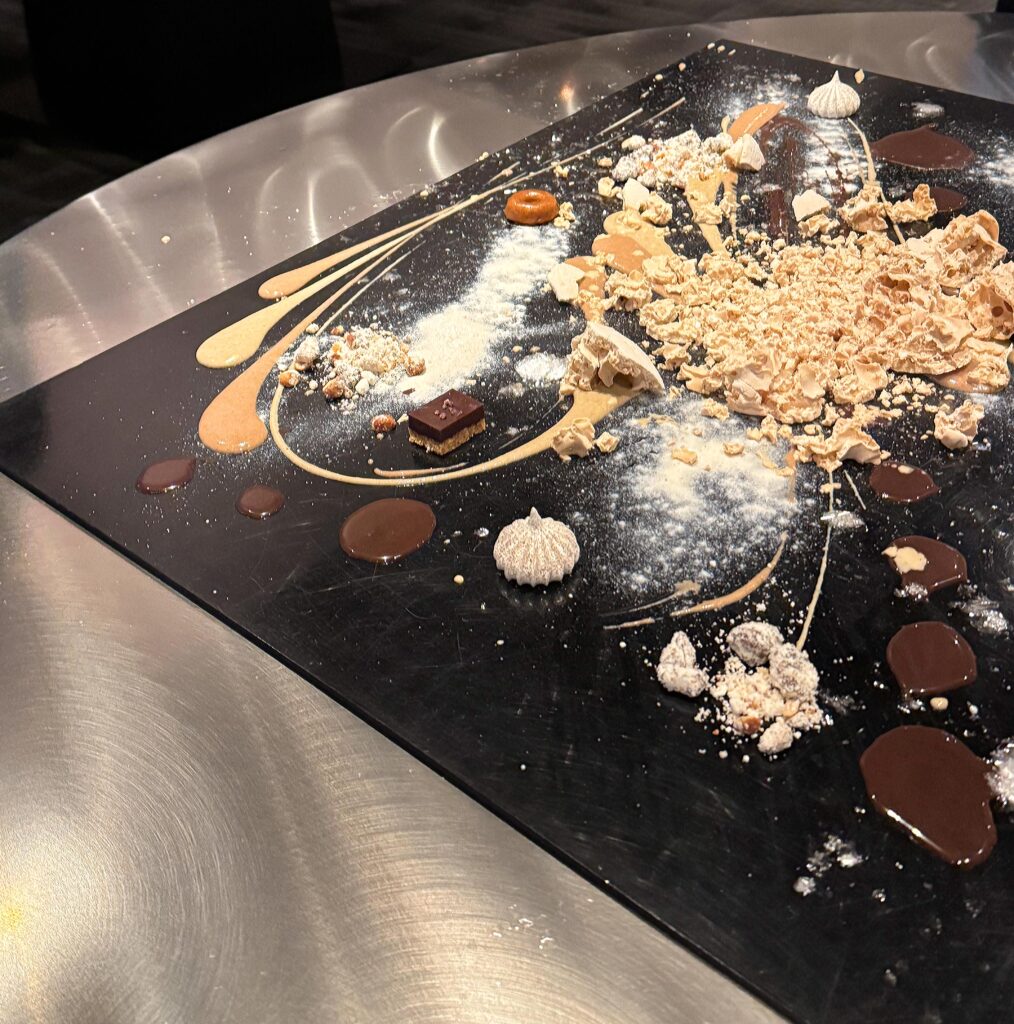
On this occasion, dessert comprises a solitary offering titled “Paint” (also known as the “table dessert”). Personally, I like seeing the menu weighed so heavily toward savory fare and then suddenly—spectacularly—shifting into this signature offering.
Centered on flavors of date, chai, and chocolate (while featuring elements like candied hazelnut, nutmeg “snow,” and cinnamon “glitter”), this canvas strikes me as one of the restaurant’s more straightforwardly decadent examples. Of course, the spice prevents it from feeling simple, yet I feel totally satisfied by the alternatingly melty, crunchy textures and flavors of cocoa and nuts I find (compared to renditions that have opted for brighter fruit).
With so many of Alinea’s signatures having now—at last—disappeared, the table dessert maintains a certain charm and nostalgia as the one connection to the restaurant’s grand past. Nonetheless, it, too, is not long for this world. The captain reveals that a new, “sculptural” course is set to replace “Paint,” and it will form the starring attraction for at least the next couple years.
Three hours later, the meal reaches its conclusion: some 23 courses served at an average pace of just under eight minutes each. Admittedly, there was never a dull moment. (But dull flavors? That’s a different question.)
Tock prepayment ensures there’s no sticker shock when it comes time to leave—a structural element that (should one decide on a pairing before arriving) ensures the evening really does feel a show. Indeed, in the moment, there can be no regret.
It only comes with digestion and reflection, which are helped along by a parting gift of pancake mix, black truffle butter, pomegranate-rhubarb compote, and local honey. Given the degree to which this gesture (save for the occasional petit four) has died out, these form one of the better take-home offerings I’ve encountered as of late.
In ranking the evening’s dishes:
I would place the “14 Day Aged White Pekin Duck” in the highest category: a superlative recipe that stands among the best things I will be served in any restaurant this year.
The “Spring Onion Cream,” “Wax Mango,” “Seedless Concord Grape,” “Barely Cooked Aleutian King Crab,” “Steamed Spanish Turbot,” and “Paint” all land in the next stratum: great items that achieved a truly memorable degree of pleasure. I would love to encounter any of these again.
Next come the ”Regiis Ova Osetra Caviar,” “Confit Abacaxi Pineapple,” “Alpine Sorrel Leaf and Frescura Blooms,” ”Shattered Giant White European Asparagus,” “Fear Factor,” “Sunflower Sandwich,” ”Cracked Maize Snow,” ”Roasted Peanut Sponge,” “Carbonized Rio Red Grapefruit,” “Softened Tōgan,” and “Ribeye of Japanese Wagyu Beef”—good—even very good—preparations I would always be happy to sample again (but that just failed to elicit an extra degree of emotion).
Finally, we have the “Preserved Trumpet Mushroom,” “Skatewing à la Pharos Siamois,” “Hand Harvested Hokkaido Scallop,” “Grilled Hoja Santa Leaf Wrapped Baby Corn,” and “Bing Cherry Juice Braised Kombu”—merely good (maybe just average) items that fell short when it came to texture or flavor. None of these bites faltered in more than one dimension, so there was still pleasure to be had (and, indeed, they could possibly be fixed with a little more tweaking).
Overall, this makes for a hit-rate of 78% with some 30% of offerings reaching that “would love to have again” level of quality. These stand among the lowest figures I have recorded for any fine dining concept this year (roughly matching my worst meals at Feld, Oriole, and Smyth); however, this probably makes for one of Alinea’s best performances in the past decade.
Admittedly, I’m being quite generous—as one portion of the “King Crab” was offensive and the sides served with the “Pekin Duck” should have brought it down by one or two categories. This would have made for calculations of 74% and 26% respectively.
It is also worth noting that, despite the excision of a few iconic recipes, more than 60% of the dishes that featured tonight have appeared on previous (i.e., pre-evolution) menus. Experiential elements (like the “Fear Factor” presentation and even the purple feathers on the table) were lifted wholesale from the 20th Anniversary Tour pop-ups.
The “Hive” sequence, to its credit, was both structurally and substantively almost entirely new. Only two of the seven components (i.e., the “Osetra Caviar” and the “Shattered Asparagus”) debuted before May 4th. Though, fundamentally, we’re talking about a table covered in beeswax and some custom-built pieces of serviceware. The other big surprise—leading guests upstairs to a third distinct space—may have more to do with the fact that “Salon” reservations are lagging than the fulfillment of any real vision. Yes, though there’s a basic novelty to moving throughout the restaurant, none of the rooms were transformed to an extent that really transcended Alinea’s pervasive minimalism and coldness.
It’s partially my fault for assuming that the restaurant’s evolution would be sudden and comprehensive. Read properly, the announcement really signified that the team is ready to start trying again after spending a year away from Chicago and getting hit with Michelin’s formal sanction. If an extra, upstairs room and some Substack posts are all the concept has to play with, I’m not sure the concept is serious about winning back customers who have written it off forever.
Today, it’s too easy to look at Somni or Alchemist or a whole world of Spanish gastronomy and see Alinea’s vision (whether one emphasizes the cuisine itself or the spatial dimension) being executed at ten times the intricacy and scale. Not to mention, we are talking about restaurants where the chefs are there and knowable and frequently act as consummate hosts. The facelessness with which The Alinea Group practices its hospitality will always rob its work of emotional power. There’s a big difference between wanton experimentation that comes straight from the hands of an obliging, engaging craftsperson and the kind that can only be attributed to an amorphous, impersonal kitchen crew. Even a deputy could (and should) fill such a role if need be.
Alinea’s sins largely remain the same because this evening was the product of the same core group of people, trapped in the same creative bubble, and only forced to pursue introspection as a means of saving face. Really, had the team started down this path in the wake of the critiques made by Chicago magazine, the Tribune, and the New York Times, they might have actually gotten somewhere by now. Instead, Bibendum forced the restaurant into a defensive posture, and I think the principals see this surface-level rebranding (largely a regurgitation of ideas that weren’t particularly well-received during the pop-ups) as a means of stemming their bleeding books.
Only time will tell if the concept retains enough creative juice to meaningfully transform the menu and do something memorable with its new upstairs space. The worst dishes tonight (like the mushroom, scallop, baby corn/sea urchin, and black truffle/kombu) still left me asking why otherwise prized ingredients were so stripped of their pleasure. Even some of the items that were more successful (i.e., the caviar/cheese, pineapple/jamón, white asparagus, and peanut sponge/curry) begged the question: what do we really gain—other than superficial novelty—by torturing products that would be perfectly enjoyable on their own? That deliver noticeably more pleasure when attuned to their traditional forms?
That said, the best dishes tonight (like the spring onion cream, mango, grape, turbot, and duck) struck with the kind of refined textures and concentrated flavors I largely think the kitchen—save for the original “Black Truffle Explosion” and “Hot Potato/Cold Potato” bites—is incapable of crafting. If the team continues to capture and prioritize this kind of magic, using all their technical prowess to make ingredients feel like something more than (not a twisted perversion of) their usual selves, they may shape a menu that leaves the audience actually wanting more.
Certainly, whatever that new “sculptural” dessert entails (when it eventually replaces “Paint”) will be hugely consequential: to what degree will it emphasize performance as opposed to legitimate pleasure? Can it possibly find a way to balance both? Will it affirm that Alinea, ultimately, has really learned something from its detractors?
I’m not sure I’ll ever be around to answer those questions. For, while I may have a high tolerance for any cuisine that takes risks, shared aesthetic values—cooking that expresses a certain intimacy, honesty, a corresponding degree of power, and an indelible sense of place—prove most essential.
Chefs who seek to “make someone feel something through food” should not fancy themselves amateur set designers or art historians or, worse, celebrities. They need only step behind the stove, directing their time and experience toward the fulfillment of newer, deeper pleasures. Likewise, anyone who goes to restaurants expecting the equivalent of a play, symphony, or film should probably find a new hobby. Texture and flavor are the only advantages that cuisine can claim over other artistic pursuits. No chef, no matter the avenue of their dilettantism, can possibly exceed the emotion—quieting, head-shaking, then exploding into shared delight—that comes from serving a table one of the best things they have ever tasted. Alinea has long chosen artifice over the fulfilment of such moments.
I’m not convinced Alinea can meaningfully alter its timeworn style or, barring that, find a way to keep pace with its latest and greatest practitioners around the world. The restaurant I’ve come to know will only ever do enough to keep its loyalists happy and keep the flow of first-time customers a-coming. They’ll shuffle the deck and go about doing the same old song and dance to a slightly different tune, reaching the same occasional highs while largely making the same mistakes—again.