
My ninth visit to Feld (back in January of this year) left me feeling that the restaurant had finally fulfilled its potential.
This wasn’t exactly a shock: the six meals I endured during those tumultuous opening months—spanning some of the crudest and the most inspired cooking I’ve tasted here in years—ultimately affirmed that it was only a matter of “when” (not “if”) Jake Potashnick would earn a place alongside Chicago’s greatest chefs.
Yes, two months in, it was already clear that the maligned concept (always set on taking bigger swings than its ~$200 tasting menu peers) had started conscientiously responding to feedback, settling into a rhythm, cementing an identity, and connecting with the kind singular, ever-evolving deliciousness only a handful of other places even hope to offer.
I understood the temptation—no doubt, fueled by mob mentality and a corresponding scapegoat mechanism by which Feld came to embody everything wrong with fine dining writ large—to undermine Potashnick’s professional credentials, to probe at the identity of his backers, and to make a mockery of the “relationship to table” ethos that underpins his work. It provided a means for consumers (and at least one fellow chef) to push back against a glitzy opening that, due to legitimate public relations missteps, stank of petulance and egoism.
This saga formed the team’s trial by fire: one, perhaps, that benefitted from certain safety nets but, nonetheless, still represented a fight to prevent Potashnick’s childhood dream from becoming nothing more than an extensive public humiliation. Ironically, this degree of negative attention—the tremendous pressure that the otherwise idealistic group had to work under—provided the sort of humbling, toughening effect that (whether detractors honestly sought it or were simply rooting for the concept’s failure) supercharged the kitchen’s growth.
(Though, ever since the chef shared just how persistent the online abuse he receives has remained, I hesitate to say this ordeal’s silver lining was worth such a personal toll. The transformation of the initial harsh, fair feedback into enduring hatred—from anonymous figures who have not and will not pay to dine here—is hard to comprehend. Anyone who continues to treat the restaurant as a lazy sort of punchline surely exacerbates the issue.)
Feld could only move forward by cutting down on its number of seatings and convincing those who did come, one by one, as to the merits of its philosophy. Potashnick, no matter what you read of him online, led from the front. He earnestly sought a connection with each guest and made his appreciation known. In a matter of months, he learned and changed and refined a cuisine that (as I stated earlier) went from weird and objectionable to interesting and kind of good to thought-provoking and genuinely great.
The critics who took their time, kept their powder dry, and sought truth found plenty to like when it came time to publish. The restaurant’s loyal regulars stacked up dozens of visits, finding the kind of “replay value” here that is usually reserved for experiences like Smyth or Kyōten (while costing a sizable premium). Michelin came calling—and now James Beard too.
18 months in, Feld was firing on all cylinders and actualizing everything that the format, even in its darkest days, promised. Now that the concept is closing in on two years of operation, I can only ask: just how high is Potashnick’s ceiling? How much better can what is already one of the city’s best restaurants, being so committed to perpetual reinvention, still get?
The thing about such an ambitious process—whether meaningfully rooted in “relationships” or just passionate about sourcing—is that it builds and deepens with each season: with the fruits of preservation, the development of a canon, and the honing of a team (the chef included) that is young and talented. Further growth seems inevitable, yet managing the missteps that come with errant experimentation also forms part of the equation.
As Smyth, Oriole, and Elske all grapple with changes in the kitchen—and as Cellar Door Provisions and Kyōten both continue their longstanding pursuit of mastery—Feld offers an essential point of comparison.
These restaurants are united by a shared sense of excellence that, alongside a desire to put such expressions in conversation with each other, has guided my writing this year. However, what Potashnick is doing as a relative upstart might be the most interesting of the bunch, for he highlights the avenues that this older guard of concepts (most of them more than a decade old) may be missing due to the constraints of their established models or the veritable generations that separate the head chefs.
At other times, the intersection of Feld’s cooking with menus that cost double (or, in other cases, half) the price is uncanny—affirming a resonance of craft across distinct kitchens that speaks to a wider Chicagoan and Midwestern sense of terroir.
Highlighting these complementary and contrasting shades of style is one of the most enriching tasks to take up as a critic. Potashnick, undoubtedly, has earned a seat at this table: providing some of the city’s most fertile fodder for anyone who wishes to think deeply about their food.
So, what does the team have in store for my tenth visit?
Let us begin.
Having eaten here more than a few times now—and having seen any early misgivings fade in favor of the expectation that I will now have a great meal—I’ve come to understand when the emotional dimension of the Feld experience really begins.
One might get a glimpse of the restaurant’s façade as they arrive: dark-stained wood, a darkened doorway, and a weathered metal sign that stand apart from the surrounding businesses. With a bit of luck, one parks opposite the Mariano’s and traces a path past the brownstones, the anonymous shops, and neighboring Lao Peng You.
In all my visits, I’ve never seen another party lingering outside the entrance. So there’s an air of hesitation—and trepidation (if you engaged with any of the old controversy)—about reaching for the door. Even now, I still feel the butterflies that accompany such an intimate dinner (suffused with all the coyness—that simmering subtext—that writing a critique naturally entails).
But, before I can even grasp the handle, the portal opens. An honor guard formed by the Feld team (and headlined by no less than Potashnick and general manager/sommelier Nathan Ducker) beckons us to enter. Greetings are offered, belongings are taken, and each party is led through the lobby into the total immersion of the dining room. However, before anyone catches a sight or smell of the food (or hears about the first of myriad relationships that shape the cuisine), it is the connection between server and served that is forged first.
There’s nothing revolutionary about this gesture, yet it’s one (i.e., a smiling welcome from all those who are looking to make your memorable) that I cannot really compare to what any other restaurant in Chicago is doing. Rather, the only kindred examples I can think of come from three-Michelin-star properties in other cities and from the broader practice of hospitality in the Nordic and Japanese fine dining contexts where Potashnick cut his teeth.
With this emotional core established—a great breaking of the ice and an affirmation that the team is here to care for you as much as they are to cook—the evening’s performance embarks from a place of familiarity and effortless that may grow into a bonafide rapport by the time the menu concludes.
Taking my seat, I note the makeup of the audience tonight: plenty of the 30- and 40-somethings that pepper this kind of environment, but also a tinge more diversity (e.g., groups that are younger, older, and more ethnically varied) than one usually sees at this level. Dress, correspondingly, runs the gamut of suits, dresses, sweatpants, and sneakers. Interactions between tables and staff seem uniformly warm and inquisitive. Some adjacent parties even engage with each other (though the spacing of each group ensures that privacy can easily be maintained if desired).
Otherwise, the only decision to make before the meal begins is what to drink. This places me in Ducker’s capable hands, and, on this occasion, I decide to sample the “Cellar Flight” ($325) pairing that the restaurant launched late last year.
Pricing here clearly signals a degree of ambition: the selection costs more than Alinea’s “Reserve Pairing” ($285) while coming in just shy of Ever’s “Cellar Wine Pairing” ($345) and Oriole’s “Reserve” ($350) offering. Given my preference for ordering bottles, I can only really compare Ducker’s work to the “Reserve Pairing” ($475) I recently encountered at Smyth (not exactly a fair fight). Nonetheless, I think there are common metrics that can be used to assess an overall sense of value.
The ”Cellar Flight” comprises:
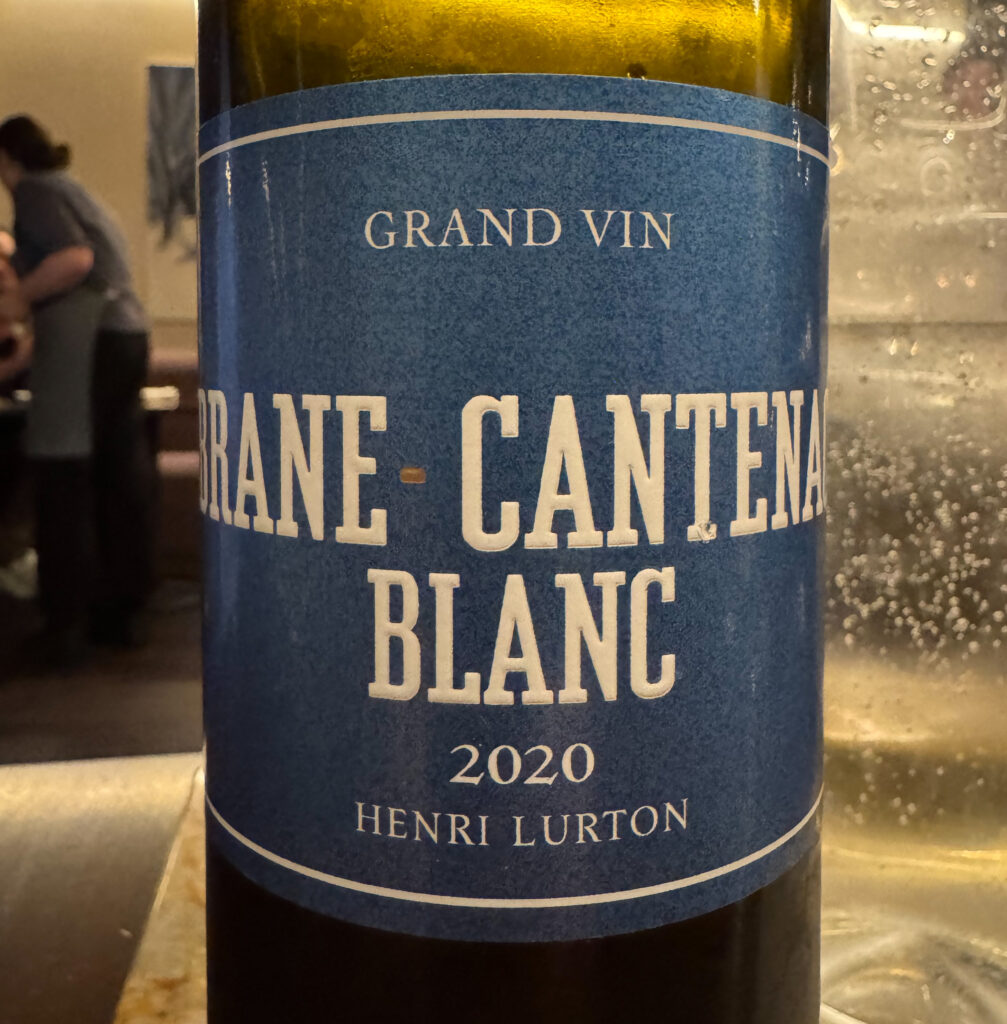
- 2020 Château Brane-Cantenac Bordeaux Blanc [$97.40 at national retail]
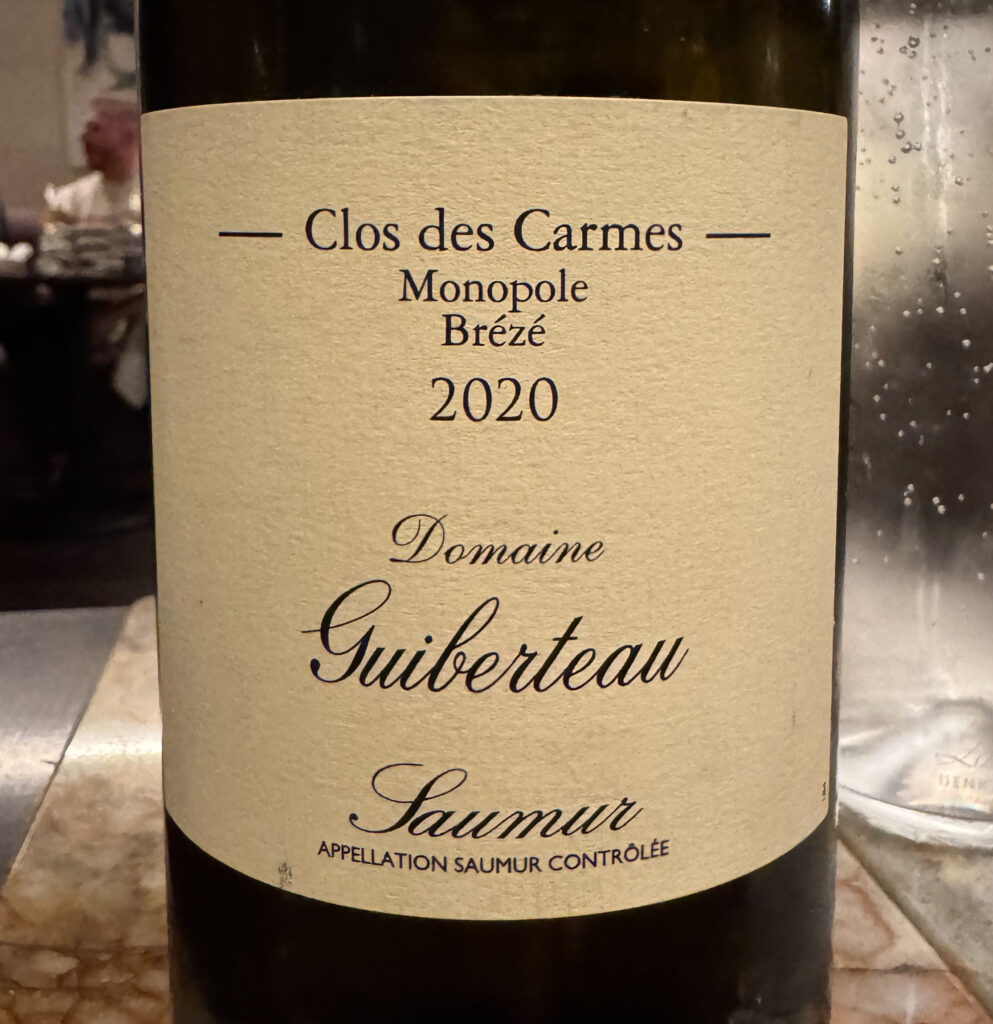
- 2020 Domaine Guiberteau Saumur Blanc “Clos des Carmes” [$109.96 at local retail]
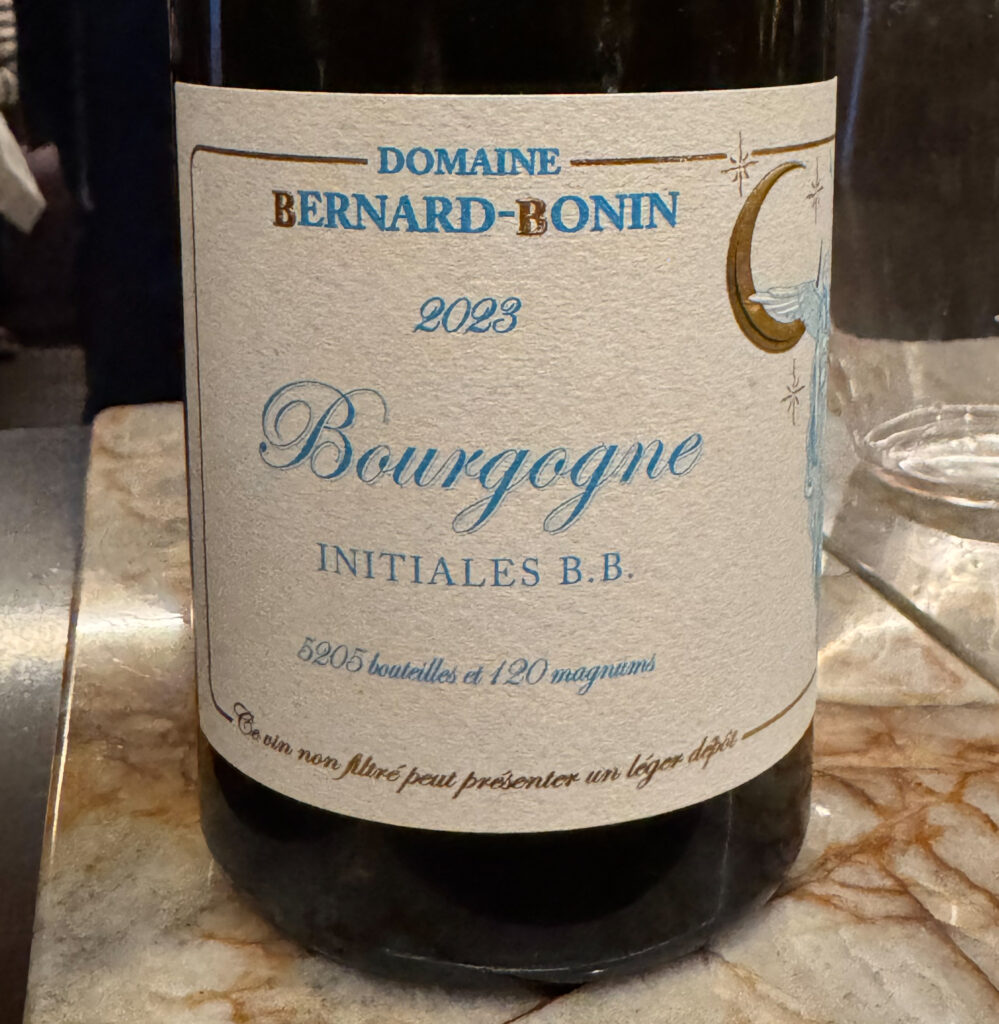
- 2023 Domaine Bernard-Bonin Bourgogne Blanc “Initiales B.B.” [$179.96 at local retail]
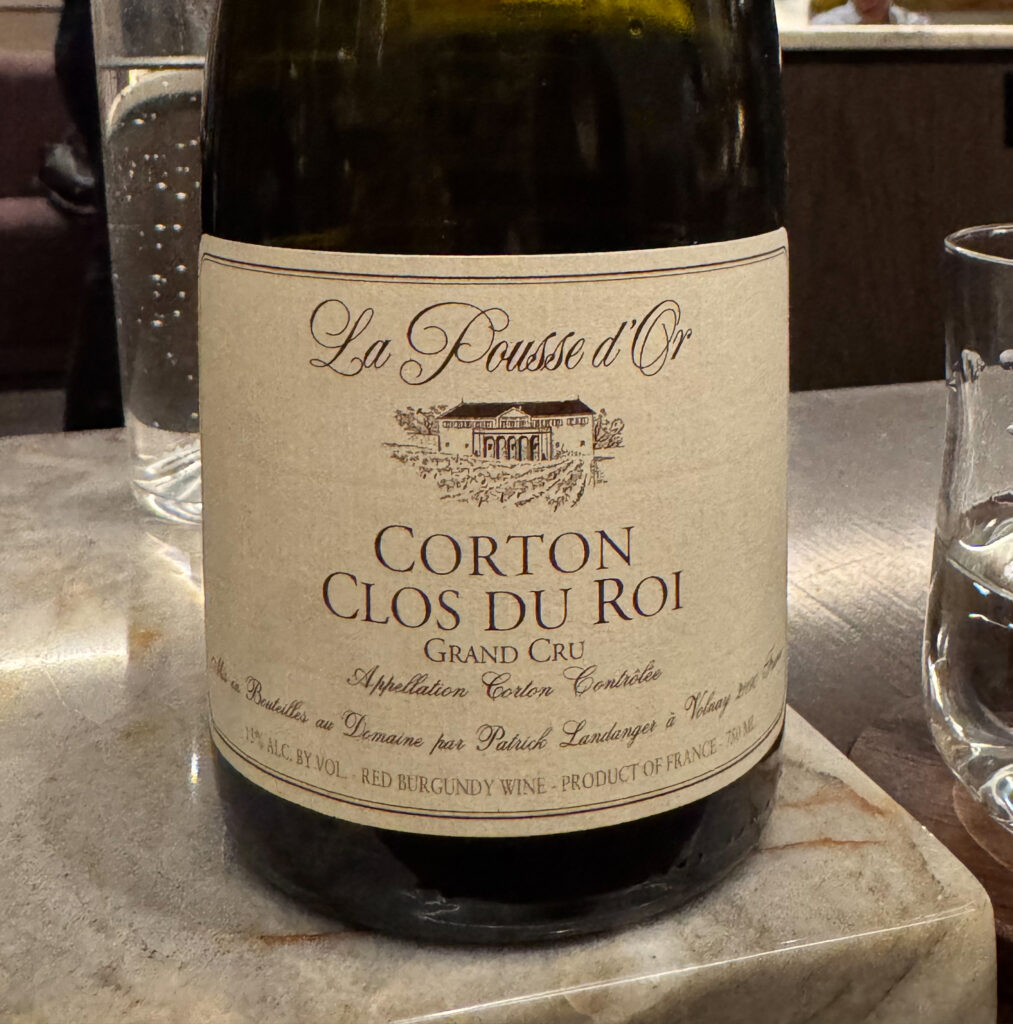
- 2012 La Pousse d’Or Corton “Clos du Roi” Grand Cru [$119 at local retail]
- 2005 Alvaro Palacios Priorat “Finca Dofí” [$235 at national retail]
- 2004 Fèlsina Vin Santo del Chianti Classico (375mL) [$61.50 global average price]
This pairing is described as a “showcase of rare wines, older vintages, and luminary producers” in which the emphasis is placed “on the wines, not menu synergy” and a “greater number of red wines” than is typically seen in the standard lineup. And it certainly lives up to its branding.
On the white end of the spectrum, I find the juxtaposition of a fresh (though beautifully rounded) Sauvignon Blanc, a richer, well-oaked Chenin Blanc, and a wonderfully reductive (yet still quite concentrated) Chardonnay to be both engaging and highly pleasing. For the reds, the introduction of a refined, medium-bodied Pinot Noir alongside an unabashedly powerful (but polished) Grenache effectively caters to all tastes. Meanwhile, the Vin Santo (at its peak of caramelized, oxidative sweetness) offers a meditative degree of depth to go with dessert.
With an average bottle price of somewhere between $100 and $150 (the low availability of the Priorat skews the figure upwards), I think the value proposition presented here is rather fair. If one considers that they’d need to spend at least $200 to $300 per wine (assuming a minimal markup) to order these off of a list, the prospect of sampling six different expressions—some benchmarks, some notably aged—for around the same price is certainly attractive.
Ultimately, I think the “Cellar Flight” forms a tempting option for diners who desire a turnkey solution but also favor more elegant, classically-styled expressions (at least relative to a standard pairing that might lean toward demi-sec Champagne, Riesling, and sake to match the menu’s seafood and produce).
For me, the biggest draw is the fact that Ducker reserves the restaurant’s most limited allocations (like, say, the Bernard-Bonin) for this selection: ensuring that these precious pours are shared with the widest number of drinkers possible rather than only rewarding one or two eagle-eyed parties by virtue of timing. Indeed, this is exactly the producer I would pick off if I encountered them on the list, and it feels good to be rewarded for indulging in a larger flight that the sommelier has put time and effort into designing.
Ultimately, once one’s party size grows to two or four diners in total—and the possibility of spending $650 or $1,300 on a corresponding number of pairings (though you can certainly mix and match the three levels)—I think most oenophiles will find greater pleasure in ordering from the bottle list.
However, this is no insult. It only testifies to how broad the selection and deep the value remains there. And, when one also considers the $75 corkage fee (limit of 1.5L total), it’s not hard for anyone passionate about wine to drink very well at Feld.
Yes, with the entry-level pairings still landing at $110 (for non-alcoholic) and $130 (for standard), this is a program that punches above its weight: thoughtfully appealing to a wide range of consumers with a degree of dynamism that matches the chef’s own work.
Turning toward the menu, we begin with what was become Feld’s emblematic tipple: one that is almost reminiscent of the “Amazake” variations served at Smyth (which serve to introduce some of the flavors that will be seen throughout the meal).
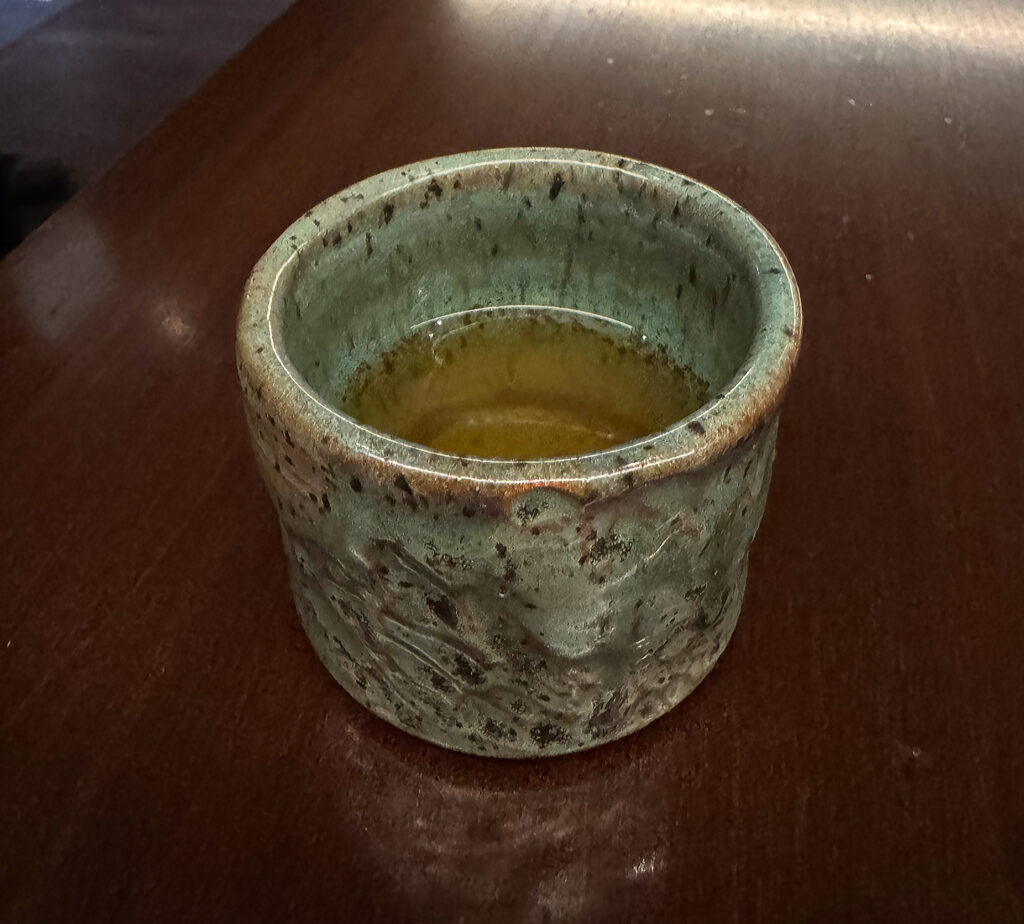
The “Mushroom and Tangelo Tea” arrives immediately after I am seated (many minutes before the wine!), ensuring that the evening’s first sensation—following the team’s greeting and a brief scan of the surroundings—speaks directly to the kitchen’s savoir-faire.
Here, the peel of the titular citrus, a cross between a tangerine (or mandarin) and a pomelo (or grapefruit), lends the brew an enlivening brightness. However, it is the character of the mushroom, in combination with some katsuobushi (or bonito flakes) Potashnick brought back from Japan, that proves decisive. The resulting layers of smoke and umami lend the tea a convincing depth, steering what might otherwise be considered a palate cleanser toward something more profound.
The dining experience really kicks off with what the restaurant has titled “The Drop” (though I do not hear the term utilized tonight). These eight bites—a decrease from the 11 served in January—speak to the moment of the season (down to the day) and to the ever-evolving nature of the chef’s craft. Potashnick calls this period a “bridge week” between ingredients like winter citrus or root vegetables and the ramps (alongside a lower proportion of meat) that really signal spring at Feld.
On this occasion, I will present the items in the order denoted by the written menu:
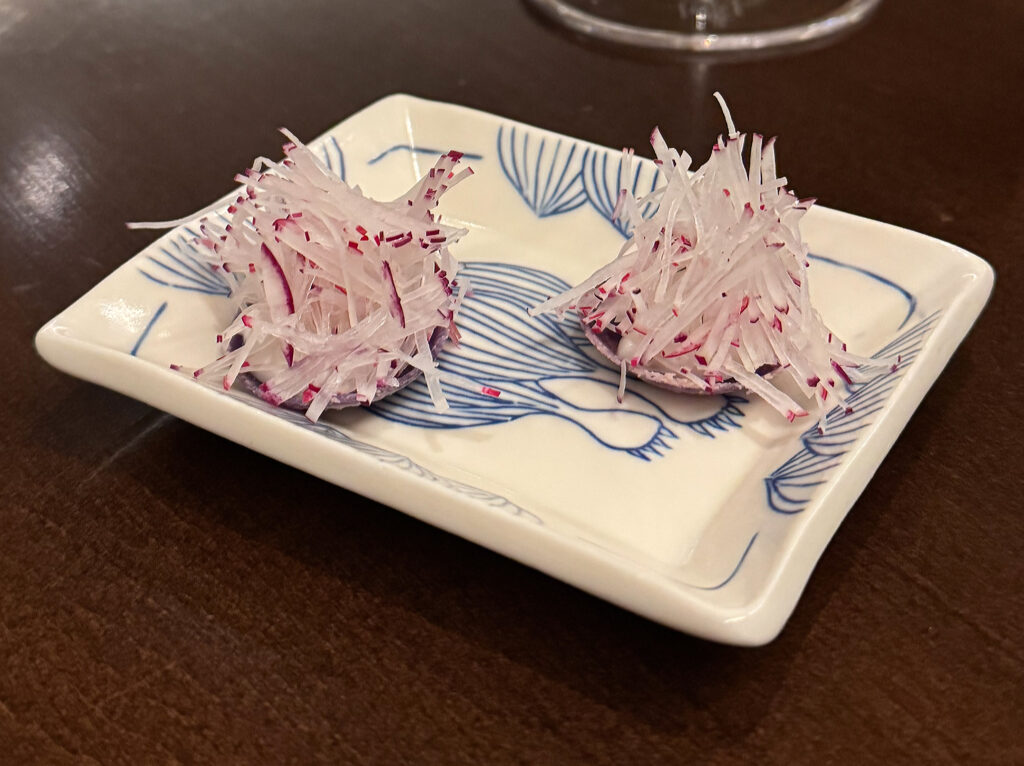
A “Radish Tart,” made from a julienne of the headlining root vegetable tucked into a potato-based shell, is resoundingly fresh and crisp on entry. Its flavor almost proves too mild, yet a firm imprint of salt and an almost cheesy finish ensure this simple construction has something to say.
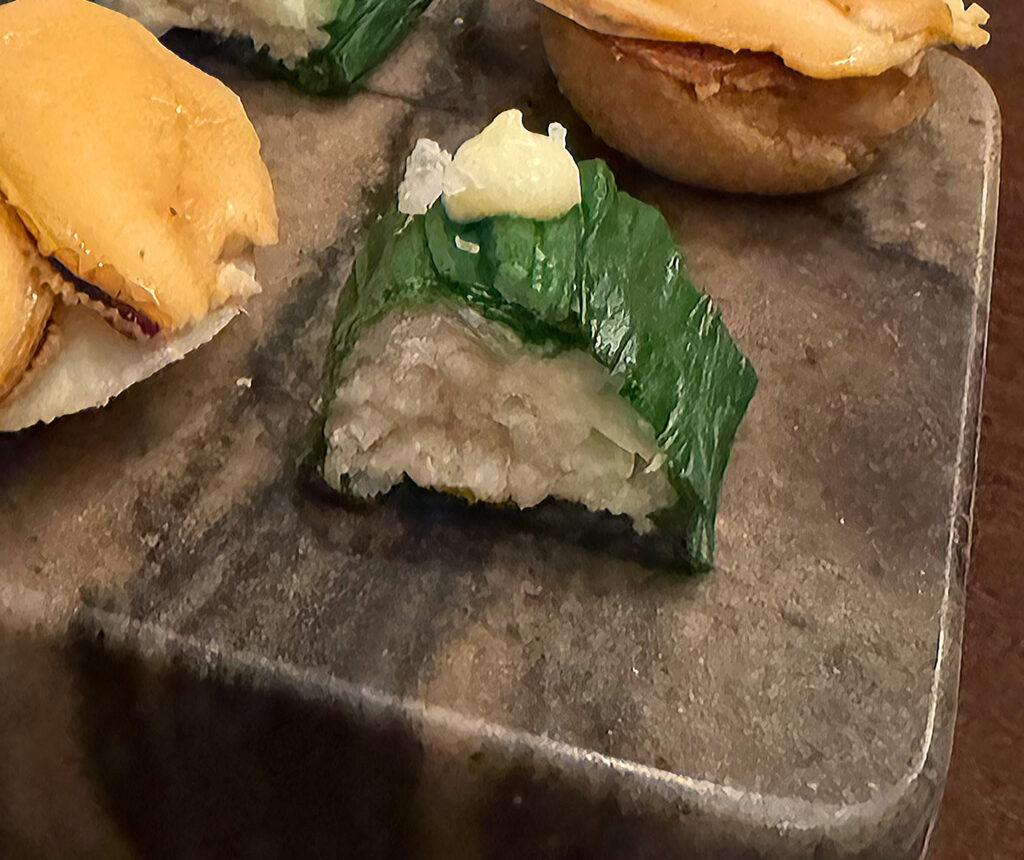
The “Ramp Leaf” actually refers to a kind of “mock sushi” made by wrapping the starring ingredient around a sizable crab filling. The resulting texture is subtly crunchy on entry and attractively moist. Yet, while the sweetness of the crustacean plays well against the allium, I think a bit of cucumber might help to really drive the intended effect home.
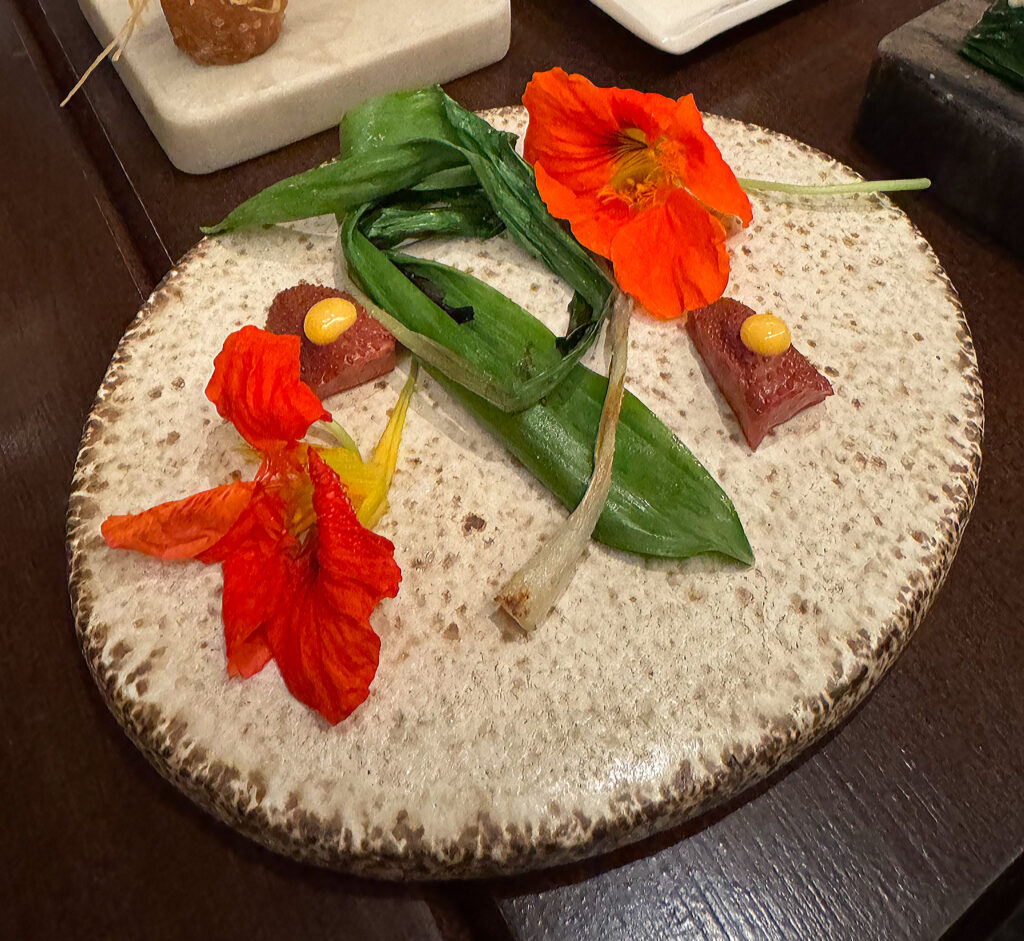
A “Pickled Strawberry,” topped with a dab of Scotch Bonnet pepper emulsion, feels surprisingly soft and gooey when it meets my tongue. The accompanying flavor—charged with a huge concentration of tanginess—broadens toward sweet, tropical fruit tones (with none of the heat one might expect) on the finish. This is simple and delicious.
A “Grilled Ramp” follows allow the same lines: there’s nothing clever to note here—just a fleeting crunch matched by a hint of char and a generous application of salt that serve to highlight this totemic Midwestern ingredient’s sweet, savory depth. What other tasting menu can get away with serving something so minimalist and worshipful?
The “Nasturtium Flower” (which has been brushed with some kind of butter I didn’t quite catch) aims at a similar minimalist. And, for an ingredient that is frequently relegated to the role of garnish (often forming a polarizing one), the flower impresses me with a sweet, rounded character that balances out its prototypical sharp, peppery notes.
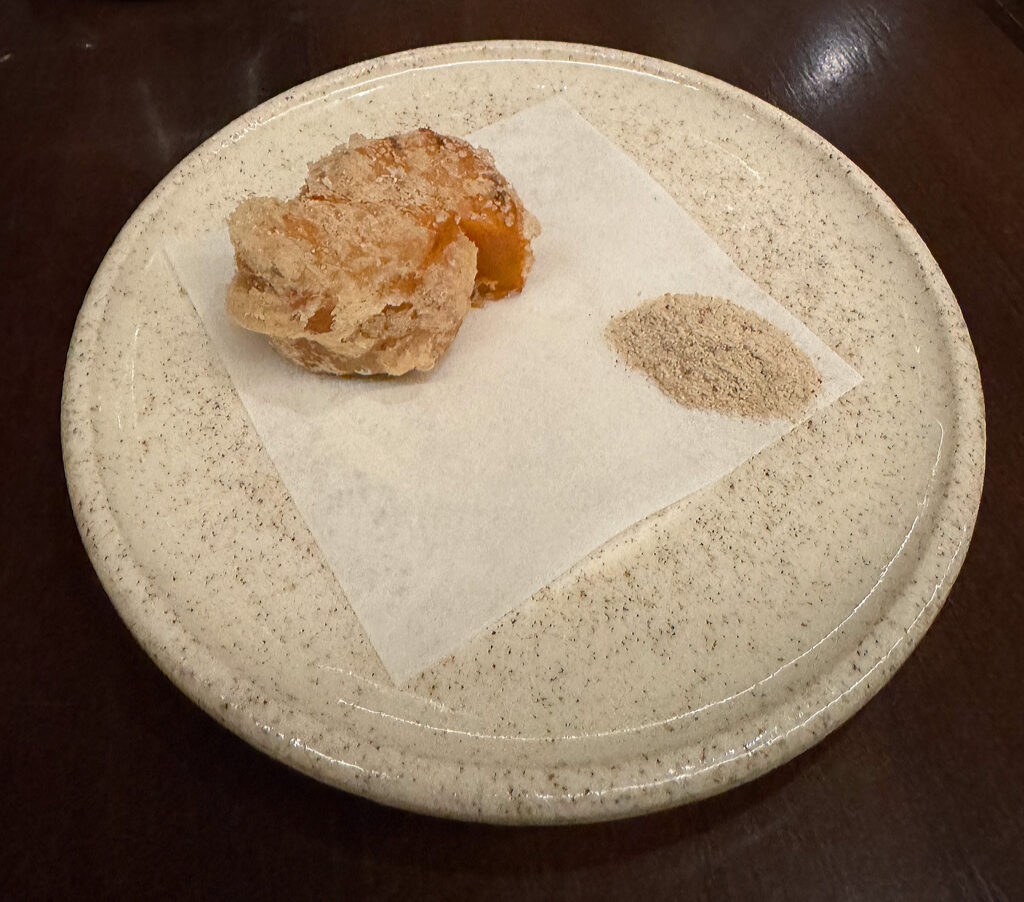
The “Tempura Sweet Potato” forms the latest in a long line of fried delicacies to be served here. (I recall when, back at opening, such items were served without paper underneath and transformed into a soggy mess.) I do think guests should prioritize this serving despite the staff’s declaration that they can go in any order they like. Doing so, I find the sweet potato’s faint crispness and soothing sweetness (accentuated by the warming notes of an accompanying spiceberry salt) to be enjoyable. However, the kitchen has still not quite mastered this technique.
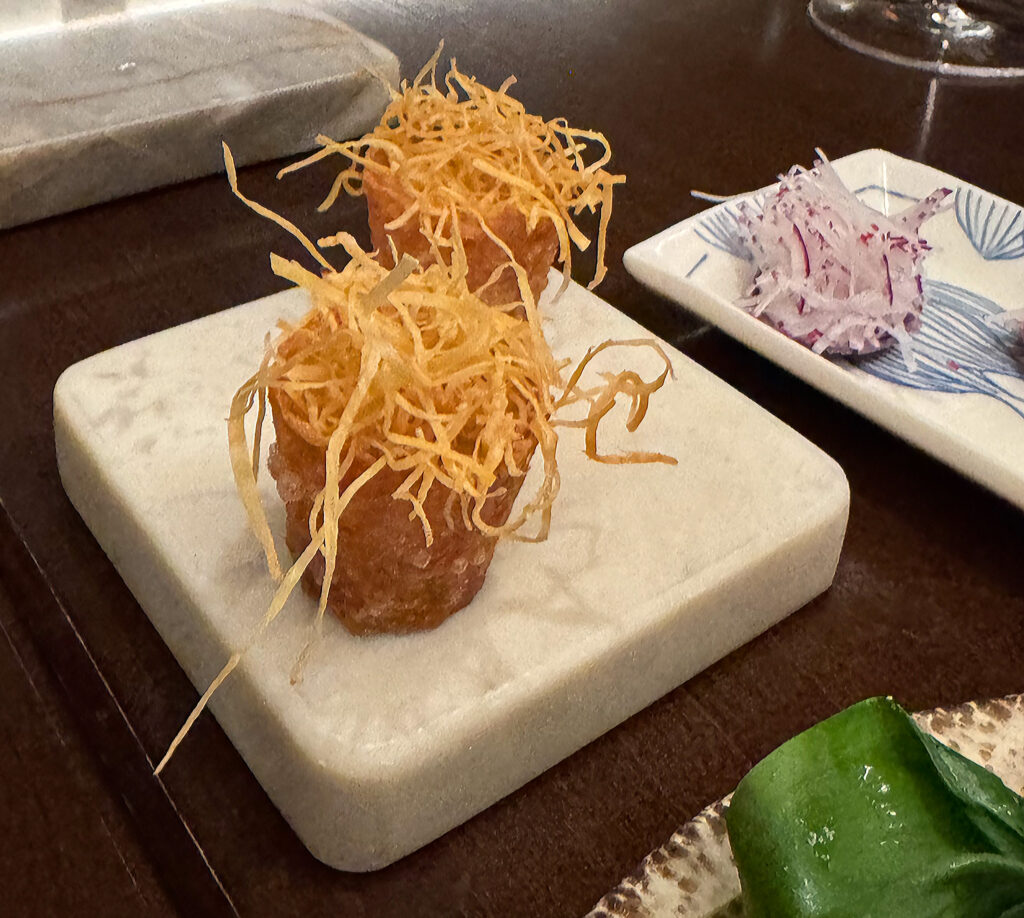
A “Quail Egg Tartlet,” topped with curls of fried burdock, would not be out of place (in style if not refinement) at Smyth. The ingredient can actually be challenging if taken in the wrong direction, but, in this instance, the crisp shell and brittle garnish frame a rich, custardy interior tinged with just enough salt to really shine. Indeed, the final sensation is somehow reminiscent of artificial cheese (in a good way), delivering a degree of satisfaction that other members of the sequence miss.
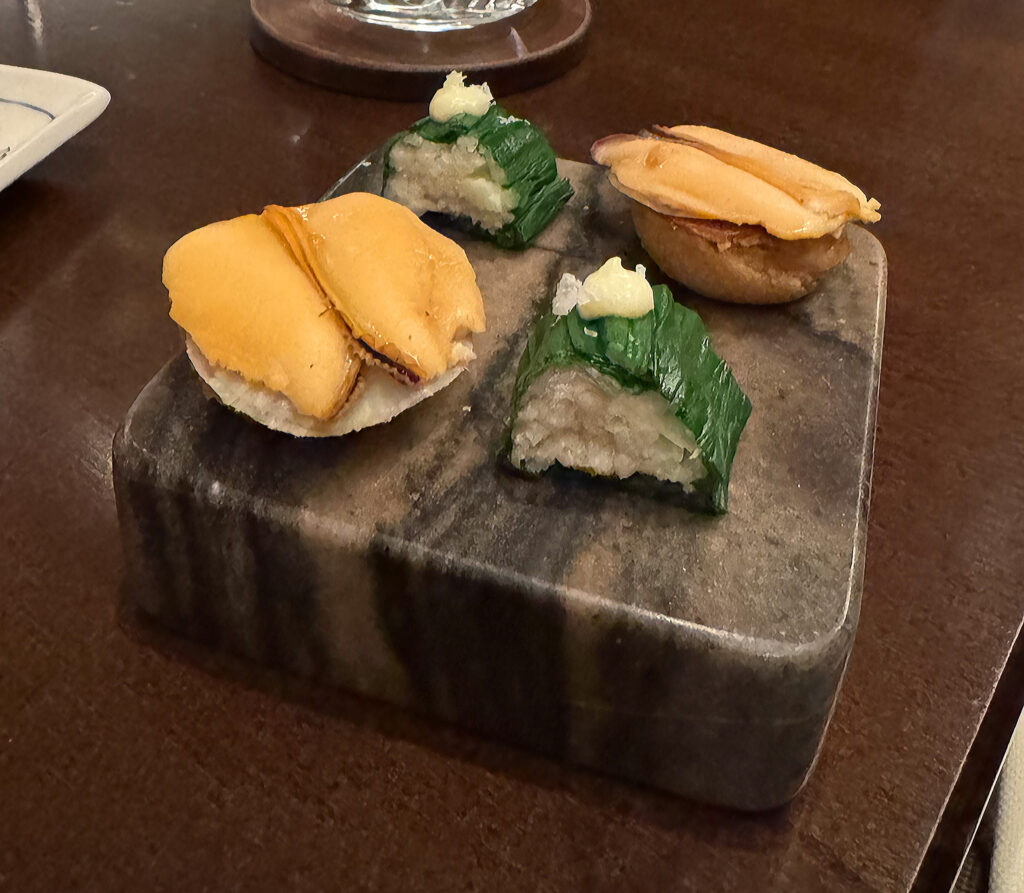
Finally, there’s the “Mussel Pancake”—what I would probably label the weakest of the bunch (and maybe the most underwhelming thing served all night). For my taste, the vessel, while pleasantly nutty, is not fluffy enough to fulfill expectations. The subtle chew of the mollusk (opposite a crisp slice of celeriac) is pleasant enough, yet the resulting flavor is too mild to really make any impression. That said, there’s really nothing objectionable about this item. It just falls short of the standard set elsewhere.
Ultimately, none of these bites rank among the very best of the meal (which, admittedly, has something to do with just how superlative those recipes are). Nonetheless, the baseline level of quality displayed here is worthy of respect (I count no clear misses), and there are at least a few offerings (i.e., the “Pickled Strawberry,” “Grilled Ramp,” and “Quail Egg Tartlet”) I would love to have again.
Turning now toward the individually plated fare, I find a preparation titled “Citrus—Rosemary” that looks to reset diners’ palates following such a diverse array of openers. The recipe centers on slivers of mandarin and pomelo that have been marinated in cherry pit oil. The fruits sit beneath a creamy rosemary emulsion while a shard of ice (flavored with peach pit tea) forms the final topping.
The whole construction is surprisingly complex—reminding me, again, of an idea Smyth has toyed with for its desserts—yet the sum effect is direct and convincing. The interplay of brittle (but not teeth-chattering) ice, soothing emulsion, and plump, juicy citrus is well conceived. And the resulting notes of tang and sweetness are steered toward a woodsy, nutty, salty complexity that transforms the dish’s expected refreshment into something more lasting and satisfying. Well done.
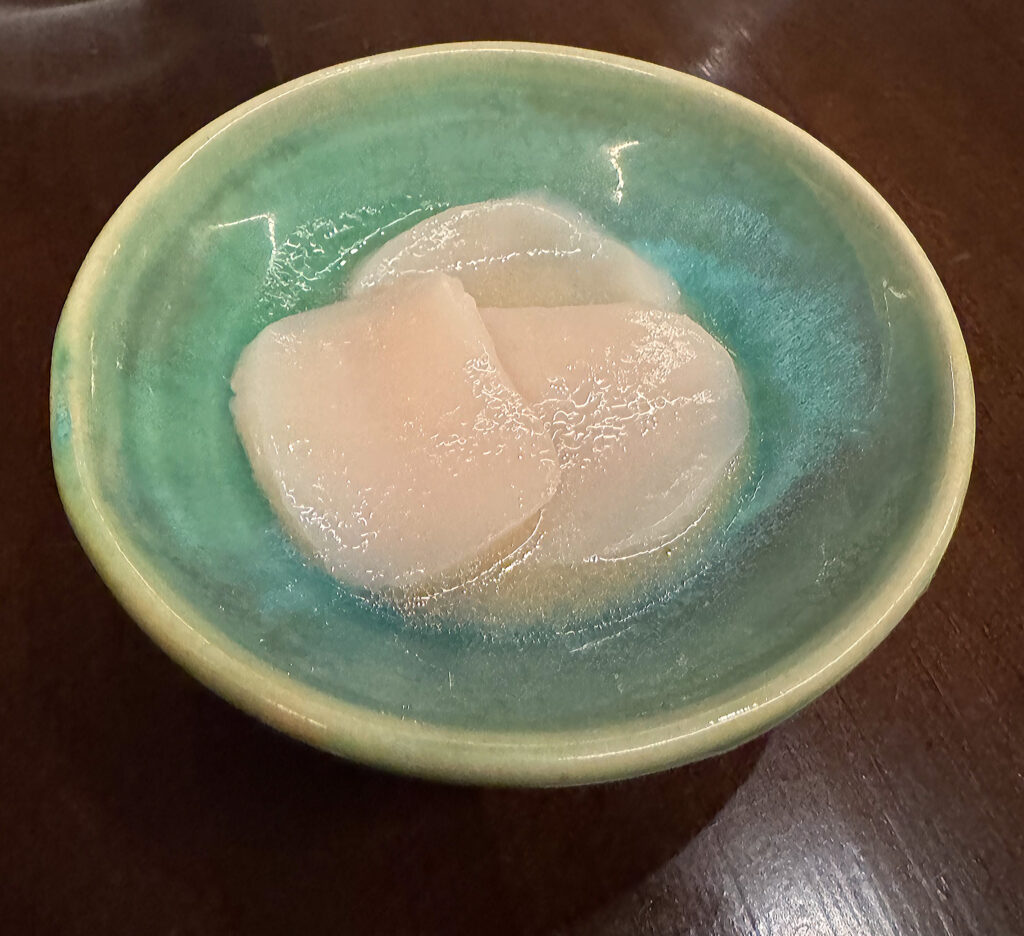
With the arrival of the “Raw Scallop—Rhubarb,” the meal suddenly gets serious. This is a pristine piece of seafood (hand-harvested for the restaurant by a diver in Maine) by which Potashnick’s technical mastery can be compared to his peers. And, dressed with nothing more than a touch of salt, some browned goat’s butter, and a warm vinaigrette of pickled rhubarb juice, these sizable medallions of mollusk have nowhere to hide.
Yet, texturally, the scallop marries the faintest sense of chew with a resounding creaminess that reminds me, instantly, why I prefer this ingredient in its rawer forms. The rhubarb juice, charged with sweet-and-sour intensity, helps to reveal a kindred latent sweetness in the bivalve. However, it’s the goat’s butter (which balances its own tang with rich, nutty, caramelized tones) that really shines: providing a baseline of umami that, in combination with the salt, tilts this recipe toward absolute decadence. In short, this is about as good a treatment of the shellfish as I can ever remember having in Chicago.
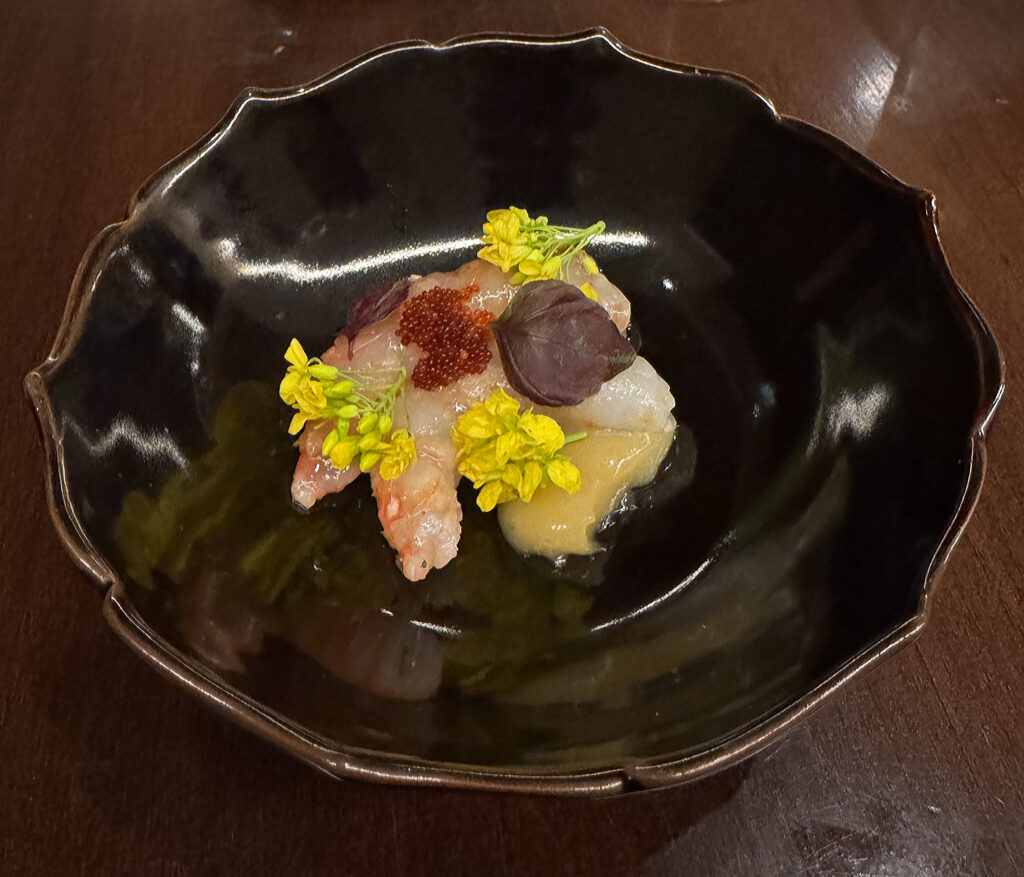
The “Spot Prawn—Citrus” follows along the same lines: centering on tails of the headlining crustacean that have been poached (“in the loosest sense of the word”) for 10 seconds in a citrus-prawn butter. An apple-lemon purée, some bok choy sprouts, a couple leaves of shiso, and a dab of roe (marinated in white shoyu and Oregon wasabi) complete the presentation.
On the palate, the prawn is plumper than the preceding scallop yet still displays an attractively soft, gooey mouthfeel with further mastication. The purée adds to the effect—though its notes of tangy citrus, rather than the apple, undoubtedly take the lead. This, along with the bok choy and shiso, tilts the preparation toward a fresher expression (still tinged with sweetness) than what came before. Nonetheless, a smart application of salt saves the day, ensuring the butter-coated shellfish tastes savory and satisfying despite the relatively lighter profile. Plus, when considering the wider flow of the menu, it actually makes for nice contrast.
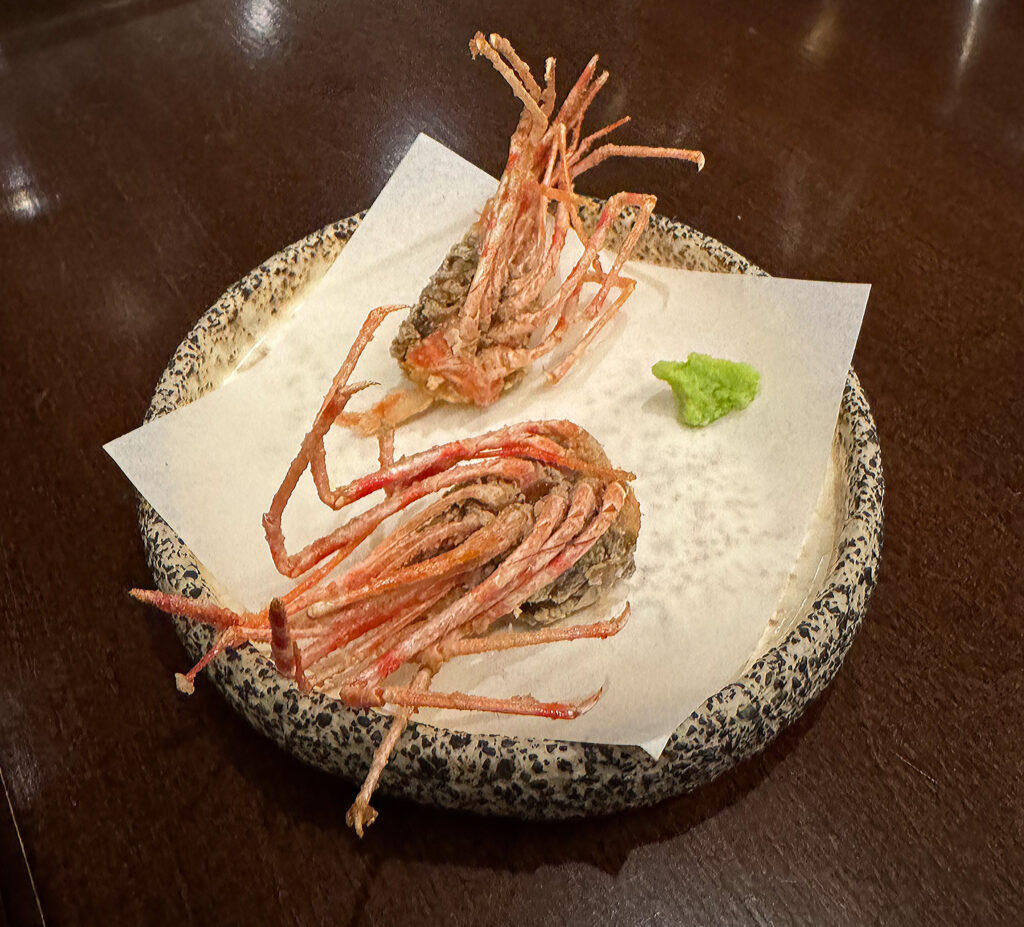
A serving of “Prawn Head” extends the kitchen’s work with the tempura form, and I think serving this bite (one that is rather more complex than the sweet potato) individually better assures its quality. Texturally, the piece of crustacean—spindly legs and all—is impressively crisp and easily consumed without encountering any limp segments of shell. The accompanying dab of Oregon wasabi is appropriately sharp but less pungent and possesses far shorter of a finish than its Japanese counterpart. I like the ingredient’s inclusion; however, a lack of adequate salt (especially opposite the preceding dish) saps some of my pleasure.
Ultimately, I believe Feld’s tempura still has room to grow in terms of its delicacy and shattery intensity. At the same time, the team is operating at a level that does the technique justice, and I feel that being served a pristine, fried morsel in this manner remains highly appealing.
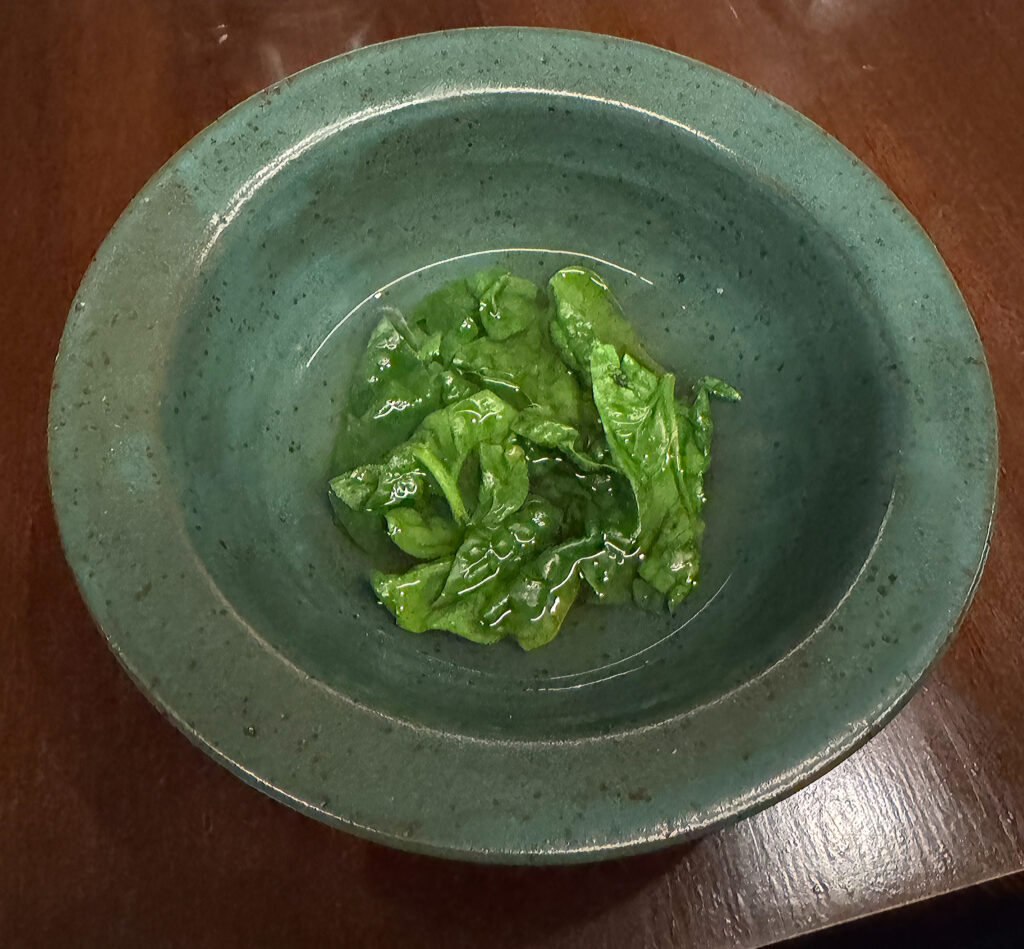
The arrival of the “Steamed Spinach—Ichiban Dashi” signals a pivot away from seafood toward a similarly worshipful approach to vegetables. Here, the starring leaves are cooked for only 30 seconds and paired with a “first infusion” broth made from the same katsuobushi (carried back from Japan) that featured in the opening tea. The bonito flakes are shaved fresh every day and steeped, à la minute, for 90 seconds to create the dashi.
Potashnick invites guests to drink the liquid straight from the bowl after finishing their spinach, leading to a sensation that is fresh, crunchy, and fleetingly sweet on entry then smoky, elegantly savory, and meditative through the finish. For my taste, I do expect a greater concentration of umami from a recipe that puts such a premium dashi at center stage. However, in turn, I admire the recipe’s degree of purity (and I think that it might have simply suffered from being served after the scallop and prawn).
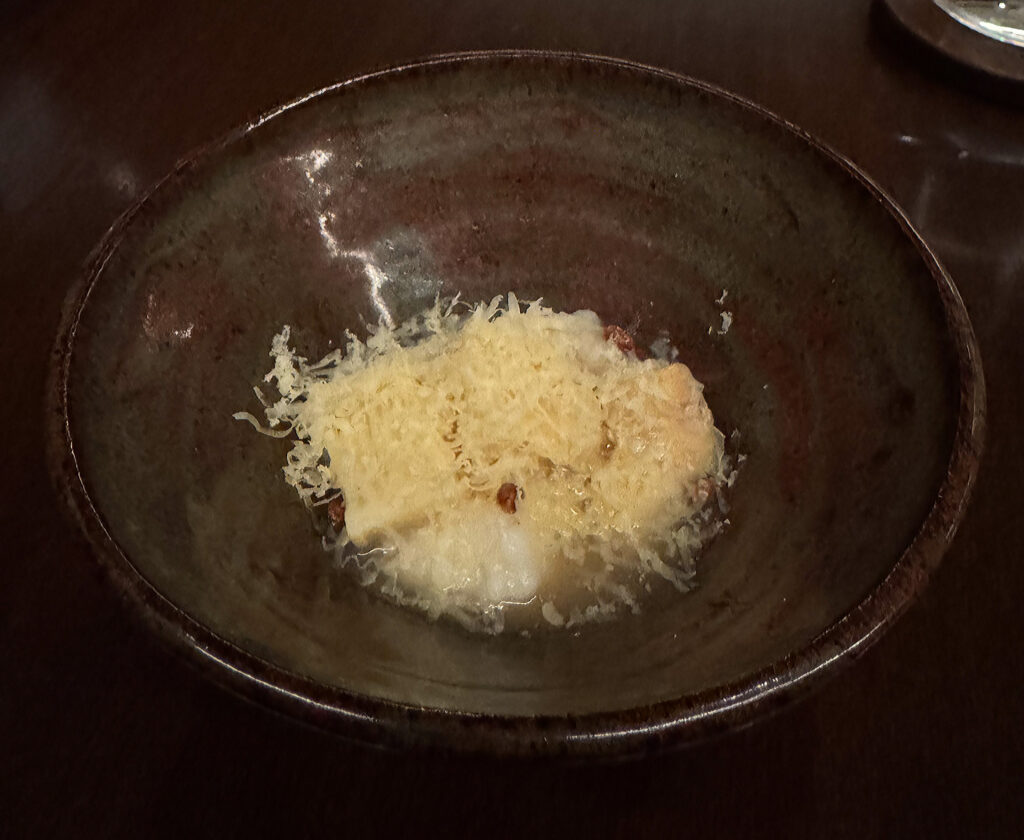
A composition titled “Bamboo Shoots—Kahokia Porridge” gets things back on track. Potashnick shares his enthusiasm for the starring vegetable, which he only gets to work with for two weeks a year (and might even prefer to those coveted ramps). The shoots are cooked in Cahokia rice (grown outside Cairo, Illinois) as a means of mimicking their traditional boiling in rice bran. The bamboo is then paired with a thickened stock made from last summer’s dried corn, some puffed malted barley, and a generous grating of Pleasant Ridge Reserve.
Texturally, the vegetables retain an engagingly crisp, crunchy consistency that still proves tender (i.e., free of any stringiness) with further chewing. When it comes to flavor, I do sense a complicating note of bitterness (whether from the shoots or something else I cannot tell). Nonetheless, the core expression—layered with nuttiness, toastiness, earthy sweetness, and building toward a rich, cheesy, caramelized finish—is sublime. I really cannot say I have ever seen bamboo feature in this manner, but I think the kitchen manages to respect its essential character while still making it delicious.
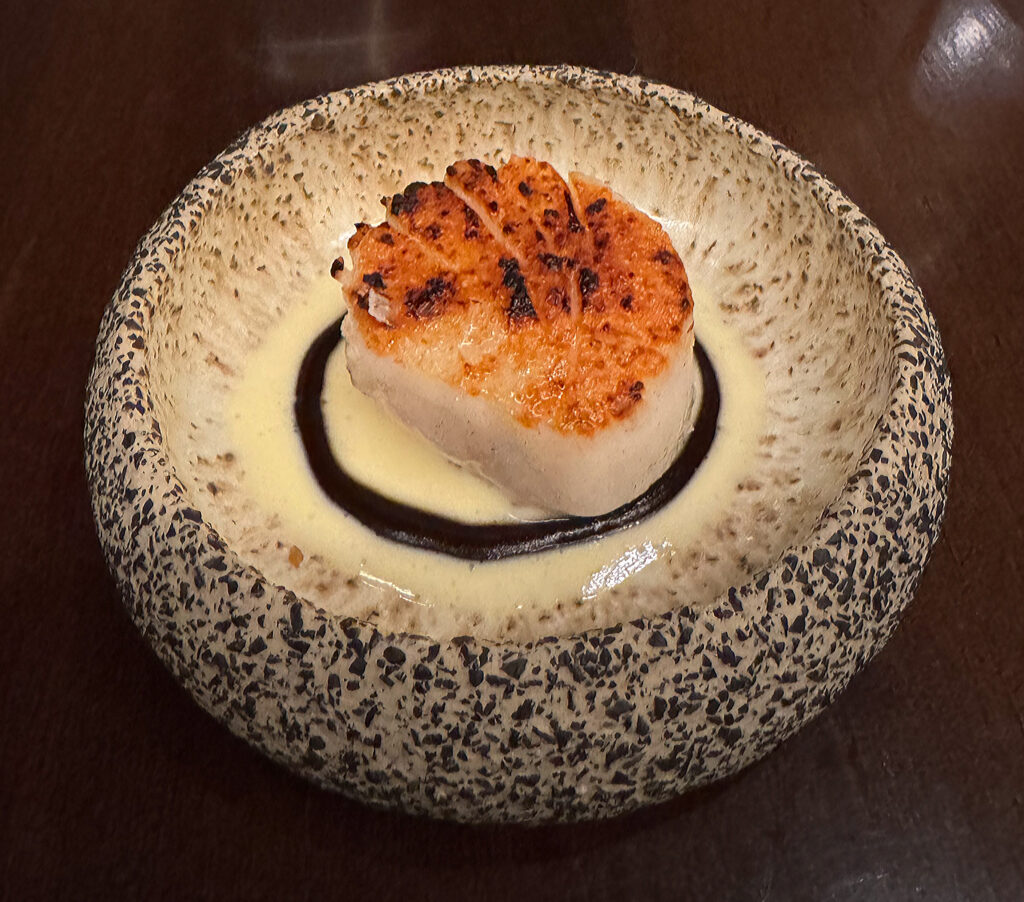
The “Grilled Scallop—Black Garlic” might be the closest thing to a repeat tonight. However, the evolution from January’s example (titled “Grilled Scallop—Smoked Garlic”) is notable. Visually, the starring mollusk (which is grilled over cherry wood) benefits from gentle scoring and an even more dramatic, comprehensive sear. The sauce work is slightly different too: the black garlic vinaigrette and almond butter remain while vin jaune and parsnip butters now join the party.
On the palate (and especially opposite the raw scallop that I enjoyed so much), the cooked version of the shellfish leads with crispness and density. That said, it’s cushioned beautifully by the assortment of creamy sauces, and the intensity of the black garlic ensures that the more substantial mouthfeel is matched by a corresponding (or at least perceived) meatiness. As a result of the changes to this recipe (namely the substitution of the mussel-inflected bagna càuda the team termed a “Magna Carta”), the dish does not achieve the same level of mouth-aching umami I loved last time. However, this sweet, nutty, and rounded iteration is worthy of praise in its own right.
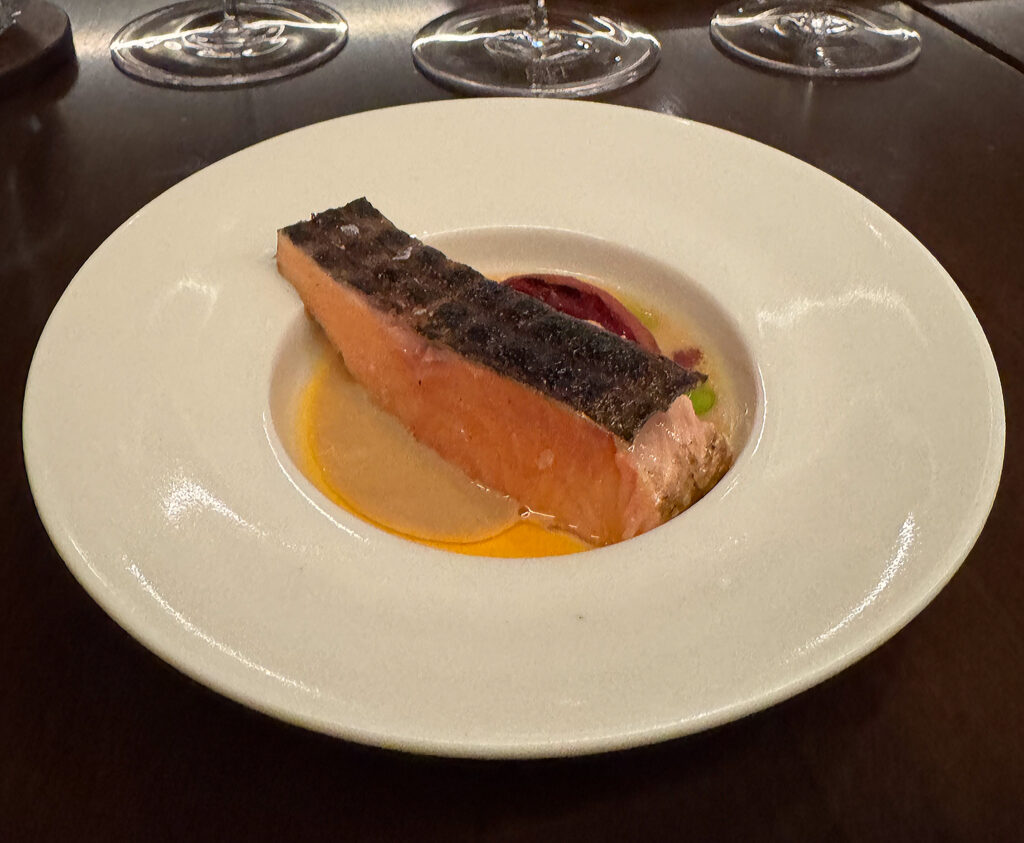
“Mt. Lassen Trout—Blood Peach” forms the menu’s headlining preparation of seafood, and it highlights a sustainable breed of fish (not unlike Smyth’s work with Smoke in Chimneys) grown in California’s mountain spring waters. The kitchen cooks the resulting fillet (skin-on) over the coals and dresses it with ramp oil, Scotch Bonnet pepper oil, and a sauce made from the bodies of the earlier spot prawns. A pickled blood peach, harvested last summer, completes the presentation.
Texturally, that brittle strip of skin is remarkably crisp, yet its corresponding flavor its jarringly bitter. I eat around it and find that the trout’s flesh, though comprising such a large portion, is supremely buttery. The accompanying sauce and oils are only moderately savory, and I do not quite taste the level of crustaceous complexity or allium depth I would like. Nonetheless, the fish’s latent sweetness is subtly accentuated, and the introduction of the blood peach—so tangy, sweet, and juicy in its own right—redeems the recipe. Indeed, the fruit (its character cleverly echoed by the Scotch Bonnet) transforms the otherwise mild fillet into a nuanced, tongue-tingling delight. Other than the skin, this makes for a clear success.
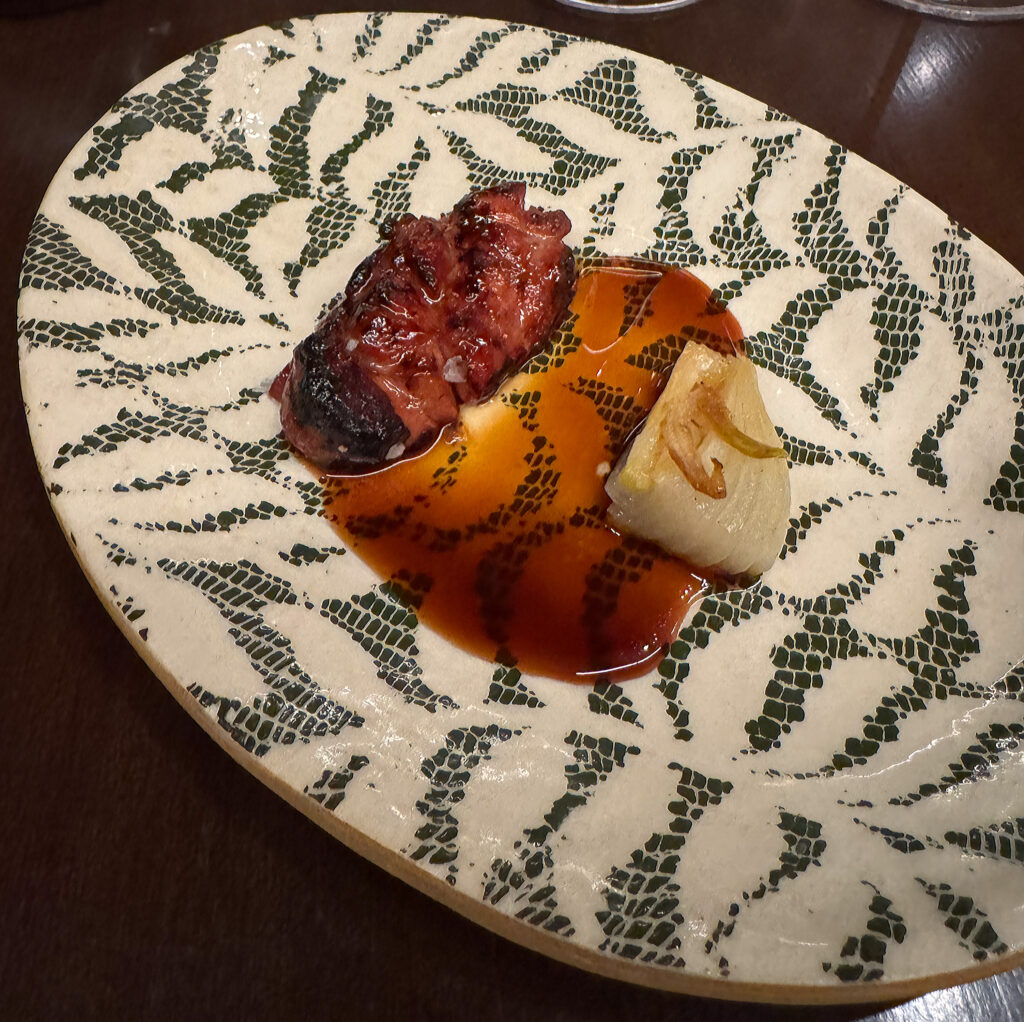
Approaching the savory peak of the meal, the “Sweetbread—Allium” grants Potashnick a chance to impress me with my very favorite ingredient. Here, the veal offal is slowly grilled over cherry wood embers for a full hour while being repeatedly glazed with fresh onion juice. On the plate, the meat is joined by a pearl onion that has been cooked koji butter, a caramelized onion jus, and a drizzle of lemon oil.
Upon reaching my tongue, the sweetbreads strike with a dense, charred, and chewy consistency that breaks apart homogenously and almost reminds me of barbecue brisket. The flesh’s first flush of flavor is sweet and teriyaki-like. I move to the pearl onion, so thoroughly softened and laden with the umami-tinged butter, and the sweetness builds. The caramelized onion jus, cut with just a hint of citrus, is impressively potent. It offers still more sweetness and more savory power. Once I return to the offal, its pleasing character has been supercharged: its smoke and structure framing a profound sense of satisfaction—unfurling with seemingly endless length—that ranks among the best preparations of this ingredient I have ever tasted. It’s incredible what the team can achieve when they swing for the fences of decadence in this manner.
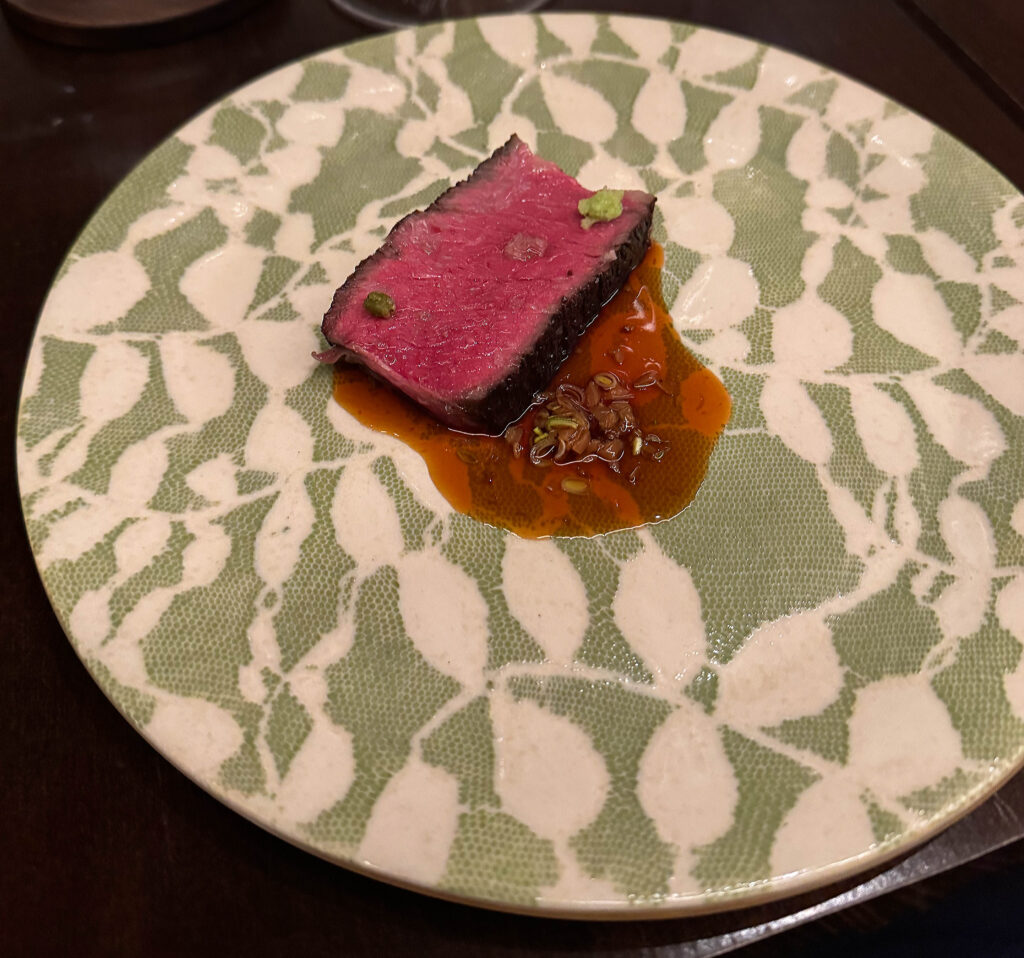
Closing out the savory section of the menu, we have the “80 Day Aged Ribeye—Wild Garlic.” Sourced from Kilgus Farmstead, the steak is cooked over cherry wood embers just as the offal was, yet it comes dressed even more simply with a sauce of preserved cherry juice, some fried spiceberry “capers,” and a dab of Oregon wasabi.
On the palate, the ribeye possesses a slight chew and overarching juiciness that is notably more refined than the sweetbreads. Thanks to a touch of flaky salt, the flesh’s latent umami is well expressed (if not totally staggering) too. The sweetness of the cherry and warming notes of the spiceberries add some welcome intrigue, but I am again left feeling that the wasabi (which should take the combination to the next level) lacks the degree of intensity that I, no doubt spoiled by Kyōten, have come to expect. Of course, the “relationship to table” philosophy can more easily justify using roots from Oregon than it can those from Japan. Ultimately, this recipe falls a bit short of—say—Oriole’s work with wagyu ribeye. However, given that Feld is opting for a local example of beef, I find the level of quality and creativity here to be admirable.
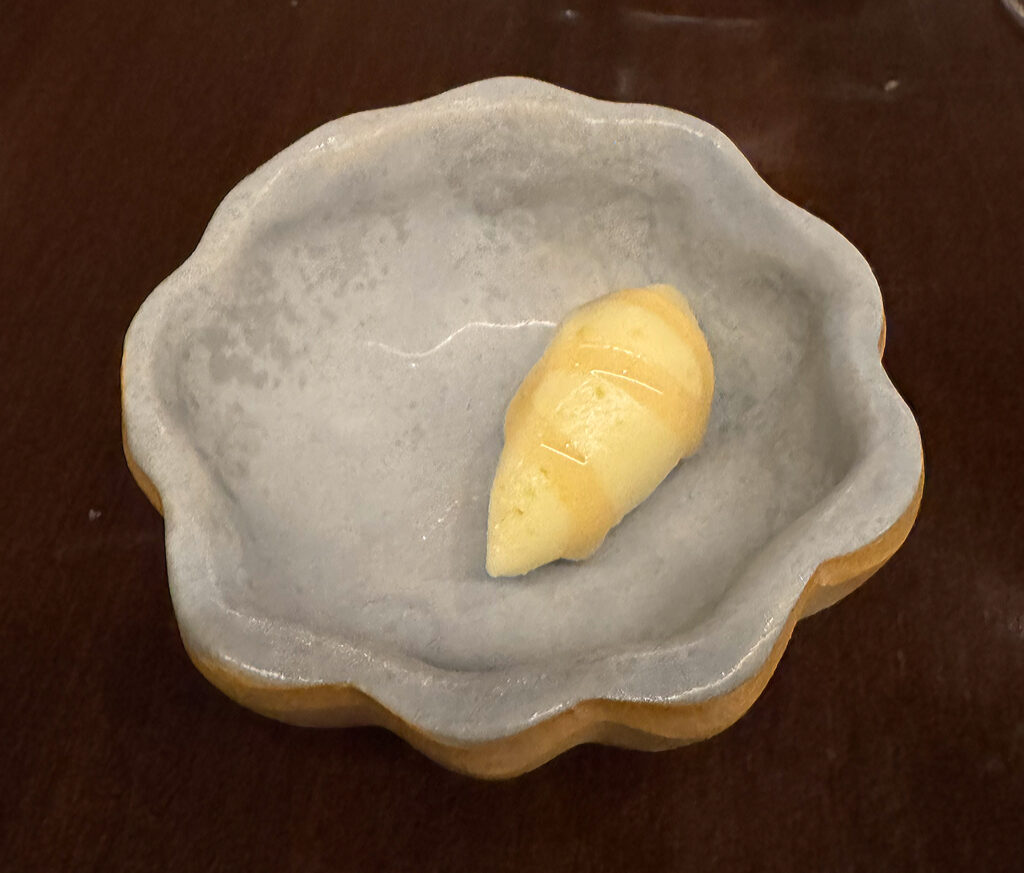
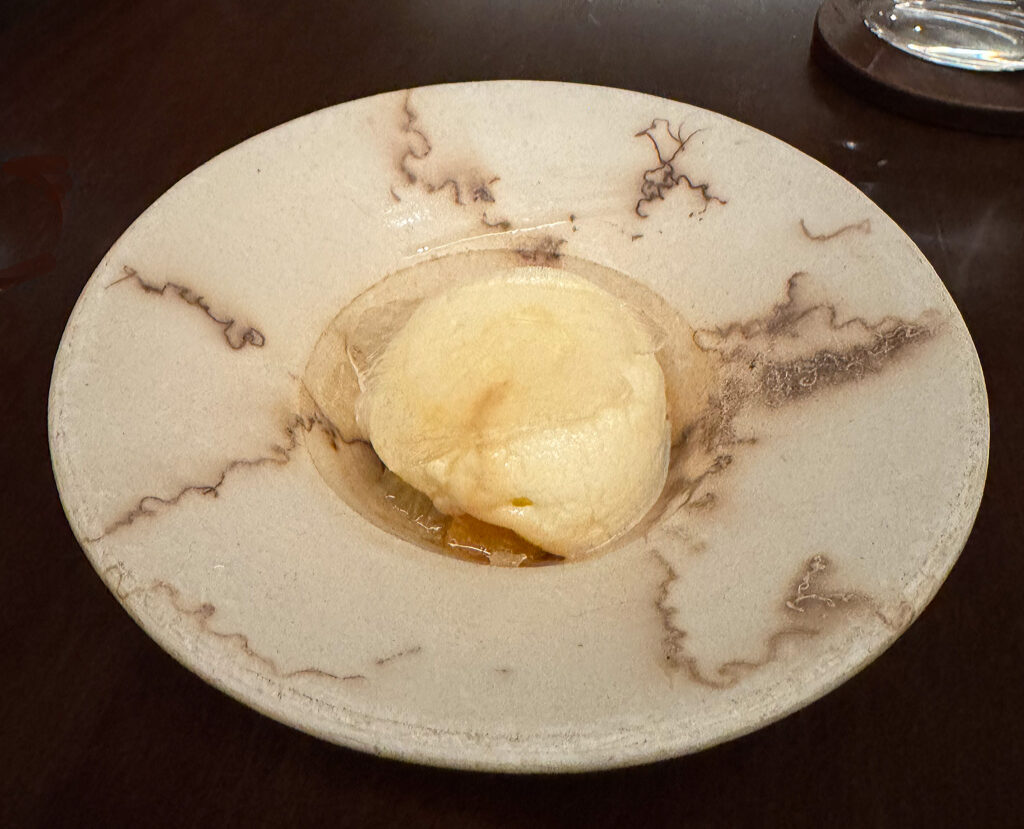
Turning toward dessert, the chef serves the “Apple Sorbet—Umeshu” as a kind of transition. Though the resulting quenelle is diminutive (just look at how it sits in the bowl), the technique here is anything but thoughtless. Indeed, the sorbet itself is perfectly creamy (even reminiscent of an apple’s own creaminess on the midpalate), and the crowning syrup (made from Japanese plum liqueur) lends the frozen treat a sour, bitter depth that cuts through the comforting sweetness to refresh one’s tongue.
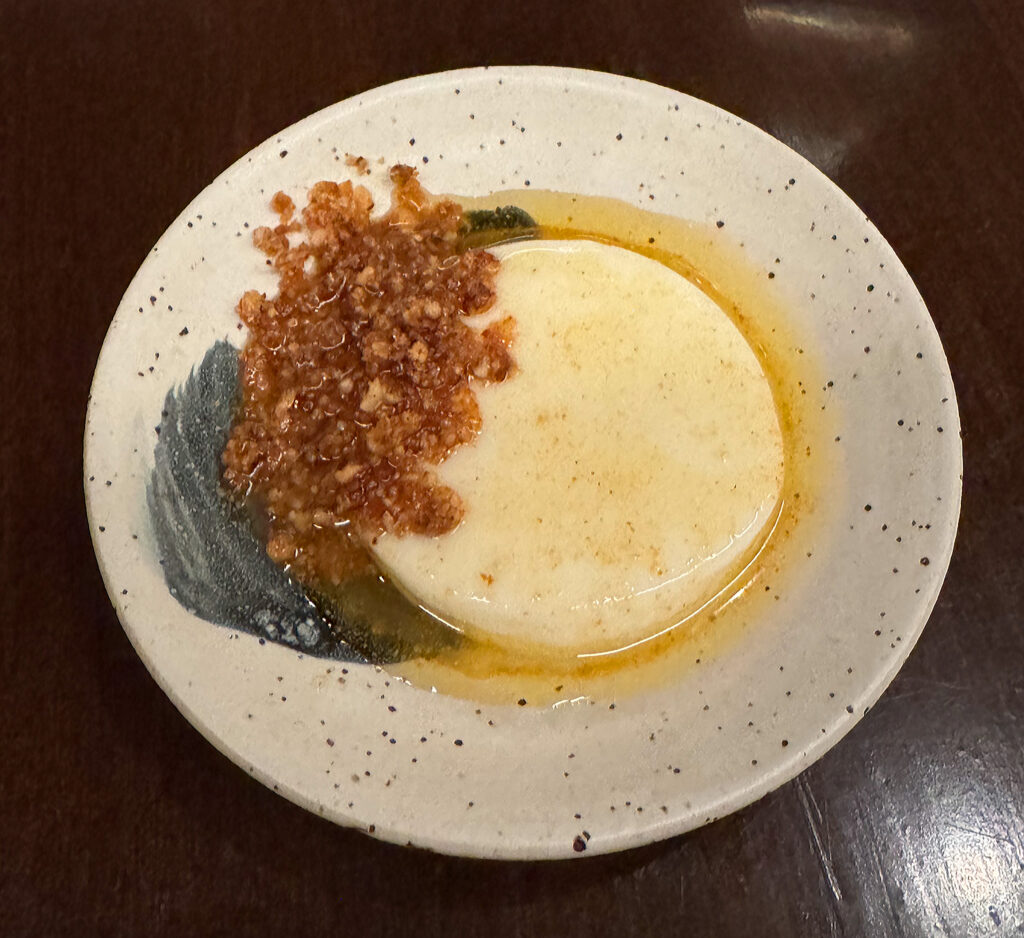
The “Fresh Cheese—Pecan” makes use of Jersey milk from Kilgus Farmstead, which is curdled just before the start of service. Paired with celeriac butterscotch (a new creation that the team considers an instant Feld classic) and a brown butter pecan praline, the cheese is soft and mild (and not nearly as tangy as I expect) when enjoyed on its own. But the butterscotch—so incredibly, intensely sweet yet backed by a transfixing earthiness—is every bit as good as promised, and the nutty tones of the praline harmonize well too. Nonetheless, I’d like to see that starring dairy do more to contrast and enhance its accompaniments. Otherwise, all the elements are here for a superlative dish.
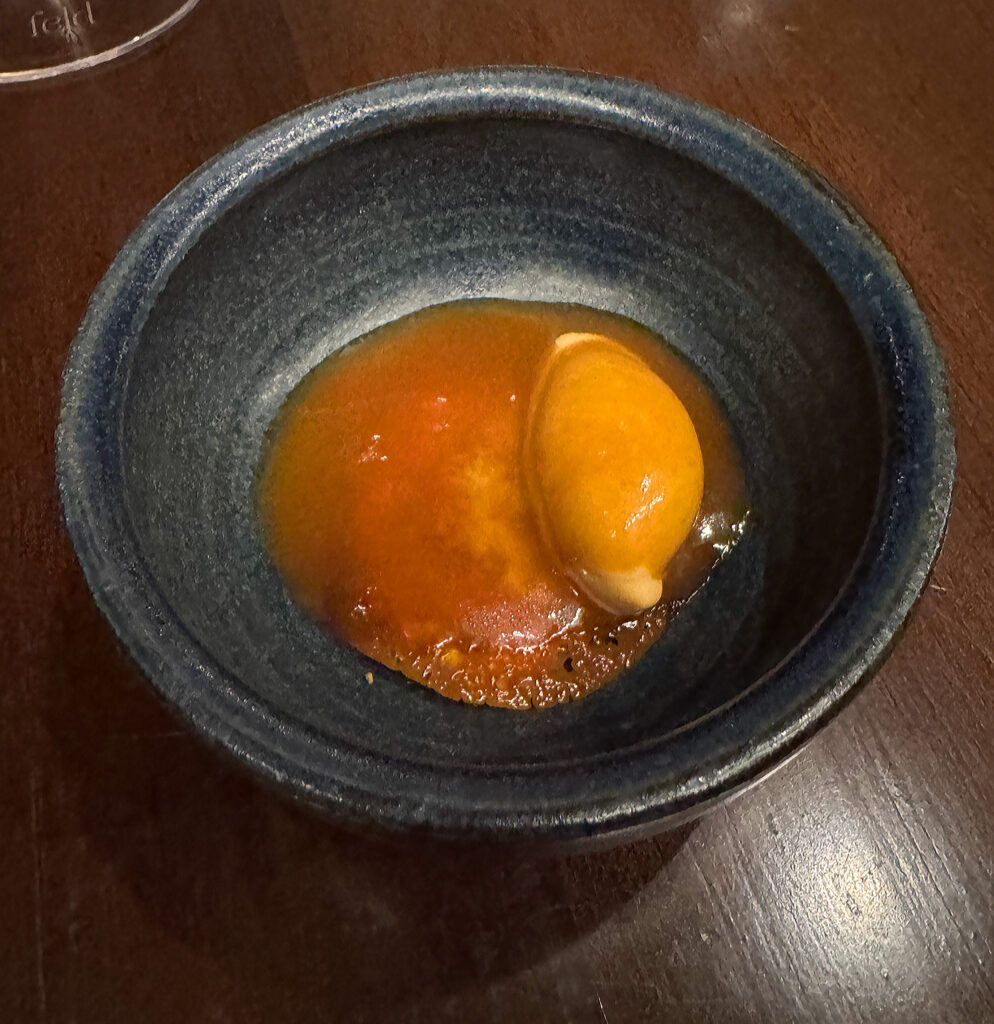
If the preceding recipe fell a little short of its potential, then the “Carrot—Miso” fulfills everything that was missing. This blend of carrot purée, carrot ice cream, miso caramel, and an acorn syrup tuile taps into a side of the root vegetable one commonly associates with its namesake cake. However, rather than opting for the contrasting tang that cream cheese frosting typically provides, this composition embraces an unadulterated sweetness and nuttiness (backed by complicating earth, salt, and umami) that flows seamlessly from the two concentrated expressions of carrot to their toppings.
Add in the temperature contrast (between the coldness of the ice cream and the warmth of everything else), and you’re left with a kind of captivating, melty sundae whose flavor—so maddeningly deep—rivals anything chocolate or vanilla is capable of. This item not only ranks as the most memorable serving of the night but as the best dessert I’ve ever had at Feld and, in my opinion, one of the very finest being served anywhere in the city.
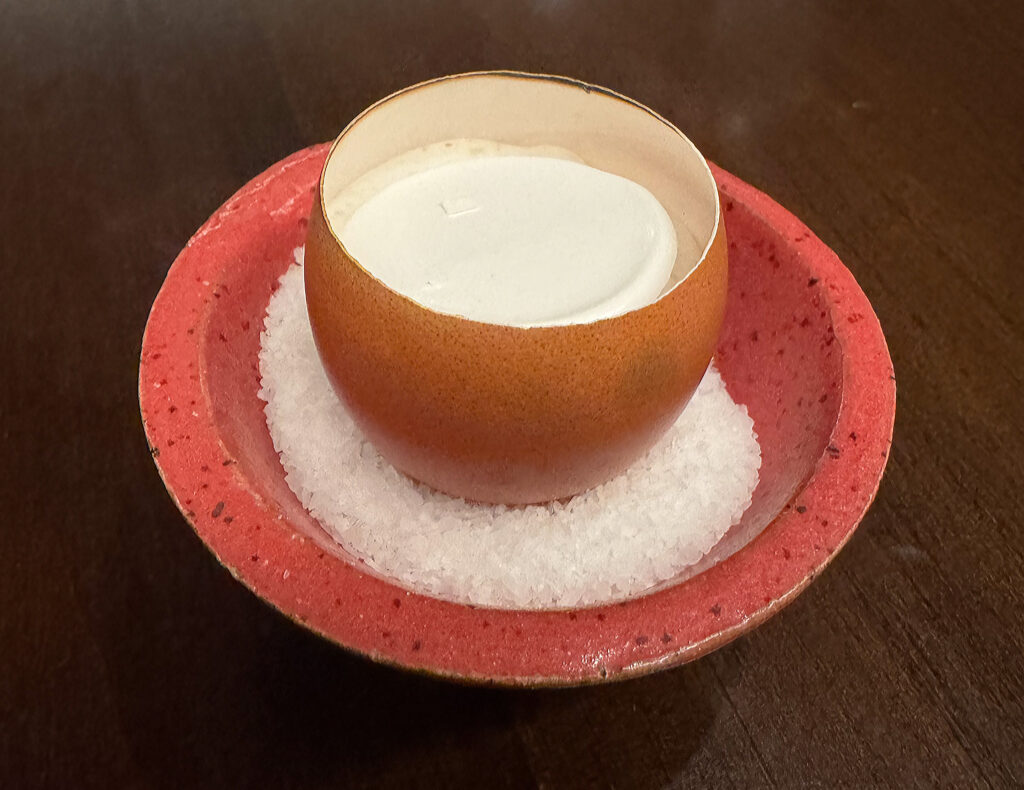
A “Sunchoke Egg” represents the last of the individual servings tonight, and, despite following the best dish of the night, it nearly keeps pace. Here, the titular shell comes filled with smoked and fried piece of sunchoke, a sunchoke caramel, an egg yolk jam, some maple cream, and a crowning disc of malted meringue. Guests are instructed to plunge their spoons down to the bottom of the vessel (while trying not to crack it), yielding an intricately layered spoonful brimming with sweet, salty, and nutty notes (backed by earthy, toasty undertones) that pick up right where the carrots left off. Yes, one could say that the ultimate flavor here tastes a bit too much like the preceding recipe. But I’m not complaining, for this preparation conjures the same kind of magic using entirely different ingredients (in an entirely different form!) that feel even richer and weightier on the tongue.
This evening’s closing bites comprise:
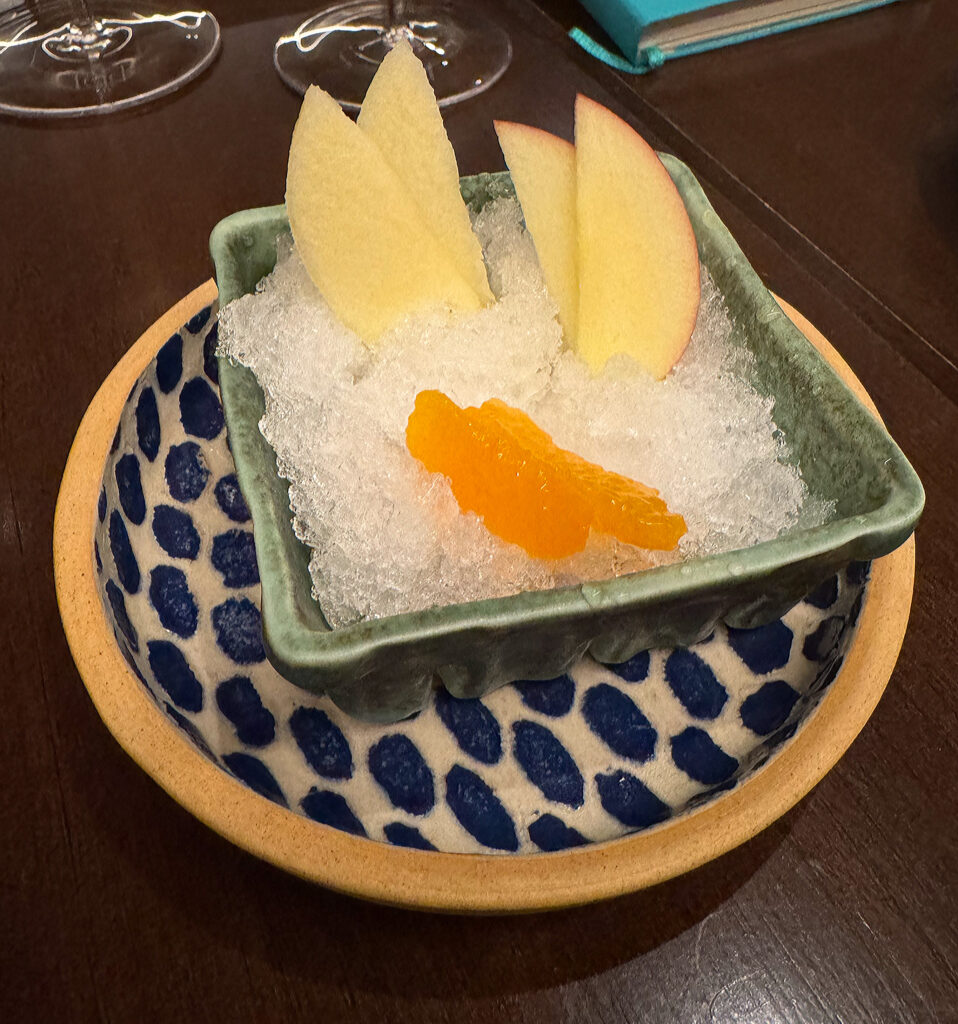
The “Fresh Fruit on Ice”—that old standby, which comprises crisp, sweet apple slices and some comparably sour-sweet tangelo. These are good (if not quite rising to the level of exotic or memorable).
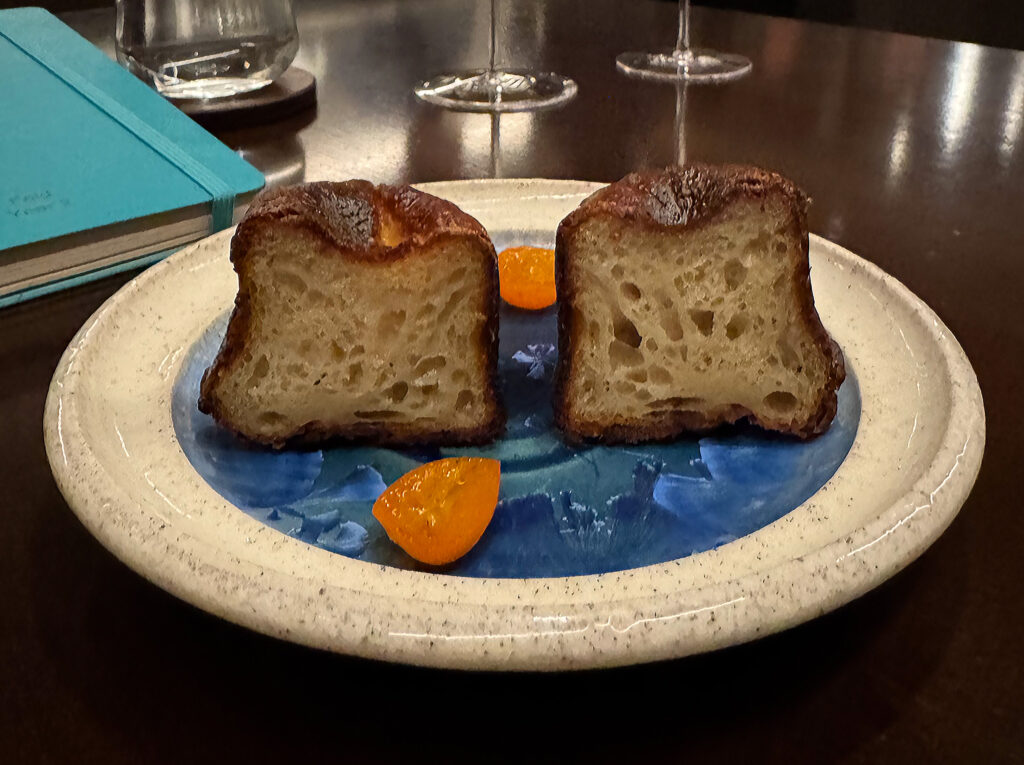
The “Candied Kumquat” helps to deliver some of the novelty I am after, offering a jammy texture and an even more concentrated sour-sweet flavor with a hint of warmth drawn from a dash of spiceberry.
Finally, the “Malört Canelé” (a familiar offering) skillfully marries a crisp exterior with a fluffier, almost custardy consistency through the crumb. While the balance of chocolate and grapefruit pith notes is well struck (not to mention charming for those who fetishize the titular liqueur), I’d probably prefer a more straightlaced example of the pastry.
With that, checks are paid, guestbooks are signed, closing tipples are sipped, and everyone (who so chooses) goes outside to share the warmth of the fire and make some s’mores.
(I happened to see at least one review lament the fact that Feld utilizes Hershey’s chocolate, alongside a similar class of conventional graham cracker and marshmallow, for the treat: something that seems to fly in the face of both “relationship to table” and fine dining more broadly. Personally, I understand the chef’s deeper desire to embrace nostalgia, a sense of frivolity, and a certain reliability when dealing with an open flame. In turn, given that this gesture is so emblematic of the restaurant, it might make sense for the team to put their stamp on these ingredients at some point in the future.)
Outside, you would never guess that Potashnick is going to host another seating tonight. He leaves plenty of time (I’m talking more than an hour) to genuinely connect with his guests and allow them to mingle amongst themselves too. The rest of the team, unharried, go about their tasks inside, yet they are always sure to offer their own heartfelt goodbyes when they see the parties successively leave.
I scarf my s’more down rather quickly and leave the chef to charm the first-timers and tourists for whom a bit of conversation forms a special thrill. But he is sure to see everyone back inside, and, away from the crowd, I offer the highest praise I can for a concept of this nature: that each new meal is better than the last and that his work, increasingly, can only be compared to that of the city’s best kitchens.
In ranking the evening’s dishes:
I would place the “Raw Scallop—Rhubarb,” “Sweetbread—Allium,” “Carrot—Miso,” and “Sunchoke Egg” in the highest category: superlative items that stand among the best things I will be served in any restaurant this year.
The “Grilled Ramp,” “Quail Egg Tartlet,” “Citrus—Rosemary,” “Spot Prawn—Citrus,” “Bamboo Shoots—Kahokia Porridge,” “Grilled Scallop—Black Garlic,” “Mt. Lassen Trout—Blood Peach,” “80 Day Aged Ribeye—Wild Garlic,” “Apple Sorbet—Umeshu,” and “Candied Kumquat” land in the following stratum: great recipes that achieved a truly memorable degree of pleasure. I would love to encounter any of these again.
Next come the “Mushroom and Tangelo Tea,” “Radish Tart,” “Ramp Leaf,” “Pickled Strawberry,” “Nasturtium Flower,” “Tempura Sweet Potato,” “Prawn Head,” “Steamed Spinach—Ichiban Dashi,” “Fresh Cheese—Pecan,” “Fresh Fruit on Ice,” and “Malört Canelé”—good—even very good—preparations I would always be happy to sample again (but that just failed to elicit an extra degree of emotion).
Finally, there’s the “Mussel Pancake”—a merely good (or maybe just intriguing) item that fell short when it came to texture and flavor. That said, the underlying ideas shaping this dish were sound, and it could easily be improved with a little more fine-tuning.
Overall, this makes for a hit-rate of 96% (by far the highest in Feld’s history) that one could even round up to 100% if one considers that the “Mussel Pancake” was part of a wider sequence that, more broadly, was successful.
Further, some 54% of offerings reached that “would love to have again” level of quality: another peak performance for the restaurant that, in truth, rivals anywhere I have eaten this year.
It is true that some of the evening’s best dishes—like the “Raw Scallop,” “Grilled Scallop,” and “Carrot—Miso”—represent evolutions of ideas I already saw in January (and, at first glance, call into question just how dynamic the team’s work really is). Yet, undoubtedly, each of these recipes meaningfully changed and improved. Likewise, nearly every other item on the present menu was entirely new, and Potashnick—most notably—went so far as to retire signatures like the ”Benton’s Ham” and “Svenska Kakaobolaget” (while also relegating Uplands Cheese to a smaller role).
Taken together, I am left feeling that this is a concept—however precocious, however idealistic—that has already reached a point of maturity: that is, the confidence to abandon its old totems, to expand the conception of “relationship to table,” and to hold onto ingredients or forms that have proven winning while always leaving plenty of room to dream. Indeed, Feld’s experimentation still doesn’t always hit the bullseye, but it certainly does more consistently and never, ever veers off the board altogether anymore.
In my opinion, if we’re talking proper, tasting menu “fine dining” (thus excluding Cellar Door Provisions and Elske for their à la carte approachability and Kyōten for its comparable minimalism), tonight’s experience lands just above my recent meal at Oriole and just below my recent meal at Smyth.
Dish for dish, there are probably a couple other restaurants at the one- or two- or no-star level that—if we’re talking pure pleasure—I could throw into the mix. But, buried beneath that “relationship to table” moniker, Potashnick’s most meaningful pursuit is really the eradication of gastronomy’s laziest tropes. Yes, by substituting totemic luxury ingredients for humbler fare (cooked and sauced with intention), Feld turns diners’ expectations on their head. The team, so passionate about what they are serving, almost dares you to find hidden glory in the humble fruit, vegetable, grain, or (God forbid) protein that arrives at the table without a certificate from Japan. They ask you to think—nakedly—through what each course has to offer rather than waiting for the payoffs that crutches like caviar, truffle, and wagyu are supposed to yield.
Frequently, it’s hard to see what all the fuss surrounding those products is about, and, for anyone lucky enough to enjoy such coveted goods at their peak, the returns (in almost every other instance) are direly diminishing. Unless, like Smyth, you are talented enough to subvert expectations and remove these ingredients from any conventional context, the only winning move is not to play. Yet most tasting menus—not just in Chicago but throughout the world’s major markets—seem afraid to abandon safe preparations of symbolic foodstuffs that only really try to assure consumers they haven’t wasted their money.
Potashnick, whatever one wants to throw at him regarding age, privilege, or inexperience, has chosen not to play defense: to do just enough to earn a Michelin star and carve out a place among concepts that, frankly, I tend to forget even exist. Instead, from the very beginning, he has almost recklessly chased a total paradigm shift. Time and tribulation have sanded down the rough edges so that, today, Feld stands ready to meet its audience where they are and convince them to indulge in a new vision of gastronomy.
In fulfilment of that mission, Potashnick, at the end of the day, is more engaged and involved in making the guests’ night than any other chef in town. His team—loyal through the concept’s darkest days and now soaring together—strikes me as the happiest, most empowered crew of its kind.
Feld’s cuisine may already taste mature, but the restaurant still feels nascent (hell, the concept is still only doing five seatings, spread across four nights, a week). The energy feels infectious, and one still gets the sense—whatever Bibendum and James Beard have said—that they are discovering something a bit underrated and misunderstood and, thus, uniquely positioned to really blow people away.
Maybe that’s the ultimate blessing of such a difficult debut: finding yourself in a position, years later, where you not only get to prove skeptics wrong but leave them ruing what they have, until now, been missing.
Still, I’ve only ever felt love—for people and produce and for the craft of hospitality itself—here. 10 visits on, there are few other places I look forward to visiting with the same fervor.