
My ninth visit to Creepies comes on the back a rather successful lunch service: one in which the gentler expectations of daytime dining yielded dishes that honored the kitchen’s distinct personality while packaging its work in a more straightforwardly delicious form.
I definitely didn’t need to be convinced as to this team’s talent. The chefs’ pedigree is clear, and Creepies, in fact, debuted with at least a few items that became instant, enduring hits. Other preparations, with more time and refinement, have come to realize their full potential. Even the introduction of new creations (more than half the menu having turned over at this point) has largely been successful.
However, certain recipes here (both old and new) continued to leave me wanting. They were by no means flawed—that is, marred by a clear lapse in texture or imbalance of flavor. Rather, these constructions seemed to pursue a logic of their own: a kind that interrogated and, at times, wholly subverted the kind of pervading comfort the bistro genre (even in its modern manifestations) promises.
I get it. Why enter this market if you are just going to play the hits (and open yourself up to direct comparison against an estimable number of existing French spots)?
I want Creepies to be creative and singular but also totally convincing in its satisfaction—a mirror of what its mothership, next door, offers. Lunch service proved that the restaurant, when forced to streamline its offerings and play to a particular audience, is every bit capable of impressing across the board.
Yet the dinner menu, by comparison, must remain the venue for the fullest fulfilment of the team’s voice. It’s the place to showcase ideas that could, maybe, transcend the limits of Chicagoan taste and secure some degree of national relevance. Rather than wanting dinner to be more like lunch, I found that my daytime experience actually prompted greater patience and understanding in how I view the chefs’ pursuit of their ultimate goal: a neo-bistro like exists nowhere else.
At the same time, Creepies has now been around for more than half a year. Criticism is not only fair game, but intentions can be questioned too. Dynamism—as well as the urge to read new ground—still demands a degree of coherence. Nobody wants to book a reservation a month in advance and bow to some of the concept’s more polarizing features (e.g., the lack of a full bar and the natural wine) only to feel like a guinea pig.
The prospect of resolving these tensions keeps me coming back to this funky, offbeat place many months later. At worst, I know the food will still provoke thought in a way I cherish. At best, it will confirm the arrival of a lifeline for an increasingly commercialized, standardized West Loop. Tracking the process—the uncertain path to (prospective) greatness—is a big part of the fun, and it has the added benefit of forming a natural companion to my recent piece on Elske.
So, where does Creepies stand today?
Let us begin.
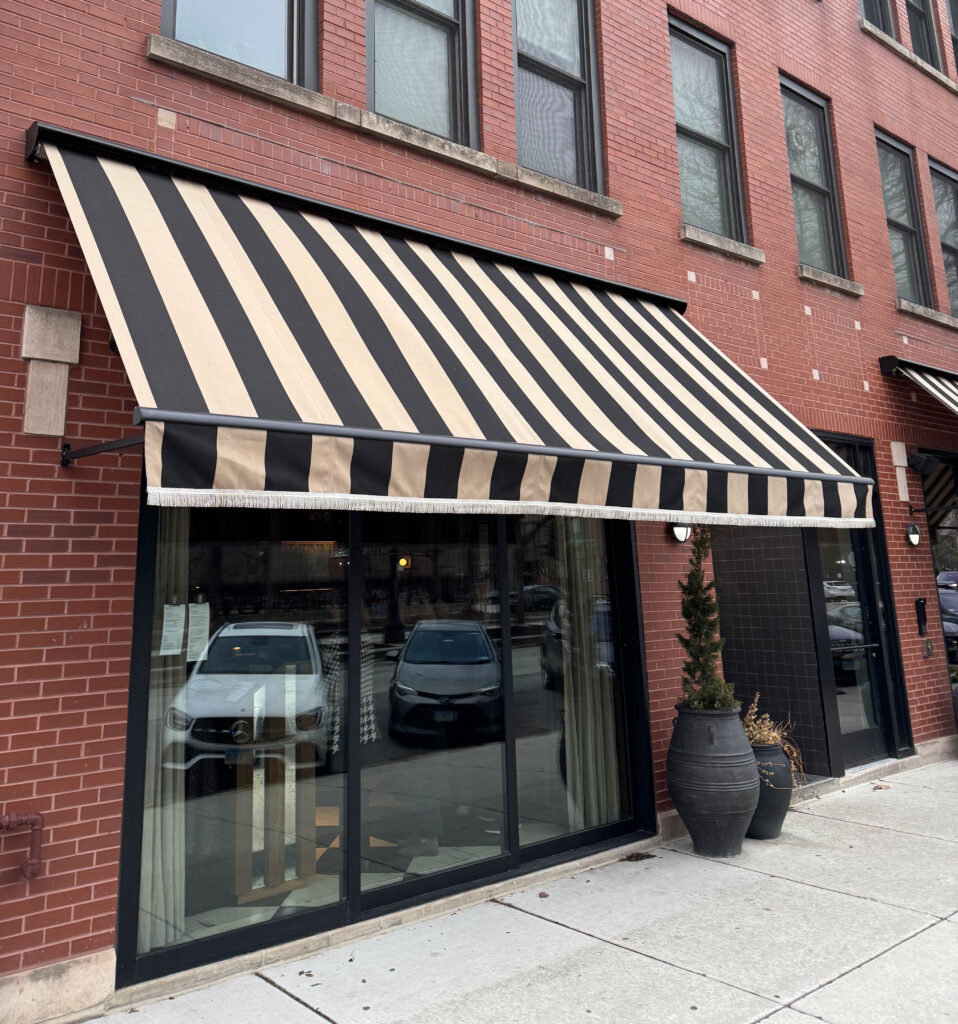
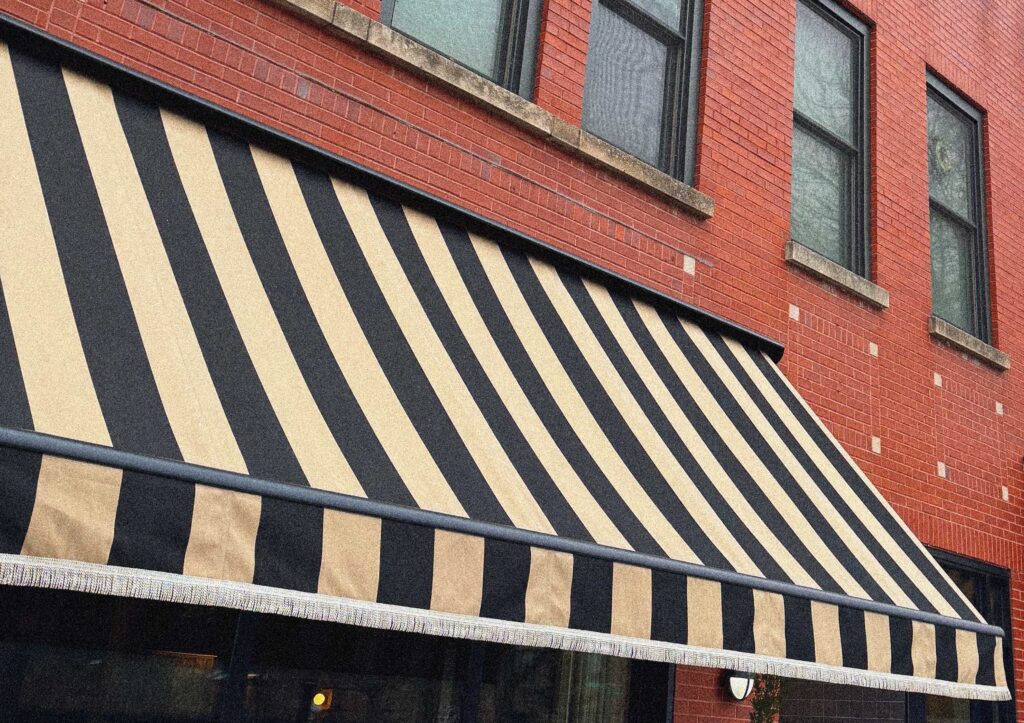
It’s five minutes to opening on a pleasantly temperate Saturday, and I already spy prospective diners traversing the striped awnings of 1360 W. Randolph. It’s to the restaurant’s credit that the front door (especially in colder weather) always seems to be unlocked. Judging by the speed with which some of these parties are being led to booths and tables, they—despite the eagerness—must have reservations. For, when I make my own way to the host stand, I hear what sounds like a three-hour wait being quoted to a younger couple who hoped (even at this earliest of hours!) to walk in.
Six months later, Creepies’s popularity—fueled, no doubt, by the essential intimacy of the space and the relatively friendly pricing—is showing few signs of waning. Even those Monday and Thursday reservations demand a few weeks’ notice to secure, so forget about primetime unless you willing to really plan. Only lunch service (a somewhat aspirational offering given the distinctiveness of the cuisine) offers any kind of accessibility, and I will be the first to say that the shorter, sweeter menu forms a perfect introduction to what chef de cuisine Tayler Ploshehanski and her team are doing in the kitchen.
That said, consumers want to try the hottest places at the most fashionable times. They want to trek the checkered floors amongst a crowd that feels equally lucky to be seated somewhere on it. And even I, nine times later, must marvel at how quickly the room fills with an eclectic, enthusiastic crowd that cuts across age, race, and dress like few finer dining spots are capable of. Elske is one of them, and it is clear (just based on what I overhear) that the regulars have installed themselves here too. But the audience is even broader, and the bonhomie—given that diners are arranged in closer proximity to each other—more overflowing.
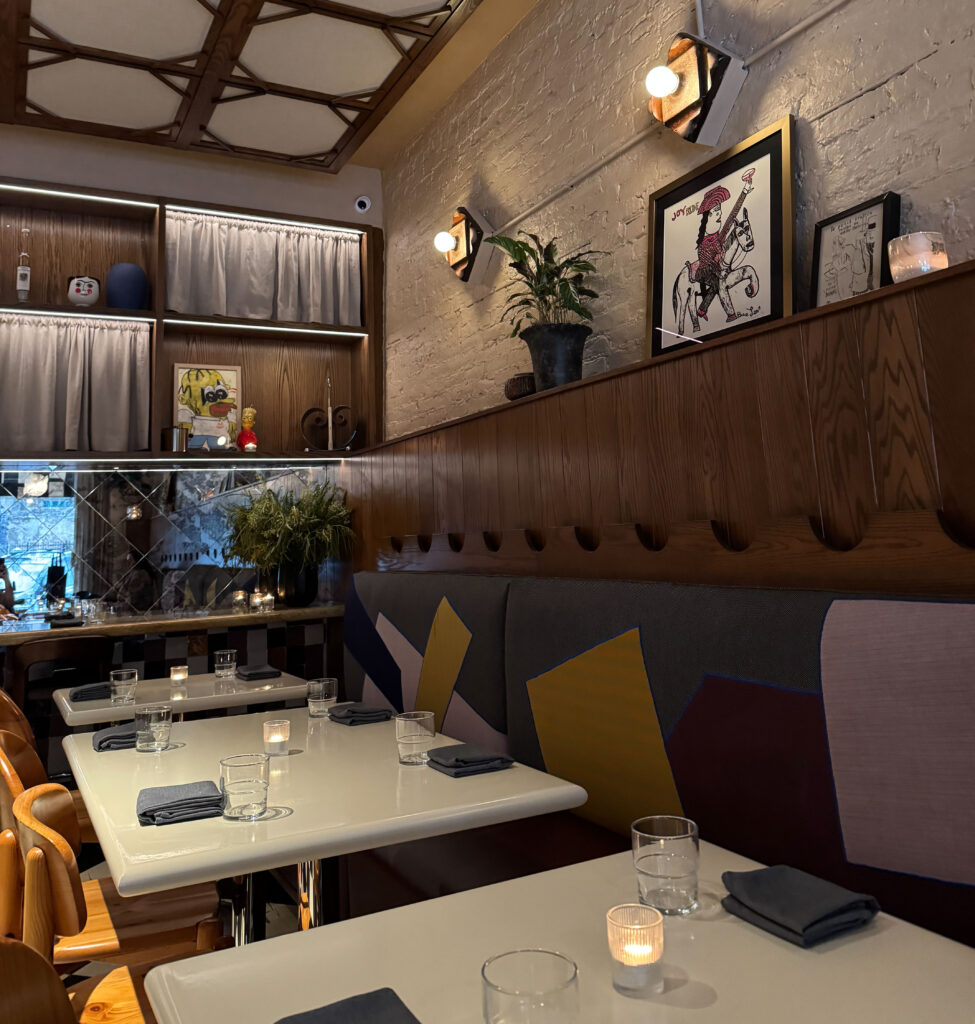
I always try to keep to myself but have to admit that interaction from table to table in these confines is both routine and wholly sincere. A lively, irreverent mood is set by the subtle weirdness of the ambiance, the equally offbeat music, and the earnestness of the staff. The emotional dimension of the experience proceeds from there, and, as long as Creepies is able to maintain this kind of infectious energy, the concept will have ample room to experiment with its food.
When it comes to mechanics, it seems to me that service at the restaurant has now hit its stride. Admittedly, I arrive knowing exactly what I want. But having a cocktail in hand less than three minutes after sitting (a clear benefit of relying on batched recipes) and a bottle of wine on the table only three minutes after that can only be described as superlative.
Pacing naturally gets more complicated as the dining room fills. However, I’m equally impressed at how the captain and the kitchen—working together—are able to deliver some 17 total dishes in a mere 90 minutes. Arriving in flights of three or four plates (arriving in roughly 15-minute intervals), these courses epitomized coordination and timing without ever making the party feel rushed. Indeed, I have no fear that guests who would rather take their time will have plenty of opportunity to linger. Just the same, I recall that a meal of this scale could take almost an hour longer back closer to opening, and I prize seeing Creepies sharpen its execution to such a degree.
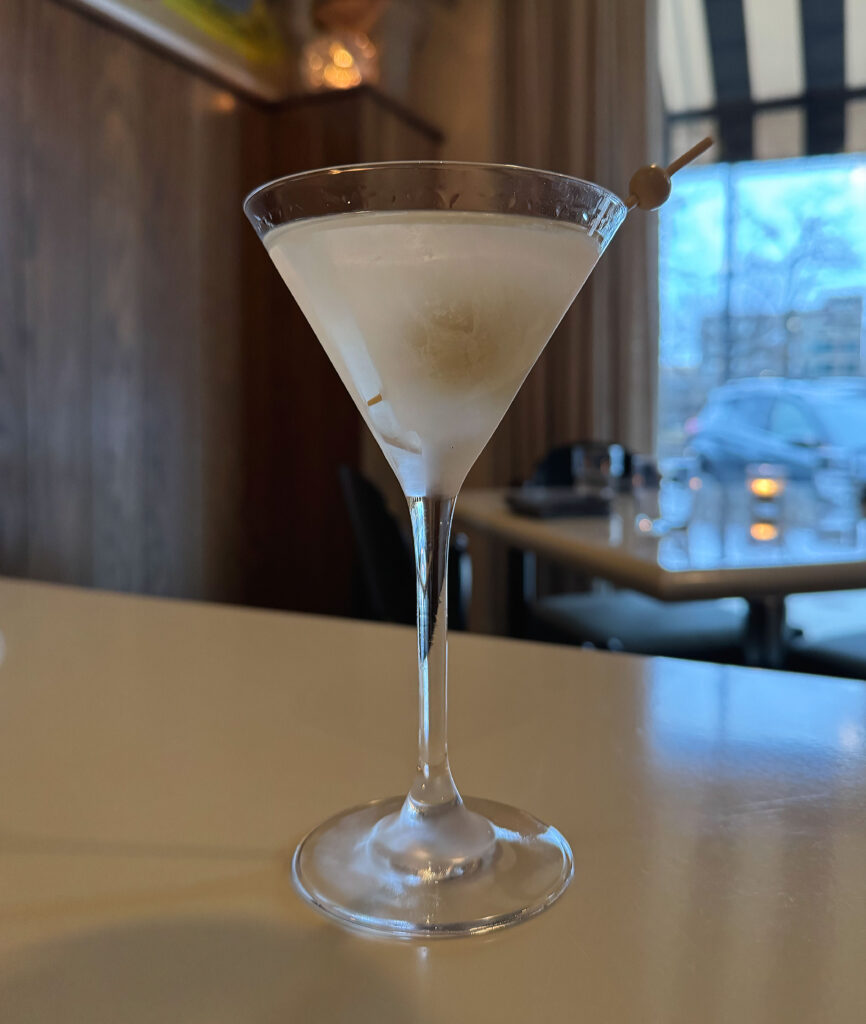
When faced with what to drink, I continue to favor the “Dirty” ($16) that survives from Monica Casillas-Rios’s tenure. For my palate, this blend of orange oil-infused vodka, aromatized wine, and brine—so seamlessly woven together, with such botanical depth, but delivering all the savory satisfaction such a recipe promises—even outmatches the excellent “Martini” ($16) served at Elske.
It is unclear what will happen to these recipes, which rank among the finest in the city, with time. The inevitability that they will change almost scares me. Nonetheless, the hiring of Stephan Jurgovan (whom I last encountered designing the “wildcraft” pairings for Warlord’s tasting menu) to run the program at Elske—and, presumably, here—seems promising. In fact (going off what I remember tasting at Enemy), this is actually a savvy stylistic match.
On the wine side, I am a little apprehensive about substituting the riches of the list I found next door for one that is more expressly focused not just on natural wine but on value.
The secret to Emily Sher’s work on the Creepies side is the selection’s dynamism. A rotation of premium Champagnes—presently the Ruppert-Leroy “Fosse-Grely” ($252)—is a lifeline for anyone who wants to splurge while not contending with anything too adventurous. It’s offered at a relatively fair 117% premium compared to local retail price.
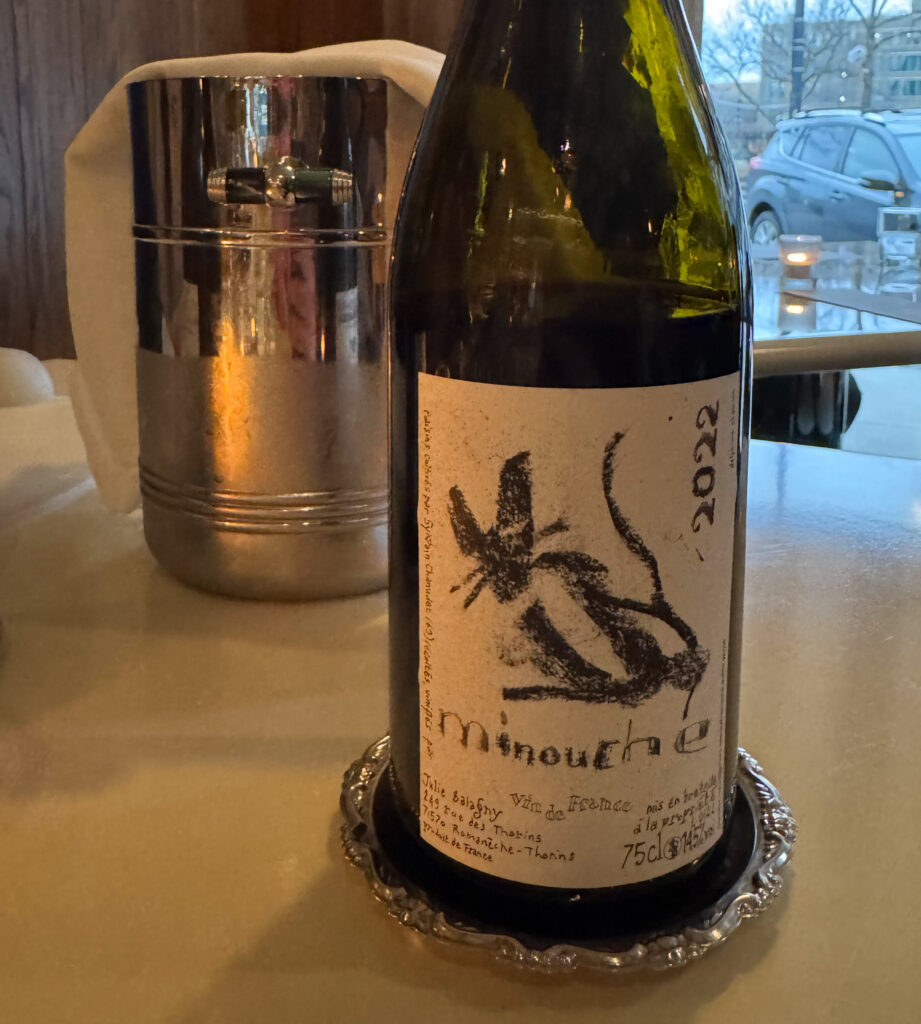
However, what really thrill me are the absolute gems that a knowing customer can find buried in that sub-$100 category. Case in point: the 2022 Julie Balagny “Minouche” ($90), a bottling of old-vine Gamay from Fleurie produced by a dearly departed winemaker. This instant collectible is priced at a mere 88% premium compared to when it was offered at retail. Today, the wine’s starting auction price comes in at 30% more than what is being charged at Creepies.
Suffice it to say that finding bottles like this in the wild is always a thrill. Yet, looking beyond any bragging rights, the Balagny—brimming with fruit and florality but balanced by a singular elegance—is honored by being served alongside this kind of food in this kind of setting. Few lists (wherever they fall on questions of natural dogma) can deliver such a thrill.
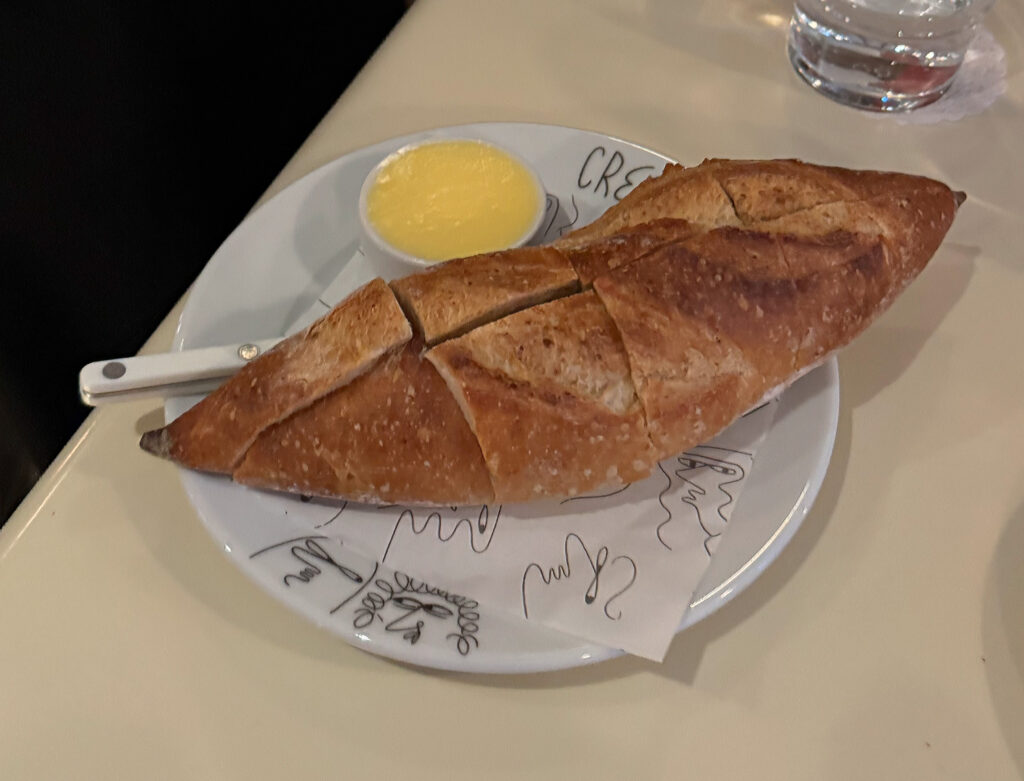
Tonight’s meal starts with a serving of “PQB Bread & Butter” ($8) that has consistently maintained its quality since Creepies began outsourcing the loaves. The demi-baguette arrives warm and boasts brittle points that fall just short of being able to draw blood. Cut into eighths (to facilitate sharing), the bread balances a mild degree of crunch with a satisfying chew and a robust wheaty flavor. The housemade butter, though only mildly salted (especially in comparison to the one I encountered at Elske), offers enough rich, milky depth to distinguish each bite. Thus, while I try to save some baguette to dip in any number of sauces that will appear later, the crusty segments are hard to resist in their own right. I cannot think of any better compliment for such a trademark of this genre.
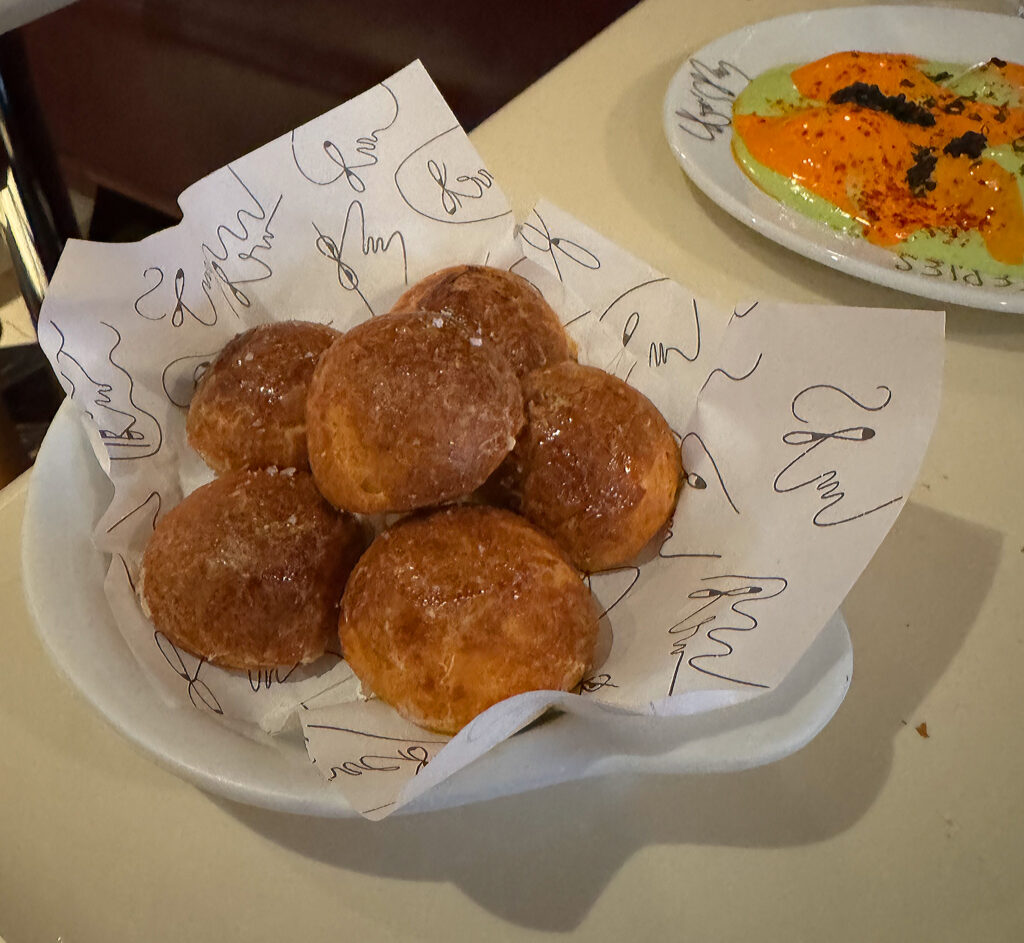
The “Warm Brie Gougères” ($16) have deservedly become a Creepies signature: representing the kind of classic form the kitchen knows how to cleverly adapt while still honoring its core appeal. Since opening night, I’ve noted small tweaks to how the finished dish has been presented, with varying applications of salt, shredded cheese, and honey influencing the recipe’s exact flavor expression. On this occasion, the pastries arrive looking only lightly dressed across their surface. However, removing the middle piece reveals a hidden puddle of the titular cheese.
By allowing guests to coat the exterior of each gougère with an added layer of brie, the chef builds a doubly warm and creamy effect to play off of the flaky crumb. The effect is expectedly rich and fairly satisfying—it is, ultimately, a concentration of the recipe’s essential elements. Correspondingly, I find that the sweetness that once prominently marked this preparation is now almost barely perceptible. The supporting level of salt here is also fairly low. In some sense, I like seeing the brie take such a starring role, but I think the balance struck here (so centered on its long, subtly fruity and mushroomy notes) almost demands a wine pairing. That could be the intention, yet I’m not sure it’s note wise to make these gougères less straightforwardly decadent and joyful than they once were. Yes, while the texture of the pastry is rendered with precision, more sweetness or salt (or both) is really necessary to ensure the brie shines.
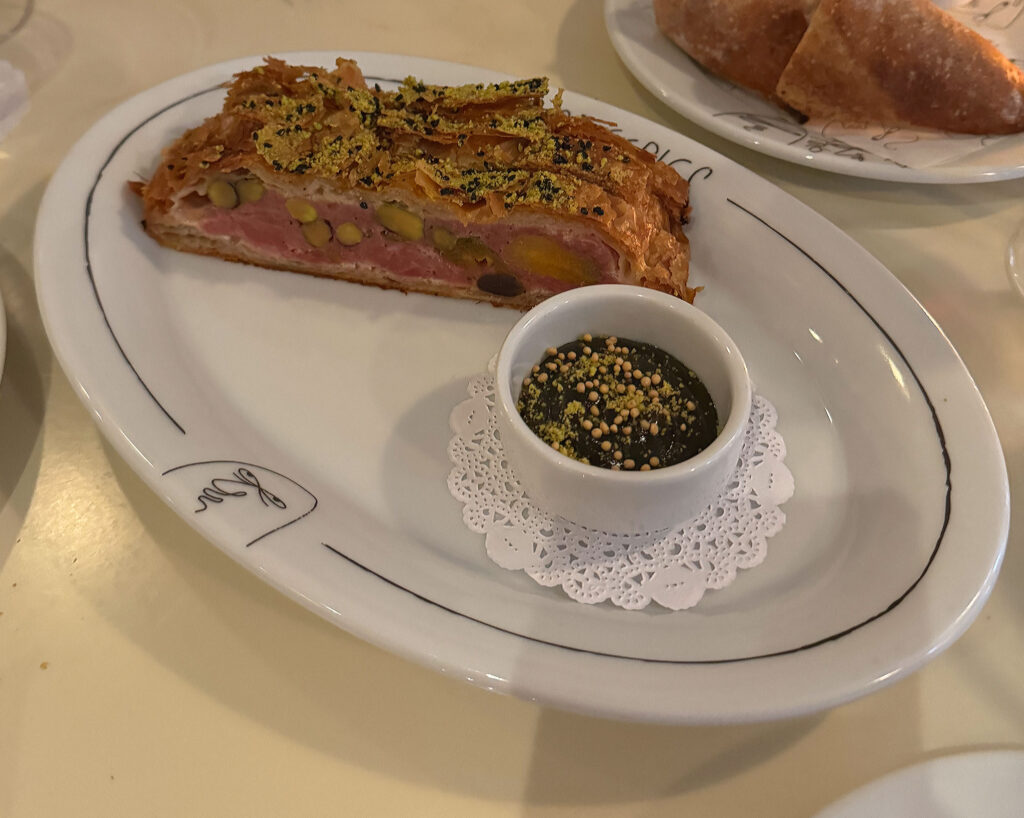
The ”Saucisson with Puff Pastry & Pistachio Mustard” ($17) is another item that has tried my patience. It was so good on opening night—fulfilling everything that succulent pork tucked into a flaky wrapper could hope to offer—but seemed to never reach that same standard on subsequent visits. Is my perception simply clouded by the fact that the dish’s novelty has long worn off? I do not think so.
Here, the slices of meat and pastry arrive at the table piping hot. They’re crisp in a way I haven’t felt for months, and they marry the sensation with a plumpness and moistness that leaves one eager to take another bite. The resulting flavor is fairly straightlaced in its expression of salty pork with nutty, peppery, garlicky undertones. However, now that the meat’s wrapper possesses the requisite rigidity, the accompanying mustard coheres without destroying the (previously soggy) puffy pastry. Indeed, the condiment takes this winning form to another level of pleasure: charging the flesh with tang and sweetness that further accentuates its savory depth. Yes, this time around, I am left totally impressed. The saucisson represents a real highlight.
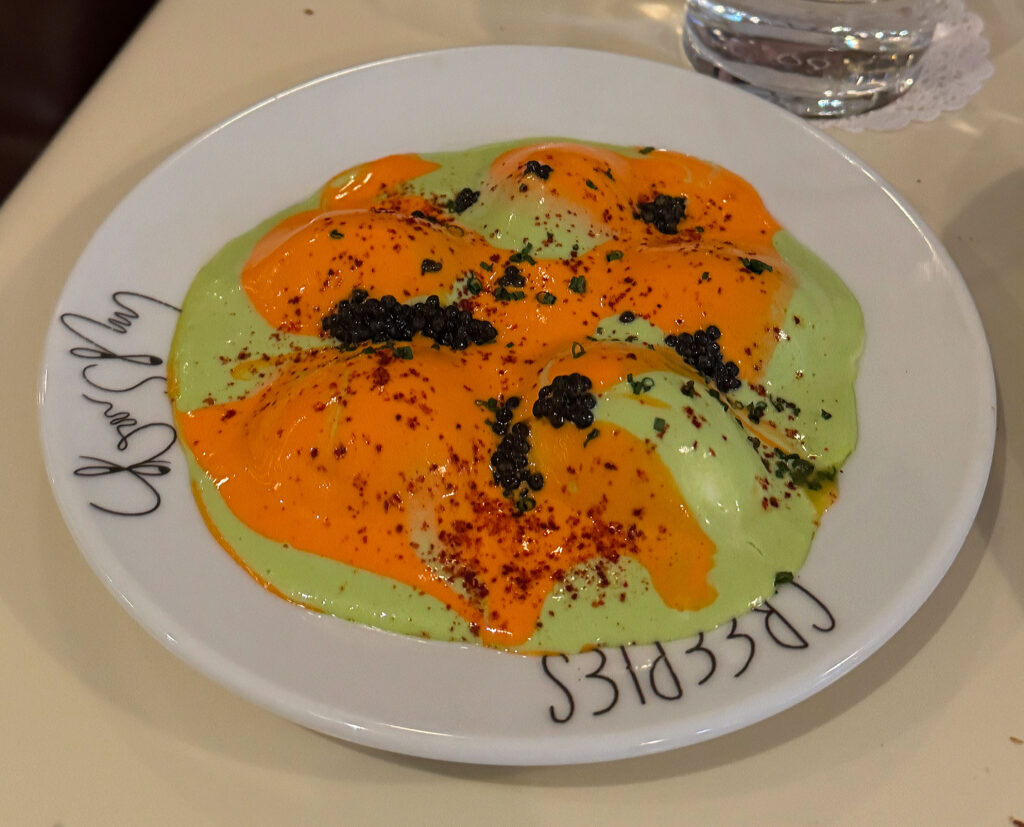
The “Oeuf Mayonnaise with Caviar, Chive, & Espelette” ($16) recently made its way onto the restaurant’s lineup of snacks—a section I think it’s fair to say is the menu’s strongest—so the pressure to perform is significant. Visually, the preparation certainly ranks among the kitchen’s most striking: with mounds of egg, trails of roe, and a tie-dye swirl of pastel green and burnt orange tones (drawn from the titular allium and pepper respectively).
Conceptually, I like the fact that this recipe enables feelings of luxury and indulgence (via the caviar) without in any way upsetting the concept’s value proposition. Instead, it’s a charming “eggs on eggs” construction in which that of the hen (supremely soft and gooey before one even considers the surrounding creaminess) is effectively salted by that of the sturgeon. Yes, the roe here doesn’t exactly smack of complexity, but I can think of items costing twice or thrice this throughout the city where that holds true. Besides, the core juxtaposition of the chive’s sweetness and the Espelette’s lingering heat (countered by the mayonnaise) is totally sound. Ultimately, this makes for a playful, enjoyable series of bites (so easily shared) that, even if one ignores the caviar altogether, displays character and elegance too. In short, I think the “Oeuf” forms a strong addition to the menu.
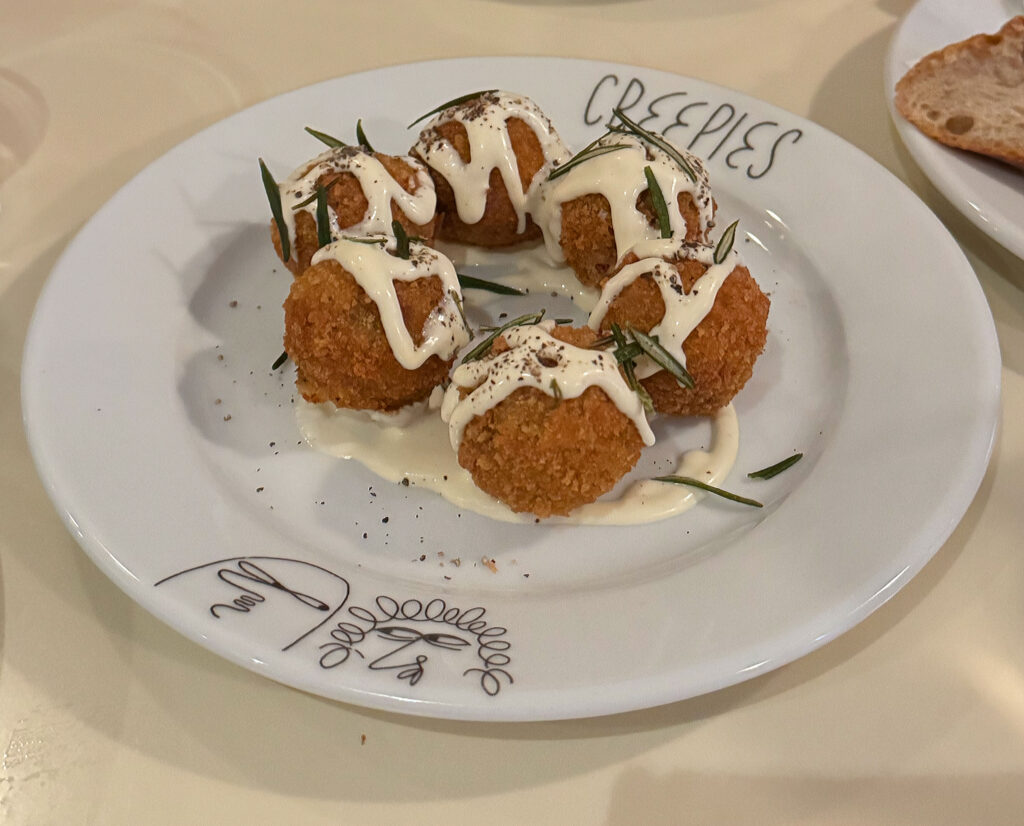
Turning toward the next section of the menu, I find a serving of “Sunchoke Croquettes with Preserved Lemon” ($14) that, given its ironclad quality and shareable format, arguably deserves a place among the snacks. Indeed, while the gougères can rely on their cheese filling and the puff pastry on its sausage stuffing, these breaded orbs rely on the humble root of the sunflower for their principal flavor. I’ve come to learn that, in the right hands, this ingredient—laden with sweet and nutty depth—ranks among the most delicious vegetables.
Framed by a crumbly crispness, the sunchoke fulfills that potential here: possessing a fluffy, potato-like consistency throughout the interior of the croquette. Matched with a tangy, salty béchamel and some fried leaves of rosemary, the dish delivers a decidedly savory, satisfying expression with more than enough intrigue (including those delectably sweet and nutty notes) to leave you wanting another. For my palate, this recipe ranks among the kitchen’s most straightlaced and reliable—though not at all hackneyed. Importantly, it maintains the momentum generated by the kitchen’s opening signature offerings.
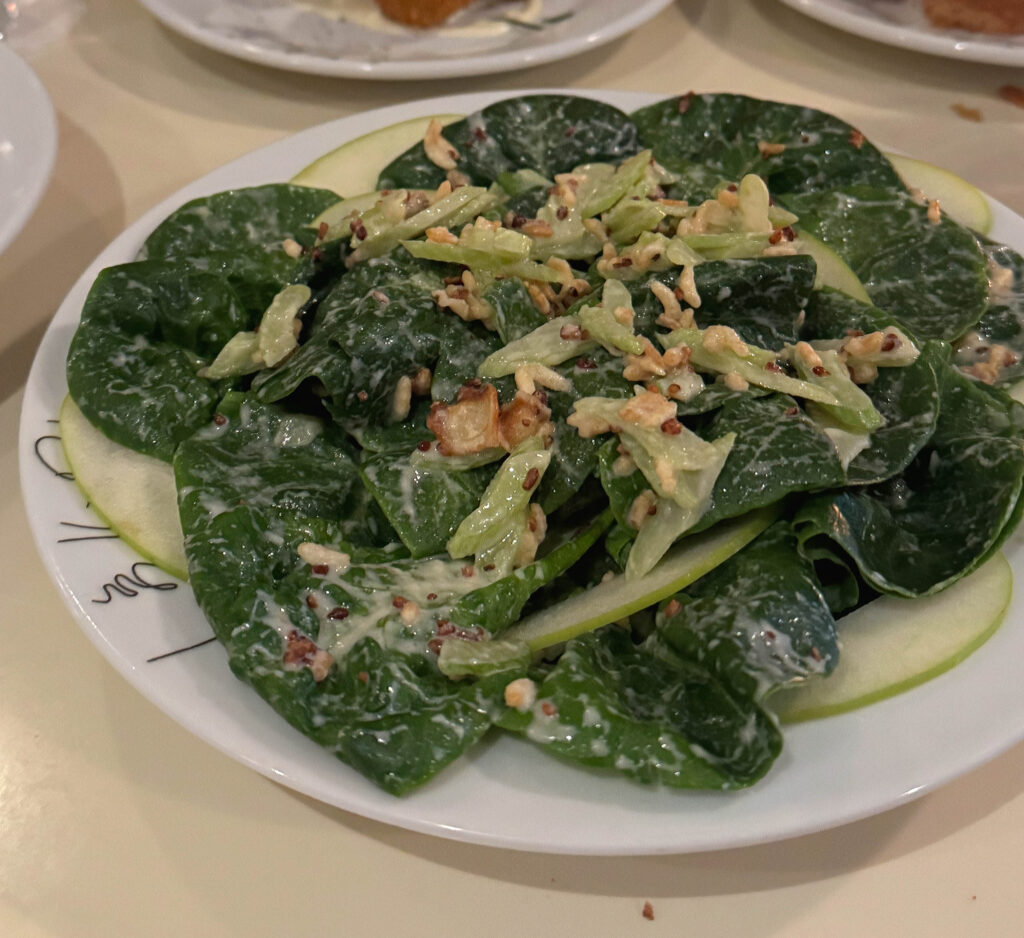
The “Little Gem with Parsley Root, Apple & Sunflower Seeds” ($16) has regularly been one of the menu’s greatest disappointments: a far cry from the vivid textures and tang that characterize Elske’s work in the salad category. However, as with a couple longstanding dishes tonight, I am pleased to report that the preparation has finally hit its stride.
The presentation of the lettuces—all fanned out—remains the same. Yet, on this occasion, the little gem retains far more crunch than I am used to while simultaneously (paradoxically) benefitting from a more generous application of tangy dressing. Opposite the greens, I enjoy the varied crispness of the larger apple slices, smaller shreds of parsley root, and tiny sunflower seeds, whose layered contributions to the salad’s mouthfeel ensure that each bite is endlessly engaging. The sweetness, freshness, and nuttiness they respectively add also ensures that the overarching flavor here feels complete. Overall, this item may not measure up to Elske’s hallowed “Belgian Endive,” but it has improved dramatically and is now worthy of being ordered.
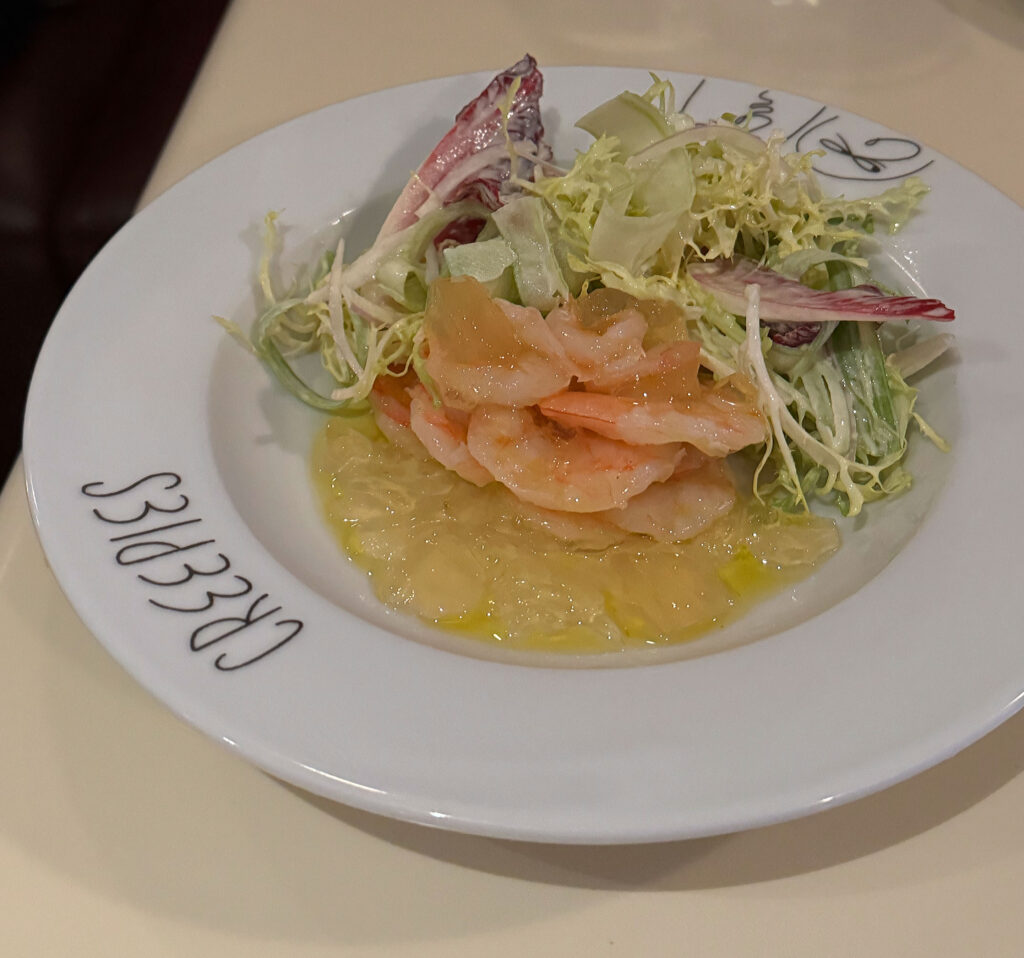
In the “Shrimp with Remoulade & Chicories” ($24), I find something completely new: a welcome serving of seafood (one of only a few offered at the restaurant) rendered with an irreverent, jellied sauce. Yes, while the crustaceans here (save for one sandy piece that was not entirely cleaned) feel fresh and plump, the remoulade calls the horrifying aspic creations of yesteryear to mind. Still, it’s actually far easier to eat and only really suffers from being too mild, too anonymous in its faintly tangy flavor. The chicories, with their crunch and bitterness, are actually well incorporated too. I just need to see the strange sauce take on greater zest, pungency, and herbaceous depth for this weird little dish (so fitting for a place like Creepies) to shine.
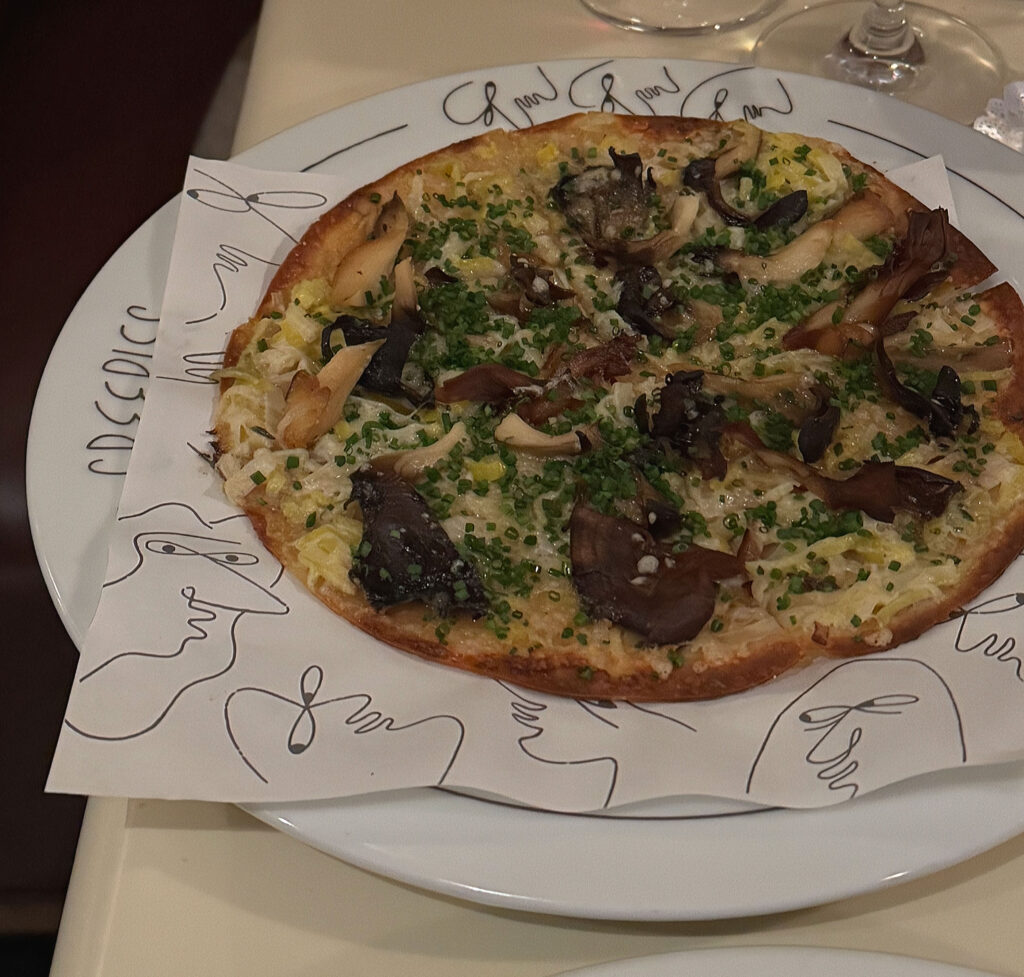
Arriving next, the “Tarte Flambé, Tavern Style” ($18) ranks as one of the kitchen’s most emblematic preparations: working to define the menu’s small plate category (alongside the mussels and gnocchi) since opening. Seeing the Alsatian recipe interpreted in the style of Chicago’s favorite thin-crust pizza holds considerable charm. However, like many of the signatures I have sampled at Creepies, consistency has sometimes been an issue—namely, achieving the right cook on the crust without totally carbonizing the mushrooms that sit atop the pie.
Tonight, I am pleased to say that the team does the “tavern-style” moniker justice. Texturally, the tarte balances a moderate crispness at its base (tending toward a more powerfully brittle crunch at the corners) with melted cheese, sweated onions, chives, and a juxtaposition of lightly roasted and more deeply caramelized mushrooms across the surface. That’s certainly a mouthful, but it’s hard not to notice that the dish has grown notably more intricate. Rather than offering an amateurish, cardboard-like bite, the ersatz pizza actually impresses me with its multidimensional mouthfeel (creamy, chewy, and resonant with subtler, telescoping sensations of crispness). The resulting flavor—balancing the sweetness of allium with the earthy satisfaction of the fungi—is now perfectly judged too. Overall, this makes for the finest example of this item I have yet encountered here and the kind of shareable plate no party should go without.
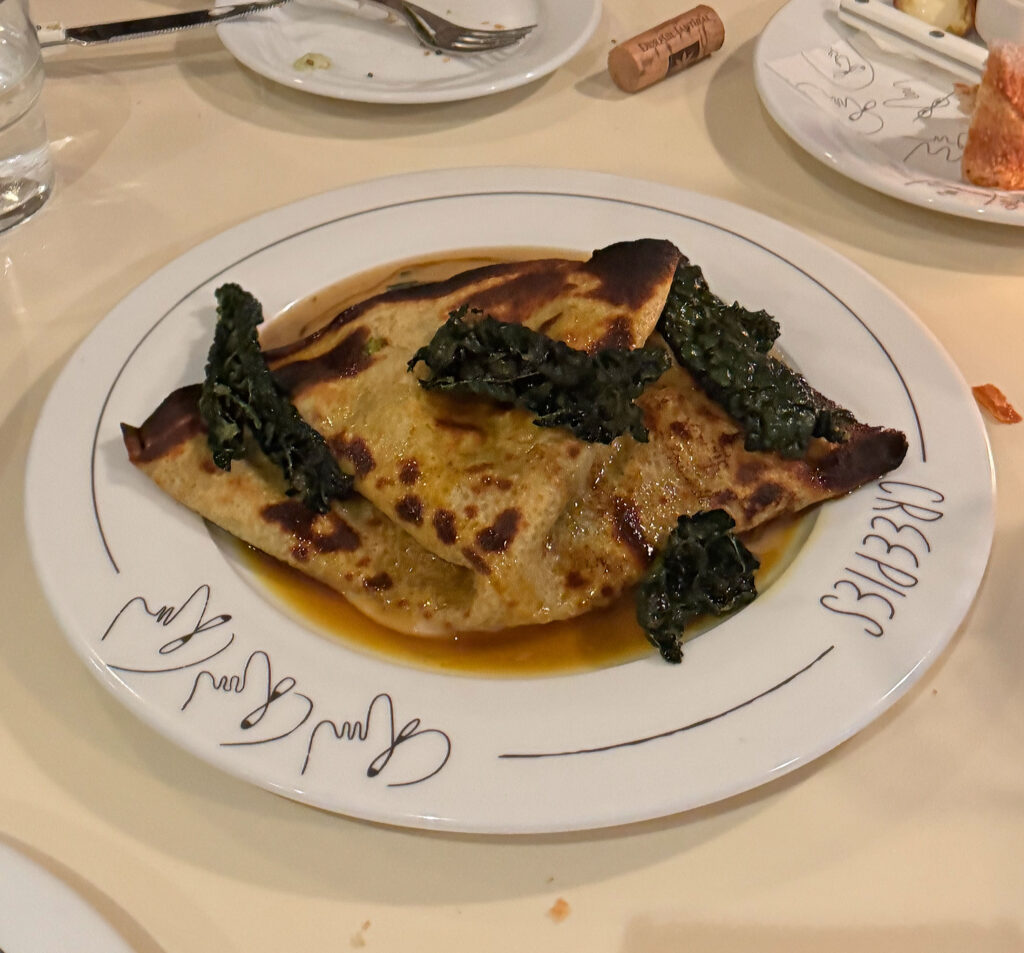
Of all the Creepies recipes I have tasted before, perhaps none is as ignominious at the “Freekeh Crepe with Sweet Potato, Kale & Vadouvan” ($25). The kitchen has been working with this form since the concept’s debut, but (even accounting for the variation that featured corn) I was never left feeling that they had mastered it. Needless to say, an iteration centered on an obscure grain—alongside vegetables and curry—would face an uphill battle. Indeed, back in November, I had a hard time understanding what this dish was even going for.
On this occasion, I am met by a transformation that goes beyond mere redemption and actually, somehow, leaves me thinking of this preparation as a bonafide highlight. Everything centers on the crêpe itself, which (for the first time) delivers an admirable degree of crispness not only around the edges but through the middle. Opposite this foundation, the crunch of the fried kale leaves, creaminess of the sweet potato, and faint chew of some mushroom segments (the latter two elements hidden within the folds) harmonize nicely. The accompanying flavor—notably sweeter than anything served up until this point in the meal yet smartly matched by earthy, nutty, and warmly spiced notes—is surprisingly decadent. Complexity (and, correspondingly, satisfaction) deepens with each bite, and, ultimately, I am left feeling that this humble vegetarian construction punches way above its weight. What a beautiful contrast from everything else on offer.
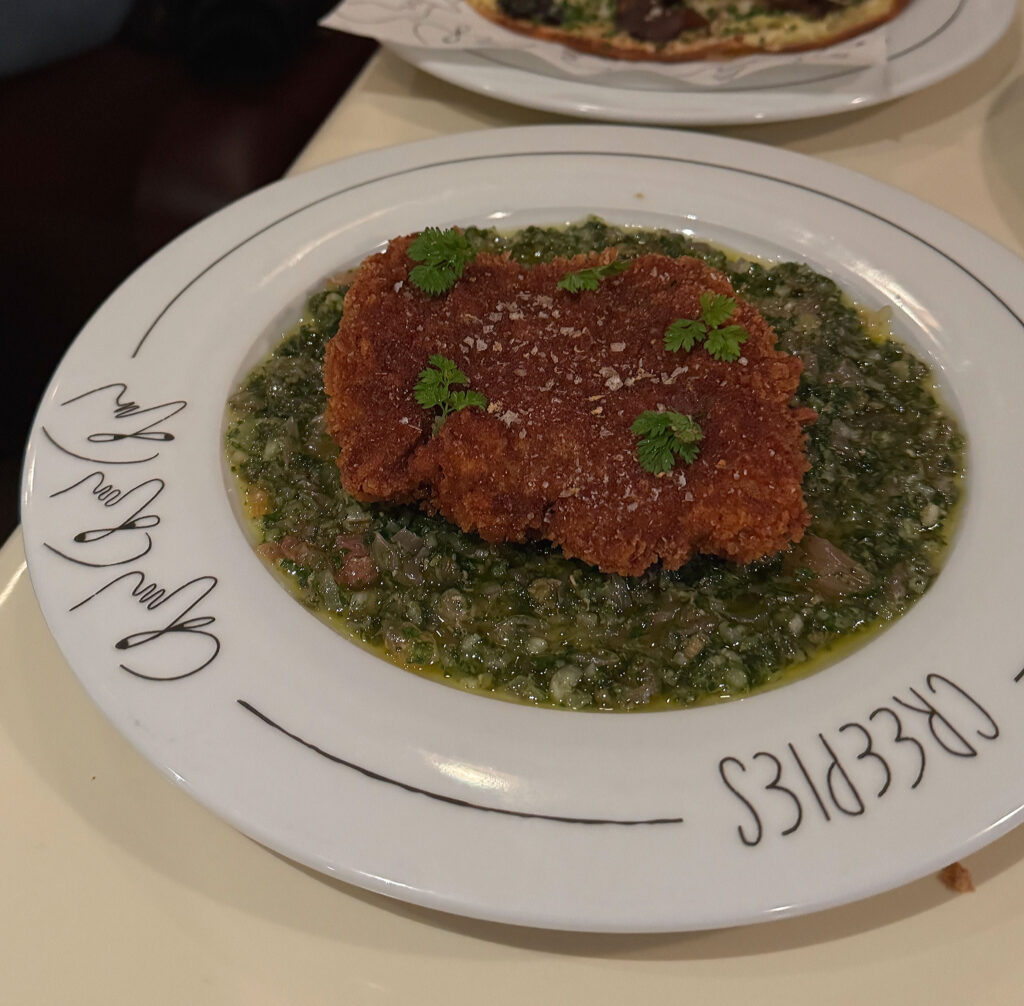
The “Sweetbread Schnitzel with Ravigote & Pomelo” ($28) made its thunderous entrance onto the menu a few months ago, and I was quite eager to try it (given that this offal stands as my very favorite ingredient). I’ve sampled the recipe a couple times now without having the opportunity to share my thoughts, which I’d characterize as something close to restrained adoration.
The starring thymus is, itself, prepared to perfection: being pounded, breaded, and fried to a deep, craggy golden brown the mere sight of which makes my mouth water. Generously sprinkled with flaky salt, the sweetbread delivers a push-pull of supreme crispness and silkiness on the palate that (appropriately) is more akin to a cutlet. And yet, the meat leaves behind a rich, faintly sweet sensation that is uniquely its own. It’s hard to imagine anything better. Now, I can see how the accompanying sauce—citrus-tinged and packed with herbaceousness—is meant to play off all this decadence. Nonetheless, I find that it saps some of my pleasure and, I do my best to enjoy the offal on its own while taking small spoonfuls of the intensely tart ravigote as a chaser. In this manner, I can appreciate the sweetbread’s full glory anew with each mouthful. Really, it’s so good that I’m not sure it demands any other condiment.
Turning toward the entrées, I choose to ignore the chicken (a signature in its own right) and train my focus on two new items.
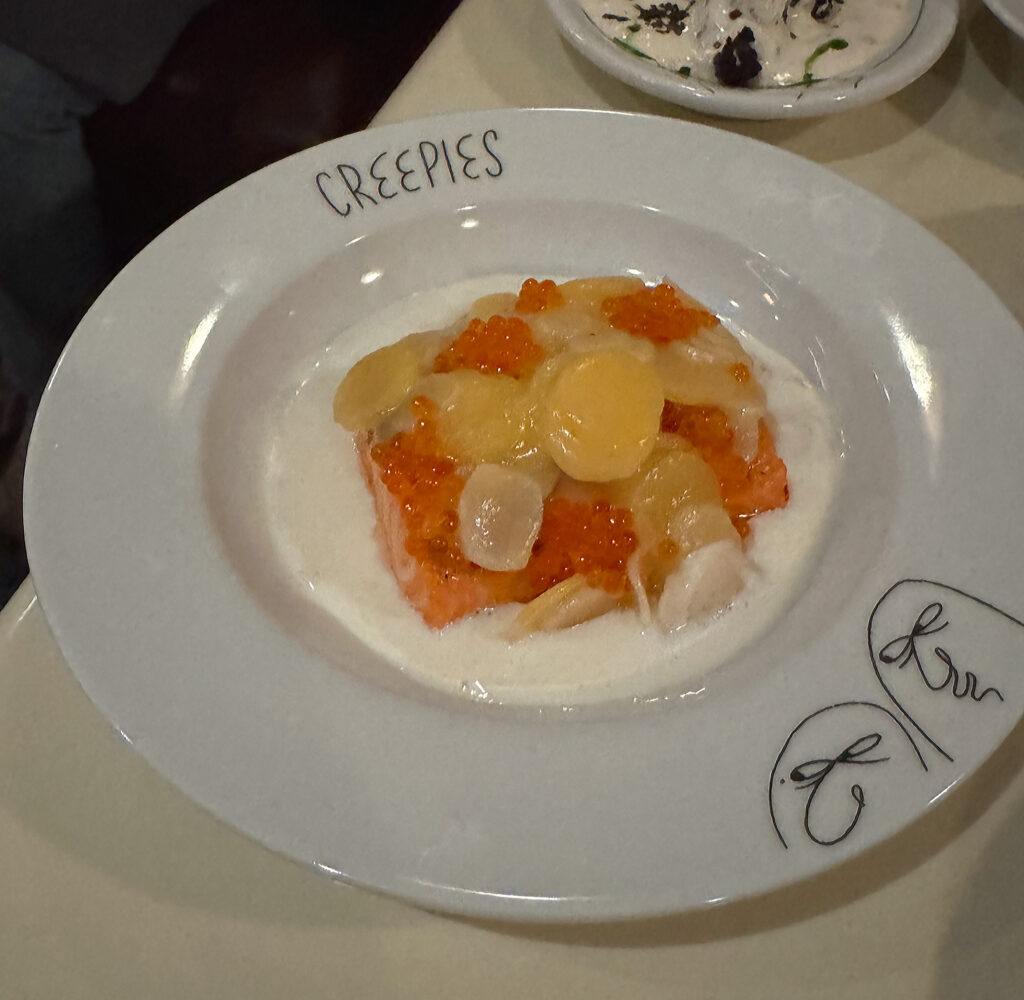
First, there’s the “Fjord Trout with Salsify, Buttermilk, & Buckwheat” ($37)—a fairly direct substitute for an old halibut preparation that ranked among the kitchen’s weaker recipes. Here, I am immediately impressed by the fish’s smooth, flaky consistency and its harmony with the subtly crisp vegetable scales. Of course, the bath in soothing buttermilk and subtler pop of some accompanying roe only add to one’s enjoyment. These latter elements bring mild notes of tang and brine to the fore but are balanced in a way that allows the latent sweetness of both the trout and the salsify to shine. The buckwheat does come across as a bit too bitter by comparison. However, overall, I think this dish represents a clear improvement on what came before.
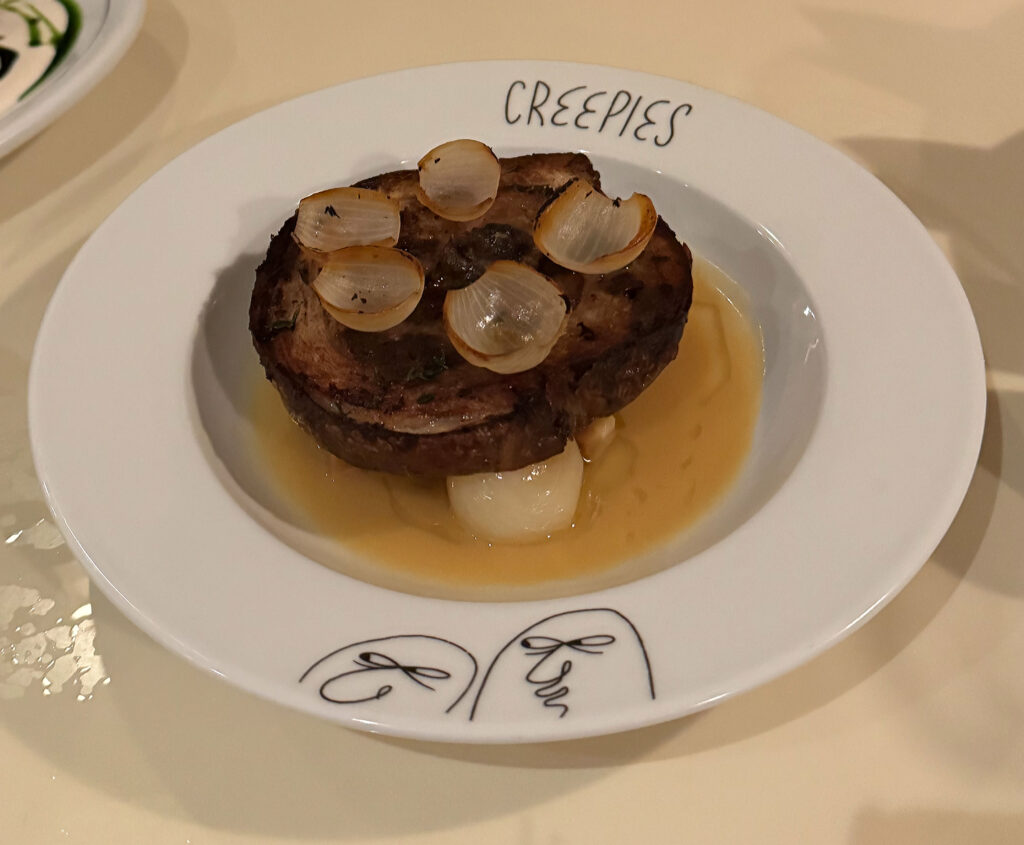
Next, I find the “Blanquette de Veau with Parsnip” ($42)—a promising adaptation of the legendary veal stew. This example trades the recipe’s “white” denotation for more carnal tones of charred meat and pearl onion. However, the accompanying velouté and orbs of parsnip are truer to type. Texturally, the veal—sliced from a rolled segment of breast stuffed with something like a sausage—combines a crisp exterior with a fairly tender interior and a little more toughness through the center. The onions and parsnip add their respective crunch and firmness to the equation, along with a mild sweetness that defines the dish. Yes, while I expect the velouté to moisten the meat and steer it toward savory satisfaction, the overall effect is not quite convincing. The ingredients feel disjoined (rather than seamless or soothing), yet I like the train of thought here and hope to see this preparation come together at some point in the future.
When it comes to sides, I also prioritize items that are new (or at least somewhat new) to me. I say that because the chosen constructions really only reimagine some of the kitchen’s earlier forms.
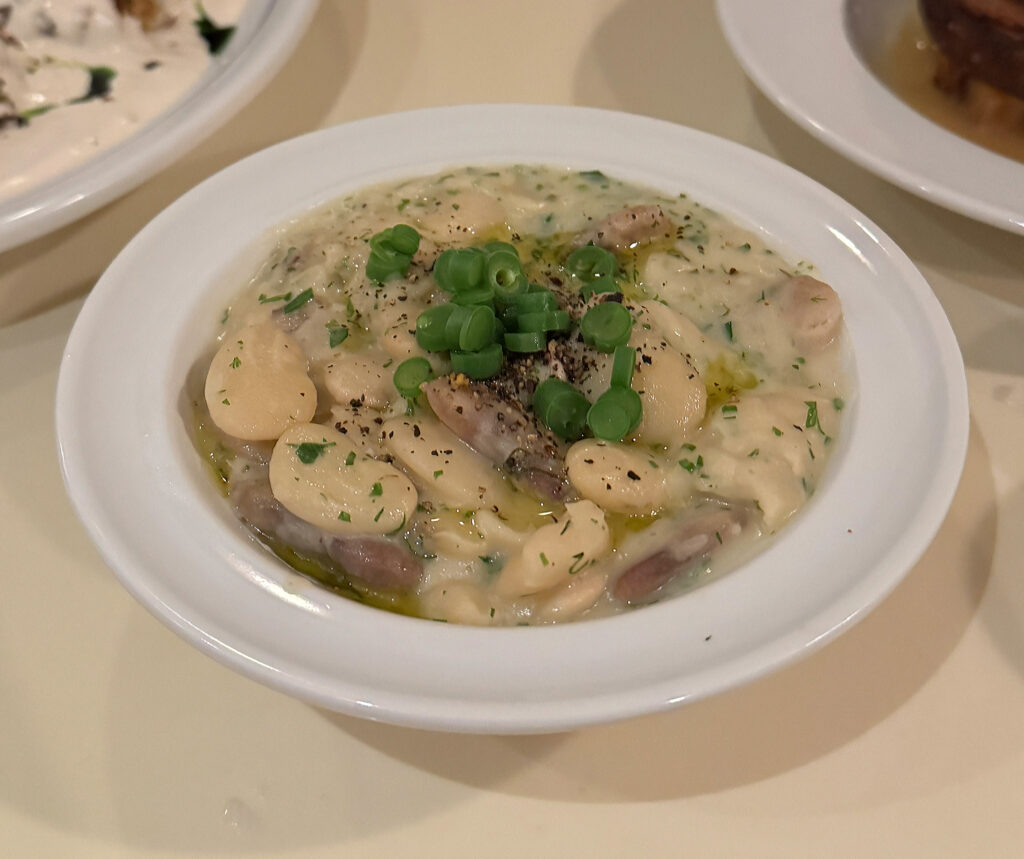
The “Creamed Butter Beans with Fines Herbes” ($10), for example, are a spin on the cranberry bean version that has featured before. On the palate, the legume displays a pleasing weight and smoothness, yet the resulting flavor is marked by a persistent bitterness. Thus, the dish falls short of the stick-to-your-ribs quality that a bowl of beans—at least how I envision it—should deliver.
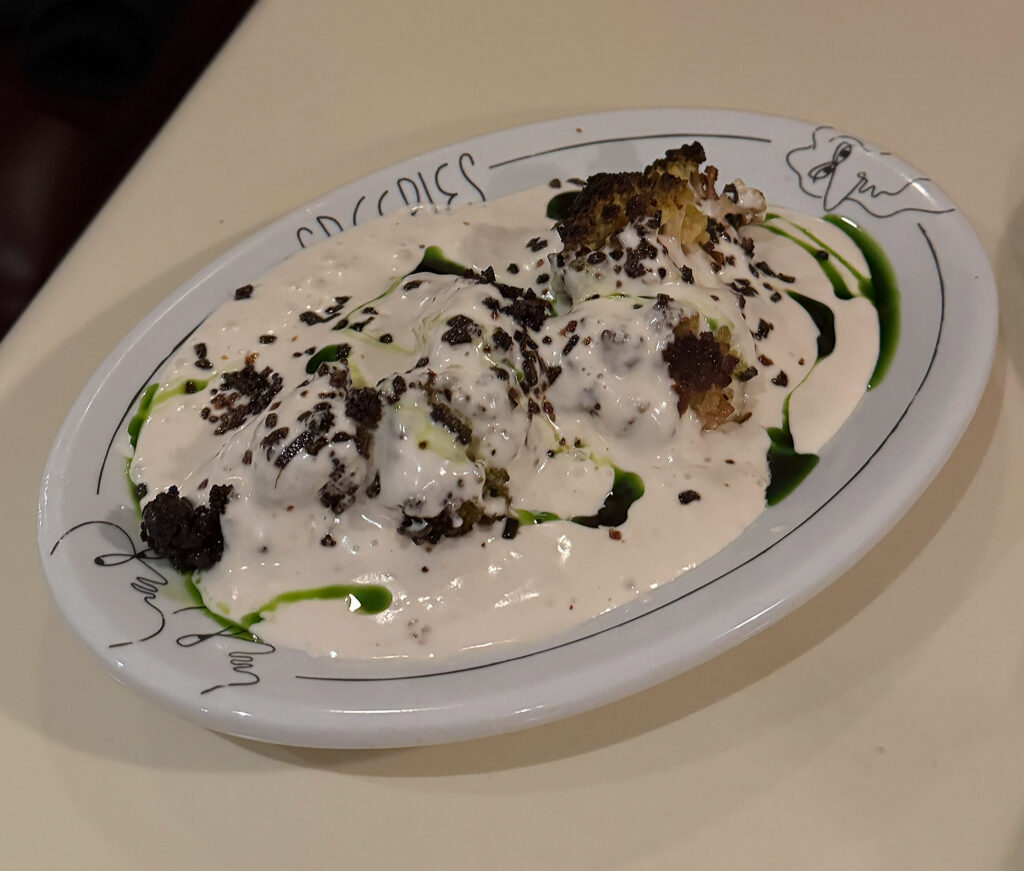
The ”Romanesco with Whipped Sesame Cream” ($13) also replaces an iteration that previously centered on Savoy cabbage. Here, the broccoflower blends crisp, charred tips and softer segments of stems in a manner that is appealing. Nonetheless, the sesame cream (while pleasing in its consistency) strikes me with an extreme density of flavor (also tinged with bitterness) that obscures any of the attractive nuttiness I might otherwise expect. This is also a miss for me.
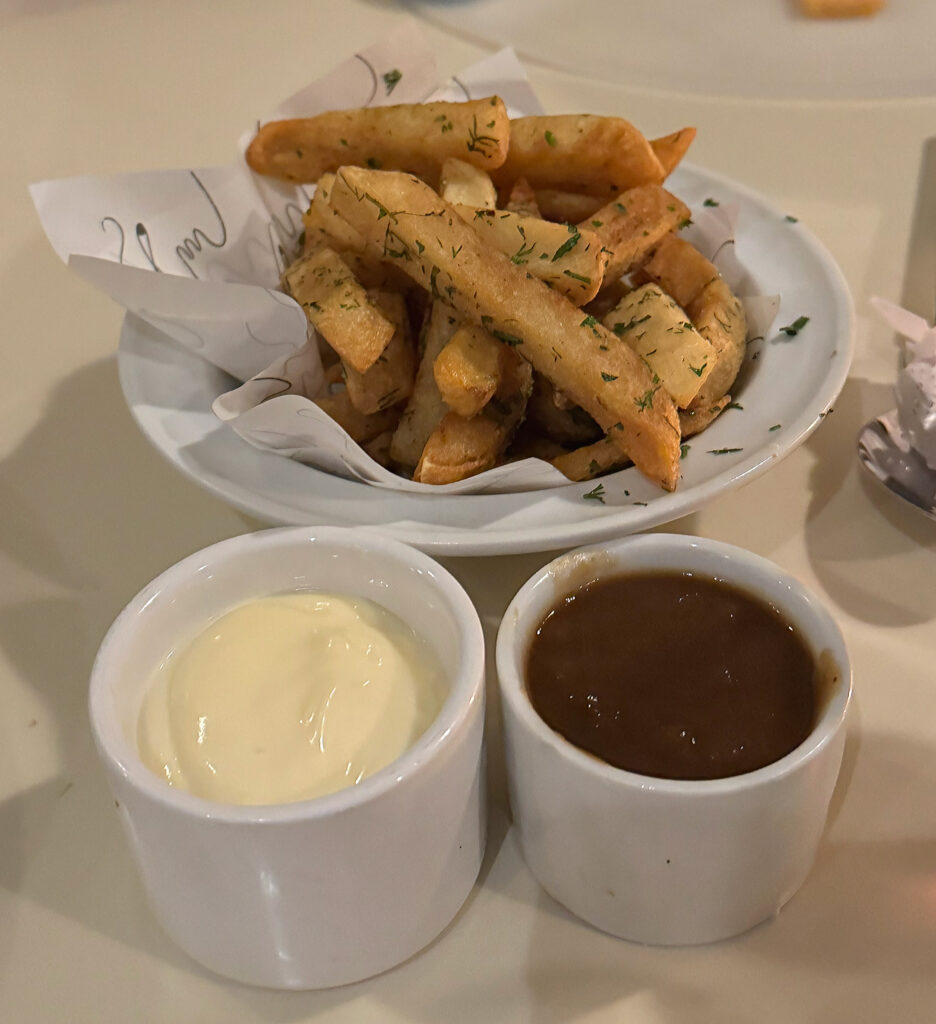
Even the “French Fries” ($10), which frequently rival the best in the city, fall a little short tonight. Yes, while many pieces display the superlative crispness and robust seasoning I have come to know and love, a notable proportion are altogether soft. This is not unforgivable, but I have to acknowledge that the team usually puts forth a more reliable, homogenous end product.
Moving on to dessert, I am again treated to a couple new (or newly reimagined) recipes that allow me to evaluate the concept’s growth on the pastry side.
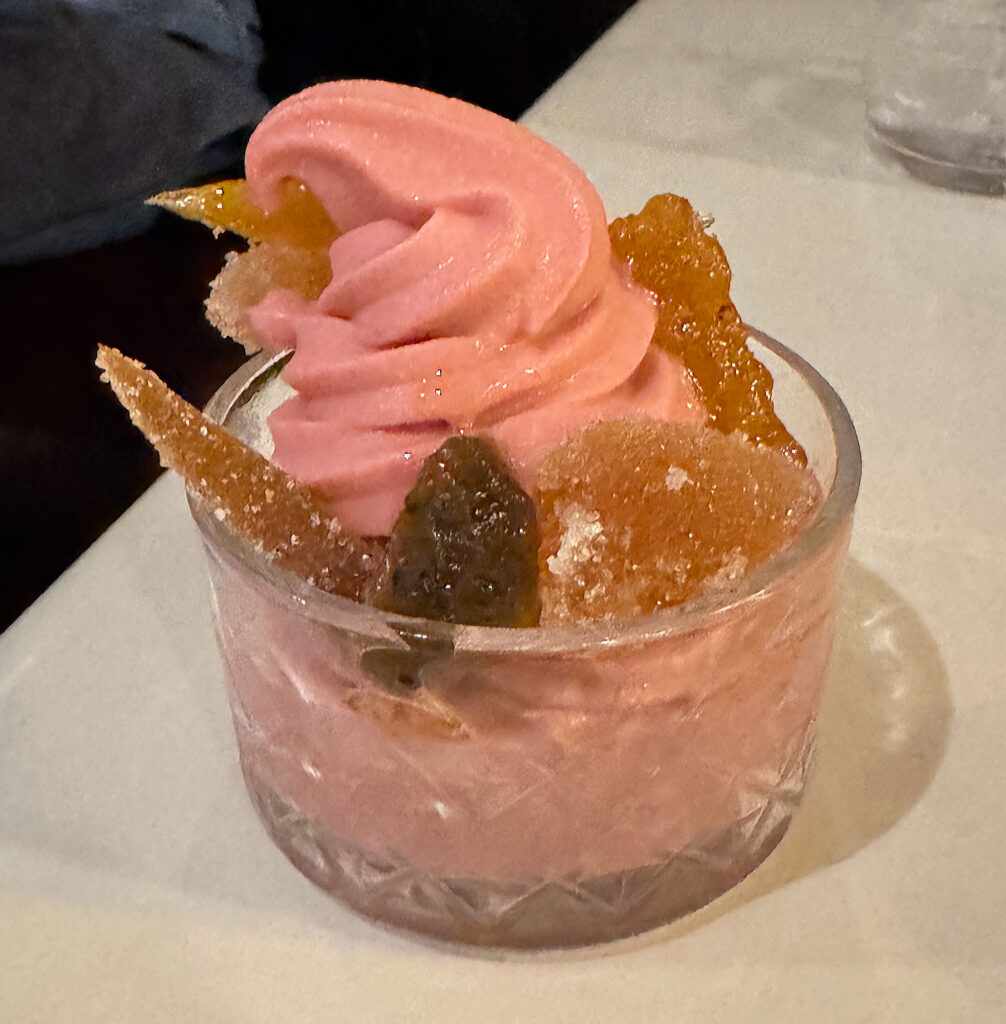
Of these, the “’Tutti Frutti’ Soft Serve with Candied Tropical Fruit” ($12)—Anna Posey’s nod to a bubble gum ice cream once offered at Blackbird—is entirely novel. I find the frozen dessert’s base (made from blood orange, strawberry, banana, coconut cream, and lemon) to be flawlessly smooth in its consistency and exuberant (almost reminiscent of carbonic wine) in its expression of sweetness. Nonetheless, while some pieces of the candied fruit (namely the pineapple) are juicy and complementary, too many of the others (featuring the rind) detract from my enjoyment with their bitterness. That said, I think this dish is wonderfully whimsical and think I might have just gotten an unlucky handful of the toppings.
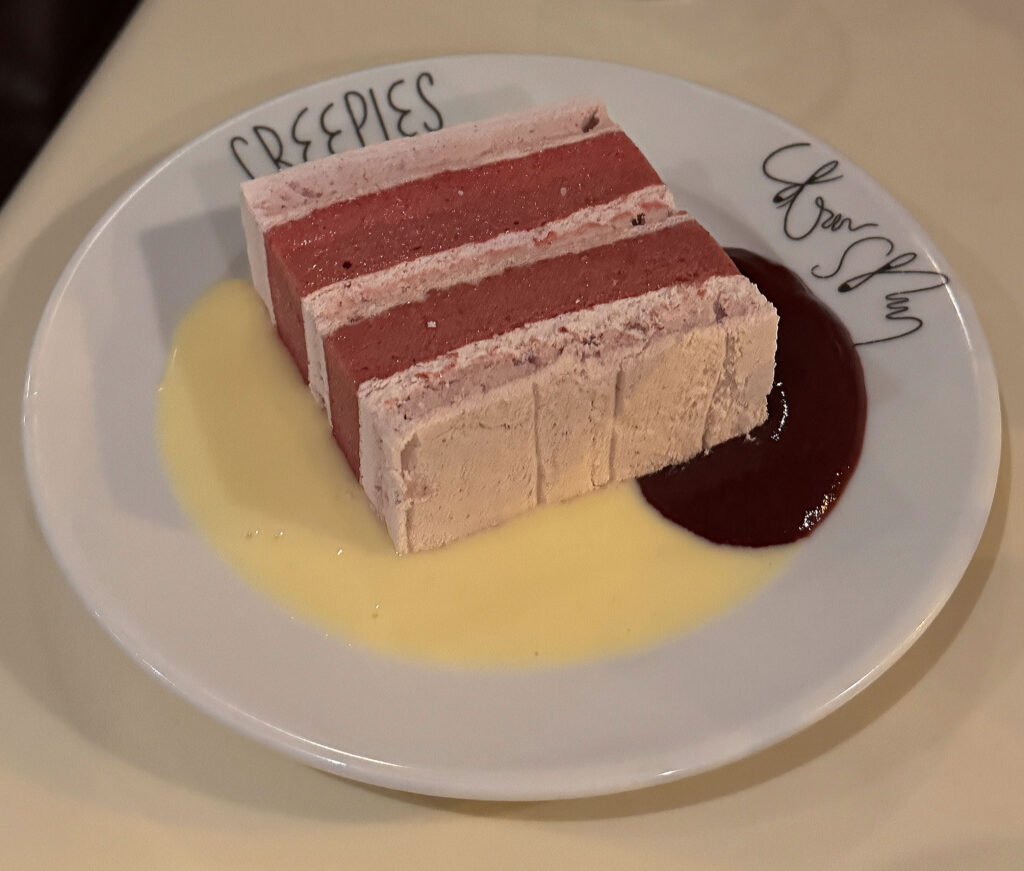
The ”Salted Cherry Sherbet & Stone Fruit Meringue Cake with Buttermilk & Mace” ($16) represents the latest iteration of the restaurant’s rotating, signature dessert form. On this occasion, I find the textural elements—crackly crisp, finely frozen, and comfortingly creamy—to be faithfully executed. The resulting flavor, though charged with the warmth and sharpness of the mace (which is incorporated into an accompanying coulis), is balanced by freshly sweet, concentrated notes of red fruit whose expression, joined by the buttermilk’s richness and tang, only grows in length. All said, I think this recipe continues to get better and better with each new example.
In ranking the evening’s dishes:
I would place the “Sweetbread Schnitzel” in the highest category: a superlative recipe that stands among the best things I will be served in any restaurant this year.
The ”Saucisson,” “Sunchoke Croquettes,” “Little Gem,” “Tarte Flambé, Tavern Style,” “Freekeh Crepe,” and ”Salted Cherry Sherbet & Stone Fruit Meringue Cake” land in the following stratum: great recipes that achieved a truly memorable degree of pleasure. I would love to encounter any of these again.
Next come the “PQB Bread & Butter,” “Warm Brie Gougères,” “Oeuf Mayonnaise,” “Shrimp with Remoulade & Chicories,” “French Fries,” “Fjord Trout,” and “’Tutti Frutti’ Soft Serve”—good—even very good—preparations I would always be happy to sample again (but that just failed to elicit an extra degree of emotion).
Finally, we have the “Blanquette de Veau,” “Creamed Butter Beans,” and ”Romanesco with Whipped Sesame Cream”—merely good (maybe just average) items that fell short when it came to texture or flavor. None of these bites faltered in more than one dimension, so there was still pleasure to be had (and, indeed, they could all easily be fixed with a little more tweaking).
Overall, this makes for a hit-rate of 82%, a huge improvement on the scores of 52% (in September) and 63% (in November) that I recorded last year. Indeed, this figure aligns with the 86% I calculated for Creepies’s comparably approachable, straightforwardly decadent lunch service. Now six months after the restaurant’s opening, I think it is fair to say that the kitchen—even when judged on the full breadth of its dinner menu—has begun to hit its stride. Tellingly, a full 41% of offerings tonight reached that “would love to have again” level of quality.
Most of this turnaround can be attributed to the rising quality (and sometimes total redemption) of longstanding items like the “Saucisson,” “Little Gem,” “Tarte Flambé,” and “Freekeh Crepe.” Even the small lapses I noted with the “Gougères” and “French Fries” couldn’t dull this evergreen selection of snacks and small plates.
However, I cannot ignore the fact that newer preparations (like the “Sweetbread Schnitzel,” “Sunchoke Croquettes,” and “Salted Cherry Sherbet”) landed at and around the very top of the ranking. Dishes like the “Oeuf Mayonnaise,” “Shrimp with Remoulade & Chicories,” “Fjord Trout,” and “’Tutti Frutti’ Soft Serve” stood closer to the middle of the pack, but their potential was obvious.
If I had to identify a weak point on the concept’s menu (and, truth be told, this has been an enduring one), it would have to be the entrées and sides. Given the fairly ironclad quality of the “Roasted Chicken” and “French Fries,” the team’s struggles within the category are by no means disqualifying. In fact, if guests make a meal out of every single item in each of the other categories, they’ll leave full and happy and intellectually stimulated in a manner that few other establishments can match.
Elske has faced its own problems in crafting appropriately satisfying entrées, and it is only recently (with the ascension of a new chef de cuisine) that the kitchen there is crafting headlining proteins that leave me feeling impressed. Surely, some of this perception comes down to my own personal taste. But what I mean to say is that Creepies, like its Michelin-starred mothership, deserves credit for composing main plates and sides that are as creative and challenging as the rest of the food. Doing so, Ploshehanski is consciously subverting expectations at a point in the menu (i.e., meat and its accompaniments) that is typically known for easy pleasure.
Nobody loves that kind of easy pleasure more than myself, yet Creepies principally exists—in this crowded genre—to pursue a more singular kind of enjoyment. Tonight, it came closer than ever to fulfilling that vision of neo-bistro fare that is equal parts thought-provoking and delectable.
Whenever those entrées and sides get up to speed (and I really do not think it will take too long), this funky upstart will have suddenly become a formidable example of what French cooking can still offer. Until then, the foundations of the restaurant—shaped by intimacy, charm, best-in-class imbibables, and those refined small plates—all but assure a good time.