
This was set to be a pretty ordinary meal: the latest in a series of visits to Chicago’s priciest, most polarizing omakase. To be clear, it’s a huge privilege to eat at Kyōten with any regularity, but writing about these experiences presents a particular challenge.
It would be all too easy to lavish praise on a concept that such a large part of the dining population (seeking Michelin stars, vaguely familiar cuisine, and a certain overall glamour when looking to splurge) will probably never spend their money on.
Why ever concede, from the other side of the velvet rope, that the sushi here is not perfect? Why resist the urge of proclaiming that the quality of tuna and uni on offer is beyond anything the uninitiated can even imagine—unless, of course, one is inclined to torch the place altogether?
It is true that, month to month and bite for bite, chef-owner Otto Phan serves some of the best food I will taste in any given year. At the same time, his menu is highly dynamic: an expression of a mercurial talent always looking to balance reliable excellence (as epitomized by his headlining bites) with the kind of experimentation necessary to continue growing as a craftsman. At this two-person operation, there’s little room for error. Thus, in order to flex my critical muscles, most of my writing on Kyōten centers on the small gradations that separate the highest of highs from what might be merely good, or ordinary, or a tad underwhelming (depending on a given audience’s expectations).
Of course, Phan occasionally hits a grand slam out of nowhere—presenting one of those legendary, life-affirming creations that even the most jaded fine diner dreams of encountering. He also, from time to time, fumbles a technique or misjudges seasoning and serves something that falls starkly below the standard the chef has set.
Yet most of my time is spent interrogating minute differences in texture and flavor and the character of particular fish (appearing and reappearing over the course of the season) rather than really highlighting anything novel. Put another way, there are rarely any big developments to speak of at Kyōten. Instead, I am left with a timeworn conversation about incremental change, the battle to never let standards slip, and one man’s solemn pursuit of a mastery that can only come with sheer repetition.
These themes are eternal—and important—for anyone who thinks dining can approach the realm of art. However, after close to a dozen reviews of this concept in the past year, I wonder if they have not become a bit trite.
The whole point of writing in a shorter format was to dispense with some of the agonizing and contextualizing and get straight to the kind of dispassionate documentation and categorization whose utility is ironclad. Surely, there are new openings out there in Chicago that could benefit from my resulting surplus of time and attention?
I was ready to do it. This might have been the shortest piece on Kyōten I ever penned. Hell, wasn’t I just there?
But then it happened: a fateful phone call just three hours before service. Phan’s wife was in labor. The chef had a flight to catch. He’d have to entrust the evening’s meal to Jorge Villa, a longstanding deputy who has led Kyoten Next Door to considerable success since its opening nearly three years ago.
I already knew Phan had been planning to take this kind of extended leave. He recently announced a $220 sushi-only omakase ($260 inclusive of 18% service charge) that would be held by Villa on Wednesdays and Thursdays in the space: one characterized as “an extended version of Kyoten Next Door with extra fish from [the] Kyōten flagship.”
I toyed with the idea of going but ultimately resisted. This was a clever way of bridging the gap between the two concepts in the chef-owner’s absence, yet it was also akin to a “second counter.” Structurally, the meal would be something less than a full Kyōten experience and, thus, destined to suffer from the implicit comparison I would make. It would be better to simply survive without sushi until April or May and pick up where I left off.
Circumstances conspired to place me before Villa despite every expectation (up until a few hours prior) that I’d be getting Phan’s course tonight. To the chefs’ credit, the sushi-only omakase is not meant to compete directly with the work of the master. The price, too, would be about half of what I expected to pay. But everything—at a social and technical level—would also be different. Most of the ingredients utilized would be too.
This experience does not represent the Kyōten I know and love, yet it offers a fresh perspective on a familiar place, attitude, and culinary approach. Indeed, Villa’s extended omakase treats me to the kind of novel value proposition—the invigorating grist for my critical mill—that I have sorely needed.
The present menu may be fleeting. It may still unavoidably pale in comparison to what I am used to. But the forthcoming meal is unlike any other I have had here, and, in that respect, it forms an essential piece of the concept’s history and an entirely new chapter in my deeper understanding of Phan’s (now in the role of mentor) craft.
Let us begin.
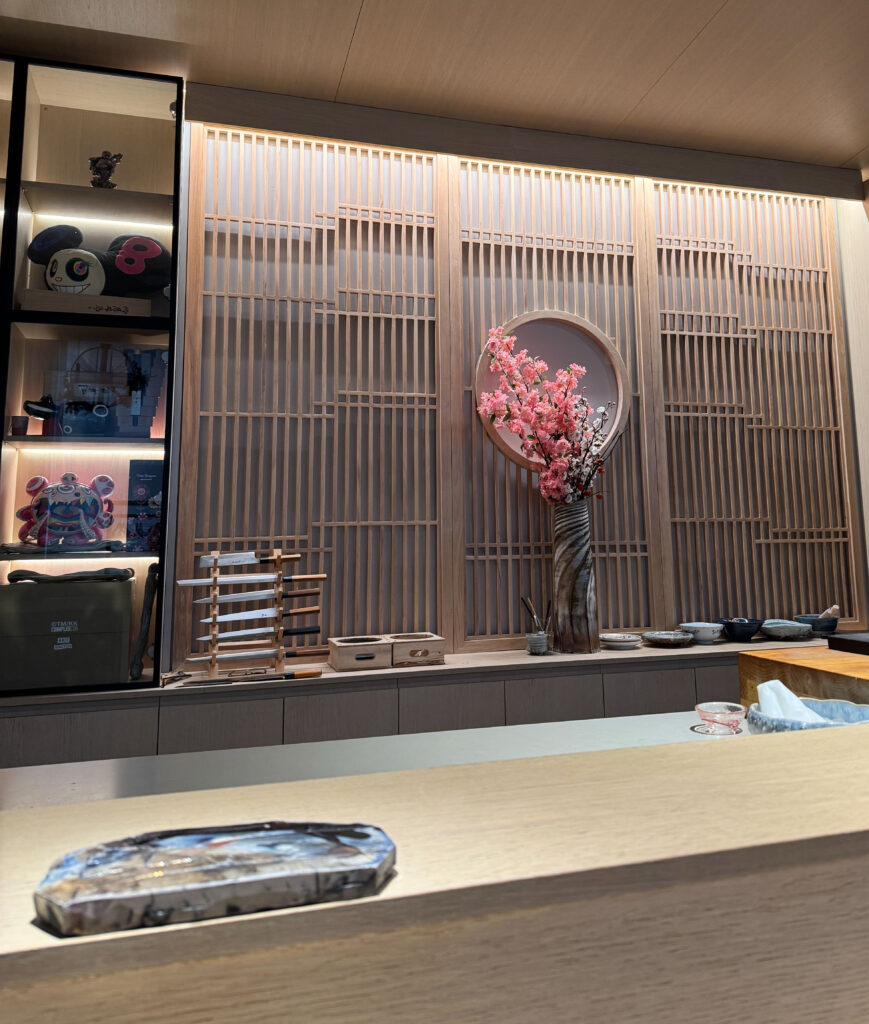
On this rare occasion, I actually arrive at 2507 W. Armitage Ave. a few minutes early, and, rather than waiting and watching for the other diners to be seated (they could be forgiven, just this once, for accidentally thinking Kyōten is Kyoten Next Door), I head right inside.
There’s no need to dwell in the lobby—I’m immediately ushered toward my spot at the counter. Villa is already at work, and, though I’m expecting to see him in Phan’s usual place, the look on my face must betray some momentary confusion. For, once I’m seated, the chef offers a greeting and starts to explain what is going on. I assure him that we heard it all from the horse’s mouth and, short notice aside, are actually pleased by the opportunity to sample his own omakase.
I take a moment to scan Next Door’s abbreviated wine list, which has been brought over for the residency (perhaps due to the fact that Phan manages the flagship’s cellar in such a, let’s say, idiosyncratic manner). I’ve rarely ever set eyes on the selection, and I like what I see: bottles like the Egly-Ouriet Champagne Brut Grand Cru ($160 on the list, $149 at local retail), 2022 Walter Scott “X-Novo” Chardonnay ($120 on the list, $105 at local retail), and 2023 Keller Kirchspiel GG ($200 on the list, $200 at local retail) being offered at the most minimal of markups.
Kyōten’s commitment toward fostering wine appreciation is well known to me, but seeing this philosophy so faithfully rendered (in a concise, approachable way) at its sister concept is inspiring. These are the kinds of consumers that stand to benefit the most from an exceptional pairing at an incredible price, for the right pour might very well set them on a lifelong journey of connoisseurship. Villa, to his credit, speaks of his burgeoning love for the stuff (Italian reds in particular) too, tracing the same path that his mentor did many years ago.
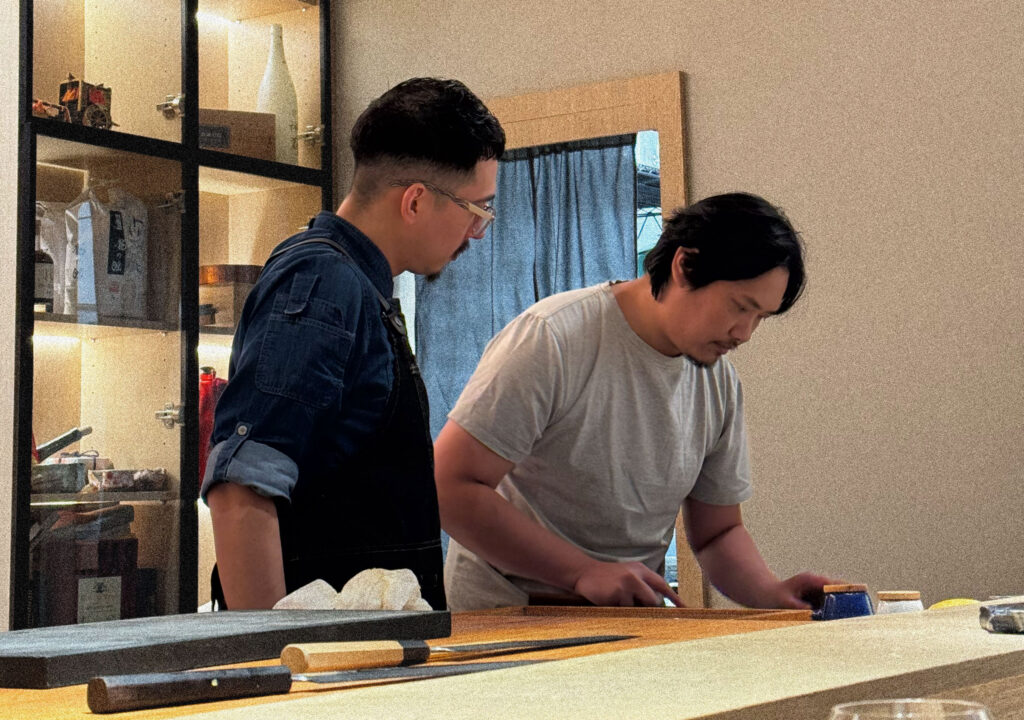
Phan enters moments later. His flight is not until midnight, so (working in the background) he takes the opportunity to organize the restaurant as best as he can before handing it off to his understudy. As the other guests arrive, the chef-owner is sure to schmooze them and allay any fears regarding the substitution in talent. There are only six diners in total (two of which are celebrating a birthday) tonight, and everyone sounds game—especially when they learn why Phan has to so suddenly depart.
Still, the chef-owner lingers as long as he can: advising his apprentice on how to cut certain fish and even stepping in with a flash or two of his own technique. But there’s no doubt that this is Villa’s show (as it will be for the foreseeable future). Yes, after toasting the audience with a glass of wine, Phan leaves at an early stage of the meal to a chorus of well wishes.
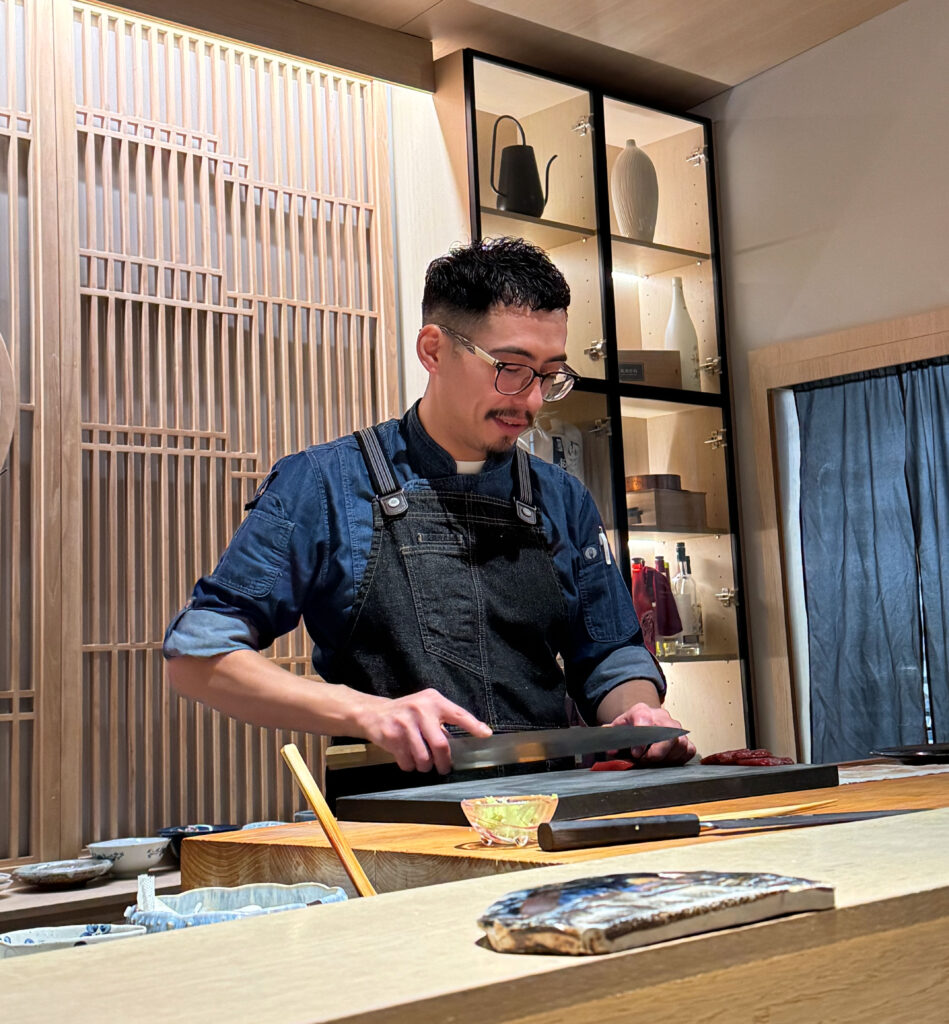
Left to man the counter on his own, Villa’s experience from Next Door serves him well. The chef’s manner of interaction is easygoing and conversational. He smoothly traverses the space and goes through the motions of slicing, forming, and seasoning each fish with a reassuring confidence. Bites are described with much of the same detail that Phan himself provides (understandably so since many of the ingredients served tonight are from the sister concept’s menu). There are even tinges of the kind of banter and irreverence that make Kyōten’s hospitality so singular within the genre.
Admittedly, Villa does not yet measure up to Phan as a master of ceremonies: naturally commanding attention and stoking enthusiasm for the headlining seafood to come. However, more importantly, the chef builds a sense of comfort and free-flowing engagement that—even if it doesn’t gild the lily in the same manner—preserves the emotional core of a meal here. About an hour in, Villa hits his stride has soon has the entire audience talking with him (and each other) in a manner reminiscent of my most memorable nights here.
When it comes to the nature of the sushi itself, Villa’s omakase preserves Kyōten’s emblematic style: one center on larger-grained Inochi no Ichi rice and a clear imprint of aged red vinegar. The chosen ingredients include a smaller selection of the wild-caught fish that Phan exclusively sources for the flagship; however, these headlining items (still included despite the cut-rate price) punctuate an array of farmed specimens that (as someone who never eats at Next Door) I rarely get to try.
I do note that a greater proportion of the fish has been portioned out right before the start of the meal, which typically helps to facilitate the sister restaurant’s faster pacing. Nonetheless, Villa does end up slicing the majority of the product as it is needed, and, ultimately, he preserves the essential flow of service (i.e., only one piece of nigiri made and served at a time) that distinguishes Kyōten from much of its competition.
The sushi-only omakase does not (as with Phan’s usual work) veer straight toward the most prized cuts of tuna. Instead (and fittingly for a menu that centers almost entirely on fish atop rice), Villa’s progression places these headlining bites around the midpoint: shaping a meal that feels engaging and rewarding in equal measure.
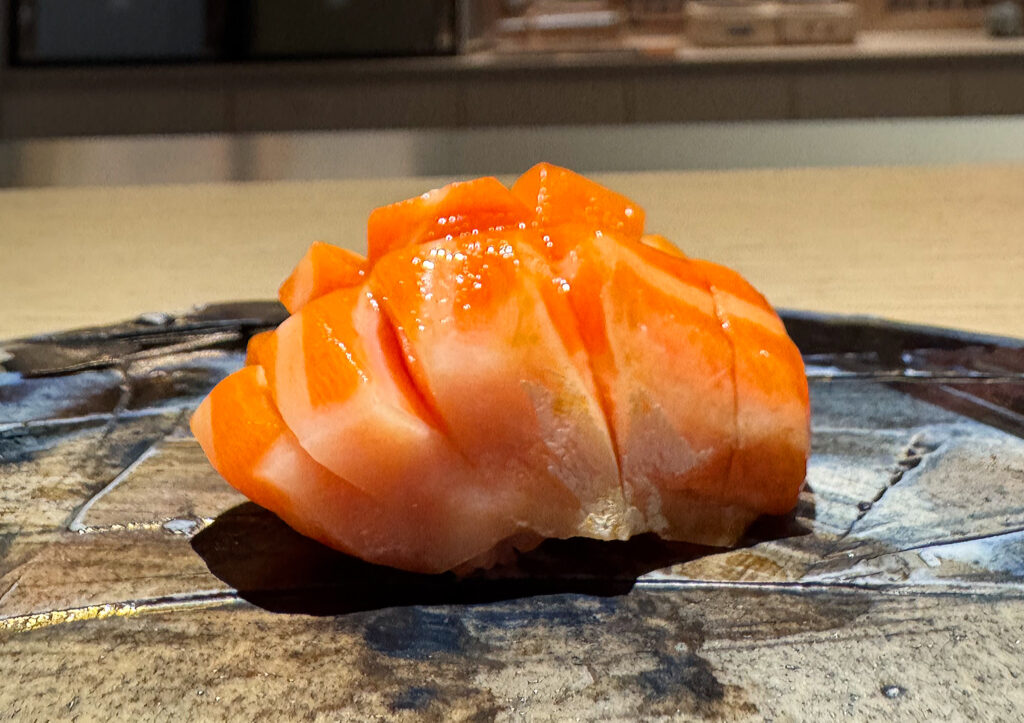
“Ōra King Salmon” starts things off, and the piece displays much of the same size, thickness, and method of scoring for which the flagship is known. Texturally, the rice seems more forcefully packed (and, thus, feels a touch firmer on the palate). I also struggle to perceive any of the fresh wasabi that Phan, working with fish of such superlative fattiness, generously applies. Nonetheless, the salmon impresses with its pleasing butteriness, and the corresponding tang of vinegar ensures that all this richness is charged with more than enough accompanying flavor. Overall, this nigiri may not exactly match Phan’s work, but it’s still recognizably “Kyōten.” I’d be happy to have it again.
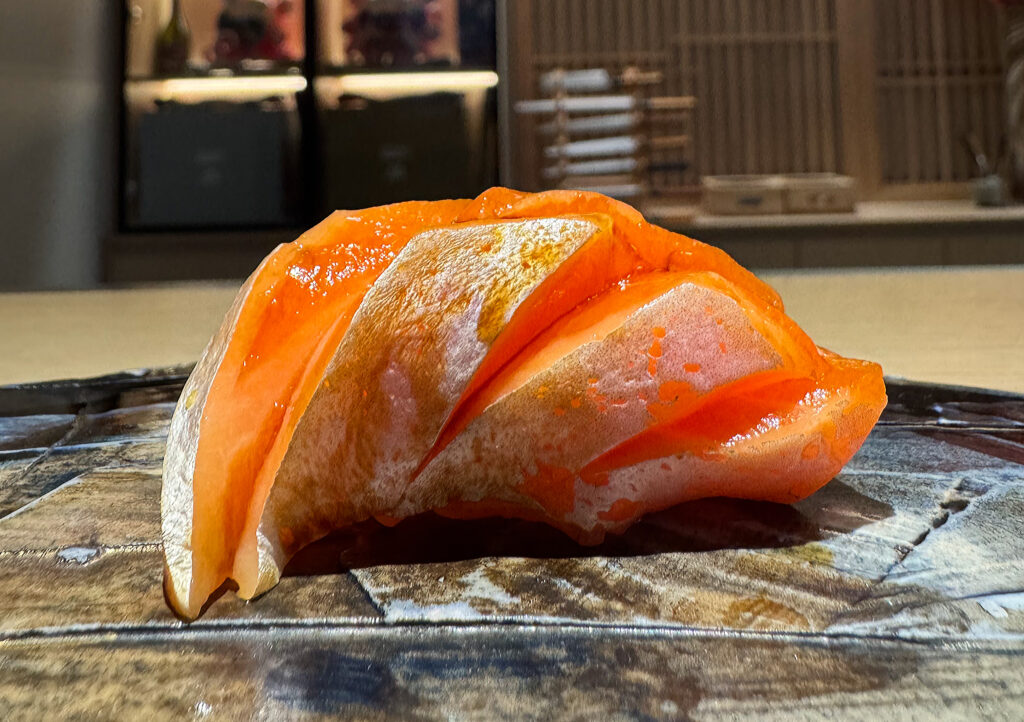
The ”Smoked Ocean Trout,” sourced from Australia, keeps Villa’s early momentum going. Visually, I cannot help but notice that these slices of fish hang over the rice in a way that totally obscures any sight of the grains. This points to a structural difference in the chefs’ work (whether it has to do merely with shaping or with the actual portion size of rice being used I do not know). However, in practice, the piece eats rather nicely: blending much of the same lusciousness I got from the salmon with a fleeting, contrasting crunch and a finish that smacks more of that wasabi I was after (as well as some pleasing sweetness from the smoke). In short, this is another success.
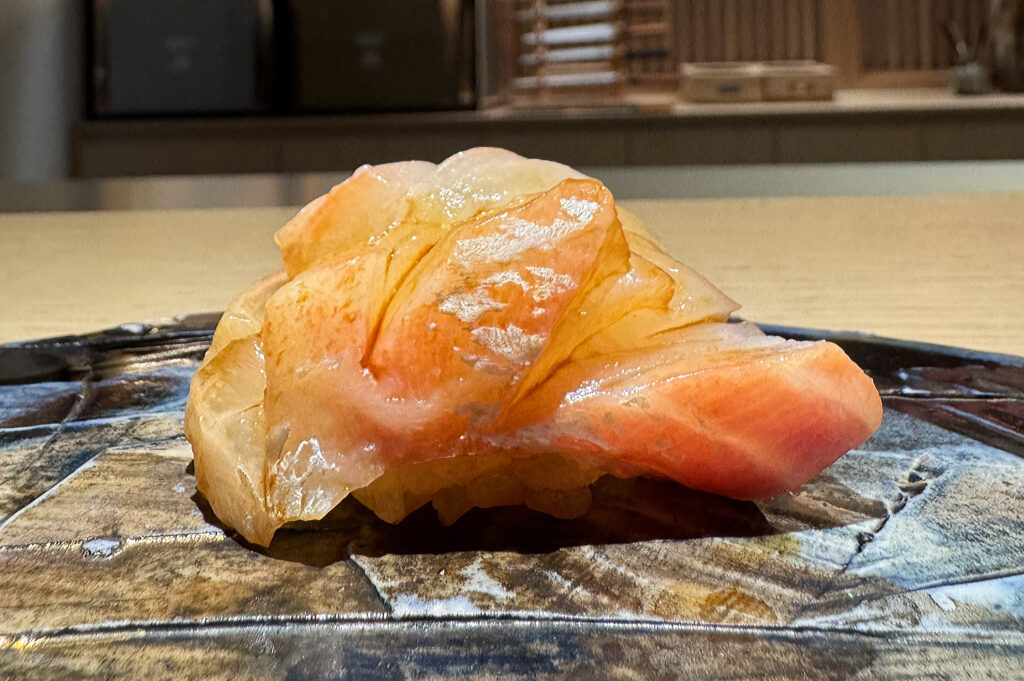
With the arrival of the “Madai” (or red seabream), things start to get serious. The fish’s scoring is far more intricate, and I even see some grains of rice peeking out underneath. This piece looks every bit like one that Phan himself would serve, and what I taste corroborates that impression. Texturally, the madai boasts more firmness than the preceding bites—a quality that feels weighty and satisfying in this context. That said, the flesh proves plenty tender with further mastication, imparting a flavor (laced with lemon zest) that is remarkably clean and resoundingly sweet. For the first time tonight, Villa’s work matches that of the master. Bravo!
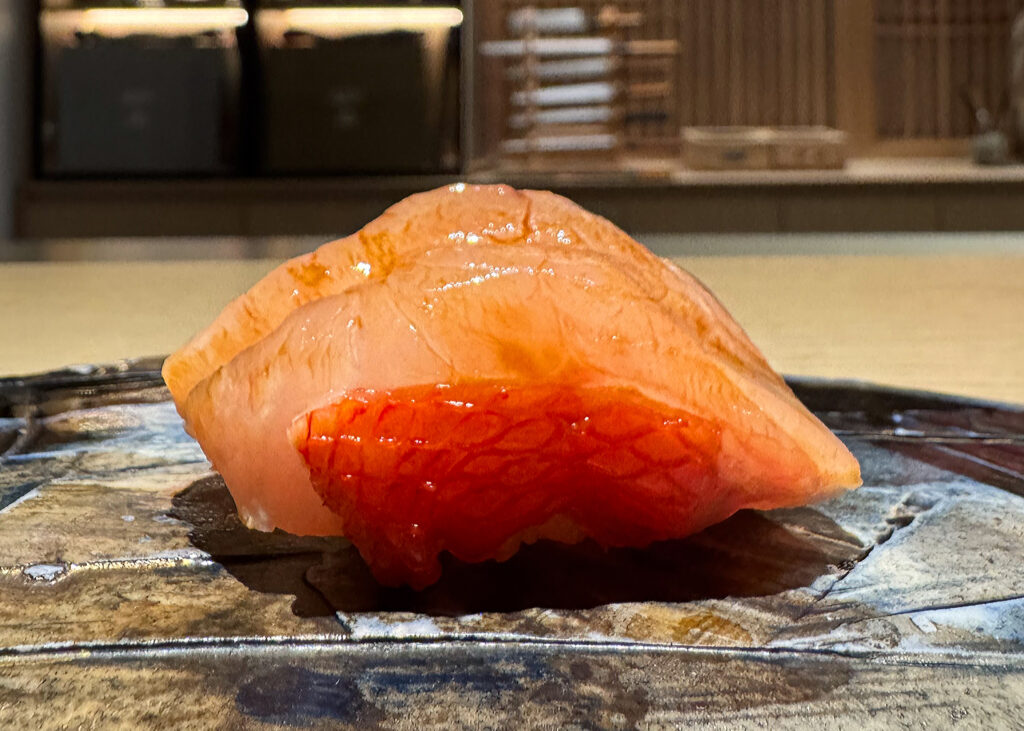
The ”Kinmedai” (or golden-eye snapper) can be compared directly to a piece of the same fish that Phan served in February. Though the methods scoring is similar, the marks in the present example are not as well defined, and, thus, the ingredient does not wrap around the rice (which is again largely obscured) in the same manner. The accompanying segment of skin (one of the kinmedai’s telltales) also doesn’t stretch across the entirety of the serving as it usually does. Still, the bite offers firm—yet yielding—flesh with a surprisingly creamy finish. Flavor, too, spans mild notes of wasabi and soy sauce that build toward a moderately savory (though not particularly long-lasting) effect as the fish melts on the tongue. Overall, the golden-eye snapper does not rank among the evening’s most memorable items, yet it certainly reaches a respectable level of quality.
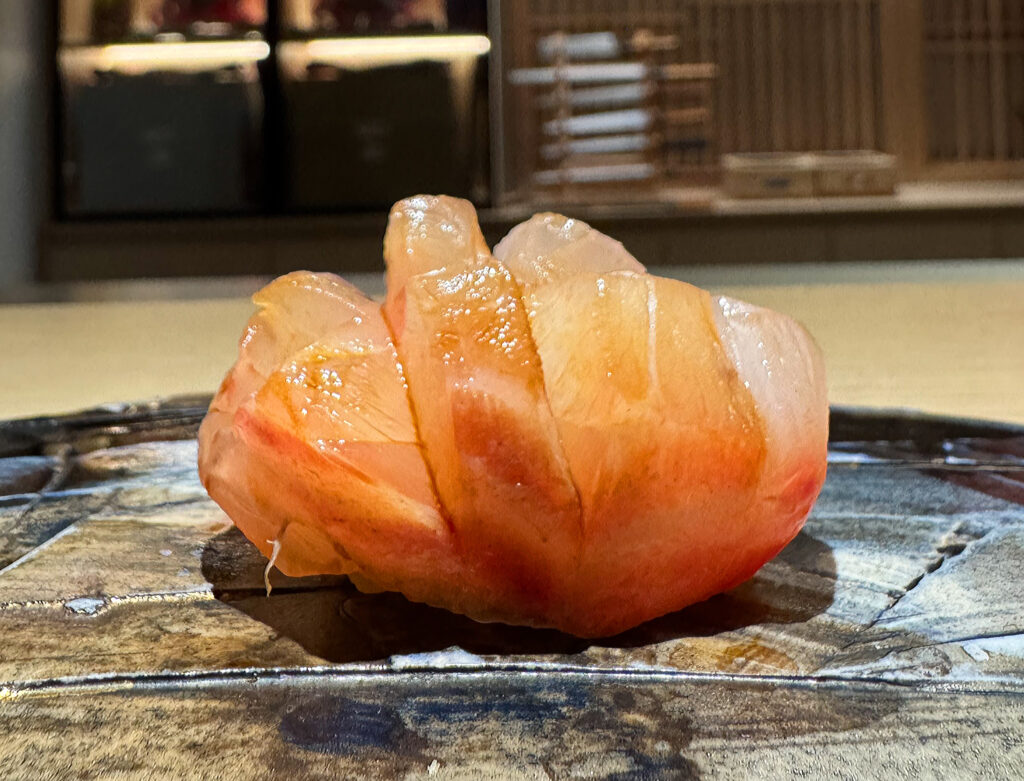
The ”Isaki” (or chicken grunt) leaves me feeling largely the same way (though, admittedly, the ingredient benefits from being one I never encounter at Kyōten proper). Visually, this piece looks more rounded and compacted than what I am used to here. But, in turn, the mix of horizontal and vertical scoring (serving to offset the gradient of whitish, pinkish flesh) ensures the bite remains appealing. On the palate, the grunt is even more straightforwardly firm that the preceding two fish. It certainly has character, but the consistency is pleasant enough, and the accompanying punch of wasabi delivers exactly what I’ve been looking for. With time, this pungency fades toward a complicating hint of fishiness. Ultimately, I like the isaki, and it only really suffers from being a bit undistinguished relative to so many other nigiri served tonight.
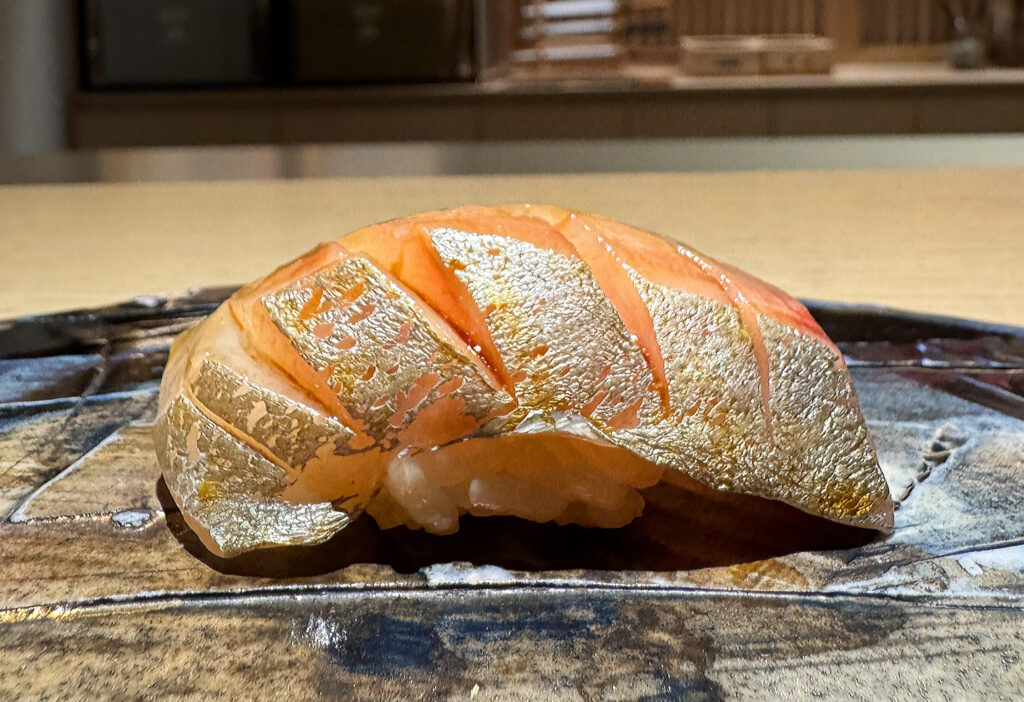
“Shima Aji” (also known as the striped jack) ranks as one of those bites that steals the show. Indeed, this is one of my all-time favorite fish, yet wild-caught examples are so rare that I barely ever see Phan serve it. Visually, the piece—with its ruffled scoring, traces of silvery skin, and elegant curvature (exposing the mound of rice below)—is one of the evening’s most attractive, and the combination of a firm (almost crunchy) first impression with an overarching butteriness is divine. Charged with a degree of savory intensity that transcends anything served up until this point (one that smoothly integrates notes of wasabi, vinegar, and soy sauce into a cohesive whole), the shima aji blows me away. Tonight, it stands as the one item I wish I got to taste more often at the flagship.
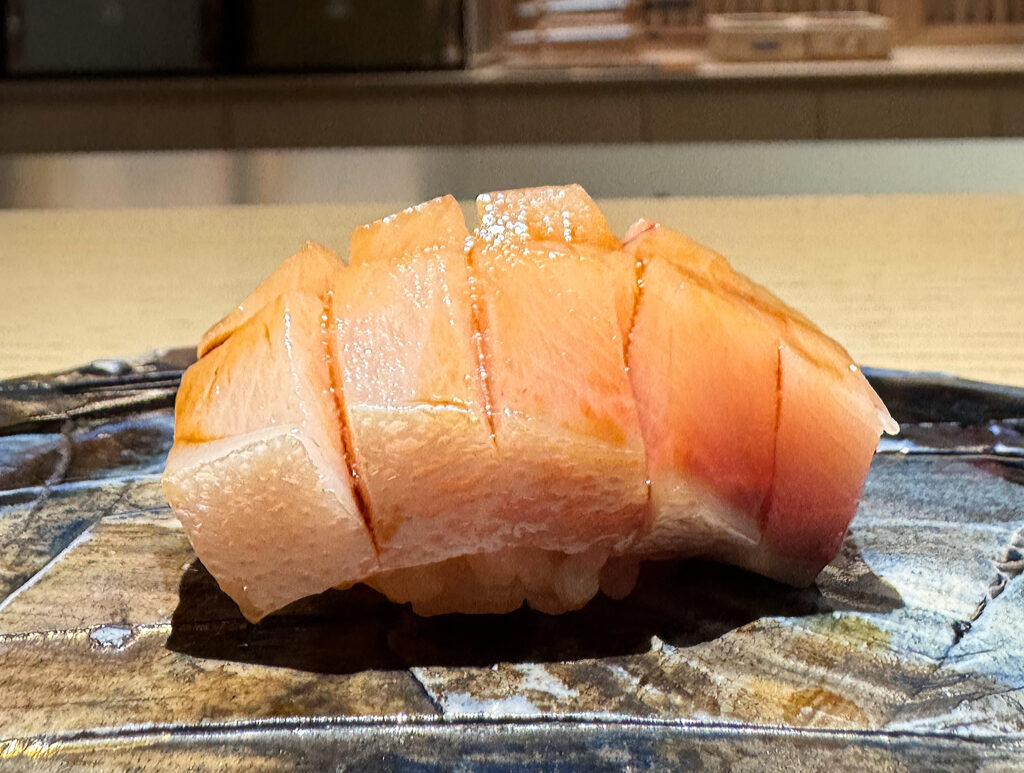
A serving of “Hamachi” (i.e., yellowtail) is equally rare given the fact that Phan has long favored the mature, wild-caught specimens that go by the name buri. Nonetheless, Villa likens the present cut (source from the belly of the fish) to chū-toro. I cannot help but agree, for the flesh—finely marbled, deeply scored, and streaked with soy sauce—proves supremely melty and seamless on the palate. The resulting flavor is mildly savory and easy to like. However, I’d prefer a stronger imprint of vinegar and wasabi that would better play off of all this fat and drive the piece to a level of hedonism that its mouthfeel (among the menu’s best) deserves.
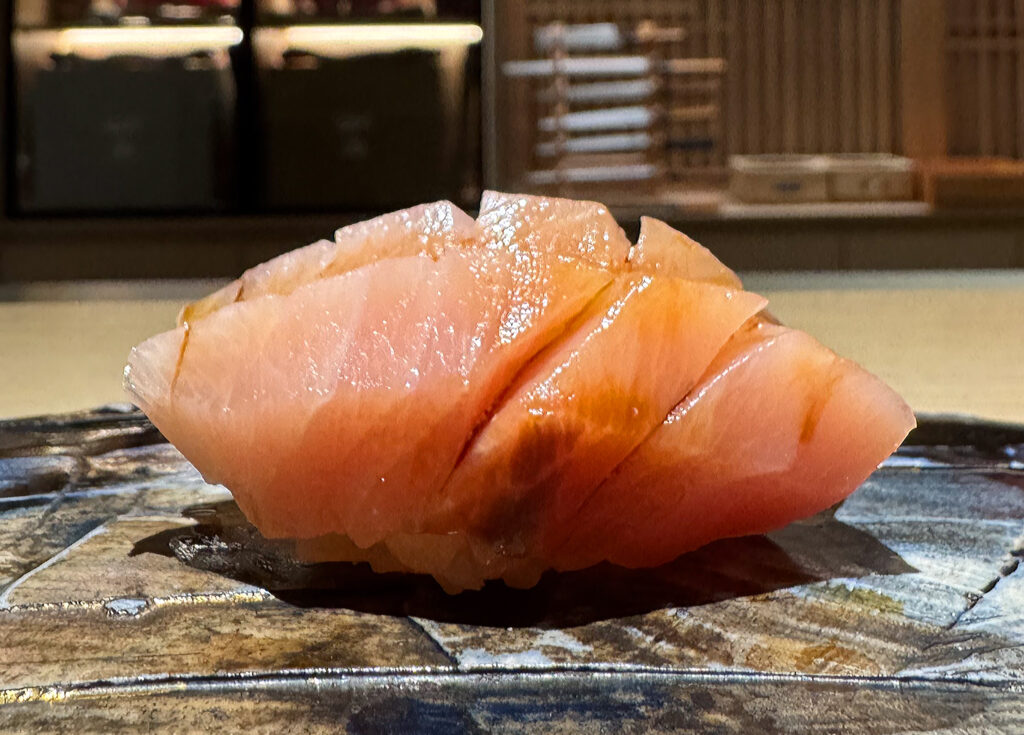
As luck would have it, the “Buri” (that wild, mature expression of yellowtail) arrives next, allowing me a direct point of comparison. Opposite such a special cut of hamachi, the present piece actually looks fairly ordinary. Served a touch too cold, the bite is not as melty but treads the line of firmness and fat rather nicely. The accompanying flavor, in turn, is clean and mild and tinged with about the same savory intensity as the preceding fish. Ultimately, there’s nothing objectionable about the buri. However, I expect absolute fireworks from such a hallowed ingredient, and, on this occasion, it’s actually the hamachi that delivers greater pleasure.
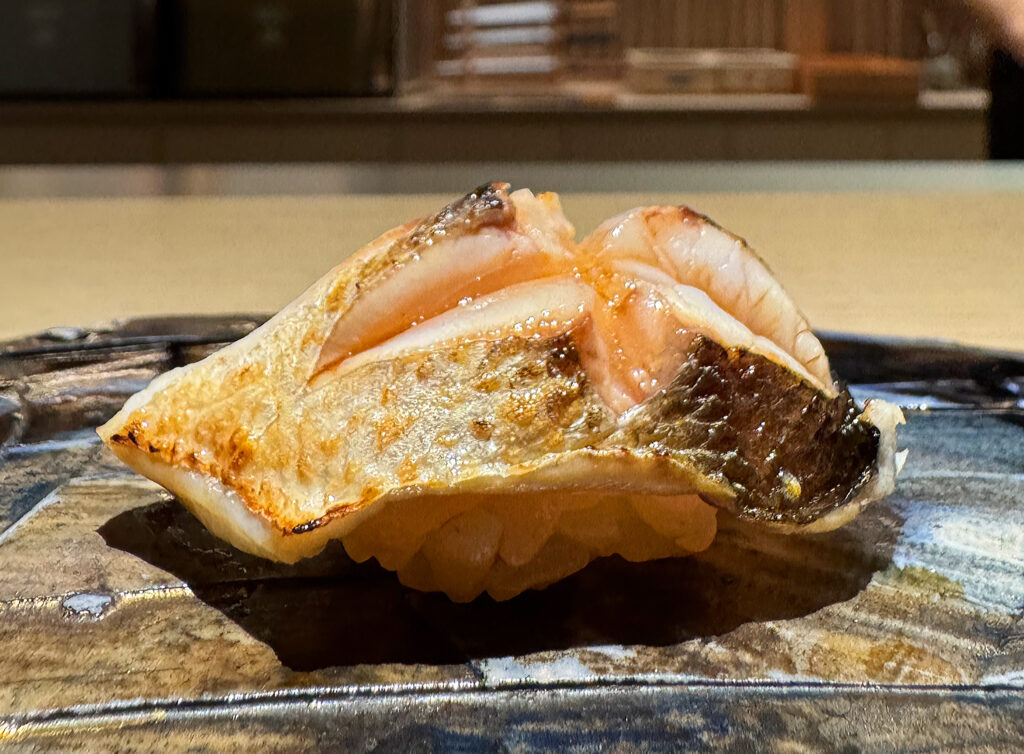
The “Barracuda” carries no such expectations, and, to be honest, I cannot recall ever being served this fish (also called kamasu) at an omakase. The resulting piece, which benefits from the evening’s first use of the torch, boasts crisped (lightly charred) strips of skin that surround a central point of scoring. With visible grains of rice underneath, this bite’s visual appeal ranks among the meal’s most “Kyōten-like.” Texturally, the barracuda displays an admirable richness and flakiness that reads as meaty. The flavor, too, possesses a nice inherent sweetness that is complicated by a hint of bitterness (perhaps unintended) on the finish. Overall, this makes for a fish that, while not among the menu’s most memorable, successfully provides a warmer, weightier expression at this early stage.
At this stage (right about the midpoint of the meal), we come to Villa’s biggest test: the servings of tuna on which many diners—no matter their degree of experience in this genre—judge the ultimate quality of an omakase. Given how frequently Phan achieves incredible results with his own examples, these also form essential points of comparison between the two chefs.
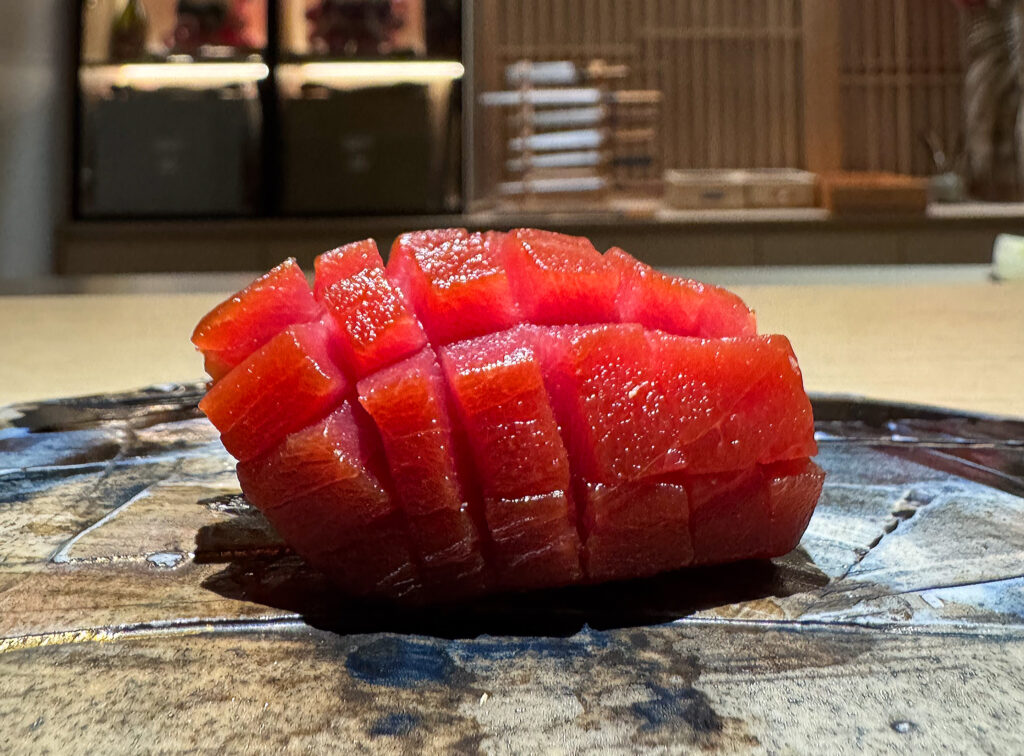
First up is the “Akami Zuké,” the fish’s leaner (and in this case marinated) flesh. Phan typically situates this bite at the end of his own sequence (which, given the number of small plates served before the nigiri, is a sensible inversion). Tonight, it makes sense to introduce it on the back of the meatier barracuda and build in decadence from there.
Visually, I definitely like what I find: a slice of ruby-hued, still rather marbled tuna scored in a grid-like manner that largely matches the chef-owner’s technique. On the palate, the akami feels soft and seamless (if not totally melty), making for a beautiful representation of the ingredient. Flavor here is understandably marked by a strong imprint of soy sauce, which I personally love, and joined by a considerable jolt of wasabi too. The latter note only errs in feeling a touch bitter on the finish. However, more broadly, I think this piece just about reaches the same standard as Phan’s iteration—a huge accomplishment!
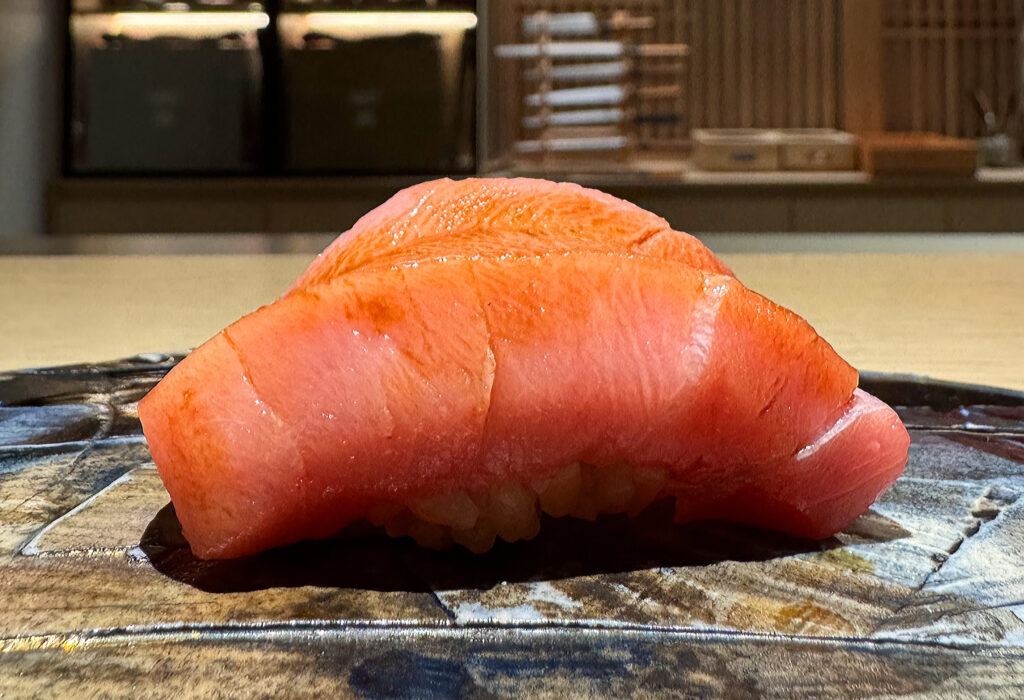
The “Chū-Toro” (a medium-fatty cut of belly coming from the same fish) is distinguished by pinkish, finely marbled flesh and a shorter, more compact profile than that which the chef-owner serves. This bite, judged against all other expressions of the fish (while, likewise, occupying a key middle ground), typically takes the crown, and that’s why Phan consistently serves it first.
On this occasion, I am impressed by the chū-toro’s ethereal—that is, so moist and loose and buttery—mouthfeel. A mild imprint of soy sauce does its best to frame the gushing, melty fat, yet the flavor expression here is almost entirely clean. Indeed, for my palate, the piece just seems to disappear (impressively enough!) without really making its presence known. I think it would benefit from stronger notes of vinegared rice and wasabi that, true to the house style, might match this exquisite raw material with a resulting flavor that is memorable and maybe even profound.
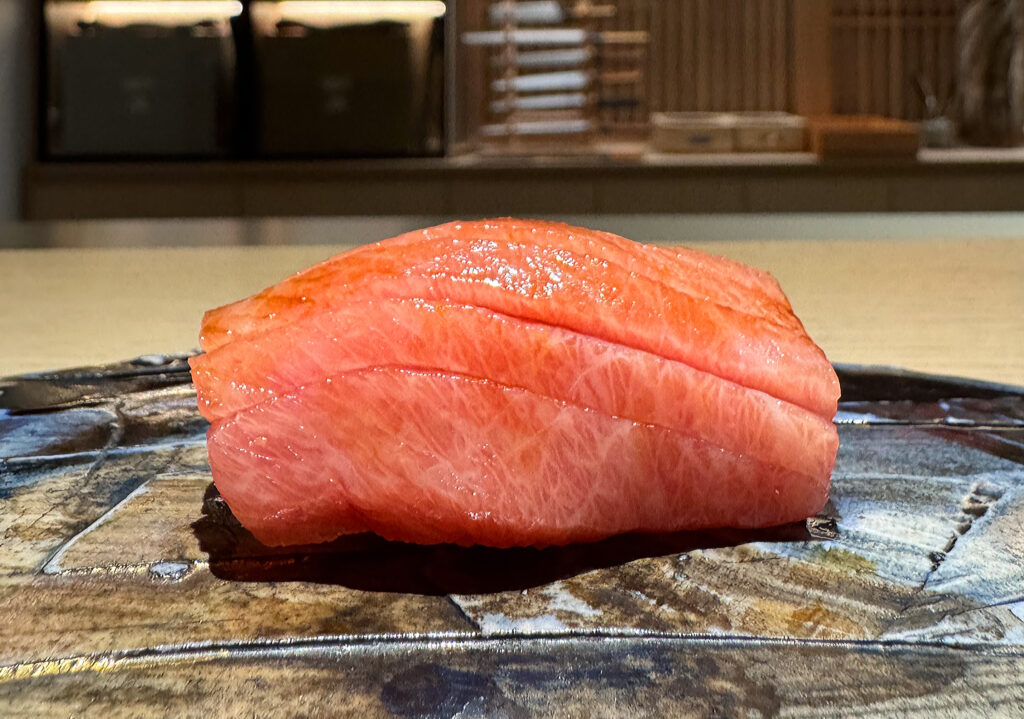
Thankfully, the “Ōtoro” (i.e., the fattiest cut from the same belly) displays that extra bit of intensity I am looking for tonight—ironically so when one considers this piece is typically more of a textural thrill than anything. Visually, the bite certainly looks true to type: displaying pinkish (tending toward white) flesh with a fine lattice of marbling woven throughout. Scoring proceeds horizontally, yielding a gentle curve over the obscured mound of rice.
On entry, this most prized portion of tuna paradoxically offers a touch more firmness than its medium-fatty counterpart. I like how this quality serves to frame the melting, mouth-coating sensation that follows, and the accompanying flavor—charged with soy sauce and tang from the vinegar—is satisfying in a way the chū-toro wasn’t. Yes, the finish here (serving to lengthen and deepen one’s perception of the fat) fulfills the potential of what ōtoro can be. Phan’s work, by my measure, reaches an even higher stratum, but this remains a superlative item.
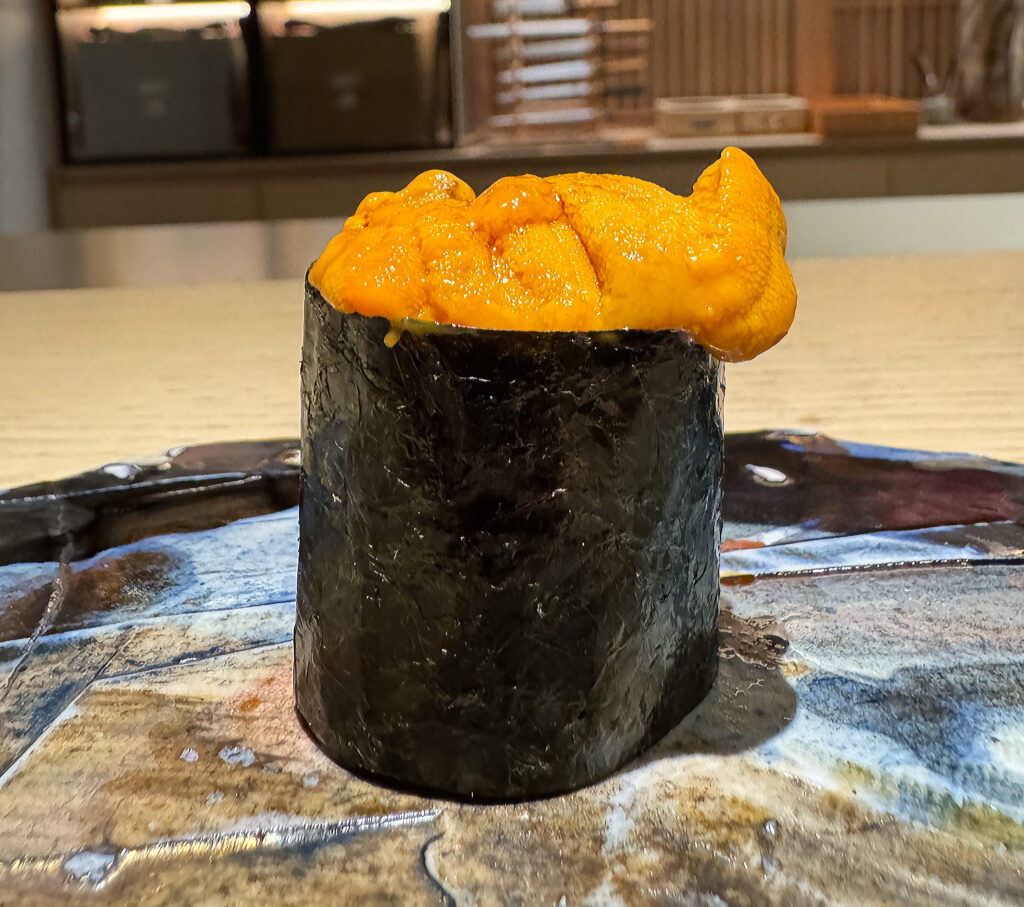
If any ingredient is going to match the desirability of the tuna, it has to be sea urchin, and Villa is lucky to serve his “Uni” on the back of such an enjoyable sequence. This ordering ensures there is no perceived drop-off (moving from luxury seafood to some ordinary fish), and the chef is doubly lucky to be working with the dry-packed, ensui (or preservative-free) variety of this Hokkaido-sourced product that Phan considered, when he can get it, to be the very best.
On the palate, the resulting bite blends the clean crispness of the seaweed wrapper (always one of the restaurant’s strengths) with the creamy, moistening mouthfeel of the uni on rice. Of course, the sea urchin’s flavor is always determinative, and the present example (free of any jarring irony quality) beautifully blends semi-sweet and oceanic notes across a lengthy finish. Overall, this makes for another piece that lives up to Phan’s usual standard and, in effect, justifies the premium one might pay for this extended omakase. Well done!
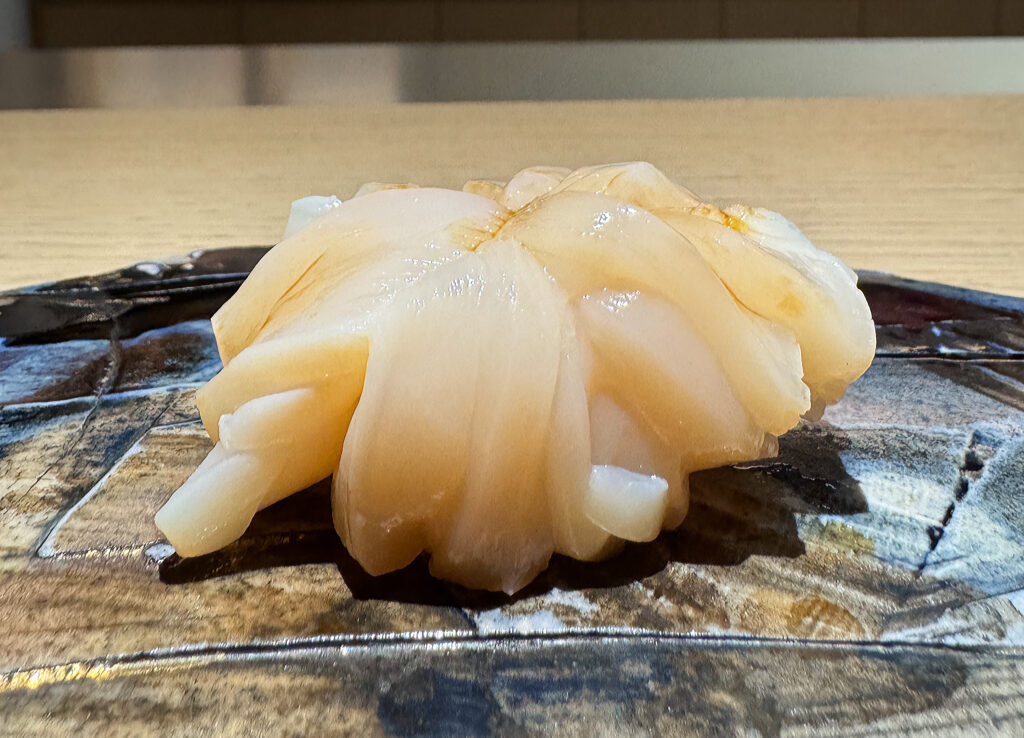
With the arrival of the “Hokkaido Scallop” (also called hotate), the chef keeps the hits coming. Phan rarely ever serves this bivalve (believing, if memory serves me, that the ingredient simply does not allow for much interesting manipulation), but Villa demonstrates its potential. He scores the scallop into a ribboned, almost amorphous shape that makes it almost hard to recognize.
However, the resulting combination of a layered, buttery mouthfeel with heaps of sharp, tangy, and resoundingly savory flavor (drawn from a lemon-ginger-scallion marinade along with a topping of yuzu koshō) is simply sublime. Yes, by treating this ingredient with a relatively heavy (though astutely balanced) hand, Villa shapes one of the surprise hits of the night. I only wish the flagship served it too!
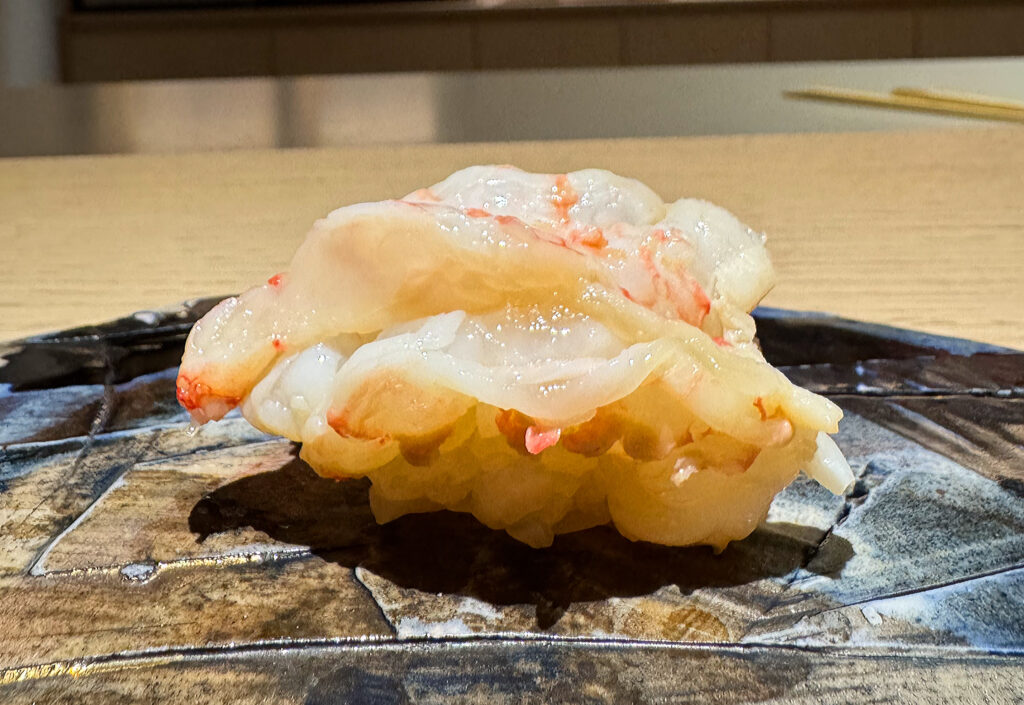
After a long series of peaks, it’s inevitable that such a lengthy omakase will have its valleys too. The first of these comes in the form of the “Hawaiian Shrimp” (also called aka ebi), an ingredient that has kicked off many Kyōten meals during the latter half of 2025 and into 2026. Phan presents the shellfish as a kind of “ceviche” (made from dashi and lemon juice), and Villa transforms the same recipe into a piece of nigiri. The resulting bite is plump on entry but tends toward crispness rather than butteriness. The accompanying flavor, too, starts of tangy while never really becoming sweet. In fact, something tastes off—almost fishy—and, despite seeming fine on paper, this item lands noticeably below everything else served tonight.
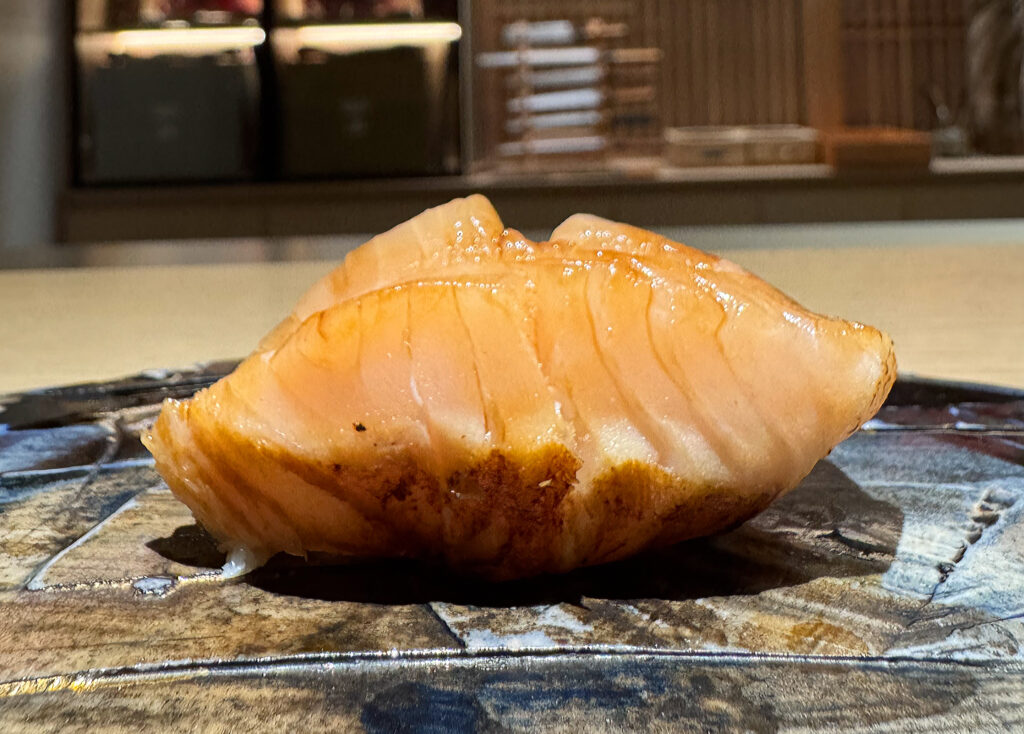
The second valley comes from the “Sawara,” a serving of Spanish mackerel that has (as nigiri) also featured on the flagship’s menu. Visually, the bite actually looks rather appealing with its ruffled scoring and elegant curvature over the rice. However, on the palate, the fish’s flesh feels tightly grained and drying with no alleviating moisture or nuance. Flavor, despite the soy sauce drizzled over the top, seems altogether missing. There’s just nothing pleasurable to latch onto here, and the sawara (though not offensive by any means) comfortably ranks as the low point of the omakase.
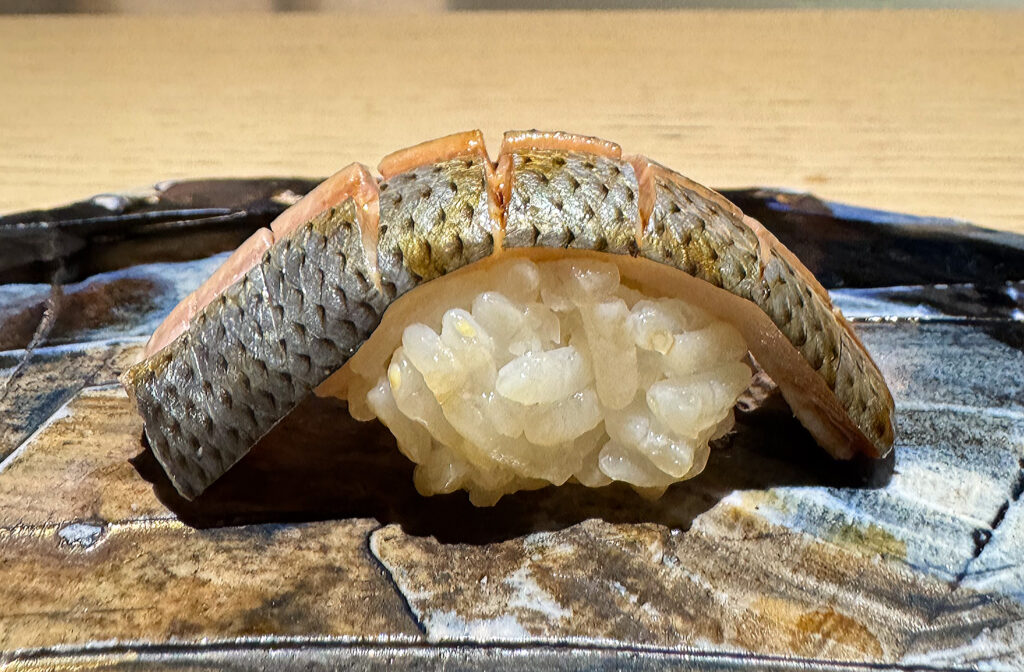
A preparation of “Kohada” (or gizzard shad) gets things back on track, representing the very bite (as Phan regularly tells his guests) on which sushi chefs have historically been judged. The exact process of preparing the fish (which typically includes deboning, washing, salting, and marinating the flesh) is not stated here. However, visually, this piece is one of the menu’s most accomplished, and, when it reaches one’s tongue, the kohada balances meaty density with a clean, yielding quality. Flavor here is decidedly tangier than the flagship’s examples, but I think it fits the gizzard shad’s robust umami character rather nicely. Overall, this makes for a faithful rendition of one of the omakase’s most distinctive ingredients.
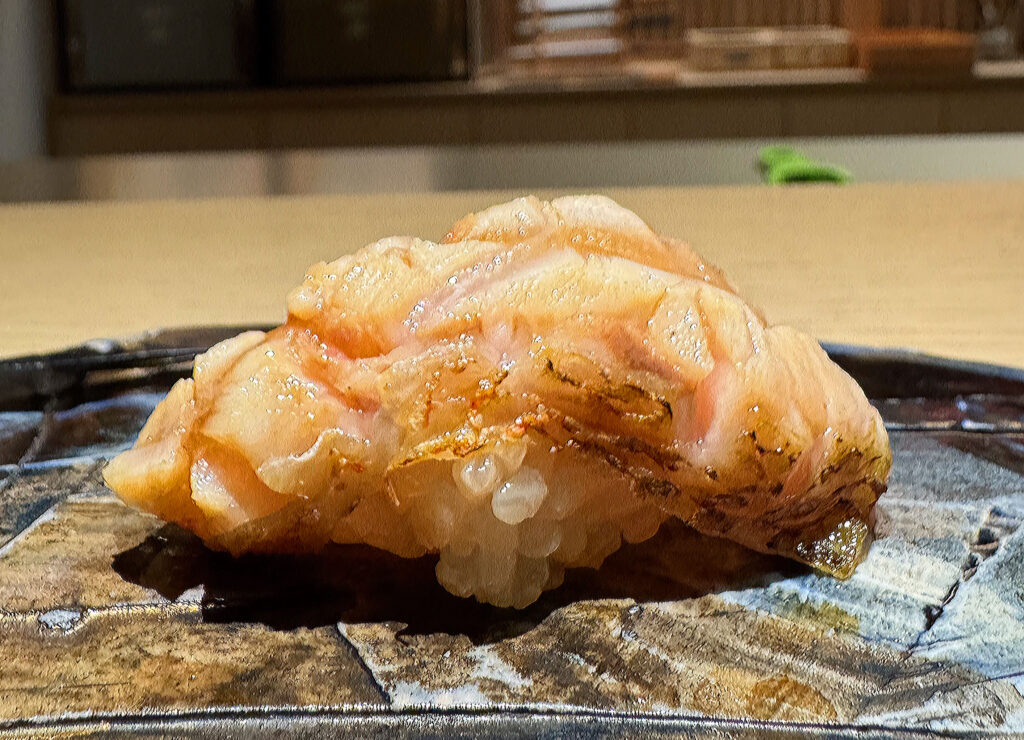
“Akamutsu” (the blackthroat sea perch Phan routinely identifies as the most luxurious fish he serves) comes next, and Villa’s example actually matches the look of the chef-owner’s quite well. For my palate, this piece rarely lives up to the status ascribed to it. Tonight, that holds true. Nonetheless, benefitting from a bit of torching, the akamutsu delivers the warm, rich, and gooey sensation it is known for. Yes, texturally, the bite is hard to fault. I’m only ever left wanting more accompanying flavor, and, while an imprint of wasabi looks to play that part, to root actually detracts from my enjoyment due to an errant bitter note. Thankfully, the perch’s supreme fattiness helps to soften it.
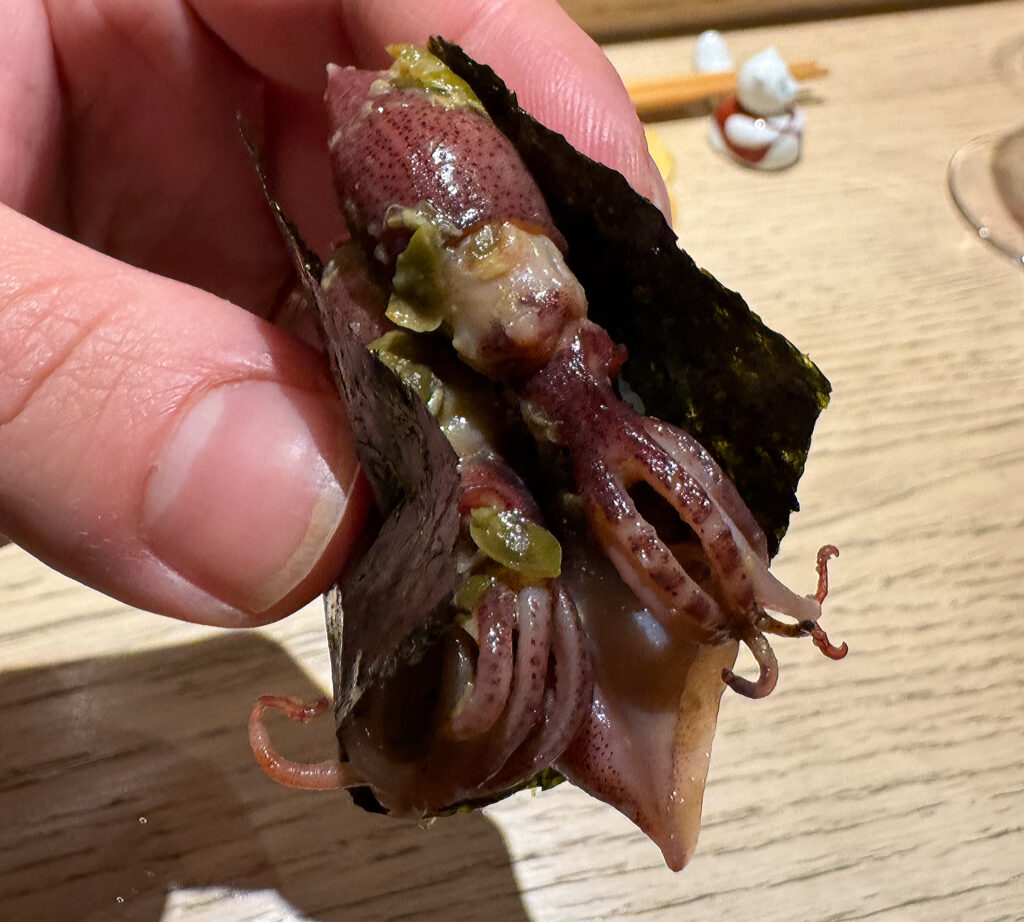
The third and final valley of the night comes from the “Hotaru Ika”—a presentation of firefly squid (a seasonal delicacy) that Phan himself reserves for the small plates. In something of a repeat of the Hawaiian shrimp, the chef adapts the recipe (characterized by its caper relish) for use in a hand roll. At its best—that is, eaten one by one with chopsticks—the squid blends warmth and plumpness with an anchovy-like flavor. Tonight, the ingredient strikes me as unpleasantly chewy and rather murky (though not offensive) in taste. Ultimately, I get none of the savory intensity I expect from such a rare, cherished item. That said, Phan’s own preparations of the hotaru ika can sometimes fall flat, and I’ll chalk this one up (at least in part) to the cephalopod’s own caprices.
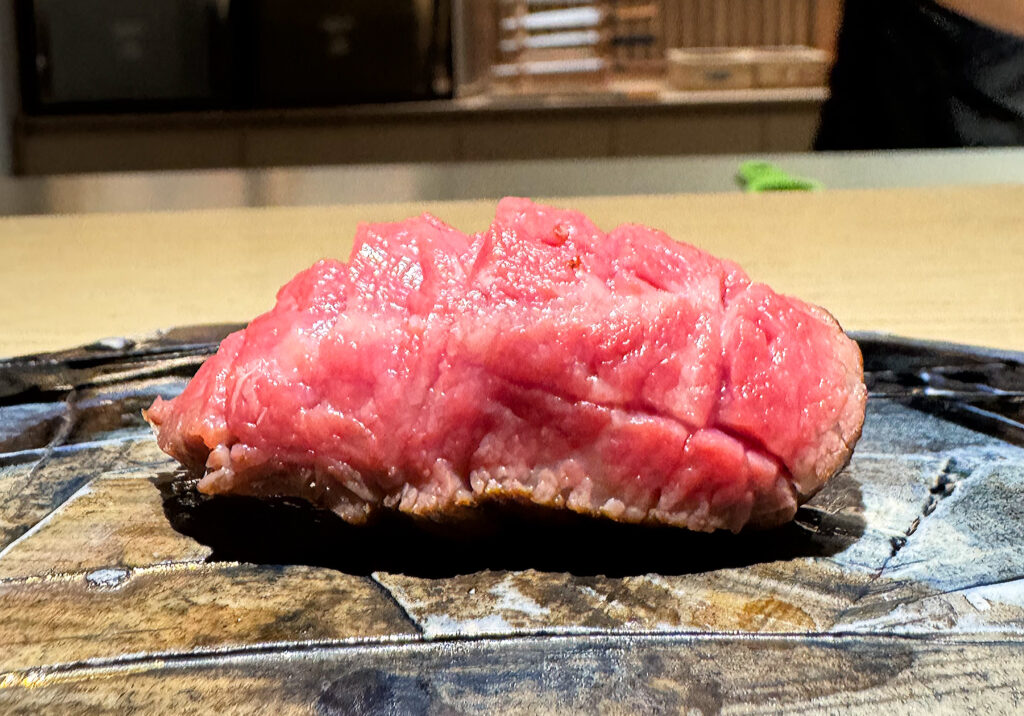
While the Kyōten flagship has favored “A5 Wagyu” from time to time, the coveted Japanese beef has found a more permanent home at Next Door. After all (extending the logic that was applied to the scallop), how much can a chef really do to make this well-marbled cut of steak any more exceptional? Villa lightly torches the meat and pairs it with a dab of horseradish, yielding a bite that is fleetingly chewy with melty streaks of fat and a mildly savory finish that comes tinged with uplifting pungency. It’s all pleasant enough—but not quite memorably so. Phan’s use of this totemic luxury ingredient, though far more infrequent, does a better job of playing to its strengths.
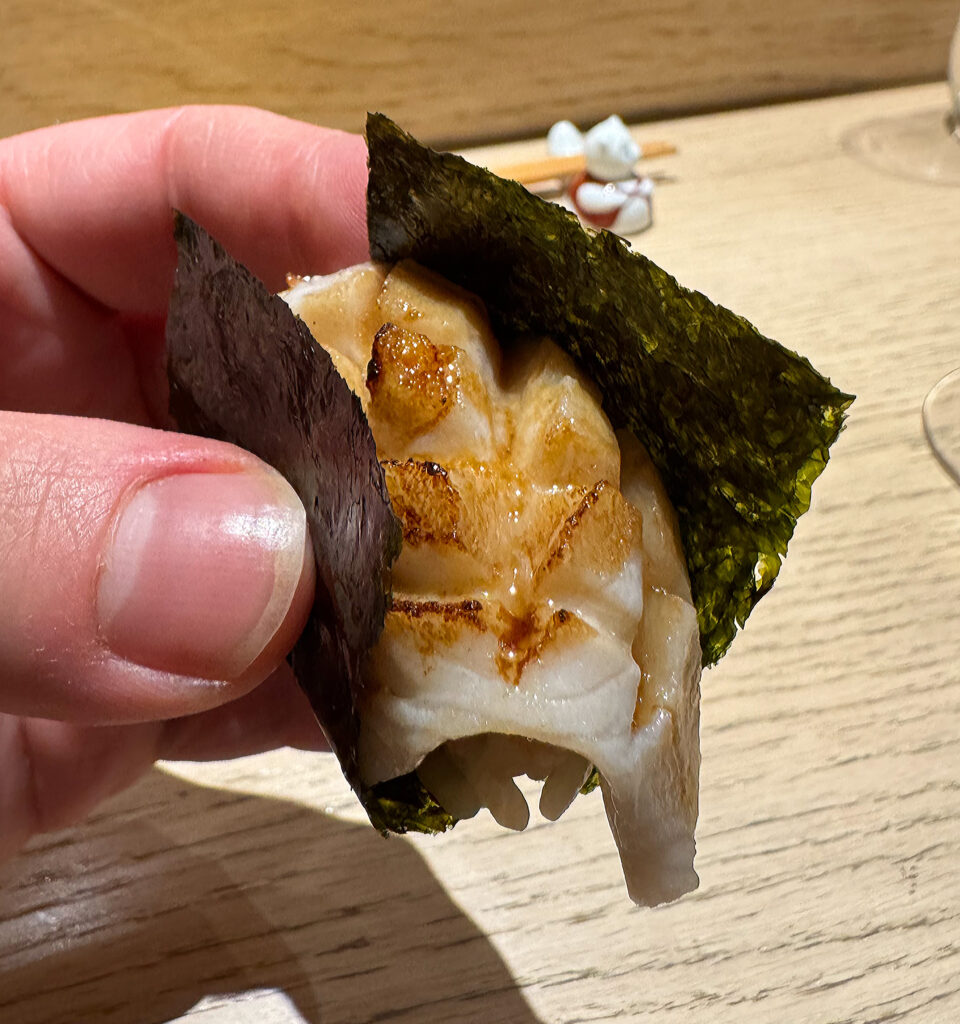
“Sablefish” is not something I am used to seeing in this context, yet, upon observing how Villa makes use of the fatty fillet, its purpose is clear. Seared, formed over rice, drizzled with eel sauce, and wrapped with a segment of seaweed, the fish is every bit a substitute for the anago (or saltwater eel) that memorable closes the meal at Kyōten. Here, the pleasure derived is not exactly comparable in scale. However, the marriage of luscious, oily flesh and exuberant sweetness (all framed by the crispness of the wrapper) conjures an effect that largely feels the same. Indeed, even if the sablefish is a like for like (and less expensive) substitute, it faithfully steers the omakase toward dessert.
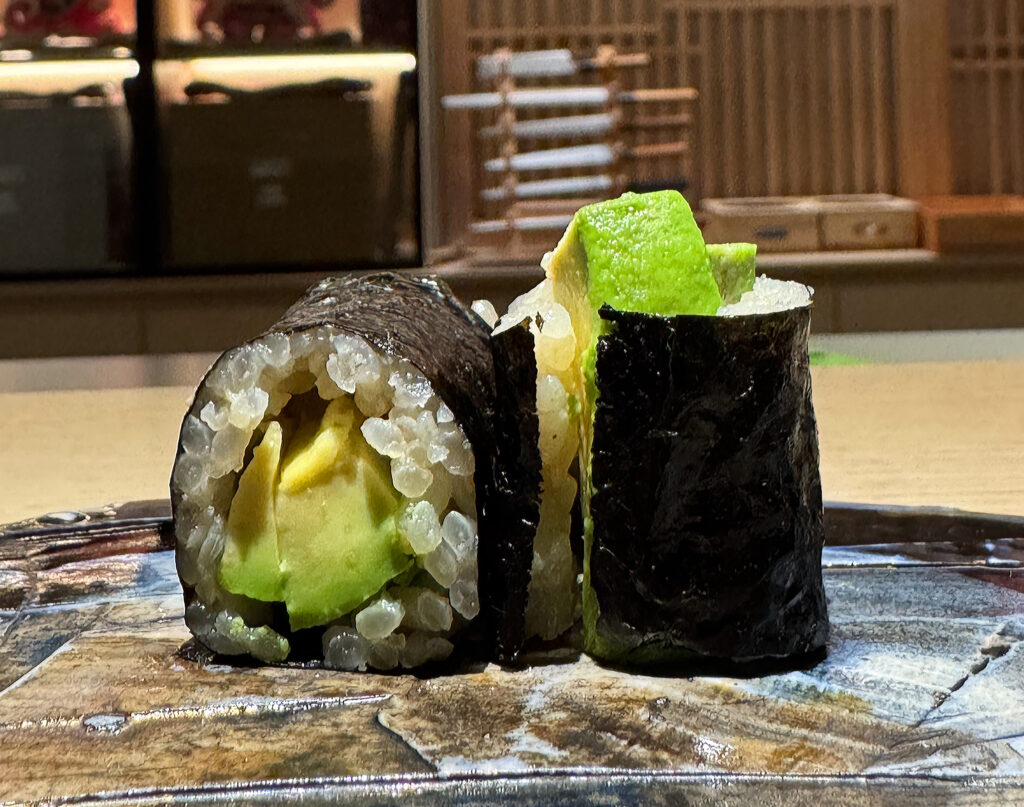
The last of the savory items on offer is something of a throwback: an “Avocado Roll” (shaped with dark vinegar rice) that references one of Phan’s signature creations from the early days of pre-pandemic, pre-remodel, pre-markup Kyōten. Villa’s version looks the part, but I find the starring ingredient (while nicely creamy) is somewhat undone by the stickiness and chewiness of the wrapper. Flavor, too, lacks any of the expected punch, making for a couple of bites that, while pleasant enough, do little to satisfy my nostalgia.
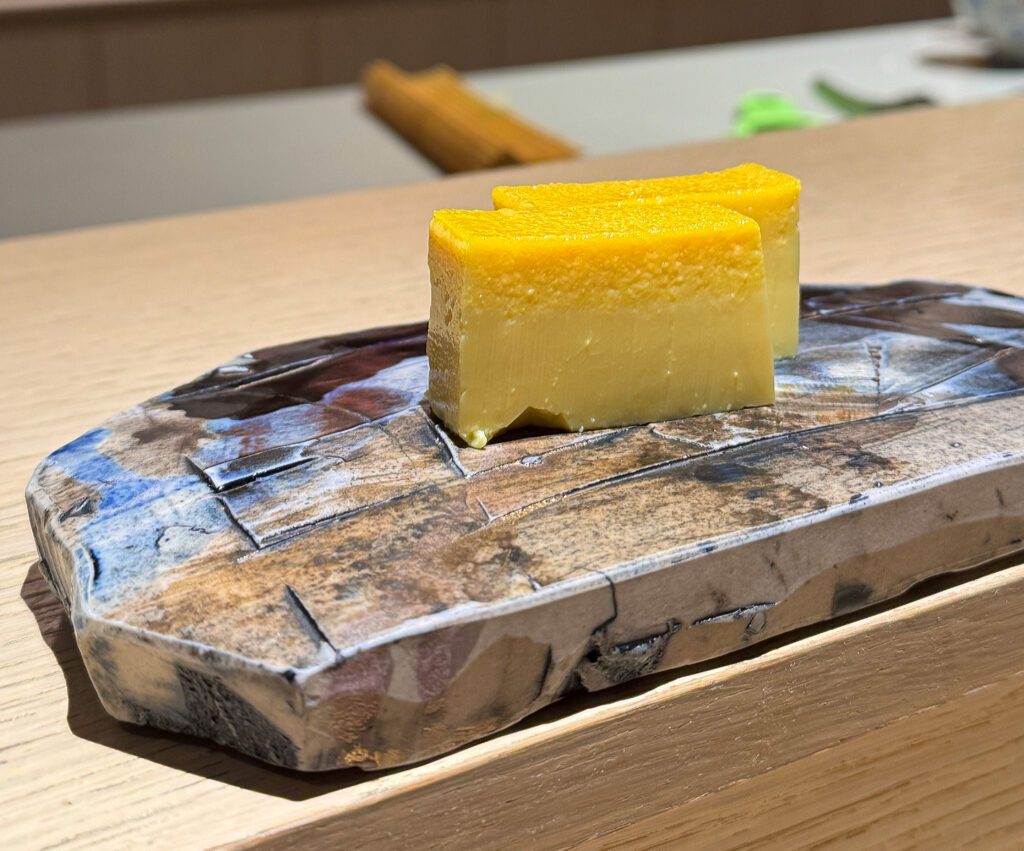
Dessert, in contrast, is entirely pleasing—perhaps due to the fact that Phan has entrusted Villa with the flagship’s recipe. His “Tamago” (rendered here as a corn- and maple-infused custard) is sliced into two thinner, longer segments rather than the usual, thicker one. All told, I kind of like the change. The bite strikes the middle of the tongue and has more room to melt, coating the palate with a comforting sweetness only for the second piece to land and multiply the effect. Even in a different chef’s hands, this tamago continues to transcend any other example of the form I have ever encountered.
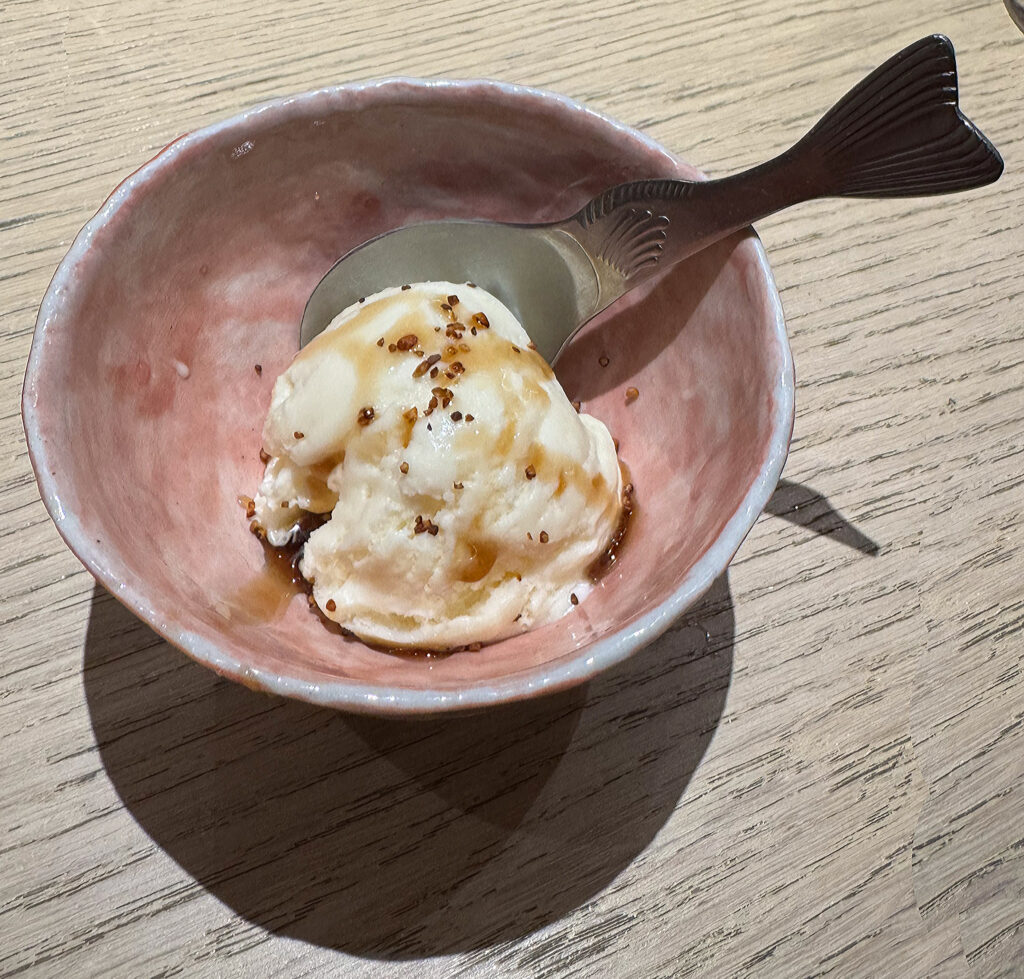
Closing out the meal, I find the “White Cheddar Ice Cream” that has anchored the sweeter side of the menu since its debut in October of 2025. Made using Prairie Breeze (produced by Iowa’s Milton Creamery), the starring element—though not as tempered as it usually is—offers a maddening blend of sharp, nutty, and butterscotch notes that leave me desperately reaching for another spoonful. A drizzle of maple syrup (the frozen dessert’s familiar accompaniment) enhances the ice cream’s subtle sweetness via a soothing, caramelized finish. Meanwhile, a sprinkle of toasted buckwheat (a new element tonight) adds some complicating crunch and contrasting earthiness to the bowl. Ultimately, I like the addition and quite enjoy this iteration of the recipe. Still, I am left wishing that the ice cream displayed its usual silkiness.
Roughly two hours later (from the first piece of salmon to the arrival of the ice cream), the omakase reaches its conclusion. The meal’s 24 total bites proceeded at a pace that puts the Kyōten flagship (where the experience typically pushes three hours) to shame. And, while Villa’s work does not quite match his mentor’s in aspiration or refinement, the chef honors the counter’s philosophy: ensuring his guests leave full and happy and open to the full range of possibilities that sushi—divorced from pomp yet crafted with a distinct perspective—can provide.
In ranking the evening’s dishes:
I would place the “Madai,” “Shima Aji,” “Hamachi,” “Akami Zuké,” “Chū-Toro,” “Ōtoro,” “Uni,” “Hokkaido Scallop,” “Tamago,” and “White Cheddar Ice Cream” in the highest category: great recipes that achieved a truly memorable degree of pleasure. I would love to encounter any of these again.
The “Ōra King Salmon,” “Smoked Ocean Trout,” “Kinmedai,” “Isaki,” “Buri,” “Barracuda,” “Kohada,” “A5 Wagyu,” “Sablefish,” and “Avocado Roll” land in the following stratum: very good—even great—preparations I would always be happy to sample again (but that just failed to elicit an extra degree of emotion).
Next come the “Hawaiian Shrimp” and “Akamutsu”—merely good (maybe just average) items that fell short when it came to texture or flavor. Neither of these bites faltered in more than one dimension, so there was still pleasure to be had (and, indeed, they could easily be fixed with a little more tweaking).
Finally, we have the “Sawara” and “Hotaru Ika”—two pieces that were clearly flawed across multiple dimensions and that I would not wish to taste again barring some clear changes.
Overall, this makes for a hit-rate of 83% with some 42% of dishes reaching that “would love to have again” caliber. Tellingly, not one of the offerings tonight was of that “best of the year” level of quality that Phan so regularly hits. However, Villa’s work here is still worthy of the highest praise.
If he had staged this experience at an unrelated counter under an unfamiliar name (rather than fighting to fulfill the expectations that the Kyōten flagship naturally carries), I’d probably be gushing about the discovery of a new talent. Certainly, the chef benefits from the ingredient sourcing and stylistic choices that his founder and mentor has made. But Villa, here and now, is the one who needs to put these pieces together—maintaining the perfect rhythm, entertaining the discerning audience—with nobody else to rely on.
It bears mentioning that this meal only marked the third time the chef has offered this particular menu at this particular counter. Villa admits that he couldn’t sleep once Phan invited him to take the position—that he came in with no set menu and figured things out one fish at a time. With another 10 or maybe even 20 of these meals ahead of him, I am eager to see the standard that Villa will reach with further practice and familiarity with the ingredients that distinguish this sushi-only offering from what he serves at Next Door.
Yet, faced with the pressure of sinking or swimming as an understudy at Chicago’s most expensive (and, for many, most eminent) omakase, Villa has undoubtedly succeeded. The chef has not only taken a huge step in his own career but, simultaneously, helped to establish a Kyōten lineage of craftspeople that may someday bequeath a bit of the style that has made Phan so successful.
Admittedly, I’m not the best person to judge how the value proposition of this experience ($220, exclusive of service charge) stacks up against what Shoji ($210), Mako ($215), Yume ($225), or The Omakase Room ($250) are doing. I just don’t eat at these places anymore.
It’s also important to reiterate: the sushi-only menu—despite comprising some of the same signature ingredients (e.g., the tuna, wild yellowtail, and sea urchin) and dishes (e.g., the tamago and ice cream) as the flagship—is not a substitute for the distinctive small plates and unerring technique (particularly as it relates to the preparation of rice) that characterize Kyōten’s full offering.
Villa even tells me, somewhat surprisingly, that he hasn’t seen many of his regulars from Next Door embrace this extended version of his work over there. They’re too preferential toward the sharper pacing of the standard menu, as well as the more casual vibe that a larger counter manned by multiple chefs naturally entails. I can’t blame them: trading up might mean a few special pieces, but it also demands the kind of full commitment and attention that a certain demographic (the kind for whom a $169 omakase might form a weekly or monthly splurge) consciously wants to avoid.
What I can say is that Villa’s residency at the Kyōten flagship does justice to Phan’s philosophy: rendering many of the best ingredients from both his properties using the kind of big textures and flavors for which the chef is known. The hybridized format (caught between the “top-value” and “most luxurious” categories that the two restaurants already occupy) might not appeal to diners who have already acclimated to either venue.
Yet this is a singular offering for a singular—and necessarily fleeting—time in the chefs’ lives, and the menu (beyond being largely delicious) highlights how differences in personality and technique can shape the same ingredients prepared in the same house style. I do not mean this as a backhanded compliment: the difference in mastery between Phan and Villa is clear, yet the latter’s raw potential (and his chance to undergo tremendous growth through this process) is worth cheering for.
Indeed, though tonight’s meal was somewhat of an unexpected one, I treasured the chance to better understand both Kyōten and Next Door via Villa’s fresh, holistic perspective. Equally, I eagerly anticipate the new ideas and ways of seeing Phan will bring to the counter upon his eventual return.
Until that time comes, the restaurant is in good hands.