
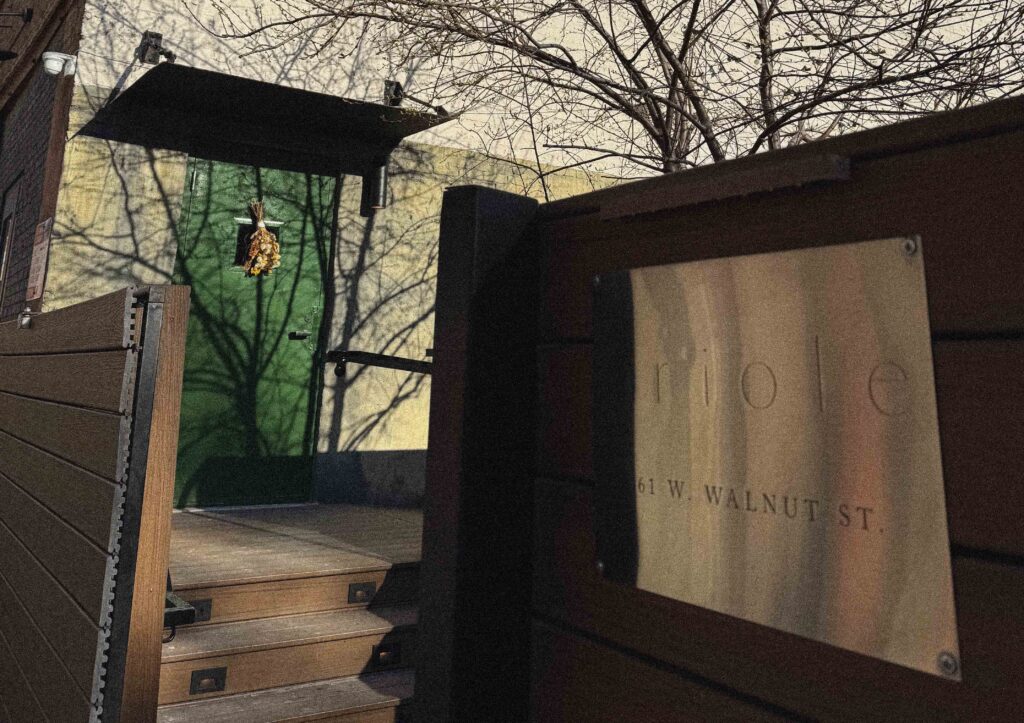
It feels strange to be eating at Oriole—the king of Chicago special occasion dining, that steadfast guarantor of sweeping pleasure—with such regularity.
Indeed, I usually try to alternate my visits here with trips to Smyth: not for the sake of any direct comparison or definitive judgment but in order to benefit from (and be rejuvenated by) the contrasting philosophies at these most eminent establishments. Yes, for any prolific gastronome, the tempering of unrestrained indulgence with wanton experimentation (even provocation) is essential in order to reset one’s place on the hedonic treadmill.
The greatest restaurants may seek to balance these competing inclinations within the same meal, yet any conscious attempt to do so might actually inhibit the creation of a cuisine that is self-driven, singular, and ultimately irreplicable (even at a global level). Kitchens, ideally, should be left to develop their personalities in accordance with the team’s unique proclivities. Yet the results often skew toward one side of the “classic” vs. “avant-garde” pendulum, and it behooves any habitual diner to avoid myopically chasing one or the other pole without an occasional respite.
Despite some scheduling issues, my next piece on Smyth is forthcoming. Plus, lacking my usual point of comparison, it might be a nice change of pace to place Oriole in the context of spots like Cellar Door Provisions, Creepies, and Elske that are presenting challenging, inventive dishes at a relatively cut-rate price (as opposed to the clear premium that the city’s only three-Michelin-star concept demands).
The real consequence of coming here more frequently is best described as a demystification: of the ambiance, the major motions of service, the very heart and soul of what makes this particular experience so special. None of these elements—the structural foundations of hospitality through which Oriole, post-renovation, has wildly succeeded—are exactly new to me. But they’re also not the kind smoke and mirrors (à la Alinea) whose novelty entirely diminishes when you encounter them a second time.
Oriole deserves credit for crafting a memorable space, leading diners on a journey throughout its confines, and wrapping the whole voyage with warm, seemingly effortless interactions. There’s a charm to the evening’s sequence—stepping through the elevator door, greeting one’s guests in the lounge, marveling at the kitchen ceiling together, settling into the finely appointed dining room, lingering over coffee, then retracing the same steps home—that never gets old. Form begets function in a manner that leaves Alinea feeling cramped, Ever feeling cold, and Smyth as if interior design was discounted altogether.
Undergoing this kind of demystification (which is really just a thorough acclimation to the surroundings), I can more easily discount the wide array of aesthetic pleasures and broader sense of occasion that so powerfully shape the meal.
It’s not a position that many other diners will (or would ever want to) be in—the death of novelty, the stripping of what should be wondrous down to its bare essentials—yet it also makes for great critical fodder.
Sapping these bells and whistles of their power necessarily has a leveling effect: one that filters out the divergent effects of outside investment and chosen business models while allowing for a wider range of comparisons when it comes to the rudiments of food, drink, and service alone.
Judging greatness of this sort—the kind that cuts across established markers of luxury to center entirely on questions of technique and imagination—has been my project this year. And, some ten years after Oriole’s debut, I cannot think of a tougher or more rewarding test for a restaurant that has earned its place in Chicago’s all-time fine dining pantheon.
Let us begin.
On this early Saturday evening—warmth fading from what has thus far been the hottest day of the year—the streets surrounding the 600 block of Walnut Street have come alive.
We’re not talking about the most popular part of West Loop, but one (anchored by MONEYGUN and SUNNYGUN and the world-renowned Kumiko) that effectively catches the mass of energy flowing westward, over the highway, toward the city’s trendiest nexus of dining and nightlife. Whatever one thinks of the way the neighborhood has changed, Oriole’s presence in this neck of the woods (alongside one or two other spots I frequently mention) affirms that the best of Chicago gastronomy still has a home here.
And the alley-like expanse of Walnut Street, now that the winter chill has lifted, feels less isolated: the former factory buildings, with their faded brick, seeming not so frozen in time. The flow of cars and passersby joins with the sound of revelry (thumping up against the garden wall) to paint a harmonious scene: the kind that blends old and new, high and low, serious and playful in a way that seems to reflect Oriole’s soul.
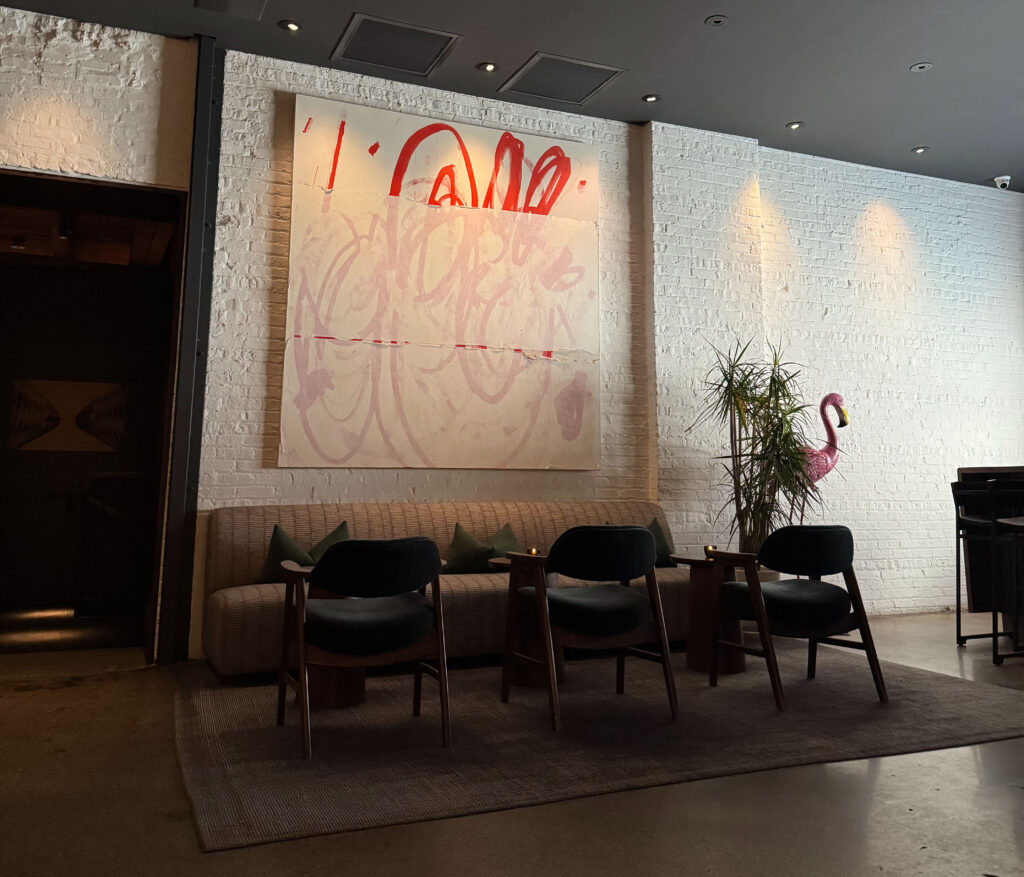
The key moment always comes when guests traverse a few steps and pull open the door, finding a candlelit lobby, a couple suited figures, and an industrial elevator awaiting them. After a cup of hot tea (a brew that couldn’t, perhaps, be changed on short notice to better match the day’s weather) and a brief sit on the bench, the wall of the compartment is pulled apart. A corridor beckons, and, as one passes the wine cellar on their way to the lounge, a feeling of refinement (though never trading its urban edge for preciousness) takes hold.
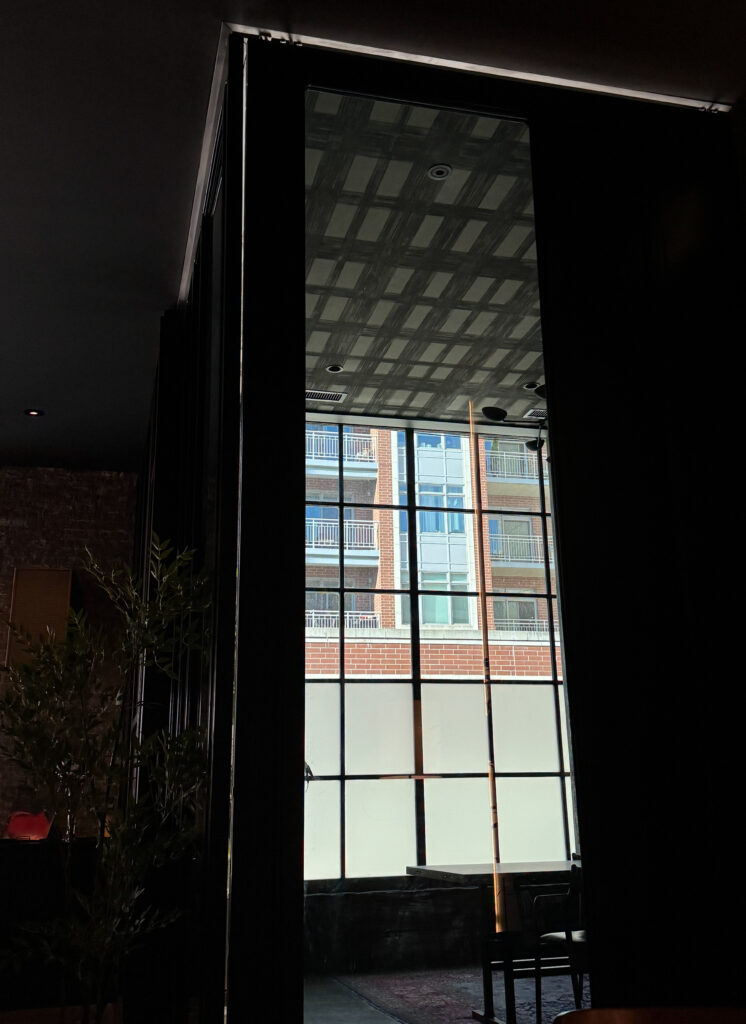
I settle in on the couch closest to the kitchen and marvel at how the private dining room (situated opposite me) looks bathed in natural light. Tonight, the connection between the restaurant and the goings-on outside feels clear, and it’s nice to know (commensurate with Sandoval’s own desire to serve a meal that leaves room for you to enjoy the rest of your evening) that one’s experience here preserves some of that same infectious energy.
Faced with deciding what to drink, I first decide to sample the work of newly minted bar director Maddie Balintona (who introduced herself during my last visit but has now had a bit of time in the role).
Her work on the pairing—courtesy of a rhubarb, citrus, and cherry blossom creation poured (from a soda siphon) for each guest in the lounge—is a rousing success. The small glass, which is refilled as desired, supercharges the palate with a tart, fizzy, and just-sweet-enough sensation that stokes desire for all the food to come. Enjoyed opposite the trio of shellfish preparations (each accented by citrus in their own right) served during this section of the menu, the chosen combination especially shines.
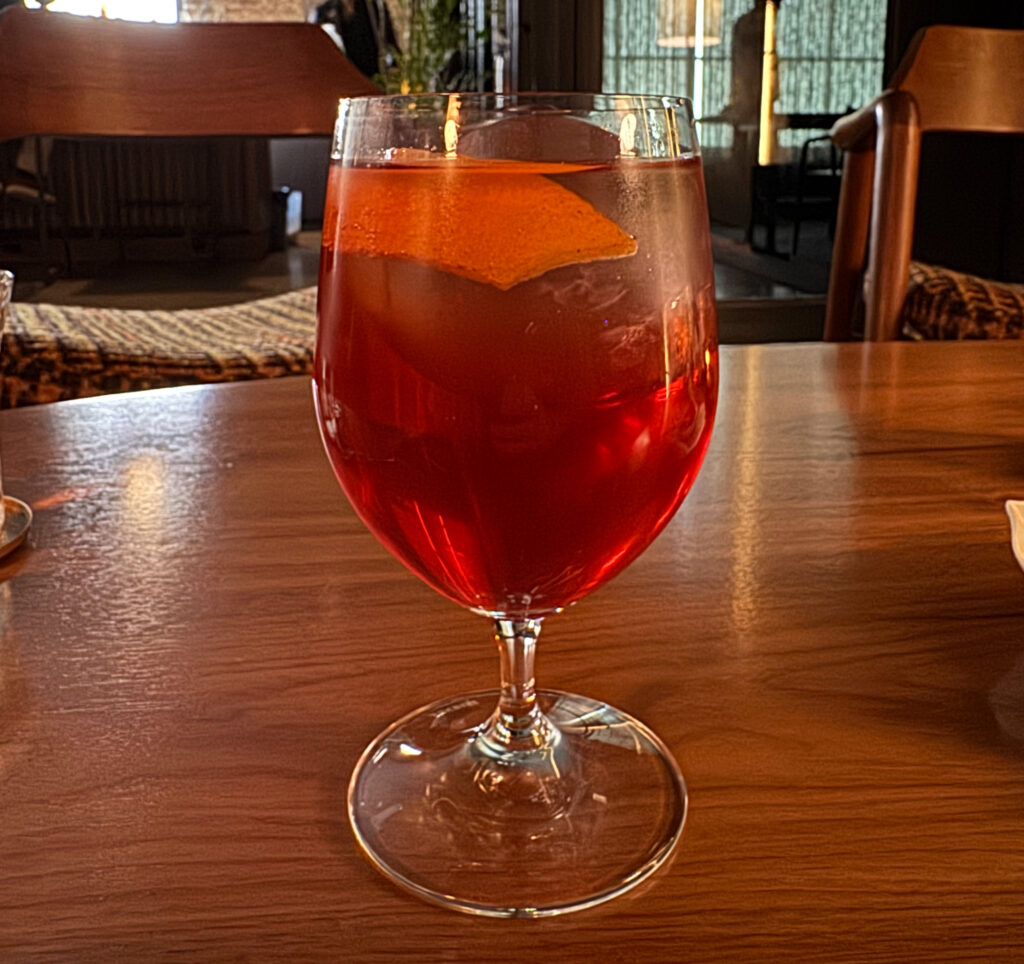
On the cocktail side, the “Star Witness” ($24)—made with Campari, Barolo Chinato, Genepy, tonic syrup, and sparkling wine—displays the kind of rounded, mildly sweet, and resoundingly bitter profile I am after while maintaining (despite every risk of being too boozy) impeccable balance.
An “Espresso Martini” ($21)—featuring Haku Vodka, housemade nocino, lemon cordial, and Sparrow Coffee’s Marbella roast—tends a bit too strongly toward its citrus element, robbing the recipe of the soothing, dessert-like quality for which it is known. Still, the proportion of cordial can be easily fixed, and Balintona’s work, overall, demonstrates good potential at this early stage.
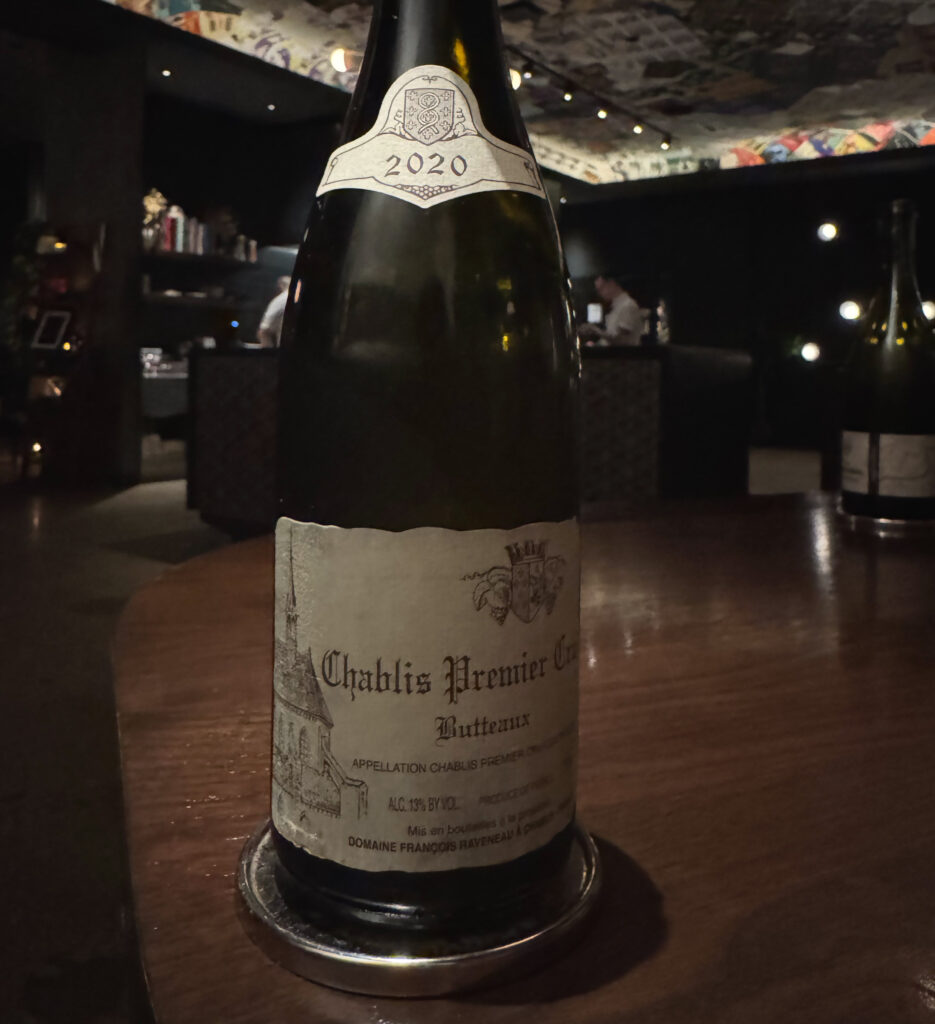
On the wine side, Emily Rosenfeld continues to skillfully steward a list that places blue-chip bottles in customers’ hands while charging only the most moderate of markups. Tonight, after considering a few sharply priced offerings from Ulysse Colin, Ramonet, and Dujac, I select the 2020 François Raveneau Chablis Premier Cru “Butteaux” ($666 on the list, $499 at national retail).
Given that RPM Seafood charges $946 for the same bottle, it’s hard not to jump at the chance to enjoy a world-class wine alongside superlative cuisine while being cared for so warmly. Routinely finding this level of value at a multi-Michelin-starred venue—an absolute rarity in a global context—is an absolute thrill, and it’s one reason I always look forward to my visits.
Turning toward the menu, a sequence of “shellfish and winter citrus” (the same one I encountered in January) serves to kick things off. Thematically, the fruit might not exactly match the temperatures diners are feeling outside today. However, seafood is always a welcome thrill, and this trio of bites (tantalizing guests while they are still seated in the lounge) largely impressed me last time.
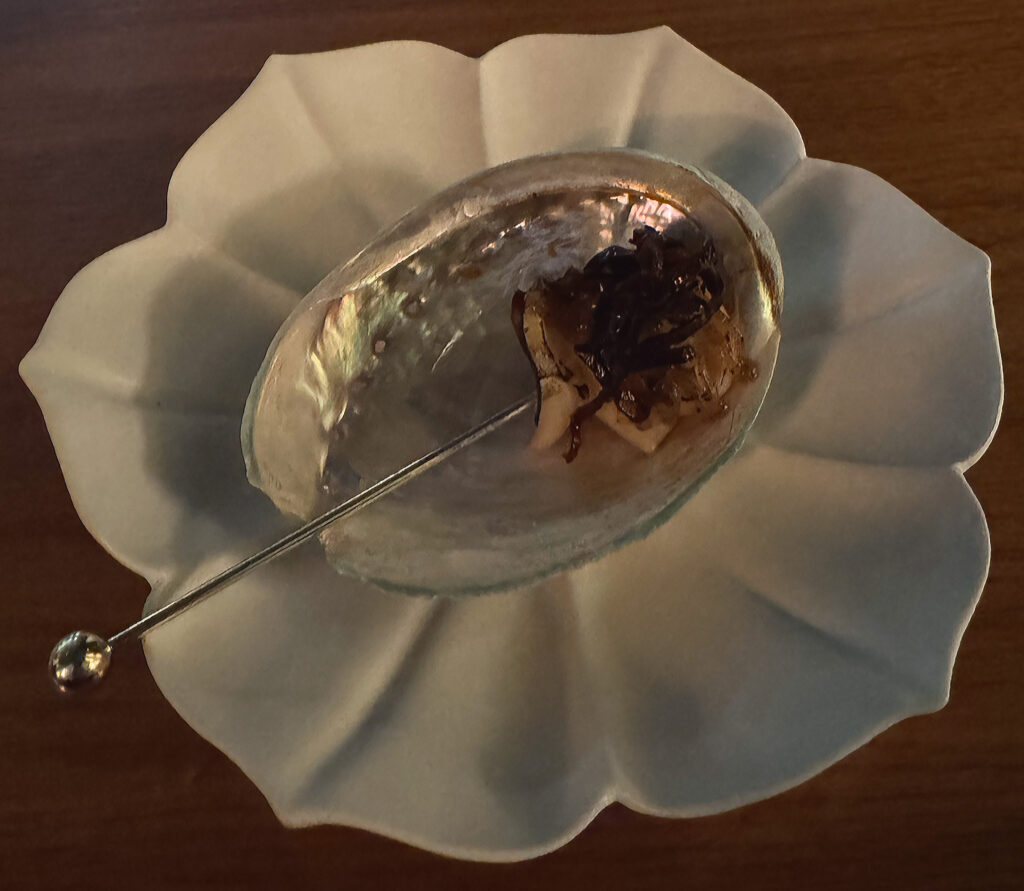
First, there’s the “Australian Abalone,” a skewer made from torched pieces of the mollusk (a sustainable species called Jade Tiger) that have been glazed with Buddha’s hand and black lime then topped with shio kombu (i.e., seasoned, dried kelp). Texturally, the resulting meat displays a clean, subtle chew that feels remarkably refined when compared to the crispness one often finds from this ingredient. The flavor here is defined by sweet, pleasing notes of citrus with less of the obvious charred, barbecue character I enjoyed before. Thus, while the brightness and succulence of the preparation remains easy to enjoy, I am still left wanting a greater concentration of umami. If anything, the recipe has slightly regressed.
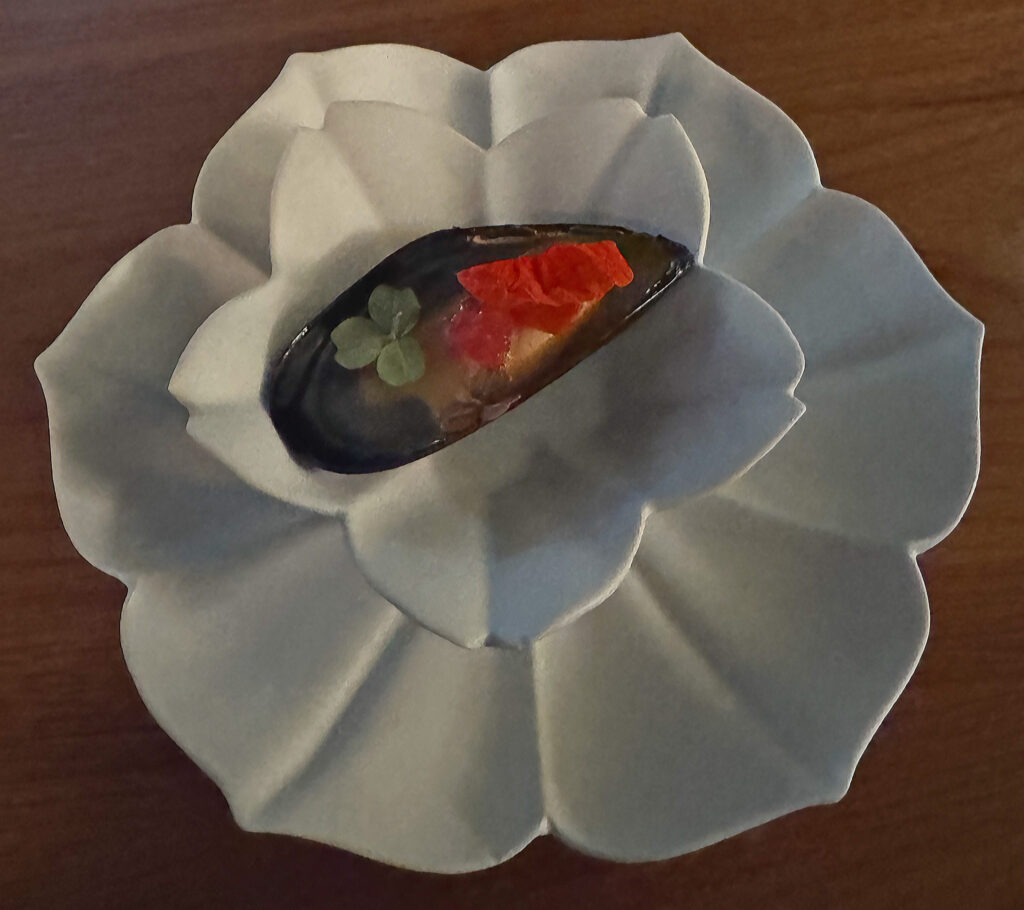
Thankfully, the “PEI Mussel” that arrives second strikes me as a touch superior to the example I encountered a couple months ago. Of course, the constituents remain the same: a poached piece of the bivalve’s meat, a mousse made from the same, some Australian finger lime, and a dash of yuzu kosho (i.e., a citrus and chili condiment). But it’s the way they combine—an entirely smooth mouthfeel matched by puckering acidity, a punch of brine, and a sharp, zesty finish—that leaves me wanting more. I still wouldn’t say this bite is as savory as I’d prefer, yet it’s hard not to appreciate the degree of complexity and intensity it delivers opposite the abalone.
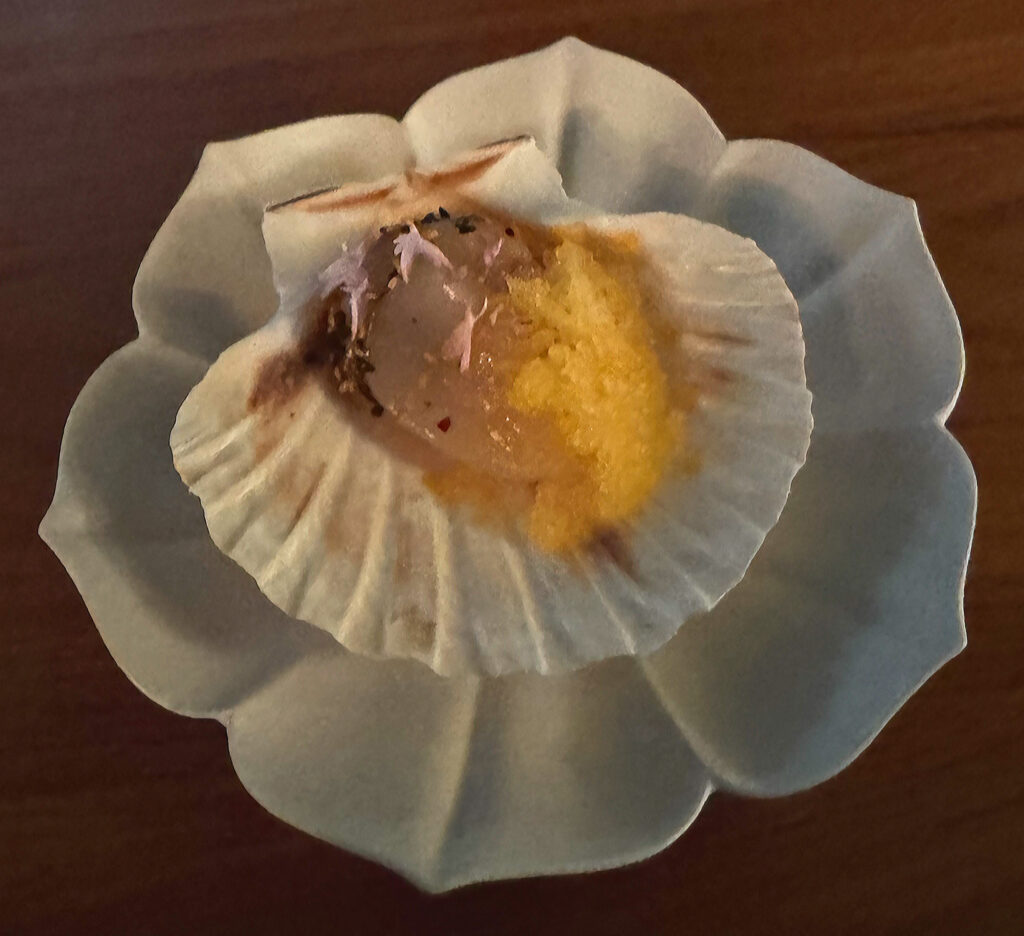
Lastly, we have the “Maine Scallop”—an offering that ranked as the strongest of the sequence when I tasted it in January. Here, it blends all of the same ingredients (like pickled persimmon, a persimmon granita, some sesame, calamansi vinegar, and a sprinkle of shichimi togarashi) while attaining an altogether different result. Indeed, while the mollusk itself (now rendered as a solitary piece rather than two smaller curls) feels buttery enough on the palate, everything else seems to fall flat. All the promised sweet fruit, tangy citrus, nutty depth, and spicy backing is entirely muted. It’s entirely missing, and this makes for a scallop of pleasing consistency but little else.
Though Oriole’s opening sequence has, with repeat exposure, lost some of its luster, what comes at the kitchen counter next ranks as one of Sandoval’s greatest guarantees.
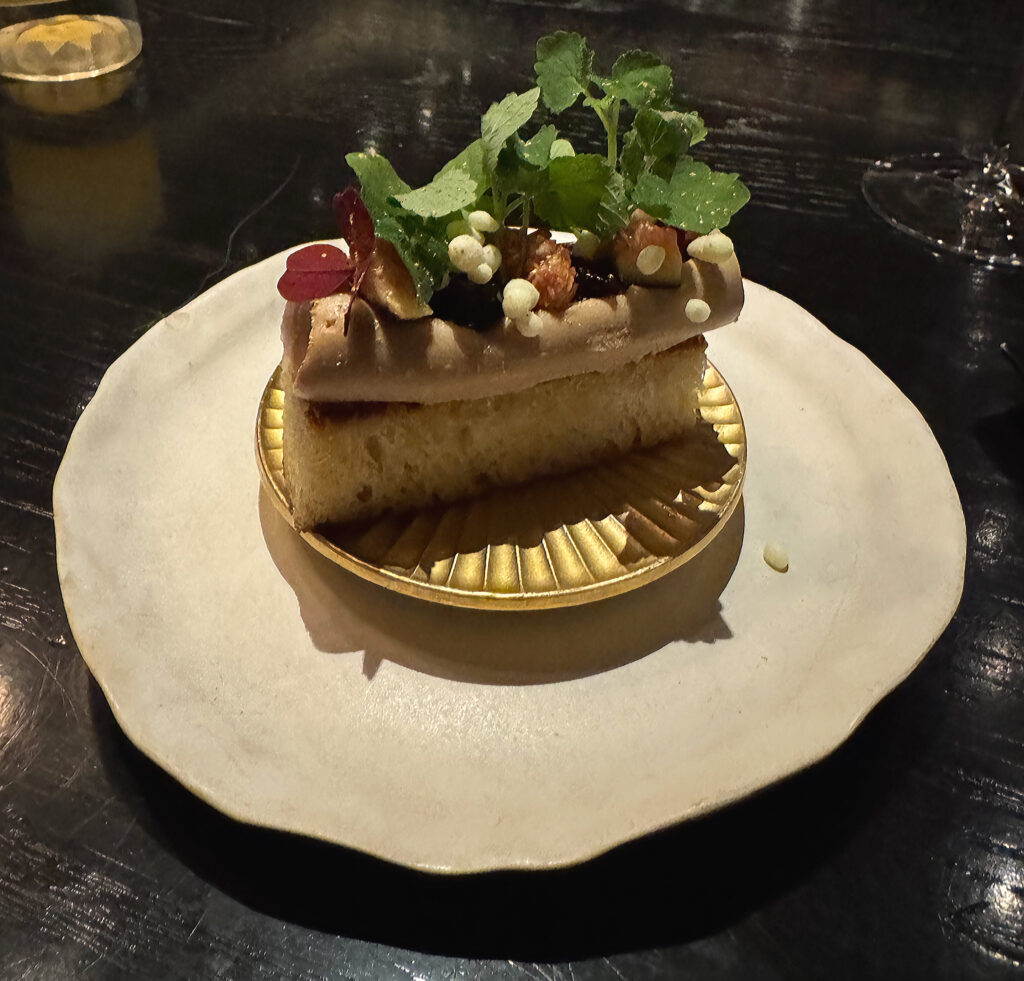
The “Hudson Valley Foie Gras” centers on the same base of yeasted butter-cooked brioche, and it comprises all of the same signature constituents: a creamy liver parfait, those irreverent crème fraîche Dippin’ Dots, some leaves of oxalis, a sprinkle of pink peppercorn, and that literal lily gilder of gold dust. Even the fruit element (which allows the team to imbue the bite with different seasonal inflections during the course of the year) remains the same as it did in January and even November.
California figs, cooked in the same vermouth poured as a pairing, charge the supreme umami of the foie gras with a lasting, caramelized sweetness. Factor in the double dose of crispness (from the enriched bread and the dots), as well as the leavening tang of the toppings, and one is left with a multifaceted, mouthcoating expression of offal whose utter hedonism never seems to dull with time. In short, this is a perfectly executed example of the recipe—the kind that affirms its status as a symbol not only of the restaurant but of fine dining writ large in Chicago.
Arriving at the table, I prepare to sink my teeth into the heart of Oriole’s culinary expression. Tonight, there will be a couple more repeats to contend with. Nonetheless, I am happy to report that the majority of offerings from this point on are entirely new creations.
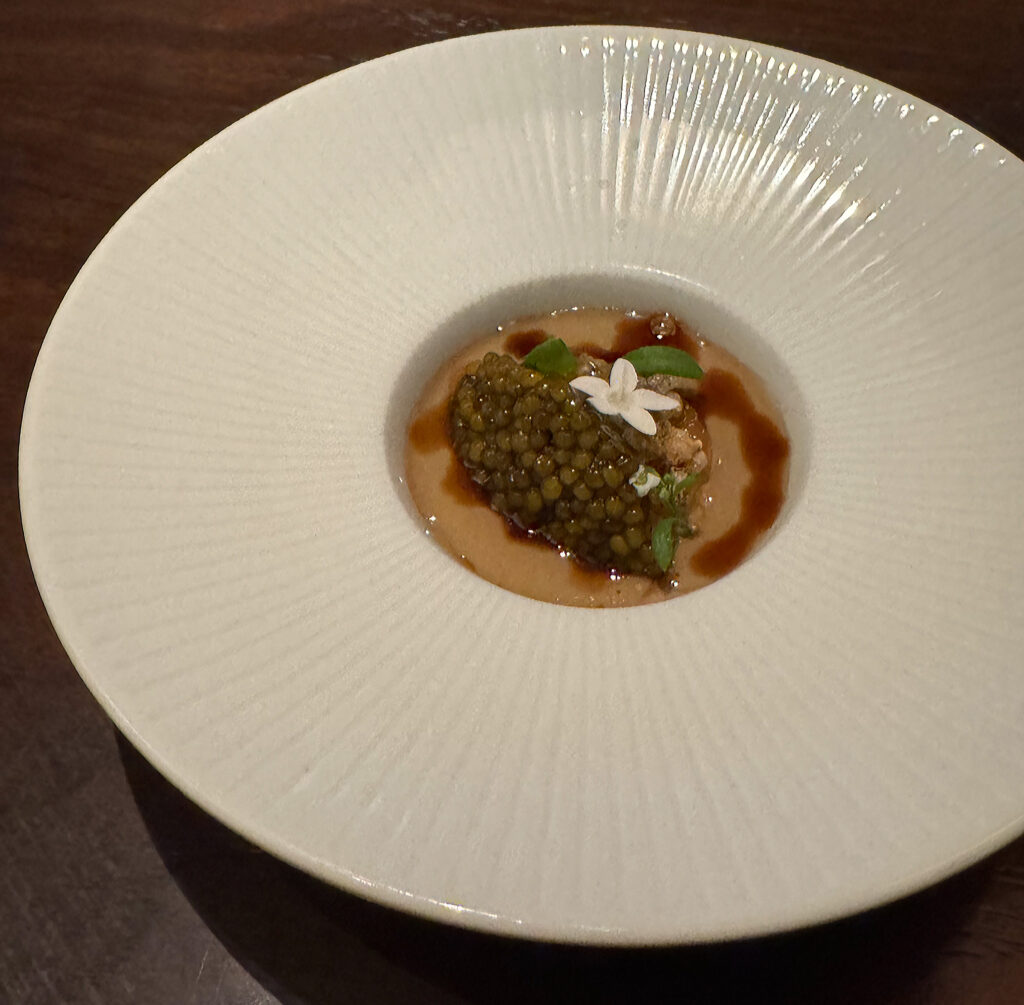
The “Golden Kaluga Caviar” has formed one of the menu’s staples—albeit with a rotating stable of accompaniments that has included peas and lobster or razor clam and green apple depending on the exact point in the year. The present example debuted in January and looks to distinguish the sturgeon roe using a hojicha (i.e., roasted green tea) custard, puffed buckwheat, toasted wheat berries, and some pieces of buckwheat honey-glazed potato.
On paper, it seems clear that this recipe is aiming to cushion the caviar with a concentration of earthy, nutty, and sweet notes that play to its decadent subtleties. And, at a textural level, I find that the assemblage of smooth, creamy, and brittly crisp components round out the Kaluga’s pop without overshadowing it. That said, it’s hard to pick out any of the roe’s rich, oceanic tones when it is eaten alongside these powerful, harmonizing ingredients. This relative anonymity does not prevent the preparation from feeling luxurious and enjoyable, yet I get the sense that the caviar could be substituted for just about any variety or quality level without any perceptible change in expression. Overall, I think this dish struck a better balance last time.
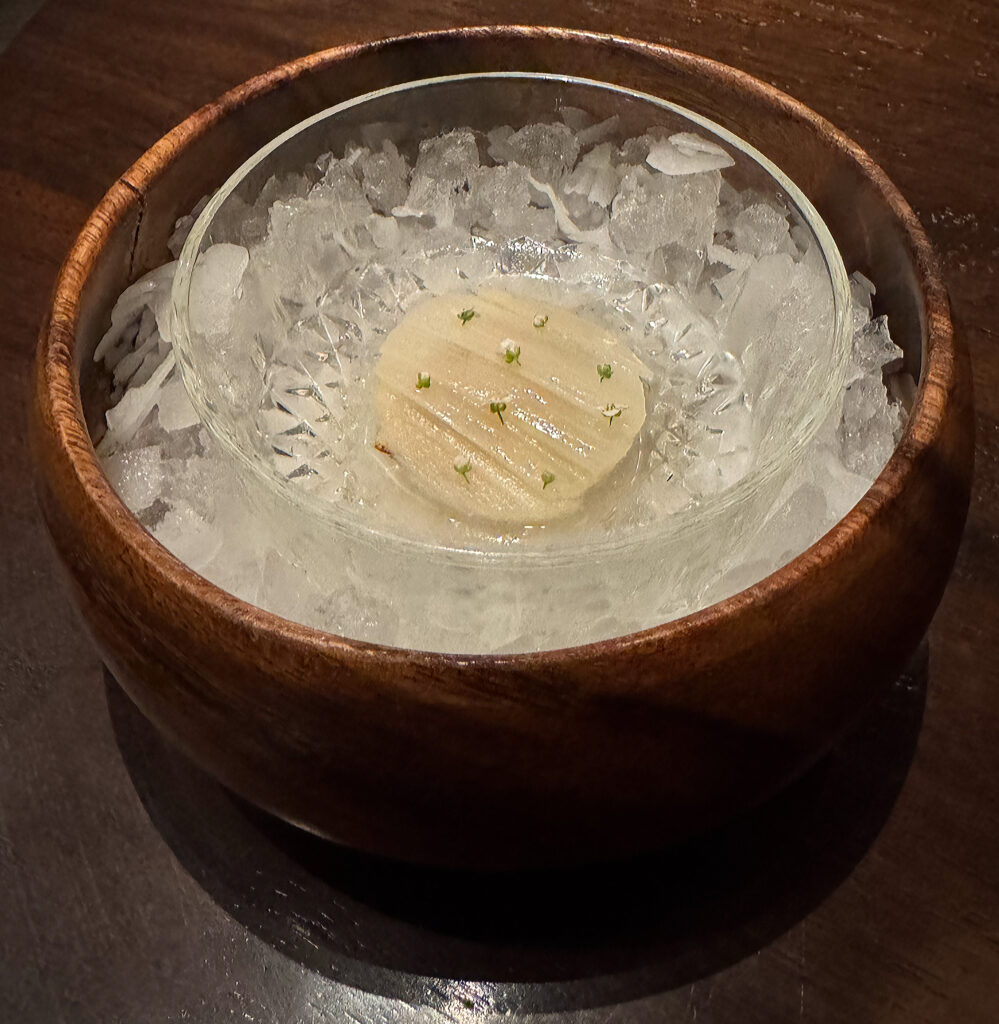
The menu’s first entirely new creation looks to celebrate “White Asparagus,” pairing the spears (which have been sliced to a gossamer thinness) with a base of applewood-smoked farmer’s cheese, some satsuma juice, candied sunflower seeds, and a sauce made from the vegetable’s trimmings along with some whey. Compared to the cauliflower recipe that this preparation has effectively replaced, the present composition achieves a far greater degree of elegance.
On the palate, those strips of asparagus display a clean, fleeting crispness that is immediately subsumed by the moist curds of the cheese. Any impression of the titular ingredient almost seems to disappear with the same speed. However, as the tang of the dairy, sweetness of the citrus, and sugar-soaked nuttiness of the seeds meld, the most pristine expression of white asparagus (no doubt fortified by the accompanying sauce) takes hold. This mildly earthy, mildly sweet note shoots right through the other flavors. Its length is profound. And it makes for a dish that is far less forceful than what I am used to tasting here yet, in its own way, beautifully rendered. The sense of precision and balance here is really quite impressive.
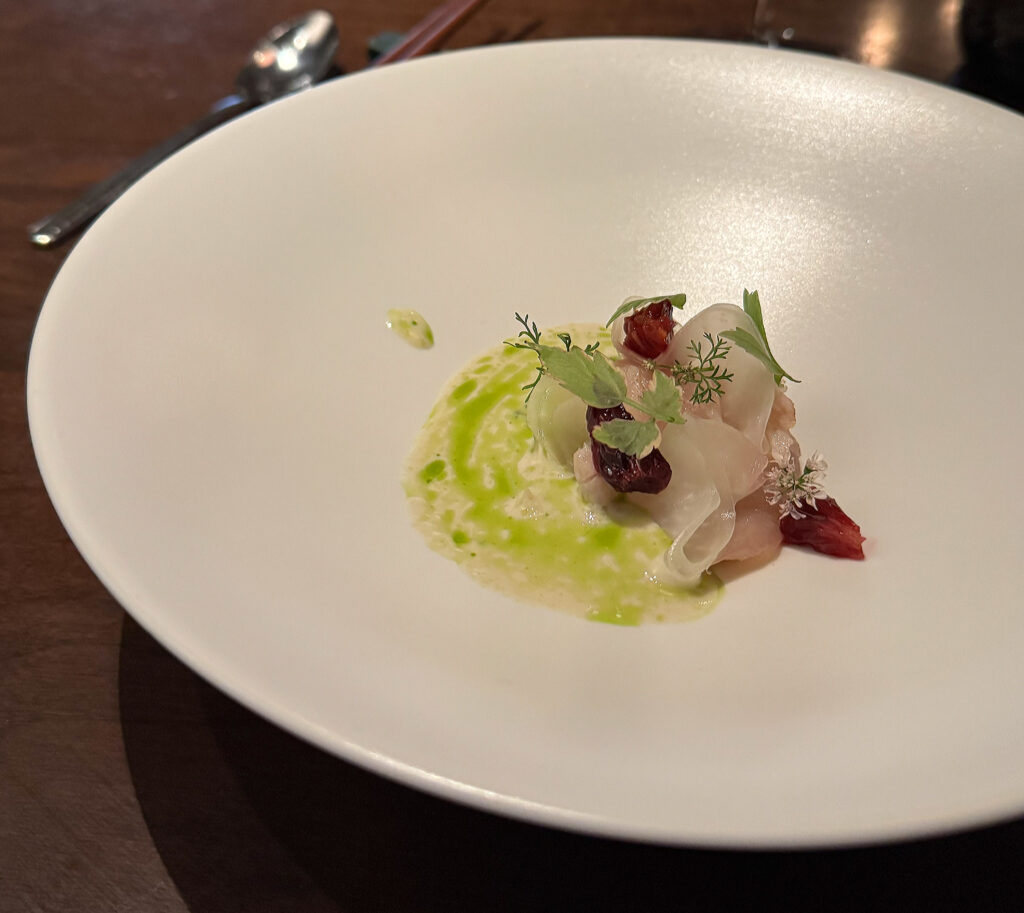
Another new offering centers on “Kanpachi” (or greater amberjack) that has been salted, marinated, thinly sliced, and dressed with a range of ingredients that includes blood orange, white koji, roasted habanero, radish, and ajoblanco (i.e., a “white gazpacho” flavored with nuts and garlic). Though guests are invited to choose from a variety of chopstick holders before the course is presented, the dish subverts the kind of straightforward Japanese inspiration that Oriole would sometimes embrace during its early years.
Texturally, the fish displays a fleeting crispness (echoed by the contrasting bits tucked into its folds) that tends toward a satisfying, mouthcoating softness. Upon this foundation—a delectable sensation I’d rank alongside any of the sushi I’ve been eating—a burst of acidity takes hold. However, unlike some of those bites in the lounge, the accompanying tang is modulated by hints of spice and sharpness (not heat) undergirded by a lasting savory note (from the ajoblanco) enhanced by a well-judged application of salt. With each mouthful, these elements meld seamlessly, build in overall intensity, and shape a finish filled the kind of length and depth that transcends any ordinary crudo. In short, this makes for a memorable preparation of yellowtail that ranks among the biggest hits of the night.
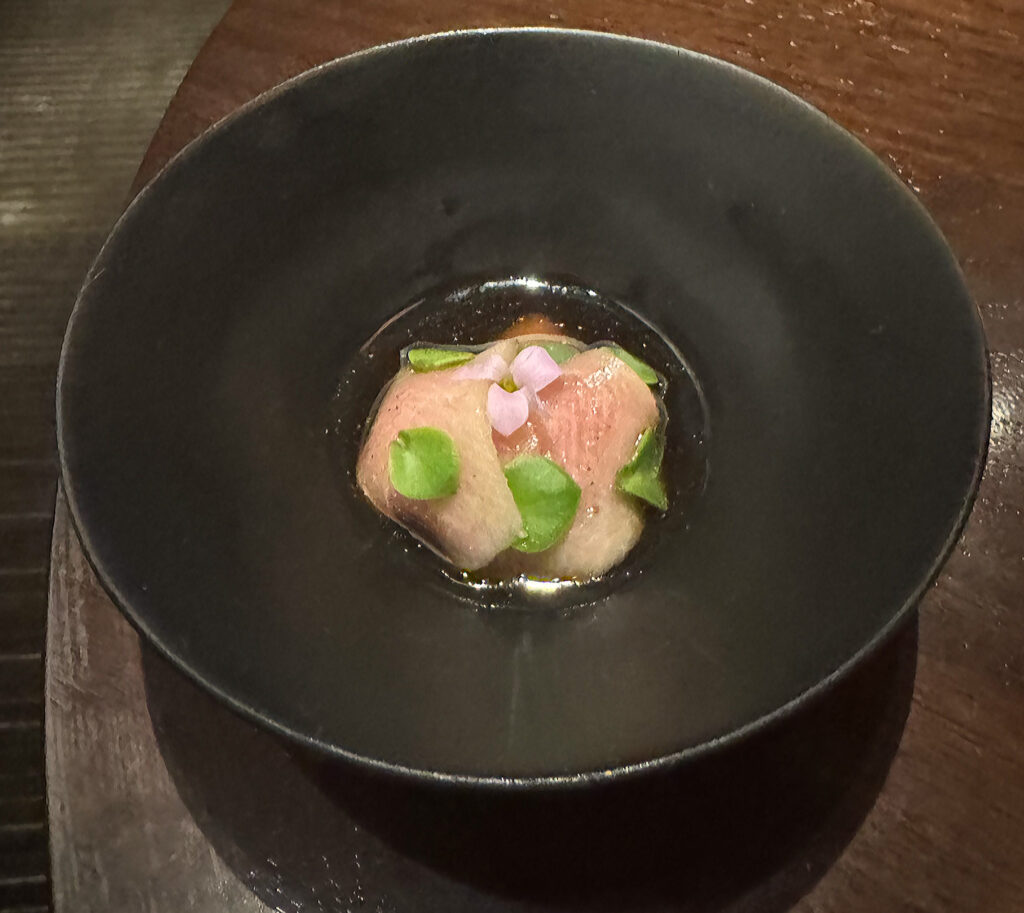
With the arrival of the “Otoro” (that fattiest cut of tuna belly I am so used to writing about in an omakase context), the kitchen’s shift toward a quasi-sashimi sequence becomes clear. Personally, I welcome the movement, which trades away recipes that featured sea urchin or mushroom for the sake of thoroughly exploring the divergent qualities of prized fish. Even better, there’s nothing rote about how the team treats this coveted cut of tuna. Sourced from Baja, it comes dressed with a sablefish bone broth, some smoked mushroom dashi, pickled Nichols Farm groundcherries (now one year old), and a few leaves of lemon succulent.
On the palate, the ōtoro leads with a trace of firmness before veering toward a soothing, melty sensation punctuated by gushing streaks of fat. Yes, sliced generously, this fatty tuna belly is absolutely true to type. When it comes to flavor, the pieces of groundcherry and succulent (beyond offering a subtle, contrasting crispness) invigorate the fish’s richness with notes of tangy citrus and tropical sweetness. The combination works nicely, and the surrounding pool of bone broth and dashi helps to provide some savory backing too. However, for my palate (and it’s a palate that has perhaps spent too much time at Kyōten), I would prefer to see the degree of umami dialed up even further. Hell, even the fruitier tones could be amplified, for I think the key to showcasing a cut like ōtoro is to totally saturate its marbling with a concentration of flavor that few other ingredients could possibly handle.
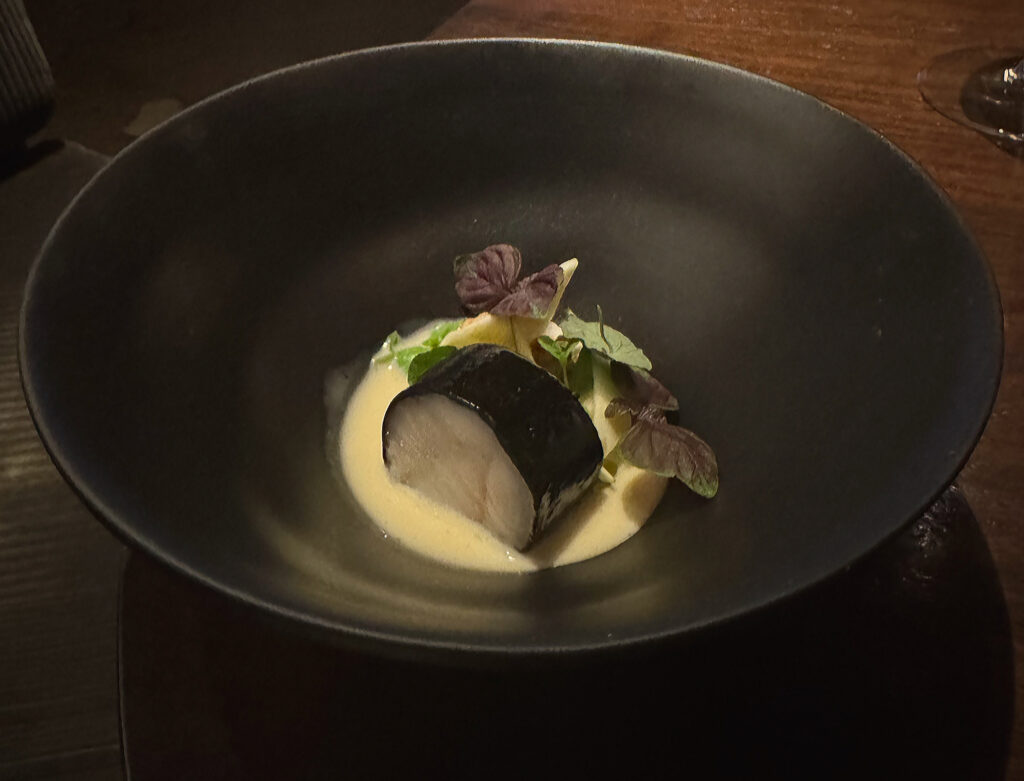
Playing off of the bone broth served as part of the preceding dish, the “Sablefish” looks to fulfill and finalize a flavor that was only hinted at before. This particular fish (which appeared in January but has also been emblematic of Oriole’s post-pandemic work) makes for one of the most satisfying I have ever tasted when entrusted to this team’s hands. However, on this occasion, the manner of preparation seems to diverge from the unabashed richness (drawn from foam, nuts, traces of shellfish, and rice) that has so impressed me in the past.
Here, the sablefish is poached and wrapped in nori—fittingly capping off a sequence I already compared to sushi. The fish is joined by segments of zucchini and a thicket of lime leaf, which all come soaked in a lemongrass beurre monté that hides a bottom layer of Koshihikari rice. Upon hearing that a couple of the usual winning elements have made their way into this recipe, I am optimistic that this course merely represents a new take on a familiar hit. Indeed, the fish itself (even tucked within its wrapped) delivers the impossible smoothness and rich, mildly savory flavor I have come to know and love. Nonetheless, just when I expect the sauce and the other accompaniments to push this starring ingredient to stratospheric heights of decadence, I encounter overwhelming notes of citrus that effectively sap any lasting pleasure. Ultimately, it’s not hard to see what this reinterpretation of the sablefish is going for, but the dish really needs to be rebalanced if it hopes to compete with past examples of the form.
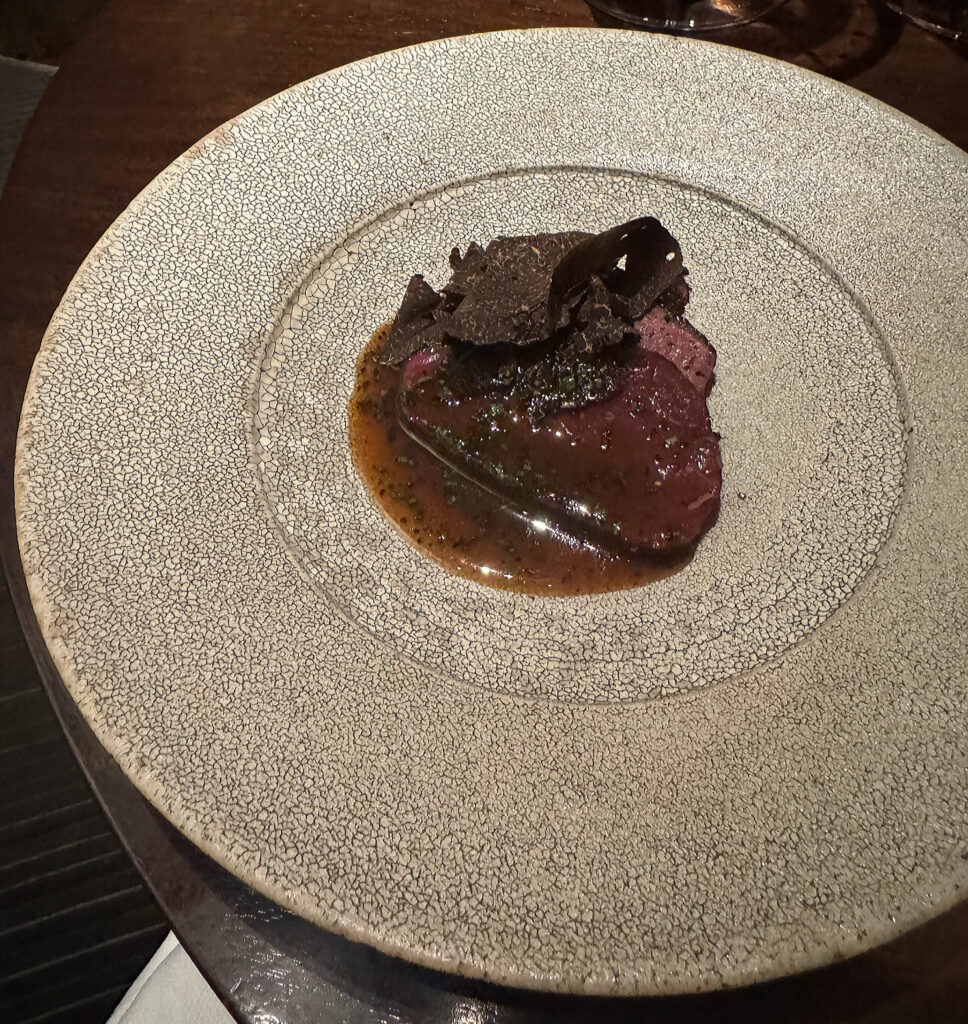
The ”Venison” really impressed me when it made its debut last visit, and I am happy to report that it tastes even better tonight. Visually, the portion of strip loin has seemed to shrunk (rarely a good sign), yet—cooked over the konro—it displays a gripping tenderness and moistness throughout the flesh. Flavor here is shaped by the meat’s own jus in combination of with coriander, quince, and a healthy shaving of Périgord truffle, which combine to enhance the venison’s own latent richness and earthiness with supporting notes of citrus, warming spice, and haunting musk.
The overall expression here is totally convincing in its savory power (just the kind I have been looking for), but there’s also an uplifting quality to the combined toppings that keeps me craving each subsequent bite. Meanwhile, the side of venison sausage-stuffed morels—plump, nutty, and nearly sweet in their own right—only adds to the fun. For my palate, this remains one of the restaurant’s most important courses: the kind that allows for a broader enjoyment of red wine throughout the meal while preventing the menu (which will soon reach its closing course of wagyu) from seeming sparse in its offerings.
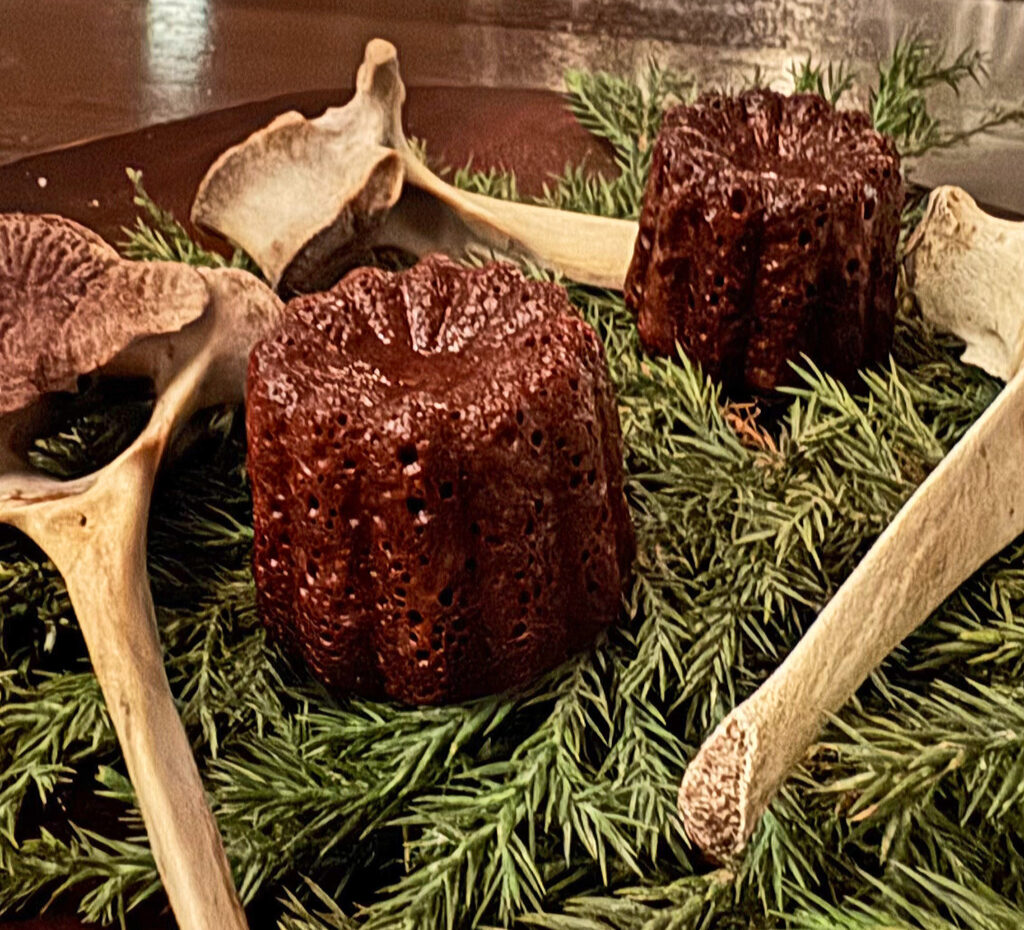
Served alongside the venison, a “Canelé” (flavored with rye, coffee, cocoa, and Nikka Yoichi whisky) remains a thrill. Honestly, I still think this pastry feels more like a dessert than a real substitution for the Japanese milk bread that Oriole used to serve. However, dragged through the meat’s jus, this crisp and custardy delight—brimming with earthy notes of its own yet tending toward chocolate and caramel—harmonizes nicely with the main plate’s savory tones. I’m almost left expecting to transition toward the sweeter side of the menu (and that would be clever), but there’s one more item to come.
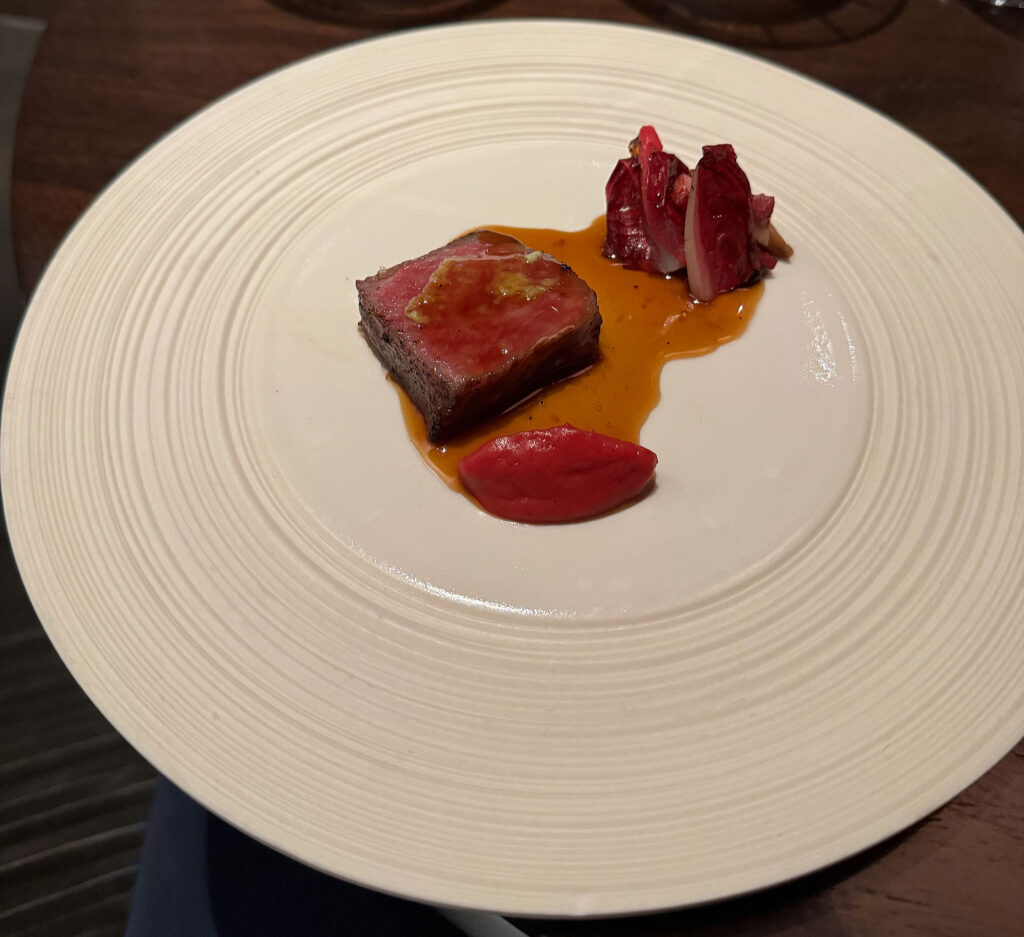
Over the past few visits, the kitchen has really come to master its “A5 Miyazaki Wagyu Ribeye”—revitalizing this totemic luxury ingredient (so hackneyed by now) by pairing it with diverse, engaging accompaniments that amount to a feeling of untold decadence. Following the announcement of Sandoval’s forthcoming concept All Well, it seems as though some version of the recipe will be making its way to the more casual spot. Thus, Oriole has had to find a new way of distinguishing its beef, settling on a composition that pairs the steak with rhubarb cream, a wagyu knuckle and rhubarb jus, some Shizuoka wasabi, and a salad of red endive, pickled pearl onion, and black garlic.
On paper, the chosen elements feel savvily chosen: cutting the ribeye’s richness with touches of tartness, bitterness, and pungency while emphasizing its hedonistic qualities through concentrated umami. Texturally, the cook on the wagyu continues to be a highlight here, for it marries a hint of chew with ample melty, luscious fat that honors the ingredient’s prized status. Flavor, as one brings the cream, the jus, and the salad together, balances tang with a strong (almost too-strong) imprint of salt. At the same time, the wasabi is so bland as to be imperceptible, meaning that the meat’s marbling lacks the sharp, sweet counterpunch that would weave the other components together.
Ultimately, this dish is undoubtedly savory, but that sensation is rooted more in the intensity of black garlic rather than the character of the beef itself. Further, nothing on this plate tastes quite as good as the eggplant or horseradish condiments used in the old recipe, and I am left feeling that the venison, tonight, handily beats its famous, fatty counterpart.
Dessert, in the hands of executive pastry chef Kyra Farkas, has been nothing short of a marvel during the course of my past few visits, and this occasion proves no different.
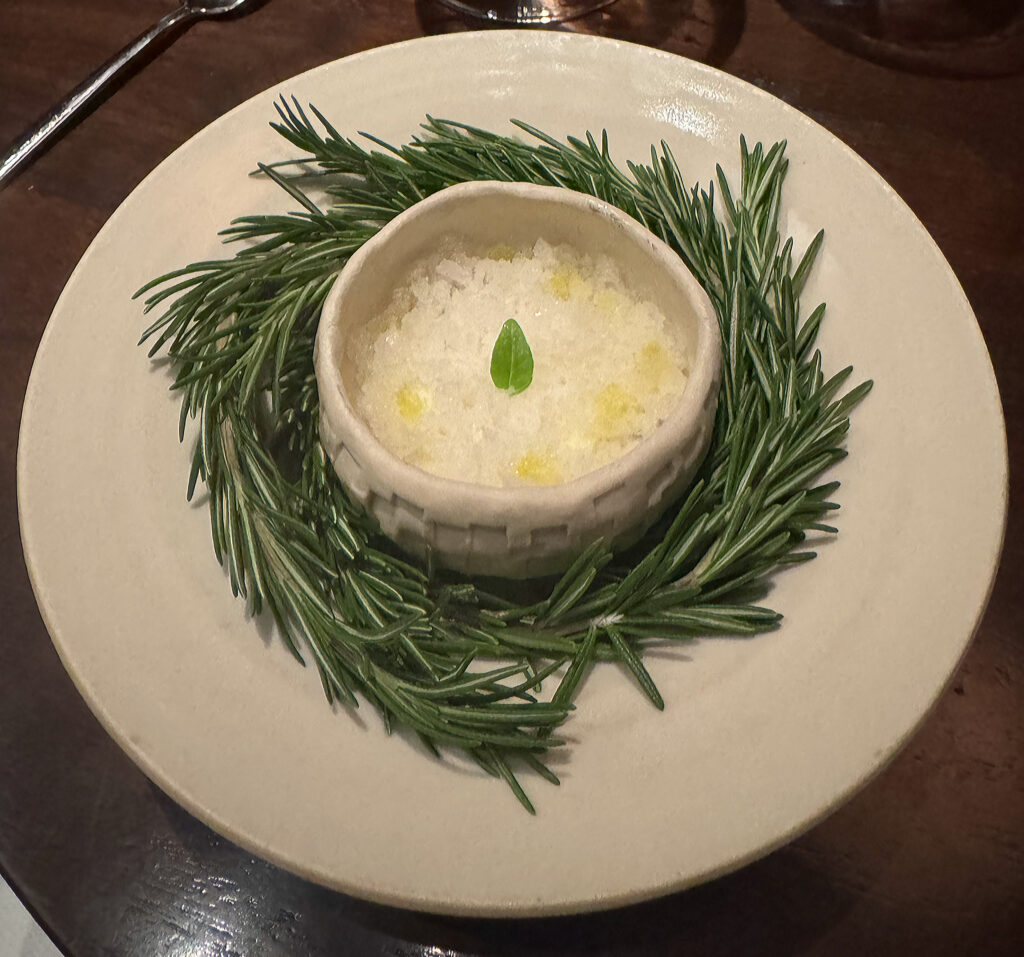
Her “Rosemary Ice,” combining lemon pâtes de fruit, an olive oil sorbet, a surrounding layer of rosemary granita, and a finishing drizzle of rosemary-infused black olive oil, remains a delight: combining creamy and melty textures (free from any abrasive ice crystals) with a resoundingly sweet, exquisitely herbaceous flavor that transcends any temptation to label the recipe a mere “palate cleanser.” Yes, it’s rare that I actually look forward to a dish like this, yet it continues to shine on each encounter.
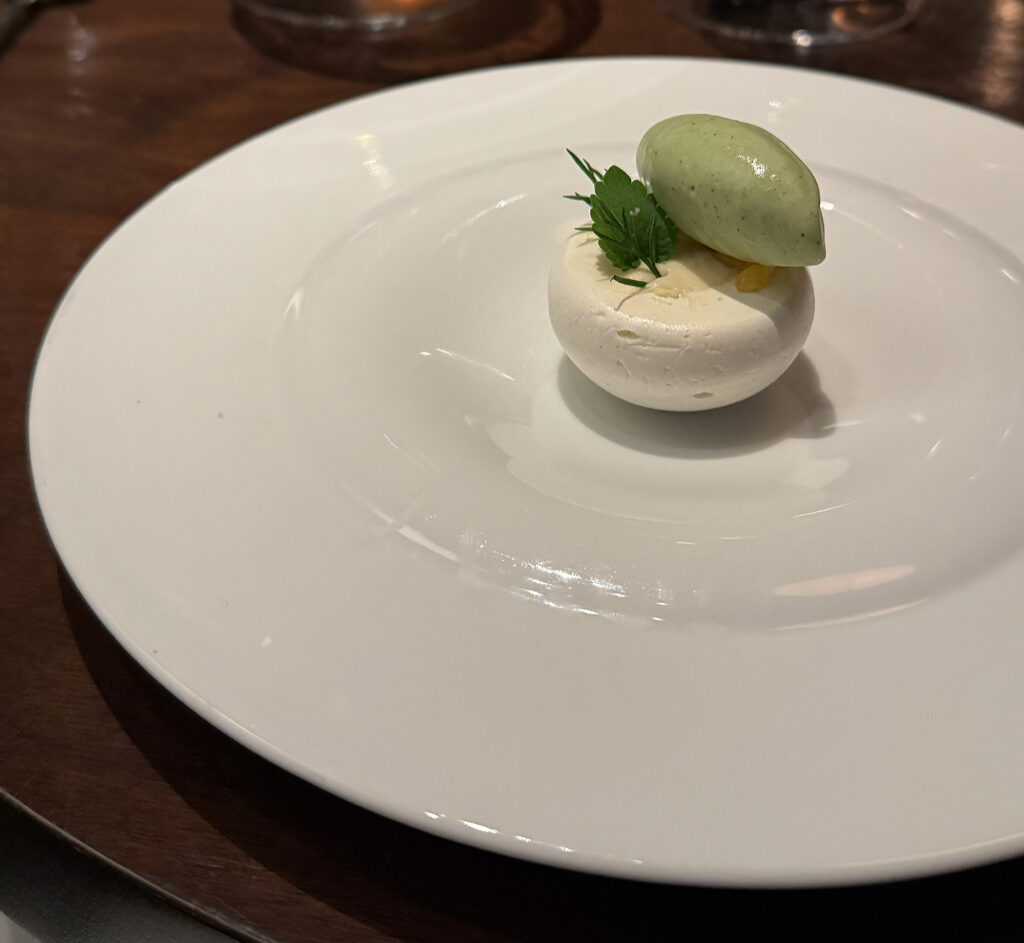
The ”Fennel Pollen Pavlova,” in turn, represents something entirely new: filling the titular meringue with a tonka bean crémeux, adding a touch of Sumo Citrus (a kind of hybrid mandarin) gel, and topping the whole thing with a quenelle of hoja santa ice cream. Framed by the airy crispness of the central vessel, this dish offers soothing textures of melty dairy and rich, gooey custard. However, it is the flavor—doubling down on the shared anise undertones of the fennel pollen and hoja santa while steering them toward vanilla, sassafras, and toasted nut notes reminiscent of root beer—that stuns me.
Yes, as much as I believe that tasting menus need to opt for rich notes of chocolate or caramel to anchor the meal with a sense of unquestionable satisfaction, the balance struck here (perhaps because it is free of any obvious tang or acidity) is remarkable. This pavlova marries a superlative degree of sweetness with a kind of can’t-put-your-finger-on-it depth that renews the force of every follow-up bite. I only wish the portion was even bigger, for this recipe ranks as one of the finest desserts I have tasted this year or any year. Incredible.
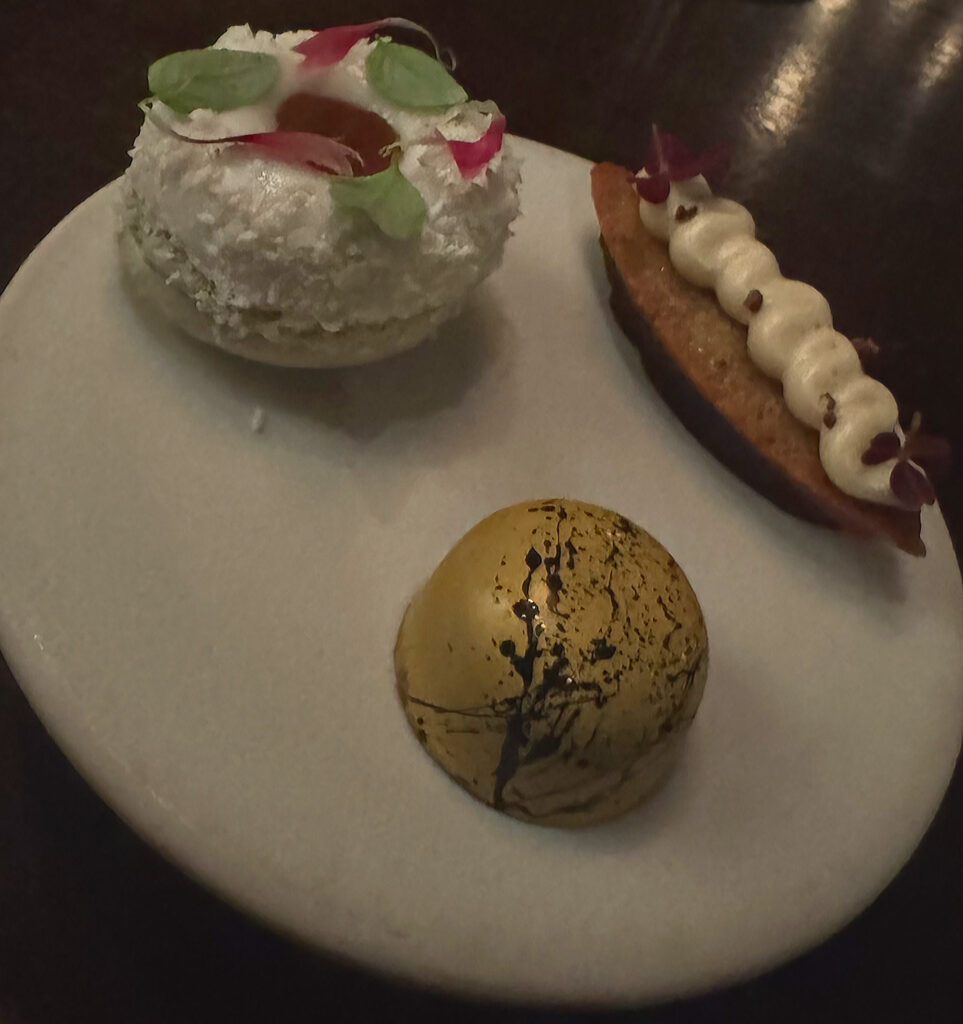
Three petit fours (two of which are new) end the evening:
A “Basil, Lemongrass & Thai Chile Macaron” is served in an open-faced manner, combining a dense frozen texture on entry (amplified by a layer of coconut sorbet) with a warmer, richer interior of fish sauce caramel. The transition in flavor here—from uplifting citrus and herbaceousness to concentrated salt and a hint of heat—is simply sublime. This is one of the best bites of its kind I’ve seen anywhere.
The ”Hazelnut & Boricha Financier” made its debut in January and tastes slightly less satisfying tonight. Yes, while pairing of roasted barley, toasted rice, and honey notes with the titular nut is well conceived (almost chocolatey in character), the texture of the starring cake feels crisp to the point one wonders if it is stale. Likewise, the ribbon of marshmallow that sits atop the financier is also firm rather than fluffy.
Lastly, there’s the “Espresso & Miso Caramel Bon Bon,” which opts for a more conventional marriage of flavors but packages them in an attractive, expectedly pleasing format. This is a nice way to end things.
In ranking the evening’s dishes:
I would place the “Hudson Valley Foie Gras,” “Kanpachi,” ”Venison,” and ”Fennel Pollen Pavlova” in the highest category: superlative recipes that stand among the best things I will be served in any restaurant this year.
The “Canelé,” “Rosemary Ice,” and “Basil, Lemongrass & Thai Chile Macaron” land in the next stratum: great items that achieved a truly memorable degree of pleasure. I would love to encounter any of these again.
Next come the “Australian Abalone,” “PEI Mussel,” “Golden Kaluga Caviar,” “White Asparagus,” “Otoro,” and “Espresso & Miso Caramel Bon Bon”— very good—even great—preparations I would always be happy to sample again (but that just failed to elicit an extra degree of emotion).
Finally, there’s the “Maine Scallop,” “Sablefish,” “A5 Miyazaki Wagyu Ribeye,” and ”Hazelnut & Boricha Financier”—merely good (maybe just average) items that fell a bit short when it came to texture or flavor. None of these bites faltered in more than one dimension, so there was still pleasure to be had (and, undoubtedly, they could all easily be improved moving forward).
Overall, this makes for a hit-rate of 76%—the lowest figure I have seen since September of 2025. However, the 24% of the dishes achieving that “best of the year” standard, as well as the 41% reaching the “would love to have again” level of quality, better align with the kind of meals I’ve been enjoying over my past few visits.
Given the announcement of All Well—with all the attention it demands (not least of which the adaptation of the flagship’s recipes for casual dining)—and the entrance of Balintona behind the bar, it’s fair to say that Oriole remains in a period of transition. Hell, on the culinary side, the arrival of Evelyn Aloupas (whose work I highlighted when writing about John’s Food and Wine and Kumiko last year) means that there’s now a bonafide ex-Smyth contingent (along with chef de cuisine Colin McHugh) shaping the cuisine at a concept that many consumers consider to be its closest rival.
Of course, the relationship between these two establishments—each pursuing their distinct visions at the highest level of craft—is one of shared admiration, and it’s wrong to reduce the sum of any cook’s experience down to a single stop in a single kitchen.
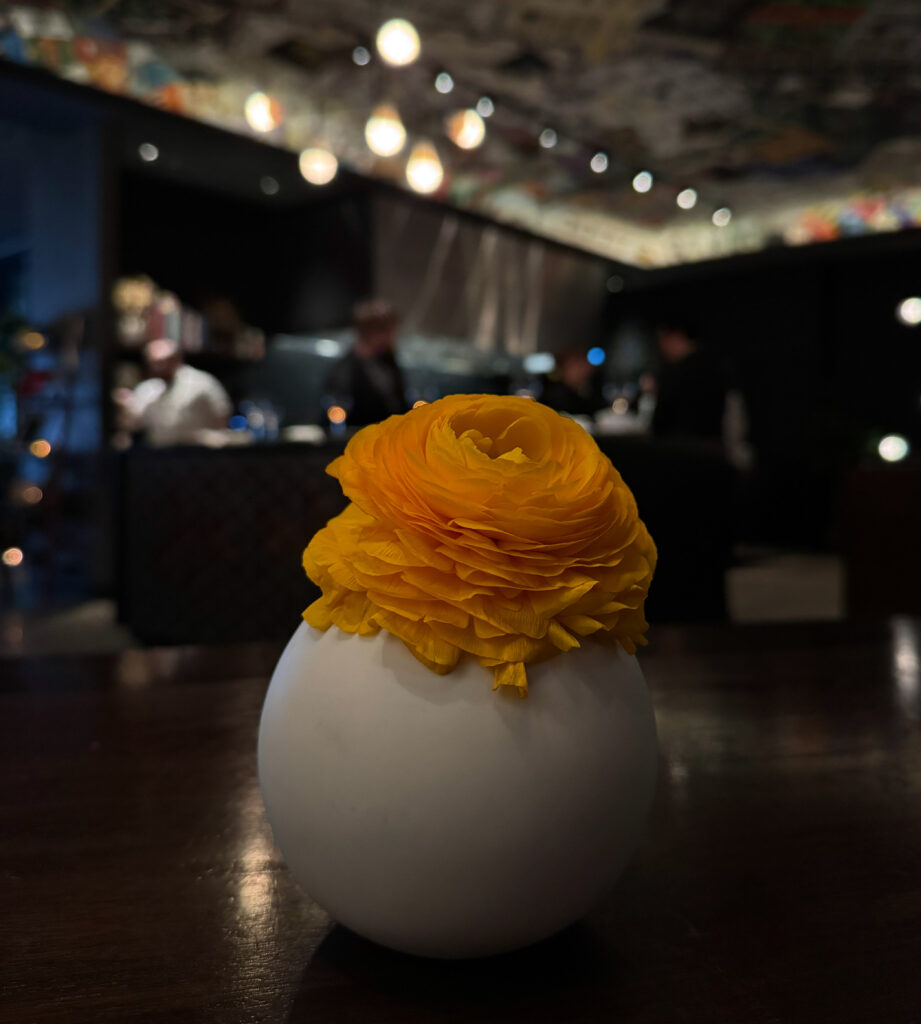
However, now 10 years in, it’s nice to see Oriole embrace a wider range of influences and maybe even undergo a stylistic shift: the kind in which the unabashed decadence of the “Foie Gras” or “Venison” can coexist with the relative elegance of the “White Asparagus,” “Kanpachi,” or “Otoro.”
To be clear, I think it would be a mistake for Sandoval to abandon the kind of dishes—approachable, comforting, and frequently profound—on which he has built the restaurant’s reputation. But there may new paths toward achieving the same kind of pleasure, and the introduction of fresh perspectives naturally carries the possibility of finding them.
The risk, perhaps, is that recipes like the “Sablefish” and “Wagyu Ribeye” see their quality drop precipitously upon being reinterpreted—though, admittedly, these dishes were not bad by any means tonight. Indeed, they showcased entirely new ideas and techniques while continuing to absolutely nail the textures of their starring proteins. Only the balance of the chosen elements felt off (i.e., not attuned to the degree of deep, savory satisfaction I am used to), yet there’s no question that the team—if they so desire—can easily reemphasize that kind of flavor expression.
Otherwise, I can only reiterate that Farkas’s return to the pastry department has been a rousing success: immediately elevating Oriole’s desserts to their rightful place among the city’s best while, simultaneously, pardoning any number of sins on the savory side (namely, an opening sequence of bites in the lounge that also seemed to lose some of its power).
In the final analysis, this menu left me with more questions than I would have expected after such a strong performance in January. Yet there were still plenty of highlights (many of them new items), and I can only applaud the restaurant’s commitment to growth in the face of change and expansion.
This is the attitude that will safeguard Oriole’s excellence over the next decade of its life. More importantly (especially for any repeat guest), it’s a posture that promises that an ever-greater meal always lies ahead.