

Having enjoyed an inventive (yet steadfastly decadent) meal at Oriole back in November, I will limit my exposition here.
It is enough simply to reiterate that chef Noah Sandoval, with the backing of his team, has reinvigorated the restaurant’s cuisine. This does not necessarily mean abandoning the preparations of foie gras, truffle pasta, and wagyu that have cemented his kitchen as Chicago’s greatest guarantor of pleasure. Rather, it involves a skillful process of preservation, adaptation, and refinement all counterbalanced by the bravery to dream: to harness the skills and experiences of the supporting chefs in the creation of a new set of ideas.
As the resulting recipes collide with the established house style, many voices become one. Nonetheless, through the process, Oriole’s own identity broadens and deepens in its expression. Guests, taken along for the ride, are gently nudged toward textures and flavors they might not have considered before. Yet a sense of comfort and security (so essential when shelling out $325 per person) still reigns.
The intention is never to deny what has endeared the restaurant to its audience over the past decade. No, if all goes to plan, the menu will usher in a new generation of signature dishes. They will spur the same emotions (surprise, delight, indulgence) regardless of any differences in underlying form. They will sustain a process of experimentation and introspection that might, eventually, yield the kind of distinctiveness that gastronomy’s highest honors demand.
Certainly, not all the changes at Oriole are good ones—Julia Momosé’s work on the spirit-free side of the beverage program (a real feather in the concept’s cap) will be hard to replace. But evolution, whether forced upon you or embraced on one’s own terms, holds boundless opportunity. We all get to ask: will what many consider to be the city’s greatest tasting menu grow even greater? Will it finally transcend its status (for those privileged enough to ask the question) as a place that impresses first-timers and rewards return visits maybe once a year yet delivers diminishing returns with any more frequency?
Thus far, 2026 has provided me with an opportunity to place Chicago’s finest restaurants head to head. The goal is never to pick winners and losers (indeed, the only losers are the places I’ve already chosen to stop patronizing) but, instead, to foster a dialogue between competing options that can only be ranked in accordance with subjective taste. Doing so, I may construct the guideposts that empower individual consumers to match a given chef’s philosophy to their own. I can also highlight the influences, ingredients, and techniques that unite (or separate) these respective kitchens, a process that might help to illuminate the state of our industry (at least in its highest stratum) during this particular moment in time.
This is all to say: any conversation about the city’s dining scene is incomplete without Oriole, and it’s always a treat (now more than ever) to see what Sandoval and his team are up to.
Let us begin.
After a warm cup of tea and a stop in the elevator, I find myself again in Oriole’s lounge.
I cannot think of any other fine dining concept in Chicago that so immediately and sumptuously sets guests at ease. But, whether one sits at the bar (which is naturally more interactive) or over on the comparably isolated couches (my preference), the first stop of the night is much more than a theatrical gesture.
There’s a welcome toast, yes, and an opportunity to orient oneself within the larger restaurant and the retinue of one’s dining companions. However, the kitchen also serves some of its strongest dishes here—a trio of ever-changing bites that, channeling luxury ingredients and Sandoval’s culinary style into diminutive forms, affirm exactly what the Oriole experience is about. Hell, there have been times when this early peak (in combination with the foie gras served in the next room) represents the climax of the entire meal.
Tonight, I will only say that I am thrilled to encounter three completely new creations: a “shellfish and winter citrus” sequence that testifies to the degree of dynamism the team has now embraced.
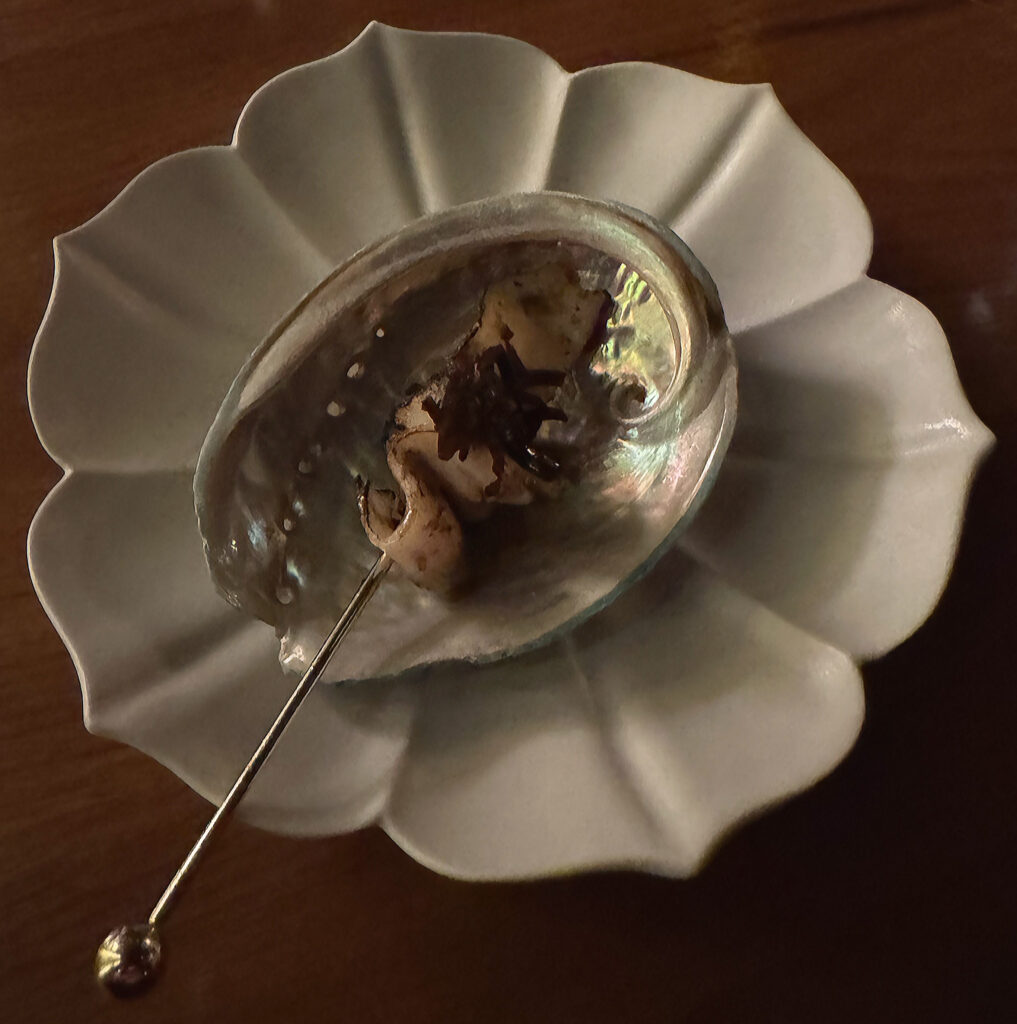
First up is the “Australian Abalone,” which centers on the sustainable Jade Tiger variety of this coveted mollusk. The meat, upon being extricated from its shell, is glazed with a combination of Buddha’s hand and black lime before being torched. The resulting portion is then neatly skewered and served with strands of shio kombu, yielding a bite that displays surprising chew and persistence before tending toward a rich, sweet finish that is almost reminiscent of barbecue. For my taste, the acidity from the fruit elements is just a bit too prominent (detracting from the umami of the abalone). Nonetheless, this dish remains wholly enjoyable and makes for a great start.
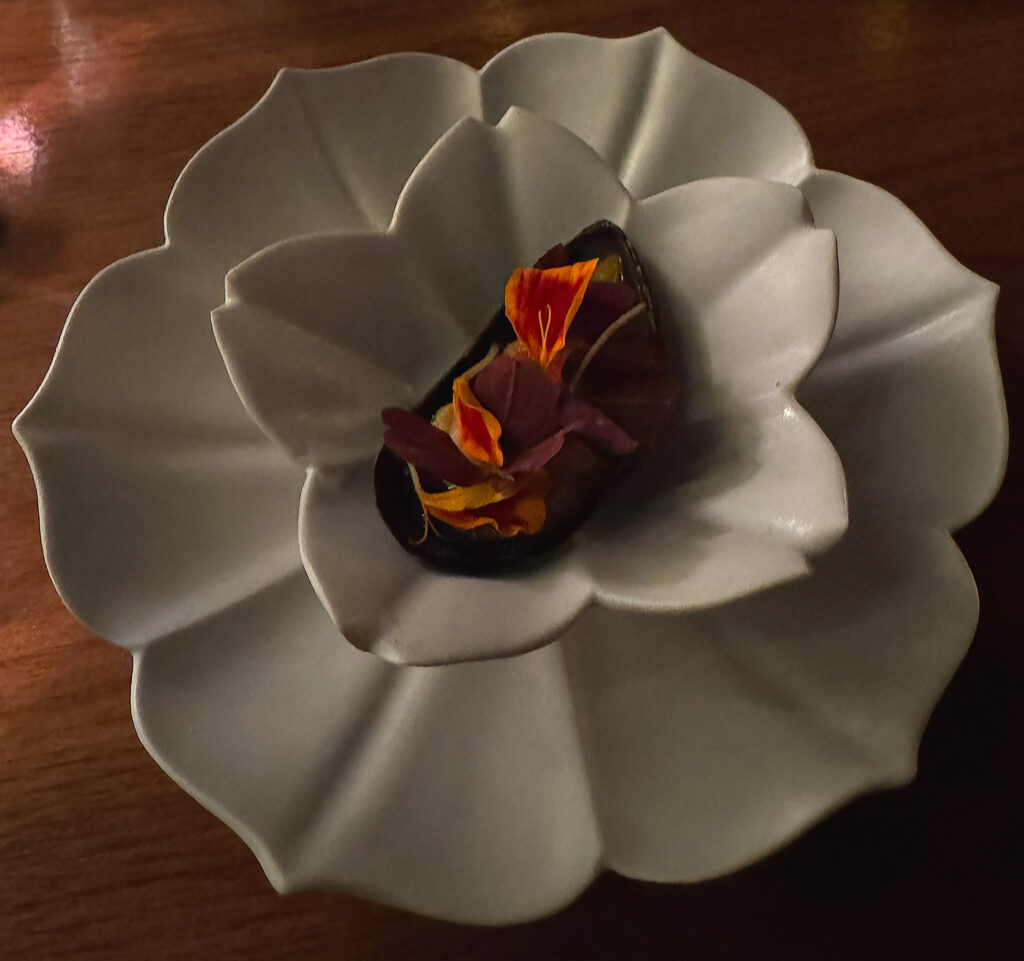
The “PEI Mussel” that arrives next (the popular “blue” species sourced, as the title suggests, from Prince Edward Island) takes the form of an enticing half shell. Therein, the bivalve’s meat has been poached, paired with a mousse made from the same ingredient, and dressed using finger lime, yuzu kosho, and some edible flowers. The resulting mouthful—though blemished by the slightest crunch of sand—is sweet and seamless with a notable imprint of tang (again) but, otherwise, a pleasing oceanic finish. Overall, this item probably forms the weakest member of the sequence; however, it is also one I would be more than happy to encounter again.
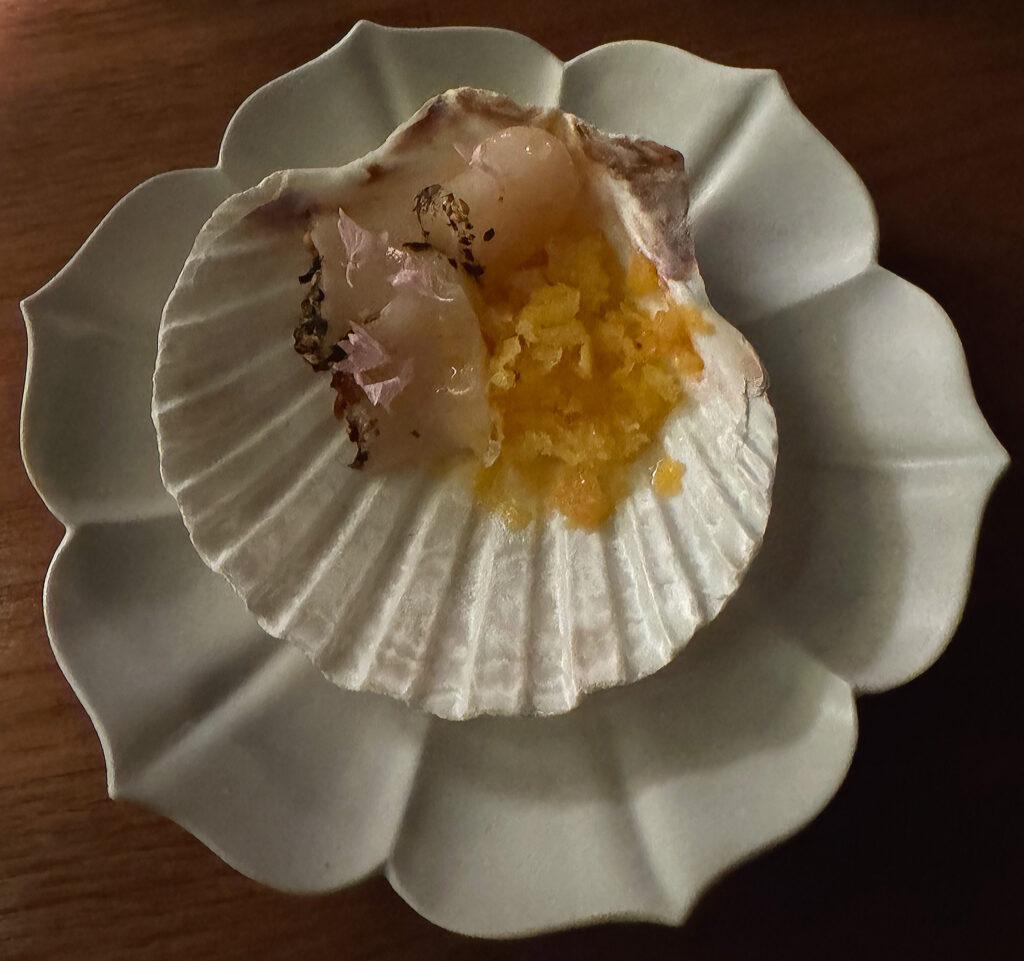
Lastly, there’s the “Maine Scallop,” an ingredient (not unlike the humble mussel) whose ubiquity generally impedes any sense of novelty or luxury. Yet, by fashioning the mollusk into a crudo (which involves slicing the meat thinly, rolling it in shichimi togarashi, then pairing it with pickled persimmon, persimmon granita, and sesame), the kitchen shapes an expression of the shellfish that is totally singular.
Texturally, the scallop possesses a soft, buttery mouthfeel that blends effortlessly with the fine, thoroughly flavored ice crystals. The pickled persimmon, true to type, provides some enlivening acidity (the kind I’m wary of after the last two bites). However, I find the dish’s overall effect to be sweet and soothing with just enough background sharpness to draw out the bivalve’s savory depth. In short, this preparation is beautifully composed, and it ranks not only as the strongest of the sequence but as one of the best of the night.
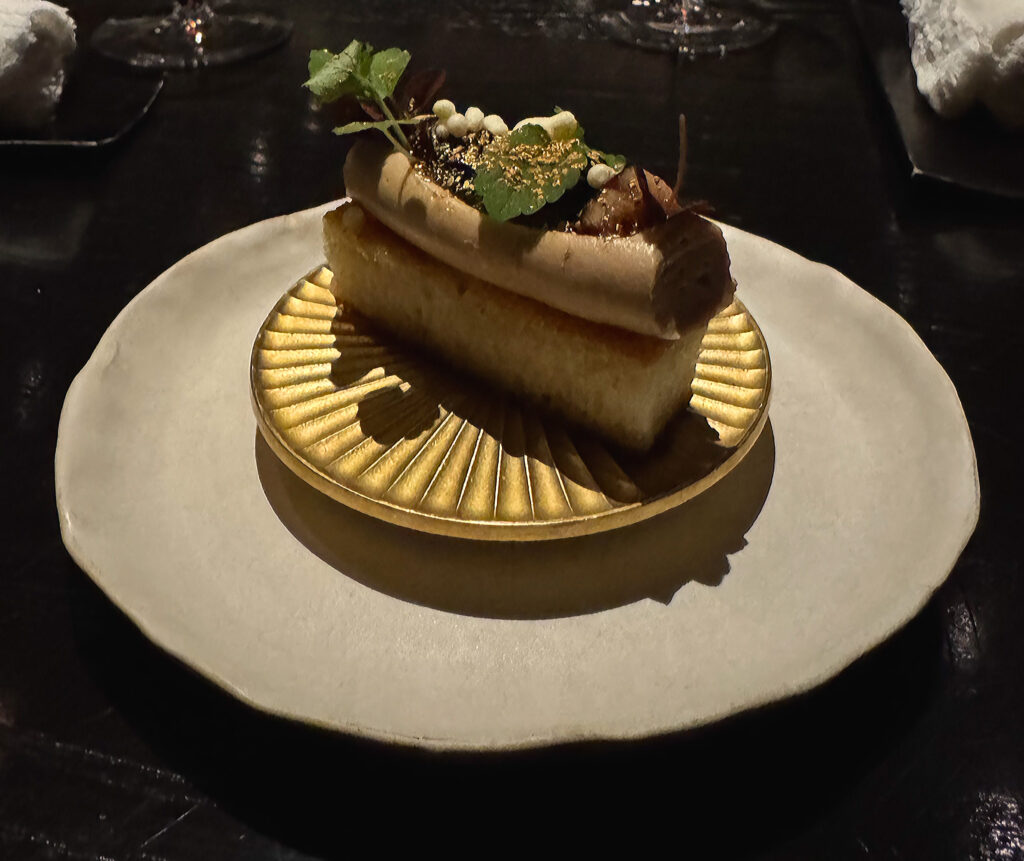
Moving to the kitchen counter, I am met by the “Hudson Valley Foie Gras”—a signature Oriole recipe that, on its day, forms the finest rendition of duck liver I have ever tasted. Back in November, this bite was marred by a slightly frozen consistency that robbed this combination (comprising a brioche base, the offal parfait, California figs, crème fraîche Dippin’ Dots, pink peppercorn, and oxalis) of its usual pleasure. Tonight, the chosen ingredients are exactly the same, and, on this occasion, they do not miss.
On the palate, the crisp bottom layer of bread (cooked in yeasted butter) yields to a ribbon of foie gras that is luscious, creamy, and lip-smacking. Though the chew of the figs and frozen, melty sensation of the dots provide some contrast, the ultimate feeling here is of weight. And that weight, with each chew, unwinds into an avalanche of sweet, savory, and caramelized tones (offset by a tinge of citrus) whose satisfaction, years on, remains immense. I don’t think I’ll ever tire of this toast when it is executed faithfully, and, barring seasonal shifts in fruit, I do not see how the team could meaningfully change this offering without drawing protest.
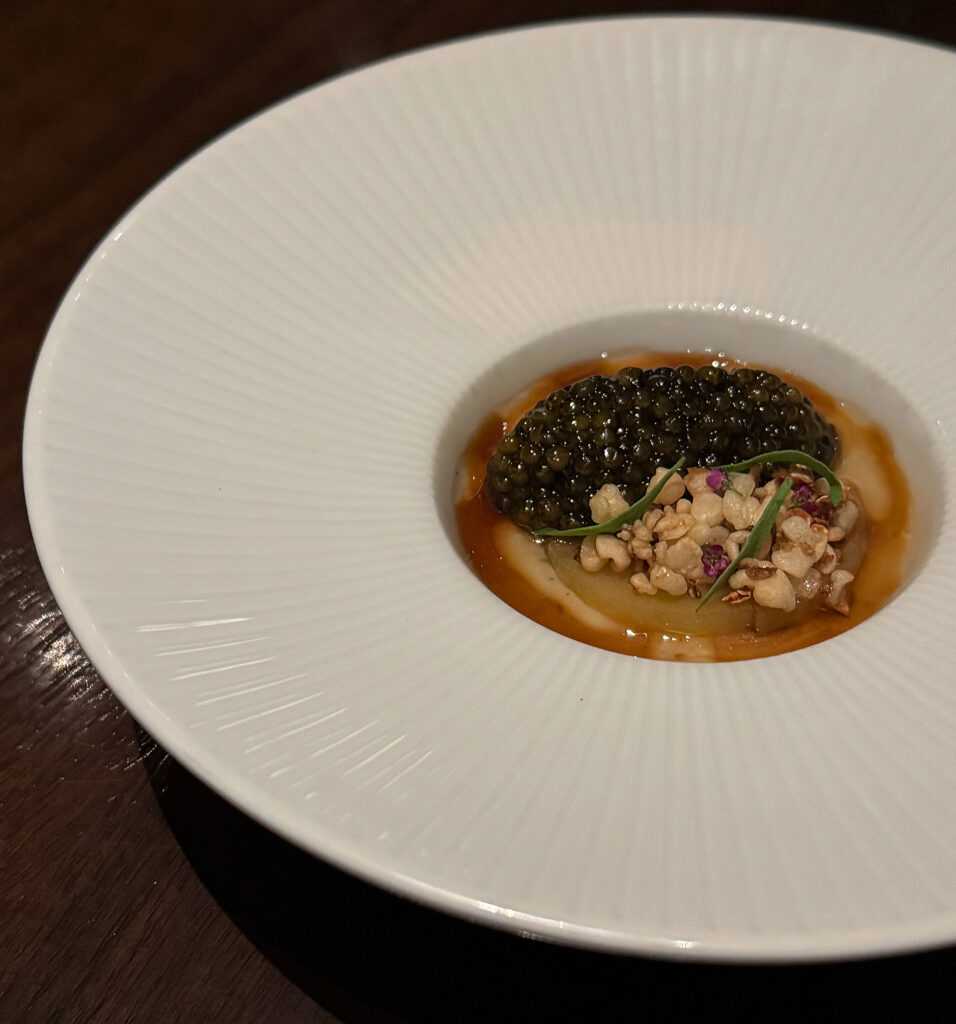
Making my way to the table, I encounter the first of Oriole’s proper, fully composed courses. Of these, “Golden Kaluga Caviar” has undoubtedly formed a fixture—albeit one whose exact constituents have changed from visit to visit. In September, I found flavors of peas, green garlic, and lobster. In November, notes of smoked crème fraîche, razor clam, and green apple tried their hand. Neither dish really blew me away, but the present combination of hojicha custard, potato, puffed buckwheat, toasted wheat berries, and sobacha honey promises a degree of decadence that might finally meet my expectations.
Texturally, it’s hard not to like the preparation, which blends smooth (the custard), crisp (the slivers of potato), and brittle (the puffed/toasted elements) sensations without obscuring the caressing orbs of roe. Golden Kaluga is characterized by its nutty finish, and, once one appreciates its buttery attack, the concentration of roasted tea and earthy grain tones drives the caviar toward a remarkably savory flavor expression. That said, it’s the sweetness of the honey (itself marked by buckwheat) that proves key: unlocking a kindred note in the Kaluga that raises the roe to a level of unabashed indulgence. Overall, this sense of harmony and intensity (rather than contrast) aligns totally with how I like to see luxury ingredients utilized. In short, the current recipe ranks as the kitchen’s finest iteration of this course to date.
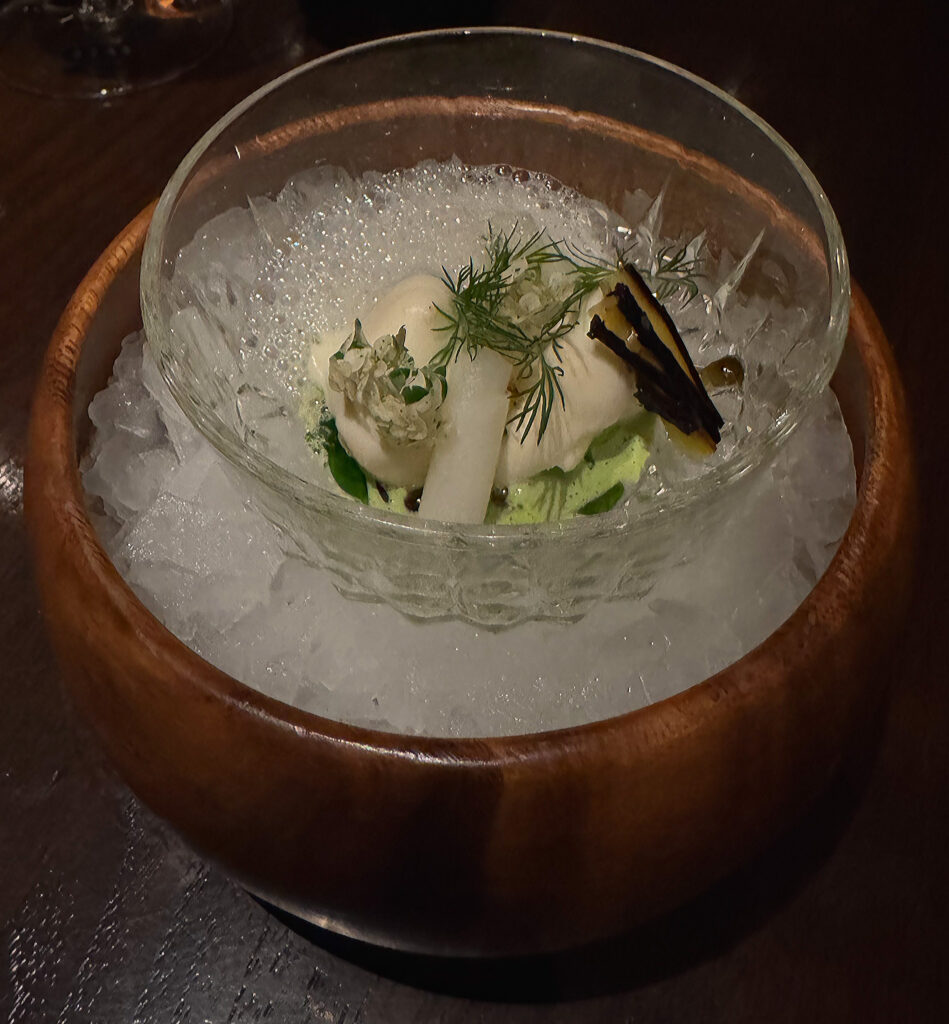
The “Cauliflower” that comes next is entirely new. It also (having replaced the dessert-like “Badger Flame Beets” seen during my last two meals) occupies a challenging position on the menu: that of a wimpy vegetable preparation flanked (on either side) by a veritable fleet of luxury ingredients. Put another way, this is the part of the night where Oriole subverts its familiar style and presents a plate that might feel more fitting at Cellar Door Provisions, Feld, of Smyth. Truthfully, I relish the chance at seeing this kitchen—so talented—show its range.
Here, the cauliflower comes covered in a chaud-froid sauce—that centuries-old, gelatinized reduction—then paired with charred Sweet Garleek, verjus, citrus syrup, dill, and green peppercorn. On the palate, the starring vegetable strikes with a doubly crisp, crunch consistency (on account of its accompanying “shell”). It’s a striking, somewhat unfamiliar effect, yet one that is soothed with the introduction of the creamier base. The resulting flavor is expectedly tangy on entry but broadens toward a sweet, allium-tinged expression with some grassy undertones. For my taste, a dash of salt would help the dish achieve greater satisfaction. However, I cannot deny that the recipe is both refreshing and strangely compelling at this early stage. I’d like to see the team work more in this realm.
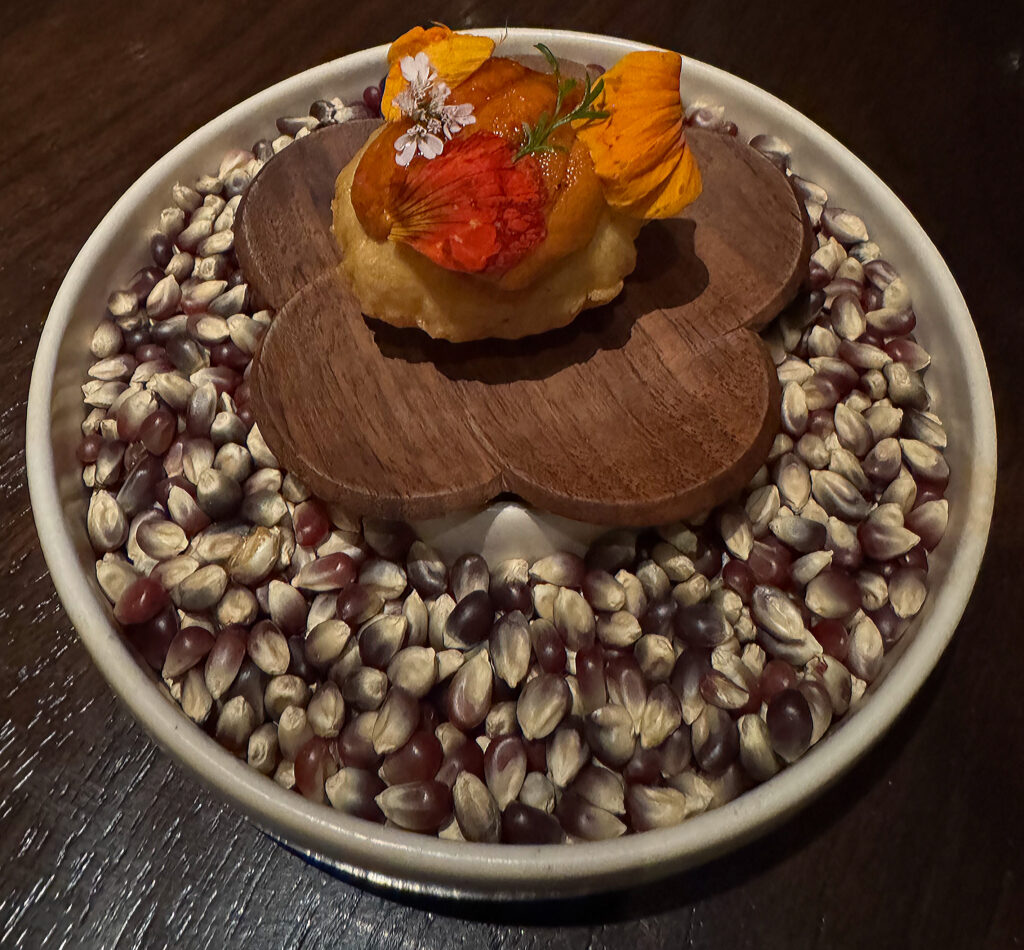
After enjoying a couple of novel creations, I am not at all upset to find something more familiar. In truth, the “Uni Infladita” still stands among the menu’s newer items. Yet, having now appeared (in more or less unchanged form) across three visits, the bite might very well become the restaurant’s latest signature. Certainly, while the first iteration I sampled was undone by a stale base, the second showed much better. I am happy to report that the present example continues that upward trend.
Tonight, the recipe remains the same: comprising a puffed tortilla base that is filled with Australian tiger prawn, fermented watermelon radish, and morita chili then topped with shio koji-glazed sea urchin. Texturally, the crunch of the vessel strikes first and anchors the palate with an earthy, roasted sensation. However, the bite quickly turns cool and creamy with an accompanying bolt of heat that turns sweet and oceanic on the finish. Indeed, while this dish came together successfully in November, it now feels beautifully cohesive. Yes, the infladita marries boldness, nostalgia, and convincing decadence in a manner that resonates with (and reinvigorates) Oriole’s identity. I think it has earned a longstanding place on the menu.
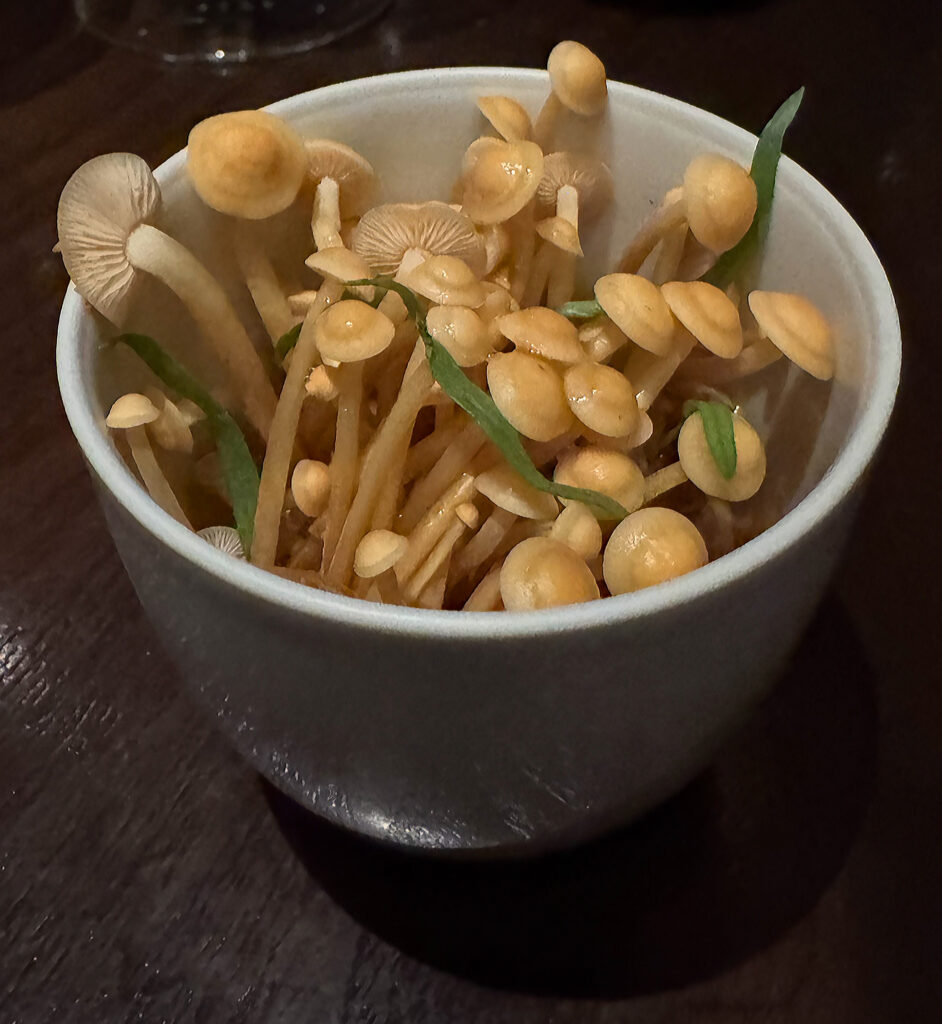
The “Matsutake Custard” represents one of the restaurant’s older staples, and the recipe—marked by a prevailing astringency—represented a rare miss back in November. In all honesty, this is a form (despite its luxurious accents) I have grown tired of. Nonetheless, though the present dish maintains the same title, the composition has meaningfully changed: centering on a tangle of enoki mushrooms set atop a king trumpet custard with the usual additions of foie gras, tarragon, ginger, and mushroom-chicken consommé playing their supporting role.
On the palate, the enokis immediately distinguish themselves from the crisp (almost chewy) matsutakes on account of their hearty, pleasing crunch. With the introduction of the custard and duck liver, the overall effect is substantial and soothing in a way that prior iterations failed to attain. Flavor, too, benefits from the excision of any piney notes. Instead, the preparation delivers a more straightlaced (that is, fruity, earthy, and intensely umami) expression of mushroom that benefits from a well-judged degree of salt and some sweet, tangy lift. In short, this is a nice reimagination and redemption of a recipe I was all but prepared to jettison after my last encounter with it.
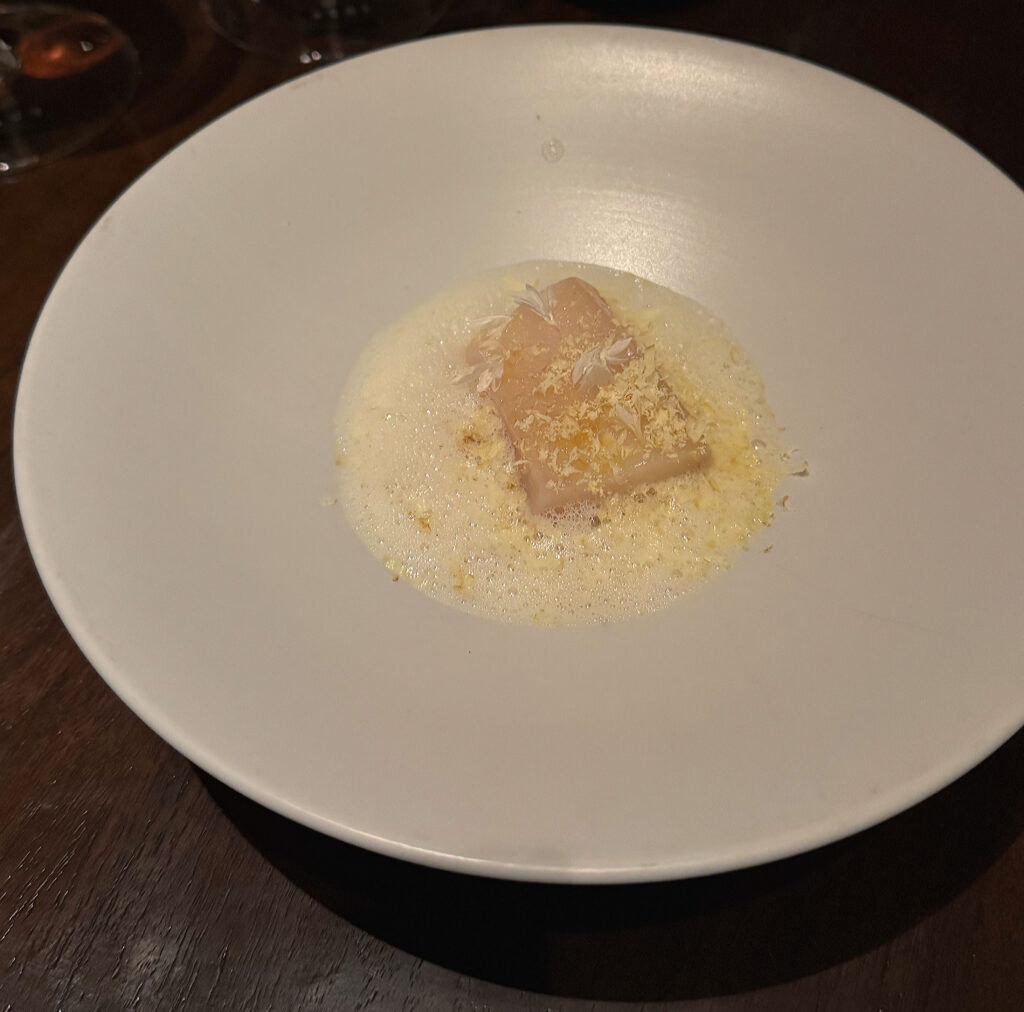
“Sablefish”—the star of the next course—is, for me, an ingredient that is emblematic of Oriole’s post-pandemic, post-renovation menus. Recently, it has given way to other seafood (like an excellent “Norwegian Fjord Trout” I sampled in November or an equally enjoyable “Turbot” from September), but I’ve always chased the high that those early constructions (joined by Japanese milk bread no less) provided. Tonight’s recipe isn’t an exact reboot, but it captures much of the essence of what made those old courses great. Here, the fish is poached, dressed in a white asparagus-chestnut foam, joined by some Dungeness crab, and finished with grated chestnut, toasted genmai, and a bit of Koshihikari rice.
These latter two elements featured in the older preparations, and, on this occasion, their respective crispness and absorptive weight do well to contrast the supremely rich, buttery fillet. Though sablefish is somewhat mild in character, the level of sweetness (from the white asparagus and crab) and nuttiness (from the chestnut) on display absolutely charges it with flavor. There’s an earthy undercurrent too that, by cutting through the decadence, only helps to delineate it further. Ultimately, the dish eats in a manner that just feels so effortlessly pleasing and near endless in its length. I still dream of being able to sop up the remaining sauce with a bit of bread. However, this sablefish reiterates why Sandoval and his team are masters at cooking fish. Its return makes for one of the evening’s most memorable moments.
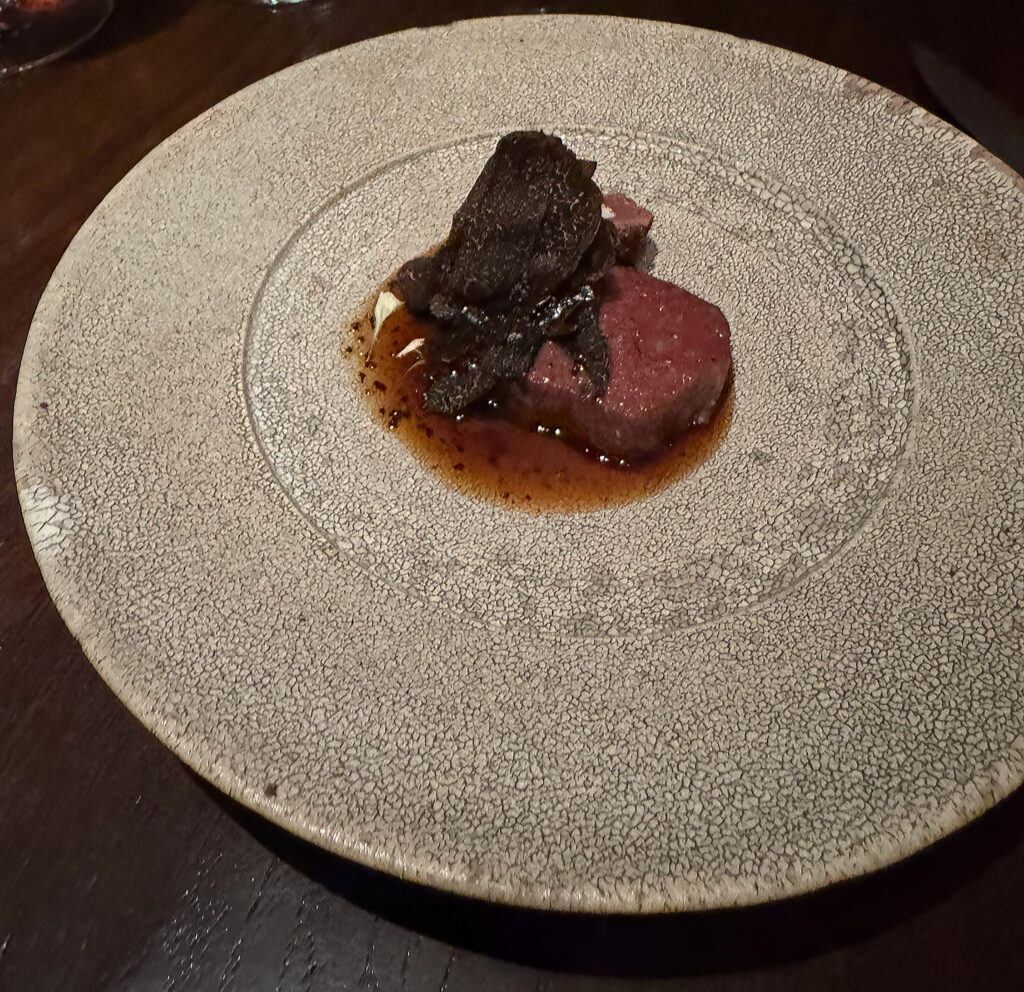
At this point in the meal, I might expect to be treated to Oriole’s signature truffle pasta. After all, it forms the restaurant’s oldest and most reliable guarantor of pleasure. But, instead, I am met by the “Venison”—an entirely new preparation that also (commensurate with the removal of one course) replaces the lamb belly I enjoyed in November.
I don’t necessarily subscribe to the logic that a tasting menu must serve a certain amount of meat to be satisfying. Nonetheless, I’ve enjoyed seeing the chefs work with multiple servings of animal protein that empower the use of heavier flavorings and make for memorable pairings with that cellar full of fine red wine. Going from fish to pasta to lamb to beef (or, tonight, fish to venison to beef) also feels less hackneyed at a time when wagyu still predominates on menus throughout Chicago.
The present dish centers on a shining slab of venison striploin that has been cooked in juniper butter, dressed in its own jus, flanked by sausage-stuffed morels, and finished with a generous shaving of black truffle. On paper, the recipe seems trained solely on pleasure—a concentration of classic, kindred notes rather than any adventurous contrast or subversion. And, indeed, each bite of meat offers a soft, juicy mouthfeel with ample backing salt and an earthy-sweet intensity that carries through the finish. The morels, too, are nicely executed: striking with a plumper texture and a slightly sharper expression of the venison. Overall, I do find that this plate lacks that extra wow factor to really be memorable. Yet, structurally, it still plays an important part in anchoring the meal.
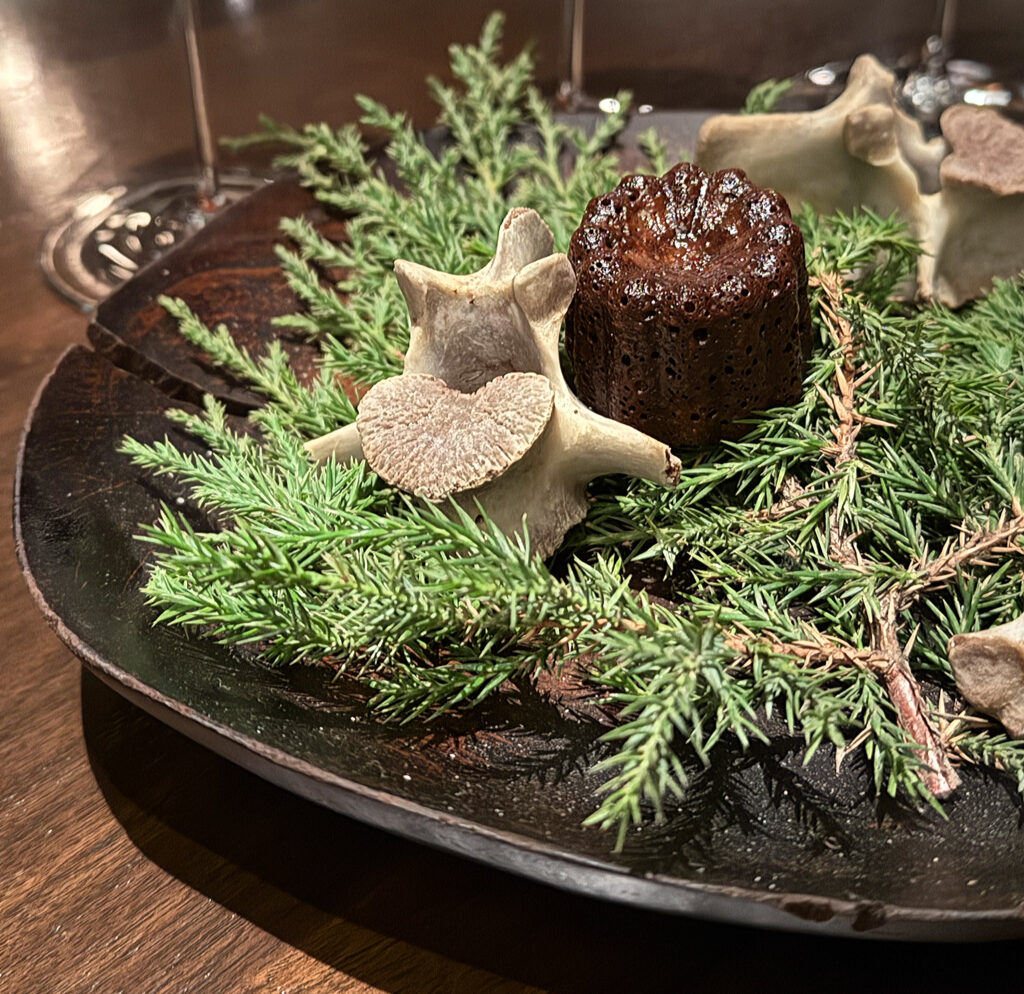
Served alongside the venison, a “Canelé” (flavored with coffee, cocoa, and Nikka Yoichi whisky) seems to answer my prayers—for an added flourish and, more broadly, the return of some kind of bread course. Now, admittedly, this pastry would not be out of place in the dessert section. However, its warm, chocolatey expression (backed by roasted, smoky tones) plays beautifully off the meat and ensures the preceding course strikes a more playful, decadent, and—yes—memorable note. What a pleasant surprise.
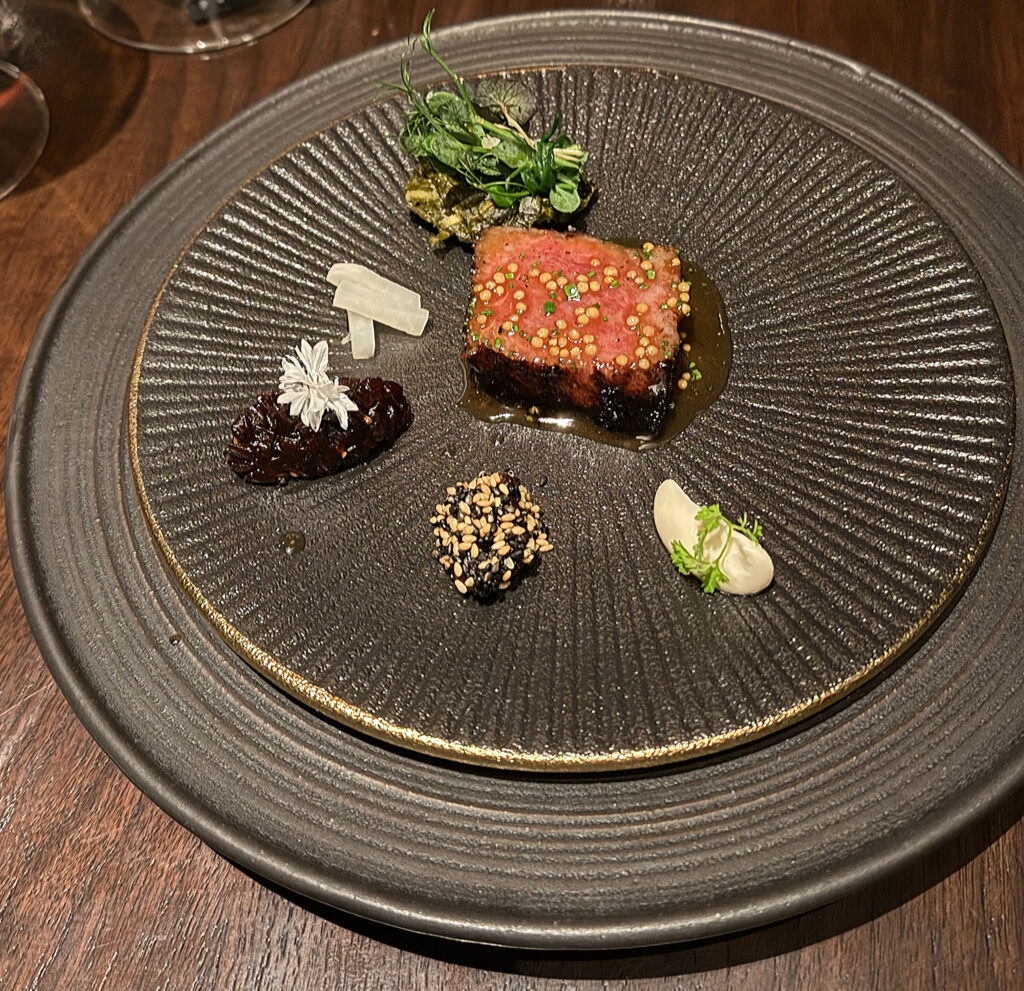
The “A5 Miyazaki Wagyu Ribeye” that arrives next has retained its form from September and November, and why not? The recipe stands as one of Oriole’s newest signatures: a preparation of coveted Japanese beef that actually, reliably delivers the kind of luxury that such an ingredient inevitably promises. This sizable cut of meat is dressed in a veal jus (interlaced with mustard seeds) and surrounded by a choose-your-own-adventure spread of turnip-horseradish cream, sesame seed-crusted spinalis, caramelized eggplant, pickled turnip, and mustard greens.
On the palate, the ribeye itself remains so winningly juicy—so charged with savory (and relievingly pungent) depth—that one need not introduce any of the accompaniments to find satisfaction. Of course, that would be a mistake, for the eggplant (profoundly sweet with some earthy intrigue) is sublime. The spinalis, blending pronounced charring with nutty complexity, stills comes across as a little meager. Nonetheless, the cream (marrying power with subtle sweetness), the pickles (more noticeably sour), and the mustard greens (crunchy, cleansing) each seem to have raised their game. Yes, with plenty of meat to go around, it really is a thrill (even on this third occasion) to mix and match the components. Ultimately, Sandoval seems to understand wagyu in a way that his Michelin-starred peers do not, and the chef—years later—continues to prove why it belongs on the restaurant’s menu.
Turning toward dessert, I am granted another opportunity to sample executive pastry chef Kyra Farkas’s work. Admittedly, the present dishes have not much since November; however, her return to Oriole still offers a huge boost to the kitchen.
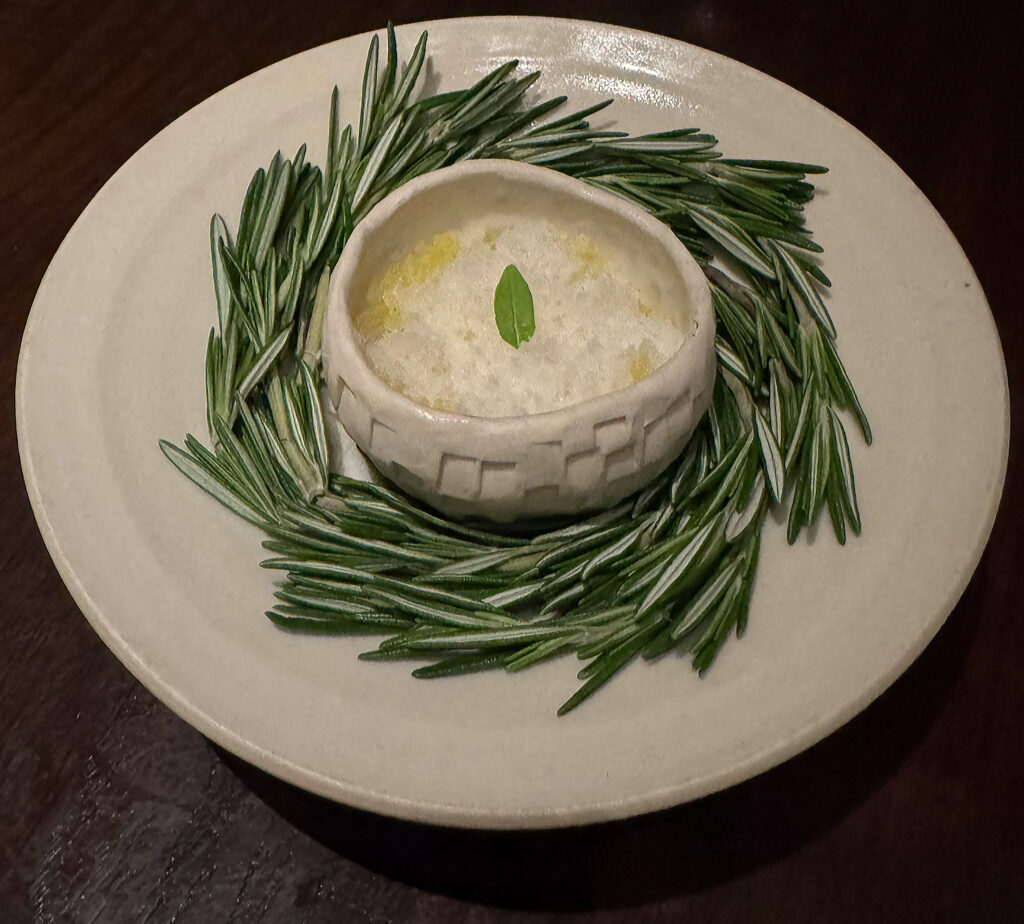
To start, the “Rosemary Ice” (inspired by Farkas’s childhood) combines lemon pâtes de fruit, some olive oil sorbet, a surrounding layer of rosemary granita, and a finishing drizzle of rosemary-infused black olive oil. Echoing my previous encounter with this recipe, I am impressed by how flawlessly smooth these frozen components (especially the granita’s ice crystals) feel on the palate. Further, while the resulting flavor is marked by ample tang and sweetness, there’s a supporting richness here (backed by earthy, woodsy notes) that spurs a unique sense of satisfaction. The sum effect is something more than a mere palate cleanser. Rather, this is a proper course that I’d enjoy lingering over again.
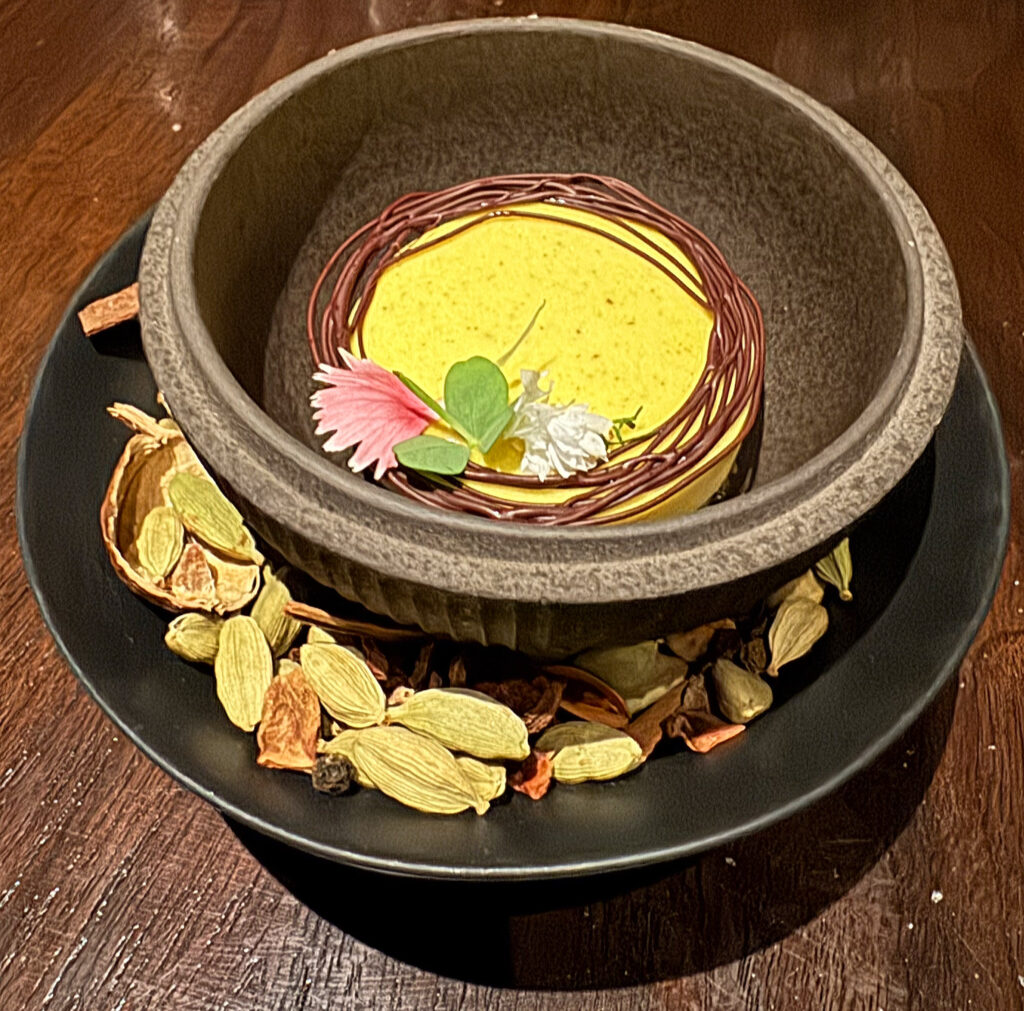
The “Golden Milk” also returns tonight: comprising a Cardamaro-soaked cake base, a dark chocolate nest, and an ice cream flavored with pistachio and titular notes of turmeric, cardamom, cinnamon, and ginger. On the palate, the dish contrasts the dark, rich, and sticky character of the crumb with the creamy, spicy, more alleviating expression of the frozen topper. The dark chocolate (Valrhona Nyangbo to be exact) helps to bridge the gap with its own delicately spiced, vanillin notes. Nonetheless, on this occasion, the Cardamaro dominates with its dried fruit tones and detracts from the other elements with a somewhat sickly finish. In short, I prefer the version of recipe I encountered in November, but, indeed, there is still pleasure to be had here.
Mirroring that dynamic opening sequence of bites, the meal ends with a set of three new petit fours:
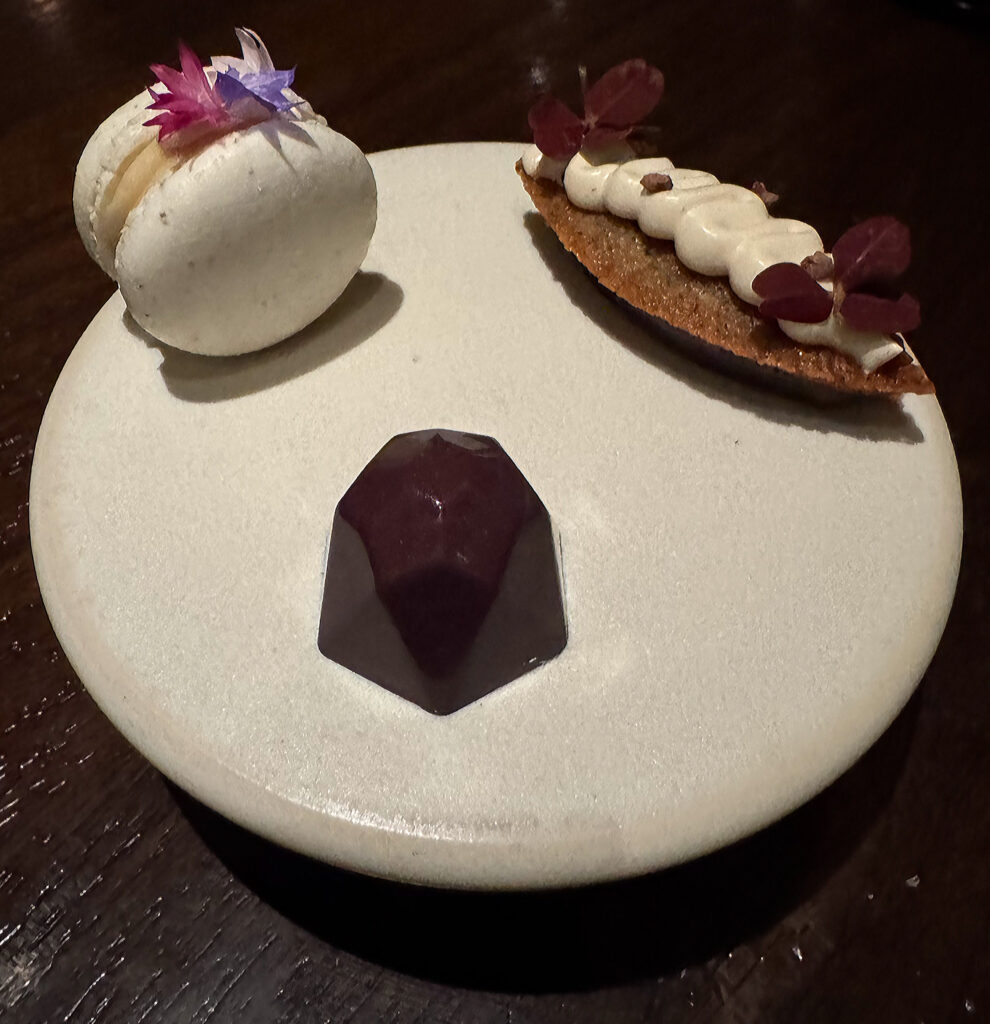
First, there’s the “Lavender Macaron” (flavored with jasmine and honey), which marries an enjoyable, fleeting chew with moderate sweetness and soothing floral depth. Technically, the word that comes to mind is textbook, and, correspondingly, this item ranks as the best of the bunch.
Next, one finds a “Hazelnut and Boricha Financier” (topped with rice honey marshmallow) that combines a crisp crumb with a rather mild dose of sugar and some underlying roasted, nutty tones. Ultimately, there’s nothing wrong here—I’d just like more intensity and decadence from what the captain alternatively titled a “brownie.”
Finally, we come to the “Dark Chocolate Bon Bon”—no longer filled with squash and miso caramel (which proved so successful last time) but with fermented blackberry and Earl Grey. On the palate, the juxtaposition between the crisp shell and creamy ganache is well executed. The blend of dark fruit, dark chocolate, and black tea is also intelligently conceived. This just doesn’t strike the same nostalgic, hedonistic note as the previous iteration.
With that, the meal comes to an end: another neat two-and-a-half-hour experience whose sharp pacing (from room to room and course to course) situates the evening’s flow of food, drink, and conversation somewhere outside of time.
Indeed, years later, I still feel like I am leaving Oriole just as soon as I arrived. This is not to say I am unsatisfied. Rather (in contrast with those favorite restaurants that push the three- or three-and-a-half-hour mark), Sandoval and his team show enough restraint to leave one wanting more. This is the chef’s stated goal—to contribute a great night out for his guests without totally incapacitating them—and he accomplishes it. With all the creativity the kitchen has shown, he is also providing a real reason to make this tasting menu, so perfectly tuned, something more of a regular occurrence.
In ranking the evening’s dishes:
I would place the “Maine Scallop,” “Sablefish,” “Canelé,” and “A5 Miyazaki Wagyu Ribeye” in the highest category: superlative items that stand among the best things I will be served in any restaurant this year.
The “Hudson Valley Foie Gras,” “Golden Kaluga Caviar,” “Uni Infladita,” and “Rosemary Ice” land in the next stratum: great recipes that achieved a truly memorable degree of pleasure. I would love to encounter any of these again.
Finally, there’s the “Australian Abalone,” “PEI Mussel,” “Cauliflower,” “Matsutake Custard,” “Venison,” “Golden Milk,” “Lavender Macaron,” “Hazelnut and Boricha Financier,” and “Dark Chocolate Bon Bon”—good—even very good—preparations I would always be happy to sample again (but that just failed to elicit an extra degree of emotion).
Overall, this makes for a rarefied hit-rate of 100%.
Yes, even those dishes I liked the least (the “PEI Mussel,” “Financier,” and “Bon Bon”) were still wholly enjoyable, and other diners could justifiably rank them higher.
However, tonight, only 24% of items (compared to 27% in November) landed in that “best of the year” category, and only 47% (compared to 60% in November) reached that “would love to have again” caliber.
These figures suggest that, even as Oriole meaningfully (i.e., totally) reduced the number of misses across its menu, the number of hits (and corresponding peaks of pleasure) has waned. Of course, nearly 50% of recipes reaching that “would love to have again” standard is still an incredible performance, and it’s not hard to see how the excision of the “Capellini” and a small lapse in quality with the “Golden Milk” skewed these percentages downward.
Moreover, while new bites like the “Abalone,” “Mussel,” “Cauliflower,” “Venison,” “Macaron,” “Financier,” and “Bon Bon” did not immediately rise to the top, the “Maine Scallop,” “Canelé,” and new “Golden Kaluga Caviar” set certainly did.
This is to say: the team is meaningfully experimenting with the menu while always guaranteeing a certain baseline of pleasure (in line with Oriole’s ethos) and, occasionally, achieving greatness. At the same time, the chefs are safeguarding their older signatures (the “Foie Gras,” the “Sablefish”), fine-tuning the newer classics (like the current “Wagyu Ribeye” set), and elevating other preparations (like the “Uni Infladita”) into the pantheon with every subsequent example.
In short, the restaurant is doing everything right: writing a new chapter, taking the risk of widening its culinary expression, yet always remaining faithful to the sense of comfort and generosity that has forged its identity.
Surely, there is much more to come and much more to achieve. However, the present process of discovery is already bearing real fruit, and these past few experiences have affirmed that the kitchen has found a foothold on which its best ever work may now be built.