
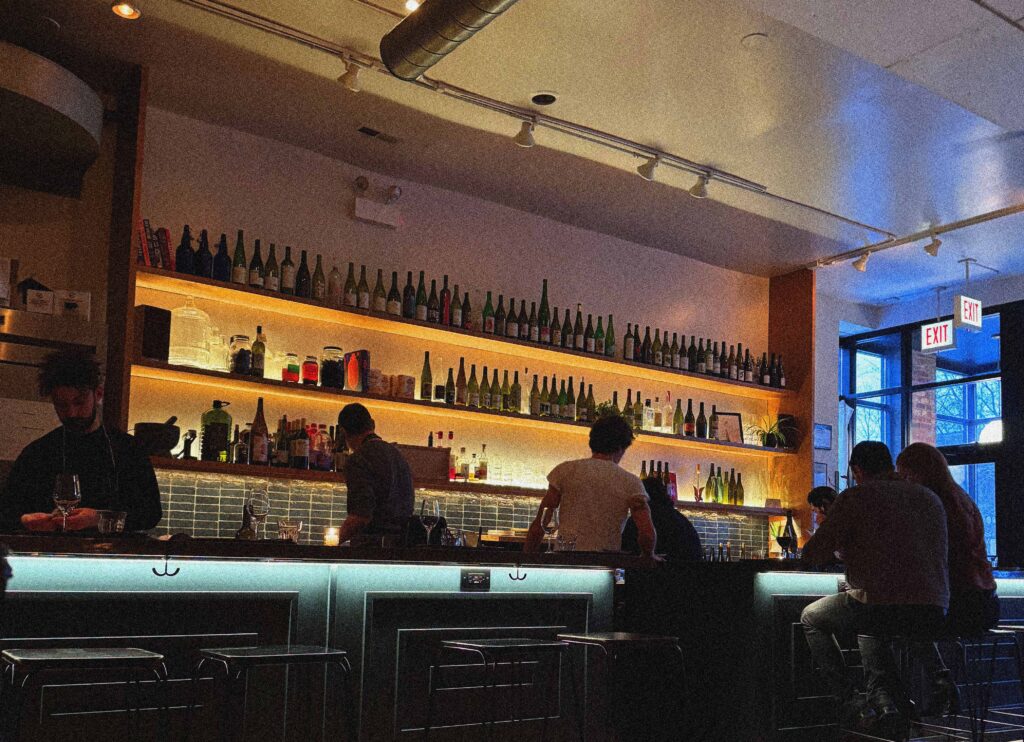
During these first weeks of 2026, I have tried to keep tabs on what I consider to be Chicago’s greatest restaurants: those kitchens that are cooking with the most creativity, delivering the rawest pleasure, or maybe even blending both these virtues in fulfilment of a transcendent dining experience.
Frankly, these are the places (no less due to the wine and warmth of service on offer) that I prefer to spend my time. For, while trying new restaurants offers a flow of superficial novelty, I find it infinitely more rewarding to uncover the how and why of what makes the best restaurants so memorable time and time again.
It’s not lost on me that much of the audience is lucky to eat somewhere like this once in a year (if not a lifetime). The point is not to primp and prattle on about an entirely privileged form of consumption. Rather, I believe that even one’s very favorite restaurants can always benefit from a critical eye. Judging their work—the flow of recipes within and between seasons—does not only mean preserving work that might never be recorded due to the scattershot nature of professional coverage. No, it means transforming oneself into the kind of regular who understands the team’s dream, tastes their work with an open mind, and (knowing that food only takes on its ultimate meaning once perceived by the public) delivers the kind of honest impression that helps chefs reach the next level.
To be clear, repeat patronage is not a requirement to offer criticism. After all, concepts of this caliber only have one chance to impress the average customer. Nonetheless, an appreciation of a cuisine’s wider context—the kitchen’s tolerance for risk, its capacity for growth, the distinctiveness of its chosen ideas in the wider national or global marketplace—inspires a certain sense of patience. The locus of control is no longer externalized to a given restaurant (which is judged as succeeding or failing based on whether it satisfied individual taste). Instead, consumer and chef meet somewhere in the middle: forging a relationship, trusting each other, and accepting when experimentation goes awry because the fruits of the overall process (and of a philosophy that may even approach art) matter more than my definition of pleasure.
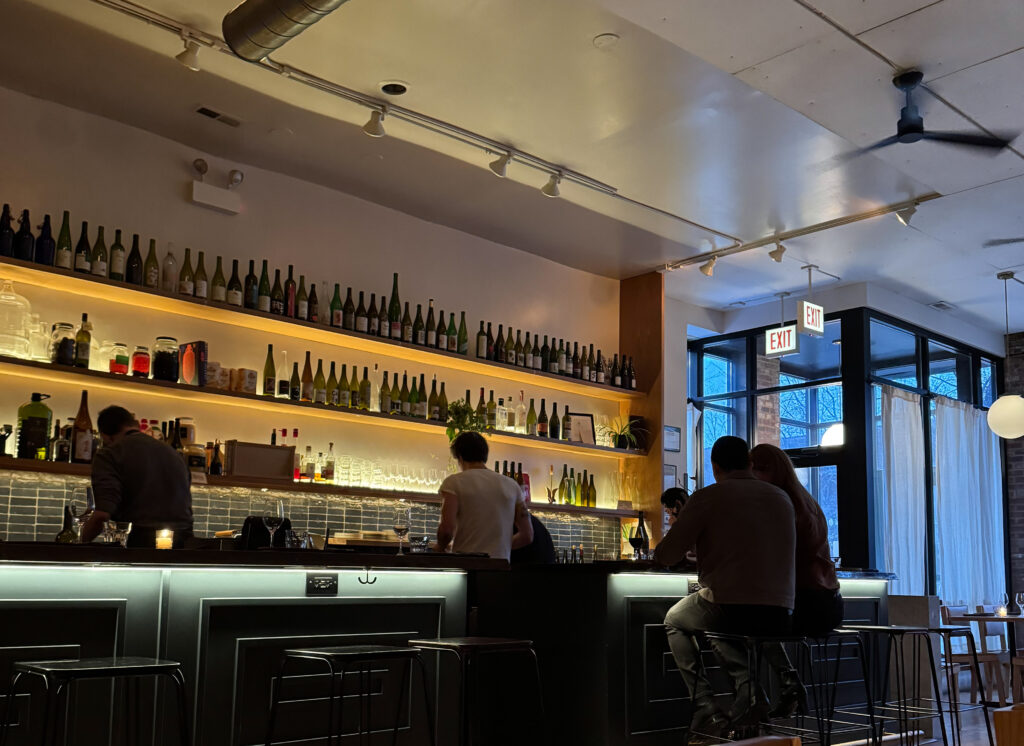
Cellar Door Provisions is special. Really, it’s an anomaly: a place one can enjoy a simple burger and a glass of natural wine or, if the mood strikes, engage with a kind of cookery that ranks among the city’s boldest. Like Elske, the eatery forms a friendly entry point to Chicago gastronomy that can get quite deep and quite serious rather quickly.
In fact, despite its à la carte model, I would place CDP in a peer group that includes Feld and Smyth. Yes, when one strips away all the finery that distinguishes a one- or three-Michelin-starred meal, the restaurant offers an affordable pathway toward an appreciation of the esoteric, hyperseasonal fare that unites these kitchens. But it’s actually wrong to imply a progression—a neat escalation of complexity and quality in accordance with Bibendum’s honors—from one concept to the next to another. In fact, CDP’s greatest virtue is that it collapses the Guide’s self-serving narrative and affirms that the stratifications of “fine dining” are not as firm as they might seem.
Indeed, night after night, the team proves that it doesn’t take a tasting menu or a couple-hundred-dollar ticket price to serve up the same degree of intellectual (and often hedonistic) appeal provided by the city’s heavy hitters. Consumers need only find a place where chefs are armed with exceptional, ever-changing ingredients and empowered to explore their potential.
Admittedly, it’s not that easy (the present iteration of CDP is more than a decade in the making). But chefs Ethan Pikas and Alex Cochran have undeniably drawn a blueprint for how restaurants might bring the dynamism and excitement of fine dining to the masses.
For this reason, their work remains essential: a key touchstone for anyone who really wishes to interrogate the value of those two- or three-hour, two- or three- or four-hundred-dollar tasting menus whose courses so frequently feel constrained by the format.
Certainly, every visit here makes me question how much pomp and circumstance I really need to feel the emotional highs of gastronomy. CDP, with all its coziness, makes cooking at this level seem easy.
Let us begin.
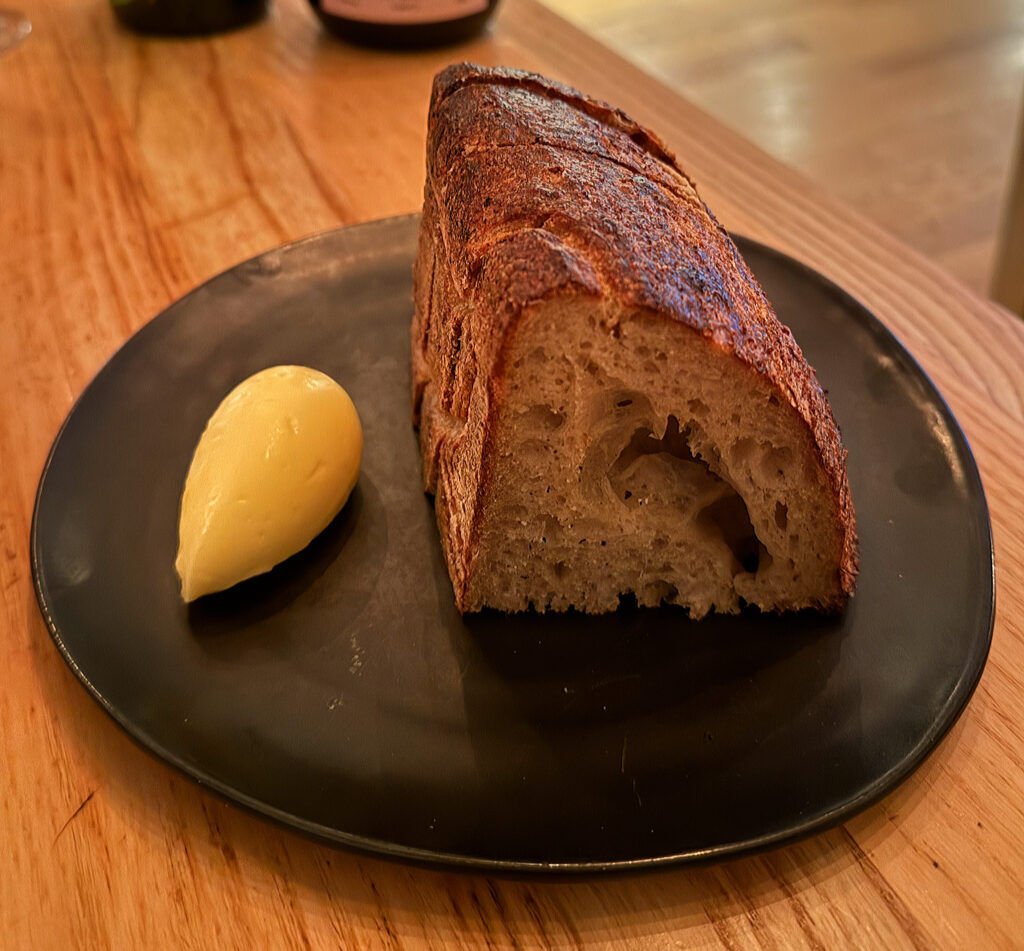
Tonight’s meal starts as it always does: with that most traditional, unassuming symbol of the baking craft (and one, so ever-changing in its expression here, that almost acts as a microcosm of the entire restaurant). Pikas’s present iteration is titled “Sprouted Oat Porridge Bread & Kefir Cultured Butter” ($10) and comes listed with optional pairings like “Brown Anchovy” ($6), “Fontina” ($6), “Pickles” ($6), and “Gordal Olive Escabeche” ($7). On this occasion, I skip the latter two (being familiar with them from my past visits) and opt for what’s new—appreciating the chance to transform a mere dish into an entire spread if one so chooses.
Visually, the bread itself boasts a craggy, mahogany crust and an airy crumb that comes speckled with grains of the sprouted oat. On the palate, each slice balances a crisp (though fleetingly so) exterior with a moist, almost creamy interior with more than enough density to sop up any accompanying liquid. The butter, for my taste, remains a little too subtle in its expression (which, thanks to the kefir, should tend toward richer, tangier tones). However, it comes beautifully tempered, and the resulting coating of fat helps to tease out the earthy—even sweet—depth of the loaf. Yes, when it comes to those fundamentals of texture and flavor, I think this may be the best bread I have tasted in all my trips to CDP.
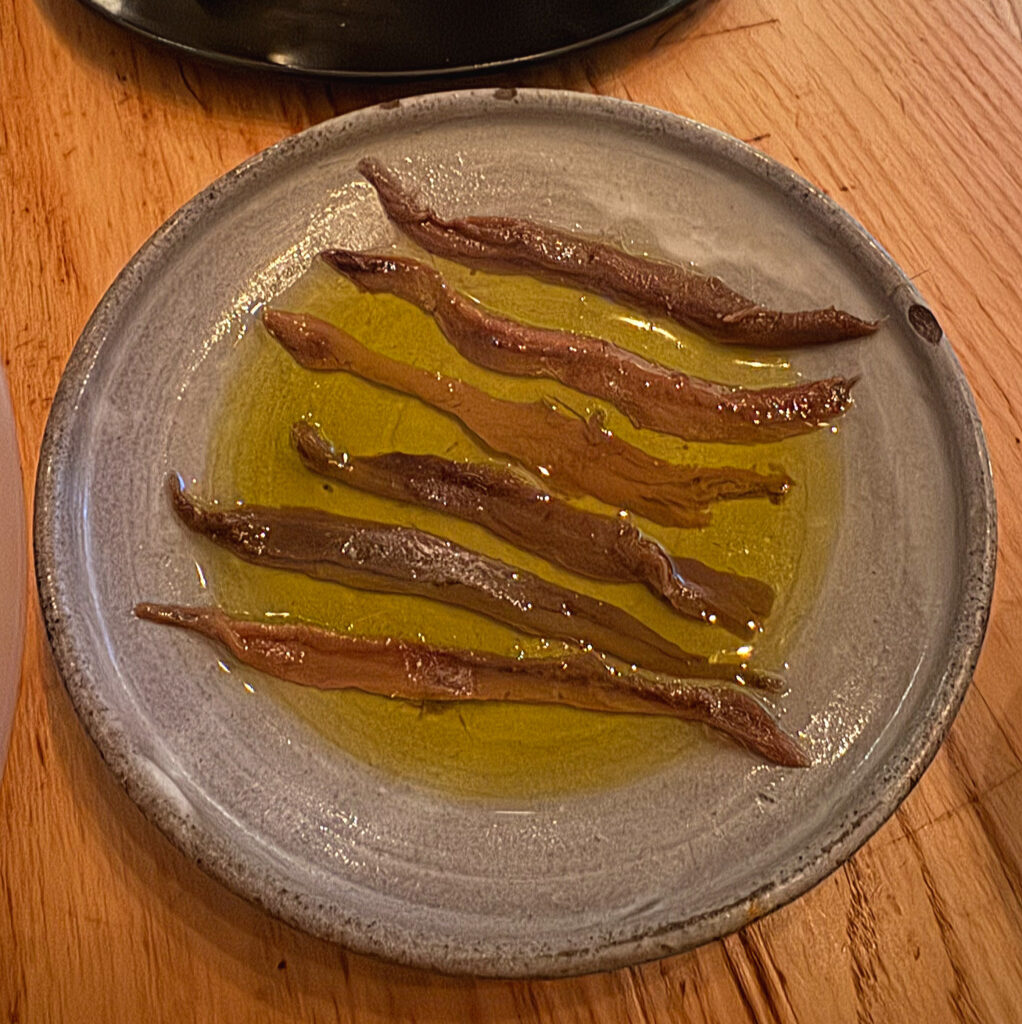
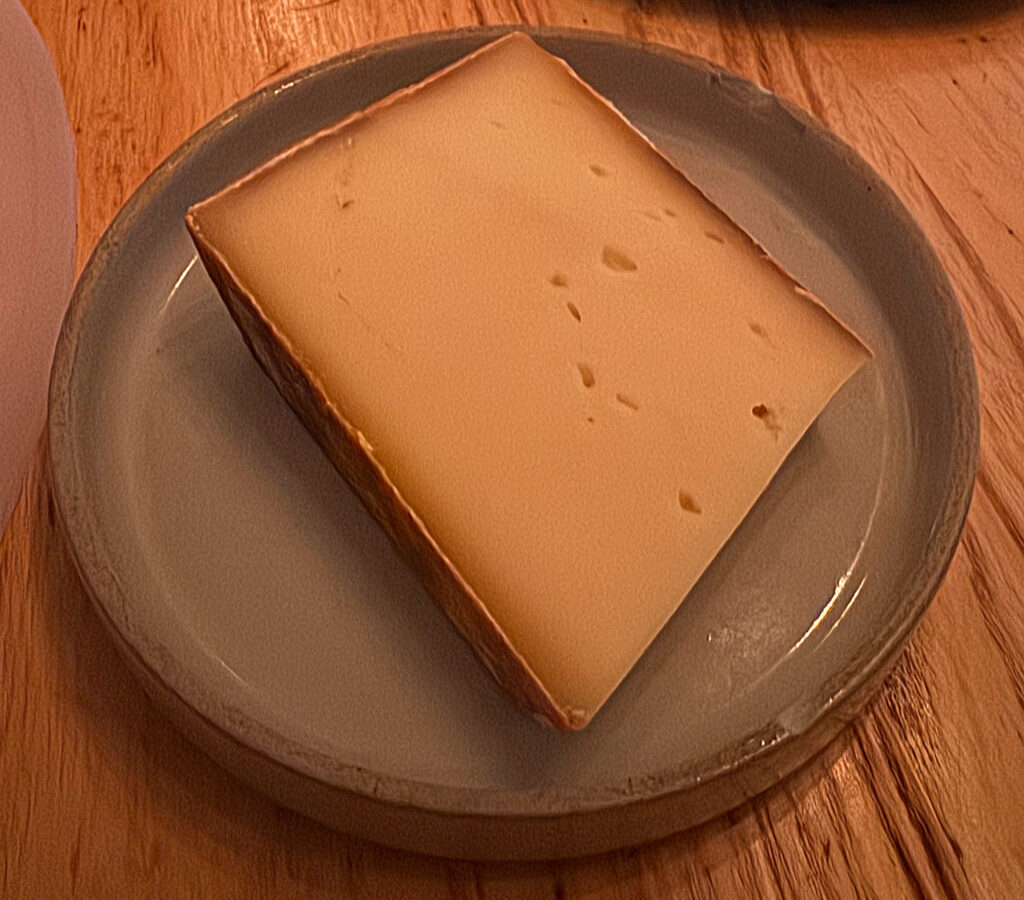
Add in the anchovies, with their concentrated brine and umami, and one’s enjoyment only grows. The olive oil that sits below the fish forms a nice bonus, imbuing the crumb with sharper, fruitier notes than the butter. The salt content of the anchovies also plays well with the fontina, which arrives in the form of a hearty slab (and whose pronounced grassy character perfectly matches the complexity of the bread). Overall, this makes for an opening salvo of real generosity and value: one that fittingly anchors the restaurant’s “wine bar” identity while simultaneously tantalizing those who are preparing to tuck in for a more elaborate meal.
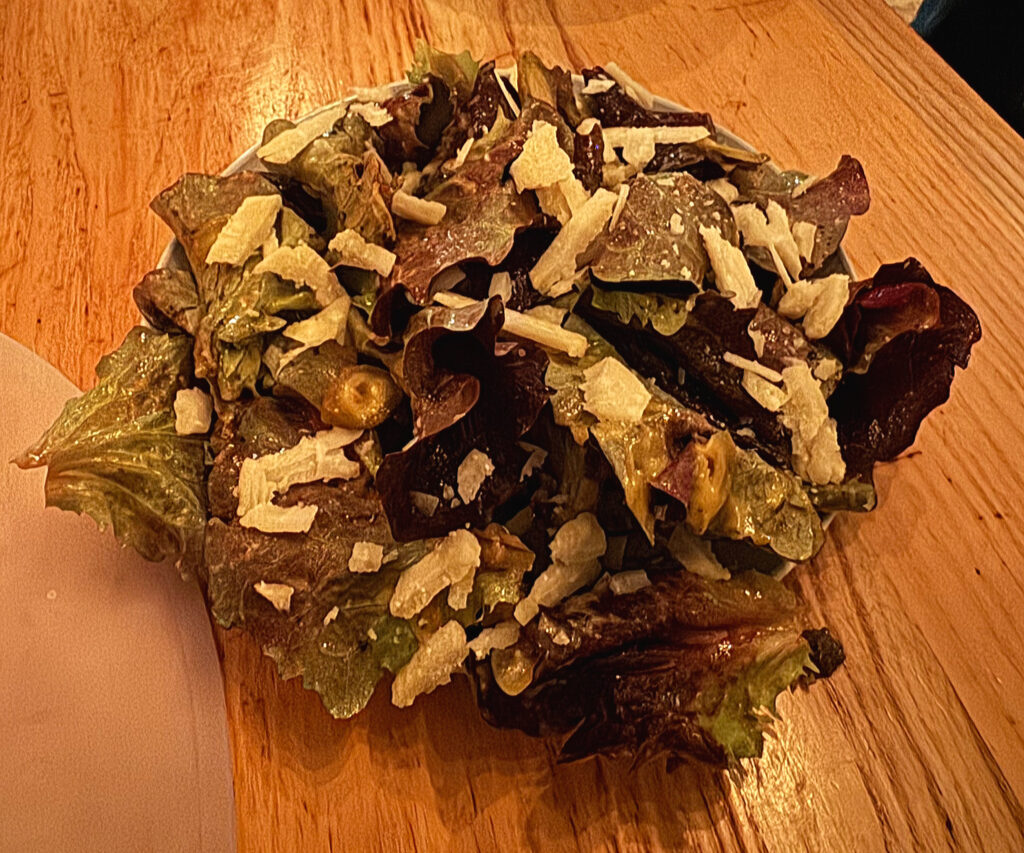
Arriving next, the “Little Gem Lettuce” ($18) enters into a long line of salads I have encountered during my visits—recipes that veer from offering the purest of pleasures to delivering the most challenging sensations on any given day. The present example lands somewhere in between, combining the titular leaves with an ume (pickled plum) vinaigrette, a squeeze of satsuma, slices of green almond, and shards of aged parmigiano.
The resulting plate absolutely overflows with well-dressed lettuce, and the little gem’s resulting mouthfeel is wet yet appropriately crunchy. It’s a treat whenever one of those chunks of cheese find their way into your mouth. However, the dressing—so powerfully tangy with an intriguing bitter note on the finish—dominates the dish. Indeed, I do not note any alleviating sweetness from the satsuma, and even the flavor of the aged parm struggles to assert itself. This leaves me with a salad that seems entirely devoted to the expression of ume, and, while the effect is certainly singular, it does not quite meet the mark of actually being delicious.
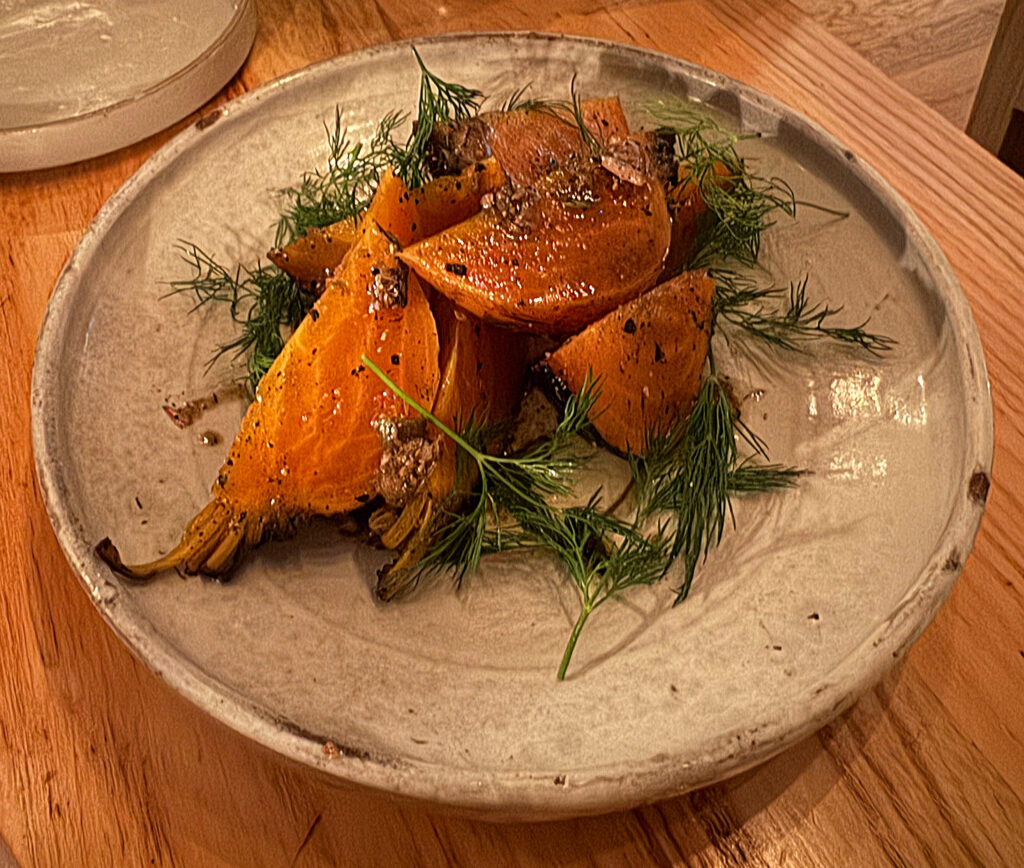
The ”Charred Touchstone Beets” ($17) would seem, on paper, to be an equally challenging preparation. This root vegetable, after all, is almost synonymous with a jarring earthiness. Nonetheless, I have always found that this kitchen excels when highlighting ingredients that are not conventionally desirable (though, if I am being honest, beets have almost become a trope at more progressive, seasonal fine dining restaurants). The key here is the variety: one known for its sweet, golden (tending toward orange here) flesh. Large, charred chunks of the vegetable are dressed in a preserved caper leaf vinaigrette then stacked atop a sunflower seed purée and paired with Fernleaf dill to complete the presentation.
On the palate, the beets blend a crisp, crunchy attack with a degree of juiciness that feels as if they’ve been marinated. With the incorporation of the purée, the starring ingredient takes on a rich, creamy coating that adds to its perceived weight. Flavor, in turn, starts on a pristine sweetness that is inflected by fresh notes of anise. This is a wonderful expression of beet in its own right. However, the character of the caper leaf (tangy, briny) and sunflower seed (nutty with just a hint of harmonizing earthiness) drives the recipe toward an attractive savory finish whose pleasure—so seamlessly extending from those sweeter tones—only builds with each successive bite. In short, this item ranks as the meal’s most surprising highlight.
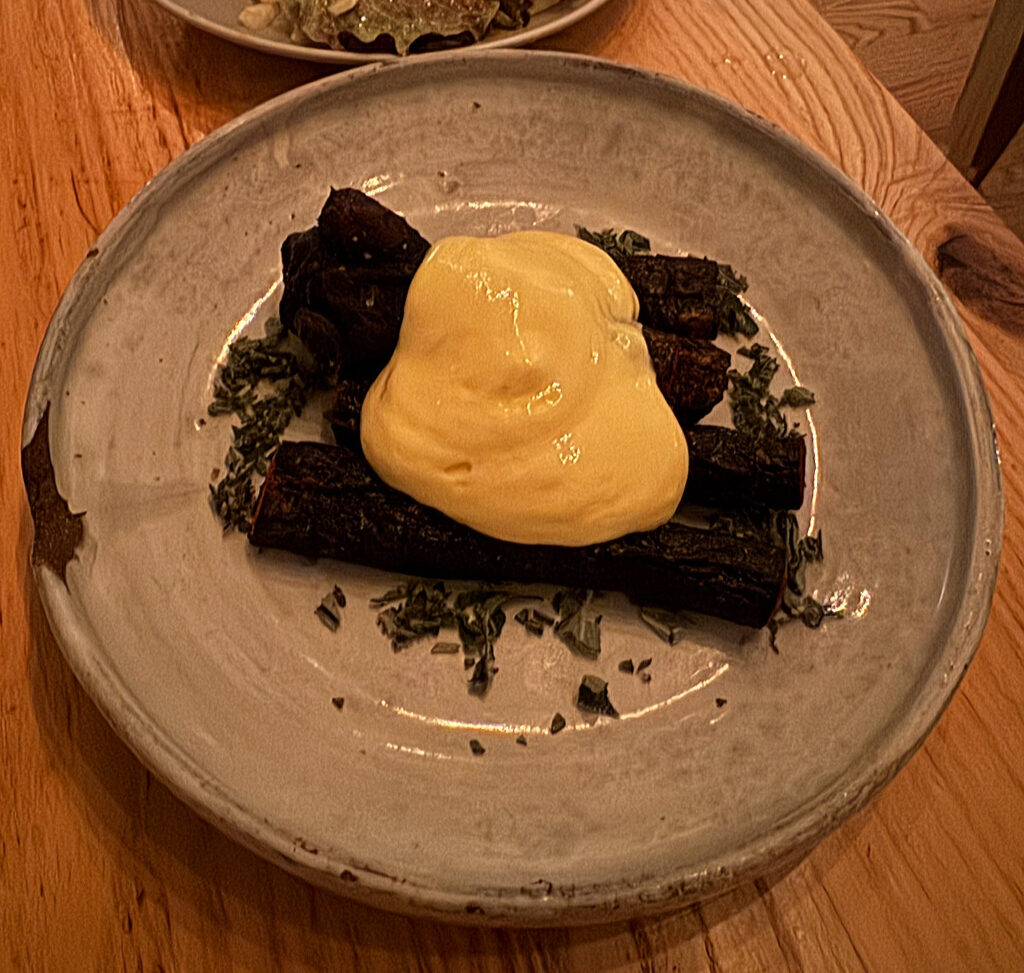
“Confit Black Salsify” ($20) sounds a lot like another ugly duckling. Who even thinks about utilizing this vegetable (a member of the sunflower family) other than the chefs at Alinea and Smyth? Moreover, who is bold enough to devote an entire dish—sold à la carte—to this obscure root?
By cooking the salsify in brown butter then dressing it simply with a horseradish espuma and plenty of sage, the kitchen looks to straightforwardly emphasize the starring ingredient’s savory quality. Texturally, the long segments of vegetable display a crisp, warm, and creamy consistency not unlike roasted carrots. The resulting flavor is markedly earthy, yet, with the help of a sharp line of acidity, a perfect application of salt, and some woodsy intrigue, it reveals sweet and nutty undertones that are highly appealing. Ultimately, this recipe (which screams to be paired with a light red wine) is skillfully executed and wholly rewarding. It wildly succeeds in introducing the audience to a root they might never even think to crave.
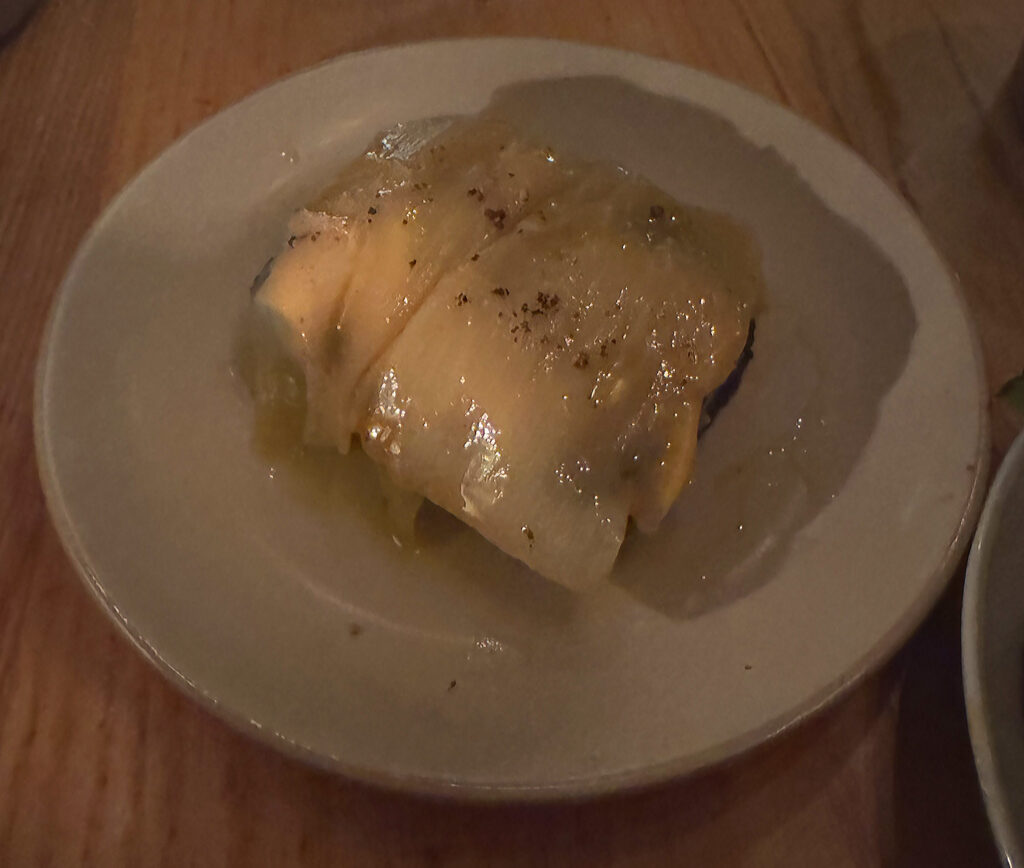
The ”Fermented Rutabaga on Sprouted Einkorn Toast” ($18) follows along the same lines (though, admittedly, I think Americans maintain at least some passing knowledge that this ingredient exists). Fashioned into a thick cream and topped with melted leeks, the root vegetable delivers a remarkable nutty-sweet, mildly tangy sensation. Charged with the sugars from the equally creamy allium, the rutabaga sees its latent earthiness subsumed by the satisfyingly crisp toast (whose use of the ancient einkorn grain lends this recipe a robust, malty quality that helps to anchor the more effusive flavors). Overall, this makes for a beautifully packaged—if messy—series of bites that, for the third dish in a row, totally surpasses any expectation one has for the starring produce.
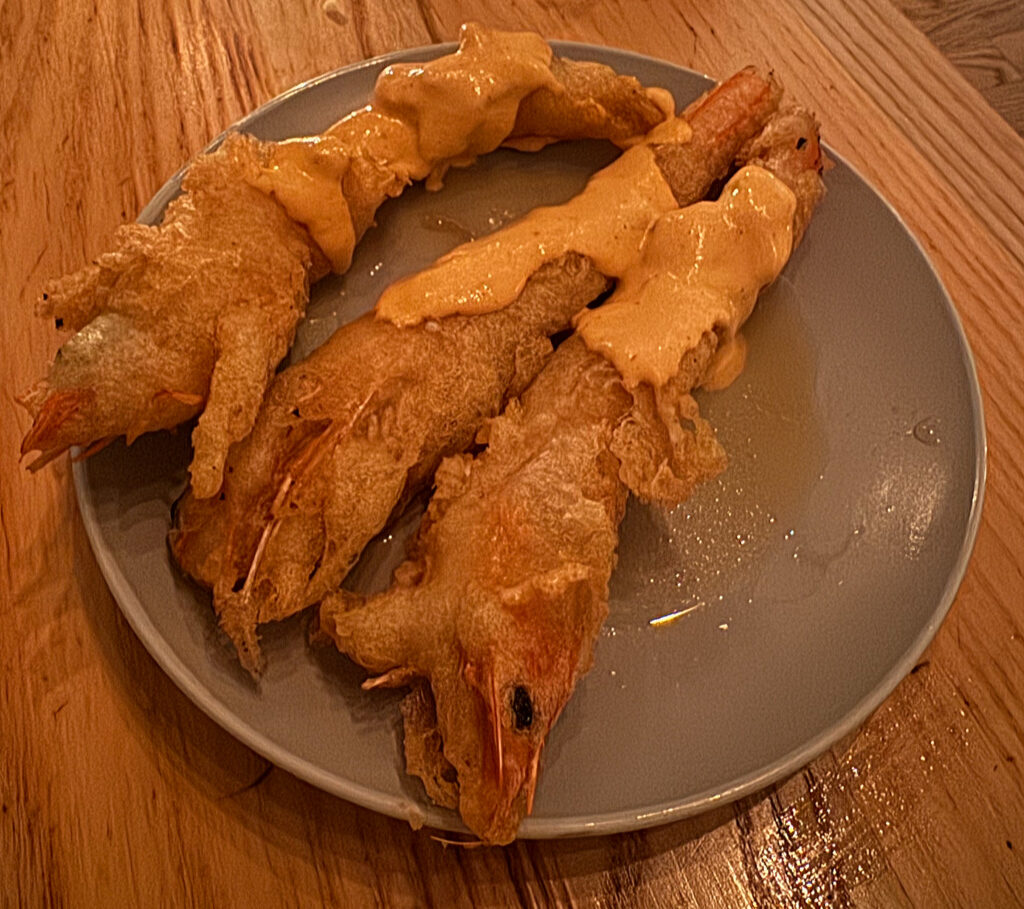
Upon spying the “Tempura Blue Prawns” ($27) on the menu, I salivate in anticipation. How nice it is to encounter, alongside all the kitchen’s more challenging work, a familiar ingredient prepared in such a crowd-pleasing manner. But this is not to say that the recipe runs short on technique. Here, the chefs batter and fry the entire body of these sizable New Caledonian crustaceans (which arrive three to an order). The resulting serving sits atop a pool of Cara Cara orange-inflected ponzu while a spoonful of Marie Rose sauce (traditionally a blend of tomato, mayonnaise, Worcestershire, and lemon juice) crowns the prime portion of each piece.
On the palate, this particular tempura is distinguished less by brittle crunch and more by an airy, shell-like coating that delivers only a fleeting crispness. That said, the prawn itself is beautifully plump and well salted. The heads, should you give them a squeeze, gush with the savory essence of shellfish. And that Marie Rose sauce, charged with a pungent horseradish depth, wraps the whole presentation in a comforting sweetness. For what it’s worth, I’m not sure the ponzu—by comparison—is easily incorporated. The size and the texture of the fried crustaceans, I must reiterate, subvert expectations. However, I really enjoyed this dish for its core flavor expression: one that drives each bite of prawn to a peak of rich, tangy intensity. I’d undoubtedly order it again.
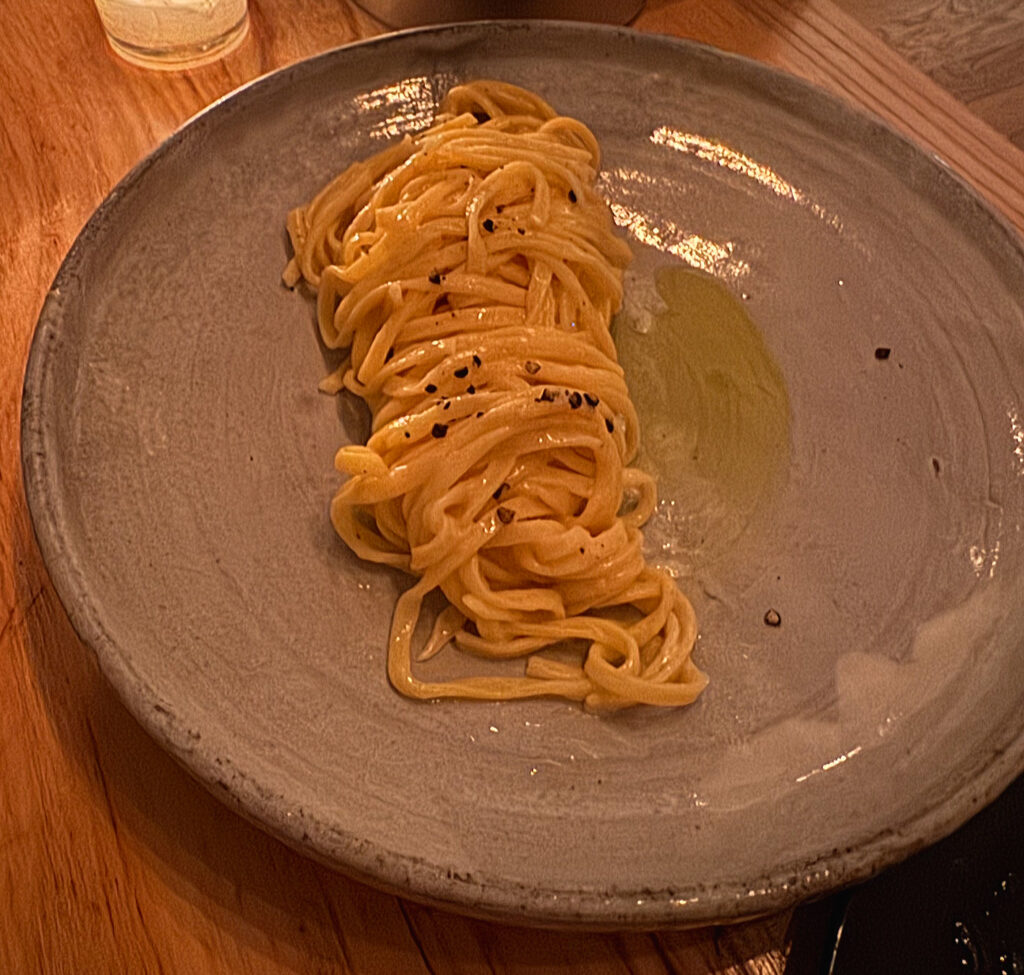
The evening’s pasta course comes courtesy of the “Spaghetti alla Chitarra” ($24): a recipe I have encountered at the restaurant before and, on this occasion, comprises the titular square noodles tossed in Tulip Tree Creamery’s Trllium, some olive oil, then flavored with winter garlic and cracked black peppercorn. The mouthfeel of the spaghetti, spooled so enticingly, marries a sense of weight and subtle chew with a soft, creamy finish. Yes, the noodles are skillfully rendered, and their ultimate expression (combining predominant notes of fresh butter with just a hint of sharpness) ensures that the texture remains the star. Indeed, while I am tempted to wish for greater intensity here, a light touch—in a city brimming with meaty red sauce—is perhaps the point. This composition threads the needle of interesting yet enjoyable quite well.
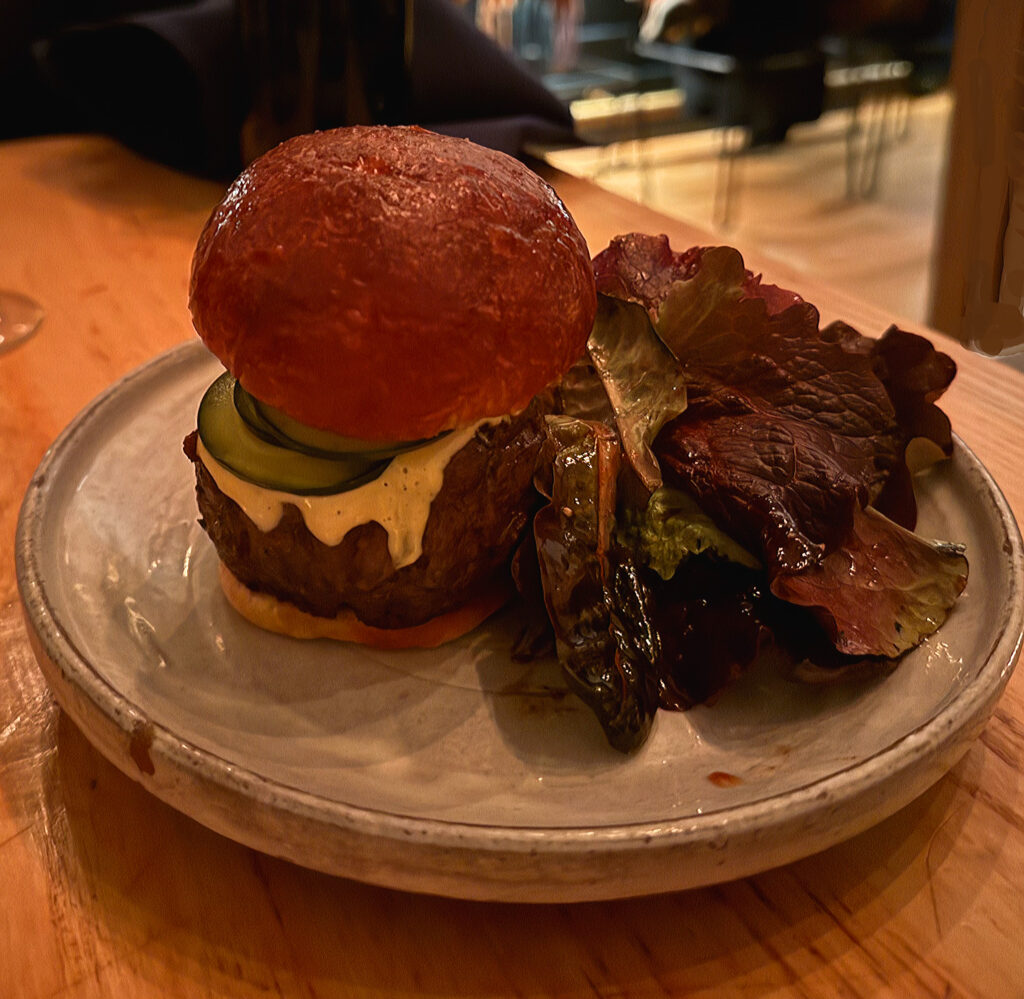
The ”Burger” ($20) is another familiar offering—that is, CDP’s longstanding overture to diners who might find all the natural wine and hyperseasonal experimentation to be a tad overwhelming. For what it’s worth, I think this preparation forms a lovely bonus even for those (like myself) who are willing to order the entirety of the menu.
Tonight, the patty (presumably made from the trimmings of the rotating steaks the restaurant serves) comes out looking particularly thick. Nonetheless, the meat is framed by the kitchen’s classic set of accompaniments: caramelized onion, aioli, bread-and-butter pickles, and optional Werp Farms greens all stacked between a house bun. This yields a textural experience that is a touch firm on entry yet moist, crisp, juicy, and even creamy with further mastication. Flavor, too, leads with the intensely savory, satisfaction character of the patty but tends toward soothing sweetness and a complicating kick of acid as one incorporates all the elements. Ultimately, I’ve certainly preferred bolder iterations of this dish in the past (one with pickled Fresno chiles for example). Still, this version—so traditionally composed—ranks among the very best I have sampled here.
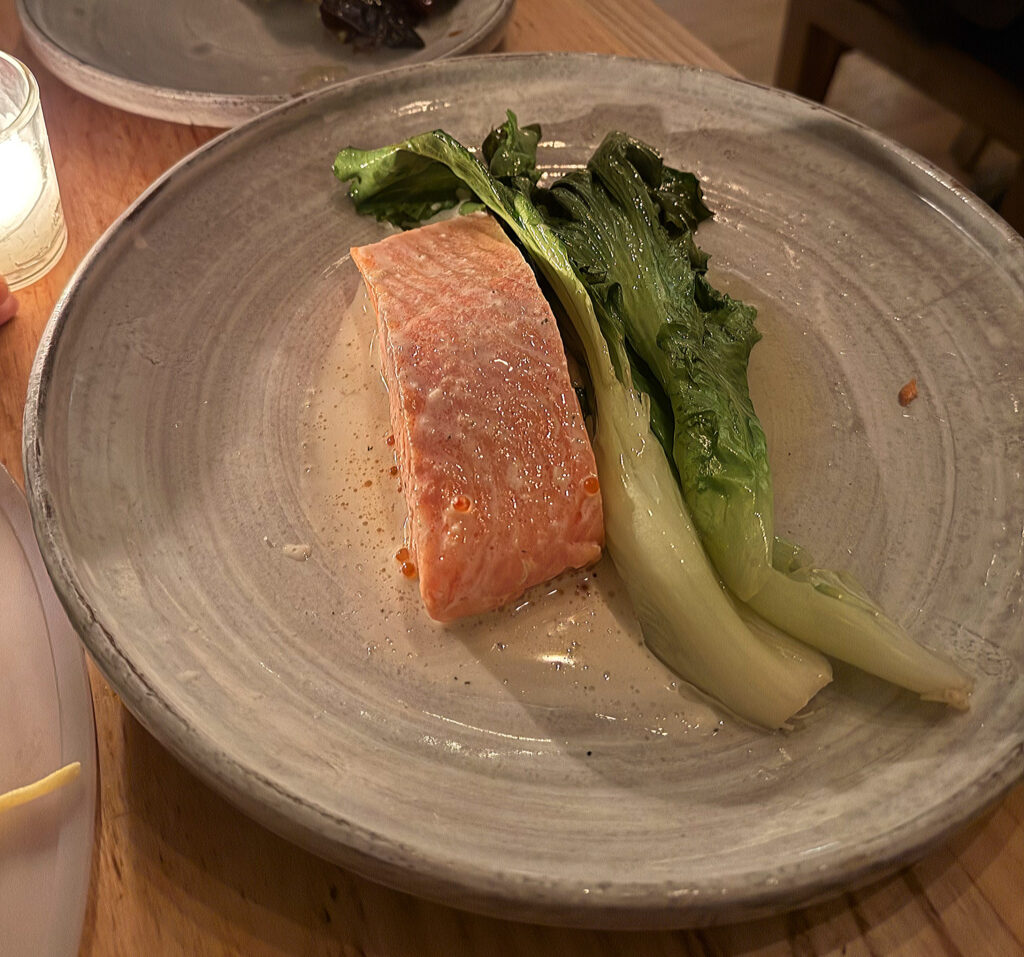
Of all the entrées I have tasted across my visits, fish tend to be the ones that overperform (perhaps because the team’s adventurousness blends so well with what is otherwise a blank canvas). Indeed, the “Poached Petuna Ocean Trout” ($42) is remarkably rich and creamy when it hits my tongue (ranking, certainly, among the most elegant fillets I have encountered), yet its latent flavor is rather mild. The accompanying leaves of braised escarole—fleeting crunchy but every bit as buttery in their own right—add an intriguing tinge of bitterness to the recipe. However, it’s the smoked trout fumet (essentially a concentrated stock) that lets the preparation down: moistening the components on the plate without imbuing them with any of the savory concentration necessary to enliven the interior of the trout. For me, the dish’s marvelous textures are let down by an overall blandness (though I concede this may be a simple matter of taste).
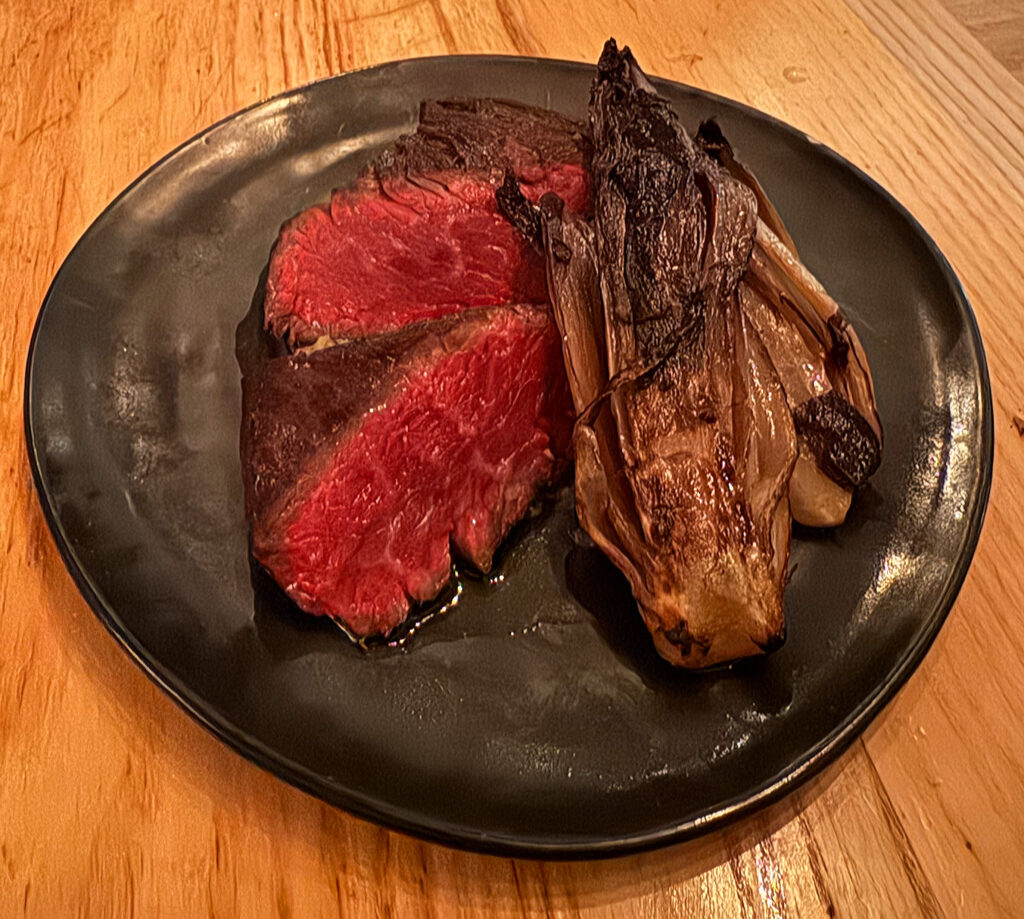
Thankfully, the arrival of the “Hanger Steak” ($48) brings me back into the realm of easy pleasure. Yes, for the price, the resulting two hunks of beef—their interior a gradient of deep red to pink—more than fit the bill. Charred on the outside, the meat displays a supreme tenderness on the palate with an accompanying richness of flavor. An accompanying salmoriglio (bursting with citrus, garlic, and a freshly herbaceous finish) provides a natural contrast. Nonetheless, it is the generous serving of roasted treviso (crunchy, juicy, nearly sweet, and expectedly bitter) that proves key: enhancing the expression of the other ingredients and raising this otherwise humble cut of steak to a level of real satisfaction.
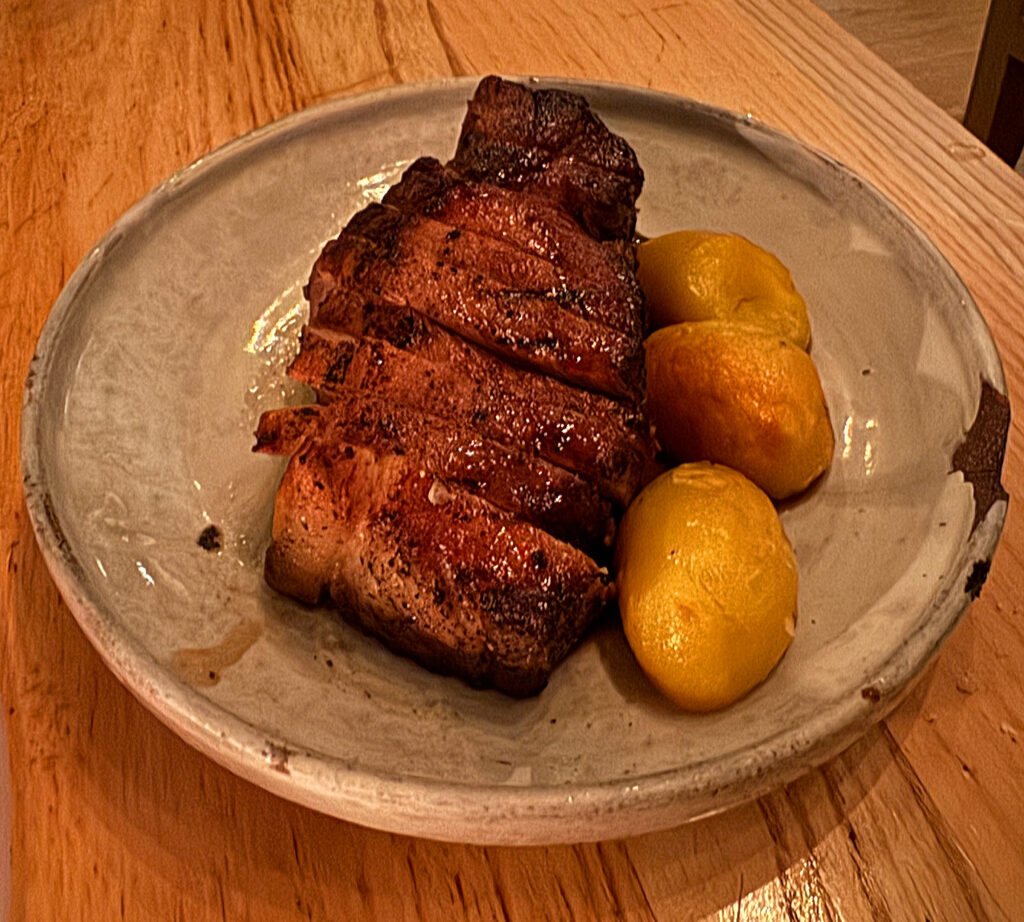
Closing out the savory side of the menu, a “Catalpa Grove Pork Loin Finished Over the Coals” ($44) promises to end the meal on a wholly convincing note. Indeed, this is an exceedingly generous portion of meat for the price (the kind of serving that complicates any attempt to order every dish on offer), and the accompanying Natascha potatoes (a smooth, yellow, early-maturing variety) make for an almost prototypically satiating plate.
In practice, I find that many of the center pieces of the loin are fairly chewy: displaying some supporting juiciness but, in turn, occasional streaks of connective tissue as well. That said, the cap running along the side is well rendered, and the best pieces of the cut (located at either end) blend flesh and melty fat with an ample imprint of salt. The potatoes, for what they’re worth, are rich and creamy (if not totally distinctive). But it’s really the pig’s foot tare that lets the recipe down. This accompaniment (traditionally a thickened soy sauce) is lightly drizzled over the pork and offers a mild degree of sweetness. It also, admittedly, helps to tease out some of the smokiness provided by the coals. However, despite drawing flavor from the animal’s trotters, the tare lacks the kind of palate presence or concentration I would expect to carry the dish. It offers but a whisper (rather than a roar) and, ultimately, leaves me searching for something more. What’s left is a plate of slightly overcooked meat and potatoes that, while pleasant enough, falls short of the standard this restaurant so often sets.
Thankfully, with the arrival of dessert, I know the kitchen is all but certain to turn things around. Indeed, whether one chooses to indulge in an evergreen recipe or try something entirely new, Pikas and Cochran almost never miss in this department. Correspondingly, any meal built upon the bread, the burger, and these sweets (while perhaps missing the point of CDP) guarantees a degree of excellence that few other concepts—even those taking nothing close to the same risks—can match.
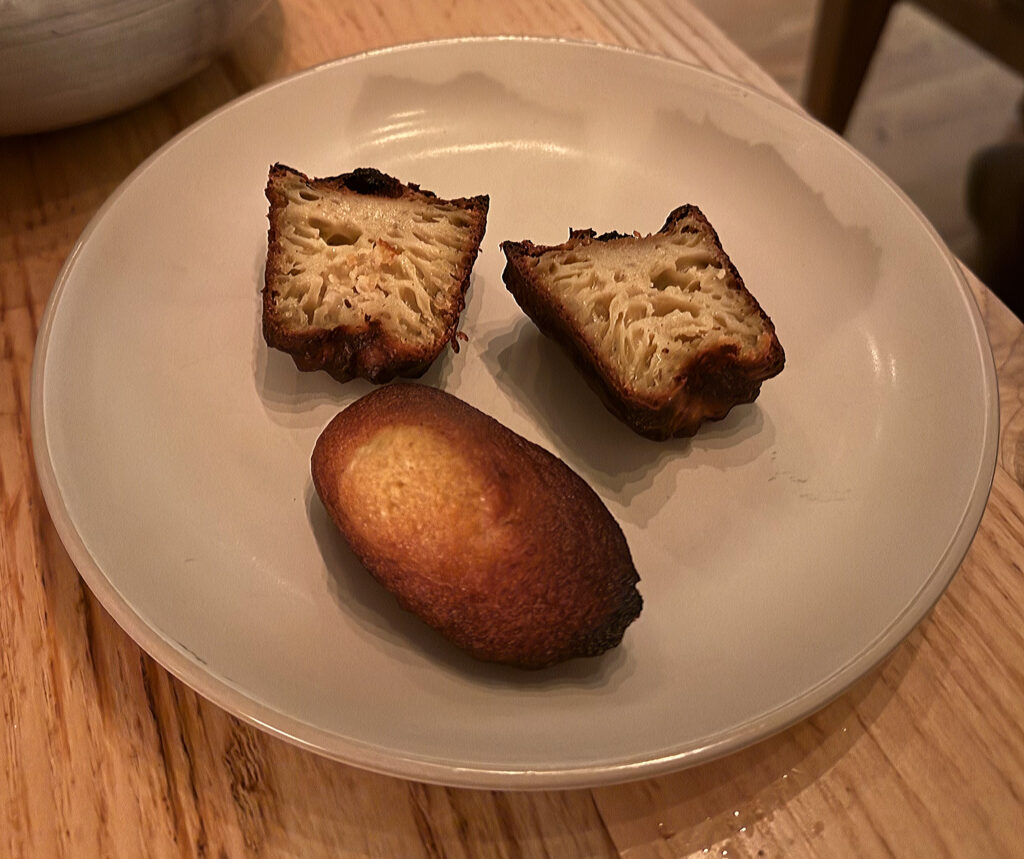
This evening’s selection begins with a “Wolf Point Whiskey Canelé” ($6) and a “Madeleine” ($1.50)—daintier items through which the chefs can showcase classic techniques and reward diners who might only want a smaller bite (or, alternatively, to build an elaborate spread).
Texturally, the canelé expertly combines a crisp exterior with a rich, custardy crumb. The accompanying flavor leads with the deep caramelization of the pastry’s crust but quickly broadens, displaying pleasing notes of vanilla and Bourbon that carry through the finish. In short, this is a textbook rendition that really honors the form.
The madeleine, in contrast, is firm and crumbly without much of the moistness or fluffiness that can really distinguish the cake. Its delivers mild notes of butter and caramel that are enjoyable enough. However, the recipe struggles to match the quality of the canelé and, overall, is not quite memorable.
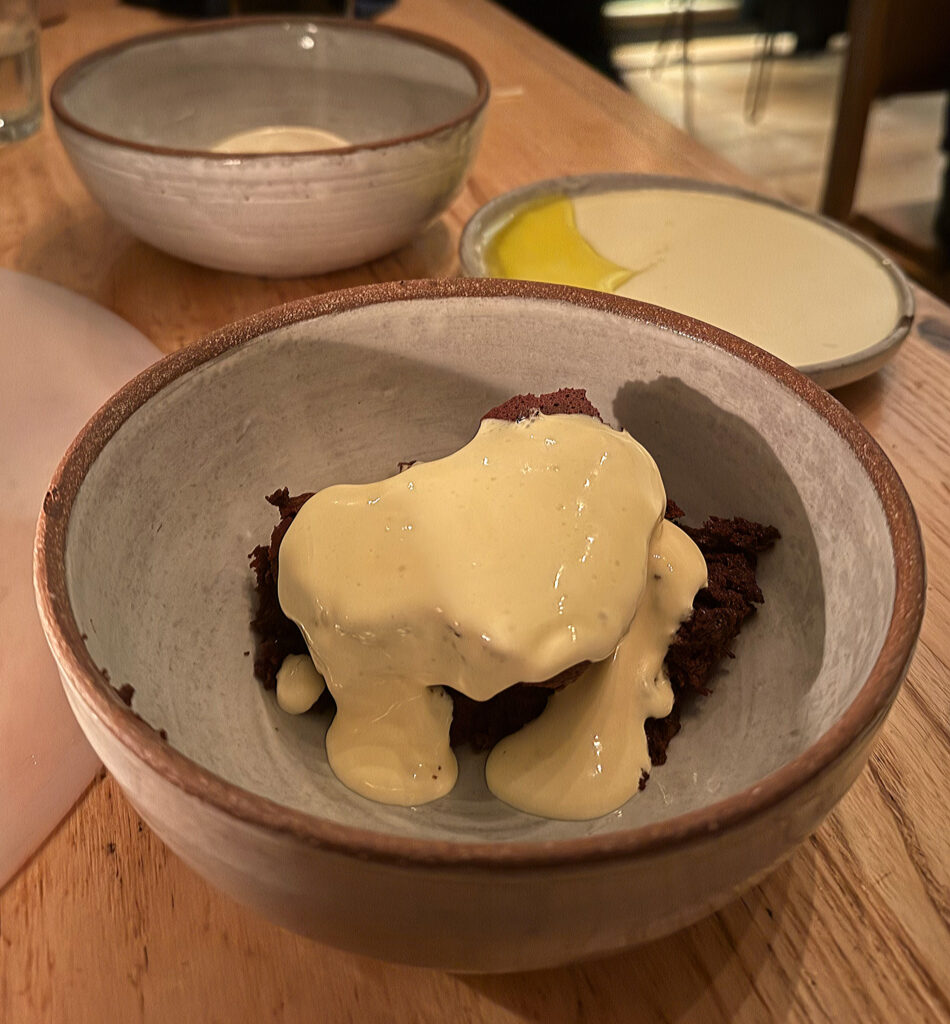
The “Chocolate Cake & Sake Sabayon” ($12) forms a familiar (if irregular and slightly evolving) option. Here, the central element is slightly crumbly yet retains enough moisture to feel rich and satisfying on the palate. The luscious sabayon adds to a feeling of decadence: cutting the dark (almost spicy) notes of the chocolate with bright, fruity depth that I probably couldn’t identify as sake but, nonetheless, find highly appealing. Overall, this makes for a good example of the form even if it does not measure up fully to past iterations.
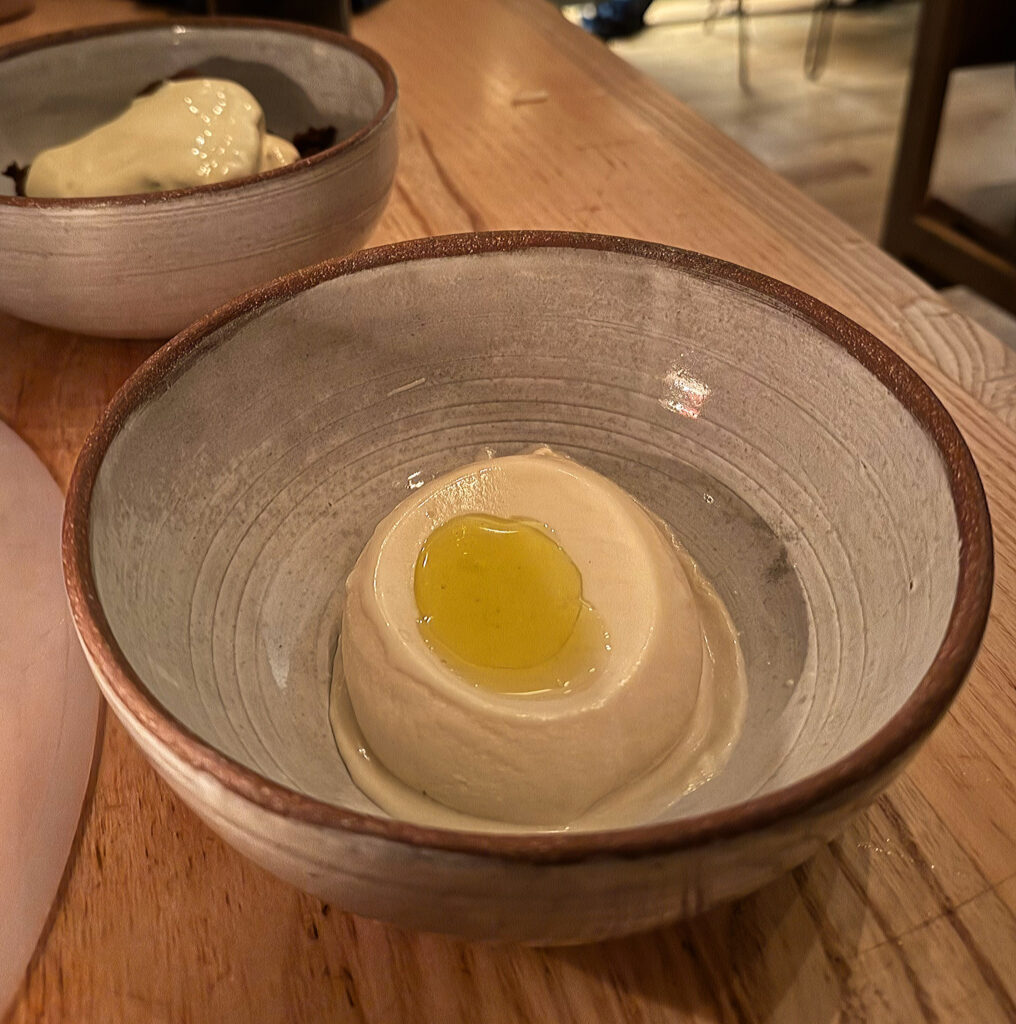
The “Marsala Ice Cream” ($12) is entirely new to me, and it ranks as the surprise hit of the bunch. Flawlessly smooth in consistency, the frozen dessert delivers a spectrum of honey-, toffee-, and almost miso-inflected notes (all drawn from the titular dessert wine) that charge the base note of milky sweetness with profound depth. There’s nothing “hot” or boozy about the dish either. It offers a memorable degree of decadence in a straightforward (yet still fairly inventive) way.
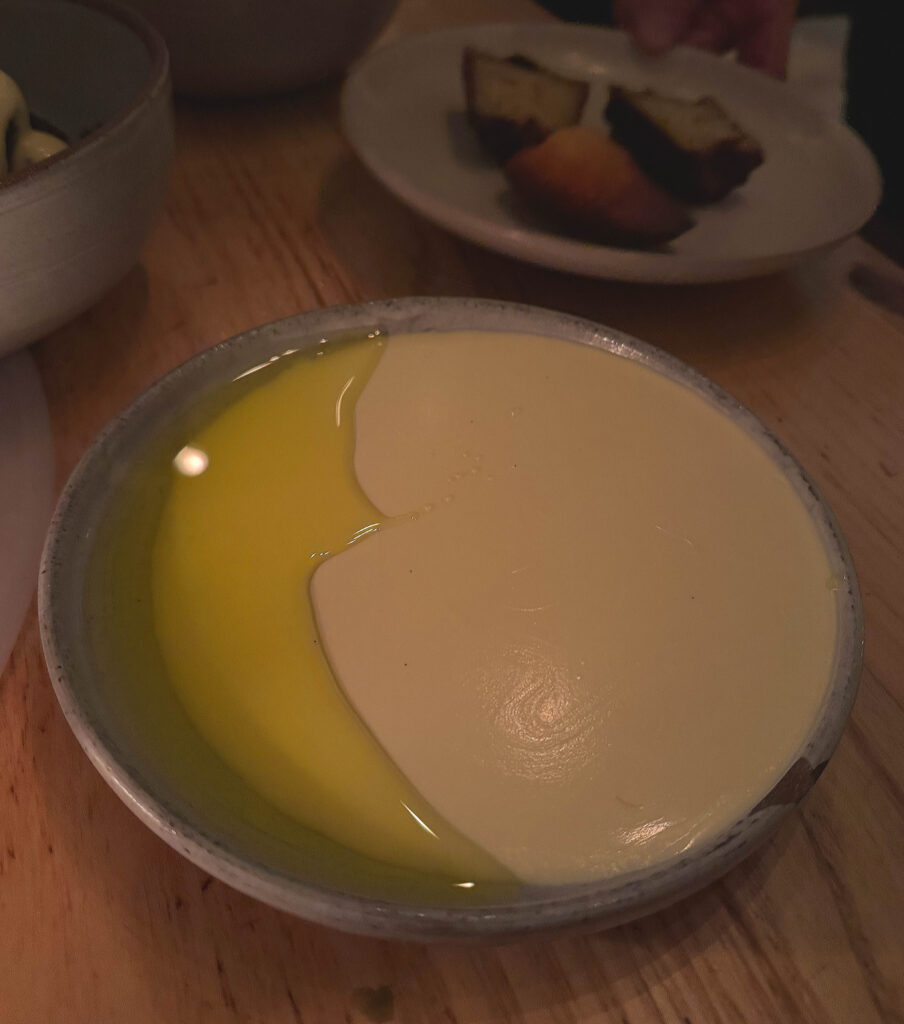
Finally, we have the “Panna Cotta & Hojiblanca Olive Oil” ($12)—a preparation that has earned its longstanding place on CDP’s menu. Tonight is no different. The thickened cream caresses one’s tongue with a maddening combination of wetness and weight, imparting an intense, soothing note of vanilla that is contrasted (and, with each spoonful, revitalized) by the sharp, fruity tones of the accompanying oil. One hardly expects the combination to work so well, and its power—many visits later—has not at all diminished.
In ranking the evening’s dishes:
I would place the “Sprouted Oat Porridge Bread,” ”Charred Touchstone Beets,” “Tempura Blue Prawns,” ”Burger,” “Hanger Steak,” “Wolf Point Whiskey Canelé,” “Marsala Ice Cream,” and “Panna Cotta” in the highest category: great recipes that achieved a truly memorable degree of pleasure. I would love to encounter any of these again.
Next come the “Little Gem Lettuce,” “Confit Black Salsify,” ”Fermented Rutabaga,” “Spaghetti alla Chitarra,” “Madeleine,” and “Chocolate Cake”—good—even very good—preparations I would always be happy to sample again (but that just failed to elicit an extra degree of emotion).
Finally, there’s the “Poached Petuna Ocean Trout” and “Catalpa Grove Pork Loin”—merely good items that fell short when it came to texture and/or flavor. That said, the underlying ideas shaping these dishes were sound, and they could easily be improved with a little more fine-tuning.
Overall, this makes for a hit-rate of 88% with a sizable 50% of dishes landing in that “would love to have again” category. In other words, Cellar Door Provisions put out a meal that—in both creativity and deliciousness—keeps pace with the one-, two-, and three-Michelin-star concepts I have been visiting. Moreover, Pikas and Cochran executed this menu in half the time (90 minutes) and at roughly half the price ($343 before tax, 3% service fee, and tip) than their tasting menu peers.
If I’m being honest, tonight’s effort doesn’t even really represent the chefs’ best work, for nothing served was of that “best of the year” caliber (and the restaurant is usually good for two or three of those). Rather, my dinner accords with what might be considered CDP’s baseline: a gastronomic tour de force that makes simple pleasures (like the bread, tempura prawns, burger, steak, ice cream, and panna cotta) shine in a whole new way while simultaneously elevating obscure ingredients (like beets, salsify, and rutabaga) to stardom.
On any other occasion, I’d expect to enjoy the salad and the spaghetti a little more. I’d expect the madeleine to be more moist, the trout to be more flavorful, and the pork loin to be both. But there will never be a next time—not exactly anyway.
CDP takes aim at a moving, morphing, hyperseasonal target. The kitchen challenges itself—accepting the caprices of nature—as a matter of core philosophy. The resulting recipes do not always hit the bullseye, yet they get damn close. The food captivates even in those instances it falls short of deliciousness. The tacit connection with those doing the cooking, our tongues and souls joined in fulfillment of a larger vision, keeps me coming back.
And, on those nights (not infrequent) when intention, ingredients, and execution align, the team here is capable of crafting one of Chicago’s finest culinary experiences: one whose biggest virtue is its broad accessibility well beyond the confines of the tasting menu format.