
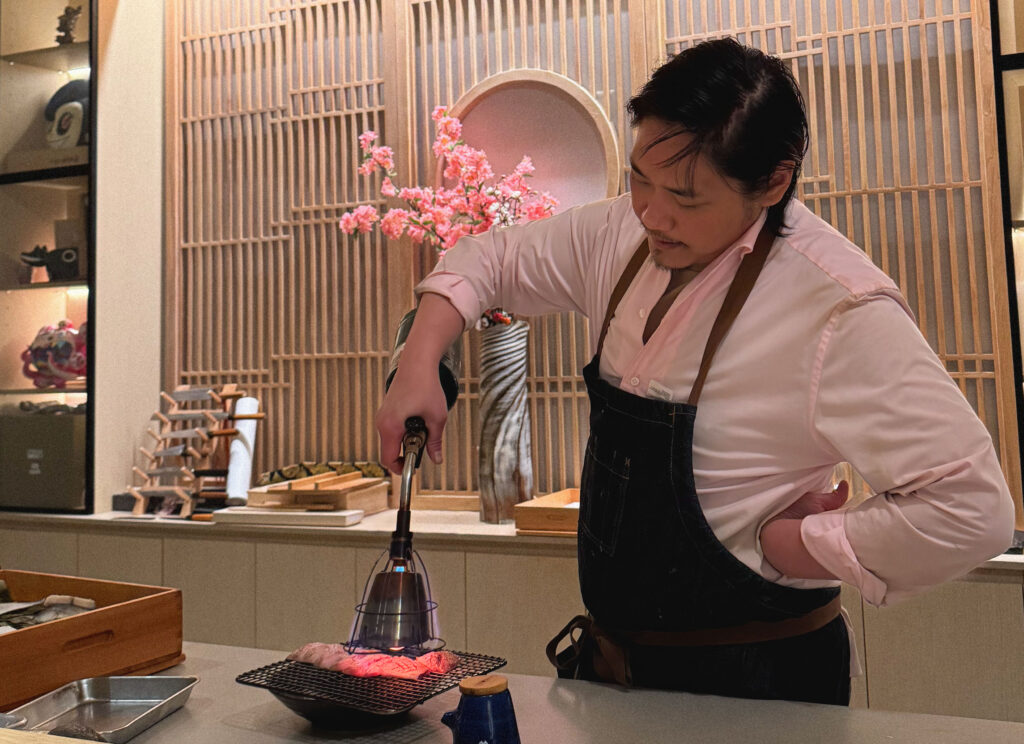
Despite the risk involved in interrupting my monthly flow of omakases (that is, never being able to present a full dozen experiences within the same year), I decided to take January off.
Sushi, for me, is just not the same when one isn’t drinking. The deceptively simple packaging of the form (wherein rice, vinegar, and fish shaped by a fathomless process of sourcing, manipulation, and lifelong iteration) demands being paired with a pour of something—be it beer, wine, sake, or whisky—that, in just a mere sip, expresses a kindred complexity of craft. This is not to discount tea either (should a Chicago restaurant ever launch a program of superlative quality).
For the regular patron of any omakase, matching the shifting qualities of an ingredient like tuna (always aspiring to the same melting, umami-laden expression but necessarily singular due to the caprices of nature) to the same dynamism found in wine (across neighboring pieces of terroir, successive vintages, or even identical bottles opened at different times) represents one of gastronomy’s peaks. I’m talking sensations of texture and flavor at their most subtle and filigreed: a privileged position at the highest speed of the hedonic treadmill where spending exponentially more for a modest increase in quality actually seems sensible.
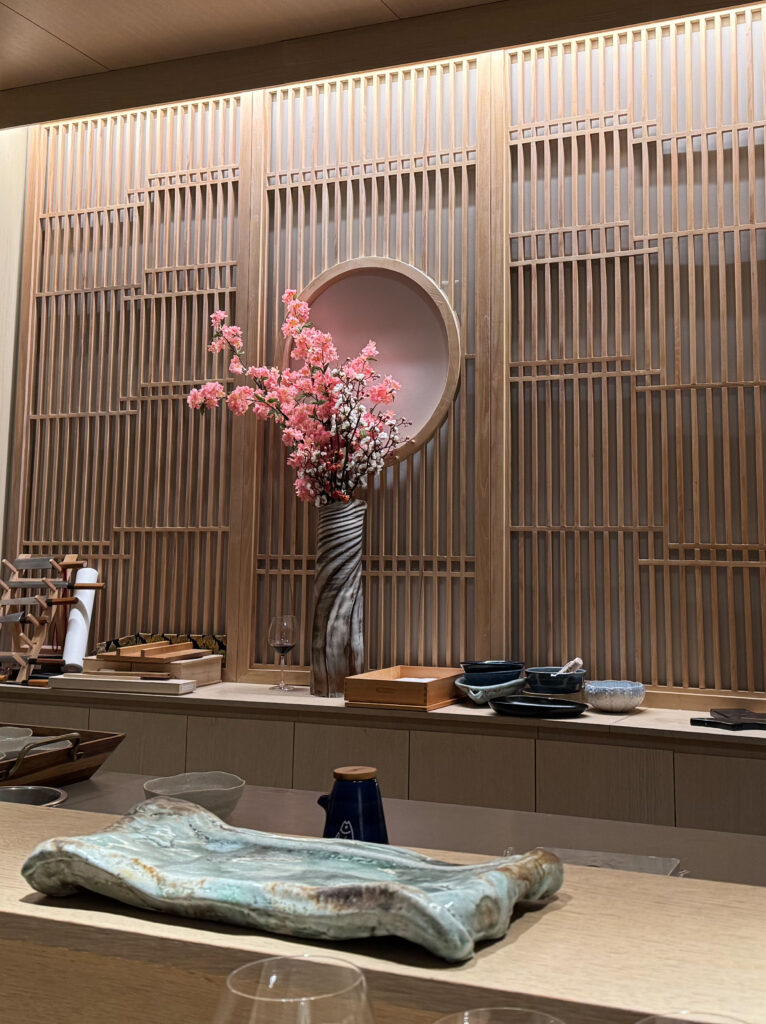
One need not pay the price that Kyōten’s coveted counter demands to get a taste of this marriage. Any diner, at every level of expenditure (and even across genres), can embark on the same journey. However, I’m not sure any other chef in this city attunes his work so precisely to the appreciation of wine. After all, Otto Phan has a palate for the stuff (the same one seasoning his nigiri), collects it, and manages the restaurant’s program on top of countless other tasks. The bottles he stocks—and attracts (courtesy of a modest $40 corkage with no limit on the number)—act as an extension of the same core identity. For this reason, the meal just feels incomplete if I cannot imbibe.
Thankfully, there’s a silver lining to my month (really more like a month and a half) off. 2026 has, up until now, been an exploration of excellence. And I think it’s nice to judge Kyōten relative to places like Smyth, Oriole, Feld, and Cellar Door Provisions (all enjoyed in quick succession during January) rather than the inverse, which is very much the norm.
Phan’s model, bite for bite, is almost impossible for any other fine dining concept—doomed to focus more on staffing, the composition of plates, the sequencing of the menu, and expectations of novelty—to match. Yet, when it comes to sheer pleasure, I believe many of the chef’s peers are getting closer—each in their own way—to matching the highs that his ankimo, ōtoro, chū-toro, buri, uni, and anago can provide.
At the same time, Kyōten’s weaknesses (principally at the level of service and ambiance) have always been clear to me. I am comfortable with such a tradeoff—viewing any roughness around the edges as a charming indicator of “authenticity”—but, simultaneously, understand that some patrons may not be. Like it or not, an overall feeling of luxury matters at this price point. Food, perversely enough, cannot always carry the day.
These are longstanding tensions, and I cannot promise that I have anything new to say about them. Nonetheless, a fresh set of eyes and a renewed sense of excitement for this distinctive, captivating omakase can never be a bad thing. Indeed, perpetual growth is the real measure by which Phan’s work should judged.
The goal, as always, is not to place Chicago’s finest restaurants in competition with each other. Instead, by fostering a conversation about chosen styles and value propositions, consumers can orient their own preferences and ascertain where they might most effectively direct their money.
Let us begin.

Stepping back into Kyōten’s sanctum after some time away always carries an air of anxiety.
There’s no question I’ll receive a warm welcome from the chef: one shaped by years of mutual appreciation. But this counter is a tiny kingdom whose identity (however defined) is still partially shaped, eight seats at a time, each and every night. Indeed, omakase here is a dialogue rather than a monologue. Phan experiments and hones his style with the clear intention of impressing Chicagoans with Chicago palates and no insecurity about whether or not they are eating sushi exactly how it is prepared in Japan.
Call it a backwards, corn-fed, flyover perspective, but the truth is actually more complicated (as I explained last time). Kyōten maximizes texture and flavor in a manner that is uncommon yet not without precedence. In fact, this approach dovetails with one of Tokyo’s most esteemed examples of the form, and I think it is more accurate to say that a certain demographic of diners—across cities, countries, and continents—justifiably prefers a powerful (though still totally refined) expression of sushi.
55 days since my last visit—hundreds of guests and thousands of nigiri served later—I feel the gnawing need to get up to speed. What has come into season? What remains? How has the chef adapted to the shifting qualities of each fish (and, I fear, in accordance with whose taste)? Has the crowd, always surprisingly colorful in its composition, finally shifted toward a sneering, “bromakase” contingent?
With a knowing greeting, I am ushered into the space: last to arrive, exiled to the farthest corner of the counter, yet met by glassware, ice buckets, and a wry smile. As I settle in, the other guests go about confirming their own beverage orders while Phan finishes his prep work.
Suddenly, a squeaky voice on the other side of the room asks if they can get a Shirley Temple. This precocious child has joined their parents tonight in order to try sushi for the very first time (a situation I have observed here at least a couple other times). The chef—soon to be a father himself—shares his regret that they cannot make the drink. Nonetheless, he relishes the chance to introduce the young diner to his life’s work: promising to tailor the menu (via the cooking of certain fish and adjustment of ingredients like wasabi) to make it more approachable.
With this interaction, any lingering apprehension in the intimate space—the stage for this nearly $500 experience—is instantly dispelled. The sense of ease and openness that characterizes Phan’s counter unfurls (it’s only ever a question of when), and the expectation of any serious performance fades in exchange for a pervading kind of comfort. This is the mood that makes the three-hour meal seem to fly by (and, in turn, that makes returning to the restaurant so rewarding).
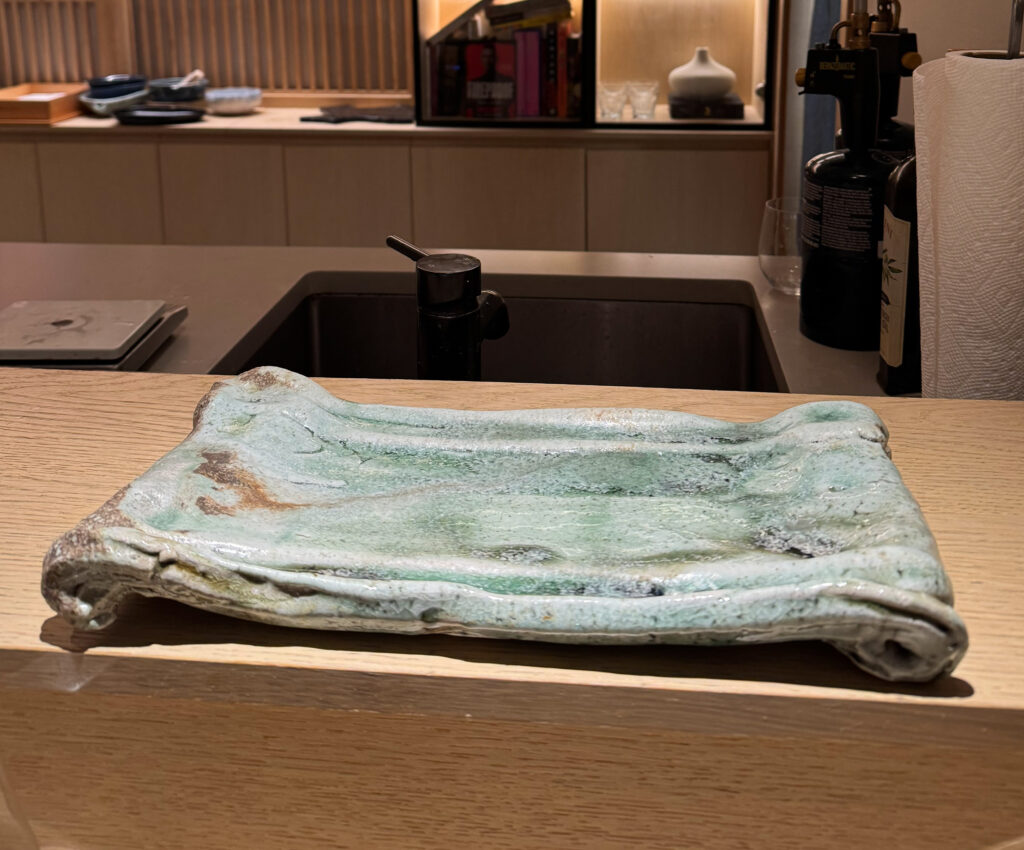
All is well, and there’s only one real change to note: a new ceramic geta (the serving board on which nigiri are placed) situated before me. These pieces, the work of Japanese potter Kumano Kurôemon, were some six years in the making. Phan admits he’s unsure if they will hold his sushi upright, but, functionally, they do the job while simultaneously anchoring each bite in a seemingly rough yet compellingly naturalistic expression of a kindred handcraft. Seeing Kyōten feature pieces of such rarity and distinction represents a real step forward in enriching the wider experience without resorting to stereotypical symbols of luxury.
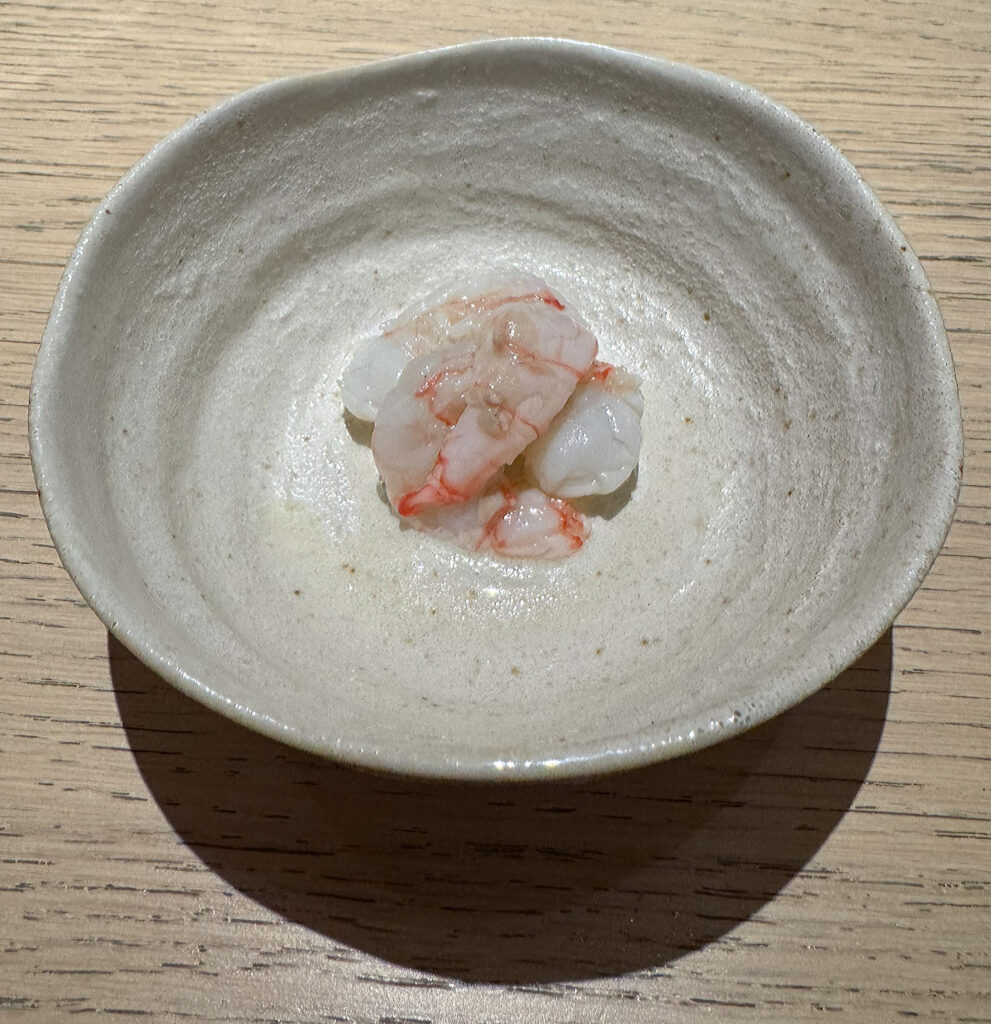
Tonight’s meal begins on an all-too-familiar note: that is, with a serving of “Aka Ebi” (a kind of red, deep-water prawn) sourced from Hawaii. This item routinely appeared during the latter half of 2025, and, given that the ingredient has also featured on other tasting menus around town, I always feel like I need to dock a couple points for lack of novelty. To be fair, I am not sure the average customer would render the same judgment—quite the opposite, Phan is actually wise to kick things off with something recognizable.
Here, two sizable curls of the crustacean are served intertwined and dressed “ceviche style” with a combination of lemon juice and dashi. The balance of this marinade (whether it veers more toward citrus or a savory character) often plays the decisive role in whether I like the dish. The prawns themselves routinely display a plump, creamy consistency, and tonight is no different. Their corresponding flavor is a touch briny on entry, but, thanks to a perfect push-pull of acidity and umami on the midpalate, the aka ebi’s latent sweetness is revealed on the finish. The sum effect is quite satisfying (certainly ranking among the best examples of this recipe I have tasted), and it’s easy even for me to see why the chef continues to rely on this opener.
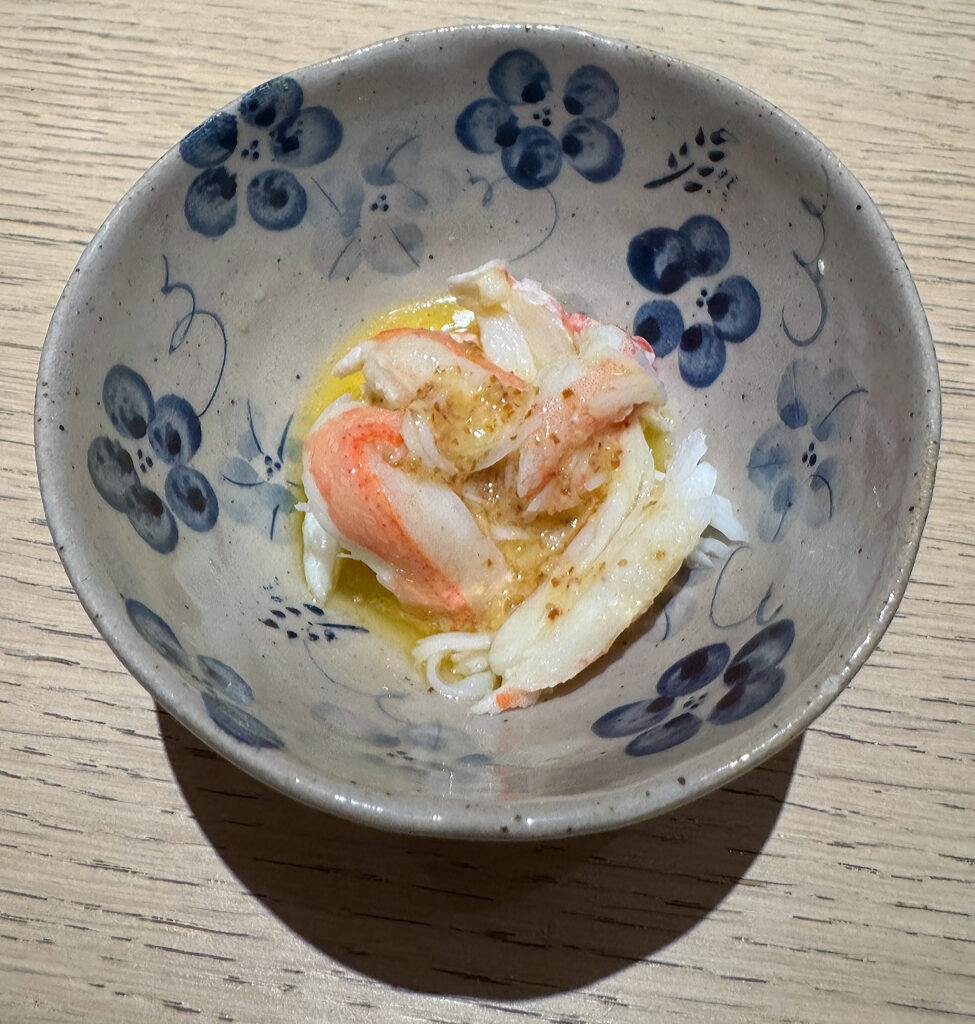
Back in December, the chef introduced an enjoyable preparation of “Zuwai-Gani” (i.e., Hokkaido male snow crab) that served to replace—but did not quite surpass—the “Ke-Gani” (i.e., Hokkaido horsehair crab) that featured during the months prior. On this occasion, the former crustacean returns to the menu, and I am happy to report that it fulfills its promise as the peak expression of shellfish served at Kyōten.
The present iteration of this dish centers on nuggets (rather than the strands seen last time) of leg meat in a dressing (substituting for the earlier dashi butter) made from mustard, butter, and lemon juice. Texturally, each piece of the crab delivers a moist, tender sensation with only the slightest trace of silky structure. The crustacean’s accompanying expression is more exuberantly sweet than the preceding prawn. However, it’s the rounded tang and sharpness of the mustard butter that really strikes me most, for (compared to lemon alone) the condiment draws out a maddening degree of umami that feels as though the flavor of the entire crab has been concentrated into a solitary bite. In truth, I do not know whether the sheer quality of the seafood or Phan’s vision deserves more credit. Yet, as I treasure the eye-rolling pleasure that lasts (impressively!) more than a minute on the finish, it becomes immediately clear that this recipe stands among the chef’s best ever offerings.
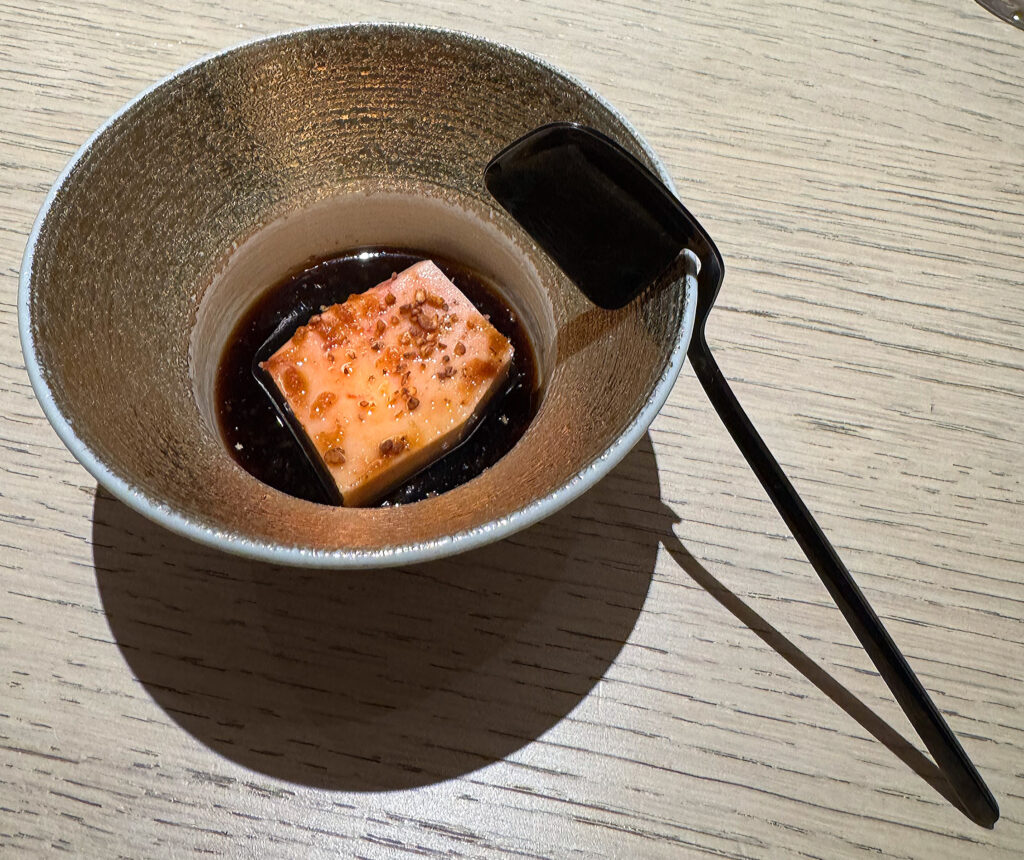
What could possibly follow a serving like that? Well, luckily, Phan can draw on one of his classic compositions: the “Ankimo” (or monkfish liver) he introduces by admitting, “if there’s a signature [on the menu], it’s this one.” Sourced from a specialist purveyor in Hokkaido, the fish offal is paired with a sprinkle of toasted buckwheat and comes soaked—as it always does—in a sauce made from ginger, mirin, and sake.
On the palate, the effect of the buckwheat is fairly muted tonight. That might be a good thing, for, while such a contrast is sensible, this brittleness can frequently feel a bit stale and jarring. Instead, I am able to appreciate the dense, creamy consistency of the liver (“the foie gras of the sea”) without any distraction. Better yet, the ginger sauce tastes particularly powerful in this instance, supercharging the ankimo with a degree of sweetness and spicy, pungent lift that counters (and thus enhances) the overarching richness. Indeed, after a couple good (not great) examples of this recipe in the recent past, I feel that the chef has finally restored this signature to its former glory. No doubt, it’s an extreme expression—but one that cuts right to the heart of what makes the restaurant’s style so appealing.
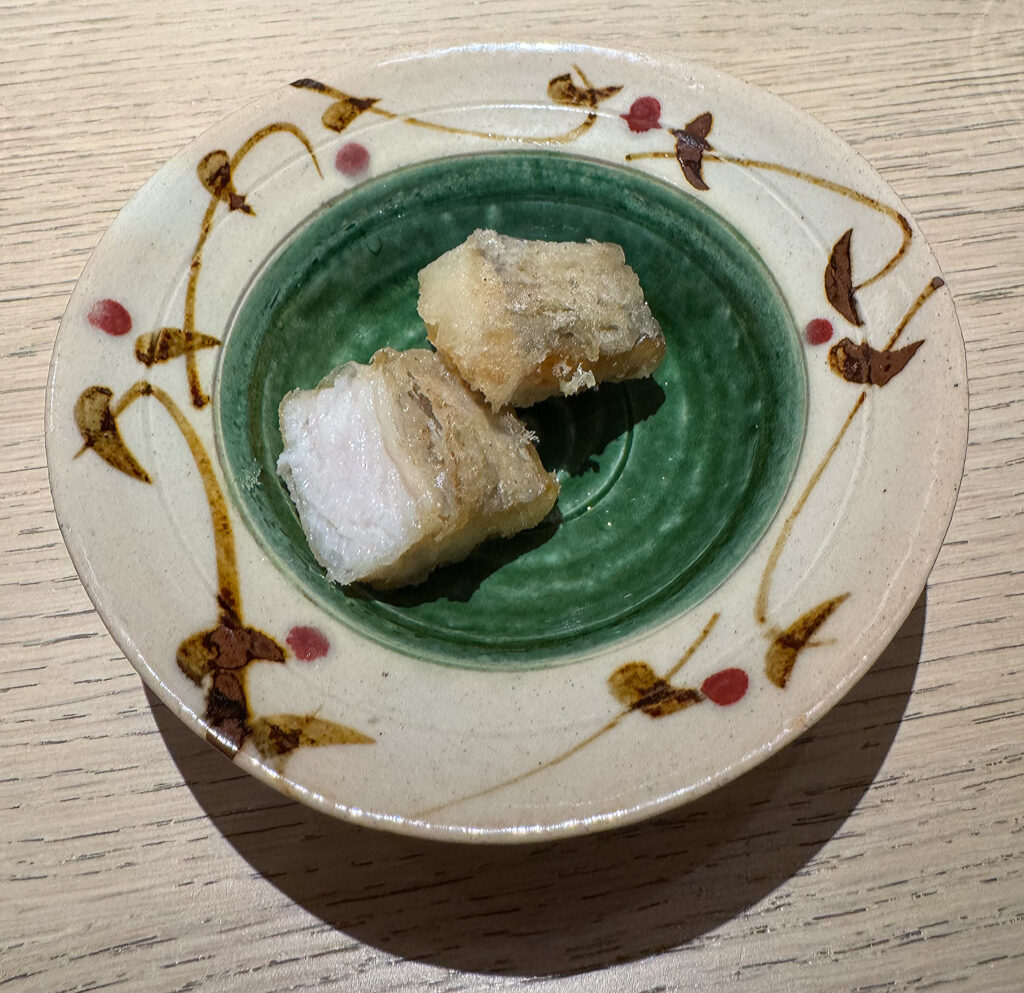
Closing out the sequence of small plates that precedes nigiri, a “Tachiuo” (or beltfish) tempura looks to build on Phan’s increasing mastery of this battered-and-fried form. The titular ingredient—subtly firm and fluffy in its consistency—ranks as the chef’s favorite for use in this kind of preparation. Yet, here, it falls short. Yes, while the beltfish possesses moist flesh, a kick of lemon juice, and a subtly sweet flavor expression, its surrounding coating displays no trace of crispness. This does not stand in the way of guests enjoying a couple tasty bites. But the dish can in no way be called tempura, and it goes to show that, as much as the restaurant has grown in its array of techniques, occasional lapses are inevitable. Either the temperature of the oil or the batter itself was completely off this time around.
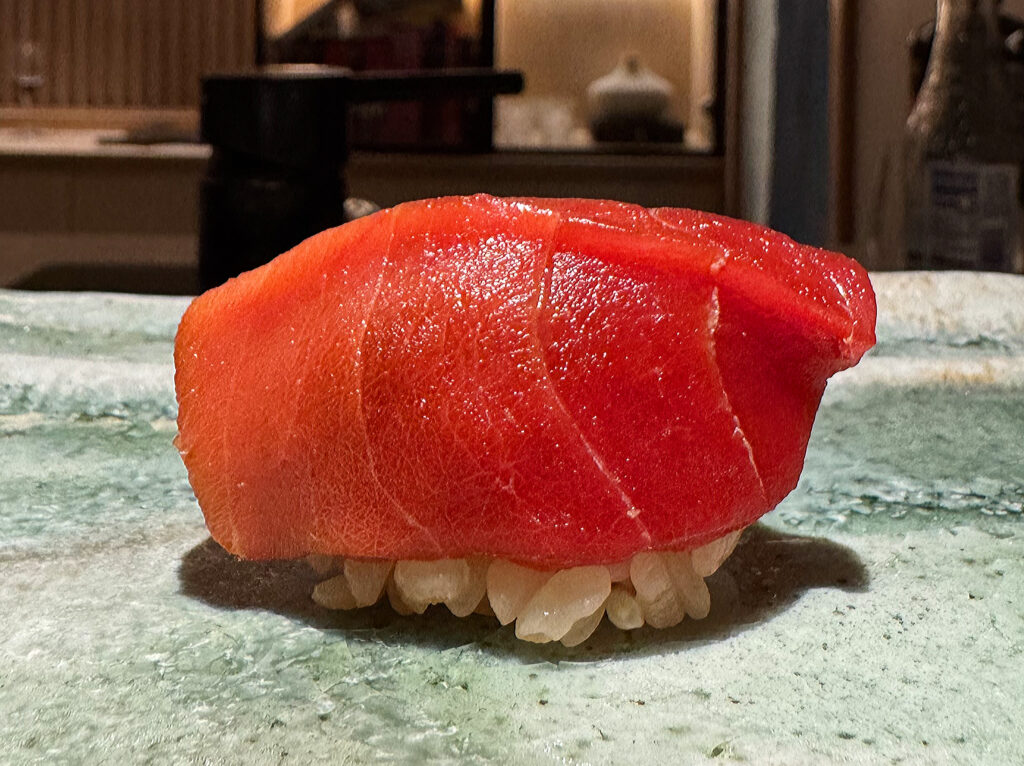
Thankfully, with the arrival of the “Chū-Toro,” Phan makes an immediate recovery. This medium-fatty cut of tuna belly (taken from a wild-caught specimen sourced off the coast of Boston) is typically favored to start the sushi sequence. The thought process here—one followed since Kyōten’s founding—is to shock and awe guests while they still possess a healthy appetite (rather than situating the most coveted pieces at the very end of the meal). By playing these strongest cards so early, the chef can then showcase more esoteric fish throughout the rest of his menu without contending with the same kind of impatience or expectation that often saps pleasure.
Tonight, the chū-toro takes the form an especially generous slice (one can barely see the rice!) displaying minimal horizontal scoring on one end and a fine web of marbling running throughout the flesh, whose color ranges from deep red to pale pink. Phan notes that he prepared this piece using the “horse saddle” cut popularized by Tadashi Yoshida of Yoshino, and this bit of outside inspiration yields a superlative result. The tuna displays a fleeting firmness on entry—just enough to make its sizable presence known—before melting with total seamlessness. The resulting flavor is marked by a generous application of fresh wasabi that, stopping just short of tickling one’s nose, shoots through the fish’s ample fat and reveals a hugely satisfying expression of umami. Ultimately, this bite falls short of the extra emotional dimension that would see it rank among the chef’s “best ever” examples. However, it’s impossible to fault, and I would never take this level of quality for granted.
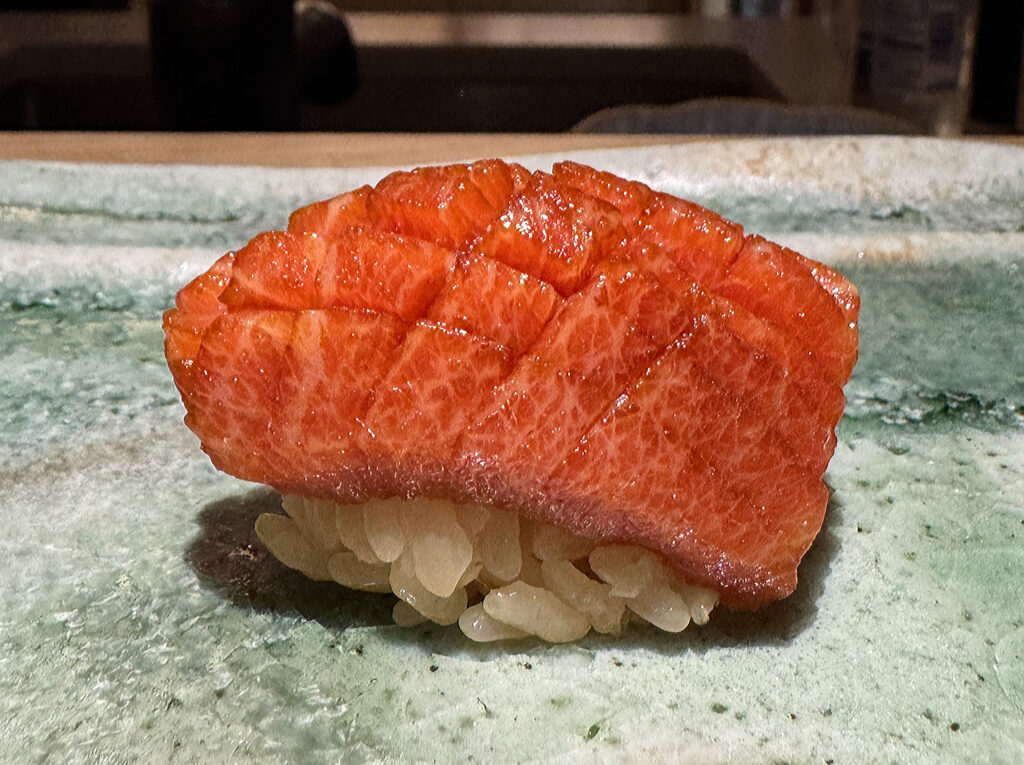
The “Ōtoro” that comes next, being taken from the fattiest segment of the same belly, promises an even greater degree of decadence. It certainly looks the part: boasting an even thicker lattice of marbling set against paler, crosshatch-scored flesh.
On the palate, this piece proves more effusive in how its fat melts, yet I detect a trace of structuring sinew (not unpleasant) that helps to maintain a sense of weight. Relative to the chū-toro, the ōtoro is marked less by wasabi, and, on entry, it seemingly suffers from a sudden drop in intensity. Nonetheless, the fattier tuna is remarkably persistent—delivering a lower register of savory, almost salty notes that cleanly reflect the essence of the fish. Being so close in quality (yet divergent in their expression), these two cuts of belly can only be judged in accordance with personal taste. On this occasion, I prefer the chū-toro by a hair, but there’s no question that both bites live up to the omakase’s high ticket price.
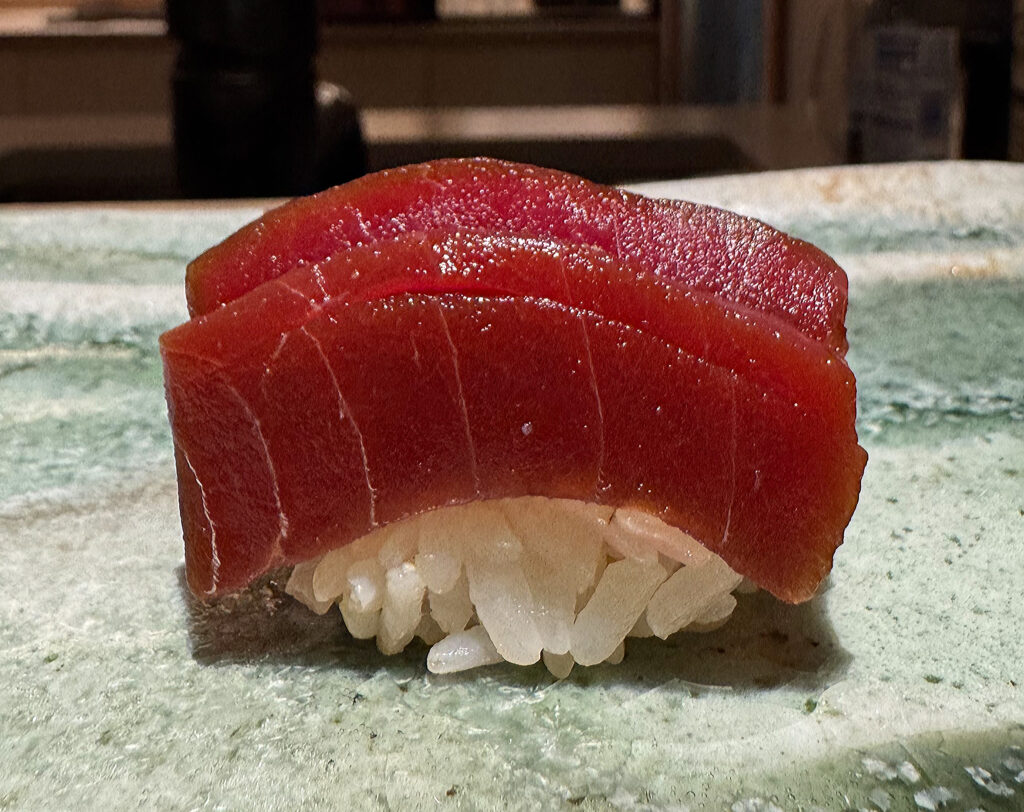
“Akami” (referring to the tuna’s leaner flesh) often makes for a startling point of comparison. For, while the cut lacks the same prized streaks of fat, it (in Phan’s hands) still manages to offer much of the same pleasure. The chef notes that he has recently changed his manner of curing the fish, and the flesh shows none of the same darker fringes that once suggested extended contact with soy sauce. Instead, the piece possesses a deep, even red tone and an elegantly wavy silhouette (courtesy of some horizontal scoring).
On the palate, the akami is shockingly soft—not quite melting like the preceding bites but unraveling with the same sense of seamlessness. Its accompanying flavor shows moderate imprints of wasabi and soy sauce, and, while the sum effect feels adequately seasoned, the lean meat’s expression is one of harmony rather than power. This makes it hard for the tuna to measure up to the chū-toro or ōtoro in terms of sheer satisfaction, yet it really only falls one step behind. Yes, the akami would put the headlining cuts at most other omakases to shame, and I am happy to see it feature in this newly refined form.
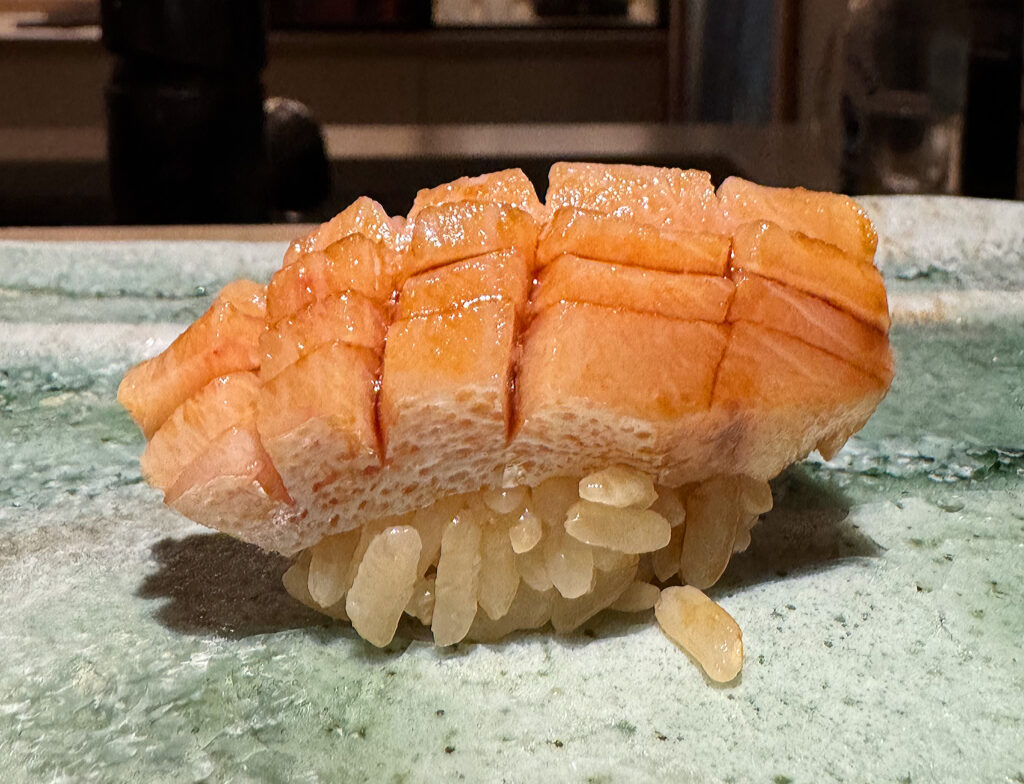
“Buri” (or wild mature yellowtail) marks the point where things start to get interesting. After all, it’s fairly easy to impress diners with the primest cuts of tuna. How do you keep the momentum going when transitioning toward fish that lack the same luxury status? To be fair, yellowtail is certainly no slouch, and it has long formed one of Phan’s signature pieces. The present example—taken from the belly and rested on seaweed before serving—seems particularly well equipped to impress.
The off-white, crosshatched flesh comes streaked with fine threads of fat and, upon reaching the tongue, melts in a manner not unlike the ōtoro. Nonetheless, the corresponding flavor is charged with soy sauce and wasabi in a way that is more akin to the chū-toro. Factor in the influence of the umami-boosting seaweed, and one is treated to a level of savory intensity that belies the buri’s white flesh. In short, this stands as a brilliant bite: the kind that assures you there are many more highlights to come after the tuna.
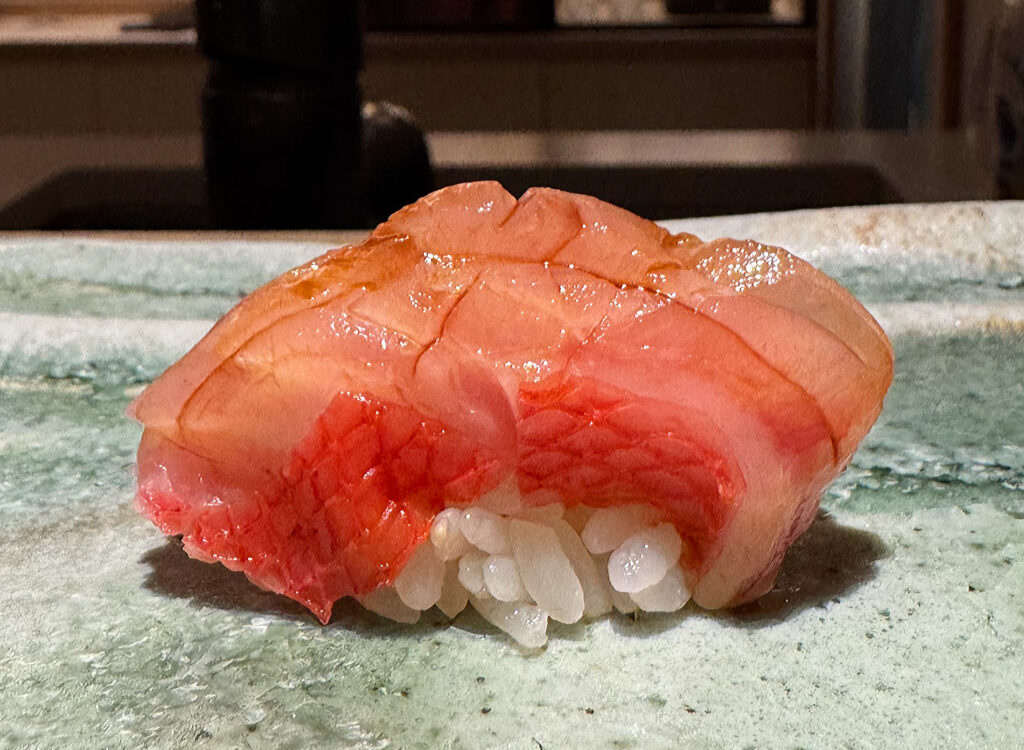
The “Kinmedai” (i.e., golden-eye snapper) has not appeared on the menu since August of last year, and I wonder what this fish (which tends to rank somewhere in the middle of the pack) might have to offer in the heart of such an exceptional winter season. The resulting piece, presented with an accompanying strip of webbed skin, boasts a milky-pink tone with some mixed horizontal and vertical scoring.
Phan describes the fish as being “particularly good today,” and I must agree. The kinmedai is fleetingly firm on entry yet turns almost creamy with further mastication. When it comes to flavor, the bite leads with citrus but marries the bright-and-tangy sensation with more than enough umami. Ultimately, this makes for a cleansing, reinvigorating serving that—importantly—does not fall short of providing a baseline level of enjoyment.
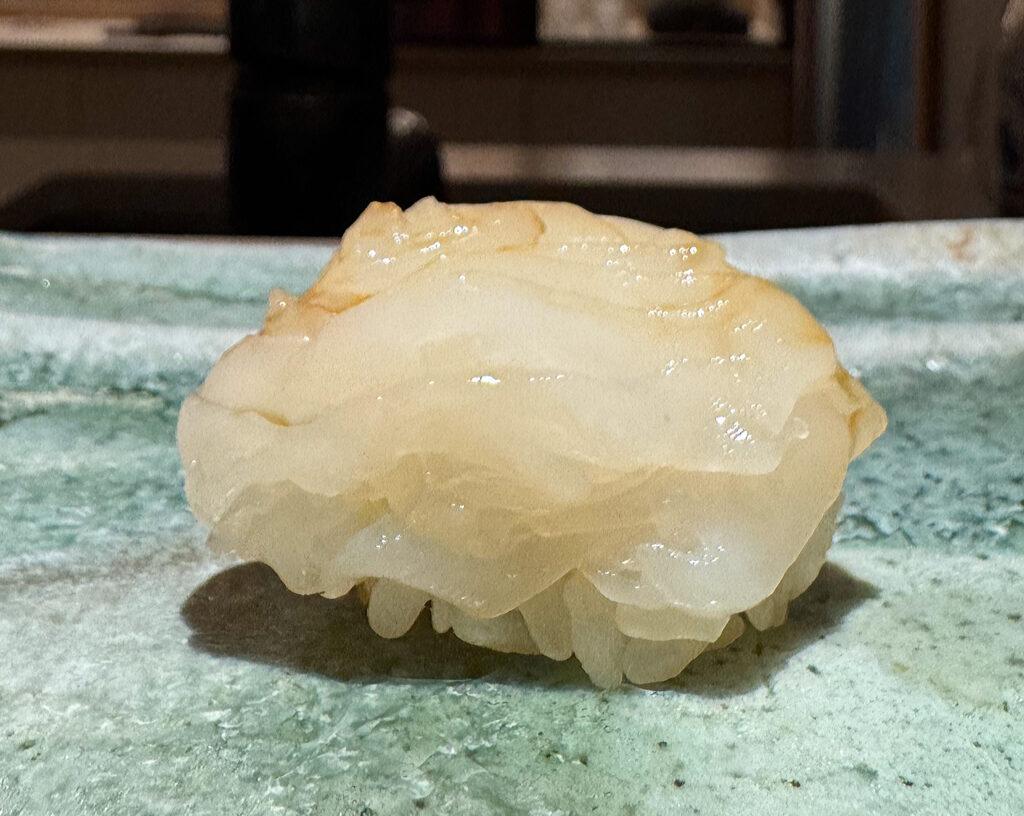
Throughout 2025, Kyōten increasingly featured squid. However, I cannot say I have ever encountered “Aori Ika” (a term referring to the bigfin reef squid) at the restaurant. The resulting portion is milky white and rather elaborately scored. It is only thanks to a drizzle of soy sauce that one can really perceive the layers of flesh that hide behind the shiny sheen.
On the palate, the aori ika possesses a mouthfeel of such melting softness that one is almost left questioning if they are really eating squid. There’s simply none of the distinguishing chew (often quite pleasant) this ingredient is known for, and the resulting flavor—its latent sweetness accentuated by a touch of lemon zest and the salty dressing—is simply sublime. Overall, I struggle to think of another piece that testifies as strongly to Phan’s technical aptitude. It’s hard to believe that this is an entirely new offering, debuting at such a high level of quality, too. I can only hope I get to encounter the bite again.
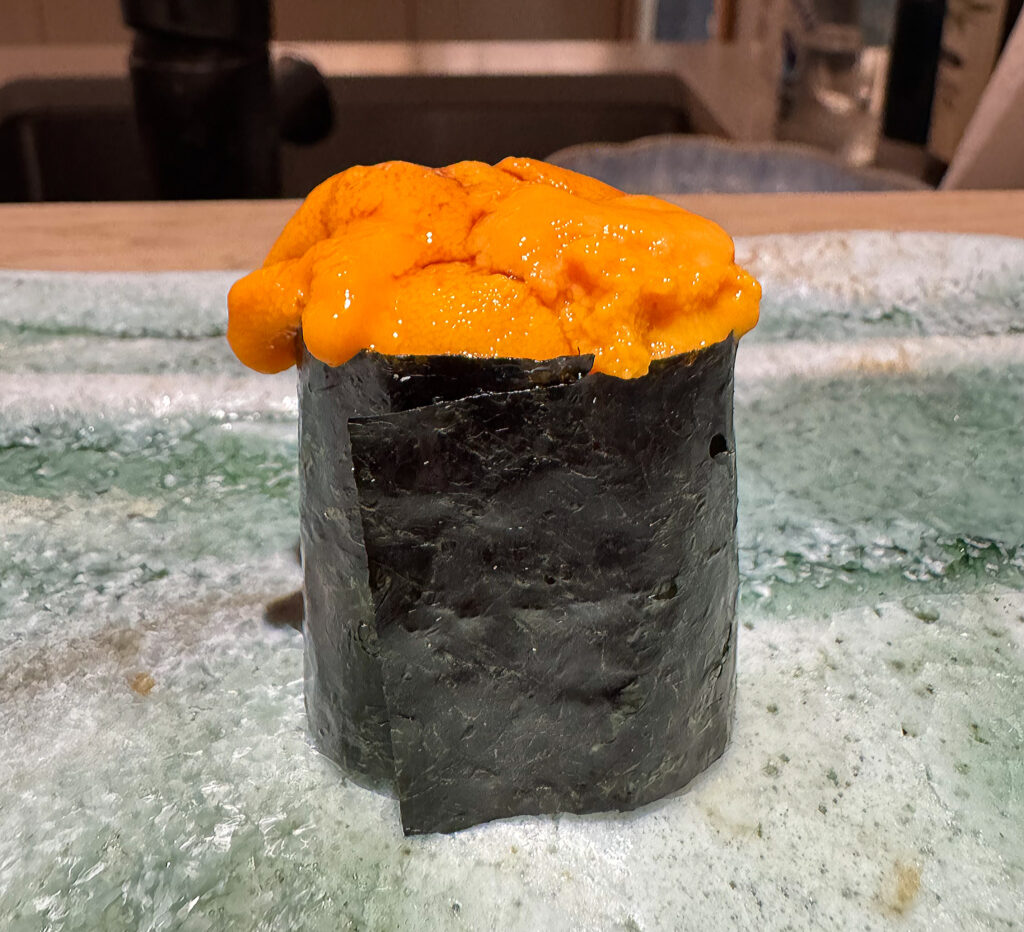
Turning back toward the menu’s heavy hitters, we come to the “Uni”—that preparation of sea urchin roe (technically the gonads) whose coveted status might come closest to matching the tuna itself. As always, Phan favors the ensui (or preservative-free) variety of this Hokkaido-sourced product: one that comes soaked in a saltwater solution and, thus, is strained before being spooned atop a clump of rice wrapped in nori.
Texturally, the resulting bite juxtaposes the flawlessly crisp seaweed (reliably one of the restaurant’s strengths) with the fluffy uni and an absorptive layer of rice. No complaints here. Indeed, flavor is the dimension on which sea urchin really must be judged, and, on entry, I find the present example to be entirely clean (i.e., lacking any funky or irony notes). Further, while the lobes lack much by way of sweetness, they make up for it with a pronounced oceanic depth: one yielding a finish that lasts, impressively, for more than a minute. To offer a critique, the starring ingredient is served a touch too cold, and the temperature serves to slightly mute its intensity. Still, the uni’s concentration cannot be ignored, and this sense of power makes for a successful iteration of the prized seafood.
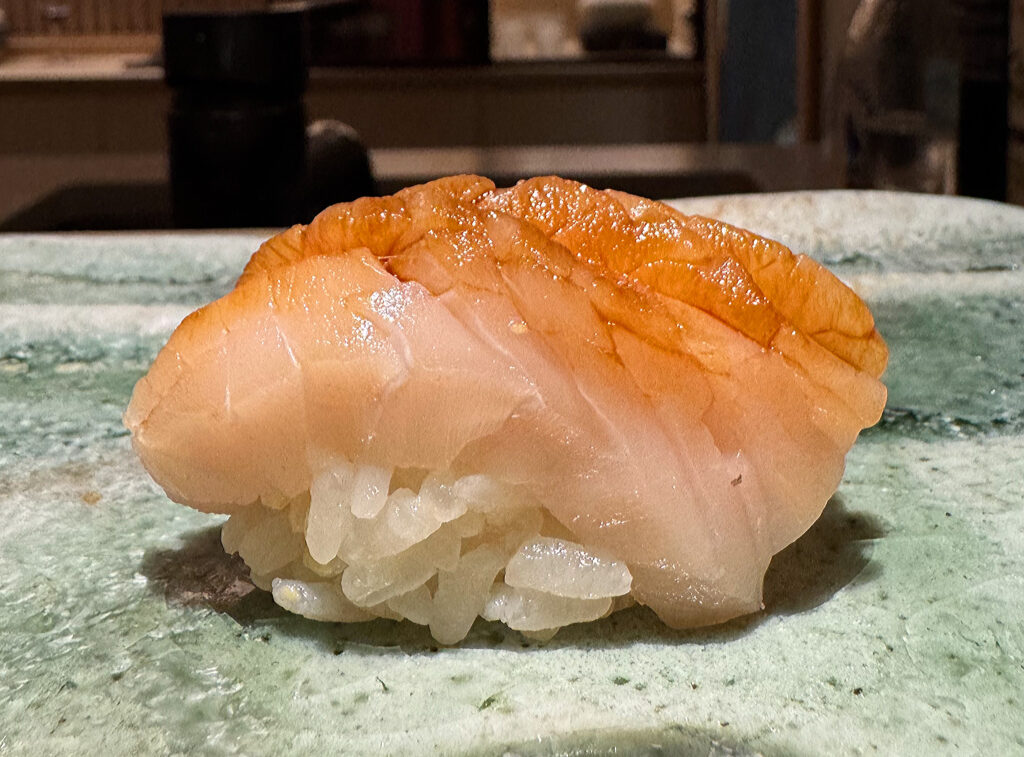
With the arrival of the “Sawara” (or Spanish mackerel), the omakase reaches its denouement: the point in which all the headlining pieces have had their say and the humbler, more obscure fish need to try and keep the momentum going until dessert. This particular ingredient has never really ranked among my favorites. Yet, tonight, it comes lightly smoked with an accompanying touch of ginger. This process yields a bite that is soft and gooey on entry but, in turn, possesses enough sharpness and persistence to enliven the rich flesh while carrying flavor well through the finish. In short, the sawara has reached its peak expression tonight and, at this later stage, represents a very pleasant surprise.
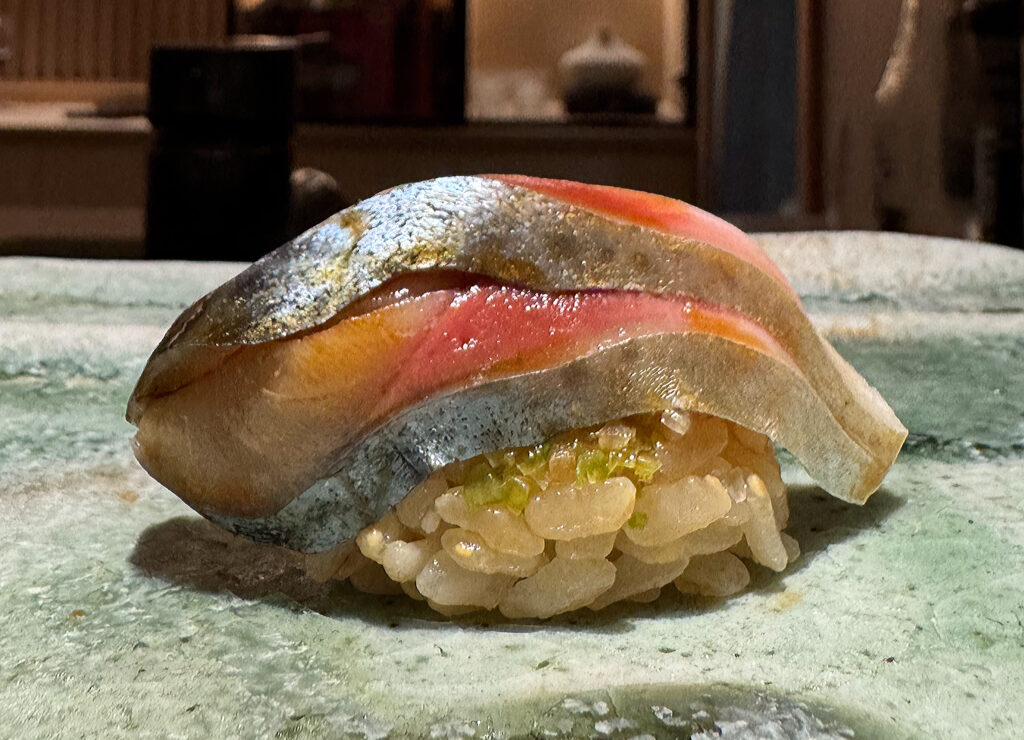
The same goes for the “Saba” (a term referring to the Pacific or blue mackerel). Like its compatriot, the fish here—distinguished by reddish streaks of flesh and strips of silvery skin—is helped along by the addition of some ginger. However, it’s the application of green onion (tucked atop the rice) that proves decisive: offsetting the oilier qualities of the piece with a satisfying crunch while also enhancing the saba’s intensely savory (almost fishy) character via its fresh, sweet, alleviating effect. Once again, what really impresses me is how well the flavor of the accompaniments (not least of which the ginger’s tang) lasts through the finish. Yes, rather than fizzling out, this mackerel convincingly matches its fat to a memorable degree of enjoyment.
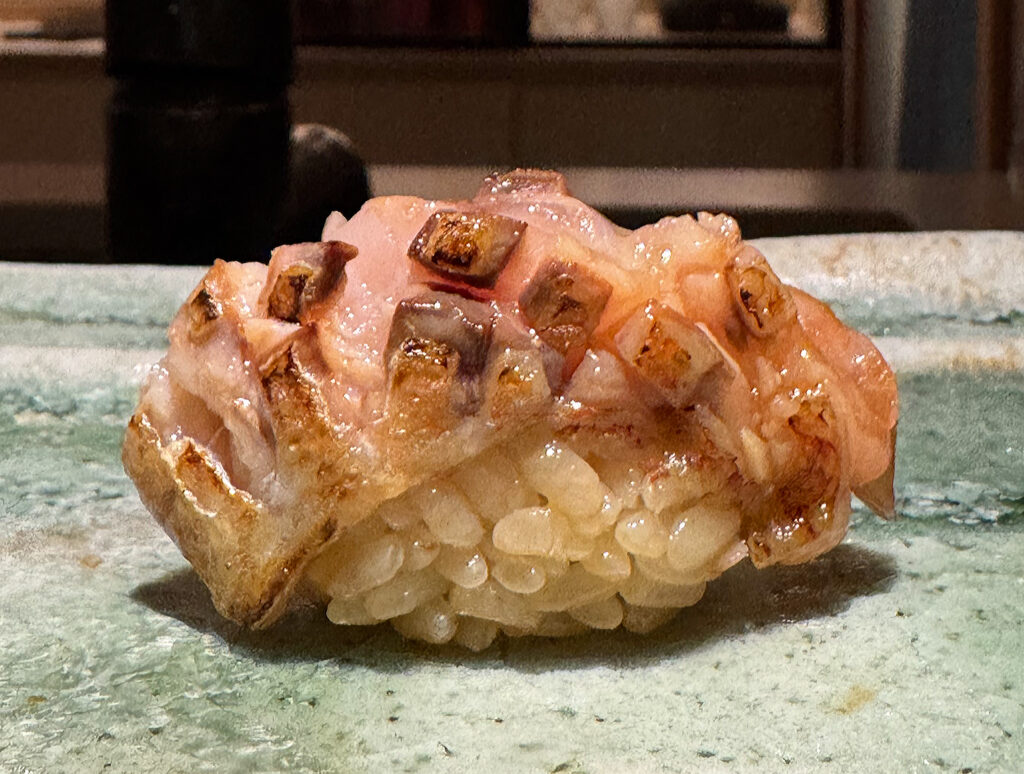
Phan has long praised “Akamutsu” (i.e., blackthroat sea perch) as the most luxurious of all the fish he serves. For a Japanese audience, it represents something of a deep cut (the chef jokes it’s what he’d serve the Prime Minister were she to dine at the restaurant). For the native crowd, the reason for this status is less obvious. Here, the akamutsu comes torched in the usual fashion: one that avoids excess charring while adequately crisping rectangular segments of skin and moistening the flesh with a sheen of rendered fat.
On the palate, the fish is expectedly rich, melty, and mouthcoating in a manner I haven’t felt since those earliest servings of tuna. Nonetheless, the accompanying flavor is decidedly mild—not quite bland but certainly content to play in the background rather than assert itself. Indeed, this piece clearly privileges textural appeal more than the kind of pronounced notes that characterized the two mackerels. For that reason, I think the akamutsu falls short in anchoring the nigiri sequence, but it remains a wholly enjoyable bite.
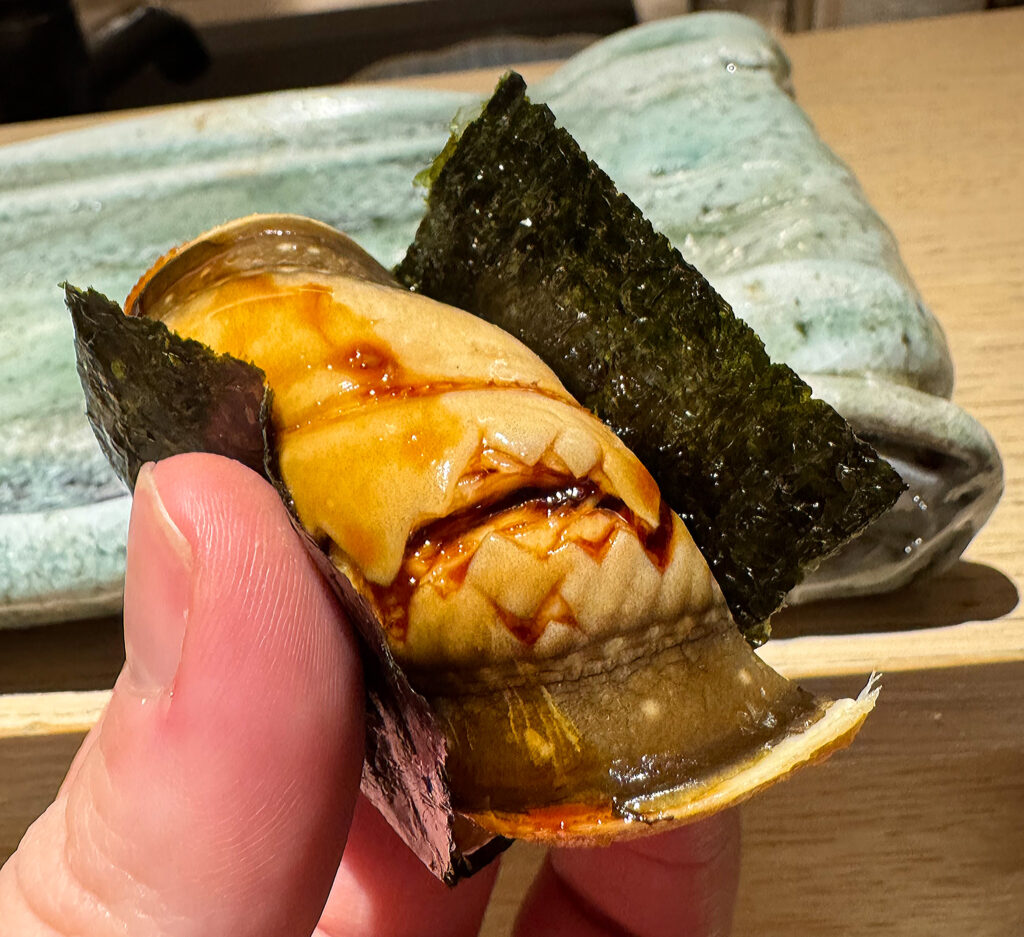
Kyōten’s “Anago” (that is, saltwater eel) is routinely one of the meal’s unexpected highlights, and, on this occasion, Phan announces that the quality is the best he’s ever served. Placed atop rice, lightly sauced, and folded between a crisp strip of seaweed, the fish (what the chef goes on to describe as a particularly small specimen) is notable for its seamless—almost custardy—mouthfeel in this instance.
The resulting flavor is marked less by the sweetness of the dressing (however much I enjoy it) and more by a long, clean, savory quality that speaks to the very essence of eel. Overall, this makes for a unique and intellectual example of anago that, while it does not deliver the degree of decadence I usually look for, is worth prizing for its subtlety. Of course, to echo my critique of the akamutsu, I still think the turn toward these softer, mild bites does break a bit from the intensity that characterized the rest of the menu.
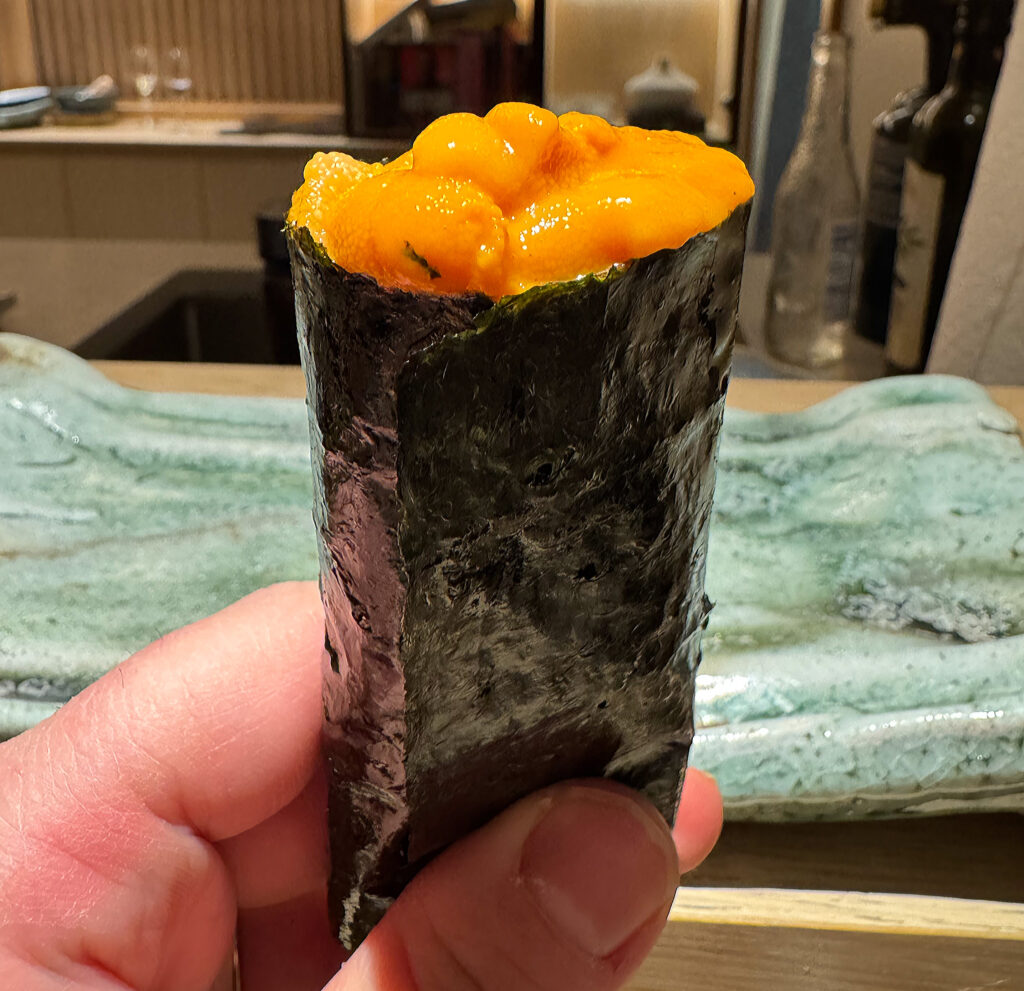
Closing out the savory portion of the evening, we have an “Uni Handroll” that comes loaded with tuna trimmings and a firm imprint of wasabi. As good as these kitchen sink constructions often sound, I rarely find that they live up to the quality of their fillings.
This time, I am happy to report that the roll tastes like something more than the sum of its parts: combining a flawlessly crisp wrapper, a creamy layer of sea urchin, and melty fish fat (all soaked into the rice) with a resulting flavor that is powerfully savory, a touch briny, and charged with nose-clearing pungency. The latter note might provide too much for some palates. Yet, given the lack of concentration I perceived from the akamutsu and anago, I find the contrast of richness and wasabi here to be just sublime.
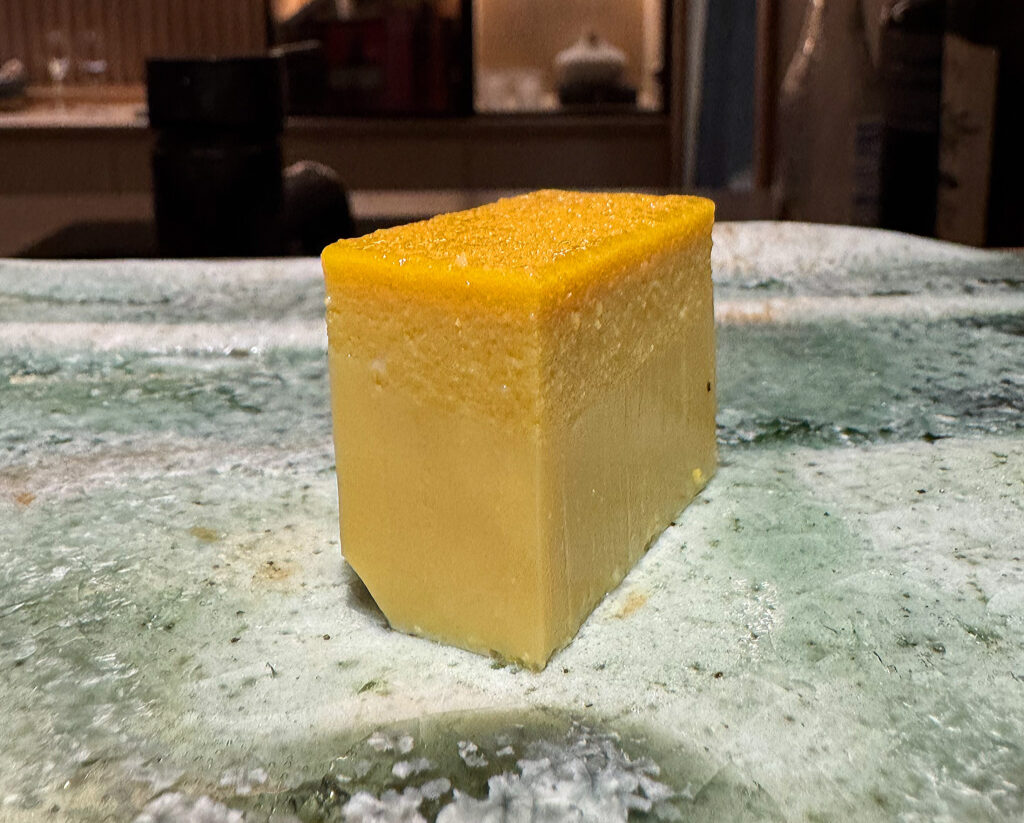
When dessert arrives, it does so in the typical fashion. Phan’s “Tamago” (rendered as a corn- and maple-infused custard) is perfectly executed tonight. Namely, the bite is not served—as it occasionally is—too cold. This ensures the egg omelet’s slick, creamy consistency and accompanying concentration of caramelized, freshly sweet flavor strike with full force. Call it untraditional, yet I have encountered no other example of this recipe that reliably delivers the same degree of pleasure.
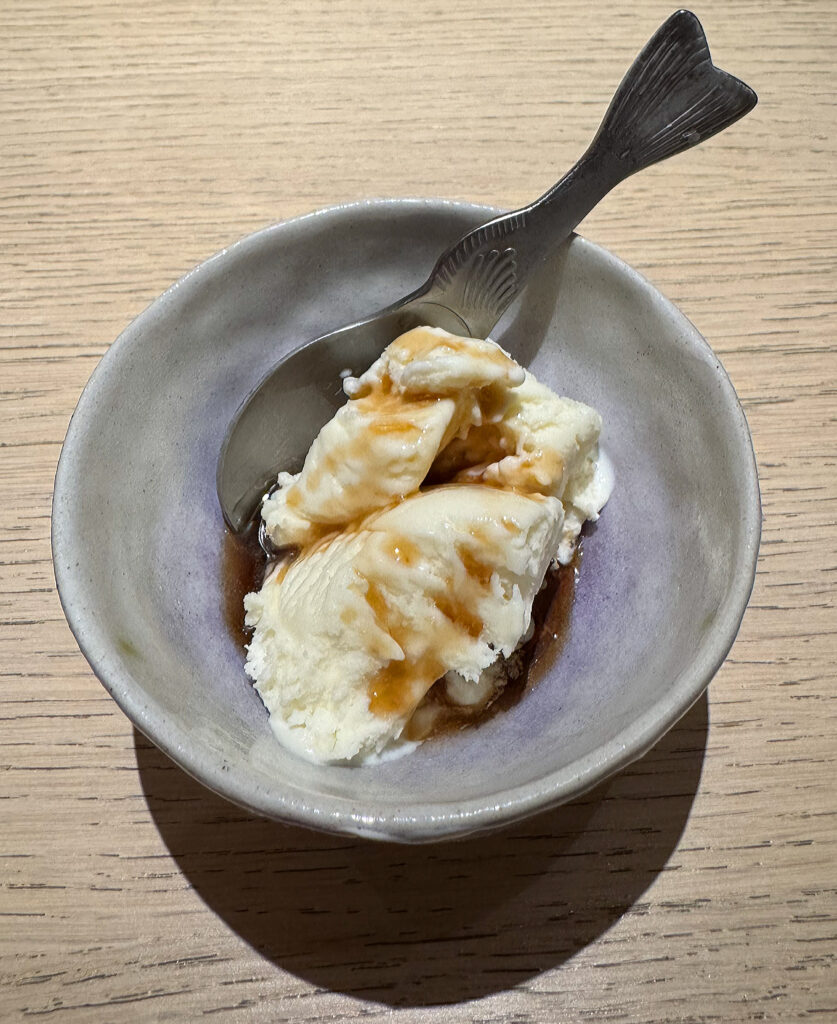
Finally, there’s the “White Cheddar Ice Cream”—an item that has, since its debut in October of 2025, immediately elevated Phan’s longstanding work in the frozen dessert realm. The chef describes the present example as being more like a gelato (signifying a lower proportion of fat). He also now uses Prairie Breeze (produced by Iowa’s Milton Creamery) for the titular cheese. Substituting toffee crumble (which appeared in December) for a drizzle of maple syrup, the ice cream builds on the harmonizing flavor of the tamago to offer a startling intensity of milky, nutty, and butterscotch tones that end the evening on a note of deep satisfaction. Given that Phan continues to tweak his recipe, the best version of this dish may still—somehow—be yet to come.
In ranking the evening’s dishes:
I would place the “Zuwai-Gani,” “Ankimo,” “Chū-Toro,” “Ōtoro,” and “Aori Ika” in the highest category: superlative items that stand among the best things I will be served in any restaurant this year.
Next come the “Aka Ebi,” “Akami,” “Buri,” “Kinmedai,” “Uni,” “Sawara,” “Saba,” “Anago,” “Uni Handroll,” “Tamago,” and “White Cheddar Ice Cream”— very good—even great—preparations I would always be happy to sample again (but that just failed to elicit an extra degree of emotion).
Finally, there’s the “Tachiuo” and “Akamutsu”—merely good (maybe just average) items that fell a bit short when it came to texture or flavor. None of these bites faltered in more than one dimension, so there was still pleasure to be had (and, undoubtedly, they could all easily be improved moving forward).
Overall, this makes for a hit-rate of 89%, with that same 89% of dishes all landing in the “would love to have again” category and some 28% reaching that rarefied “best of the year” level of quality.
Simply put, this is an immense score: the kind that should, rightfully, align with a restaurant charging among the highest prices in Chicago. Certainly, one sacrifices a considerable degree of novelty and pomp when choosing to visit Kyōten instead of Alinea or Smyth. One chooses to accept the roughness around the edges that a two-man operation (as opposed to the efforts of a full brigade) entails, as well as the limited room for error that mere fish and rice (rather than elaborate tasting menu constructions) allow.
At Kyōten, lovers of omakase will immediately recognize a level of ingredient quality and a confident house style that resists comparison. Indeed, Phan conjures such a high degree of pleasure from ingredients like tuna, yellowtail, crab, sea urchin, and eel—and with such consistency—that one really needs to judge his work from a national (not local) perspective.
In turn, omakase newbies—should they choose to splurge and run straight to the mountaintop—will find that what they seemingly sacrifice in the overall experience of an Alinea or Smyth is more than made up for by direct interaction with Kyōten’s quirky, mouthy, and thoroughly unpretentious chef. These novices might not possess the kinds of reference points that help to reveal just how good each bite is. But they’ll know that they belong and taste the fact that sushi here is flavored for Chicagoans and not in accordance with what any other palate in any other place desires.
Wherever a given customer falls on this spectrum, Phan’s value proposition remains stable. Bite for bite, his work (after more than a month away) still measures up to—and frequently surpasses—what is being served at the city’s multi-Michelin-star establishments. The meal he puts on, warts and all, implicitly poses a gnawing question: do all the infrastructure and choreography and romance that define a proper temple of gastronomy really yield more enjoyment? Or does the unshakable devotion of one chef, manning a stove or a counter each night, effectively negate the need for any frills?
We’re getting into questions of personal taste that I cannot answer. (After all, there are occasions when the splendor of a “night out,” shared with the right company, matters infinitely more than culinary geekery or the cold appraisal of technique.)
However, I am reminded of what I recently said about Cellar Door Provisions: that the concept, by serving food of fine dining quality à la carte, effectively challenges the tasting menu form. Kyōten, from its lofty perch (with its all-in ticket price), clearly doesn’t quite go as far. But Phan’s manner of minimalizing certain aspects of structure and hospitality for the sake of maximizing texture and flavor does, perhaps, interrogate some of the industry’s foundations.
The chef seems to ask, “why try to appeal to the lowest common denominator? Why build a buffer of ambiance and elaborate service and an extended beverage offerings when the right people will appreciate your work anyway? Don’t you owe it to them, the diehard fans, to marshal your limited resources toward what will please them most? Wide appeal and corresponding awards be damned!”
Phan, nearly a decade in, has a strong sense of his audience. By keeping so many of Kyōten‘s signature items on the menu at any given time, he looks to ensure that guests are richly rewarded for their faith in him. The ever-changing nature of wild fish, the expected (or unexpected) flow of the season, and the drive to hone new techniques still add a considerable degree of dynamism to the chef’s work.
But, at its core, the restaurant aligns with concepts like Cellar Door Provisions, Elske, and Feld (all places Phan openly admires) due to a gently subversive orientation toward pleasing particular diners, with particular tastes, in fulfillment of a singular philosophy, rather than reaping the rewards that catering to a wider crowd might bring. For better or worse, none of these kitchens push their experimentation as far or as unapologetically as Smyth. However, seeing these chefs dance around their respective lines of approachability forms such a large part of their establishments’ enduring appeal.
Ultimately, this might be an arcane or even surprising distinction to make across price points and genres, yet I hope it will help to articulate some the underpinnings of excellence that unite my favorite spots.