
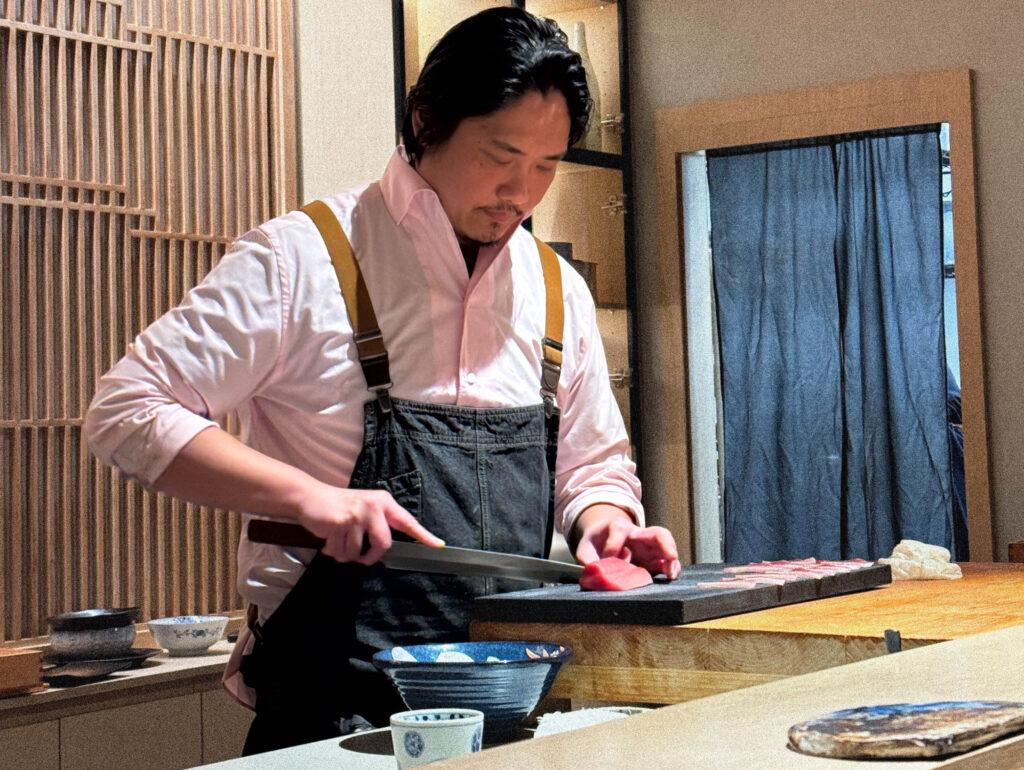
As I close out this year of Kyōten omakases—some 19 meals in total, of which I have written about 10 (each corresponding to a different month)—there remains little color or context to add to my evaluation.
Chef Otto Phan pushed his practice of craft to new heights in 2025: taking risks, making the occasional misstep, but maintaining the ironclad quality of his signature bites (the octopus, monkfish liver, tuna, yellowtail, sea urchin, freshwater eel, and tamago that delight newcomers and regulars alike) while simultaneously building a new canon (using ingredients like Sungold tomatoes, red prawn, black abalone, beltfish, squid, mother beef, and cheddar ice cream that ensure the menu here never feels stale).
Now, at the end of 2025 (and armed with a quality of fish the chef says he has not seen in several years), Phan is at the absolute peak of his powers. Given that Kyōten has not altered its pricing—an eye-popping $440 to $490 per person (inclusive of service) depending on the day of the week—in several years now, might it be fair to say that the value proposition is starting to resemble something of a deal?
Certainly, we are speaking of the most rarefied stratum of Chicago dining: a ticket that costs more than Ever or Kasama, that (accounting for gratuity) just about matches Oriole’s “Kitchen Table,” and only falls short of Alinea and Smyth. We are also talking about an experience (so centered on a lone man behind the counter, helped only by one catch-all assistant) that willingly trades away all of fine dining’s conventional frills and flourishes.
The intimacy and capacity for personal connection that omakase entails makes this exchange worthwhile for many diners: those who have cultivated an obsession with sushi (or, perhaps, have simply grown tired of the tropes that characterize the city’s great mass of “contemporary American” tasting menu concepts). That said, these patrons must also ask themselves if Kyōten is really twice as good as Shoji ($210), Mako ($215), Yume ($225), or The Omakase Room ($250) given the chasm in price.
Phan’s work and aspirations are better understood relative to what exists (and at what price) in New York: not just Masa ($950), where the chef trained, but omakases like Mekumi ($400), noda ($400), Shion ($400), Sho ($450), icca ($495), Yoshino ($500), and Noz ($550) that have—among countless other options—shaped a dining scene where stylistic differences within this minimalist genre can both coexist and enrich each other.
Kyōten wants to be a part of that conversation even if its production value isn’t quite the same. It has sought, on the basis of larger rice grains, larger slices of fish, and a pronounced (though never careless) approach to seasoning, to establish a distinctive house style that honors Chicagoans’ tastes without cheapening or totally breaking from tradition. Forging this identity—not one of mere replication but imagination and confidence in one’s own palate—is the chef’s greatest accomplishment. Indeed, it is telling that Phan has cultivated a population of regulars who live in a “sushi mecca” like New York yet are willing to come to the Midwest and spend the same sum without any of the affirmation Michelin stars provide.
Saying Kyōten competes with the country’s top omakases will always be a statement that is open to ridicule. It’s the kind of claim that a well-heeled gastronome from either of the coasts can handwave away (where’s the rare ceramic? the auction-grade product? the Japanese lineage?) as the product of backwards palates in a comparably minor market. And I’ve always felt it fundamentally unfair to judge anything being done in Chicago against the standard set by some other city.
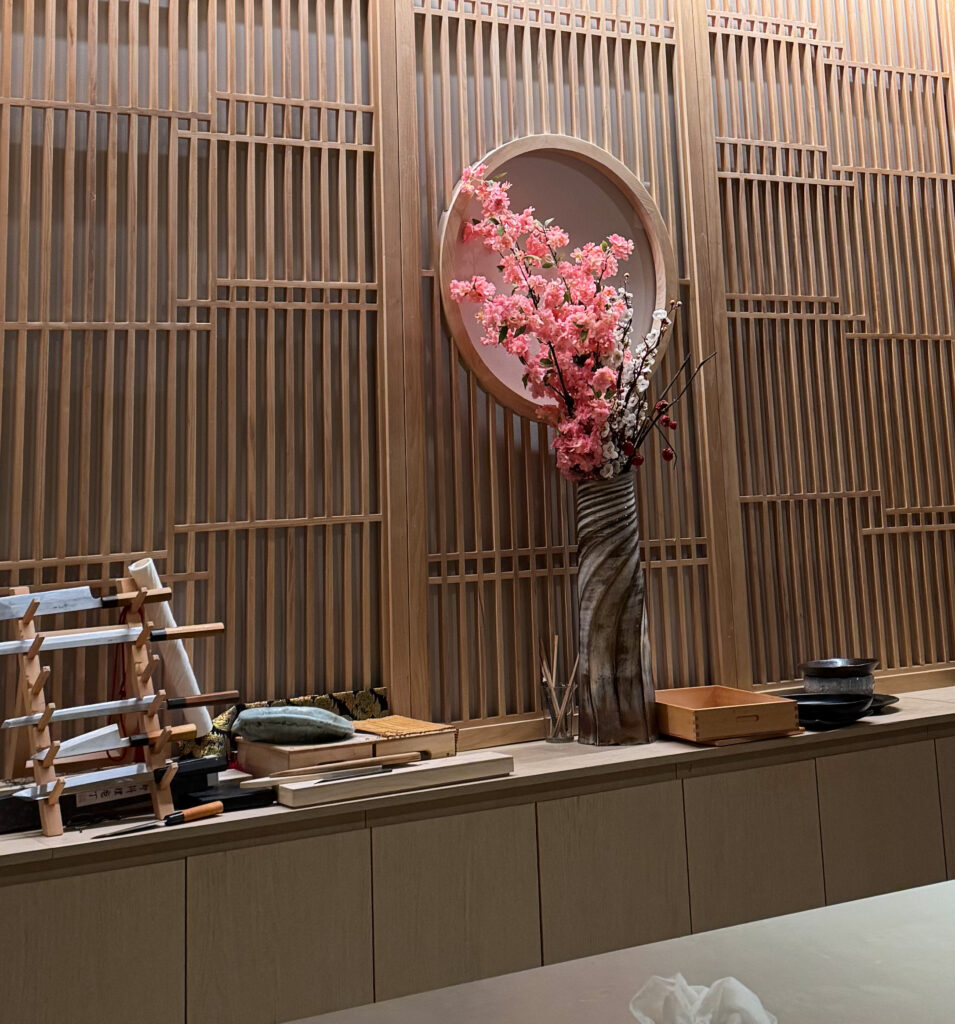
Kyōten excels—on its own terms, in its own way—within the sole confines of its chosen home. That’s what matters.
Nonetheless, I do keep score (even if I prefer not to verbalize it), and I have always found the chef’s fundamentals (of technique) measure up to the best of his peers. More importantly, while his chosen style (of size and flavoring) diverges from New York’s most hallowed names, it achieves something that is singularly pleasurable. Yes, as much as I might enjoy tasting the myriad expressions of omakase now being staged in America by pedigreed Japanese chefs, they do not scratch the same itch that Kyōten does. Phan’s sushi is just so well attuned to the people and the culture here—to the terroir—that I never really find myself jealous of those who get to visit Manhattan’s counters with the same regularity.
This final Kyōten meal of the year is special because it lands immediately after a two-week trip to Japan. Thus, it begs a comparison not only to my scattered experiences at top omakases in New York but to day after day of good eating—of top-quality ingredients tasted at the source—in the motherland.
I’ve been in this position a couple times before (encountering Phan’s menu only 24 or 48 hours after stepping off the plane): evaluating his omakase from a position on the hedonic treadmill that, so numbed to indulgence, almost precludes the enjoyment of fine dining altogether. Still, Kyōten has always performed well in such circumstances. I’ve never noted a steep drop in ingredient quality or gotten the foreboding sense I’ve been enjoying bastardized, Americanized sushi this entire time. Rather, in comparison to the language barrier that persists at many counters in Japan, the chef’s quirks and humor and the baseline of comfort he establishes actually feels rather refreshing. Ultimately, there’s really no better way to beat jet lag than to reorient one’s palate with the native style of nigiri and a bottle or two of wine.
Tonight, however, I experience Kyōten with visits to four of Tokyo’s finest omakases fresh in my memory: the revered names Saito and Sugita alongside upstarts Meino and Shunji. Attempting to rank Phan’s work relative to that of these chefs would be a serious mistake—one that ignores intractable differences in how Japanese and Westernized diners appreciate this craft.
I have no incentive to say that this or that omakase (which, even if you travel halfway around the world, you are unlikely to ever get a reservation at) is necessarily better than the one in your own backyard. Just the same, as much as I love Chicago, there’s no point in being hyperpartisan and assuring readers these places are not worth the time or money to pursue. In fact, if one really loves this genre, just about any serious example of sushi is worth trying to help triangulate personal taste.
Instead, as with the restaurants in New York I mentioned, it may be worthwhile to contextualize the “Kyōten style” within an even larger (now international) conversation. Phan, now a humbler man than when he first came to Chicago, would never explicitly place himself in these chefs’ company. Yet he is so well-traveled, so willing to interrogate his own work, and so committed to a singular kind of excellence that I know he does not fear the comparison. Ironically, his chosen style actually lands closer to one of these hallowed names than I would have ever expected.
Let us begin.
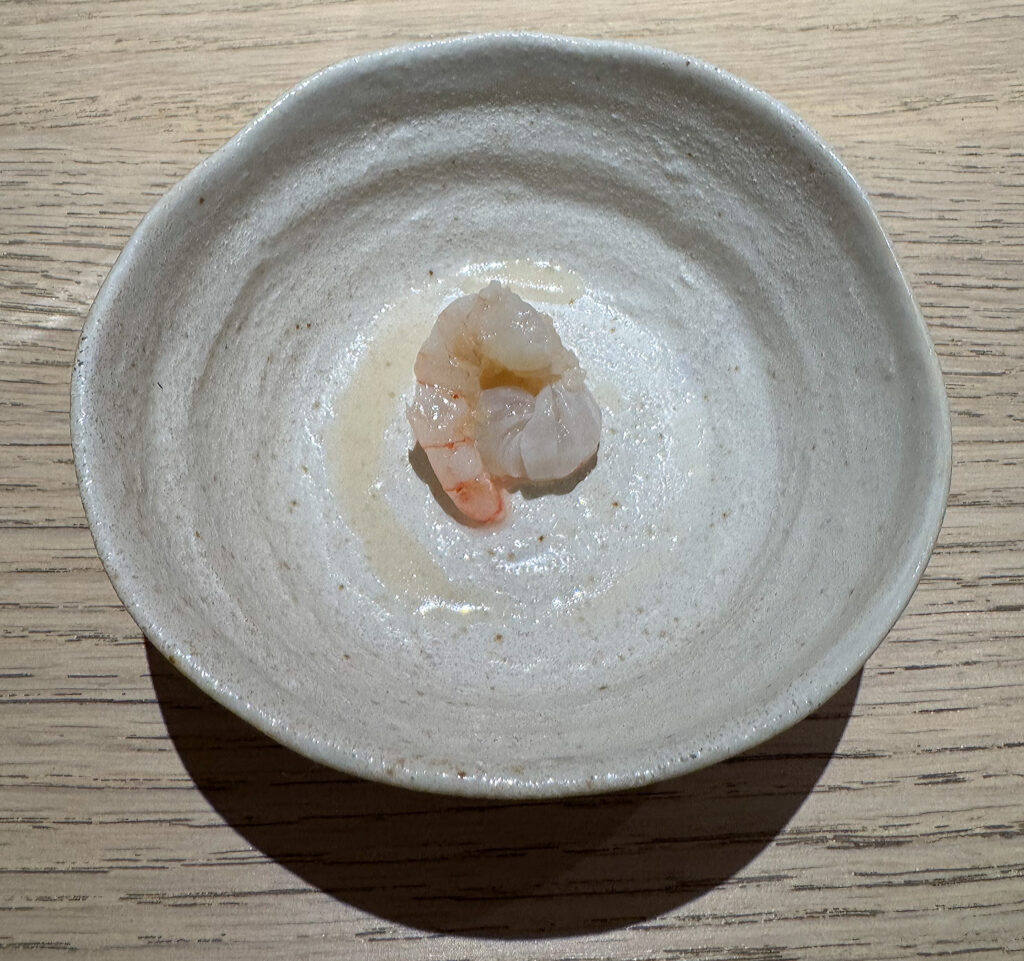
This final meal of 2025 begins on a rather familiar note: the “Aka Ebi” (or red prawn) that has occupied this place on the menu for many months now. Sourced from Hawaii, the crustacean (rendered here as two small curls) is prepared in the familiar “ceviche” style courtesy of some lemon juice and dashi.
In November, I found that the flavor of citrus dominated the dish and shifted its balance more toward punchiness than pleasure. On this occasion, the umami of the seaweed-based broth comes through more clearly, ensuring that the crunch and tang of the dressed prawn finishes on a note that is both satisfying and (faintly) sweet. Overall, this makes for a textbook example of the recipe that reminds me exactly why it has stuck around for so long.
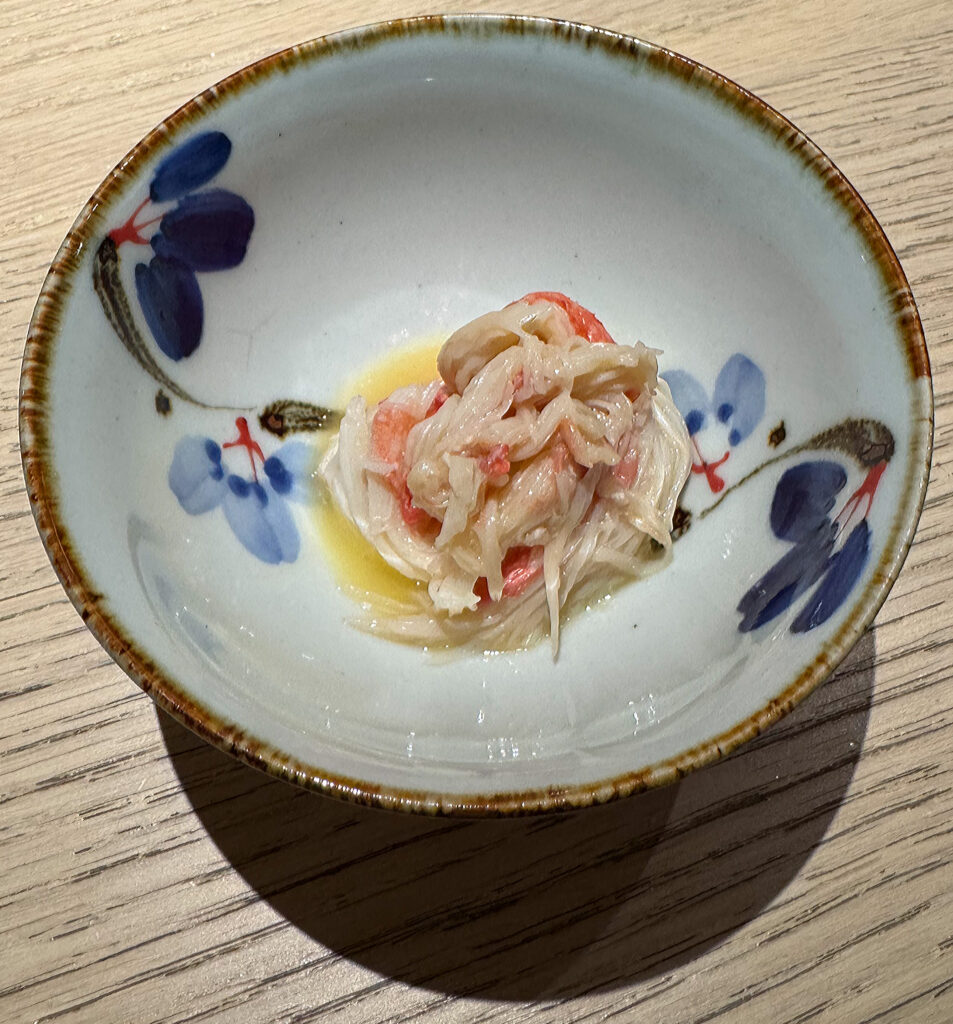
That said, it’s nice to encounter something new, and Phan’s “Zuwai-Gani” (what we know as snow crab) more than fits the bill. Relative to the “Ke-Gani” (or horsehair crab) that featured so successfully last month, the flesh of the present shellfish takes the form of larger, meatier threads.
Paired with a dashi butter, the snow crab comes to life: trading any of the citrus that brightened the preceding prawns for what I can only term total decadence. Indeed, while the chef’s use of the same flavoring might strike some as unoriginal, it allows the respective characters of the starring ingredients to really shine. Here, I am struck by the moist, melting quality of the glistening threads, and the sensation they impart—pristinely sweet with a rich, savory depth that carries through the finish—is simply sublime. Nonetheless, I think a touch of salt could make the preparation even better. Ultimately, the zuwai-gani falls just a bit short of the mind-blowing ke-gani; however, it also avoids any errant pieces of shell and ranks as a real highlight in its own right.
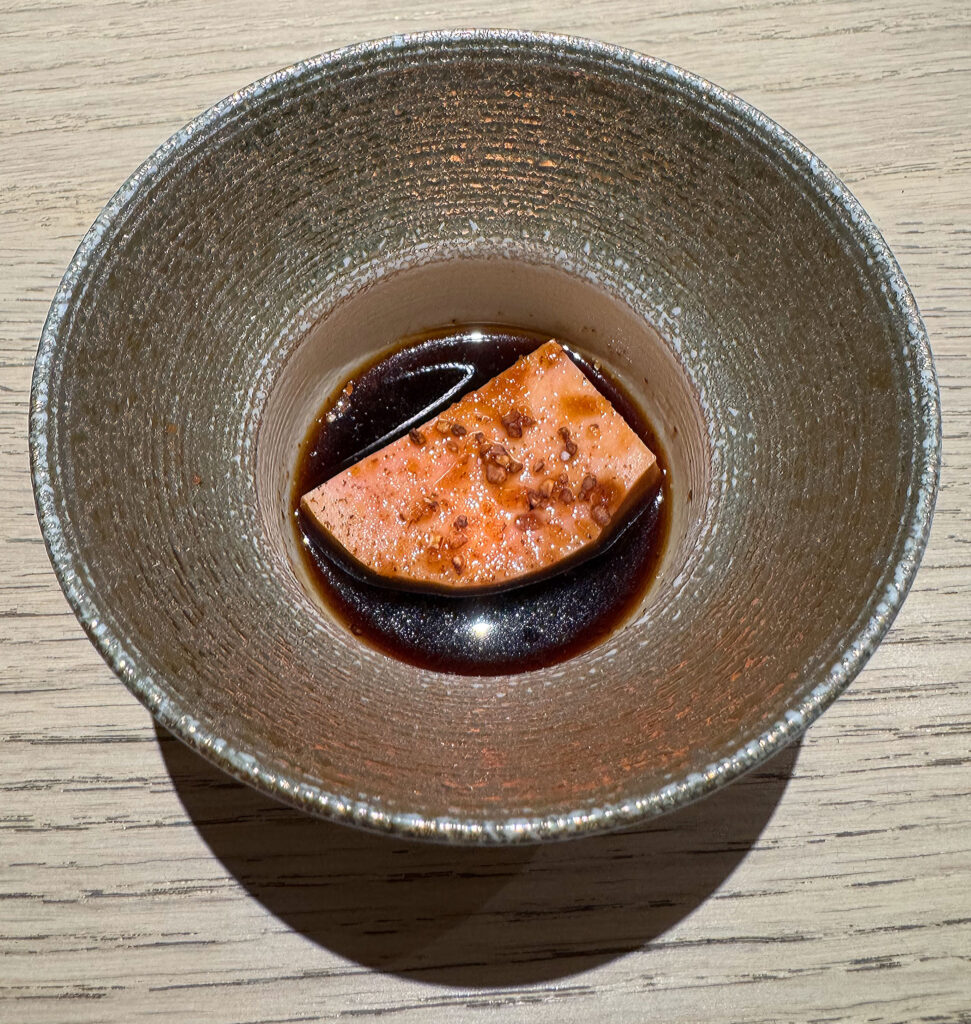
“Ankimo” (or monkfish liver) hasn’t featured since October. That’s a shame, for, when in season, the item stands among the most impressive of Kyōten’s signatures. Sourced from a specialist purveyor in Hokkaido, this ingredient (whose identity may make newcomers queasy) is said by Phan to be the “foie gras of the sea.” Routinely, the chef’s preparation proves that moniker to be true while, simultaneously, avoiding any of the guilt that the consumption of duck liver might carry.
This recipe bathes the ankimo in a powerful, sticky sauce (made from ginger, mirin, and sake) before topping it with a sprinkle of toasted buckwheat. The latter element, with its brittle (though somewhat unrefined) crunch, helps to frame the flawlessly creamy mouthfeel of the liver. The former element, in turn, really drives the dish: taking the rather undistinguished richness of the monkfish offal and teasing out its deeper sweetness and umami via the electric tang of the ginger. Really, I think that sauce would taste great with almost anything, yet, importantly, it avoids any excess. Indeed, it is the dish’s fundamental balance—its way of showcasing the best side of its (admittedly strange) starring ingredient—that has made it a hit year in and year out.
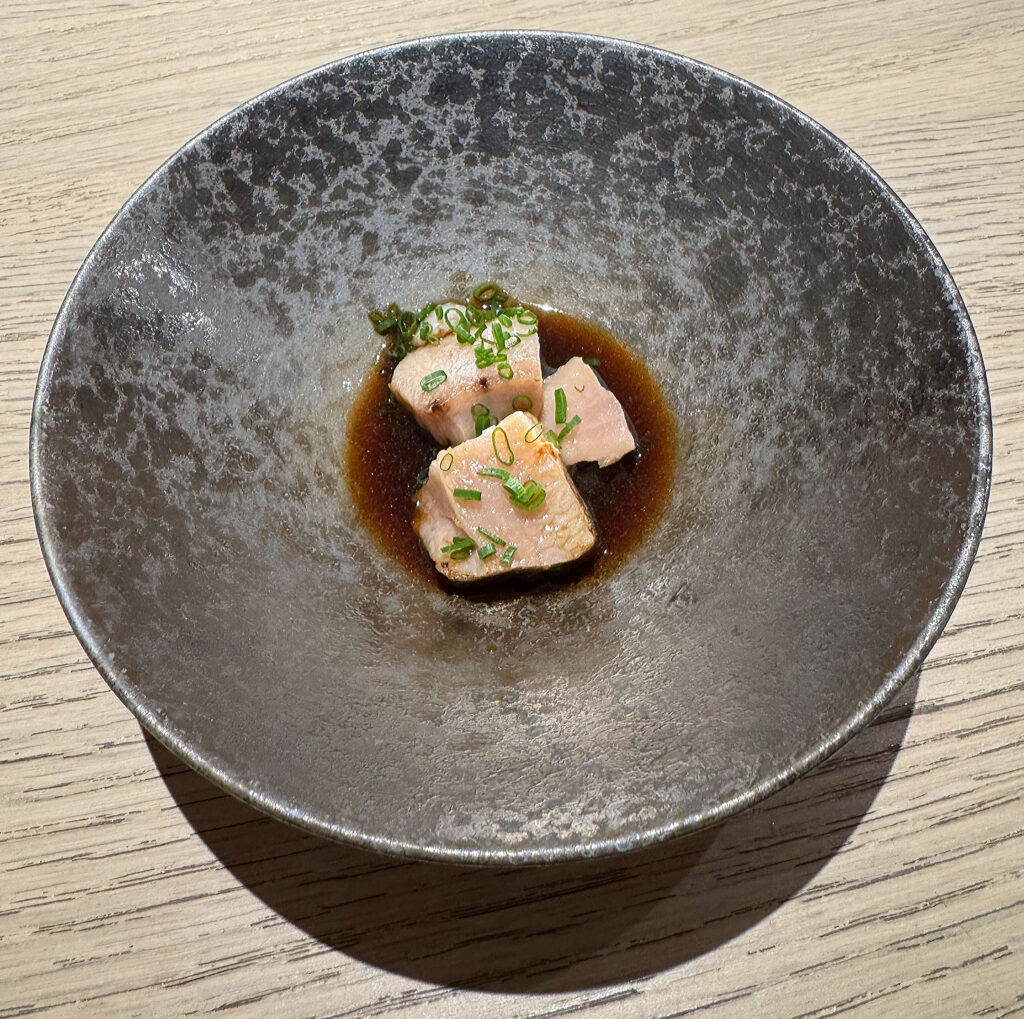
“Buri Kama” (the collar of the wild mature yellowtail that typically follows Kyōten’s tuna) has not been seen since May. Dressed with chives and ponzu, these lightly seared chunks of fish promise one of the evening’s meatiest expressions of seafood.
On the palate, the resulting cubes strike with a surprising firmness that—truth be told—is almost reminiscent of chicken. I’d maybe like to see these pieces sliced more thinly; however, the collar’s streaks of rendered fat ensure that not one of the bites feels dry. Instead, the yellowtail is marked by invigorating notes of citrus and soy sauce that help to steer its richness toward pleasure. For my taste, some salt (or, better yet, wasabi) would make the dish even better. Tonight, it remains a good—not great—example of what should be a totally winning ingredient.

Closing out the sequence of appetizers that precedes nigiri, the “Fugu Shirako” (or blowfish milt) has not featured on the menu since February of this year. Its reappearance, at this late stage, highlights the horseshoe quality of the winter season (irrespective of any change in calendar year). And its pairing—with ponzu, green onion, and shichimi togarashi—is meant to make the tempura-fried sperm sac more approachable for an audience who might cower in the face of such a unique delicacy.
Thankfully, Phan has done well to master the form: framing the soft (not too gooey) milt in a crispy, flaky shell and cutting its richness with enough acid, umami, and spice to reveal a surprising, delicate sweetness. Often, the chef is clever enough to convince his patrons to take a bite before appreciating the full weight of the ingredient’s identity, and it’s fun to see the corresponding reaction. Inevitably, it’s shocked—but also reliably positive. Introducing such a polarizing texture to a far-flung audience remains one of the restaurant’s greatest accomplishments. Over time, I’ve actually found myself looking forward to this bite.
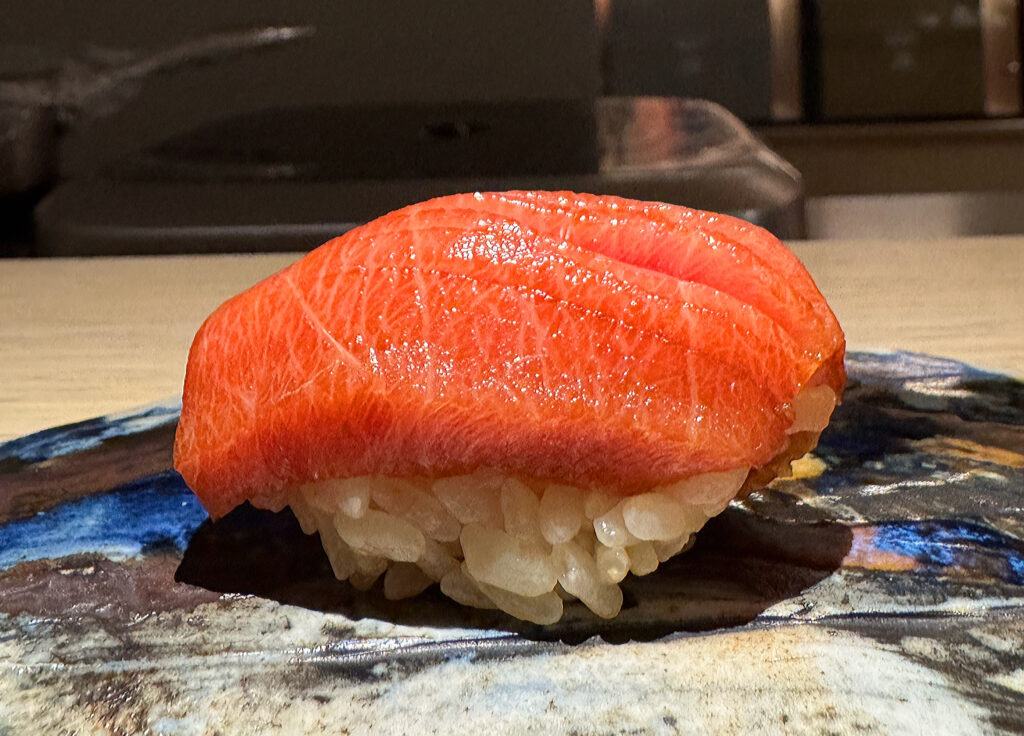
Throughout 2025, Kyōten’s progression of sushi has so frequently started with a serving of “Chū-Toro.” However, on this occasion, the chef reaches straight for the “Ōtoro” (the fattiest cut of the tuna’s belly that, in this case, actually resembles its medium-fatty counterpart given the amount of sinew it contains). To my eye, the piece still looks plenty enticing: displaying a pale reddish tone, some faint horizontal scoring, and a fine web of marbling interrupted by the odd, thicker streak.
Texturally, the ōtoro (taken from a fish sourced out of Boston) is true to type. Despite the sinew, it melts cleanly and cohesively on the tongue—only displaying a fleeting trace of structure, helping to extend the bite’s perceived length, on the finish. Indeed, marked by strong imprints of soy sauce and wasabi (which steers its oozing fat toward savory bliss), the tuna’s presence can still be felt nearly a minute after it disappears. While I think the concentration of flavor here could be driven to an even further extreme, this ranks as a textbook (if not life-changing) example of Kyōten’s ōtoro that is worthy of anchoring the menu on any given night.
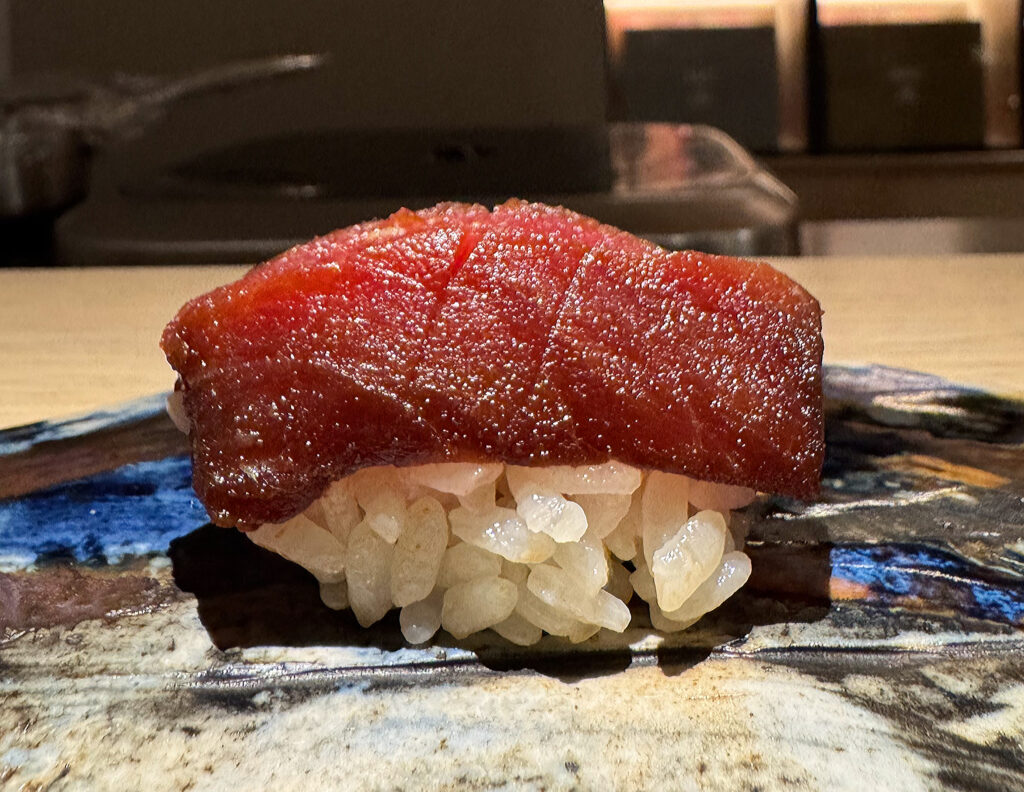
The ”Akami Zuké”—referring to the tuna’s leaner (and in this case marinated) flesh—often gives its fattier, more traditionally prized peers a run for their money. In fact, it is by playing his strongest cards at the very start of the sequence and elevating these oft-discounted cuts throughout the rest of meal that Phan really demonstrates the depth of his talent. Of course, sometimes a preparation is only great in its given context rather than collapsing the hierarchy of quality altogether.
Take the akami served tonight: a piece characterized by darker, glistening flesh and crosshatched scoring with none of the same lacy marbling. When the lean tuna reaches my palate, I marvel at its smooth, succulent mouthfeel. Yes, following the ōtoro, it’s nice to sink one’s teeth into something a bit more robust (but not less satisfying). Nonetheless, while I expect the bite to impress with a corresponding savory power, the akami actually falls flat. It whispers—rather than roars—and I am left wondering if the marination or construction of the bite (where’s the wasabi?) went wrong. As it stands, this ranks as a good, wholly enjoyable item that only falters in reaching its usual, superlative level of quality.
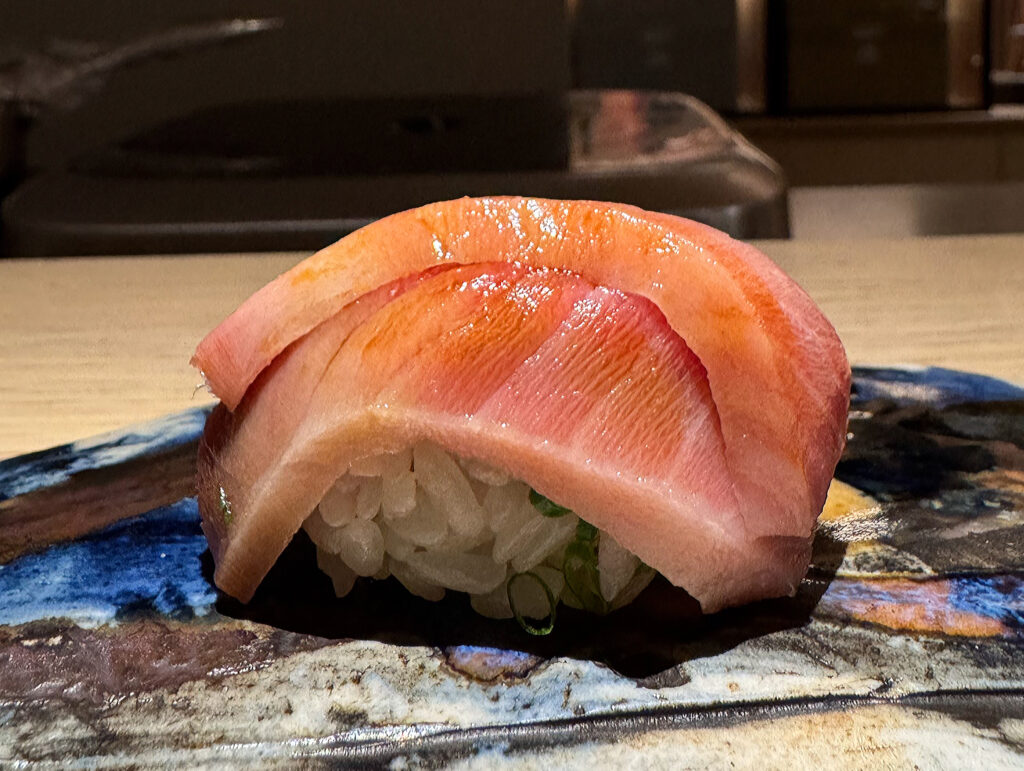
“Suma-Katsuo” (also known as black skipjack tuna or striped bonito) actually signifies a species that is distinct from the hon-maguro (or bluefin tuna) cuts that typically headline the omakase. Given that this ingredient is frequently smoked, seared, and/or heavily garnished, I am left wondering—as with the preceding akami—how Phan might transform the fish so that it punches above its weight. In this case, the chef goes the smoking route (albeit lightly). However, what really shocks me is the resulting piece’s visual appeal.
The resulting mound of rice, laced with green onion, is topped with two thick, curling slices of the katsuo. And this skipjack—pale pink in color with gossamer threads of fat throughout—is surprisingly reminiscent of ōtoro. Yes, it is clear that Phan has sourced a phenomenal specimen, and the resulting texture (dense, meaty, yet entirely clean) shows finesse despite the overall thickness of the bite. The accompanying flavor here combines a moderate degree of umami with mild fishiness and a hint of sweet smoke on the finish. That said, I wish the notes of allium were more distinct, for the tuna is missing any pleasing sweetness on the midpalate. Ultimately, this makes for an intriguing but not particularly memorable addition to the menu.

Going by the evocative name of rainbow runner, the “Tsumu-Buri” has appeared in September and November as a sometimes substitute, sometimes counterpart to the “Buri” proper. They’re actually different species, so it’s hard to imagine the former fish (with its recognizable striping) ever really replacing the latter (which always ranks among the chef’s best items).
Rather, the tsumu-buri ranks as one of the omakase’s likable, practical (yet somewhat forgettable) interludes. Yes, the ingredient offers (on the back of all that tuna) a soft, pleasing chew and predominant brightness that helps to reinvigorate one’s tongue. Tonight, I do not get any of the funkiness that has distinguished previous examples. However, I cannot say I get much depth of sweetness or umami either. In short, I do not mind this encounter with the rainbow runner though, at the same time, am not exactly sure I’ll miss the piece when it’s gone. Maybe it’s best to judge the tsumu-buri on what it precedes?
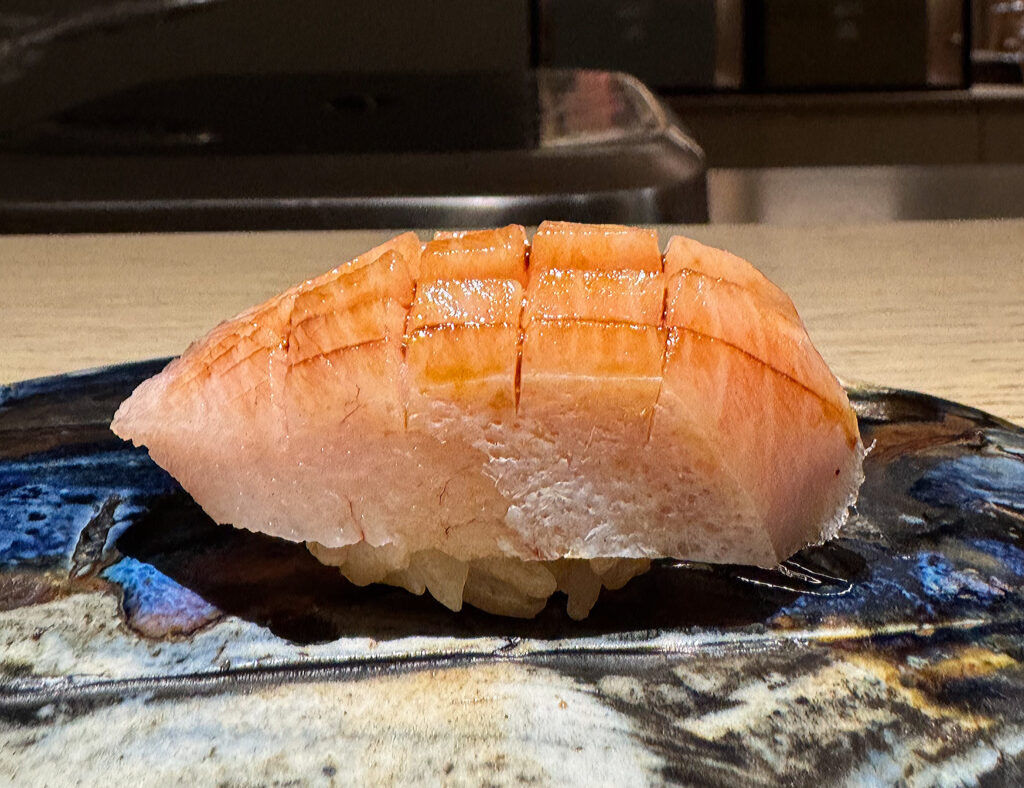
The ”Buri” itself has already featured earlier in the meal (in the form of a “Buri Kama” preparation that could use just a little more refinement). Thankfully, taking the form of nigiri, this wild mature yellowtail absolutely sings. The piece benefits from the fact that it draws on what Phan terms the “ōtoro cut” of the fish: one that is displays deep, checkerboard scoring and a remarkable proportion of white marbling.
Texturally, this high degree of fat actually yields a faintly crunchy (somewhat jarring) sensation on entry—one that suggests the slice could have been better rendered. Still, the buri offers plenty to love, marrying (with further mastication) a rich, melty mouthfeel with good backing soy sauce, a nice punch of wasabi, and (next to the opening tuna) one of the evening’s longest, most cohesive finishes. Indeed, despite the textural lapse, this yellowtail ranks highly. It only falls short of that transcendent level of quality it regularly attains.
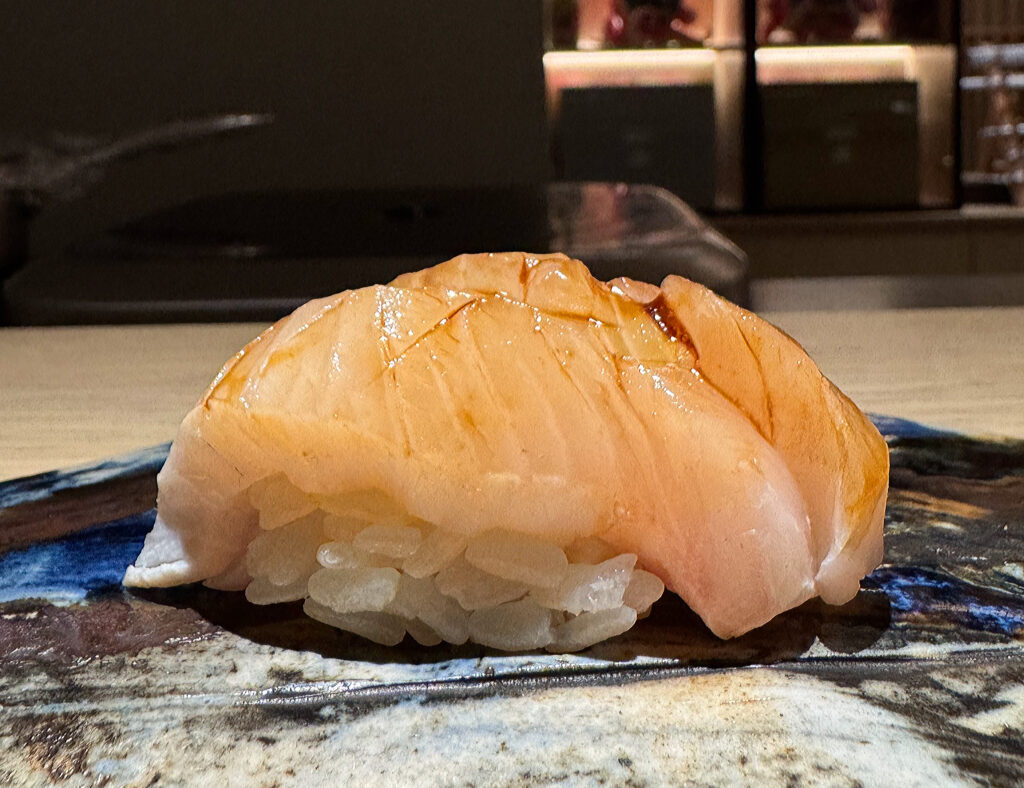
Whenever one piece falters, it’s always nice to see another reach new heights. “Kanpachi” (signifying the greater amberjack) has not been seen at Kyōten since July and was not served at any other point in the year either. Here, in its fattier winter form, the fish benefits from being rested on kombu and seasoned with a touch of yuzu—techniques I have witnessed the chef utilize before but that have (as best as I can remember) rarely delivered noteworthy results. I am happy to say that, on this occasion, they really work.
On the palate, the kanpachi leads with an appealing firmness that turns gooey with more time in the mouth. It’s a unique sensation, yet one that imparts a feeling of weight. More importantly, the amberjack translates its time on the kombu well: smacking with the kind of savory intensity I rarely associate with this fish. Yes, this level of umami helps to carry the bite’s texture, and the yuzu—with its tartness and florality—provides an alleviating contrast without sapping pleasure. Overall (and against my expectations), this is nicely done.
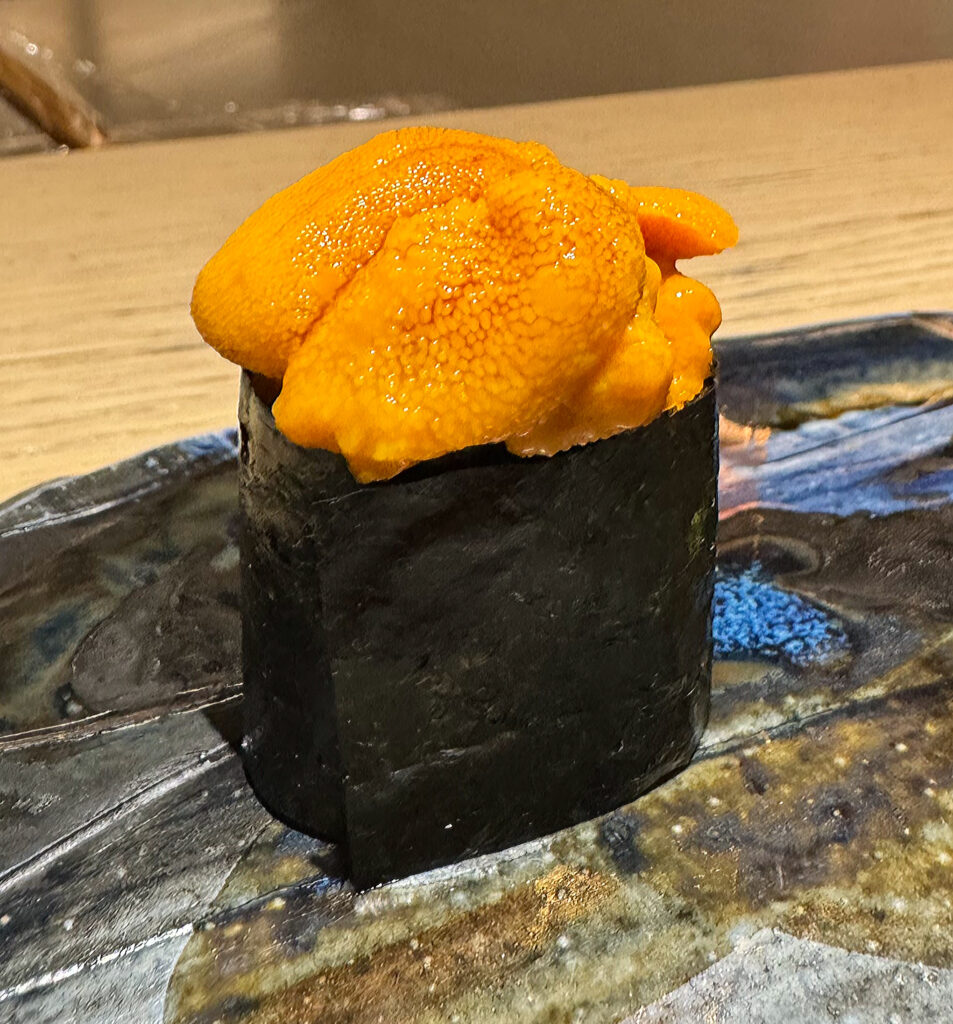
“Uni” stands right alongside the tuna as the meal’s (or any omakase’s) most coveted ingredient. Given that the “Akami Zuké” and “Suma-Katsuo” didn’t quite hit the bullseye like the “Ōtoro” this evening, I am left wondering if this serving of sea urchin, sourced from Hokkaido, will help reverse the trend. Here, Phan continues to favor the ensui (or preservative-free) variety of this ingredient: one that comes soaked in a saltwater solution and, thus, is strained before being spooned atop a clump of rice wrapped in nori.
The resulting portion arrives looking generously assembled from whole, pristine lobes with dimpled surfaces of flawless definition. I’ve had some trouble with the serving temperature on occasion, yet tonight’s uni is beautifully tempered and totally homogenous. The sea urchin oozes against its brittle wrapper (the quality of the dried seaweed always forming one of the restaurant’s strengths) and infuses the rice, imparting a flavor that is delicately sweet, faintly briny, free of any irony funk, and backed by a perceptible application of wasabi that serves to enhance the bite’s finish. In sum, this is a great representation of the prized ingredient that measures up to the best examples Kyōten has served this year.
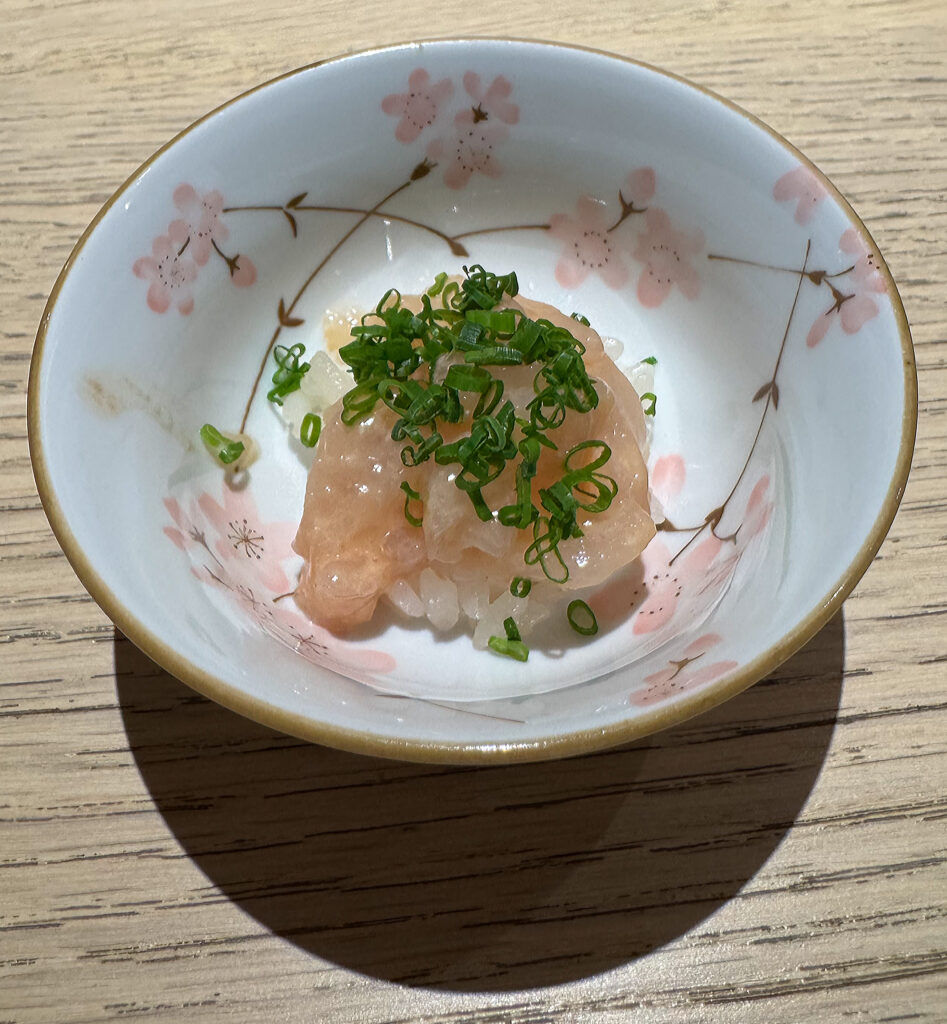
Arriving next, the “Kawahagi” (or filefish) has not appeared at the restaurant since May—the only time I’ve ever encountered it. And this former “throwaway” ingredient once more forms the core of an interesting, somewhat challenging recipe. Pairing the fish with its liver represents a classic combination. However, Phan deconstructs the usual nigiri and serves strips of kawahagi, tossed in the offal, over a clump of rice with a blanket of chives strewn on top.
Diving, the filefish itself is firm, gelatinous, and fairly mild in character. In turn, the accompanying liver is well incorporated and imbues the flesh with an oily, cleanly “fishy” sheen. While the allium here is hard to ignore, I do not find it draws out any of the sweetness I might like to taste. Likewise, it’s a little challenging to portion out the kawahagi with the right amount of rice (whose seasoning, if carefully introduced, might help to balance the dish’s flavor). Ultimately, I really enjoy seeing the chef work with this ingredient (so singular), and the present attempt is by no means a failure. Nonetheless, I do think it feels disjointed, and trying his hand at a nigiri preparation might empower a more controlled, reliably enjoyable rendering of the fish and its liver.

“Sawara” (denoting Spanish mackerel) gets the nigiri sequence back on track. This fish has become one of the omakase’s staples over the past few months, with a “super, super fatty” example from October ranking as the best of the bunch. Here, the piece aligns more with the version I encountered in November: boasting milky-white flesh and jagged, crisscross scoring across its surface.
On the palate, the sawara feels notably cooler in temperature than the rest of the menu’s bites yet maintains a rich, silky mouthfeel. The accompanying flavor is clean and mild; however, I find that the final sensation is somewhat muted. Indeed, while the best renditions of this ingredient benefitted from a heavier application of soy sauce (in accordance with greater fattiness), this one just peters out. That said, there’s nothing unpleasant about the fish. It’s just a tad undistinguished.
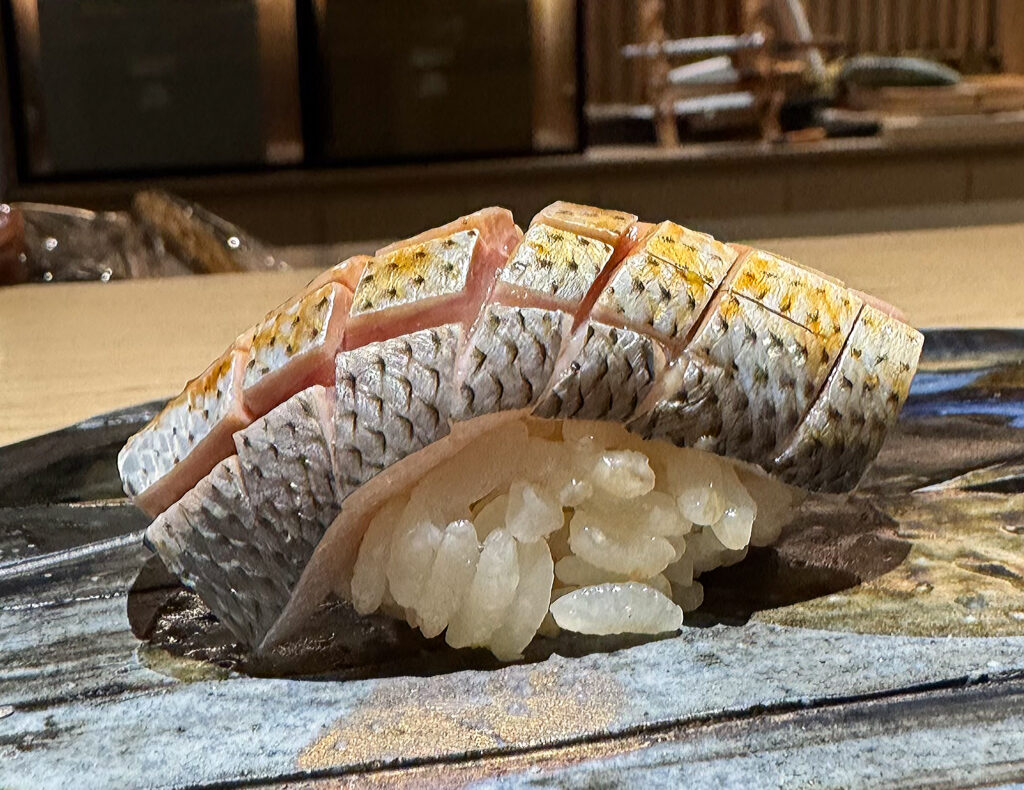
The ”Kohada” (or gizzard shad) has no such problem. Phan always describes this diminutive silver fish as being the best way to judge a sushi chef’s talent, for the manner of preparation (which involves deboning, pickling, and smoking the fillet) is so involved. The degree of flavor achieved, correspondingly, is among the meal’s most pronounced—but balance is essential.
Visually, the resulting piece is characterized by a glimpse of glistening, pinkish flesh hidden under a curve of scored skin. Already, I can tell that this portion is both plumper and more methodically fashioned than those I’ve recently encountered. Yes, while the serving temperature here is again a bit on the cold side, the kohada leads with a firm, somewhat oily texture that ends on a feeling of pleasing, gushing fat. The gizzard shad’s flavor, in turn, is defined by a smoky-sour (but decidedly not funky) savory fish character—one that joins with strong notes of soy sauce and wasabi to build an eye-rolling, tongue-tingling sort of intensity. At this late stage (and opposite the comparably anonymous sawara), a bite such as this is a thrill. And, while I enjoyed the kohada I encountered in November, this example clearly ranks alongside October’s “greatest ever” specimen as the best of the year.
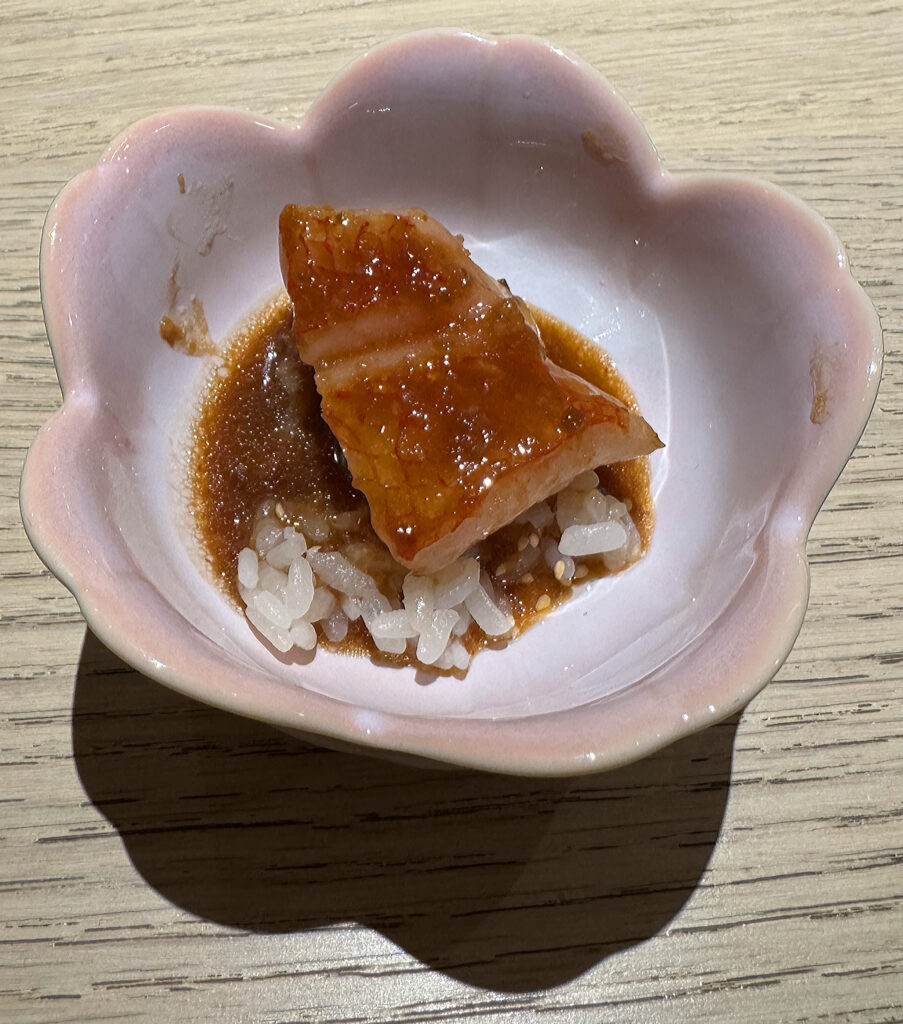
“Kinki” (also known as the rockfish or “idiot fish”) always prompts a raised eyebrow when Phan pronounces its name. I have not yet seen the chef use this ingredient in 2025 (though it has occasionally appeared over the years), and I get a little worried—given my impression of the kawahagi—when I see him building the dish in a small bowl.
Those fears are totally unfounded, for the combination of the kinki’s flawlessly buttery flesh with a so-called “magic brown sauce” is superlative. The latter element marks the only instance in which Kyōten utilizes garlic, lending the fish a burst of sharp, savory flavor that reveals a latent, beautifully persistent sweetness. Add in a clump of rice (as well as a sprinkle of sesame seeds), and one can only marvel at how this “ugly delicious” closer that steers the unabashed intensity of the kohada toward a soothing, lip-smacking denouement.
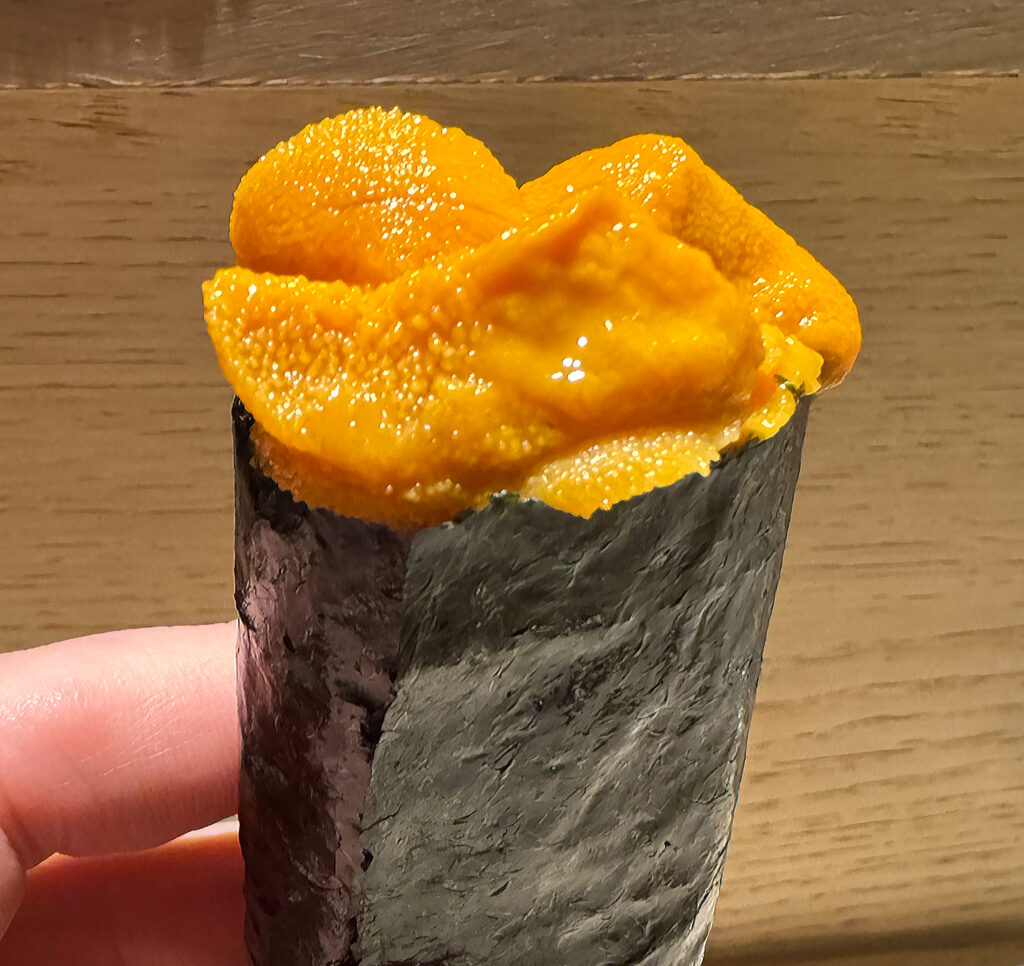
Of course, given that Phan generally refuses requests to order additional pieces of nigiri, he is sure to top his guests off with one last bite of the good stuff. Tonight, the “Uni Handroll” contains a hidden pocket of roasted, chopped tuna sinew and a healthy dab of wasabi.
Framed by the clean crunch of the seaweed, the creamy lobes of sea urchin and subtly chewy bits of fish meld with the rice. Thanks to the tuna’s fat, each bite feels particularly moist and rich. However, I find that the uni’s delicate sweetness is rather hard to pick out. Instead, it is really the wasabi that drives the dish, and, while I personally find such pungency to be thrilling, it does mark another occasion in which this handroll—while perfectly enjoyable—does not fully live up to the quality of ingredients it contains.
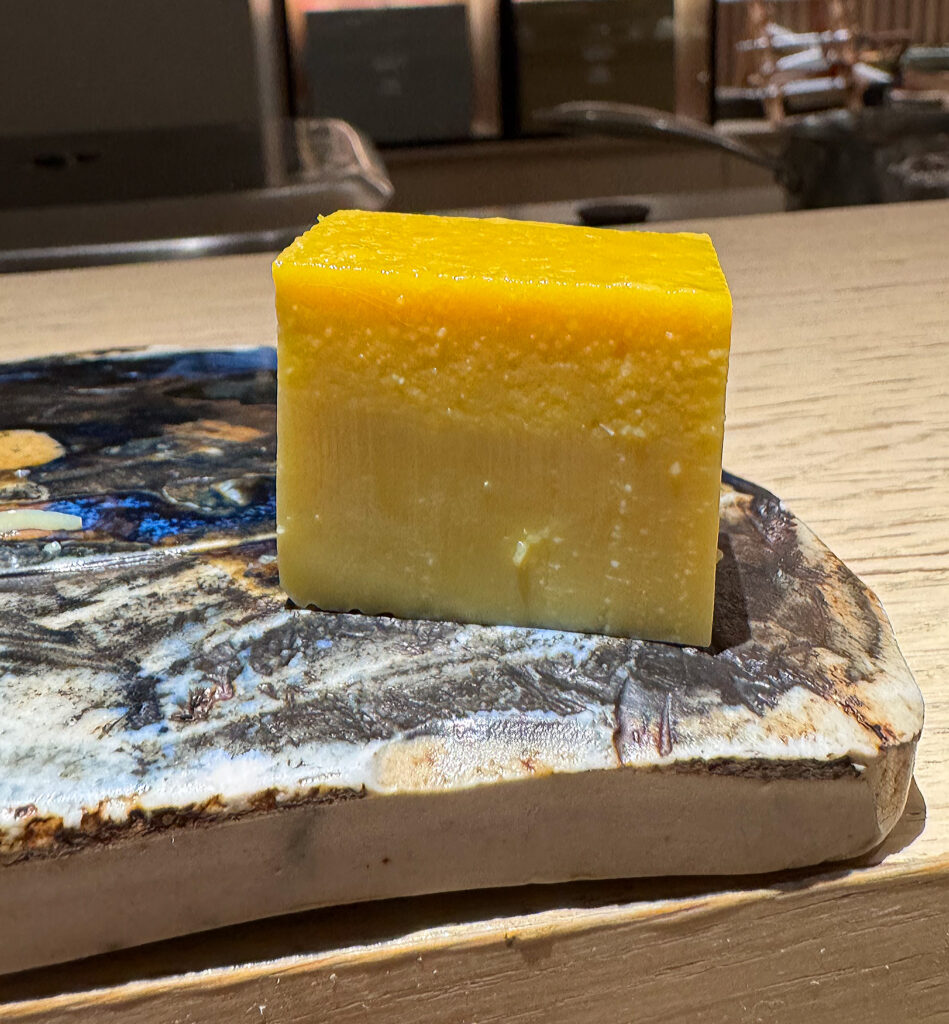
Turning toward dessert, Kyōten’s “Tamago” (rendered here as a corn- and maple-infused custard) rarely falters. If anything, it might sometimes be served too cold. Yet, on this occasion, the bite does not falter: oozing, then melting, on the tongue before leaving behind an imprint of caramelized, milky-sweet goodness that totally transcends what this egg omelet offers in any other chef’s hands. In short, the tamago remains a delight.

Finally, there’s the “White Cheddar Ice Cream,” which made its debut back in October and immediately became a star. Phan sources the hard, sharp cheese (which he likens to parmesan) from Ohio and (to broaden its appeal) makes the frozen treat using lactose-free milk. Tonight, in a first, he adds some toffee crumble into the mix—a move that charges the ice cream’s rich, smooth, sweet-savory character with crunchy, nutty, caramelized tones that (taken together) call “Chicago Mix” popcorn to mind. I cannot think of any better or more nostalgic way to improve a recipe that already delivered such decadence. Bravo!
In ranking the evening’s dishes:
The “Zuwai-Gani,” “Ōtoro,” “Uni,” “Tamago,” and “White Cheddar Ice Cream” land in the highest category: superlative items that stand among the best things I will be served in any restaurant this year.
Next come the “Aka Ebi,” “Ankimo,” “Buri Kama,” “Fugu Shirako,” ”Akami Zuké,” “Suma-Katsuo,” ”Buri,” “Kanpachi,” ”Kohada,” “Kinki,” and “Uni Handroll”— very good—even great—preparations I would always be happy to sample again (but that just failed to elicit an extra degree of emotion).
Finally, there’s the “Tsumu-Buri,” “Kawahagi,” and “Sawara”—merely good (maybe just average) items that fell a bit short when it came to texture or flavor. None of these bites faltered in more than one dimension, so there was still pleasure to be had (and, undoubtedly, they could all easily be improved).
Overall, this makes for a hit-rate of 84% with some 26% of offerings rising to that superlative, “best-of-the-year” standard. Compared to November (where these numbers clocked in at 94% and 56% respectively), tonight’s meal at Kyōten seems like something of a drop-off. However, Phan suffers from being routinely judged relative to his very best work (which he often delivers) whereas a recent meal at Oriole—one of the best I’ve had there—corresponded to a similar hit-rate of 87% (with 27% of dishes in that “best of the year” category).
Put another way: while this last omakase of the year ranks squarely in the middle of the pack, Kyōten’s most “average” meals still measure up to the best menus being served anywhere, on any night, in Chicago.
Further, when I consider the fact that this experience followed two weeks of dedicated fine dining in Japan, there’s really nothing jarring or sacrilegious about a $490 omakase being staged (just down from a hot dog stand) on a humdrum street in Chicago. Rather, at Kyōten, Phan has captured the soul of his chosen craft and articulated a philosophy that can stand alongside Tokyo’s finest counters. The chef has, since coming to this city in 2018, built a foundation of sourcing and technique that, consequently, has earned him a place in a global conversation.
Indeed, rather than trying to articulate some kind of ranking (which discounts the distinct personalities of these small, passionately-run restaurants), I will leave you with a simple set of impressions.
In pushing the limits of hospitality—especially beverage service—despite the limitations of a two-person team, Kyōten reminds me of Shunji. By reimagining traditional recipes in a worldly, cross-cultural manner, Kyōten reminds me of Meino. Through skillfully incorporating the stranger parts of the canon, Kyōten reminds me of Sugita. And, by seasoning its rice—and by extension its fish—with a firm imprint of vinegar, Kyōten—like Saito—makes the sushi served at other counters seem bland.
Despite the seeming simplicity of this genre, omakase allows each chef to weave a singular tapestry on the basis of myriad, infinitesimal stylistic preferences. The duty of any serious diner is to, rather than chasing the prestige of those impossible-to-book spots, bravely interrogate one’s own taste and align it—low or high—with a craftsperson who thinks the same way. Then, dine together as often as you can. Climb your way, through trial and error, toward the mountaintop, and maybe, along the way, you might create something new.
The best compliment I can give Kyōten, so many years later, is that it’s not the pinnacle but a pinnacle. It’s a place that has actualized its particular, opinionated perspective at the highest level. And, wherever one travels to, the restaurant—so attuned to its niche—remains irreplaceable: not just in Chicago but beyond it.